Month: February 2013

  • Aftershocks Stall Aid Efforts In Tsunami-Hit Solomons

    Aftershocks Stall Aid Efforts In Tsunami-Hit Solomons

    HONIARA (TIP): Strong aftershocks hampered effortsto reach tsunami-hit villages in the Solomon IslandsFriday, as the death toll after an 8.0-magnitude earthquakerose to nine, with many more reported missing.Officials said damage on Ndende island in the easternSolomons was much worse than first thought, with up to20 villages swamped in a tsunami generated byWednesday’s quake and 6,000 people homeless, doublingprevious estimates.”At first we thought it was going to be quite small butnow it looks like it’s going to be very big and communitieswill not be able to handle it themselves,” national disastermanagement office spokesman Sipuru Rove said.

    “This is where we might require external assistance.”A spokesman for prime minister Gordon Darcy Lilo’soffice, George Herming, said nine people were confirmeddead and an undetermined number missing, with the tollexpected to rise as reports filter in from outlying areas.He said the area was officially declared a disaster zoneon Friday, as Australia announced it will assist reliefefforts.Australian foreign minister Bob Carr, who will visit theSolomons on Sunday, said the disaster “has been adevastating experience” for people in the low-lyingislands.

    In addition to the official toll, he said “many more arereported missing”.Carr announced Aus$300,000 ($309,000) in reliefpayments and said a Royal Australian Air Force Herculeshad been sent to the Solomons to provide logisticalsupport.Rove said the plane would be deployed to make areconnaissance flight over the island, giving officialstheir first comprehensive overview of the damage.Attempts to fly aid to the remote area, more than 600kilometres (370 miles) from the capital Honiara, have beenhamstrung by damage to the airstrip at its main townLata.

    While debris stranded on the runway after it wasinundated by surging waters had been cleared, a series ofaftershocks rattling the island, including a 6.6-magnitudejolt Friday, meant pilots were wary about landing there.Herming said a flight carrying Lilo and senior officialsto the island had to turn back to Honiara on Fridaybecause of fears the 6.6 quake had caused fresh damage tothe airstrip.Rove said the aftershocks were frustrating attempts byvillagers to salvage supplies from their devastated homesto equip the makeshift camps where they are sheltering inthe rugged interior.”They will go down (to the villages) but when there’sanother aftershock they run back to the hills becausethey’re scared of another tsunami,” he said.

    With the airfield still out of action, two boats set sailfrom Honiara late on Thursday loaded with food, waterand medical supplies and were expected to arrive late onFriday or early on Saturday.World Vision said food and water in the hillside campswas running low and sanitation would soon become anissue.”Destruction has been widespread in and around Lata,”it said.

    “Coastal wells have been covered by debris orcontaminated, water tanks and toilets have beendestroyed and coastal areas are littered with dead fish andpoultry.The US Geological Survey said Wednesday’s quakestruck in the middle of the day, beneath the sea about 76kilometres west of Lata.The Solomons are part of the ” Ring of Fire”, a zone oftectonic activity around the Pacific that is subject tofrequent earthquakes and volcanic eruptions.In 2007 a tsunami following an 8.0-magnitudeearthquake killed at least 52 people in the Solomons andleft thousands homeless.

  • Mary Kom may take part in another Olympics: GS Sandhu

    Mary Kom may take part in another Olympics: GS Sandhu

    JAMSHEDPUR (TIP): Chief Boxing Coach of India, GS Sandhu on Thursday said that London Olympic bronze medallist MC Mary Kom still has enough talent to represent the country in at least one more Olympic games. Sandhu, who was in the steel city to take part in a sports seminar, on Thursday said the temperament and confidence level of the 29-year-old boxer from Manipur was excellent. But, he said, Mary Kom would have to maintain her form.

    A Dronacharya awardee, Sandhu said around 50 boxers were attending the camp in Patiala focusing on the next edition of World Championship to be held in October at Almaty, Kazakhstan. On appointing foreign coaches, he said there was no harm in that if that was done for short duration but overlooking Indian coaches would not serve the purpose.

  • Mithali’s ton helps India save face in Women’s World Cup

    Mithali’s ton helps India save face in Women’s World Cup

    CUTTACK (TIP): Indian women salvaged some pride, beating arch-rivals Pakistan by six wickets in the play-off match for the seventh and eighth positions in the ICC Women’s World Cup, at the Barabati Stadium on Thursday. Skipper Mithali Raj hit a scintillating unbeaten 103 off 141 balls, as the hosts successfully chased the 192-run target. When Reema Malhotra hit the winning boundary, it was a great consolation for the 5,000 odd spectators at Barabati, who missed local girl Roshanara Parvin in the Team India XI on Thursday.

    Player-of-the-match Mithali, who was offcolour in Mumbai, regained her old touch as she hammered the Pakistani bowlers round the park with ease and scored her fourth ODI ton. She stepped out and lifted spinner Bismah Maroof for a huge six over the bowler’s head and hit 13 glorious boundaries in her memorable knock.

    She stood like a rock, denying Pakistan a much sought after victory and batted well in small partnerships with Reema Malhotra (not out 25), Thirush Kamini (26) and Harmanpreet Kaur (16) to script a face-saving victory for her side. As expected, Pakistani players lifted their game against India and appeared a much improved side in all departments of the game. After they elected to bat first upon winning the toss, the top order batting woes for Pakistan continued for the sixth consecutive match. When Nahida Khan (2 off 9 balls), Sidra Ameen (12 off 25 balls), Bismah Maroof (15 off 39 balls) and Asmavia Iqbal (0 off 2 balls) departed in quick succession, the visitors were tottering at 60/4 in 21.4 overs. But Syeda Nain Fatima Abidi (58 off 113 balls) and all-rounder Nida Dar (68 off 83 balls) played out of their skins to help the visitors post a respectable total of 192 for 7.

    In the post-match briefing, Pakistan skipper Sana Mir said, “We did well in patches in the tournament and our bowlers and fielders were exemplary on the field. However, the tougher teams are ahead of Indian and Pakistani girls on fitness and energy levels.

  • Stem cell ‘first aid’ helps recovery post stroke

    Stem cell ‘first aid’ helps recovery post stroke

    ABolivian research team has suggested that injecting stem cells in the vital period immediately after a stroke may aid recovery. They found that rats injected with stem cells 30 minutes after a stroke had almost normal brain function restored within a fortnight.

    The team from La Paz University Hospital says the method has potential in human trials, the BBC reported. The research, published in the journal Stem Cell Research and Therapy, support other studies that have found that stem cells could aid stroke patients by boosting the body’s ability to repair tissue damage. Stem cells are the body’s “master cells” with the potential to become many different cell types, and theoretically replace cells lost through disease or injury. Recent tests in humans have shown some promise, with stroke symptoms improving after an infusion of stem cells.

    The Bolivian team extracted a certain type of stem cells from fat and bone marrow, and then injected them into the blood vessels of rats shortly after they had suffered an artificially-induced stroke. Even though the introduced cells did not appear to travel to the affected region of the brain, the rats still did better than other rats who did not receive the cells.

    Within 24 hours, they were already showing a speedier recovery, and two weeks later, they registered almost normal scores on behavioral tests. The researchers said the early introduction of the cells might even interrupt the typical “chain reaction” of tissue damage, which follows a stroke, in which the initial injury harms additional cells in surrounding areas. Dr Exuperio Diez-Tejedor, who led the research, said that the recovery improved regardless of origin of the stem cells.

    From the viewpoint of clinical translation allogenic stem cells are attractive because they can be easily obtained from young healthy donors, amplified, and stored for immediate use when needed after a stroke, the researchers wrote. They suggested that it might be possible to overcome the risk of immune rejection of the donor cells in humans.

  • Ambassador Rao Inaugurates Apparel Export Promotion Buyer Seller Meet

    Ambassador Rao Inaugurates Apparel Export Promotion Buyer Seller Meet

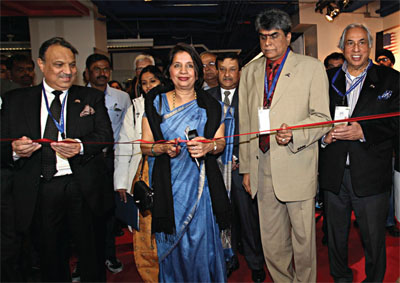
    NEW YORK, NY (TIP):Nirupama Rao,Ambassador of India to theUnited States, inauguratedhere January 28 an ApparelTrade show organized bythe Apparel ExportPromotion Council of India(AEPC), in cooperationwith M/S Trade Good, atthe PENN Plaza Pavilion.Ambassador PrabhuDayal, Consul General ofIndia in New York, KevinBurke, President ofAmerican Apparel andFootwear Association, andA. Sakthivel, Chairman of the AEPC and Sudhir Sekhri,Chairman (Export Promotion) of theAEPC were also present.Ambassador Rao, In her remarks saidthat Indian textiles represented anunbroken link between India’s ancientculture and its modern day life style.

    Noting that India’s Apparel sector hasrapidly upgraded its technology and ishighly competitive in meeting USmarket demands in various segmentsincluding high fashion and massconsumption, she highlighted thatthrough DISHA (Driving Industrytowards Sustainable HumanAdvancement), the Indian Apparelindustry has implemented an industrywidemeasure for facilitating andpreparing Indian apparel manufacturerstoward becoming more socially andenvironmentally responsible. Shepointed out that at US$3.3 billion, India’sexport of garments represents one ofthe important constituents of overallIndia-U.S trade.

    Ambassador Rao, accompanied byAmbassador Prabhu Dayal, KevinBurke, and A. Sakthivel went round andspoke with a number of sellers fromIndia. Tirupur sellers outnumberedsellers from other major centers likeLudhiana, Delhi, Gurgaon, Bangaloreetc.Giving her comments to the mediawhile taking a tour of the exhibition,Ambassador Rao said, ” Our relationswith United States are growing anddiversifying in so many areas. Textileexports are a very very important part ofthat growth and that strengthening ofour relationship with the United States.””Today, we saw on display many manyexporters from various parts of India.

    And, I was very impressed not only withthe quality of the fabrics and thedesigns, but also with the fact that ourtextile industry is becoming increasinglyglobalized and connected with theoutside world.””This is a millennium tradition inIndia-our textile tradition but today it istraveling abroad and it is through thatprocess , I think, the voice of India isheard much more powerfully around theglobe”.At the trade meet spread over twodays, on 28-29 January 2013, thirty fivemember exporters exhibited theirFall/Winter 2013-14 collections.

    Morethan 300-400 buyers, including at leasttwenty Brand Stores were expected toparticipate in the B-2-B event. Some ofthe major buyers expected to attend themeet included RALPH LAUREN;WARNACO; CHILDREN PLACE; LORD& TAYLOR; UNDER AMOUR; VFSPORTSWEAR; NAUTICA; RED CATand JONES APPAREL.The Buyer Seller Meet was expectedto generate substantial spot business andalso help cement long term businesspartnerships for participatingexhibitors.

  • Arvind Kejriwal Targets Delhi CM On Power Tariffs

    Arvind Kejriwal Targets Delhi CM On Power Tariffs

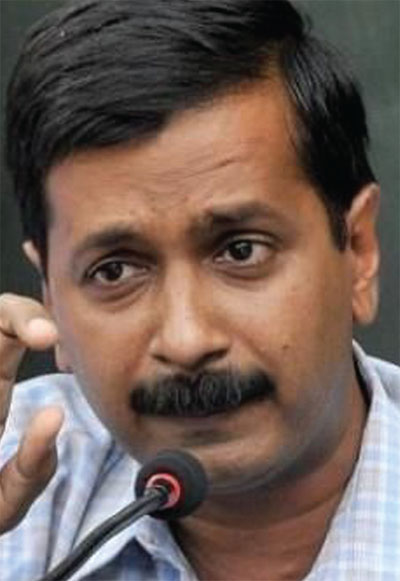
    NEW DELHI (TIP): Ahead of Delhi assembly elections inNovember, Aam Aadmi Party convenor Arvind Kejriwalhas trained his guns on chief minister Sheila Dikshit,accusing the Delhi government of conniving with privatepower distribution companies to increase power tariffs inthe Capital by showing “false” figures on losses.After several exposes on political leaders and corporatebig-wigs, Kejriwal accused the Delhi government and theDelhi Electricity Regulatory Commission of playing intothe hands of the private power companies, owned by AnilAmbani and the Tata group.

    Kejriwal said whileprivatising power distribution in Delhi in 2002, thegovernment had promised tariffs would come down asdistribution losses would be reduced. He said 11 years afterprivatisation though distribution losses have come downfrom 55% to 15%, electricity bills have gone up for Delhiites. Kejriwal alleged private powercompanies were “hiding” their revenuesand should therefore be audited by CAG.Addressing a press conference on a daywhen a3% increase in power tariff becameapplicable, Kejriwal accused Dikshit ofstalling a 2010 order of DERC, in whichformer chairperson Brijender Singh hadobserved that private distributioncompanies were making huge profits and,as a consequence, power tariffs should bereduced by 23%.

    Kejriwal said since 2010 the chairpersonhas changed and the power tariffs havegone up, first by 22% in August 2011 andthen by 32% in June 2012. “We havecalculated that for a household thatconsumes 200 units in 2 months, when thepower bill should have been Rs 503, thehousehold pays Rs 1,505 and has paid Rs7,910 extra in the last three years to theprivate companies. Similarly, for ahousehold that consumes 400 units in twomonths, the bill should be Rs 2,205, but itactually is Rs 4,400. This household hasalready paid Rs 19,443 extra in the last threeyears,” Kejriwal said.Reacting to the allegations levied byKejriwal, Tata PowerBSE 1.43 % Delhi CEOPraveer Sinha said there was a need to lookat the situation in proper perspective. “Ourtariffs are lower than neighbouring states,”he added. A BSES spokesperson said: “Theallegations posed are completely baselessand wild to mislead the citizens of Delhi.Issues raised have no relation whatsoeverwith the ground realities and are meant forpersonal gains.”The Chief Minister’s Office termedKejriwal’s accusations as a “bunch of lies”.State power minister Haroon Yusuf saidKejriwal was trying to “sensationalise theissue as he did not say anything new”.Kejriwal demanded that a case of fraudshould be lodged against Anil Ambani ashis company, BSES, had allegedly fudgedaccounts to show huge losses. Kejriwalaccused the new DERC chairman PDSudhakar of “working as an agent” ofprivate distribution companies.

  • Rahul Gandhi plans ‘drastic and lasting’ changes in Congress

    Rahul Gandhi plans ‘drastic and lasting’ changes in Congress

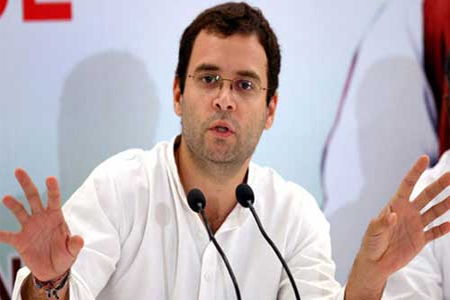
    NEW DELHI (TIP): Rahul Gandhi on Feb 1 signalled plans to carry out drastic and lasting changes in the working of the Congress to make it fighting fit ahead of a series of elections including the Lok Sabha polls.

    After giving a patient hearing to the AICC Secretaries narrating their woes, the Amethi MP, whose Lok Sabha bioprofile describes him “strategy consultant” by profession, remarked that no one appeared happy about the state of affairs in the organisation and “we have to rectify” the situation. “No one appears happy about the system as they feel it is unfair and that there are no rules and regulations and, therefore, there is uncertainty and we have to rectify the situation”, Gandhi was quoted as saying by party leaders during the twohour- long meeting with AICC office bearers.

    Gandhi yesterday began his first formal interaction with AICC office bearers as Vice President which saw lot of fireworks, blame game and complaints of oneupmanship. The young leader today said that he would go into depth of issues raised by the leaders and work to set things right. An office bearer said that Gandhi suggested that he was for “drastic and lasting changes”.

    He said that the primary task right now would be to face the immediate elections in various states including Karnataka and try to rectify the overall problems after that. Gandhi made these remarks after an AICC Secretary lamented “lack of coordination” in the party and the growing confusion as “no one is knowing what the other is doing”. Besides, the Secretary said that there was no coordination between government and organisation as the party is not taken into confidence before making appointments on official committees. With several office bearers yet to get a chance to have their say, he will be meeting them again on Monday.

  • Kiran Bedi Backs Lokpal Bill; Anna Hazare Accuses Govt. Of Betrayal

    Kiran Bedi Backs Lokpal Bill; Anna Hazare Accuses Govt. Of Betrayal

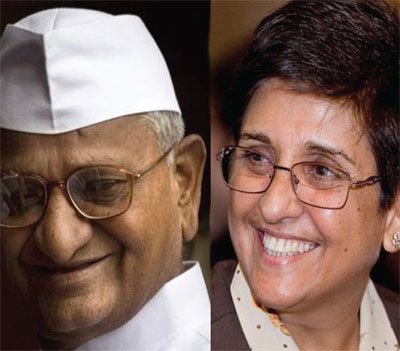
    NEW DELHI (TIP):Differing with AnnaHazare on the amendedLokpal Bill approved by theUnion Cabinet, his teammate and close confidante,the former IPS officerKiran Bedi on February 1,backed the legislationsaying it addressed most oftheir concerns.Bedi also expressedhappiness over theamended Bill paving theway for constitution of acollegium to select the chiefof Central Bureau ofInvestigation.

    “From nothing to something to more, aswe move on! This is how we can read theLokpalShe also said that most of the concernshave been addressed in the draft and citedthe appointment of CBI chief and otherchanges as positive ones.”(CBI’s) its Anti-Corruption wing hasbeen brought under oversight of Lokpal.Which is what we needed!” she said. Theactivist said, “It is open to oppositionparties to improve the Lokpal as part oftheir manifesto!”Her remarks contradict Anna Hazare’sstand that the amended Lokpal bill was a”farce”.

    He also announced he will launchanother agitation if the government wentahead with the enactment of a “weak”legislation.Meanwhile, Anna Hazare on Friday,February 1 announced that he wouldreturn to agitate at Ramlila Maidan ifrequired, expressing his lack of confidencein the government in bringing a strongLokpal. His statement comes a day after theUnion Cabinet cleared the Lokpal Bill.In sharp contrast to his colleague KiranBedi, Anna slammed the Bill saying it didnot include provision for setting up ofLokayukatas in states, did not include theCBI or CVC and also excluded lower rungbureaucracy. Bedi has been supportive ofthe Bill, saying that at least there was someanti-corruption mechanism in place.

    Anna,on the other hand, rejected the new draft asa betrayal by the government.”This government has gone back on itsassurances over the last two years. Theyhave betrayed us. I will tour the country forthe next two years to raise awarenessagainst this government and if need be Iwill agitate at Ramlila Maidan again,”Anna said.Reacting to Congress leader RahulGandhi’s speech that power was poison,Anna questioned, “If power is poison, thenwhy do people run after it…power is also anaddiction.”He also added that he had received aletter from Congress chief Sonia Gandhiassuring him that Lokpal Bill would bepassed in Parliament soon. “Thisgovernment is incapable of making goodlaws…we need clean candidates who willmake laws against corruption,” he added.The activist was accompanied by formerarmy chief V K Singh.

  • Chinese New Year 2013

    Chinese New Year 2013

    Chinese Spring Festival, also called Lunar New Year,has more than 4,000 years of history. Being one ofthe traditional Chinese festivals, it is the grandestand the most important festival for Chinese people. It isalso the time for the whole families to get together, which issimilar with Christmas Day to the westerners. Originatingduring the Shang Dynasty (about 17th – 11th century BC),Spring Festival, which celebrates family reunion, is full ofrich and colorful activities, and new hopes with the adventof spring and flowers blossoming. People from differentregions and different ethnic groups celebrate it in theirunique ways.

    Festival Time
    The Spring Festival comes on the first day of Chineselunar calendar and lasts for almost half of a month. But infolk custom, this traditional holiday lasts from the 23rd dayof the twelfth month to the 15th day of the first month(Lantern Festival) in the lunar calendar. Among these days,the New Year’s Eve and the first day of the New Year is thepeak time of the festival. The exact days are different inevery year according to the lunar calendar. Schedule ofSpring Festival in recent years is offered in the followingtable.Chinese New Year begins according to the Chinesecalendar which consists of both Gregorian and lunar-solarcalendar systems. Because the track of the new moonchanges from year to year, Chinese New Year can beginanytime between late January and mid-February.

    Below isa chart that shows the beginning day of Chinese New Yearand the animal sign for that year.Chinese New Year is the longest and most importantfestivity in the Chinese calendar. The origin of ChineseNew Year is itself centuries old and gains significancebecause of several myths and traditions. Chinese New Yearis celebrated in China and in countries and territories withsignificant Chinese populations, including Hong Kong,Macau, Singapore, Thailand, Indonesia, Malaysia, Taiwan,Mauritius, Philippines, and also in Chinatowns elsewhere.Chinese New Year is considered a major holiday for theChinese and has had influence on the lunar new yearcelebrations of its geographic neighbors.Within China, regional customs and traditionsconcerning the celebration of the Chinese new year varywidely.

    People will pour out their money to buy presents,decoration, material, food, and clothing. It is alsotraditional for every family to thoroughly cleanse thehouse, in order to sweep away any ill-fortune and to makeway for good incoming luck. Windows and doors will bedecorated with red color paper-cuts and couplets withpopular themes of “good fortune” or “happiness”, “wealth”,and “longevity.” On the Eve of Chinese New Year, supper isa feast with families. Food will include such items as pigs,ducks, chicken and sweet delicacies. The family will endthe night with firecrackers. Early the next morning,children will greet their parents by wishing them a healthyand happy new year, and receive money in red paperenvelopes.

    The Chinese New Year tradition is to reconcile,forget all grudges and sincerely wish peace and happinessfor everyone.Although the Chinese calendar traditionally does not usecontinuously numbered years, outside China its years areoften numbered from the reign of the Yellow Emperor. Butat least three different years numbered 1 are now used byvarious scholars, making the year beginning in 2012 AD the”Chinese Year” 4710, 4709, or 4649.Every family does a thorough house cleaning andpurchases enough food, including fish, meat, roasted nutsand seeds, all kinds of candies and fruits, etc, for thefestival period. Also, new clothes must be bought,especially for children. Red scrolls with complementarypoetic couplets, one line on each side of the gate, are pastedat every gate. The Chinese character ‘Fu’ is pasted on thecenter of the door and paper-cut pictures adorn windows.

    Taboos
    The Spring Festival is a new start for a new year, so it isregarded as the omen of a new year. People have manytaboos during this period. Many bad words related to”death”, “broken”, “killing”, “ghost” and “illness” or”sickness” are forbidden during conversations. In someplaces, there are more specific details. They consider itunlucky if the barrel of rice is empty, because they thinkthey will have nothing to eat in the next year. Takingmedicine is forbidden on this day, otherwise, people willhave sick for the whole year and take medicine constantly.

    Festival Food
    Food during this festival has its characteristics, which isthe representative of Chinese festival food culture.Dumplings and the reunion dinner are indispensable atthis time. Cold and hot dishes are all served. Fish is alwaysan important dish then, which expresses people’s hope ofhaving a wealthy new year.

    History
    It is said that the custom of Spring Festival started inwhen people offered sacrifice to ancestors in the last monthof Chinese lunar calendar. At that time, people preparedthe sacrifice by doing thorough cleaning, having bathesand so on. Later, people began to worship different deitiesas well on that day. It is the time that almost all the farmworks were done and people have free time. The sacrificingtime changed according to the farming schedule and wasnot fixed until the Han Dynasty (202BC-220AD). Thecustoms of worshipping deities and ancestors remainseven though the ceremonies are not as grand as before. It isalso the time that spring is coming, so people held all kindsof ceremonies to welcome the spring.

    Legends
    There are many legends about the festival in Chineseculture. In folk culture, the Spring Festival is also called”guonian” (meaning “passing a year”). It is said that the “nian”(year) was a strong monster which was fierce and cruel andate one kind of animal including human being a day. Humanbeings were scared about it and had to hide on the eveningwhen the “nian” came out. Later, people found that “nian” wasvery scared about the red color and fireworks. So after that,people use red color and fireworks or firecrackers to driveaway “nian” every year. As a result, the custom of using redcolor and setting off fireworks remains.

    Festivities Schedule
    Preparing the New Year starts 7 days before the NewYear’s Eve. According to Chinese lunar calendar, peoplestart to clean the house on Dec. 24, butcher on Dec. 26th andso on. People have certain things to do on each day. Thesefestival activities will end Jan. 15th of the lunar calendar.

  • Hare Krishna Priest Gets 3-Year Term In Visa Fraud Case

    Hare Krishna Priest Gets 3-Year Term In Visa Fraud Case

    MILWAUKEE (TIP): AnIndian spiritual guru hasbeen found guilty by a federaljury of selling religiousworker visas to Indians forover USD 30,000 each toenable them to enter the USfraudulently.Sagarsen Haldar (31) alsoknown as Gopal Hari Das,identified himself as thepresident of a Hindu templeGaudiya Vaisnava Society(GVS) in Milwaukee.A federal jury in theEastern District of Wisconsinfound Haldar guilty of conspiring tocommit immigration fraud, under whichhe fraudulently obtained and soldreligious worker visas to Indian nationals.He will be sentenced on February 24.According to evidence at the trial, Haldarconspired to sponsor more than two dozenIndian nationals to enter the US under theR-1 visas.

    The R-1 applications falsely stated thatthe individuals were religious workerswho planned to be priests and performreligious work at the GVS temple.However, the Indian nationals had noreligious training or experience and hadno intention of working as priests oncethey arrived in the US.Haldar charged the Indian nationals asmuch as USD 30,000 each for giving themthe visas. They made substantial cashpayments to Haldar and his associates inIndia and paid the balance toHaldar once they arrived inthe United States by workingat convenience stores andother Milwaukee-arealocations.

    “We are extremely gratifiedwith the jury’s guilty verdictin this case,” said GaryHartwig, special agent incharge of US Immigrationand Customs Enforcement’s(ICE) Homeland SecurityInvestigations.”Visa fraud represents avulnerability that could beexploited by criminals or others who wishto do us harm,” Hartwig said.The investigation into the matter beganin June 2008 after ICE receivedinformation from US Citizenship andImmigration Services’ Benefit Fraud Unitthat the temple had filed numerouspetitions for R-1 religious workers fromIndia.Subsequent investigation revealed thatHaldar used the GVS temple as a front foran elaborate religious visa fraud scheme.Haldar was charged in June 2010 afterHomeland Security Investigations agentsarrested him at Chicago’s O’HareInternational Airport as he arrived in theUS from India. In his luggage, Haldar hadidentification documents – includingpassports and other Indian identificationpapers – bearing the names andphotographs of other Indian nationals.

  • 2014 strategy: BJP sticks to politics, dumps Hindutava

    2014 strategy: BJP sticks to politics, dumps Hindutava

    NEW DELHI (TIP): Defining the battlelines for 2014 Lok Sabha elections, the Sangh Parivar has decided that the BJP will focus on development and decisive leader agenda, while the affiliated groups — such as the VHP — will help revive the “Hindu Identity” through Ram Janmabhoomi movement and the UPA charge of saffron terrorism.

    While the BJP core group met on Feb 1 to work out the reconstitution of its Parliamentary Board, Central Election Committee and the National Executive by the end of this month, top RSS, BJP and VHP leaders met at the residence of Goa LS MP Shripad Naik on Thursday to chalk out the future strategy and coordination among the Sangh affiliates. The meeting was attended by top BJP, RSS and VHP leaders.

    Party sources said it was decided at the meeting that Sangh affiliates would work to revive and bring back the focus on Hindutva issues with Ram Janmabhoomi movement, which is being re-launched at Kumbh Mela at Sant Mahasammelan on February 7 a day after the VHP Kendriya Marg Darshak Mandal meets in Allahabad. The BJP, on its part, will concentrate on the political agenda ofattacking the “rudderless” UPA government and showcase the development achieved in states ruled by the party, particularly Gujarat.

    Besides discussion on giving Gujarat chief minister Narendra Modi a larger role at the national level, the party also talked of the possibility of including Madhya Pradesh chief minister Shivraj Singh in the BJP Parliamentary Board, the larger issue was coordination among the Sangh affiliates. With the Sangh Parivar determined to project a united face for 2014 elections, differences between BJP and VHP were ironed out to rule out possibility of any conflicting statements in the future on core issues.

    At Thursday’s meeting, the Sangh leadersalso decided to target the UPA on socalled saffron terrorism with the aim of polarizing voters on the grounds that the UPA ministers — P Chidambaram and Sushilkumar Shinde — were deliberately “hurting” Hindu sentiments. “Further fine-tuning will be done at the Akhil Bhartiya Pratinidhi Sabha of the RSS on March 15-17, 2013 at Jaipur after reviewing the response to Ramjanambhoomi movement revival,” a party leader said.

  • Feisty Malala Nominated For Nobel Peace Prize

    Feisty Malala Nominated For Nobel Peace Prize

    OSLO (TIP): Malala Yousafzai, theshot Pakistani schoolgirl-turned-iconof Taliban resistance, and ex-Easternbloc activists are among those knownto be nominated for this year’s NobelPeace Prize, as the deadline expiredon Friday.This year’s award will beannounced in October, butspeculation was already on as thedeadline for nominations ran out onFebruary 1.”A prize to Malala would not onlybe timely and fitting with a line ofawards to champions of human rightsand democracy, but also … would setboth children and education on thepeace and conflict agenda,” said thehead of the Peace Research Instituteof Oslo, Kristian Berg Harpviken.Others known to have beennominated are human rights activists,including Belarussian human rightsactivist Ales Belyatski – and Russia’sLyudmila Alexeyeva. “They have bothdefied authoritarian state structuresand the illegal and illegitimate abuseof power,” said Jan Tore Sanner, oneof the two Norwegian PMs whonominated them.

  • Indian Americans Show Their Class Ten Named Intel Science Contest Finalists

    Indian Americans Show Their Class Ten Named Intel Science Contest Finalists

    NEW YORK (TIP): Ten IndianAmerican high school students areamong the 40 finalists in the 2013Intel Science Talent Search.Students will compete March 7-13in Washington, D.C., for $630,000 inawards, with the top winnerreceiving $100,000 from the IntelFoundation.New York led all states with sevenIntel finalists this year, followed byCalifornia with six.Of the ten Indian Americanfinalists, three are from California:Paulomi Bhattacharya of Cupertino,a senior at The Harker School inSan Jose; Pavan Mehrotra, of SimiValley, who attends Sierra CanyonSchool in Chatsworth; and SahanaVasudevan of Palo Alto, a studentat the Gnyanam Academy. Two arefrom Portland, Ore: Naomi Shah ofSunset High School and RaghavTripathi of Westview High School.The other four finalists are fromGeorgia, Kentucky, Massachusettsand Tennessee.

    Mayuri’s project is titled”Computational Analysis of theDNA-Binding Mechanism of thep53 Tumor Suppressor and its Inactivationthrough the R249S Mutation”. MayuriSridhar, a 17-year-old senior at Kings ParkHigh School accepted to MassachusettsInstitute of Technology as an early actionapplicant, attended the Kings Park Board ofEducation meeting Tuesday night, shortlyafter receiving a phone call from Intel,alerting her to her finalist status.For her project, Sridhar studied thestructure of the p53 protein, a tumorsuppressor that helps prevent cancer.”Experimental research has shown that theloss of tumor suppressors, such as the p53protein, is highly correlated with thedevelopment of tumor cells,” Sridharexplained in a previous interview.

    “I wantedto create a better cancer diagnostictechnique.”Toward the end of her research, Sridharrealized she had possibly done that.”A week before submitting my entry, all myresults flipped around and I could not for thelife of me figure out why,” she said.”Eventually I realized my results wereproving the experiment wrong. I was reallyhappy because I was able to prove that I couldactually create better diagnostic techniquesthat hadn’t been done before. That was thebest moment.”At the Tuesday meeting, KPHS scienceresearch coordinator Mary Ellen Faycongratulated Sridhar.”This is the second time we are in thissituation, which is, I think, phenomenal,” shesaid. “Do you know the first time was hersister?”In 2008, Hamsa Sridhar became Kings ParkHigh School’s first student to be named anIntel finalist.”Genes, environment, whatever it is,they’re doing something really right in thathousehold,” Fay said.

    Paulomi Bhattacharya’s project is titled “A NovelAAA-ATPase p97/VCP Inhibitor Lead for MultipleMyeloma by Fragment-Based Drug Design: AComputational Binding Model and NMR/SPR-BasedValidation.”An 18-year-old senior at Harker, she has been doingscientific research in fields as diverse as bioengineeringand chemical engineering since the eighth grade, the SanJose Mercury News reported.”It’s unbelievable. It’s a dream come true,” she said. TheIndian American student did laboratory work to find adrug with the potential to shut off a protein responsible formultiple myeloma, a cancer that affects plasma cells.She identified and tested many drug candidates lastsummer before finding one that worked. “Research is somuch about failing over and over again, and finally whenyou succeed, it’s wonderful,” she told the Mercury News.

    Sahana Vasudevan made the finals with the project:”Minimizing the Number of Carries in the Set ofCoset Representatives of a Normal Subgroup.” Theresearch could improve the speed and efficiency ofcomputer algorithms.Pavan Mehrotra advanced with “Facile, Single StepConversion of Biomass to Electricity.”

    Two Indian American finalists are from Portland,Ore. Naomi Shah of Sunset High School advancedwith the project, “The Toxicological Effect ofAirborne Pollutants on Lung Health.”

    Raghav Tripathi of Westview High School inPortland submitted “Design and Synthesis of NovelFatty Acid Binding Protein Inhibitors for Analgesicand Anti-Inflammatory Effects through Increases inEndogenous Anandamide Concentrations.”Raghav Tripathi of Westview High School in Portlandsubmitted “Design and Synthesis of Novel Fatty Acid BindingProtein Inhibitors for Analgesic and Anti-InflammatoryEffects through Increases in Endogenous AnandamideConcentrations.”

    Raja Selvakumar, Milton High School, Alpharetta,Ga., “Gastro Microbial Fuel Cell: A NovelImplementation of a GMFC in CapsularNanorobotics”; Naethan Mundkur, duPont Manual HighSchool, Louisville, Kentucky, “Investigation into theThermal and Rheological Properties of CuO Nanofluids forHeat Transfer Applications”; Surya Bhupatiraju, LexingtonHigh School, Lexington, Mass., “On the Complexity of theMarginal Satisfiability Problem”, and AkshayPadmanabha, Houston High School, Collierville, Tenn.,”Predicting, Detecting, and Treating Seizures throughVagus Nerve Stimulation.”Finalists are rated on original scientific research,achievement, and leadership inside and outside theclassroom. Winners will be unveiled at an awardsceremony at the National Building Museum March 12.Society for Science and the Public, a nonprofit groupdedicated to public engagement in scientific research andeducation, has administered the competition since itsinception in 1942. The 40 finalists were narrowed downfrom 300 semifinalists and more than 1,700 entrants.

  • As I See It: Worry About Kerry

    As I See It: Worry About Kerry

    As the US president, Barack Obama embarks on his second term, New Delhi is once again feeling the chill of a new administration in Washington. Sections of the Indian foreign policy making community are once again doing what they do best – crying hoarse over a possible change in the tone and tenor of US foreign policy. Obama has a new cabinet line-up with John Kerry nominated for the post of secretary of state, Chuck Hagel for the secretary of defense and John Bremmer as the head of the CIA. The US foreign policy is in a state of flux and some very significant changes are likely over the course of the next few years under the second Obama presidency. The most important issue in the short to medium term will be withdrawal of around 66,000 US troops from Afghanistan after more than a decade battling al Qaeda and the Taliban.

    Like most nations around the world, New Delhi will also be impacted by the impending changes in the foreign policy priorities of Washington. But instead of debating the larger ramifications of these changes, the discussion in India today is reminiscent of the discussion in the country when Obama came to office for the first time in 2008. There were widespread concerns about Obama’s attitudes towards India after eight years of privileged position under George W Bush administration. George W Bush, deeply suspicious of communist China, was personally keen on building strong ties with India.

    Hence, he was willing to sacrifice long-held US non-proliferation concerns to embrace nuclear India and acknowledge it as the primary actor in South Asia, dehyphenated from Pakistan. The Obama administration’s concerns in its initial months with protecting the nonproliferation regime, dealing with the immediate challenge of the growing Taliban threat in Afghanistan and Pakistan, and solving the unprecedented economic challenge led it to a very different set of priorities and an agenda in which India seemed to have a marginal role. The only context in which Obama mentioned India in his early months was related to the need to resolve Kashmir so as to find a way out of the west’s troubles in Afghanistan.

    To many Indians, the new administration seemed intent on sidelining India. In a similar vein, discussion these days is centered around the appointment of John Kerry and his supposed ’tilt’ toward Pakistan. Kerry has been closely associated with Obama administration’s Pakistan policy.

    It was he who helped broker the release of the CIA contractor, Raymond Davis, arrested on suspicion of murder and later persuaded Islamabad to return parts of US stealth helicopter that crashed during the Abbottabad raid that killed Osama bin Laden. Kerry has already been termed by sections of the Indian media as a friend of Pakistan, implication being that he would be unfriendly towards India. Kerry’s strong support for strengthening the NPT and the Kerry-Lugar-Berman bill authorizing a five-year $7.5 billion financial aid package to Pakistan have been viewed as examples of Kerry’s pro-Pakistan worldview.

    Sympathetic ear
    Pakistan’s effusive praise for Kerry’s nomination may indeed underscore a sense in Islamabad and Rawalpindi that they have gained a sympathetic ear in the new US cabinet. It won’t be surprising if the recent adventurous behavior of Pakistan military at the Line of Control may have been inspired by this bravado.

    But just as Pakistan will be fooling itself, if it believes that Kerry is going to be Pakistan’s friend, India is being unnecessarily defeatist if it thinks that Kerry’s nomination will be a disaster for India. Kerry is neither going to be pro-India nor pro-Pakistan, he will be pro-US. And if Obama had to change his foreign policy worldview vis-à-vis India soon after coming into office, Kerry will have no choice but to build on Obama’s first term and strengthen ties with India.

    After all, it was Kerry who has described India-US ties as “without doubt one of the most significant partnerships in US foreign policy.” The US-India relationship has matured and reached a stage where changes in personnel will only have a limited impact on its trajectory. There is a growing perception that India is not yet ready for prime-time and that the political leadership in New Delhi remains perpetually preoccupied with domestic turmoil and lacks political will to claim India’s rightful place in the comity of nations.

    It is for India to pursue strategic partnerships with like-minded nations and advance its interests. The world will only take India seriously when India starts taking itself seriously and starts behaving like a serious power. There is a larger problem that underlies this perpetual hyperventilation in India about the ostensible tilt in Washington.

    It has become a regular feature of Indian diplomacy to press America toward securing its own regional security interests. The speed with which India has outsourced its regional foreign policy to Washington is astonishing.New Delhi is now reduced to pleading with Washington to tackle Pakistan and to rein in Pakistan army’s nefarious designs against India in Afghanistan, in Kashmir and elsewhere.

    For all the breast beating in recent years about India emerging as a major global power, Indian strategic and political elites display an insecurity that defies explanation. A powerful, self-confident nation should be able to articulate a coherent vision about its priorities and national interests.

    The brazen display of a lack of self-confidence by Indian elites in their nation’s abilities to leverage the international system to its advantage only weakens India.

    A diffident India will continue to crave for the attention of Washington but will find it difficult to get. A confident India that charts its own course in world politics based on its national imperatives will force the world to sit up and take notice.

  • Immigration Reform lit by Obama Electoral Landslide

    Immigration Reform lit by Obama Electoral Landslide

    Two paths to citizenship, based upon differing culpability, can open the door to 11 million new Americans while reforming our immigration regime to welcome talented highly skilled workers and agricultural workers to stimulate our economy. Arizona’s success in the Supreme Court in “show me your papers,” with its attendant dangers of disparate impact, an issue not yet decided by the Supreme Court, seems to have galvanized both of its senators, Republicans John McCain and Jeff Flake, to be part of the Bipartisan Eight who decided enough was enough.

    America must control its borders, and the law must be recalibrated. Joining with Lindsey Graham, Marco Rubio and Democratic heavyweights Chuck Schumer, Dick Durbin, Bob Menendez and Mike Bennet, America can now cure its weak enforcement regime, legalize the illegals who help America get stronger daily with their Puritan work ethic, attract highly skilled workers as well as folks willing to work on America’s farms to expand our economy, enforce sovereignty on the border including with high-tech drones, and hold employers liable for disobeying the law. The segregated pathway to citizenship, based upon an amount of culpability, speaks with compassion and proportionality and bodes well for all of us. Its was said a long time ago: the law must never be an ass.

    Our broken immigration system, from bad enforcement to silly exclusion of highly skilled workers who could stimulate our economy, cried out for reform. The electoral cry heard in the November 2012 presidential election was the trigger to both save the nation and our vital two party system. No one more than the Republicans need to enact immigration reforms if they are to re-attract the Hispanic vote block.

    America’s best is always ahead, as we have the ability to recalibrate and each one of us is a patriot – after all, isn’t that the ultimate joy of being an American – the ability to join patriots Thomas Jefferson and Nathan Hale. Incidentally, America’s fan club is not limited only to those already American, as our exceptionalism is felt the world over. We just need our foreign policy to be less temporal and more friendship-bedrock based. Also worth noting is that our domestic freedom and lawful process permits Marco Rubio to become a star and join those already in that league.

    This Plan will now have traction in both houses, as it is filibuster-proof in the senate. The President awaits a bill that moves 11 million illegals onto a path of 11 million future voters who will remember that America acted with compassion and proportionality. As a New Yorker, I take special pride in our senior senator, the very Honorable Chuck Schumer – from presiding over a great inauguration to a great immigration reform regime. You do us all proud, Senator Schumer!

  • Rethinking our China strategy

    Rethinking our China strategy

    Senate committees will soon be asked to vote on President Obama’s nominees to head the departments of State and Defense and the Central Intelligence Agency. Many, if not most, of the senators’ questions will be focused on the nominees’ views on the pressing security problems the United States faces in the greater Middle East and Afghanistan. But it would be a mistake for the committees to let the hearings pass without also examining the administration’s own stated policy priority – the “pivot” or “rebalance” to the Asia-Pacific region. A productive discussion of the pivot, however, will require a frank acknowledgment that the primary factor driving the change is increased nervousness in Washington and Asian capitals about China’s rise and, in turn, recognition that the U.S. policy of engagement with China has not been as effective in shaping that rise as successive administrations, Republican and Democratic, had hoped. On this point, it is particularly useful to reread then-Deputy Secretary of State Robert Zoellick’s 2005 speech in which he famously invited Beijing to become a “responsible stakeholder” in the international system. Since the late 1970s, the U.S. had been, as Zoellick put it, “opening doors to China’s membership into the international system” with the expectation that doing so would lead to change in Chinese behavior as it saw the security and economic benefits of that system. By no means a China “hawk,” Zoellick provided a reasonable set of benchmarks for judging just how successful engagement would be in moving China along the path of a benign rise to great-power status. So,what does the score card look like? To start, Zoellick noted that, although China had “gained much from its membership in an open, rules-based international economic system,” its mercantilist economic policies put in doubt its commitment to that system’s underlying principles. And little has changed on that front. China keeps its currency undervalued to promote its exports, limits foreign access to its markets and treats natural resources as exclusive national assets. The government has done little to rein in intellectual property piracy or commercial cyber-espionage. State-owned banks still dominate China’s financial sector, and Beijingdriven industrial policies have increased, not decreased, in recent years. Another point of contention Zoellick hoped the Chinese would address was the lack of transparency when it came to China’s military buildup. But despite repeated U.S. initiatives, military-to-military exchanges have produced little of substance, and American intelligence continues to be surprised as some new Chinese weapons system is rolled out of its hangar or deployed at sea. Even during some of the roughest patches of the Cold War, the White House had a direct hot line to the Kremlin, and we knew, by mutual agreement, how many strategic warheads and missiles the Soviets had.With China,we haven’t a clue. As a responsible stakeholder, Zoellick said, China could and should do more to address the problem of North Korea and weapons proliferation more generally. On North Korea, only Beijing has the ability to pressure or persuade Pyongyang to change behavior. Yet North Korea continues to stockpile nuclear weapons and is bent on perfecting missiles that threaten our allies and, soon enough, the United States. If there is any good news, China’s direct role in proliferating has lessened. And while the recent vote by Beijing in support of the U.N. Security Council resolution condemning North Korea’s last missile test is a small but positive step, Beijing has not used its considerable leverage with Pyongyang to stop North Korea’s proliferation, and has dragged its feet on helping the rest of the world deal with the destabilizing impact of Iran’s nuclear program.

    As Zoellick noted, “China’s actions on Iran’s nuclear program will reveal the seriousness of China’s commitment to nonproliferation” and, so far, its record falls short of that mark. And, finally, Zoellick said that “China’s choices about Taiwan will send an important message too…. It is important for China to resolve its differences with Taiwan peacefully.” However, despite the most conciliatory government in Taiwan since the establishment of the People’s Republic of China, Beijing’s military buildup across from the island democracy has not diminished.

    Since Zoellick’s speech, China has taken an even more aggressive posture toward its neighbors, with confrontations with Japan in the East China Sea and Vietnam and the Philippines in the South China Sea. So what does this assessment of Chinese behavior mean for U.S. policy in an Obama second term? First, it reinforces the administration’s rationale for upping America’s strategic game in the Asia-Pacific region.

    What the Senate should be looking to hear, however, is exactly how the new national security team will go about making that a reality, especially in an era of major cuts in defense spending. Second, it means that, to the extent engagement is pursued, it should be with an eye to what is mutually and concretely beneficial, not with the expectation that the process itself will lead to China’s transformation.

    Finding the right balance in U.S.-China policy is a complex task. But the first step for the new secretaries of State and Defense in getting it right must be to understand what engagement can and can’t do, and to realize it is unlikely that China will become a member in good standing of the liberal international order until its leaders have made the decision to become liberal at home.

  • Suicide Bomber Attacks Market In Pakistan; 21 Killed & 33 Wounded

    Suicide Bomber Attacks Market In Pakistan; 21 Killed & 33 Wounded

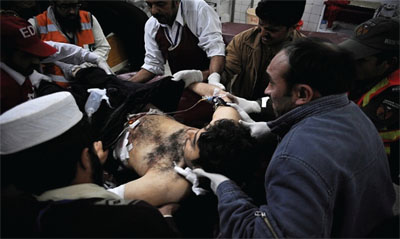
    PESHAWAR (TIP): An explosion in amarket in northwestern Pakistan on Friday,February 1, killed at least 21 people andwounded 33 in what the police described as asuicide bombing.The Pakistani Taliban claimedresponsibility for the attack in Hangu, about70 miles west of Peshawar, the capital ofKhyber-Pakhtunkhwa Province. Abu Omar, aTaliban commander in the neighboring tribalregion of North Waziristan, said in atelephone interview that the attack was inrevenge for the killing on Thursday of a Sunnicleric.

    The cleric, Mufti Abdul Majeed Deenpuri,60, was shot in the southern port city ofKarachi, setting off fears of reprisals againstShiites.Mr. Deenpuri was a senior teacher at JamiaBinoria, one of the largest seminaries inPakistan. A gunman opened fire on a vehiclecarrying the cleric and a colleague at a busyintersection and then fled.While the security situation is precariousacross Pakistan, Rehman Malik, the interiorminister, had warned of the potential for anattack in Karachi, a sprawling, violence-proneport city. Cellphone service was suspendedthere from noon to 3 p.m. during FridayPrayer.Sectarian violence has also occurred inHangu in the past, often forcing theauthorities to impose a curfew.

    The townborders the Orakzai tribal region, where thearmy and paramilitary forces are fightingTaliban militants.Friday’s explosion occurred just afterFriday Prayer as worshipers filed out ofnearby Sunni and Shiite mosques, policeofficials said. “People were coming out of themosque when the explosion occurred,” saidone officer in Hangu, speaking on thecondition of anonymity.Another police official in Hangu said asuicide bomber had detonated his explosives.While Shiites were the likely target, the deadincluded people from both Islamic sects, hesaid.

    Separately, a Pakistani intelligenceofficial, speaking on the condition ofanonymity, said 30 mortar shells fired fromAfghanistan on Friday morning killed sixresidents of Angoor Adda, a border village inSouth Waziristan. However, there was noofficial comment from the Pakistani military,and a local government official gave aconflicting number of casualties, saying threepeople were killed and six wounded.In recent years, Pakistan and Afghanistanhave traded barbs over accusations of crossborderrocket and artillery fire. The 1,510-milecraggy border between the two countries haslong posed a problem for both sides, eachaccusing the other of not manning the bordereffectively.

    Both sides maintain thatinsurgents easily cross over the porous border,but plans to fence the border have beenrejected as impractical.On Thursday, Human Rights Watchreleased its World Report 2013, which sharplycriticized the Pakistani government and itsmilitary and intelligence agencies for failingto reduce human rights abuses.”Pakistan’s human rights crisis worsenedmarkedly in 2012 with religious minoritiesbearing the brunt of killings and repression,”said Ali Dayan Hasan, the director in Pakistanfor Human Rights Watch. “While the militarycontinued to perpetrate abuses with impunityin Baluchistan and beyond, Sunni extremistskilled hundreds of Shia Muslims and theTaliban attacked schools, students andteachers.”

  • Tracking violence and terror Worrying communal tendencies

    Tracking violence and terror Worrying communal tendencies

    Justice Verma and his two colleagues on the commission set up to examine laws dealing with sexual abuse and terror have served the nation well in making a thorough examination of the subject in its widest amplitude and coming up with a range of pertinent observations and recommendations. This elaborate report was prepared in just 29 days with exemplary speed without falling short on data, analysis and findings. It now remains for the government and Parliament to match this dedication and legislate a new legal framework without the endless delays and side-interventions that have marked the working of the commissions headed by Liberhan and Nanavaty. The main recommendations have been widely discussed and one should now expect the Centre to take counsel with the states and introduce and pass a new framework law in one or more enactments that honors and protects the girl child and women of India from rape, molestation, neglect and patriarchal discrimination. The legislation should, hopefully, find backing from all parties and social groups and be enacted not later than in the monsoon session. Among the matters examined by the commission are police reforms which are fundamental to every aspect of law and order and criminal justice. Evidence of the police’s participation in the recent Dhule riot in which Muslims were targeted by them, shows how deep the rot has spread. Unfortunately, there has been limited progress in implementing police reform despite the Supreme Court’s directive on the subject. The opposition comes from across the political spectrum. All political parties are determined to retain the police and intelligence agencies as handmaids to serve their partisan agendas rather than as efficient and effective instruments for ensuring a safe and orderly society, and as the bedrock of the criminal justice system. This aspect of the Verma report should not be fobbed off yet another time as parties continue to play their dirty little games. One other matter merits emphasis. There are a plethora of laws on the statute book and many matters could be ameliorated or resolved if only they were strictly and promptly implemented. Delay leads to evasion, immunity and impunity. Influential and moneyed persons are differentially treated. A lecherous politician like Narayan Dutt Tiwari or a convicted criminal like O.P. Chautala have sought consideration on grounds of age and status. These demands are accepted only at the cost of the hallowed principle of equality before law. Unequal justice is an injustice and justifies criminality in angry young minds because of the outrage it breeds as some are placed above and beyond the rigors of the law. The Trinamool Congress is fast becoming addicted to violence and bluster against all dissidents, internal or external. A dehorsed Nitin Gadkari, charged with financial misconduct, has claimed that the income tax investigations against the Purthi group of companies with which he is associated was timed to sabotage his reelection as BJP president! Further, he has warned the officials who have merely done their duty to beware the wrath of the BJP when it is returned to power in 2014.This is taking resort to threats and blackmail. Meanwhile, the Home Minister, Sushilkumar Shinde, has stirred an avoidable controversy by charging the RSS and the BJP with training and unleashing Hindu terror. He was referring to bombing incidents in Malegaon, Ajmer, Hyderabad and elsewhere in 2007 when people like Swami Asseemanand, Sunil Joshi, Sandeep Dange and others bearing “Hindu” names were apprehended.

    The cases are pending and nothing has been conclusively proven though strong circumstantial evidence has surfaced. The RSS and the BJP have reacted strongly against the use of the phrase “Hindu terror”, arguing that terrorists cannot be labeled by faith.

    This is true, though “saffron” is more commonly used to denote Hindu right-wing connections. The BJP has threatened to prevent Parliament’s functioning unless Shinde apologizes or is sacked. The Congress has dissociated itself from the phrase “Hindu terror” but has otherwise defended Shinde.

    The fact is that it was the Parivar that first used the phrase “Muslim terror” with glee. Men like Narendra Modi openly spoke of “Miah” misdeeds and declared that while not all Muslims were not terrorists, all terrorists so far apprehended were Muslim. The RSS and the BJP, therefore, protest too much, though it is true that all sides should eschew associating terrorism with faith.

    Be that as it may, obstructing Parliament yet again would be irresponsibly to punish the nation for Shinde’s faux pas and once again stall important and urgent legislation and hold the country to ransom. The marked communal tendencies that are surfacing in the country are most worrying, The Sachar Committee’s recommendations have been tardily implemented and open discrimination against the community persists.

    After being given a state funeral out of fear of Shiv Sena hooliganism, permission to build a memorial to him in Shivaji Park in Mumbai is being mooted after a first refusal. Communal elements of all hues once again targeted the Jaipur Literary Festival on frivolous grounds while in Chennai, the release of Kamal Haasan’s new film, “Viswaroopam”, has been stayed on the ground of alleged anti-Muslim bias that could cause law and order problems. Once again, a film passed by the Film Censor Board is being censored by groups alleging hurt sentiment though it has been released elsewhere without disturbing the peace. Appeasement of communalism only encourages the same.

    Externally, the sentencing of David Coleman Headley, a US-Pakistan double agent, to only 35 years in prison in the US for his central role in staking the killing fields for the 26/11 attack in Mumbai in close collaboration with the Lashkar-e- Taiba and Hafiz Saeed has come as a grave disappointment. Even the trial judge stated that Headley deserved the death sentence but was saved from that only because of his plea bargain with the US authorities who milked him for some very damaging information of the sequence of events but not fully shared with India. Requests by Delhi for his further interrogation by Indian sleuths or extradition to India have been turned down by Washington. The US war on terror is obviously selective at the expense of Indian lives.

    And now comes another confession by a Pakistani Corps Commander, Lt-Gen Shahid Aziz, in 1998 that it was Musharraf who planned and pushed the utterly deceitful Kargil war that resulted in “total disaster”. No Mujahideen were involved but only Pakistani troops who crossed the LoC. This is no new revelation but only a further confirmation of the history of malicious lies and crass denials that Pakistan has repeatedly lived off since 1947.

    No wonder that President Mukherjee said in his Republic Day address that while India seeks friendship with Pakistan, Islamabad should not take this friendship for granted. Let the Pakistan government respond to this latest piece of “literature” as the Pakistan High Commissioner, Salman Bashir, would so elegantly phrase it.

  • Indian American Researcher’s Landmark Discovery In Cancer Treatment

    Indian American Researcher’s Landmark Discovery In Cancer Treatment

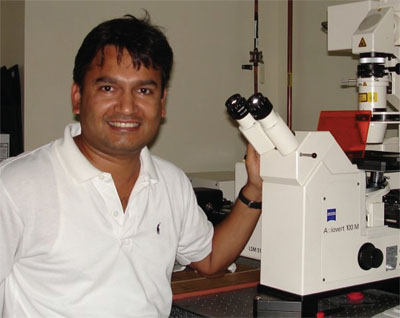
    SACRAMENTO (TIP): A recentstudy led by an Indian Americanresearcher Bikul Das, at theStanford University School ofMedicine proved that in times ofstress certain human embryonicstem cells produce molecules thatbenefit themselves along with thehelping the nearby cells to survive.”Altruism has been reportedamong bacterial populations andamong humans and other animals,like monkeys and elephants,” saidStanford postdoctoral scholar BikulDas, MBBS, PhD. “But inmammalian cells – at the cellularlevel – the idea of altruism has neverbeen described before.”

    Das has recently published aresearch paper documentingaltruistic behavior by humanembryonic stem cells, in aprominent international magazine’Stem Cells’.”Altruism in cells can mean it willbe possible to treat cancer withoutchemotherapy. In future, altruisticstem cells may be cultured andinjected into cancerous tissue fortreatment”, said Dr Chandan J Das,assistant professor in the radiodiagnosisdepartment at AIIMS,Delhi, about the study.

    Dr Purna Kurkure, seniorpediatric oncologist at TataMemorial Hospital says “thisresearch will have a bearing on notjust cancer research but in theoverall understanding of the repairand regeneration mechanism of thehuman body. Altruism has beenobserved in bacteria, which is whybacteria are great survivors. So far,we haven’t been able to beat cancerbecause there is a lack of completeunderstanding about it.Chemotherapy only targets the endcells, not the root. This research is,therefore, a major leap in the battleagainst cancer”, reports Times ofIndia.Das has been congratulated by UKscientist Dr Peter W Andrews, one ofthe two gurus of embryonic stemcell research, for his findings.

  • 55 % Indian-Americans Own House In US, Says Census Bureau Report

    55 % Indian-Americans Own House In US, Says Census Bureau Report

    WASHINGTON (TIP): Indian-Americansmay have the distinction of being thehighest-per capita income group amongethnic communities but they lag far behindtheir European counterparts when it comesto owning a house in the US.According to the ‘HomeownershipAmong the Foreign-Born Population: 2011’,released by the Census Bureau, 55 per centof the Indian-Americans own a house oftheir own while 45 live in rentedaccommodation.Foreign-born owned households with ahouseholder from Europe were the mostlikely to be owned free and clear (40 percent), while foreign-born owned householdswith a householder from Africa were theleast likely to be owned free and clear (14per cent), it said.

    Of the 20 country-of-birth groups withthe largest number of foreign-bornhouseholds in the US, several countriesfrom Europe along with Canada had thehighest homeownership rates.Over 70 per cent of foreign-bornhouseholds with a householder fromCanada (71 per cent), Germany (72 percent), Italy (79 per cent), and the UnitedKingdom (73 per cent) were owneroccupied.By comparison, less than one-third of theforeign-born households with ahouseholder born in the DominicanRepublic (25 per cent), Guatemala (30 percent), and Honduras (31 per cent), wereowner occupied. Italy and Germany werealso among the country-of-birth groupswith the highest percentage of ownedhomes that were owned free and clear.About half of foreign-born householdsthat were owned and had householdersfrom Italy and Germany owned their homesfree and clear (55 per cent and 51 per cent,respectively).

    “Homeownership is a goal shared bymany residents of the United States, bothnative- and foreign-born, citizen andnoncitizen,” said Elizabeth Grieco, chief ofthe Foreign-Born Population Branch at theCensus Bureau.”For immigrants in particular – whomaintain nearly one in seven households inthe US – making the transition from renterto homeowner represents a significantinvestment in the United States,” Griecosaid. This report found that foreign-bornnaturalized citizens were more likely to owntheir homes than foreign-born noncitizens.In naturalized citizen households, 66 percent were owner-occupied.

    That compareswith 34 per cent of noncitizen households.Rates of homeownership among foreignbornhouseholds also increased with timespent in the United States. Among foreignbornhouseholds with a householder whoentered the US before 1980, nearly threefourthswere owned rather than rented.Among households headed by someonewho entered the US since 2000, only onefourthwere owned.According to the brief, just 10metropolitan statistical areas accounted forabout half the nation’s foreign-bornhouseholds in 2011, led by New York andLos Angeles, each of which had more thanone million foreign-born households.Rounding out the top five were Miami,Chicago and Houston. Nearly half, or about45 per cent, of the metropolitan areas in theNortheast, particularly in New York andPennsylvania, exceeded the nationalhomeownership average for foreign-bornhouseholds of 52 per cent.

  • Movie Review-AkaashVani

    Movie Review-AkaashVani

    Cast: Nushrat Bharucha, Kartik Tiwari, Sunny Singh Nijjar
    Direction: Luv Ranjan
    Genre: Romance
    Duration: 2 hours 30 minutes

    STORY:
    Should you get married to someone you barely know, just to make your parents happy or should you rather marry the person you love?


    MOVIE REVIEW:
    The topic may sound archaic and something that has been addressed in Hindi films a billon times before, but director Luv Ranjan moulds the story in a contemporary setting, making it relevant, especially for women who succumb to societal pressures when it comes to marriage. Akaash (Kartik Tiwari) and Vani’s (Nushrat Bharucha) is a college romance. Like all campus love stories and films made in the 80’s and 90’s, they go to a snow-clad hill station on a college trip where love blossoms.

    The couple sings songs and dreams about their fairytale future together until parental and societal pressures force them to part ways. The bitter reality of life shatters dreams.

    Vani who has always looked at life through rose-tinted glasses, finds herself trapped in an obnoxious, loveless marriage. Given the situation of women in the country, the film rightly touches upon topics like psychological, sexual harassment post marriage.

    The characters, issues are realistic and sensible; except for the multiple irrelevant songs and scenes that drag the movie endlessly. Length is a major flaw. The film boasts of some solid performances. Lead actress Nushrat Bharucha is highly impressive.

    Sunny Singh Nijjar, who is seen in a supporting but crucial role as the chauvinistic husband Ravi, fits the bill. Kartik Tiwari is decent but needs to grin less and emote more.

    The film has an impactful background score, which helps in creating the somber mood required during the crucial confrontation scenes. Akaash Vani makes women realize that it’s more important to be happy and respected than being considered as righteous. It works strongly as social drama than a love story.

  • Rep. Tulsi Gabbard Cosponsors Commemorative Diwali Stamp Resolution

    Rep. Tulsi Gabbard Cosponsors Commemorative Diwali Stamp Resolution

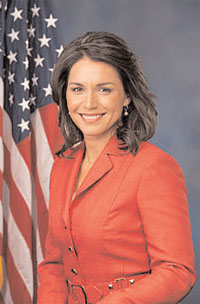
    WASHINGTON (TIP):Congresswoman Tulsi Gabbard (HI-02) this week cosponsored a HouseResolution calling for the U.S.Postal Service to establish a postagestamp to commemorate Diwali, the”festival of lights” marking theHindu New Year. Diwali is observedby Hindus, Christians, Jains, Sikhs,and Buddhists in the United States,India, and around the world.”The Diwali festival honors selfawareness,righteousness, andservice to others before ourselves,”said Congresswoman Tulsi Gabbard,who is the first Hindu-American toserve in the U.S. Congress.

    “Thisyearly festival is a time to celebratethe triumph of goodness and truth,and to reflect on the year. It is onlyappropriate that we commemoratethis widely observed holiday and itsplace in our nation’s rich tapestry ofreligious and cultural diversity.”Diwali, celebrated in October or November annually,originated as a celebration of the last harvest of the yearbefore winter. Indians around the world celebrate withfamily gatherings, glittering clay lamps, festive fireworks,strings of electric lights, bonfires, flowers, sharing ofsweets, and worship to the goddess Lakshmi.

    The resolution (H.Res.47) calls on the Citizens’ StampAdvisory Committee, an entity of the U.S. Postal Service, toissue a Diwali stamp, as it has done for other popularreligious celebrations in the United States such asChristmas, Eid, Kwanzaa, and Hanukkah.

  • Lara Dutta Nostalgic About ‘David’

    Lara Dutta Nostalgic About ‘David’

    Former beauty queen Lara Dutta, who is looking forward to ” David” release, recalls the time when she shot for the film. She says her daughter was just five months old at that time.

    The 34-year-old married ace tennis player Mahesh Bhupathi in 2011 and the couple became proud parents of daughter Saira in January last year.

    “(Director) Bejoy Nambiar’s ‘David’ is out on Feb 1. Have a ‘iity bitty’ (small) part in it. Filmed it when Saira was five months old. Fun to be part of it,” Lara tweeted. “David”, a movie transcending three different time zones, was simultaneously shot in Hindi and Telugu. It also features Neil Nitin Mukesh, Vinay Virmani, Monica Dogra, Isha Sharvani and southern star Vikram.

  • Indian-American Plans Run For Public Office In California

    Indian-American Plans Run For Public Office In California

    HOUSTON (TIP): An Indian American whoas a former US Treasury official oversawdepartment’s troubled Asset Relief Program atthe height of country’s financial crisis isconsidering a run for public office in Californiaas a Republican.Neel Kashkari, 39, announced that he isstepping down from his job as managementdirector for Pacific Investment Management Co(PIMCO), a Newport Beach investment firm.

    The former Goldman Sachs banker expressedan interest in entering public service in California in multiple interviews innewspapers and has launched a website toutinghis biography and leadership bona fides.Kashkari, whose parents Chaman and SheilaKashkari are Indian-Americans from Kashmir,said, “I’m not the typical California Republican.I’m the son of immigrants.

    “Kashkari told the Wall Street Journal. “Icome from modest upbringing. I have asuccessful track record. I’m an optimist. And Ithink something can be done if people worktogether.”Kashkari was a key figure in implementingthe USD 700 billion bank bailout effort, knownas the Troubled Asset Relief Program, duringPresident George W Bush’s second term.He stayed at the department for the start ofBarack Obama’s presidency before leaving tojoin PIMCO in 2009.

  • Deepika Happy That People Like My Performance

    Deepika Happy That People Like My Performance

    Deepika Padukone enthralled one and all with her intense acting in Cocktail and the awards season has become the talk of the town. However, Deepika is not bothered about the awards and takes people’s appreciation as the biggest compliment.

    On being asked about the competition as Vidya Balan and Sridevi top the list in the awards nominations, Deepika said, “It’s a good thing. I am happy that when it comes to awards I will be nominated with people like Vidya Balan and Sridevi.” “People addressed that I can perform and they like my performance is a big compliment and its big thing for me,” concluded Deepika.