Month: July 2013

  • Man Plays Guitar For 6 Hours While Undergoing Brain Surgery

    Man Plays Guitar For 6 Hours While Undergoing Brain Surgery

    NEW YORK (TIP): Brave or bizarre? A US man found a a novel way to help doctors perform a complex brain surgery on him – by playing his guitar! Actor-musician Brad Carter strummed his one-of-a-kind handmade guitar for six hours as doctors operated on him.Although Carter had to put down the guitar when he began experiencing debilitating hand tremors – his strumming skills came to good use when doctors implanted a wire inside his head, ‘New York Daily News’ reported.

    He used his tunes to guide surgeons through his brain as they implanted a pacemaker to ease the hand tremors that had plagued him for the better part of a decade. Carter’s fancy fretwork helped his surgeons locate the best spot for a deep brain stimulation procedure that they hope will ease tremors in his hands that have kept him from his life’s passion. “I’ve been a guitarist since 1988. Music is my first love.

    I’m an actor for a living, but I always have music to turn to. It’s a part of your soul,” Carter, an actor and musician in Los Angeles, told NBC’s “Today”. Carter began experiencing the hand tremors seven years ago. Medications didn’t help, and he had to stop performing as a musician. Doctors diagnosed his condition as a benign essential tremor, and elected to try a surgical procedure called deep brain stimulation that is also used on patients with Parkinson’s and some seizure disorders.

  • China Moving Towards Greater Economic Openness, US Official Says

    China Moving Towards Greater Economic Openness, US Official Says

    WASHINGTON (TIP): The United States on July 11 said China agreed to drop certain exceptions before restarting negotiations on a bilateral investment treaty between the two countries. The move is an encouraging sign that the world’s second largest economy is willing to open up more sectors to foreign competition, a US treasury official told reporters on the sidelines of USChina economic talks in Washington.

    China also plans to establish a Shanghai Free Trade Zone pilot program and permit foreign firms to compete in certain services sectors, including e-commerce, the official said, speaking on condition of anonymity. The United States also expects to see more progress on China’s move towards a freelyfloating exchange rate in coming weeks, the official said.

  • Lawyer Says Teenage US Terror Suspect Autistic

    Lawyer Says Teenage US Terror Suspect Autistic

    BAY SHORE (TIP): A young New York man caught boarding a plane on his way to Yemen to fight with an al- Qaida affiliate is a teenager who was diagnosed with autism and didn’t understand the gravity of what he was doing, his attorney told The Associated Press. Justin Kaliebe, 18, pleaded guilty in a secret federal court proceeding in February to a charge of attempting to provide material support to a terrorist organization. He was ordered to undergo a psychiatric evaluation before he is sentenced Sept. 27.

    His condition could be considered in determining his sentence. He faces up to 30 years in prison. “Justin Kaliebe is a gentle, misguided, autistic teenager who does not have the ability to fully understand the magnitude and consequences of his actions,” defense attorney Anthony La Pinta said in a statement to the AP. La Pinta, who joined the defense team after the guilty plea was entered, said he has medical documents showing that Kaliebe was diagnosed with autism as a young child, but he would not release them.

    Authorities have declined to say why the plea was entered in secret, though the move could mean Kaliebe was cooperating in the investigation when it was at a sensitive stage. Kaliebe, who converted to Islam about three years ago, apparently was swept up in the New York Police department’s ongoing investigation into the activities of Muslims throughout the region. Counterterrorism agents and NYPD officers intercepted him Jan. 21 as he tried to board a flight to Oman on his way to Yemen.

    Acquaintances, including the imam at a Long Island mosque he frequently attended, have described him as emotionally immature and a child of divorce who seemed in need of psychiatric counseling. According to court papers, Kaliebe told an undercover operative pretending to be a confidant, “There is no way out for me. … The only way out is martyrdom.” The NYPD has long had an interest in converts to Islam as part of its efforts to prevent terrorist attacks, saying in a 2007 report that they are “particularly vulnerable” to radicalization.

    Prosecutors allege Kaliebe began plotting to join al-Qaida on the Arabian Peninsula in 2011 while he was in contact with an undercover operative, who recorded their conversations. “Kaliebe indicated that he wanted to join a group `for the sake of Allah,”‘ documents show. A 20-year-old friend, Ahmad Deib, said he doesn’t believe Kaliebe was capable of terrorism. “This is a case of entrapment. This kid, he couldn’t hurt a fly. He is one of the most kindhearted kids you would ever know.” Friends said Kaliebe’s home life was not ideal.

    His parents were divorced in 1998 when he was a toddler, said Bilal Hito. “There was something about Justin that made you feel you were around a little boy,” Hito said. Deib said Kaliebe once confided that he had stopped taking antidepressants because he didn’t like the way they made him feel. Imam Abdul Jabbar said in an interview that Kaliebe even asked if he could live in the mosque. La Pinta disputed reports that his client had a lousy home life.

  • US ‘Very Disappointed’ With China On Edward Snowden

    US ‘Very Disappointed’ With China On Edward Snowden

    WASHINGTON (TIP): The United States told China in talks on Thursday it was “very disappointed” that Beijing did not hand over US intelligence leaker Edward Snowden when he fled to Hong Kong. Deputy secretary of state William Burns, in a joint press appearance after two days of annual talks, said that the two countries’ presidents agreed at a summit last month at the California resort of Sunnylands to work closely.

    “That is why we were very disappointed with how the authorities in Beijing and Hong Kong handled the Snowden case, which undermined our effort to build the trust needed to manage difficult issues,” Burns said. “We have made clear that the handling of this case was not consistent with the spirit of Sunnylands,” said Burns, who was filling in for secretary of state John Kerry whose wife is ill. Snowden, a former government contractor, fled the United States for Hong Kong after revealing details of pervasive US intelligence surveillance on the internet.

    The United States sought his extradition to face charges. But Snowden was allowed to leave Hong Kong, a territory of China that enjoys a large amount of autonomy, for Russia where he remains in limbo as he seeks a way to a country, likely in Latin America, that will offer him asylum. State Councilor Yang Jiechi, speaking next to Burns, defended decisions on Snowden, whose allegations of US snooping in Chinese Internet networks have caused a stir in Beijing.

    “The central government of China has always respected the Hong Kong Special Administrative Region government’s handling of cases in accordance with the law,” he said. Hong Kong “handled the Snowden case in accordance with the law and its approach is beyond reproach,” said Yang, a central figure in Chinese foreign policy.

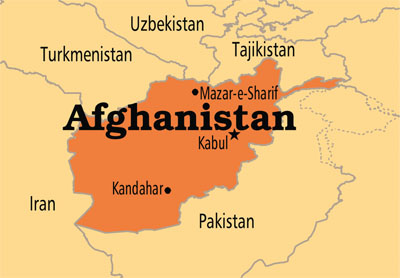
  • Could Taliban Talks Lead To Partition Of Afghanistan?

    Could Taliban Talks Lead To Partition Of Afghanistan?

    The big question for the Afghans is: what happens in the long term? What will Kabul require to maintain the Afghan form of security and peace after the US/NATO troops leave, or will Afghanistan willy-nilly pitch itself right into yet another bloodletting civil war – like what followed the Soviet troop withdrawal in 1989? “, says the author.
    The much-expected talks between the Taliban and the United States in Doha have not yet begun, and there is no clear indication when the two parties, busy settling their list of pre-negotiation do’s and don’ts, will finally sit down to discuss the features of post-2014 Afghanistan and determine role of various parties in the future. Meanwhile, some within Afghanistan have expressed concern that if indeed talks progress between the Taliban and the Americans, it may lead to the partition of Afghanistan.

    As of now it seems that one important party, the Government of Afghanistan led by President Hamid Karzai, has suspicions that the Americans are working toward allowing the Taliban to carve out some territory of its own as part of the so-called solution to the Afghan imbroglio, and has remained unwilling to participate in these talks. President Karzai demands Afghan-to- Afghan talks unfettered by the presence of foreigners – particularly those who invaded, fought the Taliban unsuccessfully for more than a decade, and are now looking for a conditional getaway.

    President Karzai’s hard stance may change. After all, he also knows that he will have to depend on these foreigners’ money to keep Kabul secure after the 100,000-plus foreign troops leave Afghanistan by mid-2014. What happens next? However, these are short-term logistical problems. What is certain at this point is that the vast majority of foreign troops will leave Afghanistan according to the timetable set by US President Barack Obama.

    The big question for the Afghans is: what happens in the long term? What will Kabul require to maintain the Afghan form of security and peace after the US/NATO troops leave, or will Afghanistan willy-nilly pitch itself right into yet another bloodletting civil war – like what followed the Soviet troop withdrawal in 1989? At that time, the Afghan strongman Najibullah, a friend of the Soviets and a gritty Pushtun, had held on to power for almost five years fighting various Mujahideen groups.

    Most of those groups were propped up by the West, the Saudis and Pakistan in the 1980s using “Islamic Jihad” as the battle cry to fight the Soviet military. After the Soviets left, some of these groups continued to receive active Pakistani help to topple Najibullah, then the Afghan symbol of the godless Soviets. The question is: Will the withdrawal in 2014 usher in the same players that we saw in 1989, killing at random to get control of Kabul? Who knows? The current tiff between Kabul and Washington that is receiving attention in the mainstream media is part of a power play in progress between President Karzai and the United States.

    This, too, will pass. But what is not certain is what the talks will in fact bring in. Will they bear the fruit that the Obama administration is hoping for? Max Fisher of the New York Times noted that the so-called peace talks are already on shaky ground for three reasons. First, on the same day Washington announced the opening of “peace talks,” the Taliban claimed responsibility for an attack that killed four Americans.

    Second, Afghan President Hamid Karzai announced he was no longer planning to participate in either the talks or a separate troop-level negotiation with the United States. And, third, the Taliban’s new office in Doha flew a banner labeled “Islamic Emirate of Afghanistan” and a flag from its days of ruling the country. “All three are individually bad signs that represent much larger challenges for peace in Afghanistan,” said Fisher.

    “In some ways, though, it’s the flag that’s most serious” (“The ultimate symbol of why Afghan peace talks will be so difficult,” Max Fisher, New York Times, June 19, 2013). Maybe Fischer is overstating here. This little summer thunderstorm may pass in no time. But, the problem is that even if the talks turn out to be “successful,” will that be any good for the Afghans? There is no reason to believe that President Obama is losing sleep over that.

    As far as he is concerned, a peaceful withdrawal from Afghanistan – unlike the kind of withdrawal from Vietnam that resembled so starkly the fearful retreat of a defeated military – is all that he cares about, even if that means supping with the devil. All the rest of the verbiage that comes out of Washington is rhetoric.

    Appeasing the Taliban? That, however, also means that Washington needs to keep the Taliban in good humor, and that means allowing the group to have some sort of authority in Kabul when the foreigners are gone – or, most of them. There is a distinct possibility that the upcoming talks will include this as an important item. Some in Washington have long claimed that the Taliban is not really that bad.

    In a December 2011 interview with Newsweek/Daily Beast, US Vice President Joseph Biden said as much. “We are in a position where if Afghanistan ceased and desisted from being a haven for people who do damage and have as a target the United States of America and their allies, that’s good enough. That’s good enough. We’re not there yet,” said Biden. “Look, the Taliban per se is not our enemy. That’s critical,” he insisted.

    “There is not a single statement that the president has ever made in any of our policy assertions that the Taliban is our enemy because it threatens US interests…” What Biden says is clear. The United States has zero problem with the Taliban. But it has loads of problems with the al- Qaeda. In Afghanistan, however, those problems have been mostly resolved.

    In fact, Washington claims that it has virtually decimated al-Qaeda – the real bad guys – and the upcoming deal with the Taliban will include the condition that the Taliban cannot allow al-Qaeda to set up shop in Afghanistan once again. If all these negotiating points work out, the Taliban could have a legitimate presence in Kabul.

    Some in Afghanistan claim that long before that becomes a reality, talks with the Taliban – who have a put up a plaque in Doha claiming themselves to be the representatives of the “Islamic Emirate of Afghanistan,” as opposed to the citizens of the Islamic Republic of Afghanistan, the actual name of the Afghan Government – will pave the way for partition of Afghanistan.

    Afghanistan’s Weesa Daily, in its June 19 editorial referring to these developments, said attention should be paid to several major points: First, the opening of the office is an understanding between the Taliban and the United States, and the Taliban now think that US forces in Afghanistan have been defeated and are escaping while the US considers how to leave the ongoing war to Afghans so that it can merely watch.

    If there is no crisis following President Karzai’s term and if peace talks advance as planned, the Taliban, according to their recent statement, will hold talks with all involved sides. But, notes Weesa Daily, “these talks of the Taliban with all involved sides would resume based on the plans suggested by US Senator Dana Rohrabacher and US Vice- President Joe Biden, who have suggested Afghanistan’s division – which may result in civil war.”

    Partition of Afghanistan? Well, US Vice President Biden has talked about the “soft partition” of Iraq, but never about the partition of Afghanistan; while Congressman (not Senator) Rohrabacher has participated in deliberations where partition/decentralization of Afghanistan was addressed as an issue. But before Rohrabacher got into the act, former US Ambassador to India and US National Security Council Deputy for Iraq (2003-2004) Robert Blackwill, a neo-con, had identified the partition of Afghanistan as Plan B.

    In a July 2010 article in Politico, Blackwill was highly critical of the Karzai administration (“Afghan President Hamid Karzai’s deeply corrupt government – as unpopular as the Taliban – shows no sign of improvement”) and implied that the “corrupt governance” of Kabul was the prime reason behind US/NATO’s failure to “win” the war in Afghanistan. He called for a ‘de facto partition’ of Afghanistan and urged the Obama administration to “accept that the Taliban will inevitably control most of its historic stronghold in the Pashtun south.”

    But, Blackwill added, “Washington could ensure that north and west Afghanistan do not succumb to jihadi extremism, using US air power and special forces along with the Afghan army and likeminded nations.” Blackwill also stated: “Given the number of US combat forces now fighting, the Taliban cannot be sufficiently weakened in Pashtun Afghanistan to drive it to the negotiating table on any reasonable timeline. True, the Afghan Pashtun are not a unified group. But they do agree on opposing foreign occupation and wanting Pashtun supremacy.”

    In January 2012, Chairman of the Europe, Eurasia, and Emerging Threats Subcommittee of the US House Foreign Affairs Committee Dana Rohrabacher (RCalifornia) went to Berlin at the head of a bipartisan congressional group represented by Reps. Louie Gohmert (R-Texas), Steve King (R-Iowa) and Loretta Sanchez (DCalifornia).

    In Berlin, the delegation met with well-known National Front leaders such as Ahmed Zia Massoud, chairman of the National Front [Jebha-e-Melli]; General Abdul Rashid Dostum, leader of the National Islamic Movement of Afghanistan [Jumbesh-e-Milli]; Haji Mohammad Mohaqiq, leader of the People’s Unity Party of Afghanistan [Hezb-e Wahdat-e Mardom]; and Amrullah Saleh, former director of the Afghan National Security Directorate.

    Together, they had signed a document advocating major changes in the Afghan constitution, designed to create a federal system which would devolve power from the centre to the provinces. Of the existing governmental arrangements in Afghanistan they had the following to say: “The current system has fatally concentrated decision-making to whoever is president of the country. The Afghan president appoints the governors of each province and district, the mayor of every town, every provincial chief of police, one third of the entire Senate, and even every judge in Afghanistan.”

    “This centralized power has led to massive corruption, disenfranchisement of a large segment of the Afghan people, obstacles to economic development, massive abuses of power, increasing political instability, poor governance, and a vast undermining of law and order.” Almost instantly Kabul reacted sharply to the statement. In April 2012, Rep. Rohrabacher was stopped in Dubai as he was leading a delegation to Kabul.

    Officials say that while the other members of the delegation had visas for Afghanistan, Rohrabacher was denied a visa. Afghan officials had told the BBC that in addition to his criticisms of the president, Rohrabacher was being shunned because of meetings he had held in Berlin with Afghan politicians about the creation of a decentralized form of government.

    According to the BBC, Afghan officials viewed that as tantamount to interference in the country’s internal affairs. “Anyone who speaks against the good of Afghanistan and tries to interfere in our internal affairs is ineligible for an Afghan visa,” one official told the BBC. Though strong, President Karzai’s reaction was not impulsive. At the time of the Berlin meetings – in fact, two meetings took place over three days (Jan. 9-11) – he had made known his discontent.

    Given the lack of clarity in the US strategy on Afghanistan, Karzai had every reason to suspect that the Berlin outcome could become the official strategy one day, particularly since Blackwill had already called for a ‘de-facto partition’ of Afghanistan a few months before. According to available reports, there was also another reason why President Karzai reacted so sharply.

    Accompanying Rohrabacher and the three other representatives was an American confidant of Gen. Dostum, Charles Santos. Santos, who had been advocating the concept of federalism and the powerful role of democratically elected local and regional governments in Afghanistan through various articles, was not listed among the participants in Berlin.

    President Karzai might have wondered: what was that all about? Reports indicate that an angry President Karzai personally called the German Foreign Office, though the meeting was already over, and leaned on then US Ambassador Ryan Crocker to de-legitimize the Berlin proceedings. On Jan 10, Ambassador Crocker issued a short statement, titled “The United States Supports Afghan Unity.”

    The statement said: “In response to recent press [sic] reports, the US Embassy reaffirms the longstanding support of the United States for a unified Afghanistan based on the Afghan Constitution. Any assertions to the contrary are entirely without foundation. Reconciliation and the political process in Afghanistan are led by the elected government and the Afghan people.

    Any statement to the contrary is inaccurate.” Subsequently, at a Jan. 21 press conference in Kabul, then-US Af-Pak envoy Marc Grossman made efforts to cool down the Afghan president by reiterating that a peace deal could only be negotiated by Afghans and would not be hijacked by US officials, despite current appearances to the contrary. It is evident from many reactions within Afghanistan that the Afghans do not want partition of their country, and some news editorials express fear that the Taliban-US talks could lead to just that.

    Afghan analysts point out that the country suffered the pains of partition when the British Raj drew a border (known as the Durand Line) between Afghanistan and then British- India in 1893. The aim of that partition was to divide and weaken the Afghan tribes. More than a century later, the Durand Line remains one of the most disputed borders in the world. Further, Afghans rightly note that during the past three decades, Afghanistan has had no functioning government, yet nonetheless remained united against foreign invasions.

    Except for two or three of the country’s 33 provinces, each province has a distinct ethnic mix; and, perhaps because of this phenomenon, separatism has never raised its ugly head in Afghanistan. During Afghanistan’s civil war in the early 1990s, when a fierce internal competition for control of Kabul was raging, no ethnic group and no warlord ever called for partition. The anti-Soviet resistance in the north remained always as strong as in the south.

    “And let’s not forget that there are millions of Pushtun in the north as well,” as one analyst pointed out. In other words, should Washington try to partition Afghanistan to provide the Taliban a permanent home and hope that will prevent an all-out civil war, it might ensure US troops a peaceful retreat; but it could also lead to huge opposition within Afghanistan, triggering a civil war.

  • God, Move Over

    God, Move Over

    It is time to see technology as a tool and not an end that defines a new fundamentalist religion through which corporations become the new gods.
    Technologies are tools for doing or making things They are a means to transform what nature has given into food, clothing, shelter, means of mobility, means of communication. Technology is a means to an end; it is no an end in itself. But when we stop perceiving technology as a means mediating between nature and human needs and elevate it to an end in itself, we falsely give it the status of a religion.

    The Green Revolution bred seeds to respond to chemical fertilizers -they were called “miracle seeds” The father of the Green Revolution, Norman Borlaug, called the 1 people he sent across the world to spread chemicals by introducing new seeds his “wheat apostles”. This is the discourse of religion, not o science and technology. the Green Revolution was introduced in India in 1965-66, no assessment was made of the impact chemical fertilizer will have on soil organisms, soil structure and the soil’s water-holding capacity.

    No attempt was made to compare the yields of Green Revolution varieties and the outputs of indigenous varieties and mixed farming system When we started to con serve native seeds thro ugh the Navdanya movement in 1987, we found many of the indigenous varieties outperformed the Green Revolution varieties in grain yield They also outperformed them in total biomas yield -this really matters because while the grain is eaten by humans, straw is food for soil organisms and farm animals.

    Our work on mixtures and biodiverse systems of farming shows that as a system, indigenous biodiversity produces more food and nutrition per acre. If we had a scientific approach to making choices about the technologies we use to produce our food, agroecology would win hands down. But the Green Revolution is promoted blindly as a religion, and not on the basis of science.

    Why else would finance minister P. Chidambaram announce in his Budget speech that the Green Revolution, which has destroyed the soil, water, biodiversity of Punjab, would now be expanded to eastern India? Is the government trying to impose the cancer epidemic of Punjab on Bihar, West Bengal, Orissa and Jharkhand? Does it want to deplete and poison the waters of eastern India like it did to the waters of Punjab? Does it want the rich biodiversity of eastern India to disappear like the biodiversity of Punjab has disappeared to create monocultures of rice and wheat? In the language of doublespeak, through a “memorandum of understanding” with biotech corporation Monsanto, the Punjab government is now introducing hybrid maize in the name of “diversification”.

    Substituting one monoculture with another is not diversification, putting more diversity on our farms is. More than 75 per cent of hybrid maize goes for industrial use, especially animal feed. This is not a food system to reduce the hunger of people; it is a system to supply profits for the insatiable greed of corporations and industry. While feeding the hungry is the mantra, the real religion is greed. Genetic engineering is the latest technology being imposed on India and the world as the new miracle.

    There are only three groups of GMO (genetically modified organisms) applications -Bt crops that are supposed to control pests, herbicide resistant crops that are supposed to control weeds, and future promises of biofortification in the form of Golden Rice for addressing Vitamin A deficiency, and GMO bananas for removing iron deficiency. When we assess genetic engineering as a tool that aims to achieve the objectives of reducing pests and weeds or increases Vitamin A and iron, it clearly fails the test.

    GMOs have created superpests and superweeds instead of reducing pests and weeds. Golden rice is 7,000 per cent less efficient in providing Vitamin A and GMO bananas will be 3,000 per cent less efficient in providing iron than alternatives available in our rich but rapidly disappearing biodiversity. GMOs continue to be promoted as a religion in spite of all the evidence that they are failing to do the job they are designed for.

    And as in religious fundamentalism, here also there is intolerance of alternatives – alternative paradigms, alternative approaches to food production and independent science. We are already witnessing the viciousness with which the industry attacks anyone who provides an alternative. The new Seed Legislation introduced by the European Commission on May 6, 2013, is a desperate attempt by the biotechnology industry to criminalize the alternative of open source seeds for farms and gardens in order to establish a monopoly of the seed and biotechnology industry.

    Another example is the attack on scientists whose scientific research has provided evidence of harm. The more the industry claims that the GMO debate is about science, the more they silence science and replace it with their pseudo-religion. Technological determinism replaces technological pluralism. Technological totalitarianism replaces democratic choice and responsibility.

    A consequence of making technology an end rather than a means is ignoring its impacts and failing to take responsibility for the harm it does to nature and people. The ultimate expression of irresponsibility is to create immunity for those who cause harm. A recent example is the Monsanto Protection Act in the US which allows agricultural companies such as Monsanto to ignore court orders against selling genetically-engineered seeds.

    Similarly, the Government of India has prepared a draft bill to establish the Biotechnology Regulatory Authority of India (BRAI). According to the bill, the authority will be an autonomous and statutory agency to regulate the research, transport, import, manufacture and use of organisms and products of modern biotechnology. GMO today means “god move over”.

    But genetic engineering in not a game of lego in which genes can be moved around without any impact on the organism or the environment. It is time to put nature and people back in the technology narrative. It is time to see technology as a tool, and not an end that defines a new fundamentalist religion through which corporations become the new gods.

  • Congresswoman Maloney’s Push For Diwali Commemorative Stamp – A Laudable Effort

    Congresswoman Maloney’s Push For Diwali Commemorative Stamp – A Laudable Effort

    Congresswoman Carolyn Maloney deserves gratitude of the entire Indian American community for her principled and laudable support for a Diwali commemorative stamp. Maloney has spent quite some years now to get the stamp used. Rightly has she reminded the Citizens Stamp Advisory Committee (CSAC) of the United States Postal Service (USPS) that there should be no hitch in issuing a Diwali stamp when the USPS has already issued commemorative stamps for holidays like Christmas, Chanukah, Kwanza and Eid.

    She has driven home to the USPS that Diwali is one of the oldest holidays in the world , celebrated by over one billion Indians throughout the world, including the three million who live in the United States. In January, 2013 Maloney introduced in the House of Representatives H. Res 47 to call on the CSAC to acknowledge the three million Indian Americans in the United States by issuing a commemorative stamp.

    The resolution enjoys bi-partisan support and has 11 cosponsors. It has been referred to the Committee on Oversight and Government Reform, on which Maloney sits as a senior member. The Citizens Stamp Advisory Committee (CSAC) of the United States Postal Service (USPS) will meet on July 28 to consider issuing new stamps. It will help the Congresswoman if the Indian American community reached out to lawmakers in their constituencies to enlist their support for Maloney’s resolution.

    Let no effort be spared to have the Diwali stamp issued on the occasion of 2013 Diwali. It surely will be a very satisfying and fulfilling achievement for the entire Indian Diaspora. So, resolve today to give Maloney’s effort a powerful push.

  • FIA’s Tall Claims Belie The Truth

    FIA’s Tall Claims Belie The Truth

    NEW YORK (TIP): Federation of India, New York, New Jersey, Connecticut announced with great fanfare on June 12 that it will celebrate India’s Independence Day on August 18 by organizing ‘India Day Parade’, which the organization claimed to be the ‘World’s largest India Day Parade outside of India’.

    The announcement was made by Sanjay Amin, president, FIA in the presence of the newly appointed Consul-General of India in New York, Dnyaneshwar Mulay, and a ball room full of people at ‘India House’ in midtown Manhattan. ‘India House’ happens to be the head quarter of the Consulate General of India in New York as well as the official residence of the Consul-General.

    The fact that FIA, an organization that has yet to prove its credentials for representing the culture and history of a country like India publicly, was allowed to use a Government of India facility for holding its kick-off meeting, gives it a legitimate status. Amused and bewildered by superlatives used by FIA officials while making exaggerated claims of achievements, Mr. Mulay nonchalantly highlighted some valid drawbacks in his scholarly speech, which were not fully understood by FIA authorities in appropriate contexts.

    Mr. Mulay advised FIA leadership to ensure representation of women in the leadership positions in the organization as women represented ‘Shakti’ in Indian culture. FIA chairman Ramesh Patel, in his effort to sound humorous, didn’t take the advise seriously and went on making fun of the issue. In a foolish remark Patel said that he had been facing Shakti all his life, referring casually to his wife.

    Taking the clue from their Chairman, other FIA functionaries also made similar out-of-the-context remarks about women, while none of them showed their concern or found it fit to explain why women were not included in the organizational hierarchy. Mulay also advised the organizers of ‘India Day’ parade to highlight India’s economic growth as a part of their celebration.

    None of the officials reacted appropriately to this suggestion except asking the government of India for financial help so guests could fly from India in the first class cabin of Air India or Jet Airways. One wonders if FIA realizes the concept of representing India in an intellectual fashion! FIA president Sanjay Amin informed the audience that his organization was successful in getting the Empire Estate Building illuminated in the tri-color of orange, green and white, symbolizing the three colors of the Indian national flag.

    He also said that FIA was honored to be invited by NASDAQ to ring the opening bell at NASDAQ. Of course these are great achievements but continue to remain symbolic in nature. There is nothing substantial that FIA could exhibit as India’s economic and cultural representations. The topmost priority of ‘India Day’ parade organizers’ remains working overtime to ensure presence of some Bollywood characters as Grand Marshall.

    The question is how many New Yorkers care about a Salman Khan or a Saif Ali Khan? Does a Bollywood celebrity represent the economic or cultural power of India? The crowds that watch the parade comprise of large number of New Yorkers, many of whom don’t belong to Indian origin. They don’t have much idea about India. They want to watch and know about India’s tradition, its history and its grand monuments.

    Unfortunately, FIA is entangled into an outdated notion of representing India with a Bollywood star who rides a float, which is nothing more than a crudely decorated publicity truck. It is absurd that FIA should claim that its parade is the biggest in the world because NYPD estimated that more than one hundred thousand people watched the India Day Parade on August 19, 2012 from the sidewalks of Madison Avenue.

    The parade took place in Midtown Manhattan that overflows with people on a Sunday anyway. Though FIA is a non-profit organization, it is controlled by a group of people who claim to be truly representing India in glamorous, spectacular and grand fashion from a Bollywood yardstick. The audacity of FIA bosses is such that they asked Mule to advise the Government of India for financial assistance for flying its guests in first class cabins of India’s national carriers. One hopes that Government of India stops legitimatizing such organizations by allowing its facilities to meet their shortsighted goals.

  • Indian-American Sentenced To 10 Months For Concealing $1.2 Mn

    Indian-American Sentenced To 10 Months For Concealing $1.2 Mn

    EDISON, NEW JERSEY (TIP): A US federal court has sentenced Indian American Sameer Gupta, to 19 months of imprisonment for concealing more than USD 1.2 million income in various domestic and Indian banks. The sentencing came July 9 after 33-year-old Sameer Gupta, a resident of Edison city in New Jersey pleaded guilty before US Magistrate Judge Patty Shwartz on February 26, 2013, for tax evasion by diverting funds from the wholesale merchandise business, J S Marketers Inc to undisclosed foreign accounts at HSBC in India, among other places.

    According to the court documents, Gupta is the 50 percent owner of J S Marketers, which sells adult paraphernalia to large adult store chains and smaller retail video stores and bodegas. Between 2006-2009, Gupta diverted USD 822,916 of the business receipts into 17 different personal bank accounts held in the names of various individuals, including himself and family members.

    He directed more than USD 250,000 of those diverted funds into six different accounts at a HSBC branch in India. “From 2007 through 2009, Gupta caused 22 J S Marketers corporate checks to be made payable to himself and family members in amounts identical to invoices from the business suppliers,” federal prosecutors said. “Gupta endorsed those checks of USD 375,138, and deposited them into bank accounts that he controlled and filed individual income tax returns between 2006-2009 that did not report his income from the diverted funds,” the Department of Justice said.

    Gupta evaded taxes on USD 1,198,054 in income between 2006- 2009. He also failed to file Reports of Foreign Bank and Financial Accounts, (FBARs), for 2006 through 2008. The tax loss resulting from Gupta’s conduct, not including interest and penalties, is USD 383,475.In addition to the prison term, Judge Hochberg sentenced Gupta to serve two years of supervised release.

    As part of his plea agreement, Gupta has paid to the United States Treasury a one-time FBAR penalty of USD 259,045 and has cooperated with the IRS in the investigation of his outstanding taxes dues.Judge Hochberg also ordered Gupta to pay an additional fine of USD 20,000.

  • Indian-American Gets $100,000 For Selling Winning Lottery Ticket

    Indian-American Gets $100,000 For Selling Winning Lottery Ticket

    WASHINGTON (TIP): An Indian-American beer shop owner in Pennsylvania will get a whopping $100,000 for selling a $131.5 millionwinning lottery ticket. Gary Patel, 30, who immigrated to the US from India as a teenager, said he would give the amount as a bonus to the three employees of his shop. The winner of the lottery ticket has not been identified yet.

    Father of twin babies, Patel came to know about his jackpot – the commission that he would get for his store selling the mega lottery ticket – when an official of Pennsylvania Lottery visited his store to ensure that the ticket was sold from his store. “You sold the Powerball ticket? Congrats, Gary!” customer Kim Morfiah said – actually, yelled at the top of her lungs – to Patel from the store’s doorway.

    “Oh, my God, somebody in the ‘hood is rich!,” the customer was quoted as saying by Philly News. “Which is good,” replied Patel. “It’s getting crazy . . . uh, I don’t like pictures,” Patel, sporting camo shorts and a V-neck, said slowly, as he politely let photographers snap away. Patel said, his wife did not believe when he called her to give her the good news. “My wife didn’t believe me when I called. I had to FaceTime her,” he said, referring to the iPhone video-chat feature.

    “Then she believed me,” he said. The winner of the lottery number – 13-19-23-33-57, and the red Powerball 28 lottery – has the option of taking the $131.5 million annuity, or $77.4 million in cash, minus the 25% federal withholding.

  • 6 Indian-American kids’ culinary skills feted at White House

    6 Indian-American kids’ culinary skills feted at White House

    WASHINGTON (TIP): Six Indian-American kid chefs have been honored for their fabulous culinary skills by US First Lady Michelle Obama at the White House’s “Kids State Dinner” as part of her initiative to tackle obesity and promote healthy eating among American children.

    Anisha Patel from Ohio, Ganesh Selvakumar from Pennsylvania; Devanshi H Udeshi from Texas; Emma Scielzo from Maryland, Vijay I Dey from North Carolina and Shefali Singh from Massachusetts were among 54 children invited by the First Lady for the event at the White House yesterday where they also had a chance encounter with President Barack Obama. “Now, first of all, usually at a state dinner, I get invited.

    So I don’t know what happened on this one — somehow the invitation slipped through somewhere. But it looks like you guys are having fun,” the President said amid laughter. Selected from over 13,000 contestants nationwide, the six Indian Americans probably constituted the largest number of kids from any ethnic group. So far, Indian Americans have been known for winning various science and math competitions and those like Spelling Bee and Geography Bee.

    “And we’re really proud of you winning this challenge — because, frankly, I’m not a great cook and — I’m not bad, but I don’t do it that much. Its hard to find the time,” the President said. “But when I do cook, I’m following a recipe.

    And to think that all of you have invented all this fabulous food just shows how creative you are and it shows that food that tastes good can be healthy, too,” Obama said. 10-year old Emma Scielzo, a third generation Indian American who attributes her winning recipe of “Chicken Masala Wrap” to her Indian grandparents who immigrated to the US several decades ago from Punjab, was one of three children who were selected to shoot short cooking videos.

  • Congresswoman Maloney Seeks A Diwali Stamp: CG Calls For Community Support

    Congresswoman Maloney Seeks A Diwali Stamp: CG Calls For Community Support

    NEW YORK (TIP): Congresswoman Carolyn Maloney spoke before the Consul General of India, in New York, July 8 to urge members and leaders in the Indian American communities to continue supporting an effort to get the Citizen’s Stamp Advisory Committee (CSAC) of the United States Postal Service (USPS) to issue a commemorative Diwali stamp. “It is high time the USPS issues a Diwali stamp.

    Diwali, also known as the Holiday of Lights, marks the triumph of good over evil, light over darkness and the beginning of the Hindu New Year. It is one of the oldest and most storied religious holidays in the world, and is celebrated by people of several faiths. There are commemorative stamps for Christmas, Hanukkah, Eid and more. Issuing a Diwali stamp would officially recognize the size and significance of the country’s Indian American population, which comprises over three million people, and would provide the USPS with sorely needed revenue,” Maloney said.

    For several years, Maloney has headed efforts in Congress to push the CSAC to consider issuing a commemorative Diwali stamp. In January, Maloney introduced H.Res. 47 that the CSAC should issue a Diwali stamp. She wrote letters to the CSAC in 2010 and 2012 requesting the same action. Ranju Batra, a former President of the Association of Indians in America – NY, who attended the event at the Indian Consulate, is a close friend of Congresswoman Maloney and was a major catalyst in the effort to get the Diwali stamp issued.

    She asked that Congresswoman Maloney provide national leadership on the effort, and Congresswoman Maloney obliged her request by remaining strongly dedicated to the issue. Aside from the cultural significance of the Diwali stamp, there are economic benefits associated with its issuance. There are over 3 million Indian Americans residing in the United States and over 1 billion Indians living in India.

    The sale of the Diwali stamp could provide the USPS with a much-needed revenue surge. The meeting was held to urge supporters and members of the Indian American communities to contact their members of Congress and the CSAC and express support for the issuance of a Diwali stamp. Speaking on the occasion, Ranju Batra said, “When I took over as president of AIANY, I set two goals: To make the 25th Silver Diwali celebrations history-making, and they were, and to laser-focus on getting the Diwali Stamp issued.

    I asked my dear friend Congresswoman Carolyn Maloney to take the lead in Congress. I am so delighted to have the support of Reps. Eliot Engel, Steve Israel, Greg Meeks, Yvette Clarke, Grace Meng, and others. Worthy of special note is the support from Reps. Ami Bera and Tulsi Gabbard. The time is now to get as much support as possible, as the USPS’ CASC will make its recommendations later this month.

    We need each of you and every media outlet to help get the word out: call your Congress member and ask them to sign on to H. Res. 47 now. If we do this, together, we have the chance to get the Diwali Stamp issued this year,” said Ranju Batra, Chair of the Diwali Stamp Project and immediate past President of the Association of Indians in America-NY.

    “The target audience of the Diwali stamp is over 5 million Americans of South Asian and Caribbean ancestry, along with over 1 billion Hindus across the world. The sale of Diwali Stamps would be a much-needed source of revenue for the US Postal Service in tough economic times. It will reduce the Postal Service’s need to always raises postage rates for everyone, while finally acknowledging Hindus here at home and abroad,” said Ravi Batra, an attorney and chair of the National Advisory Council on South Asian Affairs.

    “This laudable initiative by Ms. Ranju Batra seeks not only to embellish the great American democracy in its embrace of pluralism and diversity but also because Diwali commemorates civilizational values of respect for women’s rights and their empowerment which the United States also tries to advance everywhere. On the occasion of Diwali, Goddess Lakshmi — symbolizing prosperity and well-being of humanity — is worshiped, as is the triumph of good over evil and light over darkness, which she brings about, is celebrated.

    I wish Ranju and Congresswoman Carolyn Maloney every success in their endeavor, which will not only strengthen the cultural and people-to-people links between the democracies of India and United States, but also mark their dedication to the cause of gender equality and women’s empowerment,” said Lakshmi Puri, Acting Executive Director of UN Women.

    Mr. D. Mulay, the Consul General of India in New York lauded the efforts of Ranju Batra and Congresswoman Maloney and stated that Diwali is a secular festival celebrated by all Indians and it will be appropriate for the US Postal department to issue a Diwali commemorative stamp. He appealed to the Indian American community to support the Diwali stamp initiative of Ranju Batra and Maloney.

  • India’s Minister Of Commerce, Industry & Trade In The US

    India’s Minister Of Commerce, Industry & Trade In The US

    NEW YORK (TIP): India’s Commerce, Industry and Trade Minister Anand Sharma visited New York from 9-10 July, 2013. The Minister was accompanied by S.R. Rao, Commerce Secretary, Rajeev Kher, Additional Secretary, Rajeev Arora, Joint Secretary and Atul Chaturvedi, Joint Secretary. A business delegation led by Confederation of Indian Industries (CII) also accompanied the Minister.

    On 10th July, the Minister met UN Secretary General Mr. Ban Ki Moon. He also met with the corporate senior leadership of several companies and encouraged them to invest in broad based manufacturing in India. The companies expressed keen interest in expanding their business presence in India and agreed to stay engaged with Indian market through trade and investment.

    Anand Sharma gave a key note address to the members of US India Business Council and CII where he highlighted the fact that India and the US shared a strategic partnership, which ranged across sectors such as, aerospace, nuclear and clean energy, defense, agriculture, IT, communications, science & technology, etc. Both countries had also invested in each other, and the relationship was bound to become stronger as India bounces back to its high growth trajectory.

    The Minister highlighted India’s focus on high-end led manufacturing growth, and its plans to create self regulated autonomous industrial cities called the National Industrial Manufacturing Zones (NIMZ), thus putting in place infrastructure as well as an environment where speedy approvals and permits can be obtained within these cities itself. He invited US manufacturers to utilize the opportunity provided by NIMZ.

    He also reiterated the fact that India remained the third most favored nation for Foreign Direct Investment (FDI), and invited the US to invest in sectors liberalized by the new FDI Policy such as Multi Brand retail, Civil Aviation and Information and Broadcasting.

    He also said that barriers for movement of skilled professional should not be created and rather removed for the benefit of both countries. Amongst other issues, the Minister also briefed the audience on the India-EU Free Trade Agreement. He also met senior correspondents from International media.

  • Indian-American Sentenced To 10 Months For Concealing $1.2 Mn

    Indian-American Sentenced To 10 Months For Concealing $1.2 Mn

    EDISON, NEW JERSEY (TIP): A US federal court has sentenced Indian American Sameer Gupta, to 19 months of imprisonment for concealing more than USD 1.2 million income in various domestic and Indian banks. The sentencing came July 9 after 33-year-old Sameer Gupta, a resident of Edison city in New Jersey pleaded guilty before US Magistrate Judge Patty Shwartz on February 26, 2013, for tax evasion by diverting funds from the wholesale merchandise business, J S Marketers Inc to undisclosed foreign accounts at HSBC in India, among other places.

    According to the court documents, Gupta is the 50 percent owner of J S Marketers, which sells adult paraphernalia to large adult store chains and smaller retail video stores and bodegas. Between 2006-2009, Gupta diverted USD 822,916 of the business receipts into 17 different personal bank accounts held in the names of various individuals, including himself and family members.

    He directed more than USD 250,000 of those diverted funds into six different accounts at a HSBC branch in India. “From 2007 through 2009, Gupta caused 22 J S Marketers corporate checks to be made payable to himself and family members in amounts identical to invoices from the business suppliers,” federal prosecutors said.

    “Gupta endorsed those checks of USD 375,138, and deposited them into bank accounts that he controlled and filed individual income tax returns between 2006-2009 that did not report his income from the diverted funds,” the Department of Justice said. Gupta evaded taxes on USD 1,198,054 in income between 2006-2009. He also failed to file Reports of Foreign Bank and Financial Accounts, (FBARs), for 2006 through 2008.

    The tax loss resulting from Gupta’s conduct, not including interest and penalties, is USD 383,475.In addition to the prison term, Judge Hochberg sentenced Gupta to serve two years of supervised release.As part of his plea agreement, Gupta has paid to the United States Treasury a one-time FBAR penalty of USD 259,045 and has cooperated with the IRS in the investigation of his outstanding taxes dues.Judge Hochberg also ordered Gupta to pay an additional fine of USD 20,000.

  • IN THE AIR

    IN THE AIR

    The Indian Panorama had raised in the last week’s edition the issue of foreign political organizations operating in the US. This is what was said:
    There are quite a few foreign political party organizations operating in USA, either directly or through their overseas extensions. The questions being asked are:
    1. Does the operation of a foreign political party organization in USA constitute a violation of US laws?
    2. Does an immigrant citizen’s loyalty to a foreign political party constitute a violation of oath of allegiance?
    3. If it indeed is a violation of US laws, shouldn’t the foreign political party organization be banned and immigrant turned citizens in violation of oath of allegiance stripped of US citizenship? May be the US Department of State and Attorney General need look in to the issue.

    Readers are requested to email their comments to editor@theindianpanorama.news
    We have received comments of three well known attorneys of New York. Their comments are being reproduced ad verbatim.

    We urge our readers to participate in the debate.
    Attorney Rajiv Khanna comments:
    1. As long as these organizations are working within the limits set by their certificate of incorporation, duly filed with the secretary of state of the state of their incorporation, I do not believe their operations are illegal.
    2. The oath of allegiance merely provides that your first loyalty is to the United States. It does not bar you to have love for the country of your birth as long as it does not conflict with your loyalty to the United States. As you know, many US citizens have dual nationality such as a US citizenship along with an Israeli, Canadian or European citizenship. The US does not recognize such dual citizenship but it does not prevent it either. The only political party not allowed by US immigration law is the Nazi party.
    3. In light of my answers above, no.

    New York based attorney Karambir Singh Dahiya says:
    “Any political party can register itself as a foreign corporation. However they cannot have a not-for-profit status. They must stay for profit. Further, these entities are to be registered with the state governments. There is no registration with the federal government. However federal government can regulate them.

    Further please note that existing laws already limit foreign speakers (both individual and corporate) from making campaign contributions to candidates for state or federal office, or contributions to American political parties. See 2 U.S.C. § 441e (2006), which prohibits “foreign nationals” from making campaign contributions or expenditures, and defines them as any “foreign principal” under 22 U.S.C. § 611(b) (2006), as well as individuals who are not United States citizens or lawful permanent residents.

    Federal law defines a “foreign principal” as a foreign government, corporation, or political party organized or “having its principal place of business in a foreign country.” 22 U.S.C. § 661(b)(1), (3). “Existing laws also prohibit foreign nationals- which include individuals who are not lawful permanent residents, foreign governments, corporations, residents, and political parties “organized under the laws of or having [their] principal place of business in a foreign country”- from funding the operation of a political actions. “Now with that background these restrictions are tested under the First Amendment principle of constitutional law.”

    Immigration attorney David Frenkel writes:
    “These are questions that should be answered by either a constitutional lawyer or a civil rights lawyer. As an aside, it is extremely difficult to strip someone of citizenship, especially if the only violation is loyalty to a foreign political party.”

  • Indian-American Gets $100,000 For Selling Winning Lottery Ticket

    Indian-American Gets $100,000 For Selling Winning Lottery Ticket

    WASHINGTON (TIP): An Indian-American beer shop owner in Pennsylvania will get a whopping $100,000 for selling a $131.5 millionwinning lottery ticket. Gary Patel, 30, who immigrated to the US from India as a teenager, said he would give the amount as a bonus to the three employees of his shop. The winner of the lottery ticket has not been identified yet.

    Father of twin babies, Patel came to know about his jackpot – the commission that he would get for his store selling the mega lottery ticket – when an official of Pennsylvania Lottery visited his store to ensure that the ticket was sold from his store. “You sold the Powerball ticket? Congrats, Gary!” customer Kim Morfiah said – actually, yelled at the top of her lungs – to Patel from the store’s doorway.

    “Oh, my God, somebody in the ‘hood is rich!,” the customer was quoted as saying by Philly News. “Which is good,” replied Patel. “It’s getting crazy . . . uh, I don’t like pictures,” Patel, sporting camo shorts and a V-neck, said slowly, as he politely let photographers snap away. Patel said, his wife did not believe when he called her to give her the good news. “My wife didn’t believe me when I called.

    I had to FaceTime her,” he said, referring to the iPhone video-chat feature. “Then she believed me,” he said. The winner of the lottery number – 13-19-23-33-57, and the red Powerball 28 lottery – has the option of taking the $131.5 million annuity, or $77.4 million in cash, minus the 25% federal withholding.

  • 6 Indian-American kids’ culinary skills feted at White House

    6 Indian-American kids’ culinary skills feted at White House

    WASHINGTON (TIP): Six Indian-American kid chefs have been honored for their fabulous culinary skills by US First Lady Michelle Obama at the White House’s “Kids State Dinner” as part of her initiative to tackle obesity and promote healthy eating among American children. Anisha Patel from Ohio, Ganesh Selvakumar from Pennsylvania; Devanshi H Udeshi from Texas; Emma Scielzo from Maryland, Vijay I Dey from North Carolina and Shefali Singh from Massachusetts were among 54 children invited by the First Lady for the event at the White House yesterday where they also had a chance encounter with President Barack Obama.

    “Now, first of all, usually at a state dinner, I get invited. So I don’t know what happened on this one — somehow the invitation slipped through somewhere. But it looks like you guys are having fun,” the President said amid laughter. Selected from over 13,000 contestants nationwide, the six Indian Americans probably constituted the largest number of kids from any ethnic group.

    So far, Indian Americans have been known for winning various science and math competitions and those like Spelling Bee and Geography Bee. “And we’re really proud of you winning this challenge — because, frankly, I’m not a great cook and — I’m not bad, but I don’t do it that much. Its hard to find the time,” the President said. “But when I do cook, I’m following a recipe.

    And to think that all of you have invented all this fabulous food just shows how creative you are and it shows that food that tastes good can be healthy, too,” Obama said. 10-year old Emma Scielzo, a third generation Indian American who attributes her winning recipe of “Chicken Masala Wrap” to her Indian grandparents who immigrated to the US several decades ago from Punjab, was one of three children who were selected to shoot short cooking videos.

  • Bhattacharya Offers Specialized STEM Training To 250 Needy Students

    Bhattacharya Offers Specialized STEM Training To 250 Needy Students

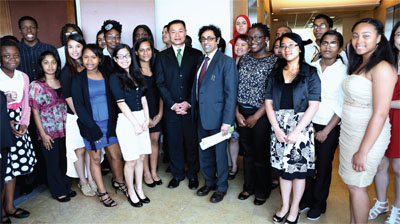
    NEW YORK (TIP): Over 250 under privileged students from lower strata of the society studying in eighth grade and above were inducted to undergo a one-year program to provide hands on experience on research in myriad fields in science, technology, math and engineering (STEM) stream.

    The students, drawn from 75 schools in New York City will work under mentors in leading Ivy League university research labs and centers such as Cornell and Columbia, institutes of higher learning such as Memorial Sloan Kettering and NASA to pursue careers in STEM stream after their graduation. The ambitious project of Harlem Children’s Society (HCS) founded by Indianorigin researcher and scholar Dr. Satyajit ‘Sat’ Bhattacharya from Kolkatta has benefited more than 2500 local economically backward and minority children so far by providing them with hands on experience on research in the past 13 years.

    Of the 250 students, about 40 percent are African-Americans, 40 percent are Hispanics and rest is immigrants from the lower strata of the society. Of the total students chosen, 65 percent are women. The students have been paid stipend up to $1500 a month for the program and the benefit of the internship range from helping prevent school drop outs to developing a scientific inquest into the young minds, he said.

    Bhattacharya, who is a renowned Research Scientist of Molecular Cancer Genetics at Memorial Sloan Kettering Cancer Center in New York, started this internship program 13 years ago when he moved to New York after completing his education in India. The skill-based learning program consists of hands on experience in research labs and scientific centers for four to five days in a week, attending lectures by Nobel Laureates and scientists, presentation of research papers to develop aptitude in conducting independent research and higher learning.

    The students find it easier to get jobs after their graduation thanks to their hands on experience in various disciplines. The practical training is followed up with web-based online training courses. The students are chosen from poor background struggling to complete high school education. The students often work in labs part-time after school and full time in summer and spring breaks.

    These internships helps the students to get into top universities and Ivy League institutions such as Cornell, Columbia, Stanford, MIT, Dartmouth, Penn State and others and also helps them in getting credit for their graduate studies. “It’s an open-ended program and it prevents school dropout rates very much. In the absence of scholarship they are forced to get jobs at the compulsion of their parents, Bhattacharya said.

    The broad spectrum of cutting-edge topics on which students have engaged in research so far include aerospace engineering, bio medicine and bio informatics, computer modeling, cybernetics, forensics, genetic engineering, green architecture, HIV/AIDS, nanotechnology, protein modeling, renewable energy among others. Students are also taught financial management and basic skills such as communication, public relations and resume writing.

    A number of school principals, science teachers, scientists, engineers and doctors from leading institutions – have joined in to support the endeavor of developing scientific pursuit among children. This is a very unique program sans classrooms as the students are placed as understudy in the network of 30,000 scientists, researchers and professors. The HCS flagship program was taken to Native American reservation in Hopi in Arizona where 15 students are chosen for skill-based development training.

    The students will be taught modern and scientific farming to help their parents besides basic healthcare training. The program was launched in 2004 and over 200 students from the Reservation were trained so far. Some of the alumnus of the program has reached new heights in their career. One such case is a student doing his MD/PhD program at Harvard Medical School in Boston thanks to his internship at Memorial Sloan Kettering Hospital.

    The students are chosen on the basis of merit, ambition and those hailing from economically weaker background of the society, he added. At the induction ceremony of the Harlem Children Society Class of 2013 held in Rosenthal Pavilion, Kimmel Center of New York University an array of speakers from public life heaped praise on the contribution of HCS to the society.

    New York Comptroller John Liu, New York State Democratic and Legislative Leader Senator Andrea Stewart-Cousins, Council Member and Manhattan Borough President Candidate Robert Jackson, New York Mayoral Candidate Joseph Lhota, New York City Public Advocate Candidate Reshma Saujani, 2013 National Spelling Bee champion Arvind Mahankali, UN Women Senior Policy Adviser Sumantara Guha and other dignitaries complimented Dr Bhattacharya and said HCS has provided a new ray of hope to underprivileged children.

    Pam Kwatra and Eric Kumar presented a proclamation from New York City Public Advocate and Mayoral candidate Bill de Blasio on the occasion. Students from the Hopi Reservation and also from Tanzania, Ethiopia, India and Nepal were inducted online and participated live thro video conference.

  • Educated Woman In Love Can’t Cry Rape: HC

    Educated Woman In Love Can’t Cry Rape: HC

    MUMBAI (TIP): A love affair gone bad is no reason to charge a man who got a woman pregnant with rape, the Bombay high court has ruled. Justice Sadhna Jadhav acquitted Borivali resident Manesh Kotiyan (39) of rape charges three years after his arrest and subsequent conviction.

    “The very fact that the prosecution has admitted in the cross-examination that she had a love affair with the accused and she desired to marry him. In these circumstances, offence underSection 376 of the IPC (rape) would necessarily fail,” said Justice Jadhav ruling that the rape charges against Kotiyan were “unsustainable”. The court went through the prosecution case and noted that the accused had proposed to the girl.

    “The complainant is an educated adult person,” said the judge. “She was fully aware of the fact that he (Kotiyan) was attracted to her. She chose to accompany him to Gorai. She also checked into a hotel to celebrate his birthday. She was aware of the consequences,” said the judge. “She had not cried for help and had not taken her resistance to a logical end. Hence, it would not be justifiable to hold that the consent was obtained by intimidation, force meditated imposition, circumvention surprise or undue influence,” said the judge.

    The court, however, upheld Kotiyan’s conviction on charges of cheating as he had failed to disclose to the victim that he was married and had children. Since he has served around three years in prison, the court ordered his release. “There is no evidence that the accused coerced her and raped her,” said advocate Arfan Sait, who was appointed by the high court legal aid cell to defend Kotiyan.

    “He had always intended to marry her and had told her he would do so once the divorce proceedings ended.” The case dates back to March 2010, when the girl who was four months pregnant lodged a case of rape against Kotiyan. The two had met when they were working at a stationery shop in Borivli.

    In November 2009, they had gone to Gorai to celebrate Kotiyan’s birthday, where according to the prosecution he forced her into having sexual intercourse. A sessions court in 2012 held Kotiyan guilty of rape and sentenced him to seven years rigorous imprisonment. Kotiyan filed an appeal in the HC. “It is clear from her deposition that she had lodged the FIR in a fit of rage,” the HC said.

  • DHONI WINS TRI-SERIES FOR INDIA

    DHONI WINS TRI-SERIES FOR INDIA

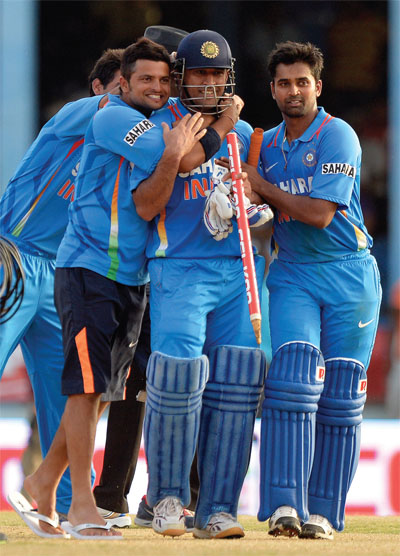
    PORT-OF-SPAIN (TIP): Leave it to me, he says. I want to take this to the last over. Me against one man. One on one. I know I am better than the last man the other team can put up against me. Once again, MS Dhoni reduced a lost match into a one-on-one contest with an opposition bowler, and knocked off the 15 required in just three hits.

    You could see the bowler – Shaminda Eranga, 9-2-34-2 until then, wickets of Shikhar Dhawan and Virat Kohli to his name – was intimidated the moment he saw the first one fly into the top of the top tier. Bear in mind that this was a treacherous pitch with seam, spin and uneven bounce. Dhoni was injured, and had come back only for this match. He wasn’t running as hard as he does, and wickets were falling at the other end.

    When Dhoni came in, the asking-rate was 3.35, but with falling wickets and turned-down singles, it hit the improbable towards the end. Dhoni, though, kept refusing singles, kept admonishing the last man Ishant Sharma for taking off for panic-stricken singles.

    Ishant couldn’t be blamed. The game had unravelled fast for India. They were cruising when Rohit Sharma had braved for yet another fifty despite another painful blow to his body (which makes it atleast four in two innings against Sri Lanka), despite many balls that seamed past his edge, despite the slow start. When India were 139 for 3 in the 32nd over, though, Rangana Herath delivered a grubber, and it squeezed under Rohit’s bat. Things were about to change. The pitch was still difficult to bat on as Suresh Raina soon found out.

    He thought he had a half-volley from Suranga Lakmal when he went for the drive, but even after pitching that full the ball seamed away appreciably and took his edge. The accurate and wily Herath saw an opening now. And burst through it. In the 38th over, his last, Herath trapped Ravindra Jadeja and R Ashwin – whose combined figures had been 17.5-1-65-6 – in successive deliveries.

    India 152 for 7. The drama had begun. Only a few minutes earlier, Mahela Jayawardene and Kumar Sangakkara had gone on and on – for overs it seemed – about an obstructing-the-field appeal against Dhoni. He had taken two steps down the wicket, and then realised he would have hit the other batsman if he ran straight. So he ran, nay hared on a bad hamstring, at an angle, but didn’t change his direction for the remaining 20 yards. The throw hit him, and the two senior Sri Lankans would not leave the umpire’s side.

    They knew they needed this man out as soon as possible. For the next half hour, though, Sri Lanka would have thought they didn’t need to get Dhoni out. Dhoni tried to intimidate Lakmal once during the Powerplay, but after that he began playing the percentage game. Sri Lanka knew Dhoni couldn’t manipulate the strike with that hamstring, and controlled the game well. Lasith Malinga – seven overs for 54 runs until then – finally got his radar right, and got Bhuvneshwar Kumar toe before wicket with his dipping slower yorker.

    In the tense overs that followed, R Vinay Kumar lost his cool, and slogged and got out. India 182 for 9 after 46.2 overs. With any other batsman than Dhoni, you would expect panic. Dhoni, though, wanted to corner just one man. He wanted to bring it down to that one man. He was also daring Sri Lanka to keep back Malinga, who had one over left, for the last. Sri Lanka didn’t. Malinga bowled the 48th. Dhoni faced the whole over, looking unhurried, for just a scrambled couple.

    The only man hurried was Ishant, who tried a suicidal single off the last ball of Malinga’s over to keep Dhoni on strike. The ball, though, had gone straight to the fielder, and Dhoni was miffed Ishant tried such desperation. It was not becoming of someone batting with the coolest and the best batsman in ODI cricket. Ishant would do that again off the first ball of the next over. Twice Dhoni let Ishant know what he did was not right. Ishant faced another dot. Then another dot. Seventeen off nine. Dhoni was cool at the other end.

    He had marked out his man. He knew it wouldn’t be an experienced bowler in the last over. Two runs came off the last three balls of the 49th over, but Ishant was made to feel under no pressure. He had been told to leave it to the man who knew his way around these lanes. Then began the great show. As soon as Ishant left alone – yes, left alone – the last ball of the 49th over, Dhoni signalled to the dressing room for a new, heavier bat.

    As Angelo Mathews psyched Shaminda Eranga up for the last over, Dhoni practised a few swings with two bats held together. Calculatedly he picked out one. Eranga went to his mark. This match should not have been on, but in Dhoni’s book this was even odds. Eranga bowled a nervous first ball: a wide length ball, which Dhoni swung hard at. That was a nervous ball, and would have been out of the ground had Dhoni connected. Dhoni didn’t. The second ball, though, was closer to Dhoni – swing, and met that hunk on the up.

    And up it went. And far. And kept going. Over the top of the stands. You could see it in Eranga’s eyes now. It was now going to be nigh impossible for Eranga to execute his skill. In one hit, Dhoni had brought it down to just luck for Sri Lanka. The luck was not with them. Eranga bowed length again, Dhoni went hard again, and the ball flew off the outside half of the bat, and over point. It was over already.

    Eranga just ran up for the formalities, delivered another length ball, and was dispatched over extra cover. The iceman had done it again, but he hadn’t had a great first half of the day as a keeper and a captain. Apart from not having been at his best with the gloves, Dhoni had also let Sri Lanka off the hook with his choice of part-time bowlers ahead of the specialist spinners, who would eventually go on to cut Sri Lanka’s effort short.

    Bhuvneshwar had given India his customary breakthroughs in the first spell, the scoring was difficult, but Virat Kohli and Raina provided Sangakkara and Lahiru Thirimanne relief with their odd long hop or big wides. Their partnership took Sri Lanka to 171 for 2, but then Thirimanne made a mistake, and almost every batsman that followed.

    In over-aiming during that Powerplay, Sri Lanka had lost their last eight wickets for 30 runs, letting Dhoni off the hook now. You will be justified to think of Dhoni’s choice of bowlers as odd. As you would have been with his persistence against all logic with Ishant in the Champions Trophy final. Just that the results were drastically different.

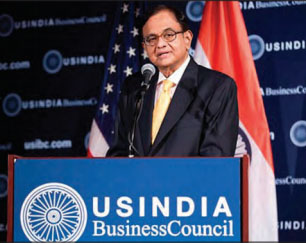
  • USIBC Chairman Ajay Banga Lays Out Agenda For Progress With India

    USIBC Chairman Ajay Banga Lays Out Agenda For Progress With India

    WASHINGTON, DC (TIP): The U.S.-India Business Council (USIBC) hosted, July 11, its 38th Anniversary Leadership Summit, Agenda for Progress , bringing together U.S. and Indian industry and government leaders to chart the way forward in the partnership between the world’s largest democracies.

    India’s Union Minister of Commerce & Industries Anand Sharma provided the inaugural address. The summit’s closing keynotes were provided by India’s Union Finance Minister P. Chidambaram and United States Trade Representative Michael Froman. U.S. Secretary of Commerce Penny Pritzker addressed the audience at one of her first public appearances in her new capacity.

    USIBC Chairman Ajay Banga, MasterCard President & CEO, energized the crowd with a speech urging deeper industry collaboration between the U.S. and India and the need for political leadership to step up and create transparent, predictable, and consistent business environments in both countries . “We want to broaden and deepen the economic and commercial ties between India and the United States.

    We want to strengthen our national security partnership as well. While we may have competing viewpoints on how to get there, there’s no disputing we have one agenda – and that’s helping India-U.S. relations fulfill their promise,” said Banga to a crowd of 350 of the most senior industry and government officials in the U.S.-India commercial space. Banga recognized recent challenges in the relationship, citing issues which have caused great concern to investors including India’s tax policy, local manufacturing restrictions, and challenges to innovation and intellectual property.

    “India has an opportunity to grow its pharmaceutical industry, foster innovation, and create competition. It’s in everyone’s interest to find solutions with the private sector. But that prospect is jeopardized when IP is jeopardized.” Banga also drew attention to the problematic provisions in the proposed U.S. immigration bill which discriminate against global technology providers and harms job creation in both countries.

    “We believe it’s in our interest not only to open doors to more skilled workers, but also to ensure immigration reform doesn’t discriminate against our partners nor limit U.S. companies from choosing where they source the IT support they need,” he said. “India-U.S. business relations have always been at the heart of the U.S-India partnership. The fact that the U.S-India relationship is under attack by the pain points I’ve just mentioned on both sides makes the search for common ground more timely and crucial,” continued Banga.

    “The U.S. is better…India is better…the world is better…when we deepen the commercial and national security ties between the largest and longest-running modern democracies. This is what we have to do.” Also during the leadership summit, USIBC presented its prestigious Global Leadership Awards to industry leaders Louis Chênevert, Chairman and CEO, United Technologies Corporation (UTC), and Analjit Singh, Founder and Chairman, Max India Limited, for their outstanding contributions to the U.S.- India growth story.

    A global trailblazer in manufacturing, Mr. Chênevert has led UTC’s significant investments across India in key sectors including commercial building systems and aerospace. Through Max India, Mr. Singh has expanded healthcare across India, founding successful joint ventures with leading American companies to bring technology and innovation to those who need it most.

    Max India is a multibusiness corporate, driven by the spirit of enterprise and focused on people and service oriented businesses. These USIBC Global Leadership Awards recognize the role exemplary industry leadership plays in shaping U.S.-India ties. The summit was generously sponsored by members of USIBC, led by Diamond Sponsor Cognizant, a global leader in business and technology services.

  • Groundswell Of Support For Tom Suozzi

    Groundswell Of Support For Tom Suozzi

    Democrats confident of regaining Nassau County Executive Position
    LONG ISLAND, NY (TIP): If Tom Suozzi wins in the race for the position of Nassau County Executive in November it will be the third time in the history of the County that a Democrat will be heading it. The County has been a bastion of Republicans ever since it was created in 1938.

    It was only in early seventies that Judge Nickerson, a democrat was elected the Executive and again in 2001 it was Tom who wrested it from the Republicans. It remains to be seen if Tom will be able to repeat the feat. However, there are quite a few pointers to suggest a democratic win in November elections. First, the number of registered Democrats has gone up in the last ten years.

    There are 83,000 more registered Democrats in Nassau County, while there are more than 16,000 fewer Republicans since the last elections. As of April, 2013, there were 371,557 registered Democrats in Nassau County and 332,036 registered Republicans, a clear yawning gap of 39,521. Two, the steadily increasing numbers of immigrants in to the County have created a larger support base for Democrats.

    Majority of immigrants have always been known to be pro Democrats, a fact explained by the dominance of Democrats in workers unions which have a large presence of immigrants. Three, while the present Executive Edward Mangano has been very active and very much in news too, he has been with only smaller groups of upper middle classes and upper classes. He has had hardly any contact with the majority of people below.

    True, he could raise a lot of money and believe me, it is a lot of money the accounts of which were published in an earlier issue of The Indian Panorama but he has not been able to pull voters. And it is the voters who will count not the fat purses when it comes to electing the next chief executive. The fundraiser for Tom Suozzi at Mint Restaurant, Garden City on July 11 was ample indication of his popularity with the South Asian community.

    The large numbers and the representation of diverse sections left no one in doubt that the challenger had arrived. There is a groundswell of support for Tom Suozzi. Amongst the gathering were the best known faces of South Asian community, politicians and officials. Supervisor Jon Kaiman, NYS Asst. Comptroller Joe Galante and Viviana Russell were present to lend their support.

    Tom said the enthusiasm of voters and the wide support of his friends and well wishers give him the confidence that he would win. He said earlier 3 I’s were important in American politics which stood for Israel, Italy and Ireland and now there were 4 R’s. The fourth I, he said stood for India.

    Speaking about the fundraiser, he said it was because of the populous support that he had raised more money than Mangano in the last four months. He thanked all for their commitment and support to him.

  • The American Flag

    The American Flag

    5 Myths About the American Flag
    We the people love and honor the Stars and Stripes but haven’t mastered its whole truth Americans love our flag. We display it at concerts and stadiums to celebrate, and at times of national tragedy to show our resolve. We have our schoolchildren pledge allegiance to it; we have consecrated it in our national anthem; we have a holiday, Flag Day, to honor it every June 14, as well as have it on prominent display for the Fourth of July. Yet the iconography and history of the American flag, especially its early history, are infused with myth and misrepresentation. Here are five of the most prevalent myths.

    Myth #1: Betsy Ross made the first American flag.
    The Betsy Ross story is the most tenacious piece of fiction involving the flag. There simply is no credible historical evidence – letters, diaries, newspaper accounts, bills of sale – that Ross (then known as Elizabeth Claypoole) either made or had a hand in designing the American flag before it made its debut in 1777. The story cropped up in 1870, almost 100 years after the first flag was supposedly sewn, when William Canby, Ross’ grandson, told the Historical Society of Pennsylvania in Philadelphia that his grandmother made the flag at George Washington’s behest. Canby’s sole evidence: affidavits from family members.

    The iconic 1893 painting of Ross sitting in her Philadelphia parlor with the sun beaming down on the flag in her lap is a scene invented by Charles H. Weisgerber, the artist and entrepreneur who profited from the Betsy Ross legend. While Ross did make flags in Philadelphia in the late 1770s, it is all but certain that the story about her creating the American flag is a myth. As President Woodrow Wilson, who presided over the first official national Flag Day on June 14, 1916, is said to have replied when asked his thoughts on the story: “Would that it were true.”

    Myth #2. The red, white and blue colors symbolize American sacrifice.
    No federal law, resolution or executive order exists providing an official reason for the flag’s colors – or their meaning. The closest thing to an explanation are the words of Charles Thomson, the secretary of the Continental Congress, who was instrumental in the design of the Great Seal of the United States. Thomson’s report to Congress on June 20, 1782, the day the seal was approved, contained a description of the colors, the same as those in the flag: “White signifies purity and innocence.

    Red hardiness and valor and Blue … signifies vigilance, perseverance and justice.” Various official documents and proclamations – including one by President Ronald Reagan marking 1986 as the “Year of the Flag” – have echoed that reasoning. But the colors do not have, nor have they ever had, any official imprimatur. Historians believe that the use of red, white and blue in the Stars and Stripes has to do with the simple fact that they were the colors of the first flag of the American colonies, the Continental Colors. And there is little doubt where the red, white and blue of the Continental Colors came from: the Union Jack of the United Kingdom.

    Myth #3: The Pledge of Allegiance has long been recited in Congress and other governmental bodies.
    The pledge was written by magazine editor Francis Bellamy in 1892 for a nationwide public school celebration of the 400th anniversary of Christopher Columbus’s landing. In 1898, during the Spanish-American War, New York became the first state to mandate that public school students recite the Pledge of Allegiance at the beginning of each school day. Many states followed suit, and the pledge remained a staple of the daily routine in many schools until 1988, when it became an issue in the presidential campaign.

    Vice President George H.W. Bush criticized his opponent, Democrat Michael Dukakis, for vetoing a bill as governor of Massachusetts that would have required the pledge to be recited in public schools. Dukakis said he did so after being advised that the law was unconstitutional. At the height of the campaign, on Sept. 13, 1988, the pledge was recited on the floor of the House of Representatives for the first time.

    Republican members of the House, who were in the minority, offered a resolution to that effect, and it was accepted by Speaker Jim Wright, a Democrat. Wright ruled that from then on, the pledge would be recited at the start of business each day that the House was in session. The Senate did not begin daily recital of the pledge until June 24, 1999. Since then, the pledge has become part of the opening rituals of nearly all state and local governmental bodies.

    Myth #4: It is illegal to burn the American flag.
    It was illegal until 1989, when the Supreme Court ruled 5 to 4 in Texas v. Johnson that burning the flag is a form of symbolic speech protected by the First Amendment. The case involved Gregory Lee Johnson, a member of the Revolutionary Communist Youth Brigade, who had burned the flag during a protest at the 1984 Republican National Convention. He was convicted of violating Texas’s flagdesecration law, fined $2,000 and sentenced to a year in jail.

    The Texas Court of Criminal Appeals overturned the conviction, ruling that Johnson was exercising his First Amendment right to freedom of speech. The Supreme Court’s decision invalidated a 1968 national flagdesecration law, as well as similar laws in 48 states (all except Wyoming and Alaska). In response, Congress passed the Flag Protection Act, but that law was also challenged and wound up in the Supreme Court. The court in 1990 essentially affirmed its earlier ruling, stating that any law banning flag burning violated free speech. Those decisions led to a national movement to amend the Constitution to make flag desecration illegal. The leading voice in that effort has been the Citizens Flag Alliance, which was founded in 1994 by the American Legion. Proposed amendments have come up regularly in the House and Senate since then but have yet to receive sufficient support.

    Myth #5: It’s OK to wear a Stars-and- Stripes T-shirt.
    The U.S. Flag Code frowns on the use of the flag “for advertising purposes.” It goes on to warn against the sale or display of any “article of merchandise … upon which shall have been printed, painted, attached, or otherwise placed a representation of” the flag to “advertise, call attention to, decorate, mark, or distinguish the article or substance on which so placed.” In other words, when you wear a flag T-shirt or hat while reclining on an American flag beach towel near your American flag camping chair, you are violating the Flag Code. The code, which was drawn up at the first National Flag Conference in Washington in 1923, is part of the law of the land. But it is not enforced, nor is it enforceable. It is merely a set of guidelines, letting Americans know what to do – and what not to do – with our red, white and blue national emblem. There is no Flag Police. You will not be arrested for wearing a flag-embossed T-shirt on Independence Day – or any other day of the year.

  • EARLY FOURTH OF JULY CELEBRATIONS

    EARLY FOURTH OF JULY CELEBRATIONS

    In the pre-Revolutionary years, colonists had held annual celebrations of the king’s birthday, which traditionally included the ringing of bells, bonfires, processions and speechmaking. By contrast, during the summer of 1776 some colonists celebrated the birth of independence by holding mock funerals for King George III, as a way of symbolizing the end of the monarchy’s hold on America and the triumph of liberty. Festivities including concerts, bonfires, parades and the firing of cannons and muskets usually accompanied the first public readings of the Declaration of Independence, beginning immediately after its adoption. Philadelphia held the first annual commemoration of independence on July 4, 1777, while Congress was still occupied with the ongoing war.

    George Washington issued double rations of rum to all his soldiers to mark the anniversary of independence in 1778, and in 1781, several months before the key American victory at Yorktown, Massachusetts became the first state to make July 4th an official state holiday. After the Revolutionary War, Americans continued to commemorate Independence Day every year, in celebrations that allowed the new nation’s emerging political leaders to address citizens and create a feeling of unity. By the last decade of the 18th century, the two major political parties– Federalists and Democratic- Republicans–that had arisen began holding separate Independence Day celebrations in many large cities.

    July 4th Becomes A National Holiday
    The tradition of patriotic celebration became even more widespread after the War of 1812, in which the United States again faced Great Britain. In 1870, the U.S. Congress made July 4th a federal holiday; in 1941, the provision was expanded to grant a paid holiday to all federal employees.

    Over the years, the political importance of the holiday would decline, but Independence Day remained an important national holiday and a symbol of patriotism. Falling in mid-summer, the Fourth of July has since the late 19th century become a major focus of leisure activities and a common occasion for family get-togethers, often involving fireworks and outdoor barbecues. The most common symbol of the holiday is the American flag, and a common musical accompaniment is “The Star- Spangled Banner,” the national anthem of the United States.

  • RAMADAN

    RAMADAN

    RAMADAN IN 2013 WILL START ON TUESDAY, THE 9TH OF JULY, AND WILL CONTINUE FOR 30 DAYS UNTIL WEDNESDAY, THE 7TH OF AUGUST.

    RAMADAN is a month of celebration for Muslims around the world. Millions of Muslims around the world eagerly await the sighting of the new crescent and the dawn of the first day that mark the beginning of the holy month. This year Ramadan begins from July 9. Ramadan, one of the five pillars of Islam and the ninth month of the Islamic calendar, is observed with prayer, fasting, reading and reciting the Qur’an, and giving to charity.

    Ramadan, a month of unity and solidarity for Muslims across the continents, is observed in accordance with the historical and cultural traditions among Muslim societies. The spirit of Ramadan lies in fasting and praying, and togetherness. The social events, seasonal foods, recipes and ways of celebrating the days of Ramadan make the holy month a festive time among Muslims around the world. Muslims celebrate the beginning of Ramadan in different ways. Greetings of Ramadan Kareem (Glorious Ramadan), Ramadan Mubarak (Blessed Ramadan) and Kul Am Wa Antum Ba Khair (may every day of the year be packed with goodness) fill the atmosphere.

    Saudi Arabia comes alive reflecting the colors of Ramadan._Most of the street poles in major cities of the Kingdom are decorated with ornamental Ramadan lights, and light streamers lining the important historical structures around cities are a visual delight.Also, street vendors selling miswak (tooth cleaning stick) and charity organizations distributing dates at traffic intersections are a common sight welcoming the holy month. Similarly, in Palestine boys and girls set off fireworks to celebrate the beginning of the fasting month. In Indonesia, ceremonial musicians walk the streets beating drums and singing devotional songs. While in Turkey, the mosques are decorated with ‘mahya’ lights, suspended between their minarets to display devotional messages.

    In Egypt, traditional lanterns or ‘fanawee’ are the symbol of the beginning of Ramadan, and cannon shots are fired at iftar time. Kids carry colorful ‘fanoosh’ around streets while people decorate their houses with a holistic lantern to mark the celebration of Ramadan. Similarly, in Jordan and Palestine, people hang the ‘hilal’ (crescent) lamps at their windows symbolizing their holy sentiments. In India and Pakistan, it is interesting to see busy with festive decorations and celebrations.

    An eventful day during Ramadan is broadly observed within two spheres. First, the time of fasting from sunrise to sunset when a Muslim is expected to abstain from food , water, bad conduct and character and utilize the hours in prayers, reading and recitation of the Qur’an and helping the needy.

    The second circles around festive food rituals of the iftar after sunset till the sahoor before sunrise in addition to the prayers, including taraweeh (special night prayers) held after Isha prayers, unique to Ramadan. As the folklore has it, in most parts of the Muslim world a ‘mushaharati’ – drummer calling out to wake people up for sahoor before sunrise can still be witnessed, especially in Palestine, Jordan, Egypt and some cities of Indonesia, India, Pakistan and Bangladesh as well. All around the world, Muslims traditionally open their fast with dates according to the ‘sunnah’( practice) of the Prophet Muhammad (peace be upon him).

    Generous iftar parties known as azeema, in Saudi Arabia among families, relatives and friends are plentiful. Here in Saudi Arabia, some families observe iftar on the beaches in Jeddah and Dammam and around popular parks in Riyadh. “This is a time to show exceptional hospitality to our fasting friends. Sharing and caring are intertwined principles of this auspicious month” says Ghena Al- Barazi, owner of G.G. Pieces. Another distinctive sight in Ramadan is Maa’idatar-Rahman – the banquet of the Merciful God.

    It’s about tables serving iftar in the streets for free to poor people or people who happen to be still in the street and unable to get back home by iftar time. “Many persons take part in funding, preparing and serving those meals, and it’s one of the best things in Ramadan as charity, and helping the poor,” says Nasser Al-Sulaieman. Food served during the Islamic observance sees a similar variant around the Muslim world.

    Muslims enjoy the holy month with delicious recipes, menus and sweet treats to break the daily fast. General atmosphere is festive and celebratory. “A time to connect with families,” says Maha Al-Malik, executive director MIX, which organizes annual food festivals in Riyadh. “During Ramadan, families and friends get together over iftar and sahoor and share their dishes over long extended sufraas (dining mats). This inspires a sense of belonging among its members.” In Ramadan, tradition and food are almost similar around the Middle East-Gulf countries, including Syria, Lebanon, Jordan, Palestine, Qatar, the UAE, Kuwait and Bahrain.

    Muslims break their fasts with dates and drinks and offer the Maghreb salah and return to a sumptuous full course dinner. After Isha salaah and taraweeh (special prayers during Ramadan) awaits a treat with sweet dishes like kunafeh, qatayef and various others desserts. Ladies mostly enjoy their time visiting relatives and doing the necessary shopping beyond iftar and return for sahoor preparations for their families. Sahoor is a light preparation of food just before sunrise and the Fajr salaah. Ramadan has its own special food rituals presenting its notable dishes and delights from Muslim regions across the globe. Bandar Al-Mutairi said: “In Saudi Arabia, we break our fast with qahwa Arbi and tamar (dates). Shorba (soup of oats and wheat), samboosas and kabsa with leham (meat), macaroons, lasagna, lughemaat, soopia and khowaz are the common flavors.” With traditions from different cultures finding a place on the same table of Ramdan, it sets an inspiring ambiance of religious unity and brotherhood.

    In Egypt, sumptuous iftar parties are known as Ozoma. For Amani Mustafa Gamal, an Egyptian married to Nasser Hassan Abdel Samad, a Sudanese Doctor at KKIA, Riyadh, Ramadan means taking the traditional food and cultural favorites of both the countries. “Popular dishes like mahshy (rice cooked with wheat and green vegetables), lughmatal ghaazi (sweet dish), aafab-e-zainab (finger of Zainab) a sweet dish, make tasty ideas for iftar dinners,” she says. Drinks and juices like soopia, ersos, licorice, tamarind are common in Ramadan, adds Amani. “Customary Ramadan recipes and celebrations include a common national Baladi meals, lughumaat made from wheat and cereals served with special dried ladies finger sauce. Variety of bread from thick gurrafah to tissue thin khassrah are common. Halomore (a sweet and sour drink) serves for breaking the fast in Sudan, Nasser Hassan of Sudan says.

    Sweets are very popular during the holy month all over the Muslim world. Local bakers prepare breads, pancakes, patties and sweetmeats like Qatayef (a sort of sweet dumpling filled with cream or nuts), an Arab dessert commonly served during the month of Ramadan. During the holy month, women remain busy making pastries and special dishes for iftar displaying the richness of their traditional cuisines.

    Sweets have a special place in the Turkish Ramadan menu, especially gullac (a traditional Ramadan dessert of layers of thin cornstarch pastry soaked in rosewater-infused milk), kadayif dolma (shredded pastry filled with walnuts), revani (dense sponge cakes soaked with sugar syrup), helva (a confection made from farina and pine nuts), baklava and lokum (Turkish delight). In India and Pakistan, shops and local vendors sell fried samosas and varieties of pakoras (vegetable fritters) and jalebis, fruit chats and sweet cakes.

    The hustle around the busy markets with people flocking the fruit vendors and sweet shops just minutes before iftar, though quiet noisy, is still appealing considering the religious flavor and sentiment about Ramadan. One delights in the sheer chai (sweet tea) enriched with dry fruits cooked over night on low flame, haleem ( a porridge of meat, wheat, and lentils), pulao with mutton, biryanis, sewaii, kheer — a sweet dish made from rice cooked in milk and nuts – add to the festive celebrations. In Jordan and Palestine, families share and exchange dishes with neighbors and relatives. Qatayef sweet pancakes), warq dawalli (rice and meat wrapped in grapes leaves), makhubah, malfoof, mansaf a layered main course dish of bread rice and meat with black licorice drink – arq sous are common Ramadan recipes, updates Haula Umme Hamza from Jordan.

    Palestinian cheese Nablus, named after the west bank city of Nablus, is sought after by Jordanians. Muhammed Sameh from Kuwait celebrates Ramadan and Eid Al-Fitr here in the Kingdom but says he misses the celebrations back home as Ramadan is a good time for family get-together, and extending invitations to relatives and friends. The completion of the month long religious observations and celebrations extends to Eid Al-Fitr, celebrated on the first three days of the Islamic month of Shawwal throughout the Muslim world.