Renee Zellweger is desperate to start a family with her guitarist boyfriend Doyle Bramhall II, as she wants to adopt a baby, according to reports.A source has said that the 44-year-old actress has molded her career in recent months to allow herself more time to focus on her personal life, Radar Online reported. The insider said that she has been directing and working on her own projects, which has given her more time and flexibility to develop her relationship with the right guy. The source said that the ‘Bridget Jones’ Diary’ star is a true romantic, and she didn’t want to be a single mom, but wanted a partner with whom she can share the adventure of parenthood.
Year: 2013
-

HATHAWAY GETS EMOTIONAL AT CHARITY EVENT
Actress Anne Hathaway couldn’t hold back her tears at an event when she introduced a doctor, who helped her close friend battle cancer. Hathaway attended the Victory Fund Champagne Brunch in Beverly Hills, California, with her husband Adam Shulman, reports femalefirst.co.uk. An emotional Hathaway said on stage: “On a personal note, Dr. Karlan helped a beloved friend of mine … excuse me. “She helped a beloved friend of mine battle cancer recently and I couldn’t be more grateful to her. Dr. Karlan, you are more than just my friend’s doctor. You’re a friend and ally. And I’m happy to say that together you kicked that cancer’s a*s.”
-

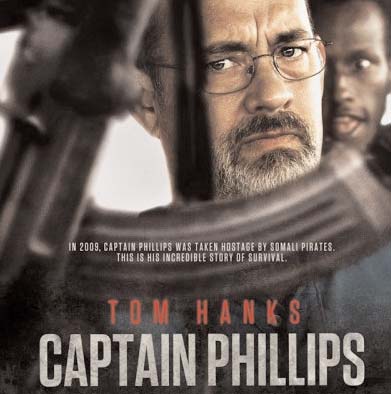
Captain Phillips
STORY: The film documents the 2009 hijacking of the US-flagged cargo ship ‘Maersk Alabama’ by Somali pirates. Unarmed and unprepared… how Captain Phillips (Tom Hanks) and his crew tackled the intruders forms the story. REVIEW: If Gravity made you experience the horrors of space, this tense drama in the high-seas will leave you feeling claustrophobic. The film is an archetypal Paul Greengrass thriller, which keeps you on the edge of your seat with its twists and turns. It engages you in deciphering the consequences of a criminal activity that unfolds onscreen. Based on a true-life story, at the helm of the hijacked ship is Captain Phillips (Tom Hanks), who puts his life in jeopardy to save his crew and the valuables on his vessel after being attacked by the Somalian pirates. His deadly cat-and-mouse game with the gun-wielding Somalians and relationship with their team leader Muse (Barkhad Abdi) is heartfelt and unnerving. While Tom Hanks is undoubtedly flawless in his portrayal of a man who’s staring at death in the face, it’s the British director who impresses the most with his thoughtful execution. In all his films, Greengrass subtly makes you notice the humane side of his characters.
You feel for their fear, dilemmas as their behaviour reflects their inner turmoil. He challenges your perception of good and bad, making you realize that crime is driven by circumstances, not people. Be it Green Zone (2010) or United 93 (2006), there is no over-bloated display of American superiority, or undue sympathy for the perpetrators. This makes his vision distinct and thus work mature, when compared to the rest. However, unlike his previous films, the build-up here is a tad tedious so needs patience. Nonetheless, the pressure keeps mounting steadily. The dialogues are profound; especially the ones exchanged between the Capt. and Muse, where the latter expresses his helplessness. Barkhad Abdi and other actors who play his sidekicks are as brilliant as Tom Hanks. Cinematography and background score create the tension required. And finally, all those mulling over the accuracy of the biographical tale must know that the director shows no interest in giving his film a docudrama treatment either. It’s essentially about each individual’s fight for survival.
-

CATFIGHTS NO LAUGHING MATTER FOR PRIYANKA
For many, talk about catfights on film sets makes great fodder for gossip, but for actress Priyanka Chopra, who has been facing a volley of questions about her camaraderie with her “Krrish 3” co-star Kangana Ranaut, it’s no laughing matter. “It really upsets me how people reduce women’s stature in a movie that the focus only remains on how she fought with her female costar,” Priyanka said here Wednesday in response to a question about a catfight. “Nobody asks the men that. Nobody says how Hrithik (Roshan) or Vivek (Oberoi) would have fought. A lot of people find it funny and laugh about it, but I take it very seriously,” added the actress, who is working with Kangana for the second time after “Fashion”. She claims they gel well. “Kangana and I have worked in the past on a film (‘Fashion’), which I believe has been a turning point in our respective careers. We get along very well.” Kangana, who was present at the press conference for the promotion of “Krrish 3” here, said: “I agree with Priyanka. We are here, promoting the film together and there is no problem between us. We are not kids that we will fight on sets.” The press conference was also addressed by filmmaker Rakesh Roshan, Hrithik Roshan and Vivek Oberoi. Their superhero movie releases Nov 1.
-

SUNNY LEONE REFUSES TO GO TOPLESS?
Ironic as it may sound, actress Sunny Leone, who is known for her porn films in the US, recently refused to go topless for a scene in her upcoming horror flick. The shot required her to cover her bare breasts with her hands, but Sunny was hesitant and insisted that she be allowed to wear a bikini top. The makers finally agreed to the actress’s demand. Says a source, “Though she was allowed to shoot wearing a top, it was later removed using computer graphics. Her breasts were then digitally superimposed from one of her earlier films.”
-

Shahid
STORY: A story based on real-life human-rights and criminal lawyer, Shahid Azmi, who was slain while defending the wrongly accused by the law in terrorist activities. REVIEW: You can escape a terror attack. You can fight terrorism. But what happens when you are branded a ‘Terrorist’ for life? On the grounds that your name reads ‘Zahir’, ‘Faheem’, ‘Khan’, ‘Shaikh’ (and not Matthew or Donald? God help!). Even if you’re acquitted, the right to live a life in fairness and dignity is permanently adjourned. Case closed! The story of ‘Shahid’ (fact remixed with fiction) confronts us with hard-hitting questions on religious fundamentalism, flawed legal investigations, and injustices suffered by the underdogs. In his teens, Shahid (Raj Kumar) witnesses the savagery of religious antagonism during the 1993 Mumbai riots. Shattered and shaken, he escapes from his ‘slumdog’ existence to Kashmir to join the militants. Unnerved with lessons in jihad and jingoism, he returns to a brief life of normalcy in Mumbai. The past catches up. He’s arrested and thrown into prison under Mumbai’s anti-terror laws. During his term he meets co-quaidi and mentor who shows him light in the dark cells of his tormented existence.
Shahid begins studying in jail, once acquitted, he gets his law degree and amidst much resentment, humiliation (often called jihadiyon ka Gandhi) and lifethreatening challenges, he becomes a fearless champion for his cause. He remarkably wins some of the most controversial terrorism cases (including defending the prime accused in 2008 Mumbai terror attack). One fateful night Shahid is gunned down. His case files reopen. Mehta’s film is brutally honest, brave and above all a fascinating humane story. Nothing distracts the dark and disturbing subject, the narrative is not found guilty of over-dramatizations; indulgence or loaded lines (like ‘tareek pe tareek’ and ‘Milord’, here). He finds a perfect pitch at crucial points – The courtroom interrogations, Shahid’s subtle romance with Mariam (Prabhleen), and moments shared with Arifbhai (Mohammed, in a fine performance) are subtle, but stirring. Raj Kumar is superb; he peels layers to strip to the core of his character. He magnifies the most intense scenes with sheer brilliance of an understated, realistic performance. It warrants applause. And an unadulterated encore. Catch it if real cinema is what you crave.
-

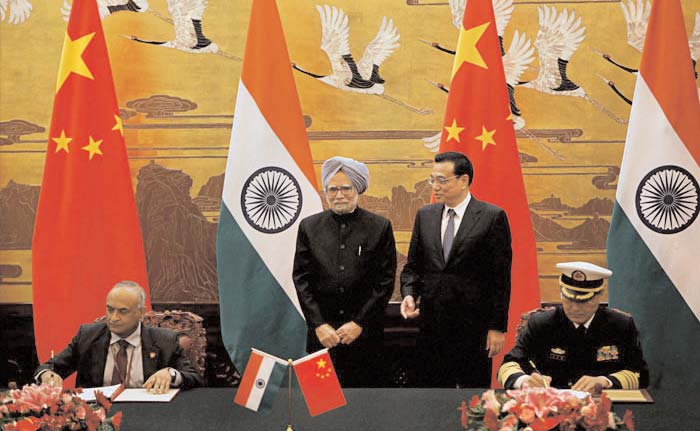
India, China ink border pact
NEW DELHI (TIP): India and China took a leap towards reducing recurring tensions across the border and promised to strengthen cooperation on trans-border rivers, even as New Delhi delayed a pact for a liberalised visa regime. The Border Defence Cooperation Agreement (BDCA) was among the nine pacts the two countries signed here at the conclusion of talks between the two sides led by Prime Minister Manmohan Singh and Premier Li Keqiang. The BDCA envisages having incremental interaction across levels starting with border personnel meetings at designated places along the 4,000-km border; periodic meetings between officers of the Military Regions of China and Army Commands of India, and similar meetings between representatives of Defence Ministry on either side; meetings of the Working Mechanism for Consultation and Coordination; and the regular Sino-India annual defence dialogue. The Prime Minister also met President Xi Jingping, who underscored the need for the two countries to charter a course for the future need to stand tall and look far.
The Prime Minister invited Xi to visit India, while the Chinese President promised to take New Delhi’s concern on river water into account from a human angle. China’s assistance to Pakistan was also brought up during the meetings with the two Chinese leaders. Underscoring the significance of Prime Minister Singh’s visit, Premier Li noted that this was the first time since 1954 that exchange visits of Prime Minister of India and Chinese Premier took place within the same calendar year. Premier Li came to India in May, the first overseas country he chose to start international engagement after assuming the office. Both India and China held wide ranging talks on bilateral, regional and international issues and arrived at a broad consensus and reaffirmed their commitment to take forward the “Strategic and Cooperative Partnership for Peace and Prosperity” for its 2.5 billion people. As Prime Minister Singh characterised the development at the joint press conference: “When India and China shake hands, the world takes notice.” He noted that both India and China had agreed that as large neighbours, the relationship pursued with other countries following independent foreign policy should not become a cause for concern for each other. “This will be our strategic reassurance.” Prime Minister Singh and Premier Li mentioned that both sides had agreed to strengthen strategic communication at all levels, including on shared neighbourhood in order to build mutual trust.
The liberalised visa regime that would have enhanced extended period of stay for business visitors was put on the hold by India to convey its unease over the decision to give stapled visas to two archers from Arunachal Pradesh recently. India did not allow the sportspersons to take part in the event in China and raised the issue during the talks today. But having placed the issue on the table, Foreign Secretary Sujatha Singh said it would remain in discussion. Asserting Arunachal Pradesh is an integral part of the country, India felt the state cannot be discriminated against by such a policy which China felt was a practice followed by countries in some cases. Through the Memorandum of Understanding on trans-border rivers pertaining to Brahmaputra or Yaluzangbu, as the Chinese call it, both agreed to extend the hydrological data provision period during flood season in China from May 15 to October 15, instead of existing start period of June 1 each year. The two will further strengthen cooperation and cooperate through existing Expert Level Mechanism on provision of flood-season hydrological data and emergency management.
India has expressed concerns over China’s plans to construct a series of dams across the river as an upper riparian state. Manmohan Singh said Premier Li was receptive when he expressed concern about the unsustainable trade imbalance and explore avenues to bridge the gap. India agreed to take forward the suggestion by Premier Li for setting up an industrial park to attract investment from China to India. India faces an adverse trade balance of up to 42 per cent while bilateral trade touched $ 62 billion last year as against the 2015 target of $100 billion. Around the time the two leaders were meeting, CEOs Forum of India and China were engaged in a discussion in an adjoining room of the Great Hall of the People. Besides, both countries envisage further discussion on concept of alignment of the ambitious BMIC (Bangladesh, Myanmar, India and China) economic corridor. Deputy Chairman of Planning Commission Montek Ahluwalia said besides understanding on water efficiency, railway modernisation was being looked at as an idea including technology for heavy haul of freight and increasing speed of trains.
-

Agusta gets show-cause notice on copter deal
NEW DELHI (TIP): The Ministry of Defence (MoD) has issued a show-cause notice to AgustaWestland, a subsidiary of Italian major Finmeccanica, seeking the cancellation of the contract for the purchase of 12 helicopters at a cost of Rs 3,500 crore. The notice was issued on October 21 and the company has been given three weeks to respond. “Documents available with the MoD had lead to the showcause notice,” official sources said. The MoD has cited the ‘pre-contract integrity pact’ in issuing the notice. The pact says that no bribes had been paid to win the contract while Italian prosecutors have claimed in the court to have traced payments of Rs 350 crore made as kickbacks to Indian as well as Europeans. Among those facing charges is former IAF Air Chief Marshall SP Tyagi (retd). The first cancellation notice was issued on February 15 and it had come just three days after Giuseppe Orsi, CEO, Finmeccanica was arrested in Italy. The notice was based on media reports and reports from the Indian Embassy in Rome. The notice issued now is final and is based on documents the CBI has collected from Italian prosecutors and provided to the MoD, officials explained. The payments to the company were put on hold in February. AgustaWestland had issued a press statement on October 4, saying it would invoke the arbitration clause.
-

PM says CBI can question him on coal scam: PM
NEW DELHI (TIP): Prime Minister Manmohan Singh on October 24 on board his special aircraft offered to open his doors for questioning by the Central Bureau of Investigation (CBI) in the probe into the allocation of a coal block to Aditya Birla Group company Hindalco. “I am not above the law of the land. If there is anything that the CBI, or for that matter, anybody wants to ask, I have nothing to hide,” Singh said as he headed back from Beijing ahead of polls in five states including Delhi and Madhya Pradesh. Singh’s offer to put himself under the CBI scanner is his first. The opposition has been seeking to know why the CBI is not investigating Singh, who had cleared the allocation of the coal block in Odisha as the minister incharge in 2005. Hindalco has denied any wrongdoing in the allocation. The Prime Minister’s Office had hoped to cap the controversy before Singh left on a two-nation tour to cement ties with Russia and China with a detailed statement, explaining the circumstances and reasons for the decision. It had recalled that Odisha chief minister Naveen Patnaik had written to them to give Hindalco the coal block to help generate more employment in the state. The opposition Bharatiya Janata Party (BJP), however, did not relent and has kept up the pressure on the Congress-led UPA government and the CBI, which is investigating 14 cases in the coal scandal. Asked if a string of scandals, from the 2G spectrum allocation to the coal allocation scam, had cast a shadow on his legacy, Singh said, “That is for history to judge”. “I am doing my duty… What impact my 10 years of Prime Ministership will have is something which is for historians to judge.”
-

Rahul Gandhi still has to prove mettle: Sharad Pawar
NEW DELHI (TIP): Agriculture minister Sharad Pawar on October 24 said Congress vice-president Rahul Gandhi has to prove his mettle before taking up a bigger role after the 2014 Lok Sabha polls. “One has to prove his mettle in administration. Rahul Gandhi should have joined the Manmohan Singh government. He did not join,” the NCP chief told a TV channel. “I would have preferred if he had joined the Manmohan Singh government… definitely it would have been beneficial for him,” he added. However, Pawar refused to elaborate on the issue saying he was not opposed to Rahul’s candidature for the post of prime minister. When asked whether he would be uncomfortable working under Rahul, Pawar said, “Here, there is no question of working together. There is a generation gap.” The NCP boss maintained that the two major political parties — Congress and BJP — may be short of the magic number to form government.
“BJP might get some more seats. Congress might lose some. But the numbers may not add up,” he said. Reiterating his support for the Congress irrespective of election results, the Maratha strongman argued that that UPA had a better prospect of getting support of regional allies. “I am with Congress. My association will be with Congress. Tomorrow, if situation comes, I will stand with Congress and UPA and will help to get likeminded forces to form the government,” he said, adding that Congress must work with allies. Pawar clarified that he was not going to contest in the next Lok Sabha elections, dismissing rumours that he was in the race for the post of prime minister. He rejected the view that there was a Narendra Modi wave in some parts of the country. Reacting to a question on Modi, Pawar said, “I have contested 14 elections so far. In my experience of electioneering, those who begin much earlier will be disappointed.”
-

Heavy rain batters Andhra Pradesh, thousands evacuated
HYDERABAD (TIP): Heavy rain triggered by northeast monsoon and a low pressure area over Bay of Bengal lashed several parts of Andhra Pradesh for the fourth consecutive day on Friday, prompting authorities to evacuate thousands of people from low-lying areas. Low lying areas continued to remain under water in number of towns and villages, particularly in coastal Andhra and Rayalaseema. Hundreds of houses have been damaged due to the rainfall, rendering many people homeless.Thousands of people have been evacuated from their homes and shifted to emergency relief camps. The rain has claimed over ten lives and crops over a vast area of land has been destroyed. “The situation is very grim as the entire delta area is completely inundated. Drains and tanks are overflowing and there is a threat of breaches occurring at some places because of the nonstop rain,” Guntur district collector S Suresh Kumar said. In Guntur district, 36 relief camps have been opened for 11,000 people who were evacuated from rainravaged villages, he said.
Six lift-irrigation scheme workers, who were stuck in flood at Chilakaluripet and Yedlapadu since Thursday, were rescued on Friday with the help of National Disaster Response Force personnel, the collector said. River Krishna is in spate with a heavy inflow of floodwater. Consequently, 70 crest gates were lifted at Prakasam Barrage in Vijayawada to discharge 1.18 lakh cusecs of water into the Bay of Bengal. In Srikakulam district in north coastal Andhra, more than 45,000 people have been shifted to relief camps as heavy rain continues to lash the district. Several rivers including Vamsasadhara and Bahuda in north coastal Andhra and rivulets were in spate at many other places. The rain has disrupted buses and train services in north coastal Andhra. Hyderabad and various parts of Telangana also received heavy rainfall for the last few days, which led to water logging on roads and also several residential colonies. The heavy downpour and waterlogging resulted in massive traffic jams making it difficult for vehicle drivers to find their way through. As the railway track at Golantri remained under a sheet of two-feet of water, train services between Visakhapatnam and Bhubaneswar were cancelled.
In East Godavari district, headquarters town Kakinada remained submerged, throwing life out of gear. Incessant rain have also left Hyderabad-Secunderabad twin cities battered. Chief Minister N Kiran Kumar Reddy spoke to the collectors of Srikakulam, Prakasam, Guntur and others districts late on Thursday night and directed them to give top priority to rescue operations, shifting people to safer places and organizing other relief measures, official sources said. He directed the officials to help the farmers and take steps to strengthen bunds of tanks and other water bodies. The CM also asked the chief secretary to coordinate with the National Disaster Response Force (NDRF) police, fire and other emergency personnel in rescue and relief operations.
-

PMO denies access to NSA’s note
NEW DELHI (TIP): The Prime Minister’s Office has denied an RTI plea to access a note written by national security adviser (NSA) Shivshankar Menon reportedly calling for a new strategy to get access to data that governments in advanced countries collect by monitoring the use of websites by Indians. The government said disclosure would prejudicially impact India’s foreign relations with countries. The internal note reportedly written by the NSA — “cyber security challenges that India is facing and the way forward” — outlines a strategy on how countries use data and the legal basis for acquiring such data from service providers. The note is also reported to have called for developing standard operating procedures for security cooperation in cyberspace with major IT powers around the globe. The denial was in response to an RTI application by Commonwealth Human Rights Initiative’s Venkatesh Nayak. In its reply, the PMO said, “Your request for a copy of the note reportedly authored by Shivshankar Menon, NSA on the matter of ‘cyber security challenges facing India’ was considered in the PMO.
The CPIO, PMO held that disclosure of the information sought would prejudicially affect the security and strategic interests of the state and relations with foreign states. As such, exemption from disclosure was claimed under section 8(1)(a) of the RTI Act.” Upholding the PIO’s order, the appellate authority said the CIC had in a previous order (Nusli Wadia vs ministry of external affairs) said that it was “within the exclusive domain of the ministry to decide and determine as to whether such disclosure is likely to have any impact on India’s relations with a foreign state or not. We may only determine whether the public authority in question has arrived at this conclusion after the exercise of due diligence”.’ CHRI’s Nayak said, “While the government is worried about getting access to data about how we use the Internet under the pretext of being prepared to fight terrorism, a very legitimate concern no doubt, in the age of the RTI Act, the government does not believe in taking its own people into confidence to explain what it is doing on this issue.” He has filed an appeal with the Central Information Commission arguing that since the strategy deals with monitoring a common citizen’s internet usage and, in turn his privacy, the issue must be discussed in the public domain.
-

India gets 101st rank on global gender gap index
NEW DELHI/GENEVA (TIP): Indicating a poor state of affairs on gender parity front, India was today ranked at a low 101st position on a global Gender Gap Index despite an improvement by four places since last year. The index, compiled by Geneva-based World Economic Forum (WEF), has ranked 136 countries on how well resources and opportunities are divided between men and women in four broad areas of economy, education, politics, education and health. While India has been ranked very high at 9th place globally for political empowerment, it has got second-lowest position (135th) for health and survival. Its rankings for economic participation and opportunity are also low at 124th and for educational attainment at 120th. The high rank for political empowerment is mostly because of India getting the top-most score in terms of number of years with a female head of state (President), as its political scores is not very good for factors like number of women in Parliament and women in ministerial positions. While India has moved up four positions from its 105th position in 2012, it still remains lowest-ranked among the five BRICS nations.
Top-four positions on the global have been retained by Iceland, Finland, Norway and Sweden. Philippines has moved up to 5th place, while Ireland has slipped one position to sixth rank. They are followed by New Zealand, Denmark, Switzerland and Nicaragua in the top ten. Other major countries on the list include Germany at 14th, South Africa at 17th, UK at 23rd, Russia at 61st, Brazil at 62nd and China at 69th. Those ranked lowest include Pakistan at 135th and Yemen at 136th. The countries that are ranked below India also include Japan (105th), UAE (109th), Republic of Korea (111th), Bahrain (112th) and Qatar (115th). About India, WEF said that India continues to struggle to demonstrate solid progress towards gender parity. Its economic participation and opportunity score has actually gone down in the past twelve months, although it has done well on political empowerment front. “This is largely down to the number of years it has had a female head of state and for the other two indicators — women in parliament and women in ministerial positions — it ranks 106 and 100 respectively,” it said. While no country has reached parity in terms of years with a female head of state, India has managed to get top rank for this indicator, whereas 65 per cent of countries have never had a female head of state over the past 50 years.
India’s ninth position on political empowerment front is also its best-ever rank for this sub-index, where it was ranked 17th in 2012 and its lowest score was 25th in 2008. The overall ranking of 101st is also its highest in the past seven years. India had ranked better at 98th position in the WEF’s inaugural Gender Gap Index in 2006. WEF said that increased political participation has helped narrow the global gender gap across the world. A total of 86 countries have improved their rankings since last year, while Iceland has maintained narrowest gender gap for fifth year running. Globally, progress is being made in narrowing the gender gap for economic equality, but women’s presence is economic leadership positions is still limited in both developing and developed countries alike. “Countries will need to start thinking of human capital very differently ? including how they integrate women into leadership roles. This shift in mindset and practice is not a goal for the future, it is an imperative today,” WEF founder and executive chairman Klaus Schwab said. “Both within countries and between countries are two distinct tracks to economic gender equality, with education serving as the accelerator,” said Saadia Zahidi, co-author of the Report and Head of the Women Leaders and Gender Parity Programme at WEF. “For countries that provide this basic investment, women’s integration in the workforce is the next frontier of change. For those that have not invested in women’s education, addressing this obstacle is critical to women’s lives as well as the strength of economies,” Zahidi added.
-

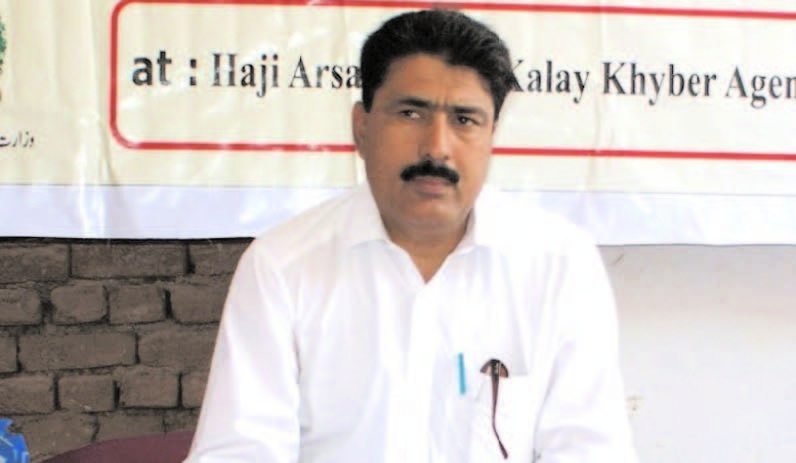
Doctor who helped track Osama bin Laden ‘not a hero’: Pakistan
ISLAMABAD (TIP): Pakistan has told the US that Shakil Afridi, the jailed doctor who helped the CIA track al-Qaida chief Osama bin Laden, is not a hero and his fate will be decided by the courts. Foreign secretary Jalil Abbas Jilani said Pakistan had told the US that Afridi was involved in “criminal activities” that violated the laws of the land. Addressing a news briefing in Washington on Prime Minister Nawaz Sharif’s ongoing visit to the US, Jilani said the doctor was “not a hero and was facing cases in courts”. Pakistan also told the US that the Lashkar-e-Taiba had been banned and action could be taken against its founder, Hafiz Mohammad Saeed, if substantial evidence is made available, he said. Responding to questions after the US house committee on foreign affairs demanded the release of Afridi, Jilani said that the Pakistani courts would decide his fate.
The demand for Afridi’s release was raised during a meeting between the US house committee and a Pakistani delegation that included finance minister Ishaq Dar, Jilani and Sartaj Aziz, the premier’s adviser on foreign affairs and national security. The two sides discussed matters related to the war on terror, militant groups like the LeT, civil nuclear programme, drone strikes, energy crisis, educational reforms, regional stability and trade, Dawn newspaper reported. Afridi was arrested shortly after the May 2, 2011 raid by US commandos that killed bin Laden. He was subsequently convicted by a court in the tribal belt on a charge of treason for alleged ties to the Lashkar-e-Islam militant group. On August 29, a judicial official overturned the 33-year jail term given to Afridi and ruled that the judge in the tribal areas had exceeded his authority when he handed down the sentence last year. The official also ordered a fresh trial. The US has been pressing Pakistan to release Afridi, who ran a fake vaccination campaign in Abbottabad to gain access to bin Laden’s compound.
-

China making N-reactor copies to sell to Pakistan
ISLAMABAD (TIP): China will be able to sidestep global nuclear commerce rules when it sells its third generation nuclear reactors to Pakistan, making its sale a win-win deal for both countries. China has reverse-engineered Westinghouse’s AP-1000 reactor to build an indigenous reactor, which, officials said, is a clever copy of the original. With Pakistani nuclear officials travelling several times this year to China as they work on a contract, the “indigenized” Chinese reactor will help Beijing overcome a key objection by the Nuclear Suppliers Group (NSG) that forbids sale of nuclear reactors or components to third countries without NSG approval and without an NPT signature. The Chinese reactors in Pakistan will be under IAEA safeguards that make them safer and lesser cause for worry in India. But Indian officials are much more concerned about nuclear weapons and missiles that China is reportedly helping Pakistan with. That, senior Indian officials say, is a greater cause for concern. China has not yet tested the design of its indigenized reactor but this is the one that will be sold to Pakistan, scheduled to be installed in Karachi.
According to sources here, China National Nuclear Corporation (CNNC) has claimed it has indigenously designed and developed a thirdgeneration nuclear power reactor which they have named as the Advanced China Pressurised (ACP)- 1000. China has reportedly indigenized most of the reactor components, which will be sold to Pakistan bypassing NSG requirements, under a grandfathering clause. Reports say Beijing is planning to install the first Chinese reactor in Fujian province. China was helped in this when Westinghouse sold its first reactor to China in 2007, China insisted on transfer of technology. According to a leaked cable by the US Consul General in Shanghai, “Chinese government made it very clear that failure to transfer AP1000 technology would have been a deal-breaker, and Westinghouse would have lost the contract.” The US official quotes a Westinghouse official as saying, “Westinghouse expressed the pragmatic view that, “If people are going to reverse engineer or copy nuclear technology, Westinghouse would prefer that people copy Westinghouse technology.” The Chinese contract was the biggest ever at $8 billion.
India is negotiating the purchase of two AP1000 reactors from Westinghouse — a pre-early works agreement was signed during PM Manmohan Singh’s recent visit to the US. But it is not clear that India would be getting any technology transfer of the variety that the Chinese have received from the American company. China’s indigenization programme is aimed at being able to provide more nuclear reactors to other customers in the world. There has been little Western protest against Chinese decision to sell such reactors to Pakistan. When China does begin building nuclear reactors in Pakistan, experts reckon, Beijing will still need to import a fair number of components from other industrialized nations. This would be seriously flouting NSG rules. Indian officials say China helps the Pakistan nuclear programme in a myriad different ways. For example, China sends its nuclear experts under the IAEA umbrella to undertake safety missions in Pakistan that Western officials avoid due to security problems.
-

Pakistan military blames India for truce violations
ISLAMABAD (TIP): Faced with India’s charges of continued ceasefire violations, Pakistan’s military on October 23 blamed Indian troops of targeting its forward posts in the past two days. “Indian troops have intensified violations and carried out unprovoked firing in Pukhlian, Chaprar, Harpal and Charwah Sectors near Sialkot, and targeted civilian areas,” Pak’s military spokesperson, Major General Asim Saleem Bajwa, said in a statement. It comes a day after a BSF head constable was killed and seven personnel injured in heavy firing by Pakistani troops, prompting Indian home minister Sushilkumar Shinde to call for a befitting reply. The Pak military had described the shelling and firing on Indian positions as a “retaliation”. The military spokesperson said Indian’s border security force (BSF) had targeted 27 Pakistani posts along the border in last two days. “Pakistani troops have effectively responded to Indian firing. During the last 2 weeks, due to Indian shelling, a Ranger’s soldier and two civilians were killed while 26 people were injured along the IB and LoC,” he said.
-

At least six killed as bomb hits Pakistan passenger train: Officials
QUETTA, PAKISTAN (TIP): A bomb hit a passenger train in Pakistan’s restive southwest on October 20 killing at least six people and wounding more than 17 others, officials said. The device, apparently planted on the railway track, exploded when the train approached a station in Naseer Abad district of the insurgency hit southwestern Baluchistan province. “It was a bomb blast, the target was the passenger train. At least six people have been killed,” Asad Gilani, provincial home secretary said, adding that more than 17 others were wounded in the blast.
-

Former Pakistan PM, officials deny US drone collusion
ISLAMABAD (TIP): Pakistani officials and former prime minister Yousuf Raza Gilani on October 23 denied a report that they had approved US drone strikes on the country’s soil.Washington Post on october 21 quoted leaked secret documents as saying Pakistan had been regularly briefed on strikes up till late 2011 and in some cases had helped choose targets.The purported evidence of Islamabad’s involvement came as Prime Minister Nawaz Sharif met US President Barack Obama at the White House and urged him to end the attacks, which are widely unpopular with the Pakistani public.A Pakistani foreign ministry spokesman said the anti-drone stance of the Sharif government, elected in May, was clear and any past agreements no longer applied. Pakistani security officials claimed the story was a US attempt to undermine Sharif’s position and reduce criticism of the drone campaign, days after an Amnesty International report warned some of the strikes could constitute war crimes.Washington Post’s revelations concerned strikes in a four-year period from late 2007, when military ruler Pervez Musharraf was in power, to late 2011 when a civilian government had taken over. Gilani, prime minister from 2008 until June last year, vehemently denied giving any approval for drone strikes. “We have never allowed Americans to carry out drone attacks in the tribal areas,” Gilani told AFP. “From the very beginning we are against drone strikes and we have conveyed it to Americans at all forums,” he added. Islamabad routinely condemns the strikes targeting suspected Taliban and Al-Qaeda militants in its northwest tribal areas. But evidence of collusion or tacit approval has leaked out in recent years.
-

US monitored the phone calls of 35 world leaders: Report
LONDON (TIP): The United States monitored the phone conversations of 35 world leaders according to classified documents leaked by fugitive whistleblower Edward Snowden, Britain’s Guardian newspaper said on Oct 24. Phone numbers were passed on to the US National Security Agency (NSA) by an official in another government department, according to the documents, the Guardian said on its website. It added that staff in the White House, state department and the Pentagon was urged to share the contact details of foreign politicians. The revelations come after Germany demanded answers from Washington over allegations chancellor Angela Merkel’s phone was bugged, the worst spat between the two countries in a decade. The White House did not deny the bugging, saying only it would not happen in future. “In one recent case, a US official provided NSA with 200 phone numbers to 35 world leaders,” reads an excerpt from a confidential memo dated October 2006 which was quoted by the Guardian. The identities of the politicians in question were not revealed. The revelations in the centre-left Guardian suggested that the bugging of world leaders could be more widespread than originally thought, with the issue set to overshadow an EU summit in Brussels. No immediate comment on the report was available from the NSA.
-

Immigration reform tops Obama menu
WASHINGTON (TIP): US President Obama on October 24 asked the Republican-majority House of Representatives to pass by the year end a stalled immigration bill over which India has expressed concern. “Let’s see if we can get it done this year. Let’s not wait. It doesn’t get easier to just put it off. Let’s do it now. Let’s not delay. Now it’s up to Republicans in the House to decide whether reform becomes a reality or not,” Obama said in a White House speech.If enacted into law the bill will pave the way for citizenship of 11 million undocumented people and accelerate immigration of science and technology professionals from India and China. Prime Minister Manmohan Singh has expressed India’s concern over the comprehensive immigration bill, already passed by the Senate. Certain provisions of the bill, in particular those related to H-1B and L1 visas, will adversely impact top Indian IT companies doing business in the US. Obama said the current immigration system is broken. “It’s not smart; it’s not fair; it doesn’t make sense. We have kicked this particular can down the road for too long,” he said.
“It’s not smart to invite some of the brightest minds from around the world to study here and then not let them start businesses here. We’ve sent them back to their home countries to start businesses and create jobs and invent new products someplace else,” he said. The Senate passed the bill in June. The plan, crafted and approved with Senate Republican support, would strengthen the border with Mexico and reorganise the visa system to give priority to high-demand fields, including engineers and farm workers.Meanwhile, the US-India Business Council (USIBC) is keeping a close eye on the bill on the House version of the bill to protect the interest of the Indian companies. PTIand US businesses with ties with India. “USIBC plans on being absolutely vigilant in the coming weeks and months with its Coalition for Jobs and Growth, with Patton Boggs leading the lobby effort, to ensure that when the Immigration Reform Bill reawakens and begins to gain traction that we are in front of it and doing our best to educate lawmakers to make certain the discriminatory provisions are excised from any final Bill,” USIBC president Ron Somers said. “We will continue to sensitise the Senate as to these harmful provisions, while working with the House to ensure a clean bill, so that when legislation goes to conference we will have champions in both chambers to ensure a clean outcome,” Somers said.