Year: 2013

  • John Kerry warns that another budget gridlock will damage US leadership

    John Kerry warns that another budget gridlock will damage US leadership

    WASHINGTON (TIP): America’s top diplomat warned on October 23 that the United States could suffer more lasting damage to its influence abroad if the next round of budget talks in a few months lead to another breakdown. Secretary of State John Kerry said the recent 16-day shutdown had raised questions among key allies about whether Washington can be counted on to lead – whether it is in talks with Iran, Middle East peace negotiations or completing an Asia- Pacific trade deal. “What we do in Washington matters deeply to them, and that is why a selfinflicted wound like the shutdown that we just endured can never happen again,” Kerry told the Center of American Progress policy think tank. “The simple fact is that the shutdown created temporary but real consequences in our ability to work with our partners and pursue our interests abroad,” Kerry added. Kerry’s warning about future U.S. credibility was more forceful at home than abroad. In Asia recently where he stood in for President Barack Obama at summits in Indonesia, Brunei and Malaysia, Kerry dismissed the protracted budget negotiation in Washington as a “moment in politics” and assured countries it would not hurt U.S. commitments to the region.

    But back in Washington on Thursday after several weeks of non-stop travel in Asia and Europe, Kerry said the shutdown had affected confidence in the United States abroad. “This political moment was far more than just symbolism, far more than just a local fight. It matters deeply to our power and to our example,” he said. “While this chapter is temporarily over, we’ve got another date looming, and the experience has to serve as a stern warning to all.” “Make no mistake, the greatest danger to America doesn’t come from a rising rival,” Kerry said, “It comes from the damage that we’re capable of doing by our own dysfunction and the risks that will arise in a world that may see restrained or limited American leadership as a result.” U.S. lawmakers reached a last-minute deal earlier in October to break the fiscal impasse and avert a crippling debt default, but it promises another budget battle in a few months. Under the deal, a House-Senate negotiating committing will be formed to examine a broader budget agreement, with a deadline of Dec. 13. The deal funds the government until Jan. 15 and raises the debt ceiling to Feb. 7. Kerry said America’s allies were watching the budgets talks closely.

  • Violence against Muslims threatening Myanmar reforms: UN envoy

    Violence against Muslims threatening Myanmar reforms: UN envoy

    UNITED NATIONS (TIP): Violence against a Muslim minority in Myanmar is feeding a wider anti-Muslim feeling that poses a serious threat to the country’s dramatic economic and political reforms as it emerges from half a century of military rule, a UN envoy said on october 23. The government says at least 192 people were killed in June and October 2012 clashes between ethnic Rakhine Buddhists and Rohingya Muslims, most of whom Myanmar deem illegal immigrants from Bangladesh, despite roots going back generations. The clashes led to unrest elsewhere in the country, where other groups of Muslims have been targeted, including Kamans, who are of different ethnicity from Rohingyas. An estimated 5 percent of Myanmar’s population of about 60 million is Muslim. “The president (Thein Sein) has made some commendable public speeches in which he has emphasized the need for trust, respect and compassion between people of different faiths and ethnic groups in Myanmar,” said Tomas Ojea Quintana, U.N.

    special rapporteur on the situation in human rights in Myanmar. “However, more needs to be done by the government to tackle the spread of discriminatory views and to protect vulnerable minority communities,” he told the U.N. General Assembly’s Third Committee, which deals with human rights issues. Thein Sein heads a quasi-civilian government installed in 2011 after Myanmar’s military stepped aside. Under his reforms, opposition leader and Nobel peace prize laureate Aung San Suu Kyi, who spent 15 years under house arrest, has been allowed back into politics and has made a number of visits abroad. “In our view the recent dramatic democratic changes in Myanmar were a clear demonstration of the changes of mindset in the government,” a representative of the Myanmar U.N. mission told the Third Committee. Myanmar is also known as Burma. “At the critical time of democratic transition no country is immune from challenges. Myanmar went through unfortunate communal violence in Rakhine state sparked by a brutal crime. We very much regret loss of life and property caused to both communities,” he said.The violence in northern Rakhine State, one of Myanmar’s poorest regions that is home to 1 million mostly stateless Rohingya Muslims, has continued this year. Dozens more have been killed and 140,000, mostly Rohingya, have been left homeless. “The situation in Rakhine State has fed a wider anti- Muslim narrative in Myanmar, which is posing one of the most serious threats to the reform process,” Quintana said. “Rakhine State remains in a situation of profound crisis.”

  • Boy who killed Nazi dad at age 10 to be sentenced

    Boy who killed Nazi dad at age 10 to be sentenced

    SANTA ANA, CALIFORNIA (TIP): The blond boy was 10 when he put a gun to the head of his sleeping neo-Nazi father and pulled the trigger. It was over in an instant for Jeff Hall, but sorting out the fate of his troubled son has been a 2{-year journey that approaches its final stage Friday in a hearing to determine where he’ll spend his teens and, possibly, his early adult years. The judge hearing the case must decide not how to punish a child for seconddegree murder, but how to rehabilitate someone who grew up in an abusive home, attacked his school teachers and was indoctrinated in the beliefs of white supremacy. Attorneys have sparred for months over what is best for the boy. He has been living in the county’s juvenile hall since the killing but spent about three months at a state youth detention center where he was evaluated to see whether a placement there could serve his needs. Several people from the state are expected to testify at the hearing. In the meantime, the small child who scribbled on a notepad and looked bored during his trial as prosecutors displayed photos of his father’s blood-splattered body has grown into a gangly teenager who is more focused than ever before.

    He attends class, gets regular therapy and has made progress in controlling the violent outbursts that got him kicked out of almost every school he attended. He has even, with time, won the affection of the prosecutor who got him convicted. “I have grown attached to him in an odd way. I enjoy watching him grow and change but I am convinced he has done better in a quasi-military penal environment,” said Deputy District Attorney Michael Soccio. “He seems to like it, he knows what the rules are and what is expected and he is treated with dignity.” That’s why Soccio believes the boy, now 13, would do best in the state’s juvenile justice system, where he would go to school and live in a dorm-like setting at a high-security facility for young offenders, possibly until age 23. Defense attorneys, however, say the teen has serious emotional disabilities that the state isn’t equipped to handle. They want to see him placed in a residential treatment center, where security would be lighter and the therapy would be more intense. Punam Patel Grewal, the boy’s defense attorney, said he would also be at risk in a state facility because of his father’s neo- Nazi beliefs. “It is a very dangerous place for him. He’s got a lot of vulnerability here,” she said. “When he comes out at 23, we’ve got a huge problem.”

    Murders by defendants as young as the one in Riverside are extremely rare and usually involve children who have mental health issues and have lived through extreme physical and psychological trauma, said Sarah Bryer, director of the National Juvenile Justice Network. “If the end goal is rehabilitation, then that youth’s mental health concerns are going to have to be front and center,” she said. “I think the judge has to ask the question, when this kid walks out, and this kid will walk out eventually, how is this kid going to be better?” Hall’s killing attracted national attention when it happened on May 1, 2011, and not just because of the defendant’s age. Hall, an out-of-work plumber, was also a regional leader of the National Socialist Movement who organized neo-Nazi rallies at synagogues and day labor sites and had hosted a meeting for the group at his house the day before he died. Hall, 32, ran unsuccessfully for a water board in 2010 and alarmed voters with his white supremacist rhetoric. Prosecutors said the boy shot his father behind the ear at point-blank range as he slept on the sofa after coming home from a night of drinking.

    The child took the .357- Magnum from his parents’ bedroom and later told police he was afraid he would have to choose between living with his father and his stepmother, who had been fighting and were headed for a divorce. The boy’s stepmother initially told police she had killed her husband, but later recanted and said she was trying to protect her stepson. His sister testified that he told her of his plan the day before, while they were playing on a swing set. During trial, the boy’s defense attorney portrayed him as a victim of both his father’s racist beliefs and of his violent upbringing. The boy’s stepmother told authorities that Hall had hit, kicked and yelled at his son for being too loud or getting in the way. Hall and the boy’s biological mother had each accused the other of child abuse multiple times during a protracted custody dispute. Social service workers visited 20 times but never removed the boy or his siblings from Hall’s custody. The child also had a history of being expelled from school for violent outbursts, starting at age 5 when he stabbed a teacher with a pencil on the first day of kindergarten. He also tried to strangle a teacher with a telephone cord.

  • Clintons to get public health awards from Harvard

    Clintons to get public health awards from Harvard

    BOSTON (TIP): Former President Bill Clinton and daughter Chelsea Clinton are being honored during the Harvard School of Public Health’s centennial celebration. At Thursday’s ceremony in Boston, the former president will receive a Centennial Medal along with two world health leaders. Also being honored are Dr Jim Yong Kim, president of the World Bank Group and co-founder of Partners in Health, and Dr Gro Harlem Brundtland, former prime minister of Norway and director-general of the World Health Organization. Chelsea Clinton will receive the Next Generation Award. The Centennial Medals honor people whose leadership has had a significant global impact, improving the health and well-being of people around the world. The Next Generation Award honors someone under 40 whose commitment to health inspires young people to make “health for all” a global priority.

  • Automatic budget cuts could hit Pentagon harder this year

    Automatic budget cuts could hit Pentagon harder this year

    WASHINGTON (TIP): Months after the US military was hit with a $37 billion budget cut that threw it into turmoil and confusion, the Pentagon is headed into the new fiscal year facing a similar threat that could have even more devastating consequences, officials say. The budget deal that ended the government shutdown this month let the Pentagon continue spending at an annualized level of $496 billion in the 2014 fiscal year that began on October 1. That is about $31 billion below what President Barack Obama requested for 2014, but about $21 billion above the caps set by the Budget Control Act of 2011, meaning the Pentagon faces another acrossthe- board cut unless Congress reaches a new spending deal that changes the law by mid-January. And the situation could get worse. Under the 2011 budget act, defense spending is expected to begin growing again in 2015. But a top defense budget analyst said on Thursday that based on historical trends from previous military cutbacks, Pentagon spending could shrink to as low as $415 billion.

    Todd Harrison, an analyst at the Center for Strategic and Budgetary Assessments think tank, said a drop of that magnitude would force a huge cut in the size of the military, cause the cancellation of many weapons programs and lead many defense companies to go out of business. “This would be, you know, catastrophic, if you will, for a lot of procurement programs. There would be a lot of glass on the floor at the end of this. You’d break a lot of things,” he told reporters at a briefing on the 2014 defense budget. Harrison said he was not predicting that scenario would actually take place, but looking at what could happen if the current defense drawdown followed the pattern of cutbacks after the end of the Cold War, the Vietnam war and the Korean war. Defense officials paint a grim picture of the impact the budget uncertainty is having on their ability to ensure the military is prepared for action in the future.

    FEWER HELICOPTERS
    Army assistant secretary Heidi Shyu told a panel in the House of Representatives on Wednesday that more automatic budget cuts this year could force the Army to buy 12 fewer Apache helicopters and 11 fewer Chinooks helicopters and delay upgrades to the Abrams tank and Bradley Fighting Vehicle. William LaPlante, a principal deputy Air Force secretary, said the Air Force might have to drop plans to buy four or five of the 19 F-35 Joint Strike Fighters it was scheduled to purchase. Navy officials told the panel they would have to cancel much of their planned maintenance for ships and aircraft. “What we’ve been experiencing over the last one-and-a-half to two years, frankly, has been extraordinarily destabilizing,” said Sean Stackley, a Navy assistant secretary, noting that the uncertainty was unraveling efforts to cut contracting costs. Automatic budget cuts under a mechanism known as sequestration, which reduces spending across all accounts regardless of their strategic importance, is causing “a steady decline” in military preparedness and ultimately national security, he said.

    Harrison said the budget cuts that went into effect in March prompted the military to reduce spending for weapons programs and development. The Pentagon shifted some of that funding to current operations and training, essentially trading future preparedness to maintain the present force. But even with that shift in funding for present operations, only two Army brigades are fully trained for combat in the event of a crisis, General Ray Odierno, the top Army officer, said this week. Harrison urged the Pentagon to acknowledge that Congress, after two years of discord, is unlikely to reach a deal to lift the budget caps it set in 2011. He said by submitting budget plans that recognize the caps, the Pentagon could avoid the uncertainty of across-the-board cuts and plan more effectively.

  • Detroit operating on ‘razor’s edge’’ before bankruptcy

    Detroit operating on ‘razor’s edge’’ before bankruptcy

    DETROIT (TIP): Detroit was operating on a “razor’s edge” and had no options to avoid running out of cash and filing bankruptcy, the city’s top adviser testified on Thursday in a trial to determine whether the city is eligible to file the largest municipal bankruptcy in US history. Kenneth Buckfire, the city’s top outside financial adviser, said the city tried to avoid filing bankruptcy in July by cutting expenses and looking at city assets that might be sold to raise cash. The case is being closely watched for the precedents it could set for other US cities facing huge healthcare and pension obligations amid declining revenue. Unions, pension funds and others who would face large financial losses if Detroit is granted bankruptcy protection are arguing that the city does not qualify and is rushing into bankruptcy as an effort to avoid meeting its financial obligations. Buckfire, an investment banker hired by the city in January to advise on its financial restructuring, described in his testimony the city’s search for cash in the weeks before the state-appointed emergency manager, Kevyn Orr, determined a bankruptcy filing was Detroit’s best option.

    Detroit’s best source of revenue was its three casinos, which brought in about $180 million a year, or 20 percent of the city’s budget, Buckfire testified. But those funds have been locked up since they were pledged as collateral to interest-rate swap contracts agreed to in 2009. And the city now hopes to use them as collateral on $350 million of debtor in possession financing to end the unfavorable swap deals. To raise cash, Detroit considered selling everything from masterpieces at the Detroit Institute of Arts to city infrastructure. But no deals could be closed before the July 18 bankruptcy filing, he said. The city’s Coleman Young Municipal Airport is “effectively worth nothing,” Buckfire testified. The city can’t sell its portion of the Detroit-Windsor tunnel until at least 2020, and the works of the Detroit Institute of Arts are currently being appraised by Christie’s auction house, Buckfire testified. The city also is looking to lease the Detroit Water and Sewerage Department to a regional authority. Detroit Emergency Manager Kevyn Orr proposed the deal in June, and negotiations are ongoing. But Buckfire testified that several private equity firms were potentially interested in purchasing the department if they could charge higher water rates.

    Buckfire’s testimony was part of Detroit’s efforts to convince Judge Steven Rhodes that Detroit meets the legal requirements of municipal bankruptcy. Lawyers representing unions, retirees and pension funds who oppose the bankruptcy will be able to question Buckfire, the third of five witnesses the city is expected to call, when the trial resumes Friday morning. Gaurav Malhotra, a financial analyst who has advised the city since 2011, testified earlier Thursday that Detroit could improve its cash flow only by restructuring its pension and health benefits, not by selling assets or deferring payments to its pension funds. Even if the city could sell some assets, the proceeds would do little to close the more than $18 billion in liabilities the city faces, he said. The city expects to wrap up its case on Friday. Michigan governor Rick Snyder, who appointed emergency manager Orr, is expected to testify on Monday. The trial could wrap up as early as next Tuesday. Rhodes is not expected to make a ruling on eligibility until at least mid-November.

  • Pak’s list of grouses grow, US unmoved

    Pak’s list of grouses grow, US unmoved

    WASHINGTON (TIP): Pakistan’s Prime Minister Nawaz Sharif trooped into the White House on October 21 for a meeting with President Obama in the face of multiple repudiations from the United States over Islamabad’s pet peeves: Drone strikes on Pakistan, its gripes against India over the Kashmir issue, and pleas that Washington treat it on par with New Delhi by accepting it as a nuclear equal. The meeting with the U.S President was going on at the time of writing and there was no readout yet, but the Obama administration made it clear on Tuesday that it did not particularly share Pakistan’s perception on any of these issues, starting with its handwringing over drone attacks on its lawless territory, accentuated by a well-timed Amnesty report highlighting some civilian casualties.White House spokesman Jay Carney set the stage for a rejection of Pakistan’s plea to stop drone strikes, saying U.S counterterrorism operations are precise, lawful, and effective, and they in fact minimize civilian casualties that would be greater if other conventional means were adopted to eliminate terrorists.

    “The United States does not take lethal strikes when we or our partners have the ability to capture individual terrorists. Our preference is always to detain, interrogate, and prosecute.We take extraordinary care to make sure that our counterterrorism actions are in accordance with all applicable domestic and international law and that they are consistent with US values and US policy,” Carney said, adding, “Before we take any counterterrorism strike outside areas of active hostilities, there must be near certainty that no civilians will be killed or injured, and that is the highest standard we can set,” he said. However, both sides are expected to project language that will minimize differences on this subject, with Washington promising to ease off the strikes as more and more suspected terrorists are eliminated, and praising Pakistan’s fight against terrorism despite its dubious credentials on this count. The U.S media was already predicting the pitch would be taking spin, with a headline in one newspaper reading, ”drones? What drones? Obama and Pakistan’s Sharif to accentuate the positive.”

    Various agreements, including one on science and technology cooperation, are being wheeled out to cover the tracks of disagreements, including over India’s role in Afghanistan, and more broadly the growing regional and global heft that Washington is helping New Delhi develop. Earlier this week, the Obama administration snubbed Sharif over his plea that Washington should mediate between India and Pakistan over the Kashmir issue, saying it was for the two sides to take care of this issue. In fact, despite the controversy over Sharif ’s reported putdown of Prime Minister Manmohan Singh (that he brings his complaints against Pakistan to Washington), it is Pakistan that has kept up an incessant reference to India, making it very much part of its gripe list. The Obama administration has entertained this only in the sense of trying to wean Pakistan out of its New Delhi complex of constantly seeking parity with it.Washington, US officials indicated ahead of the meeting, wants to have strong ties with Pakistan on its own without sharing its prejudice against India. The White House has not scheduled a media interaction at the Obama-Sharif meeting, much less an extended news conference, fearful of awkward questions.

    Even at a think-tank event on Tuesday, where Sharif made a speech, only the host former National Security Advisor Stephen Hadley posed three softball question before closing the meeting, keeping audience out of it. But it is not hard to discern that Sharif has had a torrid visit so far. There have been protocol putdowns, including him being entertained by Secretary of State John Kerry for dinner after he arrived on Sunday (while Obama was out playing golf with White House staffers), cooling his heels on Monday and Tuesday while the Obama dealt with other issues, and on Wednesday, having to breakfast with vicepresident Joe Biden (who, according to the White House schedule, then proceeded to have lunch with Obama) before the U.S President deigned to see him in the afternoon. The charitable explanation for all this is the Sharif is Pakistan’s Prime Minister, not President, but that brings to attention the extraordinary deference Obama has shown to Prime Minister Manmohan Singh. Sharif also faced a rough time on the Hill on Tuesday when he was questioned closely by the House Foreign Relations Committee over the continued incarceration of Dr Shakil Afridi, who helped the U.S nail Osama bin Laden, and Pakistan’s continued patronage of Lashkar-etaiba. “I specifically pressed the Prime Minister to release Dr. Shakil Afridi and encouraged him to ensure that his nation is in fact a responsible and effective partner in countering terrorism, proliferation and violent extremism in the region,” Committee chairman Ed Royce said later. His ranking colleague Eliot Engel was equally unsparing.

  • US cops shoot boy carrying toy gun

    US cops shoot boy carrying toy gun

    (CALIFORNIA) TIP): A 13-yearold California boy carrying a replica of an assault rifle to a friend’s house was shot and killed by a sheriff’s deputy who believed the gun was real, authorities said. The incident took place in Santa Rosa, Northern California, on October 21, a day after a 12- year-old boy killed a teacher at a Nevada middle school with a gun he also used to take his own life. The Santa Rosa boy’s father said his son, Andy Lopez Cruz, a middle schooler who played the saxophone and liked basketball, was shot while on his way to a friend’s house with a pellet gun . “It’s not right what they did to my son,” said the father, Rodrigo Lopez as he sat with family and friends outside Santa Rosa City Hall in a quiet protest. The incident took place against a backdrop of growing concern about officer-involved shootings in California, where a spate of such incidents prompted protests in 2012.

  • Myanmar’s Suu Kyi collects 1990 prize at last

    Myanmar’s Suu Kyi collects 1990 prize at last

    STRASBOURG (France): Aung San Suu Kyi, Myanmar’s Nobel Peace Prize laureate and long-time political prisoner, has finally collected the European Union’s 1990 Sakharov prize for human rights. In October 21 stirring ceremony, European Parliament President Martin Schulz said that “23 years later, we welcome you here and it is a great moment.” Suu Kyi has persevered for decades in promoting democracy. She and her National League for Democracy party were frozen out of politics by the military regime that governed until 2011, and last year she and several dozen party members won parliamentary seats. However, a clause in the army-dictated constitution disqualifies her from becoming president. She is now seeking the constitutional changes that would allow her to seek the presidency.

  • Bangladesh factory tragedy orphans vent grief

    Bangladesh factory tragedy orphans vent grief

    SAVAR, BANGLADESH (TIP): Orphans who lost their parents when a garment factory complex collapsed in Bangladesh vented their grief and anger at leading western retailers on Thursday as the country marks 6 months of the disaster. Relatives of the 1,135 people who lost their lives when the Rana Plaza complex collapsed on April 24 also said they had still to receive any compensation for their loss as they rallied at the site of the tragedy. “We lost our parents for your work: Walmart, Carrefour, Benetton …,” read a banner held by a group of orphans, listing some of the retailers whose clothing was made at Rana Plaza before it collapsed. Although some retailers have promised to pay into a compensation fund, activists complained that money was not reaching those in need. “If you talk about legal compensation, none of the 3,629 workers working in the Rana Plaza at the time of the disaster has been paid a single cent,” said Roy Ramesh, Bangladesh head of the IndustriALL global union, which is negotiating with retailers for compensation.

    “The government donated some money from its charity fund and British retailer Primark paid 30,000 taka ($375) to each of the victims,” he said, adding factory owners and the rest of the 28 retailers who were making clothing at the Rana Plaza factories have paid nothing. Rezaul Karim, 32, was one of the injured workers who joined the protest in front of the Rana Plaza ruins, demanding more money to treat his broken spinal cord and a monthly pension to maintain a decent life. “Since the collapse, I’ve got only the 30,000 taka given by Primark. I am now reduced to begging,” he said, clutching the hand of his eight-year-old son. “The government has paid for some of my treatment but more treatment is needed and it’ll cost a huge amount. “My son cannot go to school and there are days we don’t have enough food,” he said, adding he now depends on charity from relatives and neighbours. A report by British charity ActionAid published on the anniversary also highlighted a failure by the authorities and the retailers to compensate the Rana Plaza victims and their families. The charity surveyed 2,297 people — nearly two thirds of survivors and families of those who died — and found that 94 per cent reported they have not received any legal benefits from their employers since April, including sick pay or compensation. The Bangladesh government has paid some funds to 777 people — around a third of the victims and their family members — but no long-term compensation package has been agreed, it said.

  • Army deployed for Nepal poll security

    Army deployed for Nepal poll security

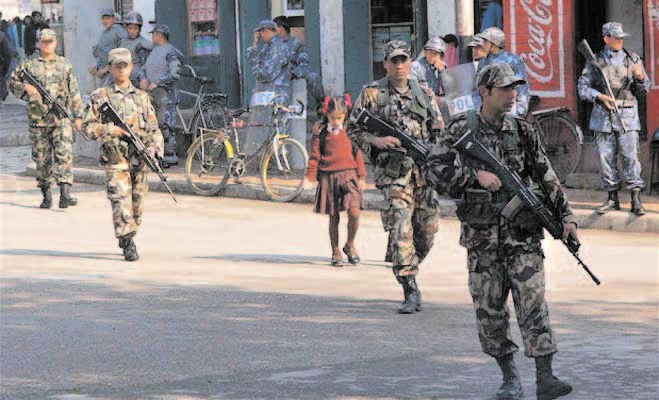
    KATHMANDU (TIP): The Nepal Army was deployed in the country on October 20 to ensure that the November 19 polls happen smoothly. According to army spokesman Brigadier General Jagdish Chandra Pokhrel, the army has been deployed as per the constitutional directive and will work together with other security forces. Two thirds of the 95,000 strong army will be deployed in 240 constituencies in 75 districts. The breakaway Maoist faction said that it will urge the people to boycott the elections. In pamphlets stuck in Kathmandu it said that since no party will win a majority, it will be allow India to interfere. The pro-monarchy Rastriya Prajatantra Party of Nepal is fighting the election on a nationalistic platform. It has called for referendum on status of monarchy and wants Nepal to again be a Hindu country. On the issue of federalism which was the sticking point the last time round, the Maoists have stuck to its ethnicity based provinces and an executive president directly elected by the people. The Nepali Congress wants a parliamentary system. Meanwhile the Communist Party of Nepal ( UML) has given a party ticket to Najma Khatun, the widow of Mohammed Alam who died of gunshot wounds earlier this month. Alam had been shot by men on a motorcycle with Indian number plates in southern Nepal.

  • OPPOSITION TO REJECT POLLS UNDER HASINA: KHALEDA ZIA

    OPPOSITION TO REJECT POLLS UNDER HASINA: KHALEDA ZIA

    DHAKA (TIP): Rejecting Premier Sheikh Hasina’s proposal for an allparty government to oversee Bangladesh’s next general election, opposition leader Khaleda Zia said her BNP party would not participate in the poll process without a nonparty neutral caretaker administration. “If we go to the election (with Hasina remaining as the premier), BNP would be affected…you have lost credibility among the people,” she told a convention of proopposition professionals here amid tight security. Zia said her party would only go to election under a “non-party neutral government”. BNP plans to stage a grand rally on October 25 to mount pressure on the Awami League-led government to accept its demand for polls under a non-party caretaker government. Bangladesh is scheduled to hold next general election anytime between October 25 and January 25, 2014.

    The constitution states that the election must be held within 90 days of the end of the tenure of the parliament. The term of the current parliament will end on October 25 and polls must be held by January 25, 2014. Awami League had scrapped the caretaker system amending the constitution with its three fourths majority in parliament two years ago in line with a Supreme Court judgement.The opposition in subsequent months staged violent street protests leaving scores of people dead. The opposition said elections under the party government would not be fair. But Awami League insisted the caretaker system proved counter productive as it was abused and it failed to protect democracy. League said the system rather allowed installation of an army backed regime to rule the country for two years, proclaiming Emergency Rules during 2007-2008, sending Hasina, Zia and many leaders of their parties to jail.

  • Afghan election candidates warned over phone bombs

    Afghan election candidates warned over phone bombs

    KABUL (TIP): Afghanistan’s intelligence service on October 21 warned candidates in the 2014 presidential election that mobile phones, computers and cameras given to them as gifts could contain hidden bombs. More than 20 candidates have registered in the race to succeed President Hamid Karzai, and the April election will pose a major security challenge as insurgents try to disrupt the US-backed process. The National Directorate of Security (NDS) said it had “intelligence information showing that the enemies of Afghanistan are planning to use new terrorist methods to disrupt the elections”. “Avoid accepting gifts such as mobile phones, computers, cameras and other packages before they are checked by your security personnel,” it advised. The Taliban last week claimed responsibility for a bomb hidden in a microphone that killed the governor of Logar province as he made a speech at a mosque after Eid prayers. Last year NDS chief Asadullah Khalid was badly injured by a suicide bomber who had explosives hidden in his underwear. Senior politician Burhanuddin Rabbani was assassinated by a bomber with explosives in his turban in 2011, while anti-Taliban commander Ahmed Shah Massoud was killed in 2001 by explosives inside a video camera.

  • Somdet Phra Nyanasamvara, Thai Buddhism’s supreme patriarch, dies at 100

    Somdet Phra Nyanasamvara, Thai Buddhism’s supreme patriarch, dies at 100

    BANGKOK (TIP): Thai doctors say the supreme patriarch, the head of the country’s Buddhist monks, has died. He was 100. Chulalongkorn hospital doctors say Somdet Phra Nyanasamvara died on October 23 from an infection in his blood vessels. He was the 19th supreme patriarch of Thailand and led the nation’s monks since 1989. The patriarch had battled health problems and had been hospitalized since 2002. He had undergone surgery earlier this month. His inability to perform his duties in recent years has led to speculation about his successor. A senior Buddhist monk who worked on his behalf since 2004 also died this year. Thailand is the world’s most heavily Buddhist country. More than 90 per cent of its 67 million people are members of the religion.

  • India ends eightyear- old ban, starts supplying arms to Nepal

    India ends eightyear- old ban, starts supplying arms to Nepal

    KATHMANDU (TIP): Ending an eight-year-old ban on military supplies, India has handed over some of the equipment, including vehicles and arms, it had pledged to provide to Nepal ahead of crucial polls to be held next month. Over 360 vehicles, including 25 mine-protected vehicles, have already arrived while arms and ammunition, which are in the pipeline, will come soon, sources in the Nepalese army headquarters said on October 22. This is the first time that military equipment is being provided to Nepal by India after ending a ban on the supply of such gear, including lethal arms, that was imposed when former King Gyanendra seized executive powers in February 2005, said a statement issued by army headquarters. Nepal has said the equipment is needed by 62,000 troops who will provide security for the constituent assembly elections to be held on November 19. The country recently amended its constitution to allow the army to be mobilized to ensure free and fair polls. The equipment provided by India so far includes 216 light vehicles, 154 heavy vehicles and some arms. Among the heavy vehicles are 58 trucks with a capacity of 7.5 tonnes, four ambulances and 25 mine-protected vehicles, sources said. The assistance will help smoothen regular operations of the Nepal Army, modernize the force and increase its efficiency for military operations, the official statement said. “This will also help in strengthening and further deepening Nepal-India mutual cooperation,” it said. India had agreed to provide the equipment during the tenth meeting of the Bilateral Consultative Group on Security Issues in April.

  • The Obama Doctrine

    The Obama Doctrine

    Is the US president veering toward isolationism? Or will he proudly carry the banner of exceptionalism?

    The recent Obama-Putin tiff over American exceptionalism reignited an ongoing debate over the Obama Doctrine: Is the president veering toward isolationism? Or will he proudly carry the banner of exceptionalism? The debate is narrower than it may seem. There is considerable common ground between the two positions, as was expressed clearly by Hans Morgenthau, the founder of the now dominant no-sentimentality “realist” school of international relations. Throughout his work, Morgenthau describes America as unique among all powers past and present in that it has a “transcendent purpose” that it “must defend and promote” throughout the world: “the establishment of equality in freedom.” The competing concepts “exceptionalism” and “isolationism” both accept this doctrine and its various elaborations but differ with regard to its application. One extreme was vigorously defended by President Obama in his Sept. 10 address to the nation: “What makes America different,” he declared, “what makes us exceptional,” is that we are dedicated to act, “with humility, but with resolve,” when we detect violations somewhere. “For nearly seven decades the United States has been the anchor of global security,” a role that “has meant more than forging international agreements; it has meant enforcing them.”

    The competing doctrine, isolationism, holds that we can no longer afford to carry out the noble mission of racing to put out the fires lit by others. It takes seriously a cautionary note sounded 20 years ago by the New York Times columnist Thomas Friedman that “granting idealism a near exclusive hold on our foreign policy” may lead us to neglect our own interests in our devotion to the needs of others. Between these extremes, the debate over foreign policy rages. At the fringes, some observers reject the shared assumptions, bringing up the historical record: for example, the fact that “for nearly seven decades” the United States has led the world in aggression and subversion – overthrowing elected governments and imposing vicious dictatorships, supporting horrendous crimes, undermining international agreements and leaving trails of blood, destruction and misery. To these misguided creatures, Morgenthau provided an answer. A serious scholar, he recognized that America has consistently violated its “transcendent purpose.” But to bring up this objection, he explains, is to commit “the error of atheism, which denies the validity of religion on similar grounds.” It is the transcendent purpose of America that is “reality”; the actual historical record is merely “the abuse of reality.”

    In short, “American exceptionalism” and “isolationism” are generally understood to be tactical variants of a secular religion, with a grip that is quite extraordinary, going beyond normal religious orthodoxy in that it can barely even be perceived. Since no alternative is thinkable, this faith is adopted reflexively. Others express the doctrine more crudely. One of President Reagan’s U.N. ambassadors, Jeane Kirkpatrick, devised a new method to deflect criticism of state crimes. Those unwilling to dismiss them as mere “blunders” or “innocent naivete” can be charged with “moral equivalence” – of claiming that the U.S. is no different from Nazi Germany, or whoever the current demon may be. The device has since been widely used to protect power from scrutiny. Even serious scholarship conforms. Thus in the current issue of the journal Diplomatic History, scholar Jeffrey A. Engel reflects on the significance of history for policy makers. Engel cites Vietnam, where, “depending on one’s political persuasion,” the lesson is either “avoidance of the quicksand of escalating intervention [isolationism] or the need to provide military commanders free rein to operate devoid of political pressure” – as we carried out our mission to bring stability, equality and freedom by destroying three countries and leaving millions of corpses.

    The Vietnam death toll continues to mount into the present because of the chemical warfare that President Kennedy initiated there – even as he escalated American support for a murderous dictatorship to all-out attack, the worst case of aggression during Obama’s “seven decades.” Another “political persuasion” is imaginable: the outrage Americans adopt when Russia invades Afghanistan or Saddam Hussein invades Kuwait. But the secular religion bars us from seeing ourselves through a similar lens. One mechanism of self-protection is to lament the consequences of our failure to act. Thus New York Times columnist David Brooks, ruminating on the drift of Syria to “Rwanda-like” horror, concludes that the deeper issue is the Sunni-Shiite violence tearing the region asunder. That violence is a testimony to the failure “of the recent American strategy of lightfootprint withdrawal” and the loss of what former Foreign Service officer Gary Grappo calls the “moderating influence of American forces.” Those still deluded by “abuse of reality” – that is, fact – might recall that the Sunni- Shiite violence resulted from the worst crime of aggression of the new millennium, the U.S. invasion of Iraq. And those burdened with richer memories might recall that the Nuremberg Trials sentenced Nazi criminals to hanging because, according to the Tribunal’s judgment, aggression is “the supreme international crime differing only from other war crimes in that it contains within itself the accumulated evil of the whole.”

    The same lament is the topic of a celebrated study by Samantha Power, the new U.S. ambassador to the United Nations. In “A Problem from Hell: America in the Age of Genocide,” Power writes about the crimes of others and our inadequate response. She devotes a sentence to one of the few cases during the seven decades that might truly rank as genocide: the Indonesian invasion of East Timor in 1975. Tragically, the United States “looked away,” Power reports. Daniel Patrick Moynihan, her predecessor as U.N. ambassador at the time of the invasion, saw the matter differently. In his book “A Dangerous Place,” he described with great pride how he rendered the U.N. “utterly ineffective in whatever measures it undertook” to end the aggression, because “the United States wished things to turn out as they did.” And indeed, far from looking away, Washington gave a green light to the Indonesian invaders and immediately provided them with lethal military equipment. The U.S. prevented the U.N. Security Council from acting and continued to lend firm support to the aggressors and their genocidal actions, including the atrocities of 1999, until President Clinton called a halt – as could have happened anytime during the previous 25 years. But that is mere abuse of reality. It is all too easy to continue, but also pointless. Brooks is right to insist that we should go beyond the terrible events before our eyes and reflect about the deeper processes and their lessons. Among these, no task is more urgent than to free ourselves from the religious doctrines that consign the actual events of history to oblivion and thereby reinforce our basis for further “abuses of reality.”

  • China – Pak Nuclear Deal Vs Sino- Indian ‘Strategic Partnership’

    China – Pak Nuclear Deal Vs Sino- Indian ‘Strategic Partnership’

    With India’s ascent in global hierarchy and American attempts to carve out a strong partnership with India, China’s need for Pakistan is only likely to grow. A rising India makes Pakistan all the more important for the Chinese strategy for the subcontinent. It’s highly unlikely that China will give up playing the Pakistan card vis-à-vis India anytime soon. Indian policymakers would be well advised to disabuse themselves of the notion of a Sino-Indian ‘strategic partnership.’ China doesn’t do sentimentality in foreign policy, India should follow suit”, says the author.

    When Prime Minister Manmohan Singh was getting ready to leave for his trip to China, news emerged of China- Pakistan nuclear cooperation. In what will be the first foreign sale of its indigenous 1,100 MW nuclear reactor, ACP 1000, China is all set to sell two more nuclear reactors to Pakistan in direct contravention of its own global commitments as a member of the NPT and the NSG. India has been reduced to protesting ever since the details of a potential Sino-Pak deal came to light some months back. New Delhi, we are told, has made its reservations known to Beijing through diplomatic channels. But should it really come as a surprise that China is trying its best to maintain nuclear parity between India and Pakistan? After all, this is what China has been doing for the last five decades. Based on their convergent interests vis-à-vis India, China and Pakistan reached a strategic understanding in the mid-1950s, a bond that has only strengthened ever since. Sino- Pakistan ties gained particular momentum in the aftermath of the 1962 Sino-Indian war when the two states signed a boundary agreement recognizing Chinese control over portions of the disputed Kashmir territory and since then the ties have been so strong that Chinese President Hu Jintao has described the relationship as “higher than mountains and deeper than oceans.”

    Pakistan’s President, Asif Ali Zardari, has suggested that “No relationship between two sovereign states is as unique and durable as that between Pakistan and China.” Maintaining close ties with China has been a priority for Islamabad and Beijing has provided extensive economic, military and technical assistance to Pakistan over the years. It was Pakistan that in early 1970s enabled China to cultivate its ties with the West and the US in particular, becoming the conduit for Henry Kissinger’s landmark secret visit to China in 1971 and has been instrumental in bringing China closer to the larger Muslim world. Over the years China emerged Pakistan’s largest defense supplier. Military cooperation between the two has deepened with joint projects producing armaments ranging from fighter jets to guided missile frigates. China is a steady source of military hardware to the resource-deficient Pakistani Army. It has not only given technology assistance to Pakistan but has also helped Pakistan to set up mass weapons production factories. Pakistan’s military modernization process remains dependent on Chinese largesse. In the last two decades, the two states have been actively involved in a range of joint ventures, including JF-17 Thunder fighter aircraft, K-8 Karakorum advance training aircraft, and Babur cruise missile the dimensions of which exactly replicate the Hong Niao Chinese cruise missile.

    The JF-17 venture is particularly significant, given its utility in delivering nuclear weapons. In a major move for China’s indigenous defense industry, China is also supplying its most advanced home-made combat aircraft, the thirdgeneration J-10 fighter jets to Pakistan, in a deal worth around $6 billion. Beijing is helping Pakistan build and launch satellites for remote sensing and communication even as Pakistan is reportedly already hosting a Chinese space communication facility at Karachi. China has played a major role in the development of Pakistan’s nuclear infrastructure and emerged Pakistan’s benefactor at a time when increasingly stringent export controls in Western countries made it difficult for Pakistan to acquire materials and technology from elsewhere. The Pakistani nuclear weapons program is essentially an extension of the Chinese one. Despite being a member of the NPT, China has supplied Pakistan with nuclear materials and expertise and has provided critical assistance in the construction of Pakistan’s nuclear facilities. It has been aptly noted by non-proliferation expert Gary Milhollin, “If you subtract China’s help from Pakistan’s nuclear program, there is no nuclear program.” Although China has long denied helping any nation attain a nuclear capability, the father of Pakistan’s nuclear weapons program, Abdul Qadeer Khan, himself has acknowledged the crucial role China has played in his nation’s nuclear weaponization by gifting 50 kg of weapon-grade enriched uranium, drawing of the nuclear weapons and tons of uranium hexafluoride for Pakistan’s centrifuges.

    This is perhaps the only case where a nuclear weapon state has actually passed on weapons grade fissile material as well as a bomb design to a non-nuclear weapon state. India has been the main factor that has influenced China’s and Pakistan’s policies vis-à-vis each other. Whereas Pakistan wants to gain access to civilian and military resources from China to balance the Indian might in the subcontinent, China, viewing India as potential challenger in the strategic landscape of Asia, views Pakistan as it central instrument to counter Indian power in the region. The China-Pakistan partnership serves the interests of both by presenting India with a potential twofront theatre in the event of war with either country. In its own way each is using the other to balance India as India’s disputes with Pakistan keep India preoccupied, failing to attain its potential as a major regional and global player. China, meanwhile, guarantees the security of Pakistan when it comes to its conflicts with India, thus preventing India from using its much superior conventional military strength against Pakistan. Not surprisingly, one of the central pillars of Pakistan’s strategic policies for the last more than four decades has been its steady and ever-growing military relationship with China. And preventing India’s dominance of South Asia by strengthening Pakistan has been a strategic priority for China. But with India’s ascent in global hierarchy and American attempts to carve out a strong partnership with India, China’s need for Pakistan is only likely to grow. A rising India makes Pakistan all the more important for the Chinese strategy for the subcontinent. It’s highly unlikely that China will give up playing the Pakistan card vis-à-vis India anytime soon. Indian policymakers would be well advised to disabuse themselves of the notion of a Sino-Indian ‘strategic partnership.’ China doesn’t do sentimentality in foreign policy, India should follow suit.

  • Beyond the border

    Beyond the border

    The Border Defense Cooperation Agreement signed during Prime Minister Manmohan Singh’s visit to China is without doubt a constructive step towards resolving the boundary dispute. The BDCA itself is not a gamechanger: it simply reinforces the basic international norm that countries ought to settle differences through peaceful means. Specifically, the Agreement adds to the existing layer of confidence-building measures through flag meetings, joint military patrols, and periodic highlevel interaction. The BDCA nevertheless indicates both New Delhi and Beijing have accorded high priority to preventing hostile incidents along the Line of Actual Control. That Chinese Premier Li Keqiang and Dr. Singh have exchanged visits within six months of the incident reflects this fact. The Chinese intrusion and subsequent withdrawal from the Depsang plain earlier this year provided the impetus to BDCA negotiations, and prompted serious introspection on the effectiveness of the Working Mechanism on Border Affairs. By opting for a tempered Agreement though, Dr. Singh has chosen to play his hand cautiously in an election year.

    The BJP, which facetiously claimed the government has ceded territory to China, would do well to acknowledge the spirit with which former Prime Minister Atal Behari Vajpayee established the Special Representative mechanism on border talks during his 2003 Beijing visit. The ultimate objective of finalizing an LAC acceptable to both countries is still some distance away.With no clear understanding of how the other perceives the Line, and China preferring “status quo” along the boundary, the onus will be on India to seize the initiative. Preparing the framework for a lasting settlement is important: that said, India-China ties cannot be hostage to the boundary dispute. It is unfortunate – but entirely predictable – that plans to usher in a liberal visa regime were shelved owing to the controversy over China handing out stapled visas to two athletes from Arunachal Pradesh. The stapled visa issue has assumed dangerous proportions. It cannot be allowed to eclipse the need for greater cooperation, particularly in the fields of trade and tourism. While making the case for robust engagement at the Strategic Economic Dialogue scheduled for next month, India must also ensure our exporters gain a stronger foothold in the Chinese market. Whether it is on the strategic or the commercial side, both governments can only reap the benefits of cooperation through constant dialogue. In snuffing out “old theories of alliance and containment,” Dr. Singh has rightly emphasized a workmanlike approach to dealing with this important relationship.

  • Obama asks Sharif why trial of 26/11 accused has not started

    Obama asks Sharif why trial of 26/11 accused has not started

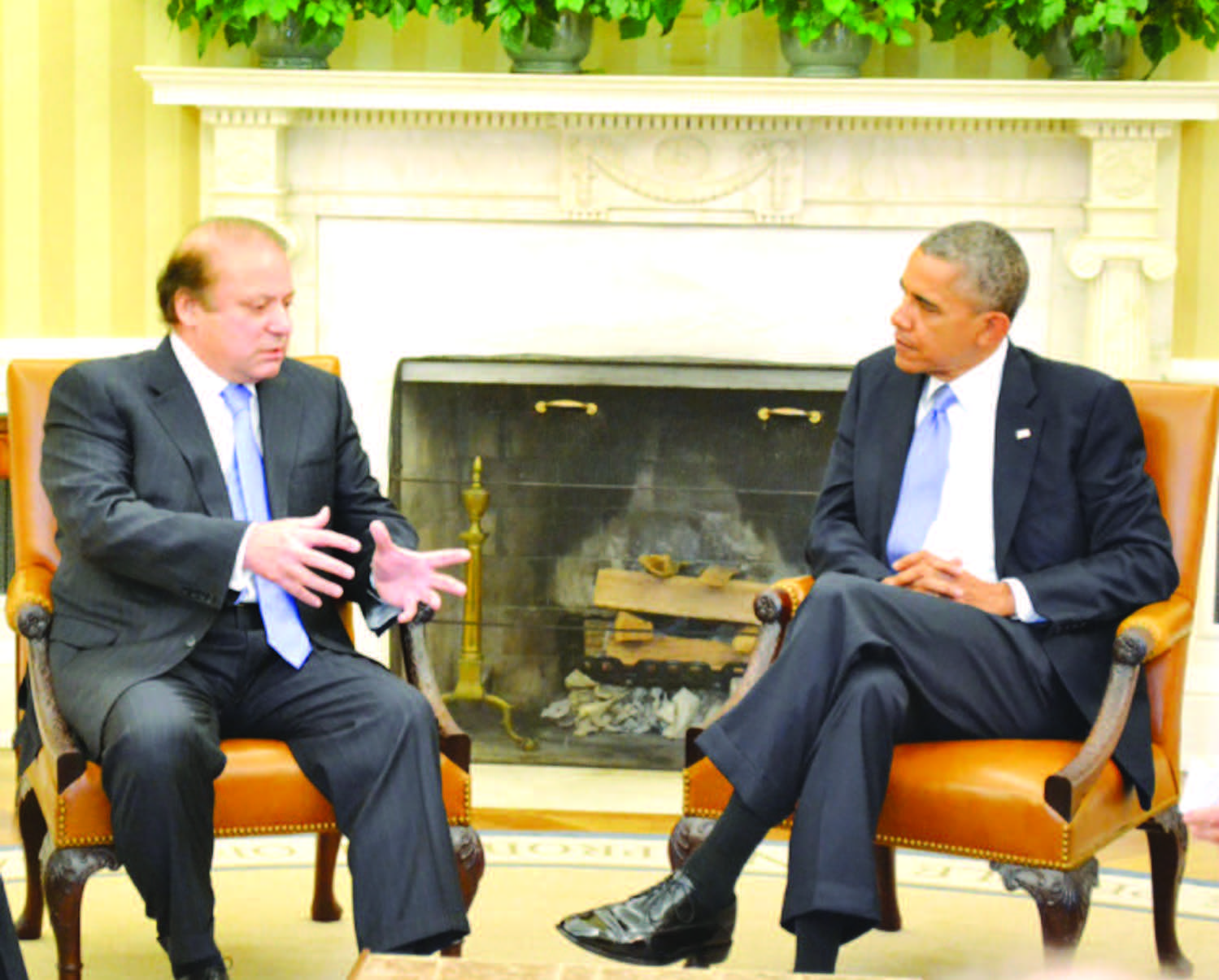
    WASHINGTON (TIP): Backing India’s concerns over the slow pace of progress in the 26/11 case in Pakistan, US President Barack Obama, October 24, asked the visiting Pakistan Prime Minister Nawaz Sharif why the trial of Mumbai attackers has not started. “He (Obama) asked, why the trial of the (Mumbai) terrorist attack in India has not started yet,” Sharif told reporters immediately after his over two-hour meeting with Obama at the Oval Office of the White House. During the meeting, the US President also raised the issue of Jamaat-ud-Dawa (JuD), cross border terrorism and Dr Shakil Afridi, the Pakistani doctor who helped the CIA track down al-Qaeda chief Osama bin Laden and has been imprisoned, Sharif said. “He (Obama) has raised the issue of (Dr Shakil) Afridi. He spoke about cross-border movement. He also talked about Jamaat-ud- Dawa,” the Pakistan Prime Minister said, without giving details. Speaking in chaste Urdu, Sharif told reporters that Pakistan’s relationship with India was discussed at length, including Kashmir, but did not give details of what aspect of Kashmir issue he raised; nor did he talk about the response from Obama on this issue.

    Obama, after the meeting with Sharif, said that the Pakistan Prime Minister was taking a “wise path” in exploring how decades of tension between India and Pakistan can be reduced. “I think he (Sharif) is taking a very wise path in exploring how decades of tension between India and Pakistan can be reduced, because, as he points out, billions of dollars have been spent on an arms race in response to these tensions and those resources could be much more profitably invested in education, social welfare programs on both sides of the border between India and Pakistan, and would be good for the entire subcontinent, and good for the world,” Obama told reporters in a joint media appearance with Sharif. In a joint statement issued after the meeting, Obama welcomed recent engagements between Sharif and Singh and expressed hope that this would mark the beginning of a sustained dialogue process between the two neighbors, aimed at building lasting peace in South Asia and resolving all outstanding territorial and other disputes through peaceful means. Obama said the two leaders had an opportunity to discuss India after the meeting of the Prime Ministers of India and Pakistan in New York on the sidelines of the UN General Assembly.

    Describing his meeting with Obama “a most cordial and comprehensive exchange of views” on matters of bilateral interest and issues of regional concern, Sharif said he told the US President about his sincere commitment to build a cordial and cooperative relationship with India. He also talked about “efforts to peacefully resolve all our outstanding issues, including Kashmir.” Sharif said that terrorism constitutes a common threat. “It is as much a concern to us as it is for India. We need to allay our respective concerns through serious and sincere efforts without indulging in any blame game. I also assured the President that as a responsible nuclear state, Pakistan will continue to act with maximum restraint and work toward strengthening strategic stability in South Asia,” Sharif said. In the joint statement, Obama and Sharif stressed that improvement in Pakistan- India bilateral relations would greatly enhance prospects for lasting regional peace, stability, and prosperity, as it would significantly benefit the lives of citizens on both sides of the border. “Obama welcomed steps taken by Pakistan and India to improve their economic relations, including by exploring electricity and gas supply agreements, developing a reciprocal visa regime, and expanding bilateral trade,” it said.

    Conceding that Pakistan is in the current situation today because of the action and deed of its own leaders in the past, Sharif said: “We need to keep our house in order. We have not taken care of our own house. As a result of which, the entire nation is suffering. We have to take Pakistan out of this situation.” He sought the support of the media, the civil society and people of Pakistan in this regard. “Both of us discussed strengthening and deepening of bilateral relationship. We had wide ranging discussions on issues including economy, Pakistan’s energy, education, extremism in Pakistan. We talked about Afghanistan; we talked about relationship with India. This included Kashmir. We talked on drones. We talked about Aafia Siddiqui,” Sharif said. Obama asked as to what the US can do for Pakistan, to which Sharif sought the policy of trade not aid. “When he (Obama) asked what we (US) can do for Pakistan, I said, I do not need any aid from you. We want to increase our economic relationship. Please open your market for Pakistani products. This is more than enough for us,” Sharif said. “He asked what we can do to address your energy issue. I said you should encourage your people, the private sector to come to Pakistan and invest in the energy sector. Pakistan is providing very good opportunities for them,” Sharif said. “We are trying to establish peace and stability in Pakistan. We hope that peace would be established in Karachi, a commercial hub. After lot of thought and determination, we have started operation there (in Karachi),” the Pakistan Prime Minister said. Sharif said he also appraised Obama on the peace talks with the Tehrik-e-Taliban Pakistan (TTP). Sharif left for Pakistan after the talks, concluding his four-day visit to the US, the first by a Pakistani head of State in more than five years.

  • Indian-American Emily Shah crowned Miss New Jersey USA

    Indian-American Emily Shah crowned Miss New Jersey USA

    WASHINGTON (TIP): 18-year-old Indian-American Emily Shah has won Miss New Jersey USA 2014 title, following in the footsteps of Nina Davuluri, who was crowned Miss America recently. Emily would now compete for the Miss America and Miss Universe titles. Davuluri had won the coveted beauty pageant in September. Emily was the youngest among more than 130 contestants for the New Jersey pageant held over the weekend.Shuffling between India and America, Emily has dabbled in cinema having acted in both Bollywood and ollywood films. She featured in Hollywood movies like ‘The Great New Wonderful’ with Naseeruddin Shah and Bollywood films such as ‘Out of Control’ alongside Riteish Deshmukh, ‘Ta Ra Rum Pum’ and ‘Jaaneman’ among others.She is daughter of LA-based Prashant Shah, who has been associated with several Bollywood production houses including big names such as Karan Johar, Rakesh Roshan and Shahrukh Khan, in various capacities. Emily plans to work in action films and is currently working as an assistant of stunt team of Hollywood movie ‘Run All Night’ starring Liam Neeson and Ed Harris.

  • US Congress set to celebrate Diwali

    US Congress set to celebrate Diwali

    WASHINGTON (TIP): Thanks to the initiative of bipartisan Congressional Caucus on India and Indian- Americans, US lawmakers are set to have their first-ever Diwali reception to celebrate the Indian festival of lights. An invitation to lawmakers for the reception next Tuesday has gone out from old India friend and Democratic caucus co-chairman Joseph Crowley, according to the gossip blog of Roll Call, an influential publication focusing on Congressional affairs. “We’re setting a major precedent that will hopefully last for years and decades to come,” he wrote asking fellow lawmakers to share the mysteries of the “festival of lights.” Crowley praised Tulsi Gabbard, first Hindu-American lawmaker and Ami Bera, the lone Indian-American politician in the US House, for helping to plan the event and “stirring up interest amongst our members.” “I think it is a testament to the growth of the Indian-American community,” Crowley, who has participated in Diwali festivals in the Indo-American enclave of the Jackson Heights section of Queens in New York, told the Roll Call.

    “According to spiritual tradition, Diwali is observed as the victory of light over darkness, truth over untruth and righteousness over wrong, and as a time of spiritual renewal,” Gabbard was quoted as saying “This message has great relevance at a time when politics and partisanship seem to overshadow compassion and concern for the greater good.” Crowley, according to Roll Call has placed the menu planning in the hands of the Sri Siva Vishnu Temple in Lanham, Maryland, a local house of worship he’s consulted with in the past – “So, we know it will be authentic.” Urging fellow lawmakers to “consider attending this exciting event,” he tempted them by saying, “Traditional Indian refreshments will be served.” “This event is an essential opportunity to come together not only to celebrate but to help increase understanding and tolerance amongst all Americans,” he wrote. “It’s going to set a precedent for Congressional Diwali celebrations for decades to come.”

  • Three Indian-Americans elected to US Institute of Medicine

    Three Indian-Americans elected to US Institute of Medicine

    WASHINGTON (TIP): Three Indian-Americans have been elected members of the prestigious Institute of Medicine (IOM), including Subra Suresh, who has become the only current university president to be elected to all three US national academies. Currently president of Pittsburgh, Pennsylvania-based Carnegie Mellon University, Suresh is one of only 16 living Americans to be elected to all three national academies- IOM, the National Academy of Sciences and the National Academy of Engineering. Besides Suresh, two other Indian-Americans have also been elected as members of IOM, among 70 new members and 10 foreign associates, during its 43rd annual meeting. They are Ashish K Jha, professor, health policy and management, Harvard School of Public Health, Boston, and Nirav Ramesh Shah, commissioner, New York State Department of Health, Albany. Election to the IOM is considered one of the highest honours in the fields of health and medicine and recognises individuals who have demonstrated outstanding professional achievement and commitment to service. “It is an honour to welcome our highly distinguished colleagues to the Institute of Medicine,” said IOM President Harvey V. Fineberg. “These individuals have inspired us through their achievements in research, teaching, clinical work and other contributions to the medical field. Their knowledge and skills will deeply enrich the IOM.” Suresh earlier served as director of National Science Foundation (NSF), a $7-billion independent government science agency charged with advancing all fields of fundamental science, engineering research and education. The IOM recognised Suresh for advancing health and medicine through his research into cell mechanics related to malaria, blood diseases and certain types of cancer.

  • NRI couple arrested in Saudi Arabia on black magic charges

    NRI couple arrested in Saudi Arabia on black magic charges

    KENDRAPARA, ODISHA (TIP): An NRI couple has been arrested in Saudi Arabia on charges of practising black magic, official sources said here on October 22. Seikh Nizam and Noor Jehan, originally from Odisha’s Kendrapara township, had shifted to Turba city of Saudi Arabia few years ago where they claimed to be a healer and mystic. The couple was arrested last month after authorities reportedly found a variety of occult items in their possession, including herbs, consulate general office of India office in Jeddah said. Raj Kumar, the community welfare officer of the consulate in Jeddah told over phone, “The couple had allegedly resorted to black magic and a complaint in this regard had been lodged by their Saudi employer Mohammad Safi in Turba town near Jeddah”. He said they are lodged in a jail and are facing trial as per Saudi law. If found guilty, they may have undergo minimum of two years of rigorous imprisonment. After the couple was arrested, their six children were left alone in their rented house and had to undergo harrowing ordeal in the alien country for three weeks.

    They were flown back to their hometown here last week by the Indian consulate after some expatriates raised the issue. The children, eldest hardly 12-year-old and youngest hardly of 18 months, are now staying in their paternal uncle’s house here. “Some locals had taken care of the children and had informed us regarding their plight. The consulate office then shifted them to safety. They were flown back to Delhi from consulate office cost. Flight tickets were also booked for them from Delhi to Bhubaneswar. Competent authorities in India were informed of the children return journey to ensure their safe return to their home as they had no elders to accompany,” Kumar added. Abdul Rehman, eldest son of the couple said, “I know nothing of the crime committed by my father and mother. They are innocent. They have been arrested on false charges. I am shocked. I am feeling absence of dear parents. The Saudi police had badly beaten up my parents. I had met them in jail. I saw injury-induced scars on their bodies. Seeing me, they cried like a child. I feel I am orphaned”.

  • Sikh organization given 450k pounds to fund research

    Sikh organization given 450k pounds to fund research

    LONDON (TIP): A lottery fund in Britain has provided 450,000 pounds to a Sikh organization to fund research into regimental histories of Sikh soldiers in the British Indian Army during World War I. The United Kingdom Punjab Heritage Association (UKPHA) has been given 450,000 pounds by the Heritage Lottery Fund, a body which distributes a share of its income from the national lottery to projects aimed at preserving and making accessible the nation’s heritage — to fund research into regimental histories, dispatches, correspondence and interviews with descendants of soldiers. Though Sikhs made up only two per cent of the population of British India, they formed 20 per cent of the British Indian Army. “Yet the role of Sikhs in World War I (WWI) is a largely unknown aspect of the Allied war effort and, indeed, of the British story,” a press release issued by the United Kingdom Punjab Heritage Association (UKPHA) said. The UKPHA has embarked on an ambitious and wideranging project on World War I to reveal these men’s untold stories. It will shed much needed light on both Sikh solders’ sacrifices and the contribution of all the non-white Allied forces of the British Empire.

  • US Gujarati association’s extreasurer charged with theft

    US Gujarati association’s extreasurer charged with theft

    NEW YORK (TIP): A former treasurer of a Gujarati community non-profit association in the US has been charged with stealing $85,844 from its bank accounts. Girishcha Patel, 58, a resident of Franklin Township of Somerset county in New Jersey and a former treasurer of the Federation of Gujarati Associations in North America (FOGANA) was charged with theft related misappropriation of the funds from the bank accounts of the association, Star Ledger reported on Tuesday. FOGANA lodged a complaint with the Somerset prosecutor’s office special investigations unit in January this year that Patel had misappropriated funds from the cultural organisation’s bank accounts when he was treasurer from 2004 through 2012. Without the organization’s permission, Patel withdrew more than $75,000 in funds from the FOGANA bank accounts between January 2006 and March 2012 while he was treasurer and had sole access to the accounts, Somerset county prosecutor Geoffrey D Soriano said.