Year: 2013

  • Edward Snowden says he took no secret documents to Russia

    Edward Snowden says he took no secret documents to Russia

    WASHINGTON (TIP): US intelligence leaker Edward Snowden says he did not bring any secret documents with him to Russia when he fled there, ensuring Moscow had no access to the files. In an interview with The New York Times published on October 18, Snowden said he gave all the classified papers he had obtained to reporters he met in Hong Kong before flying to Moscow, where he later secured asylum. The former National Security Agency contractor did not take the documents with him “because it wouldn’t serve the public interest,” Snowden told the Times. “What would be the unique value of personally carrying another copy of the materials onward?” Snowden also insisted he was able to protect the documents from China’s spy services because he was familiar with that country’s intelligence capabilities through his work as an NSA contractor. In his job, he had targeted Chinese operations and taught a course on Chinese cyber-counterintelligence.

    “There’s a zero percent chance the Russians or Chinese have received any documents,” he said. The interview took place last week over several days through encrypted online communications. US officials and critics of Snowden have expressed concern that the documents in his possession could have fallen into the hands of Russian, Chinese or other potentially hostile foreign intelligence agencies. Snowden, however, insisted the National Security Agency knew he had not cooperated with Russian or Chinese spies. “NSA has not offered a single example of damage from the leaks. They haven’t said boo about it except ‘we think,’ ‘maybe,’ ‘have to assume’ from anonymous and former officials,” Snowden added. “Not ‘China is going dark.’ Not ‘the Chinese military has shut us out.’” Snowden also said he never considered defecting while in Hong Kong or Russia, where he has been given asylum for one year. Snowden said his decision to leak secret documents evolved gradually, and that his doubts about intelligence agencies dated back to his time working for the CIA in Geneva.

    He said he clashed with a senior manager when he tried to warn the CIA about a vulnerability in its personnel Web applications. The episode convinced him that trying to work through the system would only lead to punishment. The 30-year-old, who faces espionage charges over his bombshell leaks, defended his disclosures as serving the country’s interests by sparking a public debate and informing the public about secret surveillance. “So long as there’s broad support amongst a people, it can be argued there’s a level of legitimacy even to the most invasive and morally wrong program, as it was an informed and willing decision,” Snowden said. “However, programs that are implemented in secret, out of public oversight, lack that legitimacy, and that’s a problem. “It also represents a dangerous normalization of ‘governing in the dark,’ where decisions with enormous public impact occur without any public input.” The NSA was not immediately available to comment on Snowden’s interview.

  • US Senate confirms Nisha Desai Biswal as assistant secretary of state

    US Senate confirms Nisha Desai Biswal as assistant secretary of state

    WASHINGTON (TIP): The US Senate has confirmed Indian- American woman administrator Nisha Desai Biswal as the assistant secretary of state for South and Central Asia, making her the first person from the community to hold the top diplomatic position. Biswal, who is currently the assistant administrator for Asia at the US Agency for International Development ( USAID), will replace incumbent Robert Blake to head the key bureau in the state department. President Barack Obama had nominated her for this top position on July 18. The Senate foreign relations committee had held her confirmation hearing last month, during which she received bipartisan support and was praised by lawmakers from both the parties. “I consider you another compelling argument for comprehensive immigration reform,” said Senator John McCain of the Republican Party. “Despite your misguided political affiliation, I would like to say that you’re a great example to all of us of people who come to this country.

    I know you were very young … and the opportunities that this country provides,” McCain said in praise of Biswal, who is from the Democratic Party. McCain who lost out to Obama in the 2008 presidential elections rarely praises someone from the Democratic Party. From 2005 to 2010, she was the majority clerk for the state department and foreign operations subcommittee on the Committee on appropriations in the US House of Representatives. From 2002 to 2005, she served as the Policy and advocacy director at interaction. Previously, she served on the professional staff of the US House of Representatives international relations committee from 1999 to 2002. Daughter of first generation Indian Americans, Biswal draws her inspiration from her parents’ story of journey far from rural India to pursue the American Dream and a better life for their children, which she told lawmakers during the confirmation hearing of her current position on July 21, 2010.

  • Fooled by forged files, jailers release 2 US killers

    Fooled by forged files, jailers release 2 US killers

    HOUSTON (TIP): Authorities in the US state of Florida have launched a massive manhunt for two murderers who were mistakenly released from prison after jailers were conned by forged court documents. Charles Walker and Joseph Jenkins, both 34, were released separately from the Franklin correctional institution in Carrabelle after officials received forged paperwork indicating their sentences had been reduced, The Orlando Sentinel reported. While Jenkins was serving a 50-year sentence for murder and armed robbery, Walker was serving 15 years for murder. The Florida department of law enforcement, which is investigating the case to determine how this happened, was not notified of the releases until Tuesday. Department of corrections spokeswoman Jessica Cary said state corrections officials acted on the court documents, not realizing they were falsified. Florida department of corrections secretary Michael Crews said that the agency is reviewing the releases to make sure that no other inmates have been released based on falsified documents. “The top priority of the department is the safety of Florida families and we’ll continue working with law enforcement to ensure these men are returned to custody,” Crews said.

  • eBay founder to bankroll project for journalists

    eBay founder to bankroll project for journalists

    NEW YORK (TIP): For years, the tech billionaire Pierre M Omidyar has been experimenting with ways to promote serious journalism, searching for the proper media platform to support with the fortune he earned as the founder of eBay. He has made grants to independent media outlets in Africa and government watchdog groups in the United States. In a more direct effort, he created a news website in Hawaii, his home state. Then last summer, The Washington Post came calling in its pursuit of a buyer. The Graham family ended up selling The Post to a different tech billionaire, Jeffrey P Bezos of Amazon. But the experience, Omidyar wrote on his blog on Wednesday, “got me thinking about what kind of social impact could be created if a similar investment was made in something entirely new, built from the ground up.” Omidyar also confirmed that he would be personally financing a new “mass media” venture, where he will be joined by journalist Glenn Greenwald of The Guardian, the British daily.

  • US-India Relations Hit a Rough Patch

    US-India Relations Hit a Rough Patch

    The author feels that there are a number of vital issues which are unlikely to be settled within the tenures of either Obama or Singh, leaving a lingering note of ambivalence in the US-India relationship even as it deepens outside of the high politics.

    When Indian Prime Minister Manmohan Singh visited Washington last month for the first time in four years, the mood was distinctly subdued. India’s once-stratospheric growth rate is stubbornly depressed. The Indian government is low on political capital and stuck in risk-averse mode until next year’s general elections, with a huge question mark over Singh’s personal future. Most Indians anyway focused on Singh’s New York meeting with his Pakistani counterpart Nawaz Sharif – underwhelming, as it turned out, and marred by a perceived slur – rather than his meetings with President Obama. More generally, the promise of USIndia relations remains far below the levels anticipated only a few years ago.

    Why the stasis?
    There are any number of reasons. Indian journalist Indrani Bagchi suggests that ‘there remains a strong lobby within this government starting with [ruling Congress Party chairwoman] Sonia Gandhi and [Defense Minister] AK Antony downwards, which retains an instinctive aversion to America’. That same government’s slow rate of economic reform irks American companies who want to invest in India. In particular, a strict nuclear liability law limits those companies’ ability to exploit a landmark civil nuclear cooperation agreement initiated by the Bush administration in 2005. Also, India’s Byzantine procurement rules madden the American defense companies eager to sell into what is one of the few growing arms markets in the world. A sense prevails that the low-hanging fruit in the bilateral relationship was picked some years ago. But one less-noticed problem is that the limited bandwidth of US foreign policy is presently occupied by issues in which India is either wary of US policy or simply apathetic.

    The Middle East
    In his speech to the United Nations General Assembly on 24 September, President Obama noted that ‘in the near term, America’s diplomatic efforts will focus on two particular issues: Iran’s pursuit of nuclear weapons and the Arab-Israeli conflict’. India has much to gain from a rapprochement between Iran and the United States, not least the ability to once again freely import Iranian oil. India was circumventing international sanctions by paying for a diminished flow of Iranian oil in rupees, but the new Iranian government is insisting that India can only pay for half this way. India is a bystander rather than active participant in the broader dispute, watching from the sidelines as the P5+1 bloc, which includes Russia and China, participates in negotiations. On Syria, India is sympathetic to the regime of President Bashar al-Assad. It views the issue through the lens of the Afghan jihad in the 1980s, which Indians see as indelibly associated with the subsequent uprising in Kashmir and the growth of anti- Indian militancy. When the Indian Government summoned the Syrian Ambassador in Delhi last month, it was not because of Syrian policies but because the ambassador had alleged that Indian jihadists were fighting with the rebels. The ambassador stated, tellingly, that ‘he was always deeply appreciative of India’s position on Syria’.

    India unsurprisingly opposes efforts to arm the Syrian rebels, tends to see the armed opposition as irredeemably compromised by jihadists and reflexively opposes US proposals for military action, particularly outside the ambit of the UN Security Council. India has already had to abandon several oil fields in Syria and, in September 2013, India’s foreign secretary even referred to an existing Indian line of credit to the Syrian government. Yet, despite these equities, India has no leverage over the parties to the conflict. In May, an Iranian suggestion of greater Indian involvement went nowhere. There is little that Singh would usefully have been able to say to Obama on the subject. At a broader level, the more the Middle East distracts from US attention to Asia- Pacific – including the so-called ‘pivot’ of American military forces eastwards – the less high-level attention India receives in Washington. India was not mentioned once in Obama’s UN address (to compare: China was mentioned once, Iran 26 times, and Syria 20).

    Afghanistan
    India’s attitude to US policy in Afghanistan is even more conflicted. India is ostensibly supportive of US policy, and has formally signed on to an Afghan-led peace process. But Indian officials and strategists scarcely disguise their discomfort towards what they see as undue American haste in withdrawing troops, an overeagerness to accommodate the Taliban as part of political reconciliation, and a continued indulgence of Pakistan despite its support for Afghan insurgents. India felt that its views were vindicated by the June debacle over the opening of a Taliban office in Doha, which deviated from the agreed protocol, handed a propaganda victory to the Taliban, and angered the Afghan government. Indian national security reporter Praveen Swami summed up many Indians’ views in complaining that the US was ‘subcontracting the task of keeping the peace in Afghanistan to the ISI’, Pakistan’s premier intelligence service.

    In recent months, Indians have taken offence at statements by James Dobbins, the US Special Representative for Afghanistan and Pakistan, echoing earlier Indian anger at the late Richard Holbrooke, and have chafed at what they see as a Western equivalence between Indian and Pakistani policy in Afghanistan. For their part, US and British officials have grown increasingly frustrated with India’s approach to the issue, arguing that India offers no plausible alternative to the policy of reconciliation given the long-term weakness of the Afghan state. Yet it is in Obama’s interests to assuage Indian concerns, emphasize that reconciliation with the Taliban will be constrained by the established ‘red lines’, that the US will not abandon counterterrorism efforts in Afghanistan after 2014, and that India’s role in Afghanistan is not only welcome, but also necessary to the strengthening of the Afghan state. India rebuffed Afghan President Hamid Karzai’s request for arms earlier this year, wary of provoking Pakistan. But one area that deserves more discussion is greater direct cooperation between India and the NATO-led coalition in Afghanistan to train and equip Afghan National Security Forces (ANSF).

    According to one report, Obama asked Singh last week for an ‘increased effort’ in Afghanistan, although it’s unclear whether this included an implied or explicit training dimension. India, entirely reasonably, sees a potential eastward flow of militants from Afghanistan and Pakistan as a major security threat, particularly with violent trends in Kashmir worsening this year. India would therefore be particularly receptive to a US commitment to monitor and disrupt militant movement in the years after 2014. In truth, it will be difficult to make progress on these issues until Washington settles its own internal debates over what its posture in Afghanistan will be after 2014 (for example, how many (if any) troops will remain in a training capacity?), which in turn will depend on the peace process itself, President Karzai’s domestic political calculations in the face of presidential elections next year, the integrity of that election, and trends in Afghanistan.

    Where next?
    The level of US-India tension should not be exaggerated. It is telling that recent revelations over US intelligence collection against Indian diplomatic targets have, unlike in the case of Brazil, had negligible impact on the relationship. Indian officials chose to brush the issue under the carpet, presumably hoping that the issue had little domestic salience and perhaps even tacitly acknowledging that the NSA’s activities against Indian internet traffic were indirectly beneficial to Indian policy objectives. Twenty years ago, the Indian response may have been very different. It is these changes in tone that convey strategic shifts as much as any large policy initiative. And although the two countries differ on the contentious big-picture issues outlined above, this has not prevented the relationship from advancing on other tracks. In September, US Deputy Secretary of Defense Ashton Carter visited India to push ahead with the bilateral Defense Trade Initiative (DTI), which Carter co-chairs with India’s National Security Advisor, Shivshankar Menon.

    Carter reiterated his suggestion, dating from last year, that US and Indian firms cooperate to produce military equipment – including helicopters, nextgeneration anti-tank missiles, mine systems, and naval guns – for both countries’ use. India has been bafflingly slow and reticent to respond to these overtures, despite the possibility of much-needed technology transfer to Indian industry (though many analysts are skeptical as to its capacity for technology absorption). The negotiations nevertheless reflect the US perception that the defense strand of its relationship with India are a priority. The road ahead is rocky. Over the next eighteen months, the US-India relationship will be severely buffeted by US policy towards Afghanistan. As the American drawdown accelerates, one possibility is that the US intensifies diplomatic efforts to peel away moderate factions within the Afghan Taliban, Whether that amounts to anything or not (and few are optimistic) the process is certain to involve at least a period of deeper USPakistan consultations, at the expense of India. Later this month, for instance, a fourth Afghanistan-Pakistan-UK trilateral summit will take place in London.

    India has quietly seethed at the previous three, viewing them as a coordinated effort to reduce Indian influence. Yet, for the United States at least, the centre of gravity of the US-India relationship is not Afghanistan, but China. The Middle East’s fast-moving and highly visible crises have briefly distracted from a slow-moving background trend: the political and economic rise of China. Yet this remains where Indian and American strategic interests are most collectively at stake, if not necessarily congruent. Following India’s most recent crisis with China, involving deep Chinese incursions into disputed territory a few months ago, New Delhi’s instinctive response was not to make a prominent feint towards Washington – something that might have been the natural response of other states eager to balance against Beijing – but to engage China more intensively, including on the border dispute itself. Indeed, Singh will make a trip to Beijing next month, with indications that he may sign an upgraded border agreement. Nothing better underscores how India’s internal debate over the desired scope of its relationship with the United States is unsettled, on-going, and erratic. More generally, much of India’s press and strategic community have accepted the popular narrative that American leadership, as well as American power, is in decline, and that US reliability is therefore in question. These issues are unlikely to be settled within the tenures of either Obama or Singh, leaving a lingering note of ambivalence in the USIndia relationship even as it deepens outside of the high politics.

  • India-US Partnership

    India-US Partnership

    Defense Trade to be the Driving Engine

    Contrary to the forecasts of doom and gloom and the skepticism surrounding his visit to Washington, the third Manmohan- Obama Summit meeting on September 27 has been quite productive. With hindsight, one can say that media reports about growing impatience of US NSA Susan Rice, impact of the comprehensive immigration law, lobbying in the Capitol Hill by Microsoft, IBM and American drug manufacturing giants against Indian IT and drug manufacturing companies and differences on Afghanistan, Iran, Syria, nuclear liability Act etc were highly exaggerated. An honest and dispassionate assessment of India-US relations in the last decade clearly shows that they have been transformed beyond recognition; India-US strategic partnership is for real and it is in for a long haul in spite of serious differences on some issues in the short run. Nothing demonstrates this better than the exponential expansion of defense trade; US exports of defense and military hardware to India in the last five years have crossed US$ 9bn; with the long shopping lists of the Indian Army, Air Force and Navy this is bound to expand further.

    If the promise of transfer of defense technology, joint research and co-production mentioned in the joint statement is taken to its logical conclusion, this collaboration could become the driving engine of closer Indo-US strategic partnership. In this regard, the US decision to supply offensive weapons to India will be the leitmotif of this burgeoning relationship. Notwithstanding these positive signals, well-known strategic analyst Brahma Chellaney feels that India-US strategic relationship is somewhat “lopsided and unbalanced” on account of structural and strategic limitations of India. A lot is made out of the flattering phrases such as the “defining relationship of the 21st century” (used by Obama and John Kerry) which might transcend into the 22nd century and India being the “lynch pin” of the US policy in Asia (used by Leon Panetta) and optimistic projections made by the heads of think tanks such as Ashley Tellis of Carnegie Endowment. Visiting American dignitaries seldom fail to stress the commonalities between India and the US: democracy, rule of law, human rights, and multi-ethnic, multireligious, multi-lingual, plural societies. These are, no doubt, important factors but must be taken with a pinch of salt.

    In the real world, so long as it serves their national interests, countries don’t mind doing business with other countries where these factors don’t hold water. The US-China relations are an obvious example of this phenomenon. While the US IT companies might continue urging the US government to apply some indirect brakes on the Indian IT companies, the fact is they have been receiving “great service, great quality at low costs” from Indian companies and it has enabled them to operate efficiently and profitably. The misperception created by media reports that the US wishes to “contain” China and hence is trying to warm up to India warrants closer scrutiny. The US-China economic, financial, trade, business and investment ties are so huge and millions of jobs in the US depend on this collaboration that the US will never risk them. As a matter of fact, the US has been quite careful not to hurt China’s sensitivities; it’s decision to call its new approach in Asia now as “Asia Rebalance” instead of “Asia Pivot” is a “course correction” keeping China in mind. On the issues of alleged incursions into Indian territories by the Chinese troops and the India-China spat regarding the ONGC-Vietnam offshore oil drilling collaboration, the US has maintained strict neutrality.

    Conversely, it is also a fact that the US won’t like to see a China-dominated Asia. This, apart from the economic considerations, explains its concerted efforts to come closer to India, ASEAN and beyond to shore up its influence in Asia-Pacific and maintain pressure on China to keep trade routes through the South China Sea open to international trade according to international laws. Some recent developments have eased the alleged “drift”, “wrinkles” and imaginary or real “plateau” in relations. The preliminary contract between the US nuclear companies, Westinghouse and NPCIL for setting up a nuclear plant in Gujarat is a welcome beginning. The establishment of “an American India- US climate change working group” and convening the “India-US Task Force on HFCs” are viewed as positive developments. And the reiteration of US support for a place for India in the reformed UNSC should be music to Indian ears. Besides, a temporary postponement by the US Federal Reserve to end the stimulus package should give countries like India some breathing time to put their finances in order. Though nothing concrete has been promised, some negotiated compromise on the new Immigration laws shouldn’t be ruled out.

    In the field of foreign affairs, the biggest relief has come from Iran. There is thaw in the air in the US-Iran relations thanks to the speech of the newly elected President Rouhani in the UN General Assembly and his wishes on the Jewish New Year on his Twitter which prompted Obama to make the historic Presidential phone call for the first time in 30 years! Unless, this process is cut short by the Iranian supreme leader, US-Iran relations should see some further easing of tension and resolution of the nuclear issue which has led to the imposition of crippling UN sanctions on Iran. This thaw has the potential of lightening India’s oil import bill if more Iranian oil comes on the market. India’s expectations from the US to put further pressure on Pakistan to bring the perpetrators of 26/11 Mumbai attack to book and rein in the terrorist groups like Al-Qaida and LeT and dismantle terror infrastructure and go slow on co-opting the Taliban in the talks on the future of Afghanistan aren’t likely to be met fully because of the US priorities to exit from Afghanistan smoothly. In the meanwhile, India should brace itself for a Taliban-dominated Afghanistan after the withdrawal of the American troops in 2014.

    What role India could play in Afghanistan after the US exit can’t be guaranteed by the US; it will have to work out a strategy with countries like China, Russia, and Iran and, of course, the US. As the economies of India and the US aren’t doing as great as they would have expected, there are domestic pressures in both countries which impact negatively on the bilateral relations. The IT and pharma MNCs in the US and the constituencies in India which didn’t favor FDI in retail and pressed for a more stringent nuclear liability Bill are manifestations of such domestic pressures. As both India and the US have strategic partnership with a number of countries, in crises situations each country will take a decision based on its strategic interests. From this perspective, KS Bajpai, a former Ambassador to the US, injects a reality check: “If ever India finds herself in an open conflict with another country, she will be just by herself; none will come to her help”. That should give us a wake-up call to mend our fences with our neighbors and create an environment of goodwill and warmth without lowering our guards and ignoring defense preparedness.

  • Back from the Brink

    Back from the Brink

    The financial markets worldwide felt relieved after the US Congress reached an agreement shortly before the deadline was to expire on Wednesday. A debt default would have raised the cost of borrowings for the US. The 16-day government shutdown over a budget fight between the Democrats and the Republicans caused losses not just to the domestic economy but to all those countries dependent on US exports for growth. Many such countries were relying on a US demand pick-up to compensate for the sluggish economic conditions at home. There is one positive outcome that should cheer the emerging economies like India and China. There is hope that the US Federal Reserve will not rush to roll back its $85 billion a month bond-buying program, giving more time to the Asian countries to stabilize their economies and currencies, which had been shaken by dollar outflows in recent months.

    The Republicans had brought the US government to a halt, demanding that President Barack Obama’s favorite health care program should be either delayed or defunded and the existing taxes should be cut. Two years ago when there was a similar confrontation over raising the debt ceiling, President Obama had retreated, agreeing to a staggered slashing of domestic spending. This time Obama was firm and assertive, and called the Republicans’ bluff. The deal that was signed at the last minute indicated a complete Republican surrender. There was a minor concession on health care which required the administration to audit incomes of those seeking insurance subsidies. But the damage the Republicans have caused to the US reputation is incalculable. Americans dependent on government programs and Federal employees were the main sufferers. A fringe group in the Republican Party took the entire nation to ransom and ended up hurting its own leadership. The approval ratings of the Republicans are at the rock-bottom. But the relief is for a limited period. “Our drive to stop the train wreck that is the President’s health care law will continue”, said the Republican leader, Speaker John Boehner. Early next year the battle is expected to resume.

  • Indian-American Woman is Running for Seattle City Council

    Indian-American Woman is Running for Seattle City Council

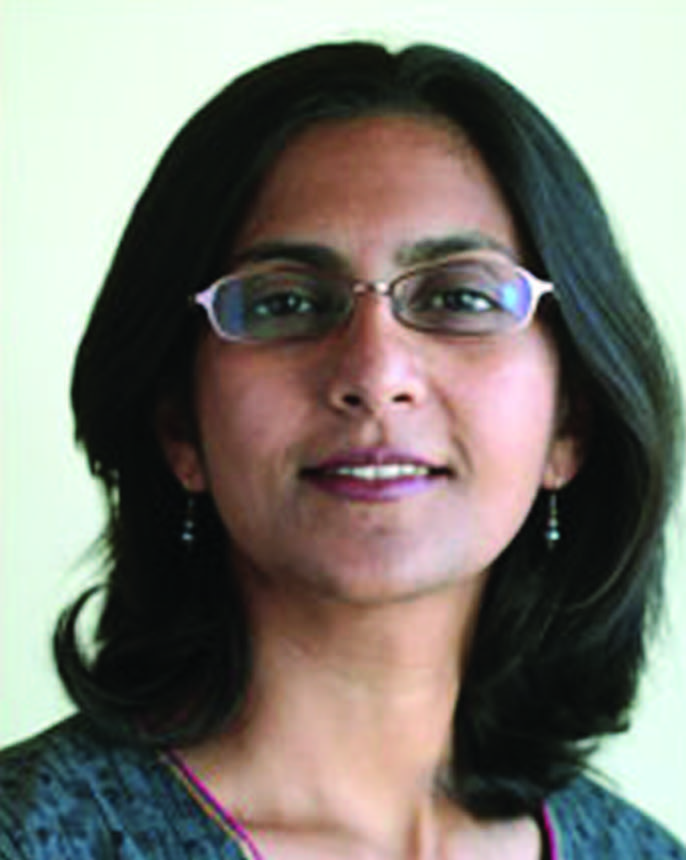
    SEATTLE (TIP): Kshama Sawant, trained as a computer engineer in her native India and now a professor of economics, is running for a seat on the City Council of Seattle under an unambiguously far-left banner. Even in this liberal bastion of the Northwest, Sawant’s political views stand out. Having gained sufficient electoral support in the August primary (44,000 votes, or about 35 percent of the total, finishing second in a threeway race), Sawant is now challenging the entrenched 16-year Democratic incumbent Richard Conlin for a council seat in the November general election. A veteran of the Occupy Wall Street movement, Sawant espouses an explicitly anticapitalist creed that champions the rights of the poor, low-wage workers,women, immigrants, the homeless, the disabled, homosexuals and other marginalized segments of the population. Her current political campaign rests on three principal platforms: a $15-per-hour minimum wage; higher taxes on millionaires to fund mass transit and education; and rent control.

    “A majority of workers and young people face an increasingly unaffordable city,” she told local media. “Most are disgusted by the endless parade of politicians who play with progressive rhetoric at election time, then pander to big corporations and the super-rich while in office.” The Stranger, a Seattle area newspaper that has endorsed Sawant, along with six labor unions, said she is the only element of the campaign season that is providing any excitement or interest. After Sawant performed well in the August primary, John Halle wrote in the North Star, a Socialist newspaper, that her success should not have come as a surprise. “Recent polls have indicated a widespread sympathy to socialism, a sign that the many years of indoctrination equating ‘free markets and free people,’ capitalism and democracy, and of there being ‘no alternative’ to neo-liberal austerity are finally losing their power to convince,” Halle wrote. “Sawant’s candidacy is the first to give a concrete indication that these attitudes are beginning to find expression in terms of real political power.” The Socialist Alternative newspaper called Sawant’s showing in the run-off “stunning” and a “breakthrough.”

    A well-known political commentator in Seattle, Tom Barnard, wrote of Sawant’s campaign: “What happened conceptually was even more revolutionary.… For what Kshama did was to simply overturn the common wisdom of how to succeed in local elections in general and City Council races in particular. She took what were viewed as two immutable political laws [the need for big money and Democratic Party endorsements] and essentially threw them out the window… It’s nothing short of an earthquake… Kshama has shown a new path for independent candidates who directly advance working people’s interests and issues.” Sawant is trying to translate her activism into practical terms – for example, she has vowed that if she wins election, she will not accept the full $120,000 annual salary awarded to City Council members. Instead, she will take the average salary for city workers and hand over the rest to social movements. In an interview with International Business Times, Sawant laid out some of her vision and her disappointment with the administration of President Barack Obama. “I don’t support the Democrats because they are largely financed by corporate interests, [just] like the Republicans,” she said. “After the initial campaign of ‘Hope and Change’ in 2008, disillusion has set in among much of the electorate.

    The hopes of progressive people have been dashed after five years of Obama.” Sawant cited such issues as the government’s treatment of Wikileaks’ source Bradley Manning, the saber-rattling over Syria, the assault on public schools, drone missile attacks in Pakistan and the deportation of thousands of immigrants, among others, for the disillusionment with Obama. “I think in the current environment, the appeal of independent and alternative candidates has greatly increased,” she noted. “And I don’t think my embrace of socialism has much stigma as it might have had in the past.” Sawant is quick to point out that she embodies the principles of democratic socialism, not the repressive, bureaucratic nature of the former Soviet Union. She also suggests that after the devastation of the housing market collapse, the huge government bailouts of banks and large corporations, and the emergence of a whole new generation of debt-strapped college graduates with bleak job prospects, many members of the American public may simply be “sick of capitalism.” “I think many Americans, particularly the youth, feel demoralized, dejected and disenfranchised by corporate-driven politics,” she said. Indeed, with respect to Seattle, the economy is weakening. After driving the bulk (70 percent) of the state of Washington’s job growth since 2010, in August of this year, the Seattle area (which includes Bellevue and Everett) shed 4,300 jobs, including 1,600 manufacturing jobs, pushing up the local jobless rate to 5.2 percent. For the state as a whole, the jobless rate edged up to 7.0 percent.

    Still, these figures represent a much brighter picture than the rest of the country, particularly California (which is suffering under a nearly 9 percent jobless rate). Even if Seattle has a much healthier economy than other parts of the nation, the cost of living is rising and wages are stagnant. Sawant, a professional economist, contends that one of her fundamental campaign proposals – a $15/hour minimum wage – makes sense, citing that if consumers don’t have enough money to buys goods and services, small businesses will collapse. “Some corporate executives make more in one day than their lowest-paid employees make in a whole year,” she said. “Many companies could easily increase employee salaries. And even at $15/hour, that’s hardly an income that one can easily live on.” Sawant’s proposal even has the support of some local capitalists. Nick Hanauer, founder of Second Avenue Partners, a Seattle venture capital fund, wrote in Bloomberg that the widening wealth gap in the U.S. presents some difficult challenges for the economy. Hanauer noted that low-wage jobs are quickly replacing middle-class jobs in the U.S. economy. “Sixty percent of the jobs lost in the last recession were middle-income,while 59 percent of the new positions during the past two years of recovery were in low-wage industries that continue to expand such as retail, food services, cleaning and health care support,” he wrote. “By 2020, 48 percent of jobs will be in those service sectors.”

    Hanauer also indicated that if the federal minimum wage had simply tracked the rate of U.S. productivity gains since 1968, it would now be $21.72 an hour — three times the current wage. He also estimated that raising the minimum wage to $15 an hour would inject about $450 billion into the economy each year. “That would give more purchasing power to millions of poor and lower-middle-class Americans, and would stimulate buying, production and hiring,” he declared. Separately, as an Indian-American, Sawant presents a rather unusual alternative for most voters. Indeed, the two most famous and prominent Indian-American politicians – Govs. Nikki Haley of South Carolina and Bobby Jindal of Louisiana – are both right-wing Republicans, the polar opposite of Sawant’s decidedly leftist ideology. Sawant suggests that Jindal and Haley, as well as Florida Sen. Marco Rubio, represent attempts at window-dressing by the Republican Party in order to appeal to ethnic minorities.”These minority politicians are outliers,” she stated. “Most ethnic minority people in the U.S. do not support the Republican Party.” She also points out that in defiance of the “model minority” image of Indian-Americans earning high salaries, there are many in the Seattle area who receive low wages, including taxi drivers,who support her candidacy. Also, Sawant’s embrace of some social issues, namely abortion, gay rights and marriage equality,might strike observers as rather odd, given the deep conservatism and traditional values inherent in Indian culture. But Sawant counters that many Indians in U.S., particularly among the young, support such issues as gay rights. “It might be more of a problem if I was running for office in India itself,” she conceded. The Seattle election will be held on Nov. 5.

  • Hillary Clinton gets a parking ticket from London traffic warden

    Hillary Clinton gets a parking ticket from London traffic warden

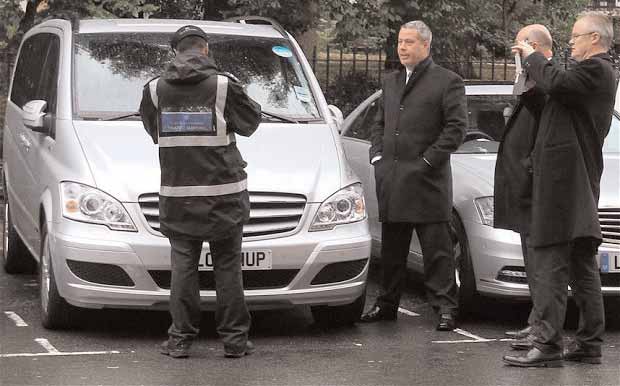
    LONDON (TIP): Hillary Clinton may be tipped as a future US president, but that did not impress a London traffic warden who slapped her vehicle with an £80 (95-euro, $130) parking fine. The former US secretary of state was in town to receive a prize from the Chatham House think tank last week for her work in promoting “a new era of US diplomatic engagement”. But her entourage failed to buy the £3.30 ticket required to park the Mercedes for an hour on the exclusive St James’ Square in central London, and received a £80 fine. “The former US secretary of state was parked for nearly 45 minutes without paying,” said Daniel Astaire, an elected member of Westminster City Council. “I’m sure she will understand that we have to be fair to everyone, regardless of their status on the world stage.” There is some good news for former first lady Clinton, however — if she pays up within 14 days, the fine will be halved to £40. London Mayor Boris Johnson has previously complained about the refusal of US diplomats to pay a ten pound daily charge for the congestion zone in the centre of the capital.

  • Britain opens its nuclear industry to Chinese investors

    Britain opens its nuclear industry to Chinese investors

    BEIJING (TIP): Britain opened the door to Chinese investors taking majority stakes in future nuclear plants on Thursday as finance minister George Osborne signed a deal aimed at helping find the billions of pounds needed to replace the country’s ageing reactors. On a visit to China, Osborne said the two countries had signed a memorandum of understanding (MOU) on nuclear cooperation that included roles for British companies in China’s nuclear sector, which is the fastest growing in the world. “While any initial Chinese stake in a nuclear power project is likely to be a minority stake, over time stakes in subsequent new power stations could be majority stakes,” a statement from the UK Treasury said. The MOU also covers training in Britain for Chinese technicians, it said.

    Chinese nuclear companies have expressed an interest in building in Britain, but until Thursday’s announcement it was unclear whether the British government would welcome China’s participation. The government said this week it was “extremely close” to a deal with French energy company EDF related to building Britain’s first new nuclear power station since 1995, a project which is likely to involve China General Nuclear Power Group (CGNPG). That deal centres on a 35-year contract guaranteeing EDF and its potential partners an electricity price for the power from the new plant of £92.5 per megawatt hour, roughly double the current wholesale price, Wall Street Journal reported. A spokesman for the UK’s department of energy and climate change said the talks were ongoing. Osborne’s statement did not refer to the EDF project but his announcement was made at the Taishan nuclear power plant in southern China, which is a collaboration between EDF and CGNPG.

    Ageing plants

    Britain aims to renew ageing nuclear power plants that are going out of service but it needs foreign investment to pay the huge upfront costs involved. Britain’s shrinking power capacity could lead to blackouts during the winter of next year, a report prepared for an advisory body to the prime minister warned on Thursday. Energy Secretary Ed Davey said on Sunday he expected nuclear investments from South Korea as well as China, Japan and France. Last year, Japan’s Hitachi bought a new nuclear joint venture company from Germany’s RWE and E.ON , underlining interest from Asian firms in entering Britain’s nuclear industry. Last month, Britain also signed a cooperation agreement with Russian nuclear conglomerate Rosatom. Britain has shortlisted eight sites that can house new nuclear plants, two of which are owned by Hitachi, one by a joint venture between GDF Suez and Iberdrola and the remainder by EDF. The Westinghouse unit of Japan’s Toshiba is in talks to purchase Iberdrola’s stake. Investment from China would similarly involve Chinese companies buying stakes in projects or partnering with the existing owners. “Investment from Chinese companies in the UK electricity market is welcome, providing they can meet our stringent regulatory and safety requirements,” Energy Secretary Ed Davey said in Thursday’s statement. China has 17 nuclear reactors in operation, accounting for about 1 percent of electricity production capacity. Another 28 nuclear plants are under construction. Osborne is in China on a trade mission that this week saw Britain take a step closer to becoming the main offshore hub for trading in China’s currency and bonds by offering less stringent rules for Chinese banks setting up in London

  • New Zealand’s Eleanor Catton wins Man Booker Prize

    New Zealand’s Eleanor Catton wins Man Booker Prize

    LONDON (TIP): Eleanor Catton has become the youngest writer to ever win a Man Booker prize. The 28-year-old New Zealander’s book The Luminaries – an 832-page murder mystery based on the gold rush in the 19th-century is also the longest novel to ever win the coveted literary prize. Catton who started writing the book when she was 25- years-old was given the £50,000 by the Duchess of Cornwall at London’s Guildhall on Tuesday evening. The judges picked Catton’s audacious take on an old form, the Victorian “sensation novel”. The youngest ever winner before Catton was Ben Okri who was 32 when his work The Famished Road won the Booker prize in 1991. The Luminaries is Catton’s second novel after The Rehearsal, which was shortlisted for the 2009 Guardian first book award. Catton is just the second New Zealander to win the prize, the first being Keri Hulme with The Bone People in 1985. The Luminaries, set in 1866 during the New Zealand gold rush, contains a group of 12 men gathered for a meeting in a hotel and a traveller who stumbles into their midst; the story involves a missing rich man, a dead hermit, a huge sum in gold, and a beaten-up whore. There are sex and seances, opium and lawsuits in the mystery too. The multiple voices take turns to tell their own stories and gradually what happened in the small town of Hokitika on New Zealand’s South Island is revealed. The novel had been up against Indian-American writer Jhumpa Lahiri’s The Lowland – a story of a young man’s tryst with the Naxalite movement at the cost of his family. Set in Kolkata, the Lowland was among six books shortlisted for the prize. One of the favourites to win was the shortest work ever to be shortlisted – Colm Toibin’s 30,000 word The Last Testament of Mary.

  • Disabled girl held captive in UK, raped for years in cellar

    Disabled girl held captive in UK, raped for years in cellar

    Apensioner who trafficked a 10-year-old deaf and mute girl into Britain, keeping her in his cellar to claim benefits, was convicted on October 15 of repeatedly raping her. Ilyas Ashar, 84, was found guilty of 13 counts of rape against the girl, who is now in her 20s, after she had been kept at the home he had shared with his wife Tallat in Eccles, Salford, and made her sleep in the “sparse, cold and damp” cellar. The jury Minshull Street Crown Court in Manchester heard that the girl, who is from Pakistan, and is profoundly deaf and cannot speak, was beaten and slapped as well as being forced to work for Ashar and his family and friends in virtual slavery as a domestic servant. Details of the victim’s ordeal only emerged after she was taught sign language following her accidental discovery in 2009 by trading standards officers who had come to the couple’s house to investigate illegal activities. Ashar used his victim to satisfy his sexual desires as well as enlisting his wife to use the girl’s details to steal more than £30,000 in benefits and set up bank accounts in her name. Two female jurors wept as the verdicts were delivered against Ilyas Ashar. The judge said he was excusing the jurors of jury service for a decade after hearing traumatic evidence. He ha d been convicted earlier on two counts of trafficking and three counts relating to the fraudulent obtaining of benefits. Tallat Ashar, 68, and their daughter, Faaiza Ashar, 46, were also found guilty at the previous trial of benefit fraud charges.

  • Indian American introduces US government reform agenda

    Indian American introduces US government reform agenda

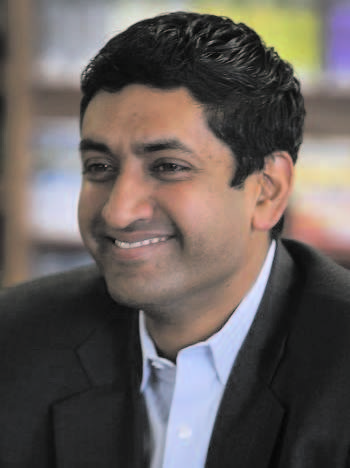
    WASHINGTON (TIP): Amidst widespread frustration surrounding the US shutdown and reckless brinkmanship over the debt limit, an Indian-American leader, seeking his maiden Congressional bid, has introduced a vision of bold government reform agenda. One of the top fund raiser, Rohit Ro Khanna, a former top Obama Administration official unveiled October 17 a five step plan to change the Congress. The proposal includes refusal to donations from political action committees (PACs) and federally registered lobbyists, refusal to Congressional pay raises, end of Congressional pension system, banning legislators from lobbying for five years after leaving office and Members of Congress from taking special interest-funded trips. “These proposals will help turn our Members of Congress back into the representatives of the people that they’re supposed to be,” Khanna said.

    “It will make them more like the voters who send them to office, who have to worry about supporting their families on paychecks that haven’t grown in years. “It will make them think twice about cutting Social Security benefits and blocking health coverage that millions of Americans rely on. It will make them more like you and me,” he said. He said America’s founders invented a government flexible enough that more and more Americans have become full shareholders in it. “Women, African Americans, Latino Americans, and Asian Americans have all obtained the right to vote, and a greater voice in our society. We’re making progress on LGBTQ, too, although we’ve still got a ways to go,” he said. “It’s because of this sometimes unsteady progress toward fairness and equality and freedom and citizenship that our country remains a model for the world. It inspired my grandfather, who joined Mahatma Gandhi’s movement for freedom and democracy in India and spent four years in jail for his activities,” he said. Khanna was addressing a gathering in California from where he is seeking to get elected to the House of Representatives from the Democratic Party. He is pitted against his own party colleague and incumbent Mike Honda and has raised more funds as compared to his rival. Khanna pledged to abide by all the five proposals if elected to the Congress. He said he has refused to accept donations from PACs, special interests, and Washington lobbyists.

  • Indian-American Couple Establishes Scholarship in Houston University

    Indian-American Couple Establishes Scholarship in Houston University

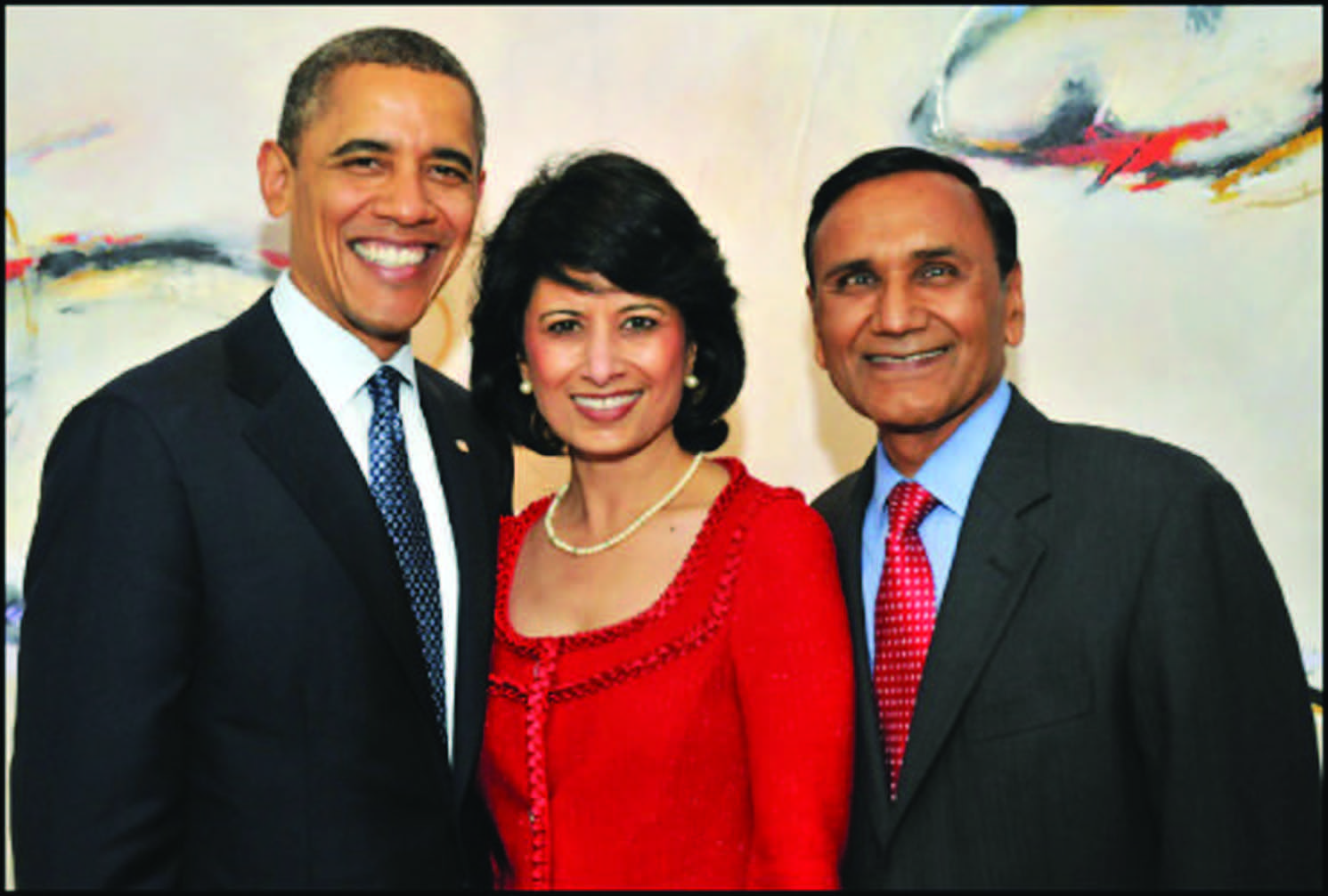
    HOUSTON (TIP): An Indian-American couple has established a tier one scholarship worth more than USD 100,000 in the prestigious University of Houston. Renu Khator, system chancellor and president of the University of Houston, and her husband Suresh, associate dean in the UH Cullen College of Engineering, have contributed more than USD 100,000 to establish the Renu and Suresh Khator UH tier one scholarship endowment. With matching funding, the endowment was augmented to USD 200,000, giving new energy to the University’s tier one scholarship program. “The University of Houston offers more than USD 150 million in aid and scholarship(s) each year to freshmen and transfer students. Most of it is needbased, but a few, including tier one scholarships, are based on merit,” Khator said. “Offering scholarships to freshmen, whether need-based or merit-based, encourages them to attend college, and more specifically, to choose UH,” Khator said. The tier one scholarship program admits students who have a combined math and critical reading SAT score of at least 1300, were ranked in the top 10 per cent of their class and were admitted to the University in the fall semester following their high school graduation, in accordance with the guidelines from the tier one website.

  • Bobby Jindal forms group to win ‘war of ideas’

    Bobby Jindal forms group to win ‘war of ideas’

    WASHINGTON (TIP): Louisiana’s Indian-American governor Bobby Jindal, a potential 2016 Republican presidential candidate, plans to create a policy-focused nonprofit group to help Republicans shed their image as “the party of no.” The group called “America Next” would produce detailed proposals for how conservatives would improve health care, education and energy policy if they were in charge again, Jindal told Politico, an influential politics focused Washington news site. Jindal, whose term as chairman of Republican Governors Association ends next month, complained that his party has focused excessively on criticising President Barack Obama without saying what it would do instead. Citing Mitt Romney’s failed effort to make the 2012 election a referendum on the president, Jindal, 42, said his group will bring together big thinkers to “play offense in the war of ideas.”

    “Saying ‘no’ is not enough,” he said. “We’ve got to get beyond the bumper-sticker slogans. We’ve got to get beyond the 30-second attack ads.” When asked about his plans for 2016, Jindal said: “I don’t know if I’m going to run for president or not.” He quoted former British Prime Minister Margaret Thatcher, who said that you need to win the war of ideas before you can win elections. Jindal, whose second term as governor ends at the start of 2016, said “America Next” will not be afraid to take controversial positions that run afoul of Republican orthodoxy. “Everything needs to be on the table,” he said. “This is not a time to be timid.” Jindal said there’s a helpful contrast between the paralysis in Washington and the reforms being pursued by 30 Republican governors in the states. “A rebellion is brewing outside the Washington Beltway,” Jindal was quoted as saying. “The American people know that the policies coming out of Washington are leading us to a dead end.

  • Sikh student in US not allowed on bus for wearing kirpan

    Sikh student in US not allowed on bus for wearing kirpan

    NEW YORK (TIP): A Sikh student in the US was not allowed to board a bus because he was wearing a knife called kirpan, a symbol of his faith, media reported. Harsimran Singh, a student of University of California in Davis, said he was not allowed to board an Amtrak bus Saturday because the driver was against Singh wearing the ceremonial knife. The student said he has travelled for the last two years with the knife in full view and had not had any issues till the incident on Saturday, CBS News reported Wednesday. “They don’t say anything. They always wish me safe travel, and they continue on with their business… they didn’t see me as a potential threat,” Singh said. According to the report, bus driver Al Smithee got concerned at the presence of a weapon on the bus. “I’m doing 70 miles an hour down the freeway, and he slits my throat, and I crash and wreck, and kill five other people or oncoming traffic. You don’t know,” he was quoted as saying. Smithee then called the police who then told Singh that he could board the bus if he stowed the kirpan. But Singh did not agree and decided against the trip he had planned to visit his family.

  • Cory Booker wins New Jersey Senate race

    Cory Booker wins New Jersey Senate race

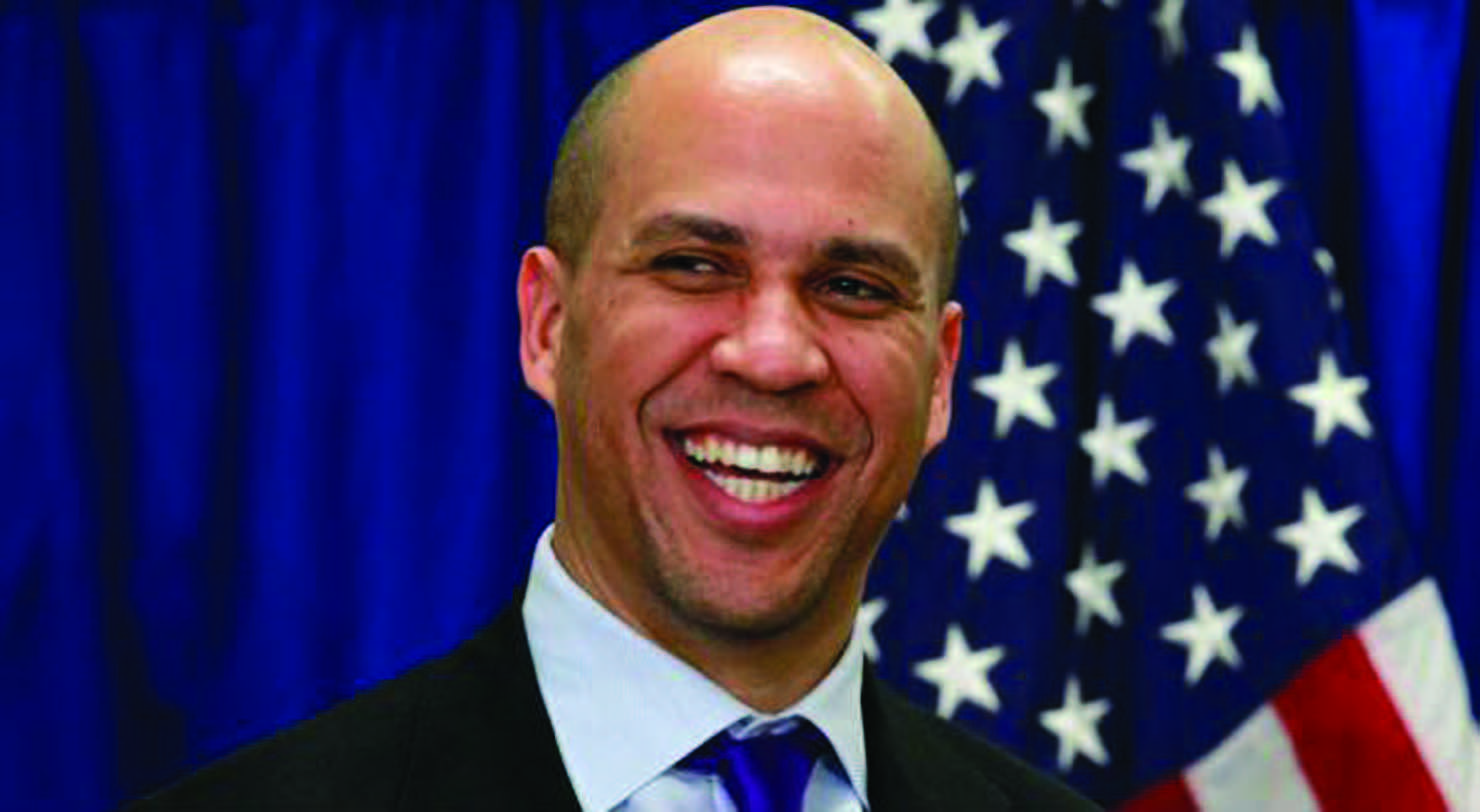
    NEWARK, NJ (TIP): A rising national Democratic star, Newark Mayor Cory Booker, was elected to the U.S. Senate October 16 and will become New Jersey’s first ever African American senator. Booker defeated Republican Steve Lonegan, a former Mayor of Bogota. With most votes counted late Wednesday, the Associated Press had called the contest for Booker, who was carrying 55 percent of the vote. When Booker is sworn in, the Democratic Caucus will once again hold a 55-45 advantage over the GOP Conference. Booker will fill the seat once held by Frank Lautenberg, a long-serving Democratic senator who died in June. Gov. Chris Christie had appointed fellow Republican Jeff Chiesa to be Lautenberg’s interim replacement. Booker, 44, will become the chamber’s second African American member along with Sen. Tim Scott (R-S.C.). The Democrat will enter the Senate having already achieved celebrity status. A regular on cable news programs and Sunday morning news shows with more than 1.4 million followers on Twitter, Booker has cultivated a profile that extends well beyond New Jersey.

  • Council Member Daniel Dromm leads demand for Diwali as School Holiday

    Council Member Daniel Dromm leads demand for Diwali as School Holiday

    NEW YORK (TIP): Council Member Daniel Dromm (D-Jackson Heights, Elmhurst), along with several elected officials and community members, are demanding that the Department of Education designate the Hindu, Jain, Buddhist and Sikh holiday of Diwali as an official day off for public school students. “There are tens of thousands of public school students in New York City who celebrate Diwali,” CM Dromm said. “These students must pick between attending class or spending the day with their families, while students in the Christian and Jewish faiths do not have to make this decision when they celebrate holidays like Rosh Hashana and Christmas. There shouldn’t be this discrepancy. I urge the Department of Education to recognize this important holiday called Diwali.” “I would like to wish all New Yorkers a safe and happy Diwali,” state Senator Toby Stavisky (D-Flushing) said. “With the South Asian population growing quickly in my district and across the city, more and more parents unfortunately have to make the tough choice between celebrating an important holiday or sending their children to school.

    I urge the City Council to strongly consider Council Member Dromm’s resolution to designate Diwali as a public school holiday. As New Yorkers and Americans what makes us special is our commitment to respecting new customs and I hope that the Council can follow through on this commitment for the over 200,000 Diwali celebrants that live in our great city.” “Diwali is one of our community’s key celebrations, and is deserving of the same respect from our school system as other religious days,” Assembly Member Michael Den Dekker (D-Jackson Heights) said. CM Dromm introduced a resolution to the City Council on July 24. Since then, 15 Council Members have signed on as cosponsors and several state elected officials have voiced their support. Diwali or Deepavali, known as the festival of lights, wherein millions of celebrants worldwide light lanterns to symbolize inner light to dispel ignorance and darkness, is a five-day festival that begins on the 13th day of the Hindu month of Kartik. It is the most important festival on the Hindu calendar.

    For Sikhs, Diwali is the day the Mughal Emperor released Hargobind, the revered sixth Guru, from captivity. For Jains, Diwali marks the anniversary of the attainment of moksha, or liberation, by Mahavira, who was the last of the Tirthankaras, or the great teachers of Jain dharma. Some Buddhists celebrate Diwali to commemorate the day King Ashok converted to Buddhism. According to the Census Bureau’s 2011 American Community Survey, there were 207,414 New York City residents who identify themselves as Asian Indian, of which many are adherents of Hinduism, Sikhism, Jainism or Buddhism. Despite the large number of Hindus, Sikhs, Jains, and Buddhists in New York City, Diwali is not recognized as a school holiday in the city’s public school system. The DOE closes for Christmas, Rosh Hashanah and Easter. Those who celebrate Diwali should be given the same respect. “To me, Diwali’s message of ‘Light over Darkness’ means eliminating ignorance and discrimination of every kind. Diwali’s row of diyas is very significant. It is the row of diyas, their unity and unified light that beats the darkness – not one diya alone. Its togetherness – Diwali’s hidden message of necessary unity,” said Ranju Batra, Chair of the Diwali Stamp Project and President of Association of

    Indians in America-NY 2011-2013. “I celebrate Council Member Daniel Dromm and his Diwali School Holiday Resolution, and ask all good people to support it.” “Danny Dromm’s Diwali School Holiday Resolution 1863 is an American landmark to be achieved on the road to forming ‘ . . . a more perfect union.’ It is E Pluribus Unum in action. I call upon Mayor Bloomberg or the next Mayor to have the DOE observe Diwali as a school holiday, so that New York City’s principled action is followed across our land, in every town and city across America, and ‘equal protection of the law’ becomes a sweet reality. Danny Dromm is an American hero,” said Ravi Batra, attorney and chair of National Advisory Council on South Asian Affairs. “Chhaya CDC is very happy to support these efforts to make Diwali an official holiday in the city’s public schools,” said Seema Agnani, Executive Director at Chhaya CDC. “This is one of the more important holidays that is celebrated by millions across the globe. Chhaya also closes its doors on this day to mark the occasion so staff can celebrate with their families and friends. We are so lucky to have so much diversity in New York City and making Diwali an official holiday will serve to increase awareness about the communities here that celebrate the holiday.” The federal government has slowly given the important holiday more respect.

    In 2007, the United States House of Representatives passed a resolution recognizing the religious and historical significance of Diwali, and since 2009, the White House has held an annual Diwali celebration. The United States Postal Service has recently decided it will issue a Diwali commemorative stamp. On the city level the significance of Diwali is acknowledged by suspending alternate side parking rules on Lakshmi Puja, the third and most important day of the holiday. For years the Muslim community has petitioned that the important holidays of Eid Al Adha and Eid Al Fitr be a day off for public school students, but in 2009 a City Council approved resolution was not signed by Mayor Bloomberg. This year Diwali will be celebrated on Sunday, Nov. 3. Next year, the day falls on Oct. 23, a Thursday, and in 2015 on Wednesday, Nov. 11. In Jackson Heights, the community celebrated Diwali last Sunday on 74th Street, the heart of Little India in New York City. Council Members Inez Dickens, Charles Barron, Margaret Chin, Leroy Comrie, Vincent Gentile, Letitia James, Peter Koo, Karen Koslowitz, Rosie Mendez, Annabel Palma, Donovan Richards, Deborah Rose, Ydanis Rodriguez and Daniel Halloran support the resolution.

  • Jackson Heights Merchants’ Association holds 25th Diwali Mela

    Jackson Heights Merchants’ Association holds 25th Diwali Mela

    Ravi and Ranju Batra honored for their services to community

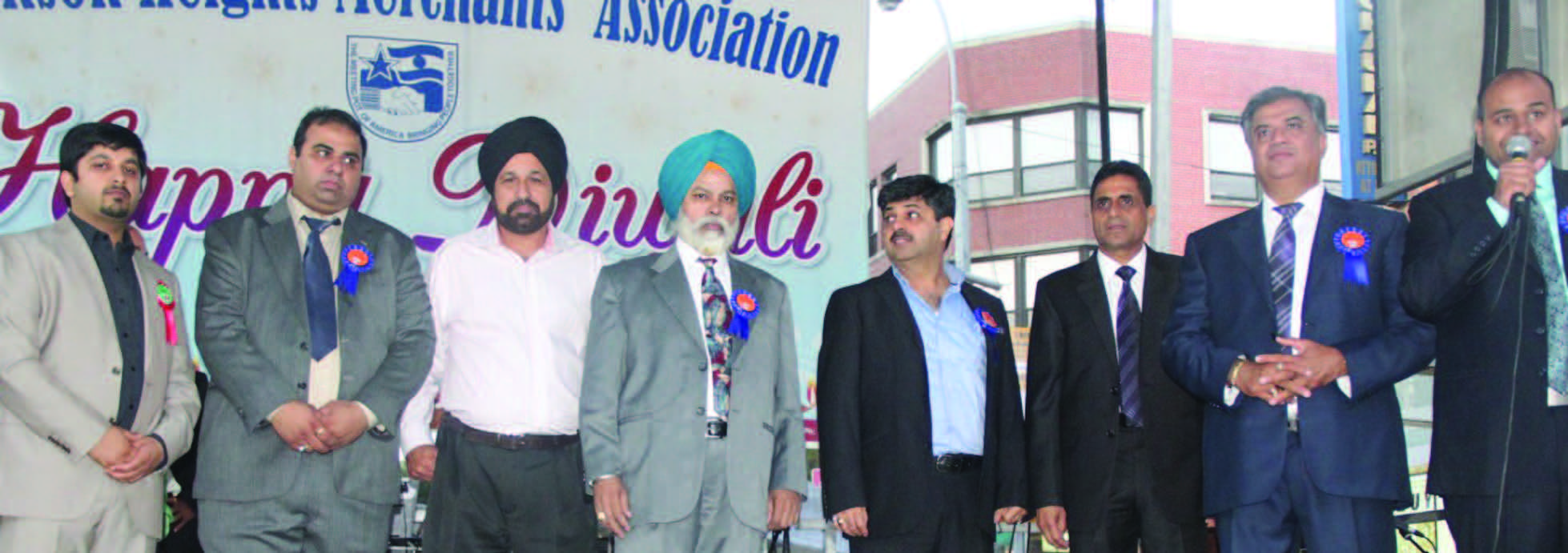
    NEW YORK (TIP): In an unending stream of Diwali Melas in New York, Jackson Heights Merchants’ Association held its 25th Diwali Mela on Sunday, the 13th October. On a pleasant Sunday afternoon, the Mela attracted large crowds though they may have been disappointed to find fewer stalls selling wares and food items as compared to earlier years. Also, the entertainment content left much to be desired, as our reporter gathered after having spoken with some in the crowd. The Mela, as usual, had a fair presence of officials that included the Consul General of India in New York, Dnyaneshwar Mulay, Senator Jose Peralta, Council Member Daniel Dromm and some others.


    img4

    Representatives of business organizations, including the Bangladesh Merchants’ Association were also present. Then there were the honorees that included attorney Ravi Batra and Ranju Batra who initiated the demand for a US postage stamp in commemoration of Diwali, the festival of India. Also honored on the occasion were sponsors that included Air India Area Manager Riwo Norbhu and Habib Bank Manager, among others. Citations by Senator Peralta and Council Member Dromm were presented to organizers who honored them with plaques. We bring here to our readers a pictorial description of the Mela.

  • Coal scam: FIR against industrialist Kumar Mangalam Birla for cheating

    Coal scam: FIR against industrialist Kumar Mangalam Birla for cheating

    NEW DELHI (TIP): CBI lodged a case against industrialist Kumar Mangalam Birla and former coal secretary P C Parekh on charges of criminal conspiracy and corruption in connection with alleged irregularities in allocation of coal blocks eight years ago. After registering the fresh FIR, its 14th in the multi-crore scandal, coordinated searches were carried out by CBI teams at nearly six locations in Mumbai, Delhi, Hyderabad and Bhubaneshwar. The 46- year-old head of the Aditya Birla group will be called in for questioning, CBI sources said. Kumar Mangalam Birla, one of the richest industrialists in India, has been charged with conspiracy and cheating to land two coal blocks in Odisha in 2005 for his firm, aluminum-maker Hindalco. The agency has booked Birla as a representative of Aditya Birla Group and his group company, aluminium maker Hindalco, for alleged corruption in the allocation of Talabira two coal blocks in Odisha which was allotted to it on November 10, 2005, the sources said.

    The blocks were allocated for power production during a meeting of the screening committee, they said. “CBI registers a fresh case in alleged irregularities in coal scam against the then Coal Secretary, M/s Hindalco, representative of Adita Birla Group, unknown persons and officials,” agency spokesperson Kanchan Prasad said. The $40 billion (about Rs. 2.45 lakh crore) conglomerate has denied receiving any FIR and refuted allegations of any wrongdoing. The CBI action had an immediate fallout with Hindalco shares dropping in the morning by 1.27 per cent. Some of the other Birla companies were also affected. Parekh, who was coal secretary at the time of this allocation, faces charges under the Prevention of Corruption Act as also criminal conspiracy and other offences. CBI has been at the receiving end in the Supreme Court which has passed tough questions on why coal fields were allocated to private players without a transparent bidding process, the slow pace of probe as also on missing files.

  • Niira Radia tapes: SC orders CBI inquiry

    Niira Radia tapes: SC orders CBI inquiry

    NEW DELHI (TIP): The Supreme Court on October 17 ordered a Central Bureau of Investigation (CBI) inquiry into eight issues arising from the tapped phone conversations corporate lobbyist, Niira Radia had with top politicians, bureaucrats and industrialists. The report on the criminal aspects of the talks will be given to the court within two months and the case will be heard again on December 16. Apart from the CBI, the vigilance wing will probe six cases. The judges observed during the proceedings that the CBI reports showed “deep-rooted malaise” in the polity. A section of the press has already published detailed reports of the finding of the CBI inquiry, for which it is facing contempt of court action. “Prima facie, there is a deep rooted malaise by private enterprises in connivance with the government officials and Niira Radia’s conversations suggest that influential persons indulged in corrupt practices for private gains for extraneous purpose,” a bench headed by G S Singhvi said.

    The order was passed in two petitions, one moved by industrialist Ratan Tata, and the other by the Centre for Public Interest Litigation (CPIL). Tata’s main complaint was infringement of his privacy, but CPIL counsel, Prashant Bhushan, widened the issues to encompass the whole gamut of political and economic sleaze. The CBI has already informed the court recently that the examination of hundreds of conversations Radia had had over the years showed criminality. Though the probe started as an income tax investigation, it has branched into several fields like the 2G spectrum scam and fixing of ministers and bureaucrats by industrialists for government largesse. The court has been monitoring the investigations and it culminated in Thursday’s order. However, the present order will lead only to a “preliminary inquiry” in legal parlance and it is still far away from a formal complaint or charge sheet. CBI is planning to register preliminary inquiries into the Radia tapes-related cases by next week, a senior official said. Presiding judge Singhvi, who passed several momentous judgments involving corruption, is retiring on December 11, before the CBI report is called for.

  • Obama meets Indian-American Miss America, Nina Davuluri

    Obama meets Indian-American Miss America, Nina Davuluri

    WASHINGTON (TIP): Despite tough ongoing negotiations to reopen the government and avoid a US debt default, President Barack Obama found time to meet Miss America, Nina Davuluri, the first Indian- American to win the coveted crown. “Had the pleasure of having a conversation with President @BarackObama in the Oval Office today! @NinaDavuluri #Celebration13,” Davuluri tweeted shortly after meeting the president at the White House Wednesday morning. “Miss America participated in a group photo with the president in honor of the Children’s Miracle Network Hospital Champions,” a White House official said. “Following the photo, she briefly visited the Oval Office,” the official said. Incidentally, Obama had referred to Davuluri’s achievement as he spoke about “incredible people-to-people ties that exist” between India and the US during his Sep 27 summit meeting with Prime Minister Manmohan Singh here. “You know, Indian-Americans make extraordinary contributions to the United States every single day — businessmen, scientists, academics. Now Miss America is of Indian-American descent. And I think it’s a signal of how close our countries are,” he then said. (Source: Arun Kumar. He can be contacted at arun.kumar@ians.in)

  • The Government Shutdown is Over President Wants a New Approach

    The Government Shutdown is Over President Wants a New Approach

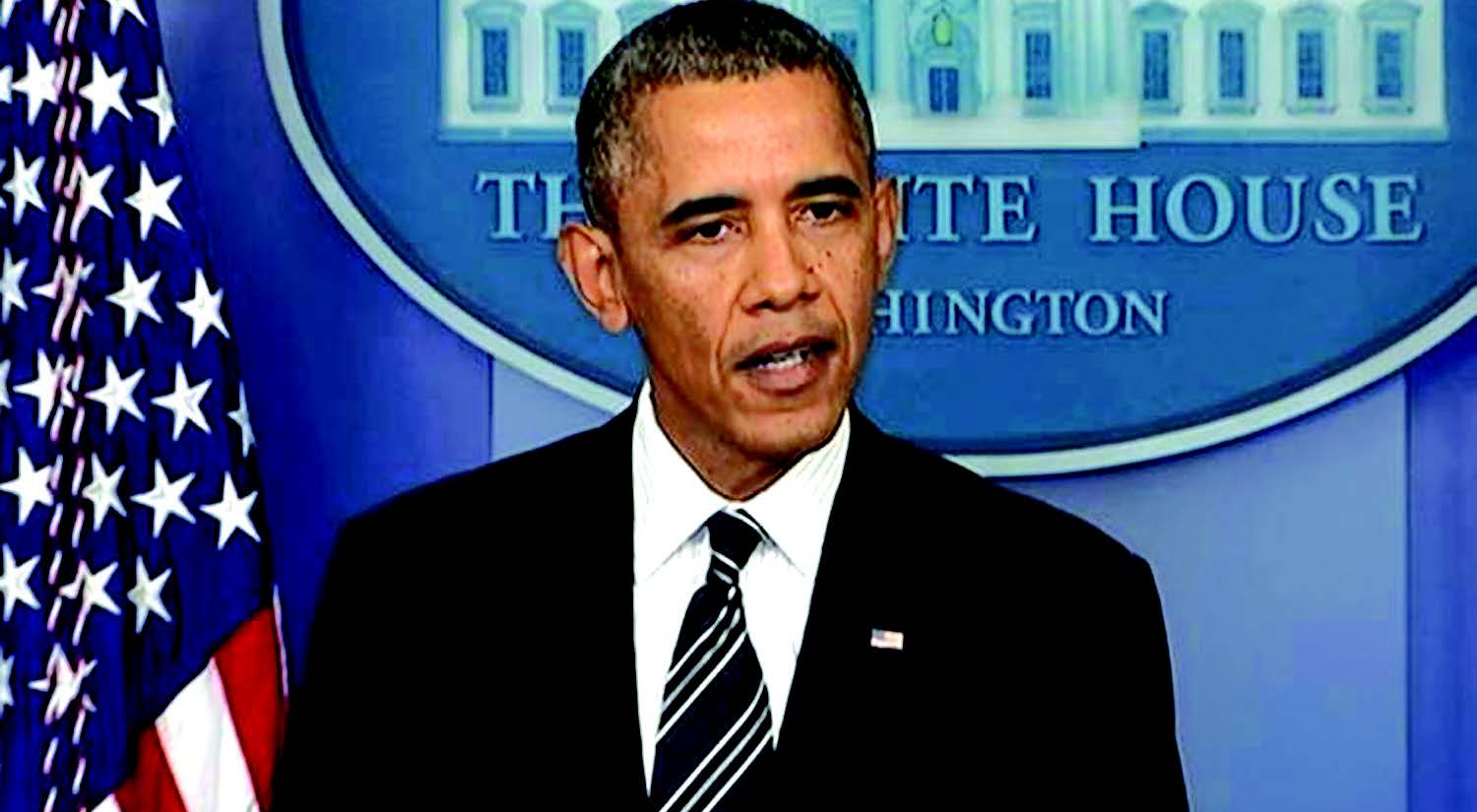
    WASHINGTON (TIP): President Obama signed the legislation to reopen the government October 16 night, soon after the House passed the bill earlier adopted by the Senate. An agreement struck by Senate Majority Leader Harry M. Reid (DNed.) and Minority Leader Mitch McConnell (R-Ky.) ended a stalemate created last month, when hard-line conservatives pushed GOP leaders to use the threat of shutdown to block a landmark expansion of federally funded health coverage. The Senate overwhelmingly ratified the deal the 16th evening, 81 to 18, with more than half of Senate Republicans voting yes. A few hours later, the House followed suit, approving the measure 285 to 144. Eighty-seven Republicans joined a united Democratic caucus in approving the measure, allowing Congress to meet a critical Treasury Department deadline with one day to spare. Speaking on the reopening of the government, Obama said, “Because Democrats and responsible President Wants a New Approach Republicans came together, the first government shutdown in 17 years is now over.

    The first default in more than 200 years will not happen. These twin threats to our economy have been lifted.” There was no economic rationale for all this, President Obama said. “Over the past four years, our economy has been growing, our businesses have been creating jobs, and our deficits have been cut in half,” he said, “but nothing has done more to undermine our economy these past three years than the kind of tactics that create these manufactured crises.” The way business is done in Washington has to change, President Obama said. The standoff “inflicted completely unnecessary damage (to) our economy” by slowing growth and increasing borrowing costs, Obama said, declaring that “there are no winners here.” At the same time, he blamed the brinksmanship that flirted with the first default in U.S. history on no-compromise tactics of the Republican tea party wing in Congress, saying that “the American people are completely fed up with Washington.” “Let’s work together to make government work better instead of treating it like an enemy or purposely making it work worse,” Obama said in a direct jab at tea party conservatives. “You don’t like a particular policy or a particular president? Then argue for your position. Go out there and win an election,” he added. “Push to change it, but don’t break it” because “that’s not being faithful to what this country’s about.” Saying “we can’t degenerate into hatred,” he ended by quoting part of the Pledge of Allegiance that states America is “one nation, under God, indivisible, with liberty and justice for all.”

  • APOCALYPTIC COMET STRUCK EARTH 28 MILLION YEARS AGO

    APOCALYPTIC COMET STRUCK EARTH 28 MILLION YEARS AGO

    JOHANNESBURG (TIP): Scientists have found the first-ever comet material on Earth – a black pebble filled with diamonds – left behind when an ‘apocalyptic’ comet exploded over modern-day Egypt, 28 million years ago. The discovery by a team of South African scientists and international collaborators is the first definitive proof of a comet striking Earth and could also help unlock the secrets of the formation of our solar system. The comet exploded, raining down a shock wave of fire which obliterated every life form in its path, and heating up the sand beneath it to a temperature of about 2,000 degrees Celsius, researchers said. It resulted in the formation of a huge amount of yellow silica glass which lies scattered over a 6,000 square kilometre area in the Sahara. A magnificent specimen of the glass, polished by ancient jewellers, is found in 18th dynasty Egyptian pharaoh Tutankhamun’s brooch with its striking yellow-brown scarab. “Comets always visit our skies – they’re these dirty snowballs of ice mixed with dust – but never before in history has material from a comet ever been found on Earth,” said Professor David Block of Wits University.

    Comet fragments have not been found on Earth before except as microscopic sized dust particles in the upper atmosphere and some carbon-rich dust in the Antarctic ice. The research began with a mysterious black pebble found years earlier by an Egyptian geologist in the area of the silica glass. After conducting highly sophisticated chemical analyses on this pebble, the authors came to the conclusion that it represented the very first known hand specimen of a comet nucleus, rather than simply an unusual type of meteorite. Lead author Professor Jan Kramers of the University of Johannesburg describes this as a moment of career defining elation. “It’s a typical scientific euphoria when you eliminate all other options and come to the realisation of what it must be,” he said. The impact of the explosion also produced microscopic diamonds. “Diamonds are produced from carbon bearing material. Normally they form deep in the Earth, where the pressure is high, but you can also generate very high pressure with shock. Part of the comet impacted and the shock of the impact produced the diamonds,” said Kramers. The team have named the diamondbearing pebble “Hypatia” in honour of the first well known female mathematician, astronomer and philosopher, Hypatia of Alexandria. “NASA and ESA ( European Space Agency) spend billions of dollars collecting a few microgrammes of comet material and bringing it back to Earth, and now we’ve got a radical new approach of studying this material, without spending billions of dollars collecting it,” said Kramers.

  • US’s new robot soldiers can gallop at 25kmph

    US’s new robot soldiers can gallop at 25kmph

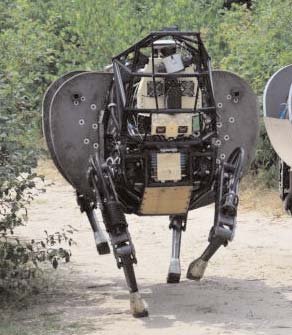
    WASHINGTON (TIP): US scientists have developed a new fourlegged robot called WildCat that gallops at 25 km/h on flat ground and will aid military and rescue operations. The robot was built by Boston Dynamics, a technology company founded by scientists from the Massachusetts Institute of Technology. A new video shows off the robot’s ability to run on flat surfaces but the machine is expected to eventually be able to run quickly over all types of terrain. WildCat is a free-running version of one of Boston Dynamics’ earlier quadruped creation called Cheetah, a super fast robot that could sprint, on a treadmill at least, up to 45.5 km/h — faster than Usain Bolt, the world’s fastest man. Though WildCat is slower than its predecessor for now, it is untethered. Wildcat is being developed as part of the US Defence Advanced Research Projects Agency’s Maximum Mobility and Manipulation, or M3, programme, which seeks to overcome the current limitations that ground robots face in terms of agility, ‘LiveScience’ reported.