Actress Kareena Kapoor says it was the village set up of Punit Malhotra’s ‘Gori Tere Pyaar Mein’ that made her say yes to the project. In the film, the 32-year-old actress is employed with a NGO and believes in working for the benefit of society. “When I heard this film will be shot in a village, I was excited. This was the reason for me to say yes to the project. I have never been to a village or shot there so I wanted to experience it,” Kareena told reporters. This film will see Kareena teaming up with Imran Khan for the second time after ‘Ek Main Aur Ekk Tu’ . “It was fun working with Imran. He is a great actor,” she said. The romantic comedy is produced by Karan Johar and will release on November 22. Also, Kareena is looking forward to working with Hrithik Roshan in ‘Shuddhi’.
Year: 2013
-

KATRINA JOINS SALMAN FOR GANAPATI VISARJAN
Actress Katrina Kaif attended Ganapati visarjan (immersion) ceremony at her former beau Salman Khan’s sister’s house. Katrina, who is known to be very close to the Khan family, made sure she was present on the auspicious occasion. Several Bolywood celebrities, including Karisma Kapoor and Sangeeta Bijlani, too attended the festivities on Tuesday evening along with entire Khan family. Salman has been welcoming Lord Ganesha for the past 11 years at his Galaxy Apartment here, but this year the celebration was shifted to his younger sister Arpita’s house. The Ganesh puja, which started with the installation of the idol on September 9, continued for one and a half days at Arpita’s house.
-

Shuddh Desi Romance
STORY: One loverboy and two lovely ladies. Live-in, walk out, make-up, makeout. In turns. Not necessarily in that order. Confused about love and marriage, they follow their heart (at times) and all that lies in between (pun!). REVIEW: So there, Bollywood breaks the stereotype. It steps out from behind the bloomin’ trees in tulip fields and comfortably ‘shacks-up’ with the times. Here ‘smooch-at-first-sight’ happens in a bus-full with baaratis. Coffee dates are sipped in bed (Happy Endings? Huh!). Commitment is not the criteria. Marriage is not on the cards. And sexual compatibility is high priority. Yes, welcome to a modern day shuddh romance in desiland. Plenty ‘Kiss Kiss, Bang Bang’, tucked in with some emotion and drama too. Raghu-(Sushant)-the-Romeo is a tourist guide in Jaipur, who also doubles up as rental baraati for Goyal (Rishi), a shaadi planner. He meets the rebellious Gayatri (Parineeti) and feels a “tezwala” attraction towards her. They waste no time in moving in, and making out. Soon, they’re love-addicts, but commitmentphobic.
The third character in this threesome (don’t expect any of that) is Tara (Vaani), who was supposed to wed Raghu, until he fled on his wedding day. She makes a re-entry for revenge, but ends up with a complicated status, really. Sushant swings between the Patiala-clad women and makes for the perfectly confused, charming and lovable Romeo. His hair perfectly styled at all times (though he should have had the ‘out-of-bed’ look more often), his clothes are more designer than dehati, but he more than makes up for it with his desi cool performance. Parineeti is a phataka, firing dialogues (smoking up too) and living it up. She makes the character her own, complementing Sushant with a casualness that’s commendable. Newbie Vaani is impressive, pretty and commands a good screen-presence. Rishi Kapoor, blows you away yet again with his incredible histrionics. Maneesh Sharma’s ‘SDR’ has a ‘Band Bajaa Baraat’ blend, but the essence lies in the conversational chemistry between the characters, some beautifully captured moments and slice-of-life scenes. He doesn’t play safe, which is good, but the second half seems repetitive. The concept is engaging, but the plot is little shudd, little desi and quite confused.
-

Modi eclipses man who made him CM, saved his job
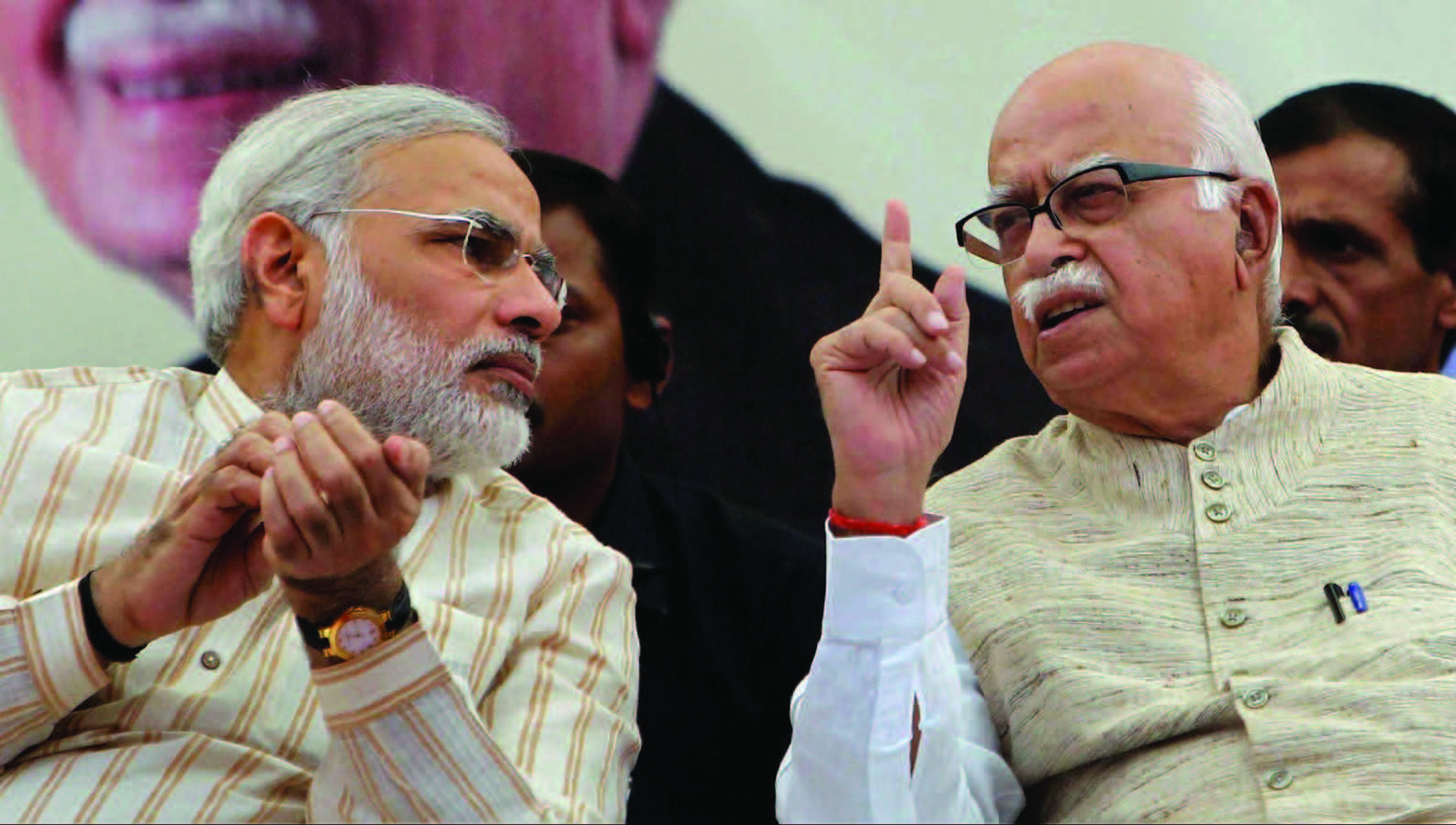
AHMEDABAD (TIP): In most photographs taken of L K Advani and Narendra Modi in the 1980s, the Gujarat chief minister is seen respectfully walking one step behind his mentor. In those days, Modi was an obedient RSS pracharak on loan to the BJP. When he was appointed chief minister in 2001, Modi took his first tentative steps out of Advani’s shadow and walked alongside him. Today, the ‘shishya’ has stolen a march ahead of his guru to the extent that Advani may now have to walk in Modi’s shadow. Flashback to 1975. At the height of the Emergency, when the RSS was opposing Indira Gandhi’s dictatorial ways, top Jan Sangh leader L K Advani first met Modi, a go-getter pracharak with exceptional organizational skills.
For the next 30 years, the two would be inseparable, watching each other’s back within and outside the party. Modi displayed his political acumen by orchestrating the BJP’s first-ever victory in the Ahmedabad Municipal Corporation in 1987. From choice of candidates to booth management, he oversaw it all, rising further in Advani’s eyes. As a result, when Modi suggested that Advani contest Lok Sabha elections from Gandhinagar instead of Delhi, the mentor readily agreed. Advani’s presence energized BJP’s grassroots workers, but also led to the sidelining of the other power centre of the BJP in Gujarat – Shankersinh Vaghela. Modi, along with Pramod Mahajan, was also involved in planning the Gujarat leg of Advani’s historydefining rathyatra from Somnath in 1990, which led to a saffron upsurge across the country and catapulted the BJP into a national force. The party gained the maximum in the political upheaval and came to power in Gujarat with two-thirds majority for the first time in 1995.
Keshubhai Patel was made chief minister, but Advani ensured that his man – Modi – was appointed general secretary in charge of organization. Six years later, in October 2001, Advani helped Modi become chief minister for the first time. The kingmaker had become king for the first time without winning a single election. When Modi was accused of mishandling the 2002 post-Godhra riots and clamour for his ouster grew, Advani, then Union home minister, stood by Modi like a rock. During BJP’s national executive in Goa in 2002, Vajpayee was keen to remove Modi but Advani, working along with young leaders, helped save Modi’s job. The Modi-Advani partnership ended in 2005 when Advani came under attack from the Sangh for praising Mohammed Ali Jinnah during a trip to Pakistan. Modi chose to remain quiet. The chasm had grown considerably by 2009 when many in the party felt the Gujarat CM would make a better PM candidate. But the last straw was Modi’s decision to prioritize his Sadbhavana fast at a time when Advani was planning to launch a nationwide yatra against UPA corruption. Instead of kicking off the yatra from Porbandar, Gandhi’s birthplace in Gujarat, Advani decided to roll it out from Sitab Diara in Bihar, a state ruled by Modi’s arch rival Nitish Kumar.
-

S JAISHANKAR NAMED AMBASSADOR TO US
NEW DELHI (TIP): India’s envoy to China Subrahmanyam Jaishankar has been appointed as the next Ambassador to the US and his position in Beijing will be taken by Ashok K Kantha. Both Jaishankar and Kantha are from 1977-batch IFS. Significantly, both appointments come ahead of Prime Minister Manmohan Singh’s visit to these countries. Singh is leaving for the US on September 25 and is expected to visit China next month. Both the diplomats are expected to take up their respective assignment shortly, Ministry of External Affairs said today. Jaishankar will replace Nirupama Rao. Ashok Kantha is currently Secretary (East) in the MEA and has served in Malaysia and Sri Lanka among other postings. The country’s envoy to Beijing since August 2009, Jaishankar’s name was making rounds for the position of Foreign Secretary after Ranjan Mathai. However, the Prime Minister opted for the seniority and appointed Sujatha Singh as the Foreign Secretary.
-

14 Naxals killed near Odisha-Chhattisgarh border
BHUBANESWAR (TIP): A joint team of Special Operations Group (SOG) and the police shot dead at least 14 Naxals during a joint operation along Odisha-Chhattisgarh borders near Malkangiri district on September 13 night. This is being dubbed the biggest Naxals casualty in Odisha so far. The police have recovered a huge cache of arms and ammunitions during the operation. Earlier on August 23, dreaded Naxal leader Madhav alias Golla Ramullu, who carried Rs. 4 lakh reward on his head, was killed in an encounter with security forces in Odisha’s Malkangiri district. Madhav was involved in many incidents of murder including the killing of 38 security personnel in Chitrakonda reservoir, extortion and land mine blasts.
-

NO ONE CAN CONTEST ELECTIONS IF AFFIDAVIT SILENT ON ANTECEDENTS: SC
NEW DELHI (TIP): The Supreme Court on September 13 ushered in a fresh dose of electoral reforms by ruling that no one can contest elections without making a full and honest disclosure about his/her assets and educational and criminal antecedents. Curbing the practice among candidates to leave columns demanding information blank in the affidavits filed along with nomination papers, the court authorized returning officers to demand relevant details and reject nomination papers if the details are not furnished despite reminder. This judgment came from a bench of Chief Justice P Sathasivam and Justices Ranjana P Desai and Ranjan Gogoi, which appeared undeterred by lawmakers’ protest in Parliament and attempt to undo the apex court’s two landmark judgments delivered on July 10 – one disqualifying MPs and MLAs convicted in serious crimes and the other debarring arrested persons from contesting polls.
Candidates left columns in affidavits blank to step around the SC’s two earlier judgments – Association for Democratic Reforms in 2002 and People’s Union for Civil Liberties in 2003 — which mandated a contestant to furnish details of his criminal and educational antecedents as well as assets owned by him, his spouse and children. If no affidavit is given, the returning officer rejects the nomination paper. If false information is given in the affidavit, it makes them liable to perjury charges. To overcome the twin predicament in a scenario where many candidates have criminal track records and face allegations of disproportionate assets, the candidates had devised the antidote to the legal requirement – leave the columns in the affidavit blank. NGO ‘Resurgence India’ brought this issue before the apex court and sought a direction to make it compulsory for returning officers to ensure that the affidavits filed by contestants are complete in all respects and to reject those affidavits which leave information columns blank.
Writing the judgment for the bench, CJI Sathasivam said in a vibrant and dynamic democracy like ours, a voter had the elementary right to know full particulars of a candidate who would represent him in Parliament. “Such right to get information is a universally recognized natural right flowing from the concept of democracy and is an integral part of Article 19(1)(a) of the Constitution (guaranteeing right to freedom of speech and expression),” he said. “In unequivocal terms, it is recognized that the citizen’s right to know the candidate who represents him in Parliament will constitute an integral part of Article 19(1)(a) of the Constitution of India and any act which is derogative of the fundamental right is at the very outset ultra vires (unconstitutional),” the bench said. Can filing of an affidavit stating that the information given in the affidavit is correct but leaving the contents blank fulfill the objective behind filing it along with nomination papers? The bench said it was unacceptable that a candidate would leave blank the columns demanding information about his antecedents and assets.
“The ultimate purpose of filing of affidavit along with the nomination paper is to effectuate the fundamental right of the citizen under Article 19(1)(a) of the Constitution of India. The citizens are required to have the necessary information at the time of filing of the nomination papers in order to make a choice of their voting.When a candidate files an affidavit with blank particulars, it renders the affidavit itself nugatory,” it said. To make the affidavit meaningful and informative for voters, the returning officer could compel the candidates to fill up the blank spaces, the bench said. Justices Sathasivam, Desai and Gogoi reiterated that “it is the duty of the returning officer to check whatever the information required is fully furnished at the time of filing of affidavit with the nomination paper since such information is very vital for giving effect to the ‘right to know’ of the citizens. If a candidate fails to fill the blanks even after the reminder by the returning officer, the nomination paper is fit to be rejected.”
-

Indian-American author Jhumpa Lahiri in Booker shortlist for her fiction ‘The Lowland’
NEW YORK (TIP): Indian-American author Jhumpa Lahiri has made it to this year’s Man Booker Prize shortlist for her new fiction ‘The Lowland’, an intimate portrayal of two brothers set in Kolkata of the 1960s. Her tale, set in the suburban streets of Calcutta of the 1960s and told through the eyes of brothers Subhash and Udayan in ‘The Lowland’, will compete alongside five other works of fiction for the coveted literary award worth 50,000 pounds to be announced here next month. Born in London and based in New York, 46-year-old Lahiri is the daughter of Indian immigrants from West Bengal. She is also a member of US President Barack Obama’s Committee on the Arts and Humanities. She won the 2000 Pulitzer Prize for Fiction with her debut short story collection ‘Interpreter of Maladies’ (1999) and her first novel ‘The Namesake’ (2003) was adapted into a popular film of the same name by filmmaker Mira Nair.
Her writing is rooted in the Indian milieu and attempts to capture dislocation and ambivalence with a unique play of words. ‘The Lowland’, released this month, is already being pitched as an easy front-runner among literary circles here. Birmingham-based Jim Crace is also being touted as among the 2013 favorites for ‘Harvest’, a novel about the fragile social eco-system of a remote English village, which the author has claimed, will be his last. Like Crace, Colm Toibin is also a previous nominee and is heading the list with ‘The Testament of Mary’ – about the mother of Jesus grieving angrily years after her son’s crucifixion. If it wins, it will be the shortest novel to win the Booker with just 104 pages. Eleanor Catton, 28, is the youngest to make the cut with her book ‘The Luminaries’, while Ruth Ozeki with ‘A Tale for the Time Being’ and No Violet Bulawayo ‘We Need New Names’ complete this year’s selection. Robert Macfarlane, chair of the judges, said the shortlist was “instantly striking because of its global range”. “It shows the English language novel to be a form of world literature,” he said.
“We looked for books that sought to extend the power and possibility of the form. This is in keeping with the history of the novel. We wanted novel novels,” he added. Each of the six shortlisted writers will receive 2,500 pounds and a handbound edition of their book. This year marks the 45th year of the prize, which will be announced on October 15 at an awards ceremony at London’s Guildhall. Last year, Hillary Mantel’s ‘Bring Up the Bodies’ took home the prize. Mantel became only the third author, after Peter Carey and J M Coetzee, to win the prize twice. In 2008, Indian author Aravind Adiga won the Booker for ‘The White Tiger’ and Kiran Desai took home the prize in 2006 for her novel ‘The Inheritance of Loss’. “Global in its reach, this exceptional shortlist demonstrates the vitality and range of the contemporary novel at its finest,” Macfarlane said.
“These six superb works of fiction take us from gold-rush New Zealand to revolutionary Calcutta, from modernday Japan to the Holy Land of the Gospels, and from Zimbabwe to the deep English countryside. “World-spanning in their concerns, and ambitious in their techniques, they remind us of the possibilities and power of the novel as a form,” he said. In ‘The Lowland’, Jhumpa explores the heart of family life and the immigrant experience. Her publisher Bloomsbury has described the book “epic in its canvas and intimate in its portrayal of lives undone and forged anew”. The Man Booker Prize for Fiction is a literary prize awarded each year for the best original full-length novel, written in English, by a citizen of Commonwealth of Nations, Ireland, or Zimbabwe.
-

Indian-American Manju Goel to run for US Congress
CHICAGO (TIP): Taking aim at “Obamacare” and national debt, India-born Manju Goel is seeking Republican nomination for a Congressional run to challenge incumbent Democrat Tammy Duckworth. Goel, an Aurora resident and conservative is backed by a national group of Republicans, including Texas congressman Pete Sessions, in her run for 8th Congressional District of Illinois state, according to Chicago Daily Herald. In her campaign literature, Goel said she grew up in a middle-class family in northern India and came to the United States at the age of 21. She has degrees in applied computer science and health care management and served as a process improvement specialist for Advocate Healthcare. Today, she works as a self-employed consultant specializing in process control improvemen.
-

Indian-American Kavita Shukla wins top design award in Denmark
NEW YORK (TIP): Indian American Kavita Shukla has won INDEX design award for her innovative design, FreshPaper, that helps keep food fresh for a longer period. The 500,000 Euro award, recognizing the best of innovations addressing problems facing the world, is given biennially in Copenhagen. Shukla is among the five winners in categories like Body, Home,Work, Play and Community. Her design won in the Home category and impressed the jury with its simplicity and cost-effectiveness. “FreshPaper is simple, low-tech and hyper affordable, with the potential to scale into new markets. The product has taken off in the United States, but it has immense potential to improve the lives of those living in less developed areas as well, where access to refrigerators is limited,” said INDEX jury chairman Mikal Hallstrup in a release. The low-cost design is compostable and infused only with organic spices. Shukla came across an old remedy after accidentally drinking dirty tap water while visiting her grandmother in India.
Her grandmother gave her a “spice tea” and when she did not get sick, her curiosity was sparked. Shukla kept experimenting with the spices and finally found a new application of the age old home remedy. Shukla, who was awarded the patent for FreshPaper at the age of 17, founded a social enterprise, Fenugreen, in 2010 to bring her product to those in need across the globe. It is already available in the US. The judges at INDEX believed that the design will have a huge impact in food preservation around the globe.
-

Obama nominates Indian-American Puneet Talwar to key diplomatic position
WASHINGTON (TIP): US President Barack Obama has nominated Indian- American Puneet Talwar as Assistant Secretary of State for Political Military Affairs, a top diplomatic post. Talwar, who was Obama’s top advisor on the Middle East region for over four years was nominated for the position by Obama yesterday. He is the second Indian-American to be nominated as the Assistant Secretary position in the State Department. In July, Nisha Desai Biswal was nominated as the Assistant Secretary of State for South and Central Asia. Both the positions need to be confirmed by the Senate. Obama announced his intent to nominate Talwar to the top State Department position along with nearly 30 senior administration positions. “I am grateful that these talented and dedicated individuals have agreed to take on these important roles and devote their talents to serving the American people,” Obama said. “I look forward to working with them in the coming months and years,” he added. If confirmed by the Congress, Talwar, in his capacity as the Assistant Secretary of State for Political Military Affairs, will provide policy direction in the areas of international security, security assistance, military operations, defense strategy and plans, and defense trade.
-

CIA finds 1-in-5 job applicants hail from Hamas, Hezbollah, al Qaeda
WASHINGTON (TIP): An estimated one-fifth of all applicants for Central Intelligence Agency positions had significant ties to the terror groups, Hamas, Hezbollah and al Qaeda, a newly released document from the Edward Snowden collection revealed on Monday, September 2. The document – released by Mr. Snowden as part of his National Security Agency intelligence dump – said that the terrorist groups worked hard to infiltrate America’s top security agencies. CIA officials uncovered thousands of applicants, roughly 1-in-5, with “significant terrorist and/or hostile intelligence connections,” the document states, Ynet News reported.
The specifics of those ties were not revealed. But the groups most often cited as attempting to infiltrate the U.S. intelligence network were al Qaeda, Hamas and Hezbollah. The NSA, in response, launched investigations into 4,000 instances of suspected abnormal staff activity, Ynet News said. Those investigations included the tracking of employee keystrokes on agency computers and the recording of document downloads. “Over the last several years, a small subset of CIA’s total job applicants were flagged due to various problems or issues,” one unnamed agency official said, Ynet News reported. “During this period, one in five of that small subset was found to have significant connections to hostile intelligence services and-or terrorist groups.”
-

Legendary Bollywood stars to perform at the Iconic ‘Diwali at Times Square’
NEW YORK, NY (TIP): The iconic and history-making ‘Diwali at Times Square’ on Sunday, September 22, 2013 will witness participation of some of the biggest stars of Bollywood, the organizers, Event Guru and ASB communications, announced here on September 12. The event is sponsored by Maharashtra Tourism, Air India, MoneyGram, Royal Albert Palace, Wells Fargo and Bank of Baroda. So do mark September 22nd2013 in your calendar because that is the day when you will get to experience and savor the cultural potpourri that is India in Manhattan when Times Square celebrates Diwali. First time ever this historic event is being celebrated at the largest and the most popular cross road of the world – Times Square.
The first-of-its-kind international initiative to promote Indian culture, heritage and diversity will span Broadway from West 45th to West 47th street. The event will take place from 11am to 6pm, followed by the ‘Light Up Times Square’ concert which will showcase live performances from some of the biggest names in Bollywood. All present will get a peek at the cultural kaleidoscope that is India by savoring Indian music, dance, food and films. The Title Sponsor of the show Maharashtra Tourism will be showcasing the much talked about and looked forward to Deccan Odyssey train through a re-creation of the same. All present will also be given an opportunity to take home a little bit of the Indian culture through an interactive exercise by the presenting sponsor Air India, wherein, they could learn how to drape the saree. Apart from this they will also get an opportunity to learn how to wear a turban or even learn how to play the dhol (Indian drum). A spokesperson for the organizers, giving details of entertainment segment said, “To kick start entertainment we shall have the melodious and ethereal voice of Shankar Mahadevan resonate in Times Square and enthrall all those present with his most popular songs medley.
As if that wasn’t enough we shall have Ranbir Kapoor, the heart throb of India, the maverick superstar whose lineage boasts of the likes of Prithviraj Raj Kapoor, Raj Kapoor and Rishi Kapoor. “Ranbir Kapoor will perform and interact with the audiences present about his new film Besharam. And over and above all this pulsating entertainment we will get to see the most popular Bollywood couple Neetu and Rishi Kapoor accompany him on stage too. Pallavi Sharada, the debutante heroine of the film, will also perform on a song from Besharam. If this isn’t enough to give you an adrenaline rush then you will be jolted into a musical culture shock by the famous group from Canada Culture Shock. So do come one and all and share in this fantastic free for all experience of Dilwali at Times Square on 22ndSepetmber 2013. For further inquiry do visit www.diwalitimessquare.com and facebook.com/DiwaliTimesSquare
-

India pays homage to those killed in the 9/11 terrorist attack
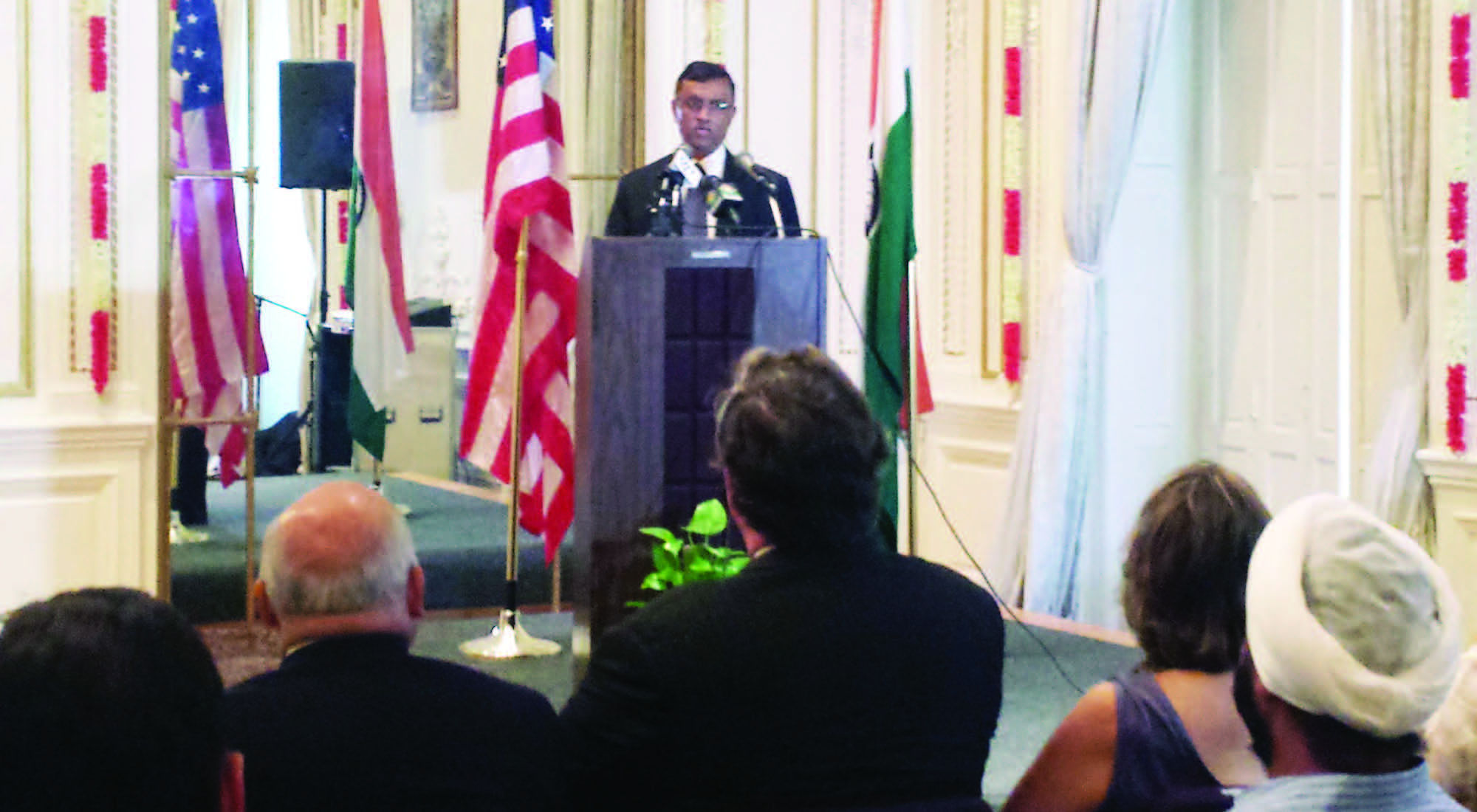
NEW YORK, NY (TIP): On the 12th anniversary of the September 11 terror attacks that killed nearly 3,000 people India announced its participation in the Queen Elizabeth II September 11 Garden as one of the commonwealth nations. The announcement was made by Consul General of India in New York, Ambassador Dnyaneshwar Mulay, at a prayer meeting organized for those who lost their lives in the deadly attack. The British Garden at Hanover Square- a triangular slip of greenery at Pearl and Hanover streets- was commissioned by the British Memorial Garden Trust and given to the city in memory of British citizens who lost their lives during the attacks of September 11 2001 and in the ensuing wars.

A view of the gathering
However in August of 2011, the purpose of the garden was expanded to honor victims from the Commonwealth nations. “We are deeply honored and touched that India has chosen to join us at the Queen Elizabeth II Garden September 11. When we started in 2002 we wanted something to honor back then the British society. However, over the years it became clear that our mission was much wider than just British nationals and changed it to much wider Commonwealth nations,” said British Memorial Garden Trust Chairman, Victor Stewart. He added, “We believe that it is very important that Commonwealth nationals in this international city have a common place that they can go to and reflect upon our common heritage.” “So far Commonwealth nations who have participated include Australia, Canada, New Zealand, Jamaica and now, it is India.We would like all Commonwealth nations especially those affected by 9/11 to participate,” said Vice Chairman, British Memorial Garden Trust, Rodney Johnson.
Condemning the terrorist attacks, Ambassador Mulay stated, “The Queen Elizabeth II September 11 garden is built in the memory of those who sacrificed their lives in the 9/11 terrorist attacks. India lost about 47 people and this number does not include people who died outside the building or people who are not accounted for and so we thought it is a good gesture to participate and pay homage to people who died.We had a request from the chairman of the garden and we readily agreed.” At the event, Ambassador Mulay recited a Sanskrit prayer to pay homage to those who died in the terrorist attack. Approximately 2996 people were reported dead in the multiple attacks. “We are gathered here to essentially pray for those who sacrificed their lives irrespective of their nationalities or religion and also take this opportunity to condemn all form of terrorism,” said Ambassador Mulay. Those who spoke on the occasion, besides Ambassador Mulay, included Attorney Ravi Batra, George Abraham, and Jagdish Sewhany.
-

Mangano announces construction of new first precinct to begin in October
Kellogg House to be transformed into a Community Center, Harrison Avenue to remain open
MINEOLA, NY (TIP): Nassau County Executive Edward P. Mangano announced September 5 that construction of a new First Precinct for the Police Department will begin in October 2013, pending approval from the County Legislature. The construction brings a modern, cutting edge building to the Police Department while addressing the concerns of the surrounding community, including the preservation of a historic house and keeping Harrison Avenue open to the public. This project saves $21 million when compared to a costly plan put forth by the prior administration that would have saddled taxpayers with the burden of a lucrative lease agreement with a private business owner. County Executive Mangano stated, “My administration has worked in close partnership with the community to ensure that a new First Precinct is constructed in Baldwin and serves as an asset to the community and police department alike. Construction of the new First Precinct will begin in early October and save taxpayers $21 million over previous plans.”Bids from prospective builders are expected to be opened September 10th, with the winning contract put before the Nassau County Legislature on September 23rd. New plans call for keeping Harrison Avenue open to the public. The street, which runs south of Merrick Road and is at the corner of the site of the new First Precinct, is an important outlet for the community. The Kellogg House, on the corner of Harrison Avenue and Merrick Road, will be preserved as a community center. During construction, the Kellogg House will be used by the construction company as offices and the area used for overflow parking to keep parking on residential streets to a minimum. The garage will also be preserved on the property. To gain more property, Nassau County is also purchasing the site of Huntington Learning Center, located on the west side of the First Precinct. The new precinct will be a three-story building and include community access space for more outreach to the surrounding neighborhoods. Construction is expected to last 18 months and cost approximately $13 million.
-

ADANI-MODI NEXUS TO COST 23,625 CRORE
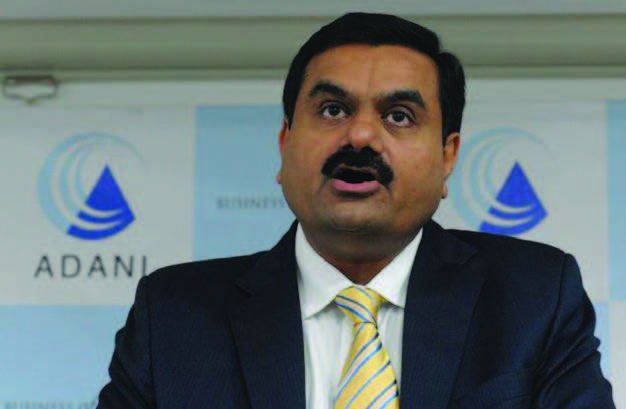
Over the past seven years the Narendra Modi government has entered into several dubious agreements in the realm of the energy sector which were tailor-made to provide astonishingly high profits to the Gautam Adani promoted power producing companies. This story analyses one such decision that will impose a heavy financial burden on the people of Gujarat even as Adani will walk away with an excess profit of Rs 23,625 crores over the next 25 years.
In 2006, when Gujarat was in dire need of power the Gujarat Urja Vikas Nigam Limited (GUVNL) decided to call on private companies to produce 3000MW electricity for the state. It signed two Power Purchase Agreements (PPAs) with the Adani group for production of 1000MW each and the rate at which the electricity was to be purchased was decided at Rs 2.89 per unit and Rs 2.35 per unit respectively. In the first case, the electricity was to be produced using imported coal while in the second it was to be produced using a mix of imported coal and coal mined in the country. However, just before the deal with Adani, GUVNL had signed an agreement with the Coastal Gujarat Power Project, a Tata Group company, for purchasing power at the rate of Rs 2.26 per unit, in this case too, imported coal would be used to produce electricity.
This higher rate of purchase from the Adani group has cost the state a loss of Rs 1347 crore in the past two years, and over a period of 25 years a staggering loss of Rs 23,625 crore. The Narendra Modi government’s decision to pay a higher price to the Adani group is nothing short of a scam. All the more, when smaller producers are ready to supply electricity at the rate of Rs 2.20 per unit, a much more competitive rate. Why this largesse towards the Adani group? Gulail sent detailed questionnaires to Adani and GUVNL on this issue. Both parties failed to respond. Arjun Modwadia, an ex-MLA from Porbandar in Gujarat had this to say, “There have been back-channel deals between Adani and Narendra Modi. On the one hand land was bought at cheap rates from people in Mundra and given to Adani to set up its projects and on the other despite all the subsidies the power is bought from them at higher prices. The fact is that the Gujarat government is working in collusion with the Adani group.”
HOW GUJARAT WILL SUFFER
o Power being bought at Rs 2.89 per unit from Adani Power Limited while Coastal Gujarat Power Project is supplying at the rate of Rs 2.26 per unit – 63 paisa more per unit is being paid to Adani. o Adani has supplied 7000 million units and 14393 units in 2011 and 2012 respectively causing the state a loss of Rs 441 crore and Rs 906 crore respectively – a total loss of Rs 1347 in two years. o If 15,000 million units are bought from Adani over the next 25 years the loss to Gujarat would amount to Rs 23,625 crore Let’s consider the implications of this deal with the Adani group. As per the first agreement with Adani Power Limited, the supply of 1000MW is to be done at the rate of Rs 2.89 per unit while the agreement with the Coastal Gujarat Power Project requires it to supply 600MW power at the rate of Rs 2.26 per unit – a difference of 63 paise per unit between the two.Simple calculations show that for supplying 7000 million units of power in 2011 and 14,393 units of power in 2012 the GUVNL has ended up paying Rs 441 crore and Rs 906 crore more to Adani Power Limited in the previous two years respectively – a total profit of Rs 1347 crore for the Adani group. Hence over a period of 25 years, at the same rate, if Adani Power Limited supplies 15,000 million units of power to the GUVNL it would mean a net loss of Rs 23,625 crore to Gujarat. While this would mean an undue profit to Adani Power Limited, it would also impact the consumer – from farmers to the common man to industrialists – all would end up paying way more than they should ideally have been required to. When rates are hiked it also results in an increase in the rate of household items like clothes, food items, salt, oil and various other things that require electricity to be manufactured or processed. This decision of the government will not only affect 6 crore Gujaratis but also end up impacting people who buy products manufactured or processed in Gujarat for the next 25 years. Clearly, Modi’s government is more concerned about ensuring profits for the Adani Group rather than citizens of the state of Gujarat.
HOW GUJARAT WILL SUFFER
o Power being bought at Rs 2.89 per unit from Adani Power Limited while Coastal Gujarat Power Project is supplying at the rate of Rs 2.26 per unit – 63 paisa more per unit is being paid to Adani.
o Adani has supplied 7000 million units and 14393 units in 2011 and 2012 respectively causing the state a loss of Rs 441 crore and Rs 906 crore respectively – a total loss of Rs 1347 in two years.
o If 15,000 million units are bought from Adani over the next 25 years the loss to Gujarat would amount to Rs 23,625 crore. -

Gallows for the Rapists, OK, but Rape too must die
The death sentence for the four accused in Nirbhaya rape case meets the expectations of all right thinking people. The sentence of death for four convicts in the December 16 Delhi rape case took nine months in the coming; a long period for what seemed an open-and-shut case. The award of capital punishment to all four accused in the Nirbhaya case does not come as a surprise. The fifth accused, a juvenile, has already been remanded to a juvenile home for a term of three years. Public outrage against the very brutality of the crime had been so overwhelming that only no judge could have imposed a lesser penalty. This is an instance in which public opinion has asserted itself, and rightly so.
The defense may find fault with the judgment. But the evidence gathered and produced had been so clinical that, with or without media hype and visible public indignation, the verdict could not have been otherwise. The Supreme Court rider of ‘rarest of rare cases’ was more than established by the prosecution, though in the larger public perception there never was any doubt. To be sure, the police, the judiciary, and even the government were under immense pressure to ensure justice. No one could afford a slip-up, and a court has to base its ruling on facts, not emotions. Given the watertight case the investigators built, this was indeed a fast-track trial. No one, after all, would advocate bypassing the due process of the law. The family of the 23-year-old Nirbhaya, who was subjected to brutality that defies narration, has expressed satisfaction at the sentence. Justice, however, is rare for victims of rape or their families; satisfaction, ever rarer.
In the same court that has pronounced death for the Delhi rape and murder, 20 out of the 23 rape cases heard this year ended in acquittal. In most cases it was because the complainant backed off. Even more than the criminal justice system, society is conditioned to remain silent on crimes against women ‘in their interest’! The December 16 case has served a cause to that extent. It has jolted society, the police, the judiciary, and even the legislature to bring about meaningful changes in the laws and procedures to protect women and children. So that the young life lost is not a complete waste, India has now to move on from the phase of debate to action. The nine months since the horrific night have thrown up an overwhelming range of ideas, including many opposing views. There, however, appears to be no decline in rapes being committed each day. Death is propounded as a deterrent to such heinous crimes. A greater deterrent would be the surety that culprits will be nabbed and sentenced.
-

IACC hosts a welcome reception to the Consul General of India
NEW YORK, NY (TIP): The Indian American Chamber of Commerce (IACC) on Thursday, September 12, held a welcome reception and dinner for the Indian Consul General in New York, Ambassador Dnyaneshwar M. Mulay. IACC President Rajiv Khanna, extending a formal welcome, highlighted Ambassador Mulay’s career and his accomplishments. He described him as the ‘renaissance man’. “It is no secret to any of us that India is currently going through a challenging economic time. It is also no secret to any of us that the trade and economic relations between India are not currently at their finest hour.

The recent global recession has brought back the drum beats of protectionism in the United States,” he said, adding, “In these challenging times, we are very fortunate that India has sent a diplomat of the caliber of Ambassador Mulay to New York, the economic capital of this country.” Formed in 1932, The Indian – American Chamber of Commerce (IACC) works to promote trade and investment between India and the United States. “The chamber of commerce has been a close ally of India through good times and bad, from the growth rate of 3% to the high growth rate of 9.5%, through the Super 301 sanctions, the sanctions against India after its nuclear test, through controversies and tensions arising from outsourcing to India, the U.S.- India nuclear treaty, to the days of warm trade and investment relations between India and the U.S.; because it is the firm belief of this Chamber that when the world’s two largest democracies, the U.S. and India, work together in trade and investment, it will not only lead to greater prosperity for the citizens of those two countries, but it will also be a growth engine for the rest of the world,” stated Khanna.
Praising the Indian American community, Ambassador Mulay said, “It is one of the most remarkable things that has happened to India, so strong, so vibrant so resourceful and spread all across the Unites States. Rough estimates suggest there are 3.8 billion Indians, and this population has emerged as one of the richest minorities… this community is now here to play an important role now, politically in US, in terms of promoting economic relations between India and the US. I would like the Indian American community to become a bridge between the two countries, the role they have not really performed and that’s very clear from the investment figures, which is still a small figure.” When asked if there are any programs between now and elections to counteract some of the negative images – corruption, economic downturn etc.- that are in play right now, Ambassador Mulay said, “…I would like you (people) to be a little patient as all of us are with United States; we are going through rough patch but India’s fundamentals are strong.” The welcome reception to Ambassador Mulay was very well attended.
-

Indian American admits role in widespread student visa fraud
NEW YORK (TIP): An Indian American has admitted his role in widespread foreign student visa fraud that took place in New Jersey, the US Department of Justice said August 28. Manamadurai Somalingam, 64, from New York pleaded guilty before US District Judge Freda Wolfson in Trenton Federal Court in New Jersey to information charging him with one count of conspiring to commit visa fraud and one count of conspiring to conceal and harbour illegal aliens for private financial gain. He now faces a maximum penalty of 10 years in jail and a fine of USD 250,000.
The sentencing is scheduled for December 5. According to court documents, Somalingam admitted that from March 2011 through May 2012, while he was the owner of a school called PC Tech Learning with campuses in Iselin and Jersey City, he engaged in a conspiracy to obtain student visas for foreign citizens who were not eligible for such visas. Somalingam admitted that he falsely certified that a woman he hired to work for him at the Jersey City campus of PC Tech was eligible for a student visa even though he knew that she would be working full-time and was not eligible. Besides, Somalingam admitted he never terminated a foreign citizen’s student status as long as that individual paid his tuition fees, even though Somalingam, as the primary designated school official for PC Tech, was required to terminate any student who failed to make proper progress in his studies, the Department of Justice said.