Year: 2013

  • Army, MEA bid can resolve LAC stand-off

    Army, MEA bid can resolve LAC stand-off

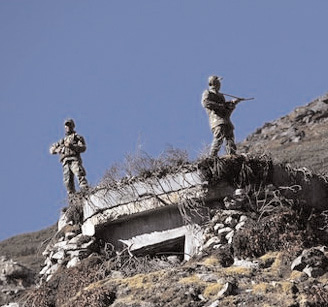
    NEW DELH (TIP)I: A third flag meeting to resolve the stand-off created by the April 15th Chinese incursion in Ladakh may be held on Friday, according to sources in the security establishment.

    The third meeting is likely to be held either at the same level of seniority as the earlier two flag meetings, or possibly at a lower level, sources said. At the first two flag meetings on April 18 and 23, the Indian side was represented by a brigadier, and China by a senior colonel.

    Even as the Chinese local commander’s willingness to stay engaged through a possible third flag meeting is welcomed by the Indian border forces, officials in the security establishment don’t sound too hopeful of an immediate resolution of the issue. “The situation may need an intervention at a higher level in the Army or the government to resolve,” a senior intelligence official said, adding that the PLA troops may agree to go back only closer to Chinese Premier Li Keqiang’s visit to India, beginning May 20. The border row will also be taken up by external affairs minister Salman Khurshid during his visit to China, starting May 9. Sources in the security establishment said that China has sought a more concrete arrangement for resolution of border issues on the ground.

    This is being interpreted as a call for a more structured mechanism for flag meetings and procedures for retreat each time an incursion is flagged. With the Chinese troops refusing to budge from the tented post they have set up at Raki Nala, 18km inside of what India perceives as its side of the Line of Actual Control (LAC), a series of flag meetings have been held to persuade them to retreat and restore the status quo.

    However, the Chinese have used these meetings to flag the “heightened Indian activity close to the border in the recent months, including movement of troops, erection of new border outposts and strengthening of infrastructure such as roads and landing grounds”. A platoon of PLA troops transgressed deep into what India claims as its territory on April 15, and refused to retreat despite the Indian border forces flagging the incursion by raising banners as per laid down procedures.

    The Chinese troops have since erected a tented post and are staying there since April 15. Indian border forces, too, have stationed a matching contingent just opposite the Chinese post.

  • Controversial Bluestar memorial ready, to be inaugurated on Saturday

    Controversial Bluestar memorial ready, to be inaugurated on Saturday

    AMRITSAR (TIP): The Damdami Taksal, a Sikh seminary, announced on April 25 that the Operation Bluestar memorial – – built in memory of Sikh militants killed in the 1984 army operation inside the Golden Temple — was ready and would be opened for public on April 27. Chief of Damdami Taksal Harnam Singh Khalsa said on Thursday that the Taksal would hand over the memorial to the Shiromani Gurdwara Parbandhak Committee on Saturday.

    The memorial has been built by the Taksal. The SGPC began the Akhand Path (continuous recitation of Guru Granth Sahib), which would conclude with a bhog on Saturday when the memorial will be inaugurated. The memorial is inside the Golden Temple complex and looks like a gurdwara with round-the-clock ‘Parkash’ (installation) of Sri Guru Granth Sahib. According to Khalsa, no photographs would be allowed inside the memorial. Golden Temple head Granthi said, “The memorial has been built in memory of martyrs like Jarnail Singh Bhinderanwala, Amrik Singh and all those who had died while fighting the army during Operation Bluestar in 1984.” The Operation Blustar was carried out by the Army to flush out armed militants from Golden Temple. Bhinderanwala was the 14th head of the Damdami Taksal and had led the militants against the army in the Golden Temple in 1984.

    Various Panthic organizations had been demanding the construction of a memorial following the operation and on February 20, 2002 the executive committee of the SGPC passed a resolution for the construction of memorial. On June 6, 2003 the Akal Takht, the supreme temporal seat of Sikhism, declared Bhinderanwala a ‘martyr’ and on June 6, 2011, the SGPC entrusted the karsewa of memorial to the Damdami Taksal which began the work on May 20, 2012.

  • Chit Fund-Tainted Bengal Government Still Holding Fort In Hinterland

    Chit Fund-Tainted Bengal Government Still Holding Fort In Hinterland

    NEW DELHI (TIP): It has been tumultuous last few weeks in West Bengal. Streets of Kolkata, which only two years ago witnessed one of the longest victory marches, is now filled with protest and anger. Three weeks ago it was over the alleged police custody death of SFI activist Sudipto Gupta, and now the collective anger over chit fund scam spreading across the state like wildfire poses the biggest challenge to Mamata Banerjee’s government. For the CPM, the principal Left party that led the four-party coalition for 34 years, the last one month has been godsend. The party is rejoicing the urban anger against the Mamata government. Sudipto’s death, CPM thought, would alienate the urban middle class from the state government.

    In chit fund scam, Left parties see a far more potent weapon against the Trinamool government. The sheer spread of chit fund victims in all walks of life could make the CPM, which is steeped in class ideology, wait for the kill. An angry Congress, Trinamool’s ally not too long ago, adds to the CPM’s hope. For the Left, Trinamool without Congress as its electoral partner is less intimidating. A senior CPM leader well versed with the ground reality agrees the party has enough to put Banerjee on the mat. But he also says what is coming out in the public is too urbancentric. “The real battle in Bengal would be fought in the rural areas.

    Trinamool is still holding the fort very well in rural areas,” he says, adding till equations change in the hinterland, Banerjee would continue to have an upper hand. The CPM leader also says violence that often settles issues in rural Bengal is still being dictated by the Trinamool. “We are at the receiving end. At the slightest pretext Trinamool attacks CPM cadre and office,” he says. The larger worry for the Left is the manner in which Trinamool has wrested control over block-bankthana, the most powerful triad of rural life. A Trinamool MP, who does not wish to be named, admits chit fund scam would have its consequences. “We would not be unseated though. Already, it looks like an all-party scam.

    Moreover, we would do everything to take action against errant party members.” He says Bengal has witnessed several chit fund scams through the decades. “The present case is the product of 24×7 television. We will weather it,” he says. He also says it would be wrong to dismiss his party’s control over rural base as handiwork of violence and repression. The MP says, without giving the specifics, a number of initiatives have been taken for farmers and rural employment. Also, in two years Banerjee’s government has done nothing to alienate the Muslim vote. In fact, the state government’s drive to recruit Muslims in the state police and other departments would pay dividend at the hustings. He admits the party would have to work hard to contain lumpen elements in the urban and semi-urban areas.

  • India protests questioning of UP minister at Boston airport

    India protests questioning of UP minister at Boston airport

    NEW DELHI (TIP): India has formally protested to the US the brief detention of Uttar Pradesh urban development minister Mohammad Azam Khan at Boston airport as he arrived to take part in an event at Harvard University. Khan, who is accompanying UP chief minister Akhilesh Yadav for the presentation of a Harvard study on the Kumbh Mela pilgrimage, was detained for about 10 minutes for “further questioning” at Boston Logan International Airport Wednesday, according to Indian officials.

    Once the visitors were cleared for entry by immigration, a woman officer of the US Customs and Border Protection wing of the Homeland Security took Khan to an adjacent room “for further questioning,” sources said. Incensed, Khan is reported to have kicked up a ruckus in the immigration area saying he was detained because he was a Muslim and sought an apology from the officer who merely said she was doing her duty.

    As arguments became heated, officials from the Indian consulate in New York intervened and Khan was escorted out of the airport. In Washington, Indian embassy spokesman M Sridharan said the mission has “taken up the issue with the State Department officially and we have conveyed our serious concern.” “We have asked them to intervene and take appropriate measures to avoid recurrence in the future.” At the State Department, when asked to comment on the incident, spokesman Patrick Ventrell said he was “not aware of the specifics of this case” as the Department of Homeland Security has jurisdiction over airport movements inside the US.

    But “I do want to underscore that we have a very important bilateral relationship with India and a very robust and thorough diplomatic exchange with our partners, he said. “We very much value our partnership with the Government of India.” The Azam Khan case is the latest instance of Indian VIPs being detained at US airports. Last year, Bollywood actor Shah Rukh Khan was detained for over two hours by immigration officials at a New York airport. Former President A P J Abdul Kalam was twice subjected to frisking at New York’s JFK Airport by US security officials. India’s then ambassador to the US Meera Shanker was patted down by a security agent in Mississippi in December 2010.

  • Khurshid to visit China on May 9

    Khurshid to visit China on May 9

    NEW DELHI (TIP): A cautious government on April 25 announced that foreign minister Salman Khurshid will indeed be travelling to Beijing on May 9, as India prepares to receive Chinese Premier Li Keqiang on May 20. The visit will happen despite the ongoing stand-off in the Daulet Beg Oldie (DBO) sector in Ladakh where Chinese and Indian soldiers are locked in a face-off with little hope of resolving the issue through local commanders. Government sources said that even if the present impasse continues, it will have no impact on Khurshid’s visit.

    Ever since the incident was first reported, the government has attributed it to differing perceptions of the Line of Actual Control (LAC). Both sides have been in touch on this through the working mechanism for consultation and coordination on India- China border affairs which is headed by joint secretary (East Asia) in the MEA, Gautam Bambawale, and the director general border affairs of the Chinese foreign ministry. Confirming his visit on May 9, Khurshid said on Thursday that the working mechanism was enough to handle the issue. “Let us allow that mechanism to find its solution and repeatedly it has found.

  • Hundreds missing as Bangladesh toll tops 270

    Hundreds missing as Bangladesh toll tops 270

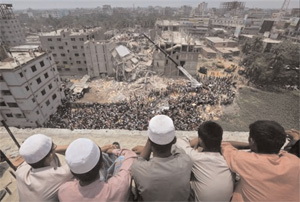
    DHAKA (TIP): The search for survivors from Bangladesh’s worst industrial accident stretched into a third day with the death toll rising to 273 after the collapse of a building housing factories that made lowcost garments for Western brands. Almost miraculously, 41 people trapped inside the rubble of the eight-storey building were rescued alive late on Thursday, government minister Jahangir Kabir Nanak said, about 40 hours after the disaster on the outskirts of Dhaka. Nanak said they had been working on the fourth floor of the Rana Plaza building and had all been found trapped in one room. Few other details were available.

    Around 2,000 people have been rescued over the past two days, at least half of them injured, but as many as 1,000 people remain unaccounted for. An industry official has said 3,122 people, mainly female garment workers, were inside the building despite warnings that it was structurally unsafe.

    Rescuers from Bangladesh’s army, navy and air force, as well as police and fire services, pored over huge piles of rubble and twisted metal in the search for survivors, using their bare hands as well as mechanical equipment. “We are not sure how many people are still trapped under the rubble,” said Dhaka District police chief Habibur Rahman, who updated the death toll early on Friday to 273. “Priority has been given to save people who are still alive,” he said. Wednesday’s disaster refocused attention on Western high-street brands that use Bangladesh as a source of low-cost goods. North American and European chains, including British retailer Primark and Canada’s Loblaw, said they were supplied by factories in the Rana Plaza building, which is in the commercial suburb of Savar, about 30 km (20 miles) from the capital.

    TRAPPED WORKERS CALL FOR HELP
    Savar residents and rescuers dropped bottled water and food on Thursday night to people who called out from between floors. Relatives identified their dead among dozens of corpses wrapped in cloth on the veranda of a nearby school. Police said the owner of the building, Mohammed Sohel Rana, a local politician from the ruling Awami League, was told of dangerous cracks on Tuesday. While a bank in the building closed on Wednesday because of the warnings, the five clothing companies told their workers there was no danger, industry officials said. Rana is now on the run, according to police. “We asked the garment owners to keep it closed,” said Bangladesh Garment Manufacturers and Exporters Association (BGMEA) President Mohammad Atiqul Islam.

    Despite the overnight rescue of 41 people, officials conceded the chances of finding more alive were growing slimmer. “We can’t be certain of getting them all out alive. We are losing a bit of hope,” fire brigade rescue worker Mizanur Rahman said earlier on Thursday. Special prayers will be offered at mosques, temples and pagodas across Bangladesh on Friday for the dead, injured and missing. The government declared a national day of mourning and flags were flown at half mast at all official buildings. Anger over the working conditions of Bangladesh’s 3.6 million garment workers, the overwhelming majority of them women, has grown steadily since the building collapse.

    More than 1,000 textile workers besieged the BGMEA on Thursday, pelting it with stones and clashing with riot police. The workers demanded all garment factories be shut and the owners harshly punished for accidents. Bangladesh is the world’s second-largest apparel exporter, with the bulk of exports – 60 percent – going to Europe. The United States takes 23 percent and Canada takes 5 percent. Primark, a unit of Associated British Foods, has confirmed one of its suppliers occupied the second floor of the building. Danish retailer PWT Group, which owns the Texman brand, said it had been using a factory in the building for seven years.

    Canada’s Loblaw, a unit of food processing and distribution firm George Weston Ltd, said one factory made a small number items for its “Joe Fresh” label. Primark, Loblaw and PWT operate under codes of conduct aimed at ensuring products are made in good working conditions. Documents including order sheets and cutting plans obtained by Reuters appeared to show that other major brands such as Benetton had used suppliers in the building in the past year. A Benetton spokesman said none of the factories were suppliers to the company. Spain’s Mango said it had an unfulfilled sample order at the plaza with Phantom Apparel.

  • Attacks on Sri Lankan monks were isolated incidents: INDIAN HIGH COMMISSIONER

    Attacks on Sri Lankan monks were isolated incidents: INDIAN HIGH COMMISSIONER

    COLOMBO (TIP): India has said that the recent attacks on Sri Lankan Buddhist monks in Tamil Nadu were isolated incidents and did not reflect the strong people-to-people bonds. “These were isolated incidents and did not reflect the strong people-topeople bonds that have been an integral part of the close historical, cultural and civilisational ties between the India and Sri Lanka,” Indian high commissioner Ashok K Kantha has said. He was making farewell calls on the two Buddhist high priests located in the central town of Kandy yesterday. The attacks on two Buddhist monks triggered protests here which even caused the wrath on Sri Lankan cricketers playing in the IPL. The protesters urged the cricketers to boycott IPL.

    The Indian envoy told the two high priests that “the state government of Tamil Nadu had taken immediate action to identify and prosecute the miscreants responsible for these incidents and that the Government of India, in consultation with the concerned state governments, had taken and would continue to take all possible measures to ensure the safety, security and well-being of Sri Lankan visitors to India, including to Tamil Nadu,” the Indian high commission said. Kantha’s remarks came just days after Sri Lankan President Mahinda Rajapaksa had said that Sri Lanka and India continued to enjoy good relations despite the rumblings in Tamil Nadu.

  • Seven killed, dozens hurt in Afghanistan earthquake

    Seven killed, dozens hurt in Afghanistan earthquake

    JALALABAD (TIP): Seven people were killed, dozens injured and many homes destroyed when a powerful earthquake struck eastern Afghanistan on Wednesday, officials said. The quake, measured at a magnitude of 5.6 by the US Geological Survey, sent people rushing from their homes in worst-hit areas and was felt in the Afghan capital Kabul and in Islamabad in neighbouring Pakistan. It struck at 0925 GMT at a depth of 62 kilometres (39 miles), with its epicentre 24 kilometres northwest of the eastern Afghan city of Jalalabad near the Pakistani border, the USGS said in a revised update. Six people died in Nangarhar province of which Jalalabad is the capital, said provincial spokesman Ahmad Zia Abdulzai, and 75 people were injured.

    Forty of them were given first aid and the rest admitted to hospital for further treatment. “We are still in the process of getting information from the affected areas. Among the dead are some children,” Abdulzai told AFP. One person was killed and one injured in neighbouring Kunar province and many homes were destroyed, said provincial spokesman Wasefullah Wasef.

  • Begging becomes business in Pakistan

    Begging becomes business in Pakistan

    RAWALPINDI (TIP): The sight of children, the disabled and disadvantaged begging at all hours of the day and night in Pakistan is a grim, constant reminder of the millions who live in abject poverty. Yet malnourished members of the underclass have to collect not just enough spare change to feed them, but to pay off police and gang bosses. Investigators say begging has turned into an organised business with mafia controlling key locations where they deploy their own lackeys or lease out ground to others on a daily, weekly or monthly basis. Some can even make more than a labourer who toils in scorching temperatures, digging or carrying cement and bricks at building sites for $6 a day.

    Mukhtiar, about 12 years old who gave only one name, is already a veteran beggar in the Saddar shopping area of Rawalpindi, the headquarters of Pakistan’s military and the sprawling twin city of the leafy capital Islamabad. Most clam up when asked if they work in groups. At first Mukhtiar denied, and then later admitted that he had to pay a cut to “thekedars” — or gang ring leaders — and sometime also to the cops. “Whenever I beg at main crossings, traffic lights or markets, I have to pay a small cut, sometimes 20-50 rupees or even 100 to the thekedar, otherwise they will beat me and expel from the area,” Mukhtiar said. Begging is punishable by up to three years in Pakistan, but police and lawyers say convictions are rare. In 2011, the Lahore High Court ruled that the government should strictly enforce laws to discourage “professional beggary,” set up homes for the destitute and improve charity disbursements. “Most beggars, if arrested, get bail. Judges also take into consideration the lack of welfare homes for destitute people and the result is that once released, offenders again start begging,” lawyer Mohammad Tayyab said.

    But Pakistan’s largest charity, the Edhi Foundation, said it offers no specific support network for beggars because there are too many. Faisal Edhi, a foundation staff member, told AFP that police sometimes round them up and bring them to their shelters. “Sometimes they bring up to 1,500 beggars a day, we cannot keep them in such a big number,” Edhi said. “Begging has become a profession now,” he added.

    Sakina Bibi, 32, a mother of five begging in Rawalpindi, says she does so to support her family and an addict husband who does not work. “Two years ago I was working as a housemaid, but I had a really bad experience and was wrongfully accused by my employers of stealing money, which I did not. “Being a maid is very difficult here, you have to work for almost 12 hours and if anything goes missing from house you are suspected,” Bibi said. She is the daughter of poor peasants. She never went to school, so begging is the only way she says she can earn money to feed her children. “I can make 300-400 rupees ($3-4) a day, but sometimes it is just 60-70 rupees,” she said. In Rawalpindi, the Child Protection and Welfare Bureau says it rescues child beggars, keeps them in a shelter and traces their parents or guardians, who then have to promise in court that they will take care of them.

    Parents whose children are found begging can end up in jail for three to five years and be fined $50 to $500, Bureau official Waseem Abbas said. “There are also organised gangs who deploy child beggars in lucrative spots like bus stops, traffic signals and markets and many raids have been conducted against them in the past,” he added. Economists say they have no data on numbers, age or average income.

    “There are gangs which are operating in different cities and they use orphans and run away children to beg in crowded places,” economic analyst Kaiser Bengali told AFP. But he said most beggars were in genuine need — the products of unemployment and Pakistan’s lack of a social security system. “You can see very old people, who can barely walk or see, begging on the roads of Karachi and other cities, because they have no family or old homes to take care of them,” he added.

    According to the United Nations, around 49 percent of the estimated 180 million population of Pakistan live in poverty. Private philanthropy is huge with charity one of the five pillars of Islam. The independent Pakistan Centre for Philanthropy says around 70 billion rupees ($700 million) is donated annually, mostly straight into the hands of individuals to alleviate immediate hardship or to religious organisations. Islamabad police claim to have launched a crackdown, but Haroon Yahya, a senior police official in Rawalpindi, says arrests are pointless. “It has become so lucrative that they do not care about arrest or imprisonment for a month,” Yahya said. “Most of them are now working in groups and protect each other. Police have busted many gangs, but after some time they again regroup,” he said.

  • Fire in Russian psychiatric hospital kills 38

    Fire in Russian psychiatric hospital kills 38

    MOSCOW (TIP): Thirty-eight people, mostly psychiatric patients, were killed on April 26 in a fire that ravaged a hospital in the Moscow region, suffocating the victims as they slept behind barred windows. The deadly blaze raised new questions about security standards at Russia’s medical institutions, in particular psychiatric hospitals, after a string of fires in the last years.

    The fire broke out on the roof and spread rapidly throughout the hospital wing in the small town of Ramensky around 40 kilometres (25 miles) outside Moscow, the health ministry said. Officials said the residents of the hospital wing suffocated to death while they slept as the fire spread rapidly through the wooden building, although three managed to escape in the early stages of the blaze. “There were 41 people in the hospital. We now know for sure that three are alive, that is a nurse and two patients,” the regional health minister Nina Suslonova, told the Interfax news agency. The emergency situations ministry in a statement listed those missing as two female members of staff and 36 patients. Several patients were in their 70s. However, in conflicting reports, acting regional governor Andrei Vorobyov, told Rossiya 24 from the scene that 36 were missing.

    Thirteen bodies have been found so far, Russian television reported as firefighters searched through the rubble after more than 100 battled to extinguish the blaze. The institution’s chief doctor, who was not named by Russian media, described the patients as a “very tough group of people — psychiatric patients with chronic illnesses and frequent attacks” who suffered from alcohol and drug addiction.

    Russia’s Investigative Committee said in a statement it had opened a criminal probe into failure to observe fire security regulations, causing multiple deaths. The main possible causes were careless handling of fire or a short circuit in the electric wiring, a spokeswoman for the regional Investigative Committee, Irina Gumennaya, told Rossiya 24 television. Two patients and one member of medical staff escaped the fire. The chief doctor was quoted as saying the one-storey building was entirely wooden and dated from 1952.

    Most of the patients apparently died in their sleep from inhaling fumes, but they would have been unable to escape from the fire which raged through the building with bars on the windows. “There were bars on all the windows of the hospital. Most of those killed died in their beds and it appears that they were not even able to save themselves,” a security source told the Interfax news agency. Acting regional governor Vorobyov told Rossiya 24 television that “the investigation must decide whether the bars were the reason or not” for the tragedy. Russian media complained that the emergency services had been slow to react, with the fire brigade taking an hour to get there. “This is a really long time,” Vorobyov admitted. Firefighters struggled to reach the clinic because a road crossing over the nearby canal was closed, a spokesman for the emergency situations ministry told the Interfax news agency.

    The patients slept soundly as they had taken medication in the evening, the ITAR-TASS news agency reported, citing a spokesman for the rescue operation. The smoke alarms did activate in the hospital and woke a nurse who managed to save two patients, the rescue operation spokesman said. “When the nurse came out into the corridor, the fire was burning and the flames were spreading quickly. She managed to bring out only two patients: a woman and a young man,” the spokesman said. The Moscow region announced a day of mourning to be held on Saturday.

    The fire was the latest tragedy to hit a medical institution in Russia, which still suffers from outdated Soviet-era infrastructure and lax security procedures. In 2009, 23 people died in a fire in the wooden building of an old people’s home in Komi republic in northern Russia while in 2007, 63 died in a fire at an old people’s home in the southern Krasnodar region. In December 2006, a fire in a Moscow drug rehabilitation clinic killed 45 women. Many of the victims were trapped by metal bars on the windows that staff could not open and an emergency exit was boarded up, officials said.

  • US authorities recall baby dolls manufactured in India due to safety hazard

    US authorities recall baby dolls manufactured in India due to safety hazard

    WASHINGTON (TIP): The US authorities have recalled handmade baby dolls manufactured in India as the toy poses “choking hazard” to young children. Sold in the US by Illinois-based Land of Nod, the baby dolls were manufactured in India by Noida-based Radiant Exports. In a statement, the US Consumer Product Safety Commission said the hands on the plush dolls can detach, posing a choking hazard to young children. “The firm has received one report of the doll hand detaching and three reports of the dolls hands loosening. No injuries have been reported,” it said, adding that in all 2,500 such dolls have been recalled, which were sold by the company from October 2012 to March 2013 for about $30.
    .

  • Toy-car remote used in Boston bombings

    Toy-car remote used in Boston bombings

    BOSTON (TIP): The Chechen-origin Boston bombings suspects used a remote-control device from a toy car to set off explosives and apparently learnt to build a bomb from an al-Qaida online magazine, a top American lawmaker has said. Maryland representative Dutch Ruppersberger, the top Democrat on the House Intelligence Committee, confirmed the details after a closed-door briefing with three senior national security officials on Capitol Hill.

    Two Chechen-origin brothers Tamerlan Tsarnaev, 26, and Dzhokhar Tsarvaev, 19, have been accused of carrying out the deadly Boston Marathon bombings at the finish line that claimed three lives and injured over 250. Ruppersberger said based on information from Dzhokhar it appears the brothers learned how to build the bomb from Inspire magazine, a publication founded by Anwar al-Awlaki, the now-deceased al-Qaida leader. “That has always been a concern of ours,” Ruppersberger said. “That magazine was put out to recruit more people for jihad.”Ruppersberger also gave more details on Russia’s contact with the United States regarding Tamerlan.Following Russia’s request to FBI regarding Tamerlan, Ruppersberger said US officials asked Russian authorities three times for more information, but never got a response.

  • Sudan jails 7 state security agents over coup plot

    Sudan jails 7 state security agents over coup plot

    KHARTOUM, SUDAN (TIP): A special court in Sudan on Thursday jailed seven members of the powerful state security service for up to eight years over a coup attempt last year, the service said. Their conviction follows the sentencing earlier this month of several army officers, who were jailed for the same plot but then walked free under a presidential amnesty. The National Intelligence and Security Service (NISS) said in a statement that three security colonels and four lowerranked security officers were sentenced to prison for various terms ranging between two and eight years. They had “participated in the plot” last November, the statement said. Analysts say the case reflects a political struggle within the 24-year regime of President Omar al- Bashir, who himself took power in a coup. Officials have never revealed more than vague details about the plot which analysts said was linked to hardcore Islamist officers who had once firmly backed the regime. Until Thursday it remained unclear how many NISS officers had been detained. The guilty officers have been expelled from the security service. “They have a right to appeal or ask for amnesty within 15 days,” the statement said. Salah Gosh, who headed the NISS until 2009, was also detained in connection with the plot but has not been tried

  • Latin America threatened with cancer epidemic

    Latin America threatened with cancer epidemic

    SAO PAULO (TIP): Latin America faces a cancer epidemic unless governments act quickly to improve health care systems and treat the poor, scientists said. The researchers pointed to around 13 deaths for every 22 cancer cases in the region, compared to around 13 deaths for every 37 cases in the United States and around 13 deaths for every 30 cases in Europe. The main reason, according to the study published in the British journal The Lancet Oncology, is that too many people are diagnosed with cancer at a late stage when the disease is much harder to treat and more likely to kill. “Researchers estimate that by 2030, 1.7 million cases of cancer will be diagnosed in Latin America and the Caribbean, with more than one million deaths from cancer predicted to occur annually,” said the report launched at the Latin American Cooperative Oncology Group (LACOG) 2013 conference in Sao Paulo.

    The disease currently means losses of $4 billion a year for the region, including not just the cost of treatment and medicine, but also the impact on businesses and the economy of lives prematurely cut short by cancer. “These costs will rise substantially if governments do not take coordinated action now to arrest the growing impact of cancer in the region,” the report warned. And it noted that “many people across the region, especially those in poor, rural, or indigenous communities, have little or no access to cancer services, a problem exacerbated by low, and highly inequitable, health investment in most Latin American countries.”

  • Obama, ex-presidents honor George Bush at new museum

    Obama, ex-presidents honor George Bush at new museum

    DALLAS (TIP): President Barack Obama praised his predecessor at the dedication of his library for showing strength and resolve in the days after the September 11 attacks and said if Congress passes immigration reform “it will be in large part thanks to the hard work of President George W Bush.” Obama spoke along with all four living former presidents in a rare reunion honoring one of their own at the opening of the George W Bush Presidential Center. “To know President George W Bush is to like him,” Obama said. The presidents — Bush, Barack Obama, Bill Clinton, George HW Bush and Jimmy Carter — were cheered by a crowd of former White House officials and world leaders as they took the stage together to open the dedication.

    They were joined on stage by their wives — the nation’s current and former first ladies — for the outdoor ceremony on a sun-splashed Texas morning. It was a day for recollections and reveries, and no recriminations or remorse. The five men have been described as members of the world’s most exclusive club, but Obama said they are “more like a support group.” “Being president above all is a humbling job,” Obama said. He there were moments that they make mistakes and wish they could turn back the clock, but “we love this country and we do our best.” He said Bush started an important conversation by speaking to the American people about the United States as a nation of laws and a nation of immigrants and he hopes Congress will act this year to pass reform, which Bush wasn’t able to achieve. The leaders put aside the profound ideological differences that have divided them for years for a day of pomp and pleasantries. For Bush, 66, the ceremony also marked his unofficial return to the public eye four years after the end of his deeply polarizing presidency. “Oh happy day,” Bush said as he took the stage. President George HW Bush, who has been hospitalized recently for bronchitis, spoke haltingly for just about 30 seconds while seated in his wheelchair, thanking guests for coming out to support his son.

    A standing ovation lasted nearly as long as his comments, and his son and wife helped him to his feet to recognize the applause. Clinton, too, was warmly received by the heavily Republican crowd, who applauded and laughed along with Clinton’s joke-peppered speech. He concluded on a serious note about the importance of the leaders coming together. “Debate and difference is an important part of every free society,” Clinton said. President Jimmy Carter praised Bush for his role in helping secure peace between North and South Sudan in 2005 and his approval of expanded aid to the nations of Africa. “Mr. President let me say that I am filled with admiration for you and deep gratitude for you about the great contributions you’ve made to the most needy people on earth,” Carter said.

    Former first lady Laura Bush said the library isn’t just about her husband, but reflects the world during his time as the first president as the 21st century. “Here we remember the heartbreak and heroism of Sept. 11 and the bravery of those who answered the call to defend our country,” she said. In a reminder of his duties as the current Oval Office inhabitant, Obama planned to travel to Waco in the afternoon for a memorial for victims of last week’s deadly fertilizer plant explosion.

    Presidential politics also hung over the event. Ahead of the ceremony, former first lady Barbara Bush made waves by brushing aside talk of her son, former Florida Gov. Jeb Bush, running for the White House in 2016. “We’ve had enough Bushes,” said Mrs Bush, the wife of George HW Bush and mother of George W Bush.

    She spoke in an interview with NBC’s “Today” show. Yet George W Bush talked up the presidential prospects of his brother in an interview that aired Wednesday on ABC.”He doesn’t need my counsel, because he knows what it is, which is, ‘Run,”‘ Bush said.

    Key moments and themes from George W Bush’s presidency — the harrowing, the controversial and the inspiring — would not be far removed from the minds of the presidents and guests assembled to dedicate the center, where interactive exhibits invite scrutiny of Bush’s major choices as president, such as the financial bailout, the Iraq War and the international focus on HIV and AIDS. On display is the bullhorn that Bush, near the start of his presidency, used to punctuate the chaos at ground zero three days after 9/11.

    Addressing a crowd of rescue workers amid the ruins of the World Trade Center, Bush said: “I can hear you. The rest of the world hears you. And the people who knocked these buildings down will hear all of us soon.” “Memories are fading rapidly, and the profound impact of that attack is becoming dim with time,” Bush told The Associated Press earlier this month. “We want to make sure people remember not only the lives lost and the courage shown, but the lesson that the human condition overseas matters to the national security of our country.”

  • Us Senate Oks Bill To End Air Traffic Control Furloughs

    Us Senate Oks Bill To End Air Traffic Control Furloughs

    WASHINGTON (TIP): The Senate approved hurry-up legislation on Thursday night to end air traffic controller furloughs blamed for inconveniencing large numbers of travelers as flight delays mounted. A House of Representatives vote on the measure was expected as early as Friday, with lawmakers eager to embark on a weeklong vacation. For the White House and Senate Democrats, the discussions on legislation relating to one relatively small slice of the $85 billion in automatic spending cuts that took effect last month after Washington failed to reach a long-term deal to rein in deficit spending.

    But it marked a shift in position in a long-running struggle with Republicans over budget issues. Similarly, the turn of events marked at least modest vindication of a decision by Republicans in the House of Representatives last winter to finesse some budget struggles in order to focus public attention on the across-the-board cuts in hopes they would gain leverage over President Barack Obama. Under the legislation, the Federal Aviation Administration would gain authority to transfer up to $253 million from accounts that are flush into other programs, to “prevent reduced operations and staffing” through the Sept. 30 end of the fiscal year. In addition to restoring full staffing by controllers, Senate officials said the available funds should be ample enough to prevent the closure of small airport towers around the country.

    The FAA has said it will shut the facilities as it makes its share of $85 billion in across-the-board spending cuts that took effect last month at numerous government agencies. The Senate acted as the FAA said there had been at least 863 flights delayed on Wednesday “attributable to staffing reductions resulting from the furlough.” There was no immediate reaction at the White House, although administration officials participated in the negotiations that led to the deal and evidently registered no objections.

    Senate approval followed several hours of pressure-filled, closed-door negotiations, and came after most senators had departed Congress on the assumption that the talks had fallen short. Officials said a small group of senators insisted on a last-ditch effort at an agreement before Congress adjourned for a vacation that could have become politically problematic if the flight delays continued. The Professional Aviation Safety Specialists, a union that represents FAA employees, reported a number of incidents it said were due to the furloughs.

    In one case, it said several flights headed for Long Island MacArthur Airport in New York were diverted on Wednesday when a piece of equipment failed. “While the policy for this equipment is immediate restoral, due to sequestration and furloughs it was changed to next-day restoral,” the union said. It added it was “learning of additional impacts nationwide, including open watches, increased restoration times, delays resulting from insufficient funding for parts and equipment, modernization delays, missed or deferred preventative maintenance, and reduced redundancy.” The airlines, too, were pressing Congress to restore the FAA to full staffing. In an interview Wednesday, Robert Isom, chief operations officer of US Airways, likened the furloughs to a “wildcat regulatory action.” He added, “In the airline business, you try to eliminate uncertainty.

    Some factors you can’t control, like weather. It (the FAA issue) is worse than the weather.” In a shift, first the White House and then senior Democratic lawmakers have signaled a willingness in the past two days to support legislation that alleviates the budget crunch at the FAA, while leaving the balance of the $85 billion to remain in effect. Obama favors a comprehensive agreement that replaces the entire $85 billion in across-the-board cuts as part of a broader deficit-reduction deal that includes higher taxes and spending cuts.

  • Transition in Afghanistan: A War of Perceptions

    Transition in Afghanistan: A War of Perceptions

    Abstract:
    A decade after the military intervention that dislodged the Taliban-Al Qaeda combine, peace and stability continues to elude Afghanistan. There is still no consensus in Western capitals on what constitutes the ‘end-state’ in Afghanistan. The Western public’s frustration with a long-drawn war has coalesced with the global economic slowdown, the Euro crisis and the pressures of electoral campaign politics in the United States – thereby complicating the efforts for the long-term stabilization of Afghanistan. Premature announcements of exit and dwindling financial assistance have added to the Afghan anxieties of being ‘abandoned’ once again. This paper brings to light the divergent perceptions among the key stakeholders in Afghanistan and in the international community (IC) on the trajectory of the ‘inteqal’ (transition) process. The paper argues that the war in Afghanistan is essentially a war of perceptions on progress made thus far. This widening gap in perceptions is bound to complicate the transition and long term stabilization process
    The Af-Pak Strategy, Surge & Exit
    President Barack Obama, in emphasizing on a renewed focus and more resources to the ‘good war’ in Afghanistan, announced a troop surge in his speech at West Point on 1 December 2009. Along with the surge, by setting the end of 2014 as the date for drawdown of forces, he ended speculations of the United States’ intent in that country and at the same time provided some clarity to his domestic constituency.

    It assuaged the concerns of the civilian team, led by Vice-President Joe Biden who had opposed the military commanders’ (General Stanley McChrystal and General David Petraeus) request of deploying additional troops for a population-centric counter-insurgency (COIN) campaign. However, the announcement of a date of drawdown sent a different message to the ‘friends and foes’ in the region. While it evoked concerns particularly among the Afghans, the message fed into the propaganda of the Taliban-led insurgency. The US Secretary of Defense Leon Panetta exacerbated the situation in early 2012 by stating that the transition process could be completed by 2013, a year earlier than 2014. Likewise, calls for early withdrawal by NATO allies have further added to the concerns inside Afghanistan and the region.

    Although the declaration arrived at the 2010 Lisbon summit had stated that the ‘transition will be conditions-based, not calendar-driven, and will not equate to withdrawal of ISAF-troops’, there was a perceived turn around at the Chicago Summit in May 2012. President Obama and the NATO leaders agreed to end their role in the Afghan war, stating it is time for the Afghan people to take responsibility for their own security and for the US-led international troops to go home. The Summit decision called for the beginning of full transition in all parts of Afghanistan by mid- 2013 and the Afghan forces taking the lead for security nation-wide.

    As per the plan, the ISAF will gradually draw down its forces to complete its mission by 31 December 2014. Such hasty announcements of early troop drawdown, largely perceived as ‘exit’, have been the source of obvious concerns inside Afghanistan, especially when the insurgency is perceived to be growing in strength and the capacity of the Afghan National Security Forces (ANSFs) to withstand the insurgent onslaught remains suspect. Analysts in the West posit that the withdrawal of Western forces, in such a situation, would lead to a collapse of the evolving security system. Others point out that transition will either fail or be determined by Afghanistan’s internal dynamics and the role of regional states, regardless of what the US, Europe, and other aid-donors do.

    Amid such pessimistic assessments, the talks and attempts of actualizing an effective transition and stabilization process appear to be a mere lip service. It is, thus not surprising that Afghans view the inteqal (transition) process as a last opportunity for the international community to set the course right in their country.

    The paper is an exercise at stock-taking of the ground realities vis-a-vis the varying perceptions among the Afghans and the international community on the progress and challenges for Afghanistan’s transition and long-term stabilization. While the West in its haste to ‘exit’ wants to demonstrate progress, there remain concerns on the ground on the fragility of these achievements. The Afghans, while acknowledging progress, seek longer international commitment to address the grey areas that could undermine gains achieved thus far. More importantly, ‘unity of effort’ and an appropriate strategic communications strategy is imperative to address this widening perception gap. Unlike pessimistic analyses that predict a return of the Taliban in post-2014 Afghanistan, the paper argues against such possibility.

    The paper highlights the tangible gains made in the security, political, governance and economic sectors during the decade-long international presence in the country and also, the areas where gains remain fragile and reversible. Unless unified effort is made to shore up the state and institution building processes before the drawdown date of 2014, the dangers of reversal are imminent resulting in a civil war (worse case scenario) or the continuation and intensification of chaos and instability (stalemate), with the external power interventions and the regional proxies further exacerbating the internal-external conflict dynamics (internecine warfare).

    The Evolving Security Situation and the Taliban led Insurgency Afghanistan continues to encounter a fragile security situation.
    While the 2010 troop surge achieved notable security gains on the ground, analysts argue that such gains are reversible and almost un-sustainable by the ANSFs alone. According to the drawdown plan, the additional troops of 33,000 have been withdrawn in September 2012 leaving behind 68,000 US troops in the country. As the debate on the usefulness of the surge continues, the US-Afghan Strategic Partnership Agreement signed on 1 May 2012 has ensured a minimal troop presence (20- 30,000) for limited counter-terrorism, train and assist mission. While the security situation is said to have improved in south-western Afghanistan, eastern Afghanistan, primarily provinces of Paktika, Paktia, and Khost (known as the P2K region), bordering Pakistan’s Federally Administered Tribal Areas (FATA), and area of operations of the Haqqani Network, remain deeply insurgency infested. The campaign of violence by the insurgents has been lethal and continues to sap the nascent institutions of the Afghan state.

    By employing asymmetric tactics with increasing use of improvised explosive devices (IEDs) and suicide bombers, the insurgents have managed to keep the levels of troop deaths high. High-profile attacks on symbolic targets like the Intercontinental hotel in Kabul (June 2011), British Council (August 2011), the American embassy (September 2011), Kabul Star Hotel (April 2012), Qargah attack (June 2012), Camp Bastion (September 2012) demonstrate their deep strike capability and intent to garner instant and worldwide media attention. The Taliban have adopted brutal tactics of violent retribution and intimidation of the population, targeting those deemed to be associated with, or sympathetic to, the government.

    This strategy witnessed rampant killing and abduction of government officials, aid workers, teachers, religious and tribal leaders. . Systematic targeting and elimination of power brokers, government officials and police chiefs in 2011 added new set of complexities and raised the specter of civil war in the north. Likewise, elimination of key government officials and power brokers in the South, has led to a power vacuum in the Pashtu areas. The Taliban have established shadow governments in areas where the writ of the Afghan government was limited or nonexistent. Much of the insurgent strength is derived from the sense of safety the insurgents are accorded across the Durand line, within Pakistan. Taliban recruits and enjoys safe havens in that country.

    The Pentagon’s April 2012 report to Congress on Security and Stability in Afghanistan stated that despite progress, international efforts to stabilize the country ‘continued to face both long-term and acute challenges’. ‘The Taliban-led insurgency and its Al Qaeda affiliates still operate with impunity from sanctuaries in Pakistan,’ the report said. ‘The insurgency’s safe haven in Pakistan, as well as the limited capacity of the Afghan Government, remain the biggest risks to the process of turning security gains into a durable and sustainable Afghanistan’, it added. The heightened tensions between Pakistan and the US over the assassination of Osama bin Laden by American Special Forces in the garrison town of Abbottabad in May 2011 and the subsequent accidental killing of 28 Pakistani security forces during a NATO air raid in Salala in November 2011, the increase in drone strikes inside Pakistani territory, have added complexities and limited the scope of the counter-terrorism cooperation with Pakistan. This has also resulted in Pakistan being at the ‘margins’ in the evolving end game in Afghanistan.

    Security Sector Reform (SSR) and Preparedness of ANSF

    At the 2010 Lisbon Summit, NATO provided a road map to transfer security responsibility to the Afghans. The first tranche of provinces, districts, and municipalities, which has 25 per cent of Afghanistan’s population, was handed over to the Afghans in July 2011. The second and third tranches were announced in November 2011 and March 2012 respectively.While the second tranche put the Afghans in the lead of providing security for more than 50 per cent of the country’s population, with the beginning of the third tranche, 75 per cent of the Afghan population will be living in areas where the ANSF have lead security responsibility.

    As per the decisions arrived at the May 2012 Chicago Summit, full transition in all parts of Afghanistan will begin by mid- 2013. The natural corollary of the ANSF taking charge of the security of Afghanistan is a change in NATO mission – from combat to an advisory role. The shift to ‘train and assist’ mode has further compounded the complexities and brought to sharp focus the levels of preparedness of the Afghan forces for independent action. The contours of post- 2014 security assistance to Afghanistan will be mentoring, training, and funding the ANSF. Although numerically, both the Afghan National Army (ANA) the Afghan National Police (ANP) are impressive, with 194,466 troops and 149,642 policemen respectively, widespread reservations have been expressed on their capacities.Will the ANSF, product of a rushed, under-resourced and frequently revamped recruitment and training procedure, be able to deliver, remains a critical question.

  • Here’s a Day to Celebrate

    Here’s a Day to Celebrate

    Rarely is found a person in the history of mankind who has left such a deep imprint on the life and character of people within a brief span of 42 years. More than three hundred years later he still continues to move millions of men and women not only in India, the great subcontinent of Asia but the entire world.

    From the five beloveds he baptized in 1699 today he has a following of 25 million and growing with the religion he gave enjoying fifth position among the world’s most favored religions.

    Guru Gobind Singh, the man I am referring to, was a unique person. The image of God he portrayed is exactly the same as painted by Guru Nanak Dev, the First Master of the Sikhs. The Mool Mantra of Jaap Sahib (a poetic work of Guru Gobind Singh) provides an interesting study from this point of view. The Almighty of Guru Gobind Singh is the “True Lord of All, has neither distinguishing signs nor marks, no one can discern him, and beyond limitations and is manifested as the Light of the Spirit, the Lord God of a myriad Indras and is proclaimed the King of Kings, the Master of the three worlds, of gods, men and demons.

    Guru Gobind Singh gave the message of equality and fraternity i.e. Fatherhood of God and brotherhood of mankind. He said, some are Hindus, some Turks, some are of Shia persuasion and some of Imam Shafai; mankind is all of one race.

    Eminent historian Cunningham states that though the last apostle of the Sikhs did not see his own ends accomplished, he effectively raised the dormant energy of a vanquished people and filled them with the lofty, although fitful, longing for social freedom and national ascendancy, the true adjunct of that purity of worship which had been preached by Guru Nanak.

    Guru Gobind Singh not only patronized the Sikh institution of sacrifice, he actually sacrificed his whole family. Guru Gobind Singh is an ideal and should be an idol for the young generation of today. All pessimism will banish and instead a robust optimism will fill our youth should they imbibe the ideals and values of the Guru. Let them give up their weakness for intoxicants and have faith in their innate energy to countenance any challenge and overcome any obstacle. Let them follow the Guru’s progressive humanism empowered with spirituality and sacrifice. Let them derive strength and courage from the Tenth Guru who expressed all optimism and positive attitude for the victory of the forces of righteousness over evil and repression.

    Sikh culture and religion is a rich heritage to be protected and glorified. The mission of Guru Nanak- Guru Gobind Singh is cosmic. May the Almighty bestow His blessings on all human beings, particularly young generation of the Sikhs and fill them with tremendous strength and will to establish the Kingdom of God on Earth. May the Lord Almighty rid the Sikh leaders of arrogance and drunkenness of power! May they learn to be meek, humble, caring, loving and giving, following the dictates of our Gurus!

    Vaisakhi is a day to thank the Tenth Master for all His gifts to His Panth and also a day to dedicate ourselves to His mission. It is a day to celebrate the birth of the Khalsa.

  • The End of Road for Musharraf

    The End of Road for Musharraf

    Whichever way the Hitchcockian drama in Islamabad plays out there is at least one certainty in the grand confusion: that Pervez Musharraf, arguably the most delusional of the four military dictators that have ruled Pakistan for nearly half its existence, has reached the end of the road. His pipedream of landing in his country after five years of exile, like a triumphant Caesar – in the hope of being welcomed by people still nostalgic about what he had done for them in the past and anxious to give him another chance to lead them – has turned out to be a nightmare.

    He can now rue over his folly during his house arrest in his sprawling farmhouse at the edge of the Pakistani capital. As a matter of fact, Islamabad-based foreign correspondents who had gone to Karachi to cover Musharraf’s “momentous arrival” have reported that it should have been clear from that moment that the former president had no future. His candidature in the four constituencies has already been rejected and most of the political leaders he expected to be with him have already joined other mainstream parties.

    He has no role in the ongoing elections or any influence on their outcome. Incidentally, the most delightful and appropriate comment on his present plight has come from Xinhua, the official news agency of China, Pakistan’s “all-weather” friend where at one time Musharraf used to be welcome. There was, says Xinhua, “poetic justice” in Pakistan when the Islamabad Supreme Court issued an arrest warrant against the former president – something he had done “against dozens of judges when he arrested them in 2007”. On the fate that awaits him, opinions differ widely.

    Some hope, rather than think, that the judiciary that he humiliated so disgracefully in 2007 would not be content without hanging him, especially because the three main charges against him are heinous and include the assassination of Benazir Bhutto and the murder in cold blood of the eminent Baloch leader, Sardar Mohammed Akbar Bugti. Some others believe that if the law and the judicial process don’t get Musharraf, the lawless Taliban would. In my view, this possibility should also be ruled out in view of the enormous commando security the Pakistan Army has provided this former commando general. As of now, the most plausible scenario seems to be that Musharraf’s judicial custody up to May 4 will be extended beyond the date of elections that is May 11. Thereafter his trial can begin, if the judiciary and the new government insist on it. But then it can go on and on for years, if only because in this and many other basic practices the underlying unity of the subcontinent endures. However, overall it is a safe bet that Pakistan’s power structure cannot afford to hurt the sentiments of the all-powerful Army by executing or even imprisoning a former army chief.

    According to available information, General Ashfaque Pervez Kayani, though a one-time protégé of Musharraf, did not want him to come home, leave alone take part in the elections. It is said that messages to this effect were sent to him several times. However, when the megalomaniac former military ruler having hallucinations about his popularity with the Pakistani masses did arrive, the Army considered it its bounden duty to see to it that no harm came to his person and that his, and more importantly, the Army’s izzat (an expression dear to both the Indian and Pakistani armies) was not besmirched in any way. This situation will prevail regardless of the dispensation resulting from the May 11 poll. It would be no surprise if some kind of an understanding already exists among the major stakeholders in Pakistan on this subject.

    Come to think of it, even under a caretaker government, whose only duty is to hold free and fair elections, all concerned have treated Musharraf with kid gloves. Remarkably, Xinhua has taken note of “the speculations” that despite the apex court’s clear order to arrest him, “some bigwigs” in the government told the police to “go slow on Musharraf”.

    It would, indeed, be instructive to look back on the events in 1999 when, after his successful coup, Musharraf wanted to “fix well and proper” his bete noir and then Prime Minister, Nawaz Sharif. But then Saudi Arabia intervened and the military dictator agreed to let Sharif go in exile to Saudi Arabia for 10 years. Today, the Saudi stakes in the stability of Pakistan are even higher than before.

    There are two other points that call for comment. The first is the rather intriguing fact that the United States is refusing to comment on Musharraf”s house arrest one way or the other. Does this lend any credence to his calculation while planning his strategy to take part in elections that, given the configuration of forces in the post-poll Pakistan, the Americans would prefer a government led by him?

    After all it was he who, on the morrow of 9/11, had reversed Pakistan’s policy on Afghanistan and lined up his country with the US in the “war on terror”. Moreover, as revealed only recently, in 2003Musharraf unhesitatingly allowed the Americans to use drones to kill as they wished in North Waziristan as long as they left the Lashkar-e-Toiba (LeT), Jaish-e- Mohammmed and other Pakistani terrorist outfits operating against India well alone?

    Today, the US desperately needs Pakistani cooperation for its plan to withdraw its combat troops from Afghanistan by the end of 2014.

    Secondly, the speculation in some quarters in both India and Pakistan that should the civilian government resist the Army’s demand to let Musharraf go, Kayani and the Army would stage a coup should be dismissed.

    Firstly, over the years Gen Kayani has demonstrated repeatedly that he sees no point in directly taking over when the Army can get its way anyhow. Furthermore, gone are the days of the Cold War when the US had a vested interest in embracing and coddling military dictators in Pakistan. Samuel P. Huntington had then written a book to press home the point that in newly independent countries the armed forces were the best instrument for stability.

    Those days are gone. Today, America is the super-salesman of democracy across the world. It can ill-afford a military takeover in Pakistan, never mind the adverse reaction of the world community in general.

  • Sudha Raghunathan enthralls audience in NY

    Sudha Raghunathan enthralls audience in NY

    NEW YORK (TIP): The Cleveland Aradhana committee and Jana Seva hosted the Morning Raga fund raiser concert featuring Padma Shri Sudha Ragunathan and six other renowned artists in New York last week. Jana Seva is a New York-based nonprofit organization that aims to construct homes for orphans and destitute children in India so that these hapless children get the best education they deserve and contribute to the development of India. The first such center is being opened in Mullai, Jolarpet in Tamil Nadu.

    It is also panning to support veda patasalas (schools of excellence in the study of Vedas) to help preserve the rich and valuable heritage and support Goshalas to preserve sacred cows and prevent its slaughter. The non-profit will also promote the concept of seva among the willing and able youth and offer an avenue for them to volunteer their services to the poor and the needy in India, according to L. Shanti Kumar, a leading CPA in Long Island and founder of Jana Seva.

    Sudha Raghunathan, a star among Carnatic musicians in India, was joined in the concert by Amit Heri, the lead guitarist, Keith Peters on bass guitar, Tiruvarur Vaidyanathan on mridangam, Raghavendra Rao on violin, Arun Kumar on drums and Guru Prasad on ghatam.

    The passion, experience and golden voice of Sudha Raghunathan blending with the dexterity of Amit Heri on the lead guitar and the musical creativity of other leading accompanists created an eclectic fusion of modern and classical music. The concert helped Sudha to have a conversation with her rasikas through the music who have drawn from various nationalities and age groups.

    The fusion ensemble was something unique to the Carnatic music lovers of tri-state who are used to the traditional ragam, thanam and pallavi concerts. Sudha started the concert with a sloka followed by the kriti on Lord Ganesha – Maha Ganapathim Manasa Swarami in raag Nattai. She then sang Maathe in dharu varnam in the raga Khamas and followed it up with India Funk in raag abhogi that kept the audience tapping their feet.

    She transported her fans to a new world when she sang the traditional number Thaaye Yashodha in raag thodi and after intermission sang the very popular Kannada song – Krshna nee begane baro – and then the popular Telugu number Brahmam okate.

    Sudha sang Peace which was Amit’s composition in raag Hamsadhwani and enthralled the fans with the ever-popular English note and ended the concert with Seetha Kalyana Vaibhogame, Bhagyadhalakshmi and Kurai Onrum Illai kanna composed by Chakravarthi Rajagopalachari and sung by M S Subbulakshmi at the United Nations in 1967. She completed the three-hour concert with the thillana of Dr. Mangalampalli Balamurali Krishna in the raag Brindavani.

    Sudha has a distinctly stunning voice with which she has ignited musical imagination and spirit across languages, frontiers and ideologies.

    Her deep relish for tradition and mystical old world charm is cloyingly addictive. As the heir apparent of her guru the legendary M L Vasanthakumari, Sudha has succeeded in holding aloft her guru’s banner while simultaneously imbuing her style with her own innovations such as The Morning Raga.

    She was invited to sing Vande Mataram at the Central Hall of Parliament in New Delhi in 2000 to commemorate the 50th anniversary of Republic of India. She was honored by the Government of India with Padma Shri for her contribution to Indian music.

    One of India’s biggest names in jazz fusion music, Amit has shared and worked with numerous internationally renowned artists including Charlie Mariano, Robert Miles, Angelique Kidjo, George Brooks, Matt Garrison and Zakir Hussain. Born into a family of percussionists, Tiruvarur Vaidyanathan was initiated into mridangam at the age of six and now he is one of the top percussionists playing for legends such as Dr M Bala Murali Krishna, K J Yesudas, Dr. N. Ramani and those seniors such as late M L Vasanthakumari, Maharajapuram Santhanam, D.K. Pattammal and K V Narayanaswamy. His playing style is characterized by melodic richness, technical dexterity and balanced use of left and right sides. Keith Peters is the best base guitarist in India today and Chennai-based Peters is a veteran of over five thousand live gigs and played over thousand songs.

    He worked with composers such as A R Rahman. Raghavendra Rao is the disciple of violin maestro T N Krishnan and has toured all over the world with top musicians. Arun Kumar ventured into the world of drums at the age of seven and plays on the western drums and morsing. Guru Prasad is the son of legendary gatam vidwan T H Vikku Vinayakram and has accompanied all the leading Carnatic singers.

  • US based Kannadiga group appeals for restoring credibility in Karnataka

    US based Kannadiga group appeals for restoring credibility in Karnataka

    NEW YORK (TIP): The Karnataka Chapter of the Indian National Overseas Congress (INOC) USA has appealed to Non-Resident Kannadigas worldwide to help elect a corrupt-free and performance-oriented government in the ensuing state-level Vidhan Sabha elections in Karnataka Karnataka State and Bangalore in particular were on the forefront of rapid economic and technological growth and a major contributor to help build India’s GDP. All these were nullified during the last five years that brought a shame to Karnataka and Kannadigas worldwide with daily dose of corruptions and scams,” said Dr. Dayan Anand Naik, president of the Karnataka chapter of INOC. “We want to see Karnataka back on the path of progress as its image has gone down globally due to corruption and failures in all fronts in the last five years. Karnataka was world’s IT capital and knowledge capital.

    Congress Party had its share in building this unique brand and model of prosperous Karnataka. There are 60 million Kannadigas both in India and abroad, he said. Since 1980 Karnataka lead the nation in GDP and per capita GDP as compared to other states in India. During the Congress regimes of Chief Ministers Veerappa Moily and S M Krishna, Karnataka became home of largest biotechnology with 50 percent of large firms located in Bangalore, he said addressing the media in New York.

    The Congress government planned and executed one of the largest airports in India in Bangalore that became a boon to non-resident Indians. His “Munnade Karnataka” (Aghe Chalo Karnataka) campaign theme is a clarion call to throw out the corrupt leaders like B.S. Yeddyurappa and the BJP government and bring back the Congress whose manifesto is on development and good governance. Yeddyurappa the former Chief Minister faced in Court, fifteen cases of corruption and He was jailed.

    He was perhaps the first Chief Minister jailed because of corruption,” he said. Dr. Naik will be leading a delegation of Non-Resident Indians from the US to campaign for the Congress Party in the Karnataka Vidhan Sabha elections. “We will campaign for as many candidates as possible and tell the voters that the whole world especially the United States is awaiting their choice to bring back the state to glory that slipped in the BJP regime,” he said. Dr. Dayan Naik, an acclaimed cardiologist by profession, is the new Karnataka INOC Chapter President and also a leading community activist. He was born and educated in Karnataka and speaks with passion and power.

    He is recipient of several prestigious awards and accolades in USA. As President of the American Association of Physicians of Indian Origin (AAPI) the largest Indian-American professional association in the United States with 60,000 Indian physicians and 20,000 medical students and researchers as members, he initiated several community outreach programs to help the patients and improve the quality of treatment. He was responsible for inviting UPA Chairperson Sonia Gandhi to the AAPI annual Convention in Washington D.C. where she addressed over 5,000 Indian doctor physicians when she visited USA in 2001. Dr. Naik was born in Neethigere village near Thanda in Channagiri taluk of Karnataka and did his MBBS from Karnataka Medical College Hubli.

    He moved to the US in 1970 and rose to become the Clinical Associate Professor of Cardiology New York Medical College. He held various prestigious posts such as Fellow of American College of Cardiology; President of American Association of Indian Cardiologists; Board of Trustee of Xavier University Medical School Aruba and Board Trustee of AAPI. He raised funds for support 26 free medical clinics in India to serve the poor and needy and sent four plane loads of medical equipment, food, clothes and medicine for earthquake victims of Bhuj in Gujarat; initiated AIDS awareness program in India and conducted several free medical camps for poor and the needy in New York and New Jersey areas

  • Obama praises Indian-American student for her science project

    Obama praises Indian-American student for her science project

    WASHINGTON (TIP): US President Barack Obama has praised a 17-year-old Indian- American student for her science project at the third annual White House science fair here. “We’re so proud of you. Keep up the good work,” Obama said to Meghana Rao from Portland, Oregon, after she explained her project based on ‘biochar’ (charcoal) to the US president at the fair in which around 30 student teams from across the country exhibited their projects. American Natural History Museum Young Naturalist Award winner, Meghana, is a Jesuit High School student who-in addition to researching the ability of ‘biochar’ also directs a student-run nonprofit organization, Portland Junior Scientists (PJS).

    According to the White House, her organization connects high school students with underprivileged youths through collaborative hands-on science experiments, with the aim of inspiring all participants to pursue higher education. Meghana started PJS in 2011, after learning that severe budget cuts where forcing local elementary schools to cut back on science curricula. Through her organization, local students can attend weekly onehour after school science programs, participate in science fairs and attend summer science programs. “Her hard work helped her earn a 2013 Young Naturalist Award from the American Natural History Museum, and brought PJS $ 5,000 grant from the Pepsi Refresh Project and an USD 11,500 grant from the Case Foundation’s Finding Fearless program,” the White House said.

  • Goa bans drinking in public – where will the Russians and the Brits go now?

    Goa bans drinking in public – where will the Russians and the Brits go now?

    PANAJI, GOA (TIP): Tourists drinking in public or littering on beaches and tourist spots will face trouble soon, as the government of Goa has decided to crack the whip against offenders. If caught flinging liquor bottles on the beach or any tourist spot or even drinking in public, they may end up behind bars for a term of not less than three months. This may be extend up to three years and they may be slapped with an additional fine, which may go up to Rs 5000 ($100.00 roughly). “Anyone one found drinking, breaking bottles or littering the tourists place with broken bottles or liquor cans and pouches will be penalized under Goa Tourist Places protection and maintenance Act, 2001,” a tourism official said. Goa tourism department issued directives on April 24, 2013 to curb drunken behavior and nuisance at tourists places, especially the beaches .

    Many cases of injuries to swimmers have been reported due to shards of liquor bottles in the Candolim-Calangute beach belt in north Goa. The IRB tourists police, IRB police sub inspector and flying squads of the tourism department have been given strict orders to keep watch at tourist places, he said.

  • Aamir Khan’s Possible Rendezvous With Us President Obama

    Aamir Khan’s Possible Rendezvous With Us President Obama

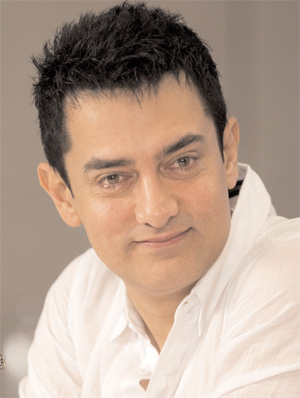
    NEW YORK (TIP): The perfectionist actor of Bollywood, Aamir Khan is scheduled to visit the USA and there is a strong possibility that he will meet with President Barak Obama here. Earlier in the year, the President had visited India. In a dinner given by Prime Minister Dr. Manmohan Singh, graced by some of the leading dignitaries of our country, was Aamir Khan who met with President and Mrs. Obama at the affair.

    It was reported that the power couple was all praise for the actor. President Obama had even extended an invitation to Aamir to come to America to promote his films while it was no secret that Michelle Obama was seen recently dancing to one of the tunes from Aamir’s film ‘Rang de Basanti’. Aamir was full of praise for the president as well and his dynamic leadership. He also expressed his honor at being part of such an exclusive affair.

    In an interview to a national daily, Aamir said “It was a real honor to be part of such a distinguished gathering. It was a very dignified and tasteful affair. I was seated on the same table as Vishwanathan Anand, who I am a big fan of. Mr. Obama sent his regards to Kiran and said, `Tell her we missed her`. And Michelle Obama told me that she really enjoyed dancing to my song from Rang De Basanti.” Millions of fans of Aamir eagerly await the new movie which he brings out every year. The actor is currently shooting for Dhoom 3. However, it was late last year when Aamir made his debut on television with the show ‘Satyamev Jayate’. He has become one of the best known faces of social campaign from the world of art and entertainment.

    Acknowledging his huge role in social movement, Aamir was recently featured on the Times cover in a list for 100 most influential people in the world. This was one of the seven special covers launched by the Times magazine. In addition to Aamir, other noted Indians who made the list include Mr. P. Chidambaram, the finance minister, Delhi based lawyer Vrinda Grover Kamala Harris, the Indian American attorney General of California. Aamir will take a 3 day break from his shooting to fly to attend a celebratory dinner in New York. President Obama is also supposed to attend the event. So, chances are, Aamir will meet with the US President again in near future.

  • Indian American Attorney slams ‘rampant’ corruption in New York

    Indian American Attorney slams ‘rampant’ corruption in New York

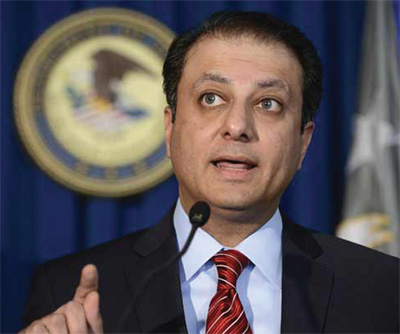
    NEW YORK (TIP): Indian-origin Manhattan U.S. Attorney Preet Bharara has said that the rampant public corruption infecting New York is due to a lack of government transparency. Bharara said, “fundamental reform” is needed to end the “showme- the-money-culture” that’s prompted the feds’ crackdown on crooked state pols.

    In a speech to the Citizens Crime Commission, Bharara said it was scandalous that someone could buy his way into office, get busted for bribery, use campaign contributions to hire a “fancy” lawyer and go to prison for years, while still pocketing a “generous state pension” for life. According to the New York Post, Bharara faulted a “substantial transparency problem throughout New York government,” which he blamed for the massive CityTime scam. Bharara also said it was much harder to “follow the money” when government makes it hard “to separate illicit money transfers from legitimate ones,” he said. When every state or local official is able to lawfully moonlight as a lawyer or accountant or consultant and may lawfully withhold deep details of that work, prosecutors face substantial challenges,” he added.