Year: 2013

  • Justice Katju seeks pardon for Sanjay Dutt

    Justice Katju seeks pardon for Sanjay Dutt

    NEW DELHI (TIP): Justice Markandey Katju, chairman of the Press Council of India, in a letter to President Pranab Mukherjee on March 28, has sought pardon for Sanjay Dutt under article 72 of the constitution. In a separate letter, he also sought pardon for Zaibunnisa Kazi, charged in the same case and awarded similar punishment by the Supreme Court. Katju has written that Dutt acquired the weapon for selfdefense and not for any terrorist activity.

    Since he was not involved in the 1993 Mumbai blasts, justice, in Dutt’s case, should be tempered with mercy, the retired judge has held. Katju said he was not questioning the verdict of the Supreme Court, but since the man had already served 18 months in prison, and since he had undergone enormous hardships in the 20 years since the case began, he was fit candidate for mercy. He also said that while mercy should not be granted just because Dutt is a celebrity, the actor should also not be denied justice because of his stature. Justice Katju pointed out that Dutt had two small children, and that in the time since the case began, he did “good social work”. Dutt was, a week ago, sentenced to five years in prison on charges of illegal possession of arms by the Supreme Court. Katju sought pardon also for Zaibunnisa Kazi. Katju appealed that since the woman was a 70-year-old widow, who had undergone surgery to remove a tumour in the kidney, mercy should be shown to her.

    He said that given how frail she was, she may not survive five years in jail. Katju pointed out that the woman had already spent nine months in jail, and that she deserved pardon even if the merits of the case were considered. Kazi was innocent of the main charge of conspiracy in the blasts, and no arms were recovered from her house, Katju pointed out. The charge against her was based on the retracted confession of a co-accused, who claimed that she possessed illegal weapons, Katju said.

  • Ashley Greene Branded Neighbour From Hell

    Ashley Greene Branded Neighbour From Hell

    Ashley Greene – who was left devastated after a fire broke out in her apartment in West Hollywood due to an unattended candle last Friday killing one of her pet pooches ‘Marlo’ – has been accused of being a nightmare neighbour. The Twilight Saga actress’ fellow residents have alleged that the fire accident was tragic but it was a disaster waiting to happen, TMZ reported.

    The 26-year-old’s fellow building tenants revealed to the website that they were not surprised by the incident. She invited friends and fellow actors over to her pad at all hours of the day, resulting in the people living below her having trouble sleeping due to the excessive commotion, said some neighbors. On top of that Greene didn”t control her dogs, who were incessant barkers. Residents are thought to have complained to the building”s manager about the star”s behavior, but no action was taken.

  • Movie Review-Django Unchained

    Movie Review-Django Unchained

    Cast: Jamie Foxx, Christoph Waltz, Leonardo DiCaprio, Samuel L Jackson, Kerry Washington
    Direction: Quentin Tarantino Genre: Drama Duration: 2 hours 45 minutes
    STORY: A slave, with the help of a bounty hunter of German origin, seeks out his wife who has been sold to a ruthless plantation owner.
    MOVIE REVIEW:
    With Quentin Tarantino, there are no half measures. The much-loved/reviled (depending on which side of the fence you’re on) director has his fans and haters split right down the middle. It isn’t easy to love or loathe the films he makes. They’re shamelessly provocative but absolute guilty pleasures.

    Take Django Unchained, for example. It isn’t QT’s best work by far. It is, however, his most discussed. Taking a familiar setting (the slave trade era in the American South), he pits it against the most outrageous (and most likely, fictional) tropes of the times. A free man, during the time, was rarely heard of.

    Much less, as a partner to a decidedly European bounty hunter who shoots with his words as eloquently as he does his trusty guns. Then there’s the plantation owner who loves Mandingo fighting and yet, treats his head slave as something of an equal. Also, there’s far more boom and far less bang. You’d be forgiven for thinking that Django (Foxx) and his minder/mentor Dr King Schultz (Waltz) have ammunition factories in each town they ride into. QT draws out the mood of the times without taking his subject matter too seriously. Cinematography and score are top-notch as is the tight screenplay.

    The trouble really begins with the abundance of characters that make their poorly fleshed out appearances and exits with no reason or rhyme attributed to their existence. And given the running time, the film could easily have done with a little less indulgence. Not Quentin’s best work by far.

  • How Lord Vishnu Married Goddess Lakshmi

    How Lord Vishnu Married Goddess Lakshmi

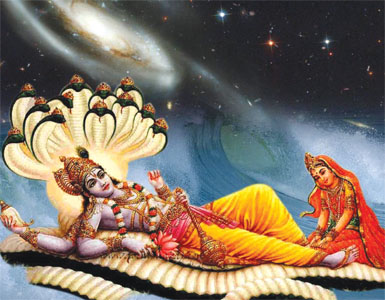
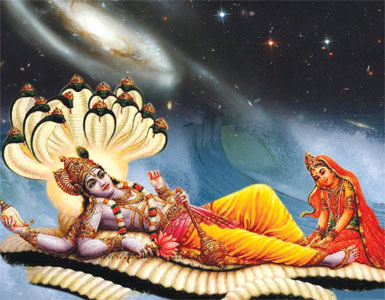
    We all know that Lord Vishnu married Goddess Lakshmi. Do you want to know the story of how they married? The story of their marriage starts with Indra – the Lord of the Devas. Now Indra was a very powerful God. He was the king of the Heaven and the ruler of the other Gods. However all this got into his head. He became arrogant and became disrespectful to others. Indra had a four tusked, beautiful white elephant called Airavatha. Whenever Indra felt like going out of the kingdom, he would occasionally travel on Airavatha.

    One such time when Indra was traveling on Airavatha, he met Sage Durvasa coming from the other side. Sage Durvasa was a powerful sage. As he was immersed in meditation most of the times, he had enormous yogic powers within him However he had one drawback.

    Sage Durvasa got angry exceptionally fast and also cursed people often. Sage Durvasa while traveling the world had found a fragrant garland. The flowers of the garland never faded and remained fresh always. He was carrying the garland with him when he met Indra coming on Airavatha. Sage Durvasa felt that Indra being the King of Gods should be given the garland. On seeing Sage Durvasa, Indra curtly greeted the Sage without saluting him. In N those days, it was customary to salute the wise and learned sages, giving them due respect. Sage Durvasa however did not get angry at this. He handed over the garland to Indra. ‘Take the garland Indra. It befits you well.’ Indra carelessly took the garland and placed it on Airavatha’s head. The aroma from the garland was so strong that Airavatha took the garland from his head and flung it down. Looking at the careless manner in which Indra had treated the garland, Sage Durvasa got enraged, ‘Have you forgotten how to greet people and how to behave when you receive a gift. You insolent…’ Indra had the fright of his life.

    He suddenly remembered the long list of people whom Sage Durvasa had cursed and reduced them to nothing. He swallowed…Lord of the Gods or not, Sage Durvasa was not someone to be taken lightly. He hastily got down from Airavatha and rushed forward fell on the sage’s feet to prevent the sage from saying anything further. Before the sage could complete his words, Indra cried, ‘Forgive me Sage. I behaved badly. I should have respected you and…’ Sage Durvasa if anything got more angry and snorted, ‘Hah!’ He blazed, ‘Now that you know I am going to curse you, you say you are sorry…Am I supposed to believe that you have realized your folly?…’ Sage Durvasa wagged his fingers angrily, with his blood red eyes. His forehead twitched and he raised his hands ominously, ‘You have to be taught a lesson. You have grown arrogant and disrespectful. I curse you that you and your Devas will all lose your power and your vigour. You will have no energy and be tired always…’ Indra shook his head, panic stricken and yelled, ‘NO!…Please no….Have mercy on me…Please my Lord…Have mercy…’ However the sage’s word were powerful. Indra could feel his power being drained.

    He imagined that the other Devas were also facing the same thing. Indra knew that he had made a huge error and all his friends were paying for his mistake. He had to set things right. Indra still hugged the sage’s feet and begged forgiveness from the sage, ‘Please Sage Durvasa.

    Forgive my mistake. Do not give all of us such a harsh punishment…Please’ But all his pleas fell on deaf ears. Sage Durvasa looked at Indra with blood red eyes, ‘I will not forgive your mistake…’ Sage Durvasa with a stiff upper lip pushed Indra away and walked away, without looking back. Indra tried talking to the sage again, but he felt his energy ebb away. Try as he might, he could not match the speed of the great Rishi. Though Indra tried following the Sage, he fell unconscious. After some time, Indra woke up to find the sage gone. He was all alone. Indra returned home a dejected man He called in the council of the other Gods only to find all the other Devas also tired and listless. Haltingly, Indra explained to the Devas, his encounter with Sage Durvasa. The other Devas were also feeling the effects of the curse.When they came to hear Indra’s explanations, the other Devas were panic stricken, wondering what to do. All the Gods were sitting in the chamber in a subdued and a defeated manner, when a guard suddenly burst inside the room, ‘Devendra, Devendra… you are needed!’ He ran inside breathless and was surprised to find all the Gods sitting listless. The Gods were too tired to ask what was wrong. The guard asked Agni what had happened. Agni explained haltingly about what happened. The guard’s eyes looked wildly as he looked panic stricken. ‘We are doomed…’ He whispered softly.

    Indra looked sharply at the guard, ‘Explain yourself my man. What happened?’ The Guard still looked terrified when he whispered, ‘It is the Asuras, sir… they are attacking us….’ The Guard looked at the floor, wondering whether any one would even survive the attack, forget defending themselves. Indra and his council of Gods looked like they had been petrified. This was bad, very bad. The Devas and the Asuras were forever at war and more often than not, the Devas won because of their superior technology. However now with the Devas feeling so tired, they doubted whether they could even survive the fight let alone win it.

    Indra knew it was suicide to even try to defend themselves. However he was left with no choice. In those days, when anyone was challenged to a fight, they had to fight back. It was a matter of honour. Needless to say, the Devas were routed and most of them fled Devaloka. The Asuras laughed at the Devas calling them cowards and the chief of the Asuras – Bali crowned himself as the King of Devaloka.

    The Devas thrown out of their home went to the Creator – Brahma’s place – Satyaloka. Tired and unhappy with their defeat at the hands of the Asuras, the Devas were glad to finally reach Brahma’s place. They saluted Brahma and told him everything and asked for a way out. Brahma was flabbergasted.

    How could Indra behave so arrogantly towards a noble sage? Brahma yelled at Indra, ‘How could you, Indra? I had asked you to be patient and wise like a leader. You do not behave like someone you is the King of Devas…’ He said his eyes blazing looking at Indra.

    Indra was downcast, unhappily, wishing that he had never met Sage Durvasa. He could see now that he had behaved very arrogantly and all the Devas were paying the price for his carelessness. He fell on the feet of Brahma, ‘Father… father, forgive me…I have behaved badly.’ He pointed at the other Devas, ‘They are also suffering because of my actions. Please father I will do anything to set this right…I will beg Sage Durvasa to take back his curse…’ He said a tears coming to his eyes. Brahma put his hands on Indra’s head, realizing that Indra had learnt his lesson. ‘Sage Durvasa is not an easy man to talk to. If you attempt to go and talk to him about the curse, he would get angry further…’ Indra gulped. He could do without one more curse… Brahma shook his head and sighed, No that would not be the way… there would have to be another way. Brahma realized that there was no use getting angry at Indra any further and decided to let it go at that. And besides he had other things to worry about. Brahma was worried about the defeat of the Devas at the hands of the Asuras. The Devas were supposed to look after the natural elements of the world. Who knows what could happen when the Asuras were in charge? He needed to help the Devas and fast, otherwise the future of the entire universe was at stake. But Brahma was a creator God. He did not know how he could set right his problem. But he knew who could set this right. He looked at the Devas. ‘We need to go to Vaikunta, my sons. I am sure Lord Vishnu will solve this problem.’ Saying Brahma got ready to leave for Vaikunta – Lord Vishnu’s place. At the mention of Vishnu’s name, Indra’s eyes sparkled. He knew well about the Dark God.

    He always had a solution to any problem and would help them no matter what. Much more happier now all the Devas went to Vaikunta and met Vishnu. Vishnu saw the tired Gods accompanied by Lord Brahma and narrowed his eyes, ‘Well Indra, What have you done now?’ Indra sighed and fell on his knees, ‘Lord, stop teasing me. You know everything that happens anywhere…Please do not shame me any more…’ He said dejectedly looking downcast. Vishnu turned his eyes on Brahma. ‘Well, should I forgive him?’ He asked pointing at Indra. Brahma looked at Indra and nodded his head. ‘My Lord I think he has learnt his lesson.’ ‘Ok’ Vishnu said letting out a sigh. He had known the entire episode with Sage Durvasa. Vishnu went to Indra and said with twinkling eyes. ‘I cannot help you. Only the Asuras can help you now…’ Indra jerked his head up. The other Gods looked at each other and at Vishnu wondering whether they had heard right. Even Brahma looked a little confused. ‘My Lord…’ Agni began hesitantly sure that he had heard right. Vishnu smiled his twinkling eyes again, ‘Do you know the secrets that are hidden within our great Ocean…’ All the Gods shook their heads. In those times there was a single ocean running through the entire world. It was a very deep ocean, which had never been explored. When none of the Gods answered, Vishnu answered the question himself, ‘Well a lot of things…’ Vishnu smiled blissfully, ‘…including something to help you…Amrita’ Vayu’s eyes widened, ‘My Lord, did you say Amrita…?’ All the Gods exchanged awe-struck glances. Amrita was the ultimate drink. Anyone who drank Amrita would never die, or age and would become extraordinarily powerful…

    Agni looked at Varuna, slowly a hope creeping into his tired eyes. However Indra frowned, ‘However my Lord, how can we get the Amrita out of the ocean…And my Lord, why do we need the help of the Asuras…? Why….?’ Vishnu held up his hands, Indra was indeed a good leader, who thought through everything…’Patience my good Indra. The Amrita has to be churned out of the ocean. For that you need a churner. Mount Mandara will be your churner.’ Vayu’s eyes grew round – Lifting Mount Mandara on the best of days was impossible.

    Lifting it in their present condition was going to be impossible. Indra however understood. They needed the help of the Asuras to break the mountain and take it to the Ocean. However he had another question. ‘My Lord,’ Indra bowed, ‘The rope for churning the ocean?’ Vishnu smiled, ‘Ask Vasuki the snake God to be the rope. Promise his share in the nectar, I think he will agree.’ Indra bowed. There was one question which was burning him. He however had no doubt that the Dark God had thought about it. Agni however asked the question for him, ‘My lord, if the Asuras help us, we would have to share the nectar with them, how can we stop them? Vishnu smiled and gave a mischievous smile. ‘I will take care of that.’ The finality with which he said it brooked no further arguments. The Gods had no doubt that Lord Vishnu would give them the Amrita. Lord Vishnu looked at the tired faces of all the Gods and said, ‘Henceforth you will not feel as tired as you are now. Though I cannot turn back the curse of the great sage Durvasa, I can make it go slow. You will lose your energy slowly. Make sure, you finish the job before you lose all your energy.’ The Gods bowed their heads and thanked Vishnu, their joy knowing no bounds. Already their visit to Lord Vishnu had revived them. Indra and the other Gods began to feel stronger… ‘Take care of the other things.’ Vishnu said. As the Gods were about to leave, Vishnu called them, ‘ Make sure you hold Vasuki’s tail and not his head, while churning the ocean.’ None of the Gods could make sense of the cryptic comment, but they knew that they had been dismissed. They left Vaikunta happier, knowing what had to be done.. Indra with Vayu and Agni first went to see the Asura King Bali. On seeing Indra unarmed, the Asura king’s ministers wanted to kill Indra.

    However Bali decided too hear them out. to be continued…Indra was downcast, unhappily, wishing that he had never met Sage Durvasa. He could see now that he had behaved very arrogantly and all the Devas were paying the price for his carelessness. He fell on the feet of Brahma, ‘Father… father, forgive me…I have behaved badly.’ He pointed at the other Devas, ‘They are also suffering because of my actions. Please father I will do anything to set this right…I will beg Sage Durvasa to take back his curse…’ He said a tears coming to his eyes. Brahma put his hands on Indra’s head, realizing that Indra had learnt his lesson. ‘Sage Durvasa is not an easy man to talk to. If you attempt to go and talk to him about the curse, he would get angry further…’ Indra gulped. He could do without one more curse… Brahma shook his head and sighed, No that would not be the way… there would have to be another way. Brahma realized that there was no use getting angry at Indra any further and decided to let it go at that. And besides he had other things to worry about. Brahma was worried about the defeat of the Devas at the hands of the Asuras. The Devas were supposed to look after the natural elements of the world. Who knows what could happen when the Asuras were in charge? He needed to help the Devas and fast, otherwise the future of the entire universe was at stake. But Brahma was a creator God. He did not know how he could set right his problem. But he knew who could set this right. He looked at the Devas. ‘We need to go to Vaikunta, my sons.

    I am sure Lord Vishnu will solve this problem.’ Saying Brahma got ready to leave for Vaikunta – Lord Vishnu’s place. At the mention of Vishnu’s name, Indra’s eyes sparkled. He knew well about the Dark God. He always had a solution to any problem and would help them no matter what. Much more happier now all the Devas went to Vaikunta and met Vishnu. Vishnu saw the tired Gods accompanied by Lord Brahma and narrowed his eyes, ‘Well Indra, What have you done now?’ Indra sighed and fell on his knees, ‘Lord, stop teasing me. You know everything that happens anywhere…Please do not shame me any more…’ He said dejectedly looking downcast. Vishnu turned his eyes on Brahma. ‘Well, should I forgive him?’ He asked pointing at Indra. Brahma looked at Indra and nodded his head. ‘My Lord I think he has learnt his lesson.’ ‘Ok’ Vishnu said letting out a sigh. He had known the entire episode with Sage Durvasa. Vishnu went to Indra and said with twinkling eyes. ‘I cannot help you. Only the Asuras can help you now…’ Indra jerked his head up. The other Gods looked at each other and at Vishnu wondering whether they had heard right. Even Brahma looked a little confused. ‘My Lord…’ Agni began hesitantly sure that he had heard right. Vishnu smiled his twinkling eyes again, ‘Do you know the secrets that are hidden within our great Ocean…’ All the Gods shook their heads. In those times there was a single ocean running through the entire world.

    It was a very deep ocean, which had never been explored. When none of the Gods answered, Vishnu answered the question himself, ‘Well a lot of things…’ Vishnu smiled blissfully, ‘…including something to help you…Amrita’ Vayu’s eyes widened, ‘My Lord, did you say Amrita…?’ All the Gods exchanged awe-struck glances. Amrita was the ultimate drink. Anyone who drank Amrita would never die, or age and would become extraordinarily powerful… Agni looked at Varuna, slowly a hope creeping into his tired eyes. However Indra frowned, ‘However my Lord, how can we get the Amrita out of the ocean…And my Lord, why do we need the help of the Asuras…? Why….?’ Vishnu held up his hands, Indra was indeed a good leader, who thought through everything…’Patience my good Indra. The Amrita has to be churned out of the ocean. For that you need a churner.

    Mount Mandara will be your churner.’ Vayu’s eyes grew round – Lifting Mount Mandara on the best of days was impossible. Lifting it in their present condition was going to be impossible. Indra however understood. They needed the help of the Asuras to break the mountain and take it to the Ocean. However he had another question. ‘My Lord,’ Indra bowed, ‘The rope for churning the ocean?’ Vishnu smiled, ‘Ask Vasuki the snake God to be the rope. Promise his share in the nectar, I think he will agree.’ Indra bowed.

    There was one question which was burning him. He however had no doubt that the Dark God had thought about it. Agni however asked the question for him, ‘My lord, if the Asuras help us, we would have to share the nectar with them, how can we stop them? Vishnu smiled and gave a mischievous smile. ‘I will take care of that.’ The finality with which he said it brooked no further arguments. The Gods had no doubt that Lord Vishnu would give them the Amrita. Lord Vishnu looked at the tired faces of all the Gods and said, ‘Henceforth you will not feel as tired as you are now. Though I cannot turn back the curse of the great sage Durvasa, I can make it go slow. You will lose your energy slowly.

    Make sure, you finish the job before you lose all your energy.’ The Gods bowed their heads and thanked Vishnu, their joy knowing no bounds. Already their visit to Lord Vishnu had revived them. Indra and the other Gods began to feel stronger… ‘Take care of the other things.’ Vishnu said. As the Gods were about to leave, Vishnu called them, ‘ Make sure you hold Vasuki’s tail and not his head, while churning the ocean.’ None of the Gods could make sense of the cryptic comment, but they knew that they had been dismissed. They left Vaikunta happier, knowing what had to be done.. Indra with Vayu and Agni first went to see the Asura King Bali. On seeing Indra unarmed, the Asura king’s ministers wanted to kill Indra. However Bali decided too hear them out.

    Indra laid out the entire plans. ‘We want to get the Amrita out of the ocean.’ He began without any preamble. Indra watched Bali’s eyes grow round. His minster blankly stared at Indra, as if he had gone mad. ‘Amrita, you mean the Amrita. The one that…’ Bali looked at Indra and realized that he was speaking the truth. He silenced his minsters. ‘How do you propose to do that?’ He asked softly,wondering whether the Devas were trustworthy. Indra told him about about Mount Mandara and Vasuki. ‘This cannot be done by you or by us alone…’ One of Bali’s minster interrupted harshly, ‘We do not need your help, you coward…we can do this…’ ‘SILENCE!’ Bali roared and the minster abruptly stopped talking. Bali angrily eyed the minister and then turned to Indra, ‘We need each other.We do this together.’ He nodded his head curtly and dismissed Indra. Indra left with Vayu and Agni happy that the first part of the plan went well. Indra then alone went to the Vasuki – the king of snakes. Indra saluted Vasuki and told him about the Devas and the Asuras planned to churn the ocean and that they needed a rope. Vasuki realized immediately his role and said hissing, ‘Well it is a tough job, but I agree. I assume, I will get part of the nectar when the churning is done?’ Indra nodded his head. Vasuki nodded his head satisfied. Being the king of snakes and a God, he could get away from all the stretching and pulling without getting hurt too much. Soon the big day arrived, the Devas and the Asuras went to the Mount Mandara.

    They prayed to Mount Mandara and set about breaking the mountain, to carry it to the ocean. Mount Mandara was a heavy mountain and with every single Deva and Asura breaking the mountain, it was still a tough job. Finally, the mountain was free, the Devas and the Asuras all of them together lifted the mountain. They carried the mountain for a few feet,when the Devas and the Asuras staggered. Mount Mandara was beyond even their combined capabilities. The mountain fell down and crushed many Devas and Asuras carrying the mountain. Indra tired from his exertion and the death of so many of the other Gods, sat under a tree, cursing himself for the fate of the other Gods. Oh Lord,what are we to do now.We cannot even get the mountain to the ocean let alone churn it…Please help us…He thought drying his eyes That was when he suddenly smelled a whiff of fresh air, so powerful and strong, Indra felt so strong that he could lift Mount Mandara all by himself. He had had this feeling once before. He turned and saw Lord Vishnu near him. Lord Vishnu smiled and pointed Indra to look at Mount Mandara once more. Indra got up to his feet forgetting all his tiredness and saw Lord Vishnu single handed lift the mountain and place it on Garuda – Vishnu’s vehicle. Garuda, the king of the birds, lifted the mountain as if it was no weight at all. Vishnu spelled out a mantra and sprinkled some water on the Devas and the Asuras lying under Mounta Mandara. The Devas and the Asuras woke up, as they had been asleep.

    Indra overjoyed threw himself at his friend’s arms, seeing them alive. ‘Vayu!’ he cried, almost sobbing, ‘you are alive!’ Vayu looked strangely at Indra, ‘What happened? I remember lifting Mount Mandara, and then nothing…’ Bali was meanwhile looking after his colleagues and making sure they were ok. He looked at Vishnu and thanked Vishnu. Indra explained to Vayu and the other Gods about how they were crushed under the Mountain. All the Devas and the Asuras fell at Lord Vishnu’s feet and thanked him. Vishnu smiled and he carried Mount Mandara on Garuda’s back and placed it near the ocean and turned to Garuda, ‘Friend, it is best you do not come to this place again. Vasuki the king of serpents would never come as long as you are here.’ Garuda nodded. Birds and snakes were natural enemies… Garuda flew off. Lord Vishnu also vanished. Both the Devas and the Asuras feeling happy now,went near the ocean to place Mount Mandara inside the ocean.

    That was when they had another problem. When the Devas and the Asuras placed the mountain inside the ocean, there was nothing to hold up the mountain, and it kept slipping down, inside the huge ocean. The Devas and the Asuras were dejected once again. They could not find anything huge enough to give support to the mountain inside the ocean to prevent it from slipping deep inside. Indra bitterly complained to Agni, ‘How can we churn the ocean, Agni. The mountain keeps sinking inside the ocean. I do not think we can find anything big enough to support Mount Mandara…To come so close and no be able to to anything…’ Indra said frustrated. Agni gently touched Indra’s shoulder. ‘Lord Vishnu will help us,’ he said. Indra nodded and prayed to the Lord once more. Oh Lord please help us. This can be solved only by you… Lord Vishnu came in the form a giant tortoise [his second avatar – Kurma Avatar] and plunged into the ocean. He went under the ocean and picked the submerged Mount Mandara and put it on his back. The Mountain now stood firmly on the tortoise’s back, inside the ocean.

    Now the Devas and the Asuras dropped medicinal herbs into the ocean, so that their churning would lead to good results. The Devas asked Vasuki to come and coil himself around the mountain and started the actual churning. After Vasuki coiled himself, Lord Vishnu’s warning flashed through Indra’s head Make sure you hold Vasuki’s tail and not his head. Indra now knew what he had to do. He rushed forward and grabbed Vasuki’s head, almost strangling Vasuki in the process. ‘We are going to hold on the head, you can hold on to the other side.’ He said to the Asura King contemptuously. Bali wondered what could have prompted Indra to act such,when his minster rushed forward. ‘You weakling! You dare make such demands! Who are you to say anything? Don’t forget you are weak and you are outnumbered.We…’ Bali tried to think wondering whether this was a trap, however his minister has grabbed Vasuki’s head and pushed Indra back. Indra fell back and pretended to be dejected as he went over to the over side. The other Gods winked at Indra knowing that his plan had worked well. The Asuras were feeling very happy that Indra had not got the upper hand. They laughed at Indra for being such a coward for not fighting… However their happiness was short lived. After the churning started the Devas realized why Lord Vishnu had insisted on the Devas holding the tail. Vasuki was the king of snakes and when he was pulled, he involuntarily spat out the venom in his mouth. The Asuras being near the mouth were badly burnt by the poison.

    Bali seethed seeing the blisters and marks on the Asuras hands. But there was nothing he could do. They had accepted to take the mouth and they were stuck with the choice. After hours of churning, the firs thing to emerge from the ocean was the poison Halahal. The Devas and the Asuras alike were stung by the poison. The Halahal mushroomed into a huge cloud threatening to engulf the whole world. If the poison was not removed, the whole world would be suffocated. Indra fell on his knees followed by the other Devas, ‘Oh Shiva, please save us from this destruction. You are the only one who can save us.’ Indra muttered a small prayer, his eyes and throat stinging. Shiva heard the prayers and came to their rescue immediately. He realized that if something was not done the Halahal would destroy the entire universe. He grabbed the entire poison in his palm and swallowed it in a gulp.

    He realized that he had put himself in danger, but that was the only way to save the universe. Parvati who was beside Shiva stared horror struck at what Shiva had done. ‘NO! What have you…?’ Realizing that she had only a few minutes to act, she immediately grasped Shiva’s throat and arrested the poison in his throat, so that the poison would neither come out nor affect Shiva in any way. She breathed deeply,when she realized that Shiva was alright. However the poison’s effect was so bad that Shiva’s throat where the poison was stored, turned blue. Since that day, Shiva has been called as ‘Nilkanta’ which meant ‘blue throat’. The Devas and the Asuras thanked Lord Shiva and Goddess Parvati and with their blessings resumed the churning. Subsequently the Kamadhenu cow, Ucchashravas horse, Kalpavriksha tree etc. also came out of the ocean. These were shared by the Devas and the Asuras. The next to come was the beautiful Goddess Lakshmi. She looked so beautiful that the Devas and the Asuras stopped churning and simply gazed at her. Eager to get her attention, the Devas scrambled to get a chair for her to sit.

    The apsaras [dancing maidens] danced for the Goddess and in the end handed her a garland. In those days, it was customary for a woman of marriageable age to choose her own husband. This was called as ‘swayamwara’. All the Devas, Asuras and Gods [Even Lord Vishnu had come in his human form] were waiting for the Goddess to choose. Every God wondered who would be the lucky one. Goddess Lakshmi saw all the assembled Devas, Asuras and Gods. She studied Dark God Vishnu with his beautiful twinkling eyes and mischievous smile. She smiled once and garlanded Lord Vishnu, choosing him above all the others. The Gods cheered when they saw Goddess Lakshmi marry Lord Vishnu. She was the Goddess of Wealth and Prosperity and he was the Preserving God. They all sensed that she was the Goddess Supreme, who had manifested herself as Lakshmi to become Lord Vishnu’s wife – his power and his strength. Thus with great pomp and show, Goddess Lakshmi married Lord Vishnu during the churning of the ocean.

    Subsequently the ocean also yielded the amrita and how Lord Vishnu gave the Amrita only to the Devas without giving any to the Asuras is another story!

  • Dance Yourself Fit

    Dance Yourself Fit

    Who said dance classes are only for kids and dance enthusiasts? Dancing is also recognised as an excellent calorie burner. According to a survey published by the American Council on Exercise, experts see dance-based workouts as a growing trend.

    It is said that you burn approximately 200 to 400 calories per hour through intense dancing, almost on par with the number of calories burnt while cycling or swimming!

    If done regularly, it is said to slow down heart rate, lower blood pressure and improve good cholesterol levels. Says Althea Shah, fitness expert, “Dance improves strength and flexibility, which keeps muscles and joints healthy.” We give you the dope on the most popular and effective dance workouts.

    Belly dancing
    While you are wiggling and jiggling your hips, you are also toning your abs, lower back and butt.
    Benefits
    1)Belly dancing helps relieve stress to the back, counteracting the almost constant compression of the disks that occurs from a sedentary lifestyle.
    2)Your arms and shoulders are also exercised when doing lifts, circles or rippling motions.
    3)You burn approximately 300 calories per hour.

    Zumba
    Zumba is a Latin dance-inspired group exercise. It engages a tonne of muscle workouts — from squats to lunges. It is also one of the best forms of cardiovascular exercise. In India, zumba is also combined with hip hop and aerobic moves. Says Kinjal Thakkar, fitness instructor, “Zumba has well-choreographed dance moves, which aid in weightloss and toning, well-synced with fast-paced music to help you stay energetic.”
    Benefits
    1)It improves your cardiovascular health by pumping blood throughout your body.
    2)It’s great for weight loss. If you dance for approximately an hour, you could lose about 400 to 500 calories.
    3)It is also known to improve body co-ordination.

    Pole dancing
    For women who look fitter and want to feel more sensual and confident, pole dancing is the answer. Derived from the pole dance culture, the workout has a mix of seductive music and slow or medium-paced moves. It’s all about having fun and twirling, spinning and swinging your body. But don’t think it will be a twirl in the park. You’ll need to throw your body weight up, down and around, hold the pole with your ankles, with the back of your knees or with just one hand.
    Benefits
    1)It strengthens your core and skeletal muscles.
    2) It lends a firmer, tougher and toned look.
    3) It improves balance and agility.
    4) It is a physically challenging activity, so check with your fitness instructor before you sign up for a class.

    Bhangra aerobic workout
    A euphoric harvest dance, this style has evolved over the years with other kinds of music and dance moves such as hip hop, disco, reggae and techno. It has made it into fitness circles as the bhangra aerobic workout — which aids in weight loss. The dance involves continuous and rhythmic body movements designed to raise your heart rate, strengthen your lungs and tone all the major muscle groups in your body, including your legs and hips. This workout is done to pulsating bhangra music.
    Benefits
    1)The bhangra aerobic workout is good for your cardiovascular health and helps avoid chronic ailments like heart disease, hypertension and stroke.
    2)It lowers blood pressure and builds strong bones and helps control weight.
    3)A 45-minute workout burns 500 calories.

    Bollywood
    If you can’t get enough of the entertaining moves that actresses pull off in infectious item songs, this filmy alternative is for you.
    Bollywood dancing has it all — thumkas, latkas, jhatkas along with desi folk, pop and classical dance.
    Benefits
    1)Tones your thighs and hips.
    2)A great workout for those who are bored of going to the gym.
    3)Indulges your love for the song-and-dance routine of Hindi films.

  • 10 Glasses Of Water A Day Cuts Flab

    10 Glasses Of Water A Day Cuts Flab

    We have all heard this advice innumerable times. Drink eight to 10 glass of water a day. Experts say that if you are overweight or tend to get most of your calories from processed and salty food, eight to 10 glass of water could actually help you reduce your weight.

    Water could lower your BMI. If you drink eight to 10 glass of water everyday you will end up eating less and also drink fewer calorie-laden beverages.

    Drinking about 500 ml of water before meal can cut the calories and help in losing weight and as a result lower body mass index (BMI). Water helps in burning fat. You can burn about 50 per cent more fat after drinking water compared with a higher calorie beverage. Water helps you play your sports better.

    Sweating away just two per cent of your body’s water content affects the performance of a sportsperson to a great extent.

    Drinking enough water can improve your game and save you from the risk of dehydration. Water can fight hangovers. Being adequately hydrated is the best way not to feel lousy and grouchy after a late night party.

    Drink a couple of glasses of water hours before the event. Even when you are flying a long distance flight, staying hydrated helps you fight hangover.

  • Red Wine Wards Off Cholesterol

    Red Wine Wards Off Cholesterol

    Drinking red wine can ward-off cholesterol buildup resulting from eating red meat, say scientists. Harmful compounds from red meat form in the bloodstream, creating “bad” cholesterol that damages blood vessels and heightens cardiac risks. The researchers showed, however, that anti-oxidants in the wine known as polyphenols prevented these compounds from being absorbed into the bloodstream where they can cause harm, the “Journal of Functional Foods” reports.

    Ron Kohen, professor from the Institute of Drug Research at the Hebrew University of Jerusalem, said this may help to explain why red wine has frequently been found to reduce the risk of heart disease, according to the “Telegraph”. “Meat is rich in polyunsaturated fat and cholesterol.

    Our results could provide an explanation for the association between frequent meat consumption and increased risk in developing cardiovascular diseases. Including polyphenol rich products as an integral part of the meal significantly diminish these harmful effects,” said Kohen. Over four days, the researchers fed a group of healthy volunteers a series of meals of dark turkey cutlets and asked them to avoid other meats and fish. A smaller group of the same individuals then repeated the fourday diet, accompanying each cutlet with the equivalent of a glass of red wine.

  • Get Rid Of Under Eye Puffiness

    Get Rid Of Under Eye Puffiness

    Do you feel old and tired because of your eyes? It is really hard to feel fresh and alert when your eyes are tired and droopy, because of those annoying bags under them. They are a sign of stress and fatigue. Fret not as Asian Roots Luxury Spa, Delhi, has come up with some totally handy and effective tips to get rid of under eye bags and dark circles.
    Go potato
    Slice a raw potato (after refrigerating for a couple of minutes) into two and circle the closed eyes gently with those halves. Place it on your eyes so that it also covers the puffed ares under your eyes and leave it like that for 15-20 minutes. You’ll notice a tremendous change in those bags as they’ll be diminished in size.
    Milky way
    If you have extremely puffed up eyes this is the regular regime that you will have to follow. Dip cotton pads in chilled milk and place on your eyelids and relax for 20-30 minutes. This well help your eyes in water retention and it would also cool them off.
    Oily help
    Take chilled water in a bowl and add a few drops of vitamin E oil to it, now mix the two well. Dip cotton pads in this mixture and place on the eyes for 20 minutes, this well help in reducing the swelling around the eyes.
    Cucumber relief
    Cucumbers are a fantastic natural remedy to get rid of under eye puffiness. Take 2 slices of fresh refrigerated cucumber and place it on your eyes for 25 minutes. Relax with the cool soothing slices over your eyes and slip into a short nap, it will help refresh your mind as well as your eyes, and the antiinflammatory properties of the cool cucumber will naturally help reduce puffy tissues.
    Chilled tea bags
    If you are in a hurry and do not want to go with droopy eyes then teabags are the way to go. Moisten two tea bags in cold water and refrigerate them for a while. Then place them over your eyes for 25-30 minutes. Lie back and relax with the cool teabags over your eyes. Finish by washing your eyes and face with cold water, and dry your skin thoroughly. You would feel relaxed and rejuvenated.
    Of spoons & iced water
    The puffiness of the eyes can be reduced with the help of a glass of ice water and four stainless steel spoons. Chill the spoons in the water and then place one over each eye. Keep switching the spoons while letting the other one chill in the glass of water. Keep switching until you see improvement.
    Egg white
    Stiffly beat a few egg whites and apply it around your eyes with a brush. It will result in making the area around and under the eye feel tighter and look less puffy. Leave it on for 20 minutes and then rinse your face in cold water. Green tea bag
    Settle down for 10-15 minutes with a chilled, steeped chamomile or green tea bag over each eye and then relax. The natural properties of these herbal teas will help bring puffy eyes back to their original size.
    Hydrate your body
    Drink as much water as possible. Yes, it seems counter-intuitive when you are retaining water, but hydrating reduces puffiness. So drink a glass of water whenever you notice your eyes getting a little droopy.

  • Bacteria Could Generate Clean Electricity

    Bacteria Could Generate Clean Electricity

    LONDON (TIP): Bio-batteries have now taken a giant leap towards becoming a reality. British scientists have made an important breakthrough in the quest to generate clean electricity from bacteria.

    Findings published today show that proteins on the surface of the bacteria can produce an electric current by simply touching a mineral surface.

    The study has therefore found for the first time that it is possible for bacteria to lie directly on the surface of a metal or mineral and transfer electrical charge through their cell membranes.

    This means that it is possible to tether bacteria directly to electrodes – bringing scientists a step closer to creating efficient microbial fuel cells or bio-batteries. Researchers from the University of East Anglia are working with a marine bacteria called Shewanella oneidensis.

    They created a synthetic version of this bacteria using just the proteins thought to shuttle the electrons from the inside of the microbe to the rock. They inserted these proteins into the small capsules of lipid membranes such as the ones that make up a bacterial membrane.

    Then they tested how well electrons travelled between an electron donor on the inside and an ironbearing mineral on the outside. Lead researcher Dr Tom Clarke said “We knew that bacteria can transfer electricity into metals and minerals, and that the interaction depends on special proteins on the surface of the bacteria.

    But it was not been clear whether these proteins do this directly or indirectly through an unknown mediator in the environment.” “Our research shows that these proteins can directly touch the mineral surface and produce an electric current, meaning that is possible for the bacteria to lie on the surface of a metal or mineral and conduct electricity through their cell membranes.

    This is the first time that we have been able to actually look at how the components of a bacterial cell membrane are able to interact with different substances, and understand how differences in metal and mineral interactions can occur on the surface of a cell.” Dr Clarke added “These bacteria show great potential as microbial fuel cells, where electricity can be generated from the breakdown of domestic or agricultural waste products.

    Another possibility is to use these bacteria as miniature factories on the surface of an electrode, where chemicals reactions take place inside the cell using electrical power supplied by the electrode through these proteins.”

  • Moon And Asteroids Share ‘Bombardment’ History: Nasa

    Moon And Asteroids Share ‘Bombardment’ History: Nasa

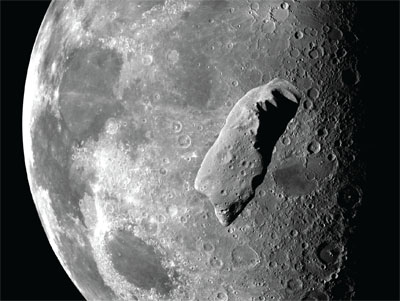
    WASHINGTON (TIP): NASA scientists have discovered that a swarm of high-speed space objects that slammed into the Moon four billion years ago also bombarded the giant asteroid Vesta and many other asteroids.

    Scientists from NASA’s Lunar Science Institute (NLSI) discovered an unexpected link between Vesta and the Moon, and provides new means for studying the early bombardment history of terrestrial planets, according to the study published in the journal Nature Geoscience. “It’s always intriguing when interdisciplinary research changes the way we understand the history of our solar system,” said Yvonne Pendleton, NLSI director. “Although the Moon is located far from Vesta, which is in the main asteroid belt between the orbits of Mars and Jupiter, they seem to share some of the same bombardment history,” Pendleton said in a statement.

    The findings support the theory that the repositioning of gas giant planets like Jupiter and Saturn from their original orbits to their current location destabilised portions of the asteroid belt and triggered a solar system-wide bombardment of asteroids billions of years ago, called the lunar cataclysm.

    The research provides new constraints on the start and duration of the lunar cataclysm, and demonstrates that the cataclysm was an event that affected not only the inner solar system planets, but the asteroid belt as well. The Moon rocks brought back by NASA Apollo astronauts have long been used to study the bombardment history of the Moon. Now the ages derived from meteorite samples have been used to study the collisional history of main belt asteroids.

    In particular, howardite and eucrite meteorites, which are common species found on Earth, have been used to study asteroid Vesta, their parent body.With the aid of computer simulations, researchers determined that meteorites from Vesta recorded high-speed impacts which are now long gone.

    Researchers have linked these two datasets and found that the same population of projectiles responsible for making craters and basins on the moon were also hitting Vesta at very high velocities, enough to leave behind a number of telltale, impact-related ages.

    The team’s interpretation of the howardites and eucrites was augmented by recent close-in observations of Vesta’s surface by NASA’s Dawn spacecraft. “It appears that the asteroidal meteorites show signs of the asteroid belt losing a lot of mass four billion years ago, with the escaped mass beating up on both the surviving main belt asteroids and the Moon at high speeds” said lead author Simone Marchi.

  • American cows have Indian origins: Scientists

    American cows have Indian origins: Scientists

    NEW DELHI (TIP): Some famous cow breeds of the Americas, including the iconic Texas Longhorn, have descended from Indian ancestors, a new genetic study reveals. Indian cows traveled to East Africa, then mixed with local cattle populations up to the North African coast.

    From there they were picked up and continued to intermingle with Spanish cattle. In 1493, Christopher Columbus took these Indian variants to the Caribbean on his second voyage. Then they spread to Mexico and Texas. The study by scientists of the universities of Texas (Austin) and Missouri (Columbia) was published in the scientific journal Proceedings of the National Academy of Sciences (PNAS) this week. This bizarre journey of the Indian cow’s genes is a reflection of human migration as cows have practically coexisted with human society. Cows were domesticated around 10,000 years ago in two regions – Turkey and India – from a wild species called aurochs which were up to two times larger than current bovines.

    These are respectively called the taurine and indicine types of cows. Aurochs were hunted to extinction by 1627. It was generally assumed that North American cattle were descendants of European cattle brought by settlers. However, certain varieties of cattle like the Texas Longhorn showed distinctive characteristics like being immune to certain ticks (parasitic insects), and quite capable of withstanding tough drought like conditions.

    Obviously, there was more to their ancient past than met the eye. To understand and unravel the origins of American cattle breeds, the scientists analyzed the genetic lineage of three cattle descended from the New World cows: Texas longhorn, Mexican Corriente and Romosinuano cattle from Colombia, and compared them with 55 other cattle breeds. They found that changes in genetic sequences found in the three New World cows were very similar to the ones in Indian breeds.

    Collating historical records, the researchers have suggested that these imported cattle survived in wild herds in their new home for another 450 years. This period, covering about 80 to 200 generations would offer an opportunity for natural selection, that is, survival of the characteristics that are better suited to the new environment, at the cost of unsuited characteristics. There have been later ‘imports’ of the Indian breeds in the Americas, the researchers admit. They were introduced to North America via Jamaica by the 1860s. In the mid-1900s, Indian cattle were imported into Brazil, and now there are “naturalized” Brazilian indicine (Nelore) and indicine/taurine hybrid (Canchim) breeds.

  • India Annihilate Australia In Historic 4-0 Series Sweep

    India Annihilate Australia In Historic 4-0 Series Sweep

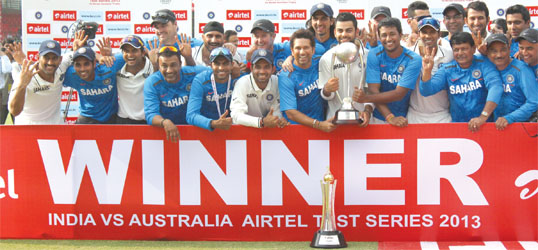
    NEW DELHI (TIP): “Dhonee. Dhonee. Dhoneee.” The chant reverberated around Feroze Shah Kotla as India closed in on victory within three days in the fourth Test against Australia. After a topsy-turvy day that saw 16 wickets tumble, leaving India 156 to win, it was fittingly the captain who hit the winning runs. It was a historic moment, a first ever 4-0 Test series win for India — and MS Dhoni deserved much of the credit.

    His pulverizing double century in the very first Test in Chennai had knocked the fight out of an inexperienced Australian side that never really got back into the contest thereafter. Having set the tone with the bat, Dhoni also exhibited a more animated, proactive style of captaincy, drawing the best out of his young team. Apart from some nervy moments in Delhi, the ploy to produce turning tracks also worked smoothly, unlike the preceding home series against England where India had embarrassingly fallen victim to its own web of spin. Before this series, India’s Test fortunes seemed to be in freefall.

    They had lost 0-4 twice in alien conditions in England and Australia, and then yielded a home series to England too. It seemed they had overestimated their own skills, their ability to outplay opponents even on friendly turf. It didn’t help they were in transition, and had lost a host of big names.

    It paved the way for some rare soulsearching. The selectors finally dropped big names like Virender Sehwag and Gautam Gambhir. A younger crop was given the chance to show their mettle — and seized the opportunity. Murali Vijay finished as the top run-getter on either side, hitting two consecutive tons. Shikhar Dhawan got just one knock but made it count.

    Ironically, his record-busting, blazing 187 revived memories of the very man he had replaced, Sehwag. The young lead spinner, R Ashwin, realized where he had erred against England and made quick changes to his technique to achieve consistency.

    He ended with 29 wickets, the highest for either side in this series and the seventh-best ever for India. Cheteshwar Pujara continued from where he had left off against England and scored 419 runs at 83.8, reasserting his status as the new bedrock of the side.

    Seamer Bhuvneshwar Kumar got into the act in Hyderabad and Mohali and picked crucial wickets. Dhoni decided to bring in the wildcard Ravindra Jadeja, who responded with 24 wickets at 17.45 with his left-arm spin, including a first-ever five-wicket haul in Delhi on Sunday which helped seal the match in India’s favour. Jadeja also seemed to have a knack for dismissing regular Aussie skipper Michael Clarke, by far Australia’s best batsman. Jadeja’s impact meant Dhoni could play with five specialist bowlers.

    His own form with the bat at No. 6 covered up the deficiencies in the batting lineup. Ashwin talked about how he needed “a kick up the backside” which had helped. The skipper, while maintaining equanimity in victory, stressed on the need for the youngsters to develop “good habits”. “Fortunately I lost all the tosses, which meant we had to bat last in difficult conditions in all the games.

    The individuals came forward to perform. We put a lot of emphasis on partnerships. We were able to implement our learning,” he said. “It was an important series for us. There were a few changes in the sides which were good. It was up to the individuals to rise up and do well. They all did, everybody performed.

    The openers batted well. I’m very happy with the new players. We have had a tough time, and you tend to learn more when you go through a tough period. We showed character in this series, which is important.” Dhoni admitted he had had to alter his laidback style of captaincy too. “With a young side you have to change a bit. You have to talk to them often, get them into a system where they do things that are supposed to be done. It’s important for them to learn good habits which will remain with them when I’m not there three-four years from now.” Australia may not have been the strongest of teams, and the pitches may have played to India’s advantage. Some of India’s younger crop of players are as yet capable of performing only in certain conditions.

    On Sunday, though, it became clear that under Dhoni, they were capable of learning, adapting and implementing changes to the side’s benefit.

    As a dejected Shane Watson from the opposition camp said, “We were not able to perform. Ultimately you cannot hide behind anything else.” An important statement has been made: At home, India remain extremely hard to beat. The confidence gained from this 4-0 win will help smoothen the rocky road ahead when this young side tours away from home.

    Men Who Mattered
    M VIJAY: Highest runscorer on either side in the series, with 430 runs (avg 61.4), including 2 successive tons
    CHETESHWAR PUJARA: Second-highest run-getter with 419 runs (avg 83.8).
    Hit 204 at Hyderabad. His unbeaten 82 at Delhi, playing with a fractured finger, turned a tricky 4thinnings chase into a stroll
    SHIKHAR DHAWAN: Only played 1 innings but his recordbreaking 187 was enough to set up a superb win at Mohali
    R ASHWIN: Learned from disappointing series against England to emerge as top wicket-taker against Aus, with 29 wickets.Deservedly declared man of the series
    RAVINDRA JADEJA: With 24 wickets, proved surprisingly effective as a bowler. Bagged 7 wicketsincluding 5/58 in the 2nd innings-and scored a feisty 43 at Kotla
    MS DHONI: Led with verve and imagination. His 224 in the first Test gave India the upper hand over Aus, which it never let go.

  • IPL Player Jesse Ryder In Coma After Bar Brawl

    IPL Player Jesse Ryder In Coma After Bar Brawl

    WELLINGTON (TIP): New Zealand cricketer Jesse Ryder lies in coma after being badly beaten up by a group of men near a bar in Christchurch early March 28, police said. “Four men” attacked Ryder as he left Aikman’s Bar in Merivale shortly after midnight (around 12.30 a.m. local) after having “a few drinks” with Wellington Firebirds teammates, The New Zealand Herald reported. The “brutal assault” has left Ryder in an induced coma with a fractured skull and multiple injuries. The left-hand batsman, who has been involved in alcohol related incidents in the past, was due to leave for India to represent Delhi Daredevils in the Indian Premier League beginning April 3.

    An eyewitness described the attack on the cricketer as “sickening”. “Just around 12.30 a.m., I look up and three or four guys were attacking Jesse,” Emma- Louise Ferguson was quoted as saying by the newspaper. “There didn’t seem to be any argument or anything. They were just punching him, they had him on the ground and they were kicking him hard. It was unbelievably brutal. It was literally right outside the door of the bar,” she said. “When he was on the ground, I couldn’t actually see him but I could hear the they were kicking him as hard as they could. I know about impact, I’ve seen fights and been in (charity boxing) fights and this was sickening.

    I can’t understand what could have caused them to attack him in such a way,” she added. Aikman’s Bar has handed over the CCTV footage of the incident to the police, who are trying to find who the assailants were, the report said. The attackers ran away when emergency services were called. Heath Mills of New Zealand Cricket Players Association wished Ryder a speedy recovery and said the assault was not “alcohol fuelled” even though the southpaw has had related problems in the past.

  • National Tourism Awards presented

    National Tourism Awards presented

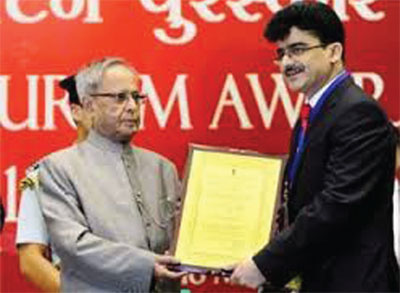
    NEW DELHI (TIP): President Pranab Mukherjee, March 18, presented National Tourism Awards for 2011-12 in New Delhi. Speaking on the occasion, Union Tourism Minister K. Chiranjeevi said the Tourism Industry has immense potential to increase tourism arrivals. “For this, we need to constantly monitor trends and re-invent our products for the marketplace”, he added. Referring to the safety of tourists, the Minister said a code of conduct for Safe and Honorable Tourism has been adopted by the Ministry and stakeholders.

    He said the code has been incorporated in the guidelines governing the approval of various categories of travel trade and related service providers as well as for the classification of various categories of accommodation including hotels. Chiranjeevi said, “The objective of the Code is to follow internationally accepted best practices of safe tourism applicable to both tourists and local residents giving special emphasis to safety of women and children”. The Tourism Minister said his ministry was working towards the electronic delivery of more than half a dozen services online; to enable anyone desirous of visiting India from any part of the world plan their trip to India and make actual bookings from the comfort of their home.

    He said, “To provide roundthe- clock information to international tourists, the Ministry is also setting up a tourism information line which would be a multi lingual helpline in nine world languages”. Chiranjeevi said this year we have come out with a very important paradigm shift in our strategy to promote India within the country and abroad. He said “The ‘Go Beyond’ campaign focuses on promoting lesser known destinations to domestic as well as international tourists. The other campaign, themed as “Find what you Seek”, targets the international tourists who imagine a need and find its realization in India.

    In the short span of four months our campaign has won international accolades”. Chiranjeevi said the Ministry of Tourism continues its holistic and integrated approach to marketing, branding and advertising that is designed to bring more visitors to our country. The Minister congratulated the awardees and expressed the hope that together we will achieve our target of being a world tourism destination in the near future. Andhra Pradesh has bagged the best state award for comprehensive development of tourism in the rest of India category of National Tourism Award 2011-12.

    The Best Heritage city award has gone to Warangal(AP). Amritsar Heritage Walk and Delhi Heritage Walk have been declared joint winner of the best Heritage Walk Award. Every year the categories of awards are reviewed with new categories being added to recognize excellence in diverse fields, in accordance with the requirements of changing times.

    It is an ongoing Endeavour of the Ministry to diversify the tourism products of the country by developing and promoting new niche segments, so as to attract different categories of tourists with diverse interests and to promote India as a year – round destination. In keeping with this thrust of the Ministry, new categories of awards for “Medical Tourism Facilities” and for “Tour Operators Promoting Niche segments” were introduced in 2011. In an attempt to encourage States and Union Territories to adopt effective mechanisms for maintaining cleanliness at tourist destinations, a new category of award for “Best State : Campaign Clean India” was introduced in 2012. New categories of awards for “Best Heritage City” and “Best Heritage Walk” were also introduced in 2012.

    Recognizing the importance of Cinema as a powerful tool for the development and promotion of the destinations, the Ministry has instituted a National Tourism Award for “Best Tourism Film”. The Tourism Ministry has also announced special National Tourism Award for Mr. Yann Martel, author of the Book “Life of Pi”, for promoting India (Puducherry and Munnar) through the film. The Ministry of Tourism, Government of India annually presents National Tourism Awards to various segments of the travel, tourism and hospitality industry. These awards are being given since the early 1990s and are presented to State Governments / Union Territories, classified hotels, heritage hotels, approved travel agents, tour operators and tourist transport operators, individuals and other private organizations in recognition of their performance in their respective fields and also to encourage healthy competition with an aim to promote tourism.

  • UK issues travel  advisory for female  travelers in India

    UK issues travel advisory for female travelers in India

    LONDON (TIP): Britain has advised its female tourists to be cautious while traveling in India in the wake of the rape of a Swiss tourist in Madhya Pradesh last week. “Our travel advice states that women should use caution if traveling alone in India. Reported cases of sexual assault against women and young girls are increasing; recent sexual attacks against female visitors in tourist areas and cities show that foreign women are also at risk,” a Foreign and Commonwealth Office (FCO) spokesperson said.

    Though the advice has not been modified following last week’s sexual assault on a foreign tourist, the government’s travel advisory remains under constant review in view of the situation on the ground, it added. “British women have been the victims of sexual assault in Goa, Delhi, Bangalore and Rajasthan and women travelers often receive unwanted attention in the form of verbal and physical harassment by individuals or groups of men. If you are a woman traveling in India you should respect local dress codes and customs and avoid isolated areas, including beaches, when alone at any time of day,” said the FCO’s current advisory under the section of ‘Crime’. Six men accused of raping the 39-yearold Swiss tourist, who was camping with her husband in a forest in MP, have been remanded in custody. The woman has since been discharged from hospital.

  • Jailed unjustly for 2  decades, man nears  freedom

    Jailed unjustly for 2 decades, man nears freedom

    NEW YORK (TIP): In the wintry darkness 23 years ago on a back street in Williamsburg, Brooklyn, a jewellry thief fleeing a botched robbery panicked and shot a Hasidic rabbi in the head. Four days later, the rabbi, Chaskel Werzberger, an Auschwitz survivor, died of his wounds. Even in the New York City of 1990, as homicides crested at 2,245, the murder stirred grief and outrage. The “Slain Rabbi” was front-page tabloid news. Mayor David N Dinkins travelled to Williamsburg’s Satmar enclave to sit in mourning and to offer a $10,000 reward.

    The new Brooklyn district attorney, Charles J Hyne, vowed to bring the killer to justice. Forty detectives worked the case, soon led by the swaggering, cigar-chewing Detective Louis Scarcella. Working closely with an influential Satmar rabbi, Detective Scarcella arrested a drugaddicted, unemployed printer named David Ranta.

    Ranta was convicted in May 1991 and sentenced to 37.5 years in maximum-security prison, where he remains to this day. He is almost certainly not guilty. This week Hynes, after a long investigation by a unit that he created to look into questionable convictions, plans to ask a state judge to release the prisoner. Ranta’s lawyer, Pierre Sussman, who conducted his own inquiry, said his client has been instructed to pack up his cell.

  • Building his dreams: Mihir Patel

    Building his dreams: Mihir Patel

    “Within our dreams and aspirations we find our opportunities”.
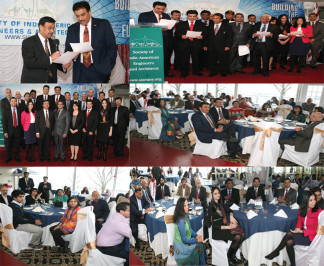
    Very few people truly love their jobs let it alone be a passion. But the just sworn in new President of the prestigious Society of Indo-American Engineers and Architects (SIAEA), Mihir Patel not only loves his job but works everyday with a burning passion. He is the President of Monpat Constructions Ltd., and a prominent member of the Indian American community. He spoke to The Indian Panorama correspondent Pooja Premchandran in an exclusive interview at his office in Flushing, New York. Mihir B. Patel is perhaps one of the wellestablished engineers in the Indian American community. A firm believer in the philosophy of ‘one life-live well’, Mihir Patel bats away the problems of his life and work. After a bit of struggling start, Patel has come a long way. “I am one of the founding members of Monpat Construction. The start to that hasn’t been easy but I sure am happy now. I came here and started working at a construction group. Currently we work on many New York City projects. Now I am the 15th President at SIAEA and that’s additional responsibility.


    img10

    But I am more than happy to take up this responsibility,” says a smiling Patel. Born in Mehsana, Gujarat, Mihir was always inclined towards doing Engineering. He set out to complete his Bachelors in Engineering from Birla Vishwakarma Mahvidyala in 1982. In 1986, he married Bhavana Patel and he now has a son, Priyank Patel, who is also an architect. Mohan Jetwani founded the Society of Indo-American Engineers and Architects or SIAEA in 1981. The Association immediately gained popularity among the Indian American engineers and architects who were continually looking for a larger umbrella to share their common goals. Patel is ready to further the valor of the organization. “They sowed the seed for this Association.

    Although it has blossomed already, my task is to make sure it remains that way. I need to carry its name and glory much further,” says Patel. Mihir also plans to get the Indian-American youth on board with SIAEA. He adds, “We plan to get many youngsters also inducted to our organization. We plan to provide them with scholarships to Engineering schools and once they graduate we will orient them to our organization.” Unlike many who see the seat of power as just another feather in their caps, Mihir resolves to change a few things within the SIAEA. He vows to accomplish a few of his own personal ambitions by using all the Presidential power that he is allotted to use. “My personal goal under this Presidency would be to open new chapters, facilitate grassroot level meetings, get more young engineers and architects involved. That would be priority. This was also the dream of Nayan Parikh, so now my task is to fulfill them,” Mihir stresses.

    In the midst of a housing crisis where the prices are sky-rocketing, Mihir has not lost all hope to provide housing for all. His personal ambition is to provide housing options to all sectors of the society. “My biggest ambition is to provide housing options for the society and not just specifically the Indian community. I think housing or shelter is a basic need for us all. I, along with the SIAEA have been trying to work on this need for the past six years. But we require continual monetary support for this. I am hoping that in these two years as the SIAEA President I will be able to bring us closer to fulfilling that dream,” says Mihir. He explains that he is relentlessly pursuing this aspiration and he hopes that it gets fulfilled. While most of us cannot handle just one job, Mihir eases through his role as President to two organizations. He attributes the successful organizing of his office and work projects to his brother. He explains, “Well my company is well organized and its very well established. I have my brother also helping me out and my staff does a wonderful job to settle things in a good way. So it gives me the motivation to come to a hassle free environment. As far as SIAEA is concerned, just being part of this group is an honor.

    I get all the respect and admiration I could ask for from SIAEA and in turn I strive to live up to the organizations dreams and valor.” Mihir also learnt long ago that all work and no play is not the way to go. He still remains a lively and active man despite the mounting economic crisis and additional work pressure. He explains that that he takes ‘the edge off’ by playing various sports. “I am most passionate about sports. I play cricket, tennis, golf and other active sports.

    I have made a small cricket pitch in my backyard. I had the fortune of having Mr. Kapil Dev come there and play once. It’s simple. With all the work you do, you need to find something that relaxes you. I need that relaxation after its 5 in the evening.” Mihir draws all his inspiration from his father. He recalls his father’s debacle when he was told that he couldn’t be an engineer. Since, then his father resolved to make Mihir an engineer.

    Mihir says, “My father easily is my mentor. When he was young, he aspired to be an engineer and run his own company in America. But sadly, my grandfather did not have the means to support him. So he always willed me to be an engineer and I did just that. Even today, I stress on the value of education. I always believe that education is the only way you can succeed in today’s world.” It usually takes a life changing experience for us to transform our manner of thinking and living.

    On being asked about Mihir’s life changing experience, he jokingly tells us, “I think ever since the 2009 recession I have been having life changing experiences. But seriously, initially we used to get regular work orders from agencies, but now we need to dig a little deeper to find work. Sadly though, the situation does not seem to be improving.” The 2009 recession has stunted many companies growth and many have given up. But Mihir Patel carries on due to his loving support from his family and friends. “See, problems will always come.

    It is never going to stop. I find that a good support from friends who are loyal and committed to you, it is easier to solve your problems,” he advises. In the last 20 years, Monpat Constructions have completed work worth $100 million. All his projects are close to his heart but two are very distinctive. “Currently, I am working on a project at the Otisville Correction facility. Although there are many other projects we are currently undertaking, the Otisville prison project or any other project that you do at the prison, deserves a special mention. Working at a prison is completely different.

    You get a bare minimum of 5 hours to work every day and you need to somehow complete your project by deadline. Also, there are strict rules on how many tools you can carry inside and how you can carry them. Even our Super’s presence and absence must be notified to authorities. So, construction around the prison is definitely a more challenging job for me,” Mihir adds.

    He also tell us about a second project called “Challenge America’ where the debris from the 9/11 tragedy was used to make the Houston park near FDR. Mihir explains, “This project was a joint effort of Erin Brokovich and Mayor Giuliani. We provided the roofing to this project. I decided to contribute to this project mainly because we all were overcome with the sense of needing to do something after the harsh 9/11 tragedy.” Like many other prominent members of our Indian American community, Mihir Patel also urges our community to grow stronger and stand united from within. “I find that the Gujarati community is very active and very well behaved. This is a group comprising of very well educated and very well established people. This is also true about the other Indian communities we have in the US. However, there is a problem with unity in our Indian society.

    Not only are we disunited but we also have the nature of being displeased when others succeed. I wish we could change that aspect.” But like any other Indian, family is the most important thing to him. “I only pray that in good or bad times, I have the support and presence of family and close friends. For me, family is of utmost importance. Everything else is secondary,” he concluded.

  • Southwest Airlines And AirTran Airways Connect Networks

    Southwest Airlines And AirTran Airways Connect Networks

    DALLAS, Texas (TIP): Southwest Airlines announced today that it has successfully completed the connection between the Southwest and AirTran networks. Customers are now able to purchase itineraries to the airlines’ combined 97 destinations, including international, in one transaction. The newly connected itineraries are on sale now via all Southwest and AirTran sales channels for service starting on April 14. “We began rolling out shared itineraries in January in a handful of markets, and we’ve gradually ramped up the initiative where we now connect our entire network across both Southwest and AirTran,” said Bob Jordan, Chief Commercial Officer at Southwest Airlines and President of AirTran. “With a connected network, we can offer Customers more itineraries, more destinations, more low fares, and a taste of what’s to come once the integration is complete.” Southwest Airlines and AirTran Airways took the first step in connecting their networks on Jan. 26, 2013, by offering a small number of connected itineraries in five markets. On Feb. 25, 2013, the airline launched connected itineraries in 39 cities.

    By connecting the Southwest and AirTran networks, Customers may: Add one or more AirTran domestic flight segments to a Southwest itinerary, using Southwest booking channels (southwest.com, 1-800-IFLYSWA, travel agencies, Southwest’s mobile site and apps, and Southwest Airlines ticket counters.) Book one or more Southwest flight segments connecting to an AirTran itinerary, using AirTran channels. Use all Southwest channels to book an AirTran-only domestic itinerary. Add an international AirTran segment to a Southwest itinerary within a single reservation, through a Customer-friendly transfer of the transaction to AirTran channels for booking, purchase, and ticketing by AirTran. Earn currency in either loyalty program no matter which carrier they fly. (The currency a Customer earns is determined by the carrier from which they buy their ticket, even if flying on a shared itinerary.) As is standard with industry “code share” arrangements, the Marketing Carrier’s (where you buy your ticket) rules and policies apply to reservations and ticketing. The Operating Carrier’s (which airline operates the flight) procedures apply to boarding, seating, and the onboard experience.

    Southwest is making one exception: any itinerary with a Southwest segment or that is purchased through a Southwest point-of-sale channel will not have bag fees for the first or second checked bag (weight and size restrictions apply.) Customers can find specific details and answers to frequently asked questions by visiting www.southwest.com Customers will continue to earn and redeem currency through the frequent flyer loyalty programs of their Marketing Carrier, regardless of the Operating Carrier they travel on.

    Customers should be enrolled in both Southwest Airlines Rapid Rewards and AirTran Airways A+ Rewards programs in order to earn currency from whichever airline they purchase a ticket. Loyalty Members also have the ability to transfer their currency between the two loyalty programs. For more information about transferring loyalty currency, visit www.rewardsfarther.com Southwest Airlines announced plans to acquire AirTran Airways on Sept. 27, 2010, an acquisition that significantly expanded Southwest Airlines’ low-fare service to more Customers in more domestic markets, creating hundreds of additional low-fare itineraries for the traveling public.

    Since Southwest Airlines closed the deal to purchase AirTran Airways on May 2, 2011, Southwest and AirTran Employees have worked hard to facilitate a thoughtful and smooth integration process while providing the same high level of Customer Service that Customers have come to expect.

    To date, Southwest Airlines has welcomed 30 percent of AirTran Employees to the Southwest Family, has converted 11 AirTran Airways 737-700 aircraft to the Southwest paint scheme and interior configuration, and has transitioned five AirTran Airways-served cities into Southwest Airlines operations. The process of a full integration of the AirTran Airways 737 fleet into the Southwest Airlines fleet (i.e. paint scheme and interior configuration) and transition to a single ticketing system is a large and complex process that is expected to be completed by the end of 2014. Southwest Airlines realized $142 million of net, annualized, pre-tax synergies during 2012, and expects to achieve $400 million in 2013 (excluding acquisition and integration expenses).

  • The worries in Afghanistan

    The worries in Afghanistan

    In the days that have passed since American Defense Secretary Chuck Hagel visited Kabul and received a less than cordial welcome from President Hamid Karzai, there has been no visible improvement in relations between the Karzai administration and the International Security Assistance Force. The fact that two Americans and some others were killed in a “green-on-blue” attack the day after Karzai made his speech criticizing America and the Taliban was probably a coincidence. But the speech itself blaming the two for colluding to create security conditions to justify a continued American presence was deemed provocative. US and Nato commander Gen Joseph Dunford issued an advisory to his commanders in the field asking them to be extra alert after what he termed an inflammatory speech that could trigger insider attacks by Afghan forces against Westerners. He even went on to say that “he [Karzai] may issue orders that put our forces at risk”.

    It is difficult to think of anything else that could better describe how precarious the Afghan-American relationship has become. After a call from US Secretary of State John Kerry, Karzai did acknowledge the importance of working with America and maintained: “My recent comments were meant to help reform, not destroy the relationship.” He did not, however, retract his charges of Taliban-American collusion or change his adamant stand on the transfer of Bagram’s Parwan prison unconditionally to Afghan authorities.

    In subsequent conversations with Dunford, Karzai’s office claimed it had been agreed that the transfer would be completed within a week but the American statement on the subject went no further than stating that the next week would be used to work out the issues.

    It does not seem likely that the Americans will agree to the transfer unless they are given assurances that the three dozen or so prisoners the Americans regard as “enduring security threats” will not be released by the Afghan judicial system. And therein lies the rub. If one understands Karzai it would appear that beyond the publicly stated position of asserting Afghan sovereignty Karzai does want to release these mostly Pakhtun prisoners because of the influence they enjoy in the Pakhtun-dominated areas of south and east Afghanistan. Perhaps he believes that these prisoners will on release become the vehicle for dialogue with the Taliban leadership that Karzai says he desperately wants as a means of advancing reconciliation. More likely he hopes that they will galvanize support in the Pakhtun belt for the candidate he puts forward for next year’s presidential election. In the meanwhile, Karzai’s speech has provoked reactions both within Afghanistan and in the West.

    In Washington a senator, Lindsey Graham, involved in Afghan policy has been quoted as being ready to “pull the plug” on assistance to Afghanistan. The New York Times in an editorial has called Karzai’s behavior “appalling” and opined that “it will make it harder for Mr. Obama to argue compellingly to keep a smaller counterterrorism and training force in Afghanistan into 2015 and beyond”. In Kabul, a group of representatives from 14 political parties – most of them opposition groups but several with members in government – held a news conference to denounce the president’s stance.

    On the other hand, there have been demonstrations in Maidan Wardak and Kabul calling for the immediate implementation of the Karzai order to remove all American forces from Wardak. The Afghan Ulema Council, all government appointees, have made a similar demand in a statement which called the Americans “infidels” and threatened that if they [the Americans] did not “honor their commitments then this [their presence in Afghanistan] will be considered as an occupation, and they may expect to see a reaction to their action”.

    The Americans currently are adamant that this contretemps will not affect their military plans but the truth is that if there is an increase in “green-on-blue” attacks it is not only a residual presence but also an orderly American withdrawal that will become a nightmare. British commentators are grimly recalling the fate of British troops in the First and Second Afghan wars. The accepted axiom that “retreat is often the most dangerous part of a deployment especially when the military falls below the critical mass required to protect itself” will certainly apply if by April 2014, 34,000 troops are withdrawn. This would leave half the number to carry out their own withdrawal and that of the $48 billion worth of equipment currently in Afghanistan, which would require the movement of 95,000 containers and 35,000 vehicles. America will do what it can to avoid such a situation. One way is to pursue reconciliation with or without Karzai. The Afghan president’s opponents have now made public their efforts, undoubtedly with American support, to seek recon-ciliation with the “armed” opposition.

    An Associated Press story by Kathy Gannon, easily the Western correspondent with the best connections with Afghan politicians and knowledgeable Pakistanis, recently said that the 20-party Council of Cooperation of Political Parties which counts among its numbers some heavyweight Afghan politicians, many part of Karzai’s administration, is reaching out to both the Taliban and Gulbuddin Hekmatyar. And that two senior Taliban officials have indicated the group is willing to pursue talks.

    The problem is that, to my mind, these parties all have different agendas and while they could come together to frame a “charter of democracy” in September 2012 laying down reasonable conditions for Afghan elections, they will have very different views on how negotiations with the Taliban should be conducted and what the outcome of these negotiations should be. It is difficult to imagine that they can sink their differences and reach a solution. The outlook is bleak for Afghanistan and therefore for Pakistan. Can we do something about it? And if not, can we make whatever effort we can to insulate ourselves from the turbulence that is to begin in Afghanistan?

    It does not seem likely that the Americans will agree to the transfer unless they are given assurances that the three dozen or so prisoners the Americans regard as “enduring security threats” will not be released by the Afghan judicial system.

  • The Taliban threat to elections

    The Taliban threat to elections

    Having divided the political class and once again confused society with talk of talks, the TTP has now “suspended” its offer of negotiations with the government. Ehsanullah Ehsan, the TTP spokesperson, has claimed that the government’s lack of seriousness about negotiations with the Taliban is behind the TTP’s move. More realistically, the TTP has achieved much of what it set out to do by mooting the idea of talks. In the two craven multi-party conferences that took place in quick succession, the religious right and large segments of the political mainstream all but suggested that the state give up on the idea of Pakistan as a modern nation-state with a monopoly over legitimate violence and in which the citizenry enjoy freedoms and rights. Given that the TTP’s offer of talks coincided with a wave of militant violence, it never really appeared to be a meaningful offer.

    What the focus should switch to now is how best to secure the upcoming elections from militant violence. Ehsanullah Ehsan’s warning to the public to stay away from electoral activities is particularly ominous because the TTP has already made it clear that it regards elections as un-Islamic and that it will target “secular” politicians during the campaign. The mere threat of violence by the TTP is enough to potentially skew elections in parts of the country because both the voter and a certain kind of candidate in areas such as Fata and parts of Khyber Pakhtunkhwa, Balochistan, Punjab and Karachi may opt to stay at home, opening the door further to pro- Taliban political forces that will be able to campaign and vote more freely.

    If the TTP is to be stopped from indirectly shaping the composition of the elected assemblies, a comprehensive security plan must be drawn up – one that will require close cooperation between the Election Commission of Pakistan, the caretaker governments and security apparatus.

    Securing the election from militant threats is neither beyond the realm of possibility nor something we can afford to overlook. True, elections by their very nature present a plethora of potential targets to those bent on violence and there is a trade-off between security and openness. But the stakes are too high to let a business-as-usual attitude prevail. The ECP, already burdened with a number of duties and crises, needs to put security near the top of the list of its priorities – and win the cooperation of the necessary institutions as quickly as possible.

  • As I See IT:The Problems Facing  Muslim Nations

    As I See IT:The Problems Facing Muslim Nations

    I recognize well this is very sensitive subject because human nature prefers not to hear the truth and simply wants to receive good news even at the expense of reality. However, let’s be frank: Most Islamic countries are being left behind in social progress as compared with other nations. There are essentially five reasons for this situation. First, we must consider the educational curriculums adopted in Islamic countries, knowing that education is the first step toward refining the talent and minds of scientists, inventors and innovators. Yet, our curriculums and our teachers, being the products of cultural norms in most Muslim countries, remain wedded to the past and unable to produce persons of creative minds and innovative ways of thinking. Why is this so? Because these curriculums and the attitudes of teachers fail to value or embrace the disciplines that are vital for today, such as subjects like mathematics, chemistry, physics, philosophy and logic, which have been disregarded and replaced, with all due respect, by mostly religious subjects and teachers who seek to impose religious dogma upon their students. While there is nothing wrong with religious classes at educational institutions devoted exclusively to religious instruction and training, such classes may impair scientific study if they are taught intensively in non-religious educational institutions.

    It has been proven throughout history (and beyond any doubt) that no nation can progress if it uses an educational system that focuses on purely religious curriculums that are based on memorization and blind obedience. Instead, the curriculums that have produced brilliant thinkers throughout history are based on understanding, comprehension, experimentation and invention.

    Indeed the Holy Qur’an repeatedly asks: Do they not reflect? Do they not ponder? Do they not understand? This certainly encourages thinking and contemplation, rather than blind unquestioning obedience to religious dogma. But how can we change this paradigm? Secondly, Islamic nations generally tend to dwell in the past at the expense of the present and the future and thus become prisoners of an outmoded way of thinking. Although great progress has been achieved in the past, now such countries seem frozen in time and beholden to certain school of thoughts that have been established by those who died decades or centuries ago, unwilling or unable to foster the kind of visionary thinking and innovations epitomized even by great Muslims themselves such as Ibn Sina Avicenna, Ibn Al-Haytham Alhazen and many others.

    Thus, we have watched as other countries have planned for the future by emphasizing the very things that have created technologies that are compelling and popular. Times change, challenges arise, and innovators respond and adapt. So must nations. Thirdly, Islamic nations praise the abstract at the expense of the concrete, that is, they believe in the unknown and disregard reality by permitting this mysterious situation to dominate all aspects of scientific inquiry. Although the Prophet (peace be upon him) said to the people of Madinah, You know best about the matters of your world, so we must emphasize the physical over the metaphysical in encouraging new ways of thinking. Yet, we remain obsessed with the taboos, heresies and errors of every useful science and do all we can to suppress legitimate questions. When all sorts of freedoms, sciences, inventors and innovators are suppressed and restrained, we are left with those scientists who specialize in the fields of Halal and Haram, etc. Fourthly, Islamic countries are obsessed with angels and demons, God and Satan.

    In other words, if something fails on the job or in school (let’s say an employee is fired from his job for poor performance or a student is expelled because of excessive absences or disciplinary problems), then the failure is due to the fact that God has decided that it is not meant to be, or Satan and his devilish schemes have caused it to fail. Conversely, if it succeeds, then this is God’s plan and the result of prayer to keep Satan away. Why are we unable to face reality and acknowledge the fact that we rely too much on intangible things, remaining confused? Why do we embrace a culture that promotes an escape from reality? How strange is that? Finally, we can see that Islamic nations have used lame and illogical excuses to push art aside and intentionally hide it from their people. All kinds of art such as music, theater, painting, and sculpture have been de-emphasized or completely disregarded and buried alive. This has led to creating shaken and disturbed personalities and spirits, stifling talents that could add to the enjoyment of life.

    Art is a means to satisfy our soul and feed our emotions, producing a more confident, balanced and spiritual humanity and motivating people to live and work, and even more, to create, innovate and give of themselves to others. Art protects humanity from all that can bring it down and allows spirits and hearts to soar high into a sky filled with optimism and hope and to move steadily down the road of innovation, creation and discovery.

    The Prophet Mohammed taught us to cheer up our hearts from time to time, because grieved hearts live in darkness. How can Islamic nations achieve such progress if there is little appreciation for thinking and questioning all aspects of our lives? We must turn the page on extolling religious dogma that breeds ignorance and fear of the future, especially when we have the great religion of Islam which is valid and applicable in every time and place.

    There is no question that Islam, as revealed to believers in the Qur’an, is a true miracle but only for those who are open to change their mindset and embrace critical thinking. Let us hope future generations, if we cannot, will emerge to lead us toward a brighter future!

    “We must turn the page on extolling religious dogma that breeds ignorance and fear of the future, especially when we have the great religion of Islam which is valid and applicable in every time and place. There is no question that Islam, as revealed to believers in the Qur’an, is a true miracle but only for those who are open to change their mindset and embrace critical thinking. Let us hope future generations, if we cannot, will emerge to lead us toward a brighter future!”, says the author.

  • It’s just law catching up with Sanjay

    It’s just law catching up with Sanjay

    Anti-hero Khalnayak or the affable Munnabhai, however you look at him, there is a man inside the star; and that man falters just as any other would. But this one mistake of Sanjay Dutt has been found serious enough by the Supreme Court to send him behind bars for five years. No one would argue with the legal merits of the sentence, but many a heart would go out to the father of a grown-up daughter and twin tiny tots resigning to the pain of his own doing. Initial reports quote him as saying he accepts the ruling ‘as it is’. That perhaps is the best way to prepare for the more than three years he may yet have to spend in jail.

    Acceptance does mitigate distress. Sanjay is a star, has been involved in charity work, was born into a family as respected and celebrated as it gets. His conduct since his bail in 2007 – and even earlier, barring the one mistake he is paying for – gives no reason to suspect he holds any threat to society. Yet, to say that he need not be sent to jail because he seems a ‘good man’ would be presumptuous to the extent that it would amount to giving a certificate of character to a man because he is in a certain position.

    It is not the posturing or proclamation of good intent that make a man, but his actions. And here he is, found possessing illegal weapons, procured from people of patently sinister character. There is no denying that Sanjay’s has been a life of extraordinary emotional upheavals – drugs, a mother dying of cancer while he was still in his early twenties, a wife dying, a divorce, and now imprisonment. And that perhaps makes him the tragic hero for us, who otherwise should have lived nothing but a high life. His fate should also serve to bring us all – forever looking for that forbidden thrill – down to mother earth. Even more, it would be people in his station who would do well to get in touch with reality.

  • Holi the festival of colors

    Holi the festival of colors

    LATHMAAR HOLI
    In what is known as the hub of holi in India – Barsana, Holi is known as Lathmaar Holi. Sounds violence?? There is more violece than the name signals off. The stick is in the hands of the women on this day and the men need to work a lot to save themselves from the immensely charged up womenfolk. The birth place of Lord Krishna’s beloved Radha, Barsana celebrates Holi with extreme enthusiasm as Krishna was famous for playing pranks on Radha and gopis. In fact, it was Krishna who started the tradition of colours by first applying colour on Radha’s face. Womenfolk, of Barsana it seems, after thousands of centuries want to take a sweet revenge of that prank of Krishna. Even men have not left their mischief and are still eager to apply colour on the women of Barsana.

    Following the tradition, men of Nandgaon, the birthplace of Krishna, come to play Holi with the girls of Barsana, but instead of colours they are greeted with sticks. Completely aware of what welcome awaits them in Barsana, men come fully padded and try their best to escape from the spirited women. Men are not supposed to retaliate on the day. The unlucky ones are forcefully led away and get a good thrashing from the women. Further, they are made to wear a female attire and dance in public. All in the spirit of Holi. The next day, it is the turn of men of Barsana. They reciprocate by invading Nandgaon and drench the womenfolk of Nandgaon in colours of kesudo, naturally occurring orange-red dye and palash. This day, women of Nadagow beat the invaders from Barsana. It is a colourful site.


    img2

    One of the major festivals of India, Holi is celebrated with enthusiasm and gaiety on the full moon day in the month of Phalgun which is the month of March as per the Gregorian calendar. Holi festival may be celebrated with various names and people of different states might be following different traditions. But, what makes Holi so unique and special is the spirit of it which remains the same throughout the country and even across the globe, wherever it is celebrated.

    Preparations
    Entire country wears a festive look when it is time for Holi celebration. Market places get abuzz with activity as frenzied shoppers start making preparations for the festival. Heaps of various hues of gulal and abeer can be seen on the roadside days before the festival. Pichkaris in innovative and modern design too come up every year to lure the children who wish to collect them as Holi memorabilia and of course, to drench everybody in the town.

    Womenfolk too start making early preparations for the holi festival as they cook loads of gujiya, mathri and papri for the family and also for the relatives. At some places specially in the north women also make papads and potato chips at this time.

    Season of Bloom
    Everybody gets delighted at the arrival of Holi as the season itself is so gay. Holi is also called the Spring Festival – as it marks the arrival of spring the season of hope and joy. The gloom of the winter goes as Holi promises of bright summer days. Nature too, it seems rejoices at the arrival of Holi and wears its best clothes. Fields get filled with crops promising a good harvest to the farmers and flowers bloom colouring the surroundings and filling fragrance in the air.

    Legends
    A Hindu festival, Holi has various legends associated with it. The foremost is the legend of demon King Hiranyakashyap who demanded everybody in his kingdom to worship him but his pious son, Prahlad became a devotee of Lord Vishnu. Hiranyakashyap wanted his son to be killed. He asked his sister Holika to enter a blazing fire with Prahlad in her lap as Holika had a boon which made he immune to fire. Story goes that Prahlad was saved by lord himself for his extreme devotion and evil minded Holika was burnt to ashes, for her boon worked only when she entered the fire alone. Since that time, people light a bonfire, called Holika on the eve of Holi festival and celebrate the victory of good over evil and also the triumph of devotion to god.

    Children take special delight in the tradition and this has another legend attached to it. It says that there was once an ogress Dhundhi who used to trouble children in the kingdom of Prithu. She was chased away by children on the day of Holi. Therefore, children are allowed to play pranks at the time of ‘Holika Dahan’. Some also celebrate the death of evil minded Pootana. The ogress tried to Lord Krishna as an infant by feeding it poisonous milk while executing the plan of Kansa, Krishna’s devil uncle.

    However, Krishna sucked her blood and brought her end. Some who view the origin of festivals from seasonal cycles believe that Pootana represents winter and her death the cessation and end of winter. In South India, people worship Kaamadeva- the god of love and passion for his extreme sacrifice.

    According to a legend, Kaamadeva shot his powerful love arrow on Lord Shiva to revoke his interest in the worldly affairs in the interest of the earth. However, Lord Shiva was enraged as he was in deep mediation and opened his third eye which reduced Kaamadeva to ashes. Though, later on the request of Rati, Kaamadeva’s wife, Shiva was pleased to restore him back.

    Holika Dahan
    On the eve of Holi, called Chhoti or Small Holi people gather at important crossroads and light huge bonfires, the ceremony is called Holika Dahan. This tradition is also followed in Gujarat and Orissa. To render greatfulness to Agni, god of Fire, gram and stalks from the harvest are also offered to Agni with all humility. Ash left from this bonfire is also considered sacred and people apply it on their foreheads. People believe that the ash protects them from evil forces.

    Play of Colors
    Great excitement can be seen in people on the next day when it is actually the time for the play of colours.Shops and offices remain closed for the day and people get all the time to get crazy and whacky. Bright colours of gulal and abeer fill the air and people take turns in pouring colour water over each other. Children take special delight in spraying colours on one another with their pichkaris and throwing water balloons and passers by. Women and senior citizen form groups called tolis and move in colonies – applying colours and exchanging greetings. Songs, dance on the rhythm of dholak and mouthwatering Holi delicacies are the other highlights of the day.

    Expression of Love
    Lovers too long to apply colours on their beloved.This has a popular legend behind it. It is said that the naughty and mischievous Lord Krishna started the trend of playing colours. He applied colour on her beloved Radha to make her one like him. The trend soon gained popularity amongst the masses. No wonder, there is no match to the Holi of Mathura, Vrindavan and Barsana – the places associated with the birth and childhood of Radha and Krishna.

    Ecstasy of Bhang
    There is also a tradition of consuming the very intoxicating bhang on this day to further enhance the spirit of Holi. It is so much fun to watch the otherwise sober people making a clown of themselves in full public display. Some, however, take bhang in excess and spoil the spirit. Caution should therefore be taken while consuming bhang delicacies.

  • Bhagat Singh

    Bhagat Singh

    Bhagat Singh was one of the most prominent faces of Indian freedom struggle. He was a revolutionary ahead of his times. By Revolution he meant that the present order of things, which is based on manifest injustice must change. Bhagat Singh studied the European revolutionary movement and was greatly attracted towards socialism. He realised that the overthrow of British rule should be accompanied by the socialist reconstruction of Indian society and for this political power must be seized by the workers. Though portrayed as a terrorist by the British, Sardar Bhagat Singh was critical of the individual terrorism which was prevalent among the revolutionary youth of his time and called for mass mobilization. Bhagat Singh gave a new direction to the revolutionary movement in India. He differed from his predecessors on two counts. Firstly, he accepted the logic of atheism and publicly proclaimed it. Secondly, until then revolutionaries had no conception of postindependence society.

    Their immediate goal was destruction of the British Empire and they had no inclination to work out a political alternative. Bhagat Singh, because of his interest in studying and his keen sense of history gave revolutionary movement a goal beyond the elimination of the British. A clarity of vision and determination of purpose distinguished Bhagat Singh from other leaders of the National Movement. He emerged as the only alternative to Gandhi and the Indian National Congress, especially for the youth. Bhagat Singh was born in a Sikh family in village Banga in Layalpur district of Punjab (now in Pakistan). He was the third son of Sardar Kishan Singh and Vidyavati.

    Bhagat Singh’s family was actively involved in freedom struggle. His father Kishan Singh and uncle Ajit Singh were members of Ghadr Party founded in the U.S to oust British rule from India. Family atmosphere had a great effect on the mind of young Bhagat Singh and patriotism flowed in his veins from childhood. While studying at the local D.A.V. School in Lahore, in 1916, young Bhagat Singh came into contact with some well-known political leaders like Lala Lajpat Rai and Ras Bihari Bose.

    Punjab was politically very charged in those days. In 1919, when Jalianwala Bagh massacre took place, Bhagat Singh was only 12 years old. The massacre deeply disturbed him. On the next day of massacre Bhagat Singh went to Jalianwala Bagh and collected soil from the spot and kept it as a memento for the rest of his life. The massacre strengthened his resolve to drive British out from India. In the face of actions by the revolutionaries, the British government enacted the Defence of India Act to give more power to the police.[citation needed] The purpose of the Act was to combat revolutionaries like Bhagat Singh. The Act was defeated in the council by one vote.[citation needed] However, the Act was then passed under the ordinance that claimed that it was in the best interest of the public.

    In response to this act, the Hindustan Socialist Republican Association planned to explode a bomb in the Central Legislative Assembly where the ordinance was going to be passed. Originally, Chandrashekhar Azad, another prominent leader of the revolutionary movement attempted to stop Bhagat Singh from carrying out the bombing. However, the remainder of the party forced him to succumb to Singh’s wishes. It was decided that Shahid Bhagat Singh and Batukeshwar Dutt, another revolutionary, would throw the bomb in the assembly. On April 8, 1929, Singh and Dutt threw a bomb onto the corridors of the assembly and shouted “Inquilab Zindabad!” (“Long Live the Revolution!”). This was followed by a shower of leaflets stating that it takes a loud voice to make the deaf hear. Bhagat Singh was known for his appreciation of martyrdom. His mentor as a young boy was Kartar Singh Sarabha. Singh is himself considered a martyr for acting to avenge the death of Lala Lajpat Rai, also considered a martyr. In the leaflet he threw in the Central Assembly on 9 April 1929, he stated that It is easy to kill individuals but you cannot kill the ideas. Great empires crumbled while the ideas survived.

    After engaging in studies on the Russian Revolution, he wanted to die so that his death would inspire the youth of India which in turn will unite them to fight the British Empire. While in prison, Bhagat Singh and two others had written a letter to the Viceroy asking him to treat them as prisoners of war and hence to execute them by firing squad and not by hanging. Prannath Mehta, Bhagat Singh’s friend, visited him in the jail on March 20, four days before his execution, with a draft letter for clemency, but he declined to sign it.

    Philosophy of Bhagat Singh
    Bhagat Singh was a visionary whose battles against the British were based on the foundation of the principles he staunchly believed in and cherished. Even though Bhagat took the plunge in the noncooperation movement called by Gandhi at an early age, he soon became disenchanted with Gandhian philosophy and gradually embraced the socialist way of thought. Bhagat Singh’s 404 page jail diary, later published as ‘A Martyr’s Book,’ offers a glimpse into the philosophy and thoughts of Bhagat Singh.

    Marxism
    Bhagat Singh was attracted to Marxism at a young age and the Russian Revolution of 1917 greatly kindled the revolutionary zeal running in his veins. He was greatly influenced by the thoughts of Marxist luminaries such as Karl Marx and Friedrich Engels. After joining the Hindustan Republican Association, Bhagat Singh and his comrades rechristened the organization as Hindustan Socialist Republican Association and partook in many revolutionary activities. Regarded as one of the earliest Marxists in India, Bhagat Singh envisioned a socialist India with equality for all.

    Atheism
    Bhagat Singh was a staunch atheist and he refused to acknowledge the existence of an omnipresent God. He opined that God is the imaginary creation of the man who is too conscious of his weaknesses, limitations and shortcomings and each time he is confronted with trying circumstances or dangers, he conveniently takes recourse to this almighty God. Because of such extreme beliefs, Bhagat Singh was criticized as being arrogant and vain even by his fellow revolutionaries. During his period of incarceration in 1931, while waiting for the hangman’s noose, Bhagat Singh wrote a pamphlet entitled ‘Why I am an Atheist’ to silence all the criticism.

  • SIAEA Change of Guard  Mihir Takes Over From Nayan

    SIAEA Change of Guard Mihir Takes Over From Nayan

    NEW YORK (TIP): Mihir Patel took over from Nayan Parikh the reins of SIAEA for a two year term, March 16, 2013. Mihir was sworn in at a well attended lunch meeting by the former Consul General Prabhu Dayal. Later, Mihir administered the oath of office to his Executive. Mr. Dayal described himself as a long time friend of SIAEA. He said he was invited “as a family member of society”. Praising the society, Mr. Dayal said, “I find SIAEA the most homogenous society. No ego hassles, no backbites”. He said, “This is how I would like to see all Indian organizations working.

    Speaking about the great contribution of the Indian American community in fostering better relationship between India and the US, Mr. Dayal said, ” You, members have the great goal of promoting and strengthening relations between India and US. Continue to do the great work”. Turning to Mihir, Mr. Dayal said, ” I wish the new President all the best”. Mihir Patel in his first address as President of SIAEA turned to his predecessor Nayan Parikh and commented that Nayan’s two years passed by very quickly. He said he would need the support of all past presidents and members as also his team to take the SIAEA forward to achieve higher goals.

    He spoke of the enormous work ahead. Mihir had a word of appreciation for RajivBhagat, the new Secretary when he said, “Keep up the good work, Rajeev”. The gathering included a number of past presidents of SIAEA that included the Founder President Mohan Jethwani, Jack Kapur, Bansi Shah, Ravi Shenoy and Nayan Parikh. We present here a picture gallery of the event.