Month: October 2014

  • THE RAMAYANA

    THE RAMAYANA

    contined from vol 8 issue 37

    Listen, Sita, unto Bharat speak no heedless angry word,
    He is monarch of Kosala and of Raghu’s race is lord,
    Crownéd kings our willing service and our faithful duty own,
    Dearest song they disinherit, cherish strangers near the throne! Bharat’s will with deep devotion and with faultless faith obey, Truth and virtue on thy bosom ever hold their gentle sway,
    And to please each dear relation, gentle Sita,
    be it thine, Part we love! for years of wand’ring in the pathless woods is mine!” Rama spake,
    and soft-eyed Sita, ever sweet in speech and word,
    Stirred by loving woman’s passion boldly answered thus her lord: “Do I hear my husband rightly,
    are these words my Rama spake, And her banished lord and husband will the wedded wife forsake? Lightly I dismiss the counsel which my lord hath lightly said For it ill beseems a warrior and my husband’s princely grade;
    For the faithful woman follows where her wedded lord may lead, In the banishment of Rama, Sita’s exile is decreed, Sire nor son nor loving brother rules the wedded woman’s state,
    With her lord she falls or rises, with her consort courts her fate,
    If the righteous son of Raghu wends to forests dark and drear,
    Sita steps before her husband wild and thorny path to clear! Like the tasted refuse water cast thy timid thoughts aside, Take me to the pathless jungle, bid me by my lord abide,
    Car and steed and gilded palace, vain are these to woman’s life,
    Dearer is her husband’s shadow to the loved and loving wife! For my mother often taught me and my father often spake, That her home the wedded woman doth beside her husband make,
    As the shadow to the substance, to her lord is faithful wife,
    And she parts not from her consort till she parts with fleeting life! Therefore bid me seek the jungle and in pathless forests roam,
    Where the wild deer freely ranges and the tiger makes his home, Happier than in father’s mansions in the woods will Sita rove, Waste no thought on home or kindred,
    nestling in her husband’s love! World-renowned is Rama’s valour,
    fearless by her Rama’s side, Sita will still live and wander with a faithful woman’s pride, And the wild fruit she will gather from the fresh and fragrant wood,
    And the food by Rama tasted shall be Sita’s cherished food! Bid me seek the sylvan greenwoods,
    wooded hills and plateaus high, Limpid rills and crystal nullas as they softly ripple by,
    And where in the lake of lotus tuneful ducks their plumage lave,
    Let me with my loving Rama skim the cool translucent wave! Years will pass in happy union,–happiest lot to woman given,– Sita seeks not throne or empire, nor the brighter joys of heaven,
    Heaven conceals not brighter mansions in its sunny fields of pride,
    Where without her lord and husband faithful Sita would reside! Therefore let me seek the jungle where the jungle-rangers rove, Dearer than the royal palace,
    where I share my husband’s love,
    And my heart in sweet communion shall my Rama’s wishes share, And my wifely toil shall lighten Rama’s load of woe and care!” Vainly gentle Rama pleaded dangers of the jungle life,
    Vainly spake of toil and trial to a true and tender wife!

    BROTHER’S FAITHFULNESS

    Tears bedewed the face of Lakshman as he heard what Sita, said, And he touched the feet of Rama and in gentle accents prayed: “If my elder and his lady to the pathless forests wend,
    Armed with bow and ample quiver Lakshman will on them attend, Where the wild deer range the forest and the lordly tuskers roam,
    And the bird of gorgeous plumage nestles in its jungle home, Dearer far to me those woodlands where my elder Rama dwells, Than the homes of bright Immortals where perennial bliss prevails! Grant me then thy sweet permission,– faithful to thy glorious star,
    Lakshman,shall not wait and tarry when his Rama wanders far, Grant me then thyloving mandate,– Lakshman hath no wish to stay,
    None shall bar the faithful younger when the elder leads the way!” “Ever true to deeds of virtue, duteous brother, faithful friend, Dearer than his life to Rama, thou shall not to forests wend, Who shall stay by Queen Kausalya, Lakshman, if we both depart,
    Who shall stay by Queen Sumitra, she who nursed thee on her heart? For the king our aged father, he who ruled the earth and main, Is a captive to Kaikeyi, fettered by her silken chain,
    Little help Kaikeyi renders to our mothers in her pride, Little help can Bharat offer,
    standing by his mother’s side. Thou alone can’st serve Kausalya when for distant woods I part,
    When the memory of my exile rankles in her sorrowing heart,
    Thou alone can’st serve Sumitra, soothe her sorrows with thy love,
    Stay by them, my faithful Lakshman, and thy filial virtues prove,
    Be this then they sacred duty, tend our mothers in their woe,
    Little joy or consolation have they left on earth below!” Spake the hero: “Fear no evil, well is Rama’s prowess known, And to mighty Rama’s mother Bharat will obeisance own,
    Nathless if the pride of empire sways him from the righteous path, Blood will venge the offered insult and will quench our filial wrath! But a thousand peopled hamlets Queen Kausalya’s hests obey,
    And a thousand arméd champions own her high and queenly sway, Aye, a thousand village-centres Queen Sumitra’s state maintain,
    And a thousand swords like Lakshman’s guard her proud and prosperous reign! All alone with gentle Sita thou shalt track thy darksome way,
    Grant it, that thy faithful Lakshman shall protect her night and day, Grant it,
    with his bow and quiver Lakshman shall the forests roam, And his axe shall fell the jungle,
    and his hands shall rear the home! Grant it, in the deepest woodlands he shall seek the forest fruit,
    Berries dear to holy hermits and the sweet and luscious root,
    And whenwith thy meek-eyed Sita thou shalt seek the mountain crest, Grant it,
    Lakshman ever duteous watch and guard thy nightly rest!”

    TO BE CONTINUED

  • WOMEN PAY MORE ATTENTION TO ART THAN THE ARTISTS

    WOMEN PAY MORE ATTENTION TO ART THAN THE ARTISTS

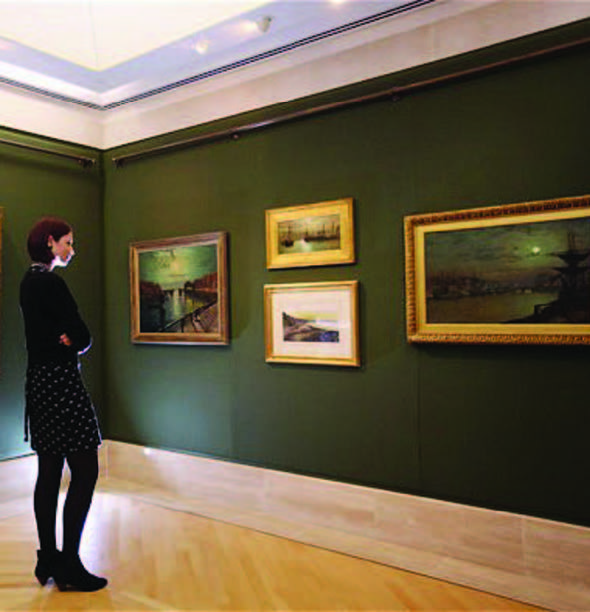
    When it comes to evaluating artwork, men seem to focus more on the artist’s background and authenticity while women pay more attention to the art itself. The sexes show stark differences in how they evaluate art, finds a new study, suggesting that busing a brand to average consumers when they appraise art is key for an artist’s success. “All consumers in the study, but especially men, evaluated art with a strong emphasis on how motivated and passionate the artist was,” said Stephanie Mangus, assistant professor at Michigan State University’s Broad College of Business.

    “So if you are an artist or if you are managing an artist, developing that human brand – getting the message across that you are authentic – becomes essential,” he asserted. Mangus and her colleagues had 518 people look at two unfamiliar paintings with made-up biographies of the artist. Some participants read a bio that characterised the artist as authentic – in other words, a lifelong painter who creates unique work.

    Others read a bio that characterised the artist as an ordinary painter who took up the craft only recently. When the artist was characterised as authentic, participants had a much more favourable impression of both the artist and the artwork. “Participants indicated they were more willing to buy that artist’s painting and to pay a higher price for it,” Mangus noted. Men were much more likely to use the artist’s brand as a deciding factor when evaluating art.

    Women also took the artist’s authenticity into account but a bigger factor for them was the artwork itself. “Women are more willing to go through a complicated process of actually evaluating the artwork whereas men may say, ‘This guy is a great artist so I will buy his art’,” Mangus added, Knowing that the artist’s brand plays a major role in consumers’ evaluation may help art dealers better set their prices. The findings can also help consumers make decisions on which art they buy.

  • THINGS TO DO AFTER HITTING 25

    THINGS TO DO AFTER HITTING 25

    Hitting the mid-20s is a milestone that can be exciting and daunting at the same time. With brighter career prospects also comes the fear of quarter-life crisis and a slower metabolism. However, every passing year is an opportunity for personal growth. A few key moves made after turning 25 will make your present and future more fruitful.

    Travel solo

    Travelling solo expands perception and lends depth to your character. Make it your mission to see as much of the world as you can. Take that holiday abroad you’ve been dreaming of. Go backpacking across South India or roam the jungles of the northeastern states.

    Follow your heart

    Unsure about the career you took up after passing out of college but afraid to switch paths? It’s actually the best time to make a career change. In case you fail, the damage won’t be too high and you will be young enough to go back to your previous field.

  • MAKE YOUR OWN SCENTED CANDLES AT HOME

    MAKE YOUR OWN SCENTED CANDLES AT HOME

    The festive season is incomplete without proper decoration of your home and workplace. Scented candles are a rage and are not very tough to make at home. You can place them at various corners at home or even pakcage it beautifully and give away as Diwali gifts.

    Here are a few tips that can help you… Before you begin… Take a few old, different sized containers, jars or candles moulds Some candle wax A bunch of candle wicks, a skewer to hold your wick A double boiler to heat wax Color and perfumed oils Method Set up the wick by tying it to the skewer and placing it across your mould or glass jar. Make sure that your wick is right in the middle of the jar and is the correct size. Melt the wax. Add color and the scented oil. Make sure there are no air bubbles. Now hold the wick in place and gently pour the wax into the mould.

    No not fill the jar or mould to the brim. Leave at least a couple of centimeters. Once the candle wax has been poured, try not to move it around too much. The wick might get displaced. Leave the candles moulds overnight to set. Once the candle has set properly, remove the skewer and then trim the candle wick. Now you can unmould the candle and go about decorating it. Pasting little beads or flowers is a good idea and one of the easiest ways to decorate the candle.

  • SIMPLE BLOOD TEST CAN NOW DETECT CANCER

    SIMPLE BLOOD TEST CAN NOW DETECT CANCER

    In a first, British researchers have devised a simple blood test that can be used to diagnose whether people have cancer or not. Early results have shown the new test gives a high degree of accuracy in diagnosing cancer and pre-cancerous conditions from the blood of patients with melanoma, colon cancer and lung cancer. The test will enable doctors to rule out cancer in patients presenting with certain symptoms, saving time and preventing costly and unnecessary invasive procedures, researchers said.

    “We found that people with cancer have DNA which is more easily damaged by ultraviolet light than other people, so the test shows the sensitivity to damage of all the DNA — the genome — in a cell,” explained professor Diana Anderson from the University of Bradford’s School of Life Sciences. White blood cells are part of the body’s natural defence system.

    They go under stress when they are fighting cancer or other diseases. The Lymphocyte Genome Sensitivity (LGS) test looks at white blood cells and measures the damage caused to their DNA when subjected to different intensities of ultraviolet light (UVA), which is known to damage DNA. “The results of the empirical study show a clear distinction between the damage to the white blood cells from patients with cancer, with precancerous conditions and from healthy patients,” Anderson noted. The study looked at blood samples taken from 208 individuals.

    The samples were coded, anonymised, randomised and then exposed to UVA light through five different depths of agar. The UVA damage was observed in the form of pieces of DNA being pulled in an electric field towards the positive end of the field, causing a comet-like tail. In the new blood test, the longer the tail the more DNA damage, and the measurements correlated to those patients who were ultimately diagnosed with cancer (58), those with pre-cancerous conditions (56) and those who were healthy (94). “If the LGS proves to be a useful cancer diagnostic test, it would be a highly valuable addition to the more traditional investigative procedures for detecting cancer,” Anderson believed.

  • Sugary drinks could lead to poor memory in kids

    Sugary drinks could lead to poor memory in kids

    Consuming a diet high in added sugar could not only lead to weight gain among kids, but could also negatively affect their memory, suggested a study. “The brain is especially vulnerable to dietary influences during critical periods of development, like adolescence,” said Scott Kanoski, corresponding author of the study and an assistant professor at the University of Southern California in the US. Studying rats as model subjects, scientists found that adolescents were at an increased risk of suffering negative health effects from sweetened beverage consumption.

    Adolescent rats that freely consumed large quantities of liquid solutions containing sugar or high-fructose corn syrup (HFCS) in concentrations comparable to popular sweetened beverages experienced memory problems and brain inflammation, and also became pre-diabetic. Neither adult or adolescent rats, who did not consume sugar, faced the same issues. The rats were then tested in mazes that probed their spatial memory ability. “Adolescent rats that had consumed the sugary beverages, particularly HFCS, performed worse on the test than any other group – which may be the result of the neuro-inflammation detected in the hippocampus,” Kanoski pointed out. The hippocampus is a part of the temporal lobe located deep within the brain that controls memory formation.

  • STRESS UPS ALZHEIMER’S RISK IN SHY WOMEN

    STRESS UPS ALZHEIMER’S RISK IN SHY WOMEN

    Women who are shy and more sensitive to stress are more likely to develop Alzheimer’s disease, found a research. Women who worry, cope poorly with stress and experience mood swings in middle age run a higher risk of developing Alzheimer’s disease later in life, it showed.

    “Some studies have shown that long periods of stress can increase the risk of Alzheimer’s disease and our main hypothesis is that it is the stress itself that is harmful,” said Lena Johansson, scientist at the University of Gothenburg’ Sahlgrenska Academy in Sweden. Shy women who, at the same time became easily worried, turned out to have the highest risk in the study. People who have neuroticism are more readily worried, distressed and experience mood swings.

    They often have difficulty in managing stress. “A person with neurotic tendencies is more sensitive to stress than other people,” Johansson added. The study carried out at the Sahlgrenska Academy followed 800 women for nearly 40 years. The women stated whether they had experienced long periods of high stress and underwent memory tests. At the follow-up in 2006, nearly 40 years later, around one fifth of these women had developed conditions associated with dementia. “We could see that the women who developed Alzheimer’s disease had been identified in the personality test 40 years earlier as having neurotic tendencies,” Johansson pointed out.

  • Get rid of double chin

    Get rid of double chin

    So you know how stripes and checks camouflage body fat, but getting rid of that nasty bulge under your chin may not happen overnight. Here are easy exercises, we recommend, which you can wrap in a few minutes daily that’ll help you get rid of that double chin soon.

    TONGUE PRESS

    Sit up straight; tilt your head to face the ceiling. Put pressure to the roof of your mouth by pressing the tongue against it. Lower your chin to the chest. Relax tongue by returning to starting position. Repeat 20 times.

    POUTING WITH PRESSURE

    Sitting in an upright position, stick out your lower lip as much you can to form a pout. Lower your chin to your chest as far as possible while keeping the lower lip stretched out. Hold for a second and slowly relax your lips and straighten your neck.

    CIRCLE OF LIFE

    Tilt your head back to face the ceiling. Shut your lips tightly, then open it only a bit so that your mouth forms an `O’ shape. Hold this position for 20 seconds.

    KISSING THE CEILING

    Tilt your head back to face the ceiling. Allow your lips to assume a pose like you are attempting to kiss the ceiling by pouting. Extend your lips as far away from your face as possible. Your neck and chin should feel the pressure at this point. Hold for five seconds, then relax your lips and lower your chin to return to starting position. Perform two sets of 15 each.

    CHIN PRESSING

    Standing or sitting with your back upright, rotate your head slowly with your chin leading the way. Drive your chin to turn from one shoulder to another via the chest. Complete a set of 10 in each direction.

  • VARANASI

    VARANASI

    THE ABODE OF LORD SHIVA AND PARVATI

    The land of Varanasi (Kashi) has been the famous pilgrimage spot for Hindus for ages. The holy city is situated on the banks of the river Ganges in the Indian state of Uttar Pradesh. Ganges in Varanasi is believed to have the power to wash away the sins of mortals. Often referred to as Benares, Varanasi is the oldest living city in the world. It is said to be the abode of Lord Shiva and Parvati. The name Kasi (another name for Varanasi) is mentioned in the Rig-Veda. It is often also referred to as “city of temples and learning”. Buddha preached his first sermon after enlightenment at Sarnath, just 10 km away from Varanasi. Knowledge, philosophy, culture, devotion to Gods, Indian arts and crafts has all flourished here for centuries.

    Ghats

    The city’s life revolves around its seven km long sweep of about 100 bathing ghats that skirt the west bank of the Ganges. Most of them are used for bathing. Some are used for cremating bodies. The most sacred ghats are the Asi, Dasashwamedh Ghat, Manikarnika and Panchganga. Pilgrims who bathe in each one consecutively believe their prayers will be fulfilled. A short boat trip from Manikarnika Ghat can be an interesting introduction to the river.

    It is believed that cremation at Manikarnika ghat ensures a safe place in Heaven, as the cremators of this ghat are believed to have the patronage of Shiva. The furthermost upstream ghat is Assi Ghat, which marks the confluence of the Ganges and the Assi rivers. It is said that after striking down demon Shumbha and nishumbha, Durga’s sword fell and created a curved ditch, which later became the Assi Channel. This Ghat is one of the five special ghats which pilgrims are supposed to bathe at in sequence during the ritual route called ‘ Panchatirthi Yatra’ ending in the Adikeshva ghat in the north. Nearby is the Tulsi Ghat, where Goswami Tulsidas lived till his death in 1623A.D.

    The Bachra Ghat is used by Jains and there are three riverbank Jain Temples. The Dandi Ghat is used by fakirs , yogis and ascetics and nearby is the very popular Hanuman Ghat. Dashashvamedh Ghat, Varanasi’s liveliest bathing place was constructed by Peshwa Balaji Baji Rao. It’s name indicates that Brahma sacrificed (medh) 10 (das) horses (aswa) here. It’s one of the most important ghats and is conveniently central. Nearby is the grand Man Mandir Ghat (1637) and an observatory both built by Sawai Raja Jai Singh of Jaipur in 1710. Mir Ghat leads to a Nepalese temple, which has erotic sculptures.

    Dattatreya Ghat bears the footprint of the Brahmin saint of that name in a small temple nearby. The Ram Ghat was built by the Raja of Jaipur. Panchaganga Ghat, where India’s five holy rivers are said to merge. The Trilochan Ghat has two turrets emerging from the river, and the water between them is especially holy. Another important cremation ghat is the Hirishchandra ghat, named after the king Harishchandra who worked as a cremator at the cremation grounds. The best time to visit the ghats is at dawn when the river is bathed in a magical light and pilgrims come to perform puja to the rising sun.

    The best view of the Ghats can be had from a boat midstream or from the Malviya bridge. Burning pyres, people getting their hair shaved off, the chanting of sacred slokas, giving of alms to Brahmins, Pandas (Brahmin Priests) sitting under huge umbrellas offering prayers for their clients, devotees praying and drinking water from the holy river are the common sight at these ghats.

    Vishwanath temple (Golden Temple)


    12


    The most sacred temple in Varanasi is the Vishwanath temple, located at Vishvanath Gali dedicated to Lord Shiva. Hindus believe Shiva lives here, so it’s far too holy a place for non-Hindus to view, the followers of other religions are permitted a view from the Naubat Khana (seat of temple choir). The shivalinga at the Vishwanath temple is among one of the 12 Jyotrilingas. The current temple was built in 1776 by Ahalya Bai of Indore with about 800 kg of gold plating on the towers, which gives the temple its colloquial name, Golden Temple. The gold plated spire, was the gift of the Sikh Maharaja Ranjit Singh of Lahore in 1835, more than 50 years later. The well of wisdom or ‘Gyan Vapi’ which is nearby is believed to have been built by Lord Shiva himself to cool the ‘linga’ of Vishwanath with water.

    Sarnath


    13


    The Buddha came to this hamlet, 10 Km. north-east of Varanasi, to preached his message “Maha-Dharma-Chakra Pravartan” (in Buddhist terminology, ‘turned the wheel of the law’) after he achieved enlightment at Bodhigaya. Later, the great Buddhist Emperor Ashoka built here the Dharmarajika Stupa and near it erected a pillar surmounted by the magnificent capital of four adored lions, which today forms the national emblem of India. Ashoka erected several memorial towers or stupas.

    Saranath probably derived its name from one of Buddha’s title, Saranganath, Lord of the Deer. The Chinese Buddhist pilgrims, Fa-hsien and Hiuen Tsiang who visited in the 5th and 7th centuries respectively, both recorded impressions of their stay. The huge swastika (110ft) covered Dhameskh Stupa dates from AD 500 and is thought to mark the place where Buddha gave his sermon. Sarnath has been a premier centre for Buddhism. It is a rich collection of ancient Buddhist relics and antiques comprising numerous Buddha and Bodhisatva images on display at the excellent Archaeological Museum (open 10am to 5pm except on Friday).

    Ramnagar

    The residential place of Kashi Naresh (Former Maharaja of Varanasi) across the Ganges at Ramnagar houses a museum with the exhibits of palanquins, costumes, swords, sabres, etc. Dussehra celebration of Ramnagar is an interesting event to witness.14 km. from Varanasi. The fort at Ramnagar houses a museum displaying the Royal collection which includes vintage cars, Royal palkies, an armoury of swords and old guns, ivory work and antique clock.

    The Durga Temple and Chhinnamastika Temple are also located at Ramnagar. Ramnagar Fort which was built in 1750A.D by the Maharaja of Banaras, is on the right bank of River Ganga. Built of red stones, it provides strength and stability to the city. Visit : Daily from 0900 t0 1200 and 1400 – 1500. It is the residential palace of the former Maharaja of Varanasi. The palace is an astronomical and astrological wonder. Inside the giant walls of the palace, there is a big clock. Besides showing year, month, week and day, it baffles the onlooker with astronomy of the sun, moon and constellation of stars.

    This wonder clock or Dharam Ghari was made by the court astronomer of Banaras in 1852A.D. The palace has a temple dedicated to Ved Vyas and a museum set up by the last Maharaja of Banaras, Vibhuti Narain Singh. The museum has a collection of brocade costumes, palanquins, weapons and has expensive coaches made of ivory. The palace is decorated majestically and it vibrates with colour and life, during Dussehra festival. The celebrations comes to an end on Vijayadashmi, when the huge effigies of demon king Ravana and his kinsmen are sent up in flames, signifying the victory of good over evil.

  • RBI TO ISSUE GUIDELINES FOR SMALL FINANCE BANKS SOON

    RBI TO ISSUE GUIDELINES FOR SMALL FINANCE BANKS SOON

    HYDERABAD: The RBI would issue guidelines for small finance banks in a few weeks as it pushed for financial inclusion backed by technolog (TIP)y. “In the next few weeks, we will put out guidelines inviting applications for what we call small finance banks.

    These are banks that will cater to smaller customers across the country. The detailed guidelines will also be put out,” RBI governor Raghuram Rajan said on Wednesday. He was speaking at the 10th IDRBT Banking Technology Excellence Awards here. Referring to payment banks, he said they should tie-up with regular commercial banks to offer different services.

    “My hope is that by licensing payment banks, we would also further cause of bank payments, bank alliances.” Highlighting that technology has an important role to play in financial inclusion, he said certain ‘Ps’, including Products, Price and Protection summaries the aspects which need to be pondered over by bankers. In this context, he said Products that are shaped to the needs of individuals, without taxing their understanding are needed.

    The RBI has put out a consumer code which puts the onus on banks to determine what is suitable for individuals, Rajan said. “Of course, that’s a harder task than just selling the product to the individual. We have to find out what the individual understands, what the needs are, etc.” Technology may help in understanding customer profiles better and to inform the customer better, the Governor said.

  • Toyota recalls 1.67 million Toyota, Lexus cars globally for 3 separate defects

    Toyota recalls 1.67 million Toyota, Lexus cars globally for 3 separate defects

    TOKYO (TIP): Japan’s Toyota Motor Corp said on Wednesday it would recall a total 1.67 million vehicles globally in a voluntary move to address three separate defects including a faulty brake master cylinder that could hinder the brake’s performance. Toyota said in an email it was not aware of any crashes, injuries or deaths resulting from the defects.

    Some 1.05 million vehicles will be recalled in Japan and 615,000 overseas, covering Toyota models Crown Majesta, Crown, Noah, Voxy, Corolla Rumion and Auris, as well as more than a dozen Lexus models. Car makers have faced heightened global scrutiny on how quickly they share information with regulators and the public since a massive recall crisis in 2009 battered Toyota’s reputation and sales. Most vehicle recalls are issued on a voluntary rather than mandatory basis. Toyota recalled 6.39 million vehicles globally in April in its second-largest recall announcement ever.

    Two months later, the company issued a recall of almost 2.3 million vehicles globally for faulty airbag inflators that have also plagued other car makers. In the latest recall, about 802,000 Crown Majesta, Crown, Noah and Voxy models manufactured between June 2007 and June 2012 will be called back to replace a rubber seal ring in the brake master cylinder to prevent brake fluid from leaking.

    If brake fluid has already leaked, the brake booster will be replaced. A second recall of about 759,000 vehicles globally, including 423,000 in the United States, will fix faulty fuel delivery pipes that could, in the worst-case scenario, cause a fire through a fuel leak. Some of these vehicles are also subject to the first recall. Toyota will also recall in Japan 190,000 front-wheel drive Corolla Rumion and Auris models built between October 2006 and October 2014 that are not equipped with an idling feature to fix a defective fuel evaporative emission control unit.

  • DLF FACES TOUGH CHOICES AFTER FUND-RAISING BAN

    DLF FACES TOUGH CHOICES AFTER FUND-RAISING BAN

    NEW DELHI/MUMBAI (TIP): DLF Ltd will be forced to sell assets, even unfinished projects, to meet debt obligations, say bankers, after India’s biggest property firm was banned from the capital markets for three years – the market regulator’s harshest penalty ever. The Securities and Exchange Board of India (SEBI) ruling on Monday will cut off DLF’s access to the Mumbai stock market, Asia’s best-performing bourse this year.

    The company, shouldering $3 billion of debt, will also be barred from the bond market just as its free cash flow sinks to multi-year lows. The ban follows what SEBI said was DLF’s failure to provide key information on subsidiaries and pending legal cases at the time of its record-breaking 2007 initial public offering. On October 14, DLF shares fell to a record low at the market close, wiping out $1.2 billion in market value. The SEBI ban comes as slowing home sales due to poor consumer sentiment, high inflation and interest rates hit developers in Asia’s thirdlargest economy.

    Bankers and analysts say the only option left for DLF, India’s most indebted property developer, is to divest assets, even half-complete projects, if the SEBI order is upheld. “That’s the only practical option because the banks are also very cautious in lending to the sectors like real estate. So refinancing would not be that easy,” a banker with a large U.S. bank that previously worked with DLF said, declining to be named as he was not allowed to speak to the media about client-specific issues.

    The ruling also adds to the regulatory pressure and political scrutiny on DLF. DLF is facing a probe from the antitrust watchdog and has been accused by the media and political opponents of entering into improper land deals with well-connected businessman Robert Vadra. DLF and Vadra, the son-in-law of opposition Congress party chief Sonia Gandhi, have denied the allegations. The SEBI ban also comes ahead of the state assembly elections in the northern state of Haryana on Wednesday.

    Any change in government could affect DLF’s future projects in the region, analysts say. An official at the Securities Appellate Tribunal said DLF could try and ask for a stay on the order until the appeal is heard. DLF declined to comment beyond the statement it issued late on Monday. The company said it would defend itself against the order passed by SEBI. SEBI is embarking on a plan to standardise corporate reporting in India, and chairman U.K. Sinha has warned that non-compliant companies will be punished.

    Insufficient funds

    DLF’s net debt stood at about 185 billion rupees ($3 billio Indian credit rating agency. “In the short term, this is a big issue for DLF clearly because there is a looming liquidity crisis in case the sales velocity does not pick up,” said V Krishnan, a sector analyst at Mumbaibased brokerage Ambit Capital. Ambit estimates that with about 57 million square feet of projects under development, DLF needs about 2 billion rupees a month towards construction costs, and its interest outflow to service debt is also about 2 billion rupees a monthly currently.

    The company’s operating cash flow of about 3 billion rupees will barely cover its construction costs and half its interest cost, given the slow pace of home sales in DLF’s primary market of Delhi and the surrounding region, Krishnan said. “DLF will either need to slow its pace of execution in underconstruction projects or monetise some of its assets at distressed valuations to contain or improve its operating cash inflows,” said Krishnan, adding that it could look for term loans from banks though that will not come cheap.

    DLF, which builds homes, offices and shopping centers and has about 26 million square feet of leased assets, will also be barred from listing a Real Estate Investment Trust (REIT) for three years, shutting yet another avenue for raising funds. Shares of DLF have slumped 37 percent this year, while the benchmark BSE index has risen about a quarter, making it the best performing index in Asia.

  • IndiGo to buy 250 Airbus A320neo aircraft

    IndiGo to buy 250 Airbus A320neo aircraft

    NEW DELHI (TIP): India’s largest domestic airline, IndiGo, has placed the single largest order ever for narrowbody aircraft by signing an agreement with Airbus for 250 A-320neo (new engine option) planes. The list price for each of these planes is $102 million, putting the collective list price of IndiGo order at a whopping $25.5 billion. The low cost carrier (LCC) had earlier placed orders for 280 A-320s and the new MoU is over and above the previous order.

    IndiGo founders signed the MoU with Airbus, which described it as the European aircraft manufacturer’s “single largest order by number of aircraft”. IndiGo president Aditya Ghosh said: “This new order reaffirms IndiGo’s commitment to the long-term development of affordable air transportation in India and overseas. The additional aircraft will enable us to continue to bring our low fares and courteous, hassle free service to more customers and markets and will create more job opportunities and growth. The IndiGo team is energised and excited to herald this new phase of our growth.”

  • BIONIC EYE ALLOWS BLIND MAN TO ‘SEE’ AFTER 33 YEARS

    BIONIC EYE ALLOWS BLIND MAN TO ‘SEE’ AFTER 33 YEARS

    WASHINGTON (TIP): A revolutionary new bionic eye implanted into a 66- year-old blind man in the US has allowed him to ‘see’ for the first time in 33 years. Larry Hester was diagnosed with retinitis pigmentosa when he was in his early 30s. At the time, the degenerative disease that would rob his sight was poorly understood, and there were no known treatments, researchers said.

    On October 1, 2014 Hester became only the seventh person in the US to have a so-called bionic eye – an Argus II Retinal Prosthesis Device – activated as a visual aid to send light signals to his brain. The device incorporates technology initially developed by researchers at the Duke Eye Centre; its sophisticated features were further enhanced and marketed by a company called Second Sight Medical Products. Using wireless technology, a sensor is implanted in the eye to pick up light signals sent from a camera mounted on special eyeglasses.

    Paul Hahn, a retinal surgeon at Duke, implanted the sensor on September 10 and activated the device three weeks later – to the sheer delight of Hester and his family. Hahn cautioned the device will not restore eyesight, but provide a visual aid that could help Hester distinguish a door from a wall, or a crosswalk painted in a roadway. ptiHester describes seeing flashes of light that are more intense when he aims the camera at lights or light-coloured objects.

    During a clinic visit, Hester described “seeing” sights he had long believed were past memories – a white duck swimming in a pond, the harvest moon, his wife’s yellow chrysanthemums. Hester’s wife, Jerry, said her most cherished moment came while they were watching a football game. She was sitting in a dark chair, and her skin was enough of a contrast that Hester could see flashes. He reached out and touched her face.

  • US ASTRONAUTS STEP OUT ON SPACEWALK

    US ASTRONAUTS STEP OUT ON SPACEWALK

    WASHINGTON (TIP): A pair of American astronauts stepped outside the International Space Station on October 15 on a spacewalk to do repairs and upkeep at the orbiting outpost, Nasa said. Reid Wiseman and Barry “Butch” Wilmore began their spacewalk at 8:16 am (1216 GMT), starting an excursion that is scheduled to last six and a half hours. “During today’s spacewalk, Wiseman and Wilmore will replace a voltage regulation device called a sequential shunt unit and relocate camera and television equipment,” Nasa said in a statement. The spacewalk is being broadcast live on Nasa’s television and website.

  • HUMANS WON’T LAST MORE THAN 68 DAYS ON MARS: MIT

    HUMANS WON’T LAST MORE THAN 68 DAYS ON MARS: MIT

    LONDON (TIP): In a big blow to plans of colonizing the Red planet, scientists have confirmed that humans won’t last more than 68 days in Mars with present day technology. Researchers have said that an oppressive environment would suffocate the first settler within an estimated 68 days. The non-profit company Mars One announced plans to establish the first human settlement on Mars by 2025. Solar panel powered huts is expected to supply the colony’s electricity, while a system to extract water from the soil would supply drinking water.

    But engineers at MIT say the project may have to take a step back, at least to reconsider the mission’s technical feasibility. The MIT researchers developed a detailed settlementanalysis tool to assess the feasibility of the Mars One mission and found that new technologies will be needed to keep humans alive on Mars. For example, if all food is obtained from locally grown crops, as Mars One envisions, the vegetation would produce unsafe levels of oxygen, which would set off a series of events that would eventually cause human inhabitants to suffocate.

    To avoid this scenario, a system to remove excess oxygen would have to be implemented – a technology that has not yet been developed for use in space. Similarly, the Mars Phoenix lander discovered evidence of ice on the Martian surface in 2008, suggesting that future settlers might be able to melt ice for drinking water – another Mars One goal. But according to the MIT analysis, current technologies designed to bake water from soil are not yet ready for deployment, particularly in space.

    The team also performed an integrated analysis of spareparts resupply – how many spare parts would have to be delivered to a Martian colony at each opportunity to keep it going. The researchers found that as the colony grows, spare parts would quickly dominate future deliveries to Mars, making up as much as 62% of payloads from Earth. As for the actual voyage to Mars, the team also calculated the number of rockets required to establish the first four settlers and subsequent crews on the planet, as well as the journey’s cost. According to the Mars One plan, six Falcon Heavy rockets would be required to send up initial supplies, before the astronauts’ arrival. But the MIT assessment found that number to be “overly optimistic”.

    The team determined that the needed supplies would instead require 15 Falcon Heavy rockets. The transportation cost for this leg of the mission alone, combined with the astronauts’ launch, would be $4.5 billion – a cost that would grow with additional crews and supplies to Mars. It would also take seven months to get to Mars each time. Olivier de Weck, an MIT professor of aeronautics and astronautics and engineering systems says “We’re not saying, black and white, Mars One is infeasible. But we do think it’s not really feasible under the assumptions they’ve made.

    We’re pointing to technologies that could be helpful to invest in with high priority, to move them along the feasibility path. One of the great insights we were able to get was just how hard it is to pull this mission off”. Graduate student Sydney Do simulated the day-to-day life of a Mars colonist. Based on the typical work schedule, activity levels, and metabolic rates of astronauts on the International Space Station (ISS), Do estimated that a settler would have to consume about 3,040 calories daily to stay alive and healthy on Mars. He then determined crops that would provide a reasonably balanced diet, including beans, lettuce, peanuts, potatoes and rice.

    Do calculated that producing enough of these crops to sustain astronauts over the long term would require about 200 square meters of growing area, compared with Mars One’s estimate of 50 square meters. If, as the project plans, crops are cultivated within the settlers’ habitat, Do found that they would produce unsafe levels of oxygen that would exceed fire safety thresholds, requiring continuous introduction of nitrogen to reduce the oxygen level. Owens points to technologies such as 3-D printing, which may enable settlers to manufacture spare parts on Mars.

    But the technology as it exists today is not advanced enough to reproduce the exact dimensions and functions of many space-rated parts. In 2012, the “Mars One” project, led by a Dutch non-profit, announced plans to establish the first human colony on the Red Planet by 2025. The mission would initially send four astronauts on a one-way trip to Mars, where they would spend the rest of their lives building the first permanent human settlement.

  • SNAKE ROBOT TO AID SEARCH-AND-RESCUE

    SNAKE ROBOT TO AID SEARCH-AND-RESCUE

    WASHINGTON (TIP): Inspired by the amazing ability of sidewinder snakes to quickly climb sandy slopes, researchers have created a robot that can climb sand hills better, an advance that may aid search-andrescue operations. Researchers report that sidewinders improve their ability to traverse sandy slopes by simply increasing the amount of their body area in contact with the granular surfaces they’re climbing.

    As part of the study, the principles used by the sidewinders to gracefully climb sand dunes were tested using a modular snake robot developed at Carnegie Mellon University. Before the study, the snake robot could use one component of sidewinding motion to move across level ground, but was unable to climb the inclined sand track the way the real snakes could readily ascend. In a real-world application – an archaeological mission in Red Sea caves – sandy inclines were especially challenging to the robot.

    However, when the robot was programmed with the unique wave motion discovered in the sidewinders, it was able to climb slopes that had previously been unattainable. “Our initial idea was to use the robot as a physical model to learn what the snakes experienced,” said Daniel Goldman, an associate professor in Georgia Institute of Technology’s School of Physics. “By studying the animal and the physical model simultaneously, we learned important general principles that allowed us to not only understand the animal, but also to improve the robot,” said Goldman. The detailed study showed that both horizontal and vertical motion had to be understood and then replicated on the snake-like robot for it to be useful on sloping sand.

  • Hermanpreet hat-trick helps India down Malaysia in Johor Cup

    Hermanpreet hat-trick helps India down Malaysia in Johor Cup

    JOHOR BAHRU (TIP): Hermanpreet Singh did the star turn with a hat-trick of goals as India enhanced their chances to qualify for the final of the Under-21 Sultan of Johor Cup with a convincing 4-2 win over hosts Malaysia, on october 16. In top form after thrashing Pakistan 6-0 yesterday, the Harjeet Singh-led side improved their chances of making it to the final after notching up its third win in four games.

    India though had some tough moments in the game after the hosts overcame a 2-0 deficit to draw level after half-time. But two late strikes from India saved the day for the Harendra Singh-coached side. The two teams wasted their respective penalty corner chances at the start but India soon forced three more penalty corners to get a goal off the last one in the 25th minute by Hermanpreet Singh.

    Two minutes later Hermanpreet punished Malaysia again with another drag flick into the roof of the net to take a 2-0 lead. Malaysia then struck back to reduce the deficit in the 37th minute as Sufi Ismat Rohulmin went past two defenders and sent a reverse stick shot into goal. The goal acted as a booster as Azril Misron levelled the score with his 42nd minute strike through a beautiful right cross from Norsyafiq Sumantri. But Hermanpreet proved his ability in penalty corners as he scored India’s third and his hattrick in the 55th minute to edge ahead in the game.

    India were then awarded a penalty stroke in the 65th minute and Varun Kumar put the result beyond doubt by scoring to make it 4-2. Commenting on the win, coach Harendra said, “I am extremely pleased to see the way the boys have performed today. Starting off well, they conceded two quick goals in the second half but did not allow pressure to take hold of them and remained calm.

    This composure helped the boys to make a brilliant comeback, the result of which is this well-deserved win for them. I am proud of the way they handled the stressful situation and look forward to similar performances in future.” India next take on Australia on Saturday and a win against the Kangaroos would seal the team’s final berth.

  • MURRAY, FERRER ADVANCE TO QUARTERFINALS IN VIENNA

    MURRAY, FERRER ADVANCE TO QUARTERFINALS IN VIENNA

    VIENNA (TIP): Andy Murray and David Ferrer stayed in the race for the year-end ATP finals as both of the leading seeds won their opening matches at the Austrian Open on October 16. Tournament number one Ferrer, who cannot increase his points unless he reaches the Sunday final at the Stadthalle, opened in the second round after a bye with a 7-5, 6-1 defeat of Tobias Kamke.

    Second seed Murray, a debutant in the Austrian capital, defeated Canadian Vasek Pospisil 6-4, 6-4. Ferrer stands provisional ninth in the points race to the World Tour Finals next month in London; Murray is trailing on tenth. With eighth-placed Canadian Milos Raonic losing his opening match in Moscow due to illness, the sprint to the finish over the season is only tightening for the three remaining spots in the eight-man field.

    Ferrer is not one to worry about that just now though – he faces a more immediate task when he plays a Friday quarter-final against Croatian serving machine Ivo Karlovic. “Even if Milos lost, it doesn’t help my chances,” said the 32-year-old. “Murray is behind me, but not by much. If I lose tomorrow, I’m in exactly the same position as Milos. “I now can only focus on my next match, a very difficult one.” Ferrer is playing Vienna for the first time in a decade and earned his first victory form three matches here.

    “It’s been a long time, in 2003 here I lost the first of many matches against Roger Federer – and I still have not won one against him.” Ferrer needed just under 90 minutes to see off the 93rd-ranked Kamke. The Spaniard fought through a first set lasting 54 minutes before breaking in the final game to earn the set with a backhand winner to the corner. Ferrer took a grip on the match in the second set, racing away to victory on his second match point.

    Murray struggled with his game in the opening set against Pospisil, who has not been past a second round since August. The second seed who took a wild card to Vienna, missed several chances in the opening set before finally earning a break for 5-4 and closing out the set a game later. “I didn’t start very well, he was serving well,” said Murray. “I had to work hard to get into the match. “I need to improve in the next round,” he said prior to facing German Jan- Lennard Struff, who beat Sergiy Stakhovsky 7-6 (8/6), 2-6, 7-6 (7/1) with 12 aces.

  • 4 Indian shuttlers, including Saina, advance in Denmark Open

    4 Indian shuttlers, including Saina, advance in Denmark Open

    ODENSE (TIP): On a fruitful day for the Indian shuttlers, Saina Nehwal and P V Sindhu stormed into the women’s singles quarterfinals while two men’s players also secured places in the last-eight stage of the Denmark Open Super Series Badminton event, here on October 16. London Olympics bronze medallist Saina made short work of Minatsu Mitani 21-12 21-10 in her second round contest, which lasted just 38 minutes.

    Before Saina’s win, two-time World Championships bronze medallist Sindhu took just 31 minutes to get the better of Ksenia Polikarpova of Russia 21-17 21-19 at the Odense Sports Park. Since the top two women shuttlers from India are in either half of the draw, they could clash for the title if they win two more matches.

    In the men’s singles, Srikanth defeated Chinese Taipei’s Jen Hao Hsu 21-12 21-15 in 45 minutes while Kashyap fought hard before prevailing over Dionysius Hayom Rumbaka of Indonesia 21-17 17-21 22-20 in a contest that lasted 69 minutes. World No. 10 Sindhu opened up a 4-0 lead in the first game and continued to widen the gap, eventually winning it 20-17. In the second game, Sindhu quickly broke away from a 2-2 tie to take a slight edge and then she kept on extending it to make it 19-15 at one stage. But a brief fight back from the Russian saw her closing the gap to 19-20 before Sindhu used all her experience to wrap it up in her favour.

    In men’s singles second round matches, Srikanth had a rather comfortable outing today, but Glasgow Commonwealth Games gold medallist Kashyap faced a stiff challenge from his Indonesian rival. After a neck and neck battle till 13-13 in the opening game, Kashyap bagged four consecutive points to make it 17-13 and then there was no looking back for the Indian. But the Indonesian shuttler came back strongly in the second game as he opened up a huge 7-1 lead.

    Although Kashyap managed to reel off six points on a trot to catch his opponent, the Indonesian showed a lot of determination to keep the Indian at bay and take the match to the decider. Third game was a closely-fought affair with both players refusing to spare an inch. The game swung from one end to other before the Indian held his nerves to earn two points from 20-20 to advance to the next stage.

  • Jyoti Randhawa takes onestroke lead at Hong Kong Open

    Jyoti Randhawa takes onestroke lead at Hong Kong Open

    HONG KONG (TIP): Jyoti Randhawa turned the clock back as he holed 23 putts en-route to a six-under-par 64 to grab the first round lead at the 1.3 million dollars Hong Kong Open on October 16. The 2002 Asian Tour number one said he ‘putted his heart out’ in a round of seven birdies and one bogey to take a one-shot lead over Angelo Que of the Philippines at the Hong Kong Golf Club.

    Anirban Lahiri, second on the Order of Merit had a tough day with a round of 75 and needs to come back with a good second round to make the cut as he was 139th. Among the other Indians Rahil Gangjee and Shiv Kapur shot two-under 68 each to be tied 27th, while SSP Chowrasia (69) was lying tied 44th.

    Things were not too good for other Indians as Chiragh Kumar (71) was 83rd, Jeev Milkha Singh and Rashid Khan carded 73 each to be 115th, Himmat Rai (74) was 130th and Sujjan Singh (75) was 130th. Jyoti, 42, rediscovered some of his best form courtesy of a hot putter which resulted in two closing birdies at the Fanling course.

  • Former Tamil Nadu Chief Minister Jayalalithaa granted bail

    Former Tamil Nadu Chief Minister Jayalalithaa granted bail

    NEW DELHI (TIP): The Supreme Court on Friday, October 17, granted bail to former Tamil Nadu chief minister J Jayalalithaa. The 66-year-old AIADMK chief, who has been behind bars since September 27, had sought relief citing that she was suffering from various ailments. The former chief minister had also cited grounds of being a senior citizen and a woman for getting out of jail. She was denied bail by the high court on October 7 despite the special public prosecutor not objecting to grant of conditional bail to her.

    The high court had also rejected the bail pleas by Jayalalithaa’s close aide Sasikala and her relatives VN Sudhakaran, disowned foster-son of the former chief minister, and Ilavarasi, who were also sentenced to four years in jail in the 18-year-old case. All four were found guilty of acquiring Rs. 66.65 crore worth of assets by corrupt means between 1991 and 1996 – during Jayalalithaa’s first tenure as CM. The ruling in the 18-yearold disproportionate assets case dealt a blow to the AIADMK chief, disqualifying her as CM and effectively putting her out of the electoral arena for 10 years.

    According to provisions of the Representation of the People Act, a convicted person cannot contest elections for six years beginning from the date of completion of sentence. There could, however, still be hope for Jayalalithaa because there is an escape route. The Supreme Court has said a convicted person can contest an election if his/her conviction and sentence – both are stayed by a superior court.

  • PM Modi launches major labor reform schemes

    PM Modi launches major labor reform schemes

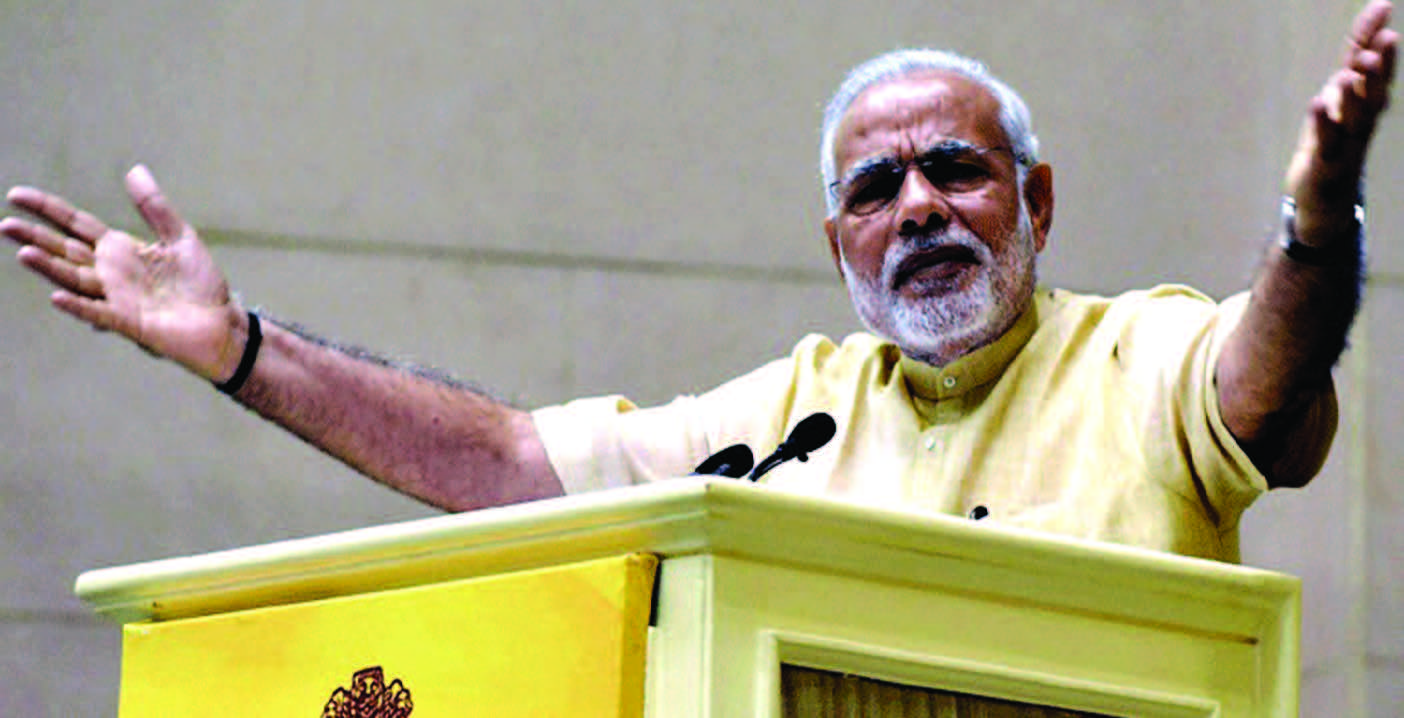
    NEW DELHI (TIP): Stressing that labor reforms hold the key to the success of the ‘Make in India’ campaign, Prime Minister Narendra Modi on October 16 unveiled a new roadmap, including measures to end ‘Inspector Raj’ with a system that is expected to sharply curb the element of discretion with labour inspectors and a single window compliance process for companies on labourrelated issues.

    As a step in this direction, all 1,800 labor inspectors will be disallowed from swooping down on companies and instead, a computerised system will randomly send them on inspections, based on data trends and objective criteria. Following inspections, they will have to upload their reports within 72 hours and cannot modify them thereafter. “Let’s start with trust,” said Modi, while inaugurating the Pandit Deen Dayal Upadhyay Shramev Jayete event organised by the Labour Ministry here on Thursday. “Ease of business is the first and foremost requirement if Make In India has to be made successful,” he said.

    Central labour inspectors have already been sent text messages on behalf of the Prime Minister to sensitize them to the reforms, and the ministry is hopeful that the annual inspections — currently about 3 lakh — will come down sharply. Modi also unveiled nearly half-a-dozen schemes, including a Shram Suvidha Portal where employers can submit a single compliance report for 16 labour laws, a new web-based labour inspection system, unique account numbers for members of the EPFO, a revamped Rashtriya Swasthya Bima Yojana as well as a new skill development and apprenticeship scheme.

    Sharply streamlining the cumbersome compliance process, manufacturers can now register online at the Shram Suvidha portal and file a self-certified single compliance report for 16 Central labour laws. In return, labour inspections by four central agencies — EPFO, Employees’ State Insurance Corporation, Central Labour Commissioner and Director General of Mines’ Safety — will be based on a computerised list of units that are picked up from this database. Noting that it is the government’s responsibility to simplify trade, he said the new schemes put the onus of compliance with the citizens who are expected to self certify their reports and also curb the arbitrariness of labour inspections.

    “These facilities are what I call minimum government, maximum governance,” he said. Asserting that Shramev Jayate is essential to boost economic development, Modi said it is important to bring back dignity of labour and respect those who choose to undertake vocational training or work as apprentices. “In our country, only white collar jobs are considered good… We have to change our perceptions and give respect to labour,” he stressed, adding that the revamped apprenticeship scheme and Industrial Training Institutes have a total of 34 lakh seats for students.

    These initiatives, he said, would also pave the way for skilling of youth, and even create an opportunity for India to meet the global requirement of skilled labour workforce in the years ahead. To showcase the success of skilling programmes, the Prime Minister and the Labour Ministry also felicitated former students from these institutes. Significantly, in a bid to clarify the NDA’s labour-friendly image, the Prime Minister also said that labour issues must be looked at from the perspective of the labour, not industrialists.

    “Such a compassionate approach would result in the shram yogi (labourer) becoming a rashtra yogi and a rashtra nirmaata (nation-builder),” he said. His comments are significant given that the NDA government has received flak from trade unions for its recent reform measures including amendments to the Factories Act and the Apprentices’ Act. However, trade unions remained skeptical of the government’s stance.

    “The announcement of the new schemes is most welcome but we have to wait and watch for the actual implementation,” said B N Rai, president, Bharatiya Mazdoor Sangh. The Left parties were more critical. “It is only cheating of workers as, while the government is launching these schemes, simultaneously it is changing the labour laws to push out the labor from their purview “ said Tapan Sen, Rajya Sabha member and general secretary, CITU, adding that there is nothing new about efforts such as the UAN that have been going one for the last six years.

  • EBOLAPHOBIA: Obama open to appointing Ebola ‘czar,’ opposes travel ban

    EBOLAPHOBIA: Obama open to appointing Ebola ‘czar,’ opposes travel ban

    he was considering appointing an Ebola “czar” to coordinate the fight against the virus in the United States, but he remained opposed to a ban on travel from West Africa. Obama’s administration is facing sharp criticism from lawmakers over its efforts to contain the disease at home. Obama authorized calling up military reservists for the U.S. fight against Ebola in West Africa on Thursday. U.S. concerns have intensified after two Texas nurses who cared for a dying Liberian patient contracted the virus that has killed nearly 4,500 people.

    Federal health officials said they were broadening their outreach to people who may have come into contact with one of the workers. Spain is also grappling with the spread of the disease, with four new patients with suspected Ebola symptoms admitted to hospitals. The disease continues to spread in West Africa where the outbreak began in March, and reached the last remaining district in Sierra Leone that had not been affected by Ebola. U.S. lawmakers held a congressional hearing about the administration’s handling of the Ebola outbreak in the United States. Some have called for a czar and a ban on travel from West Africa.

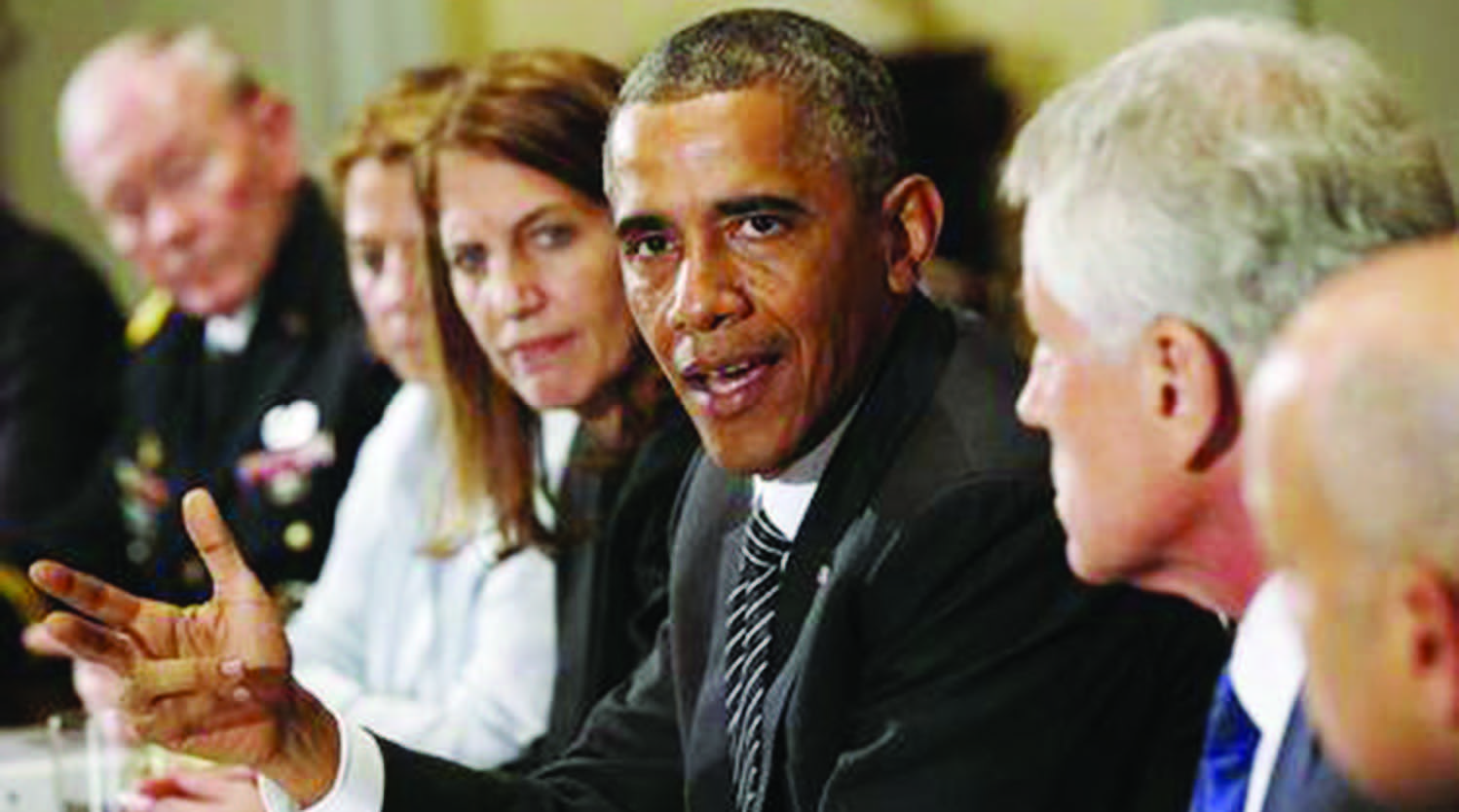
    “It may be appropriate for me to appoint an additional person” to oversee efforts to contain Ebola, Obama told reporters after meeting aides involved in the fight against the disease. Obama said experts have told him “a flatout travel ban is not the way to go” because current screening measures at airports are working. He said he had no philosophical objection to a travel ban but that some travelers might attempt to enter the United States by avoiding screening measures, which could lead to more Ebola cases, not fewer

  • Nobel Peace Prize for Indian Subcontinent: Kailash of India and Malala of Pakistan share the coveted prize

    Nobel Peace Prize for Indian Subcontinent: Kailash of India and Malala of Pakistan share the coveted prize

    LONDON (TIP): History was made on October 10 when an Indian and a Pakistani jointly shared the Nobel Peace Prize for 2014. India’s Kailash Satyarthi and Pakistan’s Malala Yousafzai were awarded the Nobel Peace Prize for “showing great personal courage” and their struggle against the suppression of children and young people and for the right of all children to education. Malala is the youngest to be awarded the globally prestigious annual prize.

    The committee said Kailash Satyarthi maintained Mahatma Gandhi’s tradition and headed various forms of protests and demonstrations, all peaceful, focusing on the grave exploitation of children for financial gain. He has also contributed to the development of important international conventions on children’s rights”. “Children must go to school and not be financially exploited. In the poor countries of the world, 60% of the present population is under 25 years of age.

    It is a prerequisite for peaceful global development that the rights of children and young people be respected. In conflict-ridden areas in particular, the violation of children leads to the continuation of violence from generation to generation,” the committee said. Talking about Malala, it said “Despite her youth, Malala has already fought for several years for the right of girls to education, and has shown by example that children and young people, too, can contribute to improving their own situations. This she has done under the most dangerous circumstances. Through her heroic struggle she has become a leading spokesperson for girls’ right to education”.

    Who is Kailash Satyarthi?

    Satyarthi is an Indian child rights activist born in Vidisha, about 50km from Bhopal. He studied engineering at the Govt Engineering College, Vidisha and gave up his career as an electrical engineer over three decades ago to start Bachpan Bachao Andolan, or Save the Childhood Movement. Today, the non-profit organization Bachpan Bachao Andolan he founded is leading the movement to eliminate child trafficking and child labour in India. The organisation has been working towards rescuing trafficked children for over 30 years.

    It receives information from a large network of volunteers. “My philosophy is that I am a friend of the children. I don’t think anyone should see them as pitiable subjects or charity. That is old people’s rhetoric. People often relate childish behaviour to stupidity or foolishness. This mindset needs to change. I want to level the playing field where I can learn from the children. Something I can learn from children is transparency. They are innocent, straightforward, and have no biases.

    I relate children to simplicity and I think that my friendship with children has a much deeper meaning than others,” he said. Satyarthi, 60, admires Mahatma Gandhi and has likewise headed various forms of peaceful protests “focusing on the grave exploitation of children for financial gain,” the Nobel committee said. While announcing the historic Nobel peace prize to an Indian and a Pakistani jointly, the Nobel Committee said, “The Nobel Committee regards it as an important point for a Hindu and a Muslim, an Indian and a Pakistani, to join in a common struggle for education and against extremism.”

    ‘Honour to children in slavery’

    “It’s an honour to all those children who are still suffering in slavery, bonded labour and trafficking,” Satyarthi said after he shared the prestigious award with Pakistani teenager Malala. “It’s an honour to all my fellow Indians. I am thankful to all those who have been supporting my striving for more than the last 30 years,” said Satyarthi. “A lot of credit goes to the Indians who fight to keep democracy so alive and so vibrant, where I was able to keep my fight on,” said Satyarthi. “Something which was born in India has gone globally and now we have the global movement against child labour. After receiving this award I feel that people will give more attention to the cause of children in the world.”

    Malala Yousafzay: An idol to the world, outcast at home

    Malala Yousafzay, who won the Nobel Peace Prize on Friday, is hailed around the world as a champion of women’s rights who stood up bravely against the Taliban to defend her beliefs. But in her deeply conservative homeland, many view her with suspicion as an outcast or even as a western creation aimed at damaging Pakistan’s image abroad. Malala, now aged 17, became globally known in 2012 when Taliban gunmen almost killed her for her passionate advocacy of women’s right to education.

    She has since become a symbol of defiance in the fight against militants operating in Pashtun tribal areas in northwest Pakistan – a region where women are expected to keep their opinions to themselves and stay at home. “The terrorists thought that they would change our aims and stop our ambitions but nothing changed in my life except this: Weakness, fear and hopelessness died. Strength, power and courage was born,” she told the United Nations last year. “I do not even hate the Talib who shot me. Even if there is a gun in my hand and he stands in front of me.

    I would not shoot him,” she said in a speech which captivated the world. Malala has also won the European Union’s human rights award and was one of the favourites to win the Nobel Prize last year. Now based in Britain, she is unable to return to her homeland because of Taliban threats to kill her and her family members. The current Taliban chief, Mullah Fazlullah, was the one who ordered the 2012 attack against her. Yousafzai has enrolled in a school in Birmingham and become a global campaigner for women’s right to education and other human rights issues, taking up issues such as the situation in Syria and Nigieria.

    In her native Swat valley, however, many people view Malala – backed by a supportive family and a doting father who inspired her to keep up with her campaign – with a mixture of suspicion, fear and jealousy. At the time of her Nobel nomination last year, social media sites were brimming with insulting messages. “We hate Malala Yousafzai, a CIA agent,” said one Facebook page.

    She was a young student in the Swati town of Mingora in Pakistan’s northwestern Khyber Pakhtunkhwa province when she became interested in women’s rights. At the time, the Taliban were in power in the strategic valley after they took control over the region and imposed strict Islamic rules, including their opposition to women’s education. She wrote an anonymous blog describing her life under the Taliban controlled the region.

    In October 2012, after the Taliban were pushed out of Swat by the Pakistani army, she was shot in the head on her way to school by a Taliban gunman. She survived after being airlifted to Britain for treatment and recovered from her lifethreatening wounds. “The wise saying, ‘The pen is mightier than sword’ was true. The extremists are afraid of books and pens,” she told the United Nations. “The power of education frightens them. They are afraid of women. The power of the voice of women frightens them.”