Hillary Duff was recently spotted with a mystery man, as they held hands at Miley Cyrus’ Bangerz concert in Los Angeles. The 26-year-old former Disney star walked into the concert at the Staples Center arm-in-arm with a dark haired hunk and joined her sister Haylie Duff to watch the ‘Wrecking Ball’ hitmaker perform, Radar Online reported. Duff, who had earlier announced her split with husband Mike Comrie, was wearing a low-cut black top, leather jacket, jeans and a statement necklace while her mystery man was clad in a tank top with a denim shirt and white jeans.
Year: 2014
-

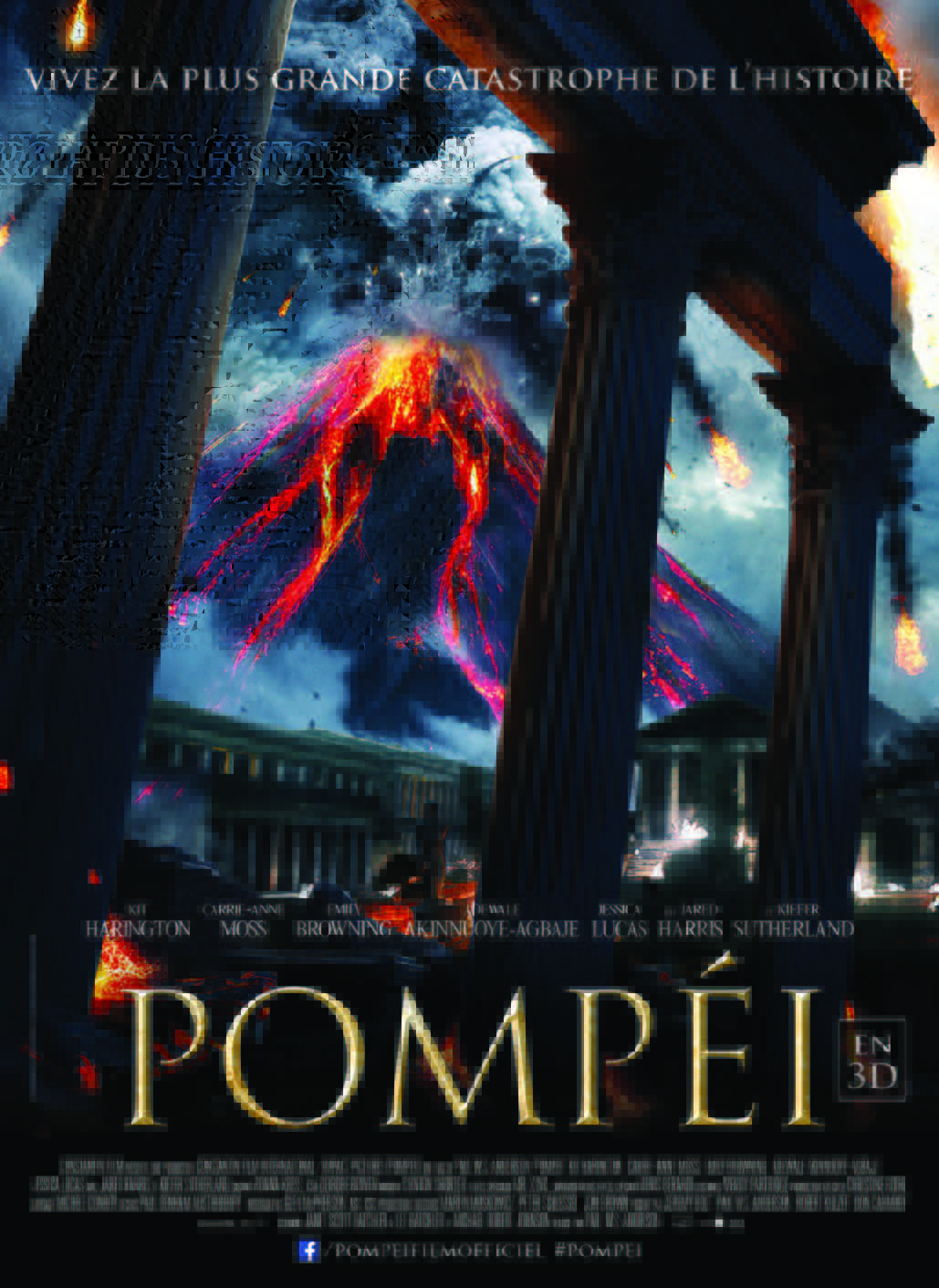
POMPEII
STORY: Set in 79 AD, Pompeii is a rich girl/poor boy-style romance served up with heaps of bloody gladiatorial action and of course, Mount Vesuvius, which erupts in a curtain of molten magma. REVIEW: As a young boy, Milo (Harington) sees his parents killed by a Roman general Corvis (Sutherland) as the Romans suppress a Celt uprising.
He is then taken into captivity and grows up to become an expert gladiator, fuelled by hatred for the Romans. His skills impress his masters and he gets a chance to fight in the amphitheatre of Pompeii during the Vinalia festival.Along the way, he meets Cassia (Browning), the daughter of a wealthy businessman Lucretius (Harris) and his elegant wife Aurelia (Moss), and the two become a veritable Romeo and Juliet of ancient Rome.
This displeases the visiting Senator Corvis, who fancies Cassia but despite his rank, air of entitlement and imperious lines, has the charm of a doorknob. Unsurprisingly, Cassia is repelled by him straight into the arms of Milo, who also befriends the man-mountain of a gladiator, Atticus (Adewale). Atticus, due to be freed after one last death match, begins to help out the already capable Milo during combat and reminds him to keep his eye on the prize – Cassia. So, they fight for freedom and love respectively.
Anderson cleverly cuts to the increasingly ominous rumblings of Mount Vesuvius whenever the story is in danger of dragging, to refocus on the movie’s focal point. You will notice the inevitable parallels with Gladiator and Game of Thrones and the script is often rudimentary (“My name is Milo. You killed my father. Prepare to die!” or “You looked at him. Did you see his muscles?”).
But that is par for the course because brutish gladiators are meant to fight and kill, not speak flowing prose in the King’s English. The love story itself is forgettable and cheesy. But that is only incidental compared to what you can watch this movie for – its fight scenes and cataclysmic climax, both produced and recreated in good detail.
-

Challenges in India-US ties
Inconsistencies mark Obama Administration’s approach
“… the US is becoming increasingly strident in its economic relations with India on issues ranging from sanctions on sections of our pharmaceutical industry and our civil aviation facilities, while demanding changes in our policies on solar panels and equipment and placing restrictions on the movement of IT personnel. It is, however, not India alone that is the recipient of such measures from the US!”, says the author
Traveling across the US as the winter Olympics in Sochi commenced, one was saddened to witness how India’s international credibility had been shaken when television audiences across the world saw three forlorn Indian athletes marching without the national flag. India faced this disgrace, thanks to the avariciousness and nepotism of an internationally disgraced Indian Olympic Association.
Sadly, this was accompanied by charges of corruption, nepotism, match fixing and worse involving the President of the BCCI. Many Indian friends in the US asked in anguish: “Is there no section of national life left in India which is free from corruption and venality?” The mood in Washington, where one had an occasion to meet a cross section of senior officials, business executives, analysts and scholars, was quite different.
In marked contrast to the earlier years, I found widespread criticism of the conduct of foreign and security policies by President Obama. The Administration had not just botched up its healthcare program, but was seen as indecisive and weak in dealing with challenges in West Asia, Afghanistan and the provocations of a jingoistic and militaristic China. President Obama, in turn, is acutely conscious of the mood in the country which wants an end to foreign military entanglements. More significantly, as the US moves towards becoming a net exporter of energy, thanks to the expanding production of shale gas and oil, the country’s geopolitics are set for profound change.
Using its leadership in areas of productivity and innovation, the US now appears set to the stage for increasing domination of the world economic order. From across its eastern shores, the US is negotiating comprehensive trade and investment partnerships with its European allies. Across its western shores in the Pacific, the Americans are negotiating transpacific partnerships with Australia, Brunei, Chile, Canada, Japan, Malaysia, Mexico, New Zealand, Peru, Singapore, South Korea and Vietnam as negotiating partners. While China has informally indicated an interest in joining this partnership, the US will use its influence to ensure that China is not admitted till American political and economic pre-conditions are met.
There is naturally interest in Washington in the forthcoming general election in India. The assessment appears to be that the ruling Congress is headed for a drubbing in the polls. Not many tears will be shed in Washington or elsewhere about this inevitability as the only questions which well-wishers of India ask are how India landed itself in its present morass of corruption and whether a new dispensation, which may be fractious, will be able to restore India to a high growth path. Speaking informally, a senior official recalled that President Obama had described the US-India partnership as “one of the defining partnerships of the world”.
The official noted that “every meaningful partnership between powerful nations encounters setbacks”, adding that such setbacks should be minor compared to the benefits of the relationship and the magnitude of what the two could accomplish together. The Khobragade episode was a defining event in India-US relations. The Americans found Indians across the political spectrum united in the view that insults to India’s national dignity would not be acceptable.
It is important that in future negotiations by the Task Force set up to address such issues, India should make it clear that it will not tolerate events like Mrs. Sonia Gandhi being threatened with prosecution while undergoing medical treatment in New York, or the supercilious attitude adopted towards Mr. Narendra Modi, who is a constitutionally elected Chief Minister. We should not accept a situation where Americans believe that they can behave high-handedly towards our elected politicians because of their domestic lobbies. The US should also be left in no doubt that on such issues, including consular and diplomatic privileges, India will firmly adhere to a policy of strict reciprocity.
The Obama Administration has messed up its relations with President Karzai in Afghanistan, dealing with him in a manner that showed scant regard for his position as the elected Head of State of Afghanistan. Worse still, by its actions, the US has clearly given the impression that despite its protestations it was clandestinely dealing, behind Mr. Karzai’s back, with the Taliban. While the US-Afghanistan Strategic Partnership speaks of joint determination in eliminating the “al- Qaida and its affiliates,” the US now speaks only of eliminating al-Qaida and not is affiliates like the Taliban, the Islamic Movement of Afghanistan, Lashkar-e-Taiba and Jaish-e- Mohammed.
There are naturally concerns in Afghanistan that the US, which needs Pakistan’s assistance for withdrawing its military equipment from Afghanistan, will seek to appease the Pakistanis by giving them a lessthan- healthy role in determining the future dispensation in Afghanistan and the role of the Taliban in such a dispensation. While there is an evident congruence of interests in working with the US, Japan and others in the face of growing Chinese military assertiveness, New Delhi and Tokyo cannot ignore the reality that there have been many flipflops and inconsistencies in the approach of the Obama Administration to China.
Moreover, the US is becoming increasingly strident in its economic relations with India on issues ranging from sanctions on sections of our pharmaceutical industry and our civil aviation facilities, while demanding changes in our policies on solar panels and equipment and placing restrictions on the movement of IT personnel. It is, however, not India alone that is the recipient of such measures from the US! Despite these challenges, India cannot ignore the reality that the US is the pre-eminent power in the world.
Moreover, it will remain so in the coming years, primarily because its innovative and technological strengths are going to be reinforced by its energy surpluses, together with the energy potential of its neighbors like Canada, Mexico and Argentina. It will, moreover, remain the foremost power in the manufacture of high-tech equipment, particularly in defense and aerospace. It is for India to fashion industrial policies to leverage its strengths and potential to secure high levels of investment and partnership in crucial high-tech industries.
I was advised in Washington that contracts currently secured with US companies enable us to import 5.8 million metric tons per annum of shale gas from the US annually. According to oil industry sources, these contracts alone provide us more gas than we could obtain from the controversial Iran-Pakistan-India pipeline. But, for all this to fructify, the new dispensation in New Delhi will have to replace economic populism and accompanying fiscal irresponsibility with a quest for accelerated growth.
-

Marital cruelty Enable women to fight it
In a country where domestic violence is not only widely prevalent but also underreported, the Supreme Court’s observation on marital cruelty assumes great significance.
A Bench comprising Chief Justice P Sathasivam and Justices Ranjan Gogoi and SK Singh has rightly held that the complaint of mental and physical cruelty leveled against the husband and parents-in-law cannot be dismissed at the onset. Its ruling that a trial is essential may not by itself translate into relief for scores of battered women.
Yet armed with the knowledge that their grievances will not be dismissed on frivolous pretexts, it can enable more women to come forward and seek redress. Even though much is said about women’s growing empowerment, instances of domestic abuse continue to find sanction in the patriarchal system.
According to the National Family and Health Survey 3, almost two in every five married women in India have experienced domestic violence. In states like Punjab and Haryana, it is one of the major crimes against women. While Haryana reported 18 cases everyday, helplines in Punjab were flooded with complaints of domestic abuse by women in distress.
Ironically, though domestic violence was recognized as a criminal offence way back in 1983 and the path-breaking Protection of Women Against Domestic Violence Act was passed nine years ago, not many recognize the gravity of the problem. While more heinous crimes like rape are looked at with horror, incidents of spousal violence are invariably brushed aside.
Sadly, though a host of laws have been passed to enable women to fight oppression, gender inequity and violence is a reality women in high positions too have to live with. Answers lie not only in proper implementation of the existing laws but also a change in attitudes that tend to dismiss cases of domestic violence as mere spousal disagreements. It’s time India realized violence against women, be it on the streets or within the four walls of a home, was abhorrent and must be dealt with severely.
-

Dragnet Nation’, by Pulitzer Prize Winner Julia Angwin – Be Warned About Dangers of PCs / Mobile Phones Being Hacked
While driving back from Long Island on Monday, February 24, I listened to an absolutely fascinating interview of Pulitzer Prize winning journalist Julia Angwin, author of Dragnet Nation, on the issue of privacy and cyber crime.
I was amazed at how easy it is for your personal financial information to stolen if you use mobile phones for your banking transactions – in particular if you use the Android operating system. There was a program on TV recently which showed how your laptop or mobile phone could be hacked within 15 seconds of your activating it in Sochi for the Olympic Games.
Certain hi-tech global firms (and I worked for one such) instruct their consultants / executives going to China / Hong Kong / Russia / Eastern Europe to only carry essential information on a separate PC. Once back in the US these are to be trashed or the drives completely reformatted – the danger of worms and viruses is so great that the danger of contamination is not worth it. BTW those in the US need not be ‘holier than thou either’.
When the People’s Republic of China ordered a Boeing transport for their President, Boeing based in the good old US of A sent the order with so many bugs pre-installed that the Chinese trashed the plane after discovering hundreds of them. Now we in India buying defense hardware from either the US or the Soviet bloc should be fully aware that it is possible that in the era of cyber warfare the sellers can render them non-functional anytime, if they want to.
I hope our Italian barmaid’s Congress Party government in India is doing something about it. When Narendra Modi becomes Prime Minister, let us hope that he brings in some top flight IT cyber crime expert ‘ethical hacker’ types to assist him. The BJP is largely known (ahem!) for good solid Hindutva bhaiyya types of limited education and not for techno nerds of Silicon Valley.
-

With Cultural Celebration and Symbolic Flag Raising Town of Hempstead Commemorates India’s Republic Day
HEMPSTEAD, NY (TIP): Though winter weather prompted the postponement of Hempstead Town’s India Republic Day ceremony in January, snow didn’t get in the way today as Supervisor Kate Murray and Senior Councilman Anthony J. Santino led the annual celebration of Indian American culture at Town Hall.
Hempstead Town’s 11th annual celebration, co-sponsored by the India American Forum, is Long Island’s only India Republic Day ceremony. India Republic Day, observed on January 26th, marks the establishment of India as a republic and its liberation from British rule. The event featured an impressive display of cultural dances and musical performances, appearances and speeches by distinguished guests and a cultural food reception provided through the generosity of Akbar Restaurant of Garden City.
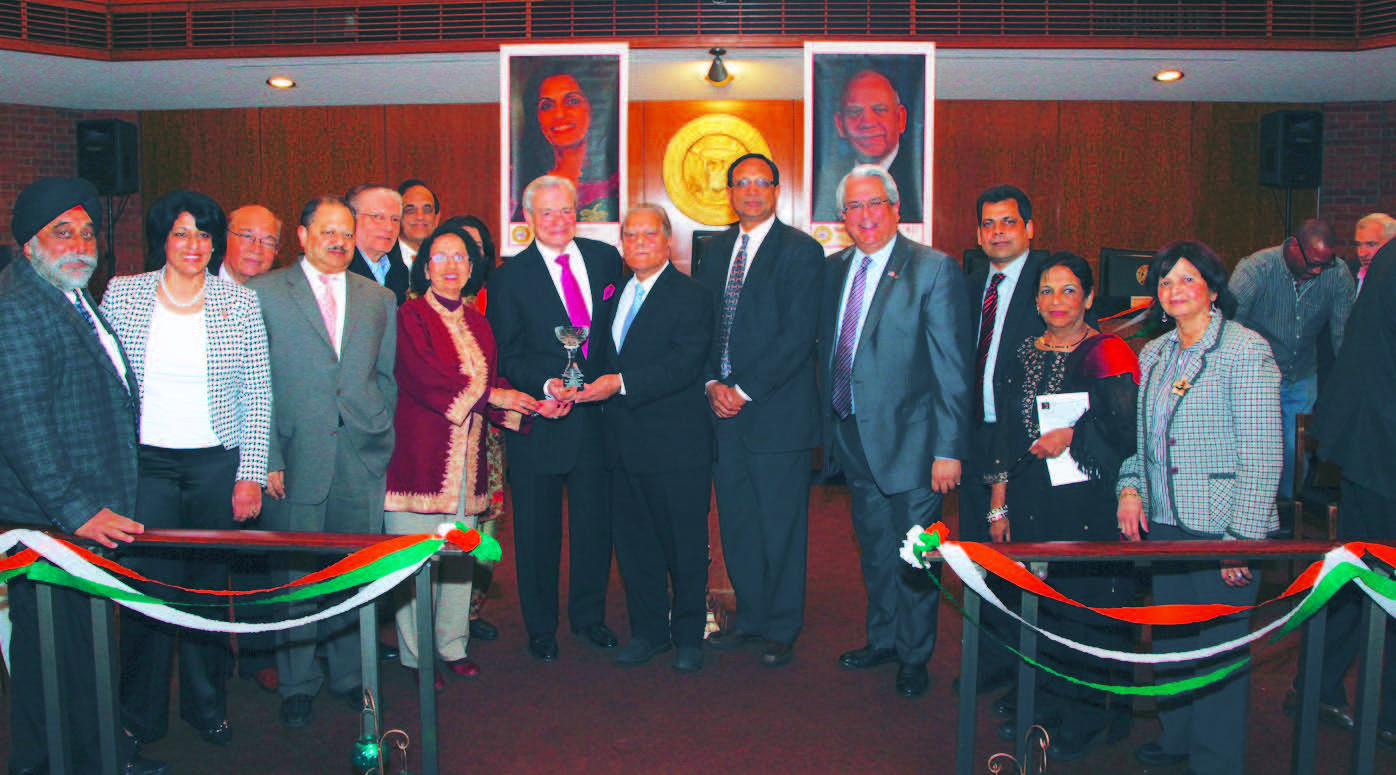
Town Clerk Nasreen Ahmed, Keynote Speaker honorable Thomas S Gulotta, Councilman Anthony Santino, Indu Jaiswal
The event was capped off by Hempstead Town’s presentation of the 2014 India Republic Day Awards. This year’s honorees were Narendra Hadpawat, M.D., and Bina Sabapathy. Hadpawat, a Five Towns resident, is a founder of one of the most successful cardiology practices on the south shore of Long Island and has been the director of Medicine and Cardiology at Peninsula Hospital for over 20 years. Bina Sabapathy, an active member of Vedic Heritage, a religious organization located in Hempstead, is Vice President of the India Association of Long Island.
Indu Jaiswal , Chairperson of Indian American Forum welcomed every one and thanked the Town of Hempstead and Supervisor Murray for continuing the traditions of India Republic Day Celebrations. Also a warm welcome was given to Honorable Nasreen Ahmed, who made history by getting elected to the Town Clerk Position . Key note speaker Honorable Thomas S GULOTTA , in his remarks praised the efforts and achievements of Indian American community in USA. Mr. Gulotta was also honored by the Town of Hempstead and Board of Trustees and Board Members of Indian American Forum.
Members of Indian veterans Association, Varinder Bhalla, Renu Sharma, Bina Sabapathy, Nasreen Ahmed, Indu jaiswal, Councilman Santino, Ratna Bhalla, Jaya Bahadkar
Several community leader and dignitaries were present, Members from Martin Luther King Group, Reverend Elliott, Dr Ajay Lodha, President of AAPIQLI, Animesh Goenka, Satnam Prahar, President of India Association of Long Island, Zahid Syed, Chairman of Human rights commission in Nassau County, Deputy Commissioners in Nassau County Ratna Bhalla , Sunita Manjarekar. Jaya Bhooplapur, Sunita Sadhnani and many Rotary Club members, Dr Anila Midha, President of South Asian Womens Alliance, Giri and Indu Chhabra from Hindu Center, members from Vedic Heritage in Hempstead, and NY Kali Mandir in Baldwin and several other community leader graced the evening. Members of Indian Veterans Association headed by Wing Commander Suresh Butani, also attended.Cultural programs were choreographed by Satya Pradeep and Sangeeta Pandit . Vocal performances by our young talent Parth Merai, Mayuri Gowda and Rhea Manjrekar were excellent “We are proud to be the only municipality on Long Island to host a celebration that marks India Republic Day,” Murray said. “As Americans, we share India’s values of democracy and independence, and we are proud to commemorate a special day for Indians around the world.”
The Town’s celebration of India Republic Day kicked off in the morning, as Murray and members of the India American Forum raised the flag of India in front of Town Hall. The main festivities commenced in the evening at Town Hall’s Nathan L.H. Bennett Pavilion. “Indian Americans have made major contributions to our township,” Murray said. “Each year, we celebrate the achievements of Indian Americans who demonstrate leadership and community involvement. Our honorees truly are role models, and I congratulate them for their achievements.”
-

OFBJP-USA Organizes ‘Yoga for Unity’ Program in New Jersey
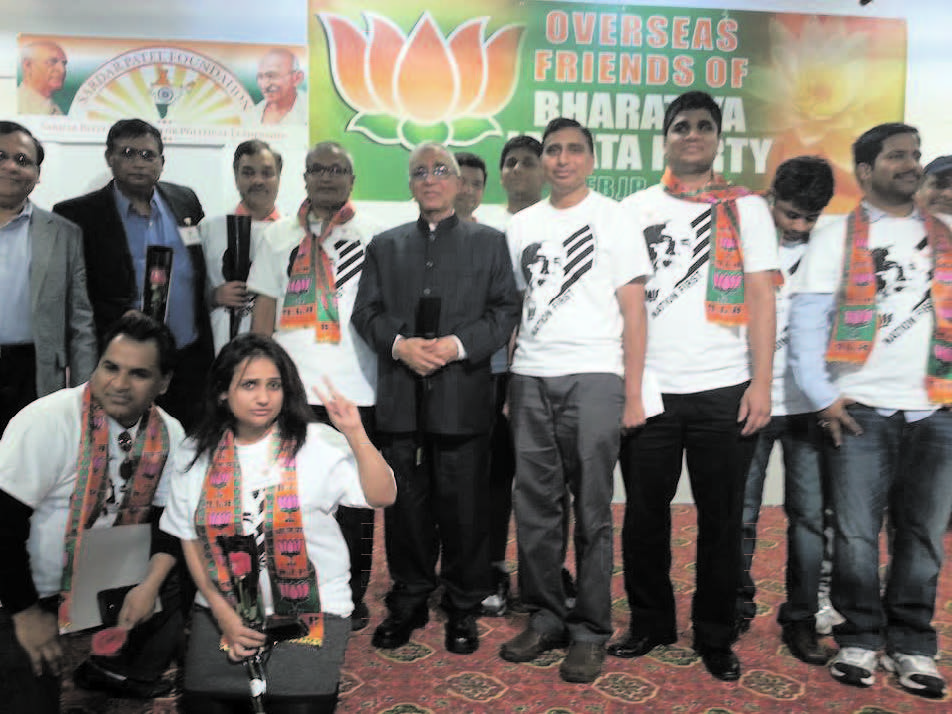
EDISON, NJ (TIP): Hundreds of Indian American volunteers enthusiastically participated in the “Yoga for Unity” program organized by the Overseas Friends of Bharatiya Janata Party (OFBJP) in Edison, New Jersey on Sunday Feb 23, 2014 at TV Asia Auditorium.
The event was managed by the OFBJP youth team to garner support for the construction of Statue of Unity, world’s tallest statue of Sardar Vallabhbhai Patel, the architect of the unification of India after the departure of British, in Gujarat, India. Aravind Modini (Convener, OFBJP NJ Youth team) acted as the Emcee for the program and welcomed the delegates.
Chandrakanth Patel (President, OFBJP), Suresh Jani (Past President, OFBJP), Jayesh Patel (Immediate Past President, OFBJP), Arvind Patel (New Jersey Coordinator, OFBJP), and Vinod Patel and Prof. Bipin Sangankar (Sardar Patel Foundation) along with other distinguished guests inaugurated the program with Lighting of the Lamp amidst the chanting of Vedic hymns by Pandit Praveen Shastri. Led by Prachi Makkar (College Student from NJ), entire audience joined in the singing of Vandemaataram.
Chandrakanth Patel (President, OFBJP) welcomed the distinguished guests and said that Narendra Modi was a visionary like Sardar Patel and currently the entire India has been chanting Narendra Modi (NaMo) mantra: Modi for PM. The youth volunteers of OFBJP have been working very hard to carry the message of NaMo among the Indian diaspora by organizing ‘Chai pe Charcha’ (NaMo Tea parties) and other outreach activities in many cities all across USA.
He strongly urged the audience to join the Mission-2014: BJP272+ and support the organization in every possible way to ensure NaMo becomes the next Prime Minister of India with BJP securing full majority. Jayesh Patel (Immediate Past President, OFBJP) read out a message of Shri Narendra Modi specially sent for the occasion, in which he conveyed his good wishes to the volunteers and success of the program. Speaking on the occasion, H.R. Shah (Chairman, TV Asia) reminded the audience that the auditorium where the program is being held is named after Sardar Patel and said the Narendra Modi has all the right qualifications to lead India.
Ramesh Patel (President, FIA) said that except for Narendra Modi the other PM contenders are no good for India in view of their track record. Rakshpal Sood (Sr. Advisor, OFBJP) stressed the need for unity at all levels and people rise above the narrow considerations of caste, creed and community, and vote for India in order to make sure BJP wins the next elections.
Vinod Patel from the Sardar Patel Foundation (SPF) which supported the event said that Sardar Patel was a great leader and visionary and was respected by everyone including Mahatma Gandhi. Prof. Bipin Sangankar (President, SPF) enlightened the audience by narrating some interesting events in Sardar Patel’s life and said India would have been a super power if he were the first Prime Minister. MS RajyaLaxmi (Member, SPF) said that Sardar Patel belongs to the entire humanity and not just India and read out the messages from Baba Ramdev and Dr. Subramaniam Swamy. Sardar Patel Foundation organized a photo exhibition on Sardar Patel during the program.
The audience was shown a video that gave a glimpse of Sardar Patel’s contributions in the service of Mother India and an overview of the prestigious Statue of Unity project. Ganesh Ramakrishnan (Volunteer, OFBJP NJ Yuva) read out a message sent by Vijay Jolly (Convener, OFBJP) who lauded the contributions of Indian diaspora and urged them to reach out to their families in India to support BJP and make Narendra Modi as the next prime minister. Led by Tanvi Shah of Tanvi Yoga, delegates performed Yogic Asanas and breathing exercises.
They were given tips on how to manage day to day issues like backaches, sitting and standing for long times, etc. Shri Ketan Bhagat of Art of Living conducted a breathing and meditation session and stressed the importance of cleaning the inner self to fight and cleanse the world outside. There was a great response for the yoga and meditation sessions from the audience. The audience was enthralled by a Punjabi folk song by Prachi and Surya Makkar. Speaking on the occasion Drumi Bhatt (Volunteer, OFBJP NJ Yuva) stressed the need for women security and cited Gujarat as an example as the state has done a lot to protect the girl child.
Arun Ayyagari (Volunteer, OFBJP NJ Yuva) said that NaMo is the most popular Indian leader on Social Media and India needs him to eradicate all the evils of the nation. Pramod Bhagat (Volunteer, OFBJP NJ Yuva) urged the audience to support the OFBJP Yuva volunteers in their mission to garner support for BJP. Aravind Modini requested the audience to support BJP by calling their family and friends in India to vote for BJP. The highlight of the program was the video on NaMo vision.
The video highlighted different quotes from NaMo’s speeches that elaborated his vision for India and were received by audience with applause at every single quote. Shri Krishna Reddy (Treasurer, OFBJP) presented the vote of Thanks and recognized the support given by Sardar Patel Foundation, Art of Living, Tanvi Yoga, HSS, TV Asia Staff, BAPS and the OFBJP volunteers for the event. Everyone present there was treated with NaMo Chai throughout the duration of the program and also enjoyed a tasteful dinner that was served after the program.
-

TV Asia – the Exclusive Broadcast partner of American College Cricket- ties up with ESPN3
EDISON, NJ (TIP): TV Asia – the Exclusive Broadcast partner of American College Cricket – is pleased to announce an agreement with ESPN3 that will deliver the American College Cricket National Championship Finals live on Sunday March 16, 2014 from the magnificent Broward County Stadium in Fort Lauderdale, Florida.
The Finals will also be carried live on TV Asia nationally on Dish Satellite, Dish World and on Cable where TV Asia is carried on their systems. Cricket fans will now have an opportunity to watch American College Cricket in the US online via WatchESPN.com and on smartphones and tablets via the WatchESPN app. Additionally, it can be streamed on televisions through ESPN on Xbox LIVE by Gold members, Apple TV and Roku.
TV Asia has been airing 60 hours of American College Cricket over 2 years and in keeping with its mission of local relevancy has been investing and building American College Cricket brand identity and awareness with Presenting Sponsors Coca Cola. “ESPN3 continues to build its position as a leader in delivering premier events from the world’s second most popular sport in the US,” said Jason Bernstein, Senior Director of Programming and Acquisitions, ESPN.
“By carrying the American College Cricket National Championship Finals, we are able to deliver the sport nationally across a variety of platforms that are easily accessible to this passionate and fast growing fan base.” “TV Asia is committed to highlighting South Asian achievers and role models in the US and Canada in sports, arts, business and cultural spheres and will continue to invest in our South Asian community,” stated H.R. Shah, Chairman TV Asia.
“TV Asia is the leading South Asian TV Channel specializing in locally relevant programs and engagement with the community nationally,” stated Lal Dadlaney, SVPBusiness & Operations TV Asia. “We are delighted to work with ESPN3 to scale and add validity to American College Cricket.” American College Cricket founder & President Lloyd Jodah stated: “All American College Cricket members – including the student leaders who believed in the vision and came to the first American College Cricket Championship in March 2009 – who helped us start the clubs and get them to the Nationals these past 5 years as well as all of our players, thank TV Asia for its strong belief in and commitment to us these past two and a half years.
We look forward to working with ESPN3 through our partnership with TV Asia.” About ESPN3 ESPN3 is ESPN’s live multi-screen sports network, a destination that delivers thousands of exclusive sports events annually. It is accessible online at WatchESPN.com, on smartphones and tablets via the WatchESPN app and streamed on televisions through ESPN on Xbox LIVE to Gold members, Apple TV and Roku. The network is currently available to more than 85 million homes at no additional cost to fans who receive their high-speed Internet connection or video subscription from an affiliated service provider.
The network is also available at no cost to approximately 21 million U.S. college students and U.S.-based military personnel via computers, smartphones and tablets connected to oncampus educational and on-base military broadband and Wi-Fi networks. About TV Asia TV Asia is a New Jersey based Pay TV Channel available in USA in HD on Dish Satellite Channel 700, Dish World IPTV and in SD on major Cable systems such as Comcast Xfinity, Time Warner, Cablevision etc including Verizon FIOS & AT & T U Verse. In Canada we are on Rogers Cable Toronto and Bell IPTV.
TV Asia is celebrating 20 years in United States and engages in dialogue via outreach programs with the community and is the Voice and Mirror of the South Asian Community in North America. For further information visit www.tvasiausa.com and www.YouTube.com/tvasiausa for program schedules as well as updates and short videos and on Facebook www.facebook.com/tvasiausa and stay connected to TV Asia. About American College Cricket American College Cricket was founded in October 2008 by Lloyd Jodah and has developed clubs in over 70 member colleges all over the USA & Canada.
Starting with a National Championship in March 2009 played for the Shiv Chanderpaul Trophy, American College Cricket developed Regional Championships in the Fall semester, and a Home & Away season year round. The organization has been featured in major media such as the NY Times, Washington Post, Boston Globe, NY Daily News and many others and played a role in the National Baseball Hall of Fame Exhibition: Swinging Away – How Cricket & Baseball Connect”. for further information visit: Face book :https://www.facebook.com/ CollegeCricket?ref=br_rs Twitter: @CollegeCricketU Website: www.Americancollegecricket.com For further media info contact: Pradeep Hegde Vice President.
-

MAHA SHIVRATRI: THE NIGHT OF SHIVA
Maha Shivratri, the night of the worship of Lord Shiva, occurs on the 14th night of the new moon during the dark half of the month of Phalguna. It falls on a moonless February night, when Hindus offer special prayer to the lord of destruction. Shivratri (Sanskrit ‘ratri’ = night) is the night when he is said to have performed the Tandava Nritya or the dance of primordial creation, preservation and destruction. The festival is observed for one day and one night only.
Origin of Shivratri According to the Puranas, during the great mythical churning of the ocean called Samudra Manthan, a pot of poison emerged from the ocean. The gods and the demons were terrified as it could destroy the entire world. When they ran to Shiva for help, he in order to protect the world, drank the deadly poison but held it in his throat instead of swallowing it. This turned his throat blue, and since then he came to be known as ‘Nilkantha’, the blue-throated one. Shivratri celebrates this event by which Shiva saved the world.

A festival significant for women Shivratri is considered especially auspicious for women. Married women pray for the well being of their husbands and sons, while unmarried women pray for an ideal husband like Shiva, who is the spouse of Kali, Parvati and Durga. But generally it is believed that anyone who utters the name of Shiva during Shivratri with pure devotion is freed from all sins. He or she reaches the abode of Shiva and is liberated from the cycle of birth and death.
Rituals On the day of Shivratri, a three-tiered platform is built around a fire. The topmost plank represents ‘swargaloka’ (heaven), the middle one ‘antarikshaloka’ (space) and the bottom one ‘bhuloka’ (earth). Eleven ‘kalash’ or urns, are kept on the ‘swargaloka’ plank symbolizing the 11 manifestations of the ‘Rudra’ or destructive Shiva. These are decorated with the leaves of ‘bilva’ or ‘bael’ (Aegle marmelos) and mango atop a coconut representing the head of Shiva. The uncut shank of the coconut symbolizes his tangled hair and the three spots on the fruit Shiva’s three eyes.
Bathing the Phallus The phallus symbol representing Shiva is called the lingam. It is usually made of granite, soapstone, quartz, marble or metal, and has a ‘yoni’ or vagina as its base representing the union of organs. Devotees circumambulate the lingam and worship it throughout the night. It is bathed every three hours with the 5 sacred offerings of a cow, called the ‘panchagavya’ – milk, sour milk, urine, butter and dung. Then the 5 foods of immortality – milk, clarified butter, curd, honey and sugar are placed before the lingam. Datura fruit and flower, though poisonous, are believed to be sacred to Shiva and thus offered to him.

Om Namah Shivaya All through the day the devotees keep severe fast, chant the sacred Panchakshara mantra “Om Namah Shivaya”, make offerings of flowers and incense to the Lord amidst ringing of temple bells. They maintain long vigils during the night, keeping awake to listen to stories, hymns and songs. The fast is broken only the next morning, after the nightlong worship. In Kashmir, the festival is held for 15 days. The 13th day is observed as a day of fast followed by a family feast.
The Powerful God Shiva is ‘shakti’ or power, Shiva is the destroyer, the most powerful god of the Hindu pantheon and one of the godheads in the Hindu Trinity. Known by many names – Mahadeva, Mahayogi, Pashupati, Nataraja, Bhairava, Vishwanath, Bhava, Bhole Nath – Lord Shiva is perhaps the most complex of Hindu deities. Hindus recognize this by putting his shrine in the temple separate from those of other deities.
Shiva As phallic symbol Shiva, in temples is usually found as a phallic symbol of the ‘linga’, which represents the energies necessary for life on both the microcosmic and the macrocosmic levels, that is, the world in which we live and the world which constitutes the whole of the universe. In a Shaivite temple, the ‘linga’ is placed in the center underneath the spire, where it symbolizes the naval of the earth.
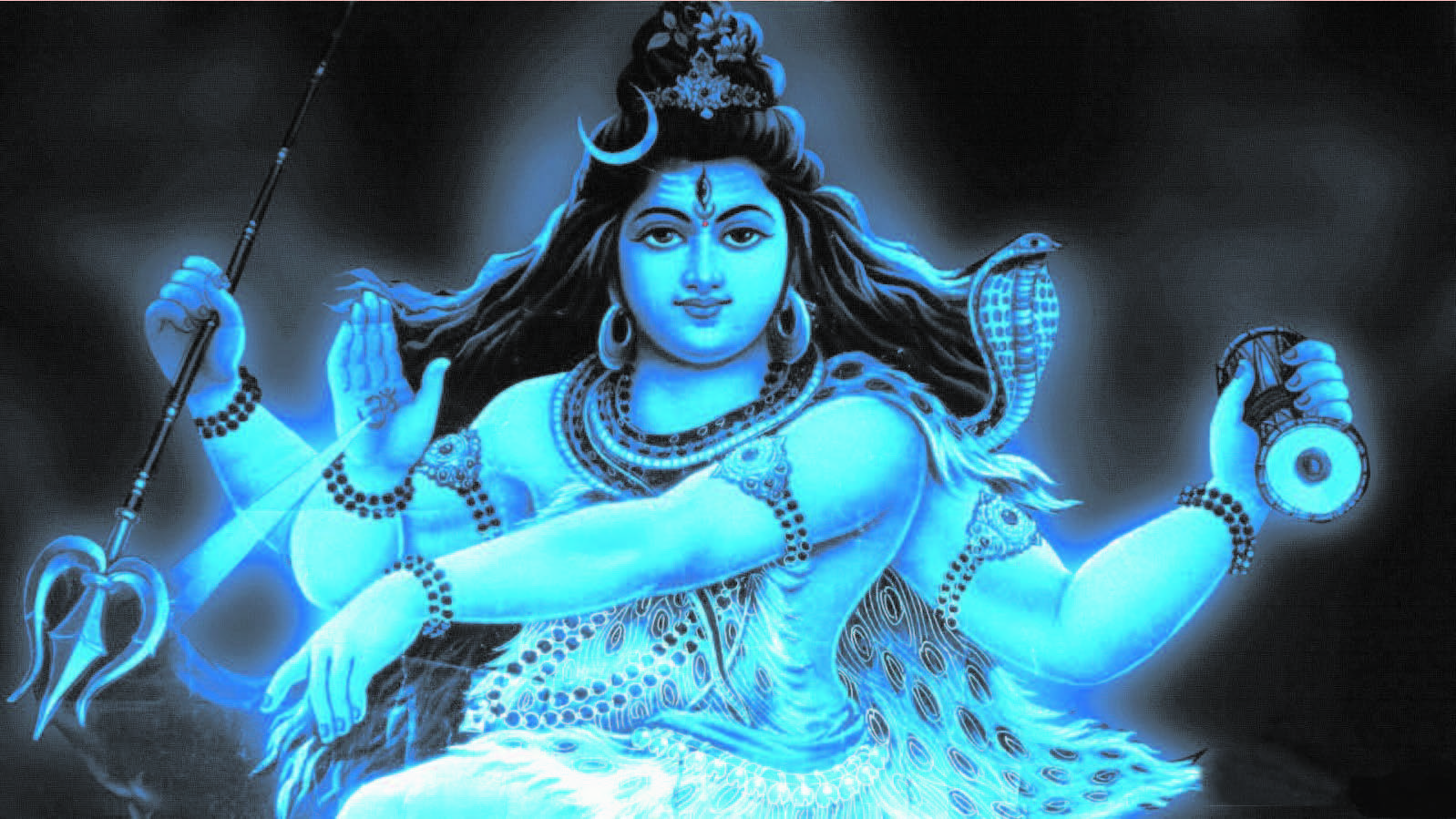
A Different Deity: The actual image of Shiva is also distinct from other deities: his hair piled high on the top of his head, with a crescent tucked into it and the river Ganges tumbling from his hairs. Around his neck is a coiled serpent representing Kundalini or the spiritual energy within life. He holds a trident in his left hand in which is bound the ‘damroo’ (small leather drum). He sits on a tiger skin and on his right is a water pot. He wears the ‘Rudraksha’ beads and his whole body is smeared with ash.
The destructive force Shiva is believed to be at the core of the centrifugal force of the universe, because of his responsibility for death and destruction. Unlike the godhead Brahma, the Creator, or Vishnu, the Preserver, Shiva is the dissolving force in life. But Shiva dissolves in order to create, since death is the medium for rebirth into a new life. So the opposites of life and death and creation and destruction both reside in his character.
The God who’s always high Since Shiva is regarded as a mighty destructive power, to numb his negative potentials he is fed with opium and is also termed as ‘Bhole Shankar’, one who is oblivious of the world. Therefore, on Maha Shivratri, the night of Shiva worship, devotees, especially the menfolk, prepare an intoxicating drink called ‘Thandai’ (made from cannabis, almonds, and milk) sing songs in praise of the Lord and dance to the rhythm of the drums.
-

Asian Indian Chamber of Commerce organizes talk on business loans and affordable care act
NORTH BRUNSWICK, NJ (TIP): The Asian Indian Chamber of Commerce (AICC) along with the Board of Directors held monthly Network Nite at Clarion Inn, North Brunswick NJ, January 29th.
The Asian Indian Chamber of Commerce – a non-profit organization- evolved in July 1994 to meet the entrepreneurial and business needs of the growing Asian Indian Community. AICC was created to provide a forum for Networking for our community and to build on the strengths of all of its members.
At each Network Nite discussions are held on topics that are important to the Asian Indian Business Community related to starting a Business, Health and Finance, Business Opportunities in New Jersey and other topics of interest to our burgeoning community in New Jersey. We bring together members to generate business opportunities through the exchange of knowledge and insights.
At the meeting, the Chamber offered 30 minutes Grand Sponsor Presentation by the Patron Sponsor- Quaterspot Inc. represented by Mike Green- Executive Vice President with Quaterspot who highlighted the Topic- “How to use loan platform and how business owners can easily apply for a short term loan. Quarterspot highlights business lending platform which has no prepayment penalties, fair rates, requires no owner collateral, and can provide cash in a few days”.
The Guest Speaker Erik Rettig from Small Business Majority gave a quick overview of what the Affordable Care Act means for small businesses in New Jersey. The event ended with a Q&A session and a discussion on the topics discussed. For more information on AICC please visit website at www.aicc.net which provides information on AICC activities. For enquiries please Call at 732 -777-4666 or e-mail at webmaster@aicc.net to Chamber office and learn more benefits that Chamber can offer your business.
-

2 men die in separate incidents on Lexington Ave. subway line
NEW YORK, NY (TIP): A 38-year-old homeless man fell and hit his head while on the tracks at the 86th St. station in Manhattan, while a 24-year-old man jumped in front of a No. 6 train at Zerega Ave.-Westchester Ave. station in the Bronx in an apparent suicide.
Two men were killed in separate incidents on the Lexington Ave. subway line early Wednesday, officials said. Death began its ride at 3 a.m. when a 38-year-old homeless man fell and hit his head on the southbound side of the 86th St. Station in Manhattan.
Two straphangers saw the unidentified man sitting on the third rail and tried to get him off the tracks, but he resisted, ran away from them, stumbled and hit his head. Paramedics rushed him Lenox Hill Hospital, where he died of cardiac arrest, officials said. About 7:30 a.m., a 24-year-old man jumped in front of an oncoming No. 6 train at the Zerega Ave.-Westchester Ave. station in the Bronx in an apparent suicide. He died at the scene, officials said.
-

Rookie NYPD cop shot in both legs in White Castle parking lot in Brooklyn
NEW YORK, NY (TIP): Officer James Li, of the 71st Precinct, was wounded in the left leg at the corner of Utica Ave. and Empire Blvd. in Crown Heights after trying to stop a bus fare beater, sources said. The gunman fired three times in the 5 p.m. confrontation in East Flatbush, hitting Officer James Li twice, once in each leg.
Li and his rookie partner, Officer Randy Chow, returned fire but the suspect fled uninjured. As two women tended to Li, who lay bleeding in a White Castle parking lot at Utica Ave. and Empire Blvd., officers gave chase, west on Empire and Lefferts Ave., then south on Schnectady Ave., where the suspect ran down an alley and into a building.
Police arrested him there, and his gun was recovered, police sources said.Li was rushed to Kings County Hospital, where he was visited by Police Commissioner Bill Bratton and Mayor de Blasio. Li, the first NYPD cop shot in the line of duty since July 4th, is expected to recover, sources said.
-

DESPITE BAN ON INDIAN PRODUCTS, FDA CHIEF CLAIMS US ‘NOT TARGETING’ INDIA
WASHINGTON (TIP): US regulators are not targeting India, despite a series of import restrictions on drugs from the major US trading partner, the Food and Drug Administration chief said Friday, February 23. FDA Commissioner Margaret Hamburg briefed reporters after her first official trip to India, where she met with government and industry leaders earlier this month.
India is the second largest US supplier of prescription and over-the-counter drugs, and its big pharma companies Ranbaxy and Wockhardt have been hit with multiple US import suspensions due to safety concerns. “We are not targeting Indian countries. We are undertaking our required regulatory activities,” Hamburg said. “When products are sold in the United States for use by American citizens, then those products have to meet our standards.” Hamburg said the FDA has ramped up inspections at Indian drug plants as part of a global effort to improve safety.
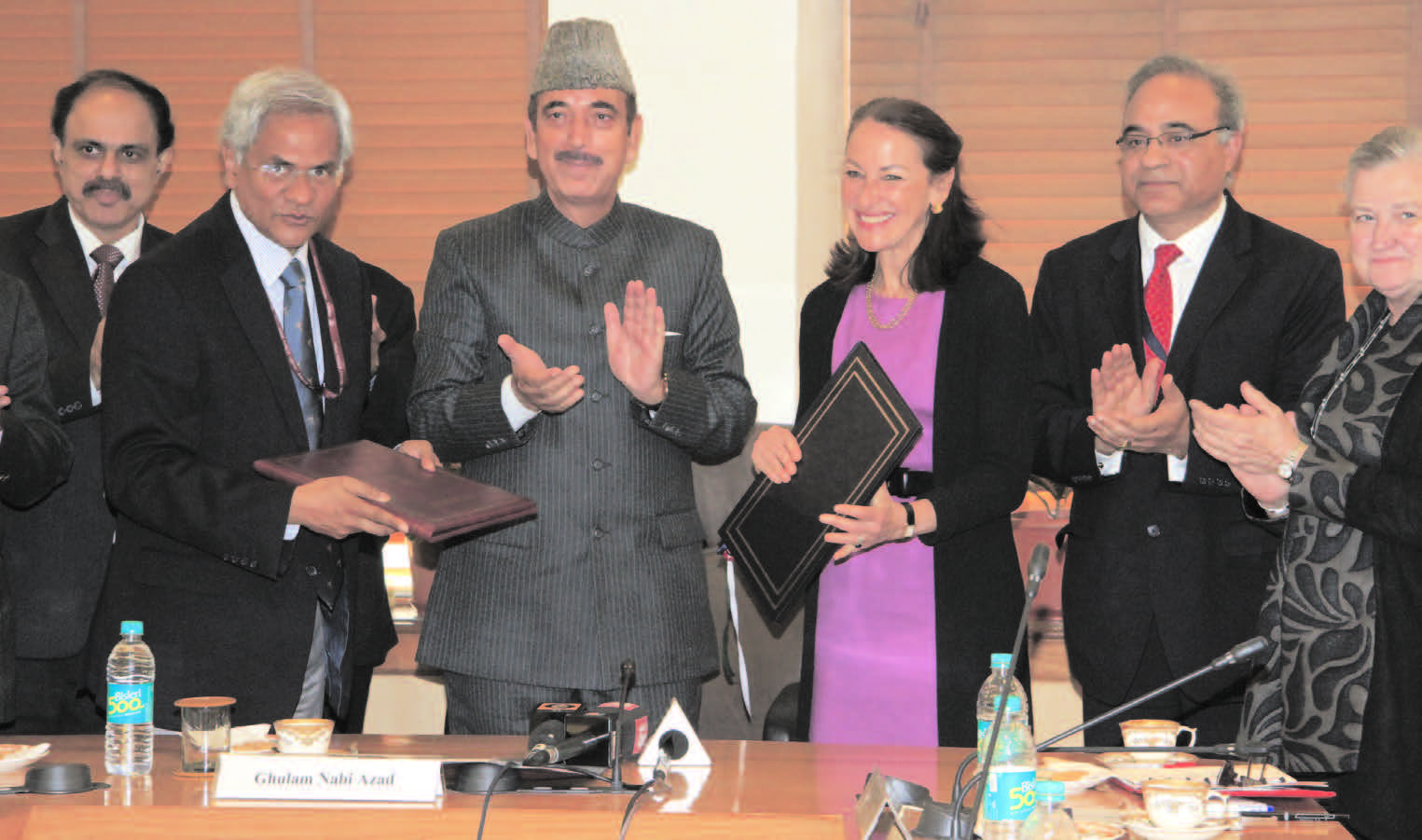
The agency has 12 staff members in India, and plans to expand to 19, she added, describing the nation as “particularly important” to US food and drug trade. “The fact that we have increased our presence in India is true but it reflects the fact that India is a very significant and growing player in the US marketplace with respect to both pharmaceutical products and food.” While in New Delhi, Hamburg and Indian health secretary Keshav Desiraju signed their first statement of intent to cooperate in the field of medical products.
Hamburg described as “encouraging” her conversations with senior representatives during her eight-day trip to India, the United States’ third largest trading partner. At the start of Hamburg’s visit, Health Minister Ghulam Nabi Azad said India’s lower-cost medicines should not be viewed as “cheap and spurious.” India’s generics industry is a major supplier of lifesaving drugs, including antiretrovirals for HIV, to the United States and over 200 other nations. Many lower-income countries rely on the generics produced by Indian plants as a key source for affordable medicine.
But Ranbaxy, one of India’s biggest drugmakers, has been hit repeatedly with FDA import suspensions, most recently in January, when a fourth manufacturing plant was cited for violations from expected “good manufacturing practice.” Roger Bate, an expert at the American Enterprise Institute, said the problem lies with India’s national regulatory body for pharmaceuticals, the Central Drugs Standard Control Organization. “I believe the Indian generics companies can make the products well, but it is the lack of oversight,” Bate told AFP, describing CDSCO as “corrupt.” “India does not take drug regulatory matters seriously.”
The FDA issued earlier its first-ever ban on tobacco products on four varieties of hand-rolled cigarettes called bidis by an Indian company headquartered in Illinois, Jash International. Just days after FDA commissioner Margaret Hamburg returned from India, agency officials announced that four bidi brands made by Jash International – Sutra Bidis Red, Sutra Bidis Menthol, Sutra Bidis Red Cone and Sutra Bidis Menthol Cone – may no longer be domestically sold, distributed or imported.
The bidis were banned not because of any imminent danger – although it is well-known that all tobacco products are dangerous – but because Jash failed to provide ingredient information that is mandatory under new rules. In a conference call on Friday, not specifically related to the bidi issue, commissioner Hamburg denied the FDA was targeting Indian companies, but said the United States has a strict quality control regime for all products being imported into America.
”When products are sold in the United States for use by American citizens, then those products have to meet our regulatory standards and requirements and we inspect those facilities in other countries as well,” she told reporters after her first official trip to India, where FDA action against Indiabased pharmaceutical companies have been the focus of attention. But US efforts to stamp out bidi imports and smoking in America has a history going back some two decades when the Indian mini-cigarette started to become a fad among youth after hippies had first lit them up in the sixties. A 2002 survey showed close to 3% of American male high school students had tried bidis, which, because they were largely unregulated, were easier for the youth to access – particularly after the US cracked down on sale of cigarettes to the under-aged.
Over the last decade, bidis also began to appear in various all-American, candy-like flavors: chocolate, vanilla and strawberry, adding newer flavors such as grape, cinnamon, watermelon, menthol, black licorice, wild cherry, and mandarin orange, as the craze caught on. No accurate figures are available about the extent of bidi imports from India but estimates by an international trade group in the 1990s put import from India at 448 million pieces valued at less than $5 million. The Clinton administration tried to ban import of beedis around that time after a CBS 60 Minutes program showed child labor in the industry that employs an estimated 3 million people in India. But it was never fully carried through.
The health and economic cost of smoking is something that has seized developed countries even as developing countries continue to get sucked into western-inspired tobacco consumption that is far more lethal and pervasive than bidi imports to America. A 2010 WHO study estimated that smoking in developed countries will amount to 29% of world tobacco consumption (down from 34% in 1998), while developing countries’ share, now said to be growing at around 3% every year, will be 71%. Some six million people die every year from tobacco-related illness – 80% of them in low-income countries. Last year, the United States also raised concern about high rates of contaminants, including salmonella, in Indian spices.
-

Indian-American Pentagon official to join think-tank
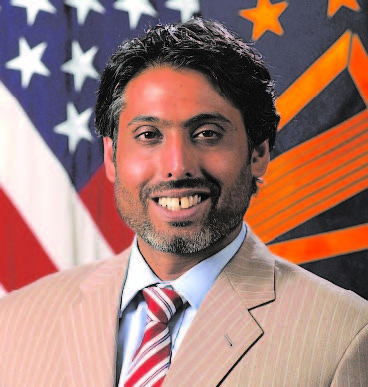
WASHINGTON (TIP): Vikram Singh, the highest-ranking Indian-American at the Pentagon, is joining an eminent US thinktank after serving the Obama administration in various positions for over five years. Singh, the deputy assistant secretary of defense for South and Southeast Asia, is joining the Center for American Progress (CAP) as its vice-president for national security and international policy and will oversee its work on national security around the globe, while continuing his focus on Asia.
He will officially join CAP in March. “Vikram is a leading foreign policy thinker of his generation and has tackled the country’s greatest foreign policy challenges during his time at the State Department and the Pentagon,” CAP president Neera Tanden said in a statement. “As we continue to shape a pragmatic foreign policy strategy over the next decade, Vikram’s insights, sharp strategic mind and experience will guide our work,” Tanden said.
Before his current appointment at the Pentagon, Singh was the deputy special representative for Afghanistan and Pakistan at the Department of State, during which he played a key role in shaping the Af-Pak policy of the Obama administration. Singh has also served in the Department of Defense as a senior advisor, representing the department in National Security Council policy reviews of Pakistan and the war in Afghanistan and later leading the development of the department’s post-2014 strategic approach to South and Central Asia.
Prior to his most recent assignments at the Pentagon, Singh served in the Department of Defense from 2003 through 2007 on a number of defense policy issues, including programs to train and equip foreign military forces, US military counterinsurgency and irregular warfare capabilities, stability operations, disaster response and humanitarian assistance, and the 2005 Quadrennial Defense Review.
As a fellow at the Center for a New American Security from 2007 to 2009, Singh published widely on defense strategy, national security policy, and Asia. Singh lived and worked in Sri Lanka while running a Ford Foundation program on minority rights and conflict in Bangladesh, India, Nepal, Pakistan and Lanka. He also reported on the Lankan civil war for the Voice of America.