Year: 2014

  • IOA to discuss Sarita’s ban with ministry officials

    IOA to discuss Sarita’s ban with ministry officials

    CHENNAI (TIP): Rattled by the International Boxing Association’s decision to provisionally suspend boxer L Sarita Devi for her protest at the Asian Games, the IOA will hold a meeting with sports ministry officials on October 28 to discuss the way forward. IOA president N Ramachandran said the meeting will be held in Delhi on October 28. AIBA, in a sweeping move, decided to suspend Sarita, her coaches — Gurbaksh Singh Sandhu, Blas Iglesias Fernandes and Sagar Mal Dhayal — and the Indian chef-demission to the Asian Games Adille Sumariwala.

    The suspension bars them from participating at all levels of AIBA competitions and meetings until further notice. As a result, Sarita will not be able to compete in the World Championships scheduled to be held next month in South Korea. Sarita is facing disciplinary action for refusing to accept her bronze medal at the Asian Games after losing a controversial semifinal bout. IOA vice-president Tarlochan Singh said all efforts would be made to help Sarita. “This is an emotional case and we should all plead for her. The international body (AIBA) has its own rules but we will try to help her. Although Boxing India is not yet affiliated to us but we don’t go by ego. We are very keen to help,” he said.

  • India name 21- member hockey squad for Australia Test tour

    India name 21- member hockey squad for Australia Test tour

    NEW DELHI (TIP): Sardar Singh will lead a 21-member Indian men’s hockey squad for the four-match Test tour of Australia to be held in Perth from November 4 to 9. Post bagging the gold medal at the 17th Asian Games in Incheon, the tour of Australia is being organised as part of preparation for the upcoming FIH Champions Trophy 2014, to be held in Bhubaneswar December 6-14.

    The Indian squad is set to depart for Perth on October 29 October 2014,. Besides the four Tests, India will also play a training game against Australia A on November 1 at the Perth Hockey Stadium. The 21-member squad was selected by Hockey India selectors B P Govinda, Harbinder Singh and Arjun Halappa alongwith chief coach Terry Walsh, coach Jude Felix and physiotherapist Jince Thomas Mathew on the basis of their performance in the recently-concluded selection trials at at Major Dhyan Chand National Stadium. Goalkeeper P R Sreejesh has been named Sardar’s deputy for the tour.

    Harjot Singh has been named as the second custodian in the squad. The first Test between India and Australia will be played on November 4, followed by matches on November 5, 8 and 9. “Playing against Australia will be an exciting clash and I am sure both the teams will strive to put on their best efforts and will display an excellent show against each other,” Hockey India president Narinder Batra said in a statement. “What will go in our benefit will be the performance that the team showcased both in the Commonwealth Games as well as the Asian Games and which will be a huge motivation for the boys when they face Australia.”

  • Terrorists attack Canada

    Terrorists attack Canada

    OTTAWA (TIP): An unarmed Canadian military guard was shot in Ottawa Wednesday, October 22 morning by Michael Zehaf-Bibeau, a convert to Islam and a selfdeclared jihadist whose alleged photo was posted hours after the shooting on Islamic State social media.

    The killer then entered the Canadian Parliament presumably with the intention of massacring lawmakers inside their caucus rooms. Zehaf-Bibeau was shot by the Parliament’s sergeant of arms, who became a citizen soldier for that particular moment. Canadian authorities launched a counterterrorism operation to track other possible gunmen at the same location. Forty hours earlier, another member of the Canadian military was killed by an indoctrinated convert, identified as Martin Rouleau, in the province of Quebec.

    Weeks before, threats issued by the Islamic State included directives to their members and supporters to strike – in any way they can – against the United States and its allies, including Canada, in retaliation for Coalition airstrikes against jihadi forces in Iraq and Syria. But years before this episode, Al Qaeda and other jihadists tried to commit bloodshed in Canada, including a plot to behead the prime minister – also in Ottawa. The jihadists’ justification is that Canada is participating in the airstrikes, but this represents only a part of the greater conflict.

    For years there have been attempts to hit Canadian citizens, cities and military. Wednesday’s shooting in the country’s capital was the most shocking, but not very surprising. The question is why Canada is being attacked by jihadists (if indeed the shooters are committed to this ideology or linked to any of these movements). Canada has a strong record of promoting human rights around the world. It maintained relations with Iran when Tehran cut its ties with the United States in the 1980s. Ottawa protected the rights of Canadian Islamic militant citizens when they were about to be remitted to the Syrian regime half a decade ago. All in all, Canada has not been in the forefront of fighting the jihadi terrorists but joined the international campaigns inasmuch as Saudi Arabia, the UAE, and Egypt did.

    So why would a jihadist single out our northern neighbor? In the jihadist ideology, there are no good infidels and bad infidels; there are only infidels. Canada happens to be outside the ISIS “caliphate” and belongs to an Atlantic alliance led by the most dangerous infidel power, the United States. Like Sweden, which was hit years ago, Canada is considered a “permissible” recipient of violence. But the ideological argument is not the primary reason it is in the crosshairs of ISIS and Al Qaeda or a target for local jihadists. We know that the Islamic State and Al Qaeda have called on their members and sympathizers to strike U.S. military personnel at will and by any means necessary.

    And while we know there is a specific instruction to target military personnel, among others, Canada is targeted because the jihadists are waging a war in the Middle East to establish a caliphate with control over lives, oil and territory. The terrorists unleashed in the West, lone wolves or jihadi packs, are extensions of the Islamic State – and possibly its Al Qaeda cousins. They are enemy combatants striking in a war that the West, and Washington in particular, has refused to name. Canada is hit because it is part of the alliance, not because of an internal issue. The response should be collective, not individual. Solidarity with Canada must be the first order of the day in the United States and the rest of the free world.

  • EBOLA IN NEW YORK CITY

    EBOLA IN NEW YORK CITY

    NEW YORK (TIP): Craig Spencer, a 33-year-old Doctors Without Borders physician who recently returned from Guinea, became the fourth person ever diagnosed with Ebola on U.S. soil on Thursday, October 23 night. He was rushed to Bellevue Hospital Center by paramedics in hazmat suits and placed in the site’s isolation ward. But New York officials quickly insisted that the city’s first Ebola case will be handled completely differently than Liberian Thomas Eric Duncan’s in Texas.

    Read Related news

    A doctor in New York City who recently returned from treating Ebola patients in Guinea tested positive for the Ebola virus on October 23, becoming the city’s first diagnosed case. The doctor, Craig Spencer, was rushed to Bellevue Hospital Center on Thursday and placed in isolation while health care workers spread out across the city to trace anyone he might have come into contact with in recent days.

    A further test will be conducted by the federal Centers for Disease Control and Prevention to confirm the initial test. While officials have said they expected isolated cases of the disease to arrive in New York eventually, and had been preparing for this moment for months, the first case highlighted the challenges surrounding containment of the virus, especially in a crowded metropolis. Even as the authorities worked to confirm that Spencer was infected with Ebola, it emerged that he traveled from Manhattan to Brooklyn on the subway on Wednesday night, when he went to a bowling alley, and then took a taxi home.


    4


    The next morning, he reported having a temperature of 103 degrees, raising questions about his health while he was out in public. People infected with Ebola cannot spread the disease until they begin to display symptoms, and it cannot be spread through the air. As people become sicker, the viral load in the body builds, and they become more and more contagious. Dr Spencer’s travel history and the timing of the onset of his symptoms led health officials to dispatch disease detectives, who “immediately began to actively trace all of the patient’s contacts to identify anyone who may be at potential risk,” according to a statement released by the department.

    It was unclear if the city was trying to find people who might have come into contact with Dr Spencer on the subway. The Metropolitan Transportation Authority directed all questions to the health department, which did not immediately respond to requests for comment on the issue. At Dr Spencer’s apartment in Harlem, his home was sealed off and workers distributed informational fliers about the disease. It was not clear if anyone was being quarantined.

    Health authorities declined to say how many people in total might have come into contact with Dr Spencer while he was symptomatic. Mayor Bill de Blasio, speaking at a news conference Thursday evening before the diagnosis, said Dr Spencer has given health workers a detailed accounting of his activities over the last few days. “Our understanding is that very few people were in direct contact with him,” de Blasio said. Dr Spencer had been working with Doctors Without Borders in Guinea, treating Ebola patients, before returning to New York City on Oct. 14, according to a city official.

    He told the authorities that he did not believe the protective gear he wore while working with Ebola patients had been breached but had been monitoring his own health.Doctors Without Borders, in a statement, said it provides guidelines for its staff members on their return from Ebola assignments, but did not elaborate on those protocols.”The individual engaged in regular health monitoring and reported this development immediately,” the group said in a statement.

    Dr Spencer began to feel sluggish on Tuesday but did not develop a fever until Thursday morning, he told the authorities. At 11am, the doctor found that he had a 103- degree temperature and alerted the staff of Doctors Without Borders, according to the official. The staff of Doctors Without Borders called the city’s health department, which in turn called the fire department. Emergency medical workers, wearing full personal protective gear, rushed to Dr Spencer’s apartment, on West 147th Street. He was transported to Bellevue and arrived shortly after 1pm.

    He was placed in a special isolation unit and is being seen by the pre-designated medical critical care team. They are in personal protective equipment with undergarment air ventilation systems. Bellevue doctors have prepared for an Ebola patient with numerous drills and tests using “test patients” as well as actual treatment of suspected cases that turned out to be false alarms. A health care worker at the hospital said that Dr Spencer seemed very sick, and it was unclear to the medical staff why he had not gone to the hospital earlier, since his fever was high.

    Dr Spencer is a fellow of international emergency medicine at NewYork- Presbyterian Hospital/Columbia University Medical Center, and an instructor in clinical medicine at Columbia University. “He is a committed and responsible physician who always puts his patients first,” the hospital said in a statement. “He has not been to work at our hospital and has not seen any patients at our hospital since his return from overseas.”Even before the diagnosis, the Centers for Disease Control dispatched a team of experts to assist in the case, before the test results were even known. More than 30 people have gone to city hospitals and raised suspicions of Ebola, but in all those cases, health workers were able to rule it out without a blood test.

  • WORLD CELEBRATES DIWALI with prayers, bright lights and fireworks

    WORLD CELEBRATES DIWALI with prayers, bright lights and fireworks

    WASHINGTON (TIP): The five-day Indian festival – Diwali – symbolic of victory of good over evil was celebrated , from October 22 , the world over with great enthusiasm Amid chanting of Vedic mantras and lighting of the traditional ‘diya’ by US Secretary of State John Kerry, Diwali was celebrated for the first time at the State Department. “As the days grow shorter, the Diwali reminds us that spring always returns – that knowledge triumphs over ignorance, hope outlasts despair, and light replaces darkness.

    Diwali is a time for the revitalization of mind and spirit,” said Kerry who was joined by India’s Ambassador S Jaishankar. “It affords a chance to reflect on how we can bring light to others. It is an opportunity for us all, regardless of our own traditions, to renew a shared commitment to human dignity, compassion, and service – and it is a commitment, I think, at the heart of all great faiths,” he said. Some 300 guests, including a large number of eminent Indian-Americans and envoys from other South Asian countries, were present to celebrate Diwali for the first time at the State Department’s historic Benjamin Franklin room, which was lit with many small diyas and candles.

    The top Indian-American US officials, including Assistant Secretary of State for South and Central Asia Nisha Desai Biswal and USAID Administrator Raj Shah, were also present. “We worked hard to prove that we were, in fact, natural partners, which I believe we are. We are two optimistic nations who believe that history doesn’t shape us, but that we have the power to shape history. And that spirit of hope and optimism is really at the center of the Diwali celebration,” Kerry said and greeted people with Saal Mubarak. The guests were served the traditional Indian dishes – including sweet dishes like Jalebi, Gulab Jamun, different varieties of burfi, kaju katli and kheer. Some of the dishes were in fact were made inside the State Department kitchen, while other dishes were procured from a popular Indian restaurant in Washington DC.

    It was also one of the rarest occasions that no alcohol was served. It was all soft drinks, juices and not to miss the traditional mango ‘lassi’. In Birmingham, UK, Bhangra music filled the air as hundreds of people flocked to Diwali celebrations in Birmingham. Food stalls and dancing also entertained families as they turned out in their droves for Soho’s Festival of Lights.

    It was the first time the event had been staged after being organized by the newly-formed Soho Road BID. The BID is home to 560 predominantly independent businesses stretching from Holyhead Road to Soho Hill – with an estimated local population of 250,000. BID manager Craig Bucky said: “We were so excited to be able to run our first community event. “It’s been a lot of hard work and determination but it was a great celebration that the community can be proud of.” BID chairman Dipak Patel said that more events were in the pipeline in a bid to improve the area.

    “The long-term strategy is to make Soho Road an exciting place to work and live,” he said. Diwali was celebrated with enthusiasm and vigor in Sri Lanka, the land where the epic happened. Distribution of misri and lighting a lamp was a traditional fix. Locals offer prayers along the beach. In Thailand, Diyas or lamps made of banana leaves with candles and incense were placed in the river to float. People greeted each other and distributed sweets. Diwali was celebrated with full aplomb in Malaysia. Even the locals indulged in the festivities wholeheartedly. Diwali is an official holiday in Malaysia. People invite each other to their homes and celebrate it with their friends and family.

    The Hindu community of Malaysia constitutes about 8% of its total population. The community celebrates it under the name of Hari Diwali. Nepal is a multi ethnic land with diversity in culture. Nepal celebrated Diwali with bright lights, gift exchanges, fireworks, and elaborate feasts to welcome Lakshmi, the goddess of light and wealth. Diwali in Nepal is known as Tihar. In Australia, Diwali was celebrated publicly amongst the people of Indian origin and the local Australians in Melbourne.

    The cultural kaleidoscope of India was depicted as Indians in Melbourne showcased Indian art, culture, style, traditions and food via various activities, seminars, festivals, fairs and events. Diwali was also celebrated in Guyana, Fiji, Mauritius, Myanmar, Singapore, Trinidad & Tobago, Indonesia, Japan, Thailand and Africa, among the Hindus across the world.

  • RSS man Manohar Lal Khattar is Haryana’s new chief minister

    RSS man Manohar Lal Khattar is Haryana’s new chief minister

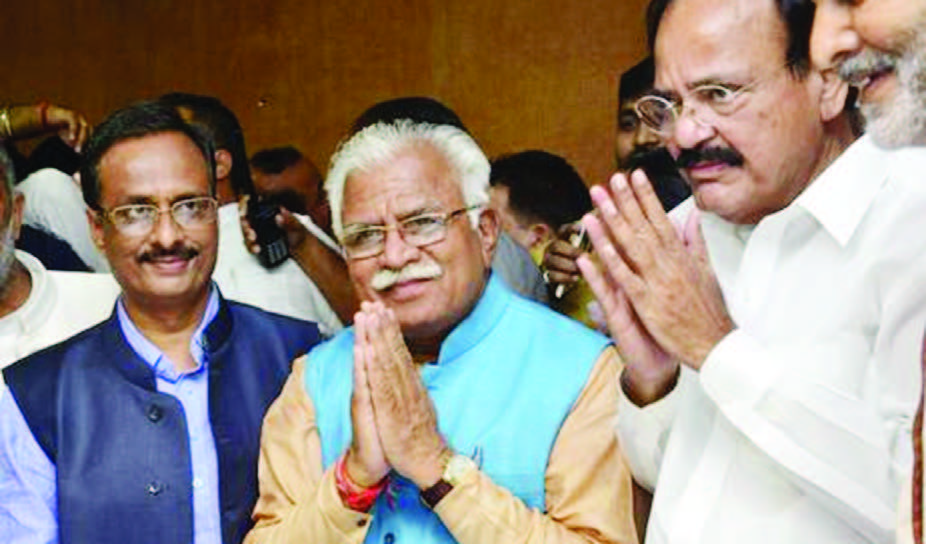
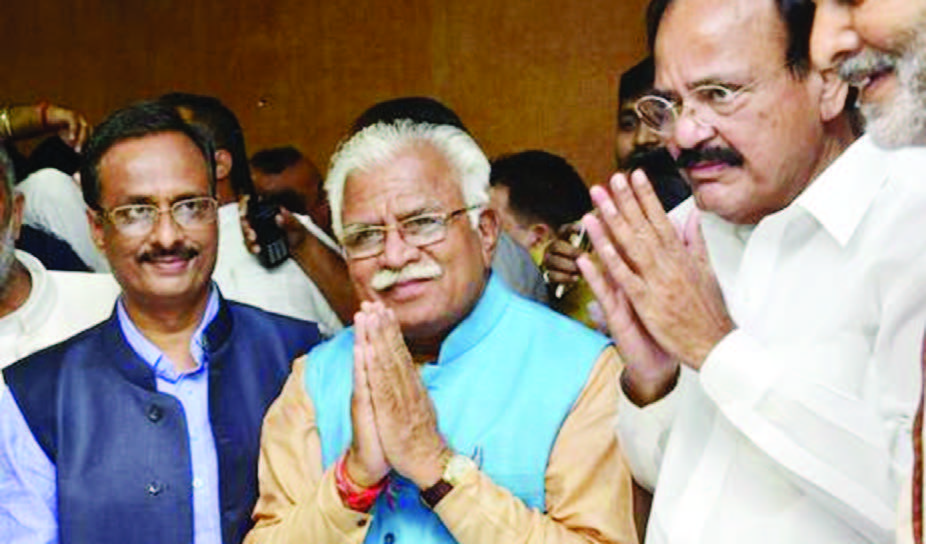
    CHANDIGARH (TIP): The Bharatiya Janata Party (BJP) has named Manohar Lal Khattar as chief minister of Haryana after it secured a majority in the Assembly elections for the first time in the state. Khattar, a Punjabi, had worked as a Rashtriya Swayamsevak Sangh (RSS) pracharak (a full-time RSS worker) for 40 years.

    The decision was taken in a meeting of elected MLAs, attended by Parliamentary Affairs Minister M Venkaiah Naidu and BJP vice president Dinesh Sharma, who were appointed as observers by the BJP’s Parliamentary Board to decide on who would become Haryana’s new chief minister. Born in Rohtak district, Khattar had contested the Assembly elections from Karnal. He won the Karnal seat with a margin of 63,736 votes. He is stated to be close to the Prime MinisterNarendra Modi and BJP chief Amit Shah Manohar Lal Khattar said, “MLAs have elected me as the leader of BJP Legislature Party.

    It was a unanimous decision. We are going to the Governor and will put forth our claim to form the Government. “The BJP has got a clear majority in the 90- member Assembly for the first time,” Khattar said as he entered the guest house with his supporters who shouted slogans in his favour. Prem Lata, first-time MLA from Uchana Kalan and wife of Birendra Singh, who joined the BJP recently, told reporters that her husband was the most experienced politician to run the state. The saffron party won 47 seats while the Indian National Lok Dal (INLD) won 19, the Congress 15, HJC-BL two, BSP and SAD bagged one seat each while Independents got five.

  • Symbol of a love affair between US and India

    Symbol of a love affair between US and India

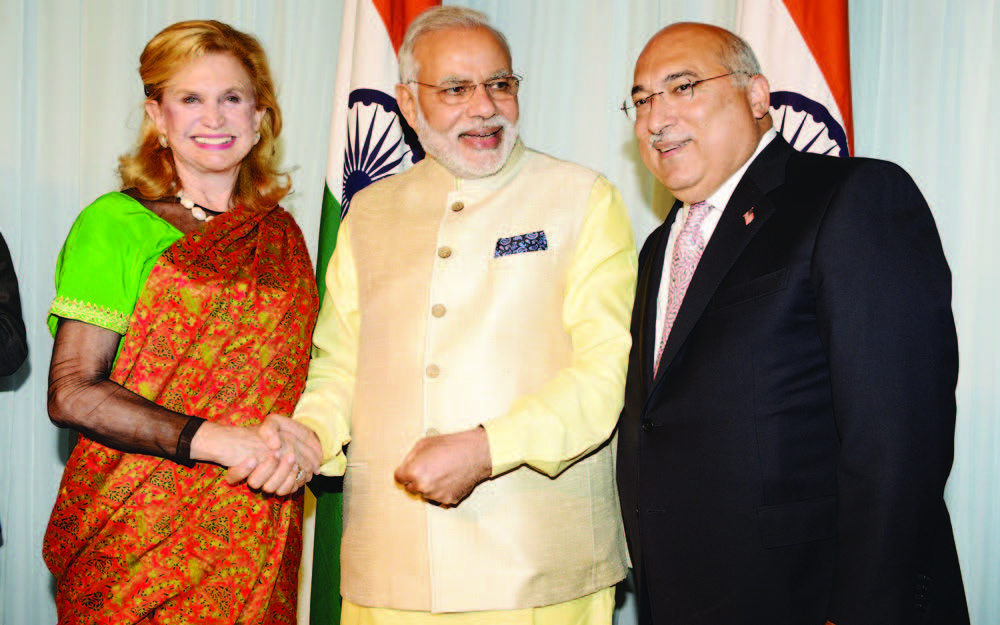
    Here are two unique pictures that capture the love affair between the United States and India. Rep. Carolyn B. Maloney decided to don an Indian Saree at the Indian Ambassador S. Jaishankar’s dinner reception to Prime Minister Narendra Modi at the Pierre Taj in New York, September 28.


    49
    Rep. Carolyn B. Maloney, PM Modi, and Maloney’s constant friend, Attorney Ravi Batra

  • The Indian Panorama Publisher- Editor greets PM Modi

    The Indian Panorama Publisher- Editor greets PM Modi

    Publisher & editor of The Indian Panorama, Prof. Indrajit S. Saluja was one of the invitees to the dinner reception to PM Modi hosted by Indian Ambassador S. Jaishankar.

  • Ranju and Ravi Batra greet PM Modi at the United Nations

    Ranju and Ravi Batra greet PM Modi at the United Nations

    As Indian-Americans and friends of India and Indians, Ravi & Ranju Batra welcome India’s PM Modi to New York and UN on 9/27/14, after he had visited the 9/11 Memorial and just walked off the UNGA podium. Batras have continued the tradition of welcoming every PM of India, including, the last PM Manmohan Singh.

  • Queens Borough President helped kick-off Queens Restaurant Week 2014

    Queens Borough President helped kick-off Queens Restaurant Week 2014

    Queens Borough President Melinda Katz helped kick-off Queens Restaurant Week 2014 by enjoying a delicious lunch with Assembly member Michael Miller (front l.), City Councilmember Elizabeth Crowley (front r.), Queens Economic Development Corporation executive director Seth Bornstein (rear l.) and Neir’s Tavern owner Loycent Gordon (rear r.) at Neir’s Tavern in Woodhaven on Tuesday, October 14. Neir’s is one of more than 200 local restaurants — spread out over roughly 30 Queens neighborhoods – that are offering special discounts to diners during this 11th annual edition of Queens Restaurant Week. The event is being held this year throughOctober 30. Most of the participating restaurants are offering special three-course prix fixe dinners for only $28 per person during this promotion, while many eateries are also offering lunches for only $14 per person. It’s a great opportunity for both borough residents and visitors alike to enjoy some amazingly diverse and incredibly tasty dishes at reasonable prices. Queens Restaurant Week has been organized by the Queens Economic Development Corporation

  • OFBJP Global Convener Vijay Jolly gets Modi’s pat

    OFBJP Global Convener Vijay Jolly gets Modi’s pat

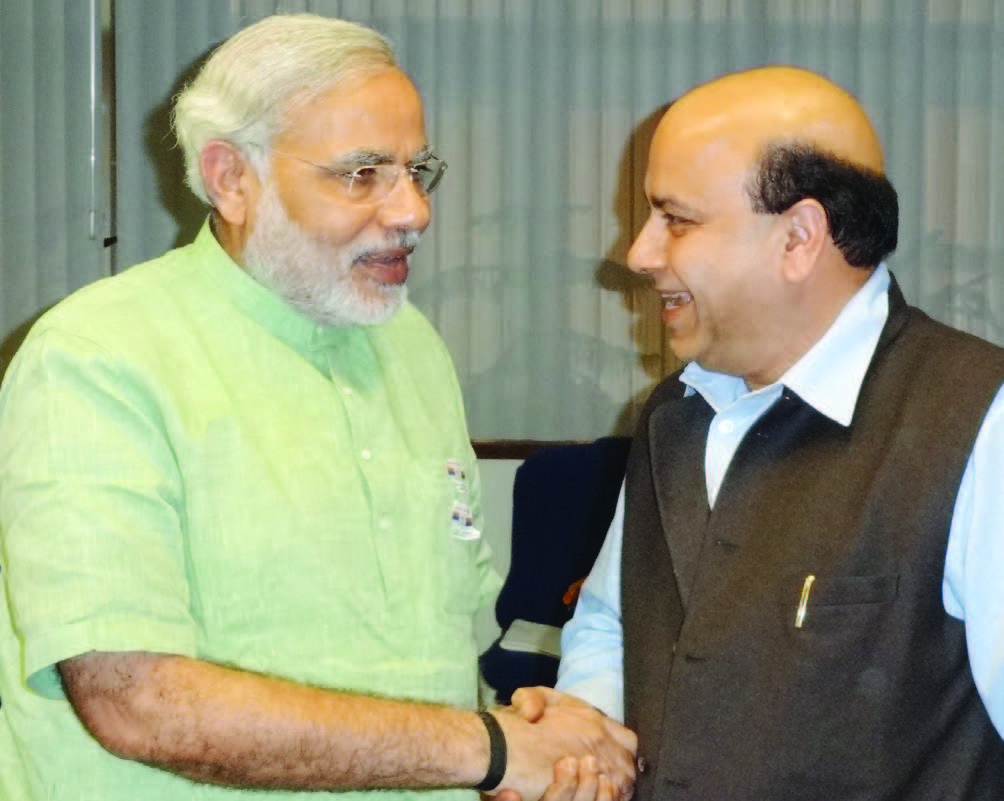
    The untiring work of Vijay Jolly, the global convener of OFBJP has been appreciated by PM Modi. Jolly has traveled far and wide to set up organizational wings all over the world. His effort has been helpful in creating loyal and hardworking cadres in every part of the world.

  • WORLD’S LONGEST FRESH FLOWER GARLAND

    WORLD’S LONGEST FRESH FLOWER GARLAND

    A new Guinness World Record for the World’s Longest Fresh Flower Garland was set , August 26 afternoon in Queens by New York City Councilman Jimmy Gennaro Ashrita Furman, holder of 206 current Guinness Records, and 200 meditation students of Sri Chinmoy(1931-2007) from 35 countries, including India to honor Sri Chinmoy’s 50 years of work for world peace. Sri Chinmoy(1931-2007) was a renowned peace visionary who founded the Oneness-Home Peace Run, world’s largest torch relay for peace, composed 21000 songs, wrote 1600 books and established meditation and peace centres in 60 counries The garland, which goes 5 miles in multiple loops on Joseph-Austin-Field in the borough Queens of New York surpasses the previous record by 1.9 miles (3 km) and weighs 4000 lb (1800 kg)

  • Gandhi Jayanti celebrated as International Day of NON-VIOLENCE at the UN

    Gandhi Jayanti celebrated as International Day of NON-VIOLENCE at the UN

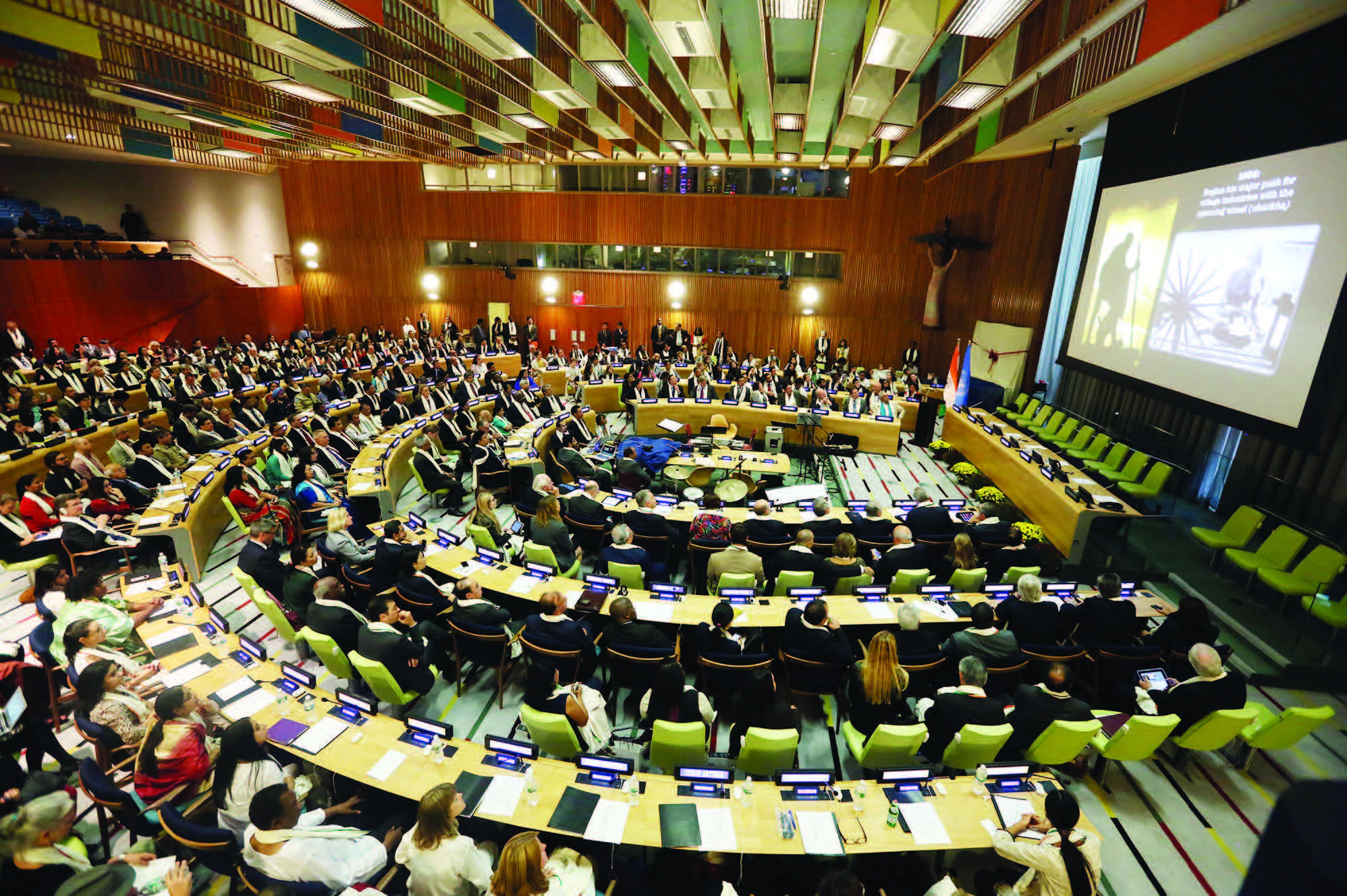
    NEW YORK (TIP): The UN General Assembly, on October 2, celebrated Mahatma Gandhi’s birthday as the International Day of Non- Violence. On 15 June 2007 the United Nations General Assembly had voted to establish October 2, as the International Day of Non-Violence. The resolution by the General Assembly asks all members of the UN system to commemorate 2 October in “an appropriate manner and disseminate the message of non-violence, including through education and public awareness.”


    43


    Present on the occasion were member nations, president of the UN General Assembly Sam Kutesa, and Sushma Swaraj, India’s External Affairs Minister who led the Indian delegation which included India’s Permanent Representative to the United Nations, Ambassador Asoke Kumar Mukerji. Rich tributes were paid to Mahatma Gandhi by the speakers which included president of the UN General Assembly Sam Kutesa, and Sushma Swaraj, India’s External Affairs Minister.

  • Dasvandh Network Inspires Giving with the Power of Ten During Dasvandh Week

    Dasvandh Network Inspires Giving with the Power of Ten During Dasvandh Week

    NEW YORK/ TROY, MI (TIP) The Dasvandh Network (DVN) is encouraging donors to give during the second annual Dasvandh Week (November 8th-16th) via online donations (www.dvnetwork.org) or in Gurdwaras throughout the country. This year’s goal of $80,000 will be achieved not only from power of ten-inspired individuals but also with matching funds from strategic donors within the Sikh community for one-time and recurring donations (limits apply).

    This makes the week of November 8th-16th the most important opportunity to maximize the reach of your donation. “Dasvandh Week is meant to serve as an annual reminder that we all can and should be giving,” said Manpreet Singh, Treasurer of the Dasvandh Network. “This year, we are calling upon our community to ask themselves, ‘Can I do more?’” Due the generosity of donors through DVN, Khalsa Food Pantry has been able to support nearly 80 families per week with non-perishable goods and produce. “We were able to acquire two refrigerators for food storage which has helped maximize our distribution of produce,” said Natasha Kaur, Khalsa Care Foundation Sevadaar.

    “We are humbled and grateful to DVN and to all who have supported us!” DVN is a not-for-profit, grassroots, crowdfunding platform that allows donors and causes to actively participate in the spirit of Dasvandh-the Sikh practice of contributing onetenth of a person’s earnings to the common good of the community. That is why DVN is encouraging donors to give with the power of ten in mind during the week-long fundraising event. Dasvandh Network is self-funded and doesn’t charge administrative fees.

    Donations via paper check are sent without any fees to the designated organization/project. To pay 3rd party payment processing providers, there is a 3.5% processing fee for credit/debit card transactions and $0.50 fee for ACH transactions. However, during Dasvandh Week, these processing fees will be waived, so along with the matching funds, 200% of donations will go to causes listed on the platform.

    About Dasvandh Network

    Dasvandh Network (www.dvnetwork.org) is a 501(c) 3 grassroots online giving platform where donors and organizations can actively participate in the spirit of Dasvandh, or share part of one’s earnings toward the betterment of society. Its mission is to inspire an increase in the level of giving to organizations and charitable projects across North America and to foster the spirit of Dasvandh among Sikhs by providing access and awareness to Sikhirelated causes.

  • 1984 Sikh Genocide’ report to be submitted to UN secretary general

    1984 Sikh Genocide’ report to be submitted to UN secretary general

    NEW YORK (TIP): The Sikhs For Justice plans to submit a report to UN secretary general Ban Ki-Moon on the genocidal violence against the Sikh community, on 7th November, on the 30th anniversary of November 1984 massacre of Sikhs in Delhi and other parts of India.

    “The report ‘1984 Sikh Genocide’ will carry details of the preplanned and deliberate killings of the Sikhs in 19 states of India, eyewash investigations by successive governments, zero convictions and the failure of the Supreme Court to take cognizance of thousands of deaths during the first week of November 1984,” announced SFJ. “On November 7, while submitting the report, thousands of Sikhs from North America and European Union will converge at the UN headquarters to highlight the denial of justice and continuous impunity to Indian political leaders involved in the 1984 genocidal violence,” said SFJ legal adviser Gurpatwant Singh Pannun.

    A ‘Sikh genocide complaint’, urging the UN to investigate the “systematic, intentional and deliberate” killing of Sikhs carried out across India during the first week of November 1984 and to recognize these attacks as genocide, is already pending before the United Nations Human Rights Council (UNHRC). The complaint, with support of more than million signatures, was filed with UNHRC on November 1, 2013.

    If the UN working group on communications decides to hear the Sikh genocide complaint, it is likely to hold hearings in 2015 August to allow the 1984 victims to present evidence related to the genocide. “The victims and the community are going to the international forum after the Indian establishment failed the victims and justice was denied to them,” Pannun said

  • The Nartan Rang Dance Academy Organizes Navratri Celebrations

    The Nartan Rang Dance Academy Organizes Navratri Celebrations

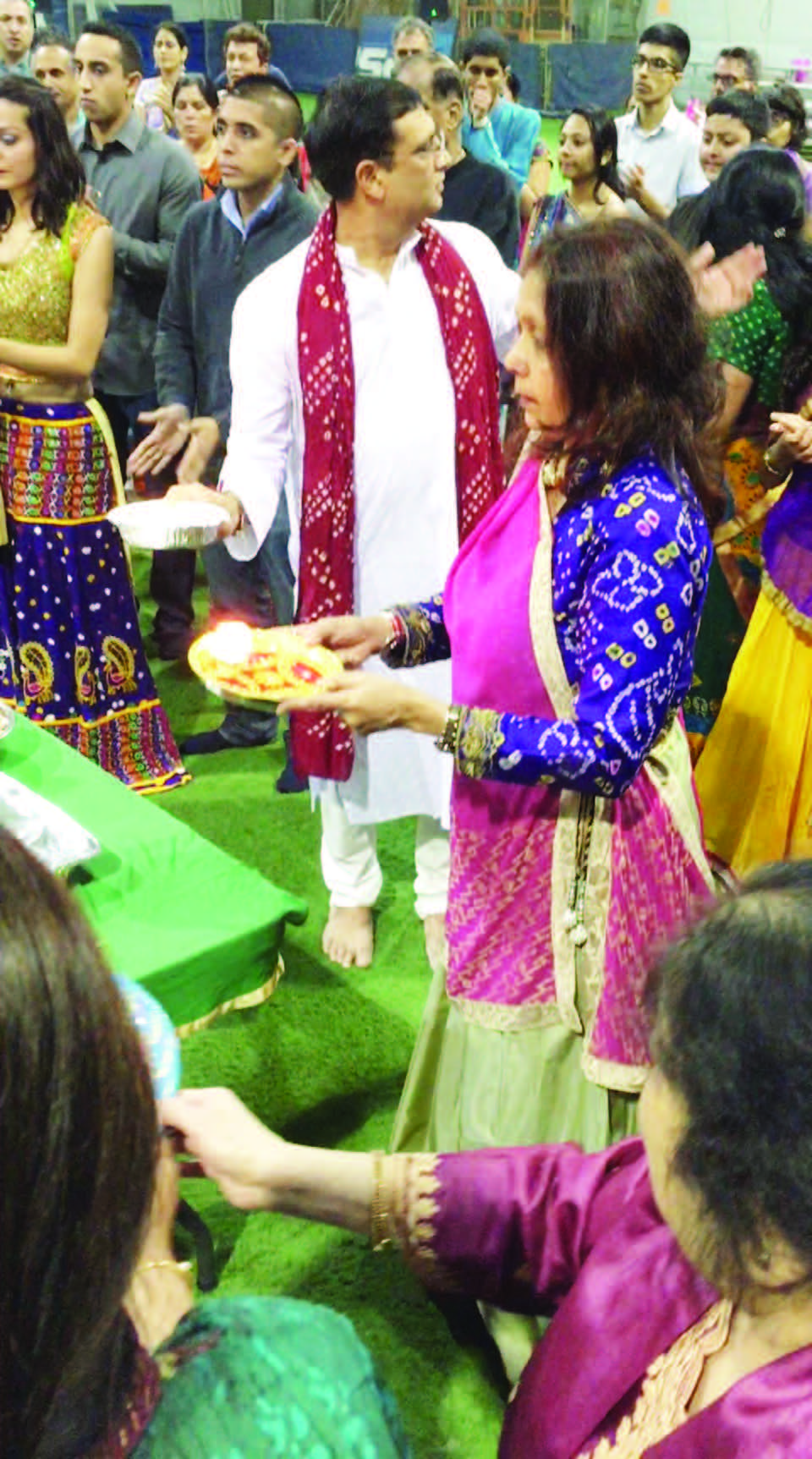
    NEW YORK (TIP): The Nartan Rang Dance Academy of Bharatiya Vidya Bhavan organized its 3rd annual Navratri celebration on Saturday, October 11th, 2014 at Mitchel Athletic Complex in Garden City, Long Island. With the melodic musical stylings of Naishad Pandya & his orchestra, nearly 250 people gathered to offer their prayers to Goddess Durga and to mingle and dance to old & new garba/raas tunes and celebrate the nine day joyous festival of Navratri, which turned out to be a special treat that the celebrations coincided with Sharad Poornima.


    40


    41


    Nartan Rang prides itself on hosting Navratri annually for the sole purpose of getting people together to dance and meet old and new friends, young & old alike, on an auspicious and joyous occasion. The director of Nartan Rang Dance Academy, Swati Vaisnav announcing the 2015 Navratri celebrations said, “Watch out for Saturday, October 17th, 2015 for the next dandiya raas; certainly not too far away!”

  • Ekal Raises Rs. 1 Crore to Implement Clean India Campaign in Villages

    Ekal Raises Rs. 1 Crore to Implement Clean India Campaign in Villages

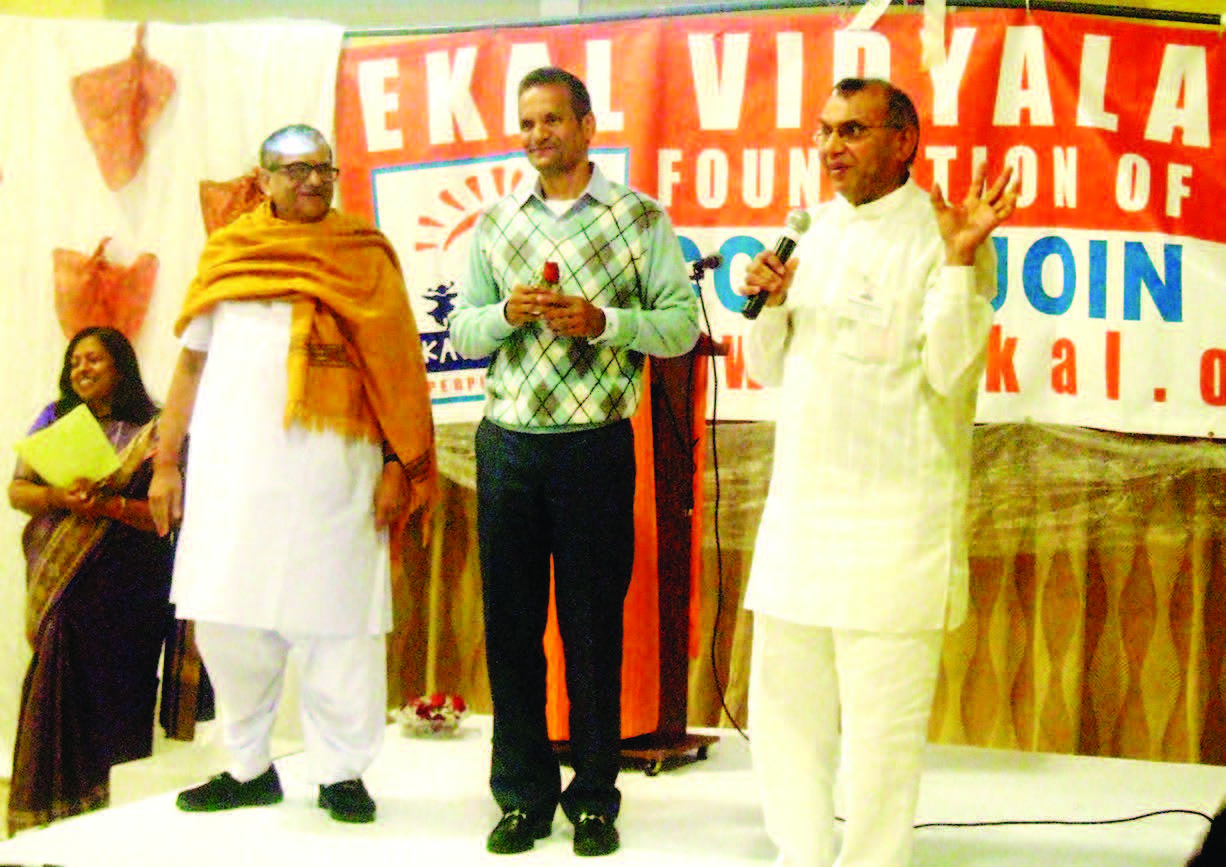
    NEW YORK (TIP): ‘Ekal Vidyalaya Foundation-USA (EVFUSA)’, recently (Oct. 3-5) hosted an international conference in Cincinnati, Ohio to address various issues facing rural education, hygiene, and integrated development in remote parts of India, where it operates. In opening remarks, Shyamji Gupta, founder of ‘Ekal Movement’ set the tone by challenging the gathering to undertake a new initiative for the rural masses.

    Inspired by the clarion call for a ‘Swachha-Bharat’ (Clean-India) by P.M. Narendra Modi, Ekal volunteers whole heartedly adopted this campaign to create and implement a strategy to clean the Ekal Villages where 1.5 million children are being nurtured and groomed. The campaign will create awareness and develop sustainable approaches to keep the villages clean. This conference had brought together volunteers, field teams and philanthropists from across US, India and Canada and astoundingly raised Rs. 1 Crore for this purpose. Spearheading the on-the-spot fundraising efforts Himanshu Shah, CEO, Shah Capital, said “poor sanitation and lack of solid waste management has had tremendous negative impact on the health of Indians all over.

    It is time we address this issue”. He contributed significant amount of his own monies to the cause and matched donations raised by Ekal.Welcoming this impromptu generosity, Vinod Jhunjhunwala, President of ‘EVFUSA’ said, “while ideas are plenty, India often loses out on implementation. Ekal, with its reach in over 54,000 villages throughout India has wide grass-root network that can effectively implement this cleaning initiative”. Ekal uses education as a primary vehicle to bring holistic development of remote and rural villages.

    In addition to education, Ekal is working on health, sanitation, agriculture and development. Ajay Singh, Project Coordinator for EVF-USA, informed the gathering about the state-of-the-art approach adopted by ‘Ekal-India’ to administer and monitor various aspects of ‘Ekal’. He further elaborated that the teacher’s and student’s third-party assessment, automated school allocation as well as their ‘google-mapping’ was already underway. The movement has created so much excitement among youth in the U. S. that several college students are going to Ekal villages to study the movement.

    Recently, Rohan & Anjeli Sharma, brother-sister team, both less than 15 year old, spent three weeks in an Ekal Village, learning how Ekal had impacted villager’s lives. The reciprocal volunteerism of the Ekal model has also caught the eye of the Afghanistan community who feel that this unique model could be beneficial to the tribal-rural villages of Afghanistan. A team from Afghanistan headed by Sunil Ishairzay, visited India, last year, with the sole intention of studying and replicating Ekal education model in Afghanistan. Several innovative solutions to a range of issues including the use of technology for education and the micro-rural entrepreneurship were also discussed.

    In several villages, solar energy is already being used by the villagers for life’s basic necessities with help from ‘Ekal’. At the conference, Ekal also addressed the national tragedy of the floods affecting the Kashmir valley. Ekal USA has year-marked $150,000 for these flood victims. In short, Ekal Vidyalaya, the largest grass-root movement undertaken by NRIs and Indians is playing a key role in the lives of neglected masses for their self-sustenance and empowerment.

  • Tenants Protest Illegal Evictions

    Tenants Protest Illegal Evictions

    City Councilmembers Jumaane Williams and Steven Levin Call for Action

    NEW YORK, NY (TIP): Vowing to continue their campaign to end illegal lockouts and evictions, tenants of threequarter houses spoke out about landlords’ abusive practices on the steps of City Hall, October 14. They were joined by City Council Members Jumaane Williams and Steven Levin, who pledged their continued support of tenants’ demands. Darryl Herring, a leader of the Three- Quarter House Tenant Organizing Project (TOP), described how hundreds of tenants have been routinely evicted by operators, often with the help of police.

    The situation led TOP to organize a citywide campaign against illegal lockouts, which resulted in the NYPD issuing a citywide directive (known as a FINEST message) clarifying that evictions can only be made with a court order. “For years, three-quarter operators have claimed that they run transitional ‘programs,’ and can ‘discharge’ tenants whenever they want,” said Matthew Main, an attorney with MFY Legal Services, which defends three-quarter house tenants. “With the NYPD directive in hand, tenants have a way to defend themselves.

    It’s an important first step in stopping this abuse.” When Gary Crawford refused to leave his three-quarter house after he was awakened in the middle of the night and told to get out, the house manager called the police, who told Crawford he had to leave. He went to Housing Court several times to get a judge to reinstate him, and contacted MFY Legal Services for help.

    He was reinstated with MFY’s help, but spent weeks sleeping on subway platforms and the street before once again having a roof over his head. Another resident, Leonard Washington, said: “I was doing my thing, doing well. They gave me an hour to leave. They said they’d call the police if I didn’t. I took as much as I could carry and left everything else behind. I was homeless. I stayed on the street for two weeks.” José Capo described how his landlord locked him out of his three-quarter house and told him that they would not let him back in without a court order. “I moved to the three-quarter house because I needed a roof over my head and it was the only place I could afford.

    I went to school, did job training, and earned a certificate. My world fell apart when they put me out,” he said. When the landlord ignored the court order Mr. Capo got ordering the landlord to let him return home, Mr. Capo called the police and showed them a copy of the FINEST Message that he kept in his pocket. The police told the landlord that illegal eviction is a crime and ordered the landlord to let Mr. Capo back into his room, keeping him from becoming homeless. “I really don’t know where I’d be if the police didn’t help me get back in that night,” Mr. Capo said. “Illegal evictions in Three-Quarter Houses are extremely harmful and destabilizing to a tenant, and often force those evicted into uncertain futures,” said City Council Member Jumaane D. Williams, Chair of the Council’s Housing and Buildings Committee.

    “Whether living in a three-quarter house or not, all tenants deserve to be treated with dignity and respect, and their rights need to be protected. I applaud the Tenant Organizing Project for advocating against illegal evictions by working with the NYPD to protect New York’s most vulnerable tenants, but hope police officers do more to ensure bad landlords do not violate the law.” Three-quarter houses are privately owned, for-profit residences that rent out rooms to New York City’s most vulnerable individuals, including people who recovering from substance abuse, reentering society after being incarcerated, trying to get themselves off of the street, or are suffering from mental illness.

    While the exact number of three-quarter houses is unknown, researchers at John Jay College’s Prisoner Reentry Institute have identified at least 317, including 250 in Brooklyn alone. Although three-quarter house operators often describe their houses as “programs,” they offer no services beyond a bed and are unlicensed and unregulated. MFY Legal Services provides free civil legal services to more than 9,000 poor and low-income New Yorkers annually in housing, public benefits, health, consumer, foreclosure and employment matters.

    Neighbors Together is a community-based organization in Ocean Hill-Brownsville, Brooklyn, which works to end hunger and poverty in the surrounding communities, providing emergency food, social services, and support for tenants to organize for systemic change. MFY collaborated with Neighbors Together and three-quarter house residents to create the Three-Quarter House Tenant Organizing Project (TOP), a tenantrun organization fighting for fair and just treatment of three-quarter house tenants.

    TOP holds regular meetings and workshops at Neighbors Together, which serves as the nexus of grassroots activity for threequarter house residents who live in houses throughout Brownsville, East New York, Bedford-Stuyvesant, Bushwick and surrounding neighborhoods. With the emergence of three-quarter houses in the Bronx, the work includes Bronx residents as well.

  • Comptroller’s Audit reveals “weak and inadequate” response to complaints about rodent infestation

    Comptroller’s Audit reveals “weak and inadequate” response to complaints about rodent infestation

    NEW YORK, NY (TIP): At a press conference in Harlem, October 14, New York City Comptroller Scott M. Stringer unveiled findings of a new audit showing widespread deficiencies in the Department of Health and Mental Hygiene’s (DOHMH) response to citizen complaints about rodents. “This is a rat race we’re all losing and it’s one that affects our quality of life,” Comptroller Stringer said. “When people discover infestations in their homes and on their blocks, they expect a quick and effective response.

    Our audit found that the Department of Health and Mental Hygiene wasn’t managing its pest control program effectively, even as the number of complaints about pests grew.” The number of pest complaints in New York City jumped from 22,300 in FY 12 to 24,586 in FY 13. Comptroller Stringer’s audit examined whether one of the agencies primarily responsible for pest control, the Department of Health and Mental Hygiene, adequately followed its procedures for addressing pest control complaints during the period from July 1, 2011 through April 8, 2014. DOHMH receives pest complaints online and through New York City’s 311 complaint call system, which are then assigned to one of five regional offices for inspection and notification, as well as the baiting and cleanup of properties if owners fail to act.

    Auditors found DOHMH had weak oversight of its Pest Control Services program and failed to follow its own procedures:

    In 24 percent of the cases examined, DOHMH failed to check out citizen complaints in the 10-day target that it has established as the proper time in which to respond;

    In 160 cases, there was no field inspection attempt at all and 14 still had an open status in DOHMH’s system as of March 2014;

    DOHMH terminated action on some citizen complaints prematurely without conducting the required number of inspection attempts and did not meet its own targets for reviewing inspections performed in the field;

    There was no indication that assessments were conducted in 44 percent of 386 instances where inspectors requested clean up services during FY13, a required step before remediation can proceed; and

    DOHMH failed to give some property owners notifications of city orders to eliminate rodent conditions – thus increasing the risk that rat infestations may spread through a neighborhood. “Rats are a daily, stomach-turning insult to New Yorkers – whether they’re scurrying over people’s feet on the sidewalks, invading homes where children sleep or swarming through restaurants,” Stringer said. “Without a vigilant and timely response by the City to citizen complaints, this problem will come back to bite us again and again.”

    In a series of recommendations, auditors said DOHMH should:

    Generate reports to identify complaints that have been pending too long, to ensure citizens get a more timely response.

    Improve its controls over pest control processes, to ensure that all requested exterminations and approved clean-ups are conducted.

    Modify its procedures to ensure that complaints are not closed after only one failed attempt to gain access to a site.

    Make certain that supervisory checks are conducted for inspections at or above the percentage specified in its procedures to ensure that problems in the field have been dealt with efficiently and completely. In response to the Comptroller’s audit, DOHMH generally agreed in principle with all but 1 of the audit’s 12 recommendations. However, DOHMH argued that the audit did not take into account the agency’s other efforts to address pest control problems. “When it comes to rat infestations, New Yorkers expect much more from the Department of Health and Mental Hygiene than excuses and denials. I fully expect this audit will help trigger a new, more serious course of action,” Stringer said.

  • What Modi did not say on Oct 2

    What Modi did not say on Oct 2

    In the cleanliness drive Gandhi’s real message of communal harmony was missing

    “That communal harmony was his (Gandhi’s) foremost concern was emphasized again in 1921 and repeated on March 24, 1947, at a prayer meeting in Rajghat thus: “I would say that Hindus and Muslims are the two eyes of mother India – just as the trouble in one eye affects the other too, similarly the whole of India suffers when either a Hindu or a Muslim suffers”, says the author

    The Modi government has, by a not-so-clever sleight of hand, converted the most important day in India, October 2, Gandhi’s birthday, into a cleanliness day. Of course this was buttressed by a repeat of Gandhi’s exhortation of “cleanliness is next to godliness”. No one can be against spreading awareness about cleanliness. But when an attempt, and not so subtle one, is made by the RSSdominated Modi government to sidetrack the real message of Gandhi, one cannot ignore this mischievous move.

    Days before Modi was to do the cleaning act at the Valmiki quarters in New Delhi, the whole area was checked for security (right, no objection to the security angle). But what was hypocritical was the fact that the whole area was cleaned by the sanitation staff regularly for days earlier. Have we not seen in newspapers how ministers, in order to show their extra loyalty, had empty bottles thrown by the sanitary staff without any embarrassment and then made a mockery of the cleanliness drive by removing them while getting themselves photographed? My objection is not to the observance of the cleanliness day – do it by all means provided it is on another day. But I do have a serious objection to converting Gandhi’s birthday as the cleanliness day, as if that is the most important message of Mahatma Gandhi.

    If one watched TV channels, it was Modi and his cohorts waving the broom. Gandhi’s real message of communal harmony was totally missing. Gandhi’s stature of being the tallest Indian was reduced to a small mention and the whole focus was on Modi holding a broom. If the Modi government denies this, will it explain why it never mentioned the real message of Gandhi which he consistently emphasized? Let me reproduce the pledge which Mahatma Gandhi wanted Indians to take in 1919: “With God as a witness we Hindus and Mohamedans declare that we shall behave towards one another as children of the same parents, that we shall have no differences, that the sorrows of each will be the sorrows of the other and that each shall help the other in removing them. We shall respect each other’s religion and religious feelings, and shall not stand in the way of our respective religious practices.

    We shall always refrain from violence to each other in the name of religion.” That communal harmony was his foremost concern was emphasized again in 1921 and repeated on March 24, 1947, at a prayer meeting in Rajghat thus: “I would say that Hindus and Muslims are the two eyes of mother India – just as the trouble in one eye affects the other too, similarly the whole of India suffers when either a Hindu or a Muslim suffers.” Gandhi’s emphasis against communalism was again shown in the letter he wrote in Harijan in January 1948 in Gujarati (emphasis mine) where he specifically said: “I think it is proper to address a few words to the people of Gujarat. (Modi as a Gujarati should have in all propriety and claiming to be spreading the message of Gandhi reminded the nation of what Gandhi wrote in 1948) Delhi has always been the Capital.

    It would be the limit of foolishness to regard it as belonging only to the Hindus or the Sikhs. All Hindus, Muslims, Sikhs, Parsis, Christians and Jews who people this country from Kanyakumari to Kashmir and from Karachi to Dibrugarh in Assam and who have lovingly and in a spirit of service adopted it as their dear motherland, have an equal right to it. No one can say that it has a place only for the majority and the minority should be dishonoured” (emphasis mine). Modi went to pay homage at Rajghat on the 2nd October 2014 morning.

    Surprisingly, no one told him about this solemn pledge taken by Gandhi. But then Modi could not have taken this pledge with a clear conscience, considering the B.J.P. is shame-facedly busy in congratulating and felicitating party workers accused of violent crimes against Muslims in Muzaffarnagar (U.P.) even when they are being prosecuted in a court of law. Such open demonstration in favor of the accused is a clear case of contempt of the court.

    Also, how can Modi spread the message of Hindu-Muslim harmony when his mentor, RSS chief Bhagwat, was provided the services of Doordarshan to spread communal poison against the Muslims by falsely bringing up the question of Bangladeshi immigrants in Assam and West Bengal, Bihar and creating panic by a canard that it had the potential to endanger the life of Hindu society there – very mischievously ignoring the fact that hundreds of Muslims were killed in the recent flare-ups in Assam, Bodoland? Modi’s claim to be secular is unacceptable in the context of his silence at the crude thinking of some of the BJP diehards who are planning to celebrate the birthday of Hemu, employed as a General in the army of Afghan ruler Sher Shah – he vainly chose to describe himself as King Vikramaditya and challenged the King. Akbar’s army was defeated.

    The diehard in the RSS are so perverse that they are claiming it as a very big battle of a Hindu king against the great Akbar who has been praised in the U.N. Human Development Report 2004 for his pronouncements on religious tolerance such as “no one should be interfered with on account of religion, and any one is allowed to go over to a religion that pleases him”. Modi in his radio speech has rightly referred reverentially to Swami Vivekanand as one of the greatest Indians. But will Modi tell his RSS followers to remember and follow Swami Vivekanand, who believed in total Hindu-Muslim unity and profusely praised Islam?

    In a letter to his friend Mohammed Sarfraz Hussain (June 10, 1898 ) Vivekanand wrote without any hesitation: “Therefore I am firmly persuaded that without the help of practical Islam, theories of Vedantism, however fine and wonderful they maybe, are entirely valueless to the vast mass of mankind. For our own motherland a junction of the two great systems Hinduism and Islam – Vedanta brain and Islam body – is the only hope……” There thus can be no real progress in India which does not include the minorities such as Muslims and Christians as equal stakeholders. This is the real message which Modi should have spoken of on Gandhi’s birthday if he meant to pay a genuine respectful tribute to Mahatma Gandhi.

    (The author is an Indian lawyer and a former Chief Justice of the Delhi High Court. He was a member of United Nations Sub-Commission on the Promotion and Protection of Human Rights.)

  • A commendable effort

    A commendable effort

    India’s Polar Satellite Launch Vehicle (PSLV), with the consummate ease that has become the rocket’s hallmark, placed the third Indian Regional Navigation Satellite System (IRNSS) spacecraft into orbit in the early hours of Thursday. Over the years, the Indian Space Research Organisation (ISRO) has steadily enhanced the capabilities of this rocket, which was originally developed to put remote sensing satellites into orbits so that it could carry heavier satellites than before, inject them into orbit with greater accuracy and take on a range of missions including launching the lunar probe, Chandrayaan-1, as well as the Mars Orbiter Mission.

    Its record of 27 consecutive successful flights is a tribute to the meticulous preparations and attention to every tiny detail that goes on behind the scenes before each launch. Indeed, the latest launch was postponed by almost a week in order to attend to a technical glitch that had cropped up. The IRNSS constellation will give India guaranteed access to what has become a critical service in the present day – navigation satellite signals.

    America’s Global Positioning System (GPS), with worldwide coverage, is the leader in the field. Russia, for its part, established a similar capability with the Global Navigation Satellite System (GLONASS). But others worry about becoming wholly dependent on them for a service that is vital for military operations as well as in many civilian sectors. Europe is therefore in the process of putting its own constellation of Galileo navigation satellites in place.

    China is likewise creating the BeiDou Navigation Satellite System; a regional service has already been launched and it intends to achieve global coverage by around 2020. Using its seven satellites, the IRNSS system will beam accurate navigation signals over India and up to 1,500 km from its borders. Three of those satellites have already been launched and ISRO plans to have the remaining satellites in place by the middle of next year. By adding four more satellites, India has the option to extend the area covered by its navigation system.

    Meanwhile, ISRO’s Space Applications Centre in Ahmedabad has undertaken the development of receivers that can utilize the IRNSS signals and is also helping industry do the same. Early trials using these receivers are going to get under way. Efforts are also going into chipsets for portable devices that will utilize those signals. A market assessment carried out by a well-known consultancy company indicates that there is potentially a huge market available in the subcontinent. Turning this potential into reality is going to be a challenge, and ISRO will necessarily have to play a leadership role here

  • How internet is helping the ‘Islamic State’

    How internet is helping the ‘Islamic State’

    The ISIS has turned the internet into the most effective propaganda tool ever. Propaganda war of Islamic extremists is being waged on Facebook and internet message boards, not mosques

    Ever since the Pentagon started talking about Isis as apocalyptic, I’ve suspected that websites and blogs and YouTube are taking over from reality. I’m even wondering whether “Isis” – or Islamic State or Isil, here we go again – isn’t more real on the internet than it is on the ground. Not, of course, for the Kurds of Kobani or the Yazidis or the beheaded victims of this weird caliphate.

    But isn’t it time we woke up to the fact that internet addiction in politics and war is even more dangerous than hard drugs? Over and over, we have the evidence that it is not Isis that “radicalises” Muslims before they head off to Syria – and how I wish David Cameron would stop using that word – but the internet. The belief, the absolute conviction that the screen contains truth – that the “message” really is the ultimate verity – has still not been fully recognised for what it is; an extraordinary lapse in our critical consciousness that exposes us to the rawest of emotions – both total love and total hatred – without the means to correct this imbalance. The “virtual” has dropped out of “virtual reality”.

    Dangerous forum

    At its most basic, you have only to read the viciousness of internet chatrooms. Major newspapers – hopelessly late – have only now started to realise that chatrooms are not a new technical version of “Letters to the Editor” but a dangerous forum for people to let loose their most-disturbing characteristics. Thus a major political shift in the Middle East, transferred to the internet, takes on cataclysmic proportions. Our leaders not only can be transfixed themselves – the chairman of the US House Committee on Homeland Security, for example, last week brandishing a printed version of Dabiq, the Isis online magazine – but can use the same means to terrify us.

    Laptop and jihad

    Stripped of any critical faultline, we are cowed into silence by the “barbarity” of Isis, the “evil” of Isis which has – in the truly infantile words of the Australian Prime Minister – “declared war on the world”. The television news strip across the bottom of the screen now supplies a ripple of these expressions, leaving out grammar and, all too often, verbs. We have grown so used to the narrative whereby a Muslim is “radicalised” by a preacher at a mosque, and then sets off on jihad, that we do not realise that the laptop is playing this role.

    In Lebanon, for example, there is some evidence that pictures on YouTube have just as much influence upon Muslims who suddenly decide to travel to Syria and Iraq as do Sunni preachers. Photographs of Sunni Muslim victims – or of the “execution” of their supposedly apostate enemies – have a powerful impact out of all proportion to words on their own. Martin Pradel, a French lawyer for returning and now-imprisoned jihadists, last week described how his clients spent hours on the internet with a preference for YouTube and other social networks, looking at images and messages marketed by Isis. They did not – please note – go to mosques, and they drew apart from family and friends.

    A remarkable AFP report tells of a 15-yearold girl from Avignon who left for the Syrian war last January without telling her parents. Her brother discovered she led parallel lives, with two Facebook accounts, one where she talked about her normal teenage life, another where she wrote about her desire to go “to Aleppo to help our Syrian brothers and sisters”. Mr Pradel said the “radicalisation” was very quick, in one case within a month. It reminds me horribly of the accounts of American teenagers who lock themselves on to the internet for hours before storming off to shoot their school colleagues and teachers.

    Publicity for a caliphate

    Online, Dabiq – named after a Syrian town captured by the jihadis which will supposedly be the site of a future and apocalyptic (yes, that word again) battle against the Western crusaders – is a slick venture. But print it up and bind it – I have such a copy beside me as I write – and it appears very crude. There are photographs of mass executions which look more like pictures of atrocities on the Eastern Front in World War II than publicity for a new Muslim caliphate. There is the full text of poor James Foley’s last message before his beheading which – on paper – is deeply saddening. “The Dabiq team (sic) would like to hear back from its readers,” the editors say at the end, providing email addresses and advice to be “brief” because – they add, with perhaps unintentional humour – “your brothers are busy with many responsibilities and therefore will not have the time to read long messages.” But that’s the point, isn’t it? Be brief. Keep the length down. No aimless arguments or the letter may be “modified” (that’s the word the editors actually use in English).

    Failure of mainstream press

    I will not dwell here on the failure of the West’s “mainstream” press – another word I loathe – in defining Isis; Dabiq’s publishers have cleverly mimicked many of its faults. But those who are gripped by the messages of the internet – pictures of the chemical gas victims in Damascus last year have clearly had a tremendous influence – are not going to be swayed by us journos any more. In this new world, we can lose our heads, literally. But remember the internet. Clearly, Isis has.

    (The author is an English writer and journalist from Maidstone, Kent. He has been Middle East correspondent of The Independent for more than twenty years)

  • Pakistan needs to ‘incite’ those ‘fighting’ in Kashmir: MUSHARRAF

    Pakistan needs to ‘incite’ those ‘fighting’ in Kashmir: MUSHARRAF

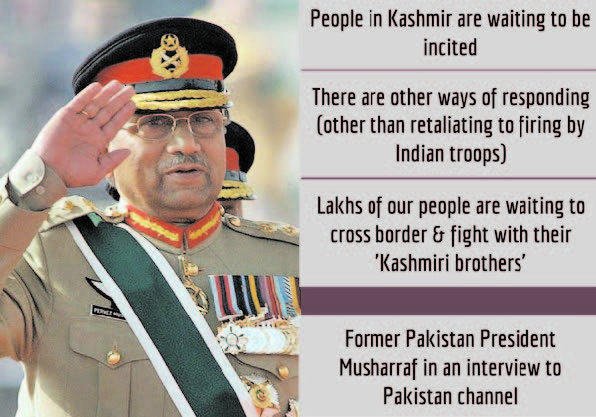
    ISLAMABAD (TIP): In the wilderness for a long time, former military ruler General Pervez Musharraf made an anti-India rant by saying Pakistan needs to “incite” those “fighting” in Kashmir. “We have source (in Kashmir) besides the (Pakistan) army…People in Kashmir are fighting against (India). We just need to incite them,” the 71- year-old retired general, who is currently on bail in a treason case, told a TV channel. Musharraf, who had grabbed power in 1999 soon after the Kargil conflict, said the army is ready for war (with India) and lakhs of people in Pakistan are willing to go and fight for Kashmir.

    India should not be under the illusion that Pakistan will not hit back, he added. “In Kashmir, we can fight with the (Indian) army from both the front and back…We are Muslims. We will not show the other cheek when we are slapped. We can respond tit for tat,” he said, while commenting on the recent firing along the Line of Control and International Border. He said external aggression happens only when the country remains internally weak. “If we remain strong internally, no one can dare to target us.” Musharraf also said (Narendra) “Modi is anti-Muslim and anti- Pakistan. He has not changed. The problem is with us… We are running to attend his (Modi) inauguration, we should keep our dignity.”

  • Shinzo Abe becomes first Japanese PM to visit Sri Lanka in 24 years

    Shinzo Abe becomes first Japanese PM to visit Sri Lanka in 24 years

    COLOMBO (TIP): Shinzo Abe on October 12 became the first Japanese prime minister to visit Sri Lanka in 24 years, on the second leg of a South Asian tour that sought to assert Tokyo’s interest in a region where it has ceded influence to China. Abe was greeted by Sri Lankan President Mahinda Rajapaksa at Colombo’s international airport, where a new passenger terminal will be built with the help of a $330 million Japanese development loan.

    The two leaders struck “a new partnership between maritime countries” that reflects Japan’s interest in keeping open shipping lanes that supply oil and liquefied natural gas from the Middle East to feed its energydependent economy. “The president and I shared the view on building friendly ties and partnership between the two maritime countries,” Abe said after the meeting. Asian great-power diplomacy has stirred into life since the rise to power of Indian nationalist Narendra Modi, who announced his intent to play an active role on the world stage by inviting regional leaders to his inauguration in May.

    Abe comes to India’s backyard after hosting Modi for summit talks that yielded a Japanese pledge to invest $34 billion in India and launched a “special, strategic global partnership” to deepen security cooperation. The Japanese premier pre-empts Chinese President Xi Jinping, who travels to India and Sri Lanka later this month. “They (the Japanese) are aware that we are beholden to China’s influence in many ways, so they would like to counter that,” Nanda Godaga, a retired Sri Lankan diplomat who follows Japanese foreign policy, said before Abe’s visit.

    China has financed the construction of a $500 million port terminal for Colombo as part of efforts to build a ’21st-century maritime silk road’, but Tokyo plays down any notion that Asia’s two largest economies are entering a geopolitical contest. “We are not going to become a big superpower … we have a lot of investment in China,” Abe’s spokesman, Kenko Sone, told a briefing in the Bangladeshi capital Dhaka on Sunday morning. “We have some difficulties with them but we prefer to solve those issues through discussions.” In Bangladesh on Saturday, Abe followed up on commitments for Japanese business to invest 600 billion yen ($5.7 billion) in infrastructure projects, and won Dhaka’s support for Tokyo’s bid for a temporary seat on the United Nations Security Council.

  • Flight MH370 mystery: Still no answers

    Flight MH370 mystery: Still no answers

    KUALA LUMPUR (TIP): Six months after Malaysia Airlines Flight MH370 with 239 people on board disappeared in the Indian Ocean, aviation experts are still clueless over the world’s greatest aviation mystery. Australia, which is responsible for search and rescue operations, is set to launch a new phase of the multimillion dollar search, in an area about 1,800 km off its west coast. Australian Prime Minister Tony Abbott on Saturday said an intensified underwater search for missing Flight MH370 will start in about two weeks’ time.