Month: May 2015

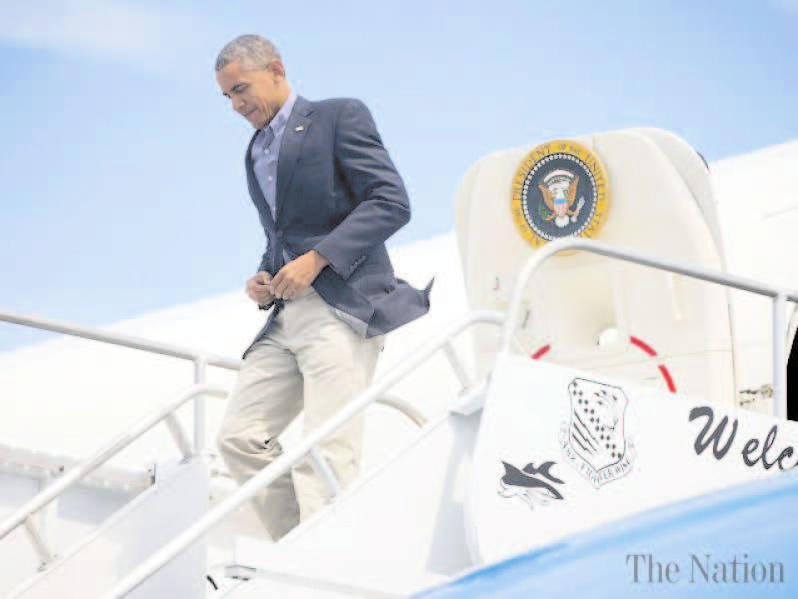
  • Obama to enter presidents’ ‘50 state club’

    Obama to enter presidents’ ‘50 state club’

    WASHINGTON (TIP): When Barack Obama steps off Air Force One in South Dakota on May 7, he will join an exclusive group of US presidents who have visited all 50 US states while in office.

    Jimmy Carter, Ronald Reagan and George W Bush didn’t do it.

    After 49 states, Bush did not fancy a trip to liberal Vermont during the financial crisis.

    But Bill Clinton did and George Bush senior managed it in just one term.

    US presidencies are made and measured by big speeches and grand symbolic gestures, but also figures and statistics.

    How many times has the president vetoed a bill from Congress? How many executive orders were issued? How many state dinners were hosted at the White House? And how many states did he visit?

    “Visiting all 50 States is an important goal,” said Brendan Doherty of the politics department at the United States Naval Academy.

    “State identity matters so much in the American system: Presidential elections are held by States, there are equal State representations in the Senate.”

    “Even if they have already visited states where over 99 percent of the American population live, they want to make a visit to each state simply so that they can say that they have.”

    Obama took to local channel KSFY-TV to announce the trip, which will include a commencement address at the Lake Area Technical Institute.

    “May 8th we’re coming,” he said. “I can’t let my South Dakota friends feel neglected.”

    South Dakota secretary of tourism James Hagen, who invited Obama to visit as far back as 2013, said “I am absolutely convinced he is saving the best for last.”

    It might be surprising that such a history-minded president would wait so long to visit the state that is home to Mount Rushmore — a rock face emblazoned with the likenesses of George Washington, Thomas Jefferson, Theodore Roosevelt and Abraham Lincoln. But even in his election drubbings of Republicans John McCain in 2008 and Mitt Romney in 2012, Obama was roundly defeated in the state.

    With a solidly Republican voter base, South Dakota is far from Washington, with a population of less than a million and with only three of 538 electoral votes up for grabs at the presidential elections. It was never going to be top of Obama’s travel list.

    But with no more elections to run, Obama may as well make a visit.

  • DRONE SPOTTED OVER PASSENGER JET IN DALLAS

    DRONE SPOTTED OVER PASSENGER JET IN DALLAS

    DALLAS (TIP): Pilots of a Virgin America flight reported seeing a drone flying above their airplane on Tuesday, April 28 night.Pilots notified Air Traffic Control at Love Field Airport just before 9:30 p.m. that the drone was flying about 200 feet above the plane, which was at 1,000 feet, according to Jose Torres from the City of Dallas’ Aviation Department.The plane was on final approach above the Crescent Hotel when pilots spotted the drone.

    The drone was not in Love Field’s airspace, Torres said. The drone was in downtown Dallas.

    Dallas Police Department’s helicopter, Air One, flew along the landing route, but did not find any sign of the drone. The Federal Aviation Administration is investigating.

  • REPUBLICAN MIKE HUCKABEE LAUNCHES 2016 US PRESIDENTIAL BID WITH FIERY SPEECH

    HOPE, ARK (TIP).: Republican Mike Huckabee announced a run for his party’s 2016 presidential nomination on May 3 with a fiery, populist speech aimed at energizing support from the Christian right and blue-collar Americans struggling to make ends meet.

    The 59-year-old former Arkansas governor and former host of a popular Fox News television show is a long shot in the widening race to represent the Republican Party in the November 2016 election. Huckabee is the sixth Republican to make a formal bid.

    The former Southern Baptist pastor rode support from social conservatives opposing abortion rights and gay marriage to an early surprise victory in the 2008 White House race. Huckabee will again face competition for those voters.

    He said that, if elected, he would change government polices to focus more on working-class Americans.

    “I don’t come from a family dynasty, but a working family. I grew up blue-collar, not blue blood,” he said, in an apparent reference to former Florida Governor Jeb Bush and Democratic front-runner Hillary Clinton.

    Huckabee chose to announce his bid in the small town of Hope, Arkansas, which both he and former Democratic President Bill Clinton call their hometown.

    At a community college where the event was held, audience members chanted, “We like Mike!”

    Huckabee spoke of his life in Hope, recalling daily prayers, fishing and hunting. He met his wife at the high school they attended.

    The candidate said hard-working Americans are being left behind in today’s economy, and blamed Democratic President Barack Obama for U.S. economic woes.

    “Ninety-three million Americans don’t have jobs,” Huckabee said. “And many of them who do have seen their full-time job with benefits they once had become two part-time jobs with no benefits at all.

    “We were promised hope, but it was just talk,” he said, referring to a major theme of Obama’s successful 2008 presidential bid.

    Huckabee reiterated his long-held opposition to abortion and gay marriage, deeply held concerns for evangelical Christians and other social conservatives. In recent years, they have seen same-sex marriage gain wider support and win legalization in an increasing number of states.

    “We’ve lost our way, morally,” Huckabee said, referring to abortion as “slaughter” and to “the biblical principles of natural marriage.”

    Huckabee became a national figure in 2008 by staging an upset win in Iowa’s kickoff presidential nominating contest.

    In addition to Huckabee and Cruz, Rand Paul of Kentucky, Marco Rubio of Florida, former Hewlett-Packard Co chief Carly Fiorina and retired neursurgeon Ben Carson are seeking the Republican nomination.

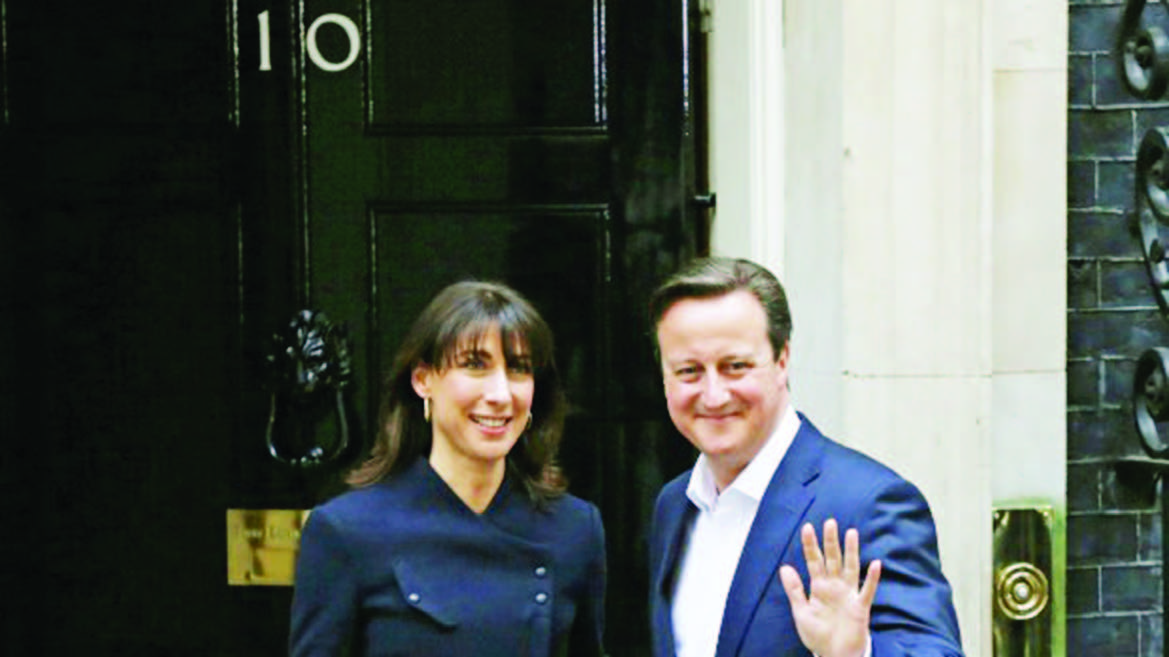
  • David Cameron returns to 10 Downing St

    David Cameron returns to 10 Downing St

    LONDON (TIP): David Cameron has returned to Downing Street as Prime Minister, after an extraordinary election night in which the Tories outperformed even their own expectations and Labour and the Liberal Democrats suffered painful losses.

    As results continued to come in Friday, 8th May morning, Mr. Cameron appeared within striking distance of a working majority in the House of Commons

    Even if he ends up leading a minority government, it would be strong enough to survive a no-confidence motion, and likely to pass most, if not all of his legislative program, according to BBC predictions of how the last few seats would fall on Friday.

    Mr. Cameron would also have the option of forming a stable majority coalition, or a confidence-and-supply deal with the Northern Irish DUP.

    As results came in on Friday morning, they confirmed a shock exit poll that predicted a strong Conservative showing as the largest party.

    The Tories gained seats mainly by eviscerating their former coalition partner, the Liberal Democrats, who lost several senior MPs and now face an existential crisis and a near-certain change of leadership. Labour failed to win most of its target seats, and was stunned by a surge of support for the Scottish Nationalists in Scotland. The party will likely be looking for a new leader as well, after its worst performance since 1987.

    An ashen-faced Ed Miliband, speaking after retaining his own seat, said it had “clearly been a very disappointing and difficult night for the Labour Party. In Scotland we have seen a surge of nationalism overwhelm our party.”

    He said he was “very sorry” for the losses in Scotland, and the next government had a “huge responsibility in facing the difficult task of keeping our country together”.

    He will now travel to London to face his colleagues. He did not indicate whether he would offer his resignation as leader.

    The Scottish Nationalist Party wins -going from 6 to 56 of Scotland’s 59 MPs in Westminster – leave the union politically fractured, and threaten a renewed push for the northern nation’s independence.

    On Friday morning David Cameron said it had clearly been a strong night for the Conservatives, though it was too early to know the final result. He said there had been “a positive response to a positive campaign” and now his government would have a chance to build on the foundation laid in the last five years.

    In a nod to the political change in Scotland, he said his aim was “to govern for everyone in the United Kingdom”. The government he would like to lead was that of “one nation, one United Kingdom”, he said.

    Pre-election polls had predicted a tight race. However exit polls, and early results, suggested either a big failure in polling methodology, or a change of heart at the last minute as British electors stood in the polling booths.

    One seat in particular told the story of the night. In Scotland, the man in charge of his party’s campaign, Labour shadow foreign secretary Douglas Alexander, was defeated by a 20 year-old student for the SNP. Mhairi Black will reportedly be the youngest MP to sit in the House of Commons since 1667. She was only two when Tony Blair won power in 1997. In the same seat, the Lib Dems received their lowest number of votes in any seat since 1859.

    Lib Dem chief secretary to the Treasury Danny Alexander, and Scottish Labour leader Jim Murphy also lost their seats to the SNP.

    “The Scottish lion has roared,” the SNP’s Alex Salmond said after winning his own seat of Gordon from the Lib Dems. He called the result in Scotland an “extraordinary statement of intent” that no government would be able to ignore.

    In the south, senior Lib Dem minister, business secretary Vince Cable, lost his seat to the Conservatives.

    Party leader Nick Clegg survived. Mr Clegg said it had been “a cruel and punishing night for the Liberal Democrats”. He said he would have more to say about the party, and whether he would continue as leader, later on Friday.

    The result would technically be enough to give the Conservatives and Liberal Democrats, together, a return to government.

    However political scientist Professor Patrick Dunleavy said it would be very unlikely the Liberal Democrats would agree to a coalition after taking such a drubbing.

    Shadow treasurer Ed Balls said the result meant “David Cameron’s ability to hang on in Downing Street is on a knife edge… the right of centre majority has disappeared”.

    Another of the night’s big losers – in terms of seats – was Nigel Farage’s UK Independence Party. Despite gathering more than 3 million votes, more than twice that of the SNP, and a million more than the Lib Dems, at the time of writing UKIP could claim only one seat.

    The election result could trigger years of uncertainty over Britain’s  position in Europe and the world – and its own identity.

    David Cameron will be under pressure to deliver on his promise for a referendum on Britain’s  membership of the European Union, as early as next year.

    But a vote to leave the EU would likely trigger a new referendum In Scotland, one the nationalists would be in a very strong position to win.

    Even if Britain  votes to stay in the EU, a Scottish electorate so significantly at odds with the rest of the country could increase calls for a new independence referendum.

    There were indications on Friday that Mr Cameron would have to quickly make a “significant gesture” towards Scotland in order to keep the peace.

    Newly-elected MP Boris Johnson, a possible future Tory leader, predicted “some kind of federal offer”.

    If no party commands a clear majority of to 650 MPs, then Mr Cameron would stay on as a prime minister.

    The firm political convention is that the Queen will choose a prime minister who is most likely to command the confidence (that is, a majority of support) in the House of Commons.

    The command of the house will be tested, if necessary, after the Queen’s Speech on May 27, traditionally a ceremonial event in which the Queen sets out her government’s program for office. The program is then debated over several days, then voted upon.

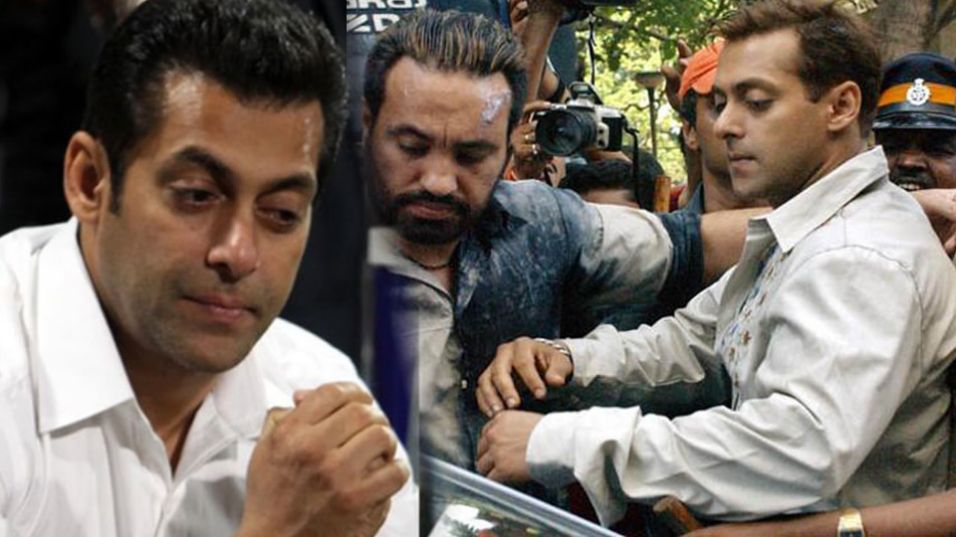
  • Salman Khan escapes jail: Mumbai High Court suspends Salman Khan’s  sentence

    Salman Khan escapes jail: Mumbai High Court suspends Salman Khan’s sentence

    MUMBAI (TIP): Mumbai High Court, on May 8, suspended the sentence of Bollywood celebrity actor Salman Khan. In a judgment delivered  May 8  Justice Desai of Mumbai High Court suspended the sentence of 5 years in jail awarded earlier on May 6. However, Salman Khan is required to surrender before the Sessions Court and obtain a regular bail.

    Earlier on May 6, Khan was sentenced to five years in jail by a Mumbai Court in a 13 year old case of hit and run driving incident in Mumbai in which a homeless man was killed while four others were run over.

    Salman Khan was charged with culpable homicide. The Sessions court found the actor guilty of all counts of charges which included drunken driving, driving without valid license, running away from the scene of the incident and causing death of a man, besides causing injuries to four others.

    Khan had said his driver was behind the wheel, but Judge D.W. Deshpande found him guilty on the charge of culpable homicide.

    “You were driving the car; you were under the influence of alcohol,” he told the actor as soon as the court proceedings began.

    The case has gripped Bollywood and India for 13 years, since 2002.

    Late on the night of 28 September 2002, Khan’s Toyota Land Cruiser hit the American Express bakery in the Bandra area of Mumbai, authorities say.

    The vehicle ran over five people sleeping on the street, killing 38-year-old Noor Ullah Khan and seriously injuring three others. Another person received minor injuries.

    The prosecution alleged that Khan had been driving the car while drunk. Giving evidence in March., Khan had denied he was drunk or that he was driving the vehicle.

    But many witnesses disagreed.

    A constable attached to Khan’s security detail said in a statement to the police that the “drunk” actor had lost control of the car. The policeman died in 2007 of tuberculosis.

    In April, Khan’s driver told the court that he had crashed the car after a tire burst but the court did not accept that version.

    [quote_center]Timeline of the case[/quote_center]

    September 2002: Salman Khan’s car runs over five people sleeping on a Mumbai street, killing a homeless man and injuring four others

    October 2002: Khan charged with culpable homicide not amounting to murder – arrested but granted bail

    May 2003: Court rejects his plea to drop culpable homicide charge

    June 2003: Bombay high court drops culpable homicide charge; actor is then tried for rash and negligent driving

    October 2007: Prime witness, a constable who served in his security detail, dies

    March 2015: Khan tells the court he was not drunk and his driver was behind the wheel

    May 6, 2015: Khan found guilty, sentenced to jail for five years

    May 6, 2015: Mumbai High Court grants interim bail to Khan for two days, until May 8

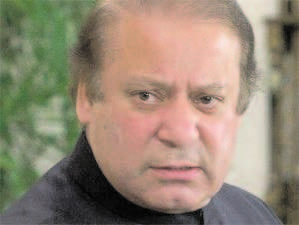
  • Pakistan warns India not to interfere in its internal affairs

    Pakistan warns India not to interfere in its internal affairs

    ISLAMABAD (TIP): Echoing similar concern expressed by the country’s top military leadership two days back, Pakistan on May 7 asked India to refrain from interfering in its internal matters, saying that Islamabad has provided proof to New Delhi about its involvement as recently as the secretary-level talks.

    At a weekly media briefing, Qazi Khalilullah, the newly appointed spokesperson of foreign office, said Pakistan has reminded to India with proof about its involvement in Pakistan’s internal affairs. “We have availed all possible opportunities to remind India to avoid interfering in Pakistan’s internal affairs. The recent time, we did it at foreign secretary-level talks,” he said.

    The statement appears to be the continuation of accusations leveled recently by the top military’s top brass. Pakistan army’s corps commanders on Tuesday accused India’s military spy agency – the Research and Analysis Wing (RAW) – of fuelling terrorism in Pakistan, at their conference headed by Army Chief Raheel Sharif.

    Days ahead of the corps commanders conference, PM Nawaz Sharif, in an interview with Saudi Gazette, had blamed India, , for not responding positively to vibes sent from Pakistan to improve shaky relations between the two countries. “India had unilaterally called off talks between the two countries and it has not been making any effort for resumption of dialogue,” Sharif said.

    At Thursday’s media briefing, the FO spokesman, while responding to a question about Dawood Ibrahim, said the government has always maintained that underworld don is not on Pakistani soil. “India had accepted Pakistan’s ignorance of his whereabouts,” he added.

  • Nepal asks India to provide only much-needed items

    Nepal asks India to provide only much-needed items

    NEW DELHI (TIP): As tonnes of relief goods sent by India pile up in quake-hit Nepal, the Himalayan country has requested New Delhi to ensure that further supply of such material is only need-based.

    According to Nepalese ambassador Deep Kumar Upadhyay, Kathmandu has asked Indian agencies not to send items like water or clothes, and focus instead on supplying tarpaulin sheets and dry rations for its citizens rendered homeless by the unprecedented disaster.

    “The Nepalese embassy is coordinating with the Indian government to make sure that supply (of relief material) is need-based,” Upadhyay said at a felicitation event for National Disaster Response Force
    (NDRF) personnel back from Nepal after a much-lauded rescue and relief operation.

    Stating that Nepal would continue to work closely with India in the reconstruction phase, Upadhyay said the emphasis would be on preserving the country’s cultural heritage. “We would like to rebuild the nation as it stood before the quake, and restore our heritage sites to their original state,” he said.

    Earlier, home minister Rajnath Singh described Nepal as a sovereign state that India considers like a family member.
    “Whatever help is sought by Nepal, we are willing to extend,” he said even as he lauded the NDRF for its “exemplary” rescue work in the quake-ravaged nation.

    “I am proud of the NDRF. They have carved a niche for themselves as an able rescue force, having rescued alive 11 of the total 16 people and recovering 133 bodies in all. This, when rescue agencies from 34 different countries had been working in Nepal,” Singh said.

    NDRF chief O P Singh, while lauding his boys, mentioned how they had braved after-shocks and partially-collapsed structures to complete their rescue mission in Nepal. He made a special mention of two incidents, one involving a 43-year-old woman who was buried under the rubble for 36 hours before being rescued by NDRF men, and the other involving extrication of the body of a serving major in the Nepalese Army after a 12-hour operation.

    All 780 NDRF personnel engaged in the rescue mission are back home, with the last group landing here on May 06 night.

  • Nepal bans drones in its skies fearing leak of sensitive info

    KATHMANDU (TIP): Nepal has banned flying of drones in its skies following the devastating earthquake, suspecting leakage of sensitive information through the use of the unmanned aerial vehicle, authorities said today.

    After the April 25 quake, some foreign media and other aid agencies used drones to track the loss of human lives and damages to properties.

    Civil Aviation Authority of Nepal said in a statement that Nepal has banned the use of drones as they could leak sensitive information and pictures of its valuable heritage sites clicked illegally.

    One such drone has been intercepted by Nepalese security agencies and handed over to the authorities concerned, said Nepal Police spokesperson Sarvendra Khanal.

    The civil aviation agency officials said that it is learnt that some organisations used drones to take pictures and videos of Nepals’ valuable heritage sites which could be misused later.

  • Sri Lanka arrests 54 Indian fishermen

    COLOMBO (TIP): As many as 54 Indian fishermen have been arrested by the Sri Lankan Navy for allegedly poaching in island’s waters off the coast of Kankesanturai and Talaimannar in the north.

    Sri Lankan Naval spokesman commander Indika Silva said that 21 fishermen were arrested and five boats were seized at Kankesanturai while the rest of them on another five boats were arrested at Talaimannar last night. They were being brought to respective fisheries inspection offices for further action, Silva said.

    Indian fishermen will be shot if they cross border, says Sri Lankan PM Ranil Wickramesinghe The arrests came ahead of announcement of the dates for the direct fisher community talks between India and Sri Lanka. Sri Lanka had released some 86 Indian fishermen last week as a goodwill gesture towards the visit of Prime Minister NarendraModi, the first Indian leader to visit Sri Lanka since 1987.

  • Afghan judge sentences 4 to death in mob killing of woman

    KABUL (TIP): An Afghan court on May 5 convicted and sentenced four men to death for their role in the brutal mob killing of a woman in Kabul in March – a slaying that shocked the nation and spurred calls for authorities to ensure women’s rights to equality and protection from violence.

    The sentences were part of a trial of 49 suspects, including 19 police officers, over the March 19 killing of the 27-year-old woman named Farkhunda who was beaten to death in a frenzied attack sparked by a bogus accusation that she had burned a copy of the Quran.

    The trial, which began Saturday, only involved two full days of court proceedings – an unusual swiftness in the slow-moving Afghan judicial system. It was broadcast live on national television, reflecting huge public interest in the case.

    Judge Safiullah Mojadedi handed down the four death sentences at Afghanistan’s Primary Court in Kabul today. He also sentenced eight of the defendants to 16 years in prison and dropped charges against 18. The remaining suspects are to be sentenced on Sunday.

    The defendants have the right to appeal their sentences. The charges included assault, murder and encouraging others to participate in the assault. The police officers were charged with neglecting their duties and failing to prevent the attack.

    Farkhunda’s brother, Mujibullah, told The Associated Press that her family was angered by the leniency of the court toward the majority of the defendants.

    “The outcome of the trial is not fair and we do not accept it – you saw just four people sentenced to death but everybody knows that more than 40 people were involved in martyring and burning and beating my sister,” said Mujibullah, who like many Afghans, including his sister, uses only one name.

    “Eighteen people have been freed. The court should punish them and that should be a lesson for anyone who would commit this sort of crime, anywhere in our country, in the future,” he added.

    Farkhunda’s brutal killing shocked many Afghans, though some public and religious figures said it would have been justified if she had in fact damaged a Quran. A presidential investigation later found that she had not damaged a copy of the Muslim holy book.

    The last agonising and brutal moments of her life were captured on mobile phone cameras by witnesses and those in the mob that attacked her. The videos of the assault circulated widely on social media. They showed her being punched, kicked, beaten with planks of wood, pushed by police onto a roof and dropped from it, thrown in the street and run over by a car.

  • Nepal earthquake death toll rises to 8,413

    KATHMANDU (TIP): The death toll from the devastating earthquake in Nepal has risen to 8,413, the Nepal Red Cross Society said on May 6.

    A Red Cross report put the number of injured at 17,576, adding 260 people were still missing following the 7.9 magnitude quake. The temblor, the worst to hit Nepal after 1934, has also caused widespread destruction in the Himalayan nation.

  • Busting the government myths around land acquisition law 

    Busting the government myths around land acquisition law 

    A big question that is begging a credible answer today is- why is the National Democratic Alliance (NDA) government hell bent on road rolling amendments on to the land acquisition law without even implementing it despite  vociferous opposition from several quarters.

    Several spokespersons for the government and the political parties which support it have repeatedly said that the amendments to the Right to Fair Compensation and Transparency in Land Acquisition, Rehabilitation and Resettlement Act (LARR Act) enacted by Parliament in 2013, first promulgated as an Ordinance and then re-promulgated because they could not get the approval of Parliament last month, are necessary to arrest the slowing down of the economy and breathing life into the stalled development projects. The mainstay of this argument has been that the process of acquiring privately owned land for developmental projects laid down in the LARR Act is too cumbersome and requires simplification.

    The state of the economy reported in Parliament by the Government in the form of the Economic Survey 2014-15 (ES14-15), a day before tabling the budget in February 2015 pointed out that the stalling of a large number of projects in the public and the private sector was the primary reason for the slowdown that the Indian economy was experiencing. However detailed data on such projects was not annexed to that report. Official spokespersons repeatedly argued that the amendments to the land acquisition law were necessary to pull up the economy out of the nadir it had reached. After reading ES 14-15, I sought granular data from the Ministry of Finance under The Right to Information Act, 2005 (RTI Act) out of sheer curiosity. Finance Ministry, moved with exceptional speed and provided a list of projects within less than a month of receiving the RI application and surprisingly without demanding any additional fee (the RTI application and reply are in the 1st attachment).

    Major findings from an analysis of the data about stalled projects obtained through RTI

    1) The list supplied by Finance Ministry contains a total of 804 projects that have stalled as of February 2015 for a variety of reasons across 24 States and two Union Territories. Maharashtra with 125 stalled projects topped the list followed by Gujarat (63 projects), West Bengal (55 projects), Karnataka (52 projects) and Telangana (52) making the rest of the top 5. The States highlighted in yellow have districts placed under the 5th Schedule of the Constitution where a significant proportion of the population is of tribal origin. Obtaining their consent for implementing any developmental project if it falls in their area is indispensable.

    2) The private sector projects (78%) outnumber the public sector projects planned by the Central or State Governments, or public sector enterprises or local municipal boards and autonomous authorities (22%).

    3) Only 8% (66 nos.) of the 804 projects are said to have stalled due to land acquisition problems. If the data provided under the RTI Act is an accurate reflection of the state of affairs, the argument that the slowdown in the economy is due to land acquisition projects becomes a busted myth- not on the basis if any biased analysis- but s simple count of the reasons provided in the last column of the attached list.

    4) Of the 66 projects stalled due to land acquisition issues, only 11 (1.36% of 804 projects) directly relate to the well being of the disadvantaged or less affluent segments of society such as slum rehabilitation projects or construction of budget housing projects or a bus stand (which few affluent people use). So the proposal to amend the LARR Act to waive the requirement for taking consent of the village assembly in the areas where land is to be acquired for providing affordable housing for the poor will affect a miniscule number of projects. Therefore the justification tomtomed for the amendment becomes untenable.

    5) Ironically on the other hand, at least 145 of the stalled projects (18%) are for the affluent and the rich as they are projects involving the construction of shopping malls or elite hotels and resorts (4 and 5 star), multiplexes, elite residences and villas, golf courses and a racing track. Another 25 stalled projects are about setting up townships- nothing in the list provided by Fin Min indicates which segment of society they are intended to benefit. 10 of the 66 projects stalled due to land acquisition problems are in this elite category. However, it must also be said that the list of 804 projects also includes power generation, airport construction or expansion, road and railway expansion, pharmaceutical, textile, software and SEZ projects amongst others. Mining projects for coal and uranium amongst other metals are also part of the stalled projects list.

    6) Of the total of 804 projects the list mentions “Others” as the reason for the stalling of 19% of the projects (153 nos.) Reasons for stalling are simply not available for 15% of the projects (121 nos.) Taken together the projects for which reasons for stalling are either unspecified or simply not available amount to more than a third of the total number of projects (34%).

    7) The largest proportion of projects that have stalled (38.8%) are due to unfavourable market conditions or lack of funds or promoter interest or raw material or fuel supply problems. Several of these projects are owned or promoted by some of the biggest industrial houses in India and a handful of foreign ownership. If readers are interested they may compare this list of Indian business houses with the list of corporates that made large sized donations to the leading national and State level political parties on the Political Party Watch segment of the website of the Association for Democratic Reforms
    (ADR): http://adrindia.org/research-and-report/political-party-watch

    8) Lack of environmental clearances account for a mere 4.2% of the stalled projects whereas lack of clearance from the State Governments amount to 11.8% of the total. It looks like the regulatory regimes have contributed to only 16% of the staled projects. So the -license-inspector raj also does not appear to be a major contributor to the stalling of the 804 projects, if the dataset is accurate.

    So it is neither land nor the regulatory regime that appears to have contributed to the stalling of the developmental projects. One is reminded of the slogan that characterised the Presidential campaign of Mr. Bill Clinton in the USA during the 1990s- “It’s the economy, stupid”.

    Some hard questions to which the RTI document does not provide answers
    1) For how long have these 804 projects remained in stalled condition? The RTI reply does not throw any light on this issue. Perhaps RTI users in the States might like to seek this information by demanding this information from the State and Central Governments through RTI applications.

    2) Are there only 804 projects across the country that have stalled and none other or is this only a sample of a larger universe of stalled projects?

    3) Of the 804 stalled projects the total monetary value of just 300 projects (37%) is said to be Rs. 18.13 lakh crores (USD 287.42 billion where 1USD=INR 63.07) when they were reviewed yesterday at a meeting held by the Finance Ministry (See: http://economictimes.indiatimes.com/new s/economy/finance/finance-ministry-discusses-85-large-projects-npas-with-rbi-banks/articleshow/47083242.cms). What is the total value of all 804 projects? The RTI data does not mention monetary value against all projects.

    4) The data that the Finance Ministry provided under the RTI Act does not appear to be data that it has generated itself. The ES 14-15 clearly states that the figures are based on inputs provided by the Centre for Monitoring Indian Economy Ltd. (CMIE). CMIE is a private sector business information company. What measures were taken to cross-check the veracity of the database that they provided the Ministry before it was inserted in the Economic Survey? Or is the database itself created on the basis of information gleaned from government records? Most importantly, if more than a third of the projects have stalled for reasons unspecified or unknown how can such incomplete data be used for reporting on the state of the economy to Parliament without making the effort to verify the claims contained in the database?

    Ideally, the Government should have volunteered this information under Section 4 of the RTI Act in order to inform the citizens of India about the nature and magnitude of the problem. Finance Ministry earmarked the RTI reply – “for RTI purpose” while sending it to me. I am circulating this data and analysis so that readers may form their own conclusions by analysing the data and influence their elected representatives to debate the need for the amendments to LARR Act, in an informed manner. http://www.indiaresists.com/busting-the-government-myths-around-land-acquisition-law/

    (The author is a well-known RTI activist based in New Delhi. He is Commonwealth Human Rights Initiative Program Coordinator)

  • Strategic Autonomy as an Indian Foreign Policy Option

    Strategic Autonomy as an Indian Foreign Policy Option

    [quote_right]For a large country like India, which has the potential of becoming a big power in the future, strategic autonomy is a compelling choice. By virtue of its demographic, geographic, economic and military size, India must lead, but does not have yet the comprehensive national power to do so. It cannot subordinate itself to the policies and interests of another country, however powerful, as its political tradition and the functioning of its democracy will not allow this. India may not be strong enough to lead, but it is sufficiently strong not to be led”, says the author.[/quote_right]

    In the joint statement issued during the Indian prime minister’s visit to France in April, the two sides reaffirmed “their independence and strategic autonomy” in joint efforts to tackle global challenges. In the French case, as a member of NATO it is not so clear what strategic autonomy might mean, but in our case it would essentially mean independence in making strategic foreign policy decisions, and, consequently, rejecting any alliance relationship. It would imply the freedom to choose partnerships as suits our national interest and be able to forge productive relationships with countries that may be strategic adversaries among themselves.

    In practical terms, this means that India can improve relations with the United States of America and China while maintaining close ties with Russia. It can forge stronger ties with Japan and still seek a more stable relationship with China. It can forge strong ties with Israel and maintain very productive ties with the Arab world, including backing the Palestinians in the United Nations. It means that India can have strategic partnerships with several countries, as is the case at present with the US, France, Germany, the United Kingdom, the European Union, Russia, China, Japan, Brazil, Saudi Arabia, Australia, Canada, Kazakhstan, Afghanistan, Vietnam, Iran and the like.

    It means that India can be a member of BRICS and the RIC dialogues, as well as IBSA, which exclude the West, and also forge closer political, economic and military ties with the Western countries. Our strategic autonomy is being expressed in other ways too. India is a democracy and believes that its spread favors its interests, but it is against the imposition of democracy by force on any country. If the spread of democracy is in India’s strategic interest, using force to spread it is against its strategic interest too, as is shown by the use of force to bring about democratic changes in West Asia by destroying secular authoritarian regimes and replacing them with Islamic authoritarian regimes. Likewise, India believes in respect for human rights, but is against the use of the human rights agenda to further the geo-political interests of particular countries, essentially Western, on a selective basis.

    For a large country like India, which has the potential of becoming a big power in the future, strategic autonomy is a compelling choice. By virtue of its demographic, geographic, economic and military size, India must lead, but does not have yet the comprehensive national power to do so. It cannot subordinate itself to the policies and interests of another country, however powerful, as its political tradition and the functioning of its democracy will not allow this. India may not be strong enough to lead, but it is sufficiently strong not to be led.

    India preserved its strategic autonomy even in the face of severe technology sanctions from the West on nuclear and missile issues. It preserved it by not signing the non-proliferation treaty and continuing its missile program. By going overtly nuclear in 1998, India once again exercised its strategic autonomy faced with attempts to close the doors permanently on its nuclear program by the permanent extension of the NPT and the comprehensive nuclear test ban treaty and fissile material cutoff treaty initiatives.

    In some quarters in India and abroad, the idea of strategic autonomy is contested as another manifestation of India’s non-aligned mindset, its propensity to sit on the fence, and avoid taking sides and assuming responsibility for upholding the present international order as a rising power should. These critics want India to join the US camp more firmly to realize its great power ambitions. These arguments ignore the reality that while the US has been crucial to China’s economic rise, China has been sitting on the fence for many years, even as a permanent member of the UN security council. Far from sacrificing its strategic autonomy, it has become a strategic challenger of the US.

    To be clear, the US government has officially stated its respect for India’s position on preserving its strategic autonomy, and denies any expectation that India would establish an alliance kind of relationship with it. It is looking for greater convergence in the foreign policies of the two countries, which is being realized.

    During Narendra Modi’s visit to the US in September, 2014, and Barack Obama’s visit to India in January this year, a strategic understanding on Asia Pacific and Indian Ocean issues, encapsulated in the January 2015 joint strategic vision for the Asia Pacific and the Indian Ocean has emerged. This document suggests a shift in India’s strategic thinking, with a more public position against Chinese maritime threat and a willingness to join the US in promoting partnerships in the region.

    Modi chose a striking formulation in his joint press conference with Obama in September when he said that the US was intrinsic to our Look East and Link West policies, which would suggest a growing role for the US in our foreign policy thinking. During Obama’s January visit, the joint statement noted that India’s Act East policy and the US rebalance to Asia provided opportunities for India, the US and other Asia-Pacific countries to work closely to strengthen regional ties. This was the first time that India implicitly endorsed the US rebalance towards Asia and connected our Act East policy to it.

    Rather than interpreting it as watering down our strategic autonomy, one can see it as strengthening it. So far, India has been hesitant to be seen drawing too close strategically to the US because of Chinese sensitivities. China watches closely what it sees are US efforts to rope India into its bid to contain China. At the same time, China continues its policies to strengthen its strategic posture in India’s neighborhood and in the Indian Ocean at India’s expense, besides aggressively claiming Indian territory.

    By strengthening relations with the US (which is strategically an Asian power), Japan and Vietnam, and, at the same time, seeking Chinese investments and maintaining a high-level dialogue with it, India is emulating what China does with India, which is to seek to build overall ties as much as possible on the economic front, disavow any negative anti-India element in its policies in our neighborhood, but pursue, simultaneously, strategic policies intended to contain India’s power in its neighborhood and delay its regional extension to Asia.

    In discussing the scope of our strategic autonomy, one should recognize that the strength of US-China ties, especially economic and financial, far exceeds that of India-US ties. India has to be careful, therefore, in how far it wants to go with the US with a view to improving its bargaining power with China. The other point to consider is the US-Pakistan equation. The US has just announced $1 billion of military aid to Pakistan; its position on the Taliban is against our strategic interests in Afghanistan; its stand on Pakistan’s sponsorship of terrorism against us is not robust enough.

    To conclude, strategic autonomy for India means that it would like to rely as far as possible on its own judgment on international issues, balance its relations with all major countries, forge partnerships with individual powers and take foreign-policy positions based on pragmatism and self-interest, and not any alliance or group compulsion.

    (The author is former foreign secretary of India. He can be reached at sibalkanwal@gmail.com)

  • Time to articulate Hindu point of View : Vibhuti Jha

    Time to articulate Hindu point of View : Vibhuti Jha

    My thoughts are that it is time , actually high time, that we Hindus began to market , teach and articulate the Hindu Point of View and the circumstances today give us the best opportunity. The general dislike, distaste and disgust with Islam is well established. The reason why we see some talk sympathetically about the “innocents amongst Muslims” is because nobody wants a general flare up. We must look at ourselves and what we must do to propagate , if not proselytize, about Hinduism.

    This sketch of Muhammed is a brilliant piece of art and it does not seem to be a cartoon. The question to establish is the reciprocity and equivalence between various beliefs. If non Muslims cannot give a face to Muhammad , I am ok with that, then They must also respect and not insult our Godess Lakshmi, Saraswati or Durga as Hussain did in the name of freedom of expression. !! There is a need to establish reciprocity – if Muslim countries do not allow us to have a temple or even congregate to do a religious ceremony , then permitting the same on our land creates an imbalance in respect and reciprocity. While they destroy our temples , they build mosques on our land ! What kind of equivalence is that ? If they convert that’s part of their faith , when we brand it as ” Ghar Wapasi” why is it a blasphemy ?

    We must not surrender our freedom to have a dialogue and that’s how we evolve.

    Every religious group have their own spokesperson and they get to represent their faith. We Hindus have none to write home about.. . For example , when Dr. Swamy and Rajeev Malhotra were not permitted to speak at Oxford , other than a few mentions in Indian papers no international coverage was seen and no conversation took place even here. Yet the same Oxford invited a Pakistani general who virtually abused the West and it was ok !!

    We Hindus have presence but have no clout in the societies we live in. I am proud of Sikhs because they are sincerely establishing their own identity, building a clout , wherever they are even if for some it might mean denying their Hindu roots.
    Gentlemen all – we must continue this dialogue in the spirit of respect , freedom, reciprocity and equality for all. From Abu Dhabi to Zurich , the union of a man and a woman conceives a child and we all die because of myocardial infraction – so what matters is not WHO we pray to but WHAT we do that defines us.

    Cheers
    Vibhuti Jha

  • Anjali Mehta of Princeton, NJ receives Fulbright Award

    Anjali Mehta of Princeton, NJ receives Fulbright Award

    PRINCETON, NJ (TIP): Anjali Mehta, resident of Princeton, NJ of American University in Washington, DC has been offered a Fulbright U.S. Student Program grant to Brazil for an English Teaching Assistantship, the United States Department of State and the J. William Fulbright Foreign Scholarship Board announced recently.

    Mehta is one of over 1,900 U.S. citizens who will travel abroad for the 2015-2016 academic year through the Fulbright U.S. Student Program. Recipients of Fulbright grants are selected on the basis of academic and professional achievement, as well as demonstrated leadership potential.

    The Fulbright Program is the flagship international educational exchange program sponsored by the U.S. government and is designed to increase mutual understanding between the people of the United States and the people of other countries. The primary source of funding for the Fulbright Program is an annual appropriation made by the U.S. Congress to the U.S. Department of State, Bureau of Educational and Cultural Affairs. Participating governments and host institutions, corporations and foundations in foreign countries and in the United States also provide direct and indirect support. Recipients of Fulbright grants are selected on the basis of academic or professional achievement, as well as demonstrated leadership potential in their fields. The Program operates in over 160 countries worldwide.

    Since its establishment in 1946 under legislation introduced by the late U.S. Senator J. William Fulbright of Arkansas, the Fulbright Program has given approximately 360,000 students, scholars, teachers, artists, and scientists the opportunity to study, teach and conduct research, exchange ideas and contribute to finding solutions to shared international concerns.

    Fulbright alumni have achieved distinction in government, science, the arts, business, philanthropy, education, and many other fields. Fifty-three Fulbright alumni from 12 countries have been awarded the Nobel Prize, and 82 alumni have received Pulitzer Prizes. Prominent Fulbright alumni include: Muhammad Yunus, founder, Grameen Bank, and 2006 Nobel Peace Prize recipient; Juan Manuel Santos, President of Colombia; John Hope Franklin, noted American historian and Presidential Medal of Freedom recipient; Riccardo Giacconi, physicist and 2002 Nobel Laureate; Amar Gopal Bose, founder, Bose Corporation; Renée Fleming, soprano; Jonathan Franzen, writer; and Daniel Libeskind, architect.

    Fulbright recipients are among over 50,000 individuals participating in U.S. Department of State exchange programs each year. The Fulbright U.S. Student Program is administered by the Institute of International Education.

    For further information about the Fulbright Program or the U.S. Department of State’s Bureau of Educational and Cultural Affairs, please visit our website at http://eca.state.gov/fulbright or contact Elaine Clayton, telephone 202-632-6452 or e-mailECA-Press@state.gov.

  • City bans ‘unfair’ credit screenings of job seekers

    City bans ‘unfair’ credit screenings of job seekers

    NEW YORK (TIP): Employers in the city soon won’t be able to use credit checks to screen job applicants.

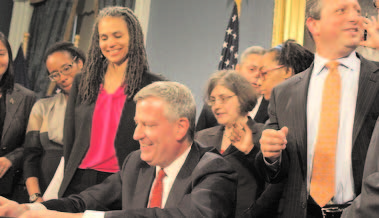
    Under a bill signed into law Wednesday, May 6, by Mayor de Blasio, businesses will be banned from using credit reports, bankruptcies and liens to disqualify people from employment.

    The law, which was sponsored by Councilman Brad Lander (D-Brooklyn), takes effect in 120 days.

    Advocates have pressed politicians for the prohibition because they say law-abiding applicants can’t get jobs after being saddled with student loans or medical bills that have ruined their credit.

    “Credit checks for employment unfairly lock New Yorkers out of jobs. There is no link that can be shown between credit history and job performance, and now New York City law reflects that fact,” Lander said.

    He called the new law the toughest of its kind in the nation.

    But it still provides exemptions.

    Law-enforcement personnel, employees who have to be bonded and financial-service workers will all still be subject to credit vetting.

    Kathryn Wylde, CEO of the Partnership for New York City, which represents some of the city’s largest employers, described the law as striking “an important balance” that will still enable “employers to conduct credit checks for the most sensitive job openings while reducing chances that a poor credit history will unfairly disqualify job candidates.”

    Still, Wylde said the partnership would be monitoring the law’s implementation to assess its “costs and consequences.”

    Only three council members voted against the measure: Steven Matteo (R-SI, Mark Weprin (D-Queens) and Eric Ulrich (R-Queens).

    “We cannot dictate to businesses what information is important in choosing their own employees when it could have a bearing on their suitability for the job they are seeking,” Matteo said.

    “This bill, while well-intentioned, was simply too much government interference.”

  • Bratton says policing ‘in a crisis’ at tribute to slain NYPD cop

    Bratton says policing ‘in a crisis’ at tribute to slain NYPD cop

    NEW YORK (TIP): Slain cop Brian Moore was honored during a touching tribute to fallen NYPD officers in Times Square on Wednesday, May 6 afternoon.

    The event, which fell a few days before the start of Police Week on May 10, began with a moment of silence for Moore, who died Monday after being taken off life support.

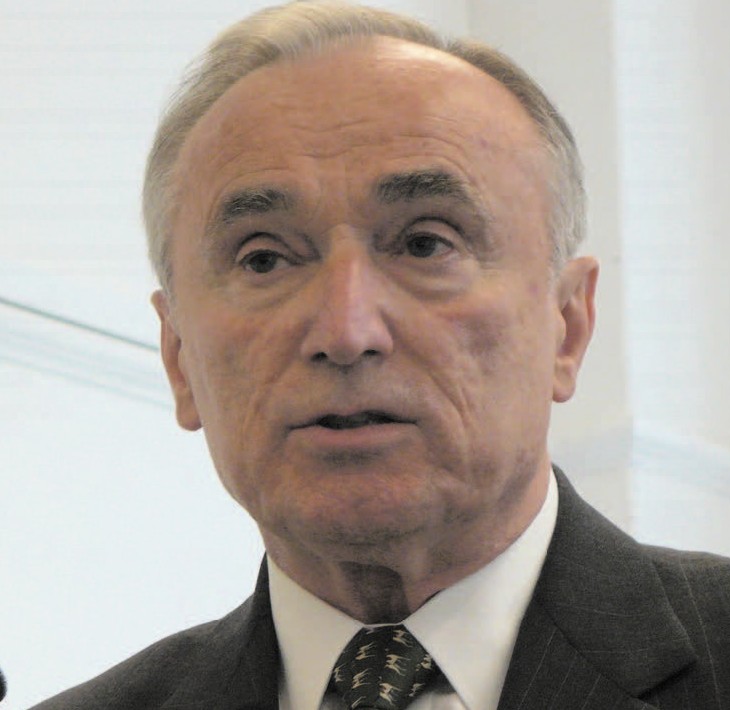
    Police Commissioner Bill Bratton spoke at the event, expressing his gratitude for cops who have made “the ultimate sacrifice” for the safety of citizens. He called Moore “a hero in every sense of the word.”

    “This young officer was doing what we’d expect an officer to do, to basically see something and follow up on it, and unfortunately it ended in the tragedy that did occur,” the top cop said at a press conference after the event.

    Bratton bluntly added that the country is in a time of crisis.

    “Let’s face it, we’re in a crisis at this time, in this country, on issues of race, around effectiveness of policing, around police tactics, probably the most significant I’ve seen since I joined policing in 1970,” he said.

    Family members of cops killed in the line of duty also spoke at the event and sympathized with Moore’s family.

    “My condolences go out to the Moore family,” said Cathy Guerra, 37, whose husband, Dennis, died while responding to an arson fire in Coney Island.

    “We understand firsthand what they are going through. It’s not easy. We’re there to support them and whatever they need. We’ll be there for them.”

    Thousands of people are expected to attend Moore’s wake Thursday. And at least 25,000 to 30,000 cops are planning to attend the Friday funeral at St. James Church.

    Before the wake, Bratton said the department will be putting the names of Officers Rafael Ramos, Wenjian Liu, Dennis Guerra and Michael Williams on a memorial in the “Hall of Heroes” inside Police Headquarters.

    St. James Church released a statement Wednesday, saying church officials are “deeply saddened” by the news of Moore’s death.

    “Brian’s decision to become a police officer clearly expressed his drive to provide service to others and his wish to secure the safety of all,” Pastor John Derasmo said in a statement.

    “The significance of PO Brian Moore’s contribution to us is not measured by the length of time he served as a police officer but by the passion and concern he brought to his work with the NYPD.”

  • More Upstate Republicans Abandon the besieged Dean Skelos

    More Upstate Republicans Abandon the besieged Dean Skelos

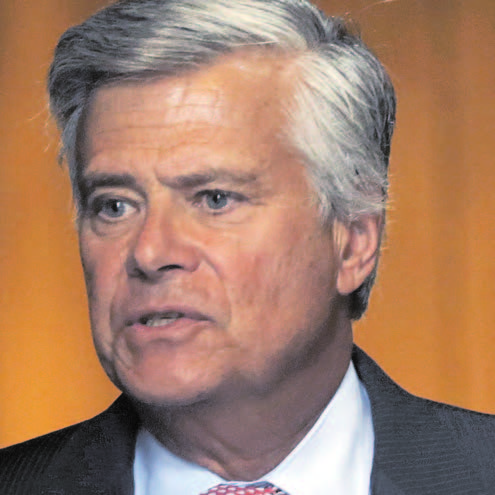
    NEW YORK (TIP): Upstate Republicans continued to abandon support for Dean Skelos staying on as majority leader, with Monroe County Chairman Bill Reilich announcing in a statement that he could no longer support the Nassau County lawmaker.

    “Now is not the time to have someone leading the NYS Senate who cannot give their full time and attention to the matters at hand,” Reilich said. “I believe that Senator Skelos should step down from his leadership position until this matter is brought to a conclusion. I feel this action would be in the best interest of all of our residents and taxpayers.”

    The statement makes him the latest Republican county chair to call on Skelos to step aside as majority leader as he fights federal corruption charges. Erie County Chairman Nick Langworthy has previously called on Skelos to resign, while the most significant downstate Republican to do so has been Suffolk’s John Jay LaValle.

    Skelos’s office on Wednesday night released a statement backed by 16 Senate Republicans affirming their support for the embattled majority leader.

    Still, there are at least seven Republican members in the GOP conference who are publicly calling on Skelos to resign as their leader.

    The latest is Sen. Kathy Marchione, a Republican who represents much of the area that was the old district of Skelos’s predecessor, Joe Bruno.

    In an interview, Marchione said she decided to call on Skelos to step aside after she was asked to sign on to the statement.

    “Last night when asked about a letter to be signing on to strongly support the senator, I realized this was not going to be something we could work around,” she said.

    Marchione added that Skleos’s legal problems have become too much of a distraction for the chamber.

    “I think it’s getting to that point where he has to think about the good conference,” she said. “I believe he has been thinking about the good of conference.”

  • Vaisakhi 5 K Sikh Run 2015 a great attraction

    Vaisakhi 5 K Sikh Run 2015 a great attraction

    RICHMOND HILL, NY (TIP): After months of planning, and weeks of heightened public anticipation, the Vaisakhi 5K Run 2015 took place at Forest Park in Woodhaven, NY last Sunday, April 26, 2015 with flying colors. Large crowds of participants donning their bright blue race t-shirts stormed the park, expressing their excitement and displaying an incredible solidarity. The Vaisakhi 5K-now in its second year-drew more than 600 participants from all backgrounds and levels of fitness. Runners came from far and wide to attend: Last year’s race was generally attended by people from across the tristate-area, but this year’s race has grown to include participants from as far away as Texas, Illinois, and the United Kingdom. Sunder Singh Bandeshah (BIB# 349), age 14, was the first finisher, timing 19:38.36. The first female finisher was 36-year-old Param Kaur Ghangas (BIB# 347), whose time was 21:59.60. Hearty congratulations to other finishers:

    • Male: 2nd place, Inder Partap Singh Khangura (BIB# 415) – 19:47.69
    • Male: 3rd place, Jaspal Singh (BIB# 56) -20:14.95
    • Female: 2nd place, Sukhzinder Braich (BIB# 6) – 22:43.20
    • Female: 3rd place, Sonya Kaur Chhabra (BIB# 116) – 25:11.02
    • Oldest Male: Balwant Rai Singhal (BIB# 18) – Age 77
    • Youngest Male: Dashmesh Singh (BIB# 361) – Age 12
    • Oldest Female: Harbans Kaur (BIB# 68) – Age 84
    • Youngest Female – Sukhpreet Kaur (BIB# 464) – Age 12

    Twenty-three teams competed in the race, of which Team “Sikhs Pack” was placed first. All runners received Vaisakhi 5K’s blue race t-shirts, bags, and beautiful medals. Breakfast, tea, water, and more were provided. The race was presented by long-time marathoner Dr. Avtar Singh Tinna and India Association of Long Island President.

    [quote_center]Glimpses of 5 K Sikh Run          [/quote_center]

    Vaisakhi 5 K Sikh Run Image Vaisakhi 5 K Sikh Run Image 1 Vaisakhi 5 K Sikh Run Image 3 Vaisakhi 5 K Sikh Run Image 4

    Photos courtesy A.S. Nagpal Photography

  • NCDC Chairman Jay S. Jacobs wants Skelos to step down as Senate Majority Leader

    NEW YORK (TIP): In a statement released to the press, May 7, NCDC Chairman Jay S. Jacobs said: “The charges against Dean Skelos are as disturbing as they are surprising. Under our system of justice, everyone is entitled to their day in court. It is no different for Dean Skelos. In government, however, the rule that
    ‘no man is bigger than the mission’ must always apply. It is no different for Dean Skelos. He must step down as Senate Majority Leader so that the process of governing New York State can proceed both efficiently and credibly.”

  • Complaints about shady job agencies which often target immigrants, triple in NYC, report finds

    NEW YORK (TIP): Complaints about shady job agencies – which often target low-wage immigrants – have nearly tripled in the city, a new report found.

    Grievances made to the city Department of Consumer Affairs spiked from 328 in 2013 to 940 last year, according to data set to be released Thursday by state Senators Jeffrey Klein and Diane Savino, Assemblyman Francisco Moya and a non-profit campaign called Justice for Job Seekers.

    Reported problems were most common in immigrant-heavy neighborhoods of north-central Queens and in parts of the Bronx.

    Maritza Daza said she found work at a hair salon through an agency on Ave. U in Brooklyn – but ended up handing over a full week’s salary of $350 plus a $20 registration fee.

    “It really hurt me, to pay that much money,” Daza told the News. She said she’s often scheduled for just two or three days a week, instead of the full time job the agency promised. Hunting for a job along Roosevelt Ave. in Queens, Rosa Pauta paid $125 upfront to an employment agent who promised her work at a laundromat, according to testimony included in the report. But when she went to the laundromat’s address, the owner turned her away saying he had no positions available.

    The agency refused to refund the fee, Pauta told researchers.

    The practice is illegal – but all too common. Undercover volunteers posing as job hunters also visited dozens of employment agencies for the study and found that at nearly 40%, agents charged a non-refundable advance fee, flouting state law. Fees averaged $128.75, according to the report. The results of the research were “quite startling,” said Klein (D-Bronx).

    “Employment agencies are referring prospective employees to employers that have no job openings,” he said. “They have no recourse in getting their money back. Clearly, the law needs to be updated.” Agencies can charge advance fees for certain types of workers – including nannies and construction laborers -but are legally required to fully reimburse clients if they don’t get a job. Nearly three quarters of the 39 agencies visited by volunteers did not offer a contract, which is required by law, and almost half illegally promised a “guaranteed” job placement. Klein, Savino (D-Staten Island/Brooklyn) and Moya (D-Queens) have introduced bills in the Senate and Assembly that would get rid of the loophole that allows employment agencies to charge some job seekers up front and boost fines from $500 per violation to $1000. “If you’re a low wage worker or an immigrant, it doesn’t mean you should have a target on your back when you look for employment,” said Moya.

  • Demand to Suspend all Contracts or enact a ‘Voluntary Procurement Disclosure Policy’

    After Kevan Abrahams and Democratic Minority Legislative Caucus called for Moratorium on voting for any more County Contracts on Monday, May 4 called for a Public Hearing on the AbTech Contact last week and filed a Disclosure Bill more than two weeks ago; Abrahams says, “ENOUGH IS ENOUGH – County Executive, suspend all contracts or begin a ‘Voluntary Procurement Disclosure Policy’ that requires each County Department participate immediately.”

    MINEOLA, NY (TIP): Since news broke a few weeks ago that Senator Dean Skelos and his son Adam Skelos were accused of using undue influence to corrupt the County contracting process and extort, bribe money from a County vendor, Nassau Democratic Legislators have taken steps to try to remedy the clear lack of disclosure that would protect taxpayers from more waste, fraud and abuse of the system while Republican Legislators have remained silent.

    It began more than two weeks ago in the wake of allegations that were cited in the April 16th New York Times article, ‘Dean Skelos, New York Senate Leader, and His Son Are Said to Be Focus of Corruption Inquiry’, that the Nassau County Democratic Legislators began taking bold steps to remedy a broken system here in Nassau County Government. “We started by filing a disclosure law, because it seemed absolutely evident that there was a void in the county procurement process and tax payers weren’t being protected enough from future fraud, unless we immediately began instituting a new, more stringent disclosure process” said Democratic Legislative Leader Kevan Abrahams.

    After filing the Disclosure Bill, Abrahams followed up a week later by writing a letter to Nassau County Republican Presiding Officer Norma Gonsalves calling upon her to “schedule a public hearing into the AbTech matter” and noting that still both the County Executive’s lobbyist registration bill and the Democrats bill calling for ‘complete disclosure of all outside influences in the contracting process’ had yet been added to the agenda of this past Monday’slegislative committee meeting.

    Then on Monday, May 4th Kevan Abrahams and the Nassau County Democratic Legislative Caucus pressed their Republican colleagues to join them in a moratorium and halt all contract votes until the County adopts policies that protect taxpayers from inside deals. Shockingly, after a more than ten minute debate on the floor of the Legislature, the Republican Caucus, led by Norma Gonsalves, refused and went along voting in millions of dollars of contracts without any further disclosure being taken.

    “Our first priority is to protect the taxpayers and it is reckless to just act like its business as usual.” said Democratic Minority Leader Kevan Abrahams. “We have a 43 page complaint from U.S. Attorney Preet Bharara filled with disturbing allegations of official corruption in Nassau’s procurement process including transcripts of wiretapped communications between Skelos and the County officials carrying out the influence peddling scheme and still Republican Legislators think we should just continue to vote on millions dollars of contracts without adopting any new procedure that would demand more transparency and disclosure. That is reckless, and tax payers deserve better!” exclaimed Abrahams.

    Democratic Minority Leader Kevan Abrahams stated last Monday’s Legislative Rules Committee Meeting; “It will be unfortunate and sad in light of what we know from last week and in light of what we’ve heard in the last few hours for us to vote on contracts”. Unfortunately, Republican Legislators still did vote in millions of dollars of contracts, and now the Democratic Leader Kevan Abrahams is asking for a suspension of all contracts unless County Executive Ed Mangano uses his executive power to enact a ‘Voluntary Procurement Disclosure Policy’ that would immediately force each county department and their supervisors to participate in immediately.

    In a letter sent to County Executive Ed Mangano today, Leader Abrahams writes: “As you must agree, this inertia is unacceptable. Action is needed now before additional contracts are pushed through the legislative process. Presumably, your proposed lobbying registry bill was not filed merely for public consumption. You can demonstrate your sincere commitment to transparency by issuing an executive order, effective immediately, requiring your department to comply with the disclosure requirements in our bill. The Contract Lobbying Disclosure law strengthens the requirements of your registry by providing the Legislature with the full transparency it needs at the time contracts actually come up for approval. It also focuses the reform measures where they are most sorely needed – on procurement. We cannot have another Ab Tech in the future. The power and responsibility to prevent such a scandal now lies entirely in your hands”

    Democratic Minority Caucus filed a Contract Disclosure Law nearly two weeks ago that has yet to be brought to the floor by the Nassau County Legislative Republican Majority. County Executive Ed Mangano also filed a law that would require lobbyists to register and disclose their business quarterly. No legislative action by the Presiding Officer has been taken on either bill. “This is about getting the County back to doing business the right way and protecting taxpayers from further fraud that leads to wasteful spending but it’s also about bringing integrity and public confidence back to our great county and we cannot do that without seriously changing the system. I hope County Executive Mangano agrees and joins me in this effort” concluded Democratic Legislative Minority Leader Kevan Abrahams.

  • New mechanism to check bank loan frauds

    MUMBAI (TIP): The RBI on Thursday put in place a new framework to check loan frauds including by way of early warning signals at banks and red flagging of accounts, while swindlers will have no access to further banking finance.

    Besides, the central bank will set up a Central Fraud Registry that can be accessed by all banks to identify borrowers having committed frauds with any bank in the past.

    The CBI and the Central Economic Intelligence Bureau (CEIB) will also share their databases with banks.

    The concept of a Red Flagged Account (RFA) is being introduced in the current framework as an important step in fraud risk control, RBI said in guidelines for banks to deal with loan frauds.

    “An RFA is one where a suspicion of fraudulent activity is thrown up by the presence of one or more early warning signals (EWS). These signals in a loan account should immediately put the bank on alert regarding a weakness or wrong doing which may ultimately turn out to be fraudulent,” it said.

    No restructuring or grant of additional facilities may be made in the case of RFA or fraud accounts, it said.

    Making penal provision stricter, the RBI said the provisions as applicable to willful defaulters would apply to the fraudulent borrowers including the promoter director and other whole time directors of the company insofar as raising of funds from the banking system or from the capital markets by companies with which they are associated is concerned, etc.

    “In particular, borrowers who have defaulted and have also committed a fraud in the account would be debarred from availing bank finance from banks and financial institutions for for a period of five years from the date of full payment of the defrauded amount,” it said.

    After this period, it is for individual institutions to take a call on whether to lend to such a borrower, it said, adding, the penal provisions would apply to non-whole time directors (like nominee directors and independent directors) only in rarest of cases based on conclusive proof of their complicity.

    “No compromise settlement involving a fraudulent borrower is allowed unless the conditions stipulate that the criminal complaint will be continued,” it said.

  • Denmark set to turn cash-free

    DENMARK (TIP): Denmark has moved one step closer to becoming the world’s first cashless society, as the government proposes scrapping the obligation for retailers to accept cash as payment.

    The Danish government has said that as of next year, business such as clothing retailers, restaurants and petrol stations should no longer be legally bound to accept cash payments. The proposal is part of a package of economic growth measures, which are being released ahead of this year’s Danish election. It aims to reduce costs and increase productivity for Danish businesses.

    Finansradet, a Danish finance industry lobbying group, says the change would free retailers from the cost of security, and the burden of managing change and notes.

    Although it seems like a drastic step, the Danes are already moving away from paper and metal money. Almost a third of the population uses an official Danske Bank app called MobilePay — it links your mobile to other users’ phones or to a sensor at the till, allowing you to confirm payments with a swipe on your smartphone’s screen.

    Similar technologies like Paym are available in the UK, which allows users to transfer money to others by entering their mobile number. Google Wallet turns your phone into a contactless card, allowing you to tap your device against readers to transfer money – however, it is currently only available in the USA. But both of these technologies are still yet to see the level of adoption that MobilePay has in Denmark.

    There are fears that moving to totally cashless payments could increase the risk of fraud — in Sweden, a nation with one of the highest numbers of bank transactions per person in the European Union, cases of card fraud have doubled in the last decade.

    However, Danske Bank has taken steps to fight fraud, by linking individuals’ MobilePay accounts to their national insurance numbers. The change would need to be approved in a vote at the Folketing, the Danish parliament, but the timing of the vote has not yet been set.

    However, in a country where cashless payments are so common, it looks unlikely that the proposal will face much opposition. The Nordic countries of Denmark, Sweden, Norway, Finland and Iceland lead the world in cashless payments — cash payments for even the smallest items, such as a packet of chewing gum, are commonplace. In 2013, a Swedish bank robber left empty-handed, after he found out that the Stockholm bank he held up did not carry any cash.

  • India-Bangladesh land boundary deal passed, Modi thanks Sonia

    India-Bangladesh land boundary deal passed, Modi thanks Sonia

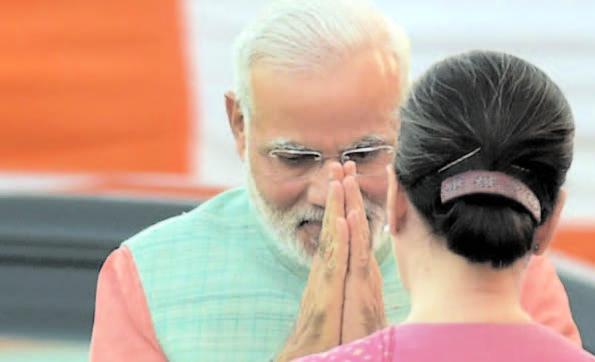
    NEW DELHI (TIP): The Parliament on May 7 passed the constitutional amendment bill regarding the land boundary agreement with Bangladesh, following which Prime Minister Narendra Modi personally thanked Congress president Sonia Gandhi for Opposition’s support over the legislation.

    The Prime Minister expressed his gratitude towards the Opposition and went to thank Sonia Gandhi personally after the passage of the Bill in Lok Sabha.

    PM Modi also tweeted that alongwith Sonia, he thanked Congress’ Mallikarjun Kharge, CPIM’s Sitaram Yechury, BSP supremo Mayawati, Samajwadi Party chief Mulayam Singh Yadav, BJD chief Naveen Patnaik and JDU leader Sharad Yadav.

    The Prime Minister also conveyed his gratitude to NDA allies for their support to the India-Bangladesh Land Boundary Bill.

    The PM also took to Twitter to thank the Opposition, wrote: “My thanks to all the political parties for their cooperation, as also to the states of Assam, Meghalaya, Mizoram, Tripura & West Bengal.”

    He also spoke to chief ministers of bordering states –West Bengal’s Mamata Banerjee, Assam’s Tarun Gogoi, Tripura’s Manik Sarkar, Meghalaya’s Mukul Sangma and Mizoram’s Lalthanhawla — to thank them for support to the Land Boundary Bill that provides for exchange of territories with Bangladesh.

    The bill had been unanimously passed by the Rajya Sabha on Wednesday and on Thursday it received Lok Sabha`s unanimous nod.

    Earlier in the day, External Affairs Minister Sushma Swaraj had moved the Constitution (One Hundred and Nineteenth Amendment) Bill, 2013, for passage of the bill and said it had been passed unanimously by the Rajya Sabha on Wednesday.

    “There was no vote against it and there was no abstention (in the Rajya Sabha). It sent a message to Bangladesh that all political parties are one on the issue. I will request that it is passed with the same spirit in the Lok Sabha as it will send a good message,” she said.

    The bill, which entails exchange of enclaves between the two countries, seeks to amend the First Schedule of the Constitution to give effect to an agreement entered into by India and Bangladesh on acquiring and transfer of territories between the two countries on May 16, 1974.

    Sushma Swaraj said that while the Bangladesh parliament had ratified the 1974 land boundary accord between two countries, the Indian parliament had not done so as demarcation had not been completed on the ground.

    She said then prime minister Manmohan Singh signed the protocol for transfer of territories during his visit to Bangladesh in 2011.

    The minister said the Constitution amendment bill was presented in the Rajya Sabha by the then United Progressive Alliance government in 2013 but the Bharatiya Janata Party, Trinamool Congress and Asom Gana Parishad had opposed it at the time.

    She said that while the AGP and the BJP felt that it overlooked interests of Assam, West Bengal was keen on a package for people who would come to the state as a result of implementation of the agreement.

    Sushma Swaraj said as foreign minister she chose Bangladesh as the country for her visit abroad, and Bangladesh Prime Minister Sheikh Hasina had urged her to move forward with the agreement.

    She said Prime Minister Narendra Modi told her to work towards removing hurdles in the implementation of the agreement.

    Sushma Swaraj said West Bengal Chief Minister Mamata Banerjee wanted a package from the central government and it had been agreed upon.

    The minister said she had moved the cabinet to keep Assam out of the implementation of agreement but the Congress was willing to support the bill only if the state was included.