Month: May 2015

  • Obama chooses Chicago to host his presidential library

    Obama chooses Chicago to host his presidential library

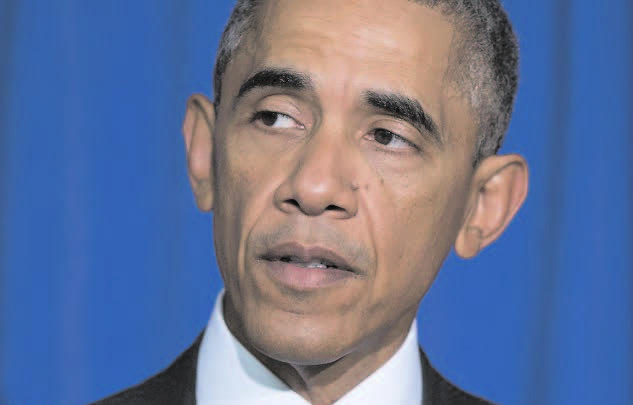
    WASHINGTON (TIP): President Barack Obama has chosen his hometown of Chicago to host his future presidential library, two individuals with knowledge of the decision said Thursday, placing the permanent monument to his legacy in the city that launched his improbable ascent to the White House.

    Obama’s library will be built on Chicago’s South Side, where the University of Chicago has proposed two potential sites not far from the Obama family’s home. It was unclear which of the two sites had been selected, but officials were expected to make an announcement within weeks.

    The decision brings to a close a hard-fought competition that kicked off in the earliest days of Obama’s second term. From an initial list of about a dozen proposals, the Barack Obama Foundation chose four universities to vie for the library. In recent months it became increasingly clear that the Obamas were leaning toward the University of Chicago, the elite private school where Obama taught law before becoming president.

    The University of Chicago’s victory marks a harsh letdown for the other three schools on the short list: The University of Hawaii, New York’s Columbia University and the University of Illinois at Chicago, a public school that proposed building the library on Chicago’s West Side.

    Obama’s decision to place the library in Chicago was conveyed to The Associated Press by two individuals with direct knowledge of the decision. Both spoke on condition of anonymity because the decision has yet to be publicly announced.

    Obama’s foundation, the University of Chicago and the White House all declined to comment.

  • No contest: Kazakh prez wins polls with 97.7% votes

    No contest: Kazakh prez wins polls with 97.7% votes

    ASTANA (TIP): Nursultan Nazarbayev, the only president Kazakhstan has ever seen since its birth some 24 years ago, won another mandate on April 26 by a margin that’d make words like ‘landslide’ and
    ‘overwhelming’ sound listless and feeble. He won 97.7% of the vote. That too in an election where 97% of those on the voter rolls turned out.

    Two others gave Nazarbayev company in this rather stately electoral no-contest — a communist and a trade unionist. Trade unionist Kusainov Abylgazy went home with 0.7% of the vote. Communist Turgyn Syzkykov had his bag slightly fuller with 1.7% of the vote. Both later acknowledged only Nazarbayev had the stature to be president.

    Kazakhstan’s “light” Nazarbayev rose from very humble beginnings to first become a steel plant worker, then the Soviet-ruled region’s top communist leader and the country’s first president after independence. He has always been at the helm. On April 27, he walked into a stadium raining confetti and bursting with roars of ‘Nursultan-Kazakhstan’. Wrapped in sea-blue and gold, this Nur Otan Party victory show was a full house. Amid much singing and dancing, Nursultan proclaimed his determination to take his country to the next level of development. For him it was a proud moment, for his people had backed him to the hilt.

    In the crowd, head covered in a blue party cap and waving a flag was young Imran. He loves Nazarbayev. “What style,” he gasped. Broad-shouldered Nazarbayev, natty in a smart suit, stepped on to the blue carpet. A golden scarf wrapped around his shoulders, the man of the moment was all about success and command. He waved, reached out, waded into crowds, did a quick jig and shook a leg as the music played. He was then on stage exhorting the nation to forge ahead — a show of showmanship.

    Imran also said he loved Bollywood stars. Malika, his course mate at the Eurasian University chipped in: “I love Shah Rukh Khan.” Even then the big Bollywood sultan isn’t a patch on their sultan — Nursultan. Once again, the roar went up: “Nursultan-Kazakhstan”, more confetti showers, more blaring music.

    The previous day, April 26, booth 81 in a central Astana neighbourhood had opened early for voting. On ordinary days, this glitzy structure, also called a palace, is home to children. They come here to learn music, take part in sports, learn other skills. That day, it was all agog. Nazarbayev would vote here. A day before the vote, a campaign ban —called day of silence in these parts —had kicked in. TV wasn’t beaming anything on elections.

    At booth 81, on the courtyard two big boxes made of transparent plastic stood on lovely expensive carpets. Husbands, wives, lithe women, athletic men, toddlers covered head to foot in woolens, elders, security men and women milled around. Unlike back home, where even in non-VIP booths, an air of grimness hangs over polling stations, this place was a breeze. Policemen weren’t making a clumsy display of guns.

    Past a metal detector and the mandatory frisking, it’s a short walk to the arena. Rolls are checked, voters given the ballot, they walk into an enclosure, stamp it and slip it into the big plastic box on the carpet through a narrow slit. Voting here closes at 8 pm. It’s unhurried. Children scamper around unafraid, walk up to securitymen and tug at their uniforms, slip into enclosures.

    Gulnar and her husband had brought their two children along. “I vote communist,” she said pointing to a miniscule photograph of Syzdykov, the communist in the race. Really? That’d make Gulnar a rare specimen of dissent — one of the barely-there 3%that voted against the great leader.

    In no time she drowned in a circle of TV booms and microphones as reporters quizzed her on her choice.

    Across the corridor, booth 81 was readying for Nursultan to show up. That’s the biggest photo-op for journalists here, the must-capture moment. Minutes later, smart securitymen — they look the same everywhere, clones of Obama’s secret service guards — burst into the hall. Nazarbayev’s here. All of 74, trim and straight, a slight smile flashes on his face. He is fit, has a tight jaw but somehow has an old soviet air about him — of being a cut above the rest, dripping dignity, in total control, creator of a nation, a man sitting on a mountain of success.

    He acknowledges the crowds, waves at them, walks into the arena, follows the process, poses for shutterbugs and showtime’s over. He’s then escorted into an enclosure where he addresses reporters. His voice deep and throaty, Nazarbayev speaks haltingly, carefully picking his words. He addresses reporters first in Kazakh, then Russian.

    Translators tell me he spoke of progress, the next level of consolidation and development. He takes no questions, waves again and walks out.

  • Cameron reprises Modi slogan for reelection

    Cameron reprises Modi slogan for reelection

    LONDON: British Prime Minister David Cameron appears to have discovered a new electoral language: Hindi. Speaking to a TV correspondent on April 30 while crisscrossing UK in a frenetic election campaign, Cameron was asked if there was anything he’d like to tell voters of Indian origin.

    “I’ll try,” said Cameron. “Phir ek baar, Cameron Sarkar.” It was a take-off on his Indian counterpart Narendra Modi’s successful poll mantra last year that went ‘Abki baar, Modi Sarkar’. Cameron also described Modi’s 3D holograms used during the election campaign as “very impressive”.

    “I’ve seen the holograms. Britain is the oldest democracy but a small country. We haven’t used the hologram yet, but who knows we might in the next 12 days?” said Cameron.

    The British PM’s remarks came a day after the Conservative party, released a song in Hindi: Aasman Neela Hai (the sky is blue). He also spoke about British ethnic voices finding increasing space in parliament, police and other wings of governance, and that more will be done in these directions in the weeks and months ahead.

    Saying he expects Modi in UK before long, Cameron said Britain takes India very seriously, evident in the deepening of bilateral relationship. “You’ve got a government with a clear plan. We take the same approach here. The key is to run the country and the election campaign at the same time.”

    British Asian votes would be a significant factor during May 7 elections and Cameron’s outreach is seen as recognition of the importance of Indian votes to the Conservative party.

  • Beijing pulls up PLA over India’s swift rescue operations

    Beijing pulls up PLA over India’s swift rescue operations

    BEIJING (TIP): The Indian military’s swift evacuation of thousands of Indians from earthquake-hit Nepal has put China’s PLA on the defensive with questions raised as to why its efforts to rescue stranded Chinese nationals did not match those of India.

    The media in China has questioned why air force planes were not deployed to airlift over 8,000 Chinese, many of whom are still stranded in Nepal.

    In a rare comparison of India’s military with the People’s Liberation Army (PLA), the world’s largest, Chinese defence spokesman Geng Yansheng was on Thursday confronted with the question at a briefing as to why the military did not use planes to airlift stranded Chinese when India had done so to ferry its nationals.

    There is considerable annoyance in China over the slow process of airlifting of Chinese tourists as well as workers employed in various Beijing-funded projects in Nepal as the task was given to a number of civilian airlines. There were also reports of some airline companies demanding heavy fares, but they were subsequently denied.

    Besides airlifting thousands of its citizens, the Indian Air Force also transported about 170 foreign nationals from 15 countries to India. Several others were also transported through special buses from across the border to Bihar.

    Defending the move to use civilian aircraft, Geng said “Whether to use military aircraft to transport people from a disaster area — this is to be decided by various factors.”

    He said that after the earthquake, the Chinese government had organized a number of civilian commercial flights to evacuate Chinese citizens stranded in Nepal. He added that soon after the quake, three helicopters from Tibet flew in food and water to a number of Chinese employees working on a hydel project and some of them were even airlifted.

    India’s quick response to send search and rescue teams besides relief supplies has been reported by sections of the Chinese media, while China too dispatched rescue teams and planes with supplies, by which time the Indian presence on the ground had swelled. Earlier, the Chinese foreign ministry had played down reports of competition with India to assist quakehit Nepal and offered to work with New Delhi “positively” in the relief efforts to help the Himalayan nation overcome the crisis.

  • Japan consumer inflation up for first time in 10 months: Govt

    TOKYO: Japan’s core inflation picked up for the first time in 10 months in March, data showed on Friday, offering a sliver of hope for the Bank of Japan, which has been struggling to beat years of deflation.

    Core inflation, excluding volatile fresh food prices, rose 2.2 percent year-on-year in March, logging the first increase since May 2014, the internal affairs ministry said.

    But stripping out the impact of a sales tax rise last year, the inflation rate came in at a tepid 0.2 percent from a year ago, well short of the BoJ’s target of 2.0 percent inflation.

    Analysts said the figures would do little to ease speculation that the central bank will have to launch further monetary easing measures this year to jack up prices and counter a downturn in the world’s number three economy.

    Weighed by a plunge in oil rates and tepid consumer spending, Japanese inflation stalled in February for the first time in nearly two years.

    Since Prime Minister Shinzo Abe took office in late 2012, Tokyo has launched a high-profile bid to kick-start the economy and end years of stagnant or falling prices.

    The downtrend in prices has been blamed for holding back growth. Separate data Friday from the ministry showed spending among Japanese households dropped for the 12th month in a row.

    Household expenditure fell 10.6 percent in March from a year earlier, worse than the 2.9 percent fall in February, partially reflecting robust spending a year earlier ahead of the April sales tax hike.

    The unemployment rate edged down to 3.4 percent in March from 3.5 percent in February.

  • No Indian name on ‘top 100 young university’ list

    LONDON (TIP): No Indian university has made it to the list of the world’s top 100 which are under 50 years old.

    Institutes from 28 countries are present in the list of rising global higher education universities poised to challenge the traditional Anglo-American dominance of the sector.

    Over 800 universities worldwide had submitted data for analysis of which 20 were from India.

    Phil Baty, rankings editor, Times Higher Education, told media, “A number of these Indian institutions did not meet our data providers’ strict criteria for inclusion in the rankings which includes a minimum number of research papers to be published each year and were therefore excluded. Many of the remaining institutions were also founded before 1964 which meant that they could not be considered for the 100 under 50.”

    Three factors were identified which helped the rise of these institutions. Citation Impact – how much a university’s research papers are being referenced by other academics; a measure of the influence its research has on the rest of the world. The second is ‘Income from Industry’ – how much companies are working with academics and applying their research to the real-world. Lastly, ‘International Outlook’, a measure of how many international students and staff a university attracts and how much it is collaborating on international research papers with other institutions.

    Ecole Polytechnique Federale de Lausanne moved to pole position from second place, where it has sat since the first 100 under 50 was published in 2012. It swaps places with South Korea’s Pohang University of Science and Technology. The remainder of the top five is static: the Korea Advanced Institute of Science and Technology (KAIST) holds on to third, the Hong Kong University of Science and Technology retains fourth, while Singapore’s Nanyang Technological University remains in fifth.

    The top 10 includes representatives from eight countries overall: the Netherlands’ Maastricht University holds on to sixth; the US’ University of California, Irvine is seventh with its UC stablemate Santa Cruz moving up three places to eighth; the UK’s University of Warwick rises from 12th to ninth and France’s Paris-Sud University falls two places to 10th.

    Australia has emerged as the number one nation, with 16 top 100 institutions, up from 14 last year. It also has a new number one, the University of Technology, Sydney, in 21st spot overall: it overtakes the University of Newcastle (30th in 2015).

    This contrasts favourably with the UK’s representatives, which are heavily concentrated in the 1960s. They are led by the University of Warwick in ninth, followed by the University of Dundee (joint 19th). This is Warwick’s final year in the list due to its 1965 foundation date, and Dundee has only two years left. Only four of the 15 UK universities in the list were founded after the 1960s.

  • Manhunt in Hong Kong as kidnapper vanishes with$3.6 million ransom

    BEIJING (TIP): The Hong Kong police has launched an intense manhunt for a man who extracted a ransom of$3.6 million after kidnapping a 29-year old woman. The woman is safe but the kidnapper has vanished after picking up the money from her family.

    The kidnapper first broker into her apartment stole some valuables and kidnapped the woman on Saturday, the police said. Her family paid him $3.6 million as ramsom, the highest ransom amount paid in Hong Kong in past decades. She was returned unharmed on Tuesday after the amount was paid.

    Hong Kong authorities have publicized description of four men, believed to be the main kidnapped and his accomplices, while asking the public to report if they are seen anywhere. The police has also created roadblocks on major routes leading to Mainland China to prevent them from leaving the city.

    Police said the accused men escaped in a white car after receiving the ransom payment.

    Kidnapping for ransom, once a major crime, has now reduced sharply as Chinese authorities have cracked down on it.

  • EU humanitarian chief sounds warning on Iraq

    BAGHDAD (TIP): The head of the European Union’s humanitarian aid department warned on Thursday that the situation in Iraq is deteriorating rapidly while the world is preoccupied with crises elsewhere.

    Jean-Louis de Brouwer told The Associated Press that the number of displaced people in Iraq has quadrupled in the last year and shows no signs of decreasing.

    “The worst is still to come,” he said. “The situation is deteriorating, humanitarian aid is becoming even more essential than it was, the problem is funding.”

    Iraq is convulsed in a battle between the government, its militia allies and forces of the Islamic State group that have taken over large parts of the north and west in the country.

    The fighting has displaced some 2.7 million people inside the country, including 110,000 who fled from renewed fighting in and around the city of Ramadi in the western Anbar province in the past two weeks.

    Many of these are living with other families, inside mosques or in makeshift camps around the western periphery of Baghdad. Meanwhile, there are hundreds of thousands more in the Kurdish northern regions.

    “This is quite a matter for concern as the needs are skyrocketing and the resources are not increasing,” said de Brouwer. “I’m afraid there is also — not donor fatigue — but donor exhaustion.”

    An even larger refugee problem in neighboring Syria and most recently and earthquake in Nepal has drawn attention away from the slow building crisis in Iraq, he said.

    In June, the EU is to co-host with the UN a new call for humanitarian aid for Iraq in Brussels. The EU has nearly doubled its allocation for Iraq from$22 million in 2014 to $43 million this year.

    De Brouwer also criticized the practice of not allowing those displaced from Sunni areas into Baghdad or the Kurdish region without sponsorship, leaving most people stranded.

    “If they keep on with this kind of practice, they will end up with the kind of ethnic division that will not be good for the country,” he said.

  • The Play  ‘Nirbhaya’ shocks and sends viewers in to soul searching

    The Play ‘Nirbhaya’ shocks and sends viewers in to soul searching

    NEW YORK CITY (TIP): The electrifying new off-Broadway production Nirbhaya is currently in preview performances at The Lynn Redgrave Theater for two weeks. Written and directed by internationally acclaimed Yaël Faber of South Africa, in collaboration with an extraordinary cast and creative team from India, Nirbhaya had its world premiere at the Edinburgh Festival Fringe in August 2013. The production won the coveted Amnesty International Freedom of Expression Award for the outstanding Fringe production that raises awareness of human rights and other awards.

    After the performance at Lynn Redgrave Theater Wednesday, acclaimed filmmaker Deepa Mehta, who is making a film on this subject matter, moderated a discussion with the performers.

    On the night of December 16, 2012, a young pharmacy student named Jyoti Singh Pandey and her male friend boarded a bus in Delhi heading for home. What followed changed the lives of these two people and countless others forever. Unable to reveal her name, the press named her “Nirbhaya” -Fearless One. In a bid to shatter the silence around sexual violence, Nirbhaya play’s performers have presented the shocking events surrounding Jyoti’s story, as well as give their own moving testimonies, cracking open the cone of silence around women whose lives have been shattered by sexual and domestic violence.

    It is hard to overstate the emotional impact of seeing Pandey’s attack played out on stage, and of hearing these women describe what they themselves have gone through: one performer, her face disfigured by scars, describes being set alight by her husband over dowry demands, and her despair at subsequently having her son taken from her. One of the 5 female performers was raped in her student apartment in Montreal   –  which underlines the fact that sexual violence is not endemic to India.

    Poorna Jagannathan, the play’s Originating Producer and performer, is an award-winning actress and has worked extensively in theatre, film and TV in India and in the US. She has a degree in  Women’s Studies from the University of Maryland. She currently lives between Mumbai and New York City.

  • US panel: Minorities under attack in India

    US panel: Minorities under attack in India

    NEW DELHI (TIP): A US government panel tracking international religious freedom has said in its latest report that religious minorities in India were exposed to “derogatory” comments by leaders of the ruling BJP as well as “violent attacks and forced conversions by the RSS and VHP” since the Modi government took over last year.

    It also slammed the “ghar wapsi” campaign and accused “Hindu nationalist groups” of offering monetary inducements to Muslims and Christians for converting to Hinduism but also to Hindus who carried out such
    “forced” conversions.

    Even as the United States Commission on International Religious Freedom (USCIRF), a federal government panel that makes policy recommendations to the US President and the Congress, welcomed Prime Minister Narendra Modi’s February 17 statement assuring protection to the minorities as a “positive development”, it added a sting to the compliment.

    The panel said his assurance was notable “given the long-standing allegations that, as chief minister of Gujarat in 2002, Modi was complicit in anti-Muslim riots in that state”. Recalling how Modi’s tourist visa was revoked by the US for “severe violations of religious freedom”, the USCIRF underlined that the Indian PM “remains the only person known to have been denied a visa based on this provision”.

    The findings in the USCIRF annual report- 2015, largely based on the accounts of minority leaders and NGOs based in India, have led it to place India on its Tier 2 list of countries for the seventh year in a row.

    Alleging that incidents of “religiously-motivated and communal violence” had reportedly increased for “three consecutive years”, the USCIRF report said religious minorities in India frequently accused RSS, VHP and other Hindu nationalist groups and individuals of intolerance, discrimination and violence against them. It even alleged that the local police seldom provided protection to the minorities, refusing to file complaints and rarely investigating them.

    Slamming the “ghar wapsi” campaign, the USCIRF noted that Hindu nationalist groups were not only paying off Christians and Muslims to convert to Hinduism but also reportedly offering money to Hindus to convert Christians and Muslims to Hinduism.

    “In December 2014, Hindu nationalist groups announced plans to forcibly reconvert at least 4,000 Christian families and 1,000 Muslim families to Hinduism in UP on Christmas Day… the Hindu groups sought to raise money… noting that it cost nearly Rs 2 lakh (nearly $3,200) per Christian and Rs 5 lakh ($8,000) per Muslim,” the report said. However, it added that domestic and international criticism led “Mohan Bhagwat, a RSS leader” to postpone the programme.

    The report also referred to the alleged mass ceremony held in Agra in December last year to forcibly reconvert Muslims to Hinduism.While noting that nearly half-a-dozen states in India had laws against forced conversions, the US panel alleged these were “one-sided, only concerned about conversions away from Hinduism but not towards Hinduism”.

    Also faulting India on protection of Muslims, the USCIRF report said the community had to face significant hate campaigns by Hindu nationalist groups and local and state politicians, “that includes widespread media propaganda accusing Muslims of being terrorists, spying for Pakistan, forcibly kidnapping, converting and marrying Hindu women, and disrespecting Hinduism by slaughtering cows”. The panel noted that the minority community also complained about some Indian states violating their religious freedom by banning cow slaughter, “which is required for Eid-al-Adha”. This, however, may not be true as the animal traditionally sacrificed for Eid-al-Adha in India is the goat.

    Regarding the religious freedom of Sikhs, the USCIRF report claimed that Sikhs were being denied benefit of reservation available to other religious minorities and Scheduled Castes. It also alleged that Sikhs were harassed and pressured to reject religious practices such as unshorn hair and carrying of kirpan. Indian commentators, however, refute these allegations saying the Scheduled Castes among Sikhs are eligible for reservation benefit and free to follow their religious preferences.

    The panel noted that prosecution and trial of communal cases was slow in India. “The Indian courts are still adjudicating cases stemming from large-scale Hindu-Muslim communal violence in Uttar Pradesh in 2013 and in Gujarat in 2002,” it said.

  • After cities, smart military stations on cards

    After cities, smart military stations on cards

    NEW DELHI (TIP): On the lines of government’s smart city project, the Indian military could develop its own smart stations.

    According to military sources, the chiefs of staff committee is discussing a proposal to develop “smart armed forces station (SAFS).” A formal proposal will be submitted to the government soon on SAFS, they said.

    In the first phase, the plan is to develop six military stations into smart stations, along the lines of smart cities that government is proposing to develop. The Union Cabinet on Wednesday approved Modi government’s flagship scheme to develop 100 smart cities.

    Sources said the military leadership will propose to convert six military stations to SAFS. OF them three will be army stations, two of air force and one from navy.

    Under the smart cities scheme each city selected through a ‘city challenge’ competition would get central assistance of Rs 100 crore per year for five years. To begin about 20 cities would be selected across India.

    The military proposal could include a suggestion to develop the six of them at a far cheaper cost than civilian cities. “Military stations generally have better infrastructure and is easier to manage for converting them into smart cities,” one officer pointed out.

    Another plan the armed forces will pursue is to dovetail development of its stations located in those cities selected for smart city project on similar lines.

  • Moga’s shame: Young woman alleges gang-rape

    Moga’s shame: Young woman alleges gang-rape

    MOGA (TIP): A young woman in Punjab’s Moga district has alleged that she was gang-raped by her friend’s husband and his friends, police said on May 1. The woman’s claim came just hours after the horror story of a girl being killed after being pushed out of a moving bus by her molesters.

    The victim, aged 23, claimed that she was gang-raped by her friend’s husband and others on the intervening night of April 29 and 30 (Wednesday and Thursday) at a secluded house in Marhi Mustafa village near Moga, 180 km from here.

    Police have registered a case of rape against her friend’s husband and others following the complaint on April 30.

    No arrest has been made so far. The victim claimed that she had gone to meet her friend at the latter’s house on Wednesday night along with her boyfriend. They decided to stay there overnight.

    The friend’s husband came home drunk late in the night with seven other friends. They allegedly thrashed her boyfriend and took her to the tube-well room in a secluded part of the village.

    She was gang-raped by the eight men after confining her to the room and allowed to leave the room only on April 30  morning.

  • Kisan Padyatra: Rahul walks for farmers in Maharashtra, but says I have nothing to offer

    Kisan Padyatra: Rahul walks for farmers in Maharashtra, but says I have nothing to offer

    MUMBAI (TIP): Congress vice-president Rahul Gandhi, who arrived in Nagpur on April 29, started his padyatra at around 8.15 am and visited five villages in Amravati division during his 15-km march on foot. He visited family members of the nine farmers who committed suicide from the five villages of Gunji, Shahapur Ramgaon, Rajna and Tongalabad which are at a distance of 50 to 70 kms from Amravati.

    The expectations were high. And so was the determination of the relatives of nine farmers who committed suicide in Vidarbha to present their woes before the Congress’ crowned prince. But neither did Rahul Gandhi utter a word on the lack of irrigation facilities in the region nor did issue any promises to the ailing farmers. What he could alone tell was: “How can I announce something or promise you anything?”

    It was only on Wednesday that Congress state chief Ashok Chavan told reporters in Nagpur that Rahul’s Vidarbha visit was not aimed at targetting Prime Minister Narendra Modi. But that was exactly what Rahul did, criticising Modi sarkar.

    Rahul, who arrived in Nagpur on Wednesday night, started his padyatra at around 8.15 am and visited five villages in Amravati division during his 15-km march on foot. He visited family members of the nine farmers who committed suicide from the five villages of Gunji, Shahapur Ramgaon, Rajna and Tongalabad which are at a distance of 50 to 70 kms from Amravati.

    Rahul first visited the village of Gunji where he met family members of Nilesh Walake and Ambadas Wahile who had committed suicides due to agrarian crisis. He was offered a cup of tea, made of cow milk, at Walake’s house. Rahul had walked mush faster than those accompanying him and most of them were seen wiping the sweat on face with turkish napkins.

    En-route to next village, Rahul walked with determination and at times stopped to have a chat with a few farmers. At Shahapur, he met family members of late Kishor Kamble. He then proceeded to Ramgaon where he met family members of Kacharu Goma Toopsundare and had lunch with the family. Rahul had moongdal wadyachi bhaaji with poli and ambyachi kairi for his lunch at Toopsundare’s house.

    After lunch at Ramgaon, he proceeded to Rajna and met family members of Marutrao Meware. He interacted with a few farmers including Pradeep Jagtap, Pandurang Chavare, Ramesh Rathi, Shrikant Gavande, Noorbhai Shaikh Noor and Sachitanand Kale, who all complained to him of lack of irrigation facilities in Vidarbha.

    He met family members of four farmers – Manik Thavbhar, Ashok Saatpaise, Ramdas Adakite and Shankar Adakite – from Tongalabad who had committed suicide. Even though they had the same story to tell and complained about the lack of irrigation facilities, what they could hear in return was nothing.

    Addressing a news conference, when reporters asked as to what he has offered the family members, the Congress vice-president replied, “How can I assure or promise them anything?I can help them through my party or on my personal behalf, but it has limitations.” All through the news meet, however, he targetted the government for ignoring farmers and demanded a complete loan waiver.

  • Chinese rescue Indian mountaineers

    HYDERABAD (TIP): Over 20 mountaineers from Andhra Pradesh and Telangana were on their way home via Lhasa after Chinese Mountaineering Association (CMA) on April 30 rescued them from Everest base camp, where they had been stranded following the Nepal earthquake.

    Nalgonda resident Shekhar Babu-led climbers planned to scale the world’s highest mountain from dangerous North Col.

    They had stayed put at the camp as avalanches triggered by the earthquake had blocked the highway connecting Nepal and China.

    “The team is safe and will be reaching Lhasa on Friday evening,” said a representative from Hyderabad’s Transcend Adventures that had organized the expedition. He said the climbers would be flown from Lhasa to India.

    As posted on the adventure club’s Facebook wall, Nima Tsering, vice-chairman, CMA, visited the base camp and told the climbers that they will be taken down, much to the relief of team leader Shekhar Babu and his boys.

    Tsering also carried some good news with him, which brought some cheer and relief to the mountaineers who pay huge sums to plan a trip to Everest. The CMA said the registration fee of the climbers for this year would hold good for the next three years.

    “We are grateful for this gesture,” said Prithvi Raj, a representative from the adventure club.

    Anxious family members have been calling the club with queries about their loved ones. “We have informed them and they are relieved that they are safe and are being escorted to safety,” said Raj. The team will return to India in a few days time.

  • Ruckus in RS over Ramdev’s drug promising male child

    NEW DELHI (TIP): Rajya Sabha plunged into chaos during Zero Hour on April 30 over an Ayurvedic medicine, manufactured by Baba Ramdev’s Divya Pharmacy and purportedly promising birth of male child, with the opposition seeking a ban on the drug and stringent action against its manufacturers.

    The entire opposition joined K C Tyagi (JD-U) when he raised the issue showing a packet of the medicine called ‘putrajeevak beej’, calling it ‘illegal’ and ‘unconstitutional’.

    Health minister JP Nadda said the issue relates to the department of Ayush, but assured the government would look into it. “It is a serious matter. Government is serious about gender ratio. All departments are working towards it. PM is himself monitoring ‘Beti Bachao, Beti Padhao’ programme. I will come back to the House,” he said. “The Government will look into it and proper action will be taken.”

    Displaying the packet of the medicine to the members, Tyagi said despite the Constiutional guarantee of no discrimination on the basis of caste and gender, the medicine will only perpetuate the gender divide. He said he bought the medicine himself. Without taking Ramdev’s name, Tyagi said, “The man has been made brand ambassador of Haryana. It is violation of PM’s ‘Beti Bachao, Beti Padhao. How can a state appoint him as brand ambassador?”

    At this point Sitaram Yechury (CPM) walked up to Tyagi and looked at the medicine. Jaya Bachchan (SP) ook the medicine to Nadda.

    Deputy chairperson PJ Kurien also joined the discussion and said, “If there is an attempt for selection or option of sex, it is against the spirit of the Constitution.” Minister of state for parliamentary affairs Mukhtar Abbas Naqvi said, “The issue should not become a topic of discussion. There are many drug-related laws in the country. We will find out if it violates any law.”

    Jaya Bachchan demanded that the licence of the company be cancelled and the product removed from market. Yechury said the medicine also spreads obscurantism and is against the spirit of scientific temper. Leader of Opposition Ghulam Nabi Azad feared the medicine could be spurious and demanded strict punishment.

    In a statement, Patanjali Yogpeeth (Trust) and Divya Yog Mandir (Trust) said the medicine had nothing to do with sex determination. “Some people, due to their ignorance and selfish reasons, are trying to give a bad name to us and to Ayurveda as part of a well-planned campaign. The truth is that ‘putrajeevak aushadhi’ has been used to treat infertility for thousands of years,” it said.

    “Its Hindi name is ‘putrajeevak’ and its botanical name is ‘putranjiva roxburghii’. From Chjarak to Sushruta, all experts of Ayurveda have mentioned in the Ayurveda texts that this medicine treats infertility and has no role in sex determination … The ancient texts use the word ‘putrajeevak’ for child,” it said.

    Patanjali’s medicine is only for treating infertility and not for sex determination, the statement said.

  • International transactions will be transparent by 2017: Jaitley

    NEW DELHI (TIP): Arun Jaitley also asked Enforcement Directorate to avoid overkill and ignore trivialities. Union FINANCE Minister Arun Jaitley on Friday said “Rupee has kept pace with the dollar in last few months.”

    Jaitley, when asked about the black money issue, said “Need law to prevent money laundering; target is to make all international transactions transparent by 2017.”

    Jaitley clarified that “New law on undisclosed income and assets abroad to be taken up in Parliament next week.”

    He also asked Enforcement Directorate to avoid overkill and ignore trivialities.

    Jaitley cautioned “Serious offenders should be brought to book; 121 prosecution cases filed against those caught with black money abroad.”

  • How Houston is becoming the new hub for Indian-American community in Texas

    How Houston is becoming the new hub for Indian-American community in Texas

    HOUSTON (TIP): Move over New Jersey and Fremont, California. With a population of 150,000 Indian-Americans, Houston, Texas, is emerging as a new hub for the community. “A couple of decades back many Indian professionals had come to Houston, including doctors who came to work at the famous Texas Medical Center and engineers who came to join Nasa’s Johnson Space Center. But now members of the community have come of age with many of them becoming entrepreneurs and setting up different ventures, including those in manufacturing and energy and petrochemicals,” says Jagdip Ahluwalia, a Houston-based businessman, who was a faculty member of the Birla Institute of Technology, Mesra, before moving to the US.

    An example is Piping Technology & Products, which was a set up in 1978 by Durga D Agrawal in his garage. Today, the company has a wide industrial product range, including pipe supports, expansion joints and shock control devices and more. The company has grown through acquisitions of Sweco Fab, Fronek Anchor/Darling, Pipe Shields and US Bellows.”

    Piping Tech is among the largest employers in the greater Houston area and its founder is a well-known businessman and influencer, who supports charitable and philanthropic activities,” says Ahluwalia.

    He adds that there are many other Indian-American owned companies such as Vinmar International, a petrochemicals company and hospitality and food services majors in Houston. “And members of the community are now also playing an important role in public life and community services, and are visible in various leadership positions in Houston,” says Ahluwalia, who is executive director and a founder member of the Indo-American Chamber of Commerce of Greater Houston.

    Ravi K Sandill, judge of the 127th district court in Harris County of Houston, became the first South Asian to hold the position in the US while another Indian-American, Himesh Gandhi, was elected to the Sugar Land City Council in 2012. Nandita Berry, an Indian-American attorney from Houston, was the former secretary of state of Texas.

    “Indians are now among the most-respected communities in the Greater Houston area with many making an impact in public policy. We now have a place at the table and there are Indian faces in different administrative and community organizations,” says Sanjay Ramabhadran, vice president at CP&Y, a Texas-based infrastructure consulting firm.

    He was honored as one of the 10 outstanding young Americans in 2012 by the US Junior Chamber. He adds that the chancellor of the University of Houston, Dr Renu Khator, who had helped make UH a tier-1 university and generate huge revenues, is a prominent member of the community.

    But it’s not just in business and public life that Indians in Houston are coming of age. Members of the community are also involved in philanthropic and charitable causes. “Sugar Land city in Houston has emerged as a hub for Indian-Americans.

    There are a large number of Indian restaurants across Greater Houston and the city is very friendly towards those arriving from India,” says Ashok Garg, who runs his company Allied Exports and is president of the Indo-American Chamber of Commerce. He is associated with various community activities including serving on the board of Literacy Advance of Houston and is currently on the board of Lighthouse of Houston, a non-profit dedicated to helping the visually impaired.

    A recent business delegation to India from Houston, led by Houston mayor Annise D Parker, had several meetings with key business leaders in energy, engineering and government. Bobby Singh, principal at Isani Consultants that offers civil engineering and construction services in Houston, said in regard to the mission, “Houston is a diverse, immigrant-friendly city where Indo-Americans like myself share in the city’s success and we have a mayor who recognizes the importance of nurturing those international ties.”

  • Indian, American Scientists Chosen for Environmental Prize

    Indian, American Scientists Chosen for Environmental Prize

    LOS ANGELES (TIP): This year’s Tyler Prize for Environmental Achievement is being awarded to two scientists who have worked for conservation on the land and in the ocean.

    Madhav Gadgil of India and Jane Lubchenco of the United States are being honored for working with communities to preserve the environment while protecting people’s livelihoods.

    Bamboo crops in the Western Ghats, a mountain range in western India, have been depleted by the paper industry. Gadgil said that has hurt local villagers who rely on the plants to make baskets and other products.

    Earlier, the crops “were exploited through the state machinery and largely they were auctioned off to  traders, to industries,” said Gadgil, a visiting professor at India’s Goa University who works with villagers to keep the ecosystem balanced and let the bamboo groves flourish. “Now the communities have rights to manage these.”

    He said that for generations, villagers have preserved parts of the forest as sacred, something that also happens in other parts of Asia.

    Gadgil said he serves as a bridge between local people and government, which wants to promote modern management techniques. He has focused on documenting the sacred forests and the kind of biodiversity resources that have been conserved, and finding out “what is now in the current context possible.”

    Gadgil traveled to Los Angeles to receive the Tyler Prize and to meet this year’s other winner, Lubchenco. A marine ecologist, she teaches at Oregon State University and served four years as the head of the U.S. National Oceanic and Atmospheric Administration. Last year, President Barack Obama named her U.S. science envoy for the ocean.

    Lubchenco has worked with American fishermen to restore depleted fisheries through “catch shares,” strategies that grant fishing rights to fishermen but put limits on their catch in affected areas.

    “Our basic idea of oceans is that they are so immense, so bountiful that we can take anything out and put anything in and it would not make much of a difference. And we have discovered that is simply not the case,” she said.

    The system of catch shares gives fishermen a share of the ocean harvest, and those rights can be bought, sold and traded. The system has its critics, but Lubchenco and other supporters point to its success in restoring depleted stocks.

    She said that limiting fishing on the high seas is difficult. “There are a lot of efforts under way to rein in overfishing, but it remains a huge challenge and it has global ramifications,” she said.

    Lubchenco said governments must lead, and local communities must be part of the solution.

    Gadgil said the same is true of the Indian villagers with whom he works.

    “Of course they have a substantial amount of understanding, local understanding, of that resource base and what is impacting it, what might be good sustainable-use practices,” he said.

    The prize winners said the balance of life in the ocean and on land is essential for a healthy planet and healthy communities.

  • Hundreds of IT workers at Disney replaced by H-1B, L-1 visa workers from India

    Hundreds of IT workers at Disney replaced by H-1B, L-1 visa workers from India

    WASHINGTON, DC (TIP): A number of information technology workers who were formerly laid off by Disney have come forward in an interview with Computerworld to describe a system they believe was systematically designed to replace American workers with H-1B visa and L-1 visa workers, primarily from India.

    The restructuring, which transpired in October 2014, was not intended to displace workers, according to Disney.

    “We have restructured our global technology organization to significantly increase our [staff] focus on future innovation and new capabilities, and are continuing to work with leading technical firms to maintain our existing systems as needed,” stated a spokesperson for the company.

    However, from the perspective of five laid-off Disney IT workers, all of whom agreed to speak to Computerworld on the condition of anonymity, Disney was cutting well-paid and longtime staff members – some who had been previously singled out for excellence – as it shifted work to contractors.

    The laid-off workers believe the primary motivation behind Disney’s action was cost-cutting.

    “Some of these folks were literally flown in the day before to take over the exact same job I was doing,” said one of the IT workers who lost his job. Computerworld noted he had to train his replacement and was angry over the fact he had to train someone from India “on site, in our country.”

    The IT workers who were let go alleged Disney cut several hundred employees last year, although the company placed the number at about 135. Disney reportedly encouraged the terminated staffers to apply for new innovation-based positions, but the former employees who were interviewed said they knew of few co-workers who landed one of the new positions.

    One of the laid off workers opined there were alternative methods for Disney to achieve its goals. “There is no need to have any type of foreigners, boots on the ground, augmenting any type of perceived technological gap,” said one former employee. “We don’t have one, first off.”

    Several of the interviewees told Computerworld they didn’t want to appear as xenophobic, but as one noted,
    “There were times when I didn’t hear English spoken” in the days leading up to his or her layoff. “I really felt like a foreigner in that building,” the worker said, primarily referring to the widespread use of Hindi.

    Congress has begun to focus on the displacement of American workers ever since Southern California Edison made national headlines for replacing hundreds of IT employees with H-1B guest workers. Disney is one of a slew of top tier companies that have been pushing lawmakers to allow more H-1B workers into the country.

  • H4 WORK PERMITS HALTED: LAWSUIT FILED BY SAVE JOBS USA

    H4 WORK PERMITS HALTED: LAWSUIT FILED BY SAVE JOBS USA

    READ UPDATE ON THIS STORY :

    [quote_box_center]H4 WORK PERMITS ALLOWED : LAWSUIT FILED BY SAVE JOBS USA DISMISSED[/quote_box_center]

    WASHINGTON (TIP): The lawsuit, co-led by the Immigration Reform Law Institute, centers not on the H-1B “high-tech” employment visa, but on the related H-4 visa that applies to the spouses of H-1B holders. A Department of Homeland Security rule published in the Federal Registrar in February purports to allow H-4 holders the right to work in the country. According to DHS estimates, 179,600 of these work permits will be doled out in the first year alone, with 55,000 more going out in subsequent years. Also according to the rule, DHS has given itself the option of expanding the program to other groups in future. The lawsuit asserts basically what H-1B expert Norm Matloff said recently, that the new H-4 visa rule is yet another example of U.S. Citizen and Immigration Services “taking the law into their own hands.”

    The complaint against DHS revolves around two functions of the new visa rule. Besides creating a new category of competitors against American workers, the H-4 rule states: “A primary purpose of this rule is to help U.S. businesses retain the H-1B non-immigrants” (emphasis added). In other words, the rule works to draw in potential H-1B workers from abroad (and who are used to far lower salaries and living standards) while providing work permits to brand-new competitors (their potentially high-skilled spouses) who will directly compete with people like Julie Gutierrez. According to the complaint, advertisements for H-4 visa holders are already popping up on engineering job boards online.

    Among the legal claims is that the authority to create work permits under the H-4 visa cannot be found in the Immigration and Nationality Act or elsewhere. But the plaintiffs say that even if a statutory basis could be found, DHS acted “arbitrarily and capriciously” when it concluded that the rule would have only “minimal labor market impacts.” As mentioned, DHS has admitted that the program will hand out nearly 200,000 work permits to new foreign job competitors in the first year, with a further 55,000 every year afterward. This alone shows that DHS’s “finding” that American workers won’t be affected was merely conjecture.

    Elsewhere, Save Jobs USA claims that the Department of Labor failed to certify that the new visa rule won’t
    “adversely affect wages and working conditions” of similarly employed American workers – that such certifications exist will probably surprise those workers in immigrant-heavy industries who have seen flat-line wages for decades. By contrast, many foreign-visa supporters believe that tech companies must interview Americans first before tapping the pool of H-1B workers; however, there is no such requirement in the law. One expert testified before Congress last month that “employers can easily hire an H-1B worker at wages far below what an American worker is paid.”

    The H-4 and H-1B programs, like most employment visas, confer benefits to other country’s citizens at the expense of American workers. It’s a corporate subsidy paid for by the middle class and everyone from Senator Sanders to Senator Inhofe now seems to agree. As the late Democratic senator Eugene McCarthy warned in 1992, right after the creation of the H-1B program, we cannot let America become “a colony of the world.” For the members of Save Jobs USA and other workers like them, this could give rise to a new Gadsden Flag. Any presidential candidate for 2016 who waves that banner will pull in a new and growing constituency that’s begging to be heard: the displaced American worker.

  • India, China win hearts, minds in quake-hit Nepal

    India, China win hearts, minds in quake-hit Nepal

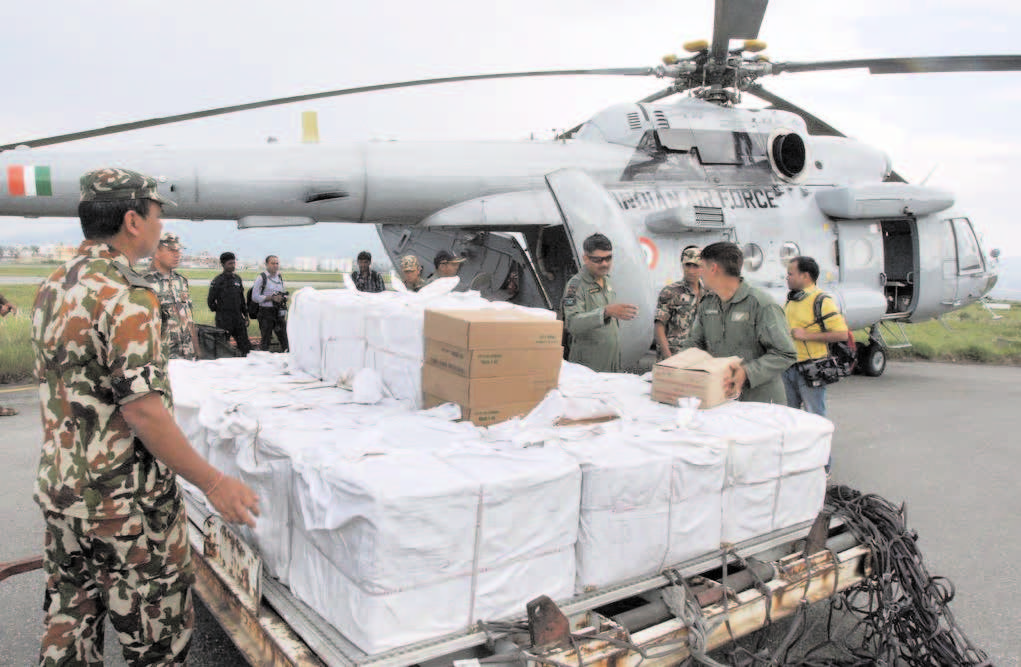
    POKHARA (TIP): At Pokhara airport in the Himalayas, Indian soldiers race back and forth loading rice, blankets, tarpaulins and other aid onto waiting helicopters for delivery to Nepal’s quake-devastated villages.

    In the ruined ancient town of Bhaktapur outside the capital Kathmandu, Chinese rescuers in blue uniforms search for survivors in the rubble of toppled temples and homes.

    Nepal’s overwhelmed government has been criticised by frustrated residents, hundreds of thousands of whom are desperate for assistance after Saturday’s monster quake.

    But foreign countries, with their medics, specialist rescuers and helicopter sorties, have won applause, with giant neighbour India sometimes singled out for praise as the biggest provider.

    “We are hungry, we have no food, and we’ve had no help from our own government,” Arjun Budhathoki, 30, said as he queued, along with thousands of others, for a bus out of Kathmandu this week.

    “The Indian government is the only one helping our citizens, they are doing so much for us,” Budhathoki said.

    India and economic powerhouse China have long vied for influence in the impoverished Himalayan country which was ripped apart by the quake, leaving more than 6,200 people dead.

    China has dispatched about 300 personnel to Nepal and announced about $10 million in aid so far, according to state media.

    Indian Prime Minister Narendra Modi has promised to “wipe the tears of every Nepali” while the country’s air force alone has sent 950 personnel and dropped more than 400 tonnes of aid across the country.

    India’s hyperactive media have devoted hours to the country’s assistance, including plucking stranded climbers from Everest base camp. But analyst Rajrishi Singhal said India’s efforts involved a degree of self-interest.

    “We share a long border with Nepal and any turmoil there can spill into India,” Singhal, senior fellow at the Gateway House think-tank in Mumbai, said.

    “It is in our interest to see that Nepal gets back on its feet as soon as possible.”

    Singhal said both India and China could play a significant role in Nepal’s reconstruction once the relief effort has concluded.

    “Affordable housing is one area where India can really help Nepal because we have seen the large-scale devastation and the way houses have been destroyed,” he said.

    “In that sense when it comes to rebuilding and reconstruction, both India and China must be prepared for the long haul in Nepal.”

    Beijing has swept aside any suggestion it is being overshadowed by its rival in the quake zone, although it says it is planning to “intensify our efforts in disaster relief”.

    “The assistance shows that all the Asian countries are part of the community of common destiny and we will work together with Nepal to help them rebuild their homeland as soon as possible,” foreign ministry spokesman Hong Lei said in Beijing on Thursday.

    Nepal’s foreign minister Mahendra Bahadur Pandey has attempted to strike a balance, saying his government is grateful to its “very good friend” India, but also quick to mention China.

    “They (China) too are sending teams of people and medicines,” Pandey said in an interview with the Indian Express newspaper on Tuesday.

    “They are trying their best to rescue our people. We have divided areas between India and China.”

    Modi has made clear since being elected last May that boosting India’s influence in its backyard is a priority.

  • Pakistan sends food with beef masala to Nepal, blames Indian media for row

    Pakistan sends food with beef masala to Nepal, blames Indian media for row

    ISLAMABAD (TIP): Pakistan on Aprl 30 blamed the Indian media for maligning its relief efforts for survivors of the devastating earthquake in Nepal.

    According to media reports, the food items in relief aid sent by Pakistan to Nepal included beef content (beef masala) in the food packets. Eating beef is prohibited in Hindu religion. Nepal is a majority-Hindu nation.

    During a weekly press briefing, Tasneem Aslam, Pakistan’s foreign office spokeswoman, said it was unfortunate that Indian media has not even spared a humanitarian mission and has, unnecessarily, tried to inject controversy into it.

    “The Meal Ready to Eat (MRE) is a pre-packed kit of 20 items for a full day’s meals. On each and every packet inside the kit the name of the dish is clearly written in English and Urdu so that people may choose whatever they like to eat or discard,” she said.

    “Both the languages are understood in Nepal,” she added.

    The Nepalese authorities, Tasneem Aslam said, found the MREs so effective that they specially requested for a full planeload of MREs on priority.

    The Pakistan foreign office reaction came the same day after Pakistan Prime Minister Nawaz Sharif contacted his Indian counterpart, Narendra Modi, to offer condolences over the loss of lives and devastation caused by the earthquake in India.

    Earlier, the spokesperson had said that she was not aware of the issue. “I am not responsible for the dispatch. The relief aid is sent by the National Disaster Management Authority,” Mail Today had quoted Aslam as saying.

    The controversy started when packets with “beef masala” and “potato bhujia”, were found in the food aid package sent for quake survivors by Pakistan. Pakistan’s National Disaster Management Authority (NDMA) sent the relief goods, according to the official handout, in collaboration with the army, Pakistan air force and ministry of foreign affairs.

    While the NDMA spokesman was not available to speak on the issue, another senior official requesting anonymity, said: “Beef and mutton are essential parts of the meal in most of the countries in Asia except large in India and Nepal which have a large Hindu population.”

    “If beef masala was really sent to Nepal, it may have been out of negligence. But making it controversial is like the proverb ‘making a mountain out of a molehill’,” he added.

  • 10 men who attacked Malala sentenced to life imprisonment

    NEW DELHI (TIP): An anti-terrorism court in Pakistan on April 30 sentenced ten men to life imprisonment for attack on child rights activist Malala Yousufzai, the Dawn.com has reported.

    “Judge Mohammad Amin Kundi in his verdict gave 25 years jail to all of these people,” said a court official in Swat, where the 10 were convicted in an anti-terrorism court.

    Pakistan army had in September last year arrested the gunmen involved in the attack.

    The Tehreek-i-Taliban Pakistan (TTP) had claimed the attack, which took place on October 9, 2012 when she was going home from school.

    Following the attack, the militants proceeded to fire on the school van that injured her schoolmates, Shazia and Qainat.

    Taliban gunmen shot Malala in the head and after getting initial treatment in Pakistan she was taken to Britain along with her family for further treatment, where she presently lives.

    Malala, along with Indian Child rights campaigner Kailash Satyarthi, was awarded the Nobel Peace prize last year.

  • With aid not getting through, relief trucks looted in Nepal

    SINDHUPALCHOWK: Homeless, exhausted and angry, Nepal quake survivors on Thursday began attacking relief convoys as complaints of tardy aid distribution piled up despite a glut of relief material clogging the airport and relief hubs.

    Wet and chilly weather hampered relief work as residents remained on edge due to aftershocks that have rattled the country since the Saturday quake that has destroyed thousands of buildings. The official death toll so far is 5,800 but Nepal Army chief General Gaurav Rana, who is leading the nationwide rescue effort, told NBC News, “Our estimates are not looking good. We are thinking that 10,000 to 15,000 may be killed.”

  • Unborn Children and their Constitutional Rights

    Unborn Children and their Constitutional Rights

    A 33-year-old Indian-American woman Purvi Patel has recently been sentenced to 30 years in prison in Indiana for feticide and child maltreatment. The verdict makes Patel the first woman in the U.S. to be charged, convicted and sentenced for “feticide” for ending her own pregnancy, according to the group National Advocates for Pregnant Women (“NAPW”). (The Washington Post April 1, 2015). Writing for The Guardian, columnist Jessica Valenti states, “We may never know what really happened in Patel’s case. She has repeatedly said that she had a miscarriage which, if true, means that the state is sending a woman to jail for not having a healthy pregnancy outcome. But even if Patel did procure and take drugs to end her pregnancy, are we really prepared to send women to jail for decades if they have abortions? Even illegal ones?” (The Hindustan Times April 4, 2015).

    On April 18, 2014, Alabama Supreme Court reaffirmed in Sarah Janie Hicks v. State of Alabama that the word “child” includes “unborn child”. In 2009, Sarah Hicks was charged with using cocaine while pregnant. As per court documents, her child tested positive for cocaine “at the time of his birth”. “Children in the womb should have the same legal standing as other children”, the Supreme Court of Alabama ruled. According to Justice Tom Parker, who wrote the majority decision, “It is impossible for an unborn child to be a separate and distinct person at a particular point in time in one respect and not to be a separate and distinct person at the same point in time but in another respect. Because an unborn child has an inalienable right to life from its earliest stages of development, it is entitled not only to a life free from the harmful effects of chemicals at all stages of development but also to life itself at all stages of development…….”

    These cases (such as Purvi’s and Hick’s) reopen the question of Pro-Choice (Woman’s Right to Choose) v. Pro Life (i.e.; whether unborn children have constitutional rights in the USA) that has been debated in the political arena of this country for long. In Roe v. Wade, (93 S.Ct. 705 (1973) Justice Blackmun, writing for majority concluded, “That the word ‘person,’ as used in the Fourteenth Amendment, does not include the unborn.” However, U.S. legal encyclopedia, states:

    “Biologically speaking, the life of a human being begins at the moment of conception in the mother’s womb, and as a general rule of construction in the law, a legal personality is imputed to an unborn child for all purposes which would be beneficial to the infant after its birth.” (42 Am. Jur. 2d, “Infants,” sec. 2.) In 2004, Congress enacted, and President Bush signed, the Unborn Victims of Violence Act, which recognizes the “child in utero” as a legal victim if he or she is injured or killed during the commission of any of existing federal crimes of violence. One of the provisions in the pending (before House-Judiciary Committee) H.R. 36 – Pain-Capable Unborn Child Protection Act, states, “By 8 weeks after fertilization, the unborn child reacts to touch. After 20 weeks, the unborn child reacts to stimuli” In Planned Parenthood v. Casey, (505 U.S. 833 (1992) Chief Justice William Rehnquist in his dissenting note stated, “Roe continues to exist, but only in the way a storefront on a western movie set exists: a mere façade to give the illusion of reality.” The courts agree that the unborn child in the path of an automobile is as much a person in the street as its mother, and should be equally protected under the law. Most courts have allowed recovery, even though the injury occurred during the early weeks of pregnancy, when the child was neither viable nor quick. “Viability, of course, does not affect the question of the legal existence of the unborn, and therefore of the defendant’s duty and it is a most unsatisfactory criterion, since it is a relative matter, depending on the health of the mother and child and many other matters in addition to the state of development”. (Prosser and Keaton on Torts, 2nd ed., sec. 36 (1955).

    Many jurisdictions, including U.S., actively warn against the consumption of alcoholic beverages by pregnant women due to its association with Fetal Alcohol Syndrome. In Whitner v. State, 328 S.C. 1, 492 S.E.2d 777 (1997), Cornelia Whitner was charged and sentenced to a charge of criminal child neglect, by Supreme Court of South Carolina, after she was discovered to have used cocaine while pregnant. In 2004, Melissa Ann Rowland of Salt Lake City, Utah was charged with murder in 2004 after her refusal to undergo a caesarean section resulted in one of the two in her twin pregnancy being stillborn. (Sage, Alexandria, April 29, 2004, “Utah C-Section Mom Gets Probation.” CBS News). Medical science recognizes that an unborn child is in existence from the moment of conception. The work of Edwards with test-tube babies has repeatedly proved that human life begins when, after the ovum is fertilized, the new combined cell mass begins to divide. (Jasper Williams, M.D.) According to A. W. Liley, M.D., “Biologically, at no stage can we subscribe to the view that the foetus is a mere appendage of the mother. Genetically, mother and baby are separate individuals from conception.” And according to Micheline Mathews-Roth, M.D., “It is scientifically correct to say that an individual human life begins at conception, when the egg and sperm join to form the zygote, and that this developing human always is a member of our species in all stages of its life.” (Constitutional Personhood of the Unborn Child by Robert C. Cetrulo) United Nations has also recognized pre-natal rights. “The child, by reason of his physical and mental immaturity, needs special safeguards and care, including appropriate legal protection, before as well as after birth.”(United Nations Declaration of the Rights of the Child” as quoted by Robert C. Cetrulo in ‘Constitutional Personhood of the Unborn Child’)

    Jeremiah 1:5 quotes God saying, “Before I formed you in the womb I knew you.”  In Sarah Janie Hicks v. State of Alabama, Chief Justice Moore argued that natural rights come from God, not from the government. A child unborn at the time of the death of its parent has also been considered a “child” of the decedent in determining beneficiaries of an award in a wrongful death action or other tort cases in the U.S. The Declaration of Independence affirms that all men are created equal, that they are endowed by their Creator with certain unalienable Rights that among these are Life & Liberty…” As the U.S. Constitution does not provide limitations upon the “right to life”, therefore, an unborn child enjoys same constitutional right as any other person in this country, the right that is enunciated so strongly in the Declaration of Independence. Even in the state of New York that is considered as one of the most progressive states in the country, known as ‘The Abortion Capital of America’, there are consequences of illegal abortion. (New York Penal Code §125.05, §125.20, §125.40-60; and Pub. Health §4164).