Month: November 2015

  • PICK PERFUMES TO SUIT YOUR PERSONALITY

    PICK PERFUMES TO SUIT YOUR PERSONALITY

    Finding the perfect fragrance can be a tough nut to crack! Choose a perfume from family of six fragrance groups – fresh, floral, oriental, woods, fougere and chypre, that blends with your personality, says an expert.

    Scents you like

    Take a stock of the fragrances you like. It can be the smell of a particular flower or fruit or maybe of rain and wet earth or sandalwood. Once you decide the smell you like the most, it will be easier for you to find the perfume with similar notes.

    Person you are buying the perfume for

    Buy a perfume according to the personality of the person you are buying it for as perfumes and personality traits go hand-in-hand. For your mother, pick up something with notes of vanilla and white musk which will echo her confidence making her smell remarkably radiant.

    Gift a perfume with notes of rose and blackcurrant to that flirty friend of yours that bring out her playfulness with elegance and grace. Choose perfumes with notes of cardamom, lavender and cinnamon for your rockstar father who is an icon to you. Shower your love on a free spirited vivacious man with fragrances that have notes of lemon, cedar, oak moss and mandarin.

    Best for your skin type

    Always spray it on your skin to see if the fragrance works well for you. Also consider the type of skin you have before wearing a perfume. On dry skin, the fragrance will dissipate faster. For a long lasting effect, remember to moisturise your skin as the fragrance will blend in with the moisturised skin ensuring long lasting fragrance.

    Wearing the fragrance

    Perfumes tend to react with fluctuating body temperature throughout the day and emit scent accordingly. To maximise the smell of your perfume, apply it on your pulse points. Wear the perfume on wrist, inside your elbows, the nape of your neck, on your cleavage and even behind the knees.

  • MAKE YOUR HAIR GROW FASTER

    MAKE YOUR HAIR GROW FASTER

    If you’ve been experiencing hair fall and want your hair to grow faster, here’s what you need to do

    Trim your hair every month

    The ideal way to ensure that your hair grows faster is by trimming your hair every four to eight weeks. Since your hair grows from the roots, by the time it grows out, the end of your gets split ends because of which your hair gets damaged and rough. Trimming your hair will ensure that your hair breathes oxygen and is healthy and grows long.

    Hot oil massage

    A hot oil massage if done every alternate week works wonders for your hair. Not only do they ensure that your hair grows faster, but it also makes your hair healthy and reduces hair fall. Oils like jojoba oil, olive oil, coconut oil and lavender oil brings shine and volume to your hair.

    Vitamin and proteins for your hair

    Just a massage of vitamin E or the application of egg yolk on your hair will bring volume and make your hair healthy. They are also known to heal damaged hair and makes your hair stronger from the roots.

    Brush your hair 50 times before bedtime

    Make sure that you are combing your hair for at least 50 times before you retire for the night. Brushing the hair makes your roots stronger and also reduces hair fall manifold.

  • ANGELINA JOLIE WORRIED ABOUT NAKED BATHTUB SCENE

    ANGELINA JOLIE WORRIED ABOUT NAKED BATHTUB SCENE

    Angelina Jolie was wracked with nerves as she prepared to shoot a naked bathtub scene in her new movie “By The Sea” after undergoing a double mastectomy.

    The 40-year-old actress, who initially went under the knife in 2013, directs and stars in the tense drama opposite her husband Brad Pitt, reported Us magazine.

    “There were lots of scenes I wanted to change or cut. I realised it was going to be me (naked) in that bathtub. But I told myself, ‘Put all of that aside… You can’t change or cut this scene because you’ve had a mastectomy, or because we’re married and people are going to analyse this or that. That would be cheating’,” she said.

    In the film, Brangelina portray a vacationing couple trying to save its marriage. The actors made the movie while on their own honeymoon in Malta after tying the knot in France in August, 2014.

  • NICOLE KIDMAN MIGHT PLAY MAJOR ROLE IN WONDER WOMAN

    NICOLE KIDMAN MIGHT PLAY MAJOR ROLE IN WONDER WOMAN

    Actress Nicole Kidman is in negotiations to star in the upcoming film “Wonder Woman”, joining Gal Gadot, who plays the title role of the Amazonian Princess.

    According to TheWrap, Kidman is being eyed to play “a high-ranking Amazonian warrior”, reports aceshowbiz.com.

    Although Kidman’s potential role is yet to be revealed, the website speculates that she may portray the Queen of the Amazons, Hyppolyta, who in the comic books happens to be Diana Prince’s biological mother. Meanwhile, Chris Pine will appear as Wonder Woman’s love interest Steve Trevor.

    Earlier rumours suggested that the film would be set mostly in the modern era with flashbacks to World War I. It’s also said that Wonder Woman would team up with Trevor to destroy Circe who, along with Ares, became the masterminds of World War III.

  • Burnt | Movie Review

    Burnt | Movie Review

    STORY: Chef Adam Jones, rated two stars by Michelin for the culinary marvels served at his old Parisian restaurant, might know his business in the kitchen. But a past drug and alcohol addiction has left him burned. Now in London, he wants to start anew in partnership with an old associate, Tony (Bruhl). After gathering a new team of kitchen expert friends, his aim is now three Michelin stars. But along the way, he must overcome his own personal demons.

    BurntMOVIE REVIEW: For a film that’s about the food that a kickass chef is able to dish out, you might wish that there was more about the actual grub. Like, maybe a special dish. Ratatouille was all about that dish. Chef made you salivate. Sure, there are shots of sole being filleted, scallops being diced, shallots caramelizing in a pan, garlic mashed potatoes being whisked and filet mignon steaks browning on a hot plate while being sauced over. But Wells’ Burnt puts the focus on Jones (Cooper) and his tantrum-laden temperament that’s apparently justified by the fact that he can cook better than anybody. His preparations are painstakingly precise (a la Heston Blumenthal) and he aims for nothing short of perfection.

    As for the rest of him, he is arrogant, rude (think Gordon Ramsay) and misunderstood. We are told that this can be traced back to a difficult childhood. Fair enough, because Adam finds salvation in the present day. And yes, his performance does evoke emotion.

    Enter Helene (Miller), a saucier, who Adam meets (via Tony) and is impressed enough with to triple her salary if she works with him and team, who also comprise Michel (Sy) and Max (Scamarcio). Miller also stands out here, and together with Cooper and Bruhl, takes things up a notch in this tasty treat of a film.

    Oh, and we get to watch the perfect omelet being made with just eggs, pepper, salt and butter, for Adam during one interesting sequence, by his rival. You might just feel like treating yourself to a delicious meal after watching this.

  • DOUBLE ROLE OF SUNNY LEONE IN MASTIZAADE

    DOUBLE ROLE OF SUNNY LEONE IN MASTIZAADE

    The poster of Sunny Leone’s much talked-about upcoming adult comedy, Mastizaade, is finally out and is piping hot.

    The Ek Paheli Leela actress has a double role in the film. While on one hand, she plays the bespectacled Lily who drives men silly, on the other hand, she is the hottie, Laila, who is every Majnu’s dream girl. Starring Vir Das as Aditya Chotia and Tusshar Kapoor as Sunny Kele, the film was stuck at the Censor Board for six months due to its suggestive content.

    Directed by Milap Zaveri and produced by Pritish Nandy and Rangita Nandy, Mastizaade is set to release on December 4.

    sunny mastizaade_0_0_0_0

  • NO HARM IN PRONOUNCING FILMS AS WOMEN-CENTRIC, SAYS VIDYA BALAN

    NO HARM IN PRONOUNCING FILMS AS WOMEN-CENTRIC, SAYS VIDYA BALAN

    Applauded for doing movies centred around the fairer sex, like Kahaani and The Dirty Picture, actress Vidya Balan feels there is no harm in pronouncing films as ‘women-centric’.

    “It’s been the norm, every film is male-centric… The identity of the character is missing, vague. When we see film with woman in the lead, it is a woman-centric film. I think there is no harm in pronouncing films as women-centric.

    “At this point of time we need it, may be after sometime we won’t need it,” Vidya said on the sidelines of MAMI Mumbai International Film Festival here. Actress Kangana Ranaut, however, thinks it is not about male or female centric films, it is about characters.

    “I think it is not about male or female centric films but about the character one plays on screen. The characters are remembered,” she said. The two actresses were speaking at a session on ‘Women in Films’ at MAMI festival, where veteran actress Shabana Azmi and director Kiran Rao were also present.

    Complimenting the work done by Vidya and Kangana, Shabana said,

  • GUDDU KI GUN | MOVIE REVIEW

    GUDDU KI GUN | MOVIE REVIEW

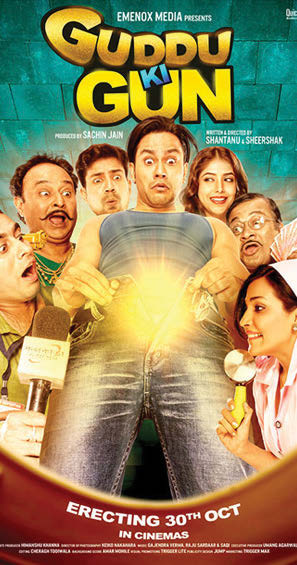
    gudduSTORY: Guddu (Kunal Kemmu), a Bihari salesman based in Kolkata, makes out with lonely housewives for fun. His interest in women is limited to physical intimacy. This hurts ‘bholi’ (Aparna Sharma), a wannabe ramp model, whose value system shuttles between puja ki thali and bikini blouses. Guddu’s pleasure-seeking lifestyle comes to a screeching halt, when he wakes up to a rude shock one day.

    MOVIE REVIEW: Bholi’s grandfather curses the womaniser, rather his ‘gun’, turning it to gold. In order to break the curse, Guddu must find true love and marry her. The hero runs from pillar to post, to find the love of his life. Enters a geeky plain Jane (Payel Sarkar, with a Gracy Singh hangover) the only ‘unattractive’ solution to his problem.

    Helping him in the process is a loyal friend/ sidekick (Sumeet Vyas). The duo must dodge the greedy (sexy nurse, silly doctor, sillier don and an anxiety-ridden Bengali man) who are after the gold. Does he succeed?

    The film can give terrible sex comedies a run for their money. Kunal Kemmu tries his best to make this dickfest watchable but it’s outright repulsive. Strangely, not because it revolves around a male organ turning into gold but because the film has no substance or humour whatsoever. Your heart goes out to Kunal. The man has a good comic timing (Golmaal, Go Goa Gone) but the film lets him down. He still shows what he’s capable of in probably the only funny scene of the film, which falls towards the end. Kunal sneaks into a historic play dressed as Shah Jahan. When expected to speak Urdu for it, he mumbles, “Dialogues Gulzar sahab ne likhe hai shayad.”

    Overall, this supposed adult comedy makes you squirm in your seat with its foolishness.

  • DIWALI CELEBRATIONS AROUND THE WORLD

    DIWALI CELEBRATIONS AROUND THE WORLD

    The growing ethnic and cultural diversity of Hindu religion throughout the world provides the opportunity to participate in the celebrations and rituals of Diwali festival that enhances the feelings of being part of a close-knit group of Indians. Most Diwali celebrations around the world focus on family and friends and it is a time to reflect on the past and envision for a future, perhaps, in a world where people live together in harmony.

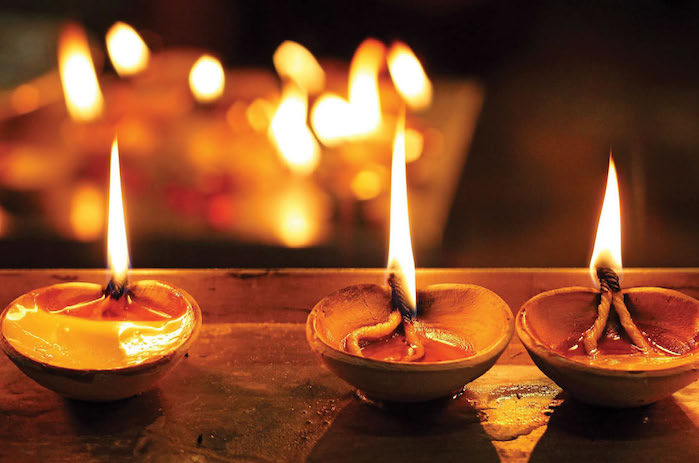
    Outside India also, as Diwali approaches, people clean their home to escape bad luck in the upcoming year and families gather for a feast and stay up late, celebrating with the help of crackers and sweets. They believe that the Hindu goddess of good luck visits homes that are brightly lit. Children make “diyas” which are small clay lamps to light and bring the good luck goddess to their home so they can receive new clothes and toys. One family may have many thousand of these little diyas decorating their home.

    Diwali in Mauritius

    Diwali is celebrated with great enthusiasm at Mauritius as this country have great Indian crowd. The Diwali celebrations at Mauritius is as good as in India. The festival of lights- Diwali is celebrated in
    October/November. Diwali marks the victory of Rama over Ravana and also commemorates Krishna’s destruction of the demon Narakasuran. Earthen oil lamps are placed in front of every home turning the island into a fairyland of flickering lights.

    Mauritius is a beautiful landmass full of picturesque landscapes and enchanting spots. Mauritius accounts a 63% of Indian majority of which 80% follow Hinduism. Hence, celebration of almost all the Hindu festivals in this island is a common phenomenon. In Mauritius, Diwali celebration is an age-old tradition. Beautiful rows of twinkling

    candles and lamps of all sorts are lit all over the island to celebrate the return of the hero of the Ramayana, Rama, from his 14 years of exile. Besides celebrating the victory of good over evil and light over darkness, the little flickering lights also symbolize the beginning of summer. The main day of the festivities is seen as a particularly auspicious day for merchants to make up their accounts and balances for the previous year, to go unburdened into the next. After the morning prayers, Hindus share sweets prepared specially for the occasion with family members, neighbors and friends of any faith, in accordance with the multicultural spirit of Mauritius.

    Diwali in Thailand

    The diversity in Thailand provides a starting point for people living there, to begin to understand and value the many distinct cultures of the world. Diwali is celebrated in Thailand under the name of Lam Kriyongh during the months of October-November. The festival has almost similar ways of celebration as that of Diwali. Diyas (lamps) made of banana leaves are made and candles are placed on it along with a coin and incense.

    These are set afloat on a river, which gives a wonderful view together on the water. The Diwali festival is not an extravagant affair. People greet each other and wish them happy returns of the day. Distribution of sweets is a common practice on Diwali day.

    Diwali in Nepal

    Surrounded by majestic Himalayas, Nepal, is a multi-ethnic and multi-lingual society and the only Hindu Kingdom of the world. Hindus in Nepal celebrate the Diwali festival with bright lights, gift exchanges, fireworks, and elaborate feasts to welcome Lakshmi, the goddess of light and wealth. Various houses and shop front in Katmandu, Nepal, displays the bright lights typical of Hindu communities during Diwali.

    Diwali is celebrated here with the usual Hindu festivities and rituals. Diwali in Nepal is known as Tihar. Just like most places in India Diwali is celebrated here to honor the goddess of wealth and god of prosperity-Lakshmi and Ganesh respectively. The festival here continues for five days. Every day has its special significance. The first day is dedicated to cows as they cook rice and feed the cows believing that goddess Lakshmi comes on cows. The second day is for Dogs as the Vahana of Bhairava. Preparation of delicious food especially meant for the dog is a typical characteristic of the day. Lights and lamps are lit to illuminate the entire surrounding and some of the specialty items are prepared to mark the third day of the festival. Fireworks, Lamps and crackers are widely used. The fourth day is dedicated to Yama, the Hindu God of Death. He is prayed for long life. The fifth final day is Bhhaya Dooj dedicated for the brothers who are wished long life and prosperity by their sisters.

    Diwali in Australia

    Australia the wonderful island country on Indian Ocean has an estimated 100000 Indians as settled in Australia. Most of them are the follower of the Hindu religion. Though, some of the Indians here are recent arrivals that belong to the affluent sections of the Indian society. Due to the large number of Hindu here, Diwali is one of the major festivals that is celebrated with great enthusiasm. The lightening of lamps and diyas on Diwali is a common practice. However, the non-availability of the appropriate material of or some other reason have influenced the celebations and has given in the touch of modernity in the celebration of the festival of light.

    Diwali in Malaysia

    Malaysia as a country is well known for its diversity. Among diverse culture of Malaysia, Diwali is celebrated in Malaysia by people of all races inhabiting there. Far away in another part of the world, even though Diwali Festival is not celebrated with all that pomp and gaiety, for Indians it is still a time to take a trip back the memory lane and enjoy the festival days spent back home in India celebrating the grand occasion. It is time to invite the Malays and Chinese to their houses. Its a public holiday in Malaysia and time to visit and pay homage to the elders. However crackers are banned in Malaysia.

    The Hindu community of Malaysia constitutes about 8% of its total population. The community celebrates Diwali festival as a symbol of triumph of good over evil. The Malaysian people call Diwali as Hari Diwali. The south Indian tradition of oil bath precedes all the rituals of Diwali Festival. The Diwali celebration includes visits to temples and prayers at household altars. Diwali is celebrated almost all over the Malaysia except in Sarawak & Federal Territory of Labuan.

    Diwali in Leicester

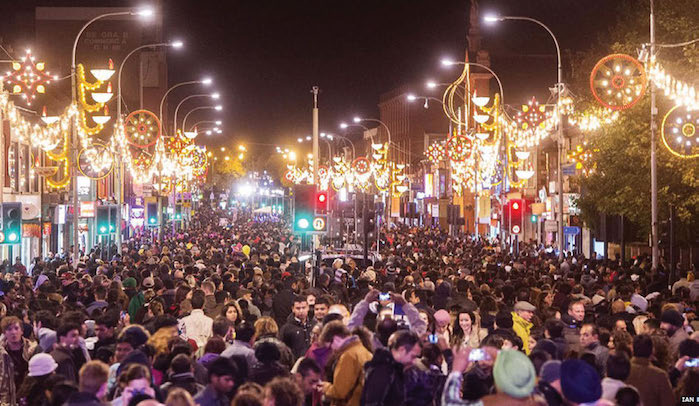
    Bright lights, fireworks and chaotic-celebrations – it can only be Diwali. Millions of Hindus, Jains and Sikhs in India and across the world have been marking the annual five-day festival of light this week with traditional prayers, fireworks and a huge amount of feasting. The festival, which coincides with Hindu New Year, involves lighting traditional earthen diyas (candles), decorating houses with colorful rangoli (floor patterns created with coloured rice or powder), and wearing new clothes, often gifts from relatives. Each faith has its own reasons for celebrating Diwali, but the main theme which runs throughout the festival is the triumph of good over evil and light over darkness, shown with huge fireworks displays and by decorating houses with candles and long strings of lights. In India, traditional holiday traffic saw cities across the country draw to a standstill as firecrackers burst overhead, shops buzzed with customers buying gold – Diwali is an auspicious time for new purchases – and children letting off firecrackers in the streets. Sweets are a major part of the festival, and Indian shop windows have been filled with towering arrays of neon-coloured hand-made Diwali specialties such as sutarfeni (sweet shredded dough topped with pistachio nuts). More than 35,000 people attended a Diwali parade on the streets of Leicester city centre October end, an area which is known for some of the largest Diwali festivities outside of India.

    Diwali in United States

    Diwali was first celebrated in the White House in 2003 and was given official status by the United States Congress in 2007 by former president George W. Bush. Barack Obama became the first president to personally attend Diwali at the White House in 2009. On the eve of his first visit to India as the president of United States, Obama released an official statement sharing best wishes with “those celebrating Diwali.

    The Diwali Mela in Cowboys Stadium boasted an attendance of 100,000 people in 2009. In 2009, San Antonio became the first U.S. city to sponsor an official Diwali celebration including a fireworks display; in 2012, over 15,000 people attended. In 2011, The Pierre in New York City, now operated by Tata Group’s Taj Hotels, hosted its first Diwali celebration. There are about 3 million Hindus in the United States.


  • BHAI DOOJ

    BHAI DOOJ

    Nowhere is the bond of brotherly-sisterly love glorified with such grandeur as in India. Hindus celebrate this special relationship twice every year, with the festivals of Raksha Bandhan and Bhai Dooj.

    After the high voltage celebrations of Diwali, the festival of lights and fire-crackers, sisters all over India get ready for ‘Bhai Dooj’ – when sisters ceremonize their love by putting an auspicious tilak or a vermilion mark on the forehead of their brothers and perform an aarti of him by showing him the light of the holy flame as a mark of love and protection from evil forces. Sisters are lavished with gifts, goodies and blessings from their brothers. Bhai Dooj comes every year on the fifth and last day of Diwali, which falls on a new moon night. The name ‘Dooj’ means the second day after the new moon, the day of the festival, and ‘Bhai’ means brother.

    Legends 

    Bhai Dooj is also called ‘Yama Dwiteeya’ as it’s believed that on this day, Yamaraj, the Lord of Death and the Custodian of Hell, visits his sister Yami, who puts the auspicious mark on his forehead and prays for his well being. So it’s held that anyone who receives a tilak from his sister on this day would never be hurled into hell. According to one legend, on this day, Lord Krishna, after slaying the Narakasura demon, goes to his sister Subhadra who welcomes him the lamp, flowers and sweets, and puts the holy protective spot on her brother’s forehead. Yet another story behind the origin of Bhai Dooj says that when Mahavir, the founder of Jainism, attained nirvana, his brother King Nandivardhan was distressed because he missed him and was comforted by his sister Sudarshana. Since then, women have been revered during Bhai Dooj.

    In Bengal this event is called ‘Bhai Phota’, which is performed by the sister who religiously fasts until she applies a ‘phota’ or mark with sandal wood paste on her brother’s forehead, offers him sweets and gifts and prays for his long and healthy life. Every brother eagerly awaits this occasion that reinforces the bond between brothers and sisters and their affectionate relationship. It’s an opportunity for a good feast at the sister’s place, coupled with an enthusiastic exchange of gifts, and merriment amid the resounding of conch shells in every Bengali household.

    Significance 

    Like all other Hindu festivals , Bhai Dooj too has got a lot to do with family ties and social attachments. It serves as a good time, especially for a married girl, to get together with her own family, and share the postDiwali glee. Nowadays, sisters who are unable to meet their brothers send their tika – the spot of protection – in an envelope by post. Virtual tilaks and Bhai Dooj e-cards have made it even easier for brothers and sisters, who’re far away from each other, specially remember their siblings on this propitious occasion.

    Uttar Pradesh 

    In Uttar Pradesh, at first, sisters give a piece of cloth, knotted into a circular shape, full of batashas (sugar balls) to their brothers. This piece of cloth is called as
    ‘aabf’. For each brother, there are two aabf. After all the rituals, sisters apply a tika of roli and rice on the forehead of the brothers and then perform aarti, praying for the long and happy life of their brothers. At last, they offer sweets to them and then the story of Bhai Dooj is narrated.

    Bengal 

    In Bengal this festival is called Bhai Photo. On this day, sisters observe fast till the time all the traditional customs have been performed. After this, they apply tika made of sandalwood paste, ghee and kohl (kajal) on their brothers’ forehead. Then the aarti is performed and sisters give sweets to their brothers to eat. Kheer and coconut laddus are the traditional sweets which are prepared on this day.

    Bihar 

    In the Bihar, the festival of Bhai Dooj is celebrated in the most unique way. The sisters curse their brothers in order to keep the evil spirits and dangers away from them. At first, they say very bad things to their brothers and then prick their own tongue with a wild prickly fruit as a punishment. By doing this, they ask their brothers to forgive them for the ill behaviour and mistakes which they have done till the date. Besides this, there is a unique custom in which brothers eat grains of bajri with water, from the hands of their sisters.

    Punjab 

    In Punjab, the day after Diwali is celebrated as tika and on this day, sisters make a paste with saffron and rice and apply tika on their brothers’ forehead to keep away all the difficulties and dangers from them. After this, they exchange gifts and sweets among each other.

    Gujarat 

    Bhai Dooj in Gujarat is known as Bhai Beej and on this auspicious occasion, sisters get up early in the morning and then the traditional tilak ceremony is held. After this, they perform aarti of their brothers and pray for their good fortune and life. Then they offer sweets to their brothers and in return the brothers bless them and exchange gifts.

    Maharashtra & Goa 

    Marathi communities in Maharashtra and Goa called this festival as Bhav Bij. On this day, sisters draw a square on the floor in within the boundaries of which the brothers have to sit. After they are seated, it is a custom for to have a bitter fruit named Karith. After this, the rituals and applying the Tilak, traditional sweets such as Shrikhand Puri and Basundi Puri are served.

  • SIGNIFICANCE OF THE FESTIVAL OF LIGHTS

    SIGNIFICANCE OF THE FESTIVAL OF LIGHTS

    Deepavali or Diwali means “a row of lights”. It falls on the last two days of the dark half of the Hindu month of Kartik.

    Mythical Origins of Diwali 

    There are various alleged origins attributed to this festival. Some hold that they celebrate the marriage of Lakshmi with Lord Vishnu. In Bengal the festival is dedicated to the worship of Kali. It also commemorates that blessed day on which the triumphant Lord Rama returned to Ayodhya after defeating Ravana. On this day also Sri Krishna killed the demon Narakasura. In South India people take an oil bath in the morning and wear new clothes. They partake of sweetmeats. They light fireworks, which are regarded as the effigies of Narakasura who was killed on this day. They greet one another, asking, “Have you had your Ganges bath?” which actually refers to the oil bath that morning as it is regarded as purifying as a bath in the holy Ganga.

    Give and Forgive 

    Everyone forgets and forgives the wrongs done by others. There is an air of freedom, festivity and friendliness everywhere. This festival brings about unity. It instills charity in the hearts of people. Everyone buys new clothes for the family. Employers, too, purchase new clothes for their employees.

    Rise and Shine 

    Waking up during the ‘Brahmamuhurta’ (at 4a.m.) is a great blessing from the standpoint of health, ethical discipline, efficiency in work and spiritual advancement. It is on Deepavali that everyone wakes up early in the morning. The sages who instituted this custom must have cherished the hope that their descendents would realise its benefits and make it a regular habit in their lives.

    Unite and Unify 

    In a happy mood of great rejoicing village folk move about freely, mixing with one another without any reserve, all enmity being forgotten. People embrace one another with love. Deepavali is a great unifying force. Those with keen inner spiritual ears will clearly hear the voice of the sages, “O Children of God unite, and love all”. The vibrations produced by the greetings of love, which fill the atmosphere, are powerful enough to bring about a change of heart in every man and woman in the world. Alas!That heart has considerably hardened, and only a continuous celebration of Deepavali in our homes can rekindle in us the urgent need of turning away from the ruinous path of hatred.

    Prosper and Progress 

    On this day, Hindu merchants in North India open their new account books and pray for success and prosperity during the coming year. The homes are cleaned and decorated by day and illuminated by night with earthen oil-lamps. The best and finest illuminations are to be seen in Bombay and Amritsar. The famous Golden Temple at Amritsar is lit in the evening with thousands of lamps placed all over the steps of the big tank. Vaishnavites celebrate the Govardhan Puja and feed the poor on a large scale.

    Illuminate Your Inner Self 

    The light of lights, the selfluminous inner light of the Self is ever shining steadily in the chamber of your heart. Sit quietly. Close your eyes. Withdraw the senses. Fix the mind on this supreme light and enjoy the real Deepavali, by attaining illumination of the soul. He who Himself sees all but whom no one beholds, who illumines the intellect, the sun, the moon and the stars and the whole universe but whom they cannot illumine, He indeed is Brahman, He is the inner Self. Celebrate the real Deepavali by living in Brahman, and enjoy the eternal bliss of the soul. The sun does not shine there, nor do the moon and the stars, nor do lightnings shine and much less fire. All the lights of the world cannot be compared even to a ray of the inner light of the Self. Merge yourself in this light of lights and enjoy the supreme Deepavali.

    Many Deepavali festivals have come and gone. Yet the hearts of the vast majority are as dark as the night of the new moon. The house is lit with lamps, but the heart is full of the darkness of ignorance. O man! Wake up from the slumber of ignorance. Realize the constant and eternal light of the Soul, which neither rises nor sets, through meditation and deep enquiry. May you all attain full inner illumination! May the supreme light of lights enlighten your understanding! May you all attain the inexhaustible spiritual wealth of the Self ! May you all prosper gloriously on the material as well as spiritual planes!

  • EXIT POLLS: ADVANTAGE NITISH AS BIHAR STARES AT CLIFFHANGER

    EXIT POLLS: ADVANTAGE NITISH AS BIHAR STARES AT CLIFFHANGER

    NEW DELHI (TIP): The race for Bihar’s top job was too close to call with exit polls divided on November 5 on who will win a fierce battle for one of India’s most politically crucial states after nearly two months of bitter campaigning.

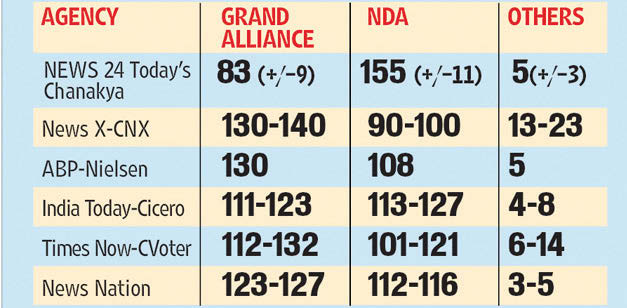
    Three exit polls — NewsX-CNX, ABP-Nielsen and News Nation — predicted chief minister Nitish Kumar could get a majority by a slender margin. Times Now- C Voter said a photo finish was likely with an edge for the Kumar-led Grand Alliance. India Today-Cicero forecast a hung assembly with the BJP ahead.

    Only News 24-Today’s Chanakya – which came closest to predicting the outcome of the 2014 Lok Sabha elections – said the BJP-led coalition was headed for a comfortable victory with 155 seats.

    But experts warned such exit polls regularly go wrong – as seen in the unexpected Aam Aadmi Party’s landslide victory in the Delhi polls in February – and chances of inaccurate surveys were increased by Bihar’s complex caste, religion and region-specific loyalties.

    Moreover, many of the exit polls didn’t fully factor in the final phase of voting for 57 seats on Thursday that saw the highest turnout of 60% in these elections. Overall, 56.8% of the 66.8-million-strong electorate voted in the five-phase polls. The votes will be counted on November 8.

    The predictions gave three clear indications.

    First, both alliances were able to hold on to their core base and the pivotal extremely- backward classes vote – that was aggressively wooed by both formations – appears to have been split.

    Second, no exit poll, barring one, reflected a personal anti-incumbency sentiment against Nitish Kumar who has been in power for 10 years with three different allies – first with the BJP for eight years and with the Congress and the RJD for the remaining period. The Grand Alliance had played up Nitish as its CM face, hoping to cash in on the goodwill.

    Third, it was largely a bipolar election which hardly gave any space to other players such as the Samajwadi Party, Left or Asaduddin Owaisi-led AIMIM. The SP broke ranks with the Grand Alliance after getting a raw deal and tried to form a third front but doesn’t seem to have made an impact. Even the likes of Owaisi who fielded candidates in Muslim-dominated areas and rebel RJD MP Pappu Yadav, a muscleman from Sahara, were largely ineffective.

    A Grand Alliance win would bolster opposition parties and may even boost Nitish Kumar’s stature as a national-level opponent to Modi. It would also tempt a belligerent Opposition to disrupt the NDA’s legislative agenda in Parliament, especially in the Rajya Sabha where the government doesn’t have the numbers to push through critical reform bills.

    An emphatic BJP victory, on the other hand, would be a huge blow to the Grand Alliance and efforts to merge six erstwhile socialist parties into the Janata Parivar. It would also be an embarrassment for two-term CM Nitish Kumar, who buried differences with arch-rival Lalu Prasad to prevent the BJP from wresting power.

    A saffron surge would not only give the BJP enough political leverage to stimulate the pace of reforms but also underscore the point that the Delhi loss was a mere blip, and Modi’s national popularity was intact.

    The third possibility of a hung assembly –with both alliances within touching distance of the majority mark of 122 in the 243-member house – will keep the hope alive on both sides with some help from independents.

    Minutes after polls closed on Thursday, a confident Lalu Prasad told reporters that the Grand Alliance was winning 190 seats. But the BJP insisted most exit polls got their numbers wrong.

    “There is no question of a photo-finish,” BJP in-charge for Bihar, Ananth Kumar said, claiming the NDA would end up with a two-thirds majority.

    One of India’s most impoverished states, Bihar was ruled by Lalu Prasad’s Rashtriya Janata Dal for 15 years but festering corruption and a poor development record paved the way for a Nitish Kumar win in 2005 in alliance with the BJP. The coalition ruled for the next eight years, till Nitish walked out of the 17-year-old alliance in 2013 over Modi’s elevation as the NDA’s chief campaigner for the 2014 general elections.

  • TS THAKUR TO BE NEXT CHIEF JUSTICE OF INDIA

    TS THAKUR TO BE NEXT CHIEF JUSTICE OF INDIA

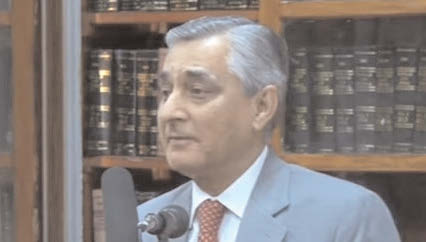
    NEW DELHI (TIP): Justice T S Thakur will take over as the next Chief Justice of India on December 2. He will succeed Justice H L Dattu, who will demit office next month. Justice Thakur, the senior-most judge of the apex court, would be the 43rd chief justice of India.

    His name was recommended to the government by current CJI Justice Dattu on Monday. It has been a convention for the sitting CJI to recommend the name of the senior-most judge as his successor a month before retirement. The law ministry will forward the file of Justice Thakur’s appointment to the Prime Minister’s Office. His warrant of appointment will be issued when the President approves it.

    Justice Thakur, who was elevated as a judge of the Supreme Court in November 2009, will have a tenure of little over one year. He would retire on January 4, 2017.

    Justice Thakur, 63, has been associated with a host of significant judgments. He led the bench which had delivered the verdict on reforming the BCCI following the IPL betting and spot-fixing scandal. The Justice Lodha Committee, which has issued a slew of recommendations relating to IPL and BCCI, had also been set up by his bench. In February 2015, a bench headed by him ruled on the contours of Article 25, which prescribes freedom of conscience and free profession, practice and propagation of religion. It held that polygamy was not an integral part of any religion and that the State could regulate such practices in the interest of public order, health and morality. By a judgment in 2014, Justice Thakur’s bench set a stricter scrutiny for those interested in joining police force. It ruled

    that any person who has faced a criminal case cannot get a job in the police force, even if he or she is acquitted or reaches a settlement under the law. “A candidate to be recruited to the police service must be worthy of confidence and must be a person of utmost rectitude and must have impeccable character and integrity. A person having criminal antecedents will not fit in this category,” it said. In 2013, Justice Thakur’s bench made it compulsory for all the courts to determine the aspect of compensation for victims in every criminal case. Regretting the “neglect” of a legal provision on award of compensation to the victims of crimes, the bench headed by him, had sent its order to all high courts for intimation and strict compliance. The first-ever official exercise to map the drug menace in India was also carried out on the orders of the bench headed by Justice Thakur in 2012. The three-year-long exercise revealed that of the 51.4 lakh kg of narcotics confiscated across the country over the last 10 years, only 16 lakh kg were destroyed. The bench headed by him is currently examining various important issues, including Ganga cleaning, Saradha chit fund scam case, NRHM scam, One-Rank-One-Pension (OROP) case, Sahara investors’ refund etc.

  • Chhota Rajan in India After 27-Yr Hunt

    Chhota Rajan in India After 27-Yr Hunt

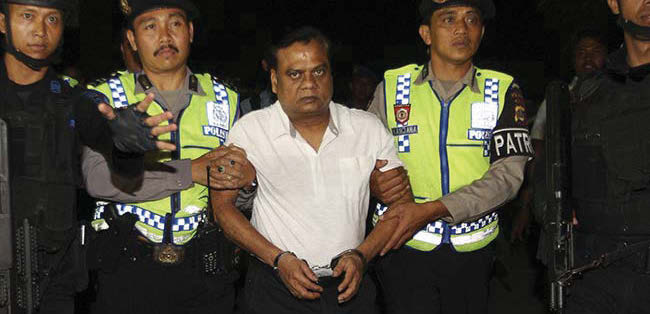
    NEW DELHI (TIP): Long-absconding underworld don Chhota Rajan was brought to Delhi early on Nov 6 morning from Indonesia by a joint team headed by CBI officials for facing trial in various criminal cases registered against him in Delhi and Mumbai.

    The 55-year-old gangster, who had been on the run for past 27 years, kissed the ground on his arrival in Delhi.

    Rajan, whose real name is Rajendra Sadashiv Nikalje, will be kept in the national capital where he will be questioned by sleuths of various investigating agencies as he has been making claims of having further evidence to nail India’s most wanted terrorist Dawood Ibrahim and his links with Pakistan’s snooping agency ISI.

    Immediately after his arrival here in an Indian Air Force Gulfstream-III aircraft from Indonesia’s Bali, Rajan, who is considered as a ‘friendly don’ as he reportedly tipped Indian security agencies about the movement of Dawood and his aides, was whisked away to an undisclosed location under tight security.

    Official cars with flashing lights accompanied by heavy-armed escort vans were seen leaving the Palam Technical Area at around 5:30am, as anxious camerapersons and photographers made unsuccessful attempts to get a glimpse of the underworld don, who was in one of those vehicles with tinted glasses.

    Rajan had told media in Bali that he was happy to return to his motherland and had rubbished reports that his arrest was orchestrated as he was facing threat from Dawood’s men.

    Ahead of his arrival in India, Maharashtra government made a surprise announcement of handing over all the cases related to the underworld don to the CBI as the agency had expertise in handling such cases. This move comes barely a few days after the state Chief Minister Devendra Fadnavis had been making claims that Rajan will be brought only to Mumbai.

    The Maharashtra government’s sudden U-turn raised many eyebrows within the police establishment in the megalopolis as the Chief Minister himself had ordered for creation of a special cell inside Aurthur Road prison with medial arrangement of dialysis being made. Rajan is on dialysis as his both kidneys are not working.

    Rajan, after his arrest, had expressed reservation over plans to lodge him in a Mumbai jail, fearing that his arch- rival and India’s most wanted terrorist Dawood Ibrahim may target him there.

    Till the formalities of CBI to take over the Maharashtra cases are completed, Rajan will be in the custody of special cell of Delhi Police which has six cases registered against him. Interestingly, CBI had told the Bombay high court, while hearing petitions filed by the family members of murdered rationalist Narendra Dabholkar, that it was severely understaffed and required officers from the Maharashtra Police to assist it in the probe.

    Rajan was arrested on the basis of an Interpol Red Corner notice at Bali airport on October 25 after he had arrived in the island city of Indonesia from Australia.

    India was keen that the deportation takes place at the earliest and had put in a request to Indonesian authorities immediately after his arrest, sources said.

    However, his deportation was deferred by a day as the international airport in Bali was shut down due to spewing of volcanic ash from a nearby mountain.

    Immediately after his flight took off, Indian ambassador to Indonesia Gurjit Singh tweeted: “#ChotaRajan deported successfully to India. Delay due to Bali airport closure ends. Thanks Indonesia for support.”

    Rajan is wanted in over 75 crimes ranging from murder, extortion to smuggling and drug trafficking.

    Mumbai Police has nearly 70 cases registered against Rajan, including 20 of murder, four cases under the Terrorist and Disruptive Activities (Prevention) Act, one under Prevention of Terrorism Act and over 20 cases under the stringent Maharashtra Control of Organised Crime Act.

    Delhi Police has six cases registered against Rajan, who was a close aide of fugitive underworld don Dawood at one point but split before the 1993 Mumbai blasts were conspired. In 2000, there was an attempt on Rajan’s life when Dawood’s men tracked him down to a hotel in Bangkok but he managed a dramatic escape by jumping from the first floor of the hotel.

    Rajan had fled India in 1988 for Dubai. NSG and special cell along with the para military. The details were finalized in a closed-door meeting on Tuesday.

    Rajendra Sadashiv Nikalje, known as Chotta Rajan, has been on Interpol’s most-wanted list for over two decades. Rajan, who has come back to India after 27 years, is wanted in over 75 crimes ranging from murder, extortion to smuggling and drug trafficking.

  • Modi on Track to Cripple India

    Modi on Track to Cripple India

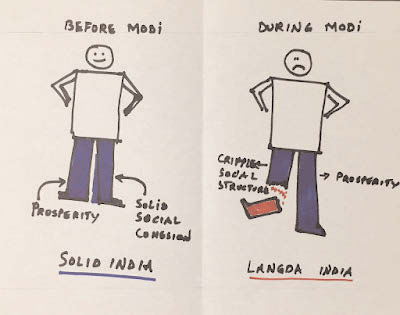
    If Prime Minister Narendra Modi of India does not speak up on the issues that are tearing the nation apart, and if he fails to restore freedom to speak, eat, drink, wear and believe what India’s constitution guarantees, and if he fails to warn the extremists in his party from destroying the social fabric of India, he will cripple the nation, making it a Langda India as we call it in Hindi.

    For India to succeed as a nation, it has to stand on its own two firm feet; prosperity and social cohesion. The two are dependent on each other; one will not happen without the other. Indeed, prosperity will be short-lived if the social structure crumbles.

    Bringing prosperity comes through raising income levels of all the sons and daughters of India; pulling the ones in ditches onto a level playing field to build a larger middle class and to expand the consumer base, whose consumption will create jobs, builds up the economy, and raise the standards of living. The more people do well, the better the nation does. Modi is talking big about it, and we can give him two full years to produce results.

    Social cohesion on the other hand is like the cohesion in the human body, where the heart, brain, kidneys, liver, lungs, digestive track and all parts of the body need to function cohesively to live a normal life.

    Failure of one organ can cause dysfunction in others. If you think the discharge part of the body is less important, wait till it stops, it will give headaches and will affect how we function. Likewise, all people in a society have to function cohesively, and it is in the interest of the body that it makes up for deficiencies in our part through a system of integration. As humans, and as Indians we have to meet those deficiencies in fellow Indians for the common good, and our own security and well being.

    Remember, I cannot be safe if people around me are not, and if I threaten others, I am equally frightened at my vulnerable moments. No one will be safe, including Hindus who may not think much of the situation in India now, but eventually they will get hit too.

    Those of you who are blinded by the love for Mr. Modi, I appeal to you to look for greater love for the nation. Modis will come and go, but the Nation will continue. I am challenging your patriotism; none of us want India to go down, so let our loyalty be to India and not Modi, until he proves that he can keep these two functions in shape, I will hold my praise for him, will you?

    We have to be truthful and brutally honest. For the sake of the long term security of each one of us, we have to learn to openly express and listen to it with civility. We need to criticize the inept government and cut them down to pieces. Indeed, that is our patriotic duty to prevent our nation from falling apart.

    I can never forget Indira Gandhi’s emergency rule. Her goons got away with sordid acts of blackmailing, harassment and vandalizing. Now, I see a replication of the same under Modi. He lives in a bubble surrounded by Chamchas (sycophants) who say everything is alright… but everything is not alright.

    I cannot thank Ramnath Goenka of Indian Express and others who went to jail instead of pandering to Indira. I cannot thank enough Mahatma Gandhi and the freedom fighters that took the beatings and went to jail for disobeying and criticizing the British colonial governments. God bless them!  Because of them we have that freedom, and I thank all those men and women who are protesting and standing up against the goons.

    Nehrus, Indiras and Modis will come and go, but India will continue and we have an obligation to save India. Indeed, by doing so, we are protecting the future of every Indian.

    Do you remember the song? 

    Sikander bhi aaye, khalandar bhi aaye, No koi raha hai, na koi rahega;
    Mera desh azaad hoke rahega,
    Mera desh azaad hoke rahega.
    Those of you cheering for Modi now, will come to regret it, unless Modi gets his act together. All that prosperity will go down the tube if no one feels secure. When injustice waxes to the extreme, it will tear the nation apart; the rich will run out of the country for safety, and ugly communism may run in under the banner of redistribution of wealth and equalizing inequality.

    It is time to wake up!  Remember: Modi had given terrorists three days to finish their slaughter during the Gujarat Riots, and now he has probably given three years to finish freedom in India. Possibly the process has begun.

    Thank God for the conscience of Indians!They are speaking up against bad governance. Modi better not mess with Narayan Murthy, Raghuram Rajan and Siddaramaiah, – if he does, or does not stop inciting his goons, the whole nation could revolt.

    I don’t want my India to be a Langda India, do you? If we all wake up and criticize Mr. Modi, guess what will happen?He will be compelled to do the right thing. Don’t you want that?

    WHAT DO WE WANT?

    Mr. Modi to speak up! That is it.

    He can address the nation this way; “I am the Prime Minister of all Indians. I will get blamed for the bad things that happen in India, and I am not going to put up with that.  From this moment, everyone who messes with their fellow Indians will be punished severely, and if they have staged acts like the one in Dadri, everyone involved will be punished severely.  This is my last warning and action will follow.”

    “Furthermore, I declare that no one will compel or tell other Indians what to read, write, eat, drink, wear or believe.”

    This is all we want.

    Arise! Awake! and stop not till the goal is reached.

    Swami Vivekananda must have meant this for Indians in 2015.

  • Groundbreaking for Nassau Veterans Memorial Coliseum

    Groundbreaking for Nassau Veterans Memorial Coliseum

    MINEOLA, NY (TIP): Nassau County Executive Edward P. Mangano, Presiding Officer Norma Gonsalves, Long Island Association President & CEO Kevin Law, Nassau-Suffolk Building Construction Trades Council President Dick O’Kane and other elected officials  joined Nassau Events Center (NEC), led by Bruce Ratner, developer of Barclays Center, and Brett Yormark, CEO of Barclays Center, at a groundbreaking ceremony for the new Nassau Veterans Memorial Coliseum. The new arena will retain its history of honoring our veterans while sharing revenue with taxpayers and employing 2,700 people.

    County Executive Mangano stated, “Today we officially begin construction of the new Nassau Veterans Memorial Coliseum and surrounding parking lot into an economic generator that creates new jobs along with a vibrant, attractive destination for Long Islanders and tourists. This is only the beginning as the property will be further developed to create healthcare-related jobs, including Memorial Sloan Kettering Cancer Center and other exciting initiatives.”

    After the Coliseum’s final sold-out show by native Long Islander Billy Joel on August 4, the project’s construction team fully mobilized on site, completed an extensive program of environmental testing and conducted pre-demolition activities, such as exterior sign removal, food service equipment disconnects, and furniture and fixture removals.

    “Long Islanders have waited far too long for a premier entertainment destination that they can be proud of,” Ratner said. “Today marks an important milestone and step forward in delivering a state of the art entertainment venue and retail destination that will truly have an incredible impact on the region.”

    “We are thrilled to bring an exceptional guest experience and a dynamic and diverse slate of events to the reimagined Nassau Coliseum,” said Yormark, who will oversee the new venue. “From sports, to music, to family entertainment, to outdoor festivals and other special events, our soon-to-be-announced programming schedule will complement the local audience and bring the best to Long Island.”

    The architect for the Coliseum facade is SHoP Architects, architect for the interior renovation is Gensler, and the construction manager is Hunt Construction Group. NEC has also secured in principle a naming rights partner for the entire project and will make that announcement soon.

    Legislative Presiding Officer Norma Gonsalves stated, “I am so pleased to see this project break ground. This project will not only bring jobs to Nassau, it will also be the premier entertainment destination for our residents.”

    “The groundbreaking for the refurbished Nassau Veterans Memorial Coliseum signals a Renaissance for Nassau’s Hub,” stated Hempstead Town Senior Councilman Anthony Santino. “Working with a respected development group and Nassau County, Hempstead Town has created a building development zone and approved a master plan for the site that will stimulate our economy, create jobs and establish an enhanced entertainment destination in the heart of America’s largest township. I’d like to thank Nassau County Executive Ed Mangano, Councilwoman Dorothy Goosby and Supervisor Kate Murray, along with the Nassau Events Center for working collaboratively with the town to bring meaningful and sustainable development to this site.”

    The renovation of the 43-year old Nassau Coliseum and construction of its surrounding retail and entertainment center is expected to create more than 1,035 direct construction jobs, and more than 570 additional indirect and induced jobs in Nassau County. Construction will also generate more than $330 million in economic activity for the County. The Coliseum is scheduled to reopen in winter of 2016.

    Both the Coliseum and the retail center are funded by $260 million in private investment from NEC. No tax dollars are being used to construct the Coliseum and its surrounding retail and entertainment center. Under terms of the agreement, $194.5 million is the minimum guaranteed revenue the County will receive during the 34-year lease term with NEC. Simply put, the County will receive a minimum of 8% of gross revenue or $4 million annually, whichever is greater; plus $400,000 annually from the retail component or 8% of the gross, whichever is greater. Payments began pre-construction in August 2015 and will be used to keep County property taxes down. Additionally, $3.7 million in annual sales taxes from the arena will be generated, along with an estimated $2.7 million in annual sales tax from new retail and entertainment surrounding the area.

    The Coliseum will continue to be owned by the taxpayers, and Nassau County taxpayers will shed significant costs related to operating the arena. On August 1, 2015, NEC took responsibility for all costs related to operating, insuring, maintaining and providing utilities at the Coliseum. In fact, the agreement provides direct financial relief to taxpayers by eliminating millions of dollars in annual expenses for utilities, parking lot repairs, and capital expenditures.

    When complete, the Coliseum will host hundreds of events annually, including six New York Islanders games, a Brooklyn Nets preseason game, boxing, minor league sports and college basketball, as well as star-studded concerts and family-fun entertainment.

    In the months after construction of the Coliseum begins, work will begin on the plaza surrounding the arena to build a movie theater, family sports and entertainment facilities, and restaurants.

  • Cop delays telling children of parents’ death, takes care of them on Halloween

    Cop delays telling children of parents’ death, takes care of them on Halloween

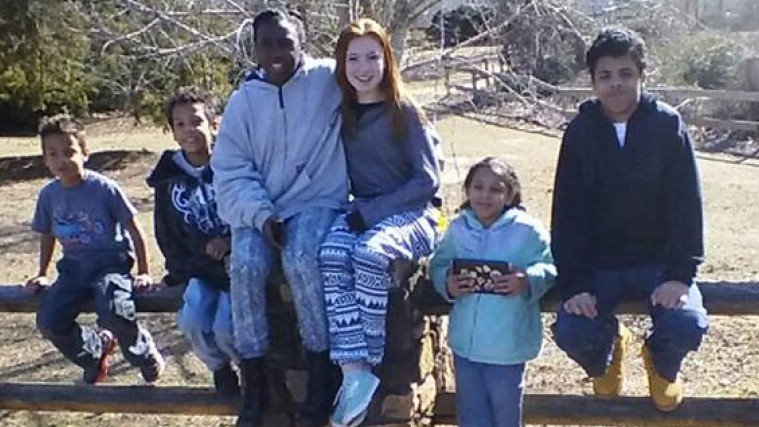
    After responding to the scene of a car crash on Halloween, Oct 30, a young Georgia state trooper realized the couple killed in the crash had left behind four young children — who were home alone, wearing their costumes and waiting for their parents.

    Nathan Bradley
    Nathan Bradley

    Faced with the tough task of informing the children that their parents are no more, the big-hearted Nathan Bradley, 25, opted to do things a little differently.

    Rather than just announce the devastating news there and then, Bradley decided to take the costume-clad kids under his wing for the evening and allow them to enjoy Halloween. He also started an online #GoFundMe campaign and helped raised over $150,000 to help the family .

    Bradley has recounted the heartbreaking moment when he and two other officials arrived at the family home in Morgan County to deliver the news.

    “The door hesitantly opened and there behind the locked screen door stood four children in full costume — a 13-year-old Freddy Krueger, 10-year-old daughter of a Dracula, 8-year-old wizard and a 6-year-old that appeared to be a firefighting ninja turtle,” he wrote on the GoFundMe page he set up.

    He and his colleagues were speechless. They’d hoped to find an adult among the family members in the house, but the eldest boy, Justin Howard, told them no one was home.

    “My parents went to the store to get more face paint. They told us not to open the door for anybody, but they should be back soon,” he told the officials, according to Bradley.

    ‘I wanted to preserve these kids’ Halloween’

    The officials found out that the closest relative of the dead parents, Donald and Crystal Howard, was the children’s paternal grandmother, who lives seven hours away in Florida.

    Bradley says he couldn’t bear the thought of the kids being told they were orphans and then having to spend the rest of Halloween waiting in a county jail for their grandmother to arrive. So he put the distressing announcement on hold.

    “I wanted to preserve these kids’ Halloween and the ones to come,” he wrote in the GoFundMe statement, which was also shared on Facebook by the Georgia Department of Public Safety.

    He took the children to get burgers, fries and milkshakes before giving them a tour of the troopers’ post. Other people who had heard what happened brought over candy, toys and Disney movies to watch.

    The children were put to bed in rooms at the post, still uninformed of the terrible news.

    “You turned an F-Minus day into an A-Plus night!” the little girl told him at bedtime — words he found difficult to take in.

    Their grandmother arrived just before dawn and agreed with Bradley and others that it would be better to tell the children what had happened the following day.

    “We hoped that they would then relate the tragedy to November 1st, rather than Halloween,” Bradley wrote.

    Fundraiser soars above initial goal

    On Tuesday, Nov 3, he said he heard from the eldest son that the transportation of the parents’ remains and other funeral costs would amount to $7,000. That’s when he decided to set up the fundraising page, with any additional money going toward the children’s future education.

    Thanks to a huge response, the amount raised has soared far above his initial goal, with other offers of help pouring in. By early Thursday, Nov 5, the GoFundMe had raised more than $150,000 from thousands of people.

    “I’m am astonished by the support of this family,” Bradley wrote as the donations flooded in. “You all are responsible for this success. The family wants to thank each and every one of you.”

    Still in his early 20s, the trooper says he plans to stay in touch with the four children.

    “I care a lot about them and I want to watch them succeed,” he said, according to CNN affiliate WSB. “I don’t want this tragedy to shadow the rest of their lives.”

    The Georgia Department of Public Safety praised his efforts.

    “Compassion is a core value of our Department,” it said in a Facebook post. “Trooper Bradley is a true example of that value.”

  • Lohan siblings score a win in $60M shopping app case

    Lohan siblings score a win in $60M shopping app case

    NEW YORK (TIP): Lindsay Lohan and her brother, Michael Lohan Jr. got some good news in a Manhattan court on Wednesday, November 4, despite Michael’s arrest a week ago in a separate case, says a Page Six report.

    The Lohans won a round in their legal battle with Fima Potik, who sued them and another partner for $60 million, alleging the trio stole his idea for a fashion app called Spotted Friend to launch their own, Vigme. But Wednesday the parties agreed, pending sign-off from a judge, to lift a temporary restraining order against the Lohans and Chris Roth, which their lawyer, Ravi Batra, claims has kept the Lohans from working on their business for a year.

    Batra told Page Six: “Fima has disobeyed three court orders to produce proof that he had a working app by June 2013, something he was never able to prove,” and he slammed Potik as a “celebrity leech” and “spoiled little wannabe trust-fund baby who wants to hang out with Lindsay and who got himself a lot of ink by suing.”

    Potik had tried in September to put the legal battle on hold for financial reasons. Batra blasted the move this week, telling us Potik, “wants to say,

    ‘Sorry, I didn’t realize I was in court. I was window shopping at Macy’s.’ No, you were in court, and by the way, here’s the bill. This is a huge civics lesson for spoiled little rich brats.”

    He said he’s moving for Potik to pay the Lohans’ legal fees.

    Potik’s third attorney in the case, Bernard Daskal, said, “At this time we have no comment.”

    When the case began, Michael Jr. was the rare member of the Lohan clan with no time before a judge. But last week he was arrested for allegedly using a forged New York State
    “Executive Branch” placard on his car windshield. His lawyer in that matter, Mark Heller, told The Post, “I’m confident the case will be dismissed.”

    Earlier this year, Lindsay did community service in New York to complete probation on a past reckless-driving case. Dad, Michael, is battling wife Kate Major after their kids were taken from them last week by the Florida Department of Children and Families. Mom Dina Lohan avoided jail time last year in a DWI case.

  • Doyen of Indian American Community Narain Kataria Passes away

    Doyen of Indian American Community Narain Kataria Passes away

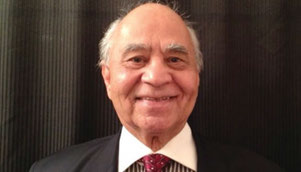
    NEW YORK (TIP): Narain Kataria, a well known figure in the Indian American community, passed away peacefully in his sleep, sometime on November 2 night. He was 85.

    He is credited with championing the cause of Hindus and creating awakening among them in USA. A man with ideas he was sociable and likeable despite his extreme Hindu views. He will be greatly missed.

    His Funeral is on Saturday, Nov. 7 in ‘Long Island’ at 11 am.

    A Proud Hindu and a Fine Human Being Narain Kataria dies in peace at 85 

    A Son-in-Law’s Thoughts – By Shyam Bhaya – Narain Kataria was born on February 15th, 1930 in Sukkur, Sind in an undivided India. At a very early age he lost both his parents and the responsibility of looking after and supporting his family, consisting of three younger brothers and a sister, fell on his young shoulders. He rose up to the challenge and through a lot of hard work and sacrifice he made sure that his family survived this very difficult phase in their lives. This strength of character became a hallmark of his life’s journey.

    The Partition of India in 1947 was a traumatic period in Narainji’s life when the entire family was uprooted, like millions of other Hindus, and the horrors perpetrated upon them remained deeply etched in his mind for the rest of his life.

    Narainji moved with his family to Ulhasnagar, near Bombay and the task of rebuilding his life and that of his family began once again. He realized early on that getting a good education was very important and applied himself diligently and worked his way to a Master’s degree (in History) from Bombay University, while simultaneously working.

    He had a deep love for music and learned to play the banjo. He spent many years fulfilling this passion playing with several musical orchestras. He was a tough teacher when training his daughters to sing. He did not accept mediocrity from anyone. For him, music was the sound of the soul. He last played the banjo on October 18th, 2015 and his control over the strings was a sight to behold.

    In May of 1956 he married Bhagwanti with whom he had two daughters, Meena and Rajni. Sadly, his wife passed away last September. Narainji joined BARC in Trombay and worked as the Personal Assistant to one of the Directors. During his tenure at BARC, he was disturbed and concerned at what he perceived to be a lack of a serious focus within the organization, on matters of national security.

    Narainji moved to the U.S.A. in the early 1970s where, after an initial period of struggle, he joined the law firm of Cahill Gordon in Manhattan as a Legal Assistant. He worked at this firm for over 25 years, and the quality of his work was recognized by all his colleagues at the firm. He retired from there in 1998.

    During his years in India, Narainji had begun to sense that even after the Partition of India, there were vested interests within India and outside its borders that believed in destabilizing the country. At the same time he realized that the news media, which at the time was controlled by the Government, distorted and misrepresented facts that were detrimental to Hindus. With this in mind, he took it upon himself to lift the curtain of lies and draw attention to the truth. He became an outspoken and passionate crusader highlighting stories which the media wanted to suppress.

    Early in this endeavor, he began writing letters to various newspapers presenting his point of view. His was a lone voice but he never gave up on reporting the true and hidden reality that there was a concerted effort by the elite to keep the masses in the dark. His continued efforts gradually began to make people sit up and take notice that there was finally someone who did not shy away from taking a stand.

    Slowly, his message began to resonate with the Indians living in the US and after the advent of the Internet, spread all over the world. People from all walks of life reached out to him and offered their support and encouragement and from there on there was no stopping.

    He made it a point to attend every event in the Tri-State area, be it cultural, religious or political, to demonstrate his support and encouragement. And as an organizer of rallies, supporting or opposing any cause, he was unmatched. He spoke to student and youth groups because he believed they were the future of the Hindu Renaissance.

    To foment a sense of unity among Hindus, in the mid-eighties Narainji came up with the idea of organizing the Hindu Unity Day in New York. He saw this as a venture with which to awaken and empower Hindus. This year marked the 20th annual celebration, which saw prominent speakers from India and the US speaking on important issues pertaining to Hindus. His dream of a Government in India, one which would treat all Indians alike, irrespective of their religion, was finally realized in May 2014.

    As a family man, Narainji was a man of principles who instilled the values of hard work and integrity in his children and loved ones. He used to work more than 12 hours a day, even in retirement and never seemed to tire. He despised weakness in any form and set an example by his own moral and physical strength. He also had a very funny side and enjoyed spending time with three different generations of his now grown family. He could converse as easily with a 50-year old as he could with a teenager. He believed that the younger generation needed to be well informed about their proud heritage that went back thousands of years. Every family gathering had him emphasizing the perils and dangers that faced Hindu society.

    Narainji used to joke that he would live up to at least 100 years. He might have lived only 85 years in body but he will live more than 100 years in our thoughts and prayers. His legacy will live on. May God bless him with eternal peace.

    (Shyam Bhaya is married to Narainji’s younger daughter, Rajni. They have been married for 28 years and have a daughter and three sons (triplets). Bhaya lives in Great Neck, NY He is an Engineer working for a Private Company. He can be reached at ravisaak2003@yahoo.com)

  • Why the Ban on Cow Slaughter is not just Anti-Farmer but Anti-Cow as well

    Why the Ban on Cow Slaughter is not just Anti-Farmer but Anti-Cow as well

    The recent killings of Mohammad Akhlaq, Noman and Zahid Ahmad Bhatt on the claim that they were slaughtering cows is not only an attack on the right to life, livelihood and diverse food cultures but an assault on the entire agrarian economy.

    The cynical fetishisation of cows by Hindutva politicians is not only profoundly anti-farmer but, paradoxically, also anti-cow.

    What these bigots fail to realize is that the cow will survive only if there are pro-active measures to support multiple-produce based cattle production systems, where animals have economic roles. The system must produce a combination of milk, beef, draught work, manure and hide, as has been the case in the rain-fed food farming agriculture systems of the sub-continent over the centuries.

    In meat production systems – whether meat from cattle, buffaloes, sheep, goat, pigs or poultry – it is the female which is reared carefully in large numbers to reproduce future generations, and the male that goes to slaughter. It is only the sick, old, infertile and non-lactating female that is sold for slaughter. In every society where beef consumption is not politicized, farmers known that eating the female bovine as a primary source of meat will compromise future production, and hence they are rarely consumed.

    On the other hand, the destiny of a male bovine is clear: it will either become a work animal (bullock), a breeding bull, or be sold for meat – which is the fate of the vast majority. In the end, the male bovine will reach a slaughterhouse. Villages earlier had a system of having one community breeding bull which roamed around servicing village cows that came to heat. Typically, 70% of a cattle herd or sheep/goat flock is female breeding stock; the rest comprises a couple of breeding males, and young male and female offspring.

    Indian cows do better in Brazil than India

    Today, rural indigenous cows are a rarity in India and community breeding bulls are history. Farmers no longer want to rear cattle, particularly cows. This trend is validated by an analysis of India’s livestock census: Between 2003 and 2012, the annual growth of young female bovines – a key indicator of future growth trends of animal populations -on a compound annual growth rate basis declined from 1. 51% to 0.94% in indigenous cattle and from 8.08% to 5.05% in crossbred cattle. On the other hand, it increased from 2.12% to 3.13% in young female buffaloes.

    Whilst India’s population of fine indigenous cattle breeds keeps decreasing year by year, Brazil’s cattle populations of Ongole, Kankrej and Gir breeds – imported from the Indian sub-continent nearly 200 years ago – keep increasing. We have laws to ‘protect’ cows, ban cow slaughter and ban the consumption of beef: the whole of the North-East, Kerala and West Bengal have no restrictions on cattle slaughter, nine states allow all cattle slaughter except cows, and the rest have a ban on all cattle slaughter. In Brazil, on the other hand, beef-based cattle production systems are the driving force behind its flourishing indigenous Indian cattle breed populations.

    Between 1997 and 2012, according to the government’s successive livestock censuses, India’s indigenous cattle population declined by over 15% from 178 million to 151 million, less than what we began with at the time of independence (155 million), when all cattle were indigenous breeds. Fifty years of sustained white revolution policy interventions to enhance milk production have actively advocated and financed replacement of indigenous cattle with high yielding breeds. Cross breeds like Jersey and Holstein Friesan now comprise some 21% of India’s cattle population. But even India’s total cattle population, including crossbreds has increased by a mere 23% (from 1951 to 2012) and stands at 190 million.

    In stark contrast, Brazil’s cattle population -comprising 80% pure Indian cattle breeds
    (Indicine) or Indian cattle breed crossed cattle – grew by 74% from 56 million in 1965 to 214 million today. The Gir, which is the favored dairy breed, comprises 10% of Brazil’s cattle population. The Ongole (or Nellore), which is the mainstay of beef production, makes up most of Brazil’s cattle population.The Ongole of India, however, is a threatened breed in its own homeland.

    While Brazil continues to have acres of lands for their cattle to graze, here in India we have successfully done away with common grazing lands where animals can be put to pasture. In the land of the Ongole, pre-2014 united Andhra Pradesh, permanent pastures and grazing lands declined by 78% from 1.17 million hectares in 1955-56 to 0.56 million hectares in 2009-10. The rate of decline was much faster in the post economic liberalization decades of 1990-2010 – a time of aggressive industrial growth and Hindutva influence.[1]

    As bullocks are displaced, less cows are reared

    In today’s India, cattle have been displaced from their productive role in agricultural livelihoods: tractors have replaced bullocks/draught animals that were used to plough, thresh, and anchor rural transportation. India’s population of work cattle or bullocks declined by 28% between 1997 and 2012. This has been the result of economic policies that have strived to industrialize, and “green” and “white” revolutionize our agriculture and livestock production.

    Chemical fertilizers have replaced manure. A shift from diverse food cropping systems of cultivation to mono-cropped production of commodity crops like cotton, sugarcane, and tobacco, or palm oil has depleted crop residues as a rich fodder source, and made bullock ploughing virtually redundant. The bullock is no longer needed to extract oil from oil seeds (in any case we now import 60% of our edible oil and even poor oil millers have closed shop), extract juice from sugarcane, pull water out of wells or be the main mode of rural transportation.

    Hence why should farmers keep indigenous bullocks? Or rear indigenous cows for that matter, which produce bullocks? Once animals stop having an economic value, they stop being reared. Simple.

    Lessons from a growing buffalo population

    Contrast the sorry state of India’s cattle with its thriving buffalo population. Our buffalo population has grown by 21% since 1997. Why? Very simple: buffaloes anchor milk and beef production in India. We are the 2nd largest exporters of buffalo beef in the world, with an annual export of nearly 2.4 million tons. Bovine meat contributes nearly 60% of total Indian meat production, as against small ruminants (15%), pigs (10%) and poultry
    (12%). Buffaloes survive well on limited, coarse, less nutritious crop residues, whilst cattle need more green fodder and green grass. This is evidence itself that given all other conducive input factors for the animal to be reared (primarily feed, fodder, water, ecological adaptability, knowledge, labor, health care and a remunerative livelihood), allowing the slaughter of an animal actually drives its numbers up. The same holds true for goat and sheep. Between 1997 and 2012, the sheep population increased overall by 13%, and goats by 10%, despite a 33-38% slaughter rate.

    In short, the secret to flourishing animal populations appears to be meat consumption.

    The highly industrialized beef producing nations of the world – the United States, Australia and New Zealand – produce beef by replacing large acres of land where food could be grown to feed human beings, with animal feed. Regrettably, in Latin America, large beef corporations are steadily converting huge tracts of natural prime Amazonian forests, home to indigenous peoples, into grazing lands: in short these systems are unsustainable, contributing hugely to carbon emissions.

    India’s beef production on the other hand, is one of the most sustainable and least ecologically damaging in the world. Beef is a by-product of buffalo rearing livelihood practices, and not its primary objective, which continue to be milk and milk products. Whilst male buffaloes end up in the slaughter houses, farmers also sell their infertile, old, diseased and non-lactating females. Our animals are not fed on predominantly grain-based concentrate diets, but on crop-residues, and natural vegetation.

    Allow slaughter to save the indigenous cow

    Threats to impose a nationwide ban on beef consumption and cattle slaughter also ignore the close relationship between those who eat beef and those who look after cattle. In India, cattle have always been relished and their meat is a critical source of nutrition for various communities – including Adivasis, Dalits, Christians, Muslims and several other castes (many of whom are too scared to admit they eat beef).

    A Dalit social activist asserts: “The Brahmins and other agraha (upper) castes who are cow worshippers have never in their lives ever grazed the animal, fed it, cleaned its dung or buried its carcass. For all that they have used our labor: we graze, we feed, we clean the sheds and dung, we bury the carcass, and we eat beef.”

    “The so-called upper castes visit our hamlets in search of beef, and are scared to publicly acknowledge their beef eating practices”, says an adivasi community leader from Telangana. “This year, Hindu families hired cows from us for the Godavari Pushkaralu, because there are no cows left in caste rural Indian villages, where people worship cows and shun beef ! We adivasis, on the other hand, eat beef, plough our fields with cattle, and farm with cattle manure; therefore we continue to own cows and cattle herds!”

    In this land of the holy cow, depleting grazing resources of common lands and forests, disappearing roles for indigenous cattle breeds in agriculture production as providers of milk, energy, manure and beef, policies to replace indigenous breeds with crossbreds, coupled with a ban on slaughter of cattle in several parts of India, have led to plummeting cattle populations and the cow fast becoming a creature of the past.

    There is only one conclusion to be drawn. If you really want to protect the cow, do not ban beef, cattle slaughter and the ecological culture that sustains the bovine economy.


    (The author has a Masters in Animal Breeding and Genetics from the University of California, Davis, USA. She is a trained veterinarian and works with the Food Sovereignty Alliance, India. He can be reached at Sagari.ramdas@gmail.com; foodsovereigntyalliance@gmail.com.)

    [1] Compendium of Area and Land Use Statistics of Andhra Pradesh 1955-56- 2004-05. Directorate of Economics and Statistics: An Outline of Agricultural Situation in Andhra Pradesh 2007-08. DES. Hyderabad.

  • Dr. Ajay Lodha  appointed to Nassau County Comptroller’s Advisory Council on Minority and Women Owned Business Enterprise

    Dr. Ajay Lodha appointed to Nassau County Comptroller’s Advisory Council on Minority and Women Owned Business Enterprise

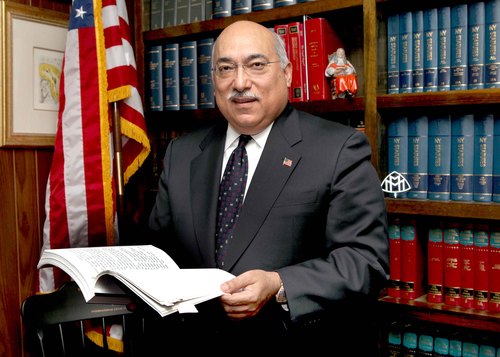
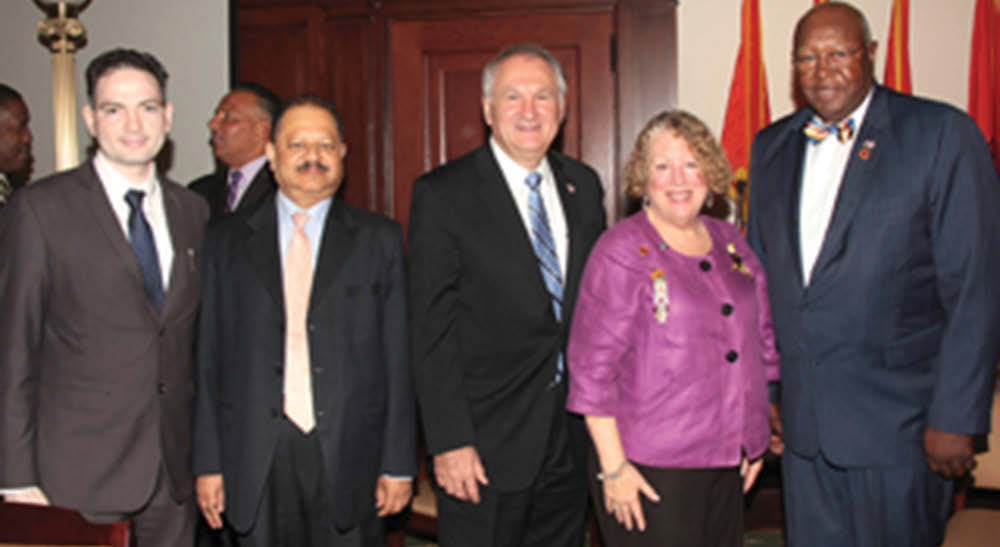
    MINEOLA, NY (TIP): Dr. Ajay Lodha, President Elect of the powerful organization of Indian American doctors AAPI (Amrerican Association of Indian Physicians ) and a very active member of Rajasthan Association of North America was appointed to Nassau County Comptroller George Maragos’s MWBE Advisory Council on Oct 14th 2015. The mission of the council is to assist the County in doubling the participation of MWBE (Minority and Women Owned Business Enterprise) businesses in the contracting process. The advisory council will assist the Comptroller’s office in monitoring the County’s compliance with MWBE goals and encourage MWBE firms to participate in County contract opportunities.

    Dr. Lodha  stated: ” I am very pleased to join the Comptroller’s MWBE Advisory Council. I will make sure through my connections with  Indian American community to increase awareness of the Nassau County Government MWBE outreach program. I hope to  assist office in organizing educational seminars for South Asian business owners, where they can learn how to apply for contracts.

  • RANA Diwali gives a Message of Integration

    RANA Diwali gives a Message of Integration

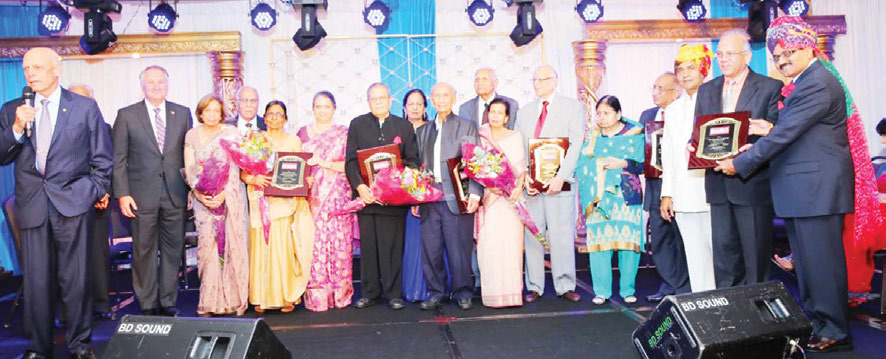
    HICKSVILLE, NY (TIP): After the huge success of the Rajasthan Mahotsav in April 2015 earlier this year and continuing in its tradition of bringing the merriment of Traditional Indian Festivals to the tri state area, RANA – Rajasthan Association of North America’s Deepavali

    Celebrations held on Sunday November 1 2015 was another monumental sensation. Over 600 people packed the Grand Ballroom at the Long Island Marriott and were entertained by the sensational Music Trio from India – Dhwani accompanied by electrifying dance performances by the dancers of Sonalee Vyas Dance Company.

    Attendees were seen packing the dance floor and dancing to the pulsating beat of Bollywood songs till the wee hours of the morning. “We have never experienced such a fabulous show before” was the universal sentiment amongst all those who attended the celebrations on that evening.

    Naveen C Shah, President of RANA in his address attributed the success of RANA’s Rajasthan Mahotsav & the Diwali celebrations to not just entertaining ourselves, but to enrich ourselves from the talent & wisdom which we all bring to this part of the world. Attendees also commended Naveen’s vision to spread the message of integration among various communities and created awareness amongst the new generation about our values, culture, traditions, food and festivities.

    Respected members of the community were presented with plaques on this evening for their efforts in instilling Rajasthani culture, values, heritage & traditions in the current and future generations. “We can never thank our elders enough for what they have done for us. They are a shining example to our current and younger generation to emulate and follow” said Naveen.

    Kanak Golia, Vice President of RANA informed the gathering that “the focus and objective of the Diwali event is also to continue RANA’s mission towards charitable and welfare causes. All excess proceeds from the event will be remitted to a residential orphanage devoted to the care of orphans. Our hope is that these children, who have nowhere to go will receive food, clothing, shelter and an opportunity for a better life”.

    Comptroller of Nassau County, George Maragos and Bollywood actress, Preety Jhangiani were the guests of honor on the evening.

    The following distinguished Rajasthani’s were recognized for their outstanding accomplishments and achievements in their respective field, philanthropic activities and contributions to religious values and fundamentals of our traditions.

    • Mrs. Manju Sharma, Managing Director of Eternal Heart Care Research Center, Jaipur.
    • Mr. Rajeev Pandya, Managing Partner of Ashi Diamonds, New York.
    • Mrs. Prabha Golia, Vice – President of Perfume Center of America, New York.

    The evening’s entertainment was a mix of traditional Rajasthani Music and contemporary Bollywood songs by Dhwani, coupled with dynamic and lively dances by the dancers of the Sonalee Vyas Dance Company with colorful costumes and traditional props to showcase the rich and vibrant culture of Bollywood.

    In her thank you address, Madhu Pareek, Secretary of RANA thanked all the Sun, Moon & Star sponsors for their support without whom this event would not have been possible. She also appreciated various vendors who worked behind the scenes to make this event successful. MC for the evening was Sangeet Sharma, the popular voice behind radio station Easy 96, Sound and Light effects for the event was provided by BD Sound, Catering was provided by Tandoor Caterers, Souvenir design was done by A-HA Designs, NJ and printing was done by Media Masters of Mineola, NY. Plaques for the honorees were provided by Crown Trophy, New Hyde Park and the honoree trophies were specially got fabricated in India by Patron member Haridas Kotahwala.

  • Woman trapped in Subway fridge for eight hours wrote ‘help’ message in ketchup

    GLOUCESTER (TIP): A Subway employee who was trapped in a chiller in Gloucester for eight hours wrote ‘help me’ messages in ketchup on pieces of cardboard in a desperate attempt to be let out. Karlee Daubeney, 20, reportedly hoped her scrawled plea would be seen by CCTV operators but failed to get their attention, according to the Gloucester Citizen. It wasn’t until 7.30am the next day, when staff arrived to open the store, that she was freed.

    She told the newspaper she had been working the late shift alone and was putting milk away in the walk-in chiller when the door shut behind her and locked her inside. Ms Daubeney said she was dressed in only leggings and a Subway shirt, but that the temperature inside the fridge was just a few degrees above zero.

    She tweeted after the incident: “Got locked in a f*****g fridge over night for 8 hours and work don’t ask me if I’m okay, they ask if I can work tonight P**S TAKE”.

  • Norway has a new passion— ghost hunting

    MOSS (NORWAY) (TIP): Like many Europeans, Marianne Haaland Bogdanoff, a travel agency manager in this southern Norwegian town, does not go to church, except maybe at Christmas, and is doubtful about the existence of God. But when “weird things” — inexplicable computer breakdowns, strange smells and noises and complaints from staff members of constant headaches —started happening at the ground-floor travel office, she slowly began to put aside her deep scepticism about life beyond the here and now. After computer experts, electricians and a plumber all failed to find the cause of her office’s troubles, she finally got help from a clairvoyant who claimed powers to communicate with the dead. The headaches and other problems all vanished.

    “I don’t know what she did,” Bogdanoff said. “It was very strange,” she added, recalling how the clairvoyant “cleansed” her travel office of a ghostlike presence neither she nor her staff had seen but whose existence they had all felt and come to fear.

  • Romania appoints Sorin Campeanu as new interim Prime Minister

    BUCHAREST (TIP): Romania’s President on Nov 5 appointed Education Minister Sorin Campeanu as interim Prime Minister to replace Victor Ponta, who quit following mass anti-government protests sparked by a deadly nightclub fire.

    Klaus Iohannis named Campeanu to lead a temporary administration ahead of talks with political parties on Thursday over forming a new government.

    Ponta quit on Wednesday after a horrific fire at a Bucharest nightclub left 32 people dead, prompting tens of thousands of people to take to the streets demanding a “profound change” in the government as a wave of grief and anger swept the country.

    The venue was not authorised to hold concerts or stage the pyrotechnic display that sparked the fire.

    Many protesters saw last Friday’s tragedy at the Colectiv club as a sign that nothing has changed in one of Europe’s poorest and most corruption-prone nations.

    Ponta himself has been under pressure for weeks over charges of fraud, tax evasion and money laundering that have made him the first Romanian head of government to go on trial.

    He said it was right for top officials to take responsibility over the fire, which sparked a stampede as panicked revellers desperately tried to get out, leaving nearly 200 people injured.

    Ponta’s resignation has failed to stop the protests and some 10,000 demonstrators, most of them young, took to the streets of Bucharest on Thursday, the third night running.

    They were protesting against corruption among the political classes they hold responsible for the nightclub deaths.