Year: 2015

  • ENDOMETRIOSIS UPS MISCARRIAGE RISK

    ENDOMETRIOSIS UPS MISCARRIAGE RISK

    A relatively common condition associated with abdominal pain, heavy periods, and infertility may increase risk of miscarriage by over 75 percent, a new research has found.

    The study involving over 14,000 women in Britain looked at the risk posed by endometriosis – a condition in which cells from the lining of the uterus (endometrium) are found elsewhere in the pelvic area.

    “These results indicate that endometriosis pre-disposes women to an increased risk of early pregnancy loss and later pregnancy complications,” said the study’s first author Lucky Saraswat, consultant gynaecologist from the Aberdeen Royal Infirmary, Britain.

    The study was a nationwide cohort study using discharge data from all state hospitals in Scotland. Records of women with and without a confirmed diagnosis of endometriosis were cross-linked to their maternity records to evaluate pregnancy outcomes.

    A total of 14,655 women were included in the analysis, with their medical records followed-up for a maximum of 30 years between 1981 and 2010.

    After adjustments for age and previous pregnancy, results showed that women with endometriosis had a significantly higher risk of early pregnancy complications than the controls.

    This risk was 76 percent higher for miscarriage and nearly three-times higher for ectopic pregnancy.

    The findings should now be taken into account when counselling women with endometriosis about their family plans and care during pregnancy, the researchers noted.

    Suggesting a possible explanation for the risk, Saraswat said that endometriosis is associated with increased inflammation in the pelvis, and structural and functional changes in the lining of the uterus.

    “We believe such changes in the pelvic and uterine environment could influence implantation and development of placenta, pre-disposing them to adverse pregnancy outcomes,” she said.

    Details of the study are scheduled to be reported this week at ESHRE 205, held in Lisbon, Portugal from June 14-17.

  • HEART DISEASES ARE UNDER-DIAGNOSED IN WOMEN

    HEART DISEASES ARE UNDER-DIAGNOSED IN WOMEN

    Studies show heart attacks and heart disease are under-diagnosed in women, as their symptoms do not match that of men. To prevent a heart attack from sneaking up on you, watch for these seven little-known signs of heart attack:

    Fatigue | More than 70 per cent of women reported extreme fatigue in the months prior to their heart attacks. This was an overwhelming fatigue that sidelined them from their usual schedules for a few days at a time.

    Insomnia | Despite their fatigue, women who’ve had heart attacks remember experiencing unexplained inability to fall asleep during the month before their heart attacks.

    Anxiety and stress | Stress has long been known to up the risk of heart attack. But what women report is the emotional experience; before their heart attacks they felt anxious and stressed, more than usual.

    Indigestion or nausea | Stomach pain, intestinal cramps, nausea, and digestive disruptions are other signs reported by women heart attack patients.

    Shortness of breath | Women couldn’t catch their breath while walking up the stairs or doing other daily tasks.

    Flu-like symptoms | Clammy, sweaty skin, along with feeling light-headed and weak, can lead women to wonder if they have flu when, in fact, they’re having a heart attack.

    Jaw, ear, neck, or shoulder pain | Many women say they felt pain and a sensation of tightness running along their jaw and down the neck, and sometimes up to the ear, as well. The pain may extend down to the shoulder and arm– particularly on the left side–or it may feel like a backache or pulled muscle in the neck and back.

  • Contraceptive pills may increase clot risks

    Contraceptive pills may increase clot risks

    Scientists have found new evidence to prove that contraceptive pills these days could increase risk of clot formation in women.

    The results show that pills containing one of the newer types of progestogen hormone
    (drospirenone, desogestrel, gestodene, and cyproterone) are associated with an increased risk of VTE than pills containing older progestogens (levonorgestrel and norethisterone). The University of Nottingham researchers said that this was “an important clarifying study” that “has sufficient power to provide reliable comparative findings for different formulations of combined oral contraceptives.”

    The researchers, led by research fellow Yana Vinogradova, used prescription data from two large UK general practice databases to measure the associations between use of combined oral contraceptives and risk of VTE in women aged 15-49 years, adjusting for other known risk factors.

    Compared with women not using oral contraceptives, women using older pills, containing levonorgestrel, norethisterone, and norgestimate, had about two and a half times increased risk of VTE. Women using newer pills, containing drospirenone, desogestrel, gestodene, and cyproterone, had around a four times increased risk of VTE. Risks for women using newer pills were around 1.5-1.8 times higher than for women using older pills.

    The authors stressed that oral contraceptives have been remarkably safe, and point out that the reported three times increased risk of VTE in women using oral contraceptives in their study was still lower than the up to 10-fold increased risk of VTE in pregnant women. They say women on combined contraceptive drugs “should not stop using them, but should consult their doctor and review their current type of pill at their next appointment if there are any concerns.”

    This is an observational study, and therefore, no definitive conclusions can be drawn about cause and effect.

  • NEW FLEXIBLE, STRETCHABLE RUBBER KEYBOARD DEVELOPED

    NEW FLEXIBLE, STRETCHABLE RUBBER KEYBOARD DEVELOPED

    MELBOURNE (TIP): Scientists have developed a soft, flexible and stretchable keyboard using a type of rubber known as a dielectric elastomer that can be wrapped around any object.

    “Imagine a world where you drop something, and it bounces back without any damage. That’s the benefit of these rubber devices that can flex and stretch,” said Daniel Xu, from the University of Auckland in New Zealand.

    The keyboard was made from a single laminated structure with two sensing layers oriented at 90 degrees apart.

    This took advantage of their mechanical coupling while at the same time still provided an electrical separation.

    A total of nine different positions were distinguished within the sensor keyboard. “A key benefit of our keyboard is that essentially, it’s just a thin sheet of rubber. It can be wrapped around any object which turns it into a keyboard,” said Xu.

    “It can also be made into a sensing skin for motion capture, which is useful for athletes, clinicians, and for new interactive gesture controllers,” he said. The researchers often used video games to test the functionality of the keyboard – and as part of a separate project have made a sensing glove to interface with shooting games.

    Researchers are working with a spin-off company, StretchSense, to develop wearable and other technologies designed to sense stretch.

  • IIT-M develops method to track cyclones accurately

    IIT-M develops method to track cyclones accurately

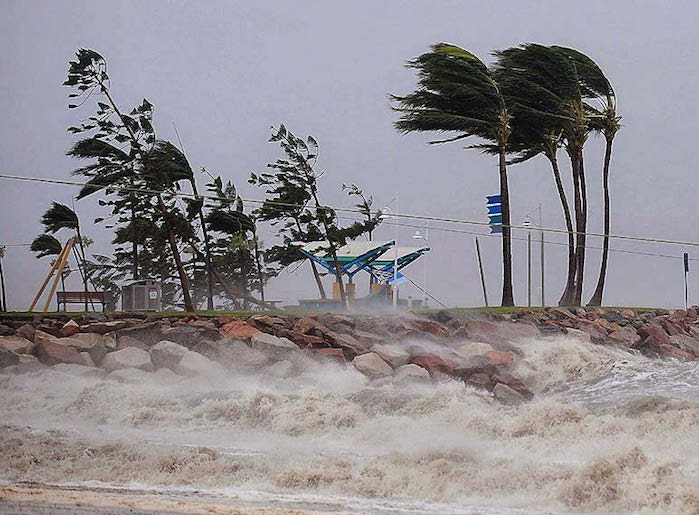
    CHENNAI (TIP): Predicting the weather is a tricky business; sometimes the weather man gets it right, but more often he cops the flak for getting it wrong. To reduce the window of mistakes and to improve the accuracy of forecasts, researchers at the Indian Institute of Technology-Madras are developing a technique that will depend that is fed into high quality data from satellites on supercomputers. They have been working on the `data assimilation’ method for more than a decade, where they combine numerical weather models with satellite and/or radar data to reduce errors in prediction of tropical cyclones.

    Traditionally, IMD meteorologists follow the synoptic method for cyclone prediction in which weather observations taken on the ground or from ships and in the upper atmosphere with the help of sensors attached to balloons are used to make forecasts.The data from various sources are then plotted on a weather map to get a synoptic view of the world’s weather. The numerical model, which meteorologists say improves forecast accuracy , is employed for cyclone forecasts two to three days prior to their estimated landings.

    When IIT-M researchers analysed the 2010 tropical cyclone Jal to evaluate the capability of their technique, they found that with the numerical model, they improve prediction by up to 35% for a 24-hour forecast and up to 12% for a 54-hour forecast. The numerical-based weather forecast system has a 60-70%prediction accuracy .

    “What we are doing at IIT-M is not extensively used in operational forecasts as we need to test these for several types of situations,” said Chakravarthy Balaji, professor at department of mechanical engineering. “Many countries have adopted data assimilation technique and it’s time that India employ the model,” he added.

    At IIT-M, researchers collect data from ground-based doppler weather radars and from multiple satellites like tropical rainfall-measuring mission, a Nasa satellite, Megha-tropiques, an Indian satellite and INSAT3D. These satellites have radiation detectors and scanning mechanism that identify visible, infrared or microwave radiation emanating from the land and ocean.

    This ensemble of data is run in Weather Research and Forecasting model, a next generation numerical weather prediction system. They fed the data into supercomputer VIRGO, along with experts’ inputs on weather systems over the years to correct errors. The forecast can be done for 7 days, but reliability is high for up to 3 days.

    The professor said the numerical model they use is time tested and the novelty in the research is the multi-pronged approach in predicting weather systems, selection of instruments on satellites to gather data, frequency selection for radiometer systems on satellites to scan the earth and measure radiation emanating from land and ocean.

    He said observations made over the years through this technique will help in studying long-term patterns in the atmosphere and climate change. It can also help build a large database over the Indian Ocean, considered a `data deficient’ region Former deputy director general of regional meteorological centre, Chennai, Y E A Raj said IMD, at present, uses statistical model, which is based on past data, for long range tropical monsoon forecasting and that a research is on to use satellite and radar data in numerical models. “Numerical models will be very good for up to one week. While statistical models depend upon equations and correlations, they are useful for long-range forecasting,” he said.

    IMD will be validating seasonal fore casting model developed at the Experimental Climate Prediction Centre, US, for more years before it can be used for op erational purpose.

  • You can finally backup your WhatsApp messages on Android to Google Drive

    You can finally backup your WhatsApp messages on Android to Google Drive

    Backing up your WhatsApp messaging history on an Android phone was a painful, multi-step process that involved connecting your phone to your computer and manually messing around with the WhatsApp folder in the phone’s memory.

    All that’s history. If you use WhatsApp on Android, here’s some news that should make you really happy: you will soon be able to back up all your WhatsApp messages, pictures, videos and voice notes to Google Drive. This is similar to WhatsApp on iPhone, which backs itself up to iCloud.

    WhatsApp and Google announced the partnership on their respective blogs.

    There don’t seem to be any file-size limits to the backup, and since WhatsApp encyrpts every piece of content that it sends and receives, you can rest assured that Google won’t be able to read anything, and, you know, serve you ads.

    The feature is rolling out over the next few months, so if you don’t have it already, hang in there and try not to lose your phone or something till you’re done backing up your WhatsApp.

  • WORLD’S SEXIEST ROBOT IS HERE

    WORLD’S SEXIEST ROBOT IS HERE

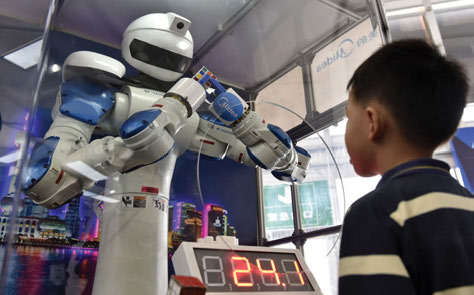
    We all love robots -but could we one day actually fall in love with one? This is Android Geminoid F , an eerily lifelike humanoid which stole the show at the World Robot Exhibition in Beijing this week. Created by Hiroshi Ishiguro Laboratory at Osaka University , Geminoid F was the star attraction as people crowded round her to have their picture taken and speak to the android.

    Some people have even remarked that they found Geminoid F “sexy”. She previously found fame as the first android film star -she co-starred in Japanese movie Sayonara, about the fall-out from a nuclear power plant meltdown. The Daily Mail reported that the 5ft 6 inch android was capable of eye movements, responded to eye-to-eye contact and could recognise body language. She has been designed to act like a human with rubber `skin’ and a woman’s face –but can’t walk and has to be wheeled around. She can smile, furrow her brows and move her mouth. She can also talk and sing -play recordings or `mouth’ other people’s voices.

    With her realistic appearance, good looks and acting talent, you might think Geminoid F has it all -but her creators, are picky. Kohei Ogawa, assistant professor at Hiroshi Ishiguro Laboratory said, “Our final goal is creating some artificial intelligence by using this robot. Most voice recognition systems do not work, in a noisy environment. In the future we’re going to create a perfect AI system by using this robot.”

  • Facebook starts testing live video sharing service

    Facebook starts testing live video sharing service

    SAN FRANCISCO (TIP): Get ready to start watching live video of your friends and family doing something fun, boring or even dumb on Facebook.

    The world’s largest social network is testing a new feature that will enable its 1.5 billion users to use their smartphones to shoot video so other people can see what they are doing as it happens.

    Facebook has begun testing the live video option among a sliver of its US audience with iPhones. The Menlo Park, California, company didn’t specify when everyone with a Facebook account and a smartphone will have an opportunity to broadcast live.

    The feature represents Facebook’s latest challenge to online messaging service Twitter, which introduced a live video application called Periscope earlier this year.

    This isn’t the first time that Facebook has copied others’ ideas in an attempt to ensure its social network remains the leading digital hangout.

    In recent years, Facebook also has embraced the hashtag symbol, a Twitter technique for flagging major events and topics of conversation, and cloned an option to check into specific places that was popularized by Foursquare.In another move of mimicry, Facebook is introducing another feature called “Collage” that will automatically bundle photos and video taken in the same place or at the same event into a slideshow. The concept mirrors a feature that Google introduced in its Plus social network years ago and imported into its Photo app six months ago.

  • INDIA HAS BETTER GROWTH PROSPECTS THAN CHINA, SAYS MARK MOBIUS

    INDIA HAS BETTER GROWTH PROSPECTS THAN CHINA, SAYS MARK MOBIUS

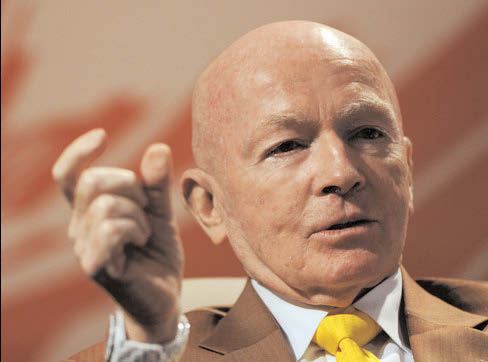
    MUMBAI (TIP): Emerging markets guru Mark Mobius said India could overtake China in the Templeton Emerging Markets group’s equity investments over the next five years, given the strong growth prospects of Asia’s third-largest economy and provided much-awaited reforms see the light of the day.

    Mobius, who is executive chairman of the Templeton Emerging Markets Group at Franklin Templeton Investments, said China accounts for 8% of the group’s equity investment, followed by India with a 3% share. But, he added, the gap could close in time to come.

    “If you look at where we are invested China is at the top of the list, followed by India and Thailand, will be the next two,” Mobius said in an interview on the sidelines of an event. “Going forward India is going to become more important, simply because it’s got better growth prospects,” said Mobius, adding that it was important that reforms went through as well.

    India’s economic growth accelerated to 7.4% in the second quarter of the current financial year, riding on a spike in manufacturing and a pickup in investment demand, government data showed on Monday.

    The ongoing reforms process was also key to Mobius’ rationale for investments in India. “The demographics are in favour. It’s a young population, and a growing population. Secondly, the reforms process is moving ahead. Modi has set an agenda for reforms,” he said. Although some people were concerned about the speed, he said, it was not as important as the direction of reforms.

    “These things (reforms) take time, but the direction is very clear,” added Mobius. The reforms process initiated by the government led by Prime Minister Narendra Modi was off to a slow start—compared with expectations—with a political logjam in previous Parliament sessions stalling the passage of crucial legislation. Hopes have risen now that things may move ahead better than expected from here on.

    Mobius does not expect the opposition Congress party to put barriers in the path of the ruling Bharatiya Janata Party (BJP) to get the reforms through. Last week, leaders of the BJP and Congress met at Modi’s residence, spurring hopes that the constitutional amendment bill to enable the goods and services tax (GST) will finally get Parliament’s nod. Modi invited Congress president Sonia Gandhi and former Prime Minister Manmohan Singh to discuss issues related to the winter session of Parliament, including the GST bill.

    Mobius said Modi’s performance as Prime Minister has been more or less in line with what he had expected, but added that he is capable of doing more.

    “I didn’t expect much more, (than what has happened), but I would say that in terms of what he could do, maybe we are talking about 75-80%,” said Mobius.

    According to him, investors could wait for another year for the government to deliver on reforms, and GST was the key reform. “If that’s delivered, that would be a watershed. That would be something.”

    The key risk to Indian markets was also deliveries on the reforms front, at this point.

    “Its really these reforms at the end of the day,” he said adding that rural electrification and reforms of the tax system were the big issues facing the Indian markets.

    There has been a debate on whether there is rising intolerance in the country, and the rising intolerance has dampened the sentiment for Modi, added Mobius.

    “It already is a hurdle. It is a problem for him, and it very difficult for him,” said Mobius. “I think his policy of not talking about it is probably a good one, because when it comes to religion, faith, class, these are emotional subjects.”

    “All these conflicts have their base in economics. When people don’t have jobs, if their standard of living is not good, and see what other people have and they don’t have it, they get angry,” he said.
    “So, I think it is definitely a problem for him but he is probably wisely trying to keep away from that and focus on his job at hand.”

    Mobius likes the consumer and infrastructure sectors in the Indian market, while he would avoid natural resources at this time. He expressed concern over state-owned banks, and emphasized that privatization was key.

    “They’ve got to get these state-owned banks out from under government control and put them on a stable basis with market-oriented policies, and that would be a giant step forward for not only for the banks, but also the government,” Mobius said.

    He said the recent outflows from emerging markets could reverse after the US Federal Reserve’s policy decision.

    “It is true that emerging markets have underperformed for the last three years and therefore a lot of investors have pulled money out of the emerging market funds,” said Mobius.

    “I believe that once the uncertainty caused by the Federal Reserve’s interest rate policy is out, then money will begin to flow again back in to emerging market.”

  • EUROPEAN STOCKS AWAIT ECB STIMULUS HOPES

    EUROPEAN STOCKS AWAIT ECB STIMULUS HOPES

    LONDON (TIP): Weak inflation data spurred hopes the European Central Bank could deliver more stimulus this week, though European bourses traded in a tight range on December 2, Frankfurt and Paris ceding spartan ground while London rose slightly.

    The data appeared to cement hopes that the ECB — which announces the outcome of its latest monetary policy meeting on Thursday — will ramp up its quantitative easing (QE) bond-buying programme.

    Inflation in the 19-nation eurozone area was unchanged in November at just 0.1 per cent, official data showed, dashing expectations of an acceleration to 0.2 per cent.

    Analysts queued up to stress the influence on the market of the impending ECB decision with the data giving ECB chief Mario Draghi “a little bit more ammunition,” according to James Hughes, chief market analyst with GKFX.

    For Hughes, a cut in the discount rate or more QE “will see the data take centre stage as investors await something to drive EURUSD (the euro against the dollar) even further lower. The Euro remains under pressure and could well be set to retest the lows for the week at 1.0495 and even push lower.”

    The European single currency fetched$1.0575 Wednesday at the European close from $1.0634 in late US trade on Tuesday.

    Spreadex analyst Connor Campbell said: “The eurozone’s inert inflation appears to give Mario Draghi the green light to increase his quantitative easing scheme tomorrow. Well, investors and analysts seem to think so.”

    Former IMF deputy director Desmond Lachman of the American Enterprise Institute indicated that “while the ECB will present its action as an appropriate monetary policy response to a weakening Eurozone economic recovery the main channel through which its actions will work will be a further significant depreciation of the euro.

    “While this might be good for the European economy, it will impose a substantial burden on the rest of the global economy.”

    The region’s markets had fallen on Tuesday as strong economic data gave rise to doubts over the likelihood of eurozone stimulus.

    London’s FTSE 100 index added 0.6 per cent at the close on strong pharmaceuticals but Frankfurt posted a 0.6 per cent drop — troubled Volkswagen being off 1.8 per cent after reporting a drop in German sales — and Paris fell 0.2 per cent.

    “There can be little doubt that the ECB will press ahead with further stimulus at its December meeting on Thursday,” added IHS Global Insight economist Howard Archer.

    “Indeed, there are high expectations that the ECB will deliver a pretty aggressive package of measures on Thursday, despite serious reservations among some members of the (ECB) governing council led by the German contingent.”

    Wall Street dipped although Yahoo shares opened higher on a report that the company could sell its core Internet business.

  • RBI’s status quo on policy rates confirms economic recovery on track

    RBI’s status quo on policy rates confirms economic recovery on track

    MUMBAI (TIP): The Reserve Bank of India (RBI) left policy rates unchanged at its final monetary policy review for 2015, even as it confirmed that an economic recovery was on, and appears “sustainable”.

    The central bank’s views on the economy come a day after the government released data that showed that gross domestic product (GDP) in the second quarter of 2015-16 expanded at the rate of 7.4% on the back of a pick-up in investment demand.

    Following review, the benchmark repo rate, or the rate at which RBI lends money to banks, remains unchanged at 6.75%. Since January, RBI has cut rates by 125 basis points. One basis point is one-hundredth of a percentage point.

    The cash reserve ratio (CRR), or the portion of a bank’s deposits that has to be maintained in cash with RBI, stands unchanged at 4%. The statutory liquidity ratio (SLR), which is the amount that banks hold in government bonds, also remains steady at 21.5%.

    All 10 analysts polled by Mint expected a status quo policy.

    The RBI’s last review of 2015 capped a year in which interest rates have seen the steepest reduction since the global financial crisis.

    Will there be more rate cuts?

    RBI governor Raghuram Rajan indicated that this depends on the effects of the Seventh Pay Commission recommendations on the government’s fiscal math and inflation remaining low.

    Most economists do not expect any more easing until the Union Budget in February.

    RBI’s view that the economy is in the “midst of a recovery” could also reduce urgency for more monetary stimulus, they point out.

    The RBI itself gave few hints of further rate cuts except to say that the central bank remains
    “accommodative” in its stance.

    “The Reserve Bank will use the space for further accommodation, when available, while keeping the economy anchored to the projected disinflation path that should take inflation down to 5% by March 2017,” the central bank said in its statement.

    “Today’s policy undertone has leaned towards the neutral-to-dovish side. The governor’s indication of being accommodative sends a positive signal for the Indian economy,” said Arundhati Bhattacharya, chairperson of State Bank of India, in an emailed statement.

    Others differed. The bar for further rate cuts, though not impossible, is high, said Pranjul Bhandari, chief India economist at HSBC.

    In its policy statement, RBI said there was a downside bias to its retail inflation forecast of 5.8% by January 2016, while adding it will track developments on commodity prices, household inflation expectations and the impact of the Seventh Pay Commission proposals closely.

    The central bank, however, said it expects that the direct impact of the pay commission report on aggregate demand in the economy to be offset by the government’s plan to reduce its fiscal deficit to 3.5% next year.

    “I am hoping that the government is able to maintain and enhance the quality of the budget. We don’t feel there would be a significant effect on aggregate demand so long as the government maintains its fiscal path,” said Rajan in a press conference after the policy announcement.

    In a conference call with analysts, Rajan said RBI may look through the “technical” impact of higher house rent allowance (HRA) built into the pay commission recommendations unless it has a broader impact on the rental market.

    House rents are a component of the consumer price inflation (CPI) index.

    The markets saw these statements as dovish.

    “While the status quo was as expected, comments by the governor have been rather dovish on inflation,” said Jayesh Mehta, country treasurer, Bank of America-Merrill Lynch (BofA-ML).

    Bond yields eased and the 10-year benchmark yield ended 6 basis points (bps) lower at 7.72% on Tuesday. The rupee closed 0.26% stronger at 66.49/$.

    Equity markets ended flat. The benchmark BSE Sensex closed at 26,169, up 23 points or 0.09%.

    The conclusion: there may be some more monetary easing in 2016, especially if inflation stays low and government presents a tight Union Budget in February.

  • SHAKTI: THE MOTHER OF UNIVERSE

    SHAKTI: THE MOTHER OF UNIVERSE

    Parvati is the daughter of the king of Parvatas, Himavan and the consort of Lord Shiva. She is also called Shakti, the mother of the universe, and variously known as Loka-Mata, Brahma-Vidya, Shivajnana-Pradayini, Shivaduti, Shivaradhya, Shivamurti, and Shivankari. Her popular names include Amba, Ambika, Gauri, Durga, Kali, Rajeshwari, Sati and Tripurasundari.

    The Story of Sati as Parvati

    Parvati’s tale is told in detail in the Maheshwara Kanda of the Skanda Purana. Sati, the daughter of Daksha Prajapati, the son of Brahma, was wedded to Lord Shiva. Daksha did not like his son-in-law because of his queer form, strange manners, and peculiar habits. Daksha performed a ceremonial sacrifice but did not invite his daughter and son-in-law. Sati felt insulted and went to her father and questioned him only to get an unpleasant reply. Sati got enraged and did not want any more to be called his daughter. She preferred to offer her body to the fire and be reborn as Parvati to marry Shiva. She created fire through her Yoga power and destroyed herself in that yogagni. Lord Shiva sent his messenger Virabhadra to stop the sacrifice and drove away all the Gods who assembled there. The head of Daksha was cut off at the request of Brahma, thrown into the fire, and replaced with that of a goat.

    How Shiva Married Parvati

    Lord Shiva resorted to the Himalayas for austerities. The destructive demon Tarakasura won a boon from Lord Brahma that he should die only at the hands of the son of Shiva and Parvati. Therefore, the Gods requested Himavan to have Sati as his daughter. Himavan agreed and Sati was born as Parvati. She served Lord Shiva during his penance and worshiped him. Lord Shiva married Parvati.

    Reunion of Shiva and Parvati

    The celestial sage Narada proceeded to Kailash in the Himalayas and saw Shiva and Parvati with one body, half male, half female – the Ardhanarishwara. Ardhanarishwara is the androgynous form of God with Shiva (purusha) and Shakti (prakriti) conjoined in one, indicating the complementary nature of the sexes. Narada saw them playing a game of dice. Lord Shiva said he won the game. Parvati said that she was victorious. There was a quarrel. Shiva left Parvati and went to practise austerities. Parvati assumed the form of a huntress and met Shiva. Shiva fell in love with the huntress. He went with her to her father to get his consent for the marriage. Narada informed Lord Shiva that the huntress was none other than Parvati. Narada told Parvati to apologize to her Lord and they were reunited.

    How Parvati Became Kamakshi

    One day, Parvati came from behind Lord Shiva and closed his eyes. The whole universe missed a heartbeat – lost life and light. In return, Shiva asked Parvati to practise austerities as a corrective measure. She proceeded to Kanchipuram for rigorous penance. Shiva created a flood and the Linga which Parvati was worshiping was about to be washed away. She embraced the Linga and it remained there as Ekambareshwara while Parvati stayed with it as Kamakshi and saved the world.

    How Parvati Became Gauri

    Parvati had a dark skin. One day, Lord Shiva playfully referred to her dark color and she was hurt by his remark. She went to the Himalayas to perform austerities. She attained a beautiful complexion and came to be known as Gauri, or the fair one. Gauri joined Shiva as Ardhanarishwara by the grace of Brahma.

  • Indian American Appointed Advisor to Accessible India Campaign

    Indian American Appointed Advisor to Accessible India Campaign

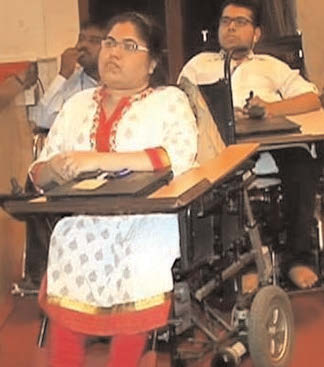
    WASHINGTON (TIP): An Indian-American techie has been appointed as advisor to the
    ‘Accessible India’ campaign to be launched by Prime Minister Narendra Modi this week to make transport, public spaces and information and communication technology accessible to differently-abled people.

    Pranav Desai, a polio survivor, is vice president with a Global IT Services Company and had played a key role in inclusion of issues related to specially-abled people in the ruling BJP’s Vision 2020 document and its election manifesto.

    Mr Desai who had met the Prime Minister Modi when the latter toured Silicon Valley in September said the Accessible India Campaign (Sugamya Bharat Abhiyan) to be launched on December 3 would jump start transformation by creating massive awareness for disability sector.

    Mr Desai was appointed advisor to the ‘Accessible India’ campaign by the Ministry of Social Justice and Empowerment.

    He is the founder of non-governmental Voice of Accessible India (VoSAP) which has been working on multi-pronged approach as part of roadmap to achieve Vision 2020 such as providing policy inputs on assisting technologies, proposals to railways, finance and seven other ministries for adopting inclusive policy decisions, a media release said.

    Accessible India Campaign (AIC), he said, is now becoming countrywide reality and inspiration to other nations in the world as well.

    The campaign by the government, social leaders and media will help sensitise society at large and accelerate change/transformation, he added.

    Mr Desai said Art of Living Foundation of Sri Sri Ravi Shankar has also joined the campaign.

    “Today as India is taking great strides in the fields of technological advances, economic development and social transformation, Sri Sri would like that we all make a conscious effort to include the specially-abled people of India and their integration in our everyday life, make it a priority,” the statement said.

  • MUKTI BHAVAN: A VARANASI HOSTEL THAT LETS PEOPLE CHECK-IN TO DIE

    MUKTI BHAVAN: A VARANASI HOSTEL THAT LETS PEOPLE CHECK-IN TO DIE

    After checking in at the Mukti Bhawan hostel, guests have two weeks to die or else they are gently asked to leave.

    The hostel — a short walk from the Ganges river in the northern Indian city of Varanasi — is a final stopover for elderly Hindus hoping they will shortly end up on one of the hundreds of funeral pyres lit on the riverbank each day.

    “While the rest of the world celebrates a new life when a child is born, similarly we celebrate death,” said Bhairav Nath Shukla, the cheerful manager of Mukti Bhawan, one of several places offering shelter to outsiders wanting to die in the city.

    Hindus believe that dying in Varanasi and having their remains scattered in the Ganges allows their soul to escape a cycle of death and rebirth, attaining “moksha” or salvation.

    But for those making that most final of pilgrimages to the city, orthodox hotels and guesthouses can be expensive, and, as Shukla points out, most are reluctant to welcome guests on the very brink of death who do not plan to check out alive.

    Mukti Bhawan — or “Salvation House” — offers 12 bare, tatty rooms arranged around a courtyard in a 100-year-old red-brick building with green shutters.

    The atmosphere is far from sombre.

    “Here we witness the deaths, the wailing shrieks, the chaos on a daily basis, so where is the fear?” said Shukla. “There will be another life after this, so there is no basis for fear. Crying over this is foolishness.”

    In one room, Narayan crouches on the floor frying chillies on a portable stove, his infant daughter wailing from the fumes. Nearby his 80-year-old mother, Manorma Devi, lies supine on a wooden plinth, unconscious and panting.

    “It’s old age. She’s had a long life, so how can I feel sad?” said Narayan. “Kashi (Varanasi) is a very important place. A place of temples. I’m happy she can die here.”

    Devi’s family will pay only their electricity and food bills. The poorest families pay nothing.

    There are no doctors, nurses or medicine cabinets. Instead there are four priests to offer prayers for the dying.

    Between 30 and 70 people die here every month. But if a guest has not died within a couple of weeks of arriving, they are usually requested to make space for someone else.

    At especially busy times, Shukla will sometimes let people in to die in his office. If it’s quiet, he sometimes waives the two-week rule.

    MAYBE NEXT TIME

    Predicting when someone will die is an inexact science, which makes choosing when to travel to Mukti Bhawan something of a gamble.

    “People come in the hope that death is near but at times it isn’t, in which case they are caught in a fix,” said Shukla.

    The family of Ram Bhog Pandey is beginning to feel anxious. The 85-year-old former teacher from a village in the eastern state of Bihar has been lying on the hard floor of his room at Mukti Bhawan for ten days.

    Unlike some other guests, he is still conscious, although he is no longer able to speak and barely able to move.

    His rheumy eyes stare at anyone entering the room. He struggles to smile. Mushed up food falls from his mouth. His body is skeletal.

    “We brought him here after the doctors said there is no hope for him,” said Daya Shankar, Ram’s eldest son, who will light the funeral pyre when the time comes.

    “His right hand is already dead,” he added, pointing towards the hand’s yellowy-purple swollen flesh.

    But if his father doesn’t die within the next few days, Daya Shankar said they will have to return him by train to their village. The family can’t stay away from their farm for too long.

    It would be a great shame if his father missed the chance to draw his last breath in Varanasi, Daya Shankar said. But perhaps he will get another chance at the end of his next life, he added.

  • Pankaja Munde defends Maharashtra temple’s practice of barring women

    Pankaja Munde defends Maharashtra temple’s practice of barring women

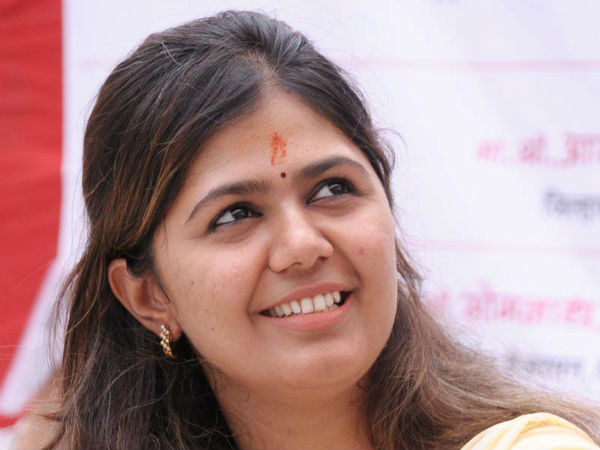
    MUMBAI (TIP): Defending the practice of not allowing women to perform ‘puja’ at Shani Shingnapur temple in Ahmednagar district, Maharashtra rural development minister Pankaja Munde said on Thursday traditional rituals cannot be “linked with insult” of women.

    Munde’s statement, which came in the wake of a woman offering ‘puja’ at the temple by breaching security, drew sharp reaction from opposition NCP.

    “These are traditions and cannot be linked with insult of women fraternity,” Munde said, defending the age-old ‘ban’ after a woman devotee’s action last week created a furore.

    “The outrage over the woman entering the Shani temple is a non-issue,” the BJP leader said.

    Chitra Wagh, women’s wing president of the state NCP, criticised Munde’s statement. “In a progressive state like Maharashtra, instead of appreciating the move to break the traditions that are against women, the BJP minister, by making such a statement, has taken state back to an era where women were not treated at par with men,” Wagh said.

    The temple, which attracts thousands of pilgrims daily, is devoted to Lord Shani and women are traditionally barred from offering prayers at the shrine, located about 250km from Mumbai.

  • BJP blasts Congress over corruption

    BJP blasts Congress over corruption

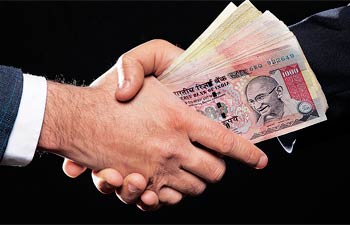
    NEW DELHI (TIP): Amid frequent disruptions by the Congress in the Rajya Sabha, the BJP on Dec 3 launched a scathing attack against the Opposition over the alleged involvement of its top leaders, including former union ministers Preneet Kaur and P Chidambaram and chief ministers Virbhadra Singh, Harish Rawat and Oommen Chandy, in “corruption cases”. While seeking answers from the Congress on “action taken” regarding allegations of corruption against its top leaders, Commerce Minister Nirmala Sitharaman maintained her questions should not be linked either to the status of the GST Bill or the functioning of Parliament.

    “GST is something which is their (Congress) Bill.

    It is in national interest. If these (corruption cases) become an issue because of which Congress party, and I would not imagine that, would not support GST, then it would be a sad day,” she said, expressing hope that the Opposition party would deal with the allegations with “maturity”.

    “The Congress is behaving as if they have not heard even a whisper. It is not one but several instances of corruption where Congress is happily looking the other wa,” she added.

  • Intolerance Fuels Radicalisation

    Intolerance Fuels Radicalisation

    India is awash with Islamophobia and there could not be a more dangerous time for this pernicious slant in our national politics.

    Hateful vitriol was spewed upon actor Aamir Khan recently, for expressing concern over the rising anti-minority attitude, just as black ink was literally spilled on the Observer Research Foundation’s Sudheendra Kulkarni last month for organising a book release event for a former Pakistani foreign Minister.

    Even more violent and disquieting were September’s mob lynching of Mohammad Akhlaq in Dadri, Uttar Pradesh, over rumours that he had stored beef in his home, and August’s murder of notable rationalist M.M. Kalburgi, who was shot dead after being threatened for his criticism of idolatry in Hinduism.

    There will no doubt be more such displays of bigotry in the months ahead, as fringe elements of the Hindutva brigade, emboldened by Prime Minister Narendra Modi’s description of the Dadri lynching as “unfortunate” and “undesirable”, go on the rampage to correct what they perceive to be injuries to the sentiments of the majority.

    The most compelling reasons for Mr. Modi to decisively stymie this rising tide of hatred are quite obvious: respect for India’s constitutionally protected secular credentials, and the maintenance of broader societal peace and harmony between communities.

    Yet there is a third feature of the Indian political firmament that makes it urgent, nay imperative, that the country’s leadership effectively tamp down on the flames of extremism – the alarming proliferation of support for Islamic State (IS), the jihadist terror outfit that controls parts of Syria and Iraq.

    The discovery of these IS-sympathisers has had a creeping quality, starting late last year with a handful of youth travelling to West Asia from Kalyan, near Mumbai, but more recently has been gathering momentum with a much larger cohort being pulled into the net by intelligence operations.

    The fact that this trend has been coterminous with the surge in anti-minority violence ought to be a red flag for the Modi government, for there is a risk that the two developments may begin to feed off one another, leading to a perfect storm linking an ongoing foreign policy crisis to a community under siege on Indian soil.

    Consider the speed and pattern of IS proliferation on Indian soil over the past year.

    Back in January The Hindu received a response on a Freedom of Information Act request to the U.S. Department of Defence asking what information it had on Indian nationals discovered to be fighting for IS in Syria and Iraq.

    Their answer was simple: none. Clearly the few Indians that had made it into the ranks of IS at that point were either relegated to menial tasks or used as cannon fodder on the frontlines as they have generally been considered “inferior” fighters.

    Yet, as outlined in a series of reports in The Hindu (“The IS Files”), the last past year has witnessed a slew of intelligence operations that have flushed out a number of potential IS recruits, and they hail from across the breadth of India.

    For example, Haja Fakkrudeen and Gul Mohamed Maracachi Maraicar both grew up in Cuddalore district in Tamil Nadu, and while Maraicar is now lodged in an Indian prison, Fakkrudeen, who may have been radicalised by Maraicar, is likely to be fighting alongside IS in Syria.

    The case of Muhammed Abdul Ahad, a U.S.-educated computer professional from Bengaluru, reflects the diversity of backgrounds from which IS has managed to woo supporters in India. Ahad was intercepted by Turkish authorities last year on the Syrian border and deported earlier this year after authorities suspected him of seeking to enter the Syrian battlefield.

    At the opposite end of the nation, in the Kashmir Valley, Kamil Wada spoke to The Hindu about how his older brother Adil had travelled to Syria, with authorities noting that he may have got radicalised by an Australian Islamic group after a visit to that country.

    As Indian intelligence agencies continue to grapple with the “foreign fighter” question, an issue that has long been front and centre for the U.S., Canada and Western Europe, it behoves the government of Mr. Modi to more effectively address societal forces that make the isolation, demonisation and ultimate radicalisation of minority communities more likely.

    Unless there is a concerted effort to neutralise the impunity of extremist elements that regularly engage in anti-Muslim violence, there may be little to halt the drift of a few members of an overwhelmingly moderate community into the arms of IS radicals.

    In the present climate of hostility, a vicious cycle is likely, as there are groups that would happily seize upon the insidious presence of the IS in India to paint the entire Muslim community with the broad brush of negative propaganda or worse.

    To have any hope of success in this context, anti-radicalisation strategies of the government must foster a sense of physical security, democratic space and cultural sensitivity towards traditions of minority communities while adopting a no-nonsense, intelligence-based crackdown on the shadowy menace of the IS.

  • America’s exploding gun violence issue

    America’s exploding gun violence issue

    The recent attack on the Planned Parenthood clinic in Colorado Springs, CO, that claimed three lives and wounded nine, highlights yet again the enormity of the gun violence problem in the US. Gun running, with the attendant travesty of police action and behaviour, has already raised considerable alarm in American civil society, campus groups, media players and the cantankerous international community. The American toe-hold in public imagination requires more than a facelift, as, the wars in West Asia and North Africa have muddied the dictums of pre-emptive action, the Responsibility to Protect and imminent threat doctrine, disrupting the swan song of the American Dream.

    The rising number of gun crimes bedevil the holier than thou idiom of a nation which places its entire policy premise on democratic peace. No society can be polemically sacrosanct and every nation state is bedeviled with the firestorms of sociological controversies. But here the situation requires urgent measures. The viscerally attuned imagery of homeless bearded men sleeping disconsolately over plastic wraps, and the staple scenario of black mothers scurrying around small houses to prepare breakfast for four children, remains embedded in the public mind.

    In the last few decades, lawyers have played a significant role in spawning a legal front against gun-violence. The incidents at Waco in Texas, the far-reaches of the Sinaloa drug cartel in the sandkissed twilight zones of the United States and Mexico, point to American enforcement agents who have been the prime protagonists of the debate for a while. The practice of letting the guns ‘walk’ and then following the investigative trail in the badlands of Chicago have led to a few fiascos which have questioned the strategy of enforcement instruments in the US.

    Some sportspersons and Hollywood stars go all the way with their support for the gun lobby in the US. The way the anti-gun grouping arranged for finances and solicited the support of law firms spread all across the nation, in order to create a national legal and civil society against the gun lobby, earned them much public support. The activists won important legal battles and created a much needed awareness amongst the citizenry.

    In the contemporary context of the many gun shootings this year alone, US President Barack Obama has come out openly against the menace. He has evoked a war cry imagery to shake the American citizens out of a stupor. He said, “We have to make a credible political choice. When Americans are killed in a mine disaster, we work to make mines safer. When Americans perish in hurricanes, we strengthen the communities but the notion that gun violence in different is rather questionable.”

    The idea that Americans love their freedom and the sanctity of the Constitution too much to resist gun control regulations, allows derelicts and mentally challenged delinquents take the law unto their own hands. Police apathy too adds to the problem when fake gun violators are mistreated or race transgressions are committed by the authorities. Data compiled by the crowd-sourced site Mass Shooting Tracker shows that there have been 294 mass shootings one mass shooting being defined as an incident in which four or more people are shot  in the 274 days sinceJanuary 1. Another agency, Gun Violence Archive, has recorded, as of December 1, as many as 47, 956 incidents of gun violence. The need of the hour is a gun control regulation as the American President has declared in disgust.

  • Obamian advice for Modi: No escape from the Cabinet system

    Obamian advice for Modi: No escape from the Cabinet system

    Towards the end of September 2015 Prime Minister Narendra Modi, according to the Indian media narrative, was out there conquering the West, engaging and earning applause from the most un-Indian Indians, the Silicon Valley NRI crowd. That week the American media was engrossed in the sudden resignation of the House of Representatives Speaker, John Boehner. This departure was the inevitable outcome of the extreme confrontational politics that the Republican Party right wing practises, not just against the Democratic Party but against its own moderate voices and faces. Speaker John Boehner was deemed by this fringe to be not sufficiently abusive, not sufficiently ideologically partisan, not sufficiently confrontational towards the Obama White House. He was forced out.

    The Silicon Valley bunch that had gathered to cheer Modi also subscribes and relishes the American right wing’s personalised, adversarial approach to matters politics. Modi appeals to them because he satisfies their notion of how political issues should be settled. It is this collective itch for a take-no-prisoner approach that doubly goads the NRI crowd to reinforce Prime Minister Modi’s own political instincts.

    When John Boehner stepped down, President Obama was magnanimously generous. He not only praised Boehner as a “patriot” and “a good man,” but also complimented his sense of democratic fairness:

    “We obviously have had a lot of disagreements, and politically we’re at different ends of the spectrum, but I will tell you he has always conducted himself with courtesy and civility with me. He has kept his words when he has made a commitment. He is somebody who has been gracious  and I think he most importantly is somebody who understands that in governance, you don’t get 100 per cent  of what you want, but you have to work with people who you disagree with, sometime strongly, in order to do the people’s business.”

    It has taken 18 months and a glorious defeat in Bihar for Mr Modi to begin to realise the abiding usefulness of Obamian wisdom about settling sometime for something less than 100 per cent. The invitation to the Congress president, Mrs Sonia Gandhi, to talk the complicated matter of the GST was perhaps the first acknowledgement of the need “to work with people you disagree with, sometime strongly, in order to do the people’s business.” This unaccustomed experiment with political dialogue has not come a day too soon.

    Arguably Bihar has put paid to the pipedream of an inexorable political supremacy, wining state after state. Regrettably, many of the professional partisans and the neo-converts are busy telling the Prime Minister that notwithstanding the grand rebuff in Bihar, he remains undiminished as the voice of our times. No one can be sure whether the Prime Minister continues to buy into this hogwash. Nor can anyone know if it has dawned on the Prime Minister that instead of working for the total annihilation of his rivals, he and his party have no choice but to seek partnership with the rest of the political rivals. Surely, there is neither shame nor a slight to political manhood to want to seek cooperation and conciliation with different stakeholders in the Indian polity.

    Nor is there any need for Mr Modi to announce from the housetop that he has understood that the Gujarat model of control and command has not worked in Delhi; but he does need to listen to the wise among his colleagues who would want to tell him that his preoccupation with over-centralisation of authority and over-concentration of initiative in the PMO has rendered the NDA government an ineffectual arrangement. Poor governance never yields healthy political dividends.

    At the end of the day there is no option for Mr Modi but to go back to the Nehruvian fix. He has to discover that he has available to him an institution called the Cabinet as an instrument of governance. And, then understand that there is this niggling little encumbrance called the state governments, with their own defined areas of constitutional authority and responsibilities. The Modi sarkar, to put it mildly, cannot be a sultanate.

    History can be a good teacher for helping Mr Modi find a good fix. Let us go 60 years back when Prime Minister Nehru was made to learn a thing or two in the niceties of federal functioning. Last week of December 1955. The new city of Chandigarh is being built. The great visionary architect Le Courbusier wanted to retain the services of the Chief Engineer, a gentleman called Parmeshwari Lal Varma, even after he had reached the age of superannuation. As far as Nehru was concerned, Le Corbusier was to have a carte blanche, Chandigarh was a dream project and the service rules were dispensable. Not for Chief Minister Bhimsen Sachar. And the Punjab Chief Minister told the Prime Minister so, in words less than courteous. In a letter dated January 10, 1956, to Sachar, Nehru noted “a certain irritation on your part that I had interfered in this matter at all and your desire to make it clear that you would stand no nonsense from me, if I may put it crudely.”

    This was in early 1956. Jawaharlal Nehru was at the peak of his political authority. But Nehru conceded that “there is the Constitution which lays down precisely in what matters the state governments must follow the Centre’s direction and in what matters they have full authority to decide for themselves and even not accept the Centre’s advice.”  In his defence, all that Nehru could do was to invoke personal and political loyalties “as a leading member of the Congress organisation of which we are all members.”

    Then, Nehru goes on to spell out a cardinal principle of governing this vast and complex land called India: “In any important matter, I do not function by myself, even though I am Prime Minister. I take the advice of my colleagues in the Cabinet either formally or informally. That is the way of democratic government. I am often overruled by my colleagues and sometimes converted by them. Often we find a middle way. There is no other method of working of democracy except by the fullest consultation and by the largest measure of agreement.”

    The ruling establishment is entitled to its silly preoccupation of wanting to de-legitimise the Nehruvian legacy. This preoccupation may perhaps be necessary to keep the Nagpur bosses in good humour. But a ruler has an obligation not to confuse frills with essentials. It is not too late in the day for the Prime Minister to defer to the Nehruvian wisdom and return to collegiate functioning. If the Prime Minister has any doubts, he can always consult President Obama.

  • The Horror in San Bernardino

    The Horror in San Bernardino

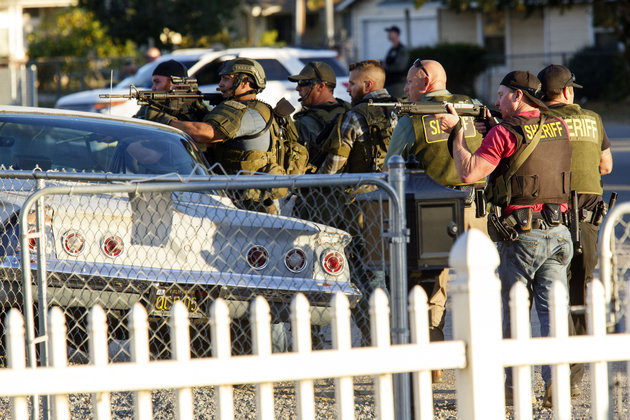
    America’s gun violence shifted Wednesday to San Bernardino, Calif., where at least 14 people were killed and at least 17 wounded.

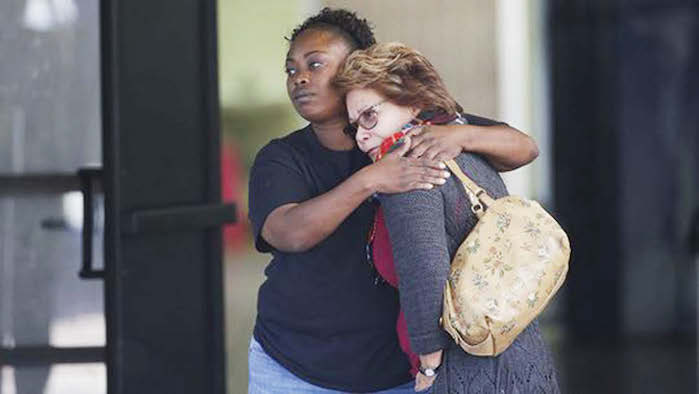
    Amid the chaos were the horrifying and familiar aspects of a mass assault by the latest “active shooter”: bodies on gurneys, innocents weeping under desks at the rattle of gunfire, desperate emails for survival, SWAT teams massed at a war zone of civilian casualties. All the familiar terror was back, as a father received a text from his daughter: “People shot. In the office waiting for cops. Pray for us.”

    There will be post-mortems and an official search for a “motive” for this latest gun atrocity, as if something explicable had happened. The ultimate question grows with each new scene of carnage: Are these atrocities truly beyond the power of government and its politicians to stop? That tragically has been the case as political leaders offer little more than platitudes after each shootout, while the nation is left to numbly anticipate the next killing spree.

    The carnage in San Bernardino happened even as the nation was trying to come to grips with last week’s massacre in Colorado Springs,where three lives were taken and nine people wounded.

    Yet, even as grief fills communities randomly victimized by mass shootings, the sales of weapons grow ever higher. Holiday shoppers set a record for Black Friday gun sales last week. They left the Federal Bureau of Investigation processing 185,345 firearm background checks, the most ever in a single day, topping the Black Friday gun buying binge after the shooting massacre of 26 people at a school in Newtown, Conn., three years ago.

  • SCHOOLS CHANCELLOR FARINA NAMES 15 SCHOOLS MODEL DUAL LANGUAGE PROGRAMS

    SCHOOLS CHANCELLOR FARINA NAMES 15 SCHOOLS MODEL DUAL LANGUAGE PROGRAMS

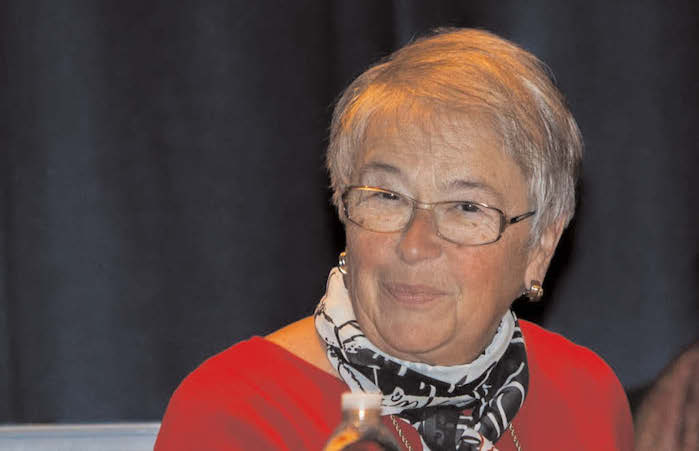
    NEW YORK  (TIP): Schools Chancellor Carmen Fariña announced that 15 schools with existing Dual Language programs will become Model Dual Language Programs for the 2015-16 school year. The schools will receive $10,000 for multilingual instructional materials and staff will have ongoing professional development. This initiative will foster collaborative practices among Dual Language educators, elevate the quality of programs across the City and provide support and guidance to school staff interested in opening programs.

    Each school designated as a Model Dual Language Program will host visits from other school leaders and staff to share best practices and strengthen other schools’ existing or prospective Dual Language programs. The 15 Model Dual Language Programs include elementary, middle and high schools in all five boroughs – four in the Bronx, three in Brooklyn, three in Queens, four in Manhattan, and one on Staten Island. They include Chinese, French, Russian, Hebrew, and Spanish Dual Language programs.

    “When principals and teachers share effective strategies, it’s the students who benefit,” saidSchools Chancellor Carmen Fariña. “Dual Language programs offer academic rigor for students and the opportunity to maintain their native language while learning a new one and learning about diverse cultures. These 15 schools are leaders in Dual Language education and, through collaborative practices, we can ensure a supportive, high-quality multilingual experience for even more students.”

    The Division of English Language Learners and Student Support, a standalone office dedicated to supporting English Language Learners, selected the 15 Model Dual Language Programsbased on their Dual Language education and schoolwide commitment to it, as well as classroom rigor and strong family engagement practices.

    “Our division is committed to expanding Dual Language programs in all five boroughs of New York City public schools,” said Milady Báez, Deputy Chancellor for the Division for English Language Learners and Student Support. “The first cohort selected will serve as models in creating uniformity across the City on the essential components of Dual Language programs. Next year, we will be selecting the second cohort of Model Dual Language Programs. This initiative allows leaders from premier Dual Language programs to share their successful practices and work collaboratively with educators.”

    “As the world becomes more and more global, being able to speak a second language is an asset,” said Tirza Shreiber-Prieto, a parent at PS 166 in Queens. “Dual Language teachers are passionate and committed to the program and my children are receiving top-tier instruction and a multilingual foundation that will last them a lifetime.”

    “Dual Language programs provide educators with innovative ways to strengthen school diversity and meet and expand horizons for both English Language Learners and English-proficient students,” said Council Speaker Melissa Mark-Viverito. “I’m pleased that MS 223 and PS 73 have been selected to host Model Dual Language Programs and look forward to continuing to work with Chancellor Fariña and the Department of Education as we work together to expand this promising new initiative.”

    “The citywide Model Dual Language Program is one more step forward towards better education in The Bronx, and is an important part of the continued push to promoting cultural integration into our society as well as professional development,” said Bronx Borough President Ruben Diaz Jr. “I want to congratulate the leadership of the four schools in The Bronx that were selected as part of the citywide Model Dual Language Program, the principals who helped make this happen, the parents, the students and the New York City Department of Education for their dedication to helping our youth reach their maximum potential.”

    “In a global economy, and in a borough where 47 percent of households speak a language other than English at home, second languages are increasingly becoming a necessity rather than an amenity,” said Brooklyn Borough President Eric L. Adams.
    “Congratulations to the students and staff of Brooklyn’s PS 200, PS 133 and IS 228, as well as all of our schools listed today, for their recognition as being a Model Dual Language Program, and I thank Mayor de Blasio for recognizing these outstanding schools and for working toward a day when this recognition becomes the norm, rather than the exception, in all of our schools.”

    “Robust incorporation of languages in the schools can literally open up new worlds of opportunity to our kids,” said Manhattan Borough President Gale A. Brewer. “I strongly support further expansion of language education in our schools.”

    “We are excited whenever a Staten Island school is recognized for the high caliber and commitment of their leadership, their level of parental involvement, and their student achievement,” said Staten Island Borough President James Oddo. “We are also excited when our schools receive additional funding to implement new programs that will help better educate their students. Congratulations to Principal Petrone and the PS 19 family.”

    “This recognition of the High School for Dual Language and Asian Studies and PS 133 William A. Butler is a testament to how these schools are dedicated to ensuring all students’ educational needs are met,” said Congresswoman Nydia M. Velázquez. “I’m proud that both schools are in my district and commend them for their continued excellence.”

    “As the representative of one of the most ethnically diverse districts in the country, I’m thrilled to see PS 16 and IS 145 selected as part of the City’s Model Dual Language Program,” said Congressman Joe Crowley. “I congratulate the principals, faculty, and parents at these schools for their role in a successful program that not only enriches our students’ education but sets them up for success. I also commend the NYC Department of Education for their commitment in the effort to strengthen these programs throughout the rest of our public schools.”

    “New York City is one of the most culturally diverse places on the planet,” said Council Education Committee Chair Daniel Dromm. “It is important that we equip our students with the language skills they need in order to succeed in school and after graduation. I applaud Chancellor Fariña’s financial support of these exemplary duel language programs. These funds will help develop already existing models and will help establish new programs in other schools interested in opening one. I look forward to continuing to support this worthy initiative as chairperson of the Council’s Education Committee.”

    “It is always great to hear that schools in the district are being distinguished for their work, leadership and innovative teaching,” said State Senator Jose Peralta. “In the 21st century, knowing just one language is not enough and that is why I am pleased that PS 16, The Nancy DeBenedittis School, is leading the way and making our kids bilingual, as well as IS 145, Joseph Pulitzer. Having the ability to fully speak another language is vital to compete in the marketplace, and that is why the Dual Language Programs are crucial for our students’ future. I want to congratulate both schools for their selection as citywide Model Dual Language Programs.”

    “I want to congratulate IS 145 for this outstanding achievement,” said Assemblyman Michael G. DenDekker. “An effort put forth by parents, staff, and most importantly students is exemplified here and their excellence has been rewarded.”

    “As our immigrant population grows, it is critical for our education system to keep pace with the reality of a growing ELL student population,” said Assemblyman Francisco Moya. “Dual Language programs are a critical part of engaging underserved student populations and making sure that all of our students are enriched by our education system. As the Assemblyman who represents the most diverse district in the country, I know how important Dual Language programs are for immigrants and first-generation Americans. I am proud to represent PS 16, The Nancy DeBenedittis School, and commend the principal, educators, parents, and students for setting the standard in high-quality Dual Language public education.”

    “In a City as linguistically diverse as ours, the expansion of foreign language education must be a priority so that students can understand other cultures and compete in a global economy,” saidCity Council Member Margaret Chin. “I am delighted that the High School for Dual Language and Asian Studies in my district has been selected for this important program. I thank Chancellor Fariña for her dedication to dual language instruction and for her selection of this exemplary school as a model for others throughout our City.”

    “New York City is arguably the most culturally diverse city in the United States. This diversity is reflected in the student body of our school system,” said City Council Member Vincent Gentile.

    “The Model Dual Language Program enables ELLs and English-proficient students to become bilingual and bicultural. At an exemplary elementary school in my district, PS 200 The Benson School, students are learning how to read, write, and speak Russian in addition to English. The bilingual and bicultural skills that our students develop as a result of this program undoubtedly strengthen their understanding of different cultures and also plants the seed for future success in the ever-increasingly diverse and competitive professional world.”

    “I am proud to congratulate Principal Sergio Caceres and the students, parents, educators, and staff of PS/IS 218 The Rafael Hernandez Dual Language Magnet School as they receive the Chancellor’s Model Dual Language Program award,” said City Council Member Vanessa Gibson. “Biliteracy is an increasingly important skill and I thank the schools being recognized today for their commitment to the highest caliber of Dual Language education and for ensuring their students develop an invaluable skillset that will serve them in their futures. I commend Schools Chancellor Carmen Fariña and the Department of Education for prioritizing dual language education and am proud a District 16 school is being recognized for their leadership in this field. I thank the DOE for their commitment to creative and innovative educational methods and thank them for taking the time to recognize the excellence of the hard-working educators honored today.”

    “I’m very happy to see Chancellor Fariña recognizing the truly excellent program at PS 133 in today’s celebration of the top Dual Language programs across NYC,” said City Council Member Brad Lander. “We have so many different strengths throughout our school system, and programs that allow our schools to learn from one another and further build out their top programs will help keep all our schools strong citywide. Congratulations to all 15 Model Dual Language Programs recognized today, and especially to the fantastic teachers, staff, parents and students of PS 133.

    “In a City as diverse as New York, it is imperative that our educational system not only provide high-quality Dual Language instruction but that we also support the schools who are doing this work so well. From Washington Heights to Corona Queens, the citywide Model Dual Language Program will come a long way in providing the support schools need to expand upon the quality of their Dual Language programing,” said City Council Member Ydanis Rodriguez. “I congratulate the schools and principals selected for this new initiative and am especially proud of MS 319 Maria Teresa and Principal Ysidro Abreu in my district.”

    “We are in one of the most diverse cities in the world, and our diversity is a social, political, and economic strength,” said City Council Member Mark Treyger. “There is no better place to cultivate and celebrate that diversity than in our public schools. The more we expose our children to multi-lingual diverse languages and cultures, the stronger our City and our future will become. This is a win-win for the children of New York City and for the social, political, and economic future of New York City. I thank the administration, the teachers, and the entire family at Boody Junior High School for their commitment to this wonderful program and the support they have received.”

    List of Model Dual Language Program Schools

    Bronx
    PS/IS 218 Rafael Hernandez Dual Language Magnet School -Spanish
    PS 73 – Spanish
    MS 223 the Laboratory School of Finance and Technology -Spanish
    High School of World Cultures – Spanish

    Brooklyn 

    PS 200 Benson School – Spanish
    PS 133 William A. Butler – Spanish and French
    IS 228 David A. Boody – Russian, Chinese, Hebrew and Spanish

    Manhattan

    PS 161 Pedro Albizu Campos – Spanish
    MS 319 Maria Teresa – Spanish
    Manhattan Bridges High School – Spanish
    High School for Dual Language and Asian Studies – Chinese

    Queens

    PS 16 The Nancy DeBenedittis School – Spanish
    PS 166 Henry Gradstein – Spanish
    IS 145 Joseph Pulitzer – Spanish

    Staten Island

    PS 19 The Curtis School – Spanish

  • San Bernardino shooting: At least 14 killed, 17 injured in California

    San Bernardino shooting: At least 14 killed, 17 injured in California

    SAN BERNARDINO , CA (TIP): Gunmen opened fire on a holiday party on Wednesday, December 2, at a social services agency in San Bernardino, California, killing 14 people and wounding 17 others, then fled the scene, triggering an intense manhunt that ended several hours later in a police firefight that left two suspected shooters dead.

    By the end of the carnage, investigators tallied 14 victims and 21 wounded – considered the worst mass shooting in modern U.S. history since Newtown, Connecticut, in December 2012.

    A Timeline of chaos in San Bernardino, California

    Wednesday, December 2, 11 a.m. PT | Initial 911 calls report shots fired at the InlandRegionalCenter, a state-run facility that serves people with developmental disabilities. Police say the shooting took place during a holiday party and lasted only a few minutes before the suspects fled. They had fired some 75 rifle rounds.

    One of the suspects – later identified as county health inspector Syed Rizwan Farook, 28 – had attended the party that morning, according to reports, but reportedly left after a dispute. Police believe between 10 and 30 minutes went by between Farook’s departure and the suspect’s return to the conference room.

    11:07 a.m. | Firefighters begin arriving at the scene within seven minutes of the first 911 calls.

    11:20 a.m. | Julie Paez, an inspector with the county’s Department of Health attending the holiday party, sends a text to her family, the Los Angeles Times reported: “Love you guys. Was shot,” it read. Paez survived two gunshot wounds and a broken pelvis.

    11:40 a.m. | Police begin reporting multiple victims shot at the scene. Several roads are shut down in the area.

    12:25 p.m. | Police say they are looking for as many as three shooters after sweeping the building and determining the suspects fled. Emergency responders are also seen treating people outside and ambulances rush in and out to take the injured to the hospital.

    12:30 p.m. | President Obama is briefed on the shooting by Homeland Security. “It does appear that there are going to be some casualties, and obviously our hearts go out to the victims and the families,” he later tells CBS News.

    1:05 p.m. | Police confirm at least three people were killed. Reports come out from family members of survivors who say the shooters were wearing “military-style” attire.

    2 p.m. | Police confirm at a news conference that there are 14 dead and 17 wounded. Area buildings are on lockdown as authorities search for the suspects.

    2:30 p.m. | San Bernardino Police Chief Jarrod Burguan declines to say what kind of weapons were used, but that the shooters “were on a mission” and “came in with a purpose.”

    3:05 p.m. | Reports come in of police in pursuit of a black SUV that had fled the scene. A shootout with police ensues a few miles away.

    3:20 p.m. | Police aim guns at a dark-colored SUV with shattered windows on a residential street. A firefight ensues. Nearly two dozen officers fired some 380 rounds at the suspects. The suspects return fire with 76 rounds. Local media reports say a person appears to be on the ground, but it is unclear who they are or what their injuries may be.

    3:30 p.m. | Police confirm shots have been fired and a suspect is down near the SUV. According to reports, a male suspect’s body is on the street, while a female suspect’s body has been pulled from the car. Some 1,600 unused rounds are found on the two suspects, police would later say.

    San Bernardino police Sgt. Vicki Cervantes said one officer suffered non-life-threatening injuries during the shootout.

    5:05 p.m. | Police serve a search warrant on a home in Redlands in connection with the shooting. An Associated Press reporter watched as a half-dozen vehicles carrying helmeted police drove into the area. One officer carrying an assault rifle ordered reporters to clear the area, and an armored vehicle parked outside a row of homes.

    5:50 p.m. | Police say a person was detained who was seen running near the gunbattle, but it was not clear if that person is connected to the shooting.

    7:40 p.m. | A law enforcement official has identified Farook as one of the suspects in a mass shooting in Southern California. Police also confirm that the two suspects – Farook and a woman – were killed in the gunbattle.

    8:55 p.m. | The brother-in-law of Farook says at a news conference that he was stunned to hear of his relative’s alleged involvement in the shooting. Farhan Khan, who is married to the sister of Farook, spoke to reporters at the Anaheim office of the Council on American-Islamic Relations.

    Khan says he last spoke to Farook about a week ago. He added that he had “absolutely no idea why he would do this. I am shocked myself.”

    10:10 p.m. | Police say they believe the man and woman killed in the gunbattle were the only two shooters. Burguan identifies the woman killed as 27-year-old Tashfeen Malik, who is described as Farook’s wife.

    The couple had been living in Redlands with Farook’s mother.

    No motive is known, but terrorism has not been ruled out.

    Thursday, December 3 (Updated till the press time)

    7:35 a.m. PT | Loma Linda University Medical Center CEO Kerry Heinrich says of the five patients being treated at its facility, two remain in critical condition and three are in stable condition.

    8:10 a.m. | Obama says the FBI is leading the investigation, and that it’s still unclear whether the shooting was either terrorism-related or workplace-related.

    He adds that legislators and all Americans have a part to play to make sure that “when individuals want to do harm, we make it a little harder for them to do it.”

    9:30 a.m. | Law enforcement officials tell NBC News that the SUV in which Farook and Malik made their getaway, and in which they were killed in a gunbattle with police, was a rental with Utah plates.

    Officials say Farook rented it “recently,” which they believe was another step in preparation for the attack.

    9:45 a.m. | Police at a news conference say the suspects fired as many as 75 rounds at the InlandRegionalCenter, and then another 76 rounds during the pursuit with police. A remote-controlled car with three pipe bombs was also found at the social services center but it did not detonate, Burguan says.

    Officials add that a second officer was wounded during the police shootout. The overall number of wounded rises to 21 from 17.

    The search of the Redlands home, where the couple’s name was on the lease, also turns up an additional 12 pipe bomb devices and thousands of rounds of ammo, police say.
    “Clearly they were equipped” to launch another attack if they wanted to, Burguan adds.

    The FBI confirms that Farook had rented the SUV – a black Ford Expedition – about three or four days ago, and it was supposed to be returned on the day of the rampage.

    10:15 a.m. | Farook appears to have been radicalized, authorities tell NBC News. The extent of his radicalization wasn’t immediately clear, but he had been in touch with persons of interest in the Los Angeles area who have expressed jihadist-oriented views.

    The Inland Regional Center is one of 21 facilities set up by the state and run under contract by non-profit organizations to serve people with developmental disabilities, said Nancy Lungren, spokeswoman for the California Department of Developmental Services.

    STRING OF SHOOTINGS

    So far in 2015, there have been more than 350 shootings in which four or more people were wounded, according to the crowd-sourced website shootingtracker.com, which keeps a running tally of U.S. gun violence.

    The shooting in California comes less than a week after a gunman killed three people and wounded nine in a shooting rampage at a Planned Parenthood clinic in Colorado Springs, Colorado. In October, a gunman killed nine people at a college in Oregon, and in June, a white gunman killed nine black churchgoers in South Carolina.

    Gun control advocates, including Democratic President Barack Obama, say easy access to firearms is a major factor in the shooting epidemic, while the National Rifle Association and other pro-gun advocates say the Second Amendment of the U.S. Constitution guarantees Americans the right to bear arms.

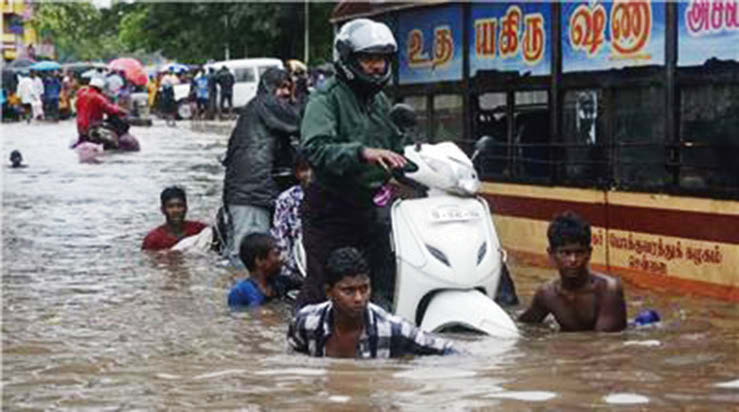
  • Deadly floods bring Chennai to a Standstill

    Deadly floods bring Chennai to a Standstill

    CHENNAI (TIP) While the world is talking about climate change. Delhi is smog laden; Chennai is flooded. Lakshadweep, Andamans, Kolkata, Mumbai may face annihilation, if earth’s temperature keeps rising at the pace it has been since industrial revolution.

    The severe flooding in Chennai again questions India’s preparedness for extreme weather events like rains, droughts and cyclonic storms which are becoming more frequent and intense.

    Flooding in Chennai, the country’s fourth-largest city, has killed more than 40 people in the past 48 hours, authorities said Thursday, December 3, bringing the death toll to 260 since last month.

    A large-scale rescue operation is under way, amid neck-high water in some areas as Chennai continues to bear the brunt of the deluge. Daily downpours threaten to worsen the already severe flooding situation around Chennai, into early next week after the city endured its wettest December day in more than 100 years of record-keeping.

    Rainfall from both a weak tropical low and moisture from the Bay of Bengal will continue put southern India at risk for new and worsening flooding problems into early next week.

    New flooding problems may develop in eastern Tamil Nadu and far southern Kerala with additional rainfall of 100-200 mm (4-8 inches) expected through Sunday.

    Hundreds of soldiers and sailors from India’s armed forces have been deployed to assist in relief efforts after weeks of heavy rains since the start of November.

    Home Minister Rajnath Singh told lawmakers that the government had released 9.4 billion rupees ($141 million) for flood relief and restoration. On his arrival in Chennai Thursday, December 3, evening, PM Modi announced an additional 10 billion rupees for relief operations. “The Government of India stands shoulder to shoulder with the people of Tamil Nadu in this hour of need,” he said.

    In November, PM Modi had said the torrential rains in Chennai were a result of climate change. “We are feeling climate change’s fast-growing impact now,” he said.

    Others blamed rampant construction, including building in areas close to the city’s rivers, for the flooding. “Development in the city has not taken into account that many parts are low-lying,” said Anil Kumar Gupta, head of policy planning at India’s National Institute of Disaster Management.

    Television footage showed residents in the city wading through muddy waters and complaining about the sluggish pace of relief operations.

    Tamil Nadu’s chief minister, J. Jayalalithaa, was quoted as saying in November that “losses are unavoidable when there’s very heavy rain.”

    “Swift rescue and relief alone are indicators of a good government,” NDTV quoted Ms. Jayalalithaa as saying during the first spell of downpours during the monsoon.

    Chennai’s international airport, closed on Wednesday, November 2, because the runway was under seven feet of water, will remain shut until at least midday on Sunday, according to the state-run Airports Authority of India.

    The rains have left more than 30 aircraft stranded at the airport, the Airports Authority of India said in a statement. Almost 300 passengers had been sent by bus to the neighboring city of Bangalore to catch flights from there, but over 2000 more remained stranded at the airport, the AAI said.

    Anurag Gupta, a senior official in the National Disaster Management Authority, said efforts are underway to ferry stranded passengers in helicopters to a naval air station in Arakonnam, about 60 miles away. They are to be flown from there to other cities.

    The inundated airport, lack of mobility owing to poor roads and a breakdown of telecommunication links has severely hampered rescue operations, Mr. Gupta said.

    The National Disaster Response Force has deployed more than 1,000 personnel and 130 boats to Chennai.

    So far, they have evacuated more than 2,000 people. Meanwhile, on Twitter, social-media users were organizing help through hashtags #ChennaiRainsHelp and #ChennaiRains, with users offering food, medicines and tweeting details of shelters where those affected could take refuge.

  • Obama lights national tree, remembers California victims

    Obama lights national tree, remembers California victims

    WASHINGTON (TIP): US President Barack Obama and his family led the lighting of the National Christmas Tree on Thursday, December 3, with charity, thanks, and a moment of reflection for the victims of Wednesday’s shooting.

    “Now, this is, of course, the most wonderful time of the year. But we would be remiss not to take a moment to remember our fellow Americans whose hearts are heavy tonight – who grieve for loved ones, especially in San Bernardino, California,” Obama said in reference to the rampage that left 14 dead and 21 wounded.

    “Their loss is our loss, too, for we’re all one American family. We look out for each other in good times, and in bad. And they should know that all of us care about them this holiday season,” he said.

  • INOC, USA APPLAUDS THE APPOINTMENT OF CAPTAIN AMARINDER SINGH AS PPCC PRESIDENT

    INOC, USA APPLAUDS THE APPOINTMENT OF CAPTAIN AMARINDER SINGH AS PPCC PRESIDENT

    NEWYORK (TIP): At a standing room crowd only gathering at the LibertyPalace in Richmond Hill, New York, hundreds of Congress loyalists cheered and distributed sweets to congratulate Captain Amarinder Singh as the Punjab Pradesh Congress Committee Chief on his appointment by the AICC President, Smt. Sonia Gandhi.

    In a resolution introduced on the floor, the meeting expressed its gratitude to Sonia ji for this bold decision at a critical time for the party in the state and congratulated Captain Amarinder Singh and wished him all the success in the future. Mr. Mohinder Singh Gilzian, President of INOC, USA, in his speech, touched upon the  state of affairs in Punjab with the mismanagement and corruption under the Badal government combined with the divisive politics of its ally BJP that is harming the interest of the common people.

    He cited the media reports saying that ‘Punjab continues to be on edge, and the outlook remains grim. The increasing grip of the Badal family over issues concerning Sikhs, both political and religious, coupled with incidents of sacrilege of the holy book, the Guru Granth Sahib, and multiple sets of problems faced by farmers, are reinforcing the impression of a State administration at a loss for initiatives to regain equilibrium. The State is already in the grip of drug abuse, falling agricultural output and farm debts. It has faced a farmers’ agitation for over two months now. The resentment in the cotton and rice belt reached such proportions that officials were scared to venture into the villages. In addition, dissidents are threatened to a point where the freedom of expression is at risk’.

    The meeting also celebrated the Constitution of India that provided stability and prosperity to the nation and saluted its architects Pandit Jawaharlal Nehru and B.R. Ambedkar. Meeting also expressed concerns about the growing intolerance in India and requested the Modi Government to uphold the constitution and respect the legacy of great leaders that paved the way for a democratic and secular nation. George Abraham, Chairman, in his speech, paid special tribute to Nehru for his great contribution in building strong institutions that have served the country well in the last six decades.

    Mr. Harbachan Singh, Secretary-General in his speech alluded to the Bihar election results and congratulated the State for its victory and pointed out that the Indian voter has already begun to draw his/her conclusions of the recent 18-month
    performance/experience with the Modi Government. ‘Captain Amarinder Singh’s appointment has rejuvenated the hopes and interests of Congress supporters and reinforced their determination to correct the mistakes of the past’ he further added.

    Mr. T.J. Gill, President of Punjab Chapter exhorted the participants to be more active in supporting good governance in the State and promised to do his very best in conveying the NRI sentiment to the Captain and the new leadership in that regard.

    Mr. Karamjit Dhaliwal, Vice-President Spoke about the need for the Congress cadre in Punjab to come together in unity as it will be facing the election in the near future.

    Among those who addressed the audience included Bawa Rajender Singh Lally, Babu Joginder Singh Miani, Mr. Satish Sharma, Mr. Sarmukh Singh, Mr. Sarbjit Singh Advocate, Mr. Rajesh Allahdad, Mr. Jaswinder Singh Bittoo, Mr. Jagjit Singh, Manmohan Singh Miani and Mr. Gurmit Singh. Mr. Jasvir Singh Nawanshahr expressed vote of thanks.