Year: 2015

  • Energy from rivers to heat UK homes

    Energy from rivers to heat UK homes

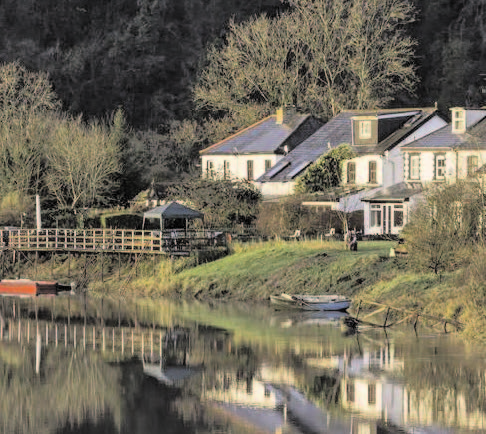
    More than one million homes across Britain could be heated using green Scandinavian-style technology that takes heat from nearby rivers and canals and pumps it into the home, the government will announce soon.

    The energy secretary Ed Davey is to leading a new drive to promote water-source heat pumps – carbon-free devices that extract thermal energy from waterways to heat water for radiators and showers. He has identified more than 4,041 rivers, estuaries, coastal sites and canals containing water warm and accessible enough to heat homes.

    More than one million homes are close enough to water to make use of the devices – with hotspots including buildings around the River Ouse in Selby, the River Trent in Nottingham and the Thames in London.

    Installing a water source heat pump reduces the need for dirty gas-fired domestic heating, and could allow the average household to reduce its carbon footprint by as much as 50%.

    The energy produced is both clean and renewable, and households could knock as much as 20% off their heating bills, Davey says. “We need to make the most of the vast amount of clean, renewable heat that lays dormant and unused in our rivers, lakes and seas,” Davey is likely to say when he launches the drive into the technology at Battersea Power Station. “Water source heat pumps will help contribute to an energy mix that maximizes clean, reliable home-grown resources rather than relying on foreign fossil fuels. It also provides a system that bolsters growth in our local economies, protects the natural environment and creates resilient communities that are capable of producing sustainable power systems.”

    Battersea hopes to install a series of water pump that could heat around 4,000 new homes, shops, offices and public amenities being built as part of the site’s redevelopment. It is working on a feasibility study for the project with SSE, one of the big six energy providers.

    Water-source pumps date back to the 19th century and are popular in Scandinavia where they are mainly used to heat individual homes.

    However, they are far less common in the UK and have been rarely used for the kind of larger scale community projects the government hopes will become common, alongside those used by individual houses.

  • RESCUE PLAN FOR SAHARA THROWN IN DOUBT AS SPANISH BANK DENIES LOAN

    RESCUE PLAN FOR SAHARA THROWN IN DOUBT AS SPANISH BANK DENIES LOAN

    MADRID/MUMBAI (TIP): A rescue plan for Sahara was thrown into disarray on Wednesday, when Spanish bank BBVA  SA denied offering a credit line to the bank, scuppering the conglomerate’s claims it would use it to help secure bail for its jailed boss.

    Sahara, once one of India’s most high-profile firms, told the Supreme Court this week that it had secured a 900 million euro ($985 million) line of credit from BBVA, one of several financial deals it said it had struck.

    The court allowed Sahara three more months to raise bail.

    Sahara’s extravagant founder and boss Subrata Roy has been held in jail for more than a year, after Sahara failed to comply with a court order to refund billions of dollars to investors in a bond programme that was ruled illegal.

    Sahara has made several failed attempts to raise the bail money.

    The court has set Roy’s bail at $1.6 billion, a product of the cost of the bond programme, estimated by regulators to be as much as $7 billion. Sahara has said it has paid most of the dues to the bondholders, but the Securities and Exchange Board of India disputes that.

    A senior executive at BBVA separately said on condition of anonymity that the bank was never in talks with Sahara for a loan and that the mention of its name in the court proceedings was a “surprise”.

    Sahara had on Monday submitted a letter in the court written on BBVA notepaper and signed by bank executive Jose Ramon Vizmanos, taking responsibility for the credit it was giving Sahara.

    “I have never worked with any Indian company … The only thing I know about Sahara is the desert in Africa,” Vizmanos said by phone.

    Loan default

    Sahara had told the court it planned to use the loan from BBVA to replace a loan from Bank of China tied to its three overseas hotels, which include New York’s Plaza hotel and Grosvenor House in London.

    Sahara has a debt of $852 million from the Chinese bank, the company lawyer told the court. Earlier this month, Grosvenor House was put up for sale, after Bank of China’s loan, partly backed by the hotel, was declared in default.

    Sahara, a conglomerate whose assets range from Formula One to property and TV, has been trying to raise bail using its properties including Aamby Valley township outside Mumbai, which has luxury villas and a golf course.

    The company’s talks with US-based Mirach Capital Group to raise $2 billion collapsed last month after Reuters reported that a bank letter underpinning the proposed deal was forged.

    The Supreme Court has said it could ask a receiver to auction Sahara’s assets if it failed to raise bail.

    Roy, the company’s founder, styles himself “managing worker” and guardian of the world’s largest family. Several employees said operations across the group had been hit over the past year without him.

    He built the group from a standing start with just 2,000 rupees and a Lambretta scooter in the late 1970s, but later could draw the country’s prime minister, state chief ministers, actors and cricketers to his extravagant parties.

    Roy is not only the face of the conglomerate, but also single-handedly controls an operation spread across dozens of tiny subsidiaries in India, Mauritius and Britain, several employees said.

  • MUTUAL FUNDS APPROACH SEBI WITH 50 NFO PROPOSALS

    NEW DELHI (TIP): Aiming to tap into the upbeat investor sentiment, mutual fund houses have filed draft papers with market regulator Sebi to launch over 50 New Fund Offers.

    Since the beginning of the year, draft documents for 53 NFOs have been submitted with the Securities and Exchange Board of India (Sebi).

    Of these, 21 draft offers have been filed so far this month, while 19 papers submitted in February and the other 13 were filed in January.

    Some of the NFOs have already been launched after getting regulatory clearances.

    ICICI Prudential MF, IDBI MF, SBI MF, Edelweiss MF and HSBC MF are among the fund houses that are offering NFOs to investors.

    A large number of these schemes are aimed at investment in equity and equity-related securities. Besides, they are offering schemes like ‘Fixed Maturity Plan’.

    Manufacturing, retirement, economic recovery, resurgence of the business cycle and e-commerce are some of the themes that are attracting mutual fund houses.

    A number of fund houses are expected to come up with more schemes that will invest in equity and equity-related securities to take benefit from the rising stock markets.

    According to market participants, MF houses are rushing to Sebi to launch new schemes on account of good response received from investors in the recent fund launches.

    Besides, they said the NFO market has picked up as investors’ confidence about equity markets is back and participation from retail investors is also on the upswing.

    According to an estimate, mutual fund sector had launched 75 NFOs in the equity segment during the calendar year 2014.

  • SBI to dilute stake in its general insurance venture to 49%

    NEW DELHI (TIP): State Bank of India  (SBI) on Thursday said it will dilute its stake in its general insurance venture SBI General to 49 percent in favour of its foreign partner, with the enactment of insurance legislation.

    SBI General is a 74:26 joint venture between SBI and Insurance Australia Group (IAG) of Australia.

    The Executive Committee of the Central Board (ECCB) “has on March 25, 2015 decided to initiate the necessary action as per JV agreement for dilution of SBI’s stake in SBI General Insurance from 76 percent to 51 percent…

    “…with corresponding increase of stake of IAG from 26 percent to 49 percent, including appointment of a valuer to facilitate valuation and price discover,” the country’s largest bank said in a statement.

    Earlier this month, Parliament had passed the Insurance Laws (Amendment) Bill, 2015 which seeks to increase foreign investment in private sector companies to 49 percent from existing 26 percent, among other things. The proposal to increase stake comes in the backdrop of capital requirement of the company.

    “There will be a substantial capital requirement by next fiscal,” SBI General insurance deputy CEO Steve Hollow had said.

    The company pegs a total premium of Rs 1,600 crore by March 2015 as compared to Rs 1,200 crore premium registered last year.

  • INDIA TO BOOST LNG IMPORTS TO RAISE POWER GENERATION

    NEW DELHI (TIP): The government said  would boost imports of liquefied natural gas (LNG) to improve electricity generation and revive plants worth billions of dollars to fuel economic expansion.

    India’s plan to import LNG will boost power supply by 79 billion units valued at about 420 billion rupees and could spur spot prices of the super cooled gas trading at about $7.60 per million British thermal units in Asia.

    Nearly a quarter of a century after India embraced economic liberalisation, many businesses still rely on costly back-up generators for round-the-clock power and a third of its 1.2 billion people are still not connected to the grid.

    Prime Minister Narendra Modi, elected in May, has made a commitment to bring order to the chaotic power sector and end the chronic blackouts that impede India’s economic rise.

    The government has charged GAIL (India) Ltd to import LNG for power plants outside Gujarat, where a local state company will import the fuel to revive power plants and improve generation, power minister Piyush Goyal said after a meeting of the union cabinet.

    During the rainy season lasting five months when power demand is less, India would daily import about 10 million cubic meters of gas and this would rise by 80 percent in the remaining seven months, Goyal said.

    To make imported gas affordable to consumers, the union and state government will give tax concessions while the importers will charge less for regassification, transportation and marketing.

    India has about 24,150 megawatt gas-grid linked generation capacity representing about 1 trillion rupees investment. Of this 60 percent is at the threshold of becoming toxic asset while the rest is operating at below capacity due to falling local gas output.

    “Revival of stranded gas based capacity would ameliorate stress on the banking sector. This will kick-start growth and have a multiplier effect on the economy,” a government statement said. It would also restore investors’ confidence in the power sector, it added.

  • Challenges to Conservation of Ganga

    Challenges to Conservation of Ganga

    Prime Minister Narendra Modi has made clear his commitment to clear up the Ganga River. This is a most welcome step since Ganga is Holy to People world over. Ashes of many American Indians are taken to Hardwar to be immersed in the Holy River at Hardwar. PIOs world over have offered help to the Government of India in cleaning up the river.

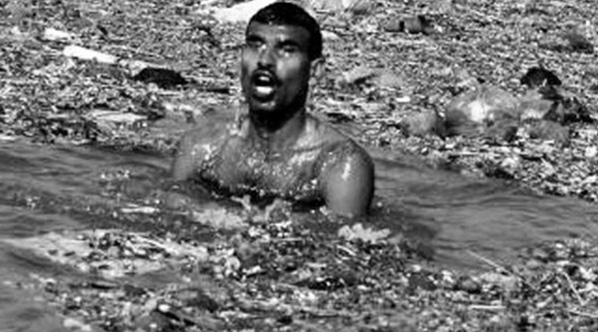
    The Ganga suffers from two problems-pollution and obstructions to free flow. Pollution, in turn, comes from two sources-municipalities and industries.

    Large amounts of monies have been spent in building Sewage Treatment Plants (STP) in cities along the Ganga. However, the Municipalities have no incentive to run these plants. They would rather spend their limited resources in providing pressing civic services like street lighting and road repairs. The Municipalities, however, are mighty happy to construct more STPs since that provides opportunities for leakages and corruption.

    The problem cannot be solved by yet more funding on non-working STPs. The way out is to make sewage treatment a profitable activity. Municipalities in Mumbai and Nagpur are selling sewage to industrial units who find it cheaper to use treated sewage water instead if buying fresh water. This model has to be applied across the board. The Government must invite private entrepreneurs to set up the STPs and make arrangements to buy the treated sewage water which can then be supplied for irrigation. This will make it profitable for businesses to treat sewage. This treatment will no longer be a “liability” for the Municipalities. This change of gears will require building a new system of canals to reach treated water to the farmer’s field. The supply of this water to farmers would also reduce their need for drawing fresh water from the Ganga and lead to increase in flows in the Holy River. The Modi Government has opened the purse strings and is providing large amounts of monies for STPs. Though good intentioned, it is still pursuing the “build STP” model that is destined to fail.

    The other source of pollution is from the industries located in the Ganga Basin. The consortium of seven Indian Institutes of Technologies is making a Ganga River Basin Management Plan under directions of the Government. They have suggested that all industries be required to adopt “Zero Liquid Discharge.” Industries should be required to treat and reuse the effluent continuously so that nothing is discharged. Industries are willing to adopt this. Their problem is that the additional cost would price them out of the market vis-à-vis industries located outside the Ganga Basin that are allowed to discharge effluent. The problem cannot be solved by imposing punitive measures on industries in the Ganga Basin. Per force, industries in the Ganga Basin will have to close down. The way out is to make a national legislation requiring Zero Liquid Discharge by all industries irrespective of their location. Let us not forget that the Krishna, Cauvery and Mahanadi also need to be conserved. It is to the credit of Modi Government that Water Resources Minister Uma Bharati has put the industries on notice to control effluent discharges. This is a step forward. But it is still following the punitive model instead of solving the underlying economic problem.

    The second dimension of conservation of Ganga is to ensure free flow in the river. Flow of the Ganga is presently obstructed by hydropower projects like Tehri, Vishnu Prayag and Srinagar; irrigation barrages at Hardwar, Bijnor, Narora and Kanpur; and the Farakka Barrage made in West Bengal to divert water to the Hooghly to enable ships to reach the Kolkata Port. Hindu scriptures clearly state that only flowing water is Holy. These projects obstruct the flow and damage the spiritual energy that the Ganga brings from the Holy Shrines of Gangotri, Kedarnath and Badrinath. Japanese researcher Masaru Emoto has taken photographs of water crystals made from different waters and found that crystals made from flowing rivers are of beautiful shape while those made from stagnant waters are not so.

    Abstraction of water for hydropower, irrigation or navigation requires building a barrage that obstructs free flow and damages the spiritual quality of the water. But we cannot stop abstraction either. The way forward is to abstract water by making a partial obstruction on the riverbed so that, say, one half of the water flows freely while other half is abstracted for various purposes. Unfortunately Modi Government is bent upon making yet more obstructions to the free flow of the Ganga. The Ministry of Shipping has come up with a plan to develop the Ganga as a waterway from Haldia to Allahabad so that imported coals can be carried to the thermal power plants top be made along the banks of the Ganga. This will entail building three or more barrages between Allahabad and Buxar. The Uttar Pradesh Government is increasing the size of Narora canal so that more water can be abstracted for irrigation. The Government-owned Tehri Hydro Development Corporation has only recently started construction of the Vishnugad-Pipalkoti hydropower project that will create one more obstruction to the free flow of the Ganga. It must be mentioned here though that the Government has recently stated in the Supreme Court that it wants to ensure free flow in the Ganga but the measures it proposes to take are still unclear. Challenge before the PIOs is to make proposals to the Government of India and lead the Government in the right directions.

  • Jeremy Clarkson, Top Gear host, sacked by BBC

    Jeremy Clarkson, Top Gear host, sacked by BBC

    LONDON (TIP): The BBC has dropped one of its most popular presenters, “Top Gear” host Jeremy Clarkson, two weeks after he was suspended over an altercation with a producer, reports said on March 25.

    The controversial star of the motoring show, which draws more than 350 million viewers around the world, will not have his contract renewed when it expires at the end of the month, The Guardian newspaper reported.

    Sky News also said that Clarkson had been sacked, while The Daily Telegraph newspaper reported that he was expected to be let go on March 25.

    The BBC said Clarkson was suspended after a “fracas”, reported to be a verbal and physical assault on show producer Oisin Tymon after the star failed to receive a hot meal after a day’s filming.

    The suspension sparked nationwide debate, with Prime Minister David Cameron among those weighing in on Clarkson’s side and more than one million signing an online petition calling for him to be reinstated.

    According to the Telegraph, an internal investigation found that Clarkson verbally abused Tymon for 20 minutes, before launching a 30-second physical assault on him.

    “There can’t be one rule for talent and one rule for ordinary human beings,” a source told The Guardian.

    A BBC spokesman told AFP: “We’ve got nothing further to add on this. We’ll let people know when we have something to announce.”

    Any decision to drop Clarkson could have major financial ramifications for the BBC.”Top Gear” earns around £50 million ($75 million, 70 million euros) each year for the broadcaster’s commercial arm, BBC Worldwide.

    But Clarkson was already on his last warning from the BBC, for whom he has worked since 1988, after drawing fire over a string of inflammatory remarks.

    Most damaging for Clarkson have been accusations of using the N-word while reciting an old nursery rhyme in leaked footage, something the presenter denied.

    He was also accused of making a racially offensive comment about an Asian man.

    “Top Gear” has regularly been criticized over its depiction and jokes at the expense of Albanians, Romanians and Germans among others.

    Last year, the team fled Argentina after residents hurled stones at a Porsche Clarkson was driving whose licence plates appeared to make reference the Falklands War.

    The BBC was also forced to apologized to Mexico after the show described Mexicans as “lazy” and “feckless”.

  • Co-pilot who crashed jet was ‘very happy’ with Germanwings job

    Co-pilot who crashed jet was ‘very happy’ with Germanwings job

    MONTABAUR,GERMANY (TIP): Andreas Lubitz never appeared anything but thrilled to have landed a pilot’s job with Germanwings, according to those who helped him learn to fly as a teenager in this town in the forested hills of western Germany.

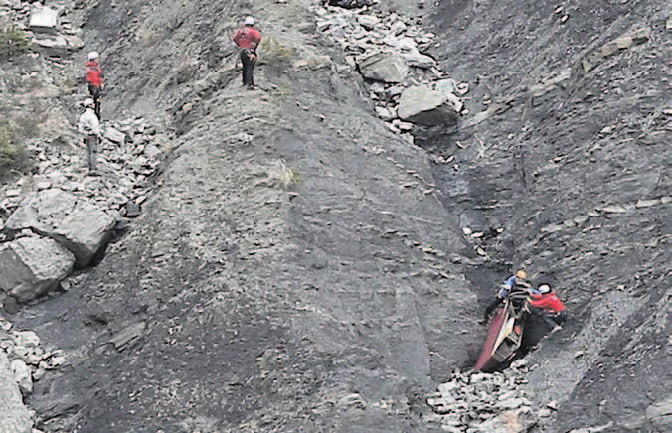
    On March 26, French prosecutors said Lubitz, the co-pilot of Germanwings Flight 9525, “intentionally” crashed the jet into the side of a mountain Tuesday in the French Alps.

    Members of his hometown flight club in Montabaur, where he renewed his glider license last fall, told The Associated Press that the 27-year-old Lubitz appeared to be happy with the job he had at the airline, a low-cost carrier in the Lufthansa Group.

    After starting as a co-pilot with Germanwings in September 2013, Lubitz was upbeat when he returned to the LSC Westerwald e.V glider club to update his glider pilots’ license with about 20 takeoffs.

    “He was happy he had the job with Germanwings and he was doing well,” said longtime club member Peter Ruecker, who watched Lubitz learn to fly. “He was very happy. He gave off a good feeling.” 

    Club chairman Klaus Radke said he rejects the Marseille prosecutors’ conclusion that Lubitz deliberately put the Germanwings flight into a descent and dove it straight into the French Alps after the pilot had briefly left the cockpit.

    “I don’t see how anyone can draw such conclusions before the investigation is completed,” he told the mediapersons.

    At the house of Lubitz’s parents, the curtains were drawn and four police cars were parked outside. Police blocked the media from the single-family, two-story home in a prosperous new subdivision on the edge of Montabaur, a town 60 kilometers (nearly 40 miles) northwest of Frankfurt.

    A team of investigators entered the home and, on Thursday evening, people could be seen emerging with blue bags, a big cardboard box and what looked like a large computer. Another person who came out was shielded from reporters with a coat by police.

    Investigators also searched the apartment that Lubitz kept in Duesseldorf in an upscale three-story building in an affluent neighborhood.

  • France launches first bombing strike against IS in Tikrit

    PARIS (TIP): France has bombed Islamic State positions in the Tikrit area of Iraq for the first time since the start of the international offensive against the jihadist militia, French military officials said on March 26.

    “Last night we struck the region of Tikrit as part of the coalition” aiding the Iraqi army battle IS fighters, a spokesman for France’s armed forces said, noting it was the first time a French strike had targeted that area of northern Iraq.

    US official did not specify whether jets or drones staged the strikes, and declined to detail targets of the attack.

    US forces earlier announced they had led an air strike against IS units in Tikrit with coalition allies at the request of Iraqi Prime Minister Haider al-Abadi.

    Despite receiving military advice and aid from Iran’s military, the Iraqi army has struggled to recapture Tikrit –hometown of ex-dictator Saddam Hussein — since its offensive began on March 2.

    Thousands of Iraqi soldiers, police officers and paramilitary forces have been deployed to retake Tikrit, which is being ferociously defended by a large number of IS fighters who have booby-trapped streets and buildings in the city with bombs.

  • Miss Universe Japan Ariana Miyamoto faces criticism for being ‘not Japanese enough’

    NAGASAKI (TIP): She was born and raised in Nagasaki, speaks Japanese as her first language and has a Japanese mother – but Miss Universe contestant Ariana Miyamoto is facing criticism from those who say she is not “Japanese enough”.

    The 20-year-old model became the first ever mixed-race beauty pageant winner when she was crown Miss Nagazaki earlier this year, success which has not come without challenges in one of the least racially diverse countries in the world.

    Ms Miyamoto grew up in the city of Sasebo near a major US naval base, and her father is an African-American man from Arkansas. She also travelled to the US to go to high school – and some in Japan think all that makes her unfit to represent the nation of her birth.

    At 6ft tall in heels, Ms Miyamoto told CNN’s Will Ripley she had always stood out in Japan and that when she was young she was bullied for being different. “In school people used to throw rubbish at me,” she said. “They also used racial slurs.” 

    In Japan, mixed-race people are known as “hafu”, and after Ms Miyamoto was selected as Miss Universe Japan last week social media users have been asking if it is “ok to choose a hafu to represent Japan?” Miss Universe 2015: National Costumes 

    According to a translation by the Washington Post, one posted a picture with the caption: “The contradiction that is having a haafu Miss Universe Japan.” 

    Another said: “Even though she’s Miss Universe Japan, her face is foreign no matter how you look at it!” 

    And a third user tweeted: “Beauty contest. Miss Universe Japan is….wha? What kind of person? She’s ….not…..Japanese…right?” The view on the ground in Tokyo was similar. Shown a picture of Ms Miyamoto and asked if she could be the country’s Miss Universe contestant, a middle-aged resident named Ishiko Komagawa said: “No, she doesn’t even look Japanese.” 

    But that view spans generations – high school student Tomoki Nogami said Ms Miyamoto should not be accepted because “half is not 100 per cent Japanese”. “If someone is chosen as Miss Japan both her parents should be Japanese,” he said.

    The website Kotaku hailed Ms Miyamoto’s selection as a sign that change was occurring in Japan – if “slowly”. It noted that “many of the highest-rated comments” about Miyamoto on the Japanese site GirlsChannel “said that they wanted a more ‘Japanese’ contestant to represent Japan”.

  • Soon, you could drive from Europe to US

    WASHINGTON (TIP): Plans for a new high-speed transport corridor that could potentially link London and New York by rail and superhighway have been unveiled. The idea, dubbed the Trans-Eurasian Belt Development (TERP), would see a high-speed railway and motorway built from Eastern Europe, across Siberia and over the Bering Strait to Alaska. Vladimir Yakunin, the head of Russia’s state railways, told a meeting of the Russian Academy of Sciences that the project could link existing networks and supercharge global economic growth. It would also feature oil and gas pipelines to connect Russia’s petro-industries more directly to the rest of the world. “This is an inter-state, inter-civilization, project. It should be an alternative to the current model, which has caused a systemic crisis. The project should be turned into a world ‘future zone’, and it must be based on leading, not catching, technologies,” he said, according to the Siberian Times newspaper. The plan was developed by the transport boss alongside the rector of Moscow State University, Viktor Sadovnichy and academic Gennady Osipov.

    Alaska is already connected to the US by superhighway through Canada, along the Alaksa Highway — though there is no passenger rail network. The highway links to US interstate network which can take motorists to all corners of the US and beyond.

    In eastern Europe the EU is drawing up plans for a high-speed rail corridor to connect the Baltic states to western Europe’s rail network — which runs through the Channel Tunnel to London. North American passenger rail are comparatively undeveloped. Plans drawn up by President Obama to develop high- speed rail corridors across the US .

  • Supreme Court allows govt to finalise spectrum auction

    NEW DELHI (TIP): The Supreme Court on March 26 allowed the Centre to finalise its just-concluded “fiercest and competitive” auction for telecom spectrum, fetching a whopping revenue of Rs 1.09 lakh crore.

    The court, however, said the finalisation of the auction was subject to the outcome of matters pending before it, in which the legality of the “design of the notice inviting tender (NIT)” for the spectrum has been challenged by major telecom players, including Bharti Hexacom Ltd and Reliance Telecom Ltd.

    A bench of Justices Dipak Misra and Prafulla C Pant observed, “We cannot block so much of money” and modified its February 26 order. The court had then allowed the auction, that began from March 4, with the condition that it would not be finalised without permission.

    The apex court on February 26 had allowed the government to go ahead with the auction of spectrum of bands 900, 1800 and 2100 Mhz for all states, which according to Attorney General Mukul Rohatgi witnessed a
    “fiercest” auction fetching a revenue of Rs 1.09 lakh crore.

    Rohatgi said if the stay order was not modified, the Centre would face difficulties in collecting earnest money of Rs 28,000 crore by March 31 emerging from the auction, in which the successful bidders have to deposit the amount within 10 days.

  • India 37th among 102 in govt tansparency index

    MUMBAI (TIP): India ranks 37 out of 102 countries on the Open Government Index 2015, which ranks countries on how transparent their governments are and the ease with which citizens can hold their government accountable.

    The report, released on March 26  by Washington-based World Justice Project, is a perception survey on a random sample in three cities in each country, and has also interviewed experts in the field of transparency.

    Those that topped the list were high income countries such as Sweden, New Zealand, Norway, Denmark and Netherlands. “Richer countries rank higher as they have more resources and more people connected to the internet. But on removing high-income countries from the list, the correlation between a country’s per capita gross domestic product and its rank on the Open Government Index disappears,” says Juan Carlos Botero, one of the authors of the report, said.

    This is evident when one compares India with China. While China is on the list of upper middle income countries and India is on the list of lower middle income countries, India outperforms China by 50 ranks when it comes to transparency in governance, with China ranking 87 on the list.

    Incidentally, US ranked 11 on the index, despite it facing heat over spying on its citizens. “In other studies, such as the Rule of Law Index, the US does not fare well on privacy,” says Botero.

    Of the four parameters used to rank countries, India ranked 27 for publicized laws and government data. But it ranked 66 on Right to Information index. In India, the survey was carried out in Mumbai, Delhi and Bangalore, and only 1% of those studied had requested information under the Act. Botero points out that there is no correlation between a country having a RTI law and implementing it. “Countries, like Germany, do not have a freedom of information law, but score well on open governance. India, on the other hand, has a strong transparency law. It now needs to implement it,” he adds. The study showed that worldwide 40% of those surveyed were aware of laws supporting their right to access government data.

  • Section 66A quashed: Citizens can still be arrested for online posts

    NEW DELHI (TIP): The Supreme Court’s decision to strike down Section 66A of I-T Act may infuse social network site addicts with a sense of unrestricted freedom of expression, but it is a deja vu situation for them as indiscrete postings in social network sites could still invite arrest under similar provisions of Indian Penal Code.

    In most of the cases slapped against persons for posting offensive views on social network sites, the police had invariably invoked Sections 153 and 505 of the IPC along with Section 66A of I-T Act, which is a bailable offence. It is the invoking of additional IPC sections which had allowed the police to arrest the persons for offensive posts.

    Section 153 and 153A provides for registration of a case against a person who gives a statement either in writing or orally that incites communal riots or provokes communal tension and enmity between communities. IT is punishable with imprisonment from 6 months to one year with fine. Section 505 punishes persons who spread rumour through their statement to cause public disorder with an imprisonment up to 3 years.

    Section 66A was not part of the original I-T Act enacted during NDA government in 2000. The UPA government had amended the Act in 2009 and brought Section 66A into force October 27, 2009. At that time Veerappa Moily was the law minister and A Raja was the minister for information technology. Kapil Sibal succeeded Raja as I-T minister.

    After the uproar over the arrest of two girls in Palghar, Sibal had issued an advisory to all state governments that no arrest under Section 66A could be made by police unless the concerned Superintendent of Police issued an order in writing.

    Moily said: “I welcome the Supreme Court judgment. It empowers the people to have freedom of expression.” He refused to be drawn into any blame game over enacting of Section 66A. He said law should be dynamic and evolve with time to meet exigencies peculiar to a particular time. “Now the Supreme Court declared law is the law of the land,” he said.

    Sibal too welcomed the apex court judgment. However, he sounded a caution. “Section 66A is not the culprit as it is a bailable offence. The police used to invoke provisions of Indian Penal Code to effect the arrests. So, one should be well advised to still exercise restraint while exercising free speech on social network sites,” he said.

  • BEANT SINGH KILLERS’ ESCAPE

    NEW DELHI (TIP): Ten years after three dreaded Khalistani terrorists allegedly involved in the assassination of former Punjab chief minister Beant Singh escaped from Chandigarh jail, the Supreme Court on Thursday held four top jail officials guilty of negligence in conducting their duty and approved government’s decision to sack them.

    Jagtar Singh Hawara, Paramjit Singh and Jagtar Singh Tara who were facing trial for the assassination of Beant Singh had escaped along with another inmate Jagdev Singh from Model Jail, Burail, Chandigarh during the intervening night of January 21-22, 2004 by digging an underground tunnel of 94 feet long.

    A bench of Justices J S Khehar and S A Bobde after going through all the records came to conclusion that there was lapses on the part of jail officials and upheld government’s decision to dismiss jail superintendent Ved Mitter Gill, deputy jail superintendent, assistant jail superintendent and head warder.

    “In our considered view, within the jail premises, only the jail staff can be permitted to function. And in case of lapses within the jail premises, it is the jail staff alone which is responsible,” the bench said 

    “Had they performed their duties diligently, there could not have been any possibility, of the escape under reference. It cannot be overlooked, that the escape was made good, by digging the escape tunnel, which measured ninety four feet in length (with diagonal dimensions of 21″ x 21″),” it said.

    The bench turned down the plea that there was no negligence on their part and the prisoners managed to escape because the police personnel, posted outside jail, were not vigilant. It said that police personnel cannot be blamed for the escape as they would be oblivious of the activities within the four walls of the jail itself.

    “The determination by the competent authority, when viewed dispassionately with reference to the duties assigned to Gill, leaves no room for any doubt, that the competent authority was justified in concluding, that the four prisoners could never have escaped, if he and and the petitioners, had diligently discharged the duties assigned to them,” it said.

  • COURT DISMISSES PLEAS OF COMPANIES INVOLVED IN 2G MONEY TRAIL

    NEW DELHI (TIP): A Special CBI court on March 26 dismissed pleas by four firms to acquit them in the money laundering case related to the 2G spectrum scam.

    DB Realty, Nihar Construction Private Limited, Eversmile Construction Company Private Limited and Conwood Construction and Developers Pvt Ltd had filed petitions earlier this month seeking acquittal from the case claiming that the Enforcement Directory (ED) did not come up with evidences against them. However, after hearing the arguments from prosecution and defence, the court said there are adequate materials on record against the companies for the trial to continue.

    The four companies, along with former Telecom Minister A Raja, DMK Rajya Sabha MP Kanimozhi and 13 others have been accused of colluding with each other in parking Rs 200 crore bribe money in Kalaignar TV for grant of spectrum licenses to DB Group Companies.

    Raja illegally favoured Swan Telecom Pvt Ltd (now Etisalat DB Telecom Pvt Ltd) while granting unified access licence and took “extra effort” to get the licenses cleared for Kalaignar TV (P) Limited where Rs 200 crore bribe money was parked through a series of transactions emanating from a company owned by one of the accused Shahid Balwa, ED joint director Himanshu Kumar Lal recently deposed in the court.

    Explaining the money trail, the prosecution witness also told the Court that Dynamix Realty, owned and managed by Balwa and Goenka, transferred Rs 209.25 crore to Kusegaon Fruits and Vegetables (P) Ltd, promoted by Shahid Balwa’s brother Asif Balwa and director.

    The Kusegaon Fruits and Vegetables (P) Ltd then transferred Rs 206.25 crore to accused Karim Morani’s Cineyug Films (P) Ltd. The production company then transferred Rs 200 crore to Kalaignar TV (P) Ltd. However, arguing for their acquittal earlier this month, council for DB Realty, Nihar Construction Pvt Ltd, Eversmile Construction Company Pvt Lt and Conwood Construction and Developers Pvt Ltd Vijay Agrawal contended that there was no evidence indicating the firms’ involvement in the transaction of money.

  • ‘GOOD’ BACTERIA MAY HELP PREVENT MENINGITIS

    LONDON (TIP): Researchers have found that nasal drops of a “good” bacterial strain can help prevent the deadly disease meningitis. The findings could lead to a new approach that could help suppress meningitis outbreaks.

    “It is the first time that anyone has taken a bug — a friendly bacterium — and has shown that it changes the way that you can become colonised by the meningitis bacterium, Neisseria meningitidis,” said study author Robert Read from University of Southampton.

    Meningitis can be life threatening and the first symptoms of the disease are usually fever, vomiting, headache and feeling unwell.

    In the study, published online in the journal Clinical Infectious Diseases, researchers placed drops containing low doses of Neisseria lactamica, a related but harmless bacterial strain, into the noses of 149 healthy university students in Britain.

    A control group of 161 students received drops of saline instead. Nose swabs were taken at regular intervals over six months and tested for both types of bacteria.

    Among students who received the N lactamica drops and became colonised, the harmless bacteria appeared to prevent N meningitidis from colonising the students’ throats.

    The “good” bacteria also displaced the worrisome pathogen in those who were already carrying it when the study began.

    The effect was seen after just two weeks, when the number of students carrying N. meningitidis in their upper airway dropped by 9.5 percent among those who were also colonised by N lactamica using the drops. The effect lasted for at least four months, the researchers noted.

    The findings suggest that N lactamica may one day be used as a bacterial medicine to help suppress meningococcal outbreaks.

  • NEW EBOLA VACCINE FOUND SAFE IN EARLY HUMAN TRIALS

    BEIJING (TIP): A new Ebola vaccine has been found to be safe in the first phase one trial based on the 2014 strain of the virus.

    The experimental vaccine, developed by the Beijing Institute of Biotechnology and the Tianjin CanSino Biotechnology, also provokes an immune response in recipients, noted the study published in the journal The Lancet.

    Until now, all tested Ebola virus vaccines have been based on the virus strain from the Zaire outbreak in 1976.

    “On the basis of our findings, we believe that the Ebola vaccine we assessed has some potential,” said lead lead researcher Fengcai Zhu from the Jiangsu Provincial Center for Disease Prevention and Control in China.

    “A significant advantage of this type of vaccine is that stable and much easier to store or transport in tropical areas with inadequate cold-chain capacity, such as Africa,” Zhu added.

    The researchers tested the safety and immunogenicity of a novel Ebola vaccine, based on the 2014 Zaire Guinea Ebola strain, and delivered by a virus-like structure (known as a recombinant adenovirus type-5 vaccine).

    For the trial, 120 healthy Chinese adults were randomly assigned in equal numbers to receive placebo, a low dose, or high dose of the vaccine.

    The randomised trial took place at one site in Taizhou County, Jiangsu Province, China.

    The researchers found that 28 days after vaccination, 38 out of 40 participants in the low-dose group and all 40 of those in the high-dose group had a positive immune response to the vaccine, with participants in the high-dose group producing higher quantities of antibodies than those in the low-dose group.No specific immune response was recorded in the placebo group.However, the researchers noted that the study does not show whether the level of immune response observed might ultimately be able to offer protection against Ebola virus.

  • Sachin, UAE healthcare offer over Rs 1 crore for needy in India

    Sachin, UAE healthcare offer over Rs 1 crore for needy in India

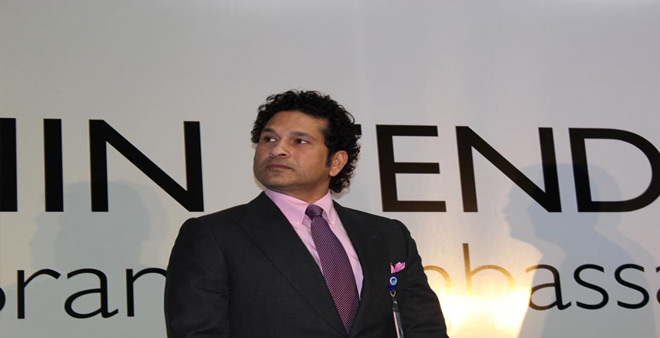
    Inaugurating the 150th outlet of Aster Pharmacy in Abu Dhabi on Monday, Tendulkar, who is the brand ambassador of Aster DM Healthcare’s Aster Pharmacy vertical, said, “In fact, I debuted for India in 1989 which happens to be the same year that Aster Pharmacy opened its first outlet and both of us did well from there on”.

    he was particularly impressed about responsible and responsive manner in which Aster DM Healthcare touched the lives of thousands of people around the region Sachin said.

    The legendary cricketer and recipient of Bharat Ratna -India’s highest civilian award, Tendulkar and the Aster DM Healthcare have committed to offer 1 million dirhams (1.69 crore rupees or USD 2.72 lakh) on various initiatives to support the needy and the downtrodden in India, the healthcare said in a statement.

    “Mr Tendulkar’s presence and support will help us to reach out to the society better and more efficiently on our various community initiatives,” Anoop Moopen, Director of the healthcare said.

  • FBI puts Indian cyber-fugitive on most wanted list

    FBI puts Indian cyber-fugitive on most wanted list

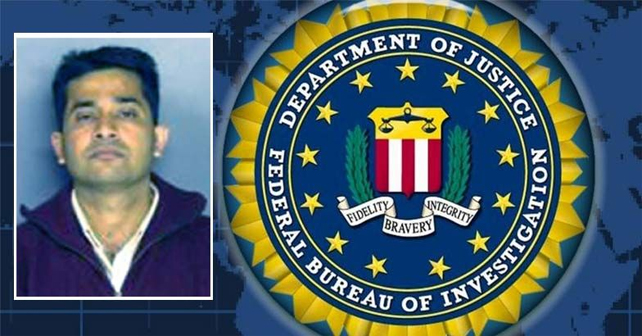
    WASHINGTON: Declaring Shivraj Singh Dabi, an Indian national, a cyber-fugitive, the FBI has put him on its most wanted list with posters in English, Punjabi and Hindi seeking information about him.

    Wanted by the FBI notice put out by the Federal Bureau of Investigation accuses Dabi, 42, of “Unlawful Flight to Avoid Confinement – Computer Crimes” and says he may have fled to India.

    Dabi, it says goes by aliases of “Shivra Dabi, Shivrha Dabi, Shivrha S. Dabi, Shivrha Singh Dabi.”

    According to FBI he is 5 feet 6 inches tall, weighs 140 to 160 pounds and has black hair and brown eyes.

    In 2007, FBI says “Dabi fled from Sacramento County, California, after he was found guilty of charges related to accessing the computers of his previous employer and deleting and purposely damaging the computer data on those computers, a felony.”

    On July 21, 2008, a federal arrest warrant was issued by the US District Court, Eastern District of California, Sacramento, California, after Dabi was charged with unlawful flight to avoid confinement.

    Dabi should be considered an international flight risk, FBI said asking people with any information concerning him to contact the local FBI office or the nearest American Embassy or Consulate.

  • FBI Takes Step to Address Needs of Sikh Indian-Americans and Other Communities

    FBI Takes Step to Address Needs of Sikh Indian-Americans and Other Communities

    WASHINGTON, D.C., March 25, 2015 —The Sikh American Legal Defense and Education Fund (SALDEF) commented today on the release of the updated FBI Hate Crime Data Collection Guidelines and Training Manual, considered the sin­gle most impor­tant and inclu­sive hate crime train­ing resource avail­able for law enforce­ment officials. This ver­sion now includes a spe­cial con­sid­er­a­tions sec­tion to help local police offi­cials effec­tively iden­tify and report the new cat­e­gories of crime man­dated for col­lec­tion in 2015 – includ­ing hate crimes directed at Sikhs, Arabs, and Hin­dus. SALDEF, alongside Sikh advocates and other civil rights groups, worked closely to counsel FBI officials on the Sikh community’s needs throughout this process. We encourage the FBI to continue to improve the manual and law enforcement training to ensure appropriate classification of crimes where a Sikh is targeted for his or her articles of faith.

    In 2010, Jasjit Singh, SALDEF’s executive director, first presented to the FBI’s Advisory Policy Board in Boston, making a case for the need for a Sikh category. In February 2012, he subsequently met with then FBI Director Robert S. Mueller III on behalf of the Sikh community, alongside leaders of other civil rights groups including the Interfaith Alliance, Muslim Public Affairs Council and the American-Arab Anti-Discrimination Committee.

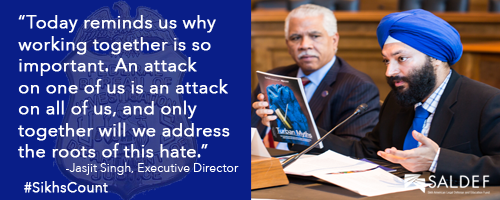
    Jasjit Singh commented, “The release of the updated Hate Crimes Tracking form and manual, a reform Sikh Americans and SALDEF have advocated towards for half a decade, marks a step towards ensuring accurate reporting of hate crimes committed against Sikhs, an important step that will ultimately aid the Sikh community as we continue to address the roots of anti-Sikh bias. Sikh, Muslim, Hindu, South Asian, and Arab Americans have disproportionately faced senseless violence motivated by hate in recent years. We look forward to continuing our work with the FBI to ensure law enforcement is addressing the Sikh community’s needs. Today reminds us why working together as partners is so important. An attack on one of us is an attack on all of us, and only together will we address the root of this hate.”

    Following the August 2012 attacks on the Gurdwara in Oak Creek, Wisconsin, over 140 Members of Congress joined the years of calls by members of the Sikh American community with their partners Rep. Joe Crowley, Rep. Judy Chu, Rep. David Valadao, Sen. Dick Durbin, and Sen. Dianne Feinstein urging the FBI to track hate crimes against the Sikh American community. In 2013, the Department of Justice and the FBI announced they would begin to track hate crimes against Sikh Americans and other communities, beginning this year with the release of the new hate crimes tracking form.

    The FBI’s manual also includes updated def­i­n­i­tions and train­ing sce­nar­ios to help officers better serve their diverse communities. SALDEF, using the findings of Turban Myths, the first-ever study on the public perception of Sikh Americans, shared the impacts of unconscious and implicit bias towards Sikhs in order to inform these future FBI trainings. Turban Myths resulted from a collaboration between SALDEF and Stanford University researchers and continues to be covered by major media for its ability to pinpoint the roots of anti-Sikh bias in the United States. In 2015 and beyond, trainings will be conducted nationwide by certified Sikh American trainers as part our Law Enforcement Partnership Program.

  • Barack Obama Praises Young Indian-American Teen Scientists

    Barack Obama Praises Young Indian-American Teen Scientists

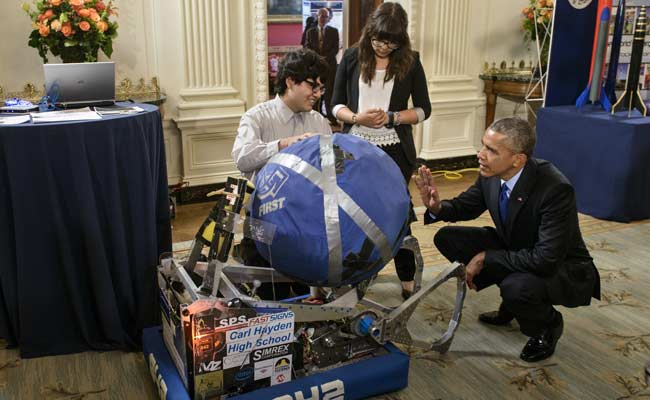
    US President Barack Obama has praised the work of budding Indian-American teenage scientists who showcased their innovative exhibits, including an algorithm to identify potential drugs for cancer, ebola and tuberculosis.

    Anvita Gupta, 17, of Scottsdale, Arizona, winner of Third Place Medal of Distinction for Global Good, was one of the participants of the fifth White House Science Fair which was attended by several other Indian-origin teenagers.

    When Ms Gupta explained how she had used an algorithm to help identify possible new drugs to treat Ebola, cancer and tuberculosis, Mr Obama turned to the press, grinned and said, “I don’t know what you all have been doing. But this is what she has been doing”.

    “It is unbelievable what so many of these young people have accomplished at such an early age,” Mr Obama said after his personal interaction and viewing of some of the exhibits on display.

    This year’s White House Science Fair has a specific focus on diversity and includes more than 100 students from 30 states, representing more than 40 science competitions and organisations.

    35 student teams exhibited their projects. Mr Obama personally viewed 12 of these exhibits.

    Another Indian-American Trisha Prabhu showcased her computer programme ‘Rethink’ that alerts users when an outgoing message contains language that is potentially abusive and hurtful.

    Ninth-grader Sahil Doshi exhibited the design of his innovative carbon-dioxide powered battery called PolluCell.

    Nikhil Behari from Pennsylvania showcased the easy-to-use security system developed by him which is versatile and effective in protecting online data.

    Ruchi Pandya from San Jose exhibited the one-square centimetre carbon nanofibre electrode-based biosensor that has the potential to improve cardiac health diagnostics for patients around the world.

    In his remarks later, Mr Obama specifically mentioned Nikhil. “He’s a freshman in high school, interested in how we can better protect ourselves against hackers and data thieves online. So scientists are already using biometrics to prove that each of us walk in our own distinct ways,” he said.

    “And Nikhil wondered, what if we each type in a distinct ways? So he collected all kinds of data about how a person types – their speed, how often they pause, how much pressure they use and built a special keyboard to test it. And he proved that his hypothesis was correct – that even if somebody knows your password, they don’t necessarily punch it in exactly the way you do,” he said.

    “He asked why – and made discoveries that now could help keep our online accounts more secure. So in the future, if keystroke-based authentication keeps your siblings from breaking into your Facebook account or your Instagram account, you will know who to thank. It will be Nikhil. Congratulations,” Mr Obama said amidst applause.

    Ruchi, Mr Obama said, found a way to use a single drop of blood to test a person’s heart function much like a person with diabetes tests their blood sugar.

    The President did not forget Anvita in his speech. “Anvita used artificial intelligence and biochemistry to identify potential treatments for cancer, tuberculosis, Ebola. What she’s done is she’s developed an algorithm that could potentially significantly speed up the process of finding drugs that might work against these diseases,” he said.

    “Anvita’s algorithm has the potential of speeding up pathways to discovering what drugs would work on what diseases, and is consistent with some of the work that we announced around precision medicine that we are funding at a significant pace here at the White House,” Mr Obama said.

    “Now, I should point out that, like several of the young people here, Anvita and Ruchi are first-generation Americans. Their parents came here, in part, so their kids could develop their talents and make a difference in the world. And we’re really glad they did,” Mr Obama said.

    Mr Obama said these young scientists and engineers teach something beyond the specific topics that they’re exploring.

    “They teach us how to question assumptions, to wonder why something is the way it is, and how we can make it better. They remind us that there’s always something more to learn, and to try, and to discover, and to imagine – and that it’s never too early, or too late to create or discover something new,” he said.

    “It’s a mindset that says we that can use reason and logic and honest inquiry to reach new conclusions and solve big problems. And that’s what we are celebrating here today with these amazing young people,” Mr Obama said.

  • Why is everything named after Rajiv or Indira Gandhi? questions Haryana minister

    Why is everything named after Rajiv or Indira Gandhi? questions Haryana minister

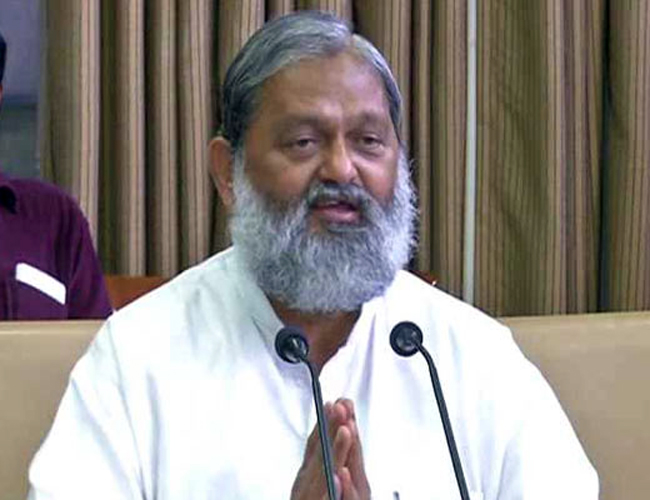
    CHANDIGARH (TIP): Haryana assembly on March 19 witnessed pandemonium after sports minister Anil Vij said he would consider renaming sports complexes named after former Prime Minister Rajiv Gandhi, drawing opposition from Congress which asked the BJP to apologize for “insulting” national leaders.

    The trouble began during question hour when ruling BJP member Sham Singh Rana asked if there was any proposal under government’s consideration to construct a modern sports stadium in Radaur constituency.

    Replying to the question, Vij, who also holds the health portfolio, informed the House that there are three Rajiv Gandhi Gramin Khel Parisars in village Barsan, Nagal and Golani in Radaur constituency.

    As he was reading out his reply, Vij said the rural sports complexes named after Rajiv Gandhi will have to be renamed. While former chief minister Bhupinder Singh Hooda was not present in the House at that time, other Congress members, including former Speaker Kuldeep Sharma, Congress Legislature Party leader Kiran Choudhary, Karan Singh Dalal and others attacked the ruling benches over Vij’s remarks.

    As the tempers ran high, Vij shot back at Kuldeep Sharma, who had demanded that the minister take back his “mischievous” and “obnoxious” thinking.

    “Government will decide what it has to do. You (Kuldeep) are not in the government. I am talking on behalf of the government. I am a Minister, you are only a MLA… Who you are (who are you), I am very serious in what I have said,” the outspoken Vij shot back.

  • Land Bill: BJP panel too favours 80% consent clause

    Land Bill: BJP panel too favours 80% consent clause

    NEW DELHI (TIP): Even as the NDA govern ment seems to be determined to pass the Right to Fair Compensation & Transparency in Land Acquisition, Rehabilitation & Resettlement Bill, 2015, an internal committee of BJP has found some sticking points on the consent clause even among farmer groups sympathetic to the party.

    According to top sources in BJP, the eight-member committee headed by party vice-president Satya Pal Malik has submitted its feedback to party chief Amit Shah. Though at least six out of the nine amendments made to the bill in the Lok Sabha were as a result of this committee’s feed back, one important sticking point has remained unresolved.

    “Most of the representations made by farmers groups and activists to the committee wanted restitution of the clause which stipulated that 80% of land owners should give consent for acquisition before the state can step in and acquire the remaining bit for any private project,” Malik said. “We haven’t submitted any written report; just given a feedback and written ideas suggested by stakeholders whom we spoke to for over 10 days,” he added.

    “I feel there is more propaganda around it than what is actually there. It is a fair bill, but like the rumour of grease ridden cartridges which had set off the revolt of 1857, rumours are strengthening the opposition to the bill,” he added.

    For example, he added, the acquisition of land one km deep from proposed industrial corridors was being touted as a grave rip off.”Yet, provision for acquisition of land 500 metres on either side of the corridor is there in the old UPA bill too,” Satya Pal Malik added.