Year: 2015

  • STUDY ILLUSTRATES THE GENETIC FOUNDATION OF EVOLUTION

    LONDON (TIP): The most extensive genetic study ever conducted of Charles Darwin’s finches from the Galapagos Islands, has revealed a messy family tree with a surprising level of interbreeding between species. It also suggests that changes in one particular gene triggered the wide variation seen in their beak shapes.

    Scientists in Sweden and the US used genome sequences of 120 individual birds from 17 different species to perform their analysis. Researchers from Princeton University and Uppsala University in Sweden have identified a gene in the Galapagos finches studied by English naturalist Charles Darwin that influences beak shape and that played a role in the birds’ evolution from a common ancestor more than 1 million years ago.

    The study illustrates the genetic foundation of evolution, including how genes can flow from one species to another, and how different versions of a gene within a species can contribute to the formation of entirely new species.

    The study was published on February 11, one day before birthday of Darwin, who studied the finches during the 1835 voyage that would lead him to publish the seminal work on evolution, “On the Origin of Species,” in 1859.

    “We now know more about the genetic basis for our evolutionary studies, and this is a highly satisfactory, very exciting discovery after all these years,” said Peter Grant, Princeton’s professor of zoology.

    Grant has studied the finches for 40 years on the arid, rocky islands of Daphne Major and Genovesa in the Galapagos archipelago. The latest study reveals how evolution occurs in halting and disordered steps, with many opportunities for genes to spread in different species and create new lineages. Given the right conditions, such as isolation from the original population and an accumulation of genetic differences, these lineages can eventually evolve into entirely new species.

    Working with DNA samples collected by the Grants, researchers at Uppsala identified the gene that influences beak shape by comparing the genomes of 120 birds, all members of the 15 species known as “Darwin’s finches.” They spotted a stretch of DNA that looked different in species with blunt beaks, such as the large ground finch versus species with pointed beaks, such as the large cactus finch.

    Within that stretch of DNA, the researchers found a gene known as ALX1, which has previously been identified in humans and mice as being associated with the formation of facial features. Mutations that inactivate this gene cause severe birth defects in humans.

    “This is an interesting example where mild mutations in a gene that is critical for normal development leads to phenotypic (observable) evolution,” said lead researcher Leif Andersson, a professor of functional genomics at Uppsala University.

    But the most exciting and interesting finding of the study, Andersson said, was that the gene also varied among individuals from the same species. For example, the medium ground finch species includes some birds with blunt beaks and others with pointed ones. This finding is significant because it shows how evolution can happen, Peter Grant said. Within a species, when some individuals have a trait that aids their survival — such as a blunt beak that allows them to crack open tough seed coverings — they will pass on the genes for that trait to their offspring, whereas individuals with pointed beaks will have died.

    “This is the genetic variation upon which natural selection can work,” he said.

    The shape and size of the beak are crucial for finch survival on the islands, which periodically experience extreme droughts, El Nino-driven rains and volcanic activity. The birds use their beaks as tools to crack open the hard and woody outer coverings of seeds, pry insects from twigs, and sip nectar from cactus flowers. In times of drought, a bird that can extract food from multiple sources will survive whereas other birds will not.

  • SPICEJET FLIES DEEPER INTO RED, Q3 LOSS WIDENS TO RS 275CRORE

    SPICEJET FLIES DEEPER INTO RED, Q3 LOSS WIDENS TO RS 275CRORE

    MUMBAI (TIP): In the middle of an ownership change, budget airline SpiceJet on Thursday reported a steep 59 per cent rise in its third-quarter net loss at Rs 275 crore on lower passenger numbers and a one-time cost of Rs 295 crore.

    The cash-strapped airline was forced to ground flights for some days during the quarter after its vendors refused to offer credit. This resulted in the airline witnessing a 31 per cent decline in capacity, while revenue fell 27 per cent to Rs 1,300 crore, from Rs 1,769 crore in the year-ago quarter. 

    The net loss has widened from Rs 173 crore during the September-December 2013 quarter, said the airline whose co-founder Ajay Singh has returned as its promoter after buying stake from the Maran family.

    The finance cost of the airline also went up sharply to over Rs 47 crore in the quarter ended December 31, 2014, from a little over Rs 30 crore in the year-ago period, while the airline had to bear one-off and exceptional expenses totaling Rs 295 crore in the latest three-month period. The passenger revenue was down 28 per cent, while ancillary revenues fell by 20 per cent.

    However the load factor was up 18 per cent, taking the total RASK (revenue per available seat km) up 5 per cent. Still, the airline’s revenue per kilometre slipped 12 per cent due to cancellations and clubbing of flights that resulted in less capacity available to sell at high yield in peak season.

    Total CASK (cost per available seat km) rose 16 per cent, while fuel cost came down by 14 per cent, but non-fuel CASK rose 42 per cent due to one-offs and exceptional costs, and unabsorbed fixed costs and overheads over 31 per cent which reduced capacity.

  • Godrej to roll-out customised colour, design selection

    Godrej to roll-out customised colour, design selection

    KOLKATA (TIP): Consumer appliance company Godrej and Boyce (GBMCL) will soon roll out customised colour and design selection for online buyers across its product range keeping at par with the global trends, a company official said.

    “Internationally there are companies who are offering customized selection of colours and designs. By mid 2015, we will come up with this feature too at a little extra cost,” the company’s executive vice president and business head Kamal Nandi told media persons here.

    The company, previously had undertaken the same initiative for the World Series appliances printing customised decals for the consumers. However, it did not pick up well due to physical limitations.

    “This is the first time we are doing it on the digital platform and to my knowledge there isn’t anybody who is doing is,” said Nandi.

    He said online sales in the appliances industry has picked up by seven to eight percent over the last ten years and this trend will continue.

    “Online sales comprises approximately two percent of our revenue and is expected to grow by seven to eight percent. By middle of 2015, we will come up with a new e-commerce website which will offer product customizations in colour and design,” he said.

    The company will be piloting the customisation project in April this year and by June it expects to complete a study for the project post which it will be rolled across.

    Besides, the company is keen to target the premium segment and is coming up with new refrigerators to take on competition from South Korean companies which are its major competitors.

    “We are keen to enter the premium segment and will be coming up with new products this year. There will be toughened glass doors replacing steel in refrigerators and other features as well,” said Nandi.

    Besides, the company has also planned an array of other refrigerator launches in the coming three months.

    Nandi said the market size of premium refrigerators comprises 15 percent of the total size where the company is absent. The air-conditioner premium market is five percent of the total size.

    “We do not have products above 400 litres (in fridges)”, he said.

    GBMCL will focus on washing machines and air-conditioners for the mass market this year and expects to increase revenues from these by 17-18 percent in the coming fiscal year.

    The company is expecting to close the current fiscal at Rs.3,000 crore revenue.

    “Until now in the current fiscal, our growth has been 43 percent by value and 35 percent by volume,” he said. The northern market contributes nearly 40 percent of its turnover while it has grown exponentially in the eastern markets which contributes 15 percent to the revenue. Its main income source is from urban and metro areas which contributes 65 percent across 35 major cities and towns while 35 percent of the remaining revenue comes in from tier 2 cities and towns.

  • SBI Q3 net profit up 30%; shares surge

    MUMBAI (TIP): State Bank of India, the nation’s top lender by assets, reported a 30 percent increase in quarterly profit, lagging estimates, although bad loans rose less than feared, sending its shares 6 percent higher.

    State Bank, which accounts for about a quarter of loans and deposits in the country, said net profit rose to 29.10 billion Indian rupees ($468.4 million) from 22.34 billion rupees a year earlier.

    Analysts on average had expected a net profit of 32.74 billion rupees,

    Gross bad loans ratio was 4.9 percent in the December quarter, compared with 4.89 percent in the September quarter.

  • SAHARA PLANS TO SUE MIRACH CAP

    NEW DELHI (TIP): Sahara group on Thursday said it plans to initiate civil and criminal proceedings against US-based Mirach Capital for alleged forgery in committing an over $1 billion bailout package in lieu of the group’s three hotels in New York and London.

    The Sahara group, which is in dire need of Rs 10,000 crore to get its chief Subrata Roy and two other directors released from Tihar Jail, was banking on Mirach’s promised bailout package, which turned sour after the Indian entity discovered that Bank of America’s (BofA) letter promising the money was forged.

    Sahara sources said when its counsel were showing the BofA letter to the Supreme Court bench headed by Justice T S Thakur on January 9, Mirach CEO Saransh Sharma was present in the courtroom.

    This comes a day after amicus curiae in the case, senior advocate Shekhar Naphade, informed the SC that the Sahara-Mirach deal didn’t look likely and termed the development “disturbing”, adding that there was “more than what meets the eye”. The bench headed by Justice Thakur had said it would examine alternative ways of recovering money from Sahara and asked the group to inform Naphade about other proposals to raise money to get Roy out on bail.

    Sahara sources also said that though Sharma had promised to return the retention/blocking fee of $2.6 million (Rs 16.5 crore), he has not done so despite the deal getting rescinded. It also rejected Sharma’s purported media statement that BofA refused to be a party to the financial transaction citing “integrity issues with Sahara”.

    “Sharma’s statement and stated reason were childish and unfounded as he had never mentioned in any communication about the alleged inability of BofA to be part of the transaction.

    Instead, he had always defended the letter and said the funds were available at BofA,” sources said.

    “Mirach and its CEO are also guilty of wilfully causing contempt of Supreme Court of India for wilfully providing forged letter to be acted upon by the Supreme Court when they were personally present in the court on January 9,” the sources added.

    Separately, company sources claimed that Roy was not in custody for non-payment of Rs 20,000 crore to its investors but his custody was due to non-compliance of Supreme Court’s order of August 31, 2012. This was related to depositing around Rs 20,000 crore to Sebi for repayment to investors.

    “Out of 3 crore investors, only around 5,000 esteemed investors with an aggregate demand amounting to around Rs 20 crore have applied with Sebi for refund and Sebi had to repay only Rs 2 crore in the last 28 months. Sahara’s money with Sebi is Rs 11,000 crore, including interest earned and post-dated cheques with undertakings,” company sources said.

    “Sahara claims that it is has repaid to more than 93%investors and the balance amount is to be repaid to them at the end of the schemes’ tenure, as decided by these investors,” they added.

  • MAHA SHIVRATRI: THE NIGHT OF SHIVA

    MAHA SHIVRATRI: THE NIGHT OF SHIVA

    Maha Shivratri, the night of the worship of Lord Shiva, occurs on the 14th night of the new moon during the dark half of the month of Phalguna. It falls on a moonless February night, when Hindus offer special prayer to the lord of destruction. Shivratri (Sanskrit ‘ratri’ = night) is the night when he is said to have performed the Tandava Nritya or the dance of primordial creation, preservation and destruction. The festival is observed for one day and one night only.

    Origin of Shivratri

    According to the Puranas, during the great mythical churning of the ocean called Samudra Manthan, a pot of poison emerged from the ocean. The gods and the demons were terrified as it could destroy the entire world. When they ran to Shiva for help, he in order to protect the world, drank the deadly poison but held it in his throat instead of swallowing it. This turned his throat blue, and since then he came to be known as ‘Nilkantha’, the blue-throated one. Shivratri celebrates this event by which Shiva saved the world.

    A festival significant for women

    Shivratri is considered especially auspicious for women. Married women pray for the well being of their husbands and sons, while unmarried women pray for an ideal husband like Shiva, who is the spouse of Kali, Parvati and Durga. But generally it is believed that anyone who utters the name of Shiva during Shivratri with pure devotion is freed from all sins. He or she reaches the abode of Shiva and is liberated from the cycle of birth and death.

    Rituals

    On the day of Shivratri, a three-tiered platform is built around a fire. The topmost plank represents ‘swargaloka’ (heaven), the middle one ‘antarikshaloka’ (space) and the bottom one ‘bhuloka’ (earth). Eleven
    ‘kalash’ or urns, are kept on the ‘swargaloka’ plank symbolizing the 11 manifestations of the ‘Rudra’ or destructive Shiva. These are decorated with the leaves of ‘bilva’ or ‘bael’ (Aegle marmelos) and mango atop a coconut representing the head of Shiva. The uncut shank of the coconut symbolizes his tangled hair and the three spots on the fruit Shiva’s three eyes.

    Bathing the Phallus

    The phallus symbol representing Shiva is called the lingam. It is usually made of granite, soapstone, quartz, marble or metal, and has a ‘yoni’ or vagina as its base representing the union of organs. Devotees circumambulate the lingam and worship it throughout the night. It is bathed every three hours with the 5 sacred offerings of a cow, called the ‘panchagavya’ – milk, sour milk, urine, butter and dung. Then the 5 foods of immortality – milk, clarified butter, curd, honey and sugar are placed before the lingam. Datura fruit and flower, though poisonous, are believed to be sacred to Shiva and thus offered to him.

    MAHA SHIVRATRI image


    Om Namah Shivaya

    All through the day the devotees keep severe fast, chant the sacred Panchakshara mantra “Om Namah Shivaya”, make offerings of flowers and incense to the Lord amidst ringing of temple bells. They maintain long vigils during the night, keeping awake to listen to stories, hymns and songs. The fast is broken only the next morning, after the nightlong worship. In Kashmir, the festival is held for 15 days. The 13th day is observed as a day of fast followed by a family feast.

    The Powerful God

    Shiva is ‘shakti’ or power, Shiva is the destroyer, the most powerful god of the Hindu pantheon and one of the godheads in the Hindu Trinity. Known by many names – Mahadeva, Mahayogi, Pashupati, Nataraja, Bhairava, Vishwanath, Bhava, Bhole Nath – Lord Shiva is perhaps the most complex of Hindu deities. Hindus recognize this by putting his shrine in the temple separate from those of other deities.

    Shiva As phallic symbol

    Shiva, in temples is usually found as a phallic symbol of the ‘linga’, which represents the energies necessary for life on both the microcosmic and the macrocosmic levels, that is, the world in which we live and the world which constitutes the whole of the universe. In a Shaivite temple, the ‘linga’ is placed in the center underneath the spire, where it symbolizes the naval of the earth.

    A Different Deity:

    The actual image of Shiva is also distinct from other deities: his hair piled high on the top of his head, with a crescent tucked into it and the river Ganges tumbling from his hairs. Around his neck is a coiled serpent representing Kundalini or the spiritual energy within life. He holds a trident in his left hand in which is bound the ‘damroo’ (small leather drum). He sits on a tiger skin and on his right is a water pot. He wears the ‘Rudraksha’ beads and his whole body is smeared with ash.

    The destructive force

    Shiva is believed to be at the core of the centrifugal force of the universe, because of his responsibility for death and destruction. Unlike the godhead Brahma, the Creator, or Vishnu, the Preserver, Shiva is the dissolving force in life. But Shiva dissolves in order to create, since death is the medium for rebirth into a new life. So the opposites of life and death and creation and destruction both reside in his character.

    The God who’s always high

    Since Shiva is regarded as a mighty destructive power, to numb his negative potentials he is fed with opium and is also termed as ‘Bhole Shankar’, one who is oblivious of the world. Therefore, on Maha Shivratri, the night of Shiva worship, devotees, especially the menfolk, prepare an intoxicating drink called ‘Thandai’
    (made from cannabis, almonds, and milk) sing songs in praise of the Lord and dance to the rhythm of the drums.

  • TIRICHY: THE LAND OF TRADITION

    TIRICHY: THE LAND OF TRADITION

    Situated on the banks of the river Cauvery,Tiruchirappalli, the forth largest city in the state was a citadel of the early Cholas which later fell to the Pallavas. But the Pallavas never really managed to retain control of this strategic city and lost it to the Pandiyas several times. This tug of war finally ended when the Cholas reasserted themselves in the 10th century. The fort of Tiruchy continued to be in their possession until the decline of the empire after which it became a Vijayanagar stronghold.

    When this empire collapsed in 1565, Tiruchy came to be occupied in turn by the Nayaks of Madurai, the Marathas, the Navabs of Carnatic, the French and finally the British. But it was under Nayaks of Madurai that Tiruchy flourished and prospered in its own right and grew to be the city that it is today. Tiruchy is a fine blend of tradition and modernity built around the Rock Fort. Apart from the fort, there are several churches colleges and missions dating back to the 1760s. With its excellent infrastructure facilities, Tiruchy will serve as a good base to see central Tamilnadu.

    Places to see

    ROCKFORT

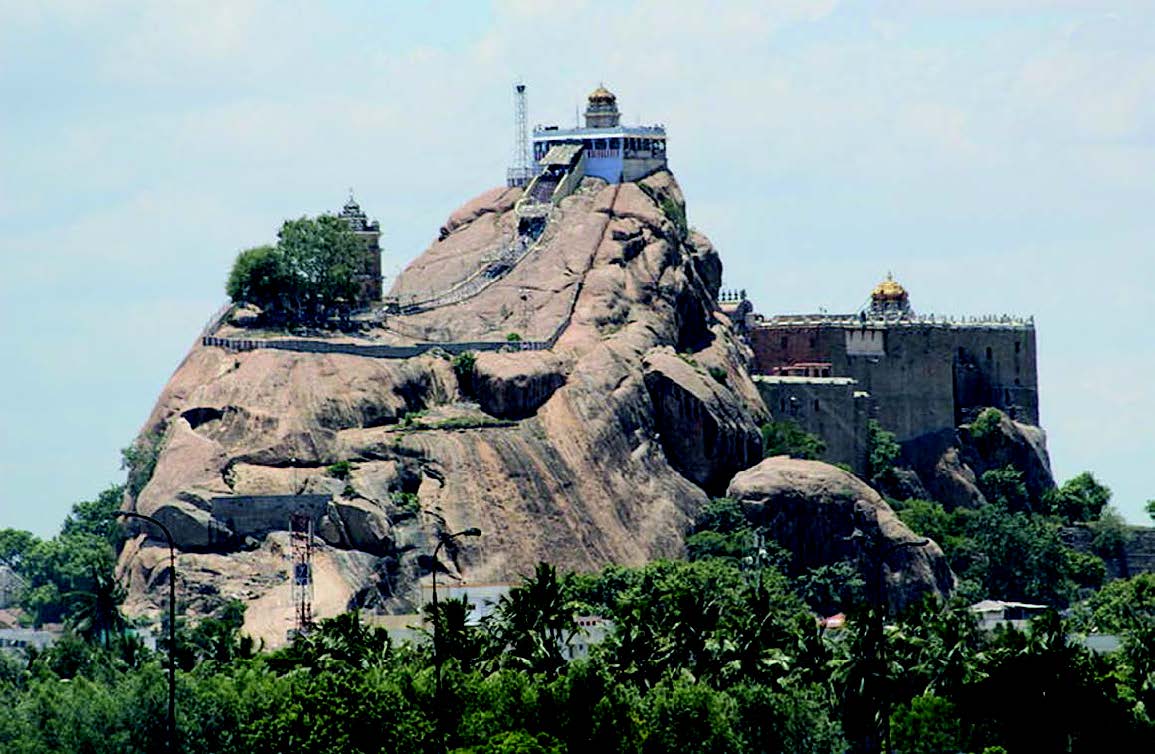
    The most famous    land  mark   of this district   is            Rockfort   Temple. This temple crowns a  massive  outcrop of rock, that soars 83 meters    upwards, from   the surrounding   plains. It is reached by a step flight of 437 steps cut into the rock. Halway up is  the Sri Thayumanaswamy Temple, dedicated to Lord Shiva. It  has  a   100 pillared hall, and a Vimana. From    its summit  we   will   get a fantastic   view   of the  town    plus  its  other  main    landmark, Srirangam, Cavery   River, Coleroon River , Thiruvanaika Kovil

    SRIRANGAM

    Sanctity is accorded to a place  on the basis of its threefold popularity   of the presiding deity, the quality of the  holy waters and its hoary past. The     holy shrine   of Srirangam  has  al   l these attributes    in rich    measure. The  township of Srirangam envelopping the shrine is situated on a tiny island formed by the bifurcation of the river Cavery at  a  place   called Mukkombu (Upper    anaicut). The southern distributary   of the   river retains the name  Cavery, while    the northern branch is called  Coleroon. The abode of the Supreme Lord, Sri Ranganatha, the reclining   form of Lord Vishnu is situated in   Srirangam   8 kilometers from Trichy city.There   are  not  less than 22 gopurams, one of which is the tallest in India. The 72m high 13-tiered Rajagopuram was built in 1987 while the remaining 21 gopurams were built between th 14th and 17th centuries.

    JAMBUKESWARA TEMPLE

    Thiruvanaikaval    Jambukeswara Temple dedicated to Lord Shiva  is situated  2 kms east of Srirangam, The temple is named after the   elephant   which  is   believed   to have worshipped Lord Siva here. Installed under an ancient Jambu tree, the lingam is partially submerged by water and meant to represent  God incarnate as water.

    TIRICHY temple


    ST. LOURDU’s CHURCH

    Built in 1812, this church has lovered doors, which when opened, turns the church into    an   airy   pavilion. Its excellent setting    and    marvelous architecture, makes   it  a site worth visiting. It is in the heart of the Trichy city, surrounded by commercial markets.

    HAZRATH NATHERVALI

    It  is  ancient  Durga more    than 1000 years old. It  is  marvelous architecture , the doom is made up of shining marbles giving a great look to the  Durga. It  is  also  situated in the heart of Trichy City.

    MUKKOMBU

    A wonderful picnic spot,where  the river Kollidam   branches  off from the river Cavery. It is 18 kilometer from Trichy City.

    Travel within city

    Travelling around Tiruchy is easy, as the city is well developed and has a good network of travel options. There are many buses and auto rickshaws available for travel in the city of Tiruchy, and a network of share auto rickshaws also ply through the city.

    BUS

    While travelling in Tiruchy, opting for bus travel can be a wise choice as the buses comprehensively cover all parts of the city. Travelling through bus in Tiruchy is also relatively safe as buses as always moderately crowded even during night time. The bus fares are also cheap and travelling in bus may cost you around Rs 3 to 9.

    AUTO-RICKSHAW

    You can also opt for auto rickshaws in the city of Tiruchy, and these do not run on meter. Auto rickshaw drivers are bound to demand for a rate that is higher than the actual amount, so you should be aware of the local rates from the start. Talking to the locals and finding out the basic rates can help. Make sure you bargain for a good rate as fares will never go beyond Rs 70.

    SHARED AUTO RICKSHAW You can also opt for share auto rickshaws while travelling in Tiruchy. A trip in a share auto rickshaw will cost you only around Rs 5 to 7, and this mode will be less crowded than a bus.

  • WORLD CUP: CHRISTCHURCH WELCOMES THE WORLD

    WORLD CUP: CHRISTCHURCH WELCOMES THE WORLD

    CHRISTCHURCH (TIP): The traffic stopped all around the city and everyone on the streets looked up at the night sky which was bathed in a riot of colours.

    As fireworks lit the skyline, the Kiwi leg of the 2015 World Cup was officially thrown open and this southern city of New Zealand, which has turned a disaster into an opportunity, embraced it with open arms.

    The opening ceremony wasn’t about grandeur or glamour quotient, it was purely about bringing the cricket world together in a city which is still trying to come to terms with the earthquake which ripped it apart four years back.

    The beautiful Hagley Park was thrown open to the public for a party and how well they responded! The twilight sky , the chilly breeze, the aroma of delicious fried lamb and the flowing beer – the setting couldn’t have been more exciting and enchanting.

    There was a crowd of close to 20,000 but there was no jostling for space, no frisking of the police, no long queues – the opening ceremony was all about welcoming the world home.

    indigenous Maori tradition wasn’t forgotten; constant references to the worldbeating rugby team kept coming up, but space was made for every participating nation.

    “You can have every nation, but the maximum colour is invariably India’s,” Emma, a New Zealand tourism volunteer said, just as the Indian performance got over.

    New Zealand Cricket came up with an interesting idea of setting up platforms for all the seven hosting cities and there was an ambassador for each. There couldn’t have been anyone better than Richard Hadlee to be Christchurch’s ambassador and the greatest New Zealand cricketer of all times thanked ICC for allocating the opening game to Christchurch.

    “This generation of cricketers is far better than we were. The game has gone to a different level and we can expect a fantastic World Cup,” Hadlee said.

    The four teams currently in the country -New Zealand, Sri Lanka, South Africa and Zimbabwe – were all represented by their captains. The Kiwis and the Lankans of course had the full squad on the stage.

    The mike moved on from one skipper to the other and all of them spoke about their teams and the chances. While McCullum spoke about keeping the consistency going, De Villiers said he wouldn’t mind breaking his own ODI world record of scoring the fastest ODI century.

  • INDIA PUT MIND ON MATTER AHEAD OF PAKISTAN CLASH

    ADELAIDE (TIP): If the Indians are looking for inspiration, the venue of their practice session on February 12 could not have been better.

    Founded in 1847, St Peter’s College is noted for its famous alumni, including three Nobel laureates, 42 Rhodes scholars and 10 Australian premiers (chief ministers of states).

    Of course, they have not produced cricketers of repute, but the scenic location right opposite the Adelaide Zoo, some 10 minutes drive from their hotel, was a welcome change for the Indian team, away from the peering eyes of the fans.

    The casual atmosphere, with students young and old on the boundary edges, galvanised the players to sweat it out for over three hours in hot sun.

    India were without their captain Mahendra Singh Dhoni for half the session, because after completing his batting stint in the nets, he drove away to catch a flight to Melbourne to attend the opening ceremony there on Friday.

    The most heartening aspect of Team India’s efforts at the picturesque college ground was that they concentrated on the element which was an eyesore during the warm-up matches – their fielding.

    They had dropped a few catches and the general standard was below par. The extra effort they put in to improve their fielding in almost match-like situation was what they needed ahead of their clash against Pakistan on Sunday.

    An interesting feature of India’s practice session was the use of two mini-stools to throw down balls at the batsmen. A support staff climbed up the stools to throw down deliveries at the batsmen from a height to counter the prospect of facing the 7-foottall Pakistani paceman Mohammed Irfan.

    The Indian team feels that as he will deliver the ball from a great height, he would be able to generate steep bounce, making life miserable for batsmen. This novel method should have given the Indian batsmen some confidence to tackle him on Sunday.

    Away from the main nets, a match of sorts was on between teammates with proper field placements and a batsman at each end. With fielders placed at strategic spots Mohit Sharma and Mohammad Shami sent the ball soaring for their mates to attempt to catch them. Once done with the bat, the duo bowled for a long period, trying to stick to line and length, as coach Duncan Fletcher watched keenly.

    Amidst all this, team director Ravi Shastri and captain Dhoni found time to have a long discussion before the latter took off for Melbourne.

    Before that Dhoni had some decent hit at the nets – he timed a few deliveries well and hammered them high and handsome to bring about a loud cheer from the students gathered there.

    The last act came from Virat Kohli, who played some exquisite shots often clearing the field easily. One only hopes he displays such fluency in the upcoming match too.

    Umesh Yadav worked up a good pace and beat the batsmen on occasions. Bhuvneshwar Kumar had a quiet session and he bowled a few delivers only towards the end, giving an indication the he may well not be 100%fit and may not be played in the opening match. Interestingly, Dhawal Kulkarni, not a part of the World Cup squad, bowled for a much longer time along with the rest of the pacers.

  • India vs Pakistan: World Cup history

    1992 – INDIA WON BY 43 RUNS : It was the first time that the two nations met at a World Cup match. India, buoyed by a young and emerging Sachin Tendulkar’s fine unbeaten knock of 54 runs, posted 216 and bowled out Pakistan for 173 to register a convincing victory.

    1996 – INDIA WON BY 39 RUNS: This quarter-final match, played at a packed M. Chinnaswamy Stadium in Bangalore, was keenly-contested. While opener Navjot Singh Sidhu scored an authoritative 93 to set India a strong platform, middle-order batsman Ajay Jadeja put the finishing touches to the innings, blasting a 25-ball 45 –being particularly severe on pacer Waqar Younis — to enable India post a commanding 287 for eight on the board.

    1999 – INDIA WON BY 47 RUNS: India batted first for the third consecutive Cup game and posted a respectable total of 227 for six wickets. Their total was driven by useful knocks from Tendulkar (45), Rahul Dravid (61) and skipper Mohammed Azharuddin (59). Pakistan’s batting once again let them down, getting dismissed for 180 in 45.3 overs. They crumbled to the pace duo of Venkatesh Prasad (5/27) and Javagal Srinath (3/37).

    2003 – INDIA WON BY 6 WICKETS: Even batting first couldn’t reverse the tide for Pakistan despite their posting a strong total of 273. Opener Anwar, always a threat to India, hit a fine century (101) but he was eclipsed by graceful hitting from Tendulkar (98) who, together with fellow opener Virender Sehwag (21), launched a stunning attack on the famed pace trio of Wasim Akram, Shoaib Akhtar and Waqar Younis.

    2011 – INDIA WON BY 29 RUNS: Tendulkar (85) again rose to the occasion in a crunch semifinal and helped India to a fighting total of 260 for nine. The home team was well placed to post a superior total but was restricted by left-arm pacer Wahab Riaz (5/46).

  • MOVIE REVIEW Shamitabh

    MOVIE REVIEW Shamitabh

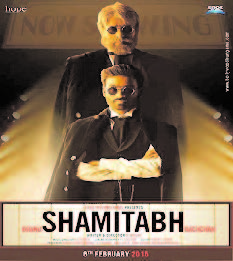
    STORY: Mute Daanish becomes a superstar when Amitabh Sinha provides him his voice – what happens when ego pulls body and speech apart?

    REVIEW: So, Shamitabh has a lovely concept – a boy falls in love with the movies and dreams of becoming a star. He has pizzazz, passion, presence – but no voice. Daanish (Dhanush) is born mute, his soul, like the film-mad lad of Cinema Paradiso, finding utterance with movies, Igatpuri’s bus conductor (rather like a certain Rajini Sir) determined to achieve stardom. Daanish hits Film City and impresses assistant director Akshara
    (Haasan) but directors reject a mute hero.

    Akshara’s doctor dad introduces Daanish to technology which, using embedded micro-recorders and ear-pieces, enables a mute person to communicate via a ‘borrowed’ voice. Daanish and Akshara find the perfect voice – that of Amitabh Sinha (Bachchan), a failed actor, snubbed due to his baritone, who lives in a graveyard, soaked in whisky and cynicism. Amitabh’s tickled by the idea of making his rejected voice successful and the ‘Shamitabh’ team becomes a super-hit.

    But what happens when Amitabh feels he’s getting no recognition, despite being as good a kalakaar as Daanish – if not better?

    Shamitabh’s dramatic performances match its unusual tale. Often evoking The Artist, Dhanush is terrific as film-crazy Daanish, whose eyes sparkle at the cinema, whose brow furrows in desperation to meet directors, who schmoozes and rages without saying a word. Amitabh Bachchan provides perfect balance, catty and chatty in that wondrous velveteen baritone, dripping sarcasm, yodelling ditties, expressing irony, then abhimaan, bringing to life Shamitabh’s crackling dialogues.

    Their acting is electric – but also, frequently over-indulged. Scenes that should’ve been tight are allowed to stretch or become repetitive. The vibrant ‘Piddly’ song gets wasted while the plot is too convenient – a rural boy flings his village life behind him like dust, no doctor explains how the mute hero’s ‘voice’ reads his thoughts and speaks them, no-one swears Amitabh’s sidekick to secrecy.

    In over-explaining this uncommon story – “Very deep”, as Amitabh drawls – the plot rushes through emotional moments. And amidst the high-wattage attention around the Dhanush-Amitabh pairing, less is paid to Akshara, whose performance, although sincere, sometimes looks a tad banal.

    As does the film occasionally, a pity because Shamitabh’s striking story could leave you speechless.

  • I AM A SIMPLE NICE GIRL LIKE MY ‘ROY’ CHARACTER ‘AYESHA’, SAYS JACQUELINE

    I AM A SIMPLE NICE GIRL LIKE MY ‘ROY’ CHARACTER ‘AYESHA’, SAYS JACQUELINE

    Bollywood actress Jacqueline Fernandez, who was in the national capital to promote her upcoming flick Roy, said she relates a lot to her character Ayesha in the movie. “I do relate to Ayesha a lot, she is quite fun loving and a free spirited girl, she is a nice simple girl. So, it was easy for me to connect with her,” she said.

    Jacqueline will be seen playing a double role as Ayesha Aamir, a bohemian filmmaker, and Tia, a glamorous globetrotter, in this movie. Directed by debutant Vikramjit Singh, the flick stars Jacqueline, Arjun Rampal and Ranbir Kapoor.

  • POONAM PANDEY REFUSES AIB’S OFFER

    POONAM PANDEY REFUSES AIB’S OFFER

    Starlet Poonam Pandey, known mostly for her offer to strip if the Indian Cricket Team won the 2011 World Cup, had made news once again. India’s most downloaded model refused an offer from Gursimran Khamba and Tammay Bhat to do a podcast on All India Bakchod (AIB) as she felt it was too demeaning to the women folk. AIB has been in the news recently for its Roast controversy including celebs Ranveer Singh, Arjun Kapoor and Karan Johar. It has been a talking point amongst celebs, fans and even the Government. But Poonam refused this offer. “I have heard that AIB has been doing some good work, but then some of what I have seen wasn’t really up my alley. The digital medium has been home for me over the last four years, but then I felt that I could not participate in something like this,” said the Nasha actress. Sources inform that Poonam felt that the contents of the show were rather demeaning to women and hence did not pursue the offer sent by AIB . While Poonam seems to have made her stand clear, here’s a look at what other celebs had to say about the AIB Roast.

  • EAT BERRIES TO LOSE WEIGHT

    EAT BERRIES TO LOSE WEIGHT

    No need to skip a meal or head to a gym as easy ways to lose a few pounds — not anymore. Replacing just one between-meal confectionery snack with a handful of berries can do the trick as well.

    Research shows that when people swapped a confectionery treat for a berry snack with the same energy content, considerably fewer calories were consumed at their next main meal.

    This suggested that a simple change in habit alone could reduce a person’s calorie intake by nearly 1,000 calories a week, reports femalefirst.co.uk.

    The reduction in calories would be expected to produce a loss of around 0.45 kg of body fat per month, and much more if consumed alongside exercise and other healthy-eating choices, according to researchers.

    Seasonal Berries commissioned Loughborough University to conduct the research.

    Lewis James from the School of Sport, Exercise and Health Sciences at Loughborough University, that conducted the research, said anyone who does the simple swap could feel the effects on their health and waistline. “Our research shows that an afternoon snack of mixed berries decreases energy intake at dinner. It’s a simple method that might help people control and lose weight,” said James.

    “There are a number of potential health benefits of consuming berries, but this is the first time that consuming them as a snack has been shown to reduce how much people eat during the next meal of the day. The cumulative effect of the reduced calories could help people lose the extra pounds without them having to make an effort, or even noticing,” added the expert.

    In the research trials, which were carried out over four months, 12 participants tested the effects of swapping a confectionery snack with a handful of berries – strawberries, blueberries, blackberries and raspberries – with the same energy content.

  • WAYS TO BOOST YOUR MEMORY

    WAYS TO BOOST YOUR MEMORY

    Not many of us can boast of a sharp memory, and those who do, certainly seem to have an edge professionally and personally as well. We’re not recommending any magic pill to boost your memory but rather some tips that will help you do so:

    Clench your fist

    This may sound weird but research suggests that balling up your right hand and squeezing it tightly actually makes it easier to memorise phone numbers or shopping lists. Later, when you want to retrieve the information, clench the left fist. Researchers think the movements activate brain regions key to the storing and recall of memories.

    Alphabets to the rescue

    When you’re trying to recall a piece of information such as the name of an actor in a film but just can’t seem to do so, use the alphabet search method. Basically, go through the alphabet to find the first letter of the word or name you are trying to remember in order to jog your memory. This trick really works.

    Exercise more frequently

    This is no rocket science because many studies have shown that aerobic exercise improves cognitive function and is particularly good at enhancing memory. Also, exercise is believed to encourage the growth of new brain cells in the hippocampus – an area of the brain important in memory and learning.

    Ditch drinking at night

    Alcohol may help you fall asleep but it leads to a disrupted night’s rest. Moreover, it has a harmful effect on concentration and memory, opine researchers. Not to forget the more you drink, the less deep – or REM – sleep you get.

    Say the words out loud

    Perhaps, the easiest of all methods for remembering anything is to say the words out loud, be it remembering where you put your car keys or what you need from the shop or revising for a test, say memory experts. Studies found that saying what you want to remember out loud to yourself – or even mouthing it – will help with recall.

    Kick the butt

    If you thought smoking only leads to cancer, you’re wrong. A separate study found that middle-aged smokers performed less well on tests compared with those without the tobacco habit.

    Give yourself a cue

    If there’s something you have to do every day at a specific time and often forget, a technique called implementation intentions can help you. For example, say to yourself ‘On my way home, I have to pick up clothes from the dry cleaners.’

    Get visually speaking

    A type of memory aid involves using imagery or visuals rather than words. For example, a classic way of remembering a person’s name is to try and imagine it (or something associated to it) on the person’s face. Psychologists have found that the more bizarre and vivid the image, the better it works.

    Consume more milk

    For study purposes, scientists asked subjects to fill in detailed surveys on their diets for tests to check their concentration, memory and learning abilities. They found that subjects who consumed dairy products at least five or six times a week did far better in memory tests compared with those who rarely ate or drank them.

    Don’t overeat

    Eating too much can double the risk of memory problems in old age, according to an American research. Studies found a high-calorie intake can substantially increase the risk of developing mild cognitive impairment, or MCI, characterised by memory loss, which can precede dementia.

    A walk in the park

    A study found people who walked around a garden did 20% better on a memory test than those who walked around streets.

    Dance away

    Not only do music lovers perform better in cognitive tests, but research has also shown the beneficial effects of music on those with Alzheimer’s disease. It is believed that music with strong rhythms and patterns, like reggae and salsa, are best for memory and problem-solving. In fact, the more complex the dance, the more the brain will be challenged.

  • REDUCE SALT FOR A HEALTHIER LIFE

    A new study has stressed that reducing sodium intake should be a major public health priority for governments and nongovernmental organizations to improve population health.

    While higher blood pressure is linked with cardiovascular disease, a diet high in sodium is known to cause high blood pressure, vascular and cardiac damage, stomach cancer, osteoporosis, and other diseases.

    Almost 1 billion adults worldwide have hypertension, and 17-30 percent of these cases can be attributed to excessive sodium consumption.

    In developed countries, almost 80 percent of sodium intake is from processed food.

    And the researchers led by Dr. Kevin Willis, at Canadian Stroke Network, have said that the regulation of the food industry by the government will bring about the most effective change, although immediate voluntary action is desired.

    “A population-wide reduction in sodium intake could prevent a large proportion of cardiovascular events in both normotensive and hypertensive populations. For example, a population-wide decrease of 2 mm Hg diastolic blood pressure would be estimated to lower the prevalence of hypertension by 17 percent, coronary artery disease by 6 percent and the risk of stroke by 15 percent, with many of the benefits occurring among patients with normal blood pressure,” wrote Willis.

    The researchers recommend that national public health policy be focused on reformulating processed food, educating consumers, labelling food clearly, and setting timelines to meet these targets.

  • WAYS TO KEEP YOUR SKIN LOOKING YOUNG

    WAYS TO KEEP YOUR SKIN LOOKING YOUNG

    You might not know what it is, but collagen is the key when it comes to keeping your skin youthful and wrinkle-free.

    Collagen is a protein produced by our cells that helps “hold” the skin together, giving it firmness and elasticity. When we’re young, our skin stays plump and smooth because it constantly regenerates itself. But as we age, collagen production slows -and existing collagen can get damaged due to sun exposure and bad skin habits.

    The results?

    Wrinkles and sagging skin. Luckily , there’s lots you can do to preserve your collagen and even boost its production…

    UP YOUR VITAMIN C IN TAKE

    A study published in the American Journal of Nutrition found women over 40 with the highest amount of vitamin C in their diet were less likely to develop wrinkles than those who consumed lower levels.”Vitamin C is crucial to the formation of collagen. Without it, amino acids can’t be linked to form the protein,” says dietitian Jo Travers, “Good sources are red pepper, dark green leafy vegetables like broccoli and sprouts, tomatoes, oranges and kiwi fruit.” Skincare products that contains vitamin C is also thought to encourage collagen repair (it’s usually listed on the label as Lascorbic acid, ascorbyl palmitate or ascorbyl phosphate).

    STOP SMOKING

    “Smoking creates enzymes called matrix metalloproteinases (MMPs), which damage the collagen in your skin; hence the telltale sagging which many smokers are betrayed by,” says consultant dermatologist Dr Nick Lowe.

    STAY SUN SAFE

    Sun exposure is a prime suspect for hastening collagen loss. “UVA rays penetrate deep into the skin and damage the deep collagen support structures there,” says Dr Lowe, “My advice would be to wear an SPF15 broad spectrum cream (one that protects against UVA and UVB rays) through the year.”

    REACH FOR RETINOL

    Retinoid creams -only available on prescription -have been proven to help boost collagen production. “Retinoids reduce substances in the skin that break down collagen after sun exposure and also target receptors in the skin which increase the production of collagen,” says Dr Maria Gonzalez. You can get your hands on milder forms of retinoid in over-the-counter retinol creams.

    CUT BACK ON THE STUFF SWEET

    According to Dr Patricia Farris, eating too much sugar can be a beauty disaster. It causes premature ageing of the skin by a process called glycation. This is where excess sugar in the blood attaches itself to lipids, nucleic acids and proteins (especially your collagen) to form “advanced glycation end products” or AGEs, which accelerate the ageing process and cause wrinkly skin.

    EXFOLIATE

    Exfoliation -removing the top, dead layer of skin -helps speed up the natural process of skin and collagen renewal, says Amanda Elias, founder of a skin care brand. “My favourite way to b exfoliate is with chemical exfoliants such as glycolic acid and lactic acid. They dis solve the glue-like substance that substance that bonds dead skin to the surface rather than sloughing it away like scrubs do, and give a more even scrubs do, and give a more even r result, leaving skin looking healthier and more radiant.”

    ADD ANTIOXIDANTS TO YOUR SKINCARE REGIME

    Antioxidants help protect against free radicals that can cause ageing skin.”The term `free radical’ describes a damaged skin cell,” says Amanda.”It’s `free’ because it’s missing an elec tron (healthy cells have two electrons, a damaged cell has one). “Free radicals attach themselves to healthy skin cells and basically suck out the electrons they need, leaving healthy skin cells damaged. This process triggers an enzyme in the skin that breaks down collagen. Antioxidants help by neutralising the free radical so that it doesn’t have to feed off our healthy skin cells.”

    Sip on green tea -it contains antioxidants called catechins -and eat foods high in lutein, an antioxidant found in green leafy veg like spinach. Look for creams and serums containing antioxidants, too.

    PLANT PROTEINS, PLEASE

    The menopause can make us wrinkly because, as we age, our oestrogen levels drop. Because oestrogen is vital to making healthy collagen, creases and crinkles can creep in to our skin. Lots of foods contain plant oestrogens (phytoestrogens) that can help replace the effects of lost oestrogen. Try hummus, nuts, soy and pinto beans. Look for face creams containing phytoestrogens.

    MASSAGE

    “Massaging your face daily will help boost the production of collagen, give skin a more plump appearance and help stimulate the lymph glands to promote clear skin,” says Nichola Joss, a skincare expert. “Use a collagen boosting oil,” she adds.

  • Greek PM edges towards bailout deal

    Greek PM edges towards bailout deal

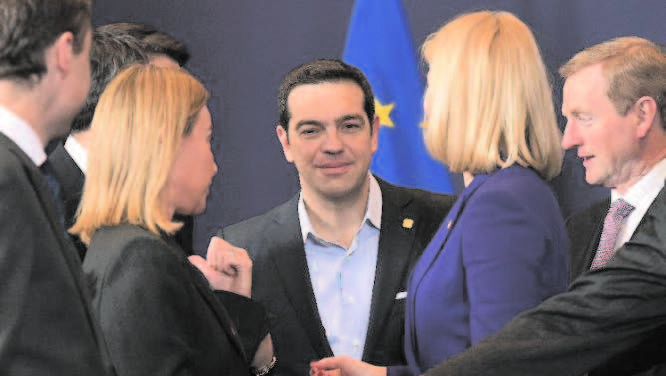
    BRUSSELS (TIP): Greece’s new Prime Minister Alexis Tsipras edged closer to securing a massive overhaul of its huge bailout on February 12 after making his case to sceptical EU leaders including German Chancellor Angela Merkel.

    Tsipras, the leftist leader elected by austerity-weary Greeks last month, agreed that Athens would start technical talks with eurozone partners on Friday in a bid to find common ground before a last ditch meeting of finance ministers on Monday.

    But with Greece facing a possible exit from the euro when its 240-billion-euro ($270-billion) EU-IMF bailout expires at the end of February, Tsipras kept talking tough during his first summit with the other 27 European Union leaders.

    “Greece will not blackmail or be blackmailed,” Tsipras said in a press conference after the talks in Brussels.

    He insisted that Greece would ditch the hated “troika” of creditors — the EU, IMF and European Central Bank — which oversees the bailout programme and carries out inspections to see that Greece is living up to its punishing reform commitments.

    “Forget the programme, it no longer exists. The troika doesn’t exist either,” Tsipras said.

    But he said that he discussed with his counterparts the possibility of a six-month bridging programme to give Greece time to work on a different programme that would be acceptable to its creditors, and “find an end to the crisis.”

    – Merkel ‘amicable’ –

    Germany has been the strongest opponent of Tsipras’s plans, adding to anger in Greece against Europe’s biggest economy, which many in Athens blame for imposing years of austerity since the country’s first bailout in 2010.

    But Merkel suggested a “compromise” was possible and spoke of a “friendly” encounter with Tsipras in Brussels, during which they shook hands in front of the cameras.

    “We greeted each other amicably, I congratulated him on his election,” said Merkel, fresh off the plane from Minsk where she helped broker a peace deal for the conflict in Ukraine.

    “On my part I showed my willingness to cooperate. Now we have to see which points we can agree on.”

    The more positive mood saw Greek shares surge over 6.0 percent while European stock markets rose and the euro was firmer against the dollar.

    It was a far cry from the previous night in Brussels, when six hours of tense talks between Greek Finance Minister Yanis Varoufakis and his eurozone counterparts broke down acrimoniously without even agreeing on how to word a joint statement.

    But on Thursday, Tsipras and Eurogroup head Jeroen Dijsselbloem agreed to renew efforts to “start work on a technical assessment of the common ground between the current programme and the Greek government’s plans,” a step that had nearly been agreed on Wednesday.

    – ‘Optimistic’ Europeans –

    Under the Greek proposals, Athens would stick to 70 percent of the programme but it would overhaul the remaining 30 percent which it sees as damaging to growth and toxic on issues including the new government’s plans to raise the minimum wage.

    Athens also wants a bridging loan until September to buy time to hammer out a new reform and bailout package, and to offer debt swaps based on economic performance as the Greek economy moves out of recession.

    Other European leaders said they were hopeful of a deal before Monday, likely the last chance for an agreement if it is to have time to be passed by eurozone parliaments.

    “It’s my understanding that the discussions between Tsipras and Dijsselbloem were quite constructive and good,” Finnish Prime Minister Alexander Stubb, usually a strong advocate for austerity, told AFP.

    “At the end of the day, no one should underestimate the capacity of the Eurogroup meeting to find a solution and I’m carefully optimistic that something will come out over the weekend.”

    Grumbling continued however over the collapse of Wednesday’s talks, with European sources telling AFP there had originally been an agreement on a joint statement with the other ministers, but that it was torpedoed by Tsipras after his finance minister spent 30 minutes on the phone with him to confirm.

    German Finance Minister Wolfgang Schaeuble had already left on the understanding the statement had been approved, they said.

    Greek sources denied this account and said Germany had tried to insert new wording.

  • Canadian Al-Jazeera journalist Fahmy released from prison

    Canadian Al-Jazeera journalist Fahmy released from prison

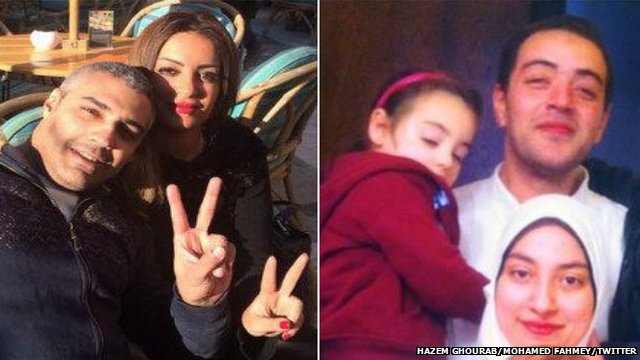
    CAIRO (TIP): Canadian Al-Jazeera journalist Mohamed Fahmy was released from an Egyptian jail on Friday, after spending more than a year in prison on terror-related charges in a case that was denounced as a sham by rights groups and the international community. He was let out pending a retrial.

    Fahmy’s brother tweeted that he posted $33,000 bail following a court decision that allowed him to walk free. It was not clear if Fahmy’s colleague, Al-Jazeera journalist Baher Mohammed, also was being released. A third co-worker, Australian Peter Greste, was released two weeks ago and deported to his home-country, Australia.

    Fahmy spent more than 400 days in detention after he was charged with terrorism for providing the Muslim Brotherhood, now declared a terrorist organization, with a platform. His next court hearing is Feb. 23 and he has to check in at a police station every day until then.

    Thursday’s decision indicated the court was moving ahead with a retrial of Fahmy and Mohammed. Still, it was greeted with tears of joy and relief by their relatives who attended the hearing in the Cairo courtroom.

    Al-Jazeera called the decision “a small step in the right direction” but said the court should dismiss “this absurd case” and release both journalists unconditionally.”

    The three journalists, who worked for Al-Jazeera’s English-language channel, were arrested in December 2013 and accused of belonging to the Brotherhood, which was branded a terrorist organization after the military ousted President Mohammed Morsi earlier that year.

    Since the ouster, Egypt has been cracking down heavily on Morsi’s supporters, and the journalists were accused of being mouthpieces for the Brotherhood and falsifying footage to suggest that Egypt faces civil war. They rejected the charges against them, saying they were simply reporting the news.

    The journalists were convicted by a lower court on terrorism-related charges and sentenced to at least seven years in prison. The Court of Cassation, the country’s highest appeals court, said in ordering a retrial that their conviction was based on “flawed evidence” and that the trial was marred by violations of the defendants’ rights, according to details of its ruling made public this week.

    President Abdel-Fattah el-Sissi had rejected calls from the United States and other Western governments to pardon or commute the sentences. In July, he acknowledged that the heavy sentences had a “very negative” impact on his country’s reputation and that he wished they had never been put on trial.

    Cairo has signaled it wants to resolve the case and end the criticism ahead of a major economic conference next month to drum up international investment. Egypt’s ties with Qatar have thawed, and Al-Jazeera’s Egyptian affiliate was shut down.

    But officials have never said outright that the controversy would be worked out, insisting on the independence of the courts — and keeping Fahmy and Mohammed’s fate murky.

    Several outcomes are possible in the retrial. It could eventually throw out the case, acquit them, convict them but sentence them to time served, or impose more prison time, with the possibility of a pardon from el-Sissi.

    The journalists and their families say they were caught in the bitter feud between Egypt and Qatar, the Gulf nation that owns Al-Jazeera and is the main backer of the Muslim Brotherhood.

  • THE RISE, FALL AND RISE OF AAP

    THE RISE, FALL AND RISE OF AAP

    Aam Aadmi Party or Common Man’s Party; abbreviated as AAP is an Indian political party, formally launched on 26 November 2012. It came into existence following differences between the activists Arvind Kejriwal and Anna Hazare regarding whether or not to politicise the popular India Against Corruption movement that had been demanding a Jan Lokpal Bill since 2011. Hazare preferred that the movement should remain politically unaligned while Kejriwal felt the failure of the agitation route necessitated a direct political involvement.

    The party’s first electoral test was in the 2013 Delhi legislative assembly election, from which it emerged as the second-largest party, winning 28 of the 70 seats. With no party obtaining an overall majority, the AAP formed a minority government with conditional support from the Indian National Congress. A significant part of its agenda was to quickly introduce the Jan Lokpal bill in the Union Territory. When it became clear after the election that the other major parties would not support this bill, the AAP government resigned. It had been in power for 49 days.

    In the 2015 Delhi Legislative Assembly election, AAP swept nearly all seats, winning 67 of the 70. Its chief opponent, Bhartiya Janta Party, was reduced to 3 seats, while the Indian National Congress was reduced to zero.

    Background

    The origin of the AAP can be traced to a difference of opinion between Arvind Kejriwal and Anna Hazare, social activists who had both been involved in Team Anna, a strand of the anti-corruption movement for Jan Lokpal Bill that had gained momentum in India during 2011 and 2012. Hazare had wanted to keep the movement politically neutral but Kejriwal considered that direct involvement in politics was necessary because attempts to obtain progress regarding the Jan Lokpal Bill through talks with existing political parties had, in his opinion, achieved nothing. A survey conducted on a Facebook page that purported to be operated by India Against Corruption and other social networking services had indicated that there was wide support for politicisation. Hazare rejected the poll, saying “elections require huge funds, which will be tough for activists to organise without compromising on their values”. He also said it would be difficult to ensure that candidates are not corrupted once elected.

    Hazare and Kejriwal agreed on 19 September 2012 that their differences regarding a role in politics were irreconcilable. Kejriwal had support from some anti-corruption movement activists, such as Prashant Bhushan and Shanti Bhushan, but was opposed by others such as Kiran Bedi and Santosh Hegde. On 2 October,[13] Kejriwal announced that he was forming a political party and that he intended the formal launch to be on 26 November, coinciding with the anniversary of India’s adoption of its constitution in 1949.

    The party’s name reflects the phrase Aam Aadmi, or “common man”, whose interests Kejriwal proposed to represent. A party constitution was adopted on 24 November 2012, when a National Council comprising 320 people and a National Executive of 23 were also formed. Both the Council and the Executive were expected to have more members in due course, with the intention being that all districts and all classes of people would have a voice. Various committees were proposed to be formed to draft proposals for adoption by the party in a process that was expected to take several months. Although one aim was to limit nepotism, there were complaints at this initial meeting that the selection of people invited to attend was itself an example of such practices.

    The party was formally launched in Delhi on 26 November and in March 2013 it was registered as a political party by the Election Commission of India.

    Ideology and issues

    AAP says that the promise of equality and justice that forms a part of the constitution of India and of its preamble has not been fulfilled and that the independence of India has replaced enslavement to an oppressive foreign power with that to a political elite. The party claims that the common people of India remain unheard and unseen except when it suits the politicians. It wants to reverse the way that the accountability of government operates and has taken an interpretation of the Gandhian concept of swaraj as a tenet. It believes that through swaraj the government will be directly accountable to the people instead of higher officials. The swaraj model lays stress on self-governance, community building and decentralisation.

    Kejriwal has said that the AAP refuses to be guided by ideologies and that they are entering politics to change the system: “We are aam aadmis. If we find our solution in the left we are happy to borrow it from there. If we find our solution in the right, we are happy to borrow it from there.”

    In early 2014, there was some media speculation that an alliance might form between the AAP and Communist Party of India (Marxist) (CPIM). Prakash Karat, the CPIM leader, thought that there were some ideological similarities between the two parties, such as their agendas relating to social justice and decentralisation of power. The AAP’s Prashant Bhushan explicitly refuted any joining of forces, claiming that there was corruption within the CPIM. A columnist, T. C. A. Srinivasa Raghavan, has said that AAP is right-wing when it comes to morality and left-wing when it comes to economics.

  • DELHI ELECTIONS – AAP TROUNCES BJP IN DELHI

    DELHI ELECTIONS – AAP TROUNCES BJP IN DELHI

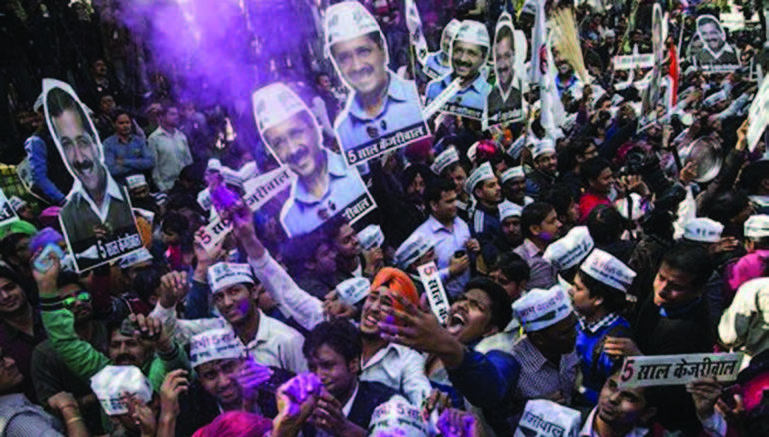
    NEW DELHI (TIP): Arvind Kejriwal’s Aam Aadmi Party surged to a landslide win in Delhi that surpassed the wildest of expectations and left a routed Bharatiya Janata Party licking its wounds in the city-state from which it rules the country.

    Kejriwal, a former tax official who turned social activist and founded AAP just over two years ago, will become chief minister for the second time on February 14, the first anniversary of his controversial resignation after just 49 days in the job.

    AAP won a record 67 seats out of 70, far higher that even the most generous exit poll, and a full 39 seats more than it won as a fledgling unit in 2013. The BJP-led alliance, which ran a disjointed campaign marked by internal dissent, saw its share vapourise to just 3 seats, down 29.

    AAP TROUNCES BJP1

    “The people of Delhi want an honest government, the people want to get rid of hollow speeches or statements like women should give birth to four children or ghar wapsi. Instead they want a government that has an action plan for Delhi,” said AAP leader Manish Sisodia as party workers celebrated wildly.

    Kejriwal thanked the city for the unprecedented win, but termed the mandate “very scary” and asked party leaders not to be arrogant. Prime Minister Narendra Modi, who had participated in a bitter election campaign against AAP, tweeted that he had congratulated Kejriwal and assured him of “complete support in the development of Delhi”.

    AAP rode to the second-biggest election victory in India’s history on promises of cheaper electricity and water and probity in government. The party also has a strident position against Delhi’s famed culture of privilege; in its last stint, one of its more popular moves was the outlawing of red beacons on official cars.

    Its culture of handouts runs counter to the ruling principles of the BJP at the Centre, which espouses a market-friendly approach and wants to cut subsidies. Stock markets, which had fallen sharply on Monday after investors took fright from the exit polls, rebounded as people chose to look ahead to this month’s union Budget.

    For the BJP, this was its first significant defeat after sweeping last year’s general election. Though statistically tiny in the overall scheme of things, the capital is home to India’s two biggest national parties and many of its top politicians, giving it a disproportionately high profile.

    The saffron party was quick to distance the result from the performance of the Narendra Modi government at the Centre. It is also expected to try and ringfence blame around its chief ministerial candidate Kiran Bedi, a high profile former cop parachuted into the role by party president and ace strategist Amit Shah, for whom the result is a rare embarrassment.

    “It’s not a referendum on the BJP government. It will be a collective responsibility of the party…and winning will just be the first step for AAP. They had made many promises. AAP kaam karke dikhaye ab (AAP, now show us what you can do),” said BJP leader Shazia Ilmi. Senior leaders stayed away from the party’s Pandit Pant Marg office after seeing the initial trends.

    Kejriwal swept to an easy win in the New Delhi constituency, while Bedi and Ajay Maken, the Congress’ chief ministerial hopeful, bit the dust in seats thought to be relatively secure for their respective parties. Congress, which ruled the state for 15 years ending 2013, scored an embarrassing duck, and its offices wore a deserted look.

    Bedi stayed true to her reputation for gaffes, telling a news conference that she hadn’t lost the elections because she had given her best. “As far as the party is concerned, it is for them to introspect on the reasons for the loss,” she added.

    Kejriwal’s first essay as chief minister, with Congress support, was marked by chaos and a vigilante approach by some of his ministers. The CM himself famously went on a dharna against the police near Rail Bhavan that briefly threatened to disrupt the Republic Day parade. He flamed out in 49 days, a resignation he later conceded was a mistake.

  • ARVIND KEJRIWAL: MAN OF DESTINY

    ARVIND KEJRIWAL: MAN OF DESTINY

    NEW DELHI (TIP): Arvind Kejriwal is a social activist and politician. He is the CM designate of Delhi as his party AAP won 67 of the 70 assembly seats of Delhi. He launched the Aam Aadmi Party (AAP) in 2012. A former Indian Revenue Service officer, he is better known for his key role in drafting the Jan Lokpal Bill.

    In 1999, Kejriwal founded Parivartan, an NGO aiming to assist the citizens in electricity, income tax and food ration-related matters. He won the 2006 Ramson Magsaysay Award for Emergent Leadership for his contribution to empower the poorest at the grassroots level and implement the Right to Information Act (RTI). He created a corpus fund with the award money and founded the NGO ‘Public Cause Research Foundation’ in 2006.

    Kejriwal also published a book called Swaraj in 2012. Arvind Kejriwal was sworn in as Delhi Chief Minister for the first time on 28 December 2013 at the Ramlila Maidan and formed the government with Congress’s support. However, his tenure lasted for only 49 days as he decided to resign from his post after both BJP and Congress turned adamant and put their foot down against giving clearance to Aam Aadmi Party’s Jan Lokpal Bill.

    Personal background

    Arvind Kejriwal was born on 16 August 1968 in Bhiwani, Haryana, to a well-educated couple, Gobind Ram Kejriwal and Gita Devi. Arvind Kejriwal has a younger brother and a younger sister. His father, Gobind Ran Kejriwal, was an electrical engineer from the Birla Institute of Technology, Mesra. His father’s work related transfers led him to several different places. Consequently, Arvind Kejriwal had to spend his childhood mostly in towns like Ghaziabad, Hisar and Sonepat. He studied at the Campus School in Hisar. Arvind Kejriwal graduated in mechanical engineering from the Indian Institute of Technology, Kharagpur, in 1989. He also spent some time at the Ramkrishna Mission and Nehru Yuva Kendra in Kolkata.

    Kejriwal is married to Sunita, his batch mate from the National Academy of Administration, Mussoorie. She is an IRS officer. They have two children – a daughter, Harshita, and a son, Pulkit. Arvind Kejriwal is a pure vegetarian and has been a regular practitioner of Vipassana.

    Professional background 

    After completing his studies in mechanical engineering from the Indian Institute of Technology, Kharagpur, he joined Tata Steel. He took leave of absence from the company so that he could concentrate on the Civil Services examination. In 1992 he quit his job. In the same year he cleared the Civil Services examination and joined the Indian Revenue Service. In February 2006, he resigned from the post of Joint Commissioner in the Income Tax Department. While working with the Income Tax department, he assisted in forming the NGO Parivartan in December 1999.

    How did Arvind Kejriwal joined politics?

    During the nation-wide protests against corruption, Arvind Kejriwal had a difference of opinion with social activist Anna Hazare. Hazare wanted the Jan Lokpal movement to be politically neutral. On the other hand, Kejriwal’s opinion was that as no progress had been attained through talks with different political parties, it was necessary to get directly involved in politics. An organisation named India Against Corruption conducted a survey in this regard. The result indicated support for politicisation. Others involved in the anti-corruption movement too had split opinions. While Kejriwal’s move was supported by Shanti Bhushan and Prashant Bhushan, others like Santosh Hegde and Kiran Bedi opposed it.

    On 19 September 2012, Anna Hazare and Arvind Kejriwal found that their differences over formation of a political party to replace India against Corruption movement were irreconcilable. On 2 October 2012, the birth anniversary of Mahatma Gandhi, Kejriwal announced the formation of a political party. He mentioned that the party would be formally launched on 26 November 2012. The Constitution of India was adopted on this day in 1949.

    The party was launched in Delhi on the scheduled date and was called the Aam Aadmi Party (AAP) or the Common Man’s Party. The party contested elections for the first time on 4 December 2013 for the Delhi legislative assembly. Arvind Kejriwal defeated Sheila Dikshit in the New Delhi assembly constituency, who had been the chief minister of Delhi for three successive terms. He was first sworn in as the Chief Minister on 28 Dec 2013. He governed Delhi for only 49 days as he resigned from the post in Feb 2014.

    Strategy for 2014 General Elections

    After Arvind Kejriwal’s resignation from the CM’s post in February, the AAP set its sights on the Lok Sabha polls. A month earlier than stepping down, Kejriwal had said that he would not contest the Parliamentary Elections. He later contested from the Varanasi parliamentary constituency in Uttar Pradesh against BJP’s Prime Ministerial candidate Narendra Modi, alleging that the party members insisted him to do so. Kejriwal lost the elections with a margin of around four lakh votes.

    Arvind Kejriwal led AAP’s run up to the 2015 Delhi Assembly Elections After 9 months of Governor’s Rule in Delhi, the Elections Commission of India dissolved the Delhi Legislative Assembly. This meant that Delhi had a date with fresh elections. Arvind Kejriwal led Aam Aadmi Party (AAP) started making a strategy for the elections. Initially, the party released a list of 62 candidates for the elections. It later added eight other names. Thus the party fielded its candidates in all 70 constituencies of Delhi as compared to 69 in the 2013 elections. AAP has resorted to innovative ways of raising funds for campaigning such as offering lunch and dinner with Kejriwal via subscriptions. The party also received funds online from the public. Social media sites too helped Kejriwal gain popularity among the masses.

    Historic Win in Delhi for AAP and Arvind Kejriwal’s Re-election as the Chief Minister

    The National Capital Territory of Delhi went to polls on 7 February 2015 and saw a record electorate turnout of 67.14 percent. But the history was still to be made. Three days later, on 10 February 2015, the “Broom” of AAP swept the Delhi polls. The AAP registered a slam-bang victory by grabbing 67 seats of the available 70. The favourite BJP was compressed to be restricted to as minimal as three seats, while Congress and the rest were crushed to ashes, accounting for none. The chief and the CM candidate of AAP, Arvind Kejriwal himself won from the New Delhi assembly constituency with a margin of more than twenty six thousand votes. He defeated the debutant Nupur Sharma of BJP and veteran Congress leader Kiran Walia. Kejriwal decided to take oath as the Chief Minister of Delhi on 14 February 2015 (a year after he had resigned from the same post), at the famous Ramlila Ground in Delhi.

    Achievements

    • In 1999 Kejriwal helped in the foundation of Parivartan, an NGO aiming to assist the citizens in electricity, income tax and food ration-related matters.
    • Played a key role to empower the poorest at the grass-root level and implement the Right of Information Act (RTI).
    • Created a corpus fund with the award money he received from the Magsaysay Award, and with that founded the NGO called Public Cause Research Foundation in 2012.
    • A committee constituted by the Government of India inducted Arvind Kejriwal as a representative member of the civil society to draft the Lokpal Bill.
    • Participated in drafting the Jan Lokpal bill.
    • Arvind Kejriwal became the architect of the movement that was started by Anna Hazare — the Jan Lokpal that demanded Citizen’s Ombudsman Bill.
    • To fight corruption cases in government departments like Delhi Electricity Board, Income Tax Department, Municipal Corporation of Delhi and the likes, Kejriwal uses the Right To Information Act.
    • Exposed alleged corruption and irregularities of political parties and government agencies through press conferences.
  • EU leaders debate new anti-terror measures

    BRUSSELS (TIP): Galvanized by the recent terror attacks in France, European Union leaders on February 12 debated a range of ambitious steps to better protect their 28 nations, including exchanging airliner passenger manifests, tightening controls at the border and combating extremism on the Internet.

    EU President Donald Tusk, the summit meeting’s host, said he would seek agreement on a “work plan to step up the fight against terrorism.” The bloc’s top official for counter-terrorism warned member governments last month that “Europe is facing an unprecedented, diverse and serious threat.”

    Counter-terrorism policy shot to the top of the EU agenda following the Jan. 7-9 terror attacks in Paris against a satirical weekly, a policewoman and a kosher grocery store that claimed a total of 17 victims. The three gunmen, who proclaimed allegiance to Al-Qaida in Yemen and the Islamic State group, were also shot dead by French police.

    The attacks mobilized France and other EU countries to seek more effective ways to deal with armed Islamic militancy, especially the problem of radicalized European-born Muslims who go to fight in Syria or Iraq and then return home.

    The attacks in the French capital “were a game-changer” for EU counter-terrorism policy, said Alexandra de Hoop Scheffer, senior trans-Atlantic fellow and director of the Paris office of the German Marshall Fund think tank. To prepare for Thursday’s summit in Brussels, EU foreign, finance and interior and justice ministers drew up recommendations on what to do.

    But as the leaders met, some officials urged caution. Finnish Prime Minister Alexander Stubb said it was imperative to strike “a careful balance between civil liberties and security.” European Parliament President Martin Schulz, who addressed the summit, told a news conference afterward that rashly limiting individual rights in the name of boosting public safety would play right into the terrorists’ hands by discrediting Western-style democracy.

    “We need to be a state of law and democracy,” Schulz said. “We need to protect our values.”

    Some of the steps the leaders were expected to consider:

    AN EU-WIDE PASSENGER REGISTRY TO SHARE INFORMATION ON AIR TRAVELERS 

    “It sounds crazy, but we don’t have that system within the EU, though we have it with the U.S., Canada and Australia,” said de Hoop Scheffer. An earlier attempt to launch an EU-wide exchange of air traveler data for prevention, detection, investigation and prosecution of terrorist offenses and other serious crimes died in the European Parliament in 2013 when a committee rejected it on civil liberties grounds.

    On Wednesday, European Parliament members, by a 532-136 vote, pledged to work toward getting a passenger name record program enacted by the end of 2015, but insisted the EU simultaneously rewrite its rules on data collection and sharing to ensure legally-binding protections.

    Even that wasn’t sufficient for Europe’s Greens, who opposed the resolution, saying it gave “carte blanche for EU governments to scale back personal freedoms.” The Greens said it would be more effective to conduct targeted surveillance on individual suspects already known to authorities.

    TIGHTER BORDER CHECKS ON TRAVELERS 

    Twenty-six European countries, among them 22 EU nations, have abolished passport and customs controls among one another in what’s commonly known as the “Schengen area.” According to EU officials, current identity checks on European travelers leaving or re-entering the area are often cursory.

    Gilles De Kerchove, the EU’s counter-terrorism chief, has called for the swift implementation of a new screening system to detect suspicious travel movements, and suggested it is also time to change some of the rules governing the Schengen area.

    FIGHTING THE USE OF THE INTERNET TO SPREAD RADICAL IDEAS 

    A draft statement prepared for Thursday’s summit calls for measures to “detect and remove Internet content promoting terrorism and extremism,” including reinforced cooperation between public and private sectors and a coordinating role for Europol, the EU’s law enforcement agency.

    “Preventing radicalization is a key element of the fight against terrorism,” the draft statement says. It also calls for development of communication strategies to promote tolerance, non-discrimination, fundamental freedoms and solidarity throughout the EU, and use of education, vocational training and rehabilitation to limit the lure of radicalization, including for people in prison.

    If all three of the major proposals are adopted, “the EU would be better equipped” to deal with the terrorism challenge, said de Hoop Scheffer.

    The EU leaders were expected to consider other measures as well, including better coordination among existing institutions like Europol, Eurojust _ the EU-wide agency of prosecutors, police and investigating magistrates _ and the bloc’s counter-terrorism coordinator.

  • North Carolina Muslims call for calm as students buried

    RALEIGH, UNITED STATES (TIP): The families of three Muslim students shot dead by a white neighbor said an emotional farewell to their loved ones on February 12, reiterating calls for the killings to be treated as a hate crime.

    More than 5,000 people gathered for the funeral of Deah Shaddy Barakat, 23, his wife Yusor Mohammad Abu-Salha, 21, and her 19-year-old sister Razan Mohammad Abu-Salha, who were killed by an anti-religion neighbor.

    The alleged shooter, Craig Stephen Hicks, 46, was believed to be strongly opposed to religion, as his Facebook page showed dozens of anti-religious posts, including proclamations denouncing Christianity, Mormonism and Islam.

    Police said they were investigating the crime as a parking dispute, but families of the slain students repeated their belief it was a religiously-motivated attack.

    “We are definitely certain that our daughters were targeted for their religion,” the father of the sisters, Mohammad Abu-Salha, told AFP.

    “This is not a parking dispute, these children were executed with shots in the back of the heads,” he said, surrounded by tearful family members as they prepared for the final funeral prayer.

    “This has hate crime written all over it and I’m not going to sit down for it,” he said later before three caskets.

    He said his daughter Yusor had complained that Hicks had harassed her, and appeared at her door to complain about a parking space with a gun holstered at his waist.

    Chapel Hill Police lieutenant Joshua Mecimore said the crime appeared to have been provoked by “an ongoing parking dispute between neighbors,” but added all possible motives were being investigated.

    Officials said the incident did not appear to be part of a broader anti-Muslim campaign, and District Attorney for Middle North Carolina

    Ripley Rand said the killing was being treated as an “isolated incident.”

    Neighbors recalled Hicks as troublesome, frequently squabbling with nearby residents over parking and seen with his gun in public, according to local media reports.

    – Stoking fear –

    The killing rattled the community, stoking fears among some Muslims in the tight-knit university town.

    “To be honest, it makes me more scared because I have two babies, so I don’t even want to imagine,” said Sarah Alhorani, a former student at University of North Carolina where Barakat was a second year dentistry student.”I was scared to walk out my door, but I did and I kept going and I kept my scarf on and you keep moving on,” said Alhorani, a friend of all three victims.Some Muslim leaders said the shooting was a reflection of wider anti-Muslim hostility, and warned it could sow fear among Muslim-Americans.

  • BRITAIN BANS DRIVERS FROM SMOKING IN CARS

    LONDON (TIP): Britain on February 11 banned drivers in England from smoking in their cars if they are carrying children as passengers.

    The move will become a law on October 1 and follows a similar ban in Wales.

    Scotland is also considering introducing a ban. Anyone found flouting the law in England could be fined £50.

    The regulations were passed in the Commons after 342 MPs voted in favour of legislation while just 74 voted against. Parliament therefore approved regulations which will make smoking in cars carrying children illegal.

    Public health minister Jane Ellison said “Three million children are exposed to second hand smoke in cars, putting their health at risk. We know that many of them feel embarrassed or frightened to ask adults to stop smoking which is why the regulations are an important step in protecting children from the harms of second hand smoke”. The regulations will not apply to a driver on their own in a car.

    Second-hand smoke is particularly harmful to children as they breathe more rapidly and have less developed airways. Children being exposed to second hand smoke results in more than 300,000 GP consultations and 9,500 hospital admissions every year. The government estimates that 3 million children in England are exposed to second hand smoke in their family car, which puts them at risk of serious conditions, including respiratory infections and meningitis and triggering asthma.

    A survey by the British Lung Foundation found that 86% of children who are exposed to smoking in cars would like the smoker to stop, yet only 31% actually feel able to ask them to do so.