Year: 2015

  • IIT alumnus Kejriwal inspires poll campaign on Powai campus

    IIT alumnus Kejriwal inspires poll campaign on Powai campus

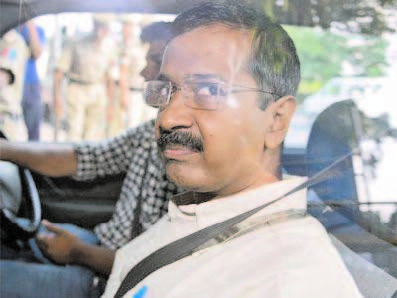
    MUMBAI (TIP): After the landmark New Delhi assembly polls, it is the turn of young ‘netas’ at IIT-Bombay to do an Arvind Kejriwal in terms of promises.

    A team of students from the institute had helped AAP understand trends on social media so that the party could finalize its manifesto for the national capital. Now, students contesting for elections to 10 posts at IIT-Powai seem inspired by the manifesto that worked wonders in the national capital.

    So, much in the style of AAP and its leader who is himself an IIT alumnus, they have made a range of promises, from the directly borrowed one of Wi-Fi connectivity to the trivial (a pizza outlet on campus), the necessary (a 24-eatery on campus) and the more serious promises of reducing students’ academic load for the first year and an increase in health insurance cover.

    None of the candidates is part of the team that recently assisted AAP, but the Kejriwal effect is evident.

    There are 18 candidates in all fighting the polls which are held annually. Five of the 10 posts on offer are for general secretaries — hostel affairs, academic affairs, sports and cultural affairs etc -and among the remaining five are those for the Mood Indigo and Techfest coordinators.Sarthak Agrawal, contesting for the post of general secretary, hostel affairs, has promised a dabba service from the mess to academic area at nominal charges during lunch and dinner hours. He and his opponent, Srikant Bukya, have both promised Wi-Fi connectivity across the campus, though they have worded their promises differently.

    Some candidates have promised counselling and stress relief workshops, others have said they will set up CCTV cameras in public areas, and still others have vowed to arrange for a/c study rooms, fire mock drills and hotline numbers to report emergencies during IIT festivals. To ease academic strain, a few candidates have promised a week-long Diwali break, and those appealing to students’ well-being have spoken of the digitisation of student records in the hospital on campus.

    Some incumbents hoping to retain their posts have assured their fellow students of follow-up action on setting up washrooms for the opposite sex in the hostels (a women’s washroom in the men’s hostel and vice versa). One candidate has even promised a system where cashless surgical and medical treatments will be possible for students across India.A student said none of the candidates has ever managed to fulfill 100% of his/her promises. ‘On an average, a good candidate fulfils around 50-60% of promises made during his/her tenure,” the student said. “The students media body acts as a watchdog and conducts debates before the elections where candidates are grilled over their ‘over-ambitious’ projects. Some fail to convince the students during these debates. After candidates are elected, every term-end their progress is reviewed comparing their performance with what they had promised in their manifestos,” the student added.Each of the candidates has prepared around two pages of manifestos. The candidates also get 10 days to go door-to-door campaigning across the 16 hostels, so that they can explain and convince the voters about their vision. Over 3,000 of the 3,600 undergraduate students are expected to vote on Monday. “The turnout is lower among post-graduate candidates with around 50% of the total 4,000 participating in the institute’s polls,” said a student.

  • Sonia seeks four weeks to respond to CIC notice

    Sonia seeks four weeks to respond to CIC notice

    NEW DELHI (TIP): Congress president Sonia Gandhi has sought four weeks time to respond to a notice of the Central Information Commission seeking an explanation on why her party had not complied with the commission’s June 2013 verdict bringing political parties under the Right to Information Act.

    Citing Delhi elections, Sonia said despite best efforts, she could not prepare the reply to the complaint within the timeframe.

    In her submission filed through her lawyer, Sonia said she was in the process of seeking legal advice and preparing appropriate response to be filed before the commission which is expected to be ready within four weeks. “The request for extension of time has been necessitated by reasons beyond the respondent’s control. The application is made bona fide and in the interest of justice,” Sonia’s lawyer said in the submission.

    The CIC had issued notice to Sonia asking her to explain why her party had not complied with the directives of a panel about responding to RTI queries and not replying to an RTI plea filed last year.

    Similar notices were issued by the CIC in separate cases to BJP as well but its chief Amit Shah has not responded till now.

    A full bench of CIC had declared that Congress and five other national parties –BJP, CPI, CPM, NCP and BSP — were public authorities under the RTI Act, but none of the parties had set up any mechanism to respond to such queries nor altered the law nor challenged the order in any high court.

    Activist R K Jain had filed the RTI application with Congress last February but with there being no response to it, he later made a complaint to the CIC.

    Alleging “non-action” on his complaint, Jain approached the Delhi High Court seeking directions for the CIC to take action on his plea. The high court gave six months to the commission to take action on Jain’s complaint.

    In a separate case filed by activist Subhash Agrawal, notices were sent to Shah and the chiefs of the other four political parties.

    Refusal to provide information or not furnishing complete information is deemed an offence under the RTI Act, which prescribes a penalty of Rs 250 per day on the public information officer of the public authority from the date the information became due to the day that it was finally made available.

  • BJP keeps options open in Bihar power struggle

    BJP keeps options open in Bihar power struggle

    NEW DELHI (TIP): BJP is keeping its options open of supporting Bihar chief minister Jitan Ram Manjhi in the trust vote he has to face on February 20. “We are keeping our options open,” senior party sources said in Delhi and in Patna, indicating that the party could abstain from voting necessitated by Nitish Kumar’s decision to remove his nominee as chief minister.

    The party is expected to take its final stand in the next couple of days. “We will come to a decision within two days,” a senior party source told TOI.

    Essentially, the choice will boil down to resolving the tension between the competing considerations of sending a message to dalits in the state by siding with Manjhi and assuaging the anxiety of its core upper caste support base over the militant empowerment politics of the chief minister.

    Manjhi got pitch-forked into chief ministership because of Kumar’s resignation from the post in the aftermath of his rout in the Lok Sabha polls last year. However, Manjhi has since projected himself as a leader of dalits in his own right. Protests, which broke out in several district headquarters and ‘welfare hostels’ (meant for SC students), attest to the success of his enterprise in promoting dalit officers in the bureaucracy. It has taken his appeal beyond the Musahar caste that he belongs to and generated sympathy for him among dalits as a whole who account for a big chunk of the electorate.

    In fact, Kumar’s political generosity for Manjhi was driven by a desire to carve a political constituency for himself among dalits.

    But while the lure of gaining dalit support in the assembly elections slated for later this year is tempting for the BJP, the party also has to factor in the unease that Manjhi’s aggressive dalit politics appears to have caused among a section of the upper caste saffron constituency. For all its reputation as a laboratory of social justice, dalits in Bihar continue to face hostility. To that extent, Manjhi’s steps like elevation of dalit officers to key positions have had their impact of jolting the equilibrium that OBCs and upper castes have achieved.

    BJP sources said the party leadership has to tread cautiously as a single political misstep can cause reverse injury at a crucial time.

  • Bengaluru-Ernakulam Express derails near Tamil Nadu’s Hosur, 10 feared dead

    Bengaluru-Ernakulam Express derails near Tamil Nadu’s Hosur, 10 feared dead

    [vc_row][vc_column width=”1/3″][vc_column_text]

    Bengaluru-Ernakulam train accident tracks Bengaluru-Ernakulam train accident map

    [/vc_column_text][/vc_column][vc_column width=”2/3″][vc_column_text]

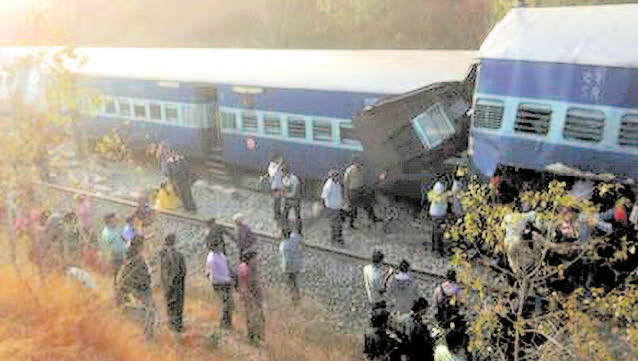
    HOSUR (TIP): At least 10 passengers were feared killed when four coaches and the engine of the Bangalore-Ernakulam Intercity Express derailed at Belagondapalli near Anekal on the Karnataka-Tamil Nadu boarder on february 13 morning.

    The Anekal police said 10 bodies have been recovered from the toppled coaches of the train and the toll was expected to go up as several passengers were still trapped in coaches.

    They said more than 70 passengers were injured in the accident that happened around 8am.

    The derailed coaches include two AC chair cars and two non-AC chair cars, railway sources said.

    They said the cause of the derailment was yet to be ascertained.

    Railway minister Suresh Prabhu said that he was personally monitoring the accident and is in touch with state and local administration.

    “My colleague Sadanand Gowda is rushing to accident site. I have directed rail board chairman to evacuate all stranded passengers,” Suresh Prabhu tweeted on Friday.

    “I express my condolences to all the unfortunate members of the families who lost lives. I have directed officials to provide best possible medical care to the injured,” Suresh Prabhu added.

    Ambulances from Tamil Nadu and Karnataka were rushed to accident spot.

    Anil Saxena, spokesperson, Indian Railways said, “A boulder hitting is suspected that have caused the train accident. Our officers are on the spot and they are looking to the matter. The accidental relief train has been dispatched. We will not be able to confirm the number of casualties as of now.”

    A passenger in coach number D10 Cherian travelling from Bangalore to Ernakulam said, “The train started at 6.30 am from Bangalore city and at 7.30 am we realised that the bogies were tilting towards the right. I fell off the berth. Most people were sleeping. By the time we escaped out, coach number D8 toppled over D9 and maximum casualties happened in D8. Police and ambulance reached after half hour or else we could saved more lives. About 11 coaches were derailed.”

    [/vc_column_text][/vc_column][/vc_row]

  • J&K STALEMATE ENDS AS PDP, BJP SEAL ALLIANCE

    SRINAGAR (TIP): The PDP-BJP alliance is all set to put an end to the Governor’s rule in Jammu and Kashmir and finally provide the state a government. According to an NDTV report, the two parties reached a consensus on key issues. Reports indicated that PDP’s Mufti Mohammed Sayeed would be the chief minister while the BJP’s Nirmal Singh will be the deputy chief minister.

    The final details of the political arrangement is expected by next week.

    The state had witnessed stalemate since the assembly elections held last year. The hung assembly gave the PDP – 28 seats, BJP – 25 seats, the National Conference (NC) – 15 seats, Congress, – 12, and others – seven.

  • CHRISTIAN SCHOOL VANDALIZED IN SOUTH DELHI

    NEW DELHI (TIP): A Christian school was vandalized by a group of men in Vasant Vihar area of south Delhi early on February 13.

    The police have identified the school as Holy Child Auxilium which has now been shut down and children sent home for the day. This is the sixth such attack on a Christian institution in the last one year.

    The Police commissioner BS Bassi has described the incident as a case of theft.

    ” Our investigations have revealed that it’s a case of theft. The CCTV footages have revealed so too. A probe is on,” said Bassi.

    Father Mathew Koyickal, member of the Delhi archdiocese, who went inside the church after the incident said, ” It looks like a case of theft. Yes they have broken a glass pane but it is too early to say it a case of vandalism”.

    The police have not disclosed the identity of the attackers but say they could be 3-4 in numbers and the footage revealed that they were wearing masks.

    Police say the principal’s office has been vandalized and Rs 8000 cash is missing.

    Senior police officers have reached the school and forensic officials and crime teams are at the spot to lift evidence. HRD minister Smriti Irani will visit the school in the afternoon today. An FIR has been registered at Vasant Vihar police station and a breakthrough is expected soon.

  • 134 companies enter final coal block race

    NEW DELHI (TIP): Altogether 134 of the 176 companies that queued up for 21 producing coal mines have been found technically qualified to make their financial bid, coal secretary Anil Swarup said on Thursday.

    Adani group, Jindal Steel and Power Ltd, Balco, Essar Power MP Ltd, GMR Chhattisgarh Energy Ltd, GVK Power, JSW Energy, Reliance Cement Company Ltd, Ambuja Cement, Hindustan Zinc, Sesa Sterlite are some of the major companies whose bids have been found technically sound.

    Of the 134 bids that were qualified, 12 are for Gare Palma IV/7 mine in Chhattisgarh, making it the most sought-after block. Balco, Hindalco, JSPL, Jaiprakash Associates Ltd, Monnet Ispat & Energy Ltd, Rungta Mines Ltd, Ultratech Cement are among the 12 interested bidders.

    Amelia (North) block and Bicharpur mine, both in Madhya Pradesh, have attracted 10 bidders each.

    The government had initially planned to auction 23 mines in the first lot but has put on hold bidding for two mines due to litigations. Swarup said the coal ministry would go ahead with the auction as per schedule, though there have been some changes due to court cases.

    “Consequent to an interim order of Jabalpur (High Court), the auction of two mines has been put on hold in schedule II (producing mines). These are Gotitoria East and Gotitoria West,” Swarup said.

    The ministry, he said, had put both the blocks in the unregulated sector (steel, cment, captive power) but the court directed that they be considered for regulated sector (power). “This will require a lot of study … so right now (only) these two mines have been put on hold ….,” he said.

    Swarup said in case of Schedule III mines (ready to produce) there are three blocks that have been taken out of auction process consequent to the order of the Delhi High Court.

    “We are referring this to a technical committee which will re-examine it in the context and as per the directives of the high court,” Swarup said, adding that in all, five blocks have been impacted by two court orders.

  • FBI director acknowledges racial bias in policing

    FBI director acknowledges racial bias in policing

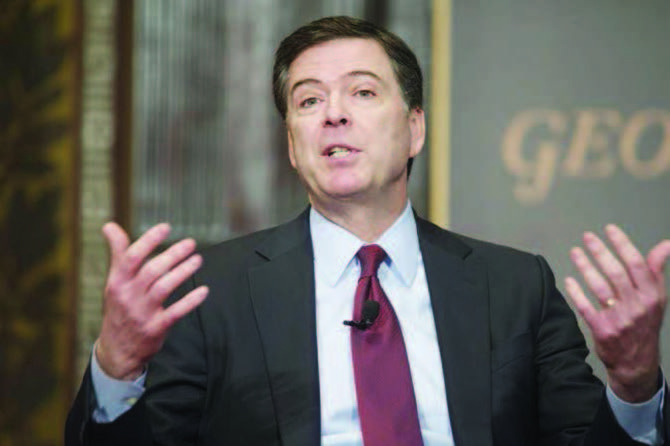
    GEORGETOWN (TIP): In an unusually frank, personal speech, FBI Director James B. Comey on Thursday, February 12, acknowledged “hard truths” about racial bias in policing, saying there’s a desperate need for law enforcement to understand the steep challenges facing minority communities and for American communities to understand the challenges facing police.

    “We are at a crossroads,” Comey said. “We can turn up the music on the car radio and drive around these problems. Or we can choose to have an open and honest discussion about what our relationship is today – what it should be, what it could be and what it needs to be.”

    Comey spoke of his respect for the police and referred to the days when his grandfather, the child of Irish immigrants, served as a police officer in Yonkers, N.Y.

    “A century ago, the Irish knew well how American society – and the police -viewed them: as drunks, ruffians and criminals,” Comey said. “Law enforcement’s biased view of the Irish lives on in the nickname we still use for the vehicle that transports groups of prisoners; it is, after all, the ‘paddy wagon.’ “In the speech, delivered to a group of Georgetown University students, Comey stepped deeper into the politically charged debate on race, policing and the use of force just 18 months after becoming director of the FBI.In 2009, Attorney General Eric H. Holder Jr. raised the ire of the White House with a speech in which he said the United States was a “nation of cowards” when it came to discussing race. Comey’s remarks were perhaps less provocative but still remarkably candid for a director of the FBI.

    At one point in his speech, Comey cited the song “Everyone’s a Little Bit Racist” from the Broadway musical “Avenue Q” in making the case that everyone makes judgments based on race.

    “No one’s really color blind,” Comey said.He said that, to remind himself of the bitter history of race in America, he keeps the one-page order that former attorney general Robert F. Kennedy signed to wiretap Martin Luther King Jr.

    Comey’s speech follows a series of high-profile cases in which police have been accused of racial bias, including the August shooting of Michael Brown, an unarmed black teenager in Ferguson, Mo., by a white police officer, as well as the choking death of Eric Garner, an unarmed black man in New York in July.

    He said that there is a need for better data about encounters between police and the communities they protect.

    “Not long after riots broke out in Ferguson, I asked my staff to tell me how many people shot by police were African American. They couldn’t, and it wasn’t their fault,” he said. “Demographic data regarding officer-involved shootings is not consistently reported to us. .?.?.?Because reporting is voluntary, our data is incomplete and therefore, in the aggregate, unreliable.”

    “It’s ridiculous that I can’t tell you how many people have been shot by the police in this country,” he later said in response to a student’s question.

    Comey said new FBI recruits, who are overwhelmingly white and male, are taken to the Holocaust Memorial as part of their training. Since he became director, he said, the recruits are now also taken to the Martin Luther King Memorial.Law enforcement attracts people who “want to do good for a living,” he added.”But something happens to people” in law enforcement, he said. Because a “hugely disproportionate percentage of street crime is committed by people of color,” officers can’t help but be influenced by cynicism, he said.

    “We must find a way to see each other more clearly,” he said. “It is hard to hate up close.”

  • Senate confirms Ashton B. Carter as secretary of defense

    Senate confirms Ashton B. Carter as secretary of defense

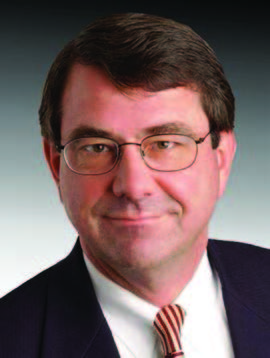
    WASHINGTON (TIP): Ashton B. Carter, a physicist with long experience in national security circles, handily won Senate confirmation Thursday, February 12, as secretary of defense, becoming President Obama’s fourth pick in six years to lead the Pentagon.

    The Senate voted 93 to 5 to approve Carter’s nomination, paving the way for him to be sworn into office sometime in the next few days.

    Voting against him were five Republicans senators: Roy Blunt (Mo.), Mike Crapo (Idaho), Mark Kirk (Ill.), James E. Risch (Idaho) and John Boozman (Ark.).

    Carter, 60, will replace Chuck Hagel, the former Republican senator from Nebraska who agreed in November to step down after Obama lost confidence in his leadership. The White House has said it wanted a new Pentagon chief to oversee the fight against the Islamic State in Syria and Iraq, as well as the continued drawdown of U.S. troops from Afghanistan.

    “With his decades of experience, Ash will help keep our military strong as we continue the fight against terrorist networks, modernize our alliances, and invest in new capabilities to keep our armed forces prepared for long-term threats,” said Obama in a statement.

    A Rhodes scholar with eclectic interests – he wrote an undergraduate thesis at Yale on the Latin writings of 12th-century Flemish monks – Carter will return to the Pentagon just 14 months after he resigned as deputy secretary of defense. He previously served as the Pentagon’s chief weapons buyer and also as a senior defense official during the Clinton administration.

    During testimony before the Senate Armed Services Committee last week, Carter pledged to keep an independent voice and demonstrated a willingness to differ with the White House. For example, he said he was “inclined” to support arms deliveries to Ukraine and that he would be open to reviewing the timetable for withdrawing troops from Afghanistan.

    Sen. Jack Reed (D-R.I.), said Carter would have to focus on existing problems such as the fighting in Ukraine, Syria, Iraq and Afghanistan but also longer-term challenges such as China’s military buildup.

    Even more daunting crises, he added, could emerge in the near future. For example, if negotiations with Iran over its nuclear program fail this year, he noted, “the consequences could alter the face of the region for generations and generations to come.”

    Sen. John McCain (R-Ariz.), the committee chairman, praised Carter on Thursday as a “committed public servant” who has drawn bipartisan support. But he questioned how much sway he would have with the White House.

    “When it comes to much of our national security policy, I must candidly express concern about the task that awaits Dr. Carter and the limited influence he may have,” McCain said. He said he had “sincere hope, but sadly little confidence, that the president who nominated Dr. Carter will empower him to lead and contribute to the fullest extent of his abilities.”

  • Sikh Officers of Harris County allowed to  wear their turbans  on duty

    Sikh Officers of Harris County allowed to wear their turbans on duty

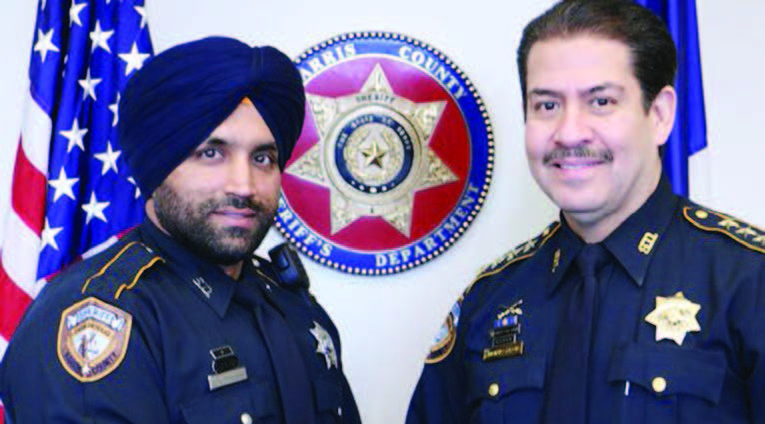
    HOUSTON, TEXAS (TIP): On February 6, Sheriff Adrian Garcia and members of Texas’s Harris County Sheriff’s Office (HCSO) made history as they held a press conference to welcome the agency’s first Sikh American deputy who will serve while wearing Sikh articles of faith, including the turban and beard.

    Sikh Americans, who have been in the United States for over 125 years, wear their articles of faith to signify a commitment to equality, service, and justice. Harris County has made history as the largest Sheriff’s office in the United States to have amongst its employees an observant Sikh American to serve his local community as a full-time deputy with his articles of faith in tact.

    “We commend Sheriff Adrian Garcia and the Harris County Sheriff’s Office for their leadership, and in recognizing that Sikh Americans and residents of Harris County should have the opportunity to serve their community, as we have done throughout our 125 year history in the United States,” said Jasjit Singh, Executive Director, SALDEF (Sikh American Legal Defense and Education Fund). “With this policy, one of the largest sheriff’s offices in the country has affirmed that a person does not have to choose between their faith and a career of service.”

    Deputy Sandeep Dhaliwal, an observant Sikh American, will for the first time be allowed to wear his Sikh articles of faith, including a dastaar (turban) and beard as part of his HCSO uniform. Dep. Dhaliwal joined the Harris County Sheriff’s Office in January 2009 as a detention officer. He became a patrol deputy in 2012 but per departmental policy at the time, he was not allowed to wear a turban or beard, both articles of faith of the Sikh religion. Due to Sheriff Garcia’s leadership that policy has now changed. In 2014, Sheriff Garcia allowed for exceptions to the HCSO’s uniform policy to allow for accommodation of religious articles under the dress code if it does not interfere with the employee’s duty. Accordingly, Sikh employees and prospective deputies can apply to wear turbans, neatly groomed beards, and other articles of faith.

    “By making these religious accommodations we will ensure that the HCSO reflects the community we serve, one of the most culturally rich and diverse communities in America,” said Sheriff Garcia. “We believe that cross-cultural inclusion and understanding is imperative for law enforcement agencies in any community. HCSO deputies need to not only understand, respect, and communicate with all segments of the population, but represent it as well,” he added.

    “Our turbans and beards represent our belief in equality. They represent a lifetime commitment to selfless service for the welfare of all,” Jasjit Singh declared.

    “Sheriff Garcia’s commitment to inclusion will help ensure that Harris County continues to attract the best and brightest from across our community to serve,” said Bobby Singh, Regional Director, SALDEF (Sikh American Legal Defense and Education Fund). “Sikh Americans cherish the values that are cultivated through a career in law enforcement, like service and commitment.”

    Starting in December 2008, just one month after being elected sheriff, Sheriff Adrian Garcia met with the Sikh American community at the Sikh Center of Houston in order to ensure that the HCSO will facilitate the safety of all its residents. That meeting was the first of many Sheriff Garcia has held with the Sikh community and other religious and ethnic groups since taking office in 2009. Upon taking office in January 2009, Sheriff Garcia immediately expanded diversity training for all Sheriff’s Office personnel, established regular faith leaders meetings, and created a Citizen Advisory Council to foster and improve communication with the public.

    The HCSO is the largest Sheriff’s Office in the United States to have a full-time Sikh American officer with his articles of faith intact due to a religious accommodation exception to their dress code policy. “We believe that this announcement will inspire other local law enforcement units from around the country to follow in Harris County’s footsteps,” said Jasjit Singh, Executive Director, SALDEF.

    SALDEF’s Law Enforcement Partnership Program provided training materials, curriculum, and instructors to the HCSO during the past six years. LEPP began as the first formalized cultural awareness training program for law enforcement about Sikh Americans in 1999. The curriculum has expanded to reach 100,000 officers and agents throughout the country.

    In May 2012, Washington Metropolitan Police Department, the seventh largest police force in the nation, became the first major police department in the United States to explicitly and voluntarily allow Sikh Americans to serve as full-time, uniformed police officers while keeping their articles of faith. Subsequently, California’s Riverside PD was the first police department in California, and only the second in the nation, to proactively amend their uniform guidance. California’s AB1964 then created statewide religious accommodations in favor of employees and job applications, which allows Sikh Americans to serve in the state with their articles of faith intact.

  • Visiting Indian grandfather assaulted, injured; Alabama Police apologize

    Visiting Indian grandfather assaulted, injured; Alabama Police apologize

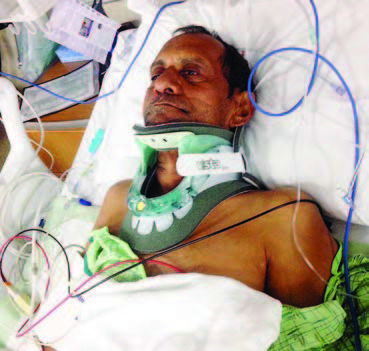
    MADISON, ALABAMA (TIP): Madison police, February 6, roughed up a 57-year-old Indian citizen who was walking on the sidewalk outside his son’s home, leaving the older man temporarily paralyzed and hospitalized with fused vertebrae.

    “He was just walking on the sidewalk as he does all the time,” said his son, Chirag Patel, this morning. “They put him to the ground.”

    Sureshbhai Patel, 57, sued the city and two officers in a civil rights complaint filed on Thursday, February 12 alleging race factored into his treatment, his attorney said. The FBI said it was also investigating.

    Police officials in Madison, Alabama, apologized to Patel and his family at a news conference on Thursday afternoon. They said one of the officers involved in the incident last Friday had been arrested on an assault charge, and officials had recommended he be fired.

    Patel, who speaks no English, moved from India to northern Alabama about two weeks ago to help his son’s family care for a 17-month-old child, said his lawyer, Henry Sherrod.

    He was walking on the sidewalk outside his son’s home around 9 a.m., when police said they received a call about a suspicious person, according to the lawsuit in the U.S. Northern District of Alabama.

    Patel told police officers who stopped him: “No English, Indian,” and gave the house number for his son, the suit said.

    A police officer then tossed Patel, who weighs about 130 pounds, to the ground, according to the complaint.

    He was severely injured, requiring surgery to relieve pressure on his spinal cord, the complaint said. He has regained some movement in his arms and legs but remains weak, his attorney said.

    “I just can’t believe what they did to this very gentle man who wanted nothing more than to go out for a walk,” Sherrod said.

    The police said in an earlier statement that Patel put his hands in his pockets and tried to pull away as officers patted him down.

    Police on Thursday released video of the incident, recorded from inside a patrol vehicle. It showed Patel standing with his hands behind his back with two uniformed officers in a residential neighborhood.

    Then an officer abruptly flipped him to the ground.

    Police also shared a recording of the suspicious person call, which had been questioned by Patel’s attorney.

    The officer involved “did not meet the high standards and expectations of the Madison Police Department,” Police Chief Larry Muncey told reporters.

    The federal probe results will be turned over to the U.S. Department of Justice, said an Alabama FBI spokesman.

    The assault on the old Sureshbhai Patel has been widely condemned by the Indian American community. A New York based senior attorney Ravi Batra has condemned the assault which has severely damaged the spine of Sureshbhai Patel. He released the following statement to The Indian Panorama.

    “The local Madison cop dishonored his badge, and violated Sureshbhai Patel’s federal civil rights and state rights. The governor of Alabama needs to speak out and mayor of Madison need to retrain their cops while holding Police Chief Larry Muncey responsible.

    Our federal government, led by President Obama, can move Sureshbhai to Walter Reade hospital – where US presidents go for care, and give him the best medical care to repair his spinal injuries.

    The local district attorney ought open a criminal investigation and seek to indict the cop for his illegal behavior. Only if there is no action, does Attorney General Holder, or AG Nominee Loretta Lynch have to open a federal investigation.

    India’s MEA needs to keep warm ties with US, while affording all benefits to Sureshbhai financially.”

  • Pakistan likely sheltered Osama: Ex-ISI chief

    Pakistan likely sheltered Osama: Ex-ISI chief

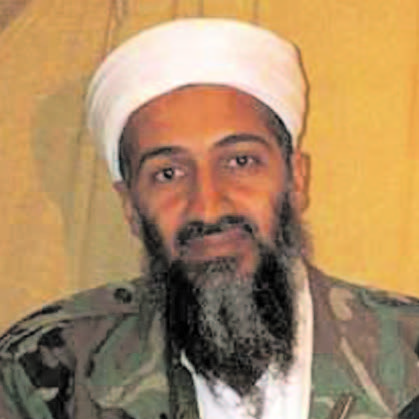
    ISLAMABAD (TIP): The former chief of Pakistan’s intelligence agency, ISI, Lt. Gen. Asad Durrani (retd) has said that the Government of Pakistan is likely to have sheltered slain terror mastermind Osama bin Laden and handed him over to the US as part of a deal. “I cannot say exactly what happened but… it is quite possible that they (the ISI) did not know, but it was more probable that they did,” Al Jazeera quoted General Asad Durrani (retd) as saying.

    The ex-Al Qaeda chief and the mastermind of the 9/11 terrorist attacks in the US was killed in a US raid on his house in Pakistan’s garrison town of Abbottabad in May, 2011. Officially, the ISI maintains that it did not harbour bin Laden and played no part in the US raid.

    Durrani told Al Jazeera that he doubted the official line given by the ISI that it was unaware of the Al Qaeda leader’s whereabouts until his death, implying that Pakistan would only have exchanged knowledge of his location in a quid pro quo deal.

    Durrani, who served as director general of the ISI from 1990 to 1992, asserted that bin Laden was handed over in exchange for an agreement on “how to bring the Afghan problem to an end”.

    Asked whether bin Laden’s compound was an ISI safehouse, Durrani responded: “If ISI was doing that, then I would say they were doing a good job. And if they revealed his location, they again probably did what was required to be done.” 

    Commentators have questioned how bin Laden could have eluded the ISI in the years leading up to his killing, given the location of his compound in a garrison town.

    According to the US, the raid on bin Laden’s compound was deliberately conducted without the knowledge of the Pakistani government or its military.

    The Abbottabad Commission, which was set up by Pakistan to investigate the circumstances surrounding the raid, charged the military and the government with “gross incompetence” leading to “collective failures” that enabled bin Laden to reside in Pakistan unnoticed.

    The ISI had previously helped the US Central Intelligence Agency (CIA) detain a number of high-ranking suspects, including Ramzi Yousef, one of the men who planned the 1993 World Trade Centre bombing in New York, and Khalid Sheikh Mohammed, one of the alleged masterminds of the 9/11 attacks on New York and Washington.

  • Sri Lanka bans alleged killer of Rajiv Gandhi from travelling abroad

    Sri Lanka bans alleged killer of Rajiv Gandhi from travelling abroad

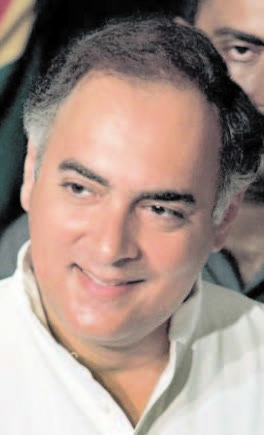
    COLOMBO (TIP): A Sri Lankan court on Thursday barred former Tamil Tiger rebel leader Kumaran Pathmanathan, wanted by India in connection with the assassination of Rajiv Gandhi, from travelling abroad, a lawyer said.

    Rajiv Gandhi was prime minister when he was killed in May 1991 by a suicide bomber at a public meeting in Tamil Nadu.

    Pathmanathan, who became leader of the Liberation Tigers of Tamil Eelam (LTTE) in 2009, after their defeat by the Sri Lankan army, is also on Interpol’s most wanted list on charges including arms smuggling and criminal conspiracy.

    “The Court of Appeal issued an order to the Controller of Emigration and Immigration to prevent him leaving the country,” said Sunil Watagala, a lawyer who had sought Pathmanathan’s arrest.

    Pathmanathan had been the LTTE’s chief arms procurer and run its global fund-raising network as it fought to carve out a separate state for minority Tamils in Sri Lanka.

    Former president Mahinda Rajapaksa’s government captured him in Southeast Asia in August 2009 and brought him to Sri Lanka. Pathmanathan then began cooperating with the government, and was released in 2012.

    The coalition headed by Sri Lanka’s new president, Maithripala Sirisena, pledged before his election victory last month to take legal action against Pathmanathan if it won.

    Janatha Vimukthi Peramuna (JVP), a Marxist party that had backed Sirisena for president, then filed a petition seeking Pathmanathan’s arrest.

  • Seven killed in Bangladesh after petrol bombs thrown at bus

    DHAKA (TIP): Opposition activists in Bangladesh trying to enforce a transport boycott threw petrol bombs at a bus early on Tuesday setting off a fire that engulfed the vehicle killing seven people, a fire department officer said.

    The opposition rejected a general election just over a year ago and stepped up its protests last month in a bid to force Prime Minister Sheikh Hasina to step down and hold a new election.

    At least 51 people have been killed in political violence over the past month including the seven on the night-bus to Dhaka.

    “Seven died on the spot after opposition activists hurled petrol bombs,” fire department official Monir Hossain told reporters in the southeastern district of Comilla.Sixteen people were injured, several of them critically, he said.

    Spokesmen for the opposition Bangladesh Nationalist Party (BNP) were not available for comment. They routinely reject accusations that their activists are responsible for violence. Bangladeshi politics has been mired for years in bitter rivalry between Hasina and BNP leader Begum Khaleda Zia.

  • Another BLASTS KILL 6 POLICEMEN IN PAKISTAN

    PESHAWAR (TIP): At least six soldiers were killed on February 10 in two separate roadside bomb blasts in Pakistan’s restive northwestern tribal region.

    Pakistan Taliban claimed responsibility for the attacks. The first remote-controlled improvised explosive device blast occurred in Mansehra district, killing two policemen this morning.

    A few hours later, second blast hit a police vehicle and claimed the lives of four cops in Urmagai area of central Kurram Agency bordering Afghanistan, officials said, adding that security forces cordoned off the area and launched a search operation.

    Tehreek-i-Taliban Pakistan, meanwhile in a statement, said that it has carried out both the attacks.

    Kurram is one of the most sensitive tribal areas as it borders three Afghan provinces. It is adjacent to North Waziristan region where security forces have launched an offensive againsgt the Taliban.

  • TALIBAN SUICIDE ATTACKERS ASSAULT AFGHAN POLICE STATION

    KABUL (TIP): Taliban suicide attackers assaulted an Afghan police station February 10, killing one officer as a separate roadside bombing targeted a prominent female politician in the country’s east, authorities said.

    The attack on a police headquarters in Afghanistan’s northern Kunduz province saw insurgents first detonate a suicide car bomb followed by a suicide bomber on foot, Interior Ministry spokesman Sediq Sediqqi said. Three more gunmen attacked following the bombings and died in a shootout with police, Sediqqi said.

    A statement from President Ashraf Ghani condemned the attack, saying it killed one police officer.

    Taliban spokesman Zabihullah Mujahid claimed the attack in a message on Twitter.

    Meanwhile, the roadside bomb in Jalalabad near a school exploded as Angeza Shinwari, a Nangarhar province councilwoman, drove past. The blast killed her driver and severely wounded Shinwari and another person, said Ahmad Zia Abdulzai, a spokesman for the provincial governor.

    No group immediately claimed responsibility for that attack.

    Taliban insurgents have stepped up their attacks on Afghan soldiers and police in recent months. US and NATO forces formally ended their combat mission at the end of last year, leaving Afghan security forces in charge of public safety in the country.

  • Yet Again – Khaleda Zia charged with inciting violence

    DHAKA (TIP): Bangladesh opposition leader Khaleda Zia was on february 11 charged by the police with
    ‘instigation’ of the fire-bombing of a bus that left 7 people dead amid escalating political crisis in the country that has claimed 60 lives within a month.

    At least seven passengers, including two women, were charred to death on Tuesday when suspected opposition activists hurled petrol bombs on a packed bus in eastern Bangladesh, the worst attack during the current spate of political unrest.

    “She has been named as an instigator of the attack,” district police chief Tutul Chakrabarty said.

    Former Comilla MP and central Jamaat-e-Islami leader Syed Abdullah Mohammad Taher has been also accused in the case, Charkavarty was quoted as saying. Bangladesh Nationalist Party (BNP) chief Zia has already been named as the instigator in two incidents of arsons, including the one at Dhaka’s Jatrabarhi, which left one dead and 30 others injured. A total of 56 BNP and Jamaat activist have been accused in both cases.

  • Meet AAP leaders

    Meet AAP leaders

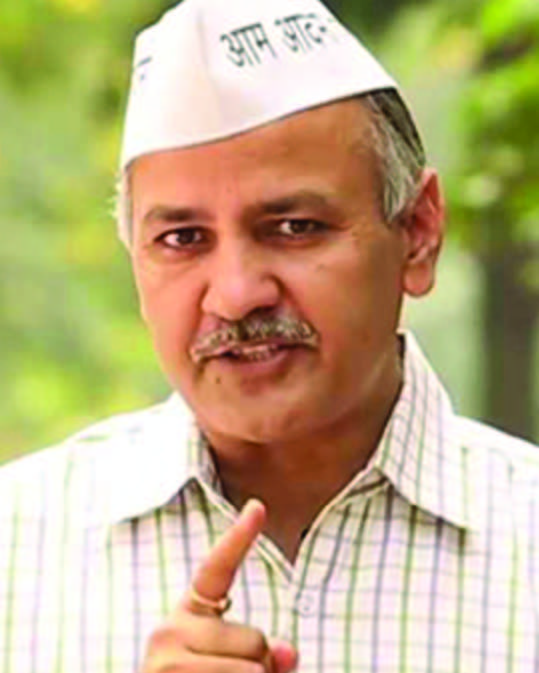
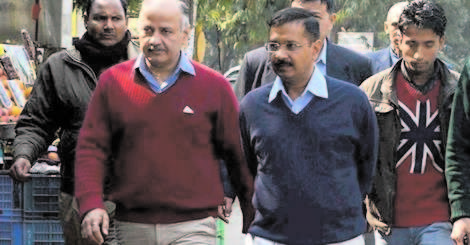
    [vc_row custom_title=”Manish Sisodia”][vc_column width=”2/3″][vc_column_text]He is often termed Arvind Kejriwal’s Man. The 42-year-old former journalist has been closely working with Kejriwal since the days of the India Against Corruption movement. He had held several key ministries in the Delhi government formed by the AAP in 2013, including urban development, public works department, land and building, local bodies, and education. Sisodia is likely to retain most of these, as he is considered the best person, apart from Kejriwal, to co-ordinate with the Centre on crucial issues such as full statehood, allocation of land for building schools, colleges and re-structuring of bodies such as the Delhi Development Authority and the Municipal Corporation of Delhi.[/vc_column_text][/vc_column][vc_column width=”1/3″][vc_single_image image=”30905″ css_animation=”appear” alignment=”center” border_color=”grey” img_link_target=”_self” img_size=”full”][/vc_column][/vc_row][vc_row custom_title=”Kumar Vishwas”][vc_column width=”1/3″][vc_single_image image=”30904″ css_animation=”appear” border_color=”grey” img_link_target=”_self” img_size=”full”][/vc_column][vc_column width=”2/3″][vc_column_text]Kumar Vishwas (born 10 February 1970) is a Hindi-language performance poet and an Indian politician and National Executive of Aam Aadmi Party. Vishwas became a professor in Rajasthan in 1994. He has taught Hindi Literature to higher class students at Lajpat Rai Post-Graduate College for the last sixteen years. Vishwas supported the anti-corruption movement led by Anna Hazare. He contested the 2014 Lok Sabha election, as an Aam Aadmi Party candidate from Amethi, but lost to Rahul Gandhi.[/vc_column_text][/vc_column][/vc_row][vc_row custom_title=”Sanjay Singh”][vc_column width=”2/3″][vc_column_text]Sanjay Singh is a social activist[1] who has campaigned for the rights of street hawkers and Aam Aadmi Party core committee member. Sanjay Singh was born in Sultanpur, Uttar Pradesh, India. He did Diploma in Mining Engineering from Orissa School of Mining Engineering in 1990. Singh was among those who were involved in creating the Aam Aadmi Party in 2012. He was a Core Commitee Member of Team Anna[4] and spoke on behalf of it during the India Against Corruption movement.[/vc_column_text][/vc_column][vc_column width=”1/3″][vc_single_image image=”30903″ css_animation=”appear” border_color=”grey” img_link_target=”_self” img_size=”full”][/vc_column][/vc_row][vc_row custom_title=”Ashutosh”][vc_column width=”1/3″][vc_single_image image=”30907″ css_animation=”appear” border_color=”grey” img_link_target=”_self” img_size=”full”][/vc_column][vc_column width=”2/3″][vc_column_text]Ashutosh (born 1965) is a former Indian TV journalist, turned politician of the Aam Aadmi Party. He is the spokesperson of Aam Aadmi Party. He was previously associated with IBN7, of TV18 group, as Managing Editor. He contested the 2014 Lok Sabha elections from Chandni Chowk against Kapil Sibal of Congress and Harsh Vardhan of the BJP. He garnered more votes than Kapil Sibal of the Congress, but lost out to Dr Harsh Vardhan of the BJP.[/vc_column_text][/vc_column][/vc_row][vc_row custom_title=”Gopal Rai”][vc_column width=”2/3″][vc_column_text]A founder-member of AAP, Rai is slated to get a berth in the Delhi Cabinet. He has been a part of key decisions such as candidate selection for the just-concluded Delhi elections and the 2014 Lok Sabha polls. He has also helped strengthen AAP’s base nationally.[/vc_column_text][/vc_column][vc_column width=”1/3″][vc_single_image image=”30906″ border_color=”grey” img_link_target=”_self” img_size=”full” css_animation=”appear”][/vc_column][/vc_row]

  • Reset of a policy of equidistance

    Reset of a policy of equidistance

    Soon after Prime Minister Narendra Modi took office, an Indian TV channel held a discussion on likely foreign policy reorientation. When the doyen of South Asian Studies, Stephen Cohen, was asked in which direction Mr. Modi would tilt -the U.S. or China – without hesitation he replied, “China,” adding, “because it is the Asian century.” Mr. Modi hosted Chinese President Xi Jinping last year but despite the fanfare preceding the visit, there was little to suggest any strategic overlap. Alas, Mr. Cohen was proved wrong after the Modi-Obama Joint Vision Statement reflected a sharp, strategic congruence. Mr. Modi has reset the United Progressive Alliance (UPA) government’s policy of equidistance between the U.S. and China and dropped the political refrain that India will not contain China.


    Choosing friends and allies

    In New Delhi last year, at a seminar, the former U.S. Ambassador to India, Robert D. Blackwill, posed the question: “How can New Delhi claim strategic autonomy when it has strategic partnerships with 29 countries?” After the latest Modi-Obama vision statement, even less so. Strategic autonomy and no military alliances are two tenets of India’s foreign policy. Quietly, India has converted strategic autonomy to strategic interconnectedness or multi-vectored engagement. When the Indo-Soviet Treaty of Peace, Friendship and Cooperation 1971 was signed, Mrs Indira Gandhi had requested the Soviet Union to endorse India’s Non-Aligned status, so dear was the policy at the time. That multifaceted treaty made India a virtual ally of the Soviet Union. Russia inherited that strategic trust and has leased a nuclear submarine, provided high-tech weapons to all three Services including technology for nuclear submarines and aircraft carriers. At the BRICS meeting in Brazil last year, when asked a question, Mr. Modi said as much: “If you ask anyone among the more than one billion people living in India who is our country’s greatest friend, every person, every child knows that it is Russia.” 

    On the other hand, differences over foreign policy with the U.S. are many including over Syria, Iran, Russia, BRICS and the Shanghai Cooperation Organisation (SCO). These policy irritants will not go away. The vision statement highlights (at the U.S.’s insistence) that both countries were on the same page in ensuring that Iran did not acquire nuclear weapons. The tongue-lashing by Mr. Obama to Mr. Putin over his bullying small countries has certainly embarrassed Mr. Modi who was himself disingenuous by inviting the leader of Crimea as a part of the Putin delegation in 2014, which deeply offended the Americans.

    What Mr. Obama and Mr. Modi easily agreed on was China’s “not-peaceful rise” which could undermine the rule-based foundations of the existing international order. So, Mr. Modi became a willing ally to stand up to China. The synergisation of India’s Act East Policy and U.S. rebalancing to Asia is intended to ensure that China does not cross red lines including the code of conduct at sea. The two theatres of action where freedom of navigation and overflight have to be ensured were identified as Asia-Pacific especially the South China Sea and, for the first time, the Indian Ocean Region.

    This is a veiled riposte to Chinese assertiveness in the South China Sea. Mr. Modi had earlier mooted the revival of the Quad, an enlarged format for naval exercises between India, the U.S., Japan and Australia. When it was mooted earlier in 2006, it was shot down by China. Underlying the strategic centrality of the Indian Ocean Region is the realisation that the existing India-China military imbalance across the high Himalayas can be offset only in the maritime domain where India has the initiative. Beijing realises that teaching India a lesson in 1962 was only a tactical success because territorial claims on Arunachal Pradesh got delegitimised after the unilateral withdrawal and worse, pushed India into the U.S.’s arms.


    Defence ties

    The rise of India which will punch to its weight under a new self-confident leadership pursuing a policy of multi-engagement is a manifest U.S. strategic goal. Defence has been the pivot around which India-U.S. relations were rebuilt, starting in 1991 with the Kicklighter Plan (Lt.Gen. Kicklighter of the U.S. Pacific Command) who initiated the multilayered defence relations which fructified in 1995 into the first Defence Framework Agreement. It was renewed in 2005 and now for the second time this year, the difference though is that for the first time, the vision statement has provided political and strategic underpinnings to the agreement. What had also been lacking until now was trust and the extent to which India was prepared to be seen in the American camp. Just a decade ago, while contracting for the Hawk trainer aircraft with the U.K., India inserted a clause that “there will be no US parts in it.” This followed the Navy’s sad experience of the U.S. withholding spare parts for its Westland helicopters. Such misgivings have held up for a decade the signing of the three “alphabet- surfeit” foundational defence agreements of force-multiplication. But we have moved on and purchased $10 billion of U.S. high-tech military equipment and another $10 billion worth will soon be contracted. The most elaborate defence cooperation programme after Russia is with the U.S.


    Dealing with China

    What made Mr. Modi, who visited China four times as Chief Minister, change his mind on the choice of the country for primary orientation was the jolt he received while welcoming President Xi Jinping to Gujarat last year. Mr. Xi’s delegation was mysteriously accompanied by a People’s Liberation Army (PLA) intrusion in Ladakh which did not yield ground till well after he had left. A similar affront preceded the 2013 visit of Premier Li Keqiang, making routine the PLA’s bad habits. While the UPA government had made peace and tranquillity on the Line of Actual Control (LAC) a prerequisite for consolidation of bilateral relations, border management rather than border settlement had become the norm. Seventeen rounds of Special Representative talks on the border yielded little on the agreed three-stage border settlement mechanism. It was therefore path-breaking when Mr. Modi during the Joint Statement asked Mr. Xi for a clarification on the LAC -the process of exchanging maps that had failed in the past and led to the ongoing attempt at a political solution skipping marking the LAC. Clearly, we have moved full circle in calling for a return to that process. Foreign Minister Sushma Swaraj, who was in Beijing this month, sought an out-of-the-box solution for the border, in which category LAC clarification will not figure. Mr. Modi is determined not to leave resolution of the border question to future generations as Chinese leaders have persistently counselled. 

    Mr. Modi, in Japan last year, expressed concerns over “expansionist tendencies.” 

    Chinese scholars I met in Beijing last year said that conditions for settling the territorial dispute were not favourable because the border is a very complicated issue, entailed compromise and had to take public opinion along. And most importantly, strong governments and strong leaders were needed for its resolution.

    While Mr. Xi did promise last year investments worth $20 billion, the fact is that, so far, Chinese investments in India do not exceed $1.1 billion. Mr. Xi’s dream of constructing continental and maritime Silk Roads are intended to complement the String of Pearls in the Indian Ocean Region, bypassing choke points like the Malacca Straits as well as neutralising the U.S. rebalancing to Asia.


    Risks and opportunities

    How will India walk the tightrope between the U.S. and China, given that the U.S. is about 13,000 kilometres away and Beijing exists cheek by jowl, peering over a disputed border and with a whopping $40 billion in trade surplus? China’s reaction to the vision statement has been to warn India against U.S. entrapment. Operationalising the strategic-security portions of the vision statement will not be easy, especially as India has no independent role in the South China Sea. Once the euphoria over the Obama-Modi statement dissipates, ground reality will emerge. Instigating Beijing, especially in the South China Sea will have costs like having to deal with the full frenzy of the PLA on the LAC with most likely ally, Pakistan lighting up the Line of Control (LoC) – the worst case two-front scenario.

    Given Mr. Modi’s growth and development agenda, for which he requires the U.S., China, Japan and others, he cannot afford to antagonise Beijing. The U.S. is vital for India’s rise and a hedge to China. So, New Delhi will necessarily be on a razor edge. In any realisation of the Asian century, while China and India are likely key players, Washington will be large and looming, making a geostrategic ménage à trois.

  • Delhi vote is a rejection of BJP

    Delhi vote is a rejection of BJP

    BJP, in particular Modi-Shah duo, must be terribly disappointed at the turn of events in Delhi. Only the other day, a roaring Modi had said, “Jo desh ka mood hai wohi Delhi ka mood hai”. He has been proved wrong. “Aap ko mujh per bharosa hai?”, Modi had asked people of Delhi at a BJP rally, believing they would believe him as the whole nation had only a couple of months ago. The people of Delhi have given him the answer; it is a big NO. It is the same people who had blessed the BJP with all 7 Parliamentary seats just a few moths ago. What a fall!

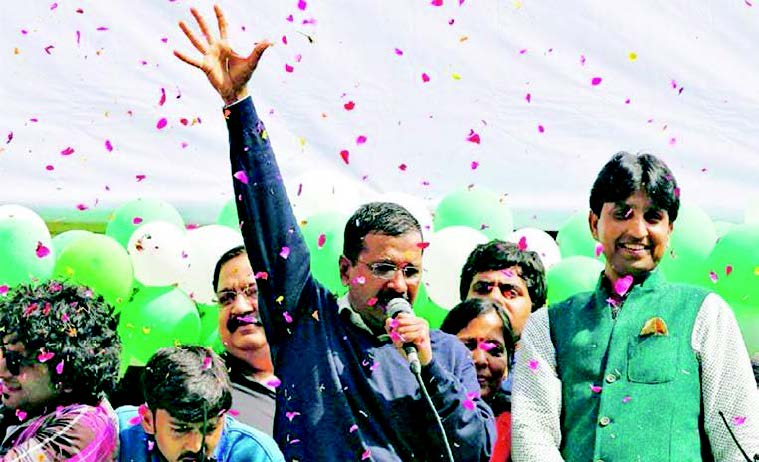
    The Lok Sabha polls last year witnessed a total loss of faith in the ruling UPA, particularly the Congress Party. The Delhi elections are a rejection of BJP. People of Delhi realized that the BJP government led by Narendra Modi had done nothing for the nation  in the last 8 months of governance to be trusted to do any good to them. With he Congress Party already rejected by them, the only choice they had was the Aam Aadmi Party. They chose to give Kejriwal  benefit of doubt for his abdication of authority in his earlier 49 days tenure and graciously gave him another opportunity to prove himself. And this time, they ensured he did not have to depend on other political parties  to have his way.

    However, let the AAP understand very clearly that people expect them to deliver, not just make  promises. If the AAP comes up to the expectations of people of Delhi, they will have made a place for themselves nationally. AAP has a great opportunity to fill the void created by the  discredited Congress party. However, they must not be  in a hurry to do so. Let them  work to fulfill their promises made to people of Delhi and consolidate their position there. If they fail in Delhi, they will have no place in politics for ever. They are small enough to be devoured.

    The Congress party, if it ever thinks of regaining some strength, has to make sure it reaches out to common people, as it had done during the freedom struggle , listen to people’s problems, and struggle against the governments in the streets, if they do not have enough strength in the legislatures, to secure social and economic justice common people. It is through reaching out to common people that the Congress party can hope to regain its lost ground. If AAP fails, the Congress party will be the natural choice against the BJP.

    One hopes, the BJP by now  will have  learnt a few lessons. One, rhetoric alone does not help. Two, Indians do not accept the divisive and communal politics f BJP brand. People, in Delhi elections, have voted for peace, development and brotherhood. They have voted for united Indians in a secular India.

  • The AAP’s Second Coming

    The AAP’s Second Coming

    In the winter of 2013, at a dinner party hosted by a prominent Janata Dal (United) leader in the national capital, shortly after the Delhi Assembly elections, I was witness to an extraordinary conversation. Seated at a table on the lawns of a Lutyens’ bungalow, senior leaders from the Congress, the Nationalist Congress Party (NCP), the Bharatiya Janata Party, the Communist Party of India (Marxist), the JD (U) and the Samajwadi Party discussed the dramatic electoral debut of Arvind Kejriwal’s Aam Aadmi Party (AAP) that stood a close second to the BJP in the State polls. The surprise?Despite their differing world views, they unanimously described Mr. Kejriwal’s politics as the most serious threat to the future of their own parties.

    But 13 months later – a period that saw Mr. Kejriwal become Chief Minister, then quit and fade away, and Narendra Modi’s BJP achieve spectacular success in the general election – many of those opposition parties including the JD (U), the Trinamool Congress and those from the Left declared solidarity with the AAP ahead of this year’s Delhi Assembly polls. When the results arrived, the significance of the barely two-year-old party’s victory sank in, and congratulations started pouring in from opposition parties including the Shiv Sena and the People’s Democratic Party, BJP allies, old and new. The message?Thank you for stopping the BJP.

    So what does the AAP’s second coming in Delhi – a microcosm of India, with its privileged, powerful urban centre widening out into a hinterland of migrants – mean for the traditional opposition parties? Is it an opportunity or a challenge, as they read it in 2013? 


    Ending era of ‘anti-Congressism’

    Last year, the BJP became the first party other than the Congress to win a majority at the Centre, ending the era of “anti-Congressism.” If the BJP was to be defeated, the message of the electorate was that as many non-BJP parties as could unite would have to come onto one platform, flipping the concept of “anti-Congressism” formulated by the socialist leader Ram Manohar Lohia over half a century ago.

    It is, therefore, not surprising that those at the forefront of the emerging “anti-BJPism” in the country are Lohia’s disciples: Janata Parivar members who have, on several occasions, since the 1960s, worked closely with the BJP or the Jan Sangh against the Congress.

    Today, the Janata Parivar’s constituents are struggling to merge their identities to form one party to protect their turf in Bihar, Uttar Pradesh, Karnataka and Haryana against the imminent BJP onslaught, their efforts slowed down by the crisis within the JD (U) in Bihar where they will face their first challenge in State elections later this year.


    Challenging BJP in Parliament

    Simultaneously, the Janata Parivar has also been playing a key role in challenging the BJP on the streets and in Parliament. The Janata Parivar-sponsored agitations questioning the government’s failure to act on the BJP’s electoral promises of bringing back black money, enhancing prices of farm produce, etc. may have gone largely unnoticed. But in Parliament, along with other opposition parties, they have caused serious discomfort to the ruling dispensation.

    In the winter session, the opposition deployed its superior numbers to block the Modi government’s reforms agenda. Divided on economic issues, the opposition joined hands to demand a clarification on religious conversions and communal statements made by BJP MPs, before cooperating on legislative business. The government walked into the opposition trap, failing to clear the Insurance Bill and the Coal Mines Bill. Eventually, it issued a slew of ordinances, providing fresh fodder for the opposition, which accused the BJP government of bypassing Parliament.

    This show of opposition solidarity (that saw nine parties including the Dravida Munnetra Kazhagam, the Bahujan Samaj Party and the NCP working jointly) will be repeated in this month’s budget session of Parliament, with the AAP’s clean sweep in the capital only strengthening that unity. Indeed, the government will find it hard now to push the land acquisition ordinance, for it was on this issue that the AAP campaigned in Outer Delhi where it had failed to get even a single seat in 2013, thanks largely to its inability to crack the caste factor among the migrant population. In 2015, the AAP won 12 of the 14 seats here.

    But replicating opposition unity outside Parliament will be far more difficult. The compulsions of State politics will ensure that regional parties such as West Bengal’s Trinamool and Odisha’s Biju Janata Dal will continue to work alone in their States, especially when it comes to electoral politics. The All India Anna Dravida Munnetra Kazhagam and the DMK will remain the dominant parties in Tamil Nadu, joining hands with parties with smaller presence at election time. Of course, any of these parties might at some stage join a broader national opposition front, provided potential partners don’t encroach upon their own areas of influence.

    For the steadily declining Left parties, which are in power in Tripura and have a notable presence in West Bengal and in Kerala, forging issue-based unity with other parties in Parliament is even less likely to translate into electoral solidarity. At best, it will participate in street agitations and its trade unions may make common cause with similar organisations on specific issues. The Left parties – the CPI(M), the CPI, the Forward Bloc and the Revolutionary Socialist Party – are currently engaged in trying “to broaden the Left” by including the Communist Party of India (Marxist-Leninist) and the Socialist Unity Centre of India. But with its focus still on creating an alternative policy framework, one that still remains at odds with most other political parties, it is unlikely that it would have any meaningful electoral alliances.

    That leaves us with the country’s largest opposition party, the Congress. If party president Sonia Gandhi had forged electoral alliances ahead of the 2004 general election to lead the United Progressive Alliance to victory, one that sustained for a decade, her successor is not cut from the same cloth. Rahul Gandhi, poised to become party president, has not yet demonstrated the leadership qualities necessary to revive the Congress that touched a historic electoral low last year. Worse, say despairing members of the Congress Working Committee, he is unwilling to work towards building electoral alliances to regain political ground.

    Most opposition parties were looking to the Congress for revival of the opposition. But now with the party scoring a duck in a State that it had earlier ruled for 15 uninterrupted years, that hope will diminish further.

    Where does the AAP now fit into the opposition? A quick check with some opposition leaders suggests that while they would like Mr. Kejriwal to endorse their dying brands, they are wary of entering into an alliance with him. They know that his David-like slaying of the Modi Goliath means he could only join such a platform in one capacity – as the leader.

    The AAP’s historic win may have shattered the air of invincibility that Mr. Modi had acquired, but for traditional opposition parties to get another life outside Parliament, they must build a younger leadership, re-invent themselves or simply perish. The Delhi election reflected a change in the national mood and if they don’t adjust to it, their irrelevance will further grow. Arithmetic can only help up to a point.

    The AAP, on its part, is in no hurry. It first wishes to make Delhi a model State, then build its unit in Punjab where it has four MPs, and then gradually grow in the rest of the country. Any success – or failure – in Delhi, the AAP knows, will get it nationwide attention. For the traditional parties, the threat they spotted in 2013 still looms large.


  • Sikhs For Justice  holds protest demonstration at Thai Consulate

    Sikhs For Justice holds protest demonstration at Thai Consulate

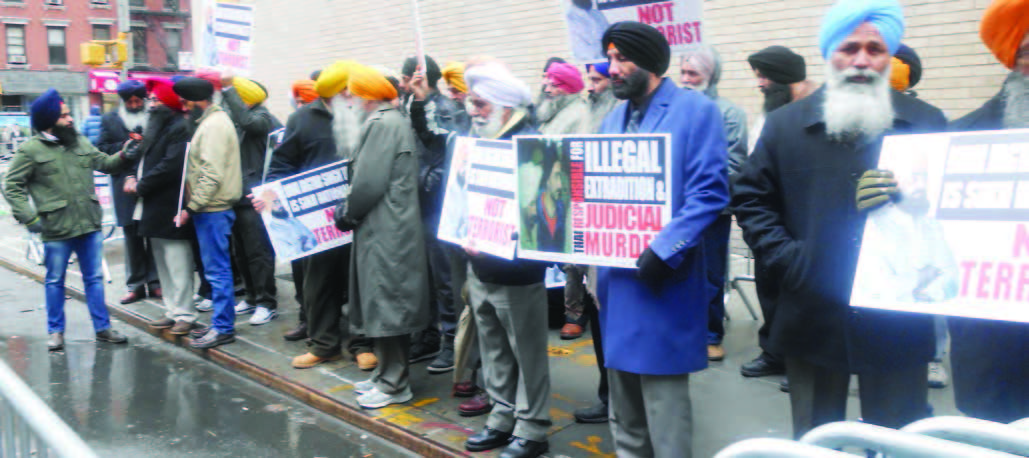
    NEW YORK CITY (TIP): A human rights advocacy group, Sikhs For Justice, organized a protest demonstration in front of Thailand Consulate in New York City, February 9. They were protesting the extradition to India of Jagtar Singh Tara, who the government of India wanted in connection with the murder of Beant Singh, a chief minister of the State of Punjab.

    About 40 demonstrators, mainly from New York and New Jersey participated.

    The protest was organized to demand from Thai government that it ask government of India to restore the custody of Jagtar Singh Tara to Thai government.

    The memorandum that SFJ submitted to Thai Consulate said, “Extradition of Jagtar Singh Tara, a Sikh nationalist, violated Thai Extradition act and UN Convention against torture. It further requested the PM of Thailand to reverse January 6 extradition order.

    Protesters who shouted slogans of Khalistan Zindabad, carried placards which read  Khalistan Zindabad and Tara’s Extradition is illegal.

    The demonstration continued for two hours during which time speeches were made by SFJ President Avtar Singh Pannu, legal advisor to SFJ, Attorney Gurpatwant Singh Pannun  and a few others.

    A representative of demonstrators was allowed to enter the Thai Consulate to submit a memorandum addressed to the Prime Minister of Thailand.

  • MANISH SISODIA TO BE DELHI DEPUTY CM

    MANISH SISODIA TO BE DELHI DEPUTY CM

    NEW DELHI (TIP): Manish Sisodia is all set to be the deputy chief minister in Arvind Kejriwal government which is likely to have four new faces this time, Aam Aadmi Party sources said.

    Barring Sisodia, who is a close confidant of Kejriwal, and Satyendra Jain, the rest four- Rakhi Birla, Saurabh Bharadwaj, Somnath Bharti, Girish Soni— who were in AAP’s earlier cabinet —are unlikely to make it this time.

    The sources said the party has decided to induct Jitendra Tomar (Tri Nagar), Kapil Mishra (Karawal Nagar), Sandeep Kumar (Sultanpuri Majra) and Asim Ahmed Khan (Matia Mahal)- the only minority face- in the ministry. The four are also first time legislators. The new government may not have a woman member.

    The list will be sent to Lt Governor Najeeb Jung today, they added. The new Cabinet will be sworn in on Saturday.

    Sisodia was de facto number two in the previous AAP government and had handled important portfolios like education, urban development, PWD, land and buildings.

    Jain, a two-time MLA from Shakur Basti who handled the health portfolio in the previous AAP government, is another minister who is likely to be retained.

    “There is a lot of brain storming going on in the party. But it would not be right to talk about it until it is formally announced,” Sisodia told reporters, when asked about his appointment as the Deputy CM. According to sources, the decision to make Sisodia the Deputy CM was taken at a meeting of AAP’s Political Affairs Committee (PAC) last night at Kejriwal’s residence in Kaushambhi.

    Sisodia is being given the responsibility so that Chief Minister-designate Kejriwal can focus on building the party at the national level, they said.

    It was also decided that Shahdra MLA Ramniwas Goel will be the Speaker while Bandana Kumari, from Shalimar Bag constituency, will be Deputy Speaker in the Delhi Legislative Assembly. The latter is also heading AAP’s women wing.

  • Shikshayatan students give great performance at Vasant Panchami & Makar Sankranti celebrations

    Shikshayatan students give great performance at Vasant Panchami & Makar Sankranti celebrations

    [vc_row][vc_column width=”1/2″][vc_column_text]

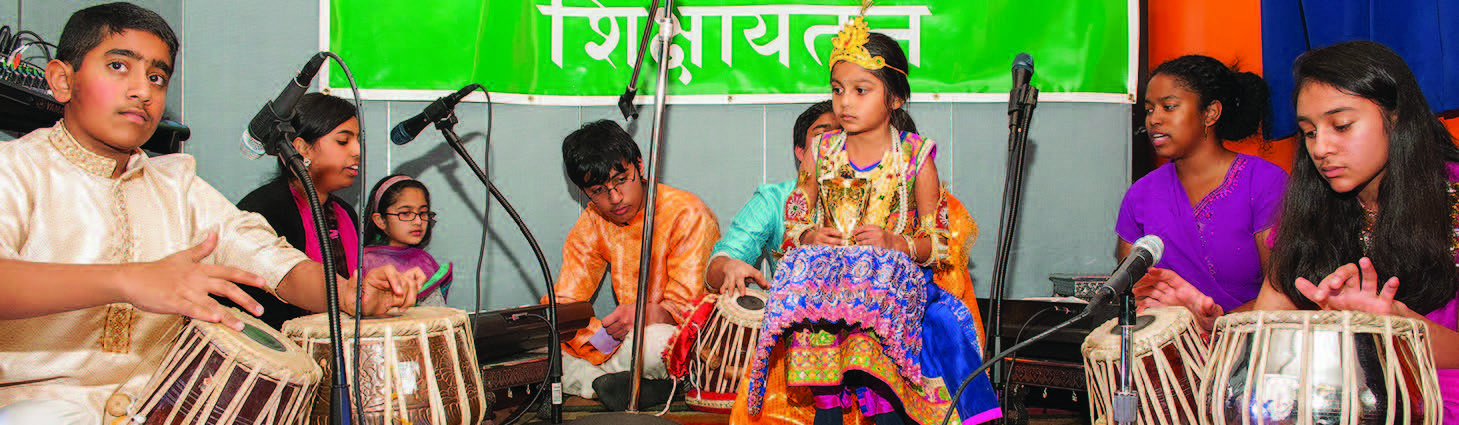
    NEW YORK (TIP): Young students, many under ten, gave a great  musical  performance at  Vasant Panchami and Makar Sankranti celebrations  organized by their school, Shikshayatan on January 18th, 2015.

    The more than an hour program of music  began with the  singing of national anthems of USA and India. It was followed by the traditional prayer to goddess of learning, Saraswati. Ramya, a very young student artist created a divine atmosphere by invoking mother Saraswati. Sudipta sang  Ganesh Vandana written by great saint poet Tulsidas who wrote Ramcharit Manas, popularly known as Ramayana. Saraswati Vandana was sung  by Kavita and Sudipta, accompanied by Sudeep, Shiv and Mansi on tabla. Students sang Lord Shiva bhajan, Guru Vandana in raag Darbari Kannada, Sri Rama stuti in Sanskrit language. A solo performance on tabla was given  by a 5 year old Samarth who played taal dadaraa with great confidence. A senior artist, Manohar played raag yaman on  violin. A child artist  Shivani sang raag kafi and also Krishna bhajan to  a child arist Shreya who was dressed up as Lord Krishna. This item stole the hearts of all. A new student Kush played Vande Mataram on Keyboard. There were a few chorus songs: Hum Honge kaamyaab,; Yahaan daal daal par sone ki ” and Shikshayatan title song ” Har Dharati Kaa” .

    A kavi darbar was also organized on the occasion. Those who recited their compositions included Dr. Bijoy Mehta, Chairman of The Hindu Center of Flushing, Prof. Indrajit S Saluja, Chief Editor of The Indian Panorama, Ashok Vyas, TV anchor, ITV, Ashok Singh, Smt. Swadesh Rana , Shri Ram Gautam, Attorney Anand Ahuja   and  Animesh Chandra. Other distinguished guests included  Arish Sahani, Ashok Ojha and Major S.B. Singh.

    The Consul General of India in New York Dnyaneshwar M. Mulay performed the opening ceremony of the new location of Shikshayatan and blessed the students and truly appreciated the dedication of the faculty and the Founder/President/Director of the center, Purnima Desai, for her tireless efforts and witnessed the progress of the center in various fields of art & culture of India.

    [/vc_column_text][/vc_column][vc_column width=”1/2″][vc_column_text]

    Chief Guest Ambassador Dnyaneshwar M. Mulay , Consul General of Indian in New York appreciating the good work being done by Shikshayatan. Mrs. Purnima Desai, Founder/Director of Shikshayatan is seen standing with him
    Chief Guest Ambassador Dnyaneshwar M. Mulay , Consul General of Indian in New York appreciating the good work being done by Shikshayatan. Mrs. Purnima Desai, Founder/Director of Shikshayatan is seen standing with him
    Honorees with  the Chief Guest and Mrs. Desai. L to R:Major S.B. Singh, Dr. Bijoy Mehta, Purnima Desai, Ashok Vyas, Dnyaneshwar Mulay, Arish Sahani, Prof. Indrajit S Saluja, Ashok Ojha
    Honorees with the Chief Guest and Mrs. Desai. L to R:Major S.B. Singh, Dr. Bijoy Mehta, Purnima Desai, Ashok Vyas, Dnyaneshwar Mulay, Arish Sahani, Prof. Indrajit S Saluja, Ashok Ojha

    Shikshayatan students5 Shikshayatan students4 [/vc_column_text][/vc_column][/vc_row]

  • A BENEVOLENT LAW ABUSED – Racketeers use SIJS to make big money

    A BENEVOLENT LAW ABUSED – Racketeers use SIJS to make big money

    [vc_row][vc_column width=”2/3″][vc_column_text]

    It has been said the crooks will always find creeks to enter any system in the world. And when the system is welcoming and benevolent, the infiltration is much easier. Special Immigrant Juvenile Status law (Please read the article below by eminent attorney Anand Ahuja on page 6) was enacted with a humanitarian objective to provide protection to those minors who are victims of domestic abuse. Over the years, the law stands abused. It has become a booming business in many countries to push young boys and girls, mainly boys (77%), in to the United States territory and make them take advantage of SIJS.

    The Indian Panorama Investigative team came across quite a few people in Queens and Long Island in New York who are part of the thriving racket to smuggle in young boys and girls from India. The reports received by us indicate that it is a big business in many South Asian countries, in particular, India, Sri Lanka and Pakistan as also in many other countries across the world. We were taken for a shock to get to know how elaborate the racket’s dragnet is, which involves agents in countries from which the young people are sent, agents at the Mexican side of the US border who help them cross over in to the United States, agents in the US who manage a guardian for the boy/girl and so on so forth. All this involves huge money. In India, the price to send a young boy or a girl in to USA is anywhere between $80,000 to $100,000.

    Another shocking revelation was the involvement of church in this racket. During our talk with some who are involved in the racket told us, on condition of anonymity, that at least, one    priest from a Christian Church in New York and a Sikh priest from a Sikh Gurudwara in Arizona are actively involved in running the racket. The authorities do not suspect the priests of any wrong doing and the latter take advantage of it. Our source told us that the Christian Priest who is based in New York and comes from Punjab, India, visits his home state in India to “recruit” the youth who want to come to USA. It was pointed out to us that the pries has been making regular trips for the job. He arranges the incoming youth’s stay and finds him a guardian. Interestingly, all the young people who come here and come to have guardians, work and stay elsewhere, not necessarily with their guardians. The person agreeing to be a guardian to a youth is offered a payment of between $5000.00 to$10,000. The attorney’s fees is anywhere between $3000.00 and $5000.00. We were also told about two attorneys whose services the priest utilizes regularly. Also, there are some attorneys who specialize in such cases. The gentleman who offered to be guardian to a young man confided in us that the young man had disappeared and that he had to report the disappearance to the court.

    The malaise is much deeper and goes beyond simple monetary racket. It has serious implications for America’s security. With ISIS and Al Qaeda stepping up recruitment of young people from all over the world, USA is threatened as never before because of such soft laws  which allow easy infiltration in to the country. Our source, on condition of anonymity, told us that he had come to know that the enemies of USA are all set to push in young people in to USA to carry out their agenda in America, which is to harm the country in every way.

    A thorough investigation by the US administration  agencies concerned in to the racket and  the possible infiltration of enemies of USA in to the country, taking advantage of the benevolent soft humanitarian laws needs to be  done sooner than later. And the earlier, the better.

    [/vc_column_text][/vc_column][vc_column width=”1/3″][vc_column_text]

    (National Juvenile Justice Network)  (The Pew Charitable Trusts: May 9, 2013)

    Hundreds of thousands of youth (under age 18) attempt to enter the U.S. every year. Some come with their families, others alone, either of their own will seeking jobs, protection and family reunification or they are smuggled into the country for sweatshop labor or sexual exploitation. The exact number of children who attempt to enter the country is unknown. In 2005 granted legal permanent resident (LPR) status to 175,000 children under 14 years of age and to 196,000 youth ages 15 to 24. Twenty thousand youth ages 17 and under were accepted as refugees and 2,000 were granted asylum in the same year. Customs and Border Protection (CPB) apprehended almost 122,000 juveniles in the U.S. in 2004. Of this total, 84.6 percent were released back to Mexico, or in rare cases to Canada.

    [/vc_column_text][vc_column_text]

    (The Migrationist: August 8, 2013)

    Each year, thousands of unaccompanied alien children
    (UACs) risk harrowing journeys and travel alone to seek refuge in the United States. These children come from all over the world for many reasons, including to escape persecution in their home countries, to reunify with family members and to look for a better life. In recent years, the U.S. government has had roughly 6,000-8,000 of these children in its care and custody each year. While these children may be as young as infants, most (approximately 70 percent) have been between the ages of 15 and 17. -Women’s Refugee Commission

    [/vc_column_text][/vc_column][/vc_row]