Year: 2015

  • Spreading fear of ISIS

    Spreading fear of ISIS

    Post Paris, when the Union Home Ministry said that an “IS-backed attack is possible in India” and went on to talk of the Islamic State’s “success in radicalizing some youth and attracting some sections of the local population or the Indian diaspora to physically participate in its activities”, it indirectly magnified the threat perception of the IS among people. Terror is not an issue that Home Minister Rajnath Singh should be casually discussing with media persons on the sidelines of a function. He needlessly lauded the striking capacity of the IS when he said it posed “a threat for the entire world”.

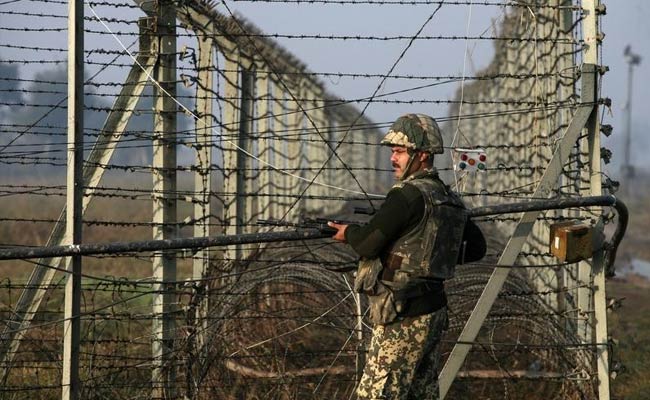
    The fight against terror has to be a rigorous, quiet and coordinated effort aimed at plugging loopholes in the state of preparedness. Intelligence sharing with other countries makes little sense when the Centre and states fail to do so within the country. States are particularly vulnerable. Leave alone having a specialized trained force to combat terror, policing, intelligence gathering and the security apparatus at the state level are far from professional. Even the Centre, despite the NIA, is ill-equipped to handle Paris-type strikes at crowded places. Mocking the security setup, an NRI rammed his SUV into the Wagah border gate on Monday. That the intruder could reach the border gate unchallenged in itself is an unflattering reflection on a regime that takes considerable pride in its masochism.

    While hundred per cent security at every vulnerable spot may be difficult, states need to be constantly motivated in modernizing policing and strengthening intelligence. Regular preparedness drills can help locate cracks which terrorists can take advantage of. There is no need to broadcast to the nation that the IS has a limited presence in India and that it has appeal among certain youth. We have yet to learn the importance of quiet, skilled capacity-building. The need is to monitor social sites more closely and wean youth from interacting with IS cells through persuasion, preferably, and by force, if necessary. Politicians and media have to take care that they don’t end up playing into the hands of terrorists by spreading scare. The IS fear has been internationalized unconsciously.

  • Islamic State releases video threatening attack on New York City

    Islamic State releases video threatening attack on New York City

    NEWYORK (TIP): Terror group ISIS released a propaganda video Wednesday, November 18, that makes threats against New York, but city leaders said there is no “credible and specific threat” to the city.

    The authenticity of the video has not been verified and New York officials have said there are no specific threats against the city.

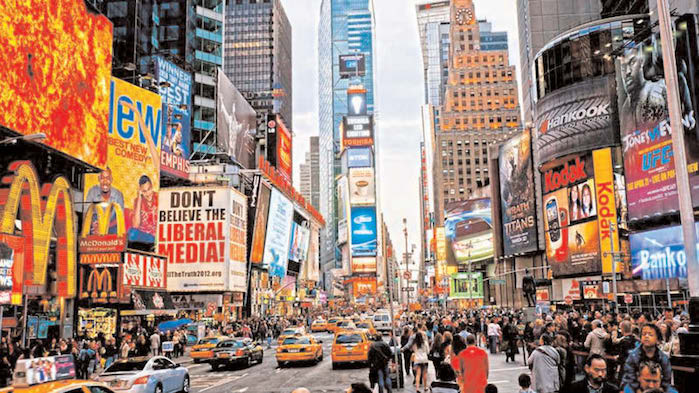
    The video shows several scenes in Manhattan including Times Square, Gap in Herald Square, T.G.I. Friday’s and yellow taxi cabs on city streets. It also includes images of terrorist sharpshooters and terrorists wearing suicide belts.

    The Islamic State considers the United States its top enemy and frequently threatens attacks against American targets.

    Mayor Bill de Blasio said New York City will not be intimidated by a newly released video by the Islamic State in Iraq and the Levant (ISIL) which shows images of Times Square.

    “There is no credible and specific threat against New York City,” de Blasio said during a news conference Wednesday night.

    “Stoking fear is the goal of terrorist organizations, but New York City will not be intimidated,” de Blasio said, encouraging New Yorkers to “go about their business” as normal, while remaining watchful.

    The ISIL video, which runs for nearly six minutes, includes a scene that appears to show a suicide bomber making preparations and zipping up a jacket, according to a description provided by SITE Intelligence Group, a Bethesda, Maryland, organization that tracks groups like ISIL.

    “Footage of New York shown in the ISIS video was taken from a video released by the group in April of this year. So while NYC is, and has been, a target for ISIS, today’s video does not warrant any kind of panic,” SITE director Rita Katz said in an email to Reuters.

    The FBI said through a spokeswoman it was aware of news reports about the video and “ongoing terrorist threats to NYC,” and would fully investigate.

    A New York Police Department spokesman said some of the video footage is old but the video reaffirms the message the city remains a top target for extremists.

    “While there is no current or specific threat to the city at this time, we will remain at a heightened state of vigilance and will continue to work with the FBI, the Joint Terrorism Task Force and the entire intelligence community,” said Stephen Davis, the NYPD’s deputy commissioner for public information.

    De Blasio said that the NYPD this week “initiated the first wave of our new Critical Response Command, which will grow to 500 officers specifically dedicated to anti-terrorism activities,” he said.

    The new unit will supplement an existing 1,000-officer counterterrorism program, police said.

  • Indian American couple from New Jersey plead guilty to $4.3 million healthcare fraud

    Indian American couple from New Jersey plead guilty to $4.3 million healthcare fraud

    NEWARK, NJ (TIP): An Indian American husband and wife from New Jersey who owned a mobile diagnostic testing company admitted receiving more than $4.3 million from Medicare and private insurance companies for diagnostic testing and reports that were never interpreted by a licensed physician, U.S. Attorney Paul J. Fishman announced.

    Nita K. Patel and Kirtish N. Patel, were arrested in June of 2014, pleaded guilty before U.S. District Judge William H. Walls in Newark federal court and both have been charged with one count of health care fraud each.

    They duo owned Biomedical Sound Services as well as Heart Solutions in Parsippany and were mobile diagnostic companies.

    According to an FBI press release, the companies provided mobile diagnostic testing, including ultrasounds, echocardiograms and nerve conduction studies that were used to diagnose heart defects, blood clots, abdominal aortic aneurysms and other serious medical conditions.

    Biosound was responsible for sending the tests to a “reading physician”-an appropriate specialist who would interpret the results. After the reading physician prepared a report, Biosound was responsible for providing it to the referring physician.

    Instead, Kirtish Patel interpreted them himself, and forged the signatures of physicians, authorities said.

    Biosound was paid millions of dollars by Medicare and other payors for the diagnostic testing, the reading physician’s interpretation of the results and the reports.

    Kirtish Patel admitted to, from October 2008 through June 2014, fraudulently interpreting and writing diagnostic reports produced by Biosound despite having no medical license and knowing that the reports would be used by the referring physicians to make important patient treatment decisions. Nita Patel admitted assisting her husband in forging physician signatures on the fraudulently produced reports to make them appear legitimate. Nita and Kirtish Patel also admitted falsely representing to Medicare that the neurological testing performed by Biosound was being supervised by a licensed neurologist.

    More than half of the diagnostic reports generated by Biosound between October 2008 and June 2014 were never actually reviewed or interpreted by a physician.

    Nita and Kirtish Patel were paid more than$4,386,133.75 by Medicare and private insurance companies for the fraudulent reports, which they used for personal expenses, including multiple residences and luxury vehicles.

    The health care fraud charge to which Nita and Kirtish Patel pleaded guilty carries a maximum potential penalty of 10 years in prison and a $250,000 fine, or twice the gross gain or loss from the offense. Sentencing for both defendants is scheduled for March 15, 2016.

  • Congressman Joseph Crowley and Councilmember Daniel Dromm Celebrate Diwali with  Indian American Business Association

    Congressman Joseph Crowley and Councilmember Daniel Dromm Celebrate Diwali with Indian American Business Association

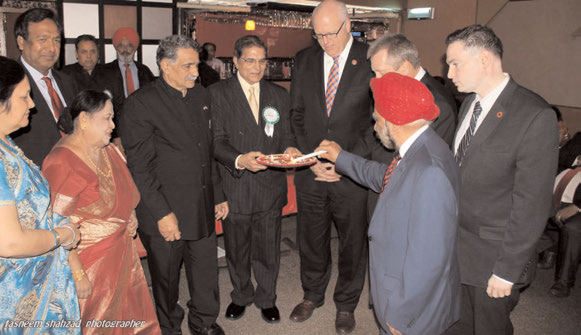
    NEW YORK (TIP): Indian American Business Association, New York Inc  held diwali celebration at Delhi Palace in Jackson Heights, New York On Nov 09  2015.

    Diya Lighting Ceremony
    Diya Lighting Ceremony

    Many respected community leaders and businessmen attended the Diwali celebration. Which include Rep. Joe Crowley (D-Queens, the Bronx), Vice Chair of the House Democratic Caucus and co-chair of the Congressional Caucus on India and Indian-Americans, Councilmember Daniel Dromm, Mr. Ved Prakash Sharma, District Leader Uma Sengupta, Dr. Vijay Chabra, Sunil Chugh, Harish Chugh, Mahendra Patel, Harshad Patel, Apan Bazar, Deepak Varma, Sunil Patel, Dr. Surinder Malhotra, Virendra Patel, Trilok Malik,Mohinder Singh Taneja, Viredra Patel & Commissioner Sharanjit Thind,

    Event started with bollywood dance performances by students of Aparna Dance Academy. National Anthom sung by Kirti Shukla and Indu Gajwani. Congressman Crowly conveyed greetings on Diwali to Indian community and recognized and appreciated Indian businessman contribution to American economy and the community as well as appreciate the Contribution of Indian American Business Association NewYork Inc’s President Mr. Mohinder Verma.

    Councilmember  Daniel Dromm also conveyed greetings on Diwali and appreciated the community. And expressed regret that Indian community was not granted holiday in city schools by Mayor and he vouched that he would fight to get diwali holiday in schools of NY City. President Mohinder Verma Thanked Congressmember Crowley and Councilmember Daniel Dromm as well as Wish Everyone on the occassio of Diwali, Also
    Mr.Mohinder Verma stated Indian American Business Association Inc. is formed with collective efforts of New York and India based businesses. The main objective of the organization is to provide a platform and disseminate information to and among businesses that are looking to grow and expand from India to the U.S. and vice-versa. Based on our experience and the data provided by the relevant authority, many businesses are interested to expand their activities in New York, USA. To advance such interests, those businesses need support, information, and a network besides other things, IABANY intends to bridge that gap.

    Dilip Chauhan South East Asian Affairs Director of Nassau County Comptroller George Maragos Presented a Citation to President of IABANY Mohinder Verma, left Ved Prakash Sharma, Uma Sengupta, Councilmember Daniel Dromm, Congressmember Joseph Crowley, President Mohinder Verma, Dilip Chauhan , Darshan Bagga, and Commissioner Sharanjeet Thind.
    Dilip Chauhan South East Asian Affairs Director of Nassau County Comptroller George Maragos Presented a Citation to President of IABANY Mohinder Verma, left Ved Prakash Sharma, Uma Sengupta, Councilmember Daniel Dromm, Congressmember Joseph Crowley, President Mohinder Verma, Dilip Chauhan , Darshan Bagga, and Commissioner Sharanjeet Thind.

    Dilip Chauhan South East/Asian Affairs  Director of Nassau County Comptroller George Maragos Presented a Citation on behalf of Nassau County Comptroller George Maragos to President Mohinder Verma for his outstanding Contribution to the community.

    Many businessmen and community leaders were awarded by citations from New York Senator Jose Peralta, Assembly member David Weprin.

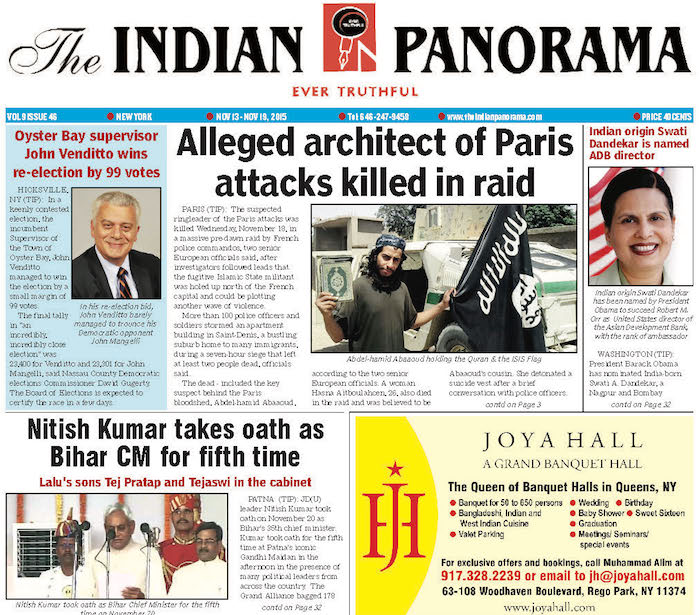
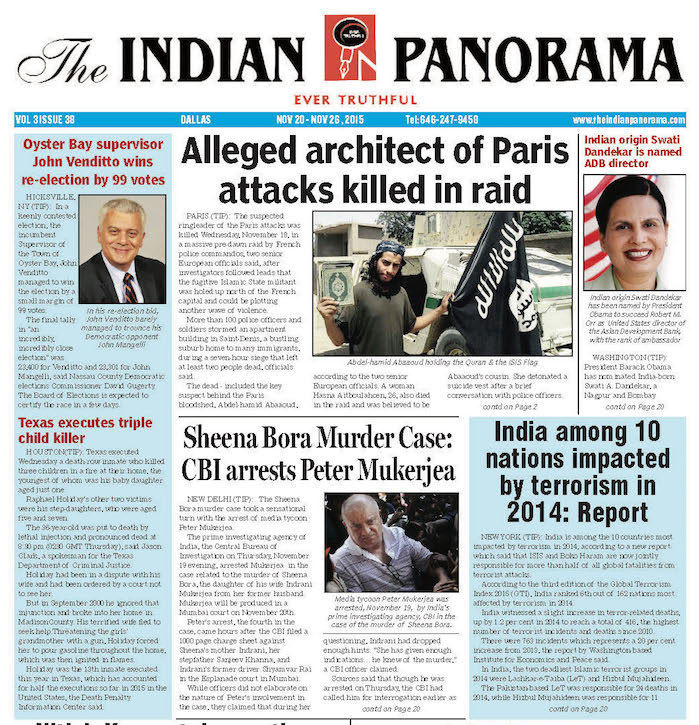
  • Alleged architect of Paris attacks killed in raid

    Alleged architect of Paris attacks killed in raid

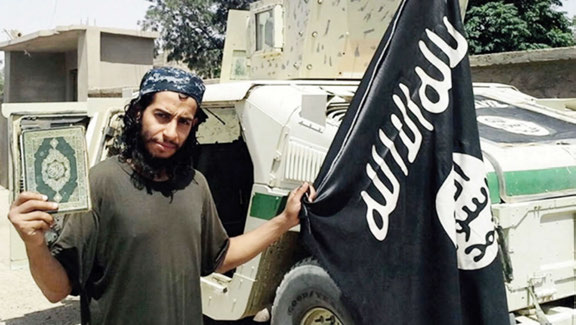
    Abdel-hamid Abaaoud holding the Quran & the ISIS Flag
    Abdel-hamid Abaaoud holding the Quran & the ISIS Flag

    PARIS (TIP): The suspected ringleader of the Paris attacks was killed Wednesday, November 18, in a massive pre-dawn raid by French police commandos, two senior European officials said, after investigators followed leads that the fugitive Islamic State militant was holed up north of the French capital and could be plotting another wave of violence.

    More than 100 police officers and soldiers stormed an apartment building in Saint-Denis, a bustling suburb home to many immigrants, during a seven-hour siege that left at least two people dead, officials said.

    The dead – included the key suspect behind the Paris bloodshed, Abdel-hamid Abaaoud, according to the two senior European officials. A woman Hasna Aitboulahcen, 26, also died in the raid and was believed to be Abaaoud’s cousin. She detonated a suicide vest after a brief conversation with police officers.

    French police are still looking for another alleged attacker, the 26-year-old French national Salah Abdeslam, who is on the run.

    Abaaoud, a 27-year-old Belgian extremist of Moroccan origin, allegedly orchestrated the attacks claimed by Islamic State of Iraq and the Levant.

    Bernard Cazeneuve, the French interior minister, said that Abaaoud had been involved in at least four previous foiled attacks, including an incident in August when  a gunman tried to kill passengers on a high-speed train between Amsterdam and Paris.

    “[The cases] would have all involved attacks perpetrated by European jihadists sent to France … Europe must coordinate itself and defend itself against this threat,” he said on Thursday, November 19, calling for a more effective arms strategy in the continent. “The fight against terrorism is crucial.”

    Paris terror attacks: A timeline

    November 13, 9:20pm Stade de France

    The first of the three explosions is heard in the stadium where Hollande and 80,000 fans are watching France play Germany in a friendly football match.

    November 13, 9:20pm Stade de France
    Stade de France before the blast are heard
    November 13, 9.25 Le Carillon & Le Petit Cambodge

    Located in one of the liveliest areas around the Canal Saint-Martin district, the bar and restaurant are packed. A car stops at the crossroads. Two men holding Kalashnikovs get out; one sprays bullets at Le Carillon, the other fires directly at Le Petit Cambodge, killing 15 people.

    Candles next to a flower in a broken window of Le Carillon restaurant in Paris, the site of one of the attacks in the French capital on Friday. (Image courtesy Venance/AFP/Getty)
    Candles next to a flower in a broken window of Le Carillon restaurant in Paris, the site of one of the attacks in the French capital on Friday. (Image courtesy Venance/AFP/Getty)


    November 13, 9.30: Second Stade de France bomb

    Sirens can be heard outside, but the game goes on. An aide informs Hollande of the unfolding attacks. A decision is taken to get the president out of the ground. Two suicide bombers and one man died outside the stadium. A third attacker detonates an explosive vest at a nearby McDonald’s at about 21:53.

    An aide informs French president Franc?ois Hollande about the attacks
    An aide informs French President Hollande about the attacks
    November 13, 9.32 Casa Nostra

    Again, a black Seat pulls up and an armed man dressed in black gets out. After more than 100 rounds five people are dead and eight  seriously injured.

    Bullet holes are seen in the windows of the Casa Nostra pizzeria on rue de la Fontaine-au-Roi, Paris (Photo  courtesy  Ian Langsdon/EPA)
    Bullet holes are seen in the windows of the Casa Nostra pizzeria on rue de la Fontaine-au-Roi, Paris (Photo courtesy Ian Langsdon/EPA)
    November 13, 9.36pm: Belle Équipe

    “The shooting lasted five minutes. They did not give anybody a chance”  – an eyewitness to the attack on the restaurant on rue de Charonne  tells BFM TV. When it was all over 19 people lay dead. Most had been sitting outside at candle-lit tables.

    Flowers and candles in front of the Belle Equipe cafe in Paris ( Photo courtesy Ian Langsdon/EPA)
    Flowers and candles in front of the Belle Equipe cafe in Paris ( Photo courtesy Ian Langsdon/EPA)
    November 13, 9.40pm: suicide bomber

    A man walks into the Comptoir Voltaire cafe  on Boulevard Voltaire and as waitress approaches he detonates an explosive vest. Fifteen people are injured.

    Coats on the ground outside the Comptoir Voltaire cafe after the attack.  ( Photo  courtesy AFP)
    Coats on the ground outside the Comptoir Voltaire cafe after the attack. ( Photo courtesy AFP)
    November 13, 9.45pm: State of emergency

    President Hollande, who has been taken to the Élysée Palace following the second bomb at the Stade de France, prepares to call a state of emergency.

    French Prime Minister Manuel Valls and  President Hollande at an emergency meeting at the Interior Ministry on Friday, November 13th ( Photo  courtesy AFP)
    French Prime Minister Manuel Valls and President Hollande at an emergency meeting at the Interior Ministry on Friday, November 13th ( Photo courtesy AFP)
    November 13, 9.49pm: Bataclan theatre

    Gunmen enter the Bataclan theatre on Boulevard Voltaire, where more than 1,500 people are at an Eagles of Death Metal concert, shooting as they move. The band is still playing as the shots ring out – some think it’s part of the show. The music stops. There is panic and scenes of terror as people try to escape. By the time police storm the building  at 00:20, 89 people are dead.

    Bataclan Theatre
    Bataclan Theatre
    November 13, 11.30pm: Hollande – “It’s a horror”

    In a live television address to the nation, President Hollande declares a state of emergency. The emergency has since been extended for another 3 months.

    Hollande declares state of emergency  (Photo courtesy Getty Images)
    Hollande declares state of emergency (Photo courtesy Getty Images)
    BELGIUM RAIDS

    The search for the attackers spreads to Belgium. A discarded parking ticket in a car near the Bataclan in Paris leads detectives to the Brussels suburb of Molenbeek. A series of raids and arrests are made across the city over several days targeting those believed to have links with Bilal Hadfi, a 20-year old jihadist who blew himself up outside Stade de France in Paris.

    SAINT-DENIS RAID

    GERMANY

    A series of raids and arrests are made on Tuesday, November 17, in Alsdorf, near Aachen, close to the Belgium border.  The Germany vs Netherlands friendly in Hanover is called off after police say authorities have “concrete information” about a bomb threat. However, no explosives were found.

    SAINT-DENIS RAID

    French police and security forces launch a major operation on Wednesday, November 18, where the target – Abdelhamid Abaaoud, said to be the leader of  November 13 attacks, is killed. His death was confirmed  by authorities on Thursday, November 19.

    RAIDS CONTUINUE IN FRANCE & BELGIUM

    Police officers have broken down doors in towns and villages from Paris to Brussels in more than 600 raids and searches since Friday. There have been 414 raids in France alone over the three nights early in the week, Bernard Cazeneuve, the French interior minister, said in a statement on Wednesday. Sixty people were arrested and detained, and 75 weapons were seized. The statement added that 118 people were put under house arrest.

    Prime Minister Manuel Valls of France said  “We don’t know at this point in the investigation if there are groups, individuals, who are directly linked to the attack on Friday evening, in Paris, in St-Denis”. “We don’t know yet, one can imagine. That’s why the threat is still there.”

    On Thursday, November 19,  several police raids were carried out in the Brussels area, many of them targeting friends and relatives of Bilal Hadfi, one of the stadium bombers. At least nine people were detained.

    The Belgian authorities on Thursday arrested nine people — seven of them as part of an investigation into Bilal Hadfi, 20, who detonated his explosive vest outside the Stade de France on Friday. Belgian police searched homes in the Brussels neighborhoods of Laeken, Uccle, Jette and Molenbeek. Molenbeek was the base of Mr. Abdeslam; his brother Ibrahim, who was one of the seven attackers who died; and Mr. Abaaoud.

  • Nitish Kumar takes oath as Bihar CM for fifth time

    Nitish Kumar takes oath as Bihar CM for fifth time

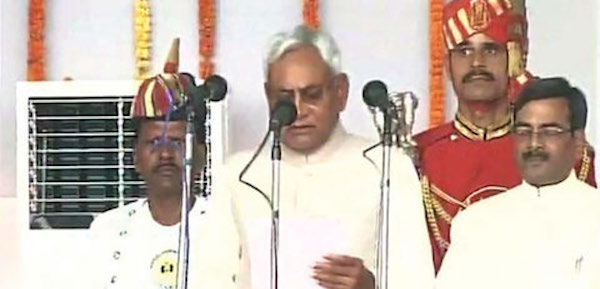
    PATNA  (TIP): JD(U) leader Nitish Kumar took oath on November 20 as Bihar’s 35th chief minister. Kumar took oath for the fifth time at Patna’s iconic Gandhi Maidan in the afternoon in the presence of many political leaders from across the country. The Grand Alliance bagged 178 out of the 243 seats in the just-concluded assembly polls, which was billed as a battle between Nitish Kumar and Prime Minister Narendra Modi, who had campaigned extensively for the BJP-led NDA.

    Former chief minister Lalu Prasad’s RJD pulled off a bigger surprise by emerging as the single-largest party, winning 80 seats while the JD(U) 71 and the Congress 27.

    As Prime Minister Narendra Modi declined to attend the event, the BJP was represented by party leaders and central ministers, including M. Venkaiah Naidu and Rajiv Pratap Rudy.

    Tens of thousands of Nitish Kumar and RJD leader Lalu Prasad supporters, besides nine chief ministers, Congress president Sonia Gandhi and vice-president Rahul Gandhi, NCP president Sharad Pawar, former prime minister H.D. Deve Gowda and leaders of several other political parties attended the event.

    The oath taking was attended by many political leaders from various parties.

  • The enduring legacy of Nehru:  a tribute to the architect of modern India

    The enduring legacy of Nehru: a tribute to the architect of modern India

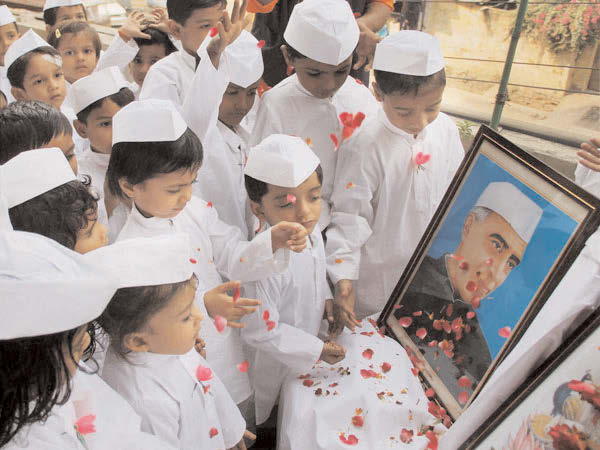
    A moment comes, but comes rarely in history, when we step out from the old to new, when an age ends, and when a soul of a nation, long suppressed, finds utterance’. Pandit Jawaharlal Nehru delivered these inspiring words in his speech, ‘Tryst of Destiny’ in1947. He is still remembered for his vision and commitment to bring India from out of oppression into freedom, modernity, and self-reliance.

    As we have celebrated the 125th birth anniversary of Jawaharlal Nehru on November 14th, 2015, we are in awe as we recollect his contribution, not only towards gaining India’s independence but also for laying a strong foundation of a pluralistic and forward looking India. Yet, half a century after his death, the current leadership of India is busy trying to downplay his legacy for political expediency, and to re-create a nation away from the democratic and secular tradition he has championed.

    Jawaharlal Nehru laid the foundation of strong institutions that helped India preserve freedom and democracy and move on to become a modern nation.
    Jawaharlal Nehru laid the foundation of strong institutions that helped India preserve freedom and democracy and move on to become a modern nation.

    When India gained Independence, there were monumental challenges resulting from the partition and the ongoing violence between Hindus and Muslims. The urgent task facing the leadership at the time was the resettlement of 6 million refugees, and arresting the spread of further violence. Nehru put together a team of dedicated patriots such as Sardar Tarlok Singh, Sarojini Naidu and S.K. Ghosh to limit the violence, as well as rescue and recover abandoned and abducted women and children.

    When the British left, the Government, headed by Nehru, faced another important task: the national integration of 562 princely states. A newly created State department under the decisive leadership of Sardar Vallabhai Patel along with Nehru ensured the integration of the country in a remarkably short period of time.

    If we look back at history for a moment, we would admire how Nehru brought together exceptional people of different ideologies such as Dr. B.R. Ambedkar, S.P. Mookerjee, John Mathai, C.H. Bhabha and Shanmukham Chetty to be reflective of India’s secular and multi-faceted character in the Constituent Assembly. The Congress party delivered on the promise that the constitution they were about to create would reflect the aspirations of the Indian people.

    The constitution of India was amongst the largest in the world with 395 Articles and 9 Schedules. The preamble spells out the basic philosophy and the solemn resolve of the people of India to secure justice, liberty, equality and fraternity for all its citizens. What Nehru has accomplished through this document with significant help and support from Ambedkar also is part of his vision to empower marginalized sections of the society.Nehru was committed to ensuring social justice and the welfare of the masses as far back as 1938 by setting up the National Planning Committee under the banner of the Congress Party for the very purpose of improving the quality of life of ordinary citizens. These efforts culminated in creating a permanent planning commission to establish a just social order to ensure the equitable distribution of income and wealth. Nehru’s actions in these matters paint him as a socialist, however, he strongly believed that planning was essential to the development needs of a poor country with scarce resources, which needed to be managed optimally.

    He was also concerned about the unequal access to land which was a big problem in rural India. After independence, the issue was prioritized, and by 1949, different states had passed land reform legislations to abolish the ‘Zamindari’ system and empowering the rural peasantry while doing away with the institutionalized exploitation by the feudal lords.

    Nehru was a strong proponent of self-reliance, clearly recognizing that underdevelopment was the result of a lack of technological progress. Consequently, a new Industrial policy was enacted to develop key industries. While Independent India was in its infancy, he identified the production of power and steel for self-sufficiency and planning. In collaboration with other countries, India built steel plants in Rourkela (Orissa), Bhilai (M.P.) and Durgapur (W. Bengal). Dam projects were undertaken in various places to produce hydro-electric power, including the flagship Dam at Bhakra Nangal, Punjab. The first oil refinery was inaugurated in Noonmati, Assam in 1962 as another leap forward towards industrialization. Nehru called them ‘the temples of modern India’.

    Nehru was determined to foster a ‘scientific temper’ as he provided leadership in establishing many new Engineering Institutes, the most important being the premier Indian Institute of Technology, 5 of which were started between 1957 and 1964. His farsightedness is also evident in granting deemed university status to the Indian Institute of Science in Bangalore, and setting up the Council of Scientific and Industrial Research, and the Defense Research and Development Organization, and laying the foundation stone for the Tata Institute of Fundamental Research. Nehru’s own words stated that these would become ‘visible symbols of building up the new India and of providing life and sustenance to our people’.

    The architects of free India- Nehru, Gandhi and Sardar Patel
    The architects of free India- Nehru, Gandhi and Sardar Patel

    Soon after independence, India embarked upon a nuclear program aimed at developing its nuclear capacity for peaceful purposes. As we know by now, Dr. Homi Bhabha’s pioneering work in this regard is widely acclaimed in enhancing India’s capabilities in this area. Dr. Vikram Sarabhai, the father of the Indian Space Program helped to establish the Indian Space Research Organization.

    Nehru recognized the importance of education as a tool for empowerment and the establishment of the University Education Commission under the Chairmanship of Dr. S. Radhakrishnan and Secondary Education Commission under the chairmanship of Dr. A. L. Mudaliar laid the foundation of education and higher education. The Indian Council of Cultural Relations was also established under Maulana Azad to promote policies pertaining to India’s external cultural relations.

    Nehru also played a crucial role as a leader of the non-aligned world, shaping India’s foreign policy for the post-independence period. His charismatic personality, along with deep understanding of the country and the world enabled him to be an effective spokesman for the developing world and an advocate for liberation movements across the globe.

    Undoubtedly, Nehru helped to build institutions that stood the test of time. The emerging nations during that period such as Yugoslavia, Egypt and Ghana failed in this regard, and results are quite evident for all of us to see. Nehru’s vision and leadership were critical in shaping India as we know it today. According to ‘Journey of a Nation’, edited by Anand Sharma, Nehru laid the foundation of a self-reliant, productive and confident India, creating many of its Institutions leaving an indelible stamp on every aspect of the country.

    Sadly, there are regressive forces at work now to undo the Nehruvian legacy and to take us back to the age when the soul of the nation was suppressed. Among reflective Indians, especially NRIs, it is time to realize that the ongoing Nehru bashing has been somewhat counterproductive. Nehru’s respect for democratic procedures and his inclusive vision will continue to remain relevant, without which a modern India might cease to exist! To revise a famous quote to fit this narrative, ‘if India is to progress, Nehru is inescapable… we may ignore him at our own risk’.

  • Indian origin Swati Dandekar is named ADB director

    Indian origin Swati Dandekar is named ADB director

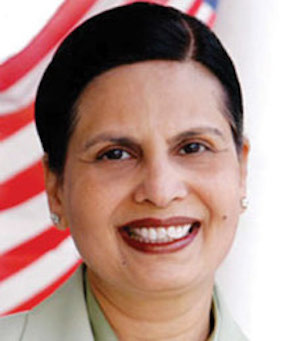
    WASHINGTON (TIP): President Barack Obama has nominated India-born Swati A. Dandekar, a Nagpur and Bombay University alum, to be United States director of the Asian Development Bank, with the rank of ambassador.

    The nomination of Dandekar who will replace Robert M. Orr was announced by the White House along with eight other key Administration posts:

    “I am confident that these experienced and hardworking individuals will help us tackle the important challenges facing America, and I am grateful for their service. I look forward to working with them,” Obama said

    Dandekar, who received a BS from Nagpur University and a Post-Graduate Diploma from Bombay University, is a former Iowa state legislator and member of the Iowa Utilities Board, according to her White House biography.

    She served on the Iowa Utilities Board from 2011 to 2013. Prior to joining the Utilities Board, Dandekar served in the Iowa State Senate from 2009 to 2011 and in the Iowa State House of Representatives from 2002 to 2008.

    From 2000 to 2003, she was a member of the Vision Iowa Board of Directors. Dandekar also served on the Linn-Mar Community School District Board of Education from 1996 to 2002 and was a member of the Iowa Association of School Boards from 2000 to 2002.

  • Oyster Bay supervisor John Venditto wins re-election by 99 votes

    Oyster Bay supervisor John Venditto wins re-election by 99 votes

    HICKSVILLE, NY (TIP): In his re-election bid, John Venditto barely managed to trounce his Democratic opponent John Mangelli.

    In a keenly contested election, the incumbent Supervisor of the Town of Oyster Bay, John Venditto managed to win the election by a small margin of 99 votes.

    The final tally in “an incredibly, incredibly close election” was 23,400 for Venditto and 23,301 for John Mangelli, said Nassau County Democratic elections Commissioner David Gugerty. The Board of Elections is expected to certify the race in a few days.


  • Tens of thousands without power as storm batters Ireland

    DUBLIN (TIP): Tens of thousands of homes in Ireland were left without electricity on Nov 17 as a storm swept across the country, causing disruption to flights and ferry crossings.

    Winds during the storm, named “Barney” by meteorological authorities, damaged electricity cables knocking out power to over 45,000 homes at one point before engineers began to restore power.

    Ireland’s national meteorological service Met Eireann had issued an orange weather warning, the second-highest level, for most of Tuesday, warning of winds of up to 130km/hr.

    Meteorologists have also warned that the storm could fell trees and cause power cuts and flooding as it moves across Britain this week.

    “Currently 25,000 customers remain without power,” said Bernadine Maloney of the Electricity Supply Board in an update at 2030 GMT, adding that the worst-affected areas were in the south and midlands.

    “We’ve had a number of large trees fall on the network and restoration will be slow.”

    Irish police said a tree fell on a bus and car and other pictures shared on social media showed felled trees and debris on roads in different parts of the country.

    Flights to Cork, Dublin and Shannon airports have all been affected by a number of cancellations, delays and diversions.

    A number of ferries to and from Wales across the Irish Sea were also cancelled because of the conditions.

  • Times NOW launched in UK

    MUMBAI (TIP): Times NOW, the leading English news channel in India, is expanding its presence in the international market. The flagship channel of Times Network, the broadcast arm of Bennett Coleman & Co Ltd, has officially launched in the UK.

    Announcing the launch, M K Anand, CEO & MD of Times Network, said, “Times NOW has had a dream journey in India where it is has remained a leader in the English news space for the past seven years. The success of Times NOW among viewers here has encouraged us to launch it for Indians who live abroad and want to keep completely abreast of all the important news of their country and its growing eminence in the world.”

    “The expansion of the channel in the UK market, for us, is the most important one since we launched in America in 2011, our International debut. UK is probably our biggest diaspora market. With this launch, we have just started building our presence in the European market and we intend to enter France and Germany too by next year,” Anand added. Times NOW editor-in-chief Arnab Goswami said, “The channel is launching in the country because we want to give viewers in the UK a platform to voice their opinion.”

  • 28 ‘terrorist group members’ shot dead in China’s Xinjiang

    BEIJING (TIP): Chinese security forces in the far western region of Xinjiang killed 28 “terrorists” from a group that carried out a deadly attack at a coal mine in September under the direction of “foreign extremists”, the regional government said on Nov 20.

    The news carried by the government-run Xinjiang Daily was the first official mention of the September 18 attack at the Sogan colliery in Aksu, in which it said 16 people, including 5 police officers were killed, and another 18 people injured.

    Radio Free Asia, which first reported the incident about two months ago, said at least 50 people had died.

    Attackers fled into the mountains and authorities launched a manhunt with more than 10,000 people participating every day, forming an “inescapable dragnet”, the Xinjiang Daily said.

    “After 56 days of continuous fighting, Xinjiang destroyed a violent terrorist gang directly under the command of a foreign extremist group. Aside from one person who surrendered, 28 thugs were completely annihilated,” the newspaper said.

    China’s government says it faces a serious threat from Islamist militants and separatists in energy-rich Xinjiang, on the border of central Asia, where hundreds have died in violence in recent years.

    Rights groups say China has never presented convincing evidence of the existence of a cohesive militant group fighting the government. Much of the unrest, they argue, is due to frustration at controls over the culture and religion of the Uighur people who live in Xinjiang, a charge Beijing denies.

    The Xinjiang Daily said two people who appeared to have Uighur names were leaders of the unnamed foreign group.

    Beginning in 2008, the Xinjiang group’s members began watching extremist videos and communicated six times with an extremist group outside of China’s borders, requesting tactical guidance, the paper said.

  • Colombia probing Syrian Islamist who traveled to Paris

    BOGOTA (TIP): Colombia is investigating a Syrian woman with ties to radical Islam, who traveled to Paris ahead of the attacks on a stolen Israeli passport, sources at the state prosecutor’s office said on Nov 19.

    Seham Al Salkhadi left ahead of Friday’s attacks on a direct flight from Bogota to the French capital’s Charles de Gaulle airport, traveling under the name of Ashira Krieger, the sources said.

    Al Salkhadi is suspected of paying off customs officials at the El Dorado international airport in Bogota to be able to travel using a stolen passport, which had been tampered with to modify some details.

    She was briefly detained upon her arrival in Paris but was released after a few hours.

    “The prosecutor’s services are working together with French authorities to establish her relationship with Islamist groups, but there is no proof that she is linked to the Paris attacks,” said an official on condition of anonymity.

    The official said the prosecutor was investigating the case in relation to a wider probe into corruption by airport officials, who have been letting criminals travel with forged documents.

    Five officials with the Colombian migration services are facing charges in connection with the scandal which broke in September.

    A statement issued by the prosecutor’s services at the time said they were investigating whether corrupt airport officials had facilitated the departure for France of a female Syrian terror suspect.

    Friday’s coordinated gun and bomb attacks on the French capital, carried out by French and Belgian jihadists with ties to Syrian jihadists, left at least 129 people dead and 352 wounded.

    The attack mastermind Abdelhamid Abaaoud, a Belgian of Moroccan, died in a police assault near Paris on Wednesday.

    The news that such a high-profile IS figure slipped undetected into France has prompted renewed debate about Europe’s border controls and monitoring of fighters returning from Syria. (Source: AFP)

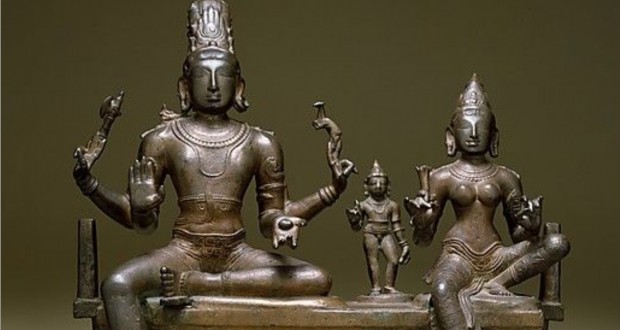
  • US to return 1000-year-old Chola-era Shiva Parvati idol to India

    US to return 1000-year-old Chola-era Shiva Parvati idol to India

    WASHINGTON (TIP): The US plans to return to India a 1,000-year-old historic Chola-era bronze idol of Shiva and Parvati which was stolen and smuggled into America by Indian- American disgraced art dealer Subhash Kapoor.

    The bronze idol, now under the custody of US Immigration and Customs Enforcement’s Homeland Security Investigations (HSI), would be repatriated to India along with six other sacred Chola bronzes recovered by HSI, officials said.

    The idol, looted from a temple in Tamil Nadu and brought to the US illegally, was surrendered by the David Owsley Museum of Art at BallStateUniversity in Indiana to authori-ties. The bronze sculpture is from the Chola Period (860-1279 CE). It was sourced illegally under Kapoor’s direction and smuggled into the US.

    Around 2004, the stolen idol was delivered to Kapoor’s for-mer New York City gallery ‘Art of the Past’.

    Kapoor had displayed the Shiva and Parvati sculpture for sale and misrepresented the idol’s true origin, the HSI said in a statement.

    In 2005, representatives from BallStateUniversity became unwitting victims as Kapoor provided the museum with a false provenance for their artifact.

    HSI special agents have tracked many false provenances provided by Kapoor. So far, HSI special agents, in conjunc-tion with the Manhattan prosecutor’s office, have netted in excess of 2,500 artifacts worth more than USD 100 million.

    The statute will be shipped to New York where it will serve as potential evidence in ‘Operation Hidden Idols’.

    Ultimately it is anticipated the item will be forfeited and repatriated to India.

  • ISIS claims attack on Italian priest in Bangladesh

    DHAKA (TIP): The Islamic State (ISIS) on Thursday claimed it was behind the shooting and injuring an Italian priest in Bangladesh, in the third attack on foreigners in the country by the dreaded group.

    The 57-year-old priest Piero Parolari was shot at from close range by unidentified motorbike-borne assailants while he was cycling down to a Catholic missionary hospital in northern Dinajpur where he also worked as a doctor.

    The priest, who came to Bangladesh 35 years ago, suffered serious injuries in his neck and skull and was the second Italian national to have been targetted by the ISIS in recent weeks.

    “Security detachments of soldiers of the caliphate in Bangladesh carried out some unique operations (including)… Targeting the Italian crusader foreigner Piero Parolari,” the jihadist monitoring organization SITE (Search for International Terrorist Entities) quoted ISIS as saying.

    The outfit also claimed two operations in Rangpur including an attack on a Bahai community leader, according to Rita Katz, director of SITE intelligence group, who posted the information on her official twitter handle.

    “Piero Parolari is 3rd foreigner to be claimed by ISIS in Bangladesh since September 29, making the country hot spot for such attacks,” she said.

    Parolari is also the third foreigner to have been attacked in Bangladesh in the past three months. Another Italian national, a 50-year-old aid worker Cesare Tavella, was shot and killed on September 28, and a similar attack just five days later on the outskirts of Rangpur city in which a 66-year-old Japanese farmer, Hoshi Kunio, was also killed by unidentified assailants riding motorbikes.

  • Afghan official: Suicide car bomber kills 1 soldier

    KANDAHAR (TIP): An Afghan official says a suicide car bombing targeting a government compound in the south of the country has killed one soldier and wounded four others.

    Samim Khopalwaq, the spokesman for the governor of Kandahar province, says the attack happened on Thursday morning at a checkpoint in Arghandab district in the center of the province.

    He says a total of five attackers were killed, one of them blew the car up and the other four tried to enter the district governor’s compound.

    No one immediately claimed responsibility for the attack. The Taliban have a stronghold in Kandahar province and have spread their reach across the country this year, following the withdrawal of foreign combat troops.

  • Bobby Jindal ends his 2016 presidential campaign: No Tears for him

    Bobby Jindal ends his 2016 presidential campaign: No Tears for him

    WASHINGTON (TIP): Bobby Jindal is a man one cannot ignore. He is one who normally gets noticed for what he does and also for what he does not do. However, his decision to pull out of presidential race has evoked no surprises or brought out tears or sighs of concerned well wishers.

    The piece below of an unknown authorship is representative of the mood of the people in general in the US to Bobby’s withdrawal from race.

    “Well, it’s time for another presidential campaign obituary, the fifth in what is statistically guaranteed to be a well-populated feature over the next few months.

    Today, we mourn Bobby Jindal, the two-term Republican governor of the great state of Louisiana. He may never have cracked even one percent of voter support in any poll anywhere, or appeared in any of the primetime Republican debates, or raised a significant amount of money or made himself known to anyone outside of Louisiana, but he was my absolute favorite male Republican first-generation Christian Indian-American governor, and my second favorite Republican first-generation Christian Indian-American governor after South Carolina’s Nikki Haley.

    As always, the death of a Presidential campaign brings with it deep, soul-searching questions: how could this have happened so soon? Why did this have to happen to him?Who is that guy? Maybe these questions have answers, maybe they don’t, but what’s important is that Bobby Jindal touched each of our lives in a special way, or didn’t. I have no way of knowing who is reading this or what your relationship is to Bobby Jindal.

    Bobby Jindal was a revolutionary and objectively-relevant person in the Republican presidential primaries. No one else in the varied field could claim to have attempted to govern Louisiana. No other candidate could claim to have the initials B.J. No other candidate went to Britain and claimed that there are “no-go zones” where Muslims “colonize Western countries,” governing themselves and excluding non-Muslims.

    But it may have been his fiscal policies that Bobby Jindal will be best remembered for. Jindal was one of the strictest anti-tax, deficit-reducing governors in the nation, and he planned to bring Louisiana’s sweeping economic success to the whole nation. Other candidates may claim to be offering large tax cuts, matched with deep cuts in wasteful entitlement spending, but none went anywhere near as far as Jindal. He planned to cut taxes so low that each year on tax day each American citizen would only owe the government a few cheap bead necklaces, while unemployment and Medicaid benefits would be reduced to simply a view of a few drunk girls’ boobs and a bucket of Popeye’s chicken-all any true American really needs. Even further, he would trim government fat by eliminating Social Security and transferring its duties to the NSA. “Society” and “the nation” are basically the same thing, why was its security ever split into two agencies in the first place?

    How could such a perfect candidate have fared so poorly?Alas, among such a varied group of candidates, Jindal failed to lock down the large and crucial Republican constituency of “xenophobic children of immigrants,” which has mostly gone to Ted Cruz, the Canadian-born Cuban American who wants to limit illegal and legal immigration and thinks the best thing we can do to help Cubans is to keep the embargo that has clearly done wonders in weakening the rule of the Castro family. I’m sorry, Bobby, but it’s hard to beat that logic. Better luck next time.”

  • Punjab approves life term for sacrilege

    CHANDIGARH (TIP): The Punjab cabinetannounced it would introduce a new amended section (295 AA) in the Indian Penal Code (IPC) to provide life imprisonment to those involved in sacrilege of Guru Granth Sahib.

    Hurting religious sentiments, currently covered under IPC’s Section 295 A, makes sacrilege punishable by three-year imprisonment.

    “This step would act as a deterrent to prevent the recurrence of such unfortunate incidents (sacrilege) in future,” deputy chief minister Sukhbir Badal said.

    “This amendment is all the more necessitated as the existing provisions of the said Act in Section 295, 295A and 296, though deal with these matters, but do not provide deterrent punishment for such unfortunate incidents.”

    The move follows over a dozen cases of Guru Granth Sahib desecrations in the past couple of months which triggered violent protests. Two protesters were killed when police fired on protesters in Faridkot last month.

    The BJP welcomed the move, but added the government should seek a similar punishment for disrespect to Hindu idols in temples where prana pratishta (idol consecration) is followed even as one of the party’s ministers attended the cabinet meeting.

  • Indian-Origin Researchers in US Discover Tool to Help Recover From Disasters

    Indian-Origin Researchers in US Discover Tool to Help Recover From Disasters

    WASHINGTON:  Indian-origin researchers in US have developed a new computerised tool that can help prepare for, and recover from, disasters such as cyclones that have knocked out swaths of India’s railway network in the past.

    A graduate student Udit Bhatia, along with Auroop R Ganguly, associate professor at Northeastern University in US, has drawn on network science to develop a computerised tool for guiding stake-holders in the recovery of large-scale infrastructure systems.

    The method can be extended to water-distribution systems, power grids, communication networks, and even natural ecological systems, researchers said.

    This unique tool also informs development of preventative measures for limiting damage in the face of a disaster.

    “The tool, based on a quantitative framework, identifies the order in which the stations need to be restored after full or partial destructions,” said Mr Bhatia.

    “We found that, generally, the stations between two important stops were most critical,” he said.

    “Structural engineers have typically focused on rebuilding large infrastructures from the bottom up, identifying individual components or small-scale infrastructure systems,” said Bhatia.

    For Indian Railways (IR), this might mean targeting the busiest station to begin repairs, researchers said.

    A comprehensive strategy requires a blend of bottom-up and top-down approaches, said Ganguly.

    “If these nodes of the system go down, here is a timely, resource-efficient, and overall effective way to speed recovery,” he said.

    For the study, Bhatia mined open-source data sets on ticket-reservation websites to track the origins and destinations of trains running on the IR – the world’s most travelled railway in terms of passenger kilometres per day.

    He then constructed a complex network, with the stations as nodes and the lines connecting those nodes as the ‘edges,’ or links, between them, and overlaid it on a geographical map of the country.

    Next he applied natural and human-made disasters to the system, knocking out stations using network science-derived algorithms.

    The researcher considered real-life events that have brought down the network, such as the 2004 Indian Ocean Tsunami and the 2012 North Indian blackout due to a power grid failure, or the 1999 Odisha Cyclone that struck the eastern coast of India, knocking out whole swaths of the network, bringing the eastern IR system to a halt.

    The researchers developed additional algorithms to assign priority to each station, indicating when it should be brought back online to produce the fastest recovery of the entire system.

    The study was published in the journal PLOS ONE.

  • Man Tried For Racism Against Indian Family in Ireland

    Man Tried For Racism Against Indian Family in Ireland

    LONDON:  A man appeared before a court in Northern Ireland for alleged racism against an Indian family and for pounding the front door of their residence with a hammer, a media report said.

    William Strain, 29, from County Down – one of six counties that form Northern Ireland – gave death threats to the family, living in an apartment directly below his house, the News Letter reported on Tuesday.

    The court on Monday heard that Mr Strain also allegedly pounded his Indian neighbour’s front door with a hammer and shouted that they were not allowed to live there.

    The prosecution said the Indian man had to press both hands against the door and the attack took place amid continued racial slurs and threats.

    Mr Strain has also been accused of allegedly attacking a man with a broken bottle on June 18.

    It was claimed that Mr Strain smashed a bottle off the ground and threw it at the victim, striking him on the forehead and inflicting a two-inch cut. He was arrested and released.

    Mr Strain now faces charges of wounding with intent, common assault, resisting police, threats to kill, criminal damage and possessing an offensive weapon with intent over the two incidents, the report said.

    Mr Strain has denied all the charges.

  • 29 Per Cent Rise in Number of Indian Students in United States: Report

    29 Per Cent Rise in Number of Indian Students in United States: Report

    MUMBAI:  The number of Indian students heading to the US for higher education recorded a robust jump of 29.4 per cent to 1,32,888 in the 2014/15 academic year, according to a report, beating China in terms of growth.

    The United States also remained the most preferred destination in higher education for students from not only India but other countries as well.

    The 2015 ‘Open Doors Report’ on international educational exchange, released today, found that China remained the top country of origin of international students in the US with enrolment rising by 11 per cent to 3,04,040.

    However, India’s growth outpaced China’s, rising by 29.4 per cent to a record high of 1,32,888 students in 2014-15. This is the highest rate of growth for Indian students in the history of the ‘Open Doors’ project, which spans back to 1954/55.

    The last time India grew at a comparable rate (29.1) was in 2000/01 when the number of students from the country exceeded 50,000 for the first time.

    The increase of more than 30,000 in the total number of students from India represents the largest growth from a single country, the report said.

    Approximately 80 per cent of all Indian students in the US are in the fields of engineering, math / computer science and business.

    The report is published annually by the Institute of International Education in partnership with the US Department of State’s Bureau of Educational and Cultural Affairs.

    After three years of drop in numbers of Indian students at US campuses, the trend reversed previous academic year and is now gaining momentum.

    In 2014/15, China and India together accounted for 67 per cent of the total increase in international students. They now constitute nearly 45 per cent of the total number of international students in US higher education, with 31 per cent coming from China and 14 per cent from India, it said.

    India sent more students to the US for studies than the next two countries combined – South Korea and Saudi Arabia – which, however, do surpass India in the number of undergraduate students.

    The report said the number of international students at US colleges and universities had the highest rate of growth in 35 years, increasing by 10 per cent to a record high of 9,74,926 students in 2014/15. This strong growth confirms that the US remains the destination of choice in higher education.

    The report also found the number of US students studying abroad rose by 5 per cent in 2013/14, the highest rate of growth since the 2008 economic downturn. India was the 12th destination for US students.

  • NRI Caught While Trying to Cross India-Pak Border by Car

    NRI Caught While Trying to Cross India-Pak Border by Car

    AMRITSAR, PUNJAB:  An NRI, said to be undergoing psychiatric treatment, allegedly attempted to cross the Attari-Wagah Indo-Pak land route in his car today. His car smashed into a barrier near the international border before he was nabbed by Border Security Force (BSF) personnel.

    According to a senior BSF official, the NRI from Canada, who originally hails from Jalandhar and identified as Surinder Singh Kang, has told investigators that he wanted to pay obeisance at Nankana Sahib in Pakistan, but thought obtaining visa and going through other formalities would take time.

    Giving details, the BSF official said that at around 4:30 AM, after paying obeisance at the Golden Temple here, the NRI crossed the first gate near the border after which he smashed a Customs barrier whose pillars broke and then proceeded towards the Swarn Jayanti Dwar, and was apprehended before he could further proceed towards the international gate.

    “Preliminary investigations reveal that he was undergoing psychiatric treatment. He told us that he wanted to pay obeisance at Nankana Sahib, but did not want to wait for the visa and other formalities and adopted the illegal way,” the official said.

    Further investigations were underway and the NRI was being questioned.

  • Canadian Sikh Wrongly Pictured as Paris Terrorist; Image Photoshopped

    Canadian Sikh Wrongly Pictured as Paris Terrorist; Image Photoshopped

    TORONTO:  An innocent Canadian Sikh journalist was wrongly accused of being involved in the Paris attacks after his Photoshopped image went viral on social media and a Spanish newspaper printed the snap identifying him as a terrorist.

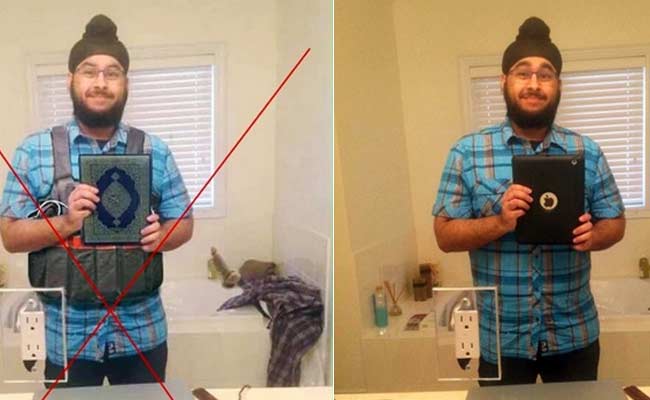
    The Madrid-based La Razon included a picture of Canadian freelance journalist Veerender Jubbal, with the caption “one of the terrorists”.

    However, the picture had been doctored to add what appeared to be a Quran and a suicide vest.

    “One of the terrorists may have entered Greece along with Syrian refugees. The unidentified attackers were between 15 and 18 years and acted in three teams,” the text by the image of Mr Jubbal read. The paper apologised on Sunday afternoon.

    In the original photo, Mr Jubbal appears to be holding an iPad. But, in the edited picture, the iPad has been turned into what appears to be a Quran and a suicide vest has been added.

    When the edited image began to spread, Mr Jubbal posted the original as evidence that he had had nothing to do with Friday night’s murderous attacks in Paris that killed 129 people and injured more than 350 others.

    “I hope everyone has caught up with what is going on with me. I went viral due to a Photoshopped image claiming that I am a terrorist,” Mr Jubbal tweeted.

    “People are editing, and Photoshopping my selfies as if I am one of the people causing the issues/problems in Paris,” he said.

    “Never been to Paris. Am a Sikh dude with a turban. Lives in Canada,” he added.

    It is unclear who edited the image and why, though some have suggested that Mr Jubbal’s criticism of the Gamergate movement was the motivation for the smear, The Guardian reported.

    Many of its adherents say Gamergate, which started in earnest as a reaction to claims made about the private lives of a female games developer and a male journalist, as a fight for more ethical coverage of video gaming. But many of its opponents say it is a misogynistic harassment campaign.

    The long-running debate has been marked by accusations of abuse from both sides.

    “Gamers are absolute garbage like I have been saying for a full year,” Mr Jubbal said.

    People will not stop harassing, and bothering me.