Tag: 2016 US Presidential Campaign & Election

  • Indian American Group Backs Donald Trump for President

    Indian American Group Backs Donald Trump for President

    NEW YORK (TIP): Calling Republican presidential frontrunner Donald Trump as the “best hope for America”, some Indian-Americans in the New York Tristate area have formed a Political Action Committee (PAC) to support and raise funds for him.

    Headed by Dr. AD Amar, a business professor with Seton Hall University in New Jersey, the ‘Indian-Americans for Trump 2016’ was registered as a PAC with the Federal Election Commission last week.

    Its sole goal is “to garner actively the support of all Americans, but particularly Indian-Americans, to have Donald J. Trump become the next President of the USA,” the PAC said in a press release.

    “On realizing that the agenda of Donald J Trump for President 2016 is focused on reviving the American economy, rightly bringing America on the world stage, defeating terrorism and establishing peace through strength, many Indian-Americans believe that he is the best hope for America and the right candidate to be the next president of the United States,” the PAC said in a statement.

    The real estate billionaire has vowed not to take money from individuals or special interest groups, or seek support from PACs.

    Anand Ahuja, an attorney based in New York, and Devendra “Dave” Makkar, a businessman in New Jersey, have been “elected” vice president and treasurer respectively.

    Dr. Sudhir Parikh, publisher of a couple of community news publications in New Jersey, has been named chair of fundraising and advisory committee of Indian-Americans for Trump 2016.

    “This is only the first step. We are on the side of Trump for this election,” Amar said, citing Trump’s policies on illegal immigration and economy in particular as the main reasons for his group to support the Republican contender.

    There was no comment from the Trump campaign.

  • Sikh Thrown Out Of Donald Trump’s Rally for Holding ‘Stop Hate’ Banner, Says Would Continue Protest

    Sikh Thrown Out Of Donald Trump’s Rally for Holding ‘Stop Hate’ Banner, Says Would Continue Protest

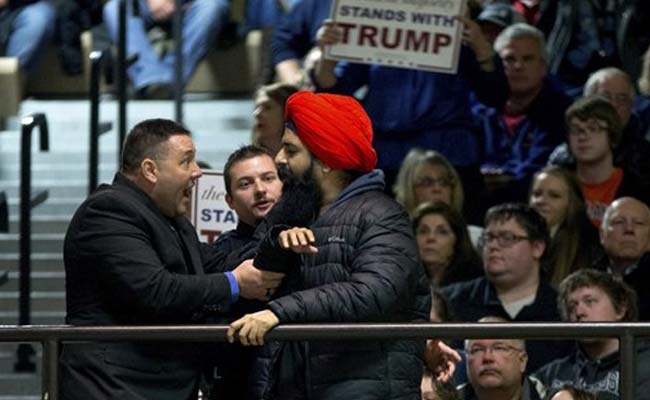
    WASHINGTON:  A turbaned Sikh, Arish Singh, was forced out of Donald Trump’s election rally in Iowa after he protested the Republican presidential frontrunner’s anti-Muslim speeches with a ‘Stop Hate’ banner.

    The protest started when Donald Trump was speaking about the twin-tower terrorist attack in New York. (AP Photo)
    The protest started when Donald Trump was speaking about the twin-tower terrorist attack in New York. (AP Photo)

    Mr. Singh started his peaceful protest impromptu, when Mr Trump was addressing an impressive campaign rally on Sunday, Jan 24, with his signature anti-Muslim speech.

    Arish Singh is a former editor of a local newspaper ‘Little Village’ and a comedian. He was thrown out of a Trump rally for displaying the banner.

    The protest started when Mr Trump was speaking about the twin-tower terrorist attack in New York.

    “We have radical Islamic terror going on all over the place, all over the world, and we have a president that won’t say it,” he said.

    “When planes fly into the World Trade Centre, and into the Pentagon, and wherever the third plane was going. When people are shooting their friends in California, when they’re shooting their friends,” Mr Trump said.

    As the Sikh raised his banner, he waved his hand and said ‘Bye. Bye. Goodbye’.

    “He wasn’t wearing one of those hats was he? And he never will, and that’s OK because we got to do something folks because it’s not working,” Mr Trump said as the sole Sikh protester was taken out of the rally amidst chanting of ‘USA, USA, USA’ by his supporters.

    Mr Trump is campaigning in Iowa ahead of the next week’s crucial caucus.

    Latest polls showed that he has taken a lead over his nearest Republican rival Ted Cruz. Iowa Caucus on February 1 is considered crucial as it would set the trend for the rest of the presidential primaries over the next few months.

    Arish Singh, a former editor of a local newspaper 'Little Village', was thrown out of a Trump rally in Iowa.
    Arish Singh, a former editor of a local newspaper ‘Little Village’, was thrown out of a Trump rally in Iowa.

    Singh has said that he plans to take his peacful protests to other rallies of the real-estate tycoon

    “I am a not a Muslim. But you don’t have to be a Muslim to stand against anti-Muslim bigotry,” Mr Singh, a resident of Chicago, tweeted yesterday afternoon.

    “I did interrupt him. I did say, ‘why do you give shelter to white supremacists. Why do we have white supremacists robocalling in Iowa?’ I did say that as we dropped the banner,” Mr Singh told the publication in an interview.

    Mr Singh said that he decided to interrupt the speech due to a series of remarks by Mr Trump – such as his suggestion that the US ban all Muslim immigrants – which have coincided with a rise in incidents of xenophobia and bigotry against Sikhs and Muslim Americans.

    While Mr Trump has not attacked Sikhs directly, Mr Singh pointed to a series of hate-crimes perpetuated against Muslim Americans over the past months.

    It is part of the Sikh tradition to stand up to injustice, regardless of where it might manifest, he said, adding that he plans on protesting during Trump’s rally in Iowa City.

    When Mr Singh saw that white supremacists began robo-calling in Iowa in support of Trump, he said that was the “last straw,” Little Village reported.

    “I don’t really care about Trump himself or his political party, but this sort of movement that he’s emboldened – this sort of fascistic element that genuinely identifies with fascism, that’s willing to commit hate-crimes – that’s something that’s real that needs to be confronted, and you can’t just let that go without comment, and I think that’s kind of how it’s been treated,” Mr Singh said.

    Mr Singh said he was not sure, if Mr Trump in his comment in hat was trying to make any kind of slur against him.

    “Whether he was trying to make any kind of slur against me is kind of irrelevant. It’s clear what his politics are as far as ostracizing and scapegoating people for their background. I think he’s left no real mystery there,” Mr Singh said.

    “I believe we’re banned from the premises for a year,” Mr Singh said.

  • Donald Trump: Will not review call to ban Muslims from entering US

    Donald Trump: Will not review call to ban Muslims from entering US

    WASHINGTON (TIP): Donald Trump refused to budge over his call to ban all Muslims from entering the US even as Republican presidential rivals questioned his controversial stance, with Jeb Bush wondering if the frontrunner also meant banning Muslims from countries like India and Indonesia which are strong allies of the US.

    Trump – whose popularity rating soared after his anti-Muslim rhetoric in which he called for banning all Muslims from entering the US – said that he would not review his decision as the security of the country is paramount for him.

    “I want security for this country. We have a serious problem with radical Islam. We have a tremendous problem. It’s not only a problem here. It’s a problem all over the world,” Trump said as he refused Bush’s request to review his plan.

    “Are we going to ban Muslims from India, from Indonesia, from countries that our strong allies — that we need to build better relationships with? Of course not. What we need to do is destroy ISIS,” Bush said during the debate with six other top candidates two weeks before the first nominating contests.

    Trump said: “We have to stop with political correctness. We have to get down to creating a country that’s not going to have the kind of problems that we’ve had with people flying planes into the World Trade Centres, with shootings in California, with all the problems all over the world.

    “We have to find out what’s going on. I said temporarily. I didn’t say permanently.”

    Bush responded, saying: “Donald I hope you reconsider this, because this policy is a policy that makes it impossible to build the coalition necessary to take out ISIS. The Kurds are our strongest allies. They’re Muslim. “You’re not going to even allow them to come to our country?”

    “The other Arab countries have a role to play in this. We cannot be the world’s policeman. We can’t do this unilaterally. We have to do this in unison with the Arab world. And sending that signal makes it impossible for us to be serious about taking out ISIS and restoring democracy in Syria,” Bush said amidst applause. Senator Ted Cruz from Texas said Americans are feeling frustrated and scared and angry when there is a president who refuses to acknowledge the threat US faces.

    (PTI)

  • If Trump wins the nomination, prepare for the end of the conservative party

    If Trump wins the nomination, prepare for the end of the conservative party

    When Republicans gather for their next thought process before the primaries in 2016, one of the main issues all the candidates should be required to address is what each thinks of the controversial statements and arguments that Donald Trump has made about everything from Russia, Foreign Policy, Domestic Policy & how to fight ISIS.

    Playing to fears can help candidates gain attention from the news media and the electorate, and it offers an easy way to depict their opposition as incapable of leading. According to a recent New York Times/CBS News poll, fears of terrorism have boosted Trump’s position.

    Trump has a habit of taking campaign rhetoric to more dramatic places. In response to the horrific series of attacks conducted by ISIS, Trump kept saying things that led observers to ask whether he had finally reached the tipping point of going so far that there would be an electoral backlash.

    Last month, Trump said that he would ban all Muslims from traveling to the United States. He has called for a federal registry of Muslims, while also promising to “take out” the families of terrorists. Trump says he would bring back the use of waterboarding. If it didn’t work, well, “they deserve it anyway,” he said. Trump has complained that Americans are too politically sensitive about profiling people who could be potential terrorist threats and “that’s part of the problem we have with our country.”

    There has been a noticeably tough response from Republicans. “We need to aggressively take on radical Islamic terrorism but not at the expense of our American values,” said RNC Chairman Reince Priebus. “This is not conservatism,” said House Speaker Paul Ryan.

    But some are skeptical about where the GOP stands. The New York Times editorial board published a blistering piece about Trump’s influence, writing, “The Republican rivals rushing to distance themselves from his latest inflammatory proposal … have been peddling their own nativist policies for months or years. They have been harshening their campaign speeches and immigration proposals in response to the Trump effect.”

    Trump’s embrace of the politics of fear is not that surprising. There is a long tradition in campaigns of candidates who have played to the worst sentiments of the electorate during times when there are serious national security threats.

    History’s lessons
    Historically, when politicians recklessly use the politics of fear, bad things happen. On the most basic level, damaging rhetoric results in injustices being committed to innocent citizens. For example, World War I had a devastating impact on many German-Americans. Other immigrant groups were harassed and saw their loyalty questioned. In April 1918, Robert Prager, a German coal miner who had applied for U.S. citizenship, was lynched by a mob. In 1919 and 1920, Attorney General Mitchell Palmer led a massive crackdown on individuals and groups associated with the left during the “red scare.” In the years that followed, nativism fused with anti-communism to produce a severe crackdown on immigration.

    Japanese-Americans were forced to live in internment camps during World War II, an action that has remained a huge black mark on Franklin Roosevelt’s record as commander in chief, as was his adminstration’s refusal to admit Jewish refugees who were desperately fleeing from Nazi Germany.

    In 1968, George Wallace’s independent campaign for president stirred up racial and social resentment against the gains on racial equality and civil rights in the 1960s.

    There are also political dangers for the Republican Party in using this kind of rhetoric, even though it often seems appealing in the short term. For decades, Democrats paid the price for being the party that intensified the war in Vietnam.

    In the early 1980s, when Ronald Reagan used pointed language to speak about the “Evil Empire” of the Soviet Union, advisers urged him to be more proactive in pursuing peace after fears emerged in 1983 of the possibility of a nuclear war. President George W. Bush’s war in Iraq dragged down his presidency. It is not clear right now, even if polls temporarily show support for ground troops in Syria, that the nation would really be willing to take on another protracted ground war that will cost human lives and a big chunk of our national budget.

    Finally, there are huge policy dangers that come from this kind of fear strategy, as it has historically stimulated a dynamic that drives political parties into poor decision-making. This undermines the nation’s ability to effectively combat threats.

    During the 1950s, too many members of both parties sat by silently as Joseph McCarthy and his allies cast an extraordinarily wide net in the search for alleged communists in the United States, violating civil liberties and damaging lives in the process. These actions polarized and divided a nation otherwise united in the fight against communism.

    The end of the conservative party

    If you look beyond Donald Trump’s comprehensive unpleasantness – is there a disagreeable human trait he does not have? -you might see this: He is a fundamentally sad figure. His compulsive boasting is evidence of insecurity. His unassuageable neediness suggests an aching hunger for others’ approval to ratify his self-admiration. His incessant announcements of his self-esteem indicate that he is not self-persuaded. Now, panting with a puppy’s insatiable eagerness to be petted, Trump has reveled in the approval of Vladimir Putin, murderer and war criminal.

    Putin slyly stirred America’s politics by saying Trump is “very .?.?. talented,” adding that he welcomed Trump’s promise of “closer, deeper relations,” whatever that might mean, with Russia. Trump announced himself flattered to be “so nicely complimented” by a “highly respected” man: “When people call you brilliant, it’s always good.” When MSNBC’s Joe Scarborough said Putin “kills journalists, political opponents and invades countries,” Trump replied that “at least he’s a leader.”

    Besides, Trump breezily asserted, “I think our country does plenty of killing also.” Two days later, Trump, who rarely feigns judiciousness, said: “It has not been proven that he’s killed reporters.”

    Well. Perhaps the 56 journalists murdered were coincidental victims of amazingly random violence that the former KGB operative’s police state is powerless to stop. It has, however, been “proven,” perhaps even to Trump’s exacting standards, that Putin has dismembered Ukraine. (Counts one and two at the 1946 Nuremberg trials concerned conspiracy to wage, and waging, aggressive war.)

    Until now, Trump’s ever-more-exotic effusions have had an almost numbing effect. Almost. But by his embrace of Putin, and by postulating a slanderous moral equivalence -Putin kills journalists, the United States kills terrorists, what’s the big deal, or the difference? – Trump has forced conservatives to recognize their immediate priority.

    Certainly conservatives consider it crucial to deny the Democratic Party a third consecutive term controlling the executive branch. Extending from eight to 12 years its use of unbridled executive power would further emancipate the administrative state from control by either a withering legislative branch or a supine judiciary. But first things first. Conservatives’ highest priority now must be to prevent Trump from winning the Republican nomination in this, the GOP’s third epochal intraparty struggle in 104 years.

    In 1912, former president Theodore Roosevelt campaigned for the Republican nomination on an explicitly progressive platform. Having failed to win the nomination, he ran a third-party campaign against the Republican nominee, President William Howard Taft, and the Democratic nominee, New Jersey Gov. Woodrow Wilson, who that November would become the first person elected president who was deeply critical of the American founding.

    TR shared Wilson’s impatience with the separation of powers, which both men considered an 18th-century relic incompatible with a properly energetic executive. Espousing unconstrained majoritarianism, TR favored a passive judiciary deferential to elected legislatures and executives; he also endorsed the powers of popular majorities to overturn judicial decisions and recall all public officials.

    Taft finished third, carrying only Utah and Vermont. But because Taft hewed to conservatism, and was supported by some other leading Republicans (e.g., Sen. Henry Cabot Lodge, one of TR’s closest friends, and Elihu Root, TR’s secretary of war and then secretary of state), the Republican Party survived as a counterbalance to a progressive Democratic Party.

    In 1964, Barry Goldwater mounted a successful conservative insurgency against a Republican establishment that was content to blur and dilute the Republican distinctiveness that had been preserved 52 years earlier. Goldwater defeated New York Gov. Nelson Rockefeller for the nomination, just as Taft had defeated TR, a former New York governor. Like Taft, Goldwater was trounced (he carried six states). But the Republican Party won five of the next seven presidential elections. In two of them, Ronald Reagan secured the party’s continuity as the custodian of conservatism.

    In 2016, a Trump nomination would not just mean another Democratic presidency. It would also mean the loss of what Taft and then Goldwater made possible – a conservative party as a constant presence in U.S. politics.

    It is possible Trump will not win any primary, and that by the middle of March our long national embarrassment will be over. But this avatar of unfettered government and executive authoritarianism has mesmerized a large portion of Republicans for six months. The larger portion should understand this:

    One hundred and four years of history is in the balance. If Trump is the Republican nominee in 2016, there might not be a conservative party in 2020 either.

  • Hillary Clinton Disapproves of  Increased Deportations & Raids

    Hillary Clinton Disapproves of Increased Deportations & Raids

    WASHINGTON (TIP): Immigration is one of the leading issues in the 2016 race and a spike in raids in recent weeks, largely aimed at women and children, has drawn the ire of rights groups.

    Hillary Clinton has called for an end to deportation raids targeting Central American families living in the US illegally.

    Mrs. Clinton said the raids “have sown fear and division in immigrant communities across the country”.

    Scores of House Democrats on Tuesday, Jan 12, echoed Mrs. Clinton and demanded the raids stop.

    Democratic President Barack Obama has been assailed by both political parties on this issue.

    More than two million undocumented migrants have been deported from the US during his presidency, prompting accusations of being “deporter-in-chief” from within his own party.

    But his Republican critics attack his administration for not doing enough to secure the borders.

    They are also deeply opposed to his plan to lift the threat of deportation to 11 million people who have been living illegally in the US for some time.

    Thousands have come over the border with Mexico in the last two years, mostly fleeing violence in Central America.

    The raids spiked over the holiday season, with 121 adults and children arrested, mainly in Texas, Georgia and North Carolina.

    Why are the raids happening?
    They come as fears grow that a spike in immigration from Central America may be foreshadowing a repeat of the 2014 crisis that saw tens of thousands of migrants – especially unaccompanied children – cross the border.

    The White House has defended the raids, with spokesman Josh Earnest saying the president was aware of the outrage but that “the enforcement strategy and priorities that the administration has articulated are not going to change”.

    The Obama administration has unilaterally enacted immigration reform to protect undocumented immigrants who have been in the country a long time, but has said deportations would continue. In February, Mr. Obama said that the forced removals would be “focusing on potential felons”.

    What has the reaction been?
    The raids have riled lawmakers and activists, who say they are disruptive and ill-timed, and were breaking families apart as well as spreading fear across immigrant communities.

    Rep Nydia Vlazquez, a member of the Hispanic caucus, said that “immigrants and their families are terrorized”.

    “These are some of the most vulnerable members of society and we are treating them like criminals.”

    The anger prompted White House officials to meet with politicians on Thursday in an attempt to dampen the anger.

    That failed to stop 135 Democrats from co-signing a letter asking that the raids stop immediately.

    “We strongly condemn the Department of Homeland Security’s recent enforcement operation targeting refugee mothers and children from El Salvador, Honduras, and Guatemala,” the letter reads.

    How has immigration played in the 2016 campaign?
    Republican candidate Donald Trump prompted a weeks-long outrage over the summer when he described Mexican immigrants as “rapists” and “criminals” and called for a wall to be built on the southern border.

    Meanwhile, one of his rivals, Marco Rubio, is framing the issue as one of national security, saying that radical jihadist groups could exploit the immigration system.

    Mr. Rubio’s support for immigration reforms in the past could be a liability for the candidate during primary elections, as he attempts to climb to the top of the crowded and mainly conservative Republican pack.

    Democrats have taken a different approach to the issue, urging a humanitarian response.
    Senator Bernie Sanders, currently in second place, wrote a letter to President Obama earlier this month saying: “I urge you to immediately cease these raids and not deport families back to countries where a death sentence awaits.”

    Martin O’Malley, who is in a distant third place, has attacked his two rivals saying that their support for immigrants was recent and politically expedient.

  • Conservatives want Indian American Nikki Hailey Deported Trump calls Hailey very weak on immigration

    Conservatives want Indian American Nikki Hailey Deported
    Trump calls Hailey very weak on immigration

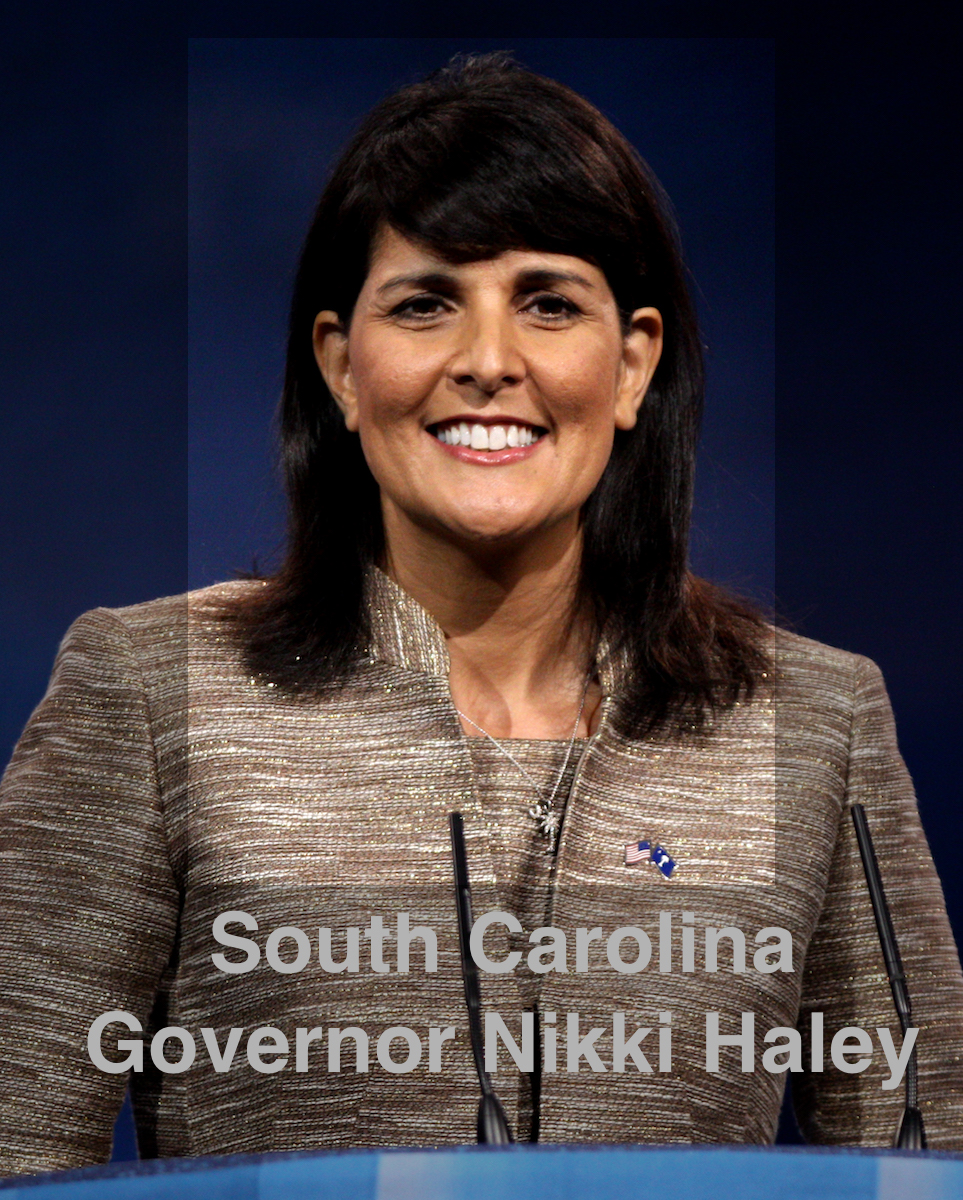
    When Nikki Haley offered the Republican response to President Obama’s final State of the Union, the American people heard an articulate conservative who has twice been elected Governor in South Carolina. It’s a sign of the GOP’s distemper that some conservatives denounced her because she didn’t denounce legal immigration.

    Gov. Haley’s parents came to America from India. Her father taught botany at Voorhees College. Her mother started what would become a multimillion-dollar clothing company out of the living room of the family home. As she put it Tuesday, “I am the proud daughter of Indian immigrants who reminded my brothers, my sister and me every day how blessed we were to live in this country.”

    Her conservative critics unloaded. “Trump should deport Nikki Haley” went one tweet. The next morning on “Fox & Friends,” Donald Trump declared that Gov. Haley is “very weak on immigration.”

    Are we talking about the same Nikki Haley? The woman who says “illegal immigration is not welcome in South Carolina”? Who signed a law toughening the state’s illegal immigration reform act, which requires employers to verify the immigration status of new hires? Who has fought President Obama’s bid to resettle unvetted Syrian refugees? And whose state has joined 16 others in a lawsuit against Mr. Obama for what they say is his unconstitutional executive order on illegal immigration?

    The distinction Gov. Haley is trying to make is between a functioning, legal immigration system that works in America’s interest—which Republicans say they want—and the unlawful, broken and arbitrary system that encourages illegality—which is what we now have and which President Obama exploits to the Democrats’ political advantage.

    The attacks on Ms. Haley show that many on the right these days oppose any immigrants, even those who arrive legally. They also want to make opposition to immigration a GOP litmus test. A party that rejects Nikki Haley as a spokeswoman is one that doesn’t really want to build a governing majority.

  • Nikki Haley Keeps Options Open For US Vice-Presidential Bid

    Nikki Haley Keeps Options Open For US Vice-Presidential Bid

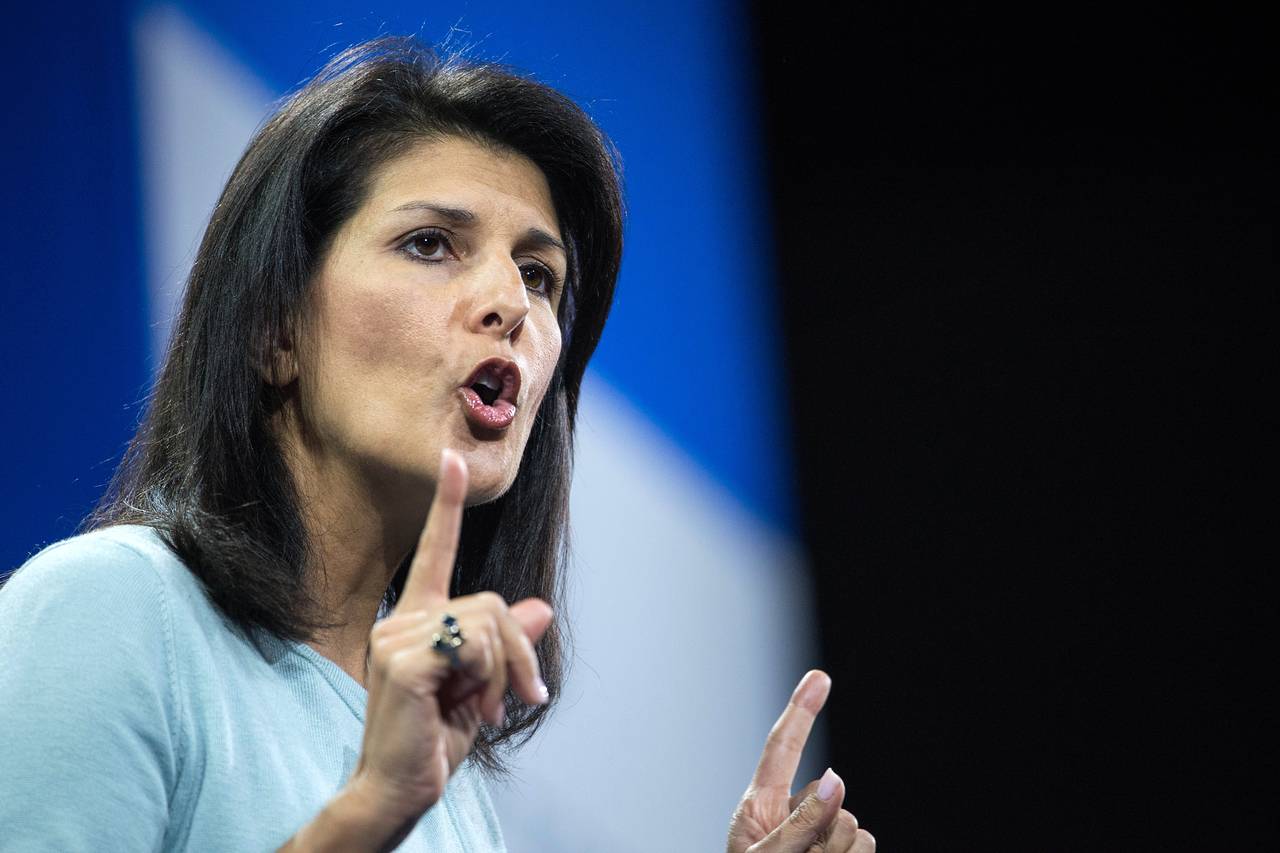
    Indian-American South Carolina Governor Nikki Haley on Wednesday kept her options open on being the Republican vice presidential nominee as she said that though her life “is full” at the moment, she would be “happy to sit down with a candidate”.

    The 43-year-old, who is the first woman and first minority governor in her state’s history, told the CNN: “I truly haven’t thought about it near as much as you guys have.”

    Ms Haley had delivered the opposition Republican response to President Barack Obama’s last State of the Union address on Wednesday in what was seen as an opportunity to propel her to the US national political scene.

    In recent days her becoming the party’s vice presidential nominee has gained ground.

    But, Ms Haley did not give a clear answer to whether she would run for the coveted post.

    “You know, I’ve got a daughter that’s a senior in high school, I’ve got a son in middle school, so I’m busy with basketball games and running the State.”

    “I’ve said, if any time someone wants to sit down, I’m happy to sit down with a candidate, but really my life is full,” she said, echoing what she also told NBC in a separate interview.

    “Everything’s pretty full right now and we’ve got a lot to do in the state of South Carolina, and I look forward to doing that,” Ms Haley said.

    She said her crucial speech in response to President Obama’s at the State of the Union address, in which she appeared to be critical of Donald Trump, was “partially” directed at her party’s presidential front runner.

    “Yes partially to Donald Trump, but partially to a lot of other people as reminding them we get more done when we listen and find out where someone else is coming from and put ourselves in their shoes to try and figure out where we can find common ground,” Haley said.

    Following her response, one of the top Mr Trump supporter had called for her deportation.

    “I am concerned,” she said when asked about such remarks. Her speech, Ms Haley said, was vetted by the top Republican leadership.

    This was also praised by many Republican presidential campaigns including those by Jeb Bush and former President Obama advisor David Axelrod.

  • Trump launches anti-Muslim and immigration campaign ad

    Trump launches anti-Muslim and immigration campaign ad

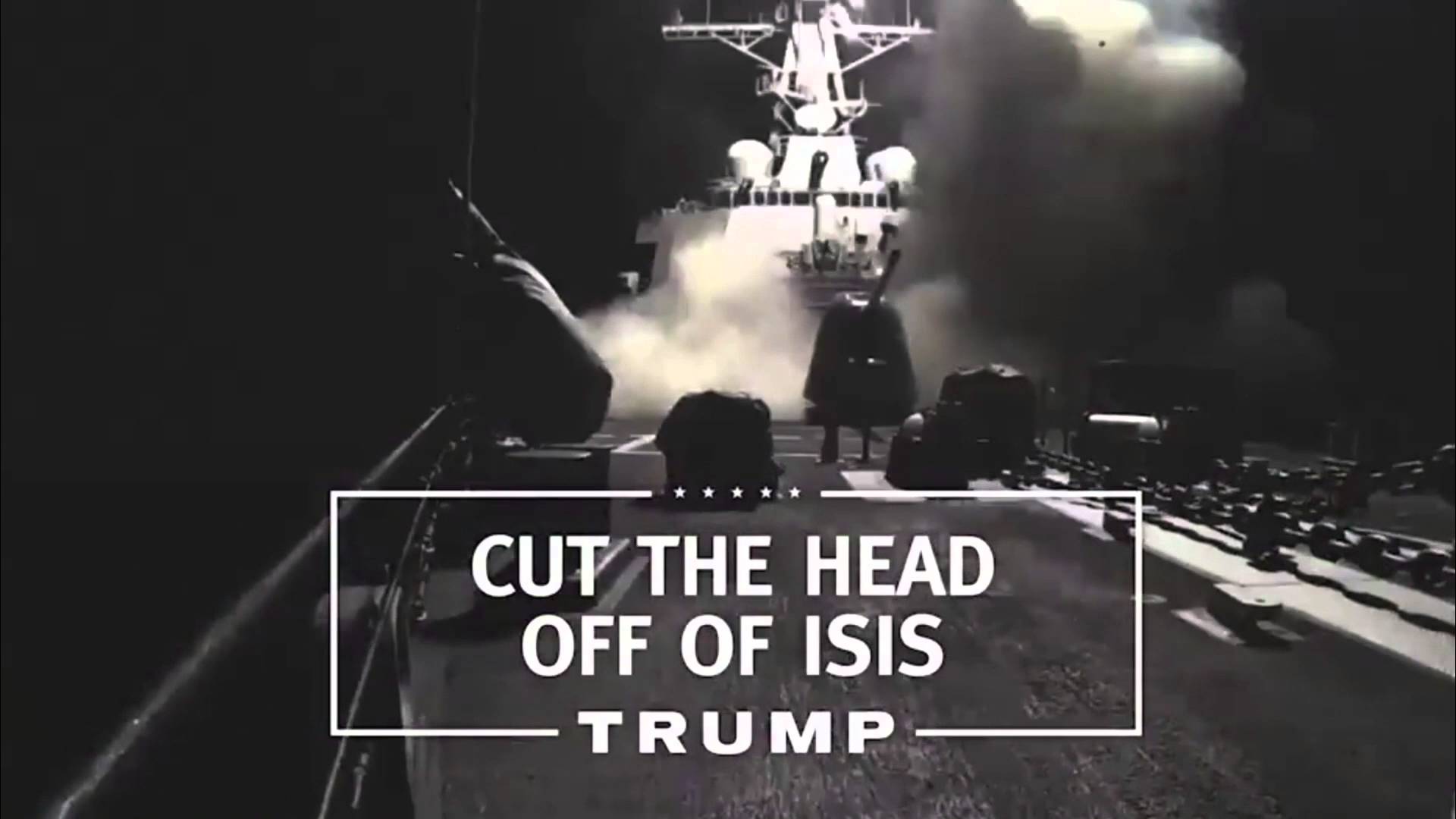
    WASHINGTON: Republican presidential candidate Donald Trump on Monday released his first television commercial in the 2016 race for the White House with a 30-second spot highlighting his stance on Muslims, immigration and terrorism.

    The ad will air starting on Tuesday in Iowa and New Hampshire, two key early voting states in the run-up to the party’s nomination convention in July ahead of the November election, Trump’s campaign said in a statement on its website.

    The commercial reiterates the Republican front-runner’s recent call to temporarily block Muslims from entering the United States and pledges a tough stance against Islamic State and acts of terrorism.

    “He’ll quickly cut the head off ISIS and take their oil,” the ad said, using an acronym for the militant group.

    The ad also reiterated the businessman-turned-politician’s ongoing calls to target illegal immigration by building a wall along the southern U.S. border that he said Mexico will pay for.

    Trump leads national public opinion polls of the 12 Republicans seeking their party’s presidential nomination, although he is trailing in some state polls.

    Reuters/Ipsos polling showed Trump with 38 percent support among Republican respondents, followed by U.S. Senator Ted Cruz with nearly 15 percent, and retired neurosurgeon Ben Carson with 12 percent.

    “I don’t know if I need it, but I don’t want to take any chances because if I win we are going to make America great again,” Trump said in a statement accompanying the ad on his website.

    He said last week he planned to spend at least $2 million a week on ads in early voting states.

    On Monday, his campaign said it is also releasing a radio ad later this week in South Carolina, another key state.

  • Trump Muslim remark used in jihadist recruitment video

    Trump Muslim remark used in jihadist recruitment video

    Republican White House frontrunner Donald Trump’s call for a ban on Muslims entering the US have been used by Somalia’s Shebab in a jihadist recruitment video, a US monitoring group said today.

    The Al Qaeda-affiliated Shebab use an excerpt from Trump’s December 7 speech to try and woo Muslims in the West to wage jihad, the SITE Intelligence Group reported.

    In his speech, Trump proposed a “total and complete shutdown” on Muslims entering the US until the US was “able to determine and understand this problem” of Islamist violence, following the killing of 14 people by a radicalised couple in California.

    In the Shebab video, the Trump soundbite is preceded by a speech by the late Anwar al-Awlaki, a US-born radical imam, calling on Muslims in America to “flee the oppressive Western atmosphere for the lands of Islam”.

    Al-Awlaki, who Washington alleges was a senior Al Qaeda operative, was killed by a US drone strike in Yemen in September 2011.

    The video, which lasts more than 50 minutes, specifically targets black youths, urging them to convert to Islam and leave for the Somali battlefield using footage of Malcolm X, protests against police actions, and speeches of white supremacists, SITE said.

    It portrays America as a country hostile to its Muslim population, with the narrator claiming that “in the United States, basic human rights and concepts such as justice, tolerance, and the rule of law do not apply if you are a Muslim”.

    Trump’s inflammatory remarks sparked a wave of global outrage, with his Democratic rival Hillary Clinton warning that his words were playing into the hands of extremist groups.

    During a Democratic debate last month, Clinton accused Trump of being “ISIS’s best recruiter,” referring to the self-described Islamic State group, and said the radical jihadists were “going to people showing videos of Donald Trump insulting Islam and Muslims in order to recruit more radical jihadists.”

    Trump hit back, accusing her of lying, but Clinton’s spokeswoman insisted that his remarks were “being used in social media by ISIS as propaganda… to help recruiting,” sourcing the information to groups that monitor IS’s online activities.

  • Barack Obama was made to look ‘blacker’ in Republican Party campaign ads

    Barack Obama was made to look ‘blacker’ in Republican Party campaign ads

    WASHINGTON (TIP): The new study shows that negative ads targeting President Obama in 2008 depicted him with very dark skin, and that these images would have appealed to some viewers’ racial biases.

    The finding reinforces charges that some Republican politicians seek to win votes by implying support for racist views and ethnic hierarchies, without voicing those prejudices explicitly. The purported tactic is often called “dog-whistle politics” — just as only canines can hear a dog whistle, only prejudiced voters are aware of the racist connotations of a politician’s statement, according to the theory.

    That debate has been prominent in the 2016 campaign, primarily targeting Donald Trump, but it has existed in almost every recent presidential election. To hear their opponents tell it, when Republican politicians say they oppose a generous welfare system, they really mean black beneficiaries are lazy. If they endorse strict immigration enforcement, they really mean that Latinos are criminals, critics say.

    A study published online this month in Public Opinion Quarterly provides new evidence that one GOP campaign —intentionally or not — has aired advertisements that exacerbate viewers’ racial biases.

    Analyzing 126 advertisements from the presidential campaign in 2008, the authors first digitally measured the darkness of the two nominees’ skin in each spot, then sorted the ads into categories based on themes. President Obama and his opponent, Senator John McCain (respresentatiove of Arizona), looked very different in various advertisements depending on how the footage was edited and produced.

    That was particularly the case in negative advertisements, in which each campaign manipulated the images of its opponent to shadow or wash out his face for dramatic effect.

    Interestingly, though, when McCain’s campaign aired spots that connected Obama with alleged criminal activity by liberal groups, the producers almost always used images that made Obama’s skin appear very dark. You can watch one of those spots here.

    Eighty-six per cent of these ads contained an image of the president in which the his skin tone was in the darkest quartile of all ads studied.

    Likewise, as the election approached, images of Obama in spots aired by McCain’s campaign became gradually darker.

    Images of McCain campaign’s own candidate, meanwhile, became somewhat lighter.

    Whether this was a conscious strategy on the part of McCain’s campaign is impossible to say. The Washington Post contacted the Republican National Committee and McCain’s Senate office. They did not immediately respond to requests for comment.

    Yet a large body of evidence shows that racial prejudices are stronger against African Americans with darker skin. For example, jurors are more likely to sentence to death black defendants with stereotypically African facial features, even when accounting for the severity of the crime.

    The authors of this study — Solomon Messing of the Pew Research Center; Maria Jabon, a software engineer who works for LinkedIn; and Ethan Plaut, a postdoctoral fellow at Stanford University — confirmed that darker images of Obama did indeed affect the way viewers perceived him. (Messing conducted the research at Stanford before joining Pew.)

    The researchers showed subjects manipulated images of Obama and then asked them to play a game resembling a crossword puzzle. The subjects had to fill in blanks, such as “C R _ _ _.” One respondent might write “C R O W D,” while another might write “C R I M E.” Given the letters “L A _ _,” a respondent could write “L A Z Y.”

    (The Independent)

  • Donald Trump ‘to spend $2 million a week on presidential bid’

    Donald Trump ‘to spend $2 million a week on presidential bid’

    WASHINGTON (TIP): Donald Trump has said that he will spend at least $2 million a week on his campaign to become the Republican party’s presidential candidate.

    The billionaire frontrunner, who has not spent large sums as part of his bid to date, said he will earmark $2 million a week for television advertising in the first three voting states.

    The controversial figure has said that, although he did not believe he needed to spend any money, he did not want to take anything for granted.

    He said: “I don’t think I need to spend anything. And I’m very proud of the fact that I’ve spent the least and achieved the best result.

    “I feel I should spend. And honestly I don’t want to take any chances.”

    The 69-year-old has spent nothing on television advertising so far, but more than$300,000 on radio advertising time – still far less than his rivals.

    Former Florida governor Jeb Bush has spent more than $40 million on his campaign, but is trailing Trump and several other candidates in the nomination race.

    The majority of Trump’s campaign has been funded by donors across the country, sending him cheques or buying merchandise from his website.

    “I’ll be spending a minimum of $2 million a week and perhaps substantially more than that,” he said.

    “If somebody attacks me, I will attack them very much and very hard in terms of ads.”

    Trump said he had screened his first two adverts, which touch on immigration, trade and national security policy.

    When the real estate mogul announced his candidacy in June, he said he planned to spend $35 million by 1 January 2016.

    But his provocative and plain-speaking style has resulted in a steady stream of media coverage – which has included, in recent weeks, his call to ban all Muslims from entering the US and claim that Democratic frontrunner Hillary Clinton was “schlonged” to the presidency by Barack Obama when they both ran for their party’s nomination in 2008.

    Trump has also said he believes that the thousands of people who attend his rallies will ultimately turn out and vote for him.

    Iowa’s caucuses will begin the voting on 1 February.

    (AP)

  • The on-off ties with the US

    The on-off ties with the US

    Travelling from east to west in the US, from the Atlantic to the Pacific, gave one an occasion to see the world’s sole superpower totally preoccupied in dealing with the aftermath of a terrorist strike. This terrorist attack, in which 14 innocent people were gunned down in the small town of San Bernardino in southern California, was executed by an immigrant couple of Pakistani origin. The uproar and outrage that followed, led to strident calls for ending immigration of Muslims, who are facing personal attacks, insults and desecration of their places of worship across the country. It is ironic that in the recent past, the US has been pontificating on the need for “tolerance” in India.

    modi obamaOne consequence of these developments has been the admiration in important sections of the American Establishment at how India, with an estimated Muslim population of 180 million, has maintained communal peace and harmony. It has been noted, that unlike in the US and Europe, few, if any, Indian Muslims have shown interest in joining the ranks of global terrorist organisations like the Al-Qaeda earlier, or the IS now. While visiting the US recently, Defence Minister Manohar Parrikar asserted that India is confident that its Muslim citizens will not be radicalised. Meetings with well-connected US friends in Washington and New York revealed a marked improvement in the climate of relations and widespread bipartisan support for India in the US Congress. The India-US relationship is, however, viewed by the Obama Administration in predominantly transactional terms. There is little empathy, or understanding, for India’s policies and concerns in its western neighbourhood, ranging from Pakistan and Afghanistan, across the Mediterranean, to Turkey. There are also questions about the reliability of the US to abide by commitments made on India’s “Act East” policies.

    Whether in New York, Washington or California, one could not help noting the widespread feeling that Prime Minister Narendra Modi has introduced qualitatively new dimensions in reinvigorating the US-India relationship. This was especially evident in the growing confidence about India in large sections of the business, industrial and high-tech establishments. The target of expanding the levels of bilateral trade in goods and services from $100 billion annually to $500 billion is no longer regarded as a pipe dream. There is confidence that India will continue on the path of perhaps being the fastest growing economy in the world in the years ahead. American business is, for the first time, seriously taking note of Indian determination to emerge as a strong industrial power by enhancing its manufacturing capabilities. American industries, in areas ranging from aerospace to motorcars, are now showing increasing confidence in India’s emergence as a significant industrial partner.

    It is fortuitous that after an era when the Pentagon showed little interest in understanding India’s defence needs and strategic compulsions, the present Defence Secretary, Ashton Carter, recognises that India cannot be treated like Pakistan or Turkey. New Delhi has well-established defence partnerships with major arms suppliers like Russia, Israel, France, Germany and the UK. Japan has now joined this list of strategic partners. It is in this background, that readiness is now being shown by the US arms industry and the Pentagon to expand areas of cooperation into fields like aero-engines for multi-role combat aircraft, aircraft carriers, artillery and attack helicopters. This development has to be assiduously utilised to leverage our relations with other partners like Russia, where we have been experiencing problems of escalating prices and poor serviceability of critical weapons systems.

    These developments do not mean that relations with the US are free of problems. In our immediate western neighbourhood, we are seeing the emergence of a tripartite US-China-Pakistan partnership to promote reconciliation with the Taliban, in a process from which India has been deliberately excluded. A return of the Taliban to the corridors of power in Afghanistan will have serious consequences for India’s security, given the Taliban’s past record and close ties with anti-Indian groups like the Jaish-e-Mohammed and the Lashkar-e-Taiba. In deference to Pakistani exhortations, the US has left the Afghan armed forces ill-equipped to face the Taliban-ISI challenge to the country’s sovereignty. While India is providing three attack helicopters, it needs to do far more to strengthen Afghan capabilities in areas like artillery, armoured vehicles and aircraft. Proactive diplomacy with Russia, its Central Asian partners neighbouring Afghanistan and Iran is required to achieve this.

    The US shows little interest in a meaningful dialogue with India on developments in West Asia, evidently because of its traditional policy of looking at this region through a Pakistani prism. Washington needs to be reminded that India has crucial interests in this region, where six million Indians live, remitting back around $50 billion annually. India, which is a major importer of oil and gas, is one of the few countries which enjoys cordial relations with all three major regional powers – Saudi Arabia, Iran and Israel. India can play a useful role in encouraging de-escalation of regional tensions. Moreover, unlike its western neighbours, India is not afflicted by Shia-Sunni tensions.

    There are indications that even in India’s eastern neighbourhood, President Obama is backtracking on promises he made on India’s quest for greater integration with institutions across the Indo-Pacific Region. This includes Mr Obama’s written commitment to back India’s membership of APEC. Trade lobbies in the US are now linking APEC membership for India to New Delhi diluting its stand on a host of issues, ranging from Intellectual Property Rights to trade liberalisation. It is being pointed out that Indian policies do not permit it to get membership of the American-led Trans-Pacific Partnership – a free trade area in which all major trading partners across India’s eastern shores, except perhaps for the present China, are set to join. This could lead to a loss of about $50 billion in India’s exports, including crucial areas like textiles. While President Obama is determined to push through legislation approving the setting up of the Trans-Pacific Partnership, he has just over a year left in office. This is a period India should utilise to determine how it would deal with the incoming Administration. India is now well positioned to have a business-like relationship with anyone who comes to power, be it Hillary Clinton, or even the mercurial Donald Trump!

    (A former diplomat the author is Visiting Professor at the Centre for Policy Research, New Delhi, and a Senior Fellow at the Centre for Strategic and International Studies in New Delhi)

  • Malala Condemns Trump’s ‘ideology of Hatred’

    Malala Condemns Trump’s ‘ideology of Hatred’

    BIRMIMGHAM, UK (TIP): Nobel prize winner Malala Yousafzai condemned Donald Trump’s views on Muslims on Tuesday, December 15 at a sombre ceremony to remember the 134 children killed in a Taliban attack on a Pakistani school a year ago.

    “Well, that’s really tragic that you hear these comments which are full of hatred, full of this ideology of being discriminative towards others,” Malala told AFP, in response to recent comments by the US Republican presidential candidate.

    Trump has been heavily criticized for calling for a ban on all Muslims entering the United States after a Muslim husband and wife killed 14 people in a shooting rampage in California, an incident classified as a terrorist act.

    Speaking at the ceremony in the city of Birmingham, central England, Malala’s father Ziauddin Yousafzai also criticized Trump’s comments.

    “It will be very unfair, very unjust that we associate 1.6 billion with a few terrorist organizations,” he said, referring to the number of Muslims worldwide.

    The event was organized by peace prize winner Malala and her family, and two survivors of the attack, Ahmad Nawaz, 14, and Mohammed Ibrahim, 13, took part.

    The massacre saw nine extremists scale the walls of an army-run school in the northwestern Pakistani city of Peshawar, lobbing grenades and opening fire on terrified children and teachers.

    “There are these terrorist attacks happening, for example what happened in Paris or what happened in Peshawar a year ago,” Malala said, referring to last month’s Islamic State attack in Paris that killed 130 people.

    “It’s not just needed in Pakistan but across the world. If we want to end terrorism we need to bring quality education so we defeat the mindset of terrorism mentality and of hatred.”

    Nawaz, dressed in a traditional shalwar kameez, recounted the horror of the December 16, 2014 Peshawar attack, in which 17 adults were also killed.

    “I saw my teacher burned alive in that incident and the friends with whom I was playing,” he told AFP.

    “I was surrounded by the dead bodies of those friends. So it was the horrifying experience of my life and I still have nightmares.”

    Nawaz was shot in the arm. His brother was killed.

    Ibrahim was in a wheelchair, having been paralyzed from the waist down.

    The Taliban assault dredged up painful memories for Malala’s family: she was shot in the head by the Taliban in 2012 after she had publicly advocated education for girls.

    “When I was watching all these graphics and all these news on television, my wife was crying, I was crying,” Malala’s father told AFP.

    “It was unbearable. It was very hard to watch. Our own trauma revived,” he said.

    “We don’t curse people, it’s a sin to curse and we never cursed Talibans for attacking our daughter, but I must say we cursed them that day.”


  • Petition seeking to get Donald Trump banned from entering UK already passes 370,000 signatures

    Petition seeking to get Donald Trump banned from entering UK already passes 370,000 signatures

    LONDON (TIP): A petition calling for Republican presidential hopeful Donald Trump to be barred from entering the UK has gathered more than 370,000 names, so MPs will have to consider debating it.

    The petition went on Parliament’s e-petition website on Tuesday, December 8, 2015. It was posted in response to Trump’s call for a temporary halt on Muslims entering the United States.

    Chancellor George Osborne criticized Trump’s comments but rejected calls for him to be banned from the UK.

    A counter-petition, set up on Wednesday, saying Trump should not be banned as it would be “totally illogical” has attracted more than 9,000 signatures.

    Any petition with more than 100,000 signatures is automatically considered for debate in Parliament.

    Trump is seeking the Republican nomination for next year’s US presidential election.

    He said on Wednesday, December 9, he would never leave the 2016 race, despite the volume of calls for him to step aside. In some related developments on the issue, Scotland’s First Minister Nicola Sturgeon has stripped Trump of his status as a business ambassador for Scotland.

    Aberdeen’s Robert Gordon University has revoked Trump’s honorary degree, which he received in 2010 in recognition of his achievements as an entrepreneur and businessman.

    One of the Middle East’s largest retail chains, Lifestyle, has withdrawn Donald Trump products from its shelves following his comments.

    The full text of the petition – entitled “Block Donald J Trump from UK entry” – reads: “The UK has banned entry to many individuals for hate speech. The same principles should apply to everyone who wishes to enter the UK.

    “If the United Kingdom is to continue applying the ‘unacceptable behaviour’ criteria to those who wish to enter its borders, it must be fairly applied to the rich as well as poor, and the weak as well as powerful.”


    Could Donald Trump be banned from the UK?

    • Labour home affairs spokesman Jack Dromey and Green Party leader Natalie Bennett have backed the petition to ban Trump from entering the country, with Conservative MP Sarah Wollaston saying the proposal merited “serious discussion”
    • The Home Office has powers to ban speakers from overseas coming to the UK under the “unacceptable behaviours or extremism exclusion policy”
    • Last year, Home Secretary Theresa May said she had excluded “hundreds” of people
    • People banned from entering the UK under the exclusion policy in recent years include leaders of the Westboro Baptist Church, Islamist preachers and Ku Klux Klan officials, and two anti-Muslim bloggers


    How Petitions work in UK

    In 2011, the coalition government launched a new e-petition site, with the prospect of a debate if 100,000 signatures are reached.

    Petitions which reach the required number of signatures are almost always debated in Parliament, but the government might decide not to put a petition forward for debate if the issue has already been debated recently or there is one scheduled for the near future. Petitions that pass 10,000 signatures receive a response from the government.

    The petition is initially handled by the Petitions Committee, set up by the House of Commons and comprising up to 11 backbench MPs from government and opposition parties. Petitions can be rejected for a number of reasons, including for being about something that the UK government or Parliament is not responsible for, or is nonsensical.

    Topics put up for petition have included the introduction of mandatory drugs tests for MPs, the full disclosure of all government documents relating to the Hillsborough disaster, and minimum prices for milk.

    But while a Parliament debate is a good way to raise the profile of an issue with lawmakers, it does not automatically follow that there will be a change in the law. In 2015 there were 14 petitions debated in Parliament, but none directly brought about any change in UK laws.

    Source: Petitions website


    Labour’s Tulip Siddiq, MP for Hampstead and Kilburn, also called for Mr Trump to be banned from the UK after he claimed that parts of London were “so radicalised” that police were “afraid for their own lives”.

    Mr Trump’s comments about the UK capital previously led to London Mayor Boris Johnson saying “the only reason I wouldn’t go to some parts of New York is the real risk of meeting Donald Trump”.

    He added: “Donald Trump’s ill-informed comments are complete and utter nonsense.

    “As a city where more than 300 languages are spoken, London has a proud history of tolerance and diversity and to suggest there are areas where police officers cannot go because of radicalisation is simply ridiculous.”

  • Hillary Clinton: Donald Trump no longer funny

    Hillary Clinton: Donald Trump no longer funny

    WASHINGTON: Hillary Clinton took aim at fellow White House hopeful Donald Trump over his call to ban Muslims from entering the United States, saying: “I no longer think he is funny.”

    Appearing on NBC’s “Late Night with Seth Meyers” later Thursday, the frontrunner for the Democratic presidential nomination said Trump had overstepped the mark with his latest comments.

    “You know, I have to say, Seth, I no longer think he is funny,” Clinton said, according to NBC News.

    “I think for weeks you and everybody else were just bringing folks to hysterical laughter, but now he has gone way over the line.

    “And what he is saying now is not only shameful and wrong, it is dangerous.”

    Trump, the frontrunner for the Republican nomination, came under fire at home and abroad this week for his proposal to temporarily bar Muslims from entering the US.

    It came in the wake of last week’s shooting by a Muslim couple in Sen Bernardino, California, that left 14 dead.

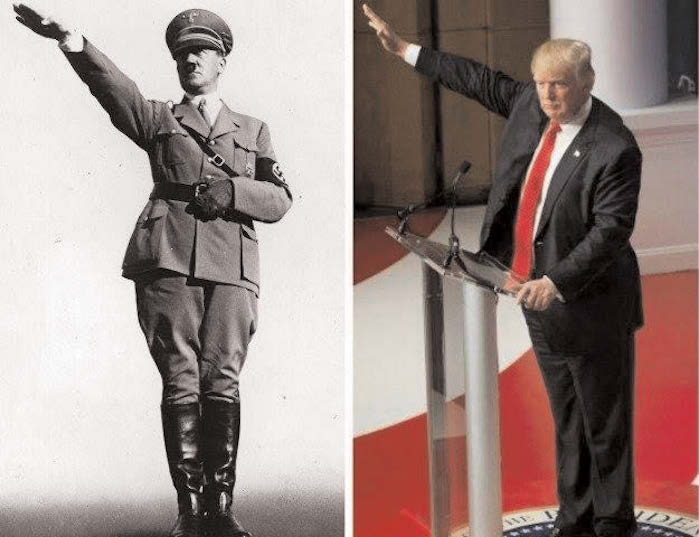
  • Donald Trump Vs. Adolf Hitler

    Donald Trump Vs. Adolf Hitler

    After Trump’s call to ban Muslims from America drew comparisons with the Nazi dictator, Adolf Hitler, some have started refereeing to him as “The New Fuhrer”. A spokesperson for the Council on America-Islamic Relations compared Trump’s  venomous attack on Muslims to Nazi rhetoric from the 1930s, saying the Republican candidate “sounds more like a leader of a lynch mob than a great nation like ours.”

    Whatever one may think of it, businessman Donald Trump’s recent call for a temporary ban on Muslim immigration is in no way directly comparable to the very genuine horrors of the Holocaust, or the murderous regime of Adolf Hitler; however, it does share some early signs of the horror to come which Hitler showed in his book “Mein Kampf”.

    Words can be wielded both for good and for evil. Mr. Trump’s continuous use of dark powerful words in his bid for the White House  will have an everlasting effect on American way and the values we are known for.

    Free speech Vs. Hate speech Vs. Plan Sedition – His way with words has rarely been seen in modern politics, except used by the very people that Trump is trying to save America from. He continues to move on hate politics with his potent language to connect with, and often stoke the fears and grievances of Americans.

    Difference of Opinion Vs Right to Co-Exist – We have seen this grow into the WWII and must see this together from the philosophical as well logical viewpoint.

    Philosophical view tells us that to have dissent is a way of life and logically if everyone shared the same view, then there would not have been any disagreement  ever. There is no limit to how much a person can rise or fall when it comes to morals and we have had plenty of examples from the last 2000 years of documented history on this.

    But it is because of history that our society has evolved and it has taken us a long time to break from the clutches of slavery, oppression and dictatorship.

    In this era  where radicalization /suppression has become the tool to justify one man’s fight for justice to become terrorism for another man words play a much larger role and have to be weighed properly.

    Still Donald Trump has said he will never leave the 2016 race despite widespread criticism of his remarks, especially about Muslims. Mr. Trump is the current frontrunner among the Republicans running for president, six weeks before the primary contests begin for each party to pick their nominee. Republican Party officials fear a third-party Trump campaign would spilt the Republican vote, and give Democrats a winning advantage.

    A White House spokesperson said Mr. Trump was “disqualified” from running after he said the US should ban Muslims from entering the country.

    The latest world leader to reject his remarks was Israeli Prime Minister Benjamin Netanyahu, who said Israel “respects all religions”, hours after Mr. Trump announced he will be visiting the country this month.

    Here are some of Mr. Trump’s comments :

    • Arab Americans cheered on the 9/11 attacks, despite a lack of evidence
    • A “great, great wall” should be built between the US and Mexico
    • Many Mexicans in the US are criminals and rapists
    • There should be a mass deportation of illegal migrants in the US
    • Muslims should be banned from entering the US solely on grounds of their religion

    5 Ways Donald Trump Perfectly Mirrors Hitler’s Rise to Power

    ● 5. He blames a Specific Group of Immigrants for all our problems (and promises to eliminate them from our society)

    ● 4. He’ll sell his hate as hope for the poorest citizens in this country

    ● 3. Don’t think concentration camps; just think prisons

    ● 2. Not taking him seriously makes him more dangerous

    ● 1. He used to keep a copy of Hitler’s sequel to Mein Kampf by his bed

    Reasons Why Trump might  just Win

    • Despair: Imagine if on almost every issue important to you over the last eight years you’re watching the other side win. It is hard to underestimate the anger of the Republican primary voter. First, The President and then the Pope and it feels to you like the world is collapsing. Think about gay marriages and socialized medicine.
    • Issues: Three of the main issues animating Trump’s candidacy?- ?immigration, free trade, and political corruption.
    • Desire: One of the things about political campaigns is that generally speaking the candidate who wants it most tends to win. You have to really want it.
    • Poll trends: Opinion Polls don’t always tell the truth in a snapshot but that the trends in polls over time are worth trusting.
    • Confidence: Trump sticks to his guns and seemed untroubled even after making wrong statements. He doesn’t apologize

    Republican Party voters will begin voting on 1st  February in Iowa, followed by New Hampshire and then a bevy of other states, to decide who will represent the party against the Democratic nominee.

    Ideally, time will prove if there are more crazy comments in store, but approaching the Trump candidacy as a comedy sketch that will never come true could potentially be the most tragic mistake this country will ever make, and you don’t need to look any further than the publicly documented words and actions of the man himself to see just how true that is.

    My Opinion: No to nomination or presidency. 

    For the avoidance of doubt, we are merely comparing rhetoric here. Whatever the perceived similarities  in the things they say, there remains a vital difference in what they do: Hitler caused the deaths of millions; Mr. Trump has no criminal record and is a democratic politician running in a free election.

  • German Leader Angela Merkel is Time Magazine’s Person of the Year

    German Leader Angela Merkel is Time Magazine’s Person of the Year

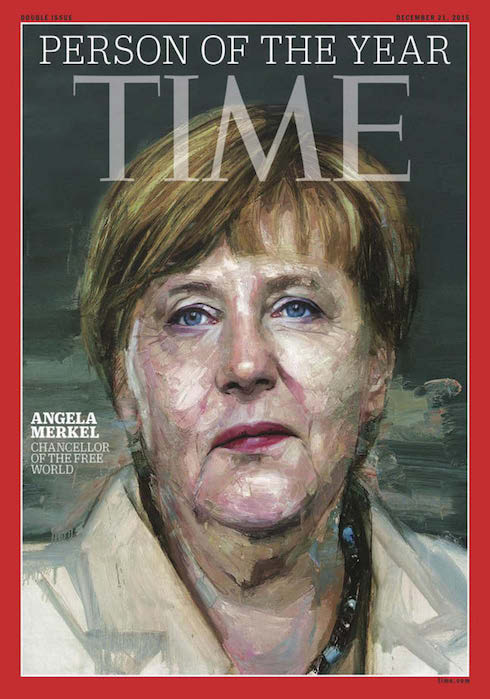
    NEW YORK (TIP): Angela Merkel, the Chancellor of Germany, has been named Time Magazine’s Person of the Year 2015. She is the fourth woman to win the award since its inception in 1927 – until 1999 it was known as the Man of the Year award.

    German Leader Angela MerkelIn a profile of Merkel, clocking in at almost 10,000 words, Time dubbed her “Chancellor of the Free World”.

    The magazine’s editor, Nancy Gibbs, wrote in an article announcing the decision : “For asking more of her country than most politicians would dare, for standing firm against tyranny as well as expedience and for providing steadfast moral leadership in a world where it is in short supply, Angela Merkel is Time’s Person of the Year”.

    From helping avert a ‘Grexit’, to taking a leading diplomatic role mediating the conflict in Ukraine, to spearheading Europe’s response to the refugee crisis, 2015 has been a landmark year for Merkel. This year also marked her tenth year as leader of Germany, during which time she has been credited with overseeing the rebuilding of the nation’s economy and its return to power on the world stage.

    In late August, when tens of thousands of migrants fleeing war in the Middle East streamed into Hungary, threatening a humanitarian crisis, Merkel agreed to suspend the European Union’s asylum rules and allow them to continue into Germany. She declared to skeptical countrymen: “Wir schaffen das,” which translates as, “We can do this.”

    Her “open-door” stance has led to a fall in support for her conservatives and in her own popularity ratings, which have slid to 54 percent from 75 percent over eight months.

    Time also noted her leadership this year in leading the West’s response to Vladimir Putin’s “creeping theft of Ukraine” and welcoming refugees to Germany despite “the reflex to slam doors, build walls and trust no one.”

    Merkel topped a short list of finalists that included U.S. Republican presidential candidate Donald Trump, who came in third, and Islamic State leader Abu Bakr al-Baghdadi, who was runner-up.

    She is the first individual woman to hold the title since Corazon Aquino in 1986, though women have been honored as part of a group. Last year, a group of Ebola doctors and survivors won the title.

  • Stirring the communal pot | Crushing a minority’s way of life will only lead to more alienation

    Stirring the communal pot | Crushing a minority’s way of life will only lead to more alienation

    Since November 13, when seven coordinated attacks in Paris causing 130 deaths, reminiscent of the 26/11 carnage in Mumbai in 2008, shook Europe and made the world pause, public opinion in Western Europe and the US has lurched more to the right. The December 2 shooting spree by a couple of Pakistani origin in Bernardino, California, that left 14 dead has raised questions about the role of Islam in the West.

    In the US, a paroxysm of anti-Islam sentiment has erupted, reflected in the 24 Republican governors, almost half the total, plus a Democrat, refusing to admit any of the 10,000 Syrian refugees that President Barack Obama announced will be admitted. They refused to take even infant orphans, compelling the President to dub such behavior “potent recruitment tool” for the Islamic State. President Obama, quoting Pope Francis in support, added that the US must “protect people who are vulnerable”, irrespective of their faith.

    France reacted to the attack with unforeseen ferocity, with French President Francoise Hollande asserting they will act “without pity”. The unprecedented success thereafter in regional polls of right-wing National Front, combining star power of niece Marion and aunt Marine Le Pen, sweeping six out of 13 regions, had the German Social Democrats declaring it as “wake-up call for democrats in Europe”.

    The most politically incorrect statement came from Donald Trump, front runner amongst US presidential Republican candidates. He said if elected, he would shut the door for all Muslim immigrants, pending a proper review. The White House reacted saying this disqualifies Trump from the race.

    Against this backdrop, India chose to allow its National Security Adviser meet that of Pakistan in Bangkok on December 6-7, accompanied by the foreign secretaries. Questions were raised by the Indian media and the Opposition how this squared with BJP’s much-professed red-lines. In reality, both nations readjusted their positions for mutual accommodation. The Indian condition that the Ufa statement only required terror to be discussed first was dropped as the joint statement indicated discussions having covered peace and security, terrorism and Jammu and Kashmir.

    Pakistan’s insistence to mainstream its proxy, the Hurriyat, was negated by the dialogue moving overseas. On the positive side, Pakistan has positioned Lt Gen Janjua, recently retired corps commander based in Quetta, overseeing operations in Baluchistan, as their NSA, in lieu of Sartaj Aziz. This opens a line to the Pakistani military, though it could also backfire if an obdurate line is adopted by the nominee, who may not be amenable to urgings from the civilian government.

    Literally hours after this meeting, Ms Sushma Swaraj, External Affairs Minister, landed in Pakistan to attend a 14-nation Hearts of Asia conference, pursuant to the Istanbul Process on the regional nations acting in concert to stabilize Afghanistan via confidence-building measures. As is normal, the focus was more on Ms Swaraj’s interaction with Pakistani leaders than the conference. Counting on Pakistani assurances on curbing India-specific terror machinery on Pakistani soil will be risky till concrete change is visible. Afghanistan in this context can be either a bridge for India-Pakistan cooperation or a theatre for lethal contestation.

    In an unprecedented move, Anton Blinken, visiting US Deputy Secretary of State, in a press interview in Delhi, revealed that the US had urged Gen Raheel Sharif, Pakistan’s chief of army staff, during his Washington trip to act against Lashkar-e-Taiba and Jaish-e- Mohammed with the same vigor he was showing against the Tehrike Taleban Pakistan. The US planned to hold the general to his promise.

    The conclusion from these choreographed events is that much spade work has gone into reviving the India-Pakistan parleys and mutual commitments on each side addressing the other’s core agenda. However, the lesson from observing the flip-flops in the Modi government’s Pakistan policy, with bonhomie suddenly dissipating into public acrimony, is that there may be more turbulence in the future, particularly once electioneering commences for the polls in W Bengal and Assam.

    The bigger danger to India is from succumbing to the mindless majoritarianism being witnessed in the US and Europe. The debate in India on tolerance has been dismissed by figures close to the Modi regime as baseless. Also ignored is the reasoning that making any group – religious, ethnic or ideological -insecure causes its alienation and increases the possibility of it resorting to extra-constitutional means. Many Donald Trumps occupy responsible positions in India today, but there is no President Barack Obama to confront their bigotry. Even during his state visit to India in January this year, one of Obama’s last messages to PM Modi was for India to retain its commitment to freedom of faith and expression.

    India has, so far correctly, focused on Pakistan-sponsored terror. But today, global jihad emanating from the caliphate of the ISIS is a parallel danger to the entire South Asia. Its initial manifestation is visible in Bangladesh with attacks on foreigners by self-starter groups. As the IS finds itself starved of funds and recruits in its current catchment area, due to migration of population and military pressure by the US and its allies on the one side and Iran and Russia on the other, it may seek to expand to new domains like South Asia.

    Thus the BJP must not ignore when its misguided elements stir the communal pot. Punjab has just seen the shadows of old passions swirling at the behest of politicians losing relevance or others seeking to re-emerge from the sidelines where history cast them. Let two examples suffice. The Congress let the Punjabi Suba agitation persist from 1956 to 1966 before finally conceding a linguistic state, obtained by other regions a decade earlier. It was, in fact, PM Lal Bahadur Shastri’s gift to a state that proved more than its loyalty in the 1965 War. But after his demise, a moth-eaten award was handed out, leaving bitterness and alienation that eventually allowed the radicals to seize control of political processes. Secondly, the fate of Kashmiri Pandits shows that majoritarianism crushing a minority’s way of life is not religion specific.Hopefully, PM Modi having imbibed the Bihar lesson will now deliver on his own slogan – Sabka saath, sabka vikaas, not just nationally but regionally.

  • Outlandish Trump & His Politics of Fear

    Outlandish Trump & His Politics of Fear

    Trump has garnered huge support among the Republican voters by playing the fear trump card. Since the Paris attacks, while the “serious” GOP contenders have proposed establishing no-fly zones and arming Kurdish rebels in Syria, Trump has focused on registering Muslims and closing mosques in the U.S. while insisting that he “watched … thousands” of Muslims in New Jersey celebrate 9/11 as the Twin Towers were coming down.

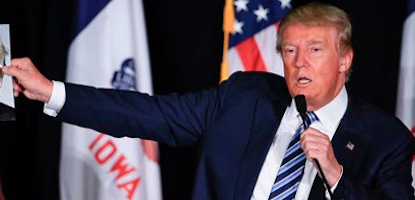
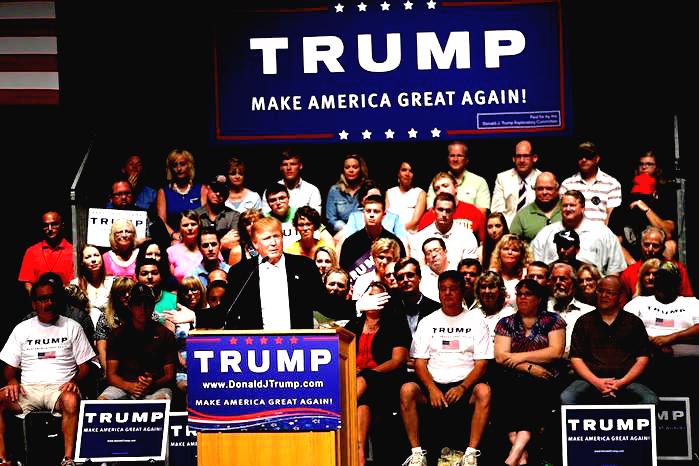
    Republican presidential hopeful Donald Trump at a rally in Oskaloosa, Iowa, July 25.
    Republican presidential hopeful Donald Trump at a rally in Oskaloosa, Iowa, July 25.

    He’s turned the focus of the debate on the right candidate to terrorism and immigration, with a vociferous anti-Muslim rhetoric. His racist approach and fear mongering statements are propelling him in debates. This needs a reality check.

    Let us see what Trump has to say on various issues.

    On Domestic Issues

    1. Arab-Americans cheered the attacks on 9/11 – Trump repeatedly claimed that on September 11, 2001, there were thousands of Arab-Americans celebrating in New Jersey after two planes flew into the Twin Towers. He says such public demonstrations “tell you something” about Muslims living in the US. However, there are no media reports or police records to back up the claim.

    2. There should be surveillance on US mosques – Trump believes Muslims should be tracked by law enforcement as a counterterrorism initiative. He has walked back some comments about keeping a database on all American Muslims, but says he doesn’t care if watching mosques is seen as “politically incorrect”.

    3. The US should use waterboarding and other methods of “strong interrogation” in its fight against the Islamic State.

    4. “Would build a “great, great wall” between the US and Mexico. In some of his earliest campaign comments, Trump suggested that Mexicans coming to the US are largely criminals. “They are bringing drugs, and bringing crime, and they’re rapists,” he said. A wall on the border, he claims, will not only keep out undocumented immigrants but Syrian migrants as well. He also believes that Mexico should have to pay for the wall, which could cost between $2.2bn and $13bn (BBC analyst).

    5. A mass deportation of the estimated 11 million illegal immigrants living in the US should go into effect. Despite criticism that this idea is xenophobic and prohibitively expensive – estimated at $114bn – Trump says his deportation plan is as achievable as it will be humane. In addition, his immigration reforms would end “birthright citizenship”, the policy that grants the children of illegal immigrants citizenship so long as they are born on American soil. He does not support creating a new path to citizenship for undocumented workers.

    6. In order to end mass shootings, the US should invest in mental health treatment rather than Gun Control. In a position paper on gun rights, Trump revealed he has a concealed carry permit and that when it comes to gun and magazine bans, “the government has no business dictating what types of firearms good, honest people are allowed to own”. He would also oppose an expansion of background checks.

    7. The Black Lives Matter movement is “trouble”. Trump mocks Democratic candidates like Martin O’Malley for apologizing to members of the protest movement against police brutality and casts himself as a pro-law enforcement candidate. “I think they’re looking for trouble,” he once said of the activist group. He also tweeted a controversial graphic purporting to show that African Americans kill whites and blacks at a far higher rates than whites or police officers. However, the graphic cites a fictitious “Crime Statistics Bureau” for its numbers, and has been widely debunked using real FBI data.

    On Foreign Policy

    1. Trump and Vladmir Putin would “get along very well”. In an interview with CNN, Trump said that Putin and Obama dislike one another too much to negotiate, but that “I would probably get along with him very well. And I don’t think you’d be having the kind of problems that you’re having right now”.

    2. Climate change is just “weather” . While Trump believes that maintaining “clean air” and “clean water” is important, he dismissed climate change science as a “hoax” and believes environmental restrictions on businesses makes them less competitive in the global marketplace. “I do not believe that we should imperil the companies within our country,” he told CNN on the issue. “It costs so much and nobody knows exactly if it’s going to work.”

    3. The world would be better off if Saddam Hussein and Muammar Gaddhafi were still in power . Trump told CNN that he believes the situation in both Libya and Iraq is “far worse” than it ever was under the two deceased dictators. While he concedes Hussein was a “horrible guy”, he says he did a better job combating terrorists.

    4. No asylum to Syrian migrants . He says that the Paris attacks prove that even a handful of terrorists posing as migrants could do catastrophic damage, and so he will oppose resettling any Syrians in the US, and deport those who have already been placed here.

    5. “Bomb the hell” out of IS. Trump claims that no other candidate would be tougher on the Islamic State and he would weaken the militants by cutting off their access to oil.

    On Healthcare

    1. Veteran healthcare in the US needs a major overhaul . Trump wants to clear out the executive level in the Department of Veterans Affairs, saying that wait times for doctor visits have only increased after previous interventions failed. Thousands of veterans have died while waiting for care, he says. He will invest in the treatment of “invisible wounds” like post-traumatic stress disorder and depression. He would also increase the number of doctors who specialize in women’s health to help care for the increasing number of female veterans.

    2. Obamacare is a “disaster”. Trump says he favors repealing the president’s Affordable Care Act, which aims at extending the number of Americans with health insurance, but he believes that “everybody’s got to be covered”. A spokesman for Trump told Forbes that he will propose “a health plan that will return authority to the states and operate under free market principles”.

    On Economy

    1. Create a simpler tax code . Trump wants anyone who earns less than $25,000 to pay no income tax. They would submit nothing more than a single page tax form that reads “I win”. He would lower the business tax to 15%. He would also allow multinational companies keeping money overseas to repatriate their cash at a 10% tax rate.

    2. Hedge fund managers are “getting away with murder” . Trump found common ground with Democrats like Senator Elizabeth Warren when he said that hedge fund managers and the ultra-wealthy do not pay enough taxes. However, after the campaign released specifics of his plan, analysts argued that hedge fund managers would actually get a tax cut along with the middle class.

    3. China should be taken to task . If elected , Trump says he will make China stop undervaluing its currency, and force it to step up its environmental and labor standards. He is also critical of the county’s lax attitude towards American intellectual property and hacking.

    4. Unemployment. Trump has said repeatedly that unemployment in the US is at 20% – once commenting it may be as high as 42% – despite the fact that the Bureau of Labor Statistics pegs the number at 5.1%. Trump says he doesn’t believe that figure is real.

    But can Americans buy the stuff Trump is so zealously dishing out?

    Americans know well presidential candidates must make unrealistic guarantees. The difference in Trump’s blather is that it is dangerous. Trump’s megalomania borders craziness.

    Everyone who has bought into Trump needs take a step back, rethink and make informed decisions about what America stands for and who will uphold the great values and tradition of America. Those who care deeply about the values of this nation need to recognize where we are. Throughout history, anxiety has brought out the worst in people.

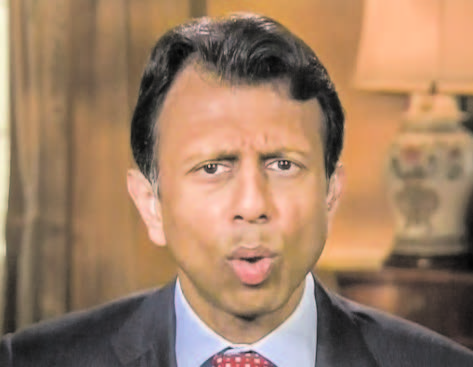
  • Bobby Jindal ends his 2016 presidential campaign: No Tears for him

    Bobby Jindal ends his 2016 presidential campaign: No Tears for him

    WASHINGTON (TIP): Bobby Jindal is a man one cannot ignore. He is one who normally gets noticed for what he does and also for what he does not do. However, his decision to pull out of presidential race has evoked no surprises or brought out tears or sighs of concerned well wishers.

    The piece below of an unknown authorship is representative of the mood of the people in general in the US to Bobby’s withdrawal from race.

    “Well, it’s time for another presidential campaign obituary, the fifth in what is statistically guaranteed to be a well-populated feature over the next few months.

    Today, we mourn Bobby Jindal, the two-term Republican governor of the great state of Louisiana. He may never have cracked even one percent of voter support in any poll anywhere, or appeared in any of the primetime Republican debates, or raised a significant amount of money or made himself known to anyone outside of Louisiana, but he was my absolute favorite male Republican first-generation Christian Indian-American governor, and my second favorite Republican first-generation Christian Indian-American governor after South Carolina’s Nikki Haley.

    As always, the death of a Presidential campaign brings with it deep, soul-searching questions: how could this have happened so soon? Why did this have to happen to him?Who is that guy? Maybe these questions have answers, maybe they don’t, but what’s important is that Bobby Jindal touched each of our lives in a special way, or didn’t. I have no way of knowing who is reading this or what your relationship is to Bobby Jindal.

    Bobby Jindal was a revolutionary and objectively-relevant person in the Republican presidential primaries. No one else in the varied field could claim to have attempted to govern Louisiana. No other candidate could claim to have the initials B.J. No other candidate went to Britain and claimed that there are “no-go zones” where Muslims “colonize Western countries,” governing themselves and excluding non-Muslims.

    But it may have been his fiscal policies that Bobby Jindal will be best remembered for. Jindal was one of the strictest anti-tax, deficit-reducing governors in the nation, and he planned to bring Louisiana’s sweeping economic success to the whole nation. Other candidates may claim to be offering large tax cuts, matched with deep cuts in wasteful entitlement spending, but none went anywhere near as far as Jindal. He planned to cut taxes so low that each year on tax day each American citizen would only owe the government a few cheap bead necklaces, while unemployment and Medicaid benefits would be reduced to simply a view of a few drunk girls’ boobs and a bucket of Popeye’s chicken-all any true American really needs. Even further, he would trim government fat by eliminating Social Security and transferring its duties to the NSA. “Society” and “the nation” are basically the same thing, why was its security ever split into two agencies in the first place?

    How could such a perfect candidate have fared so poorly?Alas, among such a varied group of candidates, Jindal failed to lock down the large and crucial Republican constituency of “xenophobic children of immigrants,” which has mostly gone to Ted Cruz, the Canadian-born Cuban American who wants to limit illegal and legal immigration and thinks the best thing we can do to help Cubans is to keep the embargo that has clearly done wonders in weakening the rule of the Castro family. I’m sorry, Bobby, but it’s hard to beat that logic. Better luck next time.”

  • Hillary Clinton wants minimum wage increased to $12 an hour

    Hillary Clinton wants minimum wage increased to $12 an hour

    U.S. Democratic presidential candidate Hillary Clinton said on Tuesday, November 3, at two campaign stops in Iowa that she would like to raise the federal minimum wage to $12 an hour from the current $7.25.

    Clinton has said repeatedly she wants to raise wages for working Americans, including by raising the minimum hourly wage, but she has rarely named a specific figure.

    “I want to raise the federal minimum wage to $12, and encourage other communities to go even higher,” Clinton told a campaign event in Coralville, Iowa.

    “I think we can manage it, and I don’t think there should be any unintended consequences to job creation,” Clinton said at another campaign stop at Grinnell College.

    Many U.S. cities and municipalities have established a higher minimum wage than the federal rate. Bernie Sanders, who is Clinton’s chief challenger for the Democratic Party nomination for the 2016 presidential election, has said the federal minimum wage should be raised to $15 an hour.

    “I’m more comfortable saying let’s get to $12,” Clinton said at Grinnell, “in a reasonable, expeditious way.”


  • US vice-president Joe Biden says he will not run for president in 2016

    US vice-president Joe Biden says he will not run for president in 2016

    WASHINGTON (TIP): Vice-president Joe Biden will not run for president in 2016, he said on Oct 21, ending a month-long flirtation with a third White House campaign and setting him on a glide path toward the end of his decades-long US political career.

    Biden’s decision finalizes the Democratic field of White House candidates and bolsters Hillary Rodham Clinton’s standing as the front-runner by sparing her a challenge from the popular vice-president.

    In an extraordinary appearance in the White House Rose Garden, Biden said he always knew the window for a viable campaign might close before he could determine whether his family was emotionally prepared for another campaign so soon after losing his son, Beau Biden, in May. Biden said his family was prepared to back him, but that he nonetheless would not be a candidate.

    “Unfortunately, I believe we’re out of time,” he said, flanked by President Barack Obama and Biden’s wife, Jill.

    Encouraged by Democrats seeking an alternative to Clinton, Biden had spent the past several months deeply engaged in discussions with his family and political advisers about entering the primary. Yet as the deliberations dragged on, Democrats began publicly questioning whether it was too late for him to run, a notion that hardened after Clinton’s strong performance in last week’s Democratic debate.

    Notably, Biden did not endorse Clinton or any of the other Democratic candidates. Instead, he used the announcement to outline the path he said Democrats should take in the 2016 campaign, including a call for them to run on Obama’s record. In what could have been a campaign speech, Biden deplored the influence of unlimited contributions on politics, called for expanding access to college educations and called on Democrats to recognize that while Republicans may be the opposition, they are “not our enemy.”

    “While I will not be a candidate, I will not be silent,” Biden said.

    Wednesday’s announcement was a letdown for Biden supporters who had pleaded with him to run, and in increasingly loud tones as his deliberations dragged on through the summer and into the fall.

    For months, the 72-year-old Democrat made front pages and appeared on cable news screens as pundits mused about his prospects and Clinton’s perceived vulnerability. A super political action committee, Draft Biden, was formed with the explicit goal of getting him into the race.

    At the White House, aides and longtime Biden loyalists had prepared for a potential bid, putting together a campaign-in-waiting should he decide to jump in. Last week one of those aides, former Sen. Ted Kaufman, wrote an email to former Biden staffers laying out the potential rationale for a Biden run and promising a decision soon.

    Biden spoke personally to many supporters. As speculation about his plans reached a fever pitch, he kept up an intense schedule of public appearances, seemingly testing his own stamina for an exhausting presidential campaign. But he also continued to broadcast his reluctance amid doubts that he and his family were emotionally ready in the wake of Beau Biden’s death. In a September appearance on “The Late Show,” Biden told host Stephen Colbert he was still experiencing moments of uncontrollable grief that he deemed unacceptable for a presidential aspirant.

  • Hillary emerges stronger from 11 hour marathon Congressional hearing on Benghazi

    Hillary emerges stronger from 11 hour marathon Congressional hearing on Benghazi

    WASHINGTON (TIP): At times, appearing impatient but never losing control of self, Hillary Clinton answered questions at a nearly 11-hour congressional hearing Thursday, October 22. The Congressional hearing was dominated by Republican criticism of her response to the Benghazi attacks. After a day-long grilling on the details of the attack and how Clinton handled it, the former secretary of state was forced to defend her use of a private email account while in office from a flurry of late evening attacks by GOP lawmakers.

    CNN reports that she also came under testy cross-examination over the extent to which she has taken responsibility for the deaths of the Americans in the September 11, 2012, attacks and her contact with U.S. Ambassador to Libya Chris Stevens, one of the victims, after sending him to the North African country.

    “I came here because I said I would. And I’ve done everything I know to do, as have the people with whom I worked, to try to answer your questions. I cannot do any more than that,” Clinton said towards the end of the grueling day — before later breaking into a coughing fit and taking a throat lozenge to ease her failing voice.

    One of the most dramatic moments of the hearing came when Clinton was asked about her contact with Stevens. She acknowledged that she couldn’t recall having talked to him after having sworn him in as ambassador, though she believed they had spoken.

    Despite the day’s intensity, Clinton appeared cool and in command for much of the hearing. But as the day wore on, she seemed to be increasingly impatient with the Republican line of questioning and with the constant interruptions from the GOP members on the panel.

    In her most emotive testimony, Clinton sought to defang the GOP attacks by arguing that she was agonized over the deaths of four Americans in Libya more than anyone else on the panel.

    “I would imagine I have thought more about what happened than all of you put together,” she said. “I have lost more sleep than all of you put together. I have been wracking my brain about what more could have been done or should have been done.”

    Clinton noted that an independent Accountability Review Board that she set up as secretary had pulled no punches, unveiling 29 recommendations for improving security for U.S. diplomats overseas. She also noted that previous attacks on Americans abroad, including in 1983 on a U.S. Marines barracks and the U.S. Embassy in Beirut, had produced changes to U.S. security procedures after nonpartisan investigations by Congress.

  • Jindal’s popularity dips below one percent – refuses to bow out

    Jindal’s popularity dips below one percent – refuses to bow out

    WASHINGTON (TIP): The popularity of first Indian-american US Presidential hopeful Bobby Jindal has dipped below one per cent, according to latest opinion polls, indicating that all is not well with his campaign.

    In two leading national opinion polls – CNN/ORC and NBC/Wall Street Journal – Jindal’s popularity rating slipped to less than one per cent, following which many political pundits were quick to pronounce a dead end to his presidential ambition at least in the 2016 elections. Bobby Jindal is the first Indian American to be elected a state governor.

    However, the 44-year-old two time Louisiana governor said he is not giving up so early. In fact he threated to skip the next round of Republican debate as based on national poll results he has been pushed to the second tier debate. The Republican race is now led by Donald Trump and Ben Carson, according to the CNN/ORC poll. Trump leads the field with 27 per cent, followed by Carson at 22 per cent. But Jindal argued Trump is going to fade. “His numbers are already starting to fall in Iowa…,” Jindal argued.

    Louisiana Gov. Bobby Jindal lost ground in the latest Fox News poll of candidates seeking the 2016 Republican presidential nomination, slipping below 1 percent and into 15th place in the large field.

    Now, Gov. Bobby Jindal has not made the cut for yet another main Republican presidential debate, and has been invited the “undercard” debate held earlier in the evening instead.

    CNBC has invited 10 GOP candidates to the primetime debate held at 8 p.m on Oct. 28 in Boulder, Colo. The “undercard” debate would take place at 6 p.m. in the same place. Jindal could face former U.S. Sen. Rick Santorum, former Gov. George Pataki, and U.S. Sen. Lindsey Graham if he participates in the earlier event.

    Jindal and three other men were invited to the early slot because their average national poll numbers in the last five weeks aren’t high enough to qualify for the main event. The New York Times reports the “undercard” candidates polling numbers are all below 2.5 percent.

    During a meeting with The Des Moines Register editorial board this week, Jindal declined to say whether he will participate in the undercard event.


  • Hillary Clinton’s Call to turn Texas Blue

    Hillary Clinton’s Call to turn Texas Blue

    SAN ANTONIO, TX (TIP): Hillary Clinton came to San Antonio Thursday, October 15 to receive the blessing of the Castro brothers, making her first official campaign stop in Texas and marking a significant moment in her second bid for the White House. At two events — a Q&A with the U.S. Hispanic Chamber of Commerce and an outdoor rally at Sunset Station — she sought to appeal to Hispanic voters, a core constituency of the Obama coalition, and underline the possibility that her campaign could mount a serious bid to win Texas in the 2016 general election.

    Clinton is one of the most fascinating figures in modern American politics, in part because of the remarkable, even Sisyphean, way that the nation’s political architecture rearranges itself seemingly with the intention of thwarting her.

    The Clintons appeared to have finally found the path to return Democrats from exile in 1992, with Hillary playing an unusually prominent role in making policy, but the Republican revolution of 1994 put a damper on that, and much of the rest of her time as first lady was derailed by other matters. She came back to independent prominence as a respectably centrist senator from New York in the 2000s, an Iraq war hawk and a defender of Wall Street, but when it came time to run for president, those positions helped sink her.

    Now, her supporters say, she’s one of the most experienced presidential contenders ever, and it’s a claim with some merit — she’s been the closest advisor of a governor and a president, and she’s served in the U.S. Senate and the cabinet. She’s been privy to history in the last quarter-century like few other people on the planet. And yet she’s running in a year of seemingly unprecedented hatred of the establishment, where her experience and record is in some ways a liability. She’s popular with Dems, for the most part, but she still needs to bolster her left credentials to win over parts of the base afflicted with Clinton fatigue.

    At the launch of the “Latinos for Hillary” initiative, October 16 Clinton was introduced by Julián Castro, who was in turn introduced by Joaquin Castro. Both brothers have now endorsed Clinton, and emphasized to the crowd that Clinton was someone for whom Hispanic issues were, and had always been, close to heart. “She’s always been there for us,” Julián Castro told the crowd, “and today we’re there for her.”

    Some Democrats had hoped to see Clinton take on more of the mantle of the left. On Thursday, she spoke about the wage gap and family leave policies, thanked the #BlackLivesMatter movement for their activism, and told the crowd she would take up immigration reform from the beginning of her presidency, aggressively pursuing a reform package with a full pathway to citizenship for undocumented people. She told the crowd that she would actively pursue gun control in office. “If you join me,” she said, “I will continue taking on the NRA!”

    Introducing Clinton, Julián Castro told the crowd he looked forward to seeing Fox News announce Clinton’s taking of Texas’ electoral votes come November, and Clinton responded by asking the audience to help her “turn Texas blue.” She lauded former San Antonio mayor Julián Castro’s advocacy for pre-K in San Antonio. She emphasized her belief that government could help level the playing field. “Talent is universal, and opportunity is not in America,” she said.

    And she lavished praise on the sitting president: “This country’s come a long way in the last six and-a-half years,” she said, thanks to the “leadership of President Obama.” He didn’t get enough credit for avoiding a second great depression, she said, to cheers. In other arenas, particularly when it comes to foreign policy, Clinton has carefully underlined differences with Obama. In front of this crowd of Texas Democrats, there was no such distancing.

    Another important thread at the Clinton event on Thursday was the possibility that Clinton’s campaign will invest some of its massive resources in Texas during the general election, with an eye to strengthening the party’s infrastructure here. That’s a hope related to long-running speculation that Clinton will pick Julián Castro to be her running mate when the time comes.

    Texas Democrats would love that, but there’s always been plenty of reason to be skeptical of the idea that Clinton would invest heavily in Texas. In a close presidential race, putting a lot of money in a state Democrats are exceptionally unlikely to win would be an inefficient use of resources, especially given the problems with party unity and competency that surfaced in 2014, and given that the third election for an incumbent party after two terms in office is traditionally a time of atrophying energy and turnout.

    But Thursday, it seemed clear that the Clinton campaign was trying to lay the foundation for a Lone Star subplot this cycle. There was the simple fact that today’s rally, the launch of the campaign’s Hispanic outreach project, happened in San Antonio, with the Castros. Introducing Clinton, Julián Castro told the crowd he looked forward to seeing Fox News announce Clinton’s taking of Texas’ electoral votes come November, and Clinton responded by asking the audience to help her “turn Texas blue.”

    Clinton also emphasized her time, spent with then-boyfriend Bill, doing organizing work in South Texas, by all accounts a formative experience for the two. Back then, she said, she and Bill, with his beard and big head of hair “like a Viking,” had a grand old time in Texas. They ate “a lot of green enchiladas,” and “drank our share of Shiner Bocks.” They “ate way too much mango ice cream at the Menger Hotel.”

    When Bill and Hillary came to Texas in 1972, they came to do campaign work for George McGovern, the liberal no-hope Democratic nominee who limped to a crushing defeat against Richard Nixon, winning only one state. That crushing defeat is one of the things that pushed the Clintons toward finding a kind of Democratic identity that could win in what was becoming a more conservative country. That search changed the Clintons in surprising ways: Years later, after Bill Clinton won the White House, Nixon and Bill became friends.

    History’s funny that way. Now the winds have changed again. The country is shifting, in some ways, to the left — at least in presidential elections, when younger and more diverse voters come out. And again, a Clinton is trying to surf the wave. Can she manage it this time? While most people are transfixed by the vulgar Republican primary, Clinton’s the best show in politics right now.