Month: January 2016

  • Indian-Origin Man Suspected To Be ‘New Jihadi John’ In ISIS Video

    Indian-Origin Man Suspected To Be ‘New Jihadi John’ In ISIS Video

    LONDON:  The terrorist who has been dubbed “new Jihadi John” and appeared in the latest ISIS video threatening attacks on the UK is suspected to be an Indian-origin British Muslim convert, media reports said today.

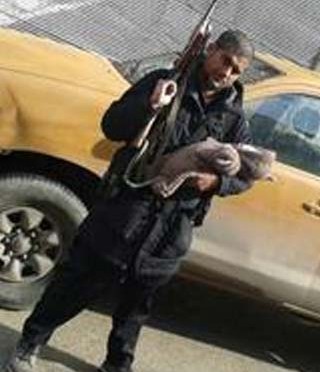
    Suspected ISIS terrorist Abu Rumaysah, who was born as Siddhartha Dhar holding his newborn son in one hand and an AK-47 assault rifle in the other. (File Photo)
    Suspected ISIS terrorist Abu Rumaysah, who was born as Siddhartha Dhar holding his newborn son in one hand and an AK-47 assault rifle in the other. (File Photo)

    Abu Rumaysah, who was born as Siddhartha Dhar, had skipped bail and fled Britain in 2014 with his wife and their four children allegedly to join ISIS in Syria.

    Born a Hindu, the 32-year-old ran a business renting out bouncy castles in London before converting to Islam and joining the radical Islamist group Al Muhajiroun.

    An official source told the BBC that Dhar is the focus of investigations into the video, which purports to show the killing of five men ISIS says were spying for the UK.

    Dhar’s mother and sister have also watched the video, released by ISIS on Sunday, and noticed similarities between the voice of the masked terrorist, being referred to as the “new Jihadi John” by the British media.

    “I heard the voice, yes, but I don’t know, I’m not sure of the voice. These are the most difficult questions to answer. I just cannot say. I’m not sure within myself whether it is the truth or not,” his mother Sobita Dhar told ‘The Daily Telegraph’.

    His sister, Konika Dhar, from north London, said: “I believed the audio to resemble, from what I remember, the voice of my brother but having viewed the short clip in detail, I wasn’t entirely convinced which put me at ease.

    “I can’t believe it. This is just so shocking for me. I don’t know what the authorities are doing to confirm the identity, but I need to know if it is.”

    She said her brother had converted to Islam more than 10 years ago and her memories of him are from when they were children and teenagers.

    “He was a very pleasant boy, and I know it may be hard to believe, but he still is, and I still believe that he still can be that person,” she added.

    One of Dhar’s former business associates told the BBC he had “no doubt” the voice on the video was that of Dhar, who had been arrested on suspicion of encouraging terrorism by the British police but was later able to travel to Syria after being bailed.

    His former neighbours from Walthamstow in east London claimed Dhar’s wife was more devout than him and suggest she may have put him on the path to extremism.

    In the months leading up to his arrest Dhar was accused of calling for the imposition of Sharia law in Britain.

    [yuzo_related]

  • A REVIEW OF 2015

    A REVIEW OF 2015

    2015 has been another phenomenal year. Always threatened by man and Nature alike, world has managed to survive. There have been natural calamities which brought huge suffering to earthly inhabitants. Tsunamis, floods, earthquakes, outbreak of diseases- all made human life miserable. But more than that , it is the human wantonness that has ravaged parts of the human world. The Middle East and West Asia are the regions that have been on the boil for decades now, with no sign of solution to the vexed Palestinian problem. Then there are localized conflicts between nations which threatened to blow up in to bigger conflagrations but for the wise counsel of other nations. Add to it the emergence of a
    militant ISIS. The emergence of all kinds of terrorist groups all over Asia and Africa have deeply scarred the human world . A Charlie Hebdo and a terrorist attack in France; a massacre by radicalized Muslims in San Bernardino in USA; series of terrorist strikes in India indicate the reach and power of terrorists. Obviously, the phenomenon has worried the United Nations and its members.

    JanuaryJan. 1: Thirty five people die in a stampede during a New Year celebration in Shanghai’s historic waterfront area, the worst disaster to hit one of China’s showcase cities in years.
    Jan. 2– The Italian air force rescues hundreds of migrants stranded on a ship apparently abandoned in rough seas by smugglers in the Mediterranean.
    Jan. 3– Boko Haram extremists kidnap about 40 boys and young men and kill scores of soldiers in a bold attack on a multinational military base in northern Nigeria.
    Jan. 4– Pope Francis names 156 new cardinals, selecting them from 14 countries, including far-flung corners of the world, to reflect the diversity of the Roman Catholic church and its growth in places like Asia and Africa.
    Jan. 5– The price of oil plunges again and falls below $50 a barrel for the first time since April 2009 as evidence mounts that the world will be oversupplied with the commodity this year.
    Jan 6– A suicide blast targeting Iraqi security forces and subsequent clashes with Islamic State extremists killed at least 23 troops and pro-government Sunni forces in the country’s embattled western province of Anbar.

    Police inspect damage after a collision between police cars at the scene after a shooting at the Paris offices of Charlie Hebdo, a satirical newspaper, January 7, 2015.
    Police inspect damage after a collision between police cars at the scene after a shooting at the Paris offices of Charlie Hebdo, a satirical newspaper, January 7, 2015.

    Jan 7-9: FRANCE – Seventeen people are slaughtered in attacks in Paris on the satirical magazine Charlie Hebdo and a Jewish supermarket two days later.

    Jan 26: SYRIA – The Islamic State (ISIS) jihadist group is driven out of the Syrian town of Kobane on the Turkish border after more than 4 months of fighting by Kurdish forces backed by US-coalition airstrikes.


    February
    Feb 12: UKRAINE – The Ukraine government and rebels agree to a “Minsk II” peace roadmap, backed by France, Germany and Russia, but the truce remains fragile. A second truce is signed on September 1. Clashes intensify in early December.

    March
    Mar 13: VANUATU – Cyclone Pam hits Vanuatu. The cyclone, the most intense in the southern hemisphere for the year, leaves 15-16 people dead.
    Mar 17: ISRAEL/PALESTINIAN TERRITORIES – Israeli Prime Minister Benjamin Netanyahu’s Likud wins legislative elections. Settlement-building continues and a stalemate in the peace process prompts renewed violence with stone throwing, stabbings, car-ramming attacks and clashes with security forces.
    Mar 18: TUNISIA – An attack on the Bardo Museum in Tunis kills 21 foreign tourists and a Tunisian policeman. On June 26 an attack at a holiday resort kills 38 foreign tourists, most of them British, while on November 24 the bombing of a presidential guard bus kills at least 12 people. All the attacks are claimed by ISIS.
    Mar 23: SINGAPORE – Lee Kuan Yew, Singapore’s founding leader who led the country to prosperity, dies after a long ilness. Lee, one of post-colonial Asia’s most towering political figures, was 91.
    Mar 24: FRANCE – An Airbus owned by German budget airliner Germanwings crashes in the French Alps with all 150 people on board declared dead. Investigators says co-pilot Andreas Lubitz deliberately crashed the plane.
    Mar 26: YEMEN – Jets from a Saudi-led coalition bomb Huthi Shiite rebels in Yemen in support of President Abedrabbo Mansour Hadi. The conflict has since left some 6,000 dead.

    April Apr 2: KENYA/SOMALIA – At least 148 people, mostly students, are massacred when Somalia’s Shebab Islamist group attacks Kenya’s Garissa university.

    A 7.8 magnitude quake killed around 8,900 people and destroyed about half a million homes in Nepal.
    A 7.8 magnitude quake killed around 8,900 people and destroyed about half a million homes in Nepal.

    Apr 25: NEPAL – A 7.8 magnitude quake kills around 8,900 people and destroys about half a million homes. A massive aftershock with a magnitude of 7.3 follows in May, killing dozens more.

    Apr 26: BURUNDI – Deadly protests break out against President Pierre Nkurunziza’s ultimately successful bid for a third term. Hundreds of people are killed in the following months.

    MayMay 7: UNITED KINGDOM – Prime Minister David Cameron’s Conservatives win a general election victory that opens the door to a national referendum on EU membership.
    May 23: IRELAND: Ireland becomes the first country in the world to legalize same-sex marriage through popular vote.
    May 29: NIGERIA – Muhammadu Buhari, elected president in March, vows to wage an intense offensive against Boko Haram Islamists, linked to ISIS. The insurgents murder more than 1,500 people since then, however, also carrying out attacks in the neighbouring countries of Cameroon, Chad and Niger.

    JuneJun 1: CHINA – A Chinese cruise ship capsizes on the Yangtze river in central China, killing 442 of the 454 people on board.

    Jun 17: UNITED STATES – A white gunman kills 9 black people at a historic black church in Charleston, South Carolina. The killings follow a series of incidents of police violence against blacks, reviving racial tensions in the United States.
    Jun 26: UNITED STATES – The US Supreme Court rules that gay marriage is a right in all US states.
    Jun 28: INDONESIA – The 2015 southeast Asian haze crisis begins, with the first reported incident in Indonesia’s Riau province. The crisis would persist for months, with the haze spreading across the region.

    JulyJul 1: UNITED STATES/CUBA – The US and Cuba agree a historic deal to re-establish full diplomatic relations, severed 54 years earlier during the Cold War.
    Jul 13: GREECE – After protracted negotiations, Greek Prime Minister Alexis Tsipras accepts a 3-year, 86-billion-euro ($93 billion) EU bailout that saves it from crashing out of the eurozone. On September 20 his ruling radical left party Syriza wins new legislative elections.
    Jul 14: IRAN – Iran and major powers reach an historic deal aimed at ensuring Iran does not obtain the nuclear bomb after 18 straight days of talks.
    Jul 14: SPACE – Pluto is seen up close for the first time, thanks to a close flyby of the New Horizons spacecraft.

    AugustAug 12: CHINA – Massive explosions at a chemical storage facility in Tianjin, one of China’s biggest cities, kill at least 165 people.

    Aug 17: THAILAND – A bomb blast at the popular Erawan shrine in the Thai capital Bangkok, ripping through a crowd of worshippers at the Hindu shrine close to 5-star hotels and upscale shopping malls. Twenty people, mostly foreigners, were killed.

    SeptemberSep 2: EUROPE –

    The picture of a 3-year-old Syrian boy's body, washed ashore on a Turkish beach, focuses attention on Europe's worst migration crisis since the end of World War II.
    The picture of a 3-year-old Syrian boy’s body, washed ashore on a Turkish beach, focuses attention on Europe’s worst migration crisis since the end of World War II.

    The picture of a 3-year-old Syrian boy’s body, washed ashore on a Turkish beach, focuses attention on Europe’s worst migration crisis since the end of World War II.

    Sep 3: GUATEMALA – Guatemalan President Otto Perez resigns after Congress strips him of immunity over corruption allegations and a warrant is issued for his arrest.
    Sep 18: UNITED STATES/GERMANY – Auto giant Volkswagen is hit by its biggest scandal ever owing to revelations that it cheated on US pollution tests.
    Sep 19-22: CUBA – Pope Francis makes a historic visit before going on to the United States. The pontiff also travelled to Kenya, Uganda and the Central African Republic from November 25-30.
    Sep 24: SAUDI ARABIA – A stampede at the Hajj pilgrimage leaves 2,236 dead at Mina, near Mecca.
    Sep 28: SPACE – Scientists announce proof of presence of liquid water on Mars.
    Sep 30: SYRIA – Russia launches air strikes on Syria, saying its intervention is against the ISIS, while Turkey and its allies say it is targeting moderate opponents of President Bashar al-Assad’s regime.

    OctoberOct 3: AFGHANISTAN – A US raid on a hospital in the northern city of Kunduz kills 42 during a Taliban offensive on the city. Washington says it is keeping thousands of soldiers in the country beyond 2016 as Afghan forces can not stand up to the Taliban on their own.
    Oct 19: CANADA – Liberal leader Justin Trudeau, son of a popular former prime minister, wins a general election.
    Oct 23: MEXICO – Hurricane Patricia, the most intense hurricane ever recorded in the Western Hemisphere, hits Mexico’s Pacific coast.
    Oct 29: CHINA – Beijing announces the end of its hugely controversial one-child policy.
    Oct 31: EGYPT/RUSSIA – A Russian passenger jet is downed on its way from Egypt’s Sharm el-Sheikh resort to Saint Petersburg, killing all 224 on board. ISIS claims responsibility for what Russia says was a bombing; Egypt says it has no evidence there was a “terror” attack.

    NovemberNov 1: TURKEY – The Justice and Development Party (AKP) of President Recep Tayyip Erdogan scores a stunning electoral comeback against a backdrop of renewed Kurdish violence and jihadist attacks. They include two suicide bombings on a peace rally in October that killed 103 people — the bloodiest in Turkey’s modern history.

    Nov 7: CHINA/TAIWAN – The presidents of China and Taiwan exchange a historic handshake and warm words in the first summit since the two sides split in 1949.
    Nov 8: MYANMAR – Democracy icon Aung San Suu Kyi’s party wins elections by a landslide after decades of military domination.

    Devastating condition of Chennai due to floods and rains.
    Devastating condition of Chennai due to floods and rains.

    Nov 8: INDIA – Heavy monsoon rains cause massive floods in the states of Tamil Nadu and Andhra Pradesh. The city of Chennai is the worst hit. More than 400 people die in the floods.
    Nov 13: FRANCE – An unprecedented string of jihadist shootings and suicide bombings at France’s national sports stadium, a concert hall and bars and restaurants in Paris leave 130 dead and hundreds injured. ISIS claims responsibility.
    Nov 18-19: PHILIPPINES – Manila hosts 21 leaders from the Pacific rim in the annual Asia Pacific Economic Cooperation (APEC) summit.
    Nov 20: MALI – A siege at a luxury hotel in the capital Bamako leaves at least 20 people dead. The attack is claimed by an Al-Qaeda affiliate.
    Nov 24: TURKEY/RUSSIA – NATO member Turkey shoots down a Russian fighter jet on the Syrian border, saying it had violated Turkish airspace, sparking a bitter diplomatic row between the two countries.

    DecemberDec 2: UNITED STATES – A radicalised couple massacres 14 people in San Bernardino, California, before they are killed in a shootout with the police.
    Dec 3: SOUTH AFRICA – South African amputee sprinter Oscar Pistorius, who shot dead his girlfriend in 2013, is convicted of murder after an appeal by prosecutors. He is freed on bail before sentencing, and plans to appeal. 6: VENEZUELA – A center-right coalition wins the first opposition parliamentary majority in 16 years amid an economic crisis in the oil-rich nation.
    Dec 12: ENVIRONMENT – 195 nations approve a historic accord to stop global warming.
    Dec 12: SAUDI ARABIA – At least 20 women win seats for the first time in municipal polls, though many restrictions on women remain in the ultra-conservative kingdom.
    Dec 14: FILM – The highly anticipated Hollywood premiere of Star Wars: The Force Awakens takes place, with some fans camping out for days seeking autographs and pictures.
    Dec 16: US – The US Federal Reserve raises its main interest rate for the first time in more than 9 years.
    Dec 18: SYRIA – The UN Security Council unanimously adopts a resolution endorsing a peace process to put an end to the nearly five-year war in Syria, without touching on one of the most contentious issues in the peace effort: the fate of Bashar al-Assad.
    Dec 18: RWANDA/CONGO – Rwanda votes to change the constitution to allow President Paul Kagame to potentially rule until 2034. In late October in the Republic of Congo, a controversial referendum enabled President Denis Sassou Nguesso to extend his 31-year rule.
    Dec 21: FOOTBALL – World body FIFA bans president Sepp Blatter and vice president Michel Platini for eight years for suspected corruption, the latest development since seven officials were arrested in a dawn raid in Zurich on May 27.
    Dec 21: A TALIBAN attacker rams a bomb-laden motorcycle into a joint NATO and Afghan patrol near the Bagram Airfield, killing six Americans in the deadliest attack on foreign troops since August
    Dec 22: AVIATION – The Falcon 9 rocket becomes the first rocket to successfully be launched into space and return to the ground upright. The launch and landing, operated by the firm SpaceX, is a first in aviation and space engineering.
    DEC. 22: MIGRATION experts say more than a million people driven out of their countries by war, poverty and persecution have entered Europe in this record-breaking year.
    DEC. 23: THE AFGHAN military rushes reinforcements to a besieged southern district threatened for days with takeover by the Taliban, the country’s defense minister says as he appealed for stepped-up NATO assistance and military support.
    Dec. 24: Christian faithful from around the world descend on the biblical city of Bethlehem for Christmas Eve celebrations as an outburst of Israeli-Palestinian violence dampens the typically festive mood.
    DEC. 25: POPE FRANCIS, in his Christmas Day greeting from the loggia of St. Peter’s Basilica, encourages U.N.-backed peace deals for Syria, Libya, praises those who welcome migrants.

  • My Expectations in  the New Year

    My Expectations in the New Year

    [vc_row][vc_column][vc_column_text]We all have expectations in the New Year. What am I waiting for in 2016?

    What are my expectations in 2016?

    From expecting riches to name and fame to the loftier expectations of discovering one-self, there is a whole world of expectations for individuals.
    For environmentalists, it could be the expectations of making the Earth a safer planet to live a healthy life and to ward off future climatic catastrophes.
    For scientists and discoverers it could be the expectation of charting the uncharted ways in search of life on other planets while for the colonizers it may be the expectation of setting up colonies once the scientists and discoverers have done their job.

    For nations and statesmen it could be the expectation to resolve conflicts and make this world a better place to live in.

    We reached out to a cross section of our readers to know from them what their expectations are in the year 2016.

    Here is what they said:

     Slide1

    [/vc_column_text][/vc_column][/vc_row][vc_row][vc_column][td_block_14 custom_title=”” category_id=”642″ limit=”3″ offset=”9″][td_block_14 custom_title=”” category_id=”642″ limit=”3″ offset=”6″][td_block_14 custom_title=”” category_id=”642″ limit=”3″ offset=”3″][td_block_14 custom_title=”” category_id=”642″ limit=”3″][/vc_column][/vc_row]

  • 2015: A Year of Work-in-Progress for Defense

    2015: A Year of Work-in-Progress for Defense

    One does not know what the Ministry of Defense (MoD) set out to achieve in the calendar year 2015 or the current financial year that will draw to a close in another three months (in March, 2016). But if one were to hazard a guess, the objective would have been to take steps, if not to completely resolve, at least address the issues that kept the MoD in the news throughout the year. A quick survey of where we stand on those issues at the end of the year would be instructive.

    To cut to the chase, the issues confronting the defense establishment at the beginning of the year broadly related to defense policy, human resource management and operational preparedness, though not necessarily in that order.

    The policy-related issues are not new. Questions about India’s national security objectives and defense strategy, in all their manifestations, have persisted for long. To be fair, these larger issues were not in the forefront at the beginning of the year but a related issue was. It concerned the appointment of a Chief of Defense Staff (CDS) or Permanent Chief of the Chiefs of Staff Committee (PC COSC). The year has gone by without one being appointed. If anything, the excitement seems to have somewhat ebbed over the past few months.

    It will take some doing to create this institution with clearly defined responsibilities and an appropriate support structure. Assuming that the present system of three-tiered defense planning will continue and, among other things, the CDS/PC COSC will be responsible for defense planning, it is time the issue is taken up on priority as the 13th Defense Five-year Plan is to commence from April 1, 2017.

    In contrast, it has been a year of palpable vibrancy in defense diplomacy, with India simultaneously engaging the United States, Russia, Japan, France, the United Kingdom, Germany and others at one level and countries in the neighborhood at another. But the tangible outcome of this outreach is awaited. The contract for the medium multi-role aircraft, which was the highlight of the prime minister’s visit to France earlier this year, is yet to be finalized. There has been little progress on the ‘pathfinder projects’ or other technologies offered by the United States. The US-2 amphibious aircraft project with Japan continues to hang fire, and so does the FGFA project with Russia. There will be many other projects of this kind. It is necessary to wrap up some of these programs to establish credibility and lay the foundations for a more meaningful engagement.

    The most significant development has been the recent outreach to Pakistan after the cancellation of the NSA-level talk in August 2015. It would be naive to expect immediate results but this is the only way forward for both the countries. There is absolutely no alternative to talks. Sustaining this engagement in the coming year without raising expectations of a breakthrough in respect of any of the several contentious issues will be a great achievement.

    As for issues concerning human resources management, the one-rank-one-pension (OROP) log-jam and the reaction of the armed forces to the recommendations of the seventh central pay commission eclipsed all other issues, reinforcing perceptions of deteriorating civil-military relations. The vitriol underlying the discourse on these issues does not bode well for a country that has one of the largest armed forces in the world. In today’s world, perception management is as important as resolving the core issues underlying those perceptions.

    Going by the coverage it got in the media in 2015, the MoD invested a tremendous amount of effort in addressing the issues concerning operational preparedness with a clear emphasis on promoting self-reliance in defense production through greater participation of the Indian private sector, coupled with the decision to go ahead with some off-the-shelf procurements, especially from the United States through the Foreign Military Sales (FMS) route.

    The finance minister gave a glimpse of the government’s thinking on this approach when he said the following in his budget speech of 28 February 2015:

    “86. Defense of every square inch of our mother land comes before anything else. So far, we have been over dependent on imports, with its attendant unwelcome spin-offs. Our Government has already permitted FDI in defense so that the Indian-controlled entities also become manufacturers of defense equipments, not only for us, but for export. We are thus pursuing the Make in India policy to achieve greater self-sufficiency in the area of defense equipment, including aircraft. Members of this august House would have noted that we have been both transparent and quick in making defense equipment related purchase decisions, thus keeping our defense forces ready for any eventuality.”1

    The gamble did not pay off, however, prompting the government to put FDI up to 49 per cent on the automatic route, while FDI beyond that limit would now require the approval of the Foreign Investment Promotion Board (FIPB) rather than the Cabinet Committee on Security (CCS). This might help but promoting self-reliance in defense would require simultaneous movement on three other fronts.

    One, the key to involving the Indian industry in defense manufacturing is to offer it with a business case. Two, it needs to be ensured that the procurement proposals do not get entangled in procedural complexities and bureaucratic indolence. And three, an industry-friendly eco-system is required to galvanize the industry.

    The year saw many efforts being made at easing the procedural rigors, as in the case of creating a level-playing field for the private sector vis-a-vis the public sector and easing the offset norms. But these efforts were disjointed. The big bang reforms in the procurement procedure based on the recommendations of the committee of experts set up by the MoD did not fructify. Measures such as setting up of a Defense Technology Fund announced in the budget speech of 2014 were not on the radar in 2015.

    The new Defense Procurement Procedure, with a revamped policy on offsets and ‘Make’ projects, continues to be eagerly awaited after having missed a few deadlines. In particular, the policy on ‘Make in India’ in defense remained the subject of much speculation in 2015. How is the new initiative different from what the MoD has been doing all these years? Where do the foreign vendors figure in this new matrix and what role they are expected to play?

    The Defense Acquisition Council would have accorded Acceptance of Necessity (AoN) for procurement proposals for more than INR 100,000 crore during the year. Their fate is not known, but considering that AoN lapses if the Request for Proposal (RFP) is not issued within a year of the date on which it is accorded, the advantage of having cleared so many proposals would be lost if it is not ensured that the RFPs get issued within time.

    The Defense Procurement Board (DPB) could play an important role in not only monitoring the situation but also proactively steering every procurement proposal at the post-AoN stage till the signing of the contract, as well as monitoring the progress of the ongoing contracts.

    Lastly, there is the question of budgetary support. The gap between the requirement projected by MoD and the allocation made in the union budget halved this year but was still more than INR 40,000 crore. The share of pay and allowances in the revenue segment of the defense budget has been increasing and presently stands at 66 per cent. This could increase further next year on account of implementation of the recommendations of the seventh pay commission, adversely affecting availability of funds for procurement of ordnance stores, spares and ammunition, among other things. On the other hand, the capital budget ironically generally remains underutilized. The trend this year so far does not show a significant improvement.

    The pension budget (INR 54,500 crore for the current year) will also go up for the same reason, as also on account of OROP. Though it is not a part of the defense budget, it could impact the government’s ability to increase the defense budget in any substantial manner next year.

    The current year has been a year of work-in-progress on several fronts. There is no reason to doubt that the coming year will witness the beginning of a transformative phase in the management of defense with all these efforts reaching fruition

    (Source :IDSA )

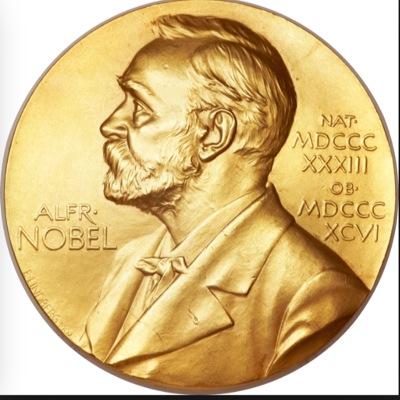
  • NOBEL PRIZE WINNERS IN 2015

    NOBEL PRIZE WINNERS IN 2015

    YEAR after Years, men with exceptional qualities of head and heart have come up with ideas, inventions and creations which have enriched the human world. Their rich contributions have made the world a better and happier place to live in. It is but natural that the grateful human world recognizes their immensely valuable contribution.

    NOBEL PEACE PRIZE 2015

    NATIONAL DIALOGUE QUARTET The Nobel Peace Prize 2015 was awarded to National Dialogue Quartet “for its decisive contribution to the building of a pluralistic democracy in Tunisia in the wake of the Jasmine Revolution of 2011”.

    NATIONAL DIALOGUE QUARTETChairman of the Norwegian Nobel committee Kaci Kullmann Five said that the Tunisian national dialogue quartet, which is a coalition of civil society organisations, was successful in forming an alternative peaceful political process in 2013 when Tunisia was on the verge of civil war.

    Nobel Prize in Literature 2015

    SVETLANA ALEXIEVICHSVETLANA ALEXIEVICH | Belarusian investigative journalist and prose writer Svetlana Alexievich has been awarded the 2015 Nobel Prize “for her polyphonic writings, a monument to suffering and courage in our time”.

    Being the 14th woman to win the prize, member of the Swedish Academy Sara Danius has referred to Alexeivich’s work as a “monument to suffering and courage in our time”.

    Nobel Prize in Physics 2015

    Takaaki Kajita and Arthur B. McDonaldTakaaki Kajita and Arthur B. McDonald | The Nobel Prize in Physics 2015 was awarded jointly to Japanese physicist Takaaki Kajita and Canadian astrophysicist Arthur B. McDonald “for the discovery of neutrino oscillations, which shows neutrinos have mass”.

    On receiving the prestigious award, Kajita said that it was “unbelievable”, thanking the “neutrinos” for his success. He also said at a press conference in Tokyo: “And since neutrinos are created by cosmic rays, I want to thank them, too.”

    Neutrinos are subatomic particles produced by the decay of radioactive elements, and earlier were believed to have no electric charge. Kajita, at the University of Tokyo, and McDonald, at the Queen’s University in Kingston, proved otherwise, showing that neutrinos indeed have mass.

    Nobel Prize in Chemistry 2015

    Tomas Lindahl, Paul Modrich and Aziz SancarTomas Lindahl, Paul Modrich and Aziz Sancar | Tomas Lindahl, Paul Modrich and Aziz Sancar were jointly awarded the Nobel Prize in Chemistry 2015 “for mechanistic studies of DNA repair”.

    These three pioneers discovered how cells repair their DNA and protect it from assaults that the body and the environment put them through.

    Dr. Lindahl from Sweden was honored for discovering ‘how cells generally fix DNA damage’, while Dr. Modrich, the James B. Duke Professor of Biochemistry at Duke University, was recognized ‘for showing how cells correct mistakes in DNA replication during cell division’, and Turkish Biochemist Dr. Sancar ‘for mapping how cells repair DNA damage from ultraviolet light’.

    Nobel Prize in Physiology or Medicine 

    This year, three scientists have won the Nobel prize in medicine for their discoveries concerning malaria and infections caused by roundworm parasites.

    William C. Campbell and Satoshi OmuraWilliam C. Campbell and Satoshi Omura | Irish-born American biologist Dr. William C. Campbell and Japanese biochemist Satoshi Omura have jointly been awarded “for their discoveries concerning a novel therapy against infections caused by roundworm parasites” The two researchers have discovered avermectin, a treatment for roundworm parasites.

    Tu YouyouTu Youyou | The other half of the Nobel Prize in Physiology or Medicine 2015 has been given to Tu Youyou “for her discoveries concerning a novel therapy against Malaria”. The 84-year old Chinese pharmacologist has been recognized for her discovery of artemisinin, a drug that has the most rapid action against Plasmodium falciparum malaria.

  • Year in Review 2015’s biggest moments for online India

    Year in Review
    2015’s biggest moments for online India

    See Year in Review: 2015 for the complete lowdown on 2015’s biggest moments for online India.

    Top 10 Most-Searched Male Celebrities
    1.  Salman Khan
    2.  Yo Yo Honey Singh
    3.  Shahid Kapoor
    4.  Aamir Khan
    5.  Shahrukh Khan
    6.  Amitabh Bachchan
    7.  Akshay Kumar
    8.  Ranbir Kapoor
    9.  Prabhas
    10. Hrithik Roshan

    Top 10 Most-Searched Female Celebrities
    1.  Sunny Leone
    2.  Katrina Kaif
    3.  Deepika Padukone
    4.  Priyanka Chopra
    5.  Aishwarya Rai
    6.  Anushka Sharma
    7.  Kim Kardashian
    8.  Sonakshi Sinha
    9.  Radhika Apte
    10. Sonam Kapoor

    Top 10 Most-Searched Sportspersons
    1.  MS Dhoni
    2.  Virat Kohli
    3.  Suresh Raina
    4.  Sachin Tendulkar
    5.  Chris Gayle
    6.  Yuvraj Singh
    7.  Sania Mirza
    8.  Ab De Villiers
    9.  Sourav Ganguly
    10. Saina Nehwal

    Top 10 Most-Searched Politicians 
    1.  Narendra Modi
    2.  Arvind Kejriwal
    3.  Smriti Irani
    4.  Shashi Tharoor
    5.  Hema Malini
    6.  RR Patil
    7.  Yogendra Yadav
    8.  Jayalalitha
    9.  Kiran Bedi
    10. Radhe Maa

    Top 10 Most-Searched News Events
    1.  ISIS
    2.  APJ Abdul Kalam
    3.  ICC Cricket World Cup 2015
    4.  Indian Premier League 2015
    5.  Indian Super League 2015
    6.  Latest Gold Prices
    7.  MH370
    8.  Sheena Bora investigation
    9.  Yakub Memon
    10. Vyapam

    Top 10 Most-Searched Movies and TV Shows
    1.  Baahubali
    2.  India’s Daughter
    3.  Bigg Boss 9
    4.  Bajrangi Bhaijaan
    5.  ABCD 2
    6.  Ragini MMS 2
    7.  Prem Ratan Dhan Payo
    8.  Fast and Furious 7
    9.  Badlapur
    10. Fifty Shades Of Grey

    Top 10 Most-Searched Gadgets
    1.  iPhone 6
    2.  Apple
    3.  Nokia
    4.  Windows 10
    5.  Sony Xperia
    6.  Lenovo A6000
    7.  iPhone 5
    8.  Intex Mobile
    9.  iPhone 6S
    10. Macbook

    Most epic Selfies of 2015
    1.  Narendra Modi and Li Keqiang during the PM’s China visit
    2.  Ranveer’s antics and Deepika’s charms
    3.  Shahid Kapoor with new wife Mira Rajput
    4.  Sachin Tendulkar’s team selfie with Mumbai Indian
    5.  Arjun Kapoor’s star studded selfie
    6.  King Khan with ex-One Direction member Zayn Malik
    7.  Katrina’s debut in the realm of Selfies
    8.  Amitabh Bachchan and younger Bachchan pouting

    Top 10 Bike launches 2015
    1.  Bajaj Pulsar RS 200
    2.  Honda Livo
    3.  Bajaj Pulsar AS 200
    4.  Bajaj Avenger Street/Cruise 220
    5.  Mahindra Mojo
    6.  Yamaha YZF-R3
    7.  Bajaj CT100
    8.  Suzuki Gixxer SF
    9.  Ducati Scrambler
    10. Yamaha Saluto

    Best Instagram accounts of the year
    1.  Jacqueline Fernandez
    2.  Tanya Ghavri
    3.  Alia Bhatt
    4.  Yasmin Karachiwala
    5.  Karan Johar
    6.  Sonam Kapoor
    7.  Namrata Soni
    8.  Priyanka Chopra
    9.  Daniel Bauer
    10. Sonakshi Sinha

    Top 10 moments from Bollywood
    1.  Salman Khan’s conviction
    2.  Gajendra Chauhan’s appointment as FTII Chairman
    3.  Shahid Kapoor’s marriage
    4.  Aadesh Shrivastava
    5.  Labh Janjua
    6.  20 years of DDLJ
    7.  Salman Khan and Shahrukh Khan
    8.  Priyanka Chopra in Quantico
    9.  Award wapsi
    10. Aishwarya Rai Bachchan in Jazbaa

    Top 10 Fashion trends of 2015
    1.  Cape Jackets
    2.  Pantsuits
    3.  Boho Chic
    4.  The Bob
    5.  Sneakers
    6.  Bardot
    7.  Gladiators
    8.  Slitted dresses
    9.  Separates
    10. Playsuits

  • Gun Control | President Obama’s Executive Action on Federal Gun Control

    Gun Control | President Obama’s Executive Action on Federal Gun Control

    POTUS unveiled new restrictions on gun purchases at the White House, saying the “constant excuses for inaction” have to stop. He was introduced by Mark Barden, whose son Daniel was killed in the 2012 massacre at Sandy Hook Elementary School in Connecticut. (Obama circled back to that shooting in the final moments of his speech)

    The White House has outlined his plans for executive action, which focus on background checks.

    Most of the actions can be carried out without Congressional approval.

    “That’s why we’re here, not to do something about the last mass shooting, but to prevent the next one,” he said.

    “The gun lobby may be holding Congress hostage right now, but they can’t hold America hostage,” Mr Obama said.

    He gave his remarks surrounded by survivors and relatives of victims of shootings, recalling mass shootings in the US in the past few years and everyday gun violence in cities like Chicago.

    The White House is seeking to expand background checks for buyers. The measure clarifies that individuals “in the business of selling firearms” register as licensed gun dealers, effectively narrowing the so-called “gun show loophole,” which exempts most small sellers from keeping formal sales records.

    The executive actions include:

    • Background checks for all gun sellers, overturning current exemptions to some online and gun show sellers
    • States providing information on people disqualified from buying guns due to mental illness or domestic violence
    • Increased workforce for the FBI to process background checks, hiring more than 230 new examiners
    • Congress being asked to invest $500m (£339m) to improve access to mental healthcare in the US
    • The departments of defence, justice and homeland security exploring “smart gun technology” to improve gun safety

    The announcement is already shaping up to be an issue in the 2016 presidential election.

    Leading Democratic candidate Hillary Clinton tweeted: “@POTUS is right: We can protect the second Amendment while protecting our families and communities from gun violence. And we have to.”

    Republican candidate Senator Ted Cruz tweeted that the executive actions are unconstitutional, with a link to sign up for his campaign correspondence on a webpage that says “Obama wants your guns” with a photo of the president in an army jacket and hat.

    Former Florida governor Jeb Bush tweeted that he would repeal the actions and protect the Second Amendment.

    Speaker Melissa Mark-Viverito “Tragedy after terrible tragedy has proven beyond doubt that the time for stringent federal gun control is long overdue. While Republicans in Congress stalled and squalled, thousands of men, women, and young children in our country have suffered and died because of lax regulations that allow these deadly weapons into the wrong hands. Consistently backward and shameful efforts to block sensible gun reform make Washington Republicans complicit in these tragedies – but we as a nation cannot and should not allow the lives of those we lost to be in vain. The executive action signed by President Obama will close dangerous loopholes in our current gun laws and tighten reporting requirements so that fewer guns end up on our streets and in our communities. This is a critical step on the path to ending the fatal epidemic of gun violence in our nation. I thank President Obama for taking action.”

    President Barack Obama grew emotional Tuesday, January 5, as he made a passionate call for a national “sense of urgency” to limit gun violence.

    Slide1 copy


    Gun violence is significantly higher in the US than in other advanced countries, killing about 30,000 people each year.

    Congress has been reluctant to pass any laws restricting gun ownership, facing pressure from gun owners and the powerful National Rifle Association.

    Mr Obama tried to pass expanded background check legislation in 2012 after the shooting in Newtown, Connecticut, that left 20 children and six adults dead but it failed in Congress.

  • South Carolina’s Indian-American Governor To Give Republican Response To Key Obama Address

    South Carolina’s Indian-American Governor To Give Republican Response To Key Obama Address

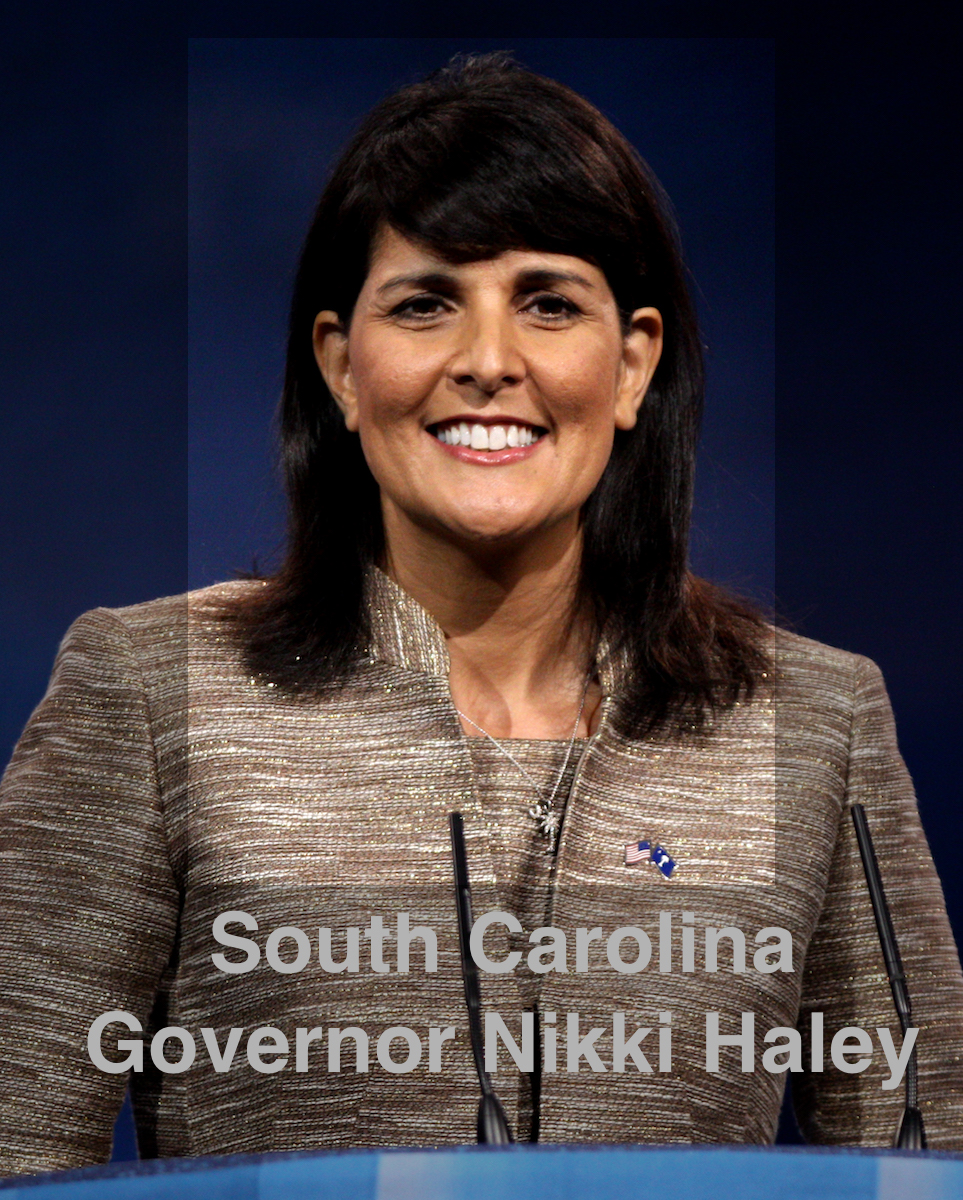
    WASHINGTON (TIP): South Carolina Governor Nikki Haley, who has been mentioned as a possible 2016 vice presidential pick, will deliver the Republican response to President Barack Obama’s final State of the Union address.

    Haley, the first female and first minority governor in her state’s history, will address the nation on the night of January 12 after Obama’s speech, congressional leaders said on Tuesday.

    She surged into the spotlight last year during a bitter debate over the Confederate flag, when she ordered the divisive and controversial banner be taken off state capitol grounds in the wake of a church shooting in Charleston.

    Several observers said Haley, who is 43 and in her second term as governor, used the opportunity as a political launch pad, securing her image as the face of the new South and helping her party’s profile in the process.

    “Nikki Haley has led an economic turnaround and set a bold agenda for her state, getting things done and becoming one of the most popular governors in America,” House Speaker Paul Ryan said in announcing her as the person to deliver the Republican address.

    “Governor Haley knows the American Dream and wants to see every American share in it, and we’re pleased that she will be delivering this year’s Republican Address,” added Senate Majority Leader Mitch McConnell.

    Haley is one of two Indian American governors in the United States. The other, Bobby Jindal of Louisiana, briefly ran for president before dropping out in November.

    “This is a time of great challenges for our country, but also of great opportunities.  I intend to speak about both,” Haley said in a statement.

    The speech comes in the run up to the highly anticipated Iowa caucuses and New Hampshire primaries, the first two state-wide votes in the process to determine the Democratic and Republican nominees for president.

  • Trump launches anti-Muslim and immigration campaign ad

    Trump launches anti-Muslim and immigration campaign ad

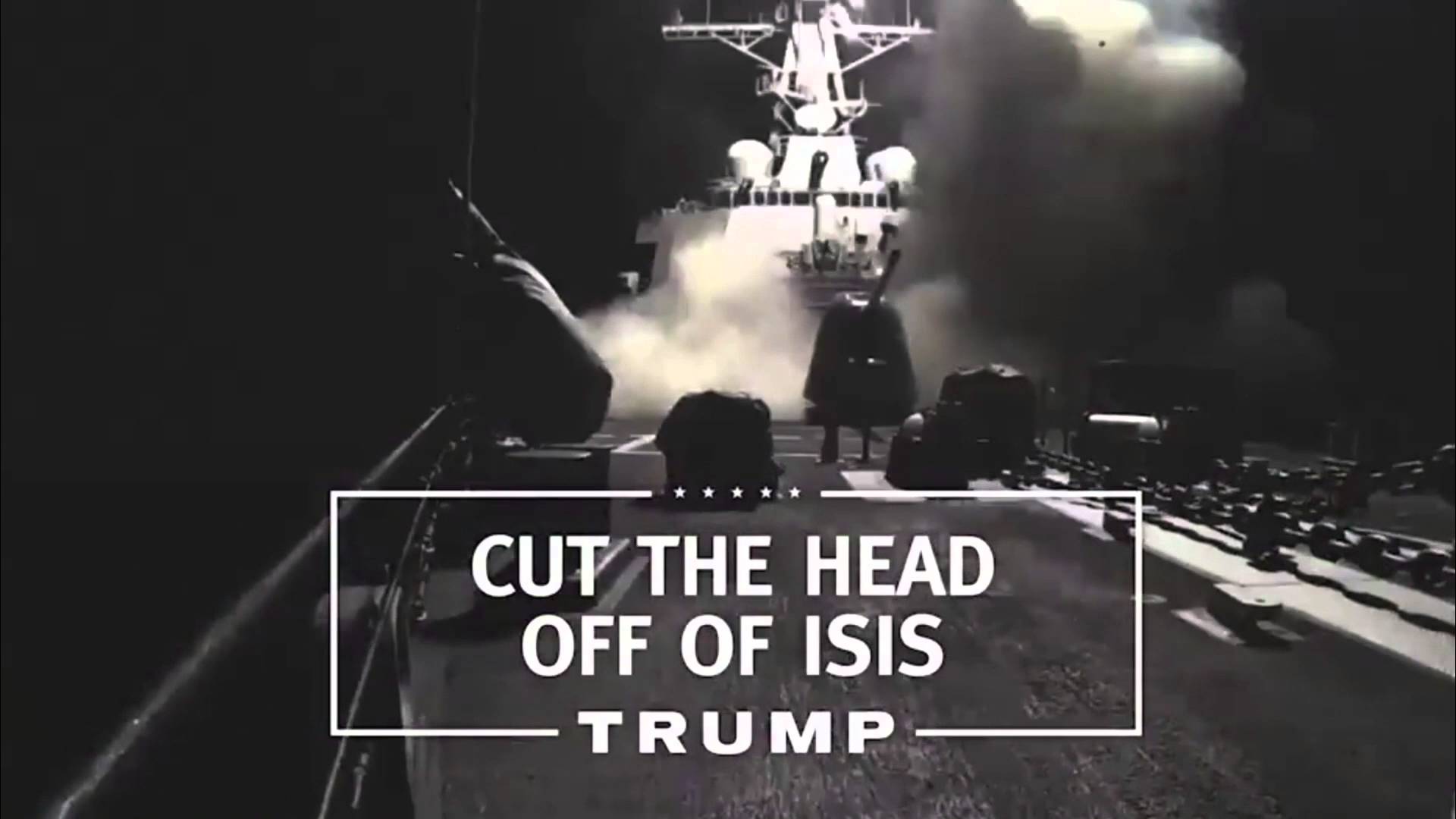
    WASHINGTON: Republican presidential candidate Donald Trump on Monday released his first television commercial in the 2016 race for the White House with a 30-second spot highlighting his stance on Muslims, immigration and terrorism.

    The ad will air starting on Tuesday in Iowa and New Hampshire, two key early voting states in the run-up to the party’s nomination convention in July ahead of the November election, Trump’s campaign said in a statement on its website.

    The commercial reiterates the Republican front-runner’s recent call to temporarily block Muslims from entering the United States and pledges a tough stance against Islamic State and acts of terrorism.

    “He’ll quickly cut the head off ISIS and take their oil,” the ad said, using an acronym for the militant group.

    The ad also reiterated the businessman-turned-politician’s ongoing calls to target illegal immigration by building a wall along the southern U.S. border that he said Mexico will pay for.

    Trump leads national public opinion polls of the 12 Republicans seeking their party’s presidential nomination, although he is trailing in some state polls.

    Reuters/Ipsos polling showed Trump with 38 percent support among Republican respondents, followed by U.S. Senator Ted Cruz with nearly 15 percent, and retired neurosurgeon Ben Carson with 12 percent.

    “I don’t know if I need it, but I don’t want to take any chances because if I win we are going to make America great again,” Trump said in a statement accompanying the ad on his website.

    He said last week he planned to spend at least $2 million a week on ads in early voting states.

    On Monday, his campaign said it is also releasing a radio ad later this week in South Carolina, another key state.

  • Iran and Saudi Arabia: Islamic Intolerance or Oil Intolerance | In-depth Coverage & Analysis

    Iran and Saudi Arabia: Islamic Intolerance or Oil Intolerance | In-depth Coverage & Analysis

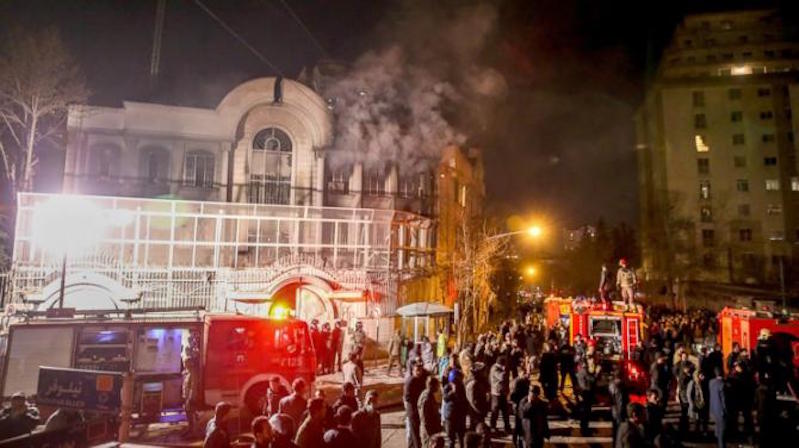
    Saudi Arabia has announced it is severing diplomatic ties with Iran following Saturday’s (January 2) attack on its embassy in Tehran during protests against executions in the kingdom.

    Adel al-Jubeir, the Saudi foreign minister, made the announcement on Sunday while the foreign ministry said it was asking Iranian diplomatic mission to leave the kingdom within 48 hours.

    The Saudi foreign ministry also announced that the staff of its diplomatic mission had been evacuated and were on their way back to the kingdom.

    Later reports said the flight carrying the Saudi embassy staff had landed in Dubai in the UAE.

    Saudi Arabia’s interior ministry announced on Saturday the execution of 47 people on terrorism charges, including a convicted al-Qaeda leader and a Shia religious leader.

    Many of the men executed had been linked to attacks in Saudi Arabia between 2003 and 2006, blamed on al-Qaeda.

    Four of those executed were said to be Shia.

    Nimr al-Nimr, the Shia leader, was accused of inciting violence and leading anti-government protests in the country’s east in 2011. He was convicted of sedition, disobedience and bearing arms.

    He did not deny the political charges against him, but said he never carried weapons or called for violence.

    Nimr spent more than a decade studying theology in predominantly Shia Iran.

    His execution prompted demonstrations in a number of countries, with protesters breaking into the Saudi embassy in Tehran late on Saturday night and starting fires.

    At Sunday’s press conference in Riyadh, Jubeir said the Saudi diplomatic representative had sought help from the Iranian foreign ministry when the building was stormed, but the requests were ignored three times.

    He accused the Iranian authorities of being complicit in the attack, saying that documents and computers were taken from the embassy building.

    Calling the incident an act of “aggression”, he said Iran had a history of “violating diplomatic missions”, citing the attacks on the US embassy in Tehran in 1979 and the British embassy in 2011.

    “These ongoing aggressions against diplomatic missions are a violation of all agreements and international conventions,” he said, calling them part of an effort by Iran to “destabilise” the region.

    – With Inputs from Al Jazeera

    IRANIAN ACTION

    Earlier on Sunday, Iranian President Hassan Rouhani ordered the arrest and prosecution of individuals involved in the embassy attack, while also condemning the execution of Nimr.

    Asked at the press conference what other steps the Saudis would take against Iran, Jubeir said “we will cross each bridge when we will get to it”.

    “We are determined not to allow Iran to undermine our security,” he said.

    Ellie Geranmayeh, an Iran expert at the European Council on Foreign Relations, said the Saudi decision was likely to have repercussions for the region, particularly concerning the Syrian negotiations.

    “Western powers must increase efforts to safeguard this process and encourage the Saudis and Iran to continue their participation [in the Syria peace talks],” she told Al Jazeera from London.

    “These events further set back the urgently needed rapprochement between Tehran and Riyadh, and spell further trouble for an already fragile region.”

    BAHRAIN, UAE AND SUDAN RALLY TO SAUDI SIDE IN IRAN ROW

    Saudi Arabia’s regional allies have stepped up diplomatic pressure on Iran, breaking or downgrading relations with the country following an attack on the Saudi embassy in Tehran, which followed executions in the kingdom.

    Bahrain announced on Monday that it was closing its embassy in Iran, and called upon Iranian diplomats to leave the country within 48 hours.

    Bahrain frequently accuses Iran of being behind protests among its majority Shia population.

    Within hours of the announcement, Sudan also said it was cutting off diplomatic relations with Iran “in solidarity with Saudi Arabia”.

    For its part, the UAE said it was downgrading its ties with Iran, replacing its ambassador with an embassy officer-in-charge.

    Saudi Arabia announced on Sunday it was severing diplomatic relations with Iran and urged its allies to follow its move.

    The decision came after Iranian protesters attacked its embassy in Tehran, following the kingdom’s decision to execute Shia religious figure Nimr al-Nimr along with 46 other mostly Sunni convicts on terrorism charges.

    Shia minorities across the Middle East have been demonstrating after Nimr’s execution.

    Saudi Arabia is adamant Nimr got a fair trial. Many of the men executed had been linked to attacks in Saudi Arabia between 2003 and 2006, blamed on al-Qaeda.

    Saudi Arabia further announced on Monday that it was cutting commercial ties with Iran and cancelling all flights to and from Iran, according to Reuters.

    In an interview with the news agency, Adel al-Jubeir, Saudi foreign minister, said the kindom was banning all its citizens from travelling to Iran.

    However, Iranian pilgrims are still welcome to visit Saudi Arabia and Mecca, Islam’s holiest site, he said.

    Earlier, Abdul Latif bin Rashid al-Zayani, secretary-general of the Gulf Cooperation Council, condemned the attack in Tehran and held Iranian authorities fully responsible for failing to protect the Saudi diplomatic mission.

    IRANIAN PERSPECTIVE

    It is not the first time diplomatic relations have been cut between Saudi Arabia and Iran. However, there are fears it could lead to more violence.

    Iran’s foreign ministry said Saudi Arabia was using the attack on its embassy in Tehran as a pretext to fuel tensions..

    The statement came after Iran was given a 48-hour deadline to remove its diplomatic mission from Riyadh.

    “Iran … is committed to providing diplomatic security based on international conventions. But Saudi Arabia, which thrives on tensions, has used this incident as an excuse to fuel the tensions,” Hossein Jaberi Ansari, Iran’s foreign ministry spokesman, said in televised remarks on Monday.

    On the other hand, Jubeir has accused Iranian authorities of being complicit in the attack, saying that documents and computers were taken from the embassy building.

    He said the Saudi diplomatic representative had sought help from the Iranian foreign ministry when the building was stormed, but the requests were ignored three times.

    Hamid Soorghali, a UK-based Iran observer said, the attack of the Saudi embassy “only works to damage and affect the image of Iran”.

    He said while the leadership in Iran is unified in condemning the execution of Nimr, it is divided in terms of the reaction.

    “We get different responses from different institutions and leaders in Iran. We get a harsher message from Iran’s supreme leader, which very much reverberates in the mood and scenes of protesters in front of the embassy,” he told Al Jazeera.

    ‘NO LOVE LOST’

    Ghanbar Naderi, a journalist with Kayhan, a publication closely linked to Ayatollah Ali Khamenei, Iran’s supreme leader, said the breaking of diplomatic relations between Saudi Arabia and Iran was inevitable.

    “It was going to happen today or tomorrow. This is a natural outcome of what has been going on for the past four or five years in Syria, Iraq and Yemen,” he told Al Jazeera.

    “Make no mistake about it, there is no love lost between the Iranians and the Saudis.”

    Al Jazeera’s James Bays, reporting from New York, said diplomats at the UN have expressed worries over the escalating war of words.

    “What we are seeing is the fallout across the Gulf countries,” he said. “In terms of the relationship between Saudi Arabia and Iran, I think most people think that this is probably as bad as you can get.”

    On Sunday, Ban Ki-moon, UN secretary-general, issued a statement saying he was “concerned” about both sides of the diplomatic dispute, while criticising both the executions and the attack on the Saudi embassy in Tehran.

    Ban was to send Staffan de Mistura, the UN special representative for Syria, to Riyadh and Tehran on Monday, a UN official told Al Jazeera.

    In a call on Monday, Ban conveyed his concerns to the foreign ministers of Saudi Arabia and Iran, a UN statement said.

    The statement said he urged the two countries “to avoid any actions that could further exacerbate the situation between two countries and in the region as a whole”.

    THE OIL PRICE, IRAN AND SAUDI’S ECONOMY

    Analysis: How Iran’s return to global oil markets may impact Saudi Arabia’s 2016 budget.

    During last month’s OPEC meeting, Saudi Arabia again declined to cut oil production despite the world being awash with oil.

    The great unanswered question for Saudi Arabia is: How low can prices go, and for how long?

    Saudi Arabia’s refusal to reduce oil output shows no sign of abating, but its determination to drive out US shale producers is taking a toll on the kingdom’s economy, recent data suggests. And with the expectation of Iran’s return to global oil markets already undermining fragile prices, Riyadh’s strategy looks increasingly like it might be a gamble with declining odds.

    Although the kingdom has substantial reserves, it appears to be burning through its financial war chest at an alarming rate. According to the Saudi Arabian Monetary Agency, foreign exchange reserves fell to $648bn at the end of October from $742bn a year earlier.

    OIL PRICES AND OPEC

    If OPEC does not compensate for the increase in Iran’s oil exports by cutting oil production, the International Monetary Fund says oil prices could fall between five and 10 percent in the medium term. Energy giant BP estimates that Iran has the fourth-largest proven oil reserves in the world after Venezuela, Saudi Arabia and Canada, as well as the second-largest gas reserves, according to the IMF.

    How quickly Iran can ramp up production is up for debate, but a consensus appears to be emerging. Industry Think Tanks believe that Iran will add between 0.5 to one million barrels a day within a year, while the IMF forecasts an increase of around 0.6 million barrels a day in 2016.

    Bijan Zangeneh, Iran’s oil minister, is considerably more bullish about the country’s ability to bolster output but, whatever the figure, it is expected to increase pressure on Saudi’s economy, in which about 90 percent of government revenues are derived from hydrocarbons.

    At the same time, there are signs that the Saudi campaign against US shale is having an impact. There is mounting evidence that shale production in the United States is beginning to wane, while energy consumption in advanced economies is rising. Elsewhere in the world, major energy companies have shelved a number of projects – a move that will support of prices in the medium term.

    SAUDI ECONOMY

    Even so, the IMF predicts that the gross domestic product in Saudi Arabia will grow by only 2.2 percent in 2016, compared with 4.4 percent in Iran.

    Eduard Gracia, a principal at the AT Kearney consulting firm, says Saudi Arabia’s decision not to cut production is due in part to the supply-demand dynamics of the global market.

    “It only makes sense ‎to cut production if the supply situation is such that a small output reduction results in a substantial price increase,” Gracia told Al Jazeera. “In a situation of global oversupply this may not be the case, so the appeal of a production-cutting strategy is not clear.”

    By the end of this year, Saudi Arabia’s budget deficit will reach 20 percent of GDP, according to a December report from Capital Economics. The situation has prompted the IMF to warn that Saudi could exhaust its reserves within five years if policies remain unchanged. Riyadh has responded with cutbacks in spending, and is under intense pressure to reduce expensive energy subsidies.

    The IMF estimates that these implicit subsidies cost the government $83bn in 2014, one of the highest totals in the Gulf Cooperation Council countries, second only to Bahrain. Attention is now turning to Saudi’s 2016 budget. It is expected to be one of mostly heavily scrutinised budgets in years, as investors seek reassurance that the kingdom’s finances are under control.

    According to press reports, leaked memos from King Salman to the Ministry of Finance in October ordered government entities to stop new infrastructure projects and to postpone purchases of new cars and furniture. Mounting economic uncertainty led Standard & Poor’s to downgrade Saudi’s rating from AA-/A-1+ to A /A-1 in October, with a warning of a possible further downgrades.

    The downgrade pushes up the costs of borrowing at a time when government revenues have fallen sharply. There has also been speculation in financial markets about how this could affect the Saudi riyal, with the spread between forward and spot rates recently widening to the highest level since 2003.

    However, according to Capital Economics, that scenario would be the last resort, and Saudi has other options that could include tapping into the international bond markets early in 2016 – something it has never done before. Authorities are currently issuing around SAR 20bn ($5bn) of debt per month to local banks, reducing the amount local banks have left to lend to the private sector, according to an estimate from Capital Economics.

  • Siege in Afghanistan ends, Indian mission safe

    Siege in Afghanistan ends, Indian mission safe

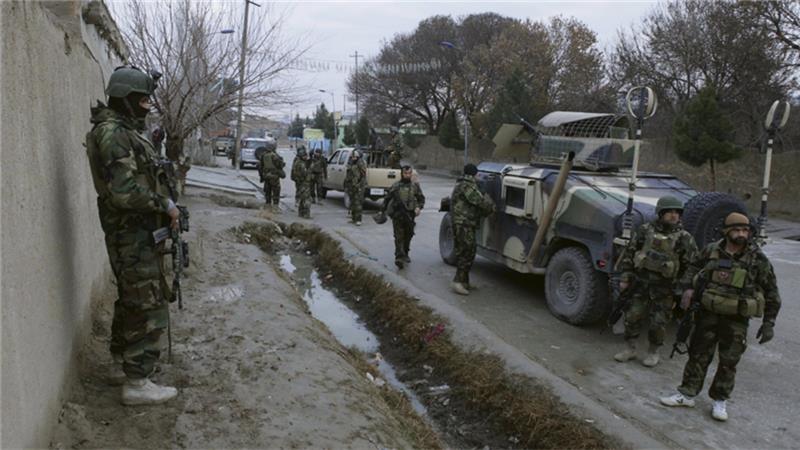
    In intense 25-hour gunbattle between security forces and terrorists out side the Indian consulate in Mazar-i-Sharif came to end late on Monday, Jan 4, night with the killing of all the attackers without any damage to the mission in Afghanistan.

    While three of the attackers were killed on Sunday night, the remaining were neutralised a day later. “The clearance operation is over and all the terrorists have al been killed,” provincial police chief Sayed Kamal Sada was quoted as saying by AFP.

    The diplomatic mission manned by about 45 ITBP commandos, is highly vulnerable to attacks as it is located in a densely populated residential area and the buildings around it are taller than the consulate, leaving it exposed to attacks by rocket launchers.

    Top government sources said that the first RPG was fired by militants from a 100meter distance and was directed at the Indian consulate, but it missed the building and hit another building nearby . That’s when ITBP commandos at the sentry post fired at the terrorists.

    From 9 pm to 9.15pm on Sunday, ITBP officials en gaged with militants and there was heavy exchange of fire. Sources said that at least seven rocket-propelled grenade (RPG) rounds were fired towards the consulate but all of them missed the target. Later, Afghan national police commandos secured the Indian consulate around 12 midnight.

    A senior officer said that there was no intelligence input from either side -India or Afghanistan -on any possible terror attack at the consulate. ITBP director general Krishna Chaudhary said the force has secured the mission area effectively. “I can assure you that my men are in a state of very high morale. I first talked to them when the attack started Sunday night and I am in constant touch with them,” he said without going into further details about the incident.


  • US expects Pakistan will take action against Pathankot attackers

    US expects Pakistan will take action against Pathankot attackers

    The US expects Pakistan will take actions against the perpetrators of the terror attack on IAF base in Pathankot, a top American official said, hours after Islamabad said it is working on the “leads” provided by India.

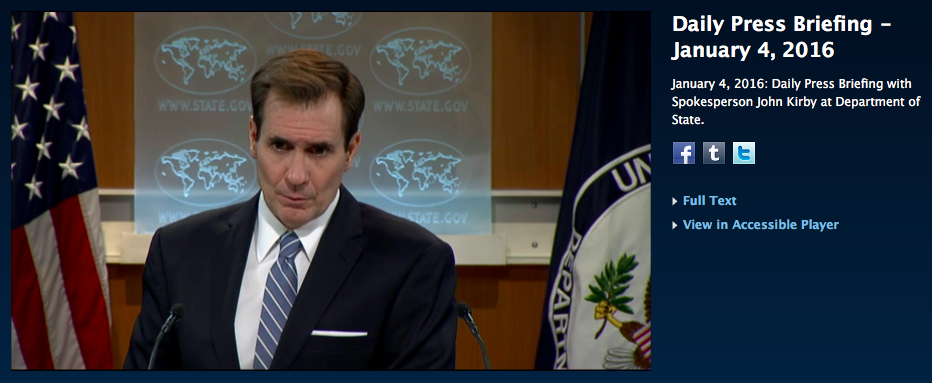
    “The government of Pakistan has spoken very powerfully to this and it’s certainly our expectation that they’ll treat this exactly the way they’ve said they would,” state department Spokesman John Kirby said on Monday.

    Pakistan has said it is working on the “leads” provided by India on this attack.

    Describing terrorism as a “shared challenge” in South Asia, the US also asked all countries in the region to work together to disrupt and dismantle terrorist networks and bring justice to the perpetrators of the Pathankot terrorist attack.

    “We urge all the countries in the region to work together to disrupt and dismantle terrorist networks and to bring justice to the perpetrators of this particular attack. I would note that the government of Pakistan, also publicly and privately condemned this recent attack on the Indian air base.

    “We have been clear with the highest levels of the government of Pakistan that it must continue to target all militant groups,” Kirby said.

    The government of Pakistan has said publicly and privately that it’s not going to discriminate among terrorist groups as part of its counter-terrorism operation, he said.

    “So this is a shared challenge that we all face in the region and we in the United States want everybody to treat it as a shared challenge,” Kirby said, adding that the US has strongly condemned the terrorist attack on the Indian Air Force (IAF) base in Punjab’s Pathankot.

    “We extend our condolences to all the victims and their families,” he said.

    He said the US has for a long time talked about the continued safe haven issues there in between Afghanistan and Pakistan and certainly between India and Pakistan.

    “We’re mindful that there remain some safe havens that we obviously want to see cleared out. And we continue to engage with the government of Pakistan to that end. And again, I would point you back to what the government of Pakistan itself has said and acknowledged that it’s not going to discriminate among terrorist groups and it will continue to take the fight,” Kirby said.

    The Pakistani government, the Pakistani people very much understand the threat here, Kirby said.

    “What we want and what we continue to say we want and will continue to work for is increased cooperation, communication, coordination, increased information-sharing and increased efforts against what we all believe is a shared challenge in the region.

    “We want to see the government of Pakistan continue to press the fight against terrorists, all terrorists, and to meet their own expectations that they’re not going to discriminate among groups. They’ve said themselves and our expectation is that they’ll live up to that pledge,” he said.

    “We recognise there’s more everybody can do, not just Pakistan but every nation can do because it is a shared challenge and it’s a challenge, as you well know, that doesn’t necessarily observe borders and boundaries. So it’s something that everybody can attack more,” Kirby said.

    Kirby said the US is encouraged by the government of Pakistan condemning this attack, and the statement that they’ve made about not discriminating among groups.

    “As we’ve said before, this is an issue that, as are so many issues between India and Pakistan and we want to see them work out bilaterally,” Kirby said, adding that normalisation of relations between India and Pakistan remains vital to the security and economic prosperity of the entire region.

    “We strongly encourage the governments of both India and Pakistan to remain steadfast in their commitment to a more secure and prosperous future for both our countries and for their region,” Kirby added.

    Pakistan on Monday said it is working on the “leads” provided by India on the terror attack on the IAF base in Pathankot, according to the Foreign Office.

    Extending Pakistan’s deepest condolences to the government and people of India on the “unfortunate terrorist incident” in Pathankot, a statement by the spokesperson of the ministry of foreign affairs said, “In line with Pakistan’s commitment to effectively counter and eradicate terrorism, the Government is in touch with the Indian government and is working on the leads provided by it.”

    The statement, however, did not give details of the “leads” provided by India.

    BELOW IS THE TRANSCRIPT OF THE PRESS BRIEFING

    QUESTION: Two questions. Yes, sir. One, it was then prime minister Atal Bihari Vajpayee who went to Pakistan with a message of peace, and it was also Prime Minister Nawaz Sharif then. And he took the bus from India to Pakistan. It was a big step at that time. And when he came back in the bus, India was faced with the Kargil War.

    MR KIRBY: Faced with a what?

    QUESTION: Kargil War. War.

    QUESTION: Kargil War.

    MR KIRBY: Kargil War.

    QUESTION: That means Pakistan’s General Musharraf attacked India. That was a gift for the Atal Bihari prime minister for the peace message. Now, on Christmas Day, Prime Minister Narendra Modi took another peace step and went to Pakistan, meet and greet Prime Minister Nawaz Sharif. When he came back – and again, the message was same from the people of India to the people of Pakistan: message of peace. When he came back, India was faced with the terrorism, terrorists on the border in airbase. So what would – and upcoming meeting January 16 is also now at stake whether India should continue or not. So what do we make this, before my second question?

    MR KIRBY: Well, there is an awful lot there. I mean, you saw my statement over the weekend. We strongly condemn the terrorist attack on the airbase in the Indian state of Punjab; and as before, we extend our condolences to all the victims and their families. We remain committed to a strong partnership with the Indian Government to combat terrorism. You and I have talked about that many, many times. We urge all the countries in the region to work together to disrupt and dismantle terrorist networks and to bring justice to the perpetrators of this particular attack.

    I would note that the Government of Pakistan also publicly and privately condemned this recent attack on the Indian airbase. And we’ve been clear with the highest levels of the Government of Pakistan that it must continue to target all militant groups, and the Government of Pakistan has said publicly and privately that it’s not going to discriminate among terrorist groups as part of its counterterrorism operations.

    So I think as I’ve said before, this is a shared challenge that we all face in the region. And we in the United States want everybody to treat it as a shared challenge. And the Government of Pakistan has spoken to this, has spoken very powerfully to this, and it’s certainly our expectation that they’ll do exactly what – they’ll treat this exactly the way they’ve said they will.

    QUESTION: Second, the people of Pakistan and the people of India both wants these terrorists – that training centers in Pakistan should be closed down, but the Pakistan Government is not taking any steps. And finally, what – the Indian media has been showing all these terrorism activities line by line and live from Pakistan and into India, this latest attack. And at the same time, Pakistani media has been told by the ISI and the military they will be punished if they show, but they must condemn that India media is just overstating all these attacks. What I’m saying: What is the future? Why U.S. is not taking action or asking Pakistan to stop and close down all these training centers, which they are threatening U.S. and India?

    MR KIRBY: Well, we have for a long time talked about the continued safe haven issues there in between Afghanistan and Pakistan and certainly between India and Pakistan. We’re mindful that there are – remain some safe havens that we obviously want to see cleared out. And we continue to engage with the Government of Pakistan to that end. And again, I would point you back to what the Government of Pakistan itself has said and acknowledged, that it’s not going to discriminate among terrorist groups and it will continue to take the fight.

    And Pakistan too has suffered from terrorism. Thousands and thousands of Pakistani soldiers have been killed. Thousands of Pakistani citizens – innocent Pakistani citizens – have been killed or injured by terrorist attacks. The Pakistani Government, the Pakistani people very much understand the threat here. And what we want and what we continue to say we want and will continue to work for is increased cooperation, communication, coordination; increased information sharing and increased efforts against what we all believe is a shared challenge in the region.

    QUESTION: Thank you, sir.

    MR KIRBY: Yeah.

    QUESTION: Can I follow it up?

    MR KIRBY: Yeah.

    QUESTION: Can I follow it up?

    QUESTION: South China Sea.

    QUESTION: Follow-up.

    MR KIRBY: I’ll go to you, then I’ll come to you. Go ahead.

    QUESTION: Do you think Pakistan is taking enough steps against terrorist networks which are targeting India, like Lashkar-e-Tayyiba, Jaish-e-Mohammad?

    MR KIRBY: Well, what I would tell you is we all recognize this is a fluid threat. It’s one that you could probably never do enough to get at. So we want to see the Government of Pakistan continue to press the fight against terrorists, all terrorists, and to – as I said, to meet their own expectations that they’re not going to discriminate among groups. They’ve said that themselves, and our expectation is that they’ll live up to that pledge. But we recognize there’s more everybody can do – not just Pakistan, but every nation in the region can do – because it is a shared challenge. And it’s a challenge, as you well know, that doesn’t necessarily observe borders and boundaries. So it’s something that everybody can attack more.

    QUESTION: You said more every nations to do. What should India do?

    MR KIRBY: I’m not going to —

    QUESTION: What —

    MR KIRBY: Look, I —

    QUESTION: In this fight against terrorism, what do you want – expect India to do?

    MR KIRBY: I’m not prepared with an agenda list for every nation in the region and what they can do. I think you should speak to Indian authorities about the challenges that they’re facing and their plans to address it. Our role has been and will continue to be one of encouraging regional cooperation and communication to get at what is actually a regional – trans-regional, frankly – threat.

    QUESTION: And finally, the kind of statements that have come from India and Pakistan after this Pathankot attack – does this give you comfort, some kind of comfort, that there is not much – enough tension between the two countries after this attack?

    MR KIRBY: Well, I mean, certainly we – we’re encouraged by the Government of Pakistan condemning this attack, and again, the statements that they’ve made about not discriminating among groups. But this is – as we’ve said before, this is an issue that – as are so many issues between India, Pakistan – India and Pakistan – we want to see them work out bilaterally.

    Okay? Yes.

    QUESTION: Can I have a follow-up on that —

    MR KIRBY: Okay.

    QUESTION: Yeah. Over the weekend, have you been in touch with either India or Pakistan to ensure that talks are on tracks and it – they’re not derailed?

    MR KIRBY: Talks are —

    QUESTION: Talks between India and Pakistan which have been started afresh last week.

    MR KIRBY: I don’t have any discussions to read out to you, but I can tell you the normalization of relations between India and Pakistan remains vital to the security and economic prosperity of the entire region. We strongly encourage the governments of both India and Pakistan to remain steadfast in their commitment to a more secure and prosperous future for both their countries and for the region. So I don’t have any specific discussions to read out to you.

    You’ve been patient. Go ahead.

  • Zinedine Zidane is the new Coach for Real Madrid FC

    Zinedine Zidane is the new Coach for Real Madrid FC

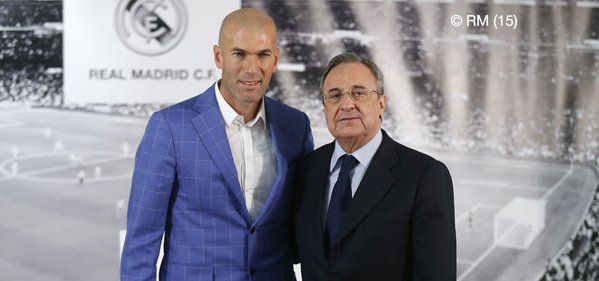
    Real Madrid FC promoted France legend Zinedine Zidane as the Coach and sacked Rafael Benitez on Monday, January 4.

    Club president Florentino Perez announced the news after a club board meeting on Monday afternoon.

    He called Zidane “one of the greatest figures in football history” and told him: “This is your stadium, your club, you have all our confidence. Madridismo is at your side. As president, I am proud to have you by my side. I know for you, the word ‘impossible’ does not exist.”

    The Frenchman is loved at the Santiago Bernabeu thanks to his five stellar years to end his playing career in the Spanish capital, most memorably scoring a stunning winning goal in the 2002 Champions League final.

    Yet, his coaching experience is limited to a season-and-a-half in charge of Madrid’s feeder team Castilla where he failed to secure promotion from Spanish football’s third tier last season.

    However, Madrid hope to recreate the magic formula enjoyed by Pep Guardiola and Barcelona during his glorious 14-trophy haul with the Catalans between 2008 and 2012.

    Like Zidane, Guardiola was a club legend as a player who graduated from a season in charge of Barca’s B team to become the most successful coach in the club’s history.

    Moreover, unlike Benitez, Zidane is at least sure to have the respect of Madrid’s star-studded dressing room, who constantly clashed with the former Liverpool and Chelsea manager.

    Zidane doesn’t just have the kudos of being a former Ballon d’Or winner, but he was Carlo Ancelotti’s assistant as Madrid won their long-awaited 10th Champions League crown in 2014.

    “We have the best club in the world, the best fans and what we have to do now, and what I will try my best to do, is ensure the team wins at the end of the season,” said the normally ice-cool Zidane, who admitted to feeling more emotional than the day he joined Madrid for a then world-record fee from Juventus in 2001.

    “It is an important day for me and like all coaches I am a bit emotional, more emotion that when I signed as a player, but that is normal and from tomorrow I will put my heart into doing all I can for this club.”

    It will take more than heart for Zidane to arrest a year-long slump that has seen Madrid burn through two Champions League winning coaches, see eternal rivals Barcelona win the treble and become embarrassed in numerous off-field scandals.

    “The best man for the job,” said Zidane’s ex-Madrid teammate David Beckham on Instagram.

    “A man that has been the best at a game we all love, taking over a club that myself and many more people love. Someone with drive, passion and also doesn’t accept failure on any level.”

    Despite being thrown out of the Copa del Rey for fielding an ineligible player last month, there is still plenty of time for Madrid to turn their season around.

    They trail La Liga leaders Atletico Madrid by just four points with over half the season to play and are strong favourites to see off Roma in the last 16 of the Champions League.

    Blind faith that Zidane can recreate his playing success as a coach is all club president Florentino Perez has left with his credit running low as Barca have dominated in Spain over the past decade despite Perez’s lavish spending on transfer fees.

    Should Zidane’s managerial stock slump as quickly as it has risen, then it may finally be Perez and not the coach who takes the fall.

  • Glen Rock attorney sworn in as Bergen County prosecutor

    Glen Rock attorney sworn in as Bergen County prosecutor

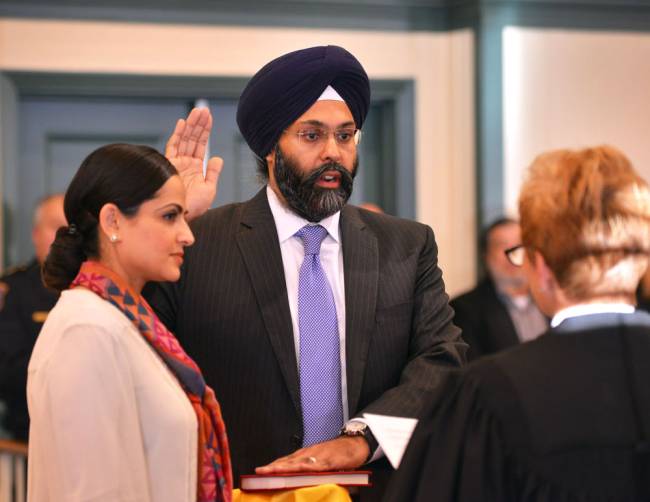
    TRENTON, NJ (TIP): A Glen Rock attorney and former federal prosecutor became the county’s top law enforcement official on Monday, January 4,  the first change in leadership in Bergen County in 14 years, says a report published in NorthJersey.com. Grewal becomes the first South Asian prosecutor in the state and the first person of the Sikh religion to occupy the office.

    Gurbir Grewal was sworn as an assistant attorney general in Trenton in the morning and later as acting Bergen County prosecutor, ending the long tenure of John L. Molinelli.

    Grewal, 42, has prosecuted major white-collar crimes for the U.S. Attorney’s Office and most recently served as chief of the Economic Crimes Unit in Newark.

    With family, friends, assistant prosecutors and others looking on in a packed courtroom, Grewal was sworn as acting prosecutor by Superior Court Judge Bonnie J. Mizdol, assignment judge for the Bergen courts.

    “It is truly an honor and a privilege to join the Bergen County Prosecutor’s office today as the acting county prosecutor,” Grewal told the audience. “This office has a tremendous reputation and that’s because of the hard work that each of you do each and every day, day in and day out. This office in many real ways sets the standard for other prosecutor’s offices throughout the state.”

    Grewal noted Molinelli’s leadership and “careful stewardship.”

    “In the years to come, however, I hope to work with each of you to not only maintain that reputation but to build on it and enhance it and that’s my goal, really,” Grewal said. “I want to spend my time here just seeing how I can make this an even better place.”

    Earlier in the day Grewal was sworn in as an assistant attorney general in Trenton by acting state Attorney General John Hoffman.

    Bergen’s 55 assistant prosecutors were sworn as special deputy attorneys general, acting Bergen County assistant prosecutors. Its 103 investigators took the oath as special state investigators, acting Bergen County detectives.

    A spokesman for the attorney general’s office said swearing in under such titles is routine when an acting prosecutor is named.

    Grewal told those in attendance he “cares deeply” about the county, and is “deeply committed to public service.” He said, too, he knows how tirelessly prosecutors and investigators work to get the job done.

    “I know what each of you do and how hard you work against terrible odds sometimes,” he said.

    He told them he also realizes there’s much he doesn’t know, such as the challenges and resource issues they face. He said he intended to meet with everyone over the next several weeks and get to know them and their cases.

    “I hope to prove to you over the next several years, and maybe more, that I’m a quick learner, I’m a hard worker, and I will always be straightforward,” he said.

    Grewal was nominated for the post by Governor Christie in 2013, but the Senate never scheduled a hearing on the appointment.

    After Molinelli was notified he would be replaced, Christie said a change was “long overdue.” He also said “when that change is officially made, I’ll give you all the reasons why.” Christie’s office did not respond to a request for comment Monday.

    Sen. Robert Gordon, D-Fair Lawn, was in attendance, as was Sheriff Michael Saudino and Bergen County Executive James Tedesco. Sens. Loretta Weinberg, D-Teaneck, and Paul Sarlo, D-Wood-Ridge, were not.

    Weinberg said it was the first day back after the holiday weekend and her office was busy. She had no opinion on Grewal, saying it has been two years since she interviewed him and would have to look again at his résumé.

    But overall, she said, it’s “a strange way of doing business,” noting the attorney general himself is serving in acting capacity and is beholden to the governor rather than being independent.

    “It just adds to the confusion of law enforcement, the way we’re doing law enforcement here,” Weinberg said.

    Sarlo, meanwhile, said he did not know of the swearing in until it was too late to change his schedule. He said that Grewal had an “impressive résumé” and that he looked forward to meeting with him and hearing his plans for handling the heroin epidemic and gangs moving into the suburbs.

    The Indian Panorama reached out to the Sikh community leaders in New Jersey on Mr Grewal’s appointment, here is what some of the sikh leaders had to say…

    Hardip Singh Goldy, President, Shiromani Akali Dal – New Jersey said sikhs worldwide are reaching new heights and he is very happy with the news that someone from their community could be the next leader of the county Prosecutor’s Office.

    Grewal, who speaks Punjabi and Hindi, comes from one of the fastest-growing segments of New Jersey’s population.

    (Source: NorthJersey.com)


  • Pakistani Husband and Wife ‘Jailed for Life’ for Planning London Bomb Attack

    Pakistani Husband and Wife ‘Jailed for Life’ for Planning London Bomb Attack

    LONDON – A potential suicide bomber and his wife have been found guilty of planning a massive terror attack in London designed to coincide with the 10th anniversary of the 7/7 bombings in the capital.

    The couple were interested in helping Islamic State extremists by bombing civilian targets in London.

    Mohammed Rehman, left and his wife Sana Ahmed Khan have been convicted of planning a large-scale bombing of civilian targets in London to mark the 10th anniversary of the July 7, 2005, attacks on the city's transit system. Rehman, 25, and his wife were found guilty Tuesday, Dec. 29. (Thames Valley Police photo)
    Mohammed Rehman, left and his wife Sana Ahmed Khan have been convicted of planning a large-scale bombing of civilian targets in London to mark the 10th anniversary of the July 7, 2005, attacks on the city’s transit system. Rehman, 25, and his wife were found guilty Tuesday, Dec. 29. (Thames Valley Police photo)

    Mohammed Rehman, 25, and his wife Sana Ahmed Khan, 24, were found guilty at the Old Bailey court.

    • Sana Ahmed-Khan, 24, has been handed a minimum of 25 years in prison
    • She and her husband Mohammed Rehman were planning to attack London
    • The pair planned to kills dozens of people in Westfield or the underground

    Prosecutor Tony Badenoch said both were interested in extremist ideology. He said Rehman wanted to demonstrate his support for the Islamic State group and that his wife helped him by paying for chemicals purchased on eBay.

    He said the couple, who lived in Reading, 40 miles west of London, had a “common interest” in taking violent action against civilians.

    Mohammed Rehman also posted images of the explosion which he carried out in his garden ahead of the foiled plot
    Mohammed Rehman also posted images of the explosion which he carried out in his garden ahead of the foiled plot

    Prosecutors said Rehman was only a few days away from finishing work on a bomb capable of causing mass casualties when police moved in on May 28. They say he had been stockpiling a substantial amount of chemicals and had detonated a small practice device in his backyard.

    Susan Hemming, head of the Crown Prosecution Service’s counter-terrorism division, said the couple had needed only a detonator to carry out an attack.

    Authorities said he had used the name Silent Bomber to ask Twitter followers to help him choose a target: “Westfield shopping center or London underground? Any advice would be appreciated greatly,” he tweeted.

    The July 7 attacks carried out by four British Muslim suicide bombers killed 52 civilians and injured hundreds more.

    Rehman was also convicted of possessing an article to be used for terrorist purposes.


  • India hits one billion mobile phone subscribers

    India hits one billion mobile phone subscribers

    New Delhi – India notched up its billionth mobile phone subscriber in October, the country’s telecoms regulator said, underscoring the importance of its fast-growing mobile market, the world’s second largest after China.

    Mobile phone subscriptions have boomed in India in recent years as aggressive cost-cutting by its 12 hyper-competitive operators has driven down prices, leading to some of the cheapest tariffs in the world.

    The number of mobile subscribers rose by nearly 7 million in October from the previous month to surpass one billion, the Telecom Regulatory Authority of India said Wednesday, hitting a milestone that China reached in 2012.

    “It is a matter of great pride for us. It shows an empowered India and an engaged India and a tech-savvy India,” Communications and IT minister Ravi Shankar Prasad told the Times of India newspaper.

    “It will mean more data, more government-to-government connectivity, more broadband,” he said.

    The figures do not indicate that India has one billion individual mobile phone users, however, as many people have more than one connection.

    “Dual sim” phones are particularly popular, allowing the country’s cost-conscious consumers to use two different mobile plans to get the cheapest rates for local or national calls, for example.

    In poorer Indian states such as Bihar, “teledensity” — the penetration of telephone connections for every hundred people — is as low as 54 percent, with a stark urban-rural divide.

    But it still represents remarkable growth in the market since 2000, when there were just two million mobile subscribers in the country, according to research firm Ipsos.

    “India is adding 10 to 15 million mobile subscribers every quarter — that’s big,” Bhasker Canagaradjou, head of business consulting at Ipsos in Mumbai, told AFP.

    “It is the fastest-growing market globally — even China is not growing as fast,” he said.

    With more than 200 million Indians mostly in rural areas yet to get their first phone and others rushing to trade up to smartphones, growth is unlikely to slow down dramatically, Canagaradjou said.

    For many people in India, a mobile phone represents their sole means of accessing the Internet, with smartphones leapfrogging desktops as the most common way of getting online.

    Cheap, mostly Chinese-made smartphone handsets are available from as little as around 1,000 rupees ($15), with many people waiting for free wifi connections to get online instead of buying expensive data plans.

    Seeking to capitalise on this, Google recently announced a plan to install free wifi at 400 Indian railway stations across the country over the next three years.

  • Modi Declines Singapore Offer to Name Orchid variety After Him

    Modi Declines Singapore Offer to Name Orchid variety After Him

    The Singapore government wanted to name a variety of orchid, the island city-state’s national flower, after Prime Minister Narendra Modi, during his November visit but the Indian leader declined.

    In the past, Singapore has accorded this honor to the duke and duchess of Cambridge, Britain’s Prince William and his wife Kate, the king and queen of Belgium, Phillipe and Mathilde, former U.S. first lady Laura Bush, former South African president Nelson Mandela, former British prime minister Margaret Thatcher and most recently, Chinese President Xi Jinping. Modi did, however, launch a commemorative Singapore-India stamp set comprising two stamps that depict the presidential residences of both countries.

    Singapore is one of the few countries Modi visited as Gujarat chief minister between 2002 and 2014, when he was shunned by the West for allegedly turning a blind eye to the 2002 Gujarat riots.

    Modi’s predecessor Manmohan Singh declined the honour during a visit to Singapore in July 2011, according to an Indian official, who recalled that former prime minister Indira Gandhi had an orchid named after her. India’s former first lady Usha Narayanan who visited Singapore along with her husband, then president K.R. Narayanan, in the year 2000 also has an orchid in her name, according to the Singapore Botanical Garden website.

    Naming an orchid after a country’s leader is aimed at promoting goodwill and fostering closer ties between nations, according to the website.

    A separate section of the Singapore Botanical Garden is devoted to honouring artistes and celebrities. As the name goes, the garden acknowledges celebrities who have “contributed significantly to the society”.

    Bollywood stars Shah Rukh Khan and Amitabh Bachchan are among the many celebrities honoured by Singapore.


  • Padmasree Warrior is the New U.S. CEO of ‘NextEV’

    Padmasree Warrior is the New U.S. CEO of ‘NextEV’

    Indian American Padmasree Warrior, one of Silicon Valley’s high-profile women executives, has been appointed as the U.S. based chief executive officer of a Chinese firm ‘NextEV’ which is building an electric car to compete with American electric car manufacturer Tesla.

    Cisco’s former chief strategy officer Padmasree, will also hold the role of Chief Development Officer.

    Warrior was one of former Cisco CEO John Chambers’ top lieutenants, but she left the company when Chuck Robbins took over as CEO earlier this year.

    Since leaving Cisco, the rumor was she was on the hunt for a CEO position of her own, the first of her career. At one point, her name was suggested to run Twitter.

    NextEV is working on smart, high-performance electric vehicles and is considered to be one of the top contenders to muscle into the territory of high-end EVs currently dominated by Tesla.

    Warrior’s track record as a technology visionary is “undisputed,” and her knowledge of the global markets and business acumen are “surpassed only by her ability to lead distributed teams of engineers and developers toward a common goal,” NextEV’s founder and chairman William Li said in a statement.

    “Her passion for technology and the positive impact it can have on humanity aligns well with the core values of NextEV as we build the first user-enterprise. NextEV’s global team is comprised of the best minds from the automotive, software and user experience domains,” Li said.

    “We will leverage leading edge technologies to deliver world-class products to global consumers,” he added.

    Warrior said she is excited to join NextEV and has always looked for opportunities to leverage technology to tackle big problems.

    “Climate change and air quality are two of the most significant global challenges today. I believe that electric vehicles will play a major role in the overall solution. As the electric vehicle industry emerges, there is a tremendous opportunity to provide a user-centric transportation experience,” she said.

    “By integrating advanced technologies in the mobile internet era,” she added, “NextEV will make electric vehicles an enjoyable experience in people’s daily lives. I am proud to be a part of this journey.”

    Warrior has previously been named by Forbes among the world’s 100 most powerful women. She is an alumnus of the IIT Delhi and Cornell University, and has regularly received various leadership awards.

    NextEV president Martin Leach said with the car industry going through its most fundamental change, electric vehicles with smart technology and connectivity are the future.

    He added that Warrior’s vision and experience will help the company deliver the next generation product and user experiences in the mobile Internet era.

    In addition to her appointment to the NextEV board, Warrior currently serves on the boards of American clothing giant Gap and Microsoft.

  • Indian American Foundation Pledges $1 Million for Studio at Indiana University’s Jacobs School

    Indian American Foundation Pledges $1 Million for Studio at Indiana University’s Jacobs School

    An Indian American foundation, The Georgina Joshi Foundation Inc., has given a $1 million gift  to Indiana University’s Jacobs School of Music for a state-of-the-art audio recording studio.

    After her untimely death, the parents of Georgina Joshi (above) created a foundation, which recently gifted Indiana University $1 million to help build a state-of-the-art audio recording studio. (Indiana.edu photo)
    After her untimely death, the parents of Georgina Joshi (above) created a foundation, which recently gifted Indiana University $1 million to help build a state-of-the-art audio recording studio. (Indiana.edu photo)

    The new facility, to be named the Georgina Joshi Recording Arts Studio, will be in the extension of the Musical Arts Center, which is under construction on the Bloomington campus.

    “I speak for the entire Indiana University community when saying that we are tremendously grateful to the Joshi family for their continued, visionary support of the Jacobs School of Music,” IU President Michael A. McRobbie said. “Georgina’s incredible life and passion for music will live on through the countless students whose lives and careers will be enhanced as a result of learning made possible by the generous gift to establish the Georgina Joshi Recording Arts Studio.”

    The Georgina Joshi Foundation’s gift will do more than upgrade the school’s technology; it will foster collaborations among students and faculty across the Bloomington campus. The new studio will be a tremendous asset for music students, as well as for those pursuing careers in film production, game design and broadcast journalism, among other areas of study.

    The Georgina Joshi Recording Arts Studio will reside in the extension of the Musical Arts Center that was funded in part by a $44 million grant from Lilly Endowment Inc. as part of the Jacobs School of Music Centennial Project. Conferred in 2007, the MAC extension is the final phase of the grant.

    “Fluency in audio recording and media production are essential skills for today’s musicians,” said Gwyn Richards, dean of the Jacobs School of Music. “Successful musicians must not only master their talent; they must be able to share and promote that talent. Every skill gained and recording made will be a lasting tribute to Georgina Joshi and her passion. We are so very thankful to Louise and Yatish for making this new chapter in the Jacobs School’s history possible.”

    Louise Addicott-Joshi and Yatish Joshi have established an extraordinary philanthropic legacy supporting many causes, including musical education on Indiana University’s Bloomington and South Bend campuses. Louise was honored by the Indiana University Foundation with the Partners in Philanthropy Cornerstone Award in 2014. The couple gave a gift to renovate what was initially a recital hall at IU South Bend’s Ernestine M. Raclin School of the Arts, transforming the space into a performance hall with a state-of-the-art sound system. They also established an international study fellowship endowment and a domestic graduate fellowship fund, both named for their daughter, Georgina.

    “The Georgina Joshi Foundation is proud and honored to continue Louise’s vision of helping students achieve their potential,” said Yatish Joshi, chairman of the Georgina Joshi Foundation. “It was her intent to provide opportunities and experiences so students can carry their aspirations far beyond their years at Indiana University. Early in her days at the Jacobs School of Music, Georgina voiced a need for a recording studio so she and her fellow students could make quality recordings for auditions. Louise continued Georgina’s efforts. We are excited that the Georgina Joshi Recording Arts Studio will help so many people in so many different ways. That would bring joy to Louise and Georgina.”

    In addition to the fellowships, the Georgina Joshi Foundation provided underwriting for IU Opera Theater’s production of “Giulio Cesare” in 2009. In 2008, the Addicott/Joshi family donated two Hamburg Steinway concert grand pianos to the Jacobs School; they are used primarily in Auer Concert Hall. The Georgina Joshi Foundation has also provided support to establish the Georgina Joshi Composition Award, the Georgina Joshi Handelian Performance Series Fund and the Five Friends Master Class Series. The Georgina Joshi Foundation Inc. was established in 2007 to continue the vision of Georgina Joshi’s mother, Louise Addicott-Joshi, by providing educational and career development opportunities for young musicians and to encourage and support public performance of music.

    About Georgina Joshi: A native of Indiana, Georgina Joshi received her bachelor’s degree in music (with honors) from the Royal College of Music, London, where she studied with Eiddwen Harrhy. At the time of her death, she was pursuing a master’s degree in voice at the IU Jacobs School of Music, where she studied with Alan Bennett. While at IU, Joshi appeared as a soloist in Haydn’s “Creation, ” Handel’s “Solomon,” Bach’s  “B-Minor Mass,” Mozart’s “Requiem” and Brahms’ “Deutsches Requiem.” She also appeared in IU Opera Theater productions as Clorinda in “La Cenerentola” and Despina in “Cosi fan Tutte.” An enthusiastic performer, Joshi collaborated with other musicians and groups, including the Catacoustic Consort and The Bath Street Studio, and was a member of the Jacobs School’s ProArte Choir and the Carmel Bach Festival Chorale. Outside the United States, she appeared as a soloist in England, Wales, Romania and Greece.

    The Indiana University Bicentennial Campaign: This gift contributes to IU’s $2.5 billion campaign, For All: The Indiana University Bicentennial Campaign. During the bicentennial campaign, the Georgina Joshi Foundation has donated a total of $4.2 million: $1 million to establish the Five Friends Master Class Series, $1.2 million for the renovation of IU South Bend’s recital hall, $1 million to establish the Georgina Joshi Handelian Performance Fund and $1 million to equip the Georgina Joshi Recording Arts Studio.

    For All: The Indiana University Bicentennial Campaign is taking place on all IU-administered campuses: IU Bloomington, Indiana University-Purdue University Indianapolis, IU East, IU Kokomo, IU Northwest, IU South Bend and IU Southeast. The campaign will conclude in December 2019 to coincide with IU’s bicentennial year celebration in 2020. To learn more about the campaign, its impact and how to participate, visit the campaign’s website, forall.iu.edu.

  • Elderly Sikh Stabbed To Death In California

    Elderly Sikh Stabbed To Death In California

    SAN FRANSISCO: A 68-year-old Sikh man was stabbed to death in California’s Fresno city on January 1, prompting police to launch a hate crime probe into the city’s first homicide.

    Gurcharan Singh Gill, an employee at local liquor store was stabbed to death on January 1. This happened at Shields Express Mart at 1107 W. Shields Avenue, just east of West Avenue at 3.30 pm.

    While investigations are still going on, local community members feel Mr Gill was attacked due to his identity and skin colour, officer Casto said.

    When officer of Fresno Police Department arrived at the scene they found an elderly man lying in the shop. Emergency medical team tried to provide first-aid but it was determined that Mr. Gill had already died.

    The motive and cause of death are not known yet. The case is under investigation.

    According to Fresno Police, this was the first homicide of the year.

    Incidentally on December 28, another elderly Sikh man was brutally assaulted by two persons in Fresno. No arrests have been made in either cases.

    The police have appealed to the local people to report if they find any leads to the incident.

  • ‘Militia’ continues siege of Oregon government building

    ‘Militia’ continues siege of Oregon government building

    A group of self-described militiamen continue to occupy a federal building in the remote high desert of the US state of Oregon in protest against a prison sentence for local ranchers accused of burning government land.

    The armed protesters have triggered a standoff when they stormed a wildlife refuge in Oregon listed their demands at a news conference Monday, while giving their group a name: Citizens for Constitutional Freedom.

    Ammon Bundy told local newspaper The Oregonian on Sunday, Jan 3, that he and two of his brothers were among “dozens of men” occupying the headquarters of the Malheur National Wildlife Refuge, close to the town of Burns, in Harney county, to show support for the two men sentenced to prison for arson.

    “I feel we are in a situation where if we do not do something, if we do not take a hard stand, we’ll be in a position where we’ll be no longer able to do so,” he said.

    Dwight Hammond, 73, and Steven Hammond, 46, were convicted of arson three years ago and served time – the father three months, the son one year. But a judge ruled that their terms were too short under US federal law and ordered them back to prison for about four years each.

    The decision has generated controversy. In particular, the Hammonds’ new sentences touched a nerve with far-right groups who repudiate US federal authority.

    The protest which started off as a rally on Saturday in support of the two men, quickly turned into a platform to raise issues of ongoing land-disputes in the state.

    Debates have raged on social media under the #OregonUnderAttack  , and newspapers have battled to reach consensus on how to describe the armed men.

    “As of Sunday afternoon, The Washington Post called them ‘occupiers’. The New York Times opted for ‘armed activists’ and ‘militia men’. And the Associated Press put the situation this way: ‘A family previously involved in a showdown with the federal government has occupied a building at a national wildlife refuge in Oregon and is asking militia members to join them,’” The Washington Post said.


    Social media users make fun of the men occupying US government building, using variations of well-known armed groups.
    #YallQaeda, #VanillaISIS and #YeehawdAs authorities adopted a wait-and-see approach to deal with a group of self-described militiamen occupying a United States federal building in the remote high desert of the state of Oregon, perhaps the strongest reaction to the siege has been on social media.

    The group of armed men, holed up at the Malheur National Wildlife Refuge since Saturday, have been mocked mercilessly over their protest against a prison sentence for local ranchers accused of burning government land and their calls for more armed “militiamen” to join them.

    And as US media organisations continued to struggle with ways to best describe those involved in the Oregon siege, a trio of hashtags emerged on Twitter to lend them a hand: #YallQaeda, #Yeehawd and #VanillaISIS.

  • FINES AND FORFEITURES BILL SIGNED INTO LAW

    FINES AND FORFEITURES BILL SIGNED INTO LAW

    New York, NY (TIP): Earlier today, January 4, State Senator Tony Avella and Assembly Member Michael G. DenDekker held a press conference celebrating the passage of their Fines and Forfeitures bill, S.5046A/A7230A, into law.

    When a traffic or vehicle ticket has been issued to a person for a violation, there are usually accompanying administrative fees, fines, penalties, or forfeitures. In the event that the violation has been dismissed, however, those additional fees remain and the very same people who have committed no wrong-doing are forced to pay regardless.

    As a result of the legislation, municipalities will be prohibited from assessing and collecting these additional fees associated with dismissed traffic and vehicle violations. In effect, people will no longer be subject to undue fines that linger even after they have been found innocent of any wrongdoing.

    Many states have been accused of engaging in this practice to generate revenue and New Yorkers, too, have been subject to this unjust practice. To address this issue, Senator Avella and Assembly Member DenDekker introduced S.5046A (A7230A), which passed both chambers and was subsequently signed by Governor Andrew Cuomo on Tuesday, December 22nd, 2015.

    “People who have had their traffic violations dismissed and yet are still being forced to pay additional fees are nothing but victims of a legal shakedown. The fines that New York State collects from the pockets of those who have wrongly been issued violations are entirely unjustified. I am glad that Governor Cuomo agrees and has signed the Fines and Forfeitures bill into law. New York will no longer be on the list of States that squeeze middle and working-class families with undue fee’s for revenue,” said State Senator Tony Avella.

    “The fact that hard-working New Yorkers were being charged administrative fees on dismissed tickets is absolutely outrageous, and I am very proud that we were able to pass this legislation removing that burden. I want to thank Governor Cuomo for signing this common-sense legislation, and Senator Avella for introducing the bill in the Senate. These are the kind of important steps that we can continue to take to protect all New Yorkers,” said Assembly Member Michael G. DenDekker.


  • Pathankot terror attack: NSG LT COL AMONG SEVEN CASUALTIES

    Pathankot terror attack: NSG LT COL AMONG SEVEN CASUALTIES

    A Lieutenant Colonel heading the National Security Guards’ (NSG) bomb disposal squad was among the seven fatalities in the terrorist attack on the Pathankot Air Force station. Five NSG commandos were among the 20 who sustained injuries.

    The high number of casualties and injuries despite “specific Intelligence inputs” is being viewed in security circles with concern. Particularly a senior officer of an elite counter-terrorist force losing his life during sanitisation operations. A commando from the IAF’s Garud special force, Gursevek Singh, was also killed.

    Lt Col Niranjan E Kumar
    Lt Col Niranjan E Kumar

    Lt Col Niranjan E Kumar was commissioned into 10 Engineer Regiment in 2004 and moved to the NSG on deputation in May 2014. He leaves behind his wife and an 18-month-old daughter.

    The last rites are scheduled to be performed at his hometown, Palakkad in Kerala, tomorrow.

    The mortal remains would be airlifted to Bengaluru and thereafter ferried by road.

    A tweet by the Home Minister, Rajnath Singh, stated that the officer was killed in “mopping-up operations”.

    Reports suggested that the NSG casualties occurred due to an explosion from either an IED that the terrorists were carrying or a booby-trapped body that was moved by them.

    One of the NSG jawans, Bhoop Singh, who sustained serious head injuries, has been airlifted to Chandigarh.

    Hailing from Ambala, IAF commando Gursevak had been hit during the initial gunfire. He carried on fighting and later succumbed to his injuries. He got married a month ago.

    Most of the other fatalities were from the Defence Security Corps (DSC), a branch comprising retired armed forces personnel who are reemployed for undertaking guard duties at military establishments. They included 51-year-old national shooting champion Subedar Fateh Singh and Hav Kulwant Singh, both of whom were from Gurdaspur, and jawans Jagdish Singh and Sanjiv Kumar.

    One of the DSC jawans had chased a terrorist and killed him with the terrorist’s own weapon before falling to fire from the other intruders.


    Pathankot Operation Continues: Government denies security lapse

    NEW DELHI — A shootout between Indian security forces and armed gunmen stretched into its second day on Sunday, January 3, at the Pathankot air force base in Punjab, near India’s border with Pakistan. At least seven Indian personnel and at least four terrorists have been killed in the fighting so far, as per statements released by officials in media.

    Operations to clear the Pathankot air base continue as at least two gunmen were still holding out against the security forces on Sunday, Jan 3, said Rajiv Mehrishi, home secretary, in a televised news conference in New Delhi, while admitting that they came to know about the two more terrorist only on Sunday morning when the duo started firing during the cleaning exercise.

    “We are sure that still there are at least two more terrorists as firing has come from two different places,” Mr. Mehrishi said.

    The gunmen have also wounded eight air force personnel and 12 members of the National Security Guard, he said.

  • Pathankot Operation Continues: Government denies security lapse

    Pathankot Operation Continues: Government denies security lapse

    NEW DELHI — A shootout between Indian security forces and armed gunmen stretched into its second day on Sunday, January 3, at the Pathankot air force base in Punjab, near India’s border with Pakistan. At least seven Indian personnel and at least four terrorists have been killed in the fighting so far, as per statements released by officials in media.

    Operations to clear the Pathankot air base continue as at least two gunmen were still holding out against the security forces on Sunday, Jan 3, said Rajiv Mehrishi, home secretary, in a televised news conference in New Delhi, while admitting that they came to know about the two more terrorist only on Sunday morning when the duo started firing during the cleaning exercise.

    “We are sure that still there are at least two more terrorists as firing has come from two different places,” Mr. Mehrishi said.

    The gunmen have also wounded eight air force personnel and 12 members of the National Security Guard, he said.

  • Netanyahu, Abbas may visit India in 2016

    Netanyahu, Abbas may visit India in 2016

    India’s relation with the West Asian region is expected to be in focus during the first few months of 2016 as South Block appears set to host top Israeli and Palestinian leaders.

    Sushma_swaraj_MEA_PTI_360x270Diplomatic sources told The Hindu on Tuesday that both Israel Prime Minister Benjamin Netanyahu and President of Palestinian Authority Mahmoud Abbas, have been invited by India and External Affairs Minister Sushma Swaraj will hold talks with both Israeli and Palestinian leaders during her January 16 to 19 trip to Israel-Palestine to firm up the dates for the visits.

    Diplomatic sources also informed that Syrian Foreign Minister Walid Moalem is expected to visit New Delhi soon. The Hindu had earlier reported that Ms. Swaraj and Mr. Moalem had invited each other during their meeting on the sidelines of the UN General Assembly session in New York.

    The high power political engagement plan for West Asia by the South Block will be in line with Ms. Swaraj’s May 31 annual press conference when she had announced a first ever visit to Israel by Prime Minister Narendra Modi. A visit by Mr Modi will be symbolically significant as Israel has not been visited by Indian Prime Ministers since both sides established full and normal diplomatic ties in January 1992. Analysts say that a visit by Prime Minister Netanyahu will also be symbolically significant as the last Israeli Prime Minister to visit India was Ariel Sharon in 2003.

    Ms. Swaraj had earlier cancelled her January visit plan for Israel due to Israeli election season. Subsequently, President Pranab Mukherjee visited Israel and Palestine in October re-starting the chain of high level engagements. “As a result of President Mukherjee’s visit to Israel, it is now the turn of Israel to reciprocate suitably,” a source told The Hindu.

    There is also a possibility that Israel might send President Reuven Rivlin to India later during 2016 as President Mukherjee had extended invitation to President Rivlin to visit Delhi. However, the diplomatic season will be kick-started a few days before Ms. Swaraj’s arrival in Israel by her colleague Agriculture Minister Radha Mohan Singh who will hold discussion with his counterpart for greater Israeli scientific support for meeting Indian agricultural production goals.

    Preparation is also on to welcome Ms. Swaraj in Ramallah where her counterpart Riyad Al Maliki has been interacting with Indian diplomats to finalise commercial, educational and regional diplomatic plans for Ms. Swaraj. Ms. Swaraj had earlier told the media that Palestinians had been helpful in getting information about the 39 Indians kidnapped in Iraq.