Month: April 2016

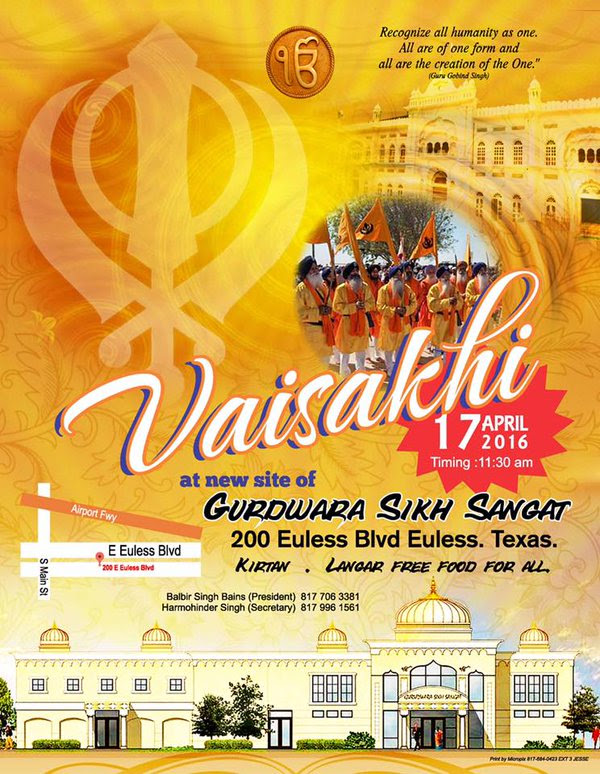
  • Sikh-Americans Celebrate Vaisakhi at their new Gurudwara (Church) on April 17th

    Sikh-Americans Celebrate Vaisakhi at their new Gurudwara (Church) on April 17th

    EULESS, TX (TIP): Sikh-Americans in Euless and the surrounding cities will be marking their annual Vaisakhi festival in a different way this year on April 17th. The program will take place at the location of their new building at 200 W. Euless Blvd. in Euless, starting at 11 am and ending at 3pm to include sharing of the free vegetarian meals provided by the Sikh community. The local dignitaries are expected between 12 noon to 2 pm.

    Vaisakhi is important annual Thanks-Giving festival for Sikhs worldwide. In 1699, the tenth Guru (prophet) of the Sikhs converted this long-established harvest festival in the Northern Indian sub-continent to a religious one, with the establishment of a new order of Sikhism called Khalsa, to uphold the ideals of equality & justice.

    As the population of Sikhs grew in Tarrant County in the nineties, a need was felt by Sikh families to share their faith with each other and their community – leading to the establishment of Gurudwara Sikh Sangat, currently at 1400 W. Euless Blvd. in Euless, TX, in 2000. One of the cornerstone tenets of Sikhsim is doing selfless service, called Seva. The Congregation has been following this principle in the community, from volunteering and donating at the local food banks to providing blankets for veterans – as well as recently hosting a bike-ride for Euless Police Department and David Hofer, the slain Euless Police Officer – which collected over $5,000 in donations. Sharing the free vegetarian meal, langar, is a continuous tradition included in all religious services at the Euless Gurudwara.

    However, as the Congregation has grown, the current building has been insufficient to handle the growth, including community programs and programs for children. Last year, the Congregation started construction of their new, modern building – which will not only serve the members, but also will provide education and programs to the surrounding community. At the Vaisakhi program on April 17th, to be held on the new foundation of the Gurudwara, new initiatives around community participation will be announced – thus furthering the principles of Seva.

    The Mayor and the Police Chief of Euless will be attending, along with their teams. People from all faiths are invited to attend the Vaisakhi program and join us for a free vegetarian meal. More information about the program and Sikhism is available at www.DFWSikhSangat.org.

  • Houston Mayor Turner avoids major layoffs with new layoffs

    Houston Mayor Turner avoids major layoffs with new layoffs

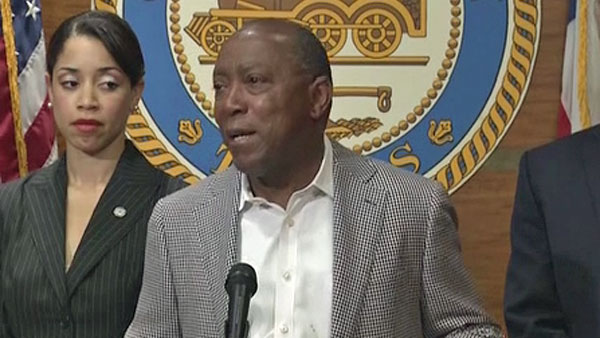
    HOUSTON (TIP): Mayor Sylvester Turner said Friday, April 15 he’s found a way to save more than a thousand city jobs with his new budget.

    Turner’s budget will cut 90 jobs, but he says it could have been much worse because of a $160-million shortfall.

    The mayor’s new budget scrapes up the money from a variety of sources. For example, it will take almost $20 million from the TIRZ’s – the tax increment reinvestment zones – like the one that picks up the trash downtown and maintains Buffalo Bayou Park.

    The budget also relies on a lot of one-time, non-recurring sources of income, like selling unused property owned by the city.

    “I can’t print money. It’s not falling from the sky. And I think that’s what people have to understand,” Mayor Turner said. “You cannot assume that everything is going to remain the same when you’re facing a $160-million shortfall.”
    The mayor plans to add another police cadet class. He says none of the job cuts will come from the police or fire departments.

    But there’s a huge red flag waving here. If it weren’t for those one-time revenue sources like selling unused property, the mayor says he would’ve faced laying off 1,235 city employees.

    If city leaders can’t fix the city’s pension problems with the help of the state legislature next year, Turner says they’re looking at layoffs on that scale in his 2017 budget.

  • Warm Farewell to India’s Consul General Harish Parvathaneni in Houston

    Warm Farewell to India’s Consul General Harish Parvathaneni in Houston

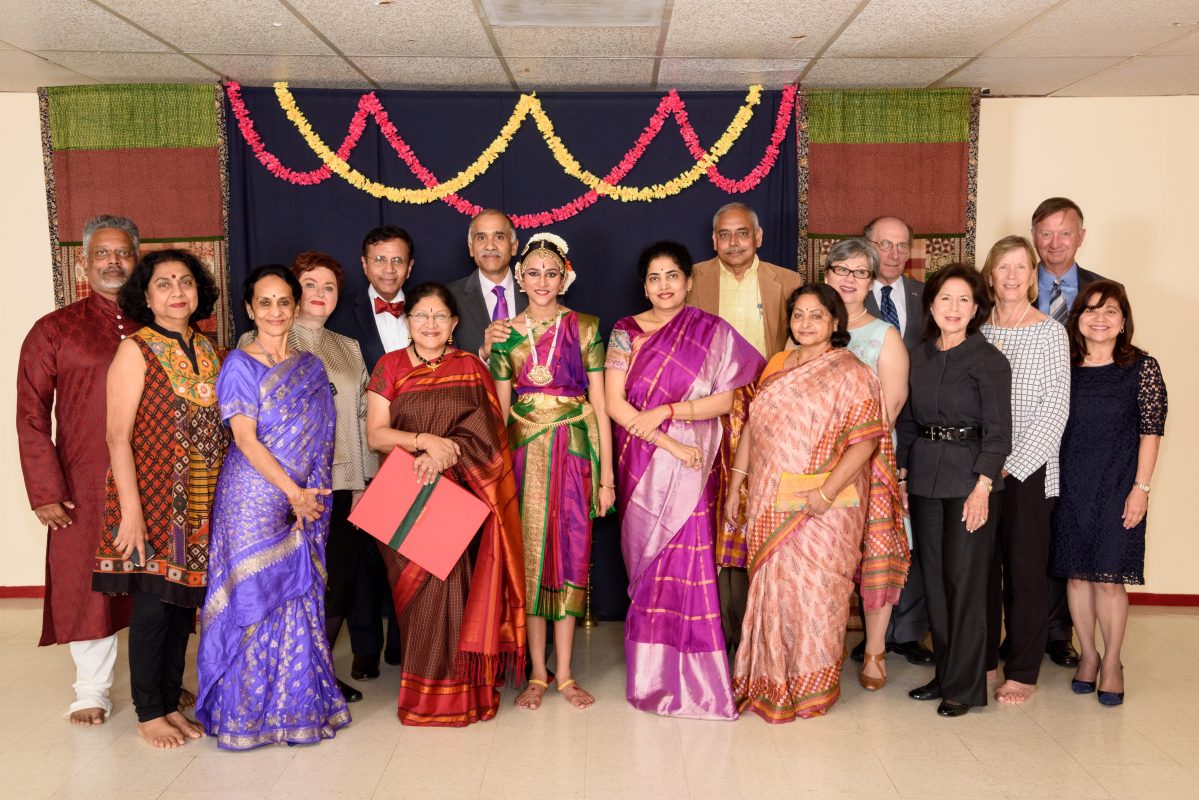
    HOUSTON (TIP): Samskriti & Anjali Center for Performing Arts Houston hosted, March 18, a farewell dinner in honor of Consul General Harish and Mrs. Nandita Parvathaneni, and a special Kuchipudi classical dance performance by their daughter Amani Parvathaneni at Anjali Center for Performing Arts on 18 March, 2016.  The program was attended by guests from arts & culture, members of Consular Corps of Houston, members of the community and media.

    Consul General, Mrs. Nandita Parvathaneni and Ms. Amani Parvathaneni (center) with Ms. Rathna Kumar, Founder / Director, Anjali Center for Performing Arts and guests from arts & culture on this occasion.
    Consul General, Mrs. Nandita Parvathaneni and Ms. Amani Parvathaneni (center) with Ms. Rathna Kumar, Founder / Director, Anjali Center for Performing Arts and guests from arts & culture on this occasion.
    A view of the gathering
    A view of the gathering
    Ms. Amani Parvathaneni, student of Anjali Center for Performing Arts performing a Kuchipudi classical dance on this occasion.
    Ms. Amani Parvathaneni, student of Anjali Center for Performing Arts performing a Kuchipudi classical dance on this occasion.
  • Salient Characteristics of Donald Trump

    Salient Characteristics of Donald Trump

    It was miraculous.
    But it was almost no trick at all
    IF you saw him
    Turn vice into virtue;
    Slander into truth;
    Impotence into abstinence;
    Arrogance into humility;
    Plunder into philanthropy;
    Thievery into honor;
    Blasphemy into wisdom;
    Brutality into patriotism;
    And sadism into justice.
    Anybody could do it.
    It required no brains at all.
    It merely required no character.

  • Pakistan given $13 billion for war on terror since 9/11

    Pakistan given $13 billion for war on terror since 9/11

    ISLAMABAD (TIP): Pakistan received at least $13 billion from the US since the September 11, 2001 attacks for logistic and other support in the war against terrorism, the country’s parliament was told.

    This was stated by defence secretary Alam Khattak while briefing the Senate committee on defence here on Wednesday.

    Khattak said that his country got “USD 13 billion under the Coalition Support Fund (CSF) since 9/11”, while another USD 200 million is due to be reimbursed by the US.

    He said that 40 per cent of the amount received was allocated to civil government while 60 per cent was given to the armed forces.

    The CSF is going to end on September 30 this year with the US troop withdrawal from Afghanistan.

  • Britain’s Prince William and Kate try archery in Bhutan

    Britain’s Prince William and Kate try archery in Bhutan

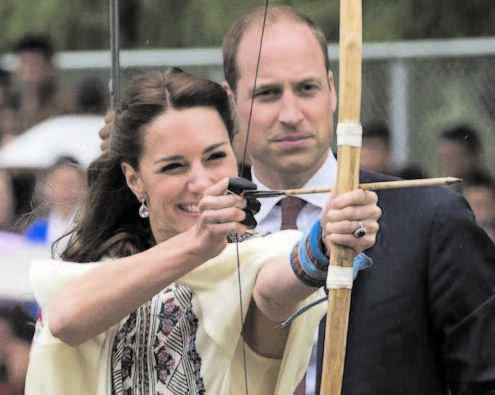
    THIMPHU (TIP): Britain’s Prince William and his wife Kate tried their hand at Bhutan’s national sport of archery on April 14 as they began their first visit to the tiny Himalayan kingdom in a whirl of colourful dancing and music.

    The couple laughed as they tested their shooting skills at an open-air archery venue in the Bhutanese capital Thimphu to loud cheers from the gathered crowds – even when they missed the target.

    Bhutanese archers must aim at very small, brightly decorated wooden targets positioned 145 metres away from where they are standing.

    The Duke and Duchess of Cambridge were allowed to move a little closer than that, but were not able to hit the target despite coaching from the experts.

    The couple had braved the rain to head to an archery competition in the open-air stadium, where they chatted to local people after earlier meeting Bhutan’s king and queen.

    They flew into the picturesque mountain kingdom today morning from India, where they played cricket, hung out with top Bollywood actors and laid a wreath at a memorial to India’s war dead.

    They will spend two days in the tiny kingdom, famously the last country to get television and home to just 750,000 people.

    A row of monks bowed to the couple as they arrived at the Tashichho Dzong fortress in Thimphu for their private audience with King Jigme Khesar Namgyel Wangchuck and Queen Jetsun Pema.

    Bhutan’s Oxford-educated monarch -known as the Dragon King – greeted the British couple in Bhutanese national dress, which is still required to be worn in schools and the workplace.

    His wife also wore traditional dress, while Catherine, Duchess of Cambridge, wore a black and cream cape top and a long blue printed skirt made from fabric hand-woven in Bhutan.

    King Jigme came to the throne in 2006 after his father abdicated and agreed to cede absolute power to a parliamentary democracy.

    The country held its first elections in 2008 and is known for pursuing a unique economic development model of “Gross National Happiness”, which aims to balance spiritual and material wealth.

    Later the couple will have a private dinner with Bhutan’s king and queen.

    On Friday, they will take a six-hour trek to [inlinetweet prefix=”” tweeter=”” suffix=””]Paro Taktsang[/inlinetweet], a spectacular Buddhist monastery perched on a cliff edge.

  • Bangladesh celebrates Bengali New Year amid tight security

    Bangladesh celebrates Bengali New Year amid tight security

    DHAKA (TIP): Bangladesh celebrated the Bengali New Year with tens of thousands of people joining the Pohela Boishakh festivities across the country, defying threats of fundamentalist Muslim groups.

    Amid tight security, festivities began with the break of dawn when artistes of major cultural group Chhayanaut welcomed the day with Rabindrath Tagore’s famous song ‘Esho hey Baishakh, esho, esho’ under the banyan tree at the Ramna Park in Dhaka.

    Men, wearing traditional panjabi-pyjama, women attired in saris with red borders, and children in colourful dresses joined the open concerts and the Shovajatra, braving the hot weather and threats of Islamists who are opposed to the celebrations, in which people carry masks of animals and colourful garlands, as “un-Islamic”.

    Traditional Boishakh music filled the air as Dhaka University’s students organised a colourful “Mongol Shovajatra” procession carrying statues and other traditional props in a key-feature of the celebration.

    The organisers focused on fighting religious radicalism amid increasing attacks on writers, publishers, foreigners, dissidents and violence against women and children.

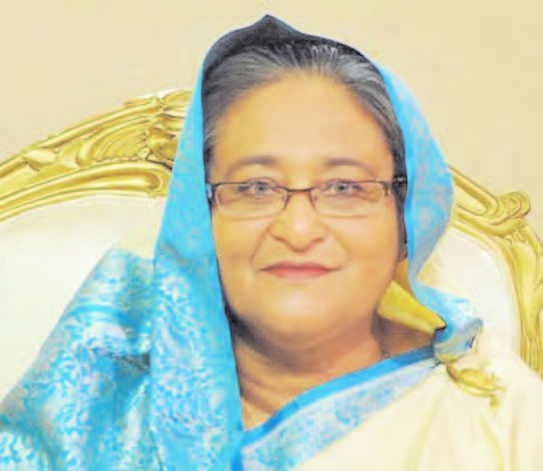
    President Abdul Hamid and Prime Minister Sheikh Hasina greeted the countrymen on the Pohela Boishakh.

    “The Bangla New Year rekindles our nationalist spirit… there were attacks again and again. People were killed in bombings. But no evil attempt of the fanatics, communal forces ever succeeded,” Hasina said.

    “Bigotry and ugly religious fanaticism have no place in our national culture,” Cultural Affairs Minister Asaduzzaan Noor said yesterday, apparently referring to the Islamists reservations against the festival.

    However, the security vigil with deployment of hundreds of policemen and members of elite anti-crime Rapid Action Battalion (RAB) with riot vehicles, sniffing dogs and two-wheelers partly surpassed the festivity.

    Security forces directed revelers to go through their makeshift checkpoints on the street while they kept a sharp watch on the people from temporary watchtowers. RAB choppers enforced a vigil hovering over the major festival spots.

    Police issued a restriction on celebrations in public places after 5 PM for security reasons and prohibited people from wearing masks. Traffic restrictions were put in place.

  • Nepal gets first woman chief justice, sign of changing attitudes

    Nepal gets first woman chief justice, sign of changing attitudes

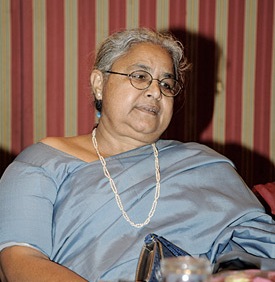
    KATHMANDU (TIP): Sushila Karki became the first female acting Chief Justice of Nepal’s Supreme Court on April 13, ending the male domination of top posts in the judiciary. The Himalayan nation, though still a deeply patriarchal society, is becoming increasingly inclusive, following the end of 10 years of civil war in 2006 and the abolition of the 239-year-old feudal monarchy two years later.

    In September last year, a specially elected Constituent Assembly approved the first post-monarchical constitution, which gave women the right to “proportional inclusion” in all government organs.

    It also guaranteed equal property rights to daughters and required that the president and vice-president be from different genders and communities.

    The Constitutional Council headed by Prime Minister K.P. Oli recommended the appointment of Karki, 63, to replace Kalyan Shrestha, who retired on Tuesday.

  • U.S. Army Acquiesces, Grants Accommodations to Three More Sikh Soldiers

    U.S. Army Acquiesces, Grants Accommodations to Three More Sikh Soldiers

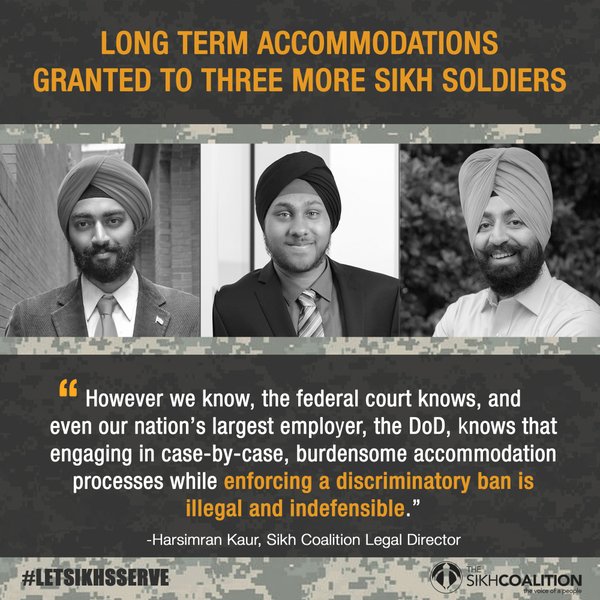
    The U.S. Army granted three observant Sikh American soldiers religious accommodation April 8, permitting them to serve with their articles of faith intact.

    The recent enlistees had sued the Army and the Pentagon to get an answer on their religious accommodation requests prior to starting basic combat training in May.

    Two have been accommodated in the Army National Guard, and one in the U.S. Army Reserve. With the Army’s recent approval of a decorated Sikh-American Army captain, in just over a week, four Sikh soldiers have received landmark religious accommodations to serve their country without being forced to compromise their faith.

    “We commend the U.S. Department of Defense for its decision to allow these soldiers to serve with their religious turbans and beards,” said Sikh Coalition Legal Director Harsimran Kaur. “However we know, the federal court knows, and even our nation’s largest employer, the DoD, knows that engaging in case-by-case, burdensome accommodation processes while enforcing a discriminatory ban is illegal and indefensible.”

    “After months of waiting, I’m ecstatic that I can finally serve both God and country,” Private Arjan Singh Ghotra, one of the plaintiffs, said in a written statement. “I will be forever grateful to the Army for at least letting me go to boot camp. I look forward to proving that I can serve as well as anyone and am hopeful the Army will extend my accommodation afterward.”

    Ghotra is a 17-year-old high school senior who enlisted with the Virginia Army National Guard.

    Religious accommodations were also granted to Specialist Kanwar Singh, who joined the Massachusetts Army National Guard after seeing its response to the Boston Marathon bombing, and Specialist Harpal Singh, who joined the U.S. Army Reserve through the Military Accessions Vital to the National Interest program, which allows legal noncitizens who have in-demand skills to join the Army in exchange for expedited citizenship.

    Devout followers of Sikhism, a South Asian religion, wear turbans and have unshorn hair.

    Under a 2014 rule change, the armed services will accommodate religious requests for individual service members unless the request would interfere with military readiness, a mission or unit cohesion.

    The religious accommodations for Ghotra, Kanwar Singh and Harpal Singh will be reevaluated after their training, according to Army memos released by their lawyers.

    “I may withdraw or limit the scope of your accommodation for reasons of military necessity, including if I cannot confirm that Army protective equipment (to include [Army combat helmet] and protective mask) will provide you the intended degree of protection against the hazards presented by the duties or areas to which you will be assigned,” Assistant Secretary of the Army Debra Wada wrote in the memos.

    Their turbans will have to be black or camouflage, depending on the situation, according to the memo. Also, their beards must be rolled or tied to no longer than two inches while in garrison or one inch when in the field or during physical training. And their hair cannot cover their ears or eyebrows or touch their uniforms’ collars.

    Lawyers for the three men applauded the Army’s decision but said the case-by-case accommodations are still discriminatory.

    “We commend the U.S. Department of Defense for its decision to allow these soldiers to serve with their religious turbans and beards,” Sikh Coalition Legal Director Harsimran Kaur said in a written statement. “However, we know, the federal court knows, and even our nation’s largest employer, the DoD, knows that engaging in case-by-case, burdensome accommodation processes while enforcing a discriminatory ban is illegal and indefensible.”

    The soldiers are represented by the Sikh Coalition, the Becket Fund for Religious Liberty and the law firm of McDermott Will & Emery.


    For more information about the Sikh Coalition’s military campaign and the facts surrounding the military ban, click here. To schedule interviews with legal and policy experts from the Sikh Coalition, McDermott Will & Emery, or the Becket Fund, please contact Mark Reading-Smith or Jagmeet Singh.
  • Texas Indian American Couple Found Dead in Apparent Murder-Suicide

    Texas Indian American Couple Found Dead in Apparent Murder-Suicide

    An Indian American couple has been found dead April 12 in a bedroom inside their home, in what police have said is a murder-suicide.

    Southlake police said the man fatally shot his wife before killing himself.

    Police were called to the 400 block of Thistle Court about 2 p.m. after a family member discovered the two bodies.

    The Tarrant County medical examiner identified the pair as Anil Kharabanda, 62, and Neeta Kharabanda, 58. They were found dead in the bedroom.

    Court records cite tension in the couple’s relationship. They married in 1980 but were involved in divorce proceedings twice, as reported by Dallas Morning News.

    Neeta Kharabanda had submitted petitions seeking a divorce in 2003 and 2011, but filed documents later on to say she didn’t want to pursue the cases.

    The Tarrant County medical examiner’s record show Neeta Kharabanda died at 2:07 pm as result of homicide and Anil Kharabanda died due to suicide at 2:03 pm.

    Records accessed from https://mepublic.tarrantcounty.com/MEPublic/default.aspx

  • Donald Trump and ‘Official Racism’ era in politics

    Donald Trump and ‘Official Racism’ era in politics

    The Republican Party and the “conservative establishment” do not disagree with Trump’s racism, xenophobia, prejudice and bigotry toward Hispanic and Latino immigrants, non-whites, Muslims and women. They are just embarrassed and aghast that Donald Trump has dropped the mask of racist gentility and exposed the racist id of today’s Republican Party and movement conservatism for the world to see.

    Republican Party elites are nervous about Donald Trump because he has taken their “polite” “dog whistle” racism and replaced it with a loud speaker.


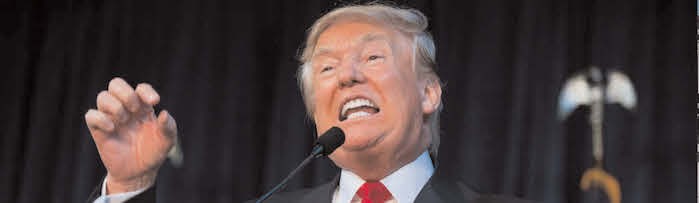
    Donald Trump

    As the world looks on askance at the freakishness of the US presidential election, it is worth bearing in mind that a large number of Americans feel much the same sense of unease.

    To outside eyes, the rise of Donald Trump especially looks like the ultimate “Only in America” story, but many of his compatriots wish it was a “Not in America” phenomenon.

    For all the billionaire’s dominance in the Republican race, for all the free airtime lavished upon him by the media, polls repeatedly suggest that he is the most unpopular presidential candidate in modern history.

    A recent survey conducted for the Washington Post and ABC News showed that 67% of voters have an unfavorable view of him.

    What’s also striking about the polling data is that the more exposure the billionaire gets, the higher his negatives soar, whether it is women angered by his misogyny, Latinos upset by his racial demagoguery, African-Americans who don’t take kindly to being called “the blacks” or fellow Republicans who believe he will lead their party off a cliff.

    Donald Trump is the preferred candidate of white supremacists. Online and in other spaces, they have anointed him their champion in the 2016 presidential race.

    [inlinetweet prefix=”” tweeter=”” suffix=””]

    Trump & KKK (David Duke) Connection, that he knows nothing about…


    [/inlinetweet]

    LIAR LIAR – “Just so you understand, I don’t know anything about David Duke, OK?” Trump said. Trump was pressed three times on whether he’d distance himself from the Ku Klux Klan — but never mentioned the group in his answers.

    “I don’t know anything about what you’re even talking about with white supremacy or white supremacists,” he said. “So I don’t know. I don’t know — did he endorse me, or what’s going on? Because I know nothing about David Duke; I know nothing about white supremacists…”

    Despite what he said, Trump apparently did know Duke in 2000 — citing him, as well as Pat Buchanan and Lenora Fulani — in a statement that year explaining why he had decided to end his brief flirtation with a Reform Party presidential campaign.

    “The Reform Party now includes a Klansman, Mr. Duke, a neo-Nazi, Mr. Buchanan, and a communist, Ms. Fulani. This is not the company I wish to keep,” Trump said in a statement reported then by The New York Times. …

    Politics is not about people but about parties and their ideology; political parties are a type of “brand name” that voters associate with a specific set of policies, ideas, personalities and moral values. Consequently, the types of voters who are attracted to a given political party also tells us a great deal about how it is perceived by the public. And in a democracy, the relationship between voters, elected officials and a given political party should ideally be reflected by the types of policies the latter advances in order to both win and stay in power.

    By these criteria, the post-civil rights era Republican Party is the United States’ largest white identity organization, one in which conservatism and racism are now one and the same thing.

    In the 2012 election, 89 percent of Republican voters were white. While the Republican Party routinely anoints a professional “best black friend” (Herman Cain in 2012; Ben Carson in 2016; Republican National Committee chairman Michael Steele in 2009) who serves in the role as human chaff to deflect charges of racism, non-whites are a minuscule part of the GOP’s electoral coalition and base. This is reflected by how Republican voters are much more likely to be racially resentful toward black Americans and also manifest what is known as “modern” or “symbolic racism.”

    Even more troubling, research by Brown University political scientist Michael Tesler demonstrates that “old-fashioned racism” has actually increased among Republican voters since the election of Barack Obama.

    New Tactics but same old agenda – Birth of The Southern Strategy

    The Southern Strategy, with its mix of coded and overt anti-black and brown racism, is a script that is closely adhered to by the broader right-wing news entertainment propaganda machine.

    The Southern Strategy was desperately deployed against the United States’ first black president, Barack Obama. From “birtherism” to claims that Obama is “traitor” who “hates Americans,” the rampant disrespect and obstructionism that Republicans have shown toward him, as well as the panoply of both overt and subtle racist attacks by conservatives against Obama’s person (and family) are all outgrowths of the Southern Strategy.

    The Age of Obama also gave rise to the Tea Party movement. As an extreme wing within an already extremist and revanchist Republican Party, Tea Party members and their sympathizers were/are extremely hostile to Barack Obama and the symbolic power of a black man leading “their” White America. The Tea Party demand that “they want their country back” is both a direct claim of white privilege and constitutes a worldview where whiteness is taken to be synonymous with being a “real American.”

    Not all Republicans are racists. But racists are more likely to be Republicans.

    Donald Trump knows this to be true. He has built a political campaign around that fact.

    Ultimately, Republican Party elites are nervous about Donald Trump because he has taken their “polite” “dog whistle” racism and replaced it with a loud speaker.

    The Republican Party and the “conservative establishment” do not disagree with Trump’s racism, xenophobia, prejudice and bigotry toward Hispanic and Latino immigrants, non-whites, Muslims and women. They are just embarrassed and aghast that Donald Trump has dropped the mask of racist gentility and exposed the racist id of today’s Republican Party and movement conservatism for the world to see.

  • A BABA FOR OUR TIMES

    A BABA FOR OUR TIMES

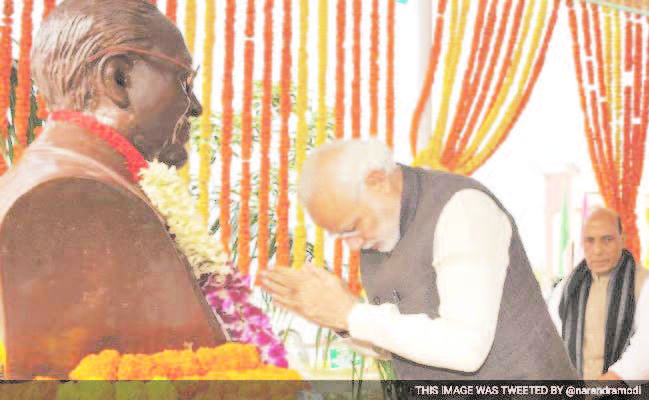
    Yesterday, April 14, we did Baba Saheb. And did him copiously. The Prime Minister was at some place in Madhya Pradesh, leading the charge, converting the occasion, with his by now familiar flamboyance, into yet another “event”. The rest of the political crowd – from the Central Hall to Nagpur – too jostled, to be seen as paying tributes to Baba Saheb. Earlier, weeklies had pitched in with cover stories, newspapers had published learned articles, and Doordarshan had the obligatory discussion about Baba Saheb’s ‘relevance’. The whole shebang.

    The ruling party is seen as keen on appropriating Baba Saheb. It has conspicuously failed to gain anything from resurrecting Sardar Patel – it begot only a Hardik Patel in Gujarat. Then, it shifted its attention to Netaji Subhas Chandra Bose – but, that sleight of hand, too, is not paying any dividends in West Bengal.

    We are told that the ruling party is now run by superb super-managers, who are not encumbered by any kind of ideological hang-ups, and that they would pry loose the Dalit vote from the presumed stranglehold of Behen Mayawati and her Bahujan Samaj Party. After all, all roads and all calculations must lead to the battlefield of Uttar Pradesh. These managers, being the practical men that they are, would pretend to be deeply in love with Baba Saheb as long as it helps them breach that all-important Dalit vote-bank.

    That is good, old-fashioned politics. The BJP’s rivals’ are free to accuse it of insincerity and worse. And, however clever the BJP bosses may be feeling about their cultivated cynicism, the great Mahar must be having a good laugh at this entire hullaballoo about him.

    How things have turned around! It was not that long ago – in 1997, to be precise – that a leading BJP ideologue was made to feel encouraged to launch a skillfully vicious attack on Baba Saheb. Arun Shourie, the rising star in the BJP’s firmament, had produced a book titled “Worshiping False Gods – Ambedkar, and the facts which have been erased”. With his characteristic brilliant acidic pen, Shourie “exposed” Ambedkar as undeserving of any honor, leave alone national veneration. He bemoaned bitingly: “Indeed, no one is idolized these days the way he is. His statue is one of the largest in the Parliament complex. His portrait in the Central Hall of Parliament is larger than life. The Bharat Ratna has been conferred on him posthumously, a national holiday has been decreed in his honor. Postage stamps have been issued in his honor. Universities have been named after him. His statues – dressed in garish blue, holding a copy of the Constitution – have been put up in city after city: it is a fair guess that by now they far outnumber those of Gandhiji. Politicians, activists and other notables flock to these on several anniversaries of his – on the anniversary of his birth, on the anniversary of the day on which he converted to Buddhism, on the anniversary of his parinirvana, the term which must compulsorily be used now for his death.”

    After this breathtaking assault on Ambedkar’s iconic reputation, Shourie was rewarded with a Rajya Sabha seatfrom Uttar Pradesh. He was immediately inducted into the Vajpayee government and became the Prime Minister’s most favorite minister. That was the time when the BJP strategy of electoral mobilization was predicated on an upper-caste consolidation. The party was still on a post-Babri Masjid demolition roll.

    It is a delicious irony that the same party finds itself having to go out of its way to worship the same “false god.” And, pray, why not? As a party that wants to emerge as the pan-India alternative to the Congress, it has to necessarily break free of its self-preferred prejudices and preferences. And, there is no reason why the Dalit vote should be allowed to remain a captive of Ms Mayawati in perpetuity.

    She has arguably performed her historic role, giving the Dalits a sense of empowerment, at least in Uttar Pradesh, and has forced every other political party, Manuvadi or not, to do business with her. She, in turn, was coopted by Vajpayee to campaign for the BJP in the Gujarat 2002 Assembly elections, after that horrible massacre of Muslims. Ever since, at least symbolically, the Dalits are being sought to be enlisted in the enduring violent confrontation with the Muslims.

    Now, Bala Saheb must be enjoying a moment of satisfaction that he is being sought to be venerated by those who were not prepared to share power.

    Even Organizer, the RSS mouthpiece, hails him as the “Ultimate Unifier”. The good doctor would be having a hard time making sense of his humbug on the Organizer cover: “Dr Ambedkar is erroneously projected as a divisive figure by certain vested interests but recognition of his contribution will finally prove to be unifier for Bharat.”

    Maybe, we are firmly in the Modi era. The Prime Minister, we are told, is an unsentimentally practical man, unwillingly to be slowed down by any kind of conviction, ideological or otherwise, and is driven purely by the “only whatever works” mantra.

    Glibness is not without its use in public life. But surely there will be life after the UP 2017 Assembly elections. And, surely the ugly realities of village India would not disappear just because the Prime Minister has visited Mhow. There remains that basic contradiction between democratic rhetoric and the fundamentally unequal nature of the Hindu social order. Even after sixty years of egalitarianism, this contradiction continues to gnaw at the vitality of our national endeavor.

    On his part, Baba Saheb was as clear as he could be: “Hinduism does not appeal to my conscience. My self-respect cannot assimilate Hinduism.… Why should you live under the fold of that religion which has deprived you of honor, money, food and shelter?”

    There is still no easy answer to that question. And, if he were making the same argument today, he would have added at least three stipulations: a political partnership, accommodation in the market place, and a social voice. He would have heartily endorsed Rohith Vemula’s mother’s decision to embrace Buddhism.

    For the Sangh and its political affiliate, the BJP, this wooing of the Dalits is a game, as a part of consolidation of the “Hindus”. After all, only a consolidated “Hindu samaj” can confront the Muslims and their global Islamic inspiration. That is why the Rohiths and the Kanhaiya Kumars are to be deeply distrusted and de-legitimatized because they believe in the unity of the oppressed, the Dalits and the Muslims, and other underdogs. That is why the ABVP must confront the Ambedkar students’ associations on campus after campus.

    The energies, imagination and creativity of the Dalit segment remain untapped. If the clever politician pretending to be in love with Baba Saheb makes promises, the consequences need not be unhealthy. Because concessions once made, claims once conceded, and consciousness once aroused, cannot be rolled back. Baba Saheb may still have the last laugh.

  • A tango with US

    A tango with US

    US Defense Secretary Ashton Carter’s visit had promised more than it delivered. Or so it appears from the publicly released outcomes of his visit. At the last moment, India appears to have hung back from inking an agreement to allow access to each other’s military bases. But the decade-long magnetism for each other in the security sphere remains undiminished. Plans remain on course to jointly develop an aircraft carrier, a Bill in the US Congress seeks to bring India on a par with NATO in the transfer of sensitive defense technology and equipment while South Block is weighing an American proposal to assemble fighter planes in the country. Defense trade also remains vibrant and Indian orders have helped keep the American military-industrial complex humming.

    The defense agreements, the proposed legislation and plans to assemble American fighter planes in India add up to a sharp turn in India’s foreign policy. The implications of marching step-in-step with the Americans will resonate far and wide in India’s extended neighborhood. Moscow has already sent a warning shot by threatening to stop cooperation in nuclear submarines if the Indian tango with the US gets too intimate. China is already miffed with a US-India joint statement -the honorarium for Barack Obama gracing the Republic Day celebrations – that all but speaks of a lockstep by the two in South China Sea. As a result, Chinese plans for massive investment in India have disappeared in thin air.

    While the US policymakers are forthcoming on their expectations of a quasi-military alliance with India, there is a deafening silence from the Indian side. Parliament should have dissected and analyzed the policy implications like the spirited debates that took place on the Indo-US nuclear agreement. The Congress and the BJP are convinced that Western help is indispensable for India to achieve big power status. They differ only on the extent of flexibility in such a partnership. A public debate and willingness to enlist the public endorsements would only deepen the sustainability of our security policies.

  • Indian-American Yale Student Awarded Soros Fellowship

    Indian-American Yale Student Awarded Soros Fellowship

    WASHINGTON (TIP): An Indian-American student at the Yale University is among 30 recipients of a prestigious fellowship aimed at supporting graduate students who have demonstrated “creativity” and “originality” in their lives.

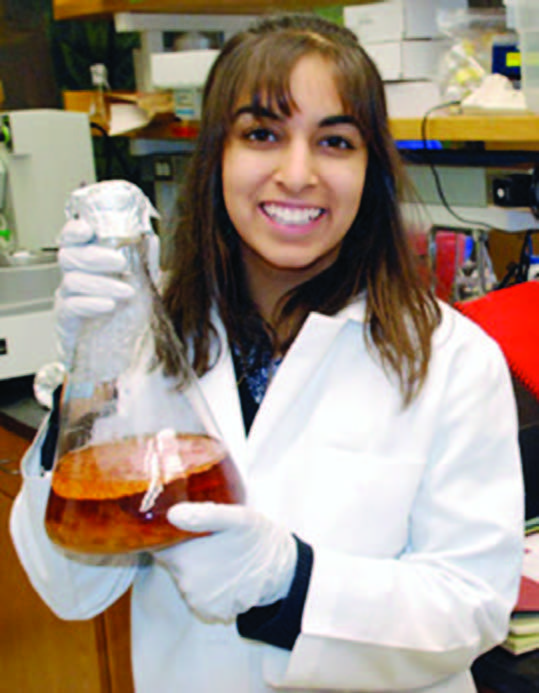
    Durga Thakral is among the winners of the 2016 Paul and Daisy Soros Fellowships for New Americans and will use her award to support work towards an MD/PhD in genetics at Yale School of Medicine, the university said in a statement.

    Ms Thakral says her work with communities with minimal healthcare resources has shown her the “dire need for better access to medical care and affordable biomedical devices.”

    An MD/PhD student in the laboratory of Yale geneticist Richard Lifton, Ms Thakral said she hoped to take advantage of the vast and growing power of molecular medicine in her work to improve the human condition and empower others to pursue their dreams.

    The fellows, selected from a pool of over 1,400 applicants, will receive tuition and stipend assistance of up to USD 90,000 in support of graduate education – in any field and in any advanced degree-granting program – in the US.

    Hungarian immigrants Paul and Daisy Soros established the program in 1997 to support the graduate educations of students who were born abroad but have become permanent residents or naturalized citizens of the US.

    Each award recipient must have “demonstrated creativity, originality, and initiative in one or more aspects of her or his life,” as well as “a commitment to and capacity for accomplishment that has required drive and sustained effort,” the statement said.

    In addition, they must have shown a commitment to the values expressed in the US Constitution and the Bill of Rights.

    Born in Illinois, Ms Thakral is the daughter of Indian immigrants. She earned a combined bachelor’s and master’s degree in molecular biophysics and biochemistry from Yale.

  • Indian American MasterCard CEO Ajay Banga appointed to key Administration post

    Indian American MasterCard CEO Ajay Banga appointed to key Administration post

    WASHINGTON(TIP) : President Barack Obama today, April 14, 2016 appointed Indian American MasterCard CEO Ajay Banga as a member of the Commission on Enhancing National Cybersecurity, a key administration post tasked with working towards internet safety.

    Mr. Banga is one of the nine members of the Commission on Enhancing National Cyber security appointed by Obama, a White House announcement said.

    “I have charged the Commission on Enhancing National Cybersecurity with the critically-important task of identifying the steps that our nation must take to ensure our cybersecurity in an increasingly digital world,” Obama said.

    “These dedicated individuals bring a wealth of experience and talent to this important role, and I look forward to receiving the Commission’s recommendations,” he said.

    Mr. Banga, in his mid-fifties, has been president and CEO of MasterCard since 2010. He joined MasterCard in 2009 as President and COO.

    Prior to joining MasterCard, he held various senior management roles with Citigroup from 1996 to 2009, most recently serving as CEO of Citigroup Asia Pacific.

    He was Director for Marketing and Business Development at PepsiCo Restaurants International India from 1994 to 1996 and began his career at Nestle India, working in sales and management roles from 1981 to 1994.

    Mr. Banga has served as a member of the Advisory Committee for Trade Policy and Negotiations since 2015.

    An alumnus of the Indian Institute of Management, Ahmedabad, he is also a member of the Board of Directors of the Dow Chemical Company, the Board of Governors of the American Red Cross, the Council of Foreign Relations, and serves as Chairman of the Financial Services Roundtable and co-chair of the American India Foundation.

  • The New York Indian Film Festival announces full lineup for the 16th Annual Film Festival May 7 – May 14

    The New York Indian Film Festival announces full lineup for the 16th Annual Film Festival May 7 – May 14

    NEW YORK CITY, NY (TIP): The New York Indian Film Festival (NYIFF) announced the full lineup last night for their 16th year of celebrating independent, art house, alternate, and diaspora films from/about/connected to the Indian subcontinent (May 7 – May 14). Dedicated to bringing these films to a New York audience, the festival will feature 40 screenings (35 narrative, 5 documentary) -all seen for the first time in New York City. In addition, the festival will also feature five programs of short films.

    The festival highlights various cinemas of India’s different regions. All the films are subtitled in English and some of the languages this year include Hindi, Bengali, Marathi, Tamil, Kannada, Malayalam, Telegu, Assamese, Haryanavi and Urdu. This year’s festival will feature a couple of sidebars –NFDC restored first films of filmmakers and a three-generations sidebar, films of Bimal Roy, Basu Bhattacharya and Aditya Bhattacharya.

    The festival’s film lineup includes 2016 National Award winners A FAR AFTERNOON, BIRDS WITH LARGE WINGS and THE RIVER OF FABLES (KOTHANODI). THE RIVER OF FABLES is an Assamese language feature film written and directed by Bhaskar Hazarika and stars Seema Biswas and Adil Hussain. The story of the film is based on folktales from Assam, India.

    “We are thrilled to be able to share these films with the New York audience,” states Aseem Chhabra, NYIFF festival director. “Three of the feature films are National Award winners. And out of the nearly 40 shorts we are showing this year, there are two National Award winners: FAMOUS IN AHMEDABAD and DAARVATHA.”

    Straight from the Sundance Film Festival, BRAHMAN NAMAN is a true Indian teenage comedy. It is funny, touching and will be universal in its appeal. It is about the exhilaration and confusion of being 17 – the pleasure of being in a gang, breaking the rules, acting big, falling in love – coming of age.

    From the Tamil films, CRIME IN PUNISHMENT is the latest film from NYIFF alum and 2015 NYIFF award winner M. Manikandan. FOR THE LOVE OF A MAN is a documentary film that explores the popularity of the Tamil Superstar Rajinikanth.

    GOOD OL’ BOY is the feel-good, coming-of-age story of Smith, a 10-year-old boy from India growing up in Small Town, America in 1979. This Diaspora film features actors Samrat Chakrabarti (Midnight’s Children, The Waiting City) and Poorna Jagannathan (Delhi Belly, Nirbhaya).

    Bengali master, Soumitra Chatterjee starrer PEACE HAVEN is the story of three septuagenarian friends who embark on a journey to build their very own mortuary.

    Multiple award winner and fresh from the international film festival circuit PARCHED is a story about women set in the heart of parched rural landscape of Gujarat, India. It traces the bittersweet tale of four ordinary women Rani, Lajjo, Bijli and Janaki. We see them unapologetically talk about men, sex and life as they struggle with their individual boundaries to face their demons and stage their own personal wars.

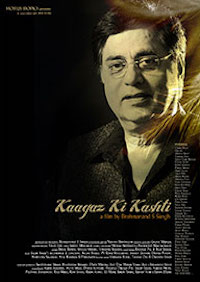
    WORLD PREMIERE of KAGAZ KI KASHTI (PAPERBOAT)

    In an era when Bollywood music ruled the Indian households and when Ghazal as a genre was limited to only the connoisseurs, Jagjit Singh made Ghazals a necessity of every music lover’s collection. KAAGAZ KI KASHTI traces the life journey of a down-to-earth, small-town boy, who made it big by breaking through the norms and the Ghazal scenario, by texturing traditional Ghazal singing with western instrumentation and making it simple and hummable, enticing new listeners into becoming Ghazal fans.

    “The 2016 festival features a wide array of films from all over the South Asian diaspora,” states IAAC founder Aroon Shivdasani. This year our films reflect the reality of India, dealing both with LGBT issues that have surfaced in the supreme court and on the streets, as well as strong feminist films dealing with female infanticide, child marriage, domestic abuse, trafficking and several other key issues that affect women in a world that still leans towards chauvinism.”

  • Know India Programme 2016 Launched

    Know India Programme 2016 Launched

    Consulate General of India, New York starts accepting applications for 35th ‘Know India Programme’ (K.I.P).

    Guidelines and application form for K.I.P may be accessed through Ministry of External Affairs website: http://www.mea.gov.in/know-india-programme.htm

    Local enquiries about K.I.P may be sent to: press@indiacgny.org


    Know India Programme of the Ministry is a three-week orientation programme for diaspora youth conducted with a view to promote awareness on different facets of life in India and the progress made by the country in various fields e.g. economic, industrial, education, Science & Technology, Communication & Information Technology, culture. KIP provide a unique forum for students & young professionals of Indian origin to visit India, share their views, expectations & experiences and to develop closer bonds with the contemporary India. 4-5 such programmes are conducted every year in partnership with one or two State Governments.

    Based on recommendations received from Heads of Indian Missions/Posts abroad, About 35 Indian Diaspora Youth in the age group of 18-26 years, are selected for each programme Selected participants are provided with full hospitality in India

    Know India Program (KIP) Link Click here

  • 125th Birth Anniversary of Dr. B. R. Ambedkar celebrated at the United Nations

    125th Birth Anniversary of Dr. B. R. Ambedkar celebrated at the United Nations

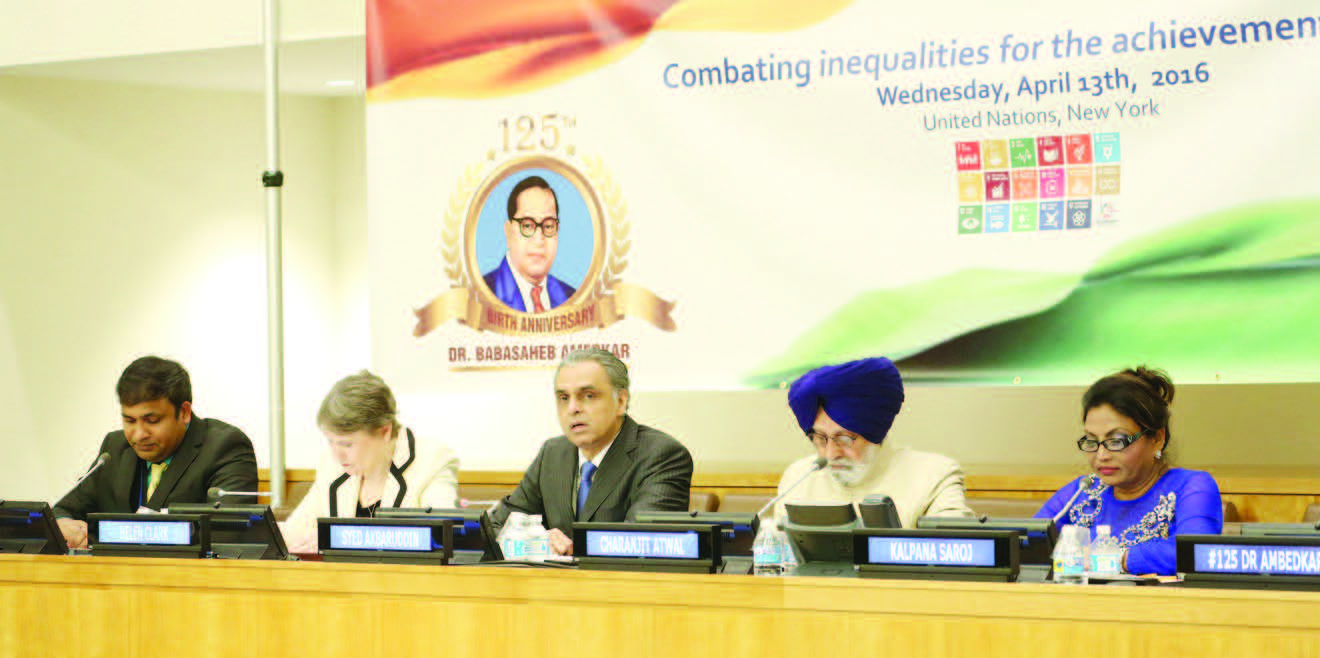
    UNITED NATIONS, NY (TIP): A special event to commemorate the 125th Birth Anniversary of Dr. B.R. Ambedkar was organized by the Permanent Mission of India to the United Nations on April 13 at United Nations Headquarters. This was the first such commemoration of Dr. Ambedkar at the UNHQ.

    Foundation for Human Horizon (US-based NGO with ECOSOC consultative Status) and Kalpana Saroj Foundation (India-based NGO of Padmashree Kalpana Saroj) were co-hosts of the event. Ms. Helen Clark, Administrator of UNDP in the Keynote address spoke on the legacy of Dr. B.R Ambedkar. She said that “Dr. Ambedkar understood that inequalities pose fundamental challenges to well-being”. Hon’ble Speaker of Punjab Legislative Assembly, Mr. Charanjit Singh Atwal (Chief Patron of Forum for SC and ST Legislators and Parliamentarians) delivered special remarks. Mr. Deelip Mhaske of Foundation for Human Horizon and Ms. Kalpana Saroj also addressed the gathering. The event also featured a Panel Discussion on the theme “Combating inequalities for the achievement of Sustainable Development Goals”.

    The Panelist included Professor Stan Kachnowsky, Colombia University and Chair, HITLAB; Ms. Anupama Rao, Associate Professor, Colombia University and; Mr. Christopher Queen, lecturer Harvard University. Prof Stan Kanchowsky spoke on influence of Dr. Ambedkar’s vision on healthcare equity and the resulting rise of mobile health in India. Mr. Christopher drew parallels between the lives of Ambedkar and Martin L. King, Jr. in their attempt to create societies based on equality, freedom and brotherhood and to overcome barriers of class, caste, race, and religion to forge alliances for peace and justice. Ms. Rao spoke about the impediments of inequalities including caste and the need for social justice to achieve sustainable development through the implementation of 2030 Agenda. She also highlighted Dr. Ambedkar as an important thinker relevant to both 20th and 21st century.

    A movie clip (a short version of the Films Division’s documentary edited by PMI) was screened on the occasion.

    There was on overwhelming response with over 550 people, many from India and various parts of the world attended the event. Diplomats, UN senior officials, state government officials from India, students, civil society, private sector representatives and academia were also present at the special event.

  • UN Chief Ban Ki-Moon offers his ‘good offices’ to resolve India-Pakistan Issues

    UN Chief Ban Ki-Moon offers his ‘good offices’ to resolve India-Pakistan Issues

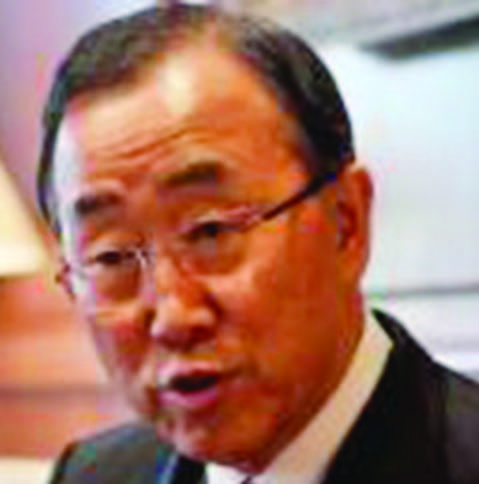
    UNITED NATIONS (TIP): With Pakistan announcing that the bilateral peace process with India has been “suspended”, UN Secretary General Ban Ki-moon has said that the offer of his “good offices” to help resolve the conflict stands but it is up to both nations to seek it.

    “Whenever there is a conflict, an issue, between Member States, the Secretary-General’s offer for good offices stands as a matter of principle. But, that has to be agreed on and asked for by both parties,” Ban’s spokesman Stephane Dujarric told reporters here.

    Dujarric was responding to a question at his daily briefing yesterday about whether the Secretary-General would like to offer his good offices given that the peace talks between India and Pakistan were “interrupted” again.

    Introducing a fresh chill in Indo-Pak ties, Pakistan High Commissioner to India, Abdul Basit on April 7 said the bilateral peace process stands “suspended”.

    He also poured cold water on India’s expectations that a team of NIA investigators would be allowed to visit Pakistan in connection with the Pathankot terror strike probe on the basis of reciprocity, a Pakistani Joint Investigation Team (JIT) having just concluded a visit to India.

    India, however, countered the Pakistan High Commissioner’s assertion that the visit by Pakistani JIT was not on reciprocity and said that before the team’s visit, both sides had agreed that it would be on the basis of reciprocity.

  • India, US commit to further ‘deepen our understanding of each other’s economies’

    India, US commit to further ‘deepen our understanding of each other’s economies’

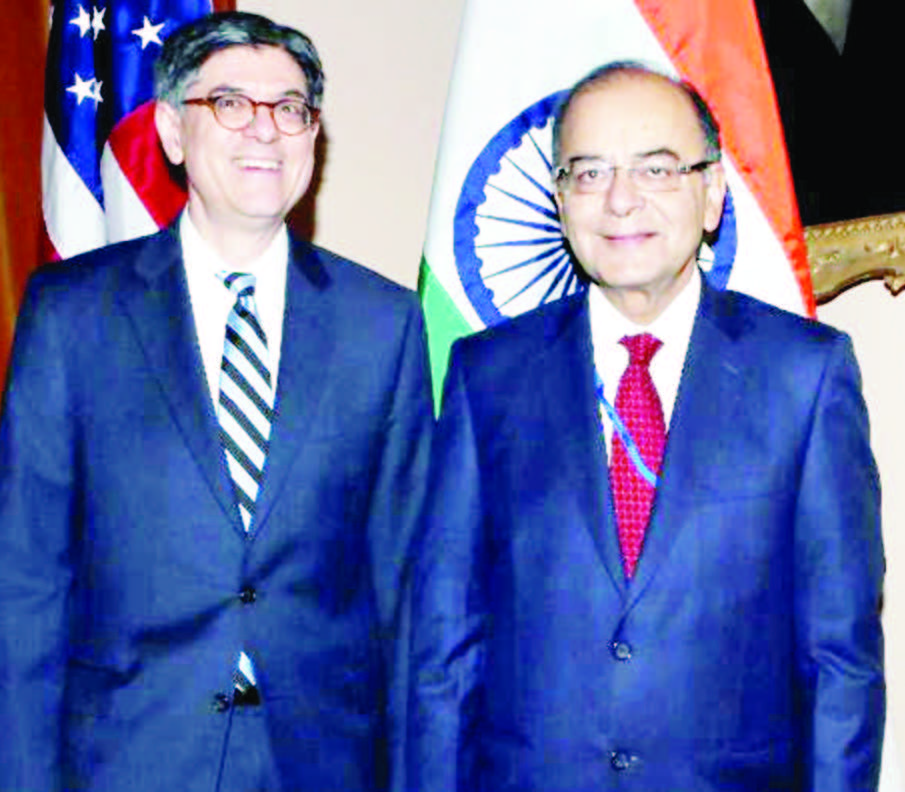
    WASHINGTON (TIP): India’s Finance Minister Arun Jaitley and U.S Treasury Secretary Jacob J. Lew met April 14 2016, for the Sixth Annual U.S.-India Economic and Financial Partnership (EFP). Others present included Federal Reserve Chair Janet Yellen and Reserve Bank of India Governor Raghuram Rajan.

    Following the conclusion of the dialogue, Minister Jaitley and Secretary Lew released a joint statement. Here is the full text.

    “The United States Treasury and India’s Ministry of Finance launched our Economic and Financial Partnership in 2010 as a framework commensurate with the growing importance of our economic relationship and the significant business and cultural ties that already exist between our two nations. At this meeting, the last for the Obama Administration, we took stock of the impressive efforts that have been undertaken by both sides to deepen mutual understanding, and to improve cooperation across a wide range of bilateral and multilateral issues. We reiterated that the U.S.-India partnership will be one of the defining relationships of the 21st century.

    “Contributing to our bilateral relationship, five work streams have been underway at the sub-cabinet level in India and the United States. Progress has been made on all fronts.

    “Over the past year, our tax authorities resolved a significant portion of bilateral tax disputes between the United States and India. In addition, our governments have begun to accept bilateral Advance Pricing Agreement applications by companies in both jurisdictions in an effort to enhance cross-border business processes and strengthen our commercial ties.

    “We have noted the progress in sharing of financial information between the two countries under the Inter-Governmental Agreement pursuant to Foreign Account Tax Compliance Act (FATCA). The two sides will continue to engage in discussions on full reciprocal arrangement on FATCA. We look forward to increased cooperation in sharing of cross-border tax-information.

    “We are committed to continued collaboration and sharing of experience in tackling offshore tax evasion and avoidance, including joint tax audits and tax examination abroad. We look forward to the Competent Authorities of the two countries engaging in bilateral dialogue to move forward cooperation in these areas.

    “Earlier this year, in India, the U.S.-India Financial Regulatory Dialogue brought together our respective financial regulators to discuss a range of issues pertinent to our domestic financial sectors and to financial stability, including banking sector reform and development of capital markets. In addition, expert staff from Treasury and the Ministry of Finance are having consultations on the United States experience and international perspectives on the regulatory design for India’s recently launched payment banks.

    “Under the U.S.-India Investment Initiative launched in January 2015, our governments have worked in collaboration with private sector to identify specific policies, regulatory reforms, and technical collaboration aimed at mobilizing capital from both domestic and foreign investors to build infrastructure and create jobs. We are working together to support India’s National Investment and Infrastructure Fund (NIIF) in order to increase financing options for India’s infrastructure growth. We look forward to continuing discussions in areas such as municipal finance under the future work of the Initiative. The next meeting of the Investment Initiative will be in the United States later in 2016.

    “Public debt management is an area of focus for India. India believes in continued efforts for more efficient debt and cash management, as well as the development of a deeper and more robust domestic debt market. It presents an opportunity for India’s Ministry of Finance and the U.S. Treasury’s Office of Technical Assistance to engage in knowledge and information sharing in India’s government debt management program. Accordingly, a Terms of Reference was signed between the two to collaborate on India’s government debt program.

    “We have enhanced our cooperation in tackling money laundering and combating the financing of terrorism through increased information sharing and cooperation, including a dialogue held recently in India. We both agree on the importance of fighting illicit finance in all forms as an important means of tackling global terrorism.

    “Finally, we are committed to further deepen our understanding of each other’s economies. As partners and peers, we are committed to working together to collaborate in multilateral fora, such as the G20, to steer our economies toward stronger, sustainable, and balanced growth. Under the aegis of our Economic and Financial Partnership, we held a sub-cabinet level discussion among our Deputies in India in early 2016.

    “We are encouraged with the developments that have taken place since the launch of the Economic and Financial Partnership and look forward to continued engagement in an effort to strengthen our relationship, our economies, and the global economy.”

  • Modi may visit US in June to meet Obama

    Modi may visit US in June to meet Obama

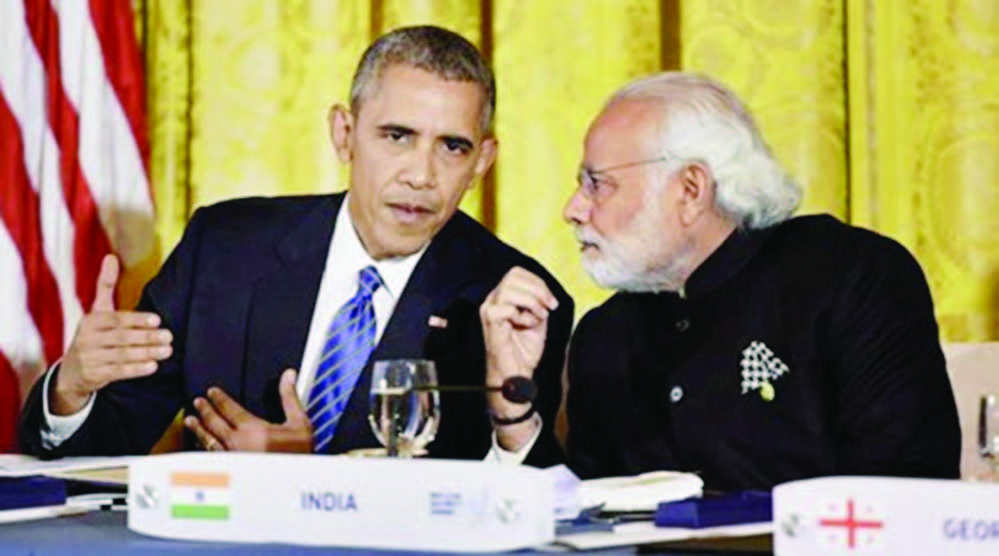
    WASHINGTON (TIP): Prime Minister Narendra Modi is likely to visit the US in June to hold a bilateral meeting with US President Barack Obama before he demits office in January next year.

    Sources confirm that the US has reached out to India on this matter and the dates are being sorted out. Sources say if dates can’t be worked out for June, Modi may then travel to the US in September. Obama is keen on meeting some world leaders before stepping down and the US is in the process of reaching out to these leaders.

    Obama will be demitting office in January next year after two four-year terms. His presidency has seen its fair share of highs and lows. Modi and the US President were able to develop a good rapport, which resulted in Obama accepting the invitation to be the Chief Guest at the Republic Day parade in 2015. That also helped Modi score a diplomatic coup on the home front.

    Besides the personal camaraderie between the two leaders, the US today has great interests in India, which it wants to safeguard. The US wants to build India as an ally in the region vis-a-vis China.

  • Sanders tops Time’s poll of 100 most influential

    Sanders tops Time’s poll of 100 most influential

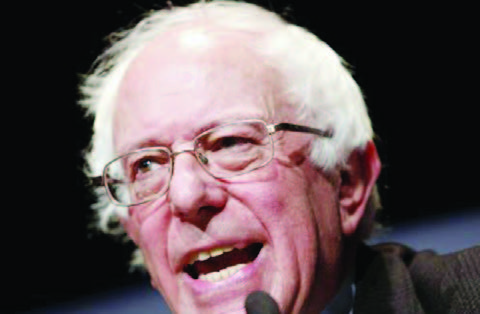
    NEW YORK (TIP): Democratic presidential hopeful Bernie Sanders has won Time magazine’s readers’ poll of the world’s 100 most influential people, garnering more than three times as many votes as his rival Hillary Clinton.

    Prime Minister Narendra Modi, tennis icon Sania Mirza and actor Priyanka Chopra are also among the probable contenders named by the magazine for its annual list. In the readers’ poll, Modi got 0.7% of the ‘yes’ votes while Mirza got 0.5% and Chopra 0.8%.

    Sanders had been leading the readers’ poll from the start and finished with 3.3 per cent of the total ‘yes’ votes when the poll closed midnight yesterday.

    The Vermont senator not only beat Clinton, 68, who has finished with one per cent of the ‘yes’ votes but also a host of world leaders and cultural figures.

    Sanders edged out the South Korean boy band Big Bang which got 2.9% votes. Myanmar pro-democracy leader Aung San Suu Kyi came in third with 2.2% votes followed by US President Barack Obama with 2%.

  • ARE REPUBLICANS RACISTS?

    ARE REPUBLICANS RACISTS?

    The Republican Party and the “conservative establishment” do not disagree with Trump’s racism, xenophobia, prejudice and bigotry toward Hispanic and Latino immigrants, non-whites, Muslims and women. They are just embarrassed and aghast that Donald Trump has dropped the mask of racist gentility and exposed the racist id of today’s Republican Party and movement conservatism for the world to see.

    Republican Party elites are nervous about Donald Trump because he has taken their “polite” “dog whistle” racism and replaced it with a loud speaker.


    Donald Trump

    As the world looks on askance at the freakishness of the US presidential election, it is worth bearing in mind that a large number of Americans feel much the same sense of unease.

    To outside eyes, the rise of Donald Trump especially looks like the ultimate “Only in America” story, but many of his compatriots wish it was a “Not in America” phenomenon.

    For all the billionaire’s dominance in the Republican race, for all the free airtime lavished upon him by the media, polls repeatedly suggest that he is the most unpopular presidential candidate in modern history.

    A recent survey conducted for the Washington Post and ABC News showed that 67% of voters have an unfavorable view of him.

    What’s also striking about the polling data is that the more exposure the billionaire gets, the higher his negatives soar, whether it is women angered by his misogyny, Latinos upset by his racial demagoguery, African-Americans who don’t take kindly to being called “the blacks” or fellow Republicans who believe he will lead their party off a cliff.

    Donald Trump is the preferred candidate of white supremacists. Online and in other spaces, they have anointed him their champion in the 2016 presidential race.

    Trump & KKK (David Duke) Connection, that he knows nothing about…

    LIAR LIAR – “Just so you understand, I don’t know anything about David Duke, OK?” Trump said. Trump was pressed three times on whether he’d distance himself from the Ku Klux Klan — but never mentioned the group in his answers.

    “I don’t know anything about what you’re even talking about with white supremacy or white supremacists,” he said. “So I don’t know. I don’t know — did he endorse me, or what’s going on? Because I know nothing about David Duke; I know nothing about white supremacists…”

    Despite what he said, Trump apparently did know Duke in 2000 — citing him, as well as Pat Buchanan and Lenora Fulani — in a statement that year explaining why he had decided to end his brief flirtation with a Reform Party presidential campaign.

    “The Reform Party now includes a Klansman, Mr. Duke, a neo-Nazi, Mr. Buchanan, and a communist, Ms. Fulani. This is not the company I wish to keep,” Trump said in a statement reported then by The New York Times. …

    Politics is not about people but about parties and their ideology; political parties are a type of “brand name” that voters associate with a specific set of policies, ideas, personalities and moral values. Consequently, the types of voters who are attracted to a given political party also tells us a great deal about how it is perceived by the public. And in a democracy, the relationship between voters, elected officials and a given political party should ideally be reflected by the types of policies the latter advances in order to both win and stay in power.

    By these criteria, the post-civil rights era Republican Party is the United States’ largest white identity organization, one in which conservatism and racism are now one and the same thing.

    In the 2012 election, 89 percent of Republican voters were white. While the Republican Party routinely anoints a professional “best black friend” (Herman Cain in 2012; Ben Carson in 2016; Republican National Committee chairman Michael Steele in 2009) who serves in the role as human chaff to deflect charges of racism, non-whites are a minuscule part of the GOP’s electoral coalition and base. This is reflected by how Republican voters are much more likely to be racially resentful toward black Americans and also manifest what is known as “modern” or “symbolic racism.”

    Even more troubling, research by Brown University political scientist Michael Tesler demonstrates that “old-fashioned racism” has actually increased among Republican voters since the election of Barack Obama.

    New Tactics but same old agenda – Birth of The Southern Strategy

    The Southern Strategy, with its mix of coded and overt anti-black and brown racism, is a script that is closely adhered to by the broader right-wing news entertainment propaganda machine.

    The Southern Strategy was desperately deployed against the United States’ first black president, Barack Obama. From “birtherism” to claims that Obama is “traitor” who “hates Americans,” the rampant disrespect and obstructionism that Republicans have shown toward him, as well as the panoply of both overt and subtle racist attacks by conservatives against Obama’s person (and family) are all outgrowths of the Southern Strategy.

    The Age of Obama also gave rise to the Tea Party movement. As an extreme wing within an already extremist and revanchist Republican Party, Tea Party members and their sympathizers were/are extremely hostile to Barack Obama and the symbolic power of a black man leading “their” White America. The Tea Party demand that “they want their country back” is both a direct claim of white privilege and constitutes a worldview where whiteness is taken to be synonymous with being a “real American.”

    Not all Republicans are racists. But racists are more likely to be Republicans.

    Donald Trump knows this to be true. He has built a political campaign around that fact.

    Ultimately, Republican Party elites are nervous about Donald Trump because he has taken their “polite” “dog whistle” racism and replaced it with a loud speaker.

    The Republican Party and the “conservative establishment” do not disagree with Trump’s racism, xenophobia, prejudice and bigotry toward Hispanic and Latino immigrants, non-whites, Muslims and women. They are just embarrassed and aghast that Donald Trump has dropped the mask of racist gentility and exposed the racist id of today’s Republican Party and movement conservatism for the world to see.

  • Volume 10 Issue 15 | New York

    Volume 10 Issue 15 | New York

    Celebrating 10 Years of The Indian Panorama

    10 years

    This Week’s Print Edition

    Reimagined for the Web 

    Volume 10 Issue 15 | New York April 15


    Introducing Home Delivery Subscription:

    As a home delivery subscriber to The Indian Panorama, you enjoy the convenience and reliability of having the printed newspaper delivered to you first thing in the morning every Saturday.

    This incredible offer is available for 2016 at an introductory price of $5 per month (including shipping & handling – US Only). To know more email subscriptions@theindianpanorama.news

    Your subscription includes free Digital Access to www.theindianpanorama.news at no additional charge.


    Advertise with The Indian Panorama 

    Place your advertisement or message in The Indian Panorama and let us start delivering your best customers to you.

    For advertisers, The Indian Panorama has no rivals. Connect with our Advertising Sales team in order to learn more about who reads TIP and how your brand can connect with our audience.

    Our main print coverage is in New York, New Jersey, Connecticut, Dallas / Fort Forth among other major cities of The United States.

    The Indian Panorama is the 2nd most visited website by NRI’s & Indian Americans for Asian News, Immigration, Diaspora News in the United States much ahead of other newspapers like DesiTalk, NewsIndiaTimes, India Abroad, The Indian Express, South Asian Times etc (Source: Alexa Rankings)

    ranking
  • Four Indian Americans Named Guggenheim Fellows for 2016

    Four Indian Americans Named Guggenheim Fellows for 2016

    Four Indian Americans — Anjan Chakravartty, Professor of Philosophy at the University of Notre Dame; Amitava Kumar, the Helen D. Lockwood Professor of English at Vassar College, New York; Rajesh Rao, Director of the Center for ‘Sensorimotor Neural Engineering’ and Professor of Computer Science and Engineering at the University of Washington in Seattle, and Neil Garg, Professor in the Department of Chemistry and Biochemistry at UCLA — are among a group of 178, artists, scholars, and scientists from all fields, who have been named John Simon Guggenheim Memorial Foundation Fellows in the prestigious program which started in 1925.

    The candidates were chosen from a group of roughly 3,000 applicants based on prior achievement and exceptional promise, according to a foundation news release, and include three joint Fellowships.

    “It’s exciting to name 178 new Guggenheim Fellows. These artists and writers, scholars and scientists, represent the best of the best,” foundation president Edward Hirsh said in a statement.

    Chakravartty was named a Fellow in the discipline of philosophy. He is a professor and director at the John J. Reilly Center for Science, Technology and Values at the University of Notre Dame.

    Garg was chosen as a Fellow in the chemistry discipline. Garg earned his bachelor’s degree in chemistry from New York University and his doctorate from the California Institute of Technology.

    Kumar was named a Fellow in the general nonfiction discipline. He is the Helen D. Lockwood professor of English at Vassar College.

    Rao received the Guggenheim Fellowship for his work in neuroscience. He is the director of the Center for Sensorimotor Neural Engineering and professor of computer science and engineering at the University of Washington in Seattle.