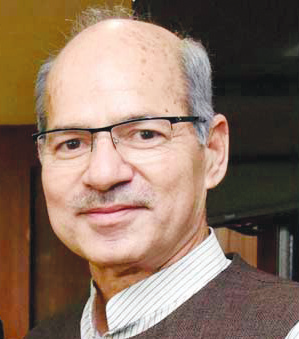
NEW DELHI (TIP): Environment minister Anil Madhav Dave died this morning, depriving Prime Minister Narendra Modi’s government of a key figure as it considers whether to approve the country’s first genetically modified food crop.
Dave, 60, died at a hospital in Delhi after complaining of feeling unwell, a day after attending a cabinet meeting.
Prime Minister Narendra Modi tweeted that he was “absolutely shocked” and described Mr Dave’s death as a “personal loss”. He wrote, “I was with Anil Madhav Dave ji till late last evening, discussing key policy issues.”
The prime minister also said Mr Dave would be remembered as a devoted public servant and was tremendously passionate towards conserving the environment.
Science and Technology Minister Harsh Vardhan will take additional charge of Environment Ministry.
The two-term lawmaker from the BJP, Mr Dave had a longtime association with the Rashtriya Swayamsevak Sangh (RSS). He was appointed Environment Minister last year. He was a Rajya Sabha member from Madhya Pradesh. He was a member of various committees in parliament and was also in the Parliamentary Forum on Global Warming and Climate Change.
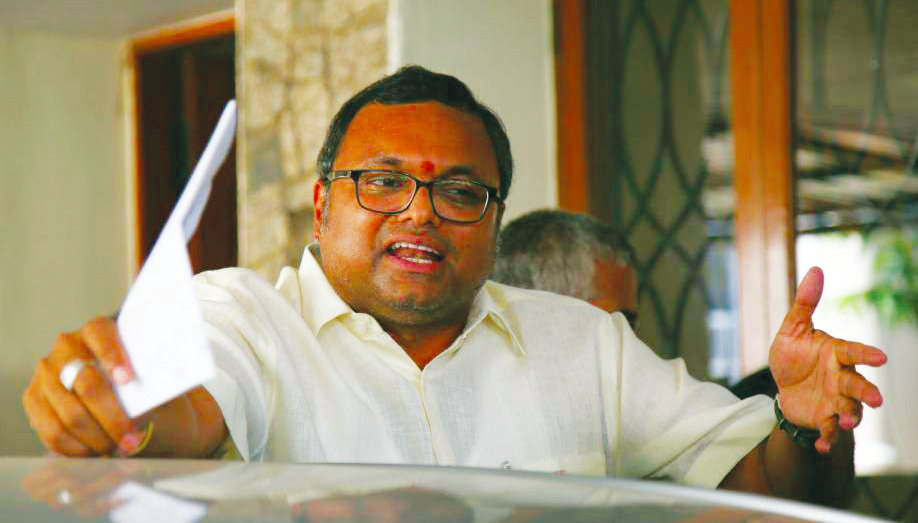
NEW DELHI (TIP): The Enforcement Directorate (ED) has registered a money laundering case against Karti Chidambaram, son of former finance minister P Chidambaram, and others, taking cognisance of a recent CBI FIR against them.
Officials said the central probe agency registered an Enforcement Case Information Report (ECIR), ED’s equivalent of a police FIR, against the accused named in the CBI complaint including Karti, INX media and its directors, Peter and Indrani Mukerjea, and others.
The ECIR has been registered under the provisions of the Prevention of Money Laundering Act (PMLA), they said. They said the ED will probe the alleged “proceeds of crime” generated in this case and may also attach assets of the various accused.
It is the ED which had provided information about the alleged illegal payments made by INX media, based on which the CBI had filed its FIR. The CBI, on Tuesday, had carried out searches at the homes and offices of Karti across four cities for allegedly receiving money from the media firm owned by the Mukerjeas to scuttle a tax probe.
The Chidambarams had denied all the charges made against them. The CBI had filed an FIR against Karti and the Mukerjeas on charges of criminal conspiracy, cheating, receiving illegal gratification, influencing public servants and criminal misconduct.
It is alleged that Karti received money from INX Media for using his influence to manipulate a tax probe against it in a case of violation of Foreign Investment Promotion Board (FIPB) conditions to receive investment from Mauritius.
The CBI had also recovered vouchers of Rs 10 lakh which were allegedly paid for the services.These vouchers were issued in favour of Advantage Strategic Consulting (P) Limited, a firm “indirectly” owned by Karti, the CBI had alleged. The senior Chidambaram, after the CBI searches on May 16, had issued a strong statement in response to the raids saying that the government was using the CBI and other agencies to target his son.
FIPB approval was granted in “hundreds of cases”, the senior Congress leader had said. The CBI FIR was made out against Karti, his company Chess Management Services, the Mukerjeas (currently in jail on charges of murder their daughter Sheena Bora), INX Media, Advantage Strategic Consulting Services and its director Padma Vishwanathan.
JAMSHEDPUR (TIP): Villagers lynched six persons in two places of Rajnagar police station area in Seraikela-Kharswan district on Thursday, suspecting them to be child lifters. Agitated villagers also torched two vehicles belonging to the police in connection with the incidents.
Three persons were lynched by the villagers, who suspected them of being child lifters in Nagadih within the limits of Bagbera police station tonight, Superintendent of Police (City) Prasant Anand said.
An old woman was also seriously injured and has been admitted to a hospital here, he said. Two of the victims were identified as Uttam Kumar Verma, a resident of Jugsalai, and Ganesh Kumar Gupta of Bagbera, the SP (City) said adding, the identity of another victim could not be established.
The SP (City) said when a police team reached the spot, agitated villagers started pelting stones at them, injuring some police personnel. Two vehicles were damaged. “A police picket has been posted at the spot to maintain law and order,” Anand said.
Earlier, two persons were beaten to death in Sosomoli village, while another was lynched in Shobhapur village by local residents, DIG (Kolhan region) Prabhat Kumar told PTI. Some of the villagers were identified and action would be taken after investigation, Kumar said adding senior officers have gone to the spot with reinforcement.
The incident occurred a week after two persons had been beaten to death and as many injured by a mob on suspicion that they were child lifters in Uranium township of Jadugora in East Singhbhum district.
NEW DELHI (TIP): A special court here on May 19 (Friday) convicted former coal secretary H C Gupta in a coal scam case.
Special CBI Judge Bharat Parashar also convicted the coal ministry’s then joint secretary K S Kropha and then director K C Samaria, besides others in the case pertaining to alleged irregularities in allocation of Thesgora-B Rudrapuri coal block in Madhya Pradesh to KSSPL.
The court will pronounce the order on quantum of sentence on May 22. The court, however, acquitted chartered accountant Amit Goyal in the case. Besides Gupta, Kropha and Samria, the court also convicted the firm KSSPL and its managing director Pawan Kumar Ahluwalia. Kropha was the then joint secretary in the Ministry of Coal, while Samria was the then director (coal allocation-I) in the ministry.
During the hearing, the CBI had alleged that the application filed by KSSPL for the coal block was incomplete and was supposed to be rejected by the ministry as it was not in accordance with the guidelines issued.
The CBI had charged that the firm had misrepresented its net worth and existing capacity, adding that state government had also not recommended the firm for the allocation of any coal block.
The accused, however, denied the allegations during the arguments. The court had in October last year framed charges against the accused observing that former prime minister Manmohan Singh was kept in the “dark” by Gupta, who had prima facie violated the law and the trust reposed in him on the issue of coal block allocation.
Around eight different charge sheets have been filed against Gupta and proceedings are going on individually. The Supreme Court had recently dismissed his plea seeking joint trial in all these cases. Source: PTI
NEW DELHI (TIP): Key members of the Kashmiri separatist group Hurriyat have been booked by the National Intelligence Agency for allegedly receiving funds from Pakistani sources such as LeT’s Hafiz Saeed to foment violence in the Jammu and Kashmir region.
Sources said the agency, which handles high-profile cases such as that of terrorism, will call for questioning Syed Ali Shah Geelani, Naeem Khan, Gazi Javed Baba and Farooq Ahmed Dar alias Bitta Karate — four prominent separatist figures it named in a preliminary enquiry (PE) on Thursday.
A PE is a precursor to an FIR (first investigation report), the first step to launching a probe. The four are suspected to have received funds from sources such as militant group Lashkar e-Tayyeba (LeT) to pay off people carrying out violent protests and arson in the Valley, where more than 100 civilians have been killed since July last year.
“We suspect the money was distributed in the Valley for various violent activities like stone pelting and torching of schools and government buildings,” said a senior NIA official, insisting to not be identified since he was not authorised to speak on the matter. The money, NIA officials believe, was routed through hawala — a system of transferring money across borders that is outlawed in India. The PE names LeT patron Hafiz Saeed as one of the sources for the funds, in addition to other unknown persons in Pakistan.
The NIA will also verify allegations in a sting operation that showed some of the Hurriyat leaders talking about receiving money from Saeed and other Pakistani individuals.
KOLKATA (TIP): The Opposition parties will leave no stone unturned to garner support for Presidential election, West Bengal chief minister Mamata Banerjee said. She also “hoped” that the Opposition combination leads to an anti-BJP political formation for the 2019 general elections. “We will talk to all possible sources of support. We will play our game and leave no stone unturned to reach out to other parties,” she said.
The term of President Pranab Mukherjee ends in July. Banerjee, who had tried to rope in her Delhi counterpart Arvind Kejriwal in the Opposition camp, indicated she is in touch with her Odisha counterpart Naveen Patnaik, Shiv Sena and other parties.
The Congress-led Opposition is falling short by more than 1.5 lakh votes from the majority mark and it’s an uphill task for them to get their candidate elected. The BJP-led NDA, which rules most of the bigger states and enjoys comfortable majority in the Lok Sabha, appears to have an advantage in the election.
But Banerjee maintained, “I will be really happy if Pranab da (President Mukherjee) gets another term in office. It all however depends on the government to build a consensus around his name.”
Odisha’s ruling BJD has around 36,500 votes in the electoral college of the Presidential election while Sena has more than 25,800 votes. “Naveen and I are old friends. I am talking to him for Presidential election,” said the Bengal CM. She is the second Opposition leader after CPI(M) general secretary Sitaram Yechury to woo Patnaik for the upcoming poll for the country’s top office.
Banerjee’s Trinamool has the largest vote share after the BJP and the Congress in the electoral college with 64,500 votes. On Tuesday, she met Congress president Sonia Gandhi and pledged her support for an Opposition candidate. Trinamool sources said that she has also spoken to Bahujan Samaj Party chief Mayawati. “On the day she spoke to Gandhi, same evening Didi had a long conversation with Mayawati,” claimed one of Banerjee’s trusted lieutenants. Banerjee is popularly referred to as Didi, meaning elder sister in Bengali.
When asked that if the positioning of different parties for the Presidential poll can lead to a potential alliance, Banerjee said, “I hope it leads to that situation. But right now, it’s too early to say. Parties should realize that the BJP is ruining the social and democratic fabric of our country.”
Even as her party fought against the Congress-Left combination in Bengal last year, Trinamool chief said, she maintains excellent equation with both Congress president Sonia Gandhi and vice president Rahul Gandhi.“We know each other for a long time. Sonia ji knows me very well. Some state-level Congress leaders behave very badly but that doesn’t mean that my relationship with Gandhi family is spoiled,” she said.
CONG, SP WELCOME MAYAWATI’S CALL FOR ANTI-SAFFRON FRONT, BJP SHRUGS IT OFF
NEW DELHI (TIP): The winds of change are blowing, but will they be enough to tame the Modi wave? When BSP supremo Mayawati faced a humiliating defeat in the Uttar Pradesh assembly elections earlier this year, her initial reaction was to blame electronic voting machines for the development. But now, in order to protect what’s left of her vote bank and put an end to the saffron party’s advance through her strongholds, the Dalit leader has decided to adopt a time-honoured strategy that has brought down many a giant in the annals of history.
She has called for unity among secular parties, which currently lie splintered across the country, and indicated that she is willing to be part of a larger anti-BJP front. Mayawati made the announcement while addressing BSP cadre during BR Ambedkar’s birth anniversary function at Lucknow’s Ambedkar Memorial on Friday. “To keep democracy alive, I am ready to be part of anti-BJP front. We have to cut poison with poison. Due to tampering of EVMs, the voters won’t be able to elect their favourite leaders. The anti-BJP front is necessary to make sure that popular candidates, who enjoy mass support, win the elections,” she said, amid a deafening applause from party workers.
NEW YORK CITY (TIP): Preity Uupula, a former Miss India International, said of Shen Yun, “The energy was very powerful in the room. (For) some of the pieces, I just closed my eyes and I felt like it was a meditation. It’s very healing actually.”
Like India, China can be proud of 5000 years of an ancient, rich civilization and culture. Having some of its roots in the ancient Indian spiritual path of Buddhism, Shen Yun, based in New York, has a mission to revive 5000 years of divinely inspired culture.
The last performances of this breathtaking theatrical amazement, for the season, were held at NJPAC (the New Jersey Performing Arts Center, NJ) from May 3-7. For 5,000 years, divine culture flourished in the land of China.
Shen Yun Performing Arts, Manchurian EleganceShen Yun Performing Arts, Sleeves of GraceShen Yun Performing Arts, Han Imperial Air
Humanity’s treasure was nearly lost, but through breathtaking music and dance, Shen Yun is bringing back this glorious culture. Shen Yun means, “The beauty of heavenly beings dancing.”
Falun Dafa, also known as Falun Gong, is a practice that combines teachings for self improvement and meditation exercises. The teachings are centered on three main principles-truth, compassion, and tolerance.
Shen Yun’s artists practice Falun Dafa, and it is a source of inspiration for their performances. However, over the last 60 years of Communist rule, the regime has treated Chinese values – centered on the idea of harmony between heaven and earth – as a threat to its existence and banned traditional beliefs and practices.
Through the universal language of music and dance, Shen Yun weaves a wondrous tapestry of heavenly realms, ancient legends, and modern heroic tales, taking you on a journey through 5,000 years of Chinese culture. Its stunning beauty and tremendous energy leave audiences uplifted and inspired.
A Shen Yun performance features the world’s foremost classically trained dancers, a unique orchestra blending East and West, and dazzling animated backdrops-together creating one spectacular performance. The Shen Yun Symphony Orchestra blends the singular beauty of Chinese melodies with the precision and power of the Western orchestra.
“Amazing! The artists perform as if they are fluid bodies with no bones. Gravity does not apply to them. They leap and fly in the air while they perform their numbers…..” quipped Pattie King, audience member at NJPAC.
“Mesmerizing! Reclaiming the divinely inspired cultural heritage of China,” remarked Donna Karan, creator of DKNY.
“I was mesmerized and astonished within the first few minutes…..Shen Yun music proves that not every message needs to be delivered via language or written words…..” Rojin Rahmani, musician.
Shen Yun Performing Arts is the world’s premier classical Chinese Dance and Music company. In 2006, a group of leading classical internationally award winning Chinese artists came together in New York with one wish: to revive the 5000-year-lost world of traditional Chinese culture and share it with the world. Through breath taking music and dance, Shen Yun is bringing back this glorious culture.
Each season, the company produces an all new show and tours with it around the globe, performing at the world’s top venues – Lincoln Center in New York, The New Jersey Performing Arts Center, New Jersey, Kennedy Center in Washington, the London Coliseum.
Since ancient times, Chinese culture has been heralded as a gift from the divine; and part of that divine gift was a supreme art form that has endured to this day: Classical Chinese Dance. “It (Classical Chinese Dance) has a history of several thousand years in both folk and imperial settings. It served as entertainment for large gatherings and celebrations”, says Ms. H. Sue Guo, Principal, The Fei Tian Academy of the Arts College, New York, the college that trains the performers of Shen Yun. Branches of the college exist in California and Taiwan.
Within China’s grand civilization of 5000 years, many traditions are linked together: martial arts, Chinese opera, folk dance and acrobatics. They all have something in common. Chinese dance has 3 main components: technical skill, form and a special feature called yun or physical bearing. Chinese dance’s technical skills include a whole series of challenging leaps, jumps, flips and many difficult tumbling techniques.
In eastern philosophy, there is a saying “beauty and roundness,” explains choreographer, principal dancer and associate company manager Yungchia Chen. “The path of the movement needs to be circular, rounded and full. It’s different from ballet which focuses on straight lines.”
What takes classical Chinese dance to another level is yun or physical bearing that is a certain sensibility when Chinese people perform classical Chinese dance. “It’s an artistic feeling that rises from the culture” demonstrates dance teacher Gu Yun. When the dancer moves there is an internal energy connected to the breath. The breath meets the body. The breath is crucial.
Over the centuries, the technical skills, form and bearing all come together to make classical Chinese dance one of the richest, most expressive and most demanding art forms in the world.
The training process for each dancer is extremely arduous. Daily training lasts for 7- 8 hours. It takes 6 years schooling just to be good enough to go on stage. After 10 years training in college is completed.
Every year, Shen Yun creates a whole new production with original dances, costumes and music. By adding the distinctive melodies of ancient Chinese instruments, over Western orchestration, Shen Yun brings together two of the greatest classical musical traditions the world has ever known.
Johnny Stuart, music director, calls the music “just phenomenal, mind blowing!” Music conductor Leon Natker says that “putting together classical Chinese instruments and classical western instruments is a way towards the future for me as a musician.” Jing Xian, a composer of the performance, says, “Both these (Chinese and western) musical systems are excellent. But it’s just like cooking. You might have great ingredients but if we don’t understand the characteristics of the ingredients, and to stir fry random things together, it simply won’t taste good.”
Shen Yun music displays China’s traditional melodies. Just like dance, music can also present different times, places, characters and moods. China has 5 millennia worth of culture: from the melodic styles of over 50 ethnic groups to grand imperial court music and lavish folk tunes. This heritage is an endless source of inspiration.
“What we are taking on is a responsibility we simply cannot shirk. There are times when I really feel it’s our life’s mission. It may take many life times to complete.” “I have dedicated my entire life to the arts. Yet it was only after I reached my 70s that I found that this is where it has the greatest meaning,” says Ms. H. Sue Guo, Principal, The Fei Tian Academy of the Arts College, New York.
(Mabel Pais is a freelance writer. She writes on theater, health and wellness, social issues and spirituality)
Atul kumar Babubhai Patel, 58, had shortness of breath and was hospitalized .His death is the second death of a detainee in ICE custody this week
ATLANTA (TIP): A man in Immigration and Customs Enforcement custody has died after being hospitalized for shortness of breath, officials said Wednesday, May 17, says a CNN report Atulkumar Babubhai Patel was pronounced dead at Atlanta’s Grady Memorial Hospital on Tuesday, May 16 afternoon.
The 58-year-old Indian national’s death is the second death of a detainee in ICE custody this week — and the second this week in the state of Georgia, according to CNN report.
Officials said complications from congestive heart failure were ruled the preliminary cause of death. Patel arrived at the Atlanta airport on May 10 on a flight from Quito, Ecuador. Authorities denied him entry into the United States because he did not have the necessary immigration documents, ICE said.
He was transferred to ICE custody in the Atlanta City Detention Center on Thursday, May 11 according to the agency. An initial medical screening at the time determined he had high blood pressure and diabetes. Two days later, Patel was transported to the hospital after a nurse checking his blood sugar noticed he had shortness of breath, ICE said. He died on Tuesday afternoon.
In its statement announcing Patel’s death, officials said fatalities in ICE custody are “exceedingly rare.” “ICE is firmly committed to the health and welfare of all those in its custody and is undertaking a comprehensive agency-wide review of this incident, as it does in all such cases,” ICE said.
Second death this week Patel is the eighth person to die in ICE custody this fiscal year, which began in October. Authorities are also investigating the death of another immigrant detainee in Georgia. Jean Jimenez-Joseph, 27, was found unresponsive in his cell on Monday with a sheet around his neck. The preliminary cause of death was self-inflicted strangulation. He’d been in solitary confinement for more than two weeks at the Stewart Detention Center in Lumpkin, Georgia.
The recent deaths have drawn sharp criticism from immigrant rights activists, who have long decried conditions in immigration detention centers and called on the government to close such facilities.
US President Donald Trump has called for increasing detention as part of his crackdown on illegal immigration. And Congress recently upped its funding for immigrant detention, approving a spending bill that pays for an average of more than 39,000 detention beds per day.
WASHINGTON (TIP): When US President Donald Trump travels to Saudi Arabia to address the Muslim world this week, participating leaders would be asked to sign a pledge to make it “illegal” in their country to fund outfits that promote extremism and terrorism.
Leaders of more than 50 mostly-Muslim countries, including Afghanistan and Pakistan from India’s neighbourhood, are scheduled to attend the meeting convened by Saudi Arabia.
Trump would address the gathering on Sunday. Such a pledge would have a far-reaching implications on countries like Pakistan, where fundraising for terrorist organisations is common and at times supported by the ruling establishment.
While the pledge would be legally non-binding, it would be used for making these countries accountable by the Trump administration, which has made the fight against terrorism a priority, a senior administration official said. (PTI)
UNITED NATIONS: US Ambassador Nikki Haley accused North Korea on Tuesday of intimidating the entire international community with its nuclear program, military ability and cyberattacks, and said any country that doesn’t implement UN sanctions is supporting Pyongyang’s actions.
“No one is immune to the threat of North Korea,” she told reporters before emergency closed-door consultations by the UN Security Council on the North’s weekend ballistic missile launch, which experts said demonstrated a significant technological jump with the rocket flying higher and for a longer period of time.
“We’re not going to continue to just say go ahead and test as often as you want,” Haley said, flanked by the South Korean and Japanese ambassadors. “This is a true threat to every country in the world. … We’re going to make sure we put the pressure on them economically, diplomatically, politically and internationally.” Haley said the US and China have been working on “a unified plan” on how to approach North Korea that would include stronger implementation of existing sanctions and tougher new sanctions.
She indicated Washington and Beijing had agreed they would take action if a new test looked to be long range and leaning toward an intercontinental ballistic missile that could reach the United States.
The latest launch appeared to fulfill both criteria, Haley said, “so I believe that China will stay true to that, and that we’ll come together on how we’re going to do that.”
The Security Council, which has imposed six rounds of sanctions on the North, discussed possible further action at Tuesday’s meeting. Haley previously indicated that new sanctions could target oil, a critical import for North Korea mainly from China, and she said Tuesday the US also wants sanctions on organizations and businesses in third countries that are helping Pyongyang.
Uruguayan Ambassador Elbio Rosselli, the current council president, said after the meeting that members are united in condemning the latest missile launch as “a serious threat to international peace.” He said the council is exploring many different avenues to proceed and “clearly sanctions are a way to go,” but also diplomacy.
Council diplomats, speaking on condition of anonymity because the consultations were private, said China never mentioned working with the US on a new sanctions resolution, and both China and Russia said they support a negotiated solution through dialogue.
Haley was asked about comments by Russian President Vladimir Putin in Beijing on Monday who called North Korea’s nuclear and missile tests “unacceptable” but also said the United States should stop intimidating Pyongyang.
“We need to return to dialogue with the Democratic People’s Republic of Korea, stop intimidating it and find ways to solve these problems peacefully,” Putin was quoted as saying, using North Korea’s official name. “Is it possible or not? I think it is possible.”
Haley answered Putin and others who have made similar comments about the United States: “What about North Korea intimidating us? They’re intimidating the entire international community. They’re trying to strengthen their muscle with no cause. There is no reason for North Korea to be having these actions outside of the fact they just choose to do so.”
Haley noted that this weekend’s missile came within 60 miles of Russia’s border and said Russia is “all wrong.” “It is actually North Korea trying to intimidate the international community,” Haley said, “and Russia itself should be concerned because that ballistic missile test was a signal to South Korea for their new elections, it was a signal to
Russia in how close it got, it was a signal to Japan being in the region, and it was a signal to us.”
The US ambassador said Russia has the same decision to make as the rest of the international community: “You either support North Korea or you don’t, but you have to choose. You have to pick a side.”
She said North Korean leader Kim Jong Un is “paranoid” and thinks that the United States is trying to promote regime change and that there are people trying to assassinate him.
“We’re not trying to do any of those things,” she said. “What we are saying is that for peace on the Korean peninsula, he has to stop his testing. He has to stop any nuclear programs that he has. The US, we are willing to talk — but not until we see a total stop of the nuclear process and any tests there.”
Haley said the Security Council is going to send a strong and unified message to North Korea that “the international community wants to support you but as long as you test, and as long as you continue your nuclear program, you are on an island by yourself.” (AP)
CHICAGO, IL (TIP): On May 13, 2017 Senior Citizen Parivar of Elgin Parivar celebrated Mother’s Day at the auditorium of Church located at 1500 old Church road in Elgin, Illinois. Chairman Dhirajbhai Suvagia and emcee Mr. Jayendra Desai extended their warm welcome to all the committee members, dignitaries and special invited guests that included guest Chandrakant M. Modi MD Chairman of Asian Cremation USA and President of Asian Media USA, Kanubhai Hathi and newly elected Schaumburg Trustee Nimeshbhai Jani. The program started with Ganesh Stuti followed by Ganesh Poojan performed by Event Sponsor – Bharatbhai Suvagia and family. Shree Nalinkant Shukla (Guruji) led the prayers and Poojan. Bharatbhai Thakkar –
President of the organization thanked all the dignitaries, donors and members. The event was filled with special performances from Dr. Kabaria, Vaibhav Thakkar, and Bharatbhai & Pravinaben Acharya to entertain members.
Performances includes emotional and heart touching stories and songs that depicted unconditional love and dedication of Mothers. The event stressed on importance of Mothers in life of every individual. Bharatbhai Suvagia delivered incredible speech on parent’s roll in our life and how it is crucial in shaping us.
Bharatbhai Suvagia’s family also distributed to all mothers in audience. Dr. Chandrakant Modi presented the audience the highlights of Not for Profit “Asian cremation USA (ACU)” organization as birth of this organization was necessitated by increasing population on India community. They provide brief history on how the organization came into existence that included the difficulties faced by Indian Communities during time of sorrow.
Dr. Chandrakant Modi worked tirelessly in organizing a system that would be readily available to Indian Community. in case funeral are required. They provided background on how they had to unite the community, compile information and contacts of Funeral homes and Indian Priest that would be available at very competitive affordable prices. The sole goal was to help community financially. They distributed booklets to Parivar members that outlined detail information services.
Their sole purpose of the Organization is to help community to educate, manage, and organize funeral services of their loved ones. It is seen that most people do not have enough information on organization funerals and at times they are forced to spend huge amounts that may not be affordable.
The Asian Cremation USA, a not for profit organization was founded to meet this urgent need. Dedicated volunteers help cut down the cost of the Final Farewell for one’s near and dear ones. The organization has negotiated an Indian Cremation Package with about 14 selected funeral homes which have their own attached crematorium, located in metropolitan Chicago and the suburbs.
(Details of these funeral homes along-with all-inclusive prices for the funerals are listed on www.AsianCremationUSA.org and in a booklet distributed free to members of the community.) Also included on the website and the booklet is other information like the contact details of priests, Pujaris, florists etc. It also lists a check- list of funeral arrangement, ingredients needed for the religious rites, requirements to obtain death certificate, a list of volunteers FAQs etc.
Since the Parivar is also keen to start similar activities, this presentation was organized to augment harness resources strength and support of Parivar organization in symbiotic way with Asian Cremation USA.
Senior Citizen Parivar Elgin is founded by Dhirajbhai Suvagia, known businessman and philanthropist, with a unique mission to encourage active lifestyle for Members. Since its inception, Senior Citizen Parivar of Elgin is highly recognized by local Governing bodies and Religious institutions and has been honored and praised as best managed Senior Group with Sole goal of service to the Members, by the members and for the Members!
Each Parivar member is active member during each event! Parivar Committee has unique responsibility to cater to the needs of any Members that has experience Medical situation or during time of sorrow. The organization forges lifelong connections with it Members.
Parivar regularly schedules monthly programs celebrating religious/nonreligious based on the Month. Parivar plans at least three international tours for Parivar can boast of having one of the best volunteering groups.
The following is the Executive Committee:
Dhirajbhai Suvagia (Chairperson),
Bharatbhai Thakkar (President),
Jayendra Desai (Secretary) and
Ashokbhai Potdar (Public Relation)
(Photographs and Press release by: Asian Media USA)
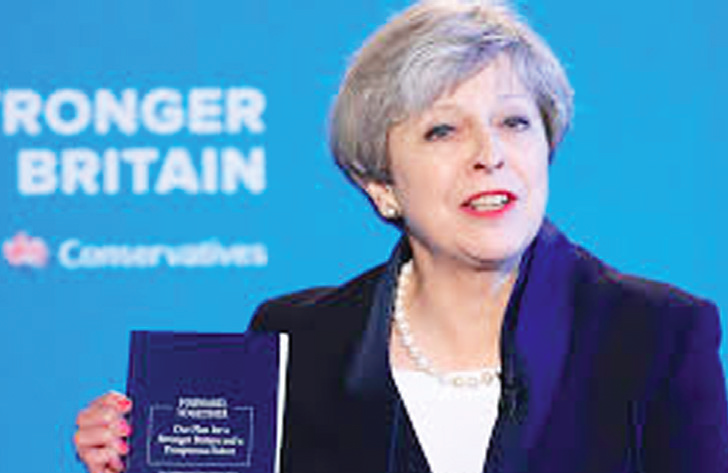
LONDON (TIP): Prime Minister of UK Theresa May, on Thursday, May18, unveiled her Conservative Party’s election manifesto that makes cutting immigration from countries like India, a central poll pledge if her party wins the June 8 general election.
The British PM set out plans to further tighten rules for skilled workers from outside the European Union, which involves anyone employing a non-EU worker to be expected to pay 2,000 pounds for each worker every year. This amount doubles the “Skills Charge” of 1,000 pounds already in force. Non-EU migrants will also be made to pay more for using the state-run National Health Service (NHS).
According to the most recent UK Home Office figures, Indian nationals accounted for 53,575 or 57 per cent of skilled work visas granted in 2016, with US nationals the next largest group at 9,348.
Prime Minister Theresa May has promised a “mainstream government that would deliver for mainstream Britain”. Launching the Conservative manifesto in Halifax, Mrs. May said a strong economy and delivering Brexit were top priorities.
She said: “We must take this opportunity to build a great meritocracy in Britain. It means making Britain a country that works, not for the privileged few, but for everyone.”
She said there were five priorities: a strong economy, facing up to the consequences of Brexit and a changing world, tackling “enduring” social divisions, responding to the. challenges of an ageing society and harnessing the power of fast-changing technology.
Manifesto measures include:
● Balancing the budget by 2025
● Increasing the national living wage to 60% of the median earnings by 2020
● Restating the commitment to bring net immigration down to tens of thousands a year
● Increasing NHS spending each year to £8bn a year extra by 2022
● Increasing the amount levied on firms employing migrant workers
● A pledge that a referendum on Scottish independence cannot take place until the Brexit process is completed
● Scrapping winter fuel payments to better-off pensioners – at the moment, all pensioners qualify for one-off payments of between £100 and £300 each winter
● A reduction of the so-called “triple lock” on pensions to a “double lock” with the state pension to rise by the higher of average earnings or inflation – but to no longer go up by 2.5% if they are both lower than that
● An extra £4bn on schools in England by 2022 – partly funded by an end to the current provision of free school lunches for all infant pupils in England
● Scrapping the ban on setting up new grammar schools
● Universities charging maximum tuition fees will have to sponsor academies or help found free schools
● A free vote in the Commons to be held on repealing the ban on fox hunting
On executive pay, the manifesto says packages should be approved by an annual vote of shareholders, and companies will have to publish details on how it compares to the pay of the workforce in general. There are also plans to ensure worker representation at board level.
Mrs. May was asked whether her plans spelled a move away from Conservative policies of recent years, and in particular those of Margaret Thatcher. She said: “Margaret Thatcher was a Conservative, I am a Conservative, this is a Conservative manifesto.” She later added: “There is no May-ism. There is good solid Conservatism, which puts the interests of the country and the interests of ordinary working people at the heart of everything we do in government.” (Sources: BBC / PTI)
Trump decries special counsel’s appointment as ‘single greatest witch-hunt’ in US history
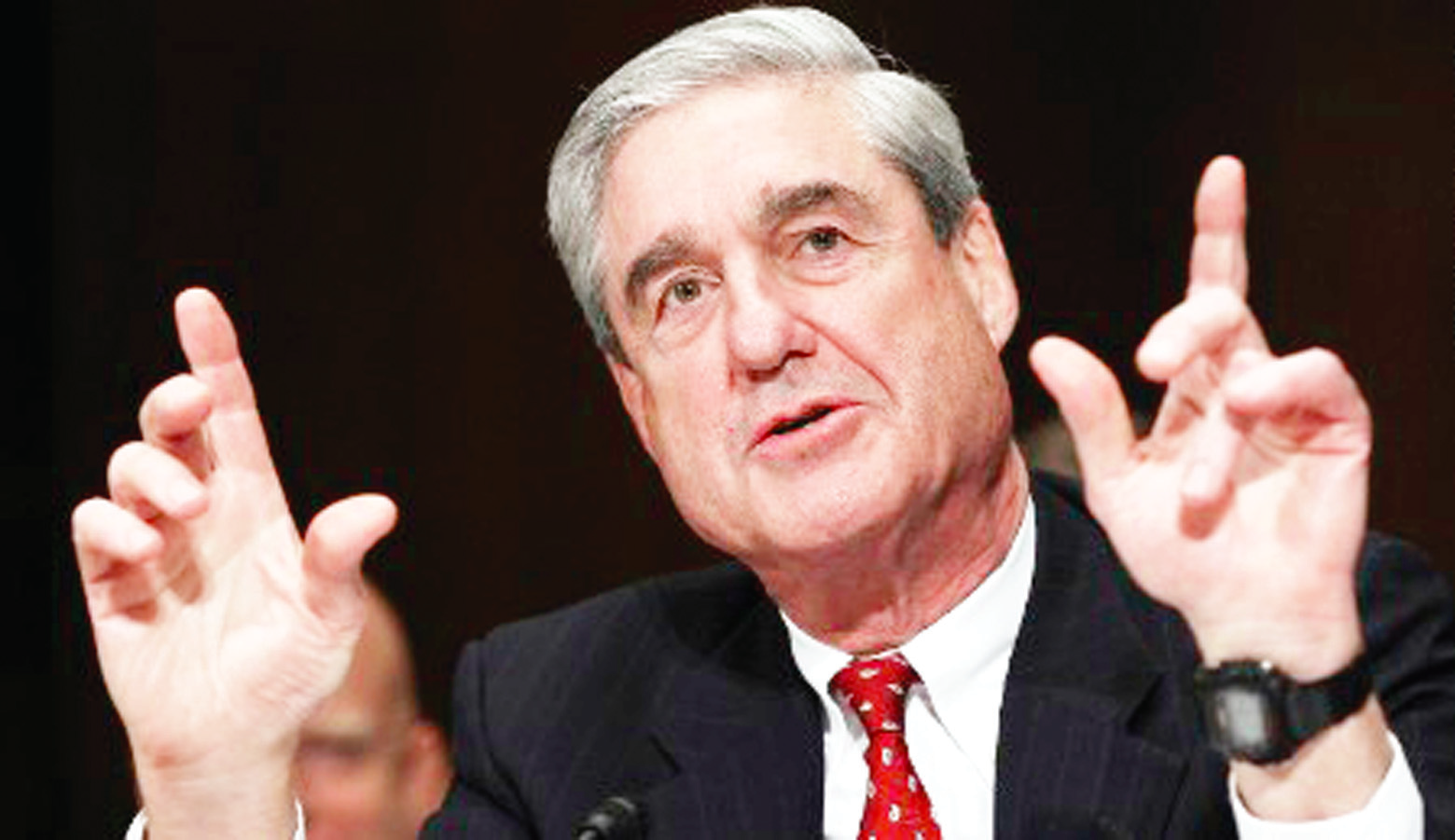
WASHINGTON (TIP): Former FBI director Robert Mueller has been appointed as special counsel to investigate alleged Russian interference in the 2016 US election and possible collusion between President Donald Trump’s campaign and Moscow.
The decision by deputy attorney general Rod Rosenstein to appoint Mueller, 72, as special counsel came on Wednesday, May 17, following a week of turmoil for the White House after Trump fired FBI Director James Comey, who had been leading a federal probe into the matter.
Rosenstein said he had taken the decision “to ensure a full and thorough investigation of the Russian government’s efforts to interfere in the 2016 presidential election,” including “any links and/or coordination between the Russian government and individuals associated with the campaign of President Donald Trump.”
President Donald Trump on Thursday, May18, decried the appointment of a special counsel to lead the Russia probe as “the single greatest witch-hunt” in US history, hours after he said he looked forward to a thorough investigation.
In the face of rising pressure from Capitol Hill, the US Justice Department named former FBI Director Robert Mueller on Wednesday as special counsel to investigate alleged Russian interference in the 2016 US election and possible collusion between Trump’s campaign and Moscow.
Trump said in a statement on Wednesday night that “a thorough investigation will confirm what we already know – there was no collusion between my campaign and any foreign entity.” In a pair of Twitter posts on Thursday morning, Trump made clear he was unhappy with the latest development to roil his administration. “With all of the illegal acts that took place in the Clinton campaign & Obama Administration, there was never a special councel appointed!” Trump wrote, misspelling the word counsel as he referred to former President Barack Obama and former presidential candidate Hillary Clinton. “This is the single greatest witch hunt of a politician in American history!”
The comments mirrored a speech by Trump on Wednesday, before Mueller’s appointment was announced, in which he said no politician in history “has been treated worse or more unfairly.”
Considering the unique circumstances of this matter, Rosenstsein said a special counsel is necessary in order for the American people to have full confidence in the outcome. “Special Counsel Mueller will have all appropriate resources to conduct a thorough and complete investigation, and I am confident that he will follow the facts, apply the law and reach a just result,” he added.
Mueller served as FBI director for 12 years after his nomination by President George W Bush in 2001. Cutting across party lines, top American lawmakers welcomed Mueller’s appointment for the investigation.
“The appointment of former FBI director Robert Mueller as special counsel for the Russia investigation is a positive development and will provide some certainty for the American people that the investigation will proceed fairly and free of political influence,” Senator Richard Burr said and Mark Warner, chairman and ranking member of Senate Select Committee on Intelligence, said.
Democratic Senator from Minnesota Al Franken said appointing Mueller is an important step that will help restore the public trust and result in a thorough and comprehensive investigation.
Mueller, a no-nonsense man Known by some as “Bobby Three Sticks” because of his full name – Robert Mueller III, the former FBI director is famous for his no-nonsense style and independence in high-profile government investigations.
Diplomatic victory for India as ICJ asks defiant Pakistan to implement ruling
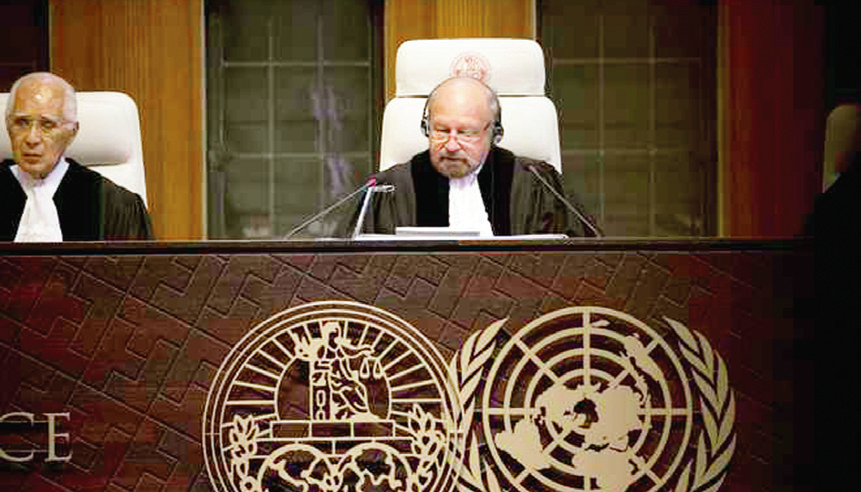
NEW DELHI (TIP): The International Court of Justice (ICJ), on May 18, stayed the execution of Kulbhushan Jadhav until it rules on the merits of the case. The stay passed unanimously by the court is a diplomatic victory for India as it upheld its argument that Pakistan has violated the Vienna Convention. For Pakistan, it comes as a setback since the court did not accept its arguments that the 2008 bilateral agreement between India and Pakistan on consular access takes precedence over the Vienna Convention.
While India welcomed the decision and said it was a matter of relief for everyone, Pakistan was quick to say that the United Nations’ highest court has no jurisdiction in national security matters.
The Ministry of External Affairs said the ICJ order was “unanimous, favorable, clear and unambiguous”. MEA spokesperson Gopal Baglay said the “provisional relief provided by the ICJ is the first step towards ensuring justice”.
A statement by the office of Pakistan’s attorney general was in line with the position taken by their foreign office that the order of the ICJ did not change the status of Jadhav in any manner. “We are determined to pursue this case to its logical end,” said the statement.
Pakistan foreign office spokesman Nafees Zakaria said India had been “trying to hide its real face” by taking the case of Jadhav to the ICJ.
Kulbhushan Jadhav gets reprieve
The ICJ, in its stay today, upheld India’s argument on the “urgency” of the issue. “Without prejudging the result, the ICJ considers that the risk or irreparable prejudice, the mere fact that Jadhav is under such a sentence and might be executed, is sufficient to demonstrate such a risk. There is considerable uncertainty as to when the decision on any appeal is rendered or when Jadhav will be executed,” said ICJ President Judge Ronny Abraham.
What might make matters tough for Pakistan are the court’s observations that its orders are legally binding. Pakistan claims to have arrested Jadhav from the restive Balochistan in March last year for “espionage”. While India has accepted that Jadhav is a former naval officer, it has rubbished claims of his being a spy. “Satisfied at ICJ order staying the execution of Kulbhushan Jadhav. Satisfied at the efforts of Harish Salve for presenting Indian case effectively. -Narendra Modi, PM
“The ICJ order has come as a great relief…We are grateful to Harish Salve for presenting India’s case so effectively before ICJ. I assure that under the leadership of PM Modi, we will leave no stone unturned to save (him). -Sushma Swaraj, External Affairs Minister
“As a lawyer for 40 years, you get a feel of how judges are reacting. I felt a positive energy when I was arguing the case. I felt judges were connecting. I felt gratified. I did not feel that connection when the other side was arguing. -Harish Salve,
LONDON/SINGAPORE/TORONTO (TIP): May 12 “unprecedented” ransomware cyberattack has hit as many as 200,000 victims in over 150 countries, Rob Wainwright, the head of EU police agency Europol said on Sunday. He warned of possible fresh disruptions when workers switch on computers at the start of the working week.
Monday was expected to be a busy day, especially in Asia which may not have seen the worst of the impact yet, as companies and organisations turned on their computers.
“Expect to hear a lot more about this tomorrow (Monday) morning when users are back in their offices and might fall for phishing emails”, or other as yet unconfirmed ways the worm may propagate said Christian Karam, a Singapore-based security researcher.
Targets both large and small have been hit. The countries that were hit included India. Investigators are looking for those behind the hack that affected systems at banks, hospitals and government agencies globally, media reports said. Technical staff scrambled on Sunday to patch computers and restore infected ones.
The threat is “escalating” as cyber experts warned that another attack was imminent in coming days. Technical staff scrambled on Sunday to patch computers and restore infected ones.
Experts said the spread of the virus, dubbed WannaCry, which locked up more than 200,000 computers — had slowed, but the respite might only be brief. New versions of the worm are expected.
The infected computers are largely out-of-date devices that organisations deemed not worth the price of upgrading or, in some cases, machines involved in manufacturing or hospital functions that proved too difficult to patch without disrupting crucial operations. “The latest count is over 200,000 victims in 150 countries and many of those will be businesses, including large corporations,” said Rob Wainwright, the head of EU police agency Europol.
After infecting the computers, the virus displayed messages demanding a payment of $300 in Bitcoin in exchange for the locked files.
Account addresses hardcoded into the WannaCry software code showed the attackers received $32,500 in anonymous bitcoin till Sunday, but that amount could rise as more victims rush to pay ransoms of $300 or more just one day before the deadline expires. (Agencies)
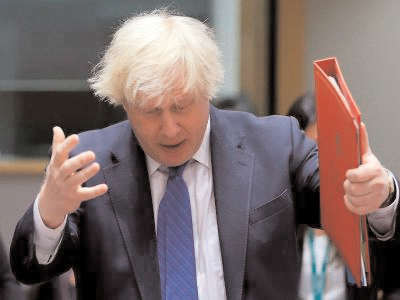
LONDON (TIP): UK Foreign Secretary Boris Johnson had a tough time on May 17 on the election campaign trail when a British Sikh woman admonished him for talking about whiskey during a stop at a gurdwara in the city of Bristol. Johnson, whose wife is of Sikh origin, was forced to apologise for raising the issue of high tariffs on scotch whiskey imports into India, which could be brought down if a free trade deal is struck between India and the UK post-Brexit.
“He was simply making the point that a free trade deal with, for example, India could be huge for both sides,” said a spokesperson for the senior Cabinet minister. “He pointed out that in India billions of litres of whiskey are consumed every year but there is a 120 per cent (customs duty) on imports of scotch whiskey and wouldn’t it be great if we could have free trade.
“One lady expressed her views based on a personal situation but the other 30 attendees warmly welcomed his remarks. He said he was sorry to hear of her personal story but that was all,” he said.
Johnson had stopped over at the Shri Guru Nanak Prakash Singh Sabha to show his support for Bristol East Conservative candidate Theo Clarke. He was presented with a ceremonial turban and given a tour of the gurdwara before his remarks created a stir.
“I wouldn’t be wanting to put somebody in power who wants to put more alcohol in India, which is causing lots of problems at the moment,” said a British Sikh woman, named locally as Balbir Kaur. “I am a practicing Sikh and to me that is absolutely outrageous,” she said.
He was also put on the spot when he stressed that the Conservative party considered the matter of alleged British involvement in Operation Blue Star in 1984 “closed”.
An independent inquiry into the issue has been included by the Opposition Labour party in its election manifesto released on Tuesday.
Johnson, the former London mayor known for his lighthearted speeches, has been using recent canvassing opportunities within the Indian diaspora communities to highlight the prospects of an FTA between India and the UK.
“Whenever we go to India, we have to pack bottles of whiskey because as you know there is a duty of 150 per cent in India on scotch whiskey. But imagine what we could do if there was a free trade deal with India,” he had said at a UK-India Awards ceremony in London last week.
Britain’s ministers have been on a hectic campaign schedule in the run up to the June 8 general election and the nearly 1.5- million-strong Indian diaspora is seen as an attractive votebank.
The Liberal Democrat party was quick to react to the latest controversy, claiming it shows the Tory party’s “bungling” approach.
Lib Dem shadow foreign secretary Tom Brake said: “This crass misjudgement has shown Boris Johnson is incapable of representing his own party at home, let alone representing Britain abroad. It doesn’t bode well for all the trade deals the Brexiteers have promised.”
“The British people don’t have to settle for bungling Boris and Theresa May’s risky and extreme version of Brexit. The Liberal Democrats will give people a say on the Brexit deal in a referendum, with the choice to remain in Europe.” (PTI)
TEHRAN, IRAN (TIP): Iranians began voting May 19 in the country’s first presidential election since its nuclear deal with world powers, as incumbent Hassan Rouhani faced a staunch challenge from a hard-line opponent over his outreach to the wider world.
The election is largely viewed as a referendum on the 68- year-old cleric’s more moderate policies, which paved the way for the nuclear accord despite opposition from hardliners. Economic issues also will be on the minds of Iran’s over 56 million eligible voters as they head to more than 63,000 polling places across the country. The average Iranian has yet to see the benefits of the deal, which saw Iran limit its contested nuclear program in exchange for the lifting of some sanctions.
In the election, Rouhani has history on his side. No incumbent president has failed to win re-election since 1981, when Ayatollah Ali Khamenei, the current supreme leader and most powerful man in Iran, became president himself. That doesn’t mean it will be easy, however. Rouhani faces three challengers, the strongest among them hardline cleric Ebrahim Raisi, 56.
Raisi, a law professor and former prosecutor who heads an influential religious charitable foundation with vast business holdings, is seen by many as close to Khamenei. Raisi has even been discussed as a possible successor to him, though Khamenei has stopped short of endorsing anyone. Raisi won the support of two major clerical bodies and promised to boost welfare payments to the poor. His populist posture, anti-corruption rhetoric and get-tough reputation bolstered by his alleged role condemning inmates to death during Iran’s 1988 mass execution of thousands of political prisoners are likely to energize conservative rural and working-class voters. (AP)
MILAN (TIP): Officials say an ancient ornamental bronze stud has been stolen from an exhibit inside the Pompeii archaeological site.
The 6th century stud was one of four that decorated a reproduction of an ancient door that is part of a special exhibit “Pompeii and the Greeks.” Pompeii’s director, archaeologist Massimo Osanna, said Thursday that the stud’s removal from beneath an acrylic panel would have taken time to avoid detection by on-site security.
Officials think it was taken during public visiting hours, and police are reviewing video surveillance. The area has been closed to visitors. The 7.3-centimeter stud belonging to a museum in Basilicata was insured for 300 euros ($333.)
The Pompeii archaeological site preserves the ruins of an ancient Roman town that was destroyed when Mount Vesuvius erupted in A.D. 79. (AP)
LONDON (TIP): Civil aviation and security authorities in London have claimed that Border Force (BF) officers had found a “quantity of heroin” on board a Pakistan International Airlines (PIA) flight that landed at Heathrow Airport on May 15.
They said National Crime Agency (NCA) officials were investigating the case after the seizure of narcotics from the plane and that no arrests were made. They said that the investigation is still ongoing, reports the Dawn.
The daily also quoted PIA spokesperson Mashhood Tajwar, as saying that British authorities had “thoroughly searched” and detained the flight crew after they landed at Heathrow Airport.
Flight 785 from Islamabad to London had landed at 2:50 p.m. on Monday. Upon landing, as passengers disembarked, the flight crew and aircraft were searched by the authorities, the spokesperson said.
Fourteen crew members were released after being detained for nearly two hours by British authorities, Tajwar said, adding that no information was given at that time about why the crew was detained.
The PIA flight returned to Pakistan at 11:30 a.m. on Tuesday. (ANI)
SEOUL (TIP): North Korea’s missile program is progressing faster than expected, South Korea’s defense minister said on May 15, hours after the UN Security Council demanded the North halt all nuclear and ballistic missile tests and condemned Sunday’s test-launch.
The reclusive North, which has defied all calls to rein in its weapons programs, even from its lone major ally, China, has been working on a missile, mounted with a nuclear warhead, capable of striking the US mainland. US President Donald Trump’s administration has called for an immediate halt to Pyongyang’s provocations and has warned that the “era of strategic patience” with North Korea is over. US Disarmament Ambassador Robert Wood said on Tuesday China’s leverage was key and that it could do more.
South Korean defense minister Han Min-koo told parliament Sunday’s test launch was “successful in flight”. “It is considered an IRBM (intermediate range ballistic missile) of enhanced caliber compared to Musudan missiles that have continually failed,” he said, referring to a class of missile designed to travel up to 3,000 to 4,000km.
Asked if North Korea’s missile program was developing faster than the South had expected, he said: “Yes.”The North’s KCNA news agency said Sunday’s launch tested its capability to carry a “large-size heavy nuclear warhead”. Its ambassador to China said in Beijing on Monday it would continue such test launches “any time, any place”.Trump and new South Korean President Moon Jae-in will meet in Washington next month, with North Korea expected to be high on the agenda, the South’s presidential Blue House said.
Moon met Matt Pottinger, overseeing Asian affairs at the US National Security Council, on Tuesday and said he hoped to continue to have “sufficient, close discussions” between Seoul and Washington, the Blue House press secretary said at a briefing.
‘FURTHER SANCTIONS POSSIBLE’:
In a unanimously agreed statement, the 15-member UN Security Council said it was of vital importance that North Korea show “sincere commitment to denuclearization through concrete action and stressed the importance of working to reduce tensions”.
“To that end, the Security Council demanded the Democratic People’s Republic of Korea conduct no further nuclear and ballistic missile tests,” the council said, adding that it was ready to impose further sanctions on the country.
The statement also condemned an April 28 ballistic missile launch by Pyongyang. Following that launch, Washington began talks with China on possible new UN sanctions. Traditionally, the United States and China have negotiated new measures before involving remaining council members. (Reuters)
BEIJING (TIP): The China-made attack helicopter Z-19E made its deput flight from the Harbin airport on May 18 marking a major step towards the country’s entry into the global market for combative choppers.
Also called the “Black Whirlwind,” the Z-19E, which took the maiden flight on Thursday, is the first export-oriented attack helicopter developed by the AVIC Harbin Aircraft Industry Group.
Based on the Z-19’s design, the 19E can be used in quick response, low-impact and frequent attack missions, the China National Radio reported.
Deputy chief designer Li Shengwei said the helicopter is equipped with safety features to improve the pilot’s survival rate.
“The Z-19E and Z-9 are similar in many respects,” Li said. In terms of manoeuvrability and functions, the Z-19E meets international standards and its operating interface is in English, he said.
“The Z-19E has strong market potential as some of its components are compatible with other countries’ military systems,” Song Zhongping, a military expert who served in the PLA Rocket Force, told the state-run Global Times.
Song also noted that the helicopter would fare well in the global market. (AP)
TOKYO (TIP): The Japanese government on May 19 approved a one-off bill allowing ageing Emperor Akihito to step down from the Chrysanthemum Throne, in the first such abdication in two centuries.
Prime Minister Shinzo Abe’s cabinet signed off on the legislation, Chief Cabinet Secretary Yoshihide Suga told reporters. It will now be sent to parliament for debate and final approval.
Reports of the 83-year-old Akihito’s desire to retire surprised Japan when they emerged last July.
In August he publicly cited age and declining health, which was interpreted as his wish to hand the crown to his eldest son, Crown Prince Naruhito.
But current Japanese law has no provision for abdication, thus requiring politicians to craft legislation to make it possible.
The status of the emperor is highly sensitive in Japan given its 20th century history of war waged in the name of Akihito’s father Hirohito, who died in 1989.
No abdication is expected until at least the end of 2018, according to reports. (AFP)
BEIJING (TIP): China says it has reached agreement with the 10 countries of the Association of Southeast Asia Nations on the rough outline of a legally binding code of conduct designed to prevent clashes in the strategic South China Sea.
State media on Friday quoted Vice Foreign Minister Liu Zhenmin as saying that the agreement reached the day before laid a “solid foundation” for further negotiations.
Liu said the text of the framework agreement would remain secret and projected no date for finalizing the code of conduct.
China and the members of ASEAN committed 15 years ago to signing a code of conduct, but progress has been slow amid disputes over the body of water that China claims virtually in its entirety. (AP)
SEOUL (TIP): South Korean President Moon Jae-in said on May 14 there was a “high possibility” of conflict with North Korea, which is pressing ahead with nuclear and missile programmes it says it needs to counter US aggression.
The comments came hours after the South, which hosts 28,500 US troops, said it wanted to reopen a channel of dialogue with North Korea as Moon seeks a two-track policy, involving sanctions and dialogue, to try to rein in its neighbour.
North Korea has made no secret of the fact that it is working to develop a nuclear-tipped missile capable of striking the US mainland and has ignored calls to halt its nuclear and missile programmes, even from China, its lone major ally.
It conducted its latest ballistic missile launch, in defiance of UN Security Council resolutions, on Sunday which it said was a test of its capability to carry a “large-size heavy nuclear warhead”, drawing Security Council condemnation.
“The reality is that there is a high possibility of a military conflict at the NLL (Northern Limit Line) and military demarcation line,” Moon was quoted as saying by the presidential Blue House. He also said the North’s nuclear and missile capabilities seem to have advanced rapidly recently but that the South was ready and capable of striking back should the North attack .
Moon won an election last week campaigning on a more moderate approach towards the North and said after taking office that he wants to pursue dialogue as well as pressure. But he has said the North must change its attitude of insisting on pressing ahead with its arms development before dialogue is possible. South Korean Unification Ministry spokesman Lee Duk-haeng told reporters the government’s most basic stance is that communication lines between South and North Korea should reopen.
“The Unification Ministry has considered options on this internally but nothing has been decided yet,” said Lee.
NO WORD YET ON THAAD
Communications were severed by the North last year, Lee said, in the wake of new sanctions following North Korea’s fifth nuclear test and Pyongyang’s decision to shut down a joint industrial zone operated inside the North. North Korea and the rich, democratic South are technically still at war because their 1950-53 conflict ended in a truce, not a peace treaty. The North defends its weapons programmes as necessary to counter US hostility and regularly threatens to destroy the United States. Moon’s envoy to the United States, South Korean media mogul Hong Seok-hyun, left for Washington on Wednesday. Hong said South Korea had not yet received official word from the United States on whether Seoul should pay for an antimissile US radar system that has been deployed outside Seoul.
US President Donald Trump has said he wants South Korea to pay for the Terminal High Altitude Area Defense (THAAD) anti-missile system which detected Sunday’s test launch. China has strongly opposed THAAD, saying it can spy into its territory, and South Korean companies have been hit in China by a nationalist backlash over the deployment.
The United States said on Tuesday it believed it could persuade China to impose new UN sanctions on North Korea and warned that Washington would also target and “call out” countries supporting Pyongyang.
Speaking to reporters ahead of a closed-door UN Security Council meeting, US Ambassador to the United Nations Nikki Haley also made clear that Washington would only talk to North Korea once it halted its nuclear programme. Trump has called for an immediate halt to North Korea’s missile and nuclear tests and US Disarmament Ambassador Robert Wood said on Tuesday that China’s leverage was key and Beijing could do more.
Trump warned this month that a “major, major conflict” with North Korea was possible, and in a show of force, sent the Carl Vinson aircraft carrier strike group to Korean waters to conduct drills with South Korea and Japan.
The US troop presence in South Korea, a legacy of the Korean War, is primarily to guard against the North Korean threat. (AP)
Narrow-mindedness, lack of vision, and an inflated sense of our own place in the world drove this latest tantrum
By Girish Shahane
“Our self-deceptionwouldn’t matter had it not led to India potentially being frozen out of the most important trade architecture in our part of the globe, a chain of highways, rail connections, sea routes and telecommunications facilities that would be particularly helpful to our tragically underdeveloped Northeast”, says the author.
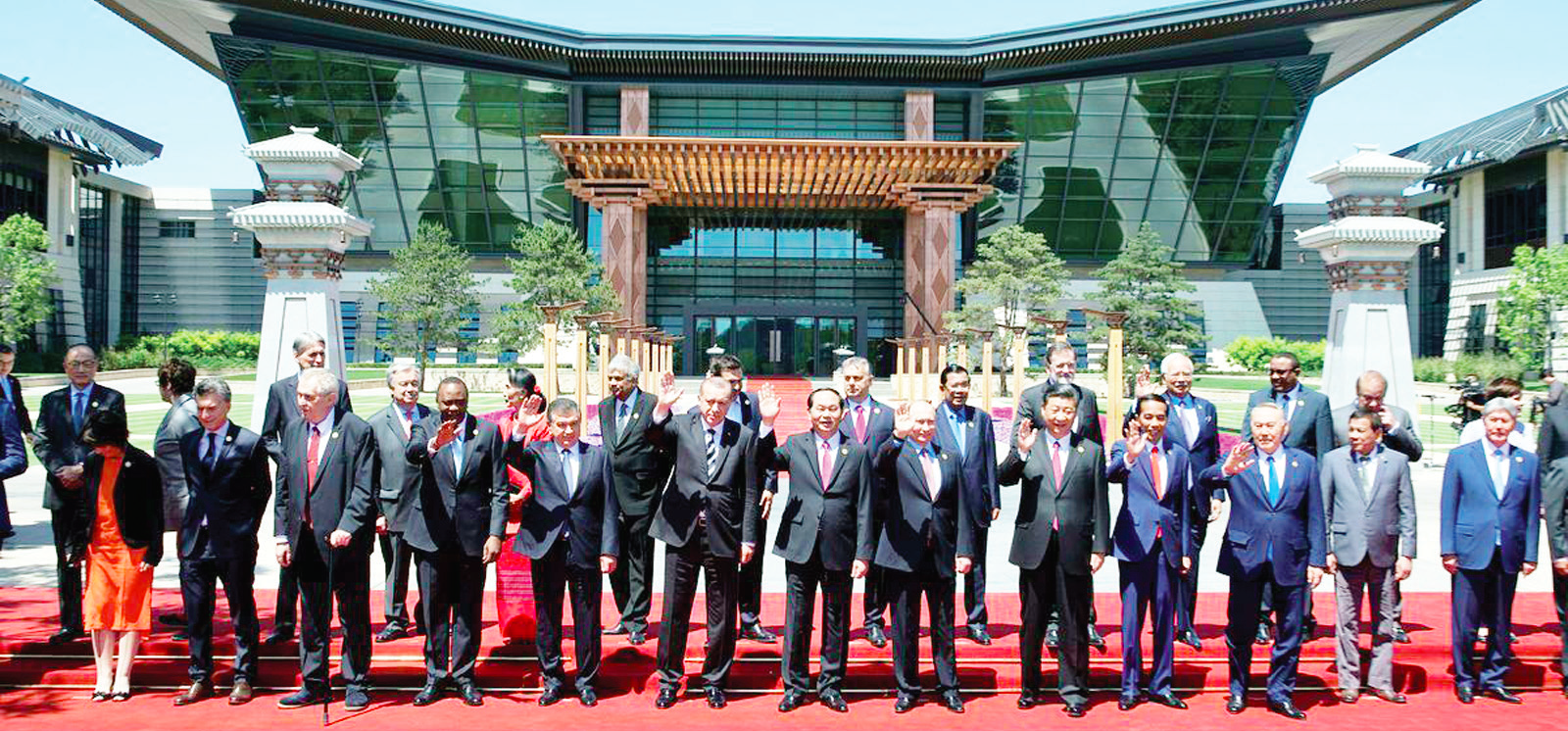
Last week, China hosted a massive summit to spur one of the most ambitious global trade infrastructure initiatives in history. As leaders from across Asia, Africa, Europe and Latin America gathered in Beijing to work on details of the
One Belt, One Road plan, India chose to take its bat and ball and go home. Unfortunately for us, nobody needed India’s bat and ball. Our absence was barely noticed, and our rejection of the initiative will hurt only ourselves.
China’s President Xi Jinping used the summit to claim moral and practical leadership of global free trade for the second time in five months. The first was in Davos last winter, soon after the United States’ counter to China, the Trans-Pacific Partnership, had been capsized by the populist tidal wave that brought Donald Trump to power.
The OBOR plan, as might be expected, was dreamt up primarily as a way for China to continue its growth trajectory for the foreseeable future. The country has overinvested in its own infrastructure, and is afraid its traditional export markets will not support the nation’s continued growth. Its solution to both these profound crises is to offer its expertise in building infrastructure and credit from a newly-minted bank to underdeveloped nations, expanding those markets in the process. By reinventing the Silk Road for the current century, Xi and his colleagues hope to boost the economy of China’s western states, which has lagged behind even as coastal regions have been transformed in the past three decades. If it works, OBOR will be a win-win for all countries concerned. If it doesn’t, China stands to lose the most.
India’s main objection to the OBOR plan is that a segment of it, the China-Pakistan Economic Corridor, passes through parts of the erstwhile Jammu and Kashmir state that India claims as its territory. Claiming land that we haven’t controlled for 70 years, whose residents have never shown any interest in becoming Indian citizens, is an absurd charade played by all our political parties in tandem with our refusal to countenance a negotiated solution to the entire Kashmir issue. We continue to delude ourselves that Gilgit-Baltistan is part of India, but can do nothing about it beyond punishing cartographers who suggest otherwise, while the world community looks on in bemusement like an adult faced with a child who demands acknowledgement of an imaginary friend.
LOSS AVERSION
One Belt, One Road is a chain of highways, sea routes and telecom facilities. Image courtesy/ Chatham House
Our self-deception wouldn’t matter had it not led to India potentially being frozen out of the most important trade architecture in our part of the globe, a chain of highways, rail connections, sea routes and telecommunications facilities that would be particularly helpful to our tragically underdeveloped Northeast. Why do we seek to engage in a symbolic fight rather than focus on what will provide concrete benefits to Indians? Hallucinatory nationalism is part of the answer, but not the whole story. It is complemented by loss aversion. The strength of that impulse has been demonstrated repeatedly by psychologists and economists. The pain we feel after losing ten rupees outweighs our joy at gaining the same amount. In fact, it’s likely that the pain of losing ten rupees outweighs the joy of gaining twice that amount. This imbalance becomes crucial in political calculations, and is bolstered by three related factors.
First, the causes behind loss tend to be more specific and easily definable than the causes behind gains, a phenomenon proven by the backlash against globalisation. Second, the groups that lose as a result of a policy and those who gain are quite different. Third, pain often precedes gain and comes as a sharp shock, while gain is spread out over years and even generations. In the final equation, you get a set of people with a definable loss, who feel their pain sharply, and feel it right away, and another lot that might be far larger but whose lives improve over a long period of time for reasons that aren’t entirely clear, whose joy does not measure up to the pain of commensurate loss. It’s no wonder that politicians tend not to risk antagonising the first group even if it means denying the second far greater reward.
That said, the Narendra Modi government could have sent an envoy to the OBOR summit without much political loss. A few hyper-nationalists would have been pained by our tacit acceptance of Pakistan’s flagrant attempt to better the lot of its citizens. On the other hand, since China helped build the Karakorum Highway decades ago, it’s hard to see how its planned upgrade threatens India’s fictitious sovereignty over the region. No, it wasn’t fear of a backlash or an understanding of loss aversion that drove our latest tantrum. It was narrow mindedness, lack of vision, and an inflated sense of our own place in the world.
(Source: Scroll.in)
Signup to our Newsletter!
Don’t miss out on all the happenings around the world