Year: 2017

  • Sri Lanka allays India’s concerns  renegotiates port deal with China

    Sri Lanka allays India’s concerns renegotiates port deal with China

    COLOMBO (TIP): Sri Lanka’s cabinet has cleared a revised agreement for its Chinese-built southern port of Hambantota on July 24, the government said, after terms of the first pact sparked widespread public anger in the island nation.

    The port, close to the world’s busiest shipping lanes, has been mired in controversy ever since state-run China Merchants Port Holdings, which built it for $1.5 billion, signed an agreement taking an 80 per cent stake.

    Under the new deal, which Reuters has examined, the Sri Lankan government has sought to limit China’s role to running commercial operations at the port while it has oversight of broader security.

    Chinese control of Hambantota, which is part of its modern-day “Silk Route” across Asia+ and beyond, as well as a plan to acquire 15,000 acres (23 sq miles) to develop an industrial zone next door, had raised fears that it could also be used for Chinese naval vessels.

    Sri Lankans demonstrated in the streets at the time, fearing loss of their land, while politicians said such large scale transfer of land to the Chinese impinged on the country’s sovereignty.

    Details of the new agreement have not yet been made public. But according to parts of the document seen by Reuters, two companies are being set up to split the operations of the port and allay concerns, in India mainly but also in Japan and the United States, that it won’t be used for military purposes. (Reuters)

  • Pakistani council orders revenge rape of 16-year-old girl

    Pakistani council orders revenge rape of 16-year-old girl

    ISLAMABAD (TIP): Pakistani police have arrested 25 members of an informal village council accused of ordering the rape of a 16-year-old girl as revenge for her brother’s alleged sexual assault of another girl.

    The Supreme Court also requested a report on the case, which echoed a notorious case from 2002 in which another teenager was gang-raped on a local council’s order.

    “A total of 29 people were involved in this ghastly crime, and we have 25 of them in our custody,” Multan City Police Officer Ahsan Younus told Reuters by telephone on July 27.

    Earlier this month, a local council in the southern city of Multan was called after a family accused a 16-year-old boy of raping a 13-year-old neighbour. The council ruled that the sister of the boy should be handed over to the victim’s brother to be raped. The punishment was carried out on July 17 after her family handed the girl over.

    The case came to light when both families filed criminal charges with police accusing the other family’s son of rape. Questioning both sides in the cases, however, soon revealed the role of the informal village council, Younus said. “All the village council elders who ordered the revenge rape have been arrested,” he said.

    Both the victims and their mothers have been sent to a women’s protection centre, he added. Pakistan has a centuries-old tradition of quick justice handed down by gatherings of local elders, known as jirgas or panchayats, seen by many villagers as preferable to the often cumbersome and corrupt formal legal system. In most of the country, jirgas are tolerated but not recognised by the formal courts and police.

    The jirgas and the practice of “revenge rape” drew international attention in 2002 when a woman named Mukhtaran Mai was ordered gang-raped by a local council for a male relative’s alleged crime.

    Mai took the rare step of filing criminal charges against her attackers, and six men were convicted and sentenced to death later that year, though five of them were later freed on appeal.

    Mai went on to become a high-profile campaigner for women’s rights in Pakistan. “Another Tribe Court (panchayat) in south Punjab Multan and another girl was raped. We are still in 2002,” Mai said on her official Twitter account this week.

    Speaking to Reuters by telephone, Mai denounced the revenge rape. “If there were any justice in the panchayat, they should have shot the rapist. Why punish an innocent girl instead?” (reuters)

  • Pakistan SC’s verdict on Nawaz Sharif in Panamagate

    Pakistan SC’s verdict on Nawaz Sharif in Panamagate

    ISLAMABAD (TIP): Pakistan’s Supreme Court is pronouncing its verdict on Nawaz Sharif in the Panamagate case in which he and his family are accused of corruption. Stay with us for latest updates.

    Meanwhile, interior minister Chaudhry Nisar Ali Khan on Thursday said that he would resign and quit politics after the Supreme Court judgment on the Panamagate case.

    Nawaz Sharif leads Pakistan’s most powerful political family and the ruling PML-N party. Sharif, who has been the prime minister of Pakistan for a record three time, faces the risk of being disqualified if the court finds him guilty of corruption and money laundering.

    What is Panamagate

    The scandal is about alleged money laundering by Sharif in 1990s, when he twice served as prime minister, to purchase assets in London. The assets surfaced when Panama Papers leak last year revealed that they were managed through offshore companies owned by Sharif’s children.

  • Beijing sends conciliatory signals after Doval’s first meeting with his Chinese counterpart Yang Jiechi

    Beijing sends conciliatory signals after Doval’s first meeting with his Chinese counterpart Yang Jiechi

    BEIJING (TIP): In the first official meeting between top Indian and Chinese officials since the Doklam stand-off+ became public, national security adviser Ajit Doval met state councillor Yang Jiechi here on July 27, offering the possibility of serious diplomatic efforts to deescalate the confrontation.

    Yang, who as China’s state councillor overseeing foreign affairs occupies a powerful position in the state council, is the Chinese nominee in the India-China special representative level dialogue with Doval. An influential post, the state councillor is a member of the state council.

    Indications of how the bilateral meeting went could be gleaned by the commentary released by the official Xinhua news agency which sent out a conciliatory signal before Doval is expected to meet Chinese president Xi Jinping on Friday. It spoke of the need to enhance mutual trust as the two countries are “not born rivals”.

    The comments released by the official Xinhua news agency made a strong plea to avoid the possibility of a war. “Most economies, including those in the West, will find themselves negatively affected by an India-China war in a globalised and intertwined world today,” it said. In Delhi, the Indian government reminded China of the agreements on peace and tranquility that go back to 1993.

    Yang also held separate meetings with security officials of three other countries on the sidelines of a security dialogue of BRICS nations comprising Brazil, Russia, India, China and South Africa.

    He discussed issues concerning bilateral relations, international and regional issues and multilateral affairs with the visiting security officials, the official Xinhua news agency said.

    The remarks are a contrast to the hectoring tone in the comments published in publications like Global Times that are seen to reflect the views of the government.

    China’s official spokespersons have accused India of trespassing into Chinese territory, ignoring India’s protests that the face-off near the Sikkim-Tibet-Bhutan trijunction has been caused by unilateral attempts by China to alter the ground position.

    There are signs that the two neighbours might be able to scale down tensions that have spiked due to the military muscle flexing over China’s bid to build a road through a plateau in Bhutanese territory.

    This is the first time in weeks that the official media ran a commentary without demanding withdrawal of Indian troops from the disputed Doklam region. China has so far been insisting that troop withdrawal is a pre-condition to a “meaningful dialogue”.

    Doval reached Beijing on Thursday ahead of his planned meetings with Chinese President Xi Jinping and state counsellor Yang Jiechi on Friday. “The recent border issue between the two countries shows a lack of strategic trust on the Indian side,” Xinhua said.

    It is not China but a set of problems common to all developing countries like corruption, a lack of quality education and healthcare that is holding back India.

    “India must understand that China wishes what’s good for the Indian people and would love to see a strong India standing shoulder by shoulder with China,” Xinhua, which reflects the government’s thinking said, giving an emotional touch to the vexed relationship.

    Doval’s formal purpose of visiting Beijing is to attend a security dialogue of BRICS nations. He is expected to discuss the border standoff with Chinese leaders in separate meetings. Chinese foreign ministry has said that bilateral meetings are usually held during BRICS meetings and indirectly confirmed meetings on the border issue with Doval.

    “Instead of being rivals, India and China have much more common ground, common interests and common aspirations. Both as developing countries, the two need to work together on important issues like fighting climate change, protectionism and the financial privileges of Washington,” Xinhua said.

    It further said, “Hopefully, wisdom will guide the two countries to common prosperity. There is more than enough room for them to co-exist and thrive in Asia and in the world”.

    “Both China and India need to enhance communication and nurture trust between them, first by recognizing that the two are not born rivals and that harboring ill will against each other is dangerous,” Xinhua added.

  • China steps up warning to  Botswana over Dalai Lama visit

    China steps up warning to Botswana over Dalai Lama visit

    BEIJING (TIP): China stepped up its warning to Botswana on July 27 over a planned visit by exiled Tibetan spiritual leader the Dalai Lama next month, demanding the African nation respect China’s core interests.

    The Dalai Lama, reviled by Beijing as a dangerous separatist, is expected to address a human rights conference in the capital, Gaborone, on August 17-19 and will also meet Botswana’s president. China is a major investor in Botswana’s economy.

    China has already “clearly” expressed its point of view about the Dalai Lama’s visit, Foreign Ministry spokesman Lu Kang told a daily news briefing. “Issues relating to Tibet concern China’s sovereignty and territory integrity. We demand the relevant country earnestly respect China’s core interests and make the correct political decision on this matter,” Lu said, using stronger language than before on the issue.

    “China will not interfere in other countries’ internal affairs, but will certainly not tolerate another country doing anything that harms China’s core interests,” he added, without elaborating.

    The Dalai Lama, who fled from Tibet into exile in India in 1959 following a failed uprising against Chinese rule, has long been at loggerheads with China, which sent its troops into Tibet in 1950.

    The Dalai Lama, who won the Nobel Peace Prize in 1989, denies he is seeking independence for his Himalayan homeland. He says he is merely seeking greater rights, including religious freedom and genuine autonomy. Visits by the Dalai Lama to foreign countries infuriate China. (Reuters)

  • Wildfires prompt 10,000  evacuations on French Riviera

    Wildfires prompt 10,000 evacuations on French Riviera


    MARSEILLE (TIP): Firefighters evacuated thousands of campers and local residents after a wildfire broke out on France’s tourist-thronged Riviera coast overnight.

    The blaze was the latest of several wind-whipped fires that are ravaging forest and scrubland on the hills and slopes that spill into the Mediterranean sea between the Marseilles and the city of Nice in the southeastern corner of France.

    Not far west of the yacht-filled marinas of Saint-Tropez resort, 10,000 people were evacuated – 3,000 of them from campsites – as a fast-encroaching fire ripped through the hills of La Lodes les Manures, the Lavabo and Bromes.

    “A fast-spreading fire broke out at 22:50 (2050 GMT), burning up about 800 hectares of land,” the local government prefect’s office said in a statement. Hundreds of firefighters fought the blaze with planes and helicopters dropping tonnes of water on the tinder box hills where fires regularly break out in summer time, often as a result of a carelessly discarded cigarette butt.

    Thousands of hectares of land have been devastated by flames since the start of the week, although Tuesday night’s evacuation was far larger than other more minor ones where dozens of people and horses were moved to safety from fasten croaching infernos.

    High winds risked whipping up more fires, said the prefect’s office of the Vary region, where most of the blazes are located. So far there have been no deaths reported in the summertime wildfires, unlike in other countries such as Portugal where they have killed dozens (Reuters)

  • Russia signs deal to use Syria air base for 49 years

    Russia signs deal to use Syria air base for 49 years

    MOSCOW (TIP): President Vladimir Putin has signed a law ratifying a deal with the Syrian government allowing Russia to keep its air base in Syria for almost half a century, official documents show.

    The original deal, signed in Damascus in January, sets out the terms under which Russia can use its Hmeymim air base in Latakia Province which it has used to carry out air strikes against forces opposing President Bashar al-Assad.

    Putin approved the agreement on Wednesday, after the two chambers of the Russian parliament backed it earlier this month, according to the government’s official information portal.

    The document says Russian forces will be deployed at the Hmeymim base for 49 years with the option of extending that arrangement for 25-year periods.

    The base has been at the heart of Moscow’s military foray since it intervened in the conflict in September 2015, helping turn the tide in favour of Assad, one of Russia’s closest Middle East allies. (Reuters)

  • Kremlin warns against harmful new US sanctions on Russia

    Kremlin warns against harmful new US sanctions on Russia

    MOSCOW (TIP): The Kremlin on july 28 warned that new US sanctions on Russia would hit the interests of both sides as Congress gears up to approved fresh punitive measures.

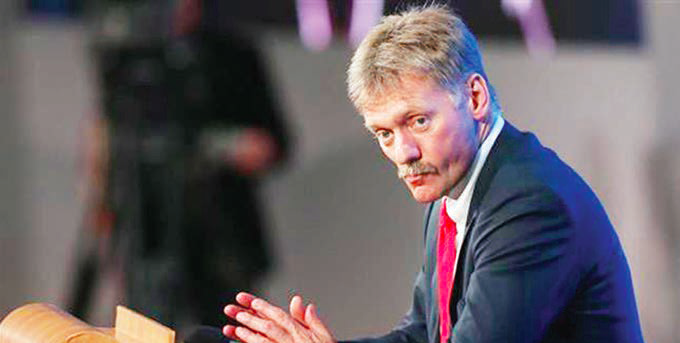
    “We consider such a continuation of the rhetoric of sanctions counter productive and harmful to the interests of both countries,” Kremlin spokesman Dmitry Peskov said. In mid-June, the US Senate overwhelmingly passed tough sanctions, but the text stalled in the House of Representatives, until agreement was reached on Saturday.

    The House is now set to vote Tuesday on a bill that targets Russia — for its alleged meddling in the 2016 presidential election and its annexation of Crimea from Ukraine in 2014 — as well as Iran and North Korea, for its ballistic missile tests. Initially, US President Donald Trump resisted the legislation, which would prevent him from unilaterally easing penalties against Moscow in the future — effectively placing him under Congress’s watch.

    But he seems to be left with little option but to sign off on the move as a political firestorm swirls over potential collusion between his campaign and Russia.

    Peskov said the Kremlin is still waiting and watching to see if Trump will approve the measures, after White House communications director Anthony Scaramucci said the US leader was weighing his decision.

    Before Trump definitively takes a decision it is too early to talk about any potential counter measure from Moscow, Peskov said. Ties between Moscow and Washington have slumped to their lowest since the Cold War as the US slapped sanctions on Moscow over it meddling in Ukraine.

    Russia had hoped that Trump’s election might ease relations between the two sides, but those prospects have dimmed in the face of a major political pushback in Washington. (AFP)

  • THE DIGNIFIED PRESIDENT OF INDIA  PRANAB MUKHERJEE

    THE DIGNIFIED PRESIDENT OF INDIA PRANAB MUKHERJEE

    WHAT MAKES PRANAB MUKHERJEE’S TENURE AS PRESIDENT UNIQUE

    As Pranab Mukherjee exits the Rashtrapati Bhavan to hand over the reins to Ram Nath Kovind – India’s 14th president, it is an appropriate time to look back to steps and actions that were taken by him that made his tenure unique from others

    Ordinances and Mercy petitions

    Pranab Mukherjee’s tenure’s biggest highlight could be the tough stance he took when it came to his judicial powers. Unlike many of his predecessors who seemed to think twice when it came to reviewing mercy petitions, Mukherjee was quite hands on. Of the 34 mercy petitions that were presented to him, he rejected 30, a number which is second only to G Venkataraman. He also promulgated or repromulgated 26 ordinances.

    Peoples president

    Under his tenure, many steps were taken to make Rashtrapati Bhavan closer to the common man. Steps were taken to reduce security checks within the Rashtrapati Bhavan to make it more inclusive for people. Many important events were shifted to the Rashtrapati Bhavan so that the public won’t suffer from security measures due to presidential movement.

    Mukherjee also became the first president to take teaching classes for the school children. An in-residence program aimed at encouraging talented scholars and artists was also set up. The official twitter account of the Rashtrapati Bhavan was launched on July 1, 2014.

    Brought an end to the colonial hangover

    Perhaps one of the greatest achievement of Pranab Mukherjee was the fact that he brought an end to certain practices that were a product of the imperial rule in the country. He ended the practice of using the honorific title ‘His Excellency’ while addressing the President on the first anniversary of his term. Even governors were encouraged to follow this practice.

    Welfare programs

    A Smartgram pilot project was launched on July 2, 2016 with the aim of developing and modernising villages. At the initial stage, five villages from Haryana was included in the program. Under another initiative Mukherjee also launched the 4S initiative ie; samskriti, samagam, sparsh and sanskar aimed at overall welfare of senior citizens and children residing in the estate.

    Re-development of the Rashtrapati Bhavan

    A new museum was established in the estate’s carriage halls and stables building. Roof top solar panels, water harvesting and recycling programmes were initiated in the Bhavan to make it energy efficient and self-reliant. Also, measures were taken to re-introduce the heritage Buggy in the estate after a gap of over three decades. Pranab Mukherjee Public Library was also set up in the estate. This included the cataloguing and bar coding of the vast number of books as part of the EPustakalaya project. Apart from all this, the presidential retreat in Dehradun known as the Rashtrapati Ashiana was also renovated.

    Source: Moneycontrol

    In keeping with tradition, Prime Minister Narendra Modi presented a memento to outgoing
    President Pranab Mukherjee at the farewell hosted by him for the President at Hyderabad
    House , in New Delhi. (Source: PTI)

    Pranab Mukherjee’s tenure as the 13th President of India ended n July 24, bringing to a close a political career spanning nearly five decades in government and in the Congress party, both extremely eventful and hugely successful.

    Pranab Mukherjee’s political journey started in West Bengal in the 1969 by-election in Midnapore when he was the election agent for V K Krishna Menon, who ran as an independent candidate. He caught the eye of Siddhartha Shankar Ray who recommended him to prime minister Indira Gandhi,who gave him a Rajya Sabha seat. Thus at the age of 35, Pranabda entered the Rajya Sabha.

    Within a short period he had gained Mrs Gandhi’sconfidence and became a minister of state in her government.

    In the wake of Rajiv Gandhi’s tragic assasination, the Congress party emerged as the single largest party, but there was no clarity as to who would be Prime Minister.Pranabda was not an MP and PV Narasimha Rao had announced his retirement from active politics. Arjun Singh and Sharad Pawar became prime contenders. But as the number of MPs from south India was large, Narasimha Rao was called out of retirement and chosen to be Prime Minister.

    During Cabinet formation, Narasimha Rao actively consulted his friend and colleague, Pranabda. It appeared certain that Pranabda would become the finance minister. But quite unexpectedly, he was left out of the Cabinet altogether and Dr Manmohan Singh was named finance minister. Pranabda was shocked. As consolation, Narasimha Rao asked Pranabda to take up the deputy chairmanship of the Planning Commission.

    Now when a former finance minister is left out of the Cabinet and sent to the Planning Commission, it clearly signals the end of an active political career. Pranabda told the Prime Minister that he would think about the offer. Narasimha Rao is supposed to have remarked, “Take as much time as you like, but join on Monday.” Narasimha Rao assured Pranabda that he would one day tell him the reason for his exclusion from the Cabinet, but he never did.

    One can describe Pranabda in one word – a survivor. His survival skills in politics are indeed remarkable. After Rajiv Gandhi became prime minister in 1984, he dropped Pranabda from the Cabinet and also from the Congress Working Committee. He was subsequently expelled from the Congress party itself, pushing Pranabda to launch his own party, the ‘Rashtriya Samajwadi Congress,’ in 1986. But his political career had clearly stalled.

    He later admitted he was no mass leader. Within two years, he was back in favour with Rajiv Gandhi and merged his party in the Congress. Despite all the ups and downs, he always bounced back.

    Pranabda is very good at keeping secrets. In fact, Indiraji used to say, “Whenever Pranabda is given any confidential information, it never comes out of his belly.What comes out is only the smoke from his pipe.” His excellent command over the English language, drafting skills, razor-sharp memory, vast knowledge of national and international affairs and mastery of parliamentary procedures made him indispensable in the cabinet and the Party.Whenever any complicated and contentious issue arose in the Cabinet, he was called upon to resolve it. He would invariably be asked to draft various AICC resolutions and chair different party committees.

    In Dr Manmohan Singh’s cabinet,Pranabda was the de facto number two. He was the chairman of more than 95 GoMs and EGoMs (Empowered Group of Ministers). I was a member of many such groups dealing with Enron, spectrum, WTO, Bhopal disaster and disinvestment. One time the issue of amending the law to remove the domicile condition for contesting Rajya Sabha elections came up for discussion. Dr Manmohan Singh was elected from Assam and Pranabda had been once elected from Gujarat. The proposal was accepted after a brief discussion as was the proposal for open voting. I insisted that the same condition be made applicable to the legislative council elections in the states. But Pranabda strongly opposed this and my proposal was not accepted. Unfortunately, “horse trading” in legislative council elections continues unabated.

    Pranabda worked under three Prime Ministers – Indiraji, Narasimha Rao and Dr Manmohan Singh. He is the only finance minister to have presented budgets both before the 1991 reforms in the license permit raj regime as well after the 1991 economic reforms. He took bold decisions after the global economic crisis of 2008 which helped shield the Indian economy. As commerce minister in 1993, Pranabda championed the cause of trade liberalisation. But as India dealt with GATT, especially its intellectual property rights regime, the fear was drug prices would increase. Pranabda’s skilful negotiations not only prevented that from happening, but also charted India’s entry into the WTO.

    The Indo-US nuclear deal over 2005-8 was a landmark achievement of the Manmohan Singh government.Both countries wanted to get India out of the discriminatory nuclear world order, facilitate India’s participation in nuclear commerce and allow it benefits of clean nuclear energy. But because the Left parties supported the UPA government in power and the Left was against India joining hands with the US, a coordination committee between the UPA and the Left parties was constituted under Pranabda’s chairmanship – and myself as its convenor. The Committee succeeded in obtaining the consent of the Left, thanks only to the skilful leadership of Pranabda and his personal equation with its leaders.

    He fulfilled the role of President of India with great dignity. Concerns were raised when the government changed after the 2014 election. But he did not needlessly confront prime minister Narendra Modi’s government and always went by the book. At the same time, he often publicly appealed for tolerance, lamented the poor quality of parliamentary debate, and urged protection of the Constitution and democratic values. He was certainly not a “rubber-stamp President”.

    Source: The Indian Express


  • M’RASHTRA OKAY IF HC SENDS DUTT BACK TO JAIL

    M’RASHTRA OKAY IF HC SENDS DUTT BACK TO JAIL

    MUMBAI (TIP): The Maharashtra Government told the Bombay High Court that the state did not have any objection if the latter ordered actor Sanjay Dutt back to jail.

    Advocate General Ashutosh Kumbhakoni told a HC Bench comprising RM Savant and Sadhana Jadhav that Dutt could be sent back to jail if there was any violation in the remission of his sentence. The court is hearing a public interest litigation petition challenging the release of Dutt from jail eight months early.

    The court had also asked the state government to explain the regular paroles and furloughs granted to Dutt while he was serving his sentence in Pune’s Yerwada jail. “Within two months from his surrender on May 16, 2013, how could authorities allow his parole and furlough leave application concurrently?” the court asked.

    “We do not want to set the clock back in time. We are not for a moment suggesting that he (Dutt) go back to jail ,” Justice Savant said. The state government told the court that the practice of granting parole to convicts was meant to motivating them into good behaviour in prison. Dutt was sentenced to five years in for possessing and destroying an AK-56 assault rifle.

  • NO AUTOMATIC ARREST IN  DOWRY CASES SAYS SC

    NO AUTOMATIC ARREST IN DOWRY CASES SAYS SC


    NEW DELHI (TIP): In an important verdict, the Supreme Court today put an end to automatic arrests in cruelty and dowry-related cases under Section 498A of IPC that has often been misused to harass innocent family members of husbands named in complaints.

    A Bench headed by Justice AK Goel — which ordered setting up of one or more family welfare committees comprising three members in each district — said, “Every complaint under Section 498A received by the police or the Magistrate should be referred to and looked into by such a committee.”

    The committee would interact with the parties personally or by means of telephonic/electronic communication and give a report within a month to the authority which referred the complaint to it, the Bench said, adding that the report would be on “the factual aspects and its opinion” in the matter.

    “Till the report of the committee is received, no arrest should normally be effected. The report may be then considered by the Investigating Officer or the Magistrate on its own merit,” said the Bench, which also included Justice UU Lalit.

    “Complaints under Section 498A and other connected offences may be investigated only by a designated Investigating Officer of the area. Such designations may be made within one month from today,” the Bench said. Such officers may be given training, to be completed within four months from today, it added.

    The Bench also issued certain directions on how to deal with bail matters. “If a bail application is filed with at least one clear day’s notice to the Public Prosecutor/complainant, it should be decided as far as possible on the same day.

    “Recovery of disputed dowry items may not by itself be a ground for denial of bail if maintenance or other rights of wife/minor children can otherwise be protected. Needless to say that in dealing with bail matters, individual roles, prima facie truth of the allegations, requirement of further arrest/custody and interest of justice must be carefully weighed… In respect of persons ordinarily residing out of India, impounding of passports or issuance of Red Corner Notice should not be a routine.”

    The Bench said: “It will be open to the District Judge or a designated senior judicial officer nominated by the District Judge to club all connected cases between the parties arising out of matrimonial disputes so that a holistic view is taken by the court to whom all such cases are entrusted; and personal appearance of all family members and particularly outstation members may not be required and the trial court ought to grant exemption from personal appearance or permit appearance by video-conferencing without adversely affecting progress of the trial.

    “These directions will not apply to the offences involving tangible physical injuries or death,” it clarified.

  • Island named after Kalam

    Island named after Kalam

    BHUBANESWAR (TIP): The Odisha Government formally named the Outer Wheeler island in Bhadrak district as APJ Abdul Kalam Island as a tribute to the former President on his second death anniversary.

    The Revenue and Disaster Management Department yesterday issued a gazette notification after obtaining a no objection certificate from the Ministry of Home Affairs, said Revenue and Disaster Management Minister Maheswar Mohanty. Mohanty today handed over a copy of the notification to Chief Minister Naveen Patnaik, who had earlier announced to name the Wheeler Island after Kalam. Patnaik paid tribute to Kalam at a function. He recalled Kalam’s emotional attachment with the interim test range at Chandipur in Balasore district and Wheeler Island in Bhadrak district. Kalam spent most of his time at these two places as part of his efforts to develop missiles for the protection of the country, the Chief Minister said after paying floral tributes. Source: PTI

  • Oppn protests in RS over kidnapping of Gujarat Congress MLA

    Oppn protests in RS over kidnapping of Gujarat Congress MLA

    NEW DELHI (TIP): Opposition Congress on July 28 created uproar in the Rajya Sabha, forcing four adjournments in quick succession, alleging that Gujarat Police had kidnapped its MLA in the state with a view to influencing the upcoming elections to the Upper House.

    Congress members trooped into the Well of the House raising antigovernment slogans and charging the BJP with “stealing” MLAs to help its candidates win the Rajya Sabha polls, forcing brief adjournments one after the other.

    Deputy Chairman PJ Kurien first adjourned the proceedings for 10 minutes soon after the House assembled as Congress leaders, including Leader of Opposition Ghulam Nabi Azad and Anand Sharma, raised the issue and party members stormed into the Well raising slogans.

    Similar scenes were witnessed when the House met again, forcing Kurien to adjourn the proceedings till 1200 hours. A repeat of the protests saw Chairman Hamid Ansari to adjourn the House again after it reassembled at noon.

    As there was no let-up in the opposition protests, the House was again adjourned till 1430 hours. Azad said he was not raising the issue of three Congress MLAs who had resigned from the party and one of them being immediately named as the BJP candidate for the Rajya Sabha polls.

    He said Punabhai Gamit, MLA from reserved constituency of Vyara, after attending district Congress executive committee, had gone for tea to another MLA’s house when the district superintendent of police “kidnapped” him.

    The police officer, he alleged, told the MLA that the Congress had decided not to give him a ticket for the upcoming assembly elections and he should leave the party and join the BJP and he would arrange his meeting with the BJP president and get him the ticket.

    Azad alleged that the police officer who picked the Congress MLA up was the one who was arrested in a fake encounter case. The MLA managed to flee when he asked the police officer to allow him to get a changeover of clothes, he claimed.

    “You are stealing MLAs by using the police (to garner votes),” Azad said, adding, “You should be ashamed.”

    Earlier, Sharma had raised the issue through a point of order saying the Constitution was being violated by the ruling BJP which was using the police to “kidnap” MLAs.

    “They are stealing MLAs,” he said, adding that it must be guaranteed that the biennial elections to the Rajya Sabha are free and fair and MLAs are released. Union Minister Parshottam Rupala sought to counter the charge saying it was an internal matter of the Congress, whose MLAs, including the leader of the party in the state assembly, were deserting it. “Why are you complaining here?” he said. Minister of State for Parliamentary Affairs Mukhtar Abbas Naqvi said it is the Election Commission’s responsibility to hold free and fair elections. “If they have a complaint, they should go to the Election Commission. The Rajya Sabha is not the place to protest.”

    The Congress is not able “to keep its house in order”, Naqvi said, prompting the opposition party MPs to troop into the Well shouting slogans.

    “You have to protect the Constitution…Voters are being kidnapped, where do we go,” Azad said. Kurien said the Chair had nothing to do with elections.

    “If what has been narrated has happened, solution lies elsewhere. You can approach police, you can approach election commission and seek remedy. I have no remedy for this,” he said.

    He asked protesting members to return to their seats but his pleas went unheeded. “What is the use of obstructing,” he asked before adjourning the proceedings for 10 minutes.

    When the House reassembled, Anand Sharma (Congress) again raised the issue of kidnapping. To this, Kurein asked what he could do.

    Azad suggested that the Chair can give a direction to the Election Commission to ensure fair election. He said the officer involved in the incident should be removed.

    Kurien, however, said the Election Commission “does not require a direction from the Chair” to conduct free and fair election, as it is bound to do so and “they are doing it”.

    “If you have a complaint, approach the Election Commission,” he said. As the Congress members trooped into the Well and started shouting slogans, Naqvi took potshots at the main opposition party saying they would also demand a direction to the Surpreme Court as several of their members are involved in “corruption” cases.

    The Congress would also seek direction to the Election Commission as they are losing the elections, the minister added.

    Kurien asked agitated Congress members to return to their seats so that Zero Hour business could be taken. However, Congress members kept shouting slogans from the well. Kurien adjourned the House till noon. When the House met at noon, Chairman Hamid Ansari adjourned the proceedings, first briefly for 15 minutes and then till 1430 hours. Source: PTI

  • Amid Sikkim standoff, Doval, Yang discuss major problems

    Amid Sikkim standoff, Doval, Yang discuss major problems

    Talks include bilateral relations, international and regional issues and multilateral affairs

    BEIJING/ NEW DELHI (TIP): National Security Adviser Ajit Doval and his Chinese counterpart Yang Jiechi discussed “major problems” in bilateral ties, the Foreign Ministry here said after the first high-level meeting between India and China since the military standoff erupted in the Sikkim sector on June 16.

    The Chinese foreign ministry, in a brief readout on Doval-Yang meeting, said Yang “elaborated China’s position on bilateral issues and major problems”, which is being seen as an apparent reference to the standoff in the Dokalam area.

    China’s state-run Xinhua news agency also reported that Yang met separately with Doval and his other counterparts from South Africa and Brazil. Though there were no direct reference to the Sikkim standoff in the Xinhua report, it said the talks between Doval and Yang included bilateral relations, international and regional issues and multilateral affairs. Though China had maintained that there won’t be a meaningful dialogue without the unconditional withdrawal of Indian troops, India has been maintaining that the unilateral action by China to build a road in the area was altering the status quo and had serious security implications for India.

    India has also been pitching for diplomatic solution to resolve the standoff but sought simultaneous withdrawal of troops of both the sides from the tri junction with Bhutan. However, the Chinese official media has been carrying a blistering campaign accusing India of trespassing into the Chinese territory.

    Doval arrived here yesterday to take part in the Brazil, Russia, India, China, South Africa (BRICS) NSAs meeting being hosted by Yang, who, like Doval, is the Special Representative for India-China boundary talks.

    His visit has raised expectations about the likelihood of India and China finding a way-out of the over the month-long standoff. While the media had no access to today’s meetings, it will be allowed to cover tomorrow’s joint meeting of the NSAs of the five-member bloc.

    Doval, along with other heads of the delegations, will also call on Chinese President Xi Jinping tomorrow evening. Source: PTI

  • Nitish says decision to quit was in Bihar interest, mandate not to serve one family

    POLITICAL DRAMA IN BIHAR

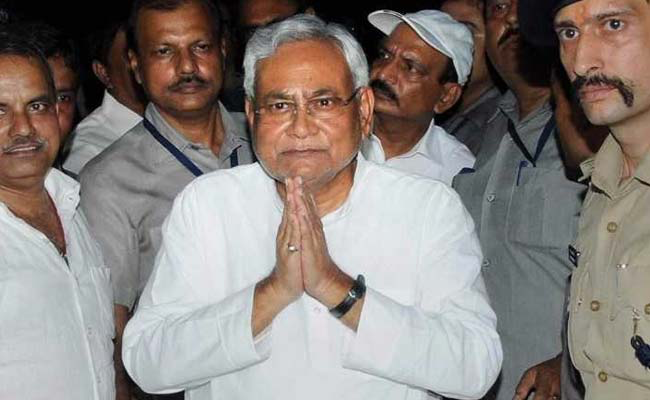
    PATNA(TIP) : The decision to part ways with the RJD and join hands with the BJP was taken in the interest of Bihar and will ensure development and justice for the state, Nitish Kumar on July 27 said after being sworn in as the chief minister.

    Kumar resigned the post Wednesday night after a fall out with the alliance partner RJD over corruption charges against Lalu Yadav and some of his family members, including son Tejashwi, who was the then deputy chief minister.

    “Whatever decision we have taken will be in the interest of Bihar and of its people. It will ensure development and justice. It will also ensure progress. This is a collective decision. I ensure that our commitment is towards the people of Bihar,” Nitish Kumar told reporters. Kumar was sworn in as the chief minister of the state along side senior BJP leader Sushil Kumar Modi, who will be his deputy in the new government, at the Raj Bhawan in Patna.

    NITISH-MODI REUNION NOT A HURRIED AFFAIR

    The reunion of Narendra Modi and Nitish Kumar appeared hurried on Wednesday, but it was in the works for nearly seven months. Warmth returned to the chilly relationship between the Prime Minister and Bihar chief minister as early as this January. The two astute politicians met after a long gap at a function in Patna to commemorate the 350th birth anniversary of Guru Gobind Singh. It was January 5 and TV screens flashed images of the two politicians sitting together, smiling at each other and even holding hands at different moments. The bitterness of parting ways and poll campaign was over.

    “The unease in the relationship between the two leaders was over,” a BJP leader said. “Over the next months, they remained in touch, directly and through emissaries.”

    The onstage bonhomie between the two was quite palpable. Modi praised Nitish for arrangements he made for prakash utsav and going ahead with prohibition despite opposition. Kumar reciprocated by praising Modi for successfully implementing a liquor ban in Gujarat as its chief minister.

    The event at the historic Gandhi Maidan in Patna happened within months of Kumar supporting Modi’s decision to recall high-value banknotes. He also supported Modi on the military “surgical strikes” against terrorist hideouts in Pakistan-occupied Kashmir. Less than a week after this bonhomie blossomed, Kumar had an ice-breaking meeting with a top BJP leader in Patna.

    They met again in Delhi in February to explore if a reunion can happen and on what terms.

    The subsequent months saw Kumar talking of a grand alliance against the BJP, and simultaneously sharing with the BJP leadership his unease about the functioning of RJD chief Lalu Prasad, his alliance partner.

    He was jittery over Prasad calling the shots in departments headed by his son, deputy chief minister Tejashwi. This was not acceptable to a leader conscious of his image. A senior Union minister remained in constant touch with Kumar and every move was communicated to Prime Minister Modi and BJP chief Amit Shah.

    A dispute between Tejashwi and another minister close to Kumar over a government project in Raxaul was another flashpoint. He was upset over friction between allies on sharing boards and corporation and the Congress’s dilly-dally on strategic matters.

    LALU PRASAD TO TAKE FIGHT FOR BIHAR TO SUPREME COURT

    Former Bihar Chief Minister and RJD supremo Lalu Prasad
    addresses a press conference in Ranchi on Thursday.
    Pic courtesy: PTI

    PATNA (TIP): The battle for Bihar is expected to reach the Supreme Court but legal experts see little hope for Lalu Prasad, who has said that he will approach the top court against the governor’s decision to not call his Rashtriya Janata Dal for government formation.

    Prasad’s ally Nitish Kumar dumped their so-called Grand Alliance on Wednesday and decided to partner with the Bharatiya Janata Party within hours, a development that Prasad has claimed should not have been allowed by governor Keshri Nath Tripathi since his was the largest party by elected legislators.

    Legal experts say there is nothing illegal about the governor’s action and that he had the prerogative to invite whoever he thought had a better shot at forming government. “The idea of a single-largest party comes after election; after a crisis comes the concept of who has the larger and a stable combination – So the governor has the discretion to call on a combination or a party that will enjoy majority on the floor of the house,” said senior advocate Rajeev Dhawan.

    Dhawan cited the example of Goa and Manipur,where too the governor’s action was challenged in the Supreme Court but nothing came of it.

    The 2017 Goa elections saw a close contest in the 40-member assembly. BJP won 13 seats,while the Congress-NCP with 18 was the single largest collective. Yet the governor invited and appointed a BJP coalition with the MGP (three seats), Goa Forward Party (three seats) and three independents to form the government. Congress took the matter to the Supreme court but its petition was dismissed. Chief Justice of India J S Kehar had then said, “Where are your numbers? You could have finished the case in 30 seconds by showing that BJP don’t have the numbers. It seems you were not confident about the support you have. You should have asked the governor what nonsense she is doing and confidently said look we have the numbers. You should have sat on a dharna. You did nothing. You could have filed affidavits of your supporters before us. You are putting us in the position of the governor. These things you should have stated before the governor.”


  • US admiral stands ready to obey a Trump nuclear strike order

    US admiral stands ready to obey a Trump nuclear strike order

    CANBERRA (TIP): The US Pacific Fleet commander said on July 27 he would launch a nuclear strike against China next week if President Donald Trump ordered it, and warned against the military ever shifting its allegiance from its commander in chief.

    Adm Scott Swift was responding to a hypothetical question at an Australian National University security conference following a major joint US-Australian military exercise+ off the Australian coast. The drills were monitored by a Chinese intelligence-gathering ship off northeast Australia.

    Asked by an academic in the audience whether he would make a nuclear attack on China next week if Trump ordered it, Swift replied: “The answer would be: yes.” “Every member of the US military has sworn an oath to defend the constitution of the United States against all enemies foreign and domestic and to obey the officers and the president of the United States as commander and chief appointed over us,” Swift said.

    “This is core to the American democracy and any time you have a military that is moving away from a focus and an allegiance to civilian control, then we really have a significant problem,” he added. (AP)

  • Amazon’s Jeff Bezos bumps Bill Gates from world’s richest position

    Amazon’s Jeff Bezos bumps Bill Gates from world’s richest position

    WASHINGTON (TIP): Amazon’s founder CEO Jeff Bezos may have ended Microsoft badshah Bill Gates’ long reign since 1995 as the world’s richest individual – a position interrupted only briefly by the likes of Berkshire Hathaway’s Warren Buffett and Mexican billionaire Carlos Slim.

    A one per cent bump in the shares of Amazon on Thursday morning pushed the personal wealth of Bezos, who owns about 17% of the company, to over $91 billion, overtaking Gates’ approximately $90 billion, give or take a few million. Gates has generally been regarded as the wealthiest individual on the planet except when Slim bumped him from the top spot in 2012 and his friend and bridge partner Buffett topped him a few years earlier in 2008. Gates regained the top position on both occasions within a year. Because their wealth is largely a result of the shares they own their company and its fluctuating price, it is possible that the wealthiest title may go back and forth between Gates and Bezos – both from Seattle — for a while.

    But Bezos is considered a good bet to hold the title in the long run given Amazon’s phenomenal run and seemingly endless business interests and revenue stream. In the past week alone, Bezos’ net worth has increased by almost $3 billion due to a 3% increase in Amazon’s stock price; it has increased $16.5 billion since Forbes’ 2017 Billionaires List was published in March, when he was ranked third behind Gates and Buffett. Amazon’s market cap+ is now over $500 billion, just $72 billion shy of Microsoft’s $575 billion, and the internet giant’s bull run not only positions it to overtake the software giant, but also – according to some market experts — put it on track to become the world’s first trillion dollar company.

    Bezos is also an early investor in Google, and holds interest in AirBnB, Uber, and Twitter among other unicorn companies. Ironically, Amazon’s hot streak has coincided with the election as President of Donald Trump, who is not favorably disposed towards Bezos or Amazon despite his pro-business credentials.

    The company has seen a 40% increase in revenue this year alone, adding billions to the wealth of Bezos, who also happens to own The Washington Post, which has been sharply critical of the President. (PTI)

  • White House infighting turns ugly as it’s Scaramucci vs Priebus

    White House infighting turns ugly as it’s Scaramucci vs Priebus

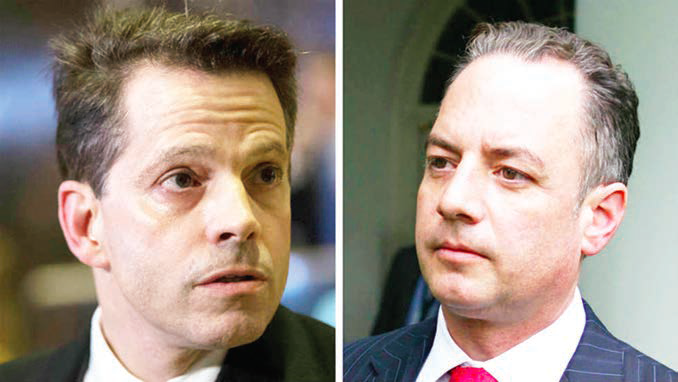
    WASHINGTON (TIP): The bitter in fighting among top staffers at White House turned ugly as Anthony Scaramucci, President Donald Trump’s new communications director, launched a foul-mouthed attack on his rival Reince Priebus, calling him a “paranoid schizophrenic”, a news website has claimed.

    Scaramucci, the Wall Street financier who joined the administration last week, had earlier vowed to crack down on leaks from the White House, threatening to fire everyone, if necessary, to stop aides from leaking information.

    “Reince is a f—— paranoid schizophrenic, a paranoiac,” Scaramucci told New Yorker writer Ryan Lizza on a phone call Wednesday.

    The journalist revealed this in a lead story on the news website yesterday. Scaramucci, he wrote, called him to find out who the source of his information was, about the dinner he had with Trump the other night. Lizza claimed when he refused to divulge the source of information, Scaramucci got agitated.

    “I’ve asked people not to leak things for a period of time and give me a honeymoon period,” he said. “They won’t do it. He was getting more and more worked up, and he eventually convinced himself that Priebus was my source,” he wrote.

    “They’ll all be fired by me,” Scaramucci said, according to Lizza. “I fired one guy the other day. I have three to four people I’ll fire tomorrow. I’ll get to the person who leaked that to you. Reince Priebus–if you want to leak something– he’ll be asked to resign very shortly,” he said. Lizza wrote that Scaramucci believed Priebus had been worried about the dinner because he hadn’t been invited.

    “Reince is a fXXXXXX paranoid schizophrenic, a paranoiac,” Scaramucci said. Priebus and the White House did not respond to allegations.

    Ever since his appointment as the White House Director of Communications, Scaramucci has portrayed himself as a close confidant of the US President.

    Last Friday, Sean Spicer had resigned as White House Press Secretary after Trump appointed Scaramucci as the White House Communications Director.

    According to New Yorker, Scaramucci also told Lizza that unlike other senior officials, he had no interest in media attention. “I’m not Steve Bannon, I’m not trying to s*** my own c***,” he said, speaking of Trump’s chief strategist. “I’m not trying to build my own brand off the f****** strength of the President. I’m here to serve the country.” Bannon did not comment.

    The White House Communications Director said that his list of allegations included leaking the Hannity dinner and the details from his financial disclosure form. (PTI)

  • July 28 New York & Dallas Print Editions

    July 28 New York & Dallas Print Editions

    [vc_row][vc_column][vc_column_text]

    Print Replica ~ Digitally

    E-Editions

    [/vc_column_text][/vc_column][/vc_row][vc_row][vc_column width=”1/3″][vc_custom_heading text=”New York Edition” font_container=”tag:h2|text_align:center” google_fonts=”font_family:Istok%20Web%3Aregular%2Citalic%2C700%2C700italic|font_style:700%20bold%20regular%3A700%3Anormal” link=”url:https%3A%2F%2Fwww.theindianpanorama.news%2Fwp-content%2Fuploads%2F2017%2F07%2FTIP-July-28-NYC.pdf|||”][vc_single_image image=”86523″ img_size=”full” add_caption=”yes” alignment=”center” onclick=”custom_link” link=”https://www.theindianpanorama.news/wp-content/uploads/2017/07/TIP-July-28-NYC.pdf”][/vc_column][vc_column width=”1/3″][vc_custom_heading text=”Dallas, Texas Edition” font_container=”tag:h2|text_align:center” google_fonts=”font_family:Istok%20Web%3Aregular%2Citalic%2C700%2C700italic|font_style:700%20bold%20regular%3A700%3Anormal” link=”url:https%3A%2F%2Fwww.theindianpanorama.news%2Fwp-content%2Fuploads%2F2017%2F07%2FTIP-July-28-Dallas-TX.pdf|||”][vc_single_image image=”86525″ img_size=”full” add_caption=”yes” alignment=”center” onclick=”custom_link” link=”https://www.theindianpanorama.news/wp-content/uploads/2017/07/TIP-July-28-Dallas-TX.pdf”][/vc_column][vc_column width=”1/3″][vc_single_image image=”82828″ img_size=”medium” alignment=”center” onclick=”custom_link” link=”https://www.theindianpanorama.news/advertising-media-kit-portal-indian-panorama/”][vc_single_image image=”82829″ img_size=”medium” alignment=”center” onclick=”custom_link” link=”https://www.theindianpanorama.news/advertising-media-kit-portal-indian-panorama/”][/vc_column][/vc_row][vc_row][vc_column][td_block_ad_box spot_id=”custom_ad_3″][/vc_column][/vc_row][vc_row][vc_column width=”2/3″][vc_custom_heading text=”Lead Stories This Week” font_container=”tag:h2|text_align:center” google_fonts=”font_family:Istok%20Web%3Aregular%2Citalic%2C700%2C700italic|font_style:700%20bold%20regular%3A700%3Anormal” link=”url:https%3A%2F%2Fwww.theindianpanorama.news%2F%20_blank|||”][td_block_5 limit=”8″][/vc_column][vc_column width=”1/3″][vc_widget_sidebar sidebar_id=”td-default”][/vc_column][/vc_row]

  • 15 people arrested in immigration protests in Austin

    15 people arrested in immigration protests in Austin

    AUSTIN (TIP):  Fifteen people were arrested in Austin on Wednesday, July 26 during a protest Texas Attorney General Ken Paxton’s threat to sue the federal government over a program that shields from deportation unauthorized immigrants who came to the country as children.

    They were all charged with obstructing a highway or other passageway — a Class B misdemeanor — and taken to the Travis County Jail.

    Victor Taylor, a DPS spokesman, said in a news release that the protesters were arrested without incident after ignoring requests to leave the roadway they were blocking.

    The group of about 40 protesters, organized by a national immigrant rights group called Cosecha, decried Paxton’s June letter to President Donald Trump’s administration asking it to rescind the Deferred Action Against Childhood Arrivals program — commonly known as DACA — or face a lawsuit over its legality.

    The 15 people arrested during the protest sat in the middle of an intersection directly to the north of the Texas Capitol and blocked traffic for about 15 minutes. They chanted and laid out posters that read “Permanent protection. Dignity and Respect.”

    Four of the arrested protesters were DACA recipients. The program gives immigrants who came to the country illegally as children a two-year relief from deportation and a work permit. Around 800,000 people have benefited from the program since its implementation in 2012. Strict immigration enforcement advocates have decried it as a mini “amnesty” and urged Trump to rescind it.

    Trump promised to do away with the program during the campaign trail but has waffled on the issue since.

    Under the heightened immigration enforcement of the Trump administration, the four recipients of the program could face a revocation of its benefits for the arrest.

    “We know there’s a lot of fear and anxiety in our communities. However, we know that we cannot put our faith and hopes in politicians,” said Reyna Montoya, one of the organizers of the protest. “We have seen that victories have [only] been won when communities have put everything at risk.”

    Responding to the protest, Paxton wrote in a prepared statement: “We’re fortunate to live in a great country where the First Amendment matters and people have the right to express their opinions freely and hold peaceful protests. It’s my sworn duty to defend the Constitution and enforce the laws passed by the Texas Legislature.”

    Cosecha is an immigrant rights groups with operations in 20 states. Protesters on Wednesday included people who lived in El Paso and Austin, but also came from as far as Arizona, California, Florida and New York.

    “We want to send a message to the American public that we are tired of how we are treated in this country,” said Jose Luis Santiago, a 21-year-old recipient of the deportation relief program, who immigrated from Mexico as a child.

    Protesters also railed against Texas’ recently passed “sanctuary cities” ban.

    “We’re here in Austin because of all the pain that politicians in this city are giving our immigrant community,” said Maria Fernanda Cabello, one of the protest organizers. “We have SB 4 that’s going to come into effect Sept. 1 that’s going to affect all immigrants in the state, not because of your legal status, but because of the color of your skin.”

    Supporters of the sanctuary cities ban say the law is necessary to ensure local jurisdictions are cooperating with immigration authorities. The law, proponents say, will help ensure that immigrants who have broken the law are turned over to federal authorities and will prevent them from committing more serious crimes.

    The protesters were transferred to Travis County Jail, where officials turn over unauthorized immigrants to federal immigration authorities only if they have been charged with violent crimes, such as murder, aggravated sexual assault and kidnapping. The Travis County Sheriff’s Office, which operates the jail, was one of Gov. Greg Abbott’s main targets during his campaign to pass the sanctuary cities ban.

    The protest was mostly peaceful, but state troopers did have to forcibly move some people while redirecting traffic. A state trooper dragged a man across the asphalt for a few feet after he refused to allow a car to pass.

    In the early afternoon, organizers said the 15 protesters had not yet been released. They said the 11 people who were citizens or legal permanent residents would remain behind bars until the four other arrested protesters, who are DACA recipients, were released.

  • Nitish joins NDA again sworn in Bihar CM whilst BJP’s Sushil Modi is deputy CM

    Nitish joins NDA again sworn in Bihar CM whilst BJP’s Sushil Modi is deputy CM

    PATNA (TIP): Bihar’s murky politics witnessed another turn of the events, July 27. Fewer than 24 hours after resigning from the post of chief minister, Nitish Kumar was again in the position after he was sworn in on July 27 morning to form a government in the state, this time with the support of the BJP and the NDA.

    Even as the ceremony was on, RJD workers in Patna set up blockades and protested Nitish forming the government with the BJP.

    Also sworn in on Thursday morning, as deputy chief minister of Bihar, was the BJP’s Sushil Modi, considered by many to be the man who deflated the not-so-grand ‘mahagathbandhan’, or ‘grand alliance’. Until Wednesday, Modi’s post was held by the erstwhile alliance’s Tejashwi Yadav, son of RJD chief Lalu Prasad.

    Tejashwi was the cause celebre cited by Nitish as the reason for his resigning as Bihar chief minister on Wednesday evening, hours after Lalu Prasad insisted his son wouldn’t resign after being named in a CBI corruption case.

    Soon after Nitish’s resignation was accepted by Bihar governor Keshri Nath Tripathi, Sushil Modi submitted a letter to Tripathi pledging the support of 132 MLAs for Nitish to form the next government. Tripathi then set the time for Thursday’s swearing-in ceremony and said Nitish has to prove his majority in the state Assembly+ within two days of being sworn in.

    Tejashwi and RJD leaders also met the governor+ on Wednesday to protest the governor’s decision to invite Nitish to form the government.

    “RJD being the single largest party in the state should be given an opportunity to stake claim to form the government,” Tejashwi said.

    The JD(U), BJP, their allies and supporting independent MLAs together account for 132 seats in the 243-member Bihar Assembly, 10 more than the magic figure of 122.

    The RJD has 81 MLAs, and even if the Congress with 27 MLAs and the CPI-ML with 3 decide to back Tejashwi, their number would add up to just 110.

  • Pranab Mukherjee bids farewell whilst Kovind takes over as 14 President of India

    Pranab Mukherjee bids farewell whilst Kovind takes over as 14 President of India

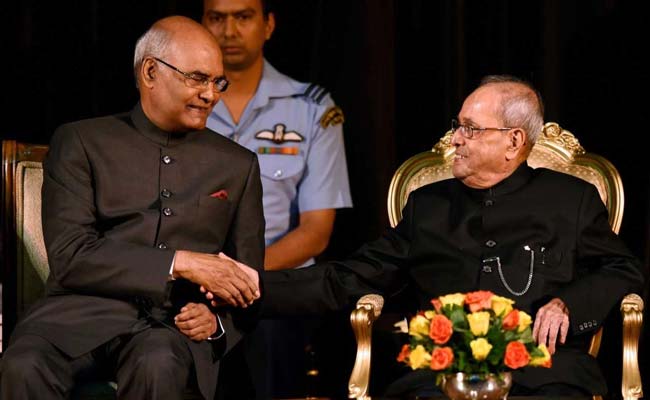
    NEW DELHI (TIP): Ram Nath Kovind on July 25 took oath at the 14th President of India, the first BJP leader to occupy the Rashtrapati Bhawan, and said India’s unity in diversity was the key to its success.

    Earlier, outgoing President Pranab Mukherjee on July 23 went down memory lane as he delivered his farewell speech, recalling his first day as a member of Parliament as well as his past associations.

    “With a sense of gratitude and a prayer in my heart, I take leave of you. I leave with a sense of fulfillment and happiness of having served the people of this great country through this institution — as their humble servant,” he said in his address to members of both the houses at the Central Hall of Parliament.

    The 71-year-old Kovind was administered the oath of office by Chief Justice of India J S Khehar at an impressive ceremony in the Central Hall of Parliament. He took oath in the name of God and pledged to “preserve, protect and defend the Constitution and the law”.

    The ceremony was attended by Mukherjee, Vice President Hamid Ansari, Lok Sabha Speaker Sumitra Mahajan and Prime Minister Narendra Modi, Governors, Chief Ministers, Union Ministers, Parliamentarians diplomats and 22 members from Kovind’s family.

    Kovind began his innings in office invoking Sardar Patel, Deendayal Upadhyay – leaders looked up by the Sangh parivar and dove-tailing their message with that of Mahatma Gandhi.

    Absent from the President’s inaugural speech was any reference to Congress stalwarts barring those held dear by the BJP.

    A section of BJP MPs raised slogans of ‘Jai Shri Ram’ and ‘Bharat Mata ki Jai’ soon after Kovind was sworn-in as the President.

    Upadhyaya’s philosophy of ‘antodyaya’ was also reflected in the President’s speech as he spoke of reaching the fruits of development to the “last person, in the last house in the last village.”

    At the outset, the President said he was conscious that he was following in the footsteps of stalwarts such as Dr Rajendra Prasad, S Radhakrishnan, APJ Abdul Kalam and his immediate predecessor Pranab Mukherjee.

    “We need to build an India that is an economic leader as well as moral exemplar. For us, those two touchstones can never be separate. They are and must forever be linked,” said Kovind, the first leader from Uttar Pradesh to adorn the top constitutional post.

    Reflecting a clear shift from the era of entitlement furthered during the UPA, the President spoke of the government being a facilitator in nation building.

    “Nations are not built by governments alone. The government can at best be a facilitator, and a trigger for society’s innate entrepreneurial and creative instincts. Nation building requires national pride,” Kovind said.

    Referring to Mahatma Gandhi, Sardar Patel and B.R. Ambedkar, the President said these leaders did not believe that political freedom was enough. “For them, it was crucial to also achieve economic and social freedom for millions of our people,” he said.

    “The key to India’s success is its diversity. Our diversity is the core that makes us so unique. In this land, we find a mix of states and regions, religions, languages, cultures, lifestyles and much more. We are so different and yet so similar and united,” the President said.

    Kovind said India of the 21st century India will be in conformity with its ancient values as well as compliant with the fourth industrial revolution. “There is no dichotomy there, no question of choice. We must combine tradition and technology, the wisdom of an age-old Bharat and the science of a contemporary India.” he said.

    Earlier, the President-elect and his wife Savita were ceremonially escorted to the Rashtrapati Bhawan where Mukherjee took Kovind on a guided tour of the Rashtrapati Bhawan.

  • Pakistan Supreme Court disqualifies PM Nawaz Sharif from office

    Pakistan Supreme Court disqualifies PM Nawaz Sharif from office

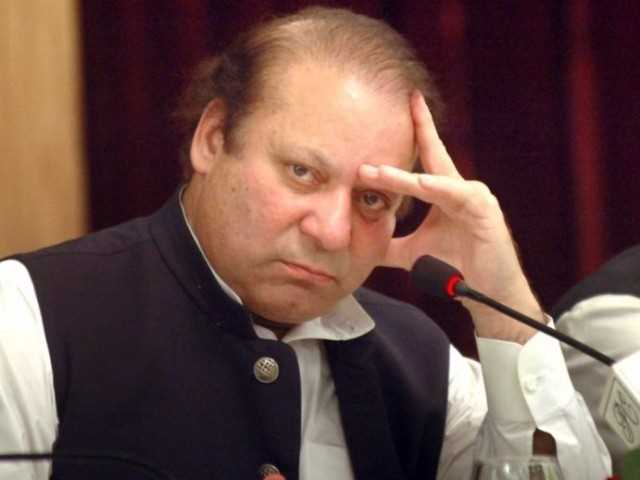
    ISLAMABAD (TIP): The Pakistan Supreme Court on Friday, July 28, disqualified Prime Minister Nawaz Sharif from office in the Panamagate graft case.

    The court had recently resumed the hearing of the high-profile case against Sharif and his family, a week after a probe panel in its final report recommended filing of the case against him and his children.

    The six-member Joint Investigation Team (JIT), set up by the apex court to investigate charges of money laundering against 67-year-old Sharif, submitted its 60-day investigation report to the court on July 10.

    It recommended filing of a corruption case against him and his children after finding “significant” disparities in their income and actual wealth.

    The JIT report recommended that a corruption case should be filed against Sharif and his sons Hassan Nawaz and Hussain Nawaz, as well as daughter Maryam Nawaz, under the National Accountability Bureau (NAB) ordinance 1999. Agencies

  • Nitish Kumar wins trust vote in Bihar Assembly

    Nitish Kumar wins trust vote in Bihar Assembly

    PATNA (TIP): Nitish Kumar on July 28 won the trust vote in the Bihar Assembly a day after he took oath as Chief Minister to head the JD-U-BJP government after dumping the Grand Alliance.

    In a 243-member Bihar Assembly, 131 members cast their votes in favor of Nitish Kumar and 108 went against.

    The RJD staged a walked out of the House after the Nitish government won the trust vote.

    RJD leader Tejashwi Yadav, the son of Lalu Prasad Yadav, spoke first on the confidence motion and launched a scathing attack against Kumar for dumping the Grand Alliance government.

    RJD MLAs protested in the portico of Assembly, signaling their aggressive mood ahead of the trust vote.

    The NDA alliance had submitted a list of 132 MLAs to the governor. These include 71 of JD(U), BJP 53, RLSP two, LJP two, HAM one and three independents.

    In the 243-member Bihar Assembly, the RJD has 80 MLAs, the Congress 27 and the CPI-ML has three.

    The Janata Dal-United leaders said Nitish Kumar was “calm and cool” and spent the early morning at his official residence as usual, not worried about the trust vote.

  • Obamacare Repeal Fails as McCain Casts Decisive No Vote

    Obamacare Repeal Fails as McCain Casts Decisive No Vote

    WASHINGTON (TIP): Despite President Trump’s Twitter exhortations to Republican Senators shortly before the vote, Obamacare repeal failed.   The President tweeted:

    Donald J. Trump ✔ @realDonaldTrump

    Go Republican Senators, Go! Get there after waiting for 7 years. Give America great healthcare!

    10:43 PM – Jul 27, 2017

    The Senate rejected legislation to repeal parts of the Affordable Care Act, with Senator John McCain casting a decisive “no.”

    Senate Republicans unveiled a “skinny repeal,” a narrow measure to roll back parts of the Affordable Care Act. It would leave 15 million more Americans without insurance next year, the Congressional Budget Office said.

    Speaker Ryan tried to reassure senators balking at the narrow bill, but he left the door open for “skinny” passage.

    The health insurance lobby came off the sidelines Thursday, July 27, to warn Republicans against repealing the individual mandate.

    While 49 Republican Senators voted for Skinny Repeal, 3 said Nay. All 48 Democrats opposed the repeal.  Senate, thus, rejected the scaled-down Obamacare repeal.

    Senator John McCain, Republican of Arizona, cast a decisive vote to defeat the proposal, joining two other Republicans, Susan Collins of Maine and Lisa Murkowski of Alaska, in opposing it.

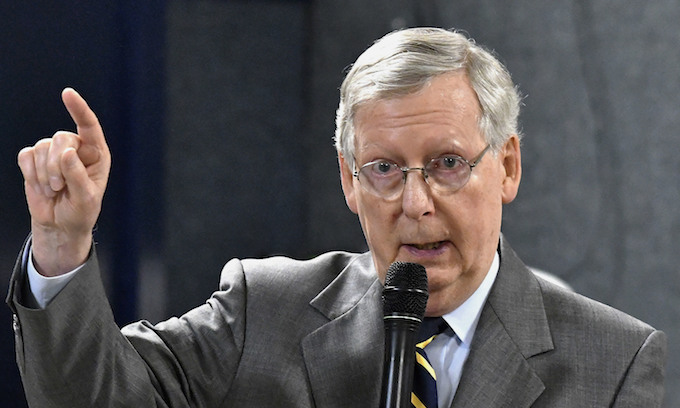
    The 49-51 vote was a huge setback for the majority leader, Mitch McConnell of Kentucky, who has spent the last three months trying to devise a repeal bill that could win support from members of his conference.

    The truncated Republican plan was far less than what Republicans once envisioned. Republican leaders, unable to overcome complaints from both moderate and conservative members of their caucus, said the skeletal plan was just a vehicle to permit negotiations with the House, which passed a much more ambitious repeal bill in early May.

    The so-called “skinny” repeal bill, as it became known at the Capitol this week, would still have broad effects on health care. The bill would increase the number of people who are uninsured by 15 million next year compared with current law, according to the nonpartisan Congressional Budget Office. Premiums for people buying insurance on their own would increase by roughly 20 percent, the budget office said.