Month: April 2018

  • Trump says he was unaware of payment to Stormy Daniels

    Trump says he was unaware of payment to Stormy Daniels

    WASHINGTON(TIP): Breaking his silence over the $130,000 payment by his lawyer Michael Cohen to adult firm star Stormy Daniels ahead of the 2016 election, President Trump on Thursday, April 5 said he was unaware of the transaction.

    Asked if he knew about the $130,000 payment to Daniels, Mr. Trump said, “No. No. What else?”

    The president made the comments aboard Air Force One, heading from a roundtable event in West Virginia to Washington, D.C. Daniels, whose real name is Stephanie Clifford, claims she had a sexual encounter with Mr. Trump in 2006. Asked why Cohen made the payment if there was no truth to the woman’s allegations, Mr. Trump said reporters would “have to ask Michael Cohen.”

    “Michael is my attorney. And you’ll have to ask Michael Cohen,” Mr. Trump said.

    Mr. Trump also claimed he did not know where Cohen obtained the money for the payment. Cohen claims the money came out of his own personal funds.

    In the past, Mr. Trump has ignored questions about the adult film star, who is suing over a nondisclosure agreement that she signed but claims, is invalid because Mr. Trump never signed it.


  • Trump deploys military to secure US-Mexico border to check ‘illegal migration’

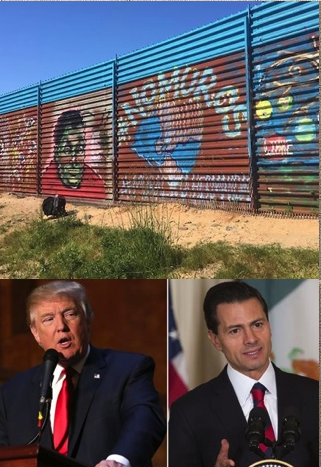
    Trump deploys military to secure US-Mexico border to check ‘illegal migration’

    President Enrique Peña Nieto of Mexico reacts sharply to Trump’s Threats

    WASHINGTON(TIP): President Donald Trump, April 5, signed an executive order directing the deployment of military along the US-Mexico border to fight illegal immigration, asserting that the situation had reached “a point of crisis.”

    The announcement came a day after Trump said he intended to deploy the National Guard to the US-Mexico border until his administration was able to deliver on his campaign promise to build a wall to bolster security.

    Given the importance to secure borders for national security, the National Guard, in coordination with governors, will remain in a support role until Congress takes the action necessary to close the loopholes, the White House said.

    Trump on Thursday told reporters aboard Air Force One that a large portion of the troops he is planning to deploy to the U.S.-Mexico border would stay there until the border wall was built. Around 2,000 to 4,000 National Guard troops will be deployed to the area, Trump said, similar to actions by Presidents George W. Bush and Barack Obama.

    “The situation at the border has now reached a point of crisis. The lawlessness that continues at our southern border is fundamentally incompatible with the safety, security, and sovereignty of the American people. My administration has no choice but to act,” Trump said in his memorandum to the Defense Secretary, Attorney general and the Secretary of Homeland Secretary.

    The threat is real, Homeland Security Secretary Kirstjen Nielsen told reporters at a White House news conference. “We continue to see unacceptable levels of illegal drugs, dangerous gang activity, trans-national criminal organizations and illegal immigration flow across our border,” she said.

    This threatens not only the safety of American communities and children, but also the very rule of law, on which, the country was founded. “It’s time to act. So, let’s talk a little bit about that today,” she said.

    “In an effort to prevent such a consequence, the President has directed that the Department of Defense and the Department of Homeland Security to work together with our governors to deploy the National Guard to our southwest border to assist the Border Patrol,” she said.

    Border Patrol recorded 37, 393 arrests on the southwest border in March, according to data released by US Customs and Border Protection (CBP).

    In the last 15 months, she said the Trump administration has taken major steps to methodically strengthen border security.

    “We began the first new border wall system construction in close to a decade, we modified our asylum system processing to more quickly adjudicate claims and we ended so-called temporary immigration program,” Nielson said.

    Ruing that the system rewards bad behavior, she said it does not punish law breakers. “It undermines our nation’s economic interests. Make no mistake, interdiction without the ability to promptly remove those without legitimate cause is not border security, it is not national security,” she asserted.

    “We will not allow illegal immigration levels to become the norm. More than 1,000 people a day, 300,000 a year, violating our sovereignty as a nation will never be acceptable to this president,” she said.

    Meanwhile, President Enrique Peña Nieto of Mexico blasted President Donald Trump in a video message on Thursday, April5, vowing that “nothing and no one stands above the dignity of Mexico” and adding that the U.S. president’s main gripes were Congress’s problem, not Mexico’s.

    “If your recent statements are the result of frustration due to domestic policy issues, to your laws or to your Congress, it is to them that you should turn to, not to Mexicans,” Peña Nieto said in the message, according to a translation provided by his office.

    (With inputs from PTI)

  • Indian origin scientist in the UK is leading a new high-speed space camera project

    Indian origin scientist in the UK is leading a new high-speed space camera project

    LONDON(TIP):  An Indian origin scientist in the UK, Professor Vik Dhillon, is leading a new high-speed space camera project that is expected to revolutionize our understanding of stars and black holes.

    Professor Dhillon and his team at University of Sheffield in the UK were joined by experts from around the world on the HiPERCAM project, which involves the creation of a new camera that can take more than 1,000 images per second.

    The camera went live on the world’s largest optical telescope, Gran Telescopio Canarias (GTC), this week.

    It will take high-speed images of objects in the universe, allowing their rapid brightness variations due to phenomena such as eclipses and explosions to be studied in unprecedented detail.

    “The combination of HiPERCAM and the world’s largest telescope provides us with a unique, new view of the universe, which history tells us is when major new discoveries are made. Astronomers are excited to use HiPERCAM on the GTC to start exploring the Universe at high speed,” said Vik Dhillon, Professor of Astrophysics at the University of Sheffield and Affiliated Researcher at the Instituto de Astrofisica de Canarias (IAC).

    “Normal cameras installed on large telescopes usually capture only one picture every few minutes. HiPERCAM can take one picture every millisecond. The high speed essentially provides a slow-motion view of rapidly varying celestial objects,” he added.

    “The high-speed images are also captured in five different colors simultaneously, which means we can instantly tell the difference between hot stars which are burning at tens of thousands of degrees Celsius and are blue in color – and cooler stars, which appear red and are burning at only a few thousand degrees.”

    The pioneering five-year project was funded by a 3.5-million-euro grant from the European Research Council (ERC) and is being conducted in partnership with the Science and Technology Facilities Council’s Astronomy Technology Centre (ATC) and the IAC, along with researchers from the University of Warwick and Durham University in Britain.

    The GTC is based on the island of La Palma, situated 2,500 meters above sea level, which is considered one of the best places in the world to study the night sky.

    Data captured by the camera, taken in five different colors simultaneously, will let scientists study the remnants of dead stars such as white dwarfs, neutron stars and black holes.

    These are key objects within astrophysics as their extreme gravities, densities and pressures allow researchers to test theories of fundamental physics, such as general relativity and quantum mechanics.

    By observing objects in the Solar System pass in front of background stars, HiPERCAM will also teach scientists about the sizes and shapes of the minor planets beyond Pluto’s orbit, and whether or not they possess atmospheres, rings and satellites.

    “The vital role that STFC and UK universities played in developing HiPERCAM is a testament to the work of our world class scientists,” Britain’s Science and Universities Minister, Sam Gyimah, said.

    This game-changing camera that will be installed on the world’s largest telescope will not only deepen our understanding of white dwarfs, neutron stars and black holes in our universe, but it will help maintain our reputation as being a global-leader in research and development.

    “It is projects such as these, and collaboration with partners and universities from across the world, which underpins our ambitious modern Industrial Strategy to boost innovation and help create a Britain fit for the future.”

    “HiPERCAM was a challenging project that pushed the design team to fit a lot of scientific potential into a small space,” Martin Black, an optical engineer from the Science and Technology Facilities Council’s UK Astronomy Technology Centre (UK ATC) and part of the HiPERCAM team, said.

    “The team had to work closely together to ensure everything fit together and to correctly position the cameras to around 30 microns, about the width of a human hair.”


  • Indian American Republican Aakash Patel raises $25K for Hillsborough Commission Campaign in March

    Indian American Republican Aakash Patel raises $25K for Hillsborough Commission Campaign in March

    FLORIDA(TIP): Indian American Republican & entrepreneur Aakash Patel has raised $25,500 for his campaign in March.

    “I am extremely excited about the continued momentum of our campaign. Our hard work is reflected in the fundraising totals and the tremendous support we have been receiving,” Patel wrote on his official Facebook handle.

    According to a report, Patel has so far raised $378,751 including $288,601 for his campaign account and $90,150 for his political committee, Elevate Tampa.

    The report said that the bulk of the funds that Patel received in February came from 60 contributors amounting to $19,886.

    Earlier in the week, Patel had announced that he received the endorsement of former Speaker of the Florida House of Representatives Will Weatherford.

    “I am so very honored to have the support of such a true conservative leader as Speaker Will Weatherford. I’m truly humbled to have members of the business community come forward with such strong support of my campaign,” Patel said.

    Patel, a first-time candidate, is reportedly far ahead of his Republican rival Todd Marks when it comes to raising funds for the campaign. His Democratic counterpart, Tampa Democratic Rep. Janet Cruz, has not released the latest reports of her campaign funding.

     “I have known Aakash Patel through our work in the business community and have witnessed his efforts to enrich economic growth in Hillsborough County. I believe he will be an asset to the community and that he will instill his strong conservative beliefs as he continues his work for greater economic development, improved transportation and many other issues important to the community,” Speaker Weatherford said.

    Patel studied his bachelor’s degree in Political Science and English Literature at Florida State University. During this time, he also worked at The Tampa Bay Times, Tallahassee Bureau. He is also a graduate of the Greater Tampa Chamber of Commerce’s Leadership Tampa (2012), FBI Citizen’s Academy (2012), Tampa Police Citizen’s Academy (2012), Tampa Bay Public Leadership Institute (2013) Leadership Tampa Bay (2011), and Tampa Connection (2010), and College Leadership Florida (2005). He is enrolled in City of Tampa’s Mayor’s Neighborhood University, according to his LinkedIn profile.

    An expert networker, Patel recently received the endorsement of Republican Rep. Matt Gaetz. In August, Gaetz, who is the son of former lawmaker Don Gaetz, tweeted, “Proud to support my longtime friend @pateltimes in his run for the Hillsborough Commission!”

  • Indian American Niraj Antani endorsed by Ohio Chamber of Commerce

    Indian American Niraj Antani endorsed by Ohio Chamber of Commerce

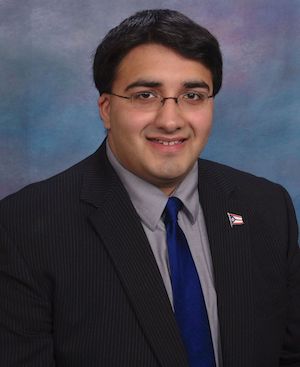
    OHIO (TIP): Ohio Chamber of Commerce Political Action Committee (OCCPAC) has endorsed Indian American incumbent Niraj Antani for the upcoming House of Representatives, District 42 Republican primary to be held on May 8.

    Founded in 1893, OCC is one of Ohio’s oldest organizations to represent businesses by pitching in for free enterprise, economic competitiveness, and growth for the benefit of business organizations in Ohio.

    Announcing the endorsement on Twitter, the Ohio Chamber of Commerce Political Action Committee tweeted, “OCCPAC endorses Rep. @NirajAntani for House District 42 in the May 8 Primary Election.”

    Earlier, Ohio Chamber of Commerce (OCC) had acknowledged the efforts made by Antani who introduced HB 450 to amend the existing health insurance law.

    “Health care mandates increase the cost of health insurance, leaving less money for companies to expand & hire new workers. Thanks, Rep. Niraj Antani for introducing HB 450 to provide #MandateRelief,” OCC posted on its official Facebook handle.

    Antani is a cosponsor of the bill that was passed by the House in July 2017. The bill is currently before a state Senate committee and proposes “to provide an opportunity for a concealed handgun licensee or qualified military member to avoid charges for carrying a deadly weapon into a prohibited place if the person leaves upon request, and to penalize failure to leave upon request or returning with a firearm.”

    In the Republican primary, incumbent Antani will battle out with fellow Republicans Sarah Clark and Marcus Rech, and the winner of the election will represent the party in the general election to be held on November 6.


  • Indian American physician Dr. Vaid from Missouri indicted for health care fraud

    Indian American physician Dr. Vaid from Missouri indicted for health care fraud

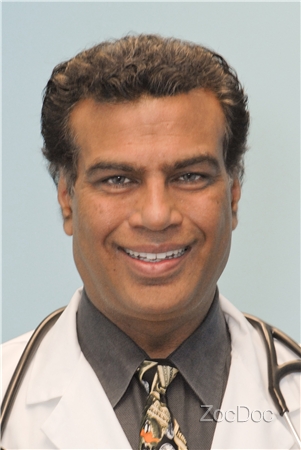
    MISSOURI(TIP): An Indian American doctor and his nurse practitioner Donna A. Waldo have been indicted after the former pre-signed prescriptions to patients and falsely claimed to Medicare and Medicaid regarding “face to face” office visits.

    According to the Justice Department, Dr. Brij R Vaid has several offices across St. Louis County and employed physician assistants who prescribed powerful opiate and opioid pain relief drugs to patients, including Opana, Hydrocodone, and Oxycontin on his pre-signed prescriptions.

    The department found that the prescriptions were given to the patients by Vaid’s assistants even when he was out of town or even out of the country. Physician assistants are not legally permitted to prescribe medicines to patients.

    The prosecutors also alleged that Vaid’s office would make misrepresentations to Medicare and Medicaid by submitting bills as if he was personally present during the visits of his patients.

    The indictment report also says that the pre-signed prescriptions were prepared by the doctor for each patient referring to the case history and based upon the previous prescription.

    According to reports, Vaid failed to stop prescribing when patients’ urine tested positive for illegal drugs or showed they were not taking the drugs he prescribed.

    Vaid, 56, and Waldo, 57, face a maximum penalty of five years in prison and/or fines up to $250,000 if they are found guilty of the conspiracy charge and the charge of making and presenting false claims to the United States.

    Steven M. Sherman, Vaid’s attorney called him “a caring physician with dedicated patients.”

    The case was investigated by the Offices of Inspector General for the US Department of Health and Human Services, the Drug Enforcement Administration, the Medicaid Fraud Control Unit of the Missouri Attorney General’s Office, and the US Department of Defense, Defense Criminal Investigative Service.

    (Source: DOJ)

  • AAPI & USAID partnering for a TB- Free India

    AAPI & USAID partnering for a TB- Free India

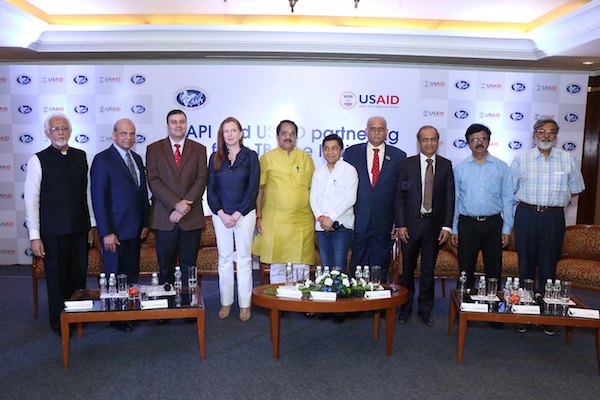
    WASHINGTON (TIP): USA-International Developmental Agency (USAID) on April 5thsigned an MOU with American Association of Physicians of Indian Origin (AAPI) to work together in achieving the goal of Tuberculosis (TB) free India.

    According to the MOU, the USAID in partnership with the Ministry of Health, India, and AAPI will rigorously work to make India TB Free.

    AAPI will play the pivotal role in achieving the goal by providing high-level education and research facility to India’s health ministry which has been pushing for the eradication of the life-threatening disease.

    According to Dr. Naresh Parikh, president-elect, AAPI, in addition to providing tools to engage patients, the organization will also be creating WHO mandated symptomatology by which indexed cases will be first detected from hotspots of tuberculosis in India.

    In addition to the TB Free India partnership, AAPI has also announced that its 12th health summit will take place in Mumbai this December. The organization said that it will provide free health care, training and support across India.

    Following the announcement of USAID and AAPI, the US Consulate in Mumbai tweeted, “Today we celebrate the announcement of @usaid_india ‘s newly signed MOU with the American Asso of Physicians of Indian Origin (AAPI) to work together toward achieving a #TBFreeIndia.”

    USAID works to end extreme global poverty and enable resilient, democratic societies to realize their potential. Since 1998, USAID has been partnering with the Government of India to combat TB. According to the official website of USAID, it has already invested more than $120 million to help diagnose and treat 15 million people with TB in India.

    AAPI is an organization of Indian American doctors practicing in the US. Founded about 34 years ago, it is now one of the largest organization of physicians in the United States.


  • Chicago Tamil Women Celebrate International Women’s Day

    Chicago Tamil Women Celebrate International Women’s Day

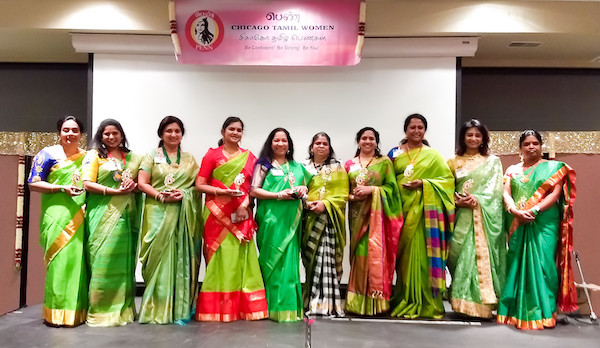
    CHICAGO, IL(TIP): There is only one thing more precious than our time & that is who we spend it on. It was truly a time well spent in the company of wonderful friends and acquaintances celebrating the international women’s day 2018 on the evening of March 17th organized by PENN (Penn in Indian language Tamil means woman), a group of extremely talented women belonging to the Indian community in the Chicagoland area who had come together to present to us an outstanding program that evening.  The air was festive with the organizers, guest speakers and most of the audience members attired in the most spectacular array of colors in the traditional wear of India.

    The event started with the guest speaker Mrs. Rajeshwari Chandrasekaran, a consul with Indian embassy who set the tone and mood for the entire evening, which was a very happy one with her witty down to earth speech.  The next speaker was Dr. Mallika Rajendran (Gynecologist) who addressed various women’s health issues from puberty to adulthood and beyond, followed by Dr. Viji Susarla, a clinical Psychologist who covered the topic very dear to every parent, our “Children” and our concerns particularly when they go through that adolescence phase. The challenges, pressures, and competition our children face now are much more than many of us would have faced a few decades ago. The next presentation was by a young lady named Amrita Raghuraman on E-Cigarettes and vaping among young ones which was an eye opener for many parents.  The last, but not the least, was a stellar presentation by Attorney Sharanya Gururajan on Estate Planning (Will & Trust).  She was candid, straight forward and funny.  The thing that made the evening most interesting was the interactive session between the experts in various fields and the audience.

    Added to the fun were the impromptu standup comedy, the most aromatic spread of food, beautiful stalls selling colorful Indian clothing, fashion jewelry, and hand-made gift items. All received a lovely goody bag & a copy of the Penn Magazine done so artistically, filled with pages of articles, short stories, poems, sketches, photographs and recipes as a take home souvenir.

    (Edited Press release by: Usha Muthukrishnan)


  • Big thaw on the Korean peninsula

    Big thaw on the Korean peninsula

    By Rakesh Sood

    The big unknown is Mr. Trump’s idea of what is an acceptable ‘deal’. Will a process towards eventual denuclearization tempt him or will he reject it as ‘fake news’ and revert to relying on sanctions and military pressure as some of his advisers are inclined to? Major compromises will be needed for reconciling interests of all the key players for the high stakes summitry on the Korean peninsula to succeed, says the author.

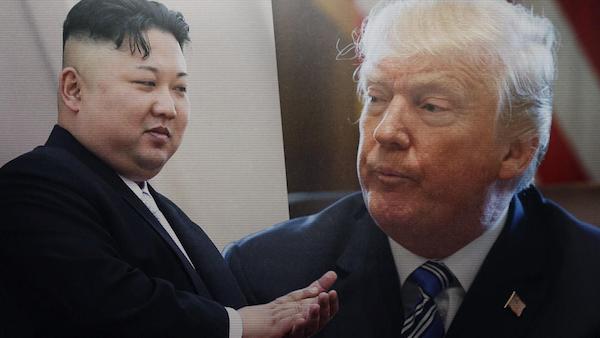
    An unusual charm offensive is under way on the Korean peninsula and the unlikely architect is none other than the North Korean Supreme Leader, Kim Jong-un. During the last three months, he has played a deft political hand, a far cry from his rhetorical exchanges with U.S. President Donald Trump. Last year, Mr. Trump was threatening the “Rocket Man” with “fire and fury like the world has never seen”; the North Korean leader described him as a “dotard” and his military called his statement “as a load of nonsense”. Now the two leaders are planning a summit in May which according to Mr. Trump could lead to “the greatest deal in the world”.

    Since 2011 when Mr. Kim took over, North Korea has conducted four nuclear tests; the first two were conducted in 2006 and 2009. The sixth test, last September, had a yield more than six times the Hiroshima bomb. He has accelerated the missile program, conducting nearly 80 tests, compared to an estimated 16 by his father Kim Jong-il between 1994 and 2011.

    In his New Year address, Mr. Kim conveyed two messages — that the entire U.S. was within range and the nuclear button was on his table, and that he was open to dialogue with Seoul and could send a team to participate in the Winter Olympics being hosted by South Korea in February. Mr. Trump responded by tweeting that his “nuclear button” was “much bigger & more powerful”. But South Korea responded positively and reaffirmed willingness to talk with North Korea at anytime and anywhere. Thereafter events gathered pace.

    Mr. Kim’s younger sister Kim Yo-jong attended the opening ceremony of the Winter Olympics, with the two Korean teams marching together. She conveyed her brother’s handwritten note to South Korean President Moon Jae-in even as she mesmerized South Korean audiences, and TV channels carried endless discussions about her clothes, hair style and whether she was pregnant.

    In early March, a South Korean delegation led by National Security Adviser Chung Eui-yong and intelligence chief Suh Hoon visited Pyongyang to explore the idea of talks. According to the officials, Mr. Kim indicated continuing restraint on nuclear and missile tests (last test was a Hwasong-15 in November with a range of 12,000 km), joking that Mr. Moon would not need to wake up early in the morning for emergency meetings, since North Korean missile tests were normally timed for dawn. According to the South Koreans, “the North Korean side clearly showed willingness on denuclearization in the Korean peninsula if military threats to North Korea decrease and regime safety is guaranteed”. An April summit between the two Korean leaders was announced and is now scheduled for April 27 at the Peace House in Panmunjom.

    The two South Korean officials travelled to Washington to brief Mr. Trump on March 8. It was announced that Mr. Trump had agreed to a summit with the North Korean leader in May.

    This will be the first summit meeting between the U.S. and North Korea. Jimmy Carter and Bill Clinton have travelled to Pyongyang in 1994 and 2009, respectively, to meet Mr. Kim’s grandfather and father, respectively, but after their terms as U.S. President ended. There have been two earlier summits between the Korean leaders, in 2000 and 2007, though the outcomes proved to be short-lived. Mr. Moon has also mooted the idea of a trilateral summit though there has been no reaction to it from Pyongyang or Washington. In another surprise move, the North Korean leader, accompanied by his wife Ri Sol-ju, travelled by train to Beijing on March 25. It was Mr. Kim’s first foreign trip since he took over in 2011. Though described as an unofficial visit, it had the trappings of a state visit, complete with a guard of honor and a banquet with Chinese President Xi Jinping and his wife Peng Liyuan at the Great Hall of the People. The North Korean leader assured Mr. Xi that if South Korea and the U.S. responded with goodwill and took phased, synchronized measures, the issue of denuclearization of the peninsula could reach resolution.

    China has long been North Korea’s political ally and economic lifeline, accounting for 90% of North Korea’s foreign trade. It has often resisted tightening of sanctions that could lead to the collapse of the regime. However, relations between the two countries have soured since 2013 when Jang Song Thaek, Mr. Kim’s uncle who was responsible for managing the China relationship, was purged. Missile tests when China was hosting the G20 summit in 2016 and the Belt and Road Forum in 2017 together with a nuclear test during the BRICS summit in 2017 were embarrassments for China. As sanctions tightened under successive UN Security Council resolutions, North Korea blamed China for ‘dancing to the tune’ of the U.S.

    However, Mr. Kim realizes that he needs help to handle U.S. pressure. His China visit acknowledges Mr. Xi’s extension in power beyond 2022; and for China, it reflects its pivotal role in any negotiations regarding North Korea. Mr. Xi has sent a personal message to Mr. Trump about his meeting with Mr. Kim while Politburo Member Yang Jiechi is being dispatched to Seoul. In Washington, recent appointments of John Bolton as National Security Adviser and Mike Pompeo as Secretary of State, both hardliners, raise the stakes for North Korea.

    Mr. Kim’s objectives are clear — securing regime legitimacy, regime security and sanctions relief. A summit with Mr. Trump provides legitimacy as long as it begins a dialogue process leading towards diplomatic recognition. In 1992, despite North Korean reservations, China recognized South Korea and today it is one of the South’s largest partners and a major investment source. How South Korea and the U.S. deal with the move towards recognition will demand political creativity.

    Having achieved a certain threshold in its nuclear and missile capabilities, North Korea can afford a pause in testing in return for sanctions relief but ‘denuclearization’ will only happen at the end of a long-drawn process which will involve discussions regarding the U.S. nuclear umbrella for South Korea, the presence of 23,500 American troops and converting the 1953 armistice into a peace treaty which will guarantee regime security.

    South Korea would like to ensure that it has a veto over U.S. decisions regarding North Korea and gaining operational control over its own military forces, both of which will require protracted negotiations. Meanwhile, Mr. Moon will do his utmost to maintain credibility in Washington and Pyongyang to keep his ‘sunshine policy’ on track. In Europe, the two Germanys recognized each other in 1972 (the U.S. recognized East Germany in 1974) as part of Willy Brandt’s ‘ostpolitik’, long before German unification was achieved in 1990.

    North Korea’s aggressive testing provided justification for the deployment of the THAAD missile defense system aggravating Chinese concerns. China would prefer lowering tensions though it is in no hurry to see Korean unification.

    The big unknown is Mr. Trump’s idea of what is an acceptable ‘deal’. Will a process towards eventual denuclearization tempt him or will he reject it as ‘fake news’ and revert to relying on sanctions and military pressure as some of his advisers are inclined to? Major compromises will be needed for reconciling interests of all the key players for the high stakes summitry on the Korean peninsula to succeed.

    (The author is a former diplomat and currently Distinguished Fellow at the Observer Research Foundation. He can be reached at rakeshsood2001@yahoo.com)


  • Deeper reasons behind Dalit anger

    Deeper reasons behind Dalit anger

    By SN Sahu
    In fact, Dalit anger can be best understood by understanding the neoliberal policies which has resulted in joblessness and job loss growth. The affirmative action taken to economically empower Dalits, subjected to centuries of exploitation and exclusion, is being weakened because of neo-liberalism, which marks the withdrawal of the State and the predominance of market and corresponding lessening of employment opportunities within the government for which the architecture of reservation policy is available. It is in the neoliberal era that a new system of employment in the form of contractual jobs has been created across the government departments and permanent jobs are shrinking at a rapid pace,says the author.

    There is widespread Dalit anger across the country (India) and it is mounting and spreading at an accelerated pace. It was manifested in the Bhima Koregaon incident a few months back. It arose out of the flogging of Dalit youths who were skinning dead cows in Gujarat. Now it is manifested in the Bharat bandh.

    However, it is wrong to locate this anger only in the context of the bandh and the resultant unfortunate killing of seven precious lives and large-scale damage and devastation of property. While the violence during the bandh has been highlighted and flashed in the media, the corresponding media coverage of the atrocities committed on a day-to-day basis against Dalits even on such trivial issues as a Dalit mounting a mare on the occasion of his marriage are not adequate and widespread.

    There are deeper and sensitive causes behind Dalit anger and it would not be fair to look at it merely in the context of the Bharat bandh called to protest against the dilution of the legislation designed to prevent atrocities on Scheduled Castes.

    In fact, Dalit anger can be best understood by understanding the neoliberal policies which has resulted in joblessness and job loss growth. The affirmative action taken to economically empower Dalits, subjected to centuries of exploitation and exclusion, is being weakened because of neo-liberalism, which marks the withdrawal of the State and the predominance of market and corresponding lessening of employment opportunities within the government for which the architecture of reservation policy is available. It is in the neoliberal era that a new system of employment in the form of contractual jobs has been created across the government departments and permanent jobs are shrinking at a rapid pace.

    Tragically, the policies of reservation are not applicable to such contractual jobs and, as a result, the Dalits, for whom the reservation policy enabled their access to jobs, have been denied employment in such contractual jobs which constitutes a mechanism to negate and dilute the affirmative action for Dalits. Both directly and indirectly, the system of contractual employment means de facto withdrawal of reservation of jobs for Dalits and other backward classes and sections of society. The job loss in the neoliberal economy is thus spelling troubles for the Dalits and stoking their anger. In fact, it constitutes the key reason behind the mounting Dalit anger in the country. It is rather unfortunate that this reason behind their anger has not been highlighted by the media.

    The neoliberal policies have made quality education very expensive as it is now available mostly in private educational institutions which exact a heavy cost from those seeking access to such education. While the Chaturvarna system created opportunities for high castes to monopolize education, the neoliberal policy is enabling the high castes and wealthy to monopolize it in the 21st century on account of its prohibitively high cost.

    Dr Ambedkar, while giving evidence before the Southborough Committee in 1919, had noted: “The growth of education, if it is confined to one class, will not necessarily lead to liberalism. It may lead to the justification and conservation of class interest; and instead of creating the liberators of the down-trodden, it may create champions of the past and the supporters of the status quo.” From his evidences, we find his interpretation that with the confinement of education to a few, a kind of nationalism would emerge which would produce a few men of sympathy.

    In the neoliberal era marked by the monopolization of education by a few based on caste and wealth, we have today a few men of sympathy, protagonists of class interest, more people wedded to values which negate liberalism and perpetuate status quo. In such a situation, the Dalit anger will get multiplied as Dalits will continue to get victimized by the protagonists of status quo. Unless we take remedial measures, the Dalit anger which has taken a pan-Indian shape will cause a huge crisis, overwhelming the society and body polity. However, Dalit anger will have to be channelized by adopting constitutional methods as any other method, in the words of Dr BR Ambedkar, would spell grammar of anarchy.

    Gandhi on Dalits

    As early as 1926, Mahatma Gandhi wrote an article, “Crime of caste”, when a Dalit in a highly devotional and ecstatic mood entered a temple in South India and was caught by some caste Hindus and given to the police for prosecution. He was tried and fined Rs 75 for having offended his own religion by entering the temple which was prohibited to him. Luckily, because of arguments of a man like C Rajagopalachari, who appeared on behalf of the man who appealed against the fine, the punishment was set aside as the prosecution had forgotten to prove the insult in the lower court. Gandhi then put several questions, “What place shall the ‘untouchables’ occupy in our scheme of swaraj? If they are to be free from all special restraints and disabilities under swaraj, why can we not declare their freedom now? And if we are powerless today, shall we be less powerless under swaraj? We may shut our eyes and stuff our ears to these questions. But they are of the highest importance…. ” After 70 years of Independence, we are still grappling with such questions. They are of the highest importance to address the rising Dalit anger.

    (The author is a Press secretary to former President, the late KR Narayanan)

  • Being Salman: Superstardom does not guarantee legal immunity

    Being Salman: Superstardom does not guarantee legal immunity

    Finally, the law has caught up with superstar Salman Khan. All those who felt his earlier acquittal by the Rajasthan High Court in the 1998 Jodhpur blackbuck and chinkara poaching cases was a travesty of justice can now breathe easy. A Jodhpur Trial Court has pronounced him guilty, thus sending out an unambiguous signal that not even a hugely famous star is above the law. For too long, an impression has been gaining ground that star power can sway court judgments. Salman did get away in a more serious charge of allegedly running over five persons, killing one. That verdict had lent further credence to the widespread belief that onscreen stars are invincible in real life too. The Jodhpur Court judgment puts things in the right perspective.

    As it is, the poaching case has been dragging for nearly two decades, reinstating once more how wheels of justice move tardily. And when it is perceived to be working for the privileged, it does little to elevate the judiciary’s image. The judgment establishes that Chief Judicial Magistrate Khatri meant business and could clearly delineate between Salman the person and the star. This difference is often blurred not just by frenzied fans, but those in power too. Not too long ago, perhaps taken in by Salman’s successful run at the box office and massive fan following, he became India’s Goodwill Ambassador for Rio Olympics. CJM Khatri, however, seemed suitably unimpressed by the entertainer’s mega stardom or his Samaritan acts off the silver screen.

    Salman is in the dock regarding the infamous hit-and-run case, whose verdict has already been challenged and an appeal by the Maharashtra Government admitted in the Supreme Court. Let it be said that the rule of law must prevail, and guilt must be proved beyond reasonable doubt. Let no one feel that Salman walked away scot-free or was hounded courtesy his mega-star status. Justice should not only be done but seen to be done. Star or no star, law cannot be leveraged to the advantage of a few, least of all the well-heeled.

    (Tribune, India)

  • NJSO presents Spring into Music Gala: performances by Broadway, Film & TV star Jason Alexander

    NJSO presents Spring into Music Gala: performances by Broadway, Film & TV star Jason Alexander

    By Mabel Pais

    “Alexander not only has an exceptional voice and a thoroughly honed gift for selling a song, but he can also be surprisingly light on his feet and work a room with an ease that any standup comedian would envy.” – Star Telegram

    The New Jersey Symphony Orchestra (NJSO) hosts its 2018 Spring into MusicGala. Tony Award-winning Broadway, film and television star Jason Alexander – world renowned as the iconic George Costanza on Seinfeld– headlines a performance of song and comedy at a gala event that includes cocktails, dinner and a silent auction.

    Jason Alexander, Broadway star
    Photo / Courtesy NJSO
    Jason Alexander on Seinfeld
    Photo / Courtesy NJSO

    The gala’s honoree is Merck & Co., Inc., Chairman of the Board and CEO Kenneth C. Frazier.

    Kenneth C. Frazier
    Photo / Courtesy NJSO

    The event on Saturday, April 14, at the New Jersey Performing Arts Center (NJPAC) in Newark, begins with a cocktail reception and silent auction at 4:30 pm, followed by a gala dinner at 6 pm.The evening concludes with Jason Alexander: The Broadway Boy– the NJSO’s 8 pmperformance.

    The award-winning Broadway song-and-dance man’s concert with the Orchestra brings a hilarious re-telling of his journey to and on the Broadway stage, featuring a program of great music from the theater along with comedy and audience interaction.

    Robert (Bob)Bernhardt
    Photo / WKTV Journal

    A highlight of the orchestral program is a medley of Bruce Springsteen hits that the NJSO debuted at parks concerts last summer.

    More information about the gala and silver and bronze event gala tickets is available at www.njsymphony.org/spring.

    More information about the concert program is available at www.njsymphony.org/jasonalexander.

    NJSO ACCENTS

    Prelude Performance—Sat, Apr 14 at 7 pmand Sun, Apr 15 at 2 pm
    Enjoy an entertaining pre-concert set from Casual Harmony, Rutgers University’s award-winning all-male a cappellagroup.

     CONCERT PROGRAM

    Jason Alexander: The Broadway Boy

    Sat, Apr 14, at 8 pm| NJPAC in Newark

    Sun, Apr 15, at 3 p.m. l State Theater New Jersey in New Brunswick

    Jason Alexander

    Bob Bernhardt, conductor

    New Jersey Symphony Orchestra

    Full concert information is available at www.njsymphony.org/jasonalexander.

    KENNETH C. FRAZIER

    Kenneth C. Frazier is Chairman of the Board and Chief Executive Officer of Merck & Co., Inc., one of the largest healthcare companies, worldwide. Under Frazier’s leadership, Merck has, besides increasing investment in medicines and vaccines and research including early research, led the formation of philanthropic and other initiatives that build on Merck’s 125-year-plus legacy.

    JASON ALEXANDER

    Though best known for his award-winning, nine-year stint as the now iconic George Costanza of television’s Seinfeld, Jason Alexander has achieved international recognition for a career noted for its extraordinary diversity. Aside from his performances on stage, screen and television, he has worked extensively as a writer, composer, director, producer and teacher of acting. In between all that, he has also become an award-winning magician, a notorious poker player and a respected advocate on social and political issues.

    Alexander began his professional career as a young teenager doing commercials for television and radio. While still in college, his desire to work as a stage actor in New York came to be with his debut in the original Broadway cast of the Hal Prince/Stephen Sondheim musical Merrily We Roll Along.He continued starring on Broadway in the original casts of Kander and Ebb’s The Rink, Neil Simon’s Broadway Bound, Rupert Holmes’ Accompliceand his Tony Award-winning performance in Jerome Robbin’s Broadway. Alexander also authored the libretto for that show which went on to win the Tony Award for Best Musical. After moving to LA, Alexander continued working in the theater, notably serving as the artistic director for the Reprise Theatre Company and starring in the hit West Coast production of Mel Brook’s The Producerswith Martin Short. In 2015, Alexander returned to Broadway to star in the Larry David comedy Fish in the Darkand recently appeared in John Patrick Shanley’s The Portuguese Kid at Manhattan Theatre Club.

    His many films include Pretty Woman, Jacob’s Ladder, Love Valor Compassion, Rocky and Bullwinkle, Dunston Checks In, The Hunchback of Notre Dameand Shallow Hal. In addition, he directed the feature films For Better or Worseand Just Looking. He is also a distinguished television director, overseeing episodes of Seinfeld, Til Death, Everybody Hates Chris, Mike and Molly, Criminal Minds and Franklin and Bash.He won the American Country Music Award for his direction of Brad Paisley’s video Online, and he has helmed a number of stage productions including The God of Hellat the Geffen Playhouse, Broadway Boundat the Odyssey, an updated revival of Damn Yankeesand The Fantasticks, as well as Sunday in the Park with George for Reprise and most recently the world premiere of Windfallby Scooter Pietsch for the Arkansas Repertory Theater.

    Aside from Seinfeld,Alexander has starred and guested in shows includingThe Grinder, Drunk History, Friends, Two and a Half Men, The New Adventures of Old Christine, Criminal Minds, Monk, Franklin and Bash, Curb Your Enthusiasm, Bob Patterson and Listen Up.He was recently seen in Hit the Road,a show he co-created, executive produced and starred in on DirecTV’s Audience network.

    He also starred in the television films of Bye Bye Birdie, Cinderella, A Christmas Carol and The Man Who Saved Xmas. Additionally, his voice has been heard most notably in Duckman, The Cleveland Show, American Dad, Tom and Jerryand the children’s animated series Kody Kapow.

    For his depiction of George on Seinfeld, Alexander garnered six Emmy nominations, four Golden Globe nominations, an American Television Award and two American Comedy Awards. He won two Screen Actors Guild Awards as the best actor in a television comedy despite playing a supporting role, and in 2012 he was honored to receive the Julie Harris Award for Lifetime Achievementfrom The Actors Fund.

    Alexander tours the country and the world performing his one-man show,As Long As You’re Asking, a Conversation with Jason Alexander,” which contains a mix of comedy, music and surprising conversation. He can also be seen in his much-heralded salute to Broadway musicals with some of the finest symphony orchestras throughout the United States. You can stay in touch with Alexander via Twitter (@IJasonAlexander).

    BOB BERNHARDT

    With 31 years of experience as a music director, 35 years as a pops conductor and 33 years in the opera pit, Bob Bernhardt brings a unique perspective and ability each time he is on the podium.

    (Mabel Pais writes on The Arts and Entertainment, Social Issues, Spirituality, and Health and Wellness).

  • Salman Khan sentenced to five-year imprisonment in blackbuck killing case

    Salman Khan sentenced to five-year imprisonment in blackbuck killing case

    Actors Saif Ali Khan, Tabu, Sonali Bendre and Neelam, and Jodhpur resident Dushyant Singh have been given the benefit of doubt and acquitted as co-accused

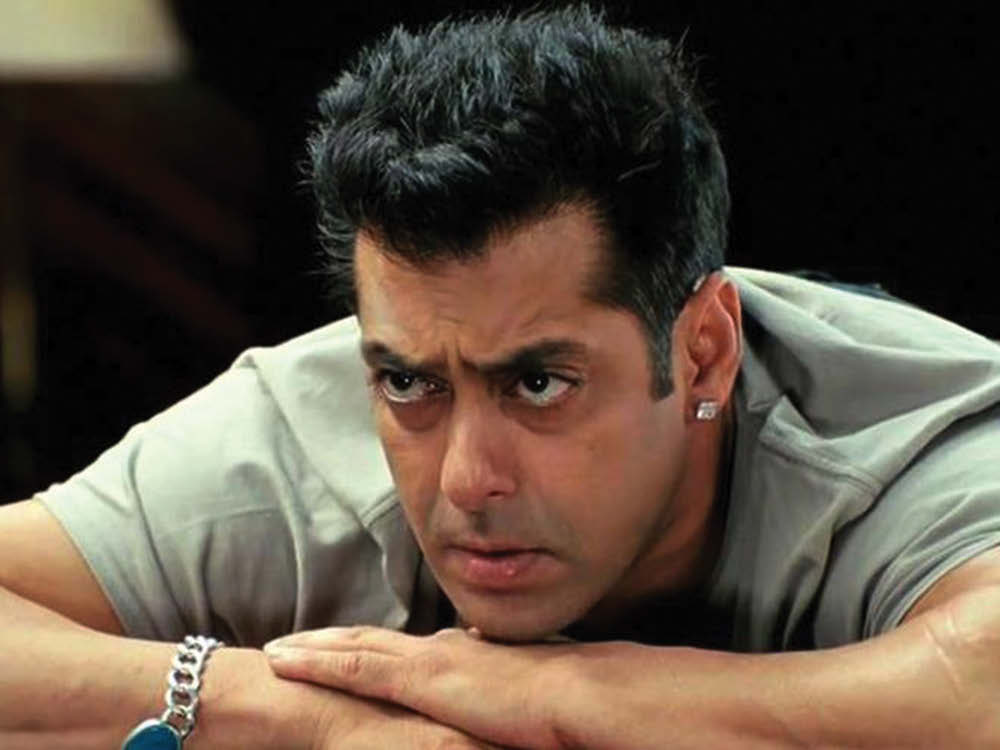
    JODHPUR, INDIA(TIP): Actor Salman Khan was on Thursday, April 5, sentenced to five years in jail after being convicted in a 19-year-old blackbuck poaching case by a court in Jodhpur.

    Chief Judicial Magistrate (Jodhpur Rural) also imposed a fine of Rs. 10,000 on Khan. The actor was taken to the Central Jail in Jodhpur from the court. He has the option of filing an appeal in the Sessions Court, reports our correspondent Mohammad Iqbal from Jodhpur. Unless the sentence is suspended, he will spend the night in jail.

    Khan is involved in four cases related to blackbuck/chinkara poaching. He has been accused of killing two chinkaras at Bhavad village in Rajasthan in September 1998, a chinkara at the Ghoda farms in the State the next month and two blackbuck near Kankani village in the State in the same month. In addition, he is also accused of using two firearms with alleged expired licenses.

    ‘Judgement came as a surprise’

    In an official statement, Mr. Khan’s lawyer Anand Desai said that the judgement came as a “surprise.”

    The statement reads:

    “We respect the decision of the Hon’ble Court. While we are studying the judgement it just came as a surprise, as the entire investigation, and facts of this case were the same as those for which Salman has been acquitted by the Hon’ble High Court of Rajasthan in two cases, and even by the Hon’ble CJM in the Arms Act matter for the alleged offence on the very same night as is the subject matter of the present case. Also, in the present case the Hon’ble Court has acquitted all the 5 co-accused which would imply that Salman was out hunting alone in the middle of the night in a remote area outside Jodhpur. We have preferred an appeal to the Hon’ble Sessions Court and applied for an urgent hearing today. The Hon’ble Sessions Court will hear the appeal for suspension of the sentence / bail at 1030 tomorrow.”

    Khan to spend the night in jail

    Salman Khan’s counsel has moved bail application in the court of Additional Sessions Judge. It will come up for hearing on Friday morning. The actor will spend the night in Central Jail of Jodhpur.

    Four actors, Jodhpur resident acquitted

    The co-accused, actors Saif Ali Khan, Tabu, Sonali Bendre and Neelam, and Jodhpur resident Dushyant Singh have been given the benefit of doubt and acquitted as the evidence against them was not strong enough.

    Public prosecutor Bhawani Singh said he would speak to the government on the acquittal of other actors and decide on filing appeals in the Sessions Court.

    Quantum of punishment

    Khan has been convicted under Section 9 and 51 of the Wildlife Protection Act. The maximum sentence under the law is six years.

    If the sentence is for three years or less, the magistrate’s court is likely to suspend the punishment, reports Mohammad Iqbal. If more, Khan will have to move the Sessions Court for bail.

    The charge against the other actors was under Section 149 (unlawful assembly) of the IPC. Their acquittal means the court has accepted that there is no sufficient evidence to prove this.

    A brief timeline of the cases:

    September-October 1998: Khan, along with his co-stars of Hum Saath Saath Hain, are accused of killing blackbuck/chinkaras during the shooting of the film.

    February 2006: Khan is convicted under the Wildlife Act and given a one-year jail term for killing two chinkaras at Bhavad in September 1998. This is overturned after an appeal.

    April 2006: A Jodhpur sessions court gives him a five-year-prison term in the second case, where he was accused of hunting a blackbuck in Ghoda farms. He spends three days in jail and gets bail.

    June 2006: A Jodhpur court frames charges against the actors in the third case. The charges were framed against Khan under Section 51 (hunting) of the Wildlife Protection Act and against Saif Ali Khan, Tabu, Sonali Bendre, Neelam and Dushyant Singh under Section 52 (abetment) of the Act.

    November 2013: The Rajasthan High Court suspends the five-year sentence.

    January 2015: The Supreme Court sets aside the High Court’s stay on the sentence.

    July 2016: The High Court acquits Khan in the two chinakara poaching cases.

    January 2017: A Jodhpur court acquits Khan in the Arms Case, where he was accused of possessing and weapons with an expired license during the hunt for chinkaras and blackbuck.

    Khan pleads ‘not guilty’

    Khan had pleaded “not guilty” in the case and claimed that only a forensic report saying that the endangered animal died of “natural cause” was true.

    “The rest of the evidence [against me] is false,” Khan said in the court of Chief Judicial Magistrate in Jodhpur while recording his statement in the 18-year-old case accusing him of hunting the animals.

    Khan killed the deer, says driver

    The man who was driving the jeep used by Khan reiterated in 2016 his claim that the actor shot the animal. The statement by Harish Dulani, who was reported to be “missing,” came two days after the 50-year-old actor was acquitted by the High Court in two poaching cases.

    (Source: The Hindu)

  • The world owes Martin Luther King Jr. a debt of gratitude

    The world owes Martin Luther King Jr. a debt of gratitude

    By Ashook Ramsaran

    Ashook Ramsaran pays a tribute to Martin Luther King Jr., American civil rights leader, on the 50th anniversary of his assassination which falls on April 4. King was fatally shot at the Lorraine Motel in Memphis, Tennessee, on April 4, 1968.

    The Indian Diaspora Council International (IDC) and its global affiliates join with other organizations, agencies, officials, groups, individuals and institutions worldwide in remembering Martin Luther King Jr. on the 50th anniversary of his assassination on April 4, 1968 in Memphis, Tennessee, USA.

    Martin Luther King Jr. lived an extraordinary life. At age 33, he was pressing the case of civil rights with US President John Kennedy. At age 34, he galvanized the nation with his famous “I Have a Dream” speech. At age 35, he won the Nobel Peace Prize. At the young age of 39, he was assassinated, but he left a legacy of hope and inspiration that continues today to confront the ugly vestiges of racial discrimination especially during these turbulent and alarming times.

    We pay special homage and grateful recognition of Martin Luther King Jr’s preeminent leadership of the modern American Civil Rights Movement, from 1955 to 1968, during which time African Americans achieved more genuine progress toward racial equality in America than the previous 3 centuries had produced. He championed equal rights which led to the 1965 US Civil Rights Act legally barring discrimination and segregation in all segments of American society.

    Martin Luther King Jr. was an American Baptist minister and activist who became the most visible spokesperson and leader in the civil rights movement. He was born on January 15, 1929 and assassinated on April 4, 1968. Martin Luther King Jr. believed that peaceful refusal to obey unjust law was the best way to bring about social change. His adherence of Gandhian non-violence teachings for peaceful protests to achieve freedom and social justice have inspired many to protest in peaceful ways against oppression, colonial rule, subjugation and violent discrimination in many countries.

    The life and legacy of Martin Luther King Jr. provide inspiration, challenges and reminders of the possibilities for good, as well as the role and responsibility of everyone to be supportive of advancing social justice in even small ways. One of his famous quotes: “Human progress is neither automatic nor inevitable. Every step toward the goal of justice requires sacrifice, suffering, and struggle; the tireless exertions and passionate concern of dedicated individuals”.

    The world owes Martin Luther King Jr. a debt of gratitude.

     (The author is President of Indian Diaspora Council International. He can be reached at  AshookRamsaran@gmail.com/    Mobile (USA) +1 917 519 5783)