NEW YORK CITY (TIP): Tali Roth, Head of Guitar Program, The Juilliard School Pre-College Division (www.taliroth.com), is organizing a faculty recital as a part of the centennial Juilliard Pre-College celebration concerts, on Saturday, September 22nd, from 6 to 7 P.M. at Paul Hall, The Juilliard School, 155 West 65th Street between Broadway and Amsterdam ( Lincoln Center). Admission to Concert is free.
Tali will collaborate with world renowned colleagues- flutist Carol Wincenc, tango dancers Martin Almiron and Maya Grego, guitarist Diego Campagna, and Juilliard Pre-College guitar and flute students and alums.
Program includes Music by Piazzolla, Gardel, Ramirez, Boccherini, Bartok. Also, part of the program is Tali’s recording of sound track from the 2010 Woody Allen Film “You will meet a tall dark stranger”.
See Sneak Previews- Short Video Promo with tango dancers
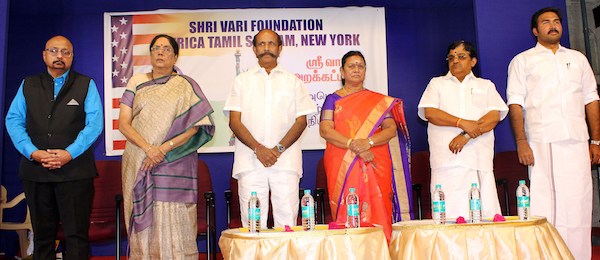
CHENNAI / NEW YORK(TIP): America Tamil Sangam and Shri Vari Foundation, New York have adopted two corporation schools in Chennai and constructed 10 restrooms partly with donations from American Association of Physicians of Indian Origin (AAPI) QLI and Indian Association of Long Island (IALI) New York.
The two Long Island, NY based associations jointly donated around $15,000 to Chennai flood relief fund of the Tamil Sangam two years ago which was now utilized to construct restrooms for girl students in two schools.
The kids were peeing in public in one school without any privacy while the other school had fewer restrooms for over a hundred children.
At a function held at Dr Janaki MGR College in Chennai, Tamil Nadu State Minister for Social Welfare Dr V Saroja, an OBGYN, said building restrooms helps improve the health of girl students and praised America Tamil Sangam and Shri Vari Foundation for implementing the project. She said the role of AAPI-QLI and IALI was praiseworthy in reaching out to the needy in their motherland. She announced a government grant of Rs 10 lakhs to the anganwadi (day care center) to be set up in an aided school in Thuluvapushpagiri in Tamil Nadu whose principal in charge was honored at the event.
Dr V. Maithreyan, Member of Parliament (Rajya Sabha), guest of honor at the event, said non-resident Tamils played a big role in attracting investments for the development of the state and acting as a bridge between the state government and the country of their residence.
Dr. J Jayavardhan, Member of Parliament (Lok Sabha- South Madras), guest of honor at the event, said Tamil sangams abroad fostered language, culture, music and heritage and in addition America Tamil Sangam also chipped in to provide social welfare measures.
Sivasankari, celebrated author and novelist, praised the role of American Tamil Sangam in putting a smile on the face of hapless children.
Dr. R Natraj, Member of the Tamil Nadu Legislative Assembly and former Director General of Police, presiding over the function, offered his support and cooperation to any Tamil associations from abroad willing to take up development work in his Mylapore constituency.
American Tamil Sangam honored Meena Rajan, headmistress in charge of government aided middle school in Thulvapushpagiri village in Thiruvannamalai district in Tamil Nadu. She had sold her jewels and her house to build classrooms and restrooms in the government school that had dilapidated class rooms with asbestos roof and no restrooms. She then went on to collect Rs 75 lakhs through donations to convert the dingy school into a smart class school with high tech facilities.
The Sangam also honored Dr TG Srinivasan, Chennai City Health Education Officer of the Corporation of Chennai for his untiring work in spreading the message of hygiene and cleanliness under Swatch Bharat program in schools, colleges, welfare associations and slum areas. It also felicitated principals of the two adopted schools – Soundarya Priya and Murugan- for their dedicated service. Two social workers – MV Ramani and Raja Mohan, advocate were also honored.
Prakash M Swamy, president of America Tamil Sangam, said the two schools were chosen for one school produced 100 percent results in tenth standard government exams for the past 8 years and the other excelled in promoting hygiene and discipline among students. Future plans include providing free sanitary napkins to girl students, improving the library and computer education, providing uniforms to students and sprucing up the campus. S Ravishankar, proposed a vote of thanks.
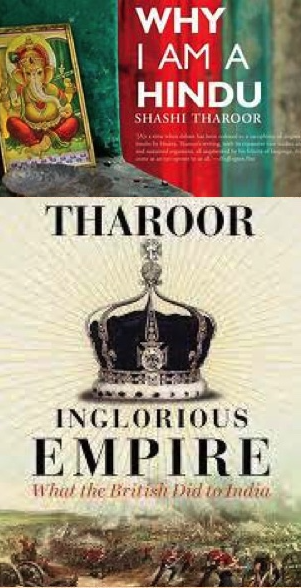
DALLAS, TX(TIP): Dallas Indian Arts Collective (DIAC), in partnership with Teamwork Arts, proudly presents a Fireside Chat with Indian politician, diplomat and author, Dr. Shashi Tharoor, on Tuesday, September 18, 2018, from 6:30 to 8 p.m. at Center Stage, located at 111 Oak Lawn Avenue in the Design District. The conversation will be moderated by Sanjoy Roy, founder and producer of the world-renowned Jaipur Literature Festival.
Tharoor, an award-winning author of 17 books of fiction and non-fiction, including Inglorious Empire (published in June 2018) and the newly published Why I Am A Hindu (not available for sale in North America until October 2018, but available at this event), is a second-term Member of Parliament representing Thiruvananthapuram and Chairman of the Parliamentary Standing Committee on External Affairs. He has served as Minister of State for Human Resource Development and External Affairs in the Government of India.
In a profound re-examination of Hinduism, one of the world’s oldest and greatest religious traditions, India’s leading public intellectual, Shashi Tharoor, lays out Hinduism’s origins and its key philosophical concepts, major texts and everyday Hindu beliefs and practices, from worship to pilgrimage to caste. Tharoor is unsparing in his criticism of extremism and unequivocal in his belief that what makes India a distinctive nation with a unique culture will be imperiled if Hindu “fundamentalists”— the proponents of “Hindutva,” or politicized Hinduism—seize the high ground. In his view, it is precisely because Hindus form the majority that India has survived as a plural, secular democracy. A book that will be read and debated now and, in the future, Why I Am a Hindu, written in Tharoor’s captivating prose, is a revelatory and original contribution to our understanding of the role of religion in society and politics.
PRAISE FOR WHY I AM A HINDU (available for pre-sale at the event):
“Shashi Tharoor is the most charming and persuasive writer in India. His new book is a brave and characteristically articulate attempt to save a great and wonderfully elusive religion from the certainties of the fundamentalists and the politicization of the bigots.”—William Dalrymple
“[O]ne of India’s most articulate liberals and a leading voice of those who reject the aggressively fundamentalist strains of Hindu nationalism.” —Victor Mallett, Financial Times
“A profound book on one of the world’s oldest and greatest religions.”—Hindustan Times
In the eighteenth century, India’s share of the world economy was as large as Europe’s. By 1947, after two centuries of British rule, it had decreased six-fold. Beyond conquest and deception, the Empire blew rebels from cannon, massacred unarmed protesters, entrenched institutionalized racism, and caused millions to die from starvation. British imperialism justified itself as enlightened despotism for the benefit of the governed, but Shashi Tharoor takes on and demolishes this position, demonstrating how every supposed imperial “gift”— from the railways to the rule of law—was designed in Britain’s interests alone. He goes on to show how Britain’s Industrial Revolution was founded on India’s deindustrialization, and the destruction of its textile industry. In this bold and incisive reassessment of colonialism, Tharoor exposes to devastating effect the inglorious reality of Britain’s stained Indian legacy.
“Rare indeed is it to come across history that is so readable and so persuasive.”—Amitav Ghosh
“Tharoor’s impassioned polemic slices straight to the heart of the darkness that drives all empires. Forceful, persuasive and blunt, he demolishes Raj nostalgia, laying bare the grim, and high, cost of the British Empire for its former subjects. An essential read.”— Nilanjana Roy, Financial Times
“His writing is a delight and he seldom misses his target … Tharoor should be applauded for tackling an impossibly contentious subject … he deserves to be read. Indians are not the only ones who need reminding that empire has a lot to answer for.”—Literary Review
Tickets are $50 and are available at www.diactexas.org. Both Tharoor & Roy will be available for one-on-one media interviews, upon request, from 5 to 6 p.m. Media RSVP to Jitin@JingoMedia.com or 512.773.6679.
To collaborate with the Government of India’s healthcare program – Ayushman Bharat.
NEW YORK(TIP): Healthcare in India is one of the largest sectors, in terms of revenue and employment. India is making tremendous progress in the healthcare sector and is building modern medical facilities throughout the country. Physicians of Indian origin have earned a name for themselves in the medical field and India is now being touted as a medical tourism hub. With a rise in population, there is an urgent need to create additional health infrastructure, which entails a higher level of planning, collaboration, and investment in the Indian healthcare market in the coming years.
It’s in this context, the groundbreaking AAPI Global Healthcare Summit (GHS) from December 28th to 31st, 2018 in Mumbai, organized by the Association of American Physicians of Indian Origin (AAPI) in collaboration with the Government of India, with participation from some of the world’s most well-known physicians, and industry leaders becomes very critical and significant.
“This international healthcare summit is a progressive transformation from the first Indo-US Healthcare Summit launched by AAPI USA in 2007,” Dr. Naresh Parikh, President of AAPI, says. “Providing a forum for innovative opportunities for learning, networking and giving back to our motherland that have now enabled us to plan ahead and prepare for an outstanding event that will have over 300 very prominent and talented physicians and surgeons from abroad, in addition to the hundreds of physicians from India, who are very passionate about serving their homeland, mother India.”
“Under the leadership of Dr. Naresh Parikh this year, AAPI is poised for a quantum leap in its activities in India with initiatives in new directions,” says Ravi Jahagirdar, M.D., Chairman of 2018 Global Healthcare Summit. “The Global Health Summit in December this year, will witness an expanded International Research Competition for budding residents and physicians – overseen by all the Medical Schools in Mumbai, with generous awards for the winners.”
For the first time, GAPIO (Global Association of Physicians of Indian Origin) will team up with a sizable representation, to promote a worldwide platform for Global Health. In keeping with its “needs based” approach, AAPI has identified the specter of Muti-Drug Resistant TB as the “Challenge of the Year,” and starting with a think tank, will oversee multisite implementation and monitoring, with involvement from the US Embassy and its Health Attache – who also represents the interests of Human and Health Resources in the USA, and works in tandem with the Clinton and the Gates Foundations.
The Women’s Leadership Forum this year is spearheaded by Mrs. Amruta Fadnavis, the dynamic and talented young wife of the Chief Minister, who is also the Chief Hostess for the entire event, Dr. Asha Parikh, Chairwoman for the Women’s Forum announced.
“While seeking to identify ways for greater collaboration and cooperation between the physicians and health care providers in India with those of Indian origin and major healthcare providers abroad, the Summit will focus on prevention, diagnosis, treatment options and share ways to truly improve healthcare transcending global boundaries,” says Dr. Raj Bhayani, Co-Chair of the GHS.
With the objective of enabling people in India to access high quality, affordable, and cost-effective world class health services, the Summit to be held in collaboration with the Indian Medical Association (IMA), the Ministry of Overseas Indian Affairs & Ministry of Health, will
provide a platform for planning for new initiatives and strengthening the past programs and actions.
As a testimony to ensuring continuity in previous initiatives, the hugely successful CPR training of police officers continues yet another year, as part of the Trauma Brain Injury (TBI) initiative.
Anwar Feroz, Strategic Advisor of AAPI, said, “For the first time at a CEO Forum – this year will have a full dedication to the AYUSHMAN BHARAT initiative by our Prime Minister Shri Narendra Modi and the Government of India, an ambitious project to provide financial support for about 500 million needy but poor patients.”
The participants will arrive from AYUSH, healthcare industry, academia, and from regulatory and clinical leaders, to brainstorm this gigantic challenge, and how to make it work.
For relaxation and entertainment, there will be a kaleidoscope of cultural presentations of Western India, featuring well known artists. Being held in Mumbai, one cannot be surprised to have special appearance by top stars from the Bollywood world.
“With the changing trends and statistics in healthcare, both in India and US, we are refocusing our mission and vision of GHS 2018, and AAPI would like to make a positive meaningful impact on the healthcare in India,” Dr. Parikh says. “In our quest to fulfill the mission of AAPI, we are proud to share best practices and experiences from leading experts in the world and develop actionable plans for launching demonstration projects that enable access to affordable and quality healthcare for all people.”
With such a striking agenda, this 2018 Global Health Summit in Mumbai promises to be one of the best ever. Register ASAP – to get the better rooms and locations. There will be NO AAPI CANCELLATION CHARGES until November 1st, 2018 – just in case you may have to change plans afterwards. Still more, the Early Bird Special with the discounted rates has been extended to September 30th. Do not miss the opportunity. For more information on Global Healthcare Summit 2018, please visit www.aapiusa.org
Aries:Ganesha says a lot depends on biorhythms and other influences too. Astrology never compels. Plus, remember, this is a general reading and I do not have your personal chart. This can be a period of contrasting emotions. You look for salvation. Old wounds open their hoods. You go looking for a guru and take recourse to yantra, tantra and mantra. You take time out from work and family and may do something completely different from the norm.
Taurus:‘Fiction gives us a second chance that life denies us,’ said Paul Theroux, the novelist. Your mind is in a million places all at once. You are simply unable to be precise. You cannot put pen down to paper. You are all thought and no action. You cannot walk the talk. This is a phase of deep anguish as you are unable to activate your thoughts. It is an impotent period. There are expenses and many domestic challenges.
Gemini:The leak in the boat is finally fixed. You are back on terra firma. The winter sun is scorching the bones and you realize that time is flying. You have to get cracking before it is too late. You get back to the business of making a living. It’s a tough choice but there is no room any more for indulgences. Those in jobs work double shifts and freelancers spread their net wide. You have to make both ends meet and prepare a nest egg too.
Cancer:You are all pumped up and raring to go. In the mood you are in, you can perform miracles. Nothing is beyond you. You reach for the stars and may even touch them on tiptoe. There are awards and rewards, applause and kudos. You are the toast of your peer group. This is a fantastic time for creative folk and those in the visual arts. If you are also looking to cleanse your soul, you will succeed. You are in the quest for the holy grail. Ganesha urges you on.
Leo:Jung, the great analyst, said, ‘Show me a sane man and I will cure him.’ You are living out your inherent contradictions in splendor. You wear them on your sleeve and could be easily the most misunderstood person on the planet now. Your emotions are bubbling over like a volcano erupting. At home, the health of elders will be a cause of concern. Those in committed relationships take bond to new heights.
Virgo:There is powerful intensity propelling you. Sadguru Jaggi Vasudev, today’s popular mystic says, ‘There is security in repetitive life patterns, but there are no possibilities, no growth.’ You realize the import of his words. You want to change the status quo, you want to challenge everything that has been said and said again down the ages. You want to flirt with danger, even kiss a cobra on its hood like they do in Thailand, or eat broken glass, or walk over the Niagara Falls on a tripwire.
Libra:‘An ant on the move does more than a dozing ox,’ said Lao-tzu. You find new ways to tackle the issues on your plate. There is success, and money too. You win applause. You also spend time with social work and may help with the less fortunate. You lend a shoulder and an ear where necessary. You are the toast of your neighborhood as you espouse causes common to all. You excel in group discussions, contractual negotiations and conferences.
Scorpio:You live and love large. You make money by the bushels and spend it too. You play the field and are caught in the deep coils of amour. Nothing makes sense to you anymore but the sweet fragrance, however fleeting, of your beloved. This is a great period for those in realty and the stock market. There could be an addition to the family, possibly an adoption. At the very least, you may bring an exotic pet home. Ganesha smiles.
Sagittarius:You scale new heights. There are expenses, ego drives, passions, altercations and misunderstandings. You stand your ground on flimsy issues and take even the most trivial arguments to heart. This doesn’t fetch you brownie points and you will have to examine your core to see what has disrupted it so much that you flinch and retort at the slightest perceived disagreement. You play the field. Youngsters will be tough to rein int.
Capricorn:You are with your buddies, be it the boy gang or the girl gang or the mixed gang. It is party time and you are not one to miss out on the fun. You could be travelling too, and letting your hair down on the Riviera or some other exotic locale. You are also in line for a windfall, possibly an inheritance. This is a lucky period. You strike gold in the most barren spaces. Bob Marley said, ‘I have no education. I have inspiration. If I was educated, I would be a damn fool.’ You are inspired to take the moment to dizzy heights. Ganesha joins you.
Aquarius:You are in a philanthropic bent of mind. You want to serve others and there are no full stops in your yearning to do so. You want to give back to society and the stars support you in all your endeavors. You have the endearing softness and sentimentality in your sign now and there is new love, fellowship and selfless giving. You could put Mother Teresa in the shade in the mood you are in. I shall end with a quote from J. Krishnamurti: ‘It is only when the mind is completely quiet, free of conflict – it is only then that the mind can go very far into the realms that are beyond time, thought and feeling.’ Ganesha wrings his hands in thrall.
Pisces:‘A scholar who cherishes the love of comfort is not deemed to be a scholar,’ said Lao-tzu. You want to be a person of renown, a person of letters, someone society can respect for his / her knowledge and erudition. But you may have a long distance to go. You need to traverse the razor’s edge, you need to get out of your comfort zone and get scarred. It is only after you emerge from the plain of struggle – like a caterpillar that becomes a butterfly – that you can delight in the prowess of true empirical knowledge.
The US Open from Aug 21 to Sep 9, 2018 in New York has been an experience for millions of lovers of Tennis the world over. Those who found opportunity to be at the stadium and watched games, have unforgettable memories of the great sporting event. So it has been with Jay Mandal, the ace photographer who is passionate about capturing action, wherever it is. We bring to our readers some exclusive pictures from his camera lens of the exciting tournament.
Photo:-Jay Mandal/On Assignment
Andy Murray
Carla Suarez
Dominic Thiem of Austria Photo:-Jay Mandal/On Assignment
Dominic
Khachanova
Millman
Novak Djokovic of Serbia, 2018 U.S. Open men’s singles champion. September8, 2018 Photo:-Jay Mandal/On Assignment
Novak
Photo:-Jay Mandal/On Assignment
Nadal
Roger Federer at US Open Photo:- Jay Mandal/On Assignment
Federer
Serena Wuilliams Photo:-Jay Mandal/On Assignment
Serena
Sharapova
Yuk
Sandeep Chakravorty & Taruna Chakravorty
Priyanka Chopra and Nick Jonas at the US Open at Flushing Meadows. September 4, 2018 Photo:-Jay Mandal/On Assignment
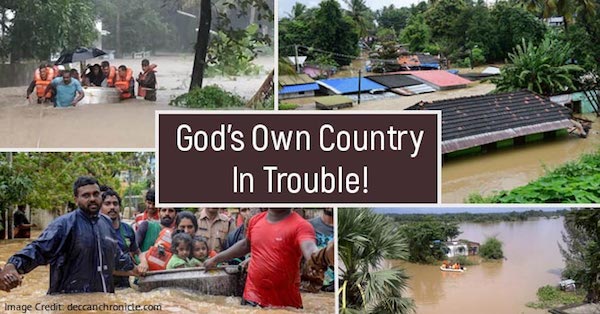
After the devastating floods, Kerala society as a whole now needs to reorient its relationship with nature
By Pulapre Balakrishnan
“Kerala society as a whole now needs to reorient its relationship with nature. However inclusive this development may have been — and there is reason to believe that some of the claims made are exaggerated — that by itself does not ensure that the assault on nature will now end”, says the author.
In a national calamity, people look towards a leader to extend them empathy, a sense of somebody being in charge and a route to a more secure future. By any measure, Pinarayi Vijayan, the Chief Minister of Kerala, has lived up to expectation on the first two aspects and may be expected to play a role in identifying the third after the State has had to face its biggest disaster in a century in the form of floods. He has reflected gravitas, displayed pragmatism and expressed a willingness to take assistance from any source. The last is a necessary corrective at a time when false pride, standing in the way of accepting the hand of friendship extended from the outside, is projected as a desirable nationalism. At the very same time, it is necessary to acknowledge the extraordinary outpouring of humanity and material assistance towards the people of Kerala from the rest of India. It is difficult to recall something on this scale as a response to a calamity in a distant corner of the country in recent times.
Natural capital and progress
Now that the Chief Minister has affirmed that the “last person has been rescued”, rehabilitation is progressing, and plans are afoot to rebuild Kerala, it is hoped that the last will be approached with an open mind. This would be a mindset that recognizes that much must change in Kerala’s civil society, which in turn would trigger change at the level of governance. Indeed, a paradigm shift, being a profound change in the perception of progress, is needed. The central element in this new perception must be that a continuous decline of a society’s natural capital cannot be seen as compatible with progress. Kerala has justifiably been identified as having carved out a niche, and not just in India but globally, as a society with high human development at a relatively low level of income. While it may be pointed out that globally, many other societies, particularly to the east of India, have achieved the same in terms of some standard social indicators, it must be remembered that, as a part of India, it had also to deal with an ossified social structure in the form of caste and the inequalities it perpetuated. Social stratification was far less in east Asian societies making it easier for them to transform. For Kerala to have overcome this burden through a non-violent political revolution is a considerable achievement.
At times though, stories of our success relayed across the world may lead us to be somewhat swayed by praise. This may have happened to the leadership of Kerala society which extends beyond the political class to its intellectuals. While focusing on certain aspects of a society, external observers could miss others that are just as crucial in evaluating its development. Laudatory evaluations of Kerala have masked the decline in natural capital and associated ecosystem services that have accompanied the rise in income. The decline in natural capital has ranged from deforestation that contributes to rainwater run-off contributing to landslides, to sand-mining that leads to rivers over-flowing their banks and building on the flood plains that were meant to provide a cushion. All of these contribute to flooding.
Too much consumption
When we have it upon the word of Madhav Gadgil — who may be considered India’s ecological voice and has studied the Kerala topography and its alteration — that human action may have exacerbated the consequences of the unusually heavy rain this year, we would be advised to hear the message. We know exactly the corrective actions necessary to reverse, possibly only at a glacial pace at that, the accumulated man-made factors responsible for this. At the center of it is consumption. In relation to the ecological damage that it can wreak, Kerala consumes too much. At the center of this consumption is luxury housing and commercial holiday resorts, of course luxurious. Structures much larger than necessary cover the soil with concrete, heightening rainwater run-off, and through their weight increase subsidence. Houses here have historically been built with sand mined from rivers. Once this source got exhausted, river sand has been replaced by manufactured sand which is a by-product of quarrying. Large-scale quarrying has meant loping off the top of hills and allowing water to seep into them, making them unstable. So, at the back of much of the human factor that has exacerbated the flooding by changing the landscape is luxury housing. It is significant too that some of this housing is not even used or has very few persons living in them. This is hardly a rational use of a scarce resource such as land, especially when it has known catastrophic consequences.
Unsustainable trajectory
Altogether, Kerala’s much-acclaimed development trajectory is unsustainable as demonstrated during the recent floods and needs a change. The needed change is radical, and the reality is that its past cannot be a guide to its future. This past has been one of human development, but Kerala society as a whole now needs to reorient its relationship with nature. However inclusive this development may have been — and there is reason to believe that some of the claims made are exaggerated — that by itself does not ensure that the assault on nature will now end. Only the State’s civil society can guarantee its future on this score. Political parties are loathe to speak the language of responsible consumption for fear of losing out on votes.
While, going forward, a path-breaking environmental movement in Kerala’s civil society is necessary, it does not mean that governance in Kerala should be left unaccountable out of concern for peaceability. Even in a past that has witnessed progress in the form of an elimination of social barriers, government in Kerala has remained unaccountable with respect to the economy. Malayalis have had to migrate in large numbers, leaving their families behind, to keep the home fires burning. Now with the new challenge of ecological sustainability arising, government — by which is meant the entire public sector — needs to assume accountability for the depletion of natural capital. Someone has to take responsibility for the pattern of land use in Kerala, the pathologies of which extend to building resorts on hillsides, turning every public space into a refuse dump for used plastic, and the continuous alienation of agricultural land, all of which may have had a role in exacerbating the floods. It is by now clear that the decentralization of government has been unable to prevent these developments. Land use in the State needs review at the level of the State government.
Calling for a public review
Mr. Vijayan has been statesmanlike in saying that he will take material assistance from every quarter. He must now extend this approach to listening to independent voices on the rebuilding of Kerala. The obvious place to start would be to institute a public review of the dams in Kerala and how they are operated, focusing in particular on how their operation may have affected the flooding. Such a demand has been made by a section of Kerala’s legislators. Even a conservative body such as the World Bank had instituted an independent review of the Sardar Sarovar Project in the 1990s and tailored its policy accordingly. Considerations of both transparency and confidence of the people in the functioning of the government machinery demand that such a review be instituted at the earliest.
(The author is Professor of Economics, Ashoka University and Senior Fellow, Indian Institute of Management, Kozhikode)
There was a time when Pete Sampras’s tally of 14 Grand Slam singles titles — the last of which came at the U.S. Open in 2002 — seemed like the acme of sporting achievement in men’s tennis. Little did anybody expect that in the next 16 years, across 64 Majors, not one or two but three players would stand shoulder to shoulder with the American great. On Sunday, Novak Djokovic became that third man, defeating Argentine Juan Martin del Potro, for his third U.S. Open title at Flushing Meadows. The 31-year-old Serb has never been considered a once-in-a-generation talent, as have Roger Federer and Rafael Nadal, the ones above him in the trophy count. But nobody represents the modern-day game as well as Djokovic. He is the ultimate practitioner of the attrition-based baseline tennis, and at his best, with his supremely efficient patrolling of the court, is near invincible. Over two weeks in New York he hit these high many times over. In fact, the 95-minute second set in the final was a microcosm of Djokovic’s last two years. It was long and weary as fortunes swung back and forth. But adversity energized him, and he found a level which his opponent couldn’t match. Coming after his triumphant return at Wimbledon in July, the latest success is evidence enough that technically, tactically and physically Djokovic is back to his best.
If it was about the restoration of the old order on the men’s side, it was the continuation of the new in the women’s section. There has been a first-time winner in four of the past six Grand Slam tournaments, and 20-year-old Naomi Osaka added to the eclectic mix by becoming the first Japanese to win a Major. In Serena Williams, the winner of 23 singles Slams, the most by any player in the Open Era, Osaka faced the ultimate challenge. It was also an inter-generational battle like none other. The 16-year age gap between Williams and Osaka was the second biggest in the Open Era for a women’s final, next only to Monica Seles (17) vs. Martina Navratilova (34) at the 1991 U.S. Open. To her immense credit, Osaka wasn’t awed by the stage. While growing up, she had revered Williams. After all, this is someone who chose Williams as her subject for a school essay in third grade. On Saturday she played like she knew the 36-year-old’s game like the back of her hand, absorbing everything the American threw at her, and redirecting them with much more panache. The magnitude of her achievement was nearly drowned out by the chaos in the aftermath of Williams’s tirade against the chair umpire. Yet, the manner in which Osaka, at an impressionable young age, closed out the match with a cold relentlessness showed she is here to stay.
SACRAMENTO(TIP): The Sutter County police arrested Jasbir Singh and his son, Gagandeep Singh on September 12, in connection with assault on Akali Dal leader Manjit Singh GK in a Yuba City Sikh Temple on August 25.
Manjit Singh GK was attacked amid chants of ‘Khalistan Zindabad’ by pro-Khalistan supporters in Yuba City in Northern California on August 25 where he had gone to pay obeisance to the Sikh Guru Granth Sahib.
Releasing a statement immediately after the incident, Manjit Singh GK said,” I had come to Yuba city Gurudwara with other devotees. We had come here to pay our obeisance. Around 20-25 men entered the Gurudwara premises and attacked me. Considering the situation and respecting the sanctity of the Gurudwara I told my supporter to not react to such elements. Despite the brutality with which they have attacked me, I am absolutely fine”.
Earlier in August, Manjit Singh GK was attacked by a group of Khalistan supporters. The first incident took place in New York where he and his family members were attacked. Minutes after the incident, Manjit Singh posted the video of the incident which took place when he had come out of a TV studio after participating in a debate.
“A group of people attacked me and my relatives in New York. This will not scare me away from my path to serve the community. I have fought, and I will fight till my last breath. Such cowardly incidents do not scare me,” Manjit Singh tweeted.
Union Minister Harsimrat Kaur Badal has alleged that the men who were behind the attacks have links with Pakistan’s intelligence agency, ISI. She also added that these attackers enjoy the support of senior Congress leader and the accused in the 1984 anti-Sikh riots case, Jagdish Tytler.
“Heads of ‘Sikhs for Justice’ who are direct beneficiaries of ISI, and who work on their orders and are supported by those who are in direct touch with the likes of Jagdish Tytler, and Jasbir Singh and his son Gagandeep Singh, were seen attacking him (Manjit Singh GK). Jasbir Singh is the same person who has spent three months in jail for trying to intimidate an eyewitness against Jagdish Tytler in the 1984 massacre”, she said.
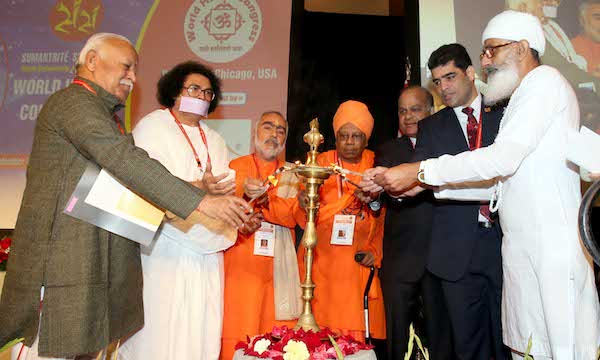
CHICAGO(TIP): It was a time for connecting and reflection for the 2500 Hindu delegates who had gathered at Hotel Westin in Chicago for the 2nd World Hindu Congress from 7-9 September. The mega initiative, a brainchild of IITian Swami Vigyananand, assessed ways to raise the visibility of Hindus on the world stage and work on challenges facing the community globally. Hindus from 60 countries were present with sizable delegations from Bharat and the US.
The event had a historical significance as it commemorated the 125thanniversary of Swami Vivekananda’s iconic address at the World Parliament of Religions in Chicago.
(Also Read ‘Fake Saviors of Hinduism at the World Hindu Congress in Chicago’ on page 9)
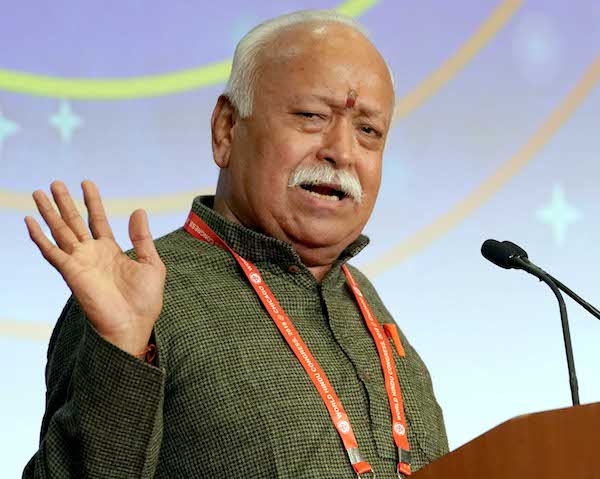
Against the backdrop of a life like statue of Swami Vivekananda, RSS Chief Dr. Mohan Bhagwat, at the inaugural event, addressed the congress on the core theme drawn from the Mahabharat, “Think collectively, Act Valiantly.”
He highlighted the need for Hindus to work together and said “We have stopped our descent and are contemplating how to ascend. Our universal values, now called Hindu values, lead to the welfare of the individual, the society, nature and the environment. It is the duty of Hindus to remind the world, the universal values from time to time.”
Stressing the need for unity, Bhagwat said if a lion is alone, wild dogs can invade and destroy the lion. We must not forget that.”
“We want to make the world better. We have no aspiration of dominance. Our influence is not a result of conquest or colonization,” he noted.
Chair SP Kothari, said he and many speakers attending the conference received calls and petitions from organizations and individuals to withdraw from the Congress on the ground WHC or some of its organizers are “socially and religiously divisive.” “I urge them to listen to my talk and reflect on whether it is tainted with hate. I have chosen to disregard those petitions as originating from a lack of complete understanding of the World Hindu Congress.”
Coordinator Dr. Abhaya Asthana stated that WHC is not an event, it is a community movement. It seeks to encourage Hindus around the world to ascend to the highest levels of excellence. This Congress was important so we “may graduate from individual success to collective success.”
Award winning actor Anupam Kher said “Hinduism is a way of life and one becomes a Hindu by living like one. Tolerance was the centerpiece of Vivekananda’s message. My roots are steeped in Hinduism… As a Hindu, it pains me deeply to see how ignorance and half knowledge are trying to destroy one of the oldest, world’s most peaceful religion.”
Vice Chair, Raju Reddy, urged Hindus worldwide to become more visible as positive change makers in their respective countries they call home, wherever they may be today. He added, Hindus as a community should become economically more prosperous and be viewed as an economic powerhouse. Our immense soft power of Hindu teachings, Vedic knowledge and thought will be limited in its acceptance and reach without the accompanying economic power.
India’s Vice President Venkaiah Naidu, keynote speaker for the concluding session, renewed Swami Vivekananda’s message and elaborated on some of the essential elements of Hinduism. Also seen in the picture is India’s Ambassador to the United States Navtej Sarna. Photo /Jay Mandal-on assignment
India’s Vice President Venkaiah Naidu, keynote speaker for the concluding session, renewed Swami Vivekananda’s message and elaborated on some of the essential elements of Hinduism namely the breadth of its vision in treating the world as one family, tolerance and acceptance of plurality, and unity in diversity. True nationalism is in the preservation of India’s invaluable heritage, he said.
Swami Poornatmananda of Bharat Seva Ashram, Chinmaya Mission Spiritual Head Swami Swaroopananda, Swami Paramatmananda, secretary general of Hindu Dharma Acharya Sabha, Satguru Dalip Singh of Namdari, Madhu Pandit Dasa, chairperson of Akshaya Patra Foundation, ISKCON, Bangalore were some of the spiritual leaders who spoke at the event. Messages by Prime Minister Narendra Modi, his Holiness the Dalai Lama and Art of Living Guru Sri Sri Ravi Shanker, BAPS Spiritual Guru Mahant Swami Maharaj were played via video.
Congressman Raja Krishnamoorthi, (D-IL) said “Some of my friends and constituents were very concerned about my presence here today…I decided I had to be here because I wanted to reaffirm the highest and only form of Hinduism that I’ve ever known and been taught…namely one that welcomes all people, embraces all people, accepts all people regardless of their faith including all my constituents.”
(Also Read ‘U.S. Congressman Krishnamoorthi Challenged for World Hindu Congress Appearance’ on Page 13)
Lt. Governor of Illinois Evelyn Sanguinetti, Congressman Bill Foster, Congressman Bruce Fraser were also present. Other eminent dignitaries who spoke were Vice-president of the Republic of Suriname Ashwin Adhin, entrepreneur and Grammy nominated artist Chandrika Tandon, renowned classical dancer Sonal Mansingh, author Amish Tripathi of the Shiva Trilogy and Mohandas Pai chairperson of Board of Manipal Global.
Four organizations were recognized for their outstanding contributions to spreading Hindu philosophy. BAPS was honored for their architecturally beautiful temples, Chinmaya Mission for explaining the essence of the Gita, Geeta Press, Gorakhpur for making sacred Hindu literature accessible, and ISKCON for spreading the message of Gita.
Seven conferences and three plenary sessions over the course of three days highlighted issues facing Hindus. The Political Conference suggested the need for a permanent secretariat in the US or UK for the cause of Hindu rights around the globe, asserting a strong political voice especially in countries like the Caribbean, Fiji and the African countries, and developing young political leaders.
Other parallel sessions were on youth, media, economy, women, education, and Hindu organizations.
To create awareness about atrocities committed against Hindus around the world, speak out against biased portrayals of Hindus, freeing temples from government control, making writing contemporary and relevant to the present generation, finding new ways to open trade, skill development, an Angel Investor group for women entrepreneurs and a global Hindu Women Business directory, a strategy for developing scholarship in religious studies were some of the recommendations of the conferences.
Prominent Houstonian, Col. Raj Bhalla said “Being a Sikh, 87 years old, I always had a personal belief that Sikhs are part of Hindus. The World Hindu Congress further enlightened me and strengthened my conviction. My earnest desire is, in India, Sanskrit should be taught to children at a very young age so they learn about Vedic, Spiritual and Scientific knowledge that Hindus gave to the world 5000 years ago – a rightful matter of pride.”
The third World Hindu Conference will be held in Bangkok, Thailand, from Nov. 4 to 6, 2022. The theme will be “Victory of dharma, not adharma.”
ANDOVER, MA(TIP): Dozens of explosions, apparently triggered by a natural gas pipeline rupture, rocked three communities near Boston on Thursday, September 13, killing at least one person, injuring 12 and prompting the evacuation of hundreds, officials said.
The blasts left dozens of homes and other buildings demolished or engulfed in flames as firefighters from some 50 departments raced for hours from one blaze to another and utility crews rushed to shut off gas and electricity in the area to prevent further ignitions.
Police drove up and down streets with bull horns telling residents to vacate their homes immediately.
Fire investigators suspected “over-pressurization of a gas main” belonging to Columbia Gas of Massachusetts led to the series of explosions and fires, Andover Fire Chief Michael Mansfield told a news conference.
Columbia Gas, a unit of the utility giant NiSource Inc (NI.N), announced earlier on Thursday that it would be upgrading gas lines in neighborhoods across the state, including the area where the explosions occurred. However, it was not immediately known whether any work was being done in those communities at the time.
“Columbia Gas is investigating what happened on its system today,” NiSource spokesman Ken Stammen said.
The U.S. Department of Transportation’s Pipeline and Hazardous Materials Safety Administration (PHMSA) said it was sending a team to support the state’s emergency response efforts.
The former head of the agency, Brigham McCown, called the series of gas explosions “unprecedented, at least in recent memory.”
“I can’t think of a series of natural gas-related incidents like this,” McCown, who led PHMSA under President George W. Bush, told Reuters by telephone. “We have had similar issues on a much smaller scale.”
He said the National Transportation Safety Board was also sending a team headed by its chairman, Robert Sumwalt, to investigate the disaster.
Live TV images showed firefighters battling blazes in the former mill towns of Lawrence, Andover and North Andover, about 25 miles (40 km) north of the Massachusetts capital.
The streets were darkened after nightfall with power cut off to the area as a precaution.
Lawrence General Hospital said on its Facebook page it treated 13 people for injuries ranging from smoke inhalation to blast trauma. One of those patients, who was in critical condition, was transported to Massachusetts General Hospital in Boston. Officials told Reuters that patient later died.
At least three people, including one firefighter, were hurt in Andover, the town said in a statement, but it was unclear whether any of those individuals were among the patients treated in Lawrence, some of whom were later released.
“This has been an overwhelming event,” Mansfield told reporters, saying that fire companies responding to blazes were putting one house fire out only to discover another house on fire as they finished their work. “This event is not over tonight. This event will probably go on.”
Massachusetts State Police said a total of 70 fires, explosions or investigations of gas odor had been reported. Some 50 fire departments responded to the emergency, said John McArdle, fire chief of Plaistow, New Hampshire, which sent a tower ladder and engine crew to the scene.
State police urged residents served by Columbia Gas to evacuate their homes. Lawrence Mayor Dan Rivera said residents in the southern part of the city had been asked to leave their homes whether or not they were Columbia Gas customers, due to planned power cuts.
NEW YORK(TIP): Hurricane Florence, with tropical storm-force winds hundreds of miles wide, began pounding the Carolina coastline on Thursday, September 13 night as officials made last-minute pleas for residents to evacuate.
Hurricane-force winds are moving across portions of the North Carolina coast, and water levels were rising along parts of the coastline. The threat of tornadoes increases as Florence moves closer, with landfall expected Friday, September 14 morning.
The storm surge is expected to worsen late Thursday and into early Friday during high tide in the Atlantic Ocean.
Though the storm, once a Category 4, was downgraded Thursday night to a Category 1 from a Category 2, the danger is very real. Parts of North Carolina may see as much as 40 inches of rain and storm surges could be as high as 13 feet.
“Flooding and the storm surge — those are the two main things that kill people, and this storm is not letting up,” North Carolina Gov. Roy Cooper said Thursday.
The storm will churn very slowly Friday and Saturday, extending the damaging winds and huge amounts of rain that will hit the same areas of North and South Carolina for 24 hours.
High winds and floodwaters could knock power out for several days, if not longer, officials said. Almost 160,000 customers already were without power in North Carolina Thursday evening — and that number is likely to rise.
For those in an evacuation area, “there is still time to get out,” Cooper said Thursday. “Don’t risk your life riding out a monster storm.”
“You’re potentially risking the life of a first responder who would try to come and help you, and we don’t need that,” he added. “I know it’s difficult to move, and I know that you are leaving things behind that you don’t want to leave behind, but no possession is worth your life.”
South Carolina Gov. Henry McMaster added: “Time is running out. Now is the time to go because that window of opportunity is closing on you very quickly.”
CHICAGO, IL(TIP): Over the two days leading up the launch of the World Hindu Congress (WHC) 2018 in Chicago, delegations from Organization for Minorities of India (OFMI) visited U.S. Congressman Raja Krishnamoorthi’s (D-IL) district office in Schaumburg and his Capitol Hill office in Washington, D.C. to register protest against the congressman’s presence at the event.
“The World Hindu Congress is a point of concern for us as citizens, as voters, and also as advocates of those who are underrepresented because the World Hindu Congress, under the guise of a religious event, is actually a partisan political event,” remarked activist Jada Bernard in a September 6 meeting at the Schaumburg office.
In conversation with Staff Assistant Yasmeen Bankole, he said the WHC was organized by the Vishwa Hindu Parishad (VHP) and featured Rashtriya Swayamsevak Sangh (RSS) leaders as its keynote speakers. Describing how these groups fall under the umbrella term “Sangh Parivar,” he explained, “Sangh Parivar groups represent Hindutva, which is Hindu supremacy. That ideology is responsible for violence in the past, and because it’s responsible for violence in the past, any association with this group in the present could damage elections in the future. That’s pretty much our warning. Voters care about lives, even if the Sangh Parivar groups don’t.”
On the previous day, Pawan Singh visited Krishnamoorthi’s D.C. office. In a meeting with Legislative Director Sam Morgante, he explained how the RSS engages in violence against minorities in India. Discussing the groups involved in the conference, Singh named Vishwa Hindu Parishad of America (VHPA) and Hindu Swayamsevak Sangh (HSS), pointing out that the HSS is the international wing of the RSS.
“When Mr. Morgante asked me if the RSS in India is any different from the HSS, I told him no,” says Singh. “Everything falls under the RSS shell organization. I told him our concern is that events like this are trying to legitimize the genocides of minorities committed by the RSS. Our concern is that these terrorist groups should not be given a platform on American soil.” Speaking in Illinois, Bernard added, “We also want to make other congressional representatives aware of this, but we also want to kind of give a warning because, when congressional representatives show up at events like this, it associates them with the ideology.”
Both Bernard and Singh presented the offices they visited with an 18-page information packet. The executive summary of the packet states, “The organizers and many keynote speakers are part of a militant religious nationalist movement which, according to the U.S. Commission on International Religious Freedom, ‘holds non-Hindus as foreign to India.’ As per reports from Amnesty International, Human Rights Watch, and the U.S. State Department, these groups persecute India’s minorities (especially Muslims and Christians), sponsor pogroms, and are implicated in daily acts of violence against marginalized peoples who do not participate in their supremacist agenda.”
On Capitol Hill, Singh also visited the offices of Representatives Ro Khanna (D-CA), Ami Bera (D-CA), Zoe Lofgren (D-CA), Jeff Denham (R-CA), David Valado (R-CA), John Garamendi (D-CA), and Tom McClintock (R-CA), and had a brief personal meeting with Rep. Jack Bergman (R-MI).
Subsequently, on September 8th and 9th, protestors demonstrated outside the WHC for several hours each day. One protestor, a local Muslim man, commented on a placard which read, “VHP, RSS, BJP carried pogrom of Gujarat.” Describing how the Sangh Parivar groups perpetrated violence against Muslims, he said, “I would like the city of Lombard and our congressman, Raja Krishnamoorthi, to not share dais with these killers and hate-mongers.”
Adding that he had previously voted for the congressman, he said, “I was very much impressed when he came out at O’Hare to talk about anti-immigration when Trump administration banned visas for six Muslim nations. I like the speech which Raja Krishnamoorthi gave at O’Hare. I’m a big supporter of his speech.” In conclusion, he suggested that “I would, definitely” continue supporting the congressman if he had withdrawn from the WHC, as did Congresswoman Tulsi Gabbard, who called it a “partisan Indian political event.”
Organization for Minorities of India was founded in 2006 to advance individual liberties of Christians, Buddhists, Dalits, Muslims, Sikhs, and all Mulnivasi people of South Asia by encouraging secularism, progressive human rights, liberation of oppressed peoples, and universal human dignity. Visit OFMI.org for more information.
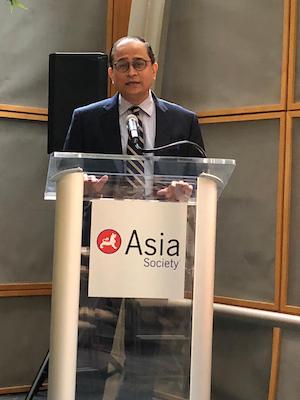
NEW YORK CITY(TIP): The Asia Society of New York hosted a press conference at Asia Society Museum in New York City on September 13 to debut a landmark exhibition of works by members of the Progressive Artists’ Group, which was formed in Bombay, now Mumbai, in the aftermath of independence. India’s Consul General in New York Ambassador Sandeep Chakraborty inaugurated the show.
In his brief speech Ambassador Chakraborty applauded Asia Society for hosting an exhibition of such magnitude. “I am aware of the hard work (of Asia Society) behind the show because it is not easy to convene such an exhibition. This is a rare exhibition because I think this kind of exhibition has not been organized ever before in the United States
Progressive Artists’ Group, Bombay 1949.The exhibition comprises of important works from the Group’s core founders—K. H. Ara, S. K. Bakre, H. A. Gade, M. F. Husain, S. H. Raza, and F. N. Souza — as well as later members: V. S. Gaitonde, Krishen Khanna, Ram Kumar, Tyeb Mehta, Akbar Padamsee, and Mohan Samant Image / Courtesy Raza Foundation Archives. The Raza Foundation, New Delhi
Just after India’s independence, six young firebrands came together in Bombay: K. H. Ara, S. K. Bakre, H. A. Gade, M. F. Husain, F. N. Souza, and S. H. Razaunited to form the Progressive Artists’ Group (PAG). In the early 1950s, Krishen Khanna, V. S. Gaitonde, andMohan Samant joined their ranks; Ram Kumar, Tyeb Mehta, andAkbar Padamseebecame closely affiliated with the Group. Together, the Progressives forged fresh art for an independent India and in time have come to be known as the country’s quintessential moderns.
The Progressive Revolution: Modern Art for a New Indiawill examine the founding ideology of the Progressives and explore the ways in which artists from different social, cultural, and religious backgrounds found common cause at a time of massive political and social upheaval.
Though the group disbanded in 1956, the movement continued to animate and give visual expression to India’s modern identity, with many of the group’s artists creating their most iconic works after this period. Works in the exhibition — primarily oil paintings from the 1940s to 1960s — underscore how these artists gave visual form to the idea of India as secular, heterogeneous, international, and united. Like their counterparts in the West, India’s modern masters mined multiple sources of inspiration while forging their own distinctive styles. Their consideration of the ways in which a new secular republic could emerge from a rich, multi-religious tradition continues to be relevant today.
The Progressive Artists’ Group, surrounded by artists, art critics, and patrons at the Bombay Art Society Salon in the 1940s. From Left to Right: (Seated in the first row): Mulk Raj Anand, K.H. Ara, M.F. Hussain. (Seated in the second row): Laxman Pai, Mrs. Langhammer, Emmanuel Schlesinger, Bal Chhabda, among others. (Standing): Khorshed Gandhy, Krishen Khanna, S.K. Bakre, V.S. Gaitonde, Walter Langhammer, and Kekoo Gandhy. Image / Courtesy Chemould Prescott Road Archive
The exhibition comprises of important works from the Group’s core founders—K. H. Ara, S. K. Bakre, H. A. Gade, M. F. Husain, S. H. Raza, and F. N. Souza — as well as later members: V. S. Gaitonde, Krishen Khanna, Ram Kumar, Tyeb Mehta, Akbar Padamsee, and Mohan Samant.
A Page from M.F. Hussain’s Scrap Book, with a drawing and annotated photographs. Image / Courtesy Private collection, France /Courtesy Grosvenor Gallery
The exhibition comprises of three sections. The first section, Progressives in Their Time, considers the Group’s origins as the artists struggled to cast off the old and invent a new artistic language for the new India. National/Internationalexplores the development of the Progressives’ styles, as they drew upon multiple sources of inspiration, not only Western motifs, but also South Asian high art and folk traditions, as well as those from Asia more generally. The last section, Masters of the Game, displays some of the most iconic artworks produced by the Progressives, many of which were created long after the Group dissolved, and individual members had developed their signature styles.
A must-see exhibition, it will be on view at Asia Society Museum from September 14, 2018 to January 20, 2019.
The Women’s Association of NJPAC(WA)is celebrating 24 years in 2018 and over $51 Million to NJPAC and its Arts Education program! Membership in the WAis a major opportunity to share in the excitement and energy of NJPAC and to participate in the ongoing renaissance of the City of Newark. It will also connect members with the metro area professional and civic-minded leaders to enjoy lots of opportunities for learning, inspiration, and fun.
How WA Does It
The Women’s Association of NJPACconnects women who are impassioned by the arts and who embrace the importance the arts play in children’s lives and in the brightness of their futures. It serves as ambassador for the arts that assembles and engages women from divergent communities throughout the great state of New Jersey to support the cultural, educational, and artistic vision of NJPAC.
The WAis 2,000 members strong. Many of the most influential and powerful women in the state lend their time, talent and treasure to the organization through vehicles like their annual Spotlight Gala and annual Spring Luncheon & Auction. WA’sstrategic moves have helped NJPAC to evolve and expand since its doors opened.
Before the building was even open, the WA (first coined The Women’s Board Association), hosted their first Spotlight Galain a Continental Airlines hanger at Newark Airport starring the soulful legend Ray Charles. The WA was formed by nine pioneering women—Joan Budd, Patti Chambers, Sally Chubb, Ronnie Goldberg, Sheila Labrecque, Gabriella Morris, the late Patricia Ryan, the late Phyllis Cerf Wagner, and, Diana Vagelos – in support of Governor Kean’s idea of building an arts center for New Jersey in Newark. Despite the skeptics, the nine women strategized how to introduce influential and prominent New Jersey women to the concept and help to raise the initial funds and friends needed to build NJPAC. They recruited more dedicated women to join their efforts and soon, they established a Board of Trustees and an association of members.
About NJPAC
Vision
NJPAC is the artistic, cultural, educational and civic center of New Jersey–where great performances and events enhance and transform lives every day.
Mission
Present the world’s greatest artists in the State’s most spectacular setting
Convene ongoing civic, social, cultural and intellectual exchanges
Engage New Jersey’s diverse population
Enhance and transform the lives of children and families through arts education
Help drive Newark’s revitalization
Arts Education
The WA is downright passionate about Arts Ed. It has raised over $1.5 Million for the program and continues to look for new and innovative ways to support the fourth largest program of its kind in the USA. It has funded hundreds of scholarships to eager and talented students. It has raised money for tap shoes, ballet slippers, dance studios, scripts, props, sets, summer musicals, hip hop classes, vocal training, and so much more!
Why? Plain and simple—the arts transform lives. NJPAC’s schooltime performances, in-school residencies, and after-school arts training classes reach thousands. WA is confident that exposure to the arts early and often makes for better citizens down the road. When they hear a child singing in the shower, or drumming on his desk, or telling jokes to her friends…WA sees confidence boosting, talent budding, and character building. And that’s too hard to ignore.
Special Guest Valerie Simpson of Ashford and Simpson
VALERIE SIMPSON of Ashford & Simpson joins Cyrille Aimée, Southside Johnny, Raul Midón, Alice Smith, Bernie Williams as they perform songs made famous by Jazz Divas: Lena Horne, Billie Holiday and Sarah Vaughan.
The (WANJPAC or WA) Women’s Association of NJPAC’s Spotlight Gala 2018kicks off NJPAC’s season and benefits NJPACand its arts education programs.
This signature event of the year of The WANJPAC is attended by over 1,000 of the State’s most high profile professionals and philanthropists.
Valerie Simpson Photo / Courtesy, NJPAC
Valerie Simpson, singer-songwriteris half of the songwriting/performing/producing entity formerly known as Ashford & Simpson. Their award-winning collaborations began four decades ago and she, along with her late husband Nick Ashford, have penned classic hits such as “Ain’t No Mountain High Enough,” “You’re All I Need to Get By,” “Ain’t Nothing Like the Real Thing” and “Your Precious Love.”
Christian McBride. Photo / Courtesy, NJPAC.
Christian McBride, the multi-Grammy winner, NJPAC’s Jazz Advisor, directs the country’s biggest names in jazz. From “Stormy Weather” and “Strange Fruit” to “Summertime” and “Misty,” expect exciting and original renditions of numbers that will be forever associated with the voices of three legends known simply as Lena, Billie and Sarah.
Cyrille Aimee Photo / Courtesy NJPAC
Cyrille Aimée, a past winner of the Sarah Vaughan International Jazz Vocal Competition at NJPAC, was a finalist in the 2010 Thelonious Monk International Jazz Vocal Competition. Her talents recently caught the attention of Stephen Sondheim, who cast her in a special Encore presentation at City Center.
Southside Johnny Photo / Courtesy John Cavanagh
Southside Johnny,the Godfather of “the New Jersey Sound” and the Asbury Jukes have become a staple in the New Jersey music scene having released twelve studio albums since 1976 and featuring a rotating group of members such as Bruce Springsteen, Jon Bon Jovi, and Steve Van Zandt.
Raul Midon Photo / Courtesy Raul Midon
Raul Midón, Grammy-nominated singer, songwriter and guitarist “plays with such freedom and joy that his hands smile,” writes the Huffington Post. His 2016 rendering of John Coltrane’s classic “Giant Steps” – which sees him fly through all 12 keys – has earned more than 1.2 million views via Facebook.
Alice Smith Photo / Courtesy Alice Smith
Alice Smith (“Fool for You,” “I Put a Spell on You”) is a passionate singer-songwriter who has an unshakable sense of self and the attitude to match. She was raised on a steady diet of gospel, pop, soul and go-go. Her sophomore album, She, is an intoxicating mixture of rock, pop and R&B.
Bernie Williams Photo / Courtesy NJPAC
Bernie Williams, retired New York Yankees center fielder and a four-time World Series Champion and five-time All Star, never gave up his passion for the guitar. His critically acclaimed debut album, 2003’s The Journey Within, featured fusions of jazz, rock and the tropical rhythms of his Puerto Rican heritage. He is a Latin Grammy nominee.
Christian McBride, six-time Grammy-winningBassist and His Big Band, host the performance tocelebrate the Music of Lena, Billie and Sarah.
For more information on NJPAC or for Performance only tickets visit www.njpac.orgor the box office or call 888.GO.NJPAC(888.466.5722).
Concert only tickets are available.
For full Gala tickets and sponsorship, contact Sarah Rosen at srosen@njpac.org or call 973.297.5806 or visit wanjpac.org. Full Gala tickets include the performance as well as a cocktail reception, dinner, dancing and a dessert extravaganza.
The Gala Co-Chairs are Mindy A. Cohen, Vice President, Women’s Association of NJPAC and Kevin P. Conlin, Chairman, President & CEO, Horizon Blue Cross Blue Shield of New Jersey
Mabel Pais writes on The Arts and Entertainment, Social Issues, Health
“These guys are frightening some of the innocent and ignorant Hindus to believe that “Hinduism is in danger” and posing themselves as the freaking saviors. Hinduism does not need these men to save it. It is a 5000-year-old robust religion and will always be there like all other religions.”
The World Hindu Congress held a conference in Chicago in the first week of September 2018, and it was attended by about 3000 Hindus from around the world. Unfortunately, many speakers fouled. Here is an accounting of the two who were divisive and sowed the seeds of ill-will between Indian communities.
Every faith group holds similar conferences. As Americans, we have an opportunity to guide these conferences towards the goal of civility and pluralistic societies, that is, “Respecting the otherness of others.” When we do that, conflicts fade, and solutions emerge.
Each one of us must work towards building cohesive societies where we can live without apprehensions and tensions. No matter what religion you belong to, you must put in that effort.
This conference listed over 100 speakers including the Rashtriya Swayam Sevak Sangh Chief Mohan Bhagwat and Vice President of India Venkaiah Naidu. Can we expect them to talk about the idea of living your life and letting others live theirs? I hope so, but their history points to the opposite. They want to ‘dictate’ what you eat, wear or believe.
Almost all speakers at the event were hell-bent on breaking India to pieces by placing wedges between fellow Indians, at this time, I am familiar with two of the most virulent speakers, and they are Rajiv Malhotra and Dilip Amin.
We unequivocally condemn their false preaching, but spare them, for they know not.
Malhotra panders to the base instincts of humans, some of whom have fallen for him. A few weeks ago, he sent a message urging Hindus to contribute to help Hindus only in the Kerala flood disaster and not Christians and Muslims. Instead of criticizing him for his egregious tweet, a small percent of Hindus has showered him with glory. I am not sure if these Indian Americans have imbibed the American values of caring for fellow humans – which is the value in all religions.
Malhotra is not only wrong but advocating evil acts in the Indian society, dividing it further, causing everyone to live in the hell of tensions.
These guys are frightening some of the innocent and ignorant Hindus to believe that “Hinduism is in danger” and posing themselves as the freaking saviors. Hinduism does not need these men to save it. It is a 5000-year-old robust religion and will always be there like all other religions.
The other guy speaking at the World Hindu Congress in Chicago is Dilip Amin, whose poster heads as “Interfaith Marriages – Silent Holocaust of Hindus.” On his website, he has placed a few good token messages of interfaith marriages, but his goal seems to frighten Hindus to prevent their daughters from marrying Muslims or Christians.
“Every faith group holds similar conferences. As Americans, we have an opportunity to guide these conferences towards the goal of civility and pluralistic societies, that is, “Respecting the otherness of others.” When we do that, conflicts fade, and solutions emerge.”
Amin rightfully claims that 38% of Hindus marry outside their faith and alludes that Hinduism is losing out to Muslims and Christians. Dumbly, he also quotes a similar figure of Muslims and Christians marrying outside their faiths as if they are not losing their flock.
On his website, he points out that these marriages ultimately will not pan out as one 18 years-married Hindu man says, we are divorcing, she calls me a Kafir. This is the dumbest idea he is selling in Chicago. When people go through a divorce, they resort to saying anything that pisses off the other. It has nothing to do with religion; it is all about personal conflicts. When a Hindu woman and man go through a divorce, they label some other reason for their divorce including an abusive, violent relationship, but when there is a religion, they make a scapegoat of religion. There is no need to blame the faith for the acts of individuals.
Over the last seven years, I have officiated nearly 75 interfaith weddings of all combinations. Hindu-Muslim, Muslim-Jain, Hindu-Atheist, Christian-Muslim, Jewish-Muslim and other combinations. The only divorce thus far has been between a Jewish-Christian couple – not because of their religion, but because of the differences in raising their combined children.
They come to me because I do not require conversions and deliver the sermon in both their religious traditions. Only two people have converted thus far out of their free will, which is a part of the pre-wedding counseling. More at Interfaith Marriages http://interfaithmarriages.org/
Those who convert, do feel comfortable sacrificing their belief for the love they have for the other, and to live with least conflicts and more harmony. Why should it matter to you or me? Do we own them and their souls?
“There are millions of Dalit Hindus who live in utter humility and are humiliated on a daily basis. Let these fake saviors of Hinduism give them dignity, treat them as equals, consider them as Brahmins. If not, let them find dignity in other faiths. To a majority of Hindus, Hinduism is an open universal tradition that has a large umbrella to give its beneficence to all faiths. Hinduism is not a dogmatic religion.”
Hindus, Muslims, Christians, Jews or others are individuals who have the freedom to fall in love with anyone and marry anyone for their good. Who are you to dictate who marries whom? American born kids will laugh at these ridiculous attempts to save Hinduism.
One of the members of RSS writes, “Take particular note of World Vision – the worst of the whole bunch bent on harvesting the Lost (Hindu) souls in India via any means – deception, disguise in helping victims. Majority of Christian NGOs are not much better. The Muslims Charities only help fellow Muslims.”
This man is very short-sighted and ill-informed. If everyone in the society starts caring for their own, we will have a disaster on hand. During the Gujarat Earthquake, Tsunami, Kerala Floods and other disasters, Indians have come together for each other. Americans have gone all over the world to serve fellow humans. That’s the right thing to do.
These men also need to know that Saint Mother Teresa saved so many souls and brought dignity to them; the Catholic Charities have helped so many Dalits that the upper Caste Hindus refuse to even go near. Islamic Relief has gone and helped people regardless of their religion in every corner of the world and the majority of Hindus have done the same and will continue to serve and care for fellow beings.
If American Christian Charities had taken the same stinky attitude and not sent shiploads of wheat and corn to non-Christians during the famine in the late sixties, India would have suffered a major crisis, that includes extremist Hindus like the men quoted above.
There are millions of Dalit Hindus who live in utter humility and are humiliated on a daily basis. Let these fake saviors of Hinduism give them dignity, treat them as equals, consider them as Brahmins. If not, let them find dignity in other faiths. To a majority of Hindus, Hinduism is an open universal tradition that has a large umbrella to give its beneficence to all faiths. Hinduism is not a dogmatic religion.
Didn’t some of these guys come to America for making money? So, what if Dalits convert to Christianity for money and uplifting their own lives.
Hinduism is not in danger, these guys are making it appear so, so that they can cash in on the fears of innocent and honest Hindus. I appeal to every Indian not to support divisive individuals or organizations.
We all have to work towards creating better societies.
(The author is the Executive Director of the Center for Pluralism in Washington, DC. He is committed to building cohesive societies and offers pluralistic solutions on issues of the day. More about him at https://www.linkedin.com/in/mikeghouse/)
WASHINGTON(TIP): Ludhiana-born Anshdeep Singh Bhatia has become the first Sikh to have been inducted into the security detail of US President Donald Trump.
Anshdeep was inducted last week after he completed his grueling training in the United States.
His family moved to Ludhiana from Kanpur during the 1984 anti-Sikh riots. He lost his uncle and a close relative after the frenzied mob stormed their house in Kanpur’s KDA Colony in Barra. His aunt’s marriage was scheduled in second of week of November and the family was busy making an arrangement.
Anshdeep’s father Devendra Singh was also injured in the attack and had received three bullet wounds.
His grandfather Amreek Singh Bhatia, a manager with Punjab and Sind Bank, opted for a transfer to Ludhiana. His father, who was into the pharmaceutical business in Kanpur, married in Ludhiana and moved to the United States with his family in 2000. Anshdeep was 10 at that time.
Anshdeep who dreamt of making to the President’s security one day stumbled upon a block when he was told he would have to change his looks. But Anshdeep moved the court against the riders and the decision came out in his favor. “
NEW YORK(TIP): An Indian- origin Finance consultant was among three people killed when a gunman opened fire in a bank building in the US city of Cincinnati. He was only 25 years old.
Pruthviraj Kandepi, who belonged to Andhra Pradesh’s Guntur district, was killed when 29-year-old Omar Enrique Santa Perez from the town of North Bend, Ohio, opened fire at the headquarters for the Fifth Third Bank near Fountain Square in downtown Cincinnati, police said.
India’s Consul General in New York Ambassador Sandeep Chakravorty told the media that the consulate is in touch with the police, Mr Kandepi’s family as well as members of the community.
An official of the Telugu Association of North America (TANA) said that Mr Kandepi was working with the bank as a consultant. Arrangements were being made to send his body to India, he added.
The two other victims of the Cincinnati bank shooting were identified as 48-year-old Luis Felipe Calderon and 64-year-old Richard Newcomer.
Five people were shot, some multiple times, in the incident, they said, adding that the gunman was killed in a shootout with the police.
According to Cincinnati Police Chief Eliot Isaac, officers responded to a 911 call at around 9:10 am local time about an “active shooter” at the bank.
The gunman was shot multiple times as four police officers approached him, and he died at the scene.
He had a pistol and more than 200 rounds of ammunition, Mr Isaac said, adding that the gunman was not a former or current employee of the bank. He had gone to several businesses before going to the bank, he said.
Perez had opened fire in the building’s loading dock before continuing into the lobby area and firing more shots, Mr Isaac told reporters at a televised press conference.
LONDON (TIP): An Indian-origin shopkeeper, who refused to sell cigarette paper to a 16-year old, was murdered by the underage. The teen has been sentenced to four years of imprisonment.
The shopkeeper, Vijaykumar Patel sustained a fatal head injury in the unprovoked attack by the boy, whose name has not been revealed for legal reasons, outside a mini-market in Mill Hill, north London, in January. The 49-year-old had refused to sell the tobacco related item to the boy and his two friends who came into his shop on January 6 because they were under 18 years of age.
Sentencing the teenager at a hearing on Sep 7, Justice Stuart-Smith described the boy as a “time bomb”, who had been out of on bail at the time of the attack.
“The record, the facts of this case, the contents of the PSR (pre-sentence report) with the analysis of very high risk of causing significant harm. I do not find the PSR surprising at all,” the judge noted.
He sentenced the boy to four years’ detention and a further three years on license, or under monitoring.
A trial at the Old Bailey court in London was told the boy, who had five alcoholic drinks at a party on the evening of the attack, became aggressive and shouted abuse before hurling himself at Patel outside the shop. The attack was captured on CCTV and it was possible to see the moment Mr Patel was hit.
Mr Patel was rushed to St Mary’s Hospital in central London but died the following day from the injury to the back of his head. The teenager had claimed self-defense but was found guilty of manslaughter at the end of the trial in July.
“The CCTV shows he was simply standing with his hands in his pockets doing nothing,” the judge told the boy during the sentencing hearing this week.
“What happened next was that you deliberately moved to the left and launched yourself at Mr Patel, taking him off his feet and to the ground. He was completely defenseless and did not move. You struck him,” he said.
The court was informed that the Patel family was in India and therefore no victim impact statement was presented.
Another shop worker had chased the boys away with a billboard sign and a broom following the incident. The boys were then seen laughing and joking as they fled the scene.
The court was told the boy suffered from Attention Deficit Hyperactivity Disorder (ADHD) and low intelligence and had previous convictions for weapons offences and kicking and punching a teacher at his school.
His lawyer Philippa McAtasney said the boy was “not beyond hope and help” and had been seriously affected by the stabbing of a youth worker friend who had confronted a drug dealer. The teenager himself had written a letter to trial judge expressing his remorse over the killing of Mr Patel.
LONDON(TIP): Indian-origin Harvinder Kaur Thethi, described as a “bogus immigration lawyer” has been jailed for five years’ after she was found guilty of six counts of fraud by false representation.
Ms. Thethi, from the West Midlands region of England, had been convicted by Southwark Crown Court in London in July for falsely claiming to be a barrister, solicitor and a UK Home Office official with the ability to progress immigration applications.
Despite being unqualified in any of these fields, she went on to obtain GBP 68,000 from vulnerable people in payment for immigration related services, which were promised but not delivered, the court was told.
At a hearing, Judge Nicholas Loraine-Smith sentenced the 46-year-old to five years behind bars for each of the six counts, to run concurrently.
“You decided to embark on a fantasy life, when you claimed to be a successful lawyer earning a large income. You were nothing of the sort,” the judge said during the sentencing hearing.
“The large amounts of money you obtained came entirely from money you had stolen from people you had befriended and cheated,” he noted.
The judge observed that people whose immigration status is precarious are “very, very vulnerable”, which would make them susceptible to somebody they thought was a family friend and could be convinced to part with large sums of money they could ill afford.
Harvinder Kaur Thethi was found to have ingratiated herself to her victims and was, in many cases, treated as a daughter or sister. Her prosecution was the result of an investigation led by the UK’s Office of the Immigration Service Commissioner (OISC), in partnership with Immigration Enforcement and the Metropolitan Police Service.
“You preyed on their vulnerability again and again… the investigation was thorough, fair, and – it is clear from the Victim Personal Statements – kind. I commend both officers in this case,” the judge concluded.
The offences took place between June 1, 2013, and September 8, 2014 in Hounslow, west London. Harvinder Kaur Thethi had been remanded in custody pending a sentencing hearing in July.
Ian Leigh, Deputy Immigration Services Commissioner, said his team was delighted with the outcome of the case, which they hope would send a “clear deterrent message” to anyone considering acting similarly.
WASHINGTON(TIP): Indian–origin Professor Arul Chinnaiyan has been recognized by the US National Cancer Institute and given the “Outstanding Investigator Award”.
Prof. Chinnaiyan is from the University of Michigan. He has been awarded $6.5 million in funding over seven years, to identify cancer biomarkers to improve diagnosis and develop new targeted therapies.
“The field of precision oncology continues to evolve with the overarching goal of providing cancer patients with enhanced diagnostic and prognostic capabilities and better treatments,” Mr Chinnaiyan, said in a statement.
“This grant will help us identify new biomarkers and understand their biological roles in cancer progression,” he added.
A pioneer in precision oncology, Mr Chinnaiyan in 2010, launched the Michigan Oncology Sequencing (Mi-ONCOSEQ) program. Mi-ONCOSEQ is a research protocol for sequencing the DNA and RNA of metastatic cancers and normal tissue to identify alterations that could help drive treatment.
The program includes a precision medicine tumor board in which experts discuss each case.
Mr Chinnaiyan’s lab has also analyzed the global landscape of a portion of the genome that has not been previously well-explored — long non-coding RNAs (lncRNAs).
Earlier, considered as the dark matter, new evidence suggests that lncRNAs may play a role in cancer and that understanding them better could lead to new potential targets for improving cancer diagnosis, prognosis or treatment.
Mr Chinnaiyan’s lab has also identified and explored several lncRNAs that could be promising targets for future therapy.
“We want to further characterize the dark matter of the genome. Some of these lncRNAs will certainly be very useful as cancer biomarkers and we think a subset are important in biological processes,” Mr Chinnaiyan noted.
“We hope to make it commonplace for patients to have a molecular blueprint of their tumor to guide treatment choices.”
WASHINGTON(TIP): India-origin scholar in the US, Rajalakshmi Nandakumar, has been chosen for a prestigious award for her work to help detect potentially life-threatening health issues using smartphones.
Ms. Nandakumar, studying at the University of Washington, has created a technology that turns an ordinary smartphone into an active sonar system capable of detecting physiological activities, such as movement and respiration, without requiring physical contact with the device.
She has been selected for the 2018 Marconi Society Paul Baran Young Scholar award.
She took inspiration from bats, which use sonar technique to navigate in the dark by sending out acoustic signals and using the reflections to identify objects.
Her system works by transmitting inaudible sound signals from the phone’s speaker and tracking their reflections off the human body. The reflections are then analyzed using a combination of algorithms and signal processing techniques, a media release said.
Ms. Nandakumar received her bachelor’s degree in Computer Science and Engineering from Chennai.
She worked for Microsoft Research India before beginning her graduate work at the University of Washington in 2013. Her Madurai-based parents founded a company for distribution of diagnostic medicines to hospital laboratories in Tamil Nadu.
Young scholars are selected by an international panel comprising engineers from leading universities and companies and receive a USD 5,000 prize plus expenses to attend the annual awards event.
Three other young scholars were also selected this year. Being named ‘Young Scholar’ brings valuable mentorship and guidance by Marconi Prize winners who include some of the world’s leading scientists and researchers.
“I always wanted to find a way to detect physiological signals, like breathing and heart rate, because they are the most commonly used signals for healthcare applications,” said Ms. Nandakumar.
Her system is disrupting the sleep industry by creating a non-intrusive, low-cost application ApneaApp for detecting sleep apnea, a breathing disorder affecting millions of people worldwide that often goes undiagnosed, a media release said.
“Rajalakshmi has a knack for selecting problems with high social impact,” says Dr Shyam Gollakota, an associate professor at the Allen School.
“Our Young Scholar award attracts the world’s brightest young communications researchers,” said Dr Vinton Cerf, Chairman of the Marconi Society and ‘Father of the Internet’.
“With my collection, I’m hoping to raise money for breast cancer research in memory of my late sister”
Poonam Gogia has a passion for painting. With about 70 paintings in her collection, she is looking forward to helping out community. In her conversation with The Indian Panorama, she said:”With my collection, I’m hoping to raise money for breast cancer research in memory of my late sister. Raising awareness for early detection of breast cancer is such an important and integral part of the solution, and something I’m extremely passionate about doing for the community as an artist”.
Poonam’s first painting in 1982: Rajasthani warrior. She says she loves Rajasthan and its culture, as also the bright colors Rajasthanis are so fond of (1982)
Poonam Gogia was born and raised in a middle class family in Delhi, India. Asked to describe how she took to painting, she said: “Throughout my life, I’ve always had a natural talent and passion for creating art. However, growing up in a middle class family in India, I didn’t have the luxury to pursue this interest. My passion for art was ultimately dismissed and discouraged by my family but still, it remained a hobby of mine throughout the years. I still remember I would save up money all winter to buy myself some brushes and colors, so I could paint during my summer vacations. I have some of those paintings till this day. One time, my next door neighbor saw one of my paintings and loved it so much that he paid me to make him one just like it! That moment changed my life. I knew I didn’t have the luxury to pursue art full time then, but I thought back to that moment many times throughout my life, knowing that one day I would share my art with the world.
A Banjaran in traditional Rajasthani dress (May 2012)
“After graduating from Miranda House Delhi University, I got married and moved to New York. We raised two beautiful children, and my family kept me busy and occupied most of my days. Around 2010, my youngest sister, Guddu, was diagnosed with breast cancer. We battled it together, as taking care of her became a full time responsibility for me. Through this experience, I felt inspired to rediscover my passion for art. Since then, painting has turned into a self-taught meditation that disconnects me from the trials and tribulations of my everyday life”.
Pathway to a beach in Virginia (2014)
I asked her what has been the role of her husband in encouraging her to paint. She at her husband, Rakesh, a very amiable and gentle person, and said,” My husband not only encouraged me to paint, but also supported me financially in my pursuit”.
Poonam was very appreciative of her children, son, Vijay Gogia, and daughter, Mansi Gogia who always appreciated her work and encouraged her.
Asked about influences of painters on her, she said, “I draw inspiration from both classical Indian and French painters. Raja Ravi Verma, B.G. Sharma, Claude Monet, and Édouard Manet to name a few. Impressionism and the use of vivid, bright colors bring me both energy and inspiration”.
Sunflower Sunday (Sept. 2017)
Speaking about what she likes to paint, she said,” My collection today largely depicts stories of Indian mythology and scenes from nature that I’ve photographed over the years, in oil. I’ve got a soft spot for painting flowers, as they are my favorite subject to paint”.
I suggested to Poonam to hold an exhibition of her paintings and make a good bit of money. But she had other ideas. She said, “with my collection, I’m hoping to raise money for breast cancer research in memory of my late sister. Raising awareness for early detection of breast cancer is such an important and integral part of the solution, and something I’m extremely passionate about doing for the community as an artist”. A noble thought, in deed.
Energy (2018)
Poonam has organized her debut art exhibition on Sunday, September 16, from 4 to 8 P.M. at Hilton Long Island/ Huntington, 598 Broad Hollow Road, Melville, NY 11747. She will be happy to welcome you there.
Priyanka Das, 29, started her first artistic journey at the very early age of her life. At the age 9 she was involved in painting, photography and creative writing. Her early embark on this artistic path was only made possible because of her mother’s keen interest in art, and dedication of making sure the availability of the different resources to foster the artistic practices.
Growing up in a middle class family in Kolkata, India, she studied science and management like many others to stable her career as art hardly seemed like a sustainable career option. However, her passion for art and artistic expression had always been a guiding light in her life. While she was freelancing writing and photography along with her day job she started exploring world cinemas during her early 20s. Exploring world cinemas impacted her immensely and opened a new horizon to explore different cultures through cinematic lens. She remembered the impact she had watching Ingmar Bergman’s films which explores the deep morasses of human heart.
A Scene from Under the Jazz, Circulation, Formation, Priyanka’s feature debut
The beauty of the nomadic tribes people and landscapes along the Indo-China border, just north of Ladakh, emboldened her to continue engaging with the visual medium. She made her first ever short on that subject of relation between the nomadic people and vast space in northern Ladakh. With a strong support from her family, she moved to USA to study film at Ohio University. Ohio University provided a supportive and fertile platform to her to grow further as an artist and filmmaker. She completed her both master in fine arts and master in arts in film at Ohio University over 4 years. While she was studying film there she made total 5 short films and her first feature debut- Under the Jazz. Circulation. Formation, which is going to premiere by the end of 2018. Her films are shown over 30 international film festivals across the world including Cannes, Clermont-Ferrand, Kolkata film festivals and won awards.
Currently, she is living in the New York City and working on her multiple video art projects, drawings, and writing her next feature film, which she plans to shoot in India. She takes her creative works as a modality to break away from the stereotypes and heteronormative structures in our society. She envisions to focus on “feminine voices” through her works. Being a non-male and immigrant have shaped her body of work. In one hand it is a challenge and a struggle to voice her thoughts and feelings in a highly white male dominated art world; on the other hand these challenges structure her identity through her works and inspire her to make an art of her own. She likes to continue making small alternatives films and video projects to shred lights onto the sensitivity of human complexities and the sensitivity cinematic medium can offer to the audience. She believes that any kinds of art forms can create a space for the audience to reflect on their own life, rather than just completely absorbed by the narrative of the films. Specifically, in current situation where the world is obsessed with the identity politics and “about-ness”, her artworks may encourage people to listen to their own bodies and minds in a more personal way to make sense of their own surroundings and their own beings.
Priyanka Das has had screenings of her films at almost every film festival across the world. Here is a list of the screenings.
2017
32nd Clermont Ferrand Short Film Market – France
44th Athens International Video + Film Festival- USA
Beijing Film Festival- China
Geo Film festival and Expocinema- Italy
Shanghai Queer International Film festival- China
2016
Oberhausen Open Screening- Germany
22nd Kolkata International Film Festival- India
5th Delhi International Film Festival- India
2nd Asia International Youth Short Film Exhibition (Wenzhou)- China
Newark Famfest- USA
2015
Cannes Art Film Festival- France
Philadelphia International Film Festival- USA
Kolkata International Film Festival- India
Athens International Video + Film Festival- USA
Cambridge Short Film Festival- UK
Columbus Art Film Festival- USA
Euro Film Festival- France
Columbus Film Council- USA
Phoenix Film Festival Melbourne- Australia
Siliguri international Film Festival- India
Student Art Film Festival – USA
Wiper Film Festival- USA
Emerge Film Festival- USA
Southway Film Festival- Ukraine
Visionaria International Film Festival- Italy
Signup to our Newsletter!
Don’t miss out on all the happenings around the world