Year: 2018

  • Engaging Naya Pakistan

    Engaging Naya Pakistan

    Imran Khan offers a chance to deal with Pakistan’s deep state, but no outcome is likely before the Lok Sabha polls

    By Happymon Jacob

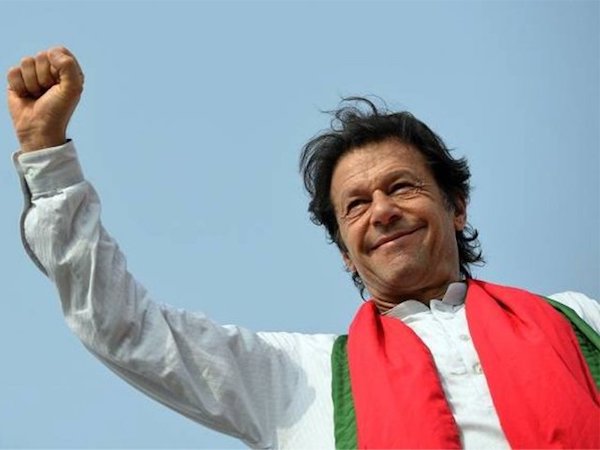
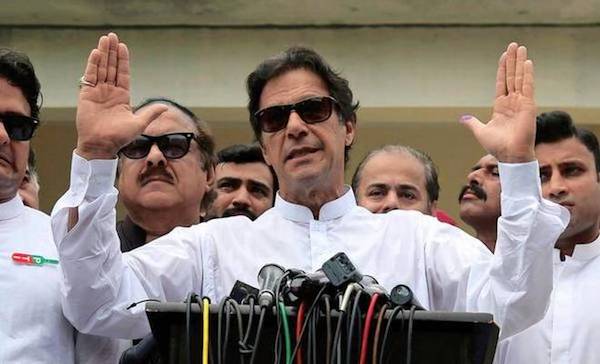
    The victory of Imran Khan’s Pakistan Tehreek-e-Insaf (PTI) in the recent general elections in Pakistan poses both challenges and opportunities for India. The challenge would be to engage a newly minted Pakistani Prime Minister who is yet to reveal his way of conducting diplomacy. The opportunity, even so, lies in the fact that the rise of Mr. Khan will enable India to deal with the Pakistani ‘deep state’ more effectively.

    Mr. Khan’s ‘victory speech’ had several well-meaning and conciliatory references to India which, if logically followed up, could potentially yield long-term benefits for the two countries. But it may be unrealistic to expect much movement in bilateral ties till India’s own general elections are concluded.

    A popular leader

    Despite allegations of a rigged election in Pakistan in which the army is said to have enabled Mr. Khan’s victory, it is widely recognized that there was a major groundswell of support for him. The fact that his PTI left the rival Pakistan Muslim League (Nawaz) far behind in terms of seat share, and that the PTI, until recently a provincial party, made stunning inroads in all of Pakistan’s provinces shows that the big story is also the rise of a charismatic Pakistani political leader seen as incorruptible and visionary by young voters.

    More significantly, despite concerns in India, religious parties have once again failed to convert their street power into political outcomes, which goes to highlight the sheer lack of mass base for terror outfits and their affiliates in Pakistan, and the moderate nature of its polity. This is not to say that Mr. Khan has a clean record: he has been a supporter of Pakistan’s blasphemy law and has in the past flirted with rightwing parties and terror outfits in Pakistan, which earned him the moniker ‘Taliban Khan’.

    The central Indian concern, and a legitimate one, about Mr. Khan’s victory is whether he can independently navigate a sustained policy process with New Delhi. India fears that the Pakistani deep state, i.e. the army and the Inter-Services Intelligence (ISI), will decide the India policy, and Mr. Khan will merely carry it out, if he is kept in the loop at all. A related concern is that the Pakistani deep state is not keen on a dialogue process with New Delhi. While it is difficult to predict the nature of the evolving relationship between an extremely popular Mr. Khan with the Pakistani deep state, let’s assume, for argument’s sake, that Mr. Khan will be subservient to the Pakistan army with regard to the country’s security policy. Whether that is desirable for the Pakistani state and its democracy is not a question that should detain us here.

    The question that should bother us is whether Mr. Khan being a puppet in the hands of the Pakistan army is detrimental to Indian interests or not. India’s grievance in regard to civil-military relations so far has been three-fold: one, the Pakistani deep state has a nefarious agenda vis-à-vis India; two, dialogue with the Pakistani political establishment has often not been successful since the Pakistani security establishment is often not on board the dialogue process; three, New Delhi’s desire for peace becomes a casualty in the turf war between Pakistan’s deep state and its political establishment.

    Logically then, one could argue that the only way India can have a steady dialogue process with Pakistan is when there is agreement between Pakistan’s deep state and its Prime Minister on what the country’s India policy should be. If so, Mr. Khan’s closeness to the Pakistan army should be viewed as an opportunity to have a fruitful dialogue with the Pakistani deep state without New Delhi’s message to Rawalpindi getting lost in Islamabad. New Delhi, while engaged in a dialogue with Islamabad, would not need to second-guess Rawalpindi’s intentions.

    Does the Pakistan army desire peace with India? Pakistan’s Army Chief, General Qamar Javed Bajwa, has on several occasions spoken of the need to build peace with India, underscoring that bilateral dialogue can lead to peace and stability in the region. There is, of course, no need to take it at face value. However, if the Pakistan army proposes dialogue and if the new Prime Minister is assumed to be on board such an objective, wouldn’t it suit Indian interests?

    This begets more questions. Can this new-found civil-military equation in Pakistan withstand the force of Mr. Khan’s personality traits and Pakistan’s political dynamics in the days ahead? Will Mr. Khan’s relationship with the deep state continue as expected or will his unpredictable temperament create more confusion? One would have to wait and watch.

    The China question

     Yet another angle that needs to be factored in while engaging Naya Pakistan is the rising regional influence of China and the further strengthening of China-Pakistan ties. Both the Pakistan army and the political class in Pakistan are upbeat about the China-Pakistan Economic Corridor (CPEC) and Chinese investments in Pakistan, notwithstanding Mr. Khan’s initial reservations about China. It is possible that China could pacify some of Pakistan’s revisionist tendencies towards both Afghanistan and India. In Wuhan, Prime Minister Narendra Modi and Chinese President Xi Jinping agreed to carry out joint projects in Afghanistan. This is perhaps the opportune time to implement them. If (and that’s a big ‘if’) Beijing can get the Pakistan army to agree to a reconciliation process in Afghanistan, and if New Delhi and Beijing can collaborate in Afghanistan, we may witness some move towards regional stability. This would be helped by Mr. Khan’s desire to improve Pakistan-Afghanistan relations.

    The Kashmir hurdle

    In this plausible scenario, Kashmir is likely to be the wild card. Two lessons stand out from earlier India-Pakistan negotiations: talks with Pakistan are unlikely to succeed if Kashmir continues to be a domestic challenge for India; and talks with Kashmiri separatists will not get anywhere without a parallel process with Pakistan. In other words, unless New Delhi reaches out to Kashmiri separatists and to Pakistan in parallel, a dialogue process with Pakistan is unlikely to succeed. Given that the Bharatiya Janata Party — after having pulled out of a difficult coalition with the Peoples Democratic Party in Jammu and Kashmir — is gearing up to use the Kashmir issue in the upcoming elections, there is unlikely to be much appetite in New Delhi to open a serious dialogue with Kashmiris, and Pakistan.

    In any case, Mr. Modi might not want to take a chance with Pakistan at this point since a failure to show anything substantive from a peace process with Pakistan could have domestic political implications, especially if ceasefire violations and terror attacks continue to take place.

    Therefore, notwithstanding the positive statements from Mr. Khan and Mr. Modi’s gracious phone call to him, we might not witness much progress in bilateral ties in the short term. The interlude between the general elections in Pakistan and India is a period of extreme caution and careful domestic calculations, and hence not conducive for bold foreign policy initiatives, especially on something as fraught as India-Pakistan relations.

    (The author is Associate Professor of Disarmament Studies at JNU, New Delhi)


  • Whitewashing India’s Religious Freedom

    Whitewashing India’s Religious Freedom

    Make no mistake about it; Hinduism is a religion of peace like all other religions. The problem is not between people of faith, but the radicals.

    By Mike Ghouse

    India has an impeccable history of welcoming the stranger and giving refuge to the oppressed, rejected and the evicted. She has welcomed Jews, Christians, Zoroastrians and the Baha’is. Indeed, the very first mosque built outside of Arabia was in India by a Hindu King in the state of Malabar. The Tibetan Buddhist refugees found a home in India; the Ahmadiyya Muslims felt secure, so were the displaced Bangladeshi and Afghan refugees.

    This beautiful pluralistic 5000-year-old tradition of India is in peril now. BJP and its affiliates (The Sangh Parivar) that govern India “currently” are hell-bent on destroying that heritage. They want to force non-Hindus into obedience and tell them what they can eat or believe, and whom they can marry or live as 2nd class citizens. They want to free India from Christians and Muslims and plan to convert them by 2025 to Hinduism.  Indeed, the ISIS had given similar options to the Christians and Yazidis.

    Make no mistake about it; Hinduism is a religion of peace like all other religions. The problem is not between people of faith, but the radicals.

    A few Indian American organizations linked to the Sangh Parivar want to whitewash the situation. They want to portray that everything is hunky dory in India.

    Hunky dory it is not, the Congressmen and Senators are fully conversant of the harassment, lynching, raping and killing of Christians, Dalits, Muslims, Sikhs, Atheists and others in India.

    It is time for the Indian Americans to save the honor of India and restore her pluralistic heritage that got derailed in the last four years.

    The prosperity of a nation stands on her two firm legs; economic growth and social cohesion, one will not sustain without the other.

    If the minorities continue to live in apprehension and fear, the whole nation gets engaged in useless battles and the prosperity will come to a grinding halt, and the country will limp until it reaches a new life or loses all that was achieved.

    The confidence of foreign investments in a nation spurs the growth, India’s IT industry, call centers, and businesses have raised the standard of living for many. As long as the investors feel secure about their investments they will pump in more funds. However, when they see chaos emerging with the nations discriminative practices, harassment, lynching, rapes and killing of the minorities, they will pull out and everyone stands to lose.

    It was embarrassing to note the missing presence of India at the religious freedom conference held by the Department of State in July 2018. If the violations continue, India may get stamped as a “Country of Particular Concern” for violations of religious freedom. It will hurt India, particularly the business community and the information technology sector.

    The whitewash report produced by the Hindu America Foundation is understandable. No Indian wants India to lose, but neither should we compromise on the truth to look good. We hope to produce an accurate state of the union; after all, India’s emblem includes the phrase, Satyameva Jayate – Truth triumphs.

    The majority of Indians of all faiths believe in Pluralism, i.e., respecting the otherness of other. It is not Hindus either, but the radicals among Hindus that are causing the problems with the subtle encouragement from the BJP government.

    Quotes from the HAF, reported by Jha;

    “The Indian government provides “unprecedented” religious accommodations to its religious minority population, says a report by a US-based Hindu advocacy group.”

    The truth is far from it. It sounds like the majority is doing a favor to the minorities in ‘accommodating’ them.  It is like saying “we give equal rights to women” who the hell are we to give them their rights, to begin with, the rights were theirs.  Indeed, every Indian is guaranteed those rights; we are all equal citizens. No one has more privileges than the other.

    “To bring greater stability to the region and prevent the growth of radical Islamist and Communist/Maoist terrorism.” This statement is too hypocritical and divisive to exclude radical Hindutva terrorism from the list.  The issue is not with Hindus or Muslims; it is with radicals among them.

    “Overall, it seeks to show the broader story of religious freedom and pluralism in India, which is often not, reflected in the media or US policy circles.” Indeed, India was a pluralist nation until the Hindutva brigade took over the country four years ago. 

    We need to come together and appeal to the Government of India, to issue visas to the commissioners of the USCIRF to investigate the Sikh Genocide, Massacre of Muslims in Gujarat, killing of Christians, Rapes, and lynching of Dalits, and harassment of Sikhs. If the commission gives a clean certificate, it will help boost the investor confidence in India; on the other hand, if India’s record is of particular concern, then it is time to fix it than pretending to be holier than thou.

    I would appeal to the Hindu America Foundation to issue press releases condemning the lynching of Muslims, killing of Christians, harassment of Dalits and Atheists, by condemning each event, it will give them the credibility to be a legitimate pluralist organization for Human rights.

    We will also write a letter urging Prime Minister Modi to speak out forcefully against harassment of any Indian and pledge that no Indian has more privileges than the other. Ambassador Sam Brownback says, if evil acts get condemned as they occur, they will be choked and will not see the light of the day.

    (The author is president of the Center for Pluralism and is committed to fostering cohesive societies where no human has to live in apprehension or fear of the other)

  • Questions of faith at Ayodhya

    Questions of faith at Ayodhya

    We need to carefully understand the issues before the Supreme Court

    By Subramanian Swamy

    This refers to A. Faizur Rahman’s article “The essentiality of mosques” (The Hindu, August 7, 2018). He says that the Supreme Court needs to reconsider the Ismail Faruqui verdict, in which it stated that a mosque is not essential to Islam. Instead of arguing his case, Mr. Rahman blandly states: “A reading of the Koran and authentic traditions of the Prophet make clear the significance of the mosque in Islam.” This is, at best, a circular argument and, at worst, a terrible obfuscation.

    Misreading the Constitution

    It is also a misreading of the Constitution of India to state, as the writer does, that Articles 25 and 26 guarantee Muslims an unfettered fundamental right to pray in a mosque. Fundamental rights in our Constitution are not absolute, and are subject to reasonable restrictions of morality, health, and public order.

    It is now established that Babri Masjid was a structure constructed by invaders, and after demolishing a pre-existing temple. The Supreme Court in 1994 had directed the Allahabad High Court to verify this by scientific methods.

    The High Court then asked the Archaeological Survey of India (ASI) to determine and verify this fact. A team of two top archaeologists, B.B. Lal and K.K. Mohammed, in 2002 deployed the most scientific tools and unanimously concluded that there was indeed an extensive temple complex in ruins under the site where the Babri Masjid structure had stood.

    The High Court accepted this finding and relied on the same in depth in its 2010 judgment of 1,000 printed pages, now available in three bound volumes. It is this judgment that the Sunni Waqf Board has appealed against in the Supreme Court.

    Before the Supreme Court today are two sets of petitions being considered. The first is a civil suit appeal against the High Court judgment, viz., on questions of who the “disputed” Ayodhya site belongs to. The second is my writ petition seeking enforcement of my fundamental right to pray at the site where Rama was born. Many devout Hindus believe that Bhagwan Sri Rama was born at a particular spot in Ayodhya, the then capital of a flourishing kingdom of the Suryavamsa dynasty.

    Imam-e-Hind

    Rama is venerated as Maryada Purushottam and worshipped by Hindus in the north as an avatar of Vishnu, while some Tamil saints known as Nayanmars and Alwars composed many hymns and songs dedicated to his divinity. In that sense, Sri Rama was the first truly national king of India, supra region, supra varna or jati. That is why the poet Mohammed Iqbal called him ‘Imam-e-Hind’.

    The exact spot of the palace where Rama was born has been — and remains — firmly identified in the Hindu mind and is held sacred. This is the very area where stood, from 1528 till December 6, 1992, a structure that came to be known as Babri Masjid, put up by Babar’s commander, Mir Baqi.

    Posed as it is, my petition should prevail in the Supreme Court since my fundamental right is a superior right in law compared to the ordinary right to property as claimed by the Sunni Waqf Board.

    It is thus to forestall the superior right of worship at Ram Janmabhoomi from prevailing, and to buy time till the next general elections, that the lawyers engaged by the Sunni Waqf Board have introduced this new prayer (which was not raised at the High Court level), of setting up a larger Constitution Bench to reconsider the 1994 five-judge Constitution Bench judgment that a mosque is not “an essential part” of the Islamic religion. This is also the view of prominent Islamic scholars.

    To argue otherwise, as Mr. Rahman does, is nothing but a part of a legal strategy to obfuscate and delay the apex court judgment.

    (The author is a member of the Rajya Sabha and a former Union Law Minister)

  • Russia’s pro-Pakistan tilt: India must not allow old ally to slip away

    Russia’s pro-Pakistan tilt: India must not allow old ally to slip away

    The signs have been ominous for the past four years. By the time PM Modi arrived at his ‘Barack’ moment, Russia had read South Block’s signals of apathy and inked an agreement on defense cooperation with Pakistan. Meandering through a naval agreement and sale of Mi helicopters, the Russia-Pakistan security relationship has moved well past Cold War hostilities to enter a more intimate phase of training Pakistani troops in Russian institutes. Pakistan may have taken the plunge because the US, its steady pole of security cooperation, is more interested in a settlement in Afghanistan rather than shoring up Pakistan army’s arsenal.

    But for India’s policy planners this is a moment of reflection. Russia is not just a consistent supplier of cheap and sturdy military equipment. Both sides have taken comfort in the other’s company at times of international distress — India backed Moscow to the hilt on Afghanistan while Russia bailed out India on Kashmir with its vetoes. There was also a healthy dose of self-interest involved: Russia backed India in the 1971 war to pay back Pakistan for arranging a secret summit between Nixon and Mao. For India, Moscow provided a reliable hedge against geopolitical arm-twisting by the West during the Cold War.

    Indian diplomacy may be on the wrong side of history if it is steering away from Russia. Along with Iran and China, Russia has lately become indispensable in the region. In addition, much is going on with Russia to permit it to drift away. Moscow’s mediation, in fact, can prove useful in bringing together Pakistan and India on Afghanistan, which could lead to the breaking of the Indo-Pak diplomatic ice. PM Modi’s informal meeting in May with Vladimir Putin would have attempted a course correction, reflecting the unease in the Indian establishment over the current state of affairs. Russia is currently in a spot of bother; a helping hand at this juncture is likely to be more than appreciated.

    (Tribune, India)

  • End of an epoch: on M. Karunanidhi’s death

    End of an epoch: on M. Karunanidhi’s death

    By Gopalkrishna Gandhi
    “He will be long remembered for three outstanding accomplishments — his passion for Tamil as a language and a metaphor for the dignity of its users; his refusal to be bullied by political hubris during the national emergency; and his uncompromising secularism.
    “Jakkirathaiya irunga,”he said in Tamil, over which his command was legendary. “Take care” is how the phrase would translate. But in the way he said it, laying stress on the double ‘kk’, I could see he meant to say, “Take every care.” This was on August 13, 2000. I was on my way to Colombo to join duty as High Commissioner.

    A federal mind

    Calling on Tamil Nadu Chief Minister M. Karunanidhi would have been on the wish list and task list of any Indian envoy on her or his way to Sri Lanka. But, for me, this was not just about protocol. Nor was it about politics, the Dravida Munnetra Kazhagam (DMK) then being a crucial presence in the National Democratic Alliance government led by Atal Bihari Vajpayee. It was about plain common sense, sheer self-interest. There was no way I would present letters of credence in Colombo without finding out what Tamil Nadu’s senior-most and completely wide-awake leader thought about the island nation’s travails, the present and future state of its Tamil population and that of the Liberation Tiger of Tamil Eelam’s supremo, Velupillai Prabhakaran. To go to Colombo without the ‘input’ — to use a crassly opportunistic expression — of a veteran of Tamil Nadu’s political chemistry would be absurd. What I needed and was to get from him was the insight, as knowledgeable as it was detached, of ‘one who knew’. The hinterland of any foreign policy is ground knowledge of the roots of that policy in the soil of its origin.

    It was not easy, even for one on ‘relevant’ official duty, to get an appointment with the Chief Minister. He had his hands more than full with the complexities of Tamil Nadu’s polity, where facing the All India Anna Dravida Munnetra Kazhagam and its charismatic leader J. Jayalalithaa meant being alert 24×7; where running a government of which he was the alpha and the omega meant working harder than the mind and body could take. And where, to make matters more complex for him, explaining to the people of Tamil Nadu how and why India-Sri Lankan relations were a foreign policy matter and foreign policy was the prerogative of the Union government was just about impossible. He was on the cusp of India’s federal dilemmas.

    A lesser politician could have played politics on that fluid crest, just to remain ‘on top’. But, as the direct successor-in-office to C.N. Annadurai (CNA) who had given up secession as the DMK’s policy goal, he was going to do nothing of the kind.

    The Chief Minister was seated in the sitting room on the first floor of his Gopalapuram residence in Chennai. He half-rose to greet me, a gesture that neither his age — he was 76 at the time — nor his high office necessitated. “Sir… sir… Please do not get up,” I protested. Sitting back, he commenced what was for me a lesson on the limitations of diplomacy and of politics. He said I was going to a highly troubled land at a highly incendiary time. “Ranil Wickremesinghe [now Prime Minister of Sri Lanka] met me the other day,” he said, “and we spoke for more than an hour. He is a visionary… He wants to build a physical bridge from Rameswaram to Talai Mannar… I welcomed the idea and told him that our own Bharathiar [Subramania Bharati] had envisioned the very thing…palamaippom… But today who is going to be crossing that bridge and in which direction?” Then followed an analysis of the ethnic problem on the island which for its crisp pragmatism could not have been equaled, let alone bettered.

    “Nobody knows Prabhakaran’s mind,” he said. “Nobody from our side is in touch with him… Nobody can be… We used to know his deputies… Amirthalingam… Now they are all dead… assassinated. But militancy is no solution… Secession will never be countenanced by Sri Lanka… And it will never be given up by Prabhakaran… We grope in the dark.” And then doing a fast-forward: “Yet, we have to keep trying for our Tamil kin’s urimai (rights) there.” The insights continued for some 10 more minutes and then he rose to conclude the call, saying, as if in a summing-up: “Prabhakaran will never have a change of heart.” As I thanked him and prepared to leave, he gave the advice I started this tribute with, very softly, “Jakkirathaiya irunga.”

    I had received briefings, each very helpful, very skilled, from officials, ministers, politicians, military leaders, strategists. But the one I got at Gopalapuram that afternoon covered every facet of the Sri Lankan scene in brief sentences, replete with historical, geopolitical and diplomatic nuances, topped with an intuitive sense of urimai being the long-shot aim and jakkirithai an immediate concern.

    Another meeting

    Seventeen years later, last year, I was to see him again, in the same room. He was seated on a wheelchair. And this time he did not — could not — get up. His son, M.K. Stalin, and his daughter, Kanimozhi, who were beside him, gave him the caller’s name. The 93-year-old looked long and steadily at me. No sign of recognition appeared on his face. There was no immediate response, but a few seconds later, when everyone present was waiting for a response, a wisp of a half-smile played across his face for but a fleeting moment. I will not presume to imagine he recognized me. But that was not really necessary.

    Kalaignar Karunanidhi was now a legend, an icon of the old mold, but without the patina of obsolescence on its form or features. He was a living legend, an icon of the here and now as a symbol of aspirational politics negotiating electoral quicksand. In his case the aspirational politics was Dravida self-esteem combined with social radicalism, derived from Periyar and C.N. Annadurai (CNA). And the quick sands were Tamil Nadu’s political uncertainties, with his mentors having become history and rivals from a different ‘stage’ scripting a very new, very glitzy theatre. Here was an idealism being taunted by reality to be pragmatic, a pragmatism being haunted by history to be idealistic. Some predicaments are cruel.

    And yet, he emerged from it, un-bowed, the see-saw of electoral results being another matter.

    He will be long remembered for three outstanding accomplishments — his passion for Tamil as a language and a metaphor for the dignity of its users; his refusal to be bullied by political hubris during the national emergency; and his uncompromising secularism.

    Such a long journey

    CNA was in office for far too little for the dust of any controversy to settle on him. The Kalaignar was in office for far too long for that dust to stay away. Did he shake it off?

    Did the flatterer and the tale-carrier manage to reach ear-distance? Was the sponger spurned, the money-spinner, the corrupter, family-splitter, the party-breaker turned away? Was the fear-instiller, the superstition-planter, the suspicion-sower shown the door? Equally, was the caring critic, the daring dissenter, the worried warner given welcome? Was the frank friend, the bold biographer shown in, given time, consideration?

    Only his family would know.

    On it — all generations of it — falls the privilege and the challenge now to stay and work together, to take the legacy of this extraordinary statesman further afield and make it a force for Tamil Nadu’s redemption from localism, myopia and the power of floating cash. And beyond that, a force for India’s federal intelligence, her plural wisdom and, above all, her Constitution-enshrined mandate for justice — social, economic and political.

    (The author is a former administrator, diplomat and Governor)

  • Russia faces US sanctions over poisoning of Skripal in UK

    Russia faces US sanctions over poisoning of Skripal in UK

    WASHINGTON(TIP): The US has said it will impose fresh sanctions on Russia after determining it used nerve agent against a former Russian double agent living in the UK.

    Sergei Skripal and his daughter Yulia were left seriously ill after being poisoned with Novichok in Salisbury in March, though they have now recovered.

    A UK investigation blamed Russia for the attack, but the Kremlin has strongly denied any involvement.

    Russia has criticized the new sanctions as “draconian”.

    In a statement released on Wednesday, August 8, the US State Department confirmed it was implementing measures against Russia over the incident.

    Spokeswoman Heather Nauert said it had been determined that the country “has used chemical or biological weapons in violation of international law or has used lethal chemical or biological weapons against its own nationals”.

    “The strong international response to the use of a chemical weapon on the streets of Salisbury sends an unequivocal message to Russia that its provocative, reckless behavior will not go unchallenged,” a UK Foreign Office statement said.

    The Russian embassy in the US hit back on Thursday morning, criticizing what it called “far-fetched accusations” from the US that Russia was behind the attack.

    Russia had become “accustomed to not hearing any facts or evidence”, it said, adding: “We continue to strongly stand for an open and transparent investigation of the crime committed in Salisbury.”

    The new sanctions will take effect on or around 22 August and relate to the exports of sensitive electronic components and other technologies.

    The State Department said “more draconian” sanctions will follow within 90 days if Russia fails to give reliable assurances it will no longer use chemical weapons and allow on-site inspections by the United Nations.

    An official said it was only the third time that the US had determined a country had used chemical or biological weapons against its own nationals.

    Previous occasions were against Syria and against North Korea for the assassination of Kim Jong-nam, the half-brother of leader Kim Jong-un, who died when highly toxic VX nerve agent was rubbed on his face at Kuala Lumpur airport.

    Are these the only US sanctions against Russia?

    No. In June the US imposed sanctions on five Russian companies and three Russian individuals in response to alleged Russian cyber-attacks on the US.

    All are prohibited from any transactions involving the US financial system.

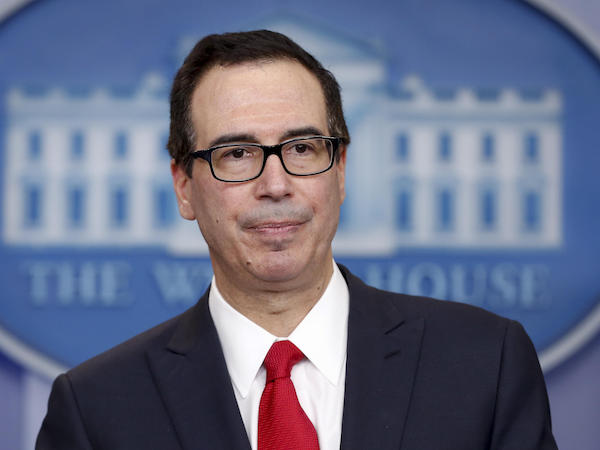
    Treasury Secretary Steven Mnuchin said the measures were to counter “malicious actors” working to “increase Russia’s offensive cyber-capabilities”.

    After pressure from Republican members of Congress, the State Department has determined Moscow broke international law by using a military grade chemical weapon on the Skripals.

    While the US expelled some five dozen diplomats shortly after the poisoning, the administration stopped short of making a formal determination that Russia had broken international law.

    But Congress has been pushing for such a decision and now the state department has confirmed Russia’s actions contravened 1991 US legislation on the use of chemical weapons. That breach automatically triggers the imposition of sanctions and places requirements on Russia to avert further restrictions in three months’ time.

    Those requirements could include opening up sites in Russia for inspection – a move Moscow would probably resist.

    So far President Donald Trump has been silent on this latest move – which could well derail his attempts to develop a new, warmer relationship with Vladimir Putin.

    Following the incident, the British government said the military-grade nerve agent Novichok, of a type developed by Russia, had been used in the attack.

    Relations between Russia and the West hit a new low. More than 20 countries expelled Russian envoys in solidarity with the UK, including the US. Washington ordered 60 diplomats to leave and closed the Russian consulate general in Seattle.

    Three months after the Salisbury attack, two other people fell ill at a house in Amesbury, about eight miles from the city. Dawn Sturgess later died while her partner, Charlie Rowley, spent three weeks recovering in hospital.

    After tests, scientists at the UK’s military research lab, Porton Down, found the couple had also been exposed to Novichok.

    Mr Rowley told ITV News he had earlier found a sealed bottle of perfume and given it to Ms Sturgess, who sprayed the substance on her wrists.

  • NY Congressman Collins Arrested, Charged with Insider Trading

    NY Congressman Collins Arrested, Charged with Insider Trading

    NEW YORK(TIP): The FBI has arrested New York Rep. Chris Collins on securities fraud-related charges, law enforcement officials said.

    Collins, a Republican who hails from western New York, his son and his son’s future father-in-law have all been charged with insider trading, U.S. Attorney Geoffrey Berman said.

    The congressman surrendered to the FBI at 26 Federal Plaza Wednesday, August 8 morning, officials said.

    Collins pleaded not guilty at an appearance in Manhattan federal court Wednesday afternoon.

    Hours after he was released on bail, Collins spoke to reporters in Buffalo, professing his innocence and saying he would remain on the ballot for re-election this fall.

    Collins was one of the first members of Congress to endorse President Donald Trump during his presidential campaign.

    Last fall, the Office of Congressional Ethics released a report that said the congressman may have violated House rules when he bought discounted stock that wasn’t available to the public and was offered to him based on his status as a politician.

    The report also found that Collins, a board member of Australia-based Innate Immunotherapeutics, may have shared nonpublic information about the company, another possible violation.

    Innate had been in the process of developing a drug to treat multiple sclerosis in 2017, according to the indictment. When the product failed drug trials in June 2017, however, the public results sent Innate stock prices plummeting by 92 percent.

    Collins — one of Innate’s largest stockholders — had access to information about the company and its research that wasn’t available to the public, the indictment alleges.

    When Collins found out about the trial results, he allegedly told his son Cameron Collins, also an Innate stockholder, who told his then-girlfriend’s father Stephen Zarsky, as well as several other stockholders.

    Cameron Collins, Zarsky, and the stockholders Collins told subsequently sold their Innate stock before prices plunged, narrowly avoiding hundreds of thousands of dollars in losses, the indictment says.

    The congressman, his son and Zarsky have all been charged with conspiracy, securities fraud, wire fraud and making false statements to the FBI, the Manhattan U.S. Attorney’s office said. The Securities and Exchange Commission has filed its own civil action against the three men.

    “Representative Collins, who, by virtue of his office, helps write the laws of this country, acted as if the law did not apply to him,” Berman said. “These charges are a reminder that this is a nation of laws, and everyone stands equal before the bar of justice.”

    “I believe I acted properly and within the law at all times,” he said. “I will mount a vigorous defense in court to clear my name. I look forward to being fully vindicated and exonerated.”

    The congressman’s attorneys Jonathan Barr and Jonathan New, of BakerHostetler, also said Wednesday they would “answer the charges filed against [Collins] in court and… mount a vigorous defense to clear his good name.”

    “It is notable that even the government does not allege that Congressman Collins traded a single share of Innate Therapeutics stock,” they said in a statement. “We are confident he will be completely vindicated and exonerated.”

    House Speaker Paul Ryan said in a statement the congressman would no longer serve on the House Energy and Commerce Committee, pending the ultimate outcome of the indictment.

    “While his guilt or innocence is a question for the courts to settle, the allegations against Rep. Collins demand a prompt and thorough investigation by the House Ethics Committee,” he said. “Insider trading is a clear violation of the public trust.”

    House Democratic leader Nancy Pelosi, meanwhile, said Americans “deserve better than the GOP’s corruption, cronyism and incompetence.”

    “The charges against Congressman Collins show the rampant culture of corruption and self-enrichment among Republicans in Washington today,” she said. “The Ethics Committee must accelerate its own investigation into Congressman Collins’ illegal abuse of the public trust.”

    The congressman is expected to appear in court again on Oct. 11.

  • US Army suspends discharging immigrant recruits

    US Army suspends discharging immigrant recruits

    WASHINGTON(TIP): The U.S. army has for now suspended its practice of quietly discharging immigrant recruits, according to a news report published in newspapers.

    An Associate Press report said that Marshal Williams, an assistant secretary of the Army, ordered high-ranking officials to suspend the processing of separations in a July 20 memo.

    The news comes one month after the AP reported the Army had discharged dozens of immigrant recruits and reservists, putting their immigration status at risk.

    “It’s an admission by the Army that they’ve improperly discharged hundreds of soldiers,” immigration attorney and former Army Reserve officer Margaret Stock, who helped create the program, told the AP on Wednesday. “The next step should be go back and rescind the people who were improperly discharged.”

    Many immigrant recruits told the AP last month they were not given a reason for their discharges or said they were labeled as a security risk because of their relatives abroad.

    Reports estimate there are around 10,000 Army recruits currently serving as part of the program, which offers a pathway to citizenship, according to the AP.

    The discharges inflamed immigration activists last month, who pointed to the policy as another example of escalating anti-immigration sentiment under President Trump.

    It is unclear if the Army will resume discharging immigrant recruits, and the AP reported none of those already separated have been reinstated.

  • PepsiCo chief executive Indra Nooyi to step down on October 3

    PepsiCo chief executive Indra Nooyi to step down on October 3

    Ramon Laguarta to replace Ms Nooyi, who will continue as chairwoman until next year

    WASHINGTON(TIP): PepsiCo said on Monday, August 6, that Indra Nooyi would step down as chief executive after 12 years at the helm and named president Ramon Laguarta as her successor.

    Mr Laguarta will take over from Ms Nooyi on October 3rd and will also join the board, the company said in a statement.

    Ms Nooyi (62), who has been with the company for 24 years, will continue as chairwoman of the board until early 2019.

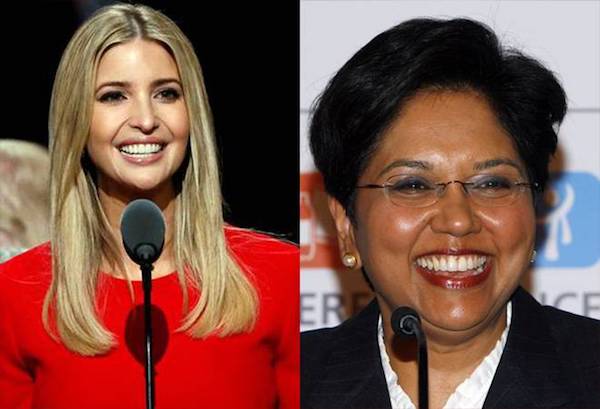
    Ivanka Trump who looks upon Indra Nooyi as her inspiration and mentor commented: “The great Indra Nooyi is stepping down as PepsiCo CEO, after 12 years. Indra, you are a mentor + inspiration to so many, myself included,”

    Indra Nooyi has been a darling of Indian Americans who have always taken pride in her as a shining example of the achievements of women of Indian origin abroad.

    Commenting on her stepping down as CEO of one of the largest companies of the world, Dr. VK Raju, eminent Indian American ophthalmologist who hails from Andhra Pradesh, said, “Indra Nooyi has been a towering personality in the corporate world of America and is responsible for the growth of PEPSICO”.

    Ms. Nooyi grew up in Chennai, India, where during food shortages in the 1960s her middle-class family stood in line for rice rations studded with stones. When Indra and her sister were young, their mother challenged them at the dinner table each night to give speeches about what they would do if they were prime minister or another world leader. After the speeches, their mother would vote.

    Ms. Nooyi came to the U.S. in 1978 on a scholarship to the Yale School of Management and worked at several companies before joining PepsiCo in 1994 as head of strategy. She was chief financial officer and president before she was named chief executive, succeeding Steve Reinemund.

    After becoming CEO in 2006, Ms. Nooyi said she wanted to make PepsiCo “a defining corporation of the 21st century.” “Nobody’s going to remember you for delivering earnings to stockholders; they will remember you for the lasting impact you made on society,’’ she said in a 2009 speech.

    The company’s shares have gained 78 per cent since Ms Nooyi took the top job in 2006.

    Mr Laguarta, a 22-year veteran of PepsiCo, oversaw global operations, corporate strategy, public policy and government affairs in his role as president.

    He also served as head of the company’s Europe Sub-Saharan Africa division before becoming president.

  • Pence details plan for creation of Space Force

    Pence details plan for creation of Space Force

    ‘We must have American dominance in space”- Pence

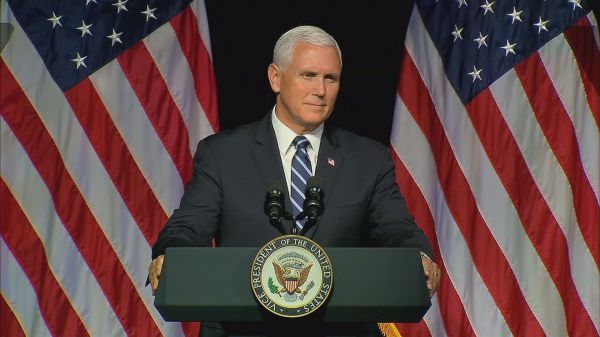
    WASHINGTON(TIP): ‘We must have American dominance in space”, said Vice President Pence, outlining an ambitious plan on Thursday, August 9 that would begin creating a military command – “Space Force” as the sixth branch of the U.S. military as early as 2020.

    Pence warned of the advancements that potential adversaries were making and issued what amounted to a call to arms to preserve the military’s dominance in space.

    “Just as we’ve done in ages past, the United States will meet the emerging threats on this new battlefield,” he said in a speech at the Pentagon. “The time has come to establish the United States Space Force.”

    But the monumental task of standing up a new military department, which would require approval by a Congress that shelved the idea last year, may require significant new spending and a reorganization of the largest bureaucracy in the world. And the idea has already run into fierce opposition inside and out of the Pentagon, particularly from the Air Force, which could lose some of its responsibilities.

    Defense Secretary Jim Mattis last year said he opposed a new department of the military “at a time when we are focused on reducing overhead and integrating joint warfighting functions.”

    This week, Mattis said the Pentagon and White House “are in complete alignment” on the need to view space as a warfighting domain. But he stopped short of endorsing a full-fledged Space Force. In a briefing with reporters after Pence’s speech, Deputy Defense Secretary Patrick Shanahan suggested that Mattis’s comments opposing the Space Force were made at a different time, before the Pentagon received a bolstered budget.

    White House officials have been working with national security leaders to aggressively move ahead without Congress. The first step is creating a new U.S. Space Command by the end of the year, which would be led by a four-star general, the way the Pentagon’s Indo-Pacific Command oversees those regions.

    The new command would pull space experts from across the armed services, and there would be a separate acquisitions office, dedicated to buying satellites and developing new technology to help the military win wars in space.

    After the announcement Thursday, President Trump tweeted, “Space Force all the way!”

    For months, Trump has been calling for a Space Force, a new, free-standing military department, with its own chain of command and uniforms.

    The White House intends to work with lawmakers in submitting legislation by early next year, a senior administration official said, with the hopes of standing up the first new military department since the Air Force in 1947.

    Some members of Congress and military leaders have been warning space is no longer a peaceful sanctuary, but a domain of conflict that needs more attention and resources. Space is vital to the way the United States wages war; The Pentagon’s satellites are used for missile-defense warnings, guiding precision munitions and providing communications and reconnaissance.

    Russia and China have made significant advancements, challenging the United States’ assets in space.

    After Pence’s speech, Reps. Mike Rogers (R-Ala.) and Jim Cooper (D-Tenn.), members of the House Armed Services Committee, praised the move, saying a Space Force “will result in a safer, stronger America.”

    “We have been warning for years of the need to protect our space assets and to develop more capable space systems,” they said in a joint statement.

    In his speech, Pence urged the audience to support the administration’s effort to create the new department.

    Speaking to a room made up mostly of U.S. troops in uniform, Pence said their “Commander-in-Chief is going to continue to work tirelessly toward this goal, and we expect you all to do the same.”

    “The only thing we can’t afford is inaction,” he said.


  • August 10 New York & Dallas Print Editions

    August 10 New York & Dallas Print Editions

    [vc_row][vc_column][vc_column_text]

    Print Replica ~ Digitally

    E-Editions

    [/vc_column_text][/vc_column][/vc_row][vc_row][vc_column width=”1/3″][vc_custom_heading text=”New York Edition” font_container=”tag:h2|text_align:center” google_fonts=”font_family:Istok%20Web%3Aregular%2Citalic%2C700%2C700italic|font_style:700%20bold%20regular%3A700%3Anormal” link=”url:https%3A%2F%2Fwww.theindianpanorama.news%2Fwp-content%2Fuploads%2F2018%2F08%2FTIP-August-10-NYC.pdf|||”][vc_single_image image=”93925″ img_size=”full” add_caption=”yes” alignment=”center” onclick=”custom_link” link=”https://www.theindianpanorama.news/wp-content/uploads/2018/08/TIP-August-10-NYC.pdf”][/vc_column][vc_column width=”1/3″][vc_custom_heading text=”Dallas,Texas Edition” font_container=”tag:h2|text_align:center” google_fonts=”font_family:Istok%20Web%3Aregular%2Citalic%2C700%2C700italic|font_style:700%20bold%20regular%3A700%3Anormal” link=”url:https%3A%2F%2Fwww.theindianpanorama.news%2Fwp-content%2Fuploads%2F2018%2F08%2FTIP-August-10-Dallas-TX.pdf|||”][vc_single_image image=”93926″ img_size=”full” add_caption=”yes” alignment=”center” onclick=”custom_link” link=”https://www.theindianpanorama.news/wp-content/uploads/2018/08/TIP-August-10-Dallas-TX.pdf”][/vc_column][vc_column width=”1/3″][vc_single_image image=”82828″ img_size=”medium” alignment=”center” onclick=”custom_link” link=”https://www.theindianpanorama.news/advertising-media-kit-portal-indian-panorama/”][vc_single_image image=”82829″ img_size=”medium” alignment=”center” onclick=”custom_link” link=”https://www.theindianpanorama.news/advertising-media-kit-portal-indian-panorama/”][/vc_column][/vc_row][vc_row][vc_column][td_block_ad_box spot_id=”custom_ad_3″ tdc_css=””][/vc_column][/vc_row][vc_row][vc_column width=”2/3″][vc_custom_heading text=”Lead Stories This Week” font_container=”tag:h2|text_align:center” google_fonts=”font_family:Istok%20Web%3Aregular%2Citalic%2C700%2C700italic|font_style:700%20bold%20regular%3A700%3Anormal” link=”url:https%3A%2F%2Fwww.theindianpanorama.news%2F|||”][td_block_5 separator=”” limit=”12″ tdc_css=””][/vc_column][vc_column width=”1/3″][vc_widget_sidebar sidebar_id=”td-default”][/vc_column][/vc_row]

  • The long and difficult journey back home – or what was home

    The long and difficult journey back home – or what was home

    By Vikas Gupta

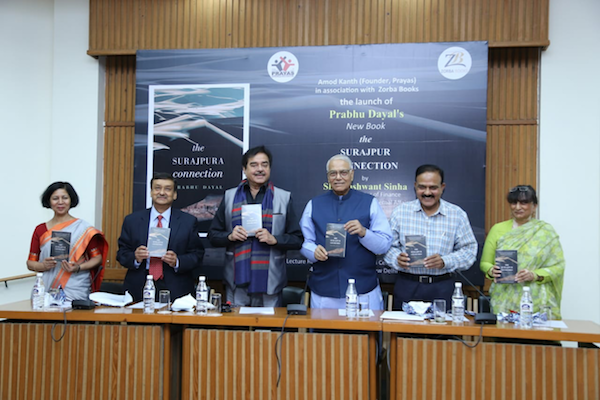
    Title:The Surajpur Connection

     Author: Prabhu Dayal

     Publisher: Zorba Books

     Pages: 160

     Price: Rs 199

    The hardest journey to undertake, if it is even possible, is to return to one’s childhood home, particularly if it was a happy period. But even this happiness — which may not be everyone’s lot — can be disrupted by forces beyond relentless time. Within a twinkling of eye, all comforts and happiness being replaced by pain, deprivation and oppression.

    And even if you can surmount the problems and even manage to return, it will never be the same.

    It is this inexorable truth of life that former diplomat Prabhu Dayal portrays in his second work, a novella which is poignant and heart-wrenching but also showcases hope, and how kindness and generosity — no matter how expressed — can be encountered as often as cruelty and self-interest.

    Beginning with an evocative prologue, where a well-heeled expatriate businessman, on a trip to Mumbai, is casually reading the paper in his hotel room when something catches his attention and forces him to change his whole schedule and leave for north India.

    The scene then shifts over a quarter century or so into the past, to the rural areas in Uttar Pradesh’s Allahabad, where a prominent and influential landlord has repeatedly spurned the (then) all-powerful Congress’ repeated requests to be the party candidate for the coming elections (1967).

    The reason is simple — for “after years of pills, prayers and pilgrimages”, he and his wife finally have a son, they fondly call Sonu.

    But while his parents are overjoyed, there are others, who pretend to adore him as much but have darker intentions in their heart, and soon act on them without mercy.

    One post-monsoon afternoon, the household is sleeping and a four-year Sonu playing outside when he goes missing. An extensive search is made, police swing into action, desperate efforts are made to find him, but there is no trace and not even a ransom demand.

    Little his grieving parents know that their innocent son has become the victim of a particular dreadful crime and is even no longer in the country, but far away beyond the seas, doing a dangerous chore in a desert land.

    But while after six months of torture, danger and worse, Sonu and a fellow prisoner do manage to escape, will the unforgiving desert allow them to survive? Will he, if he stays alive and manages to find his way home to his own land, by some miracle, be able to make his way home, given he doesn’t know the name of his parents or where he lived, despite this promise made to himself?

    And what is the connection between Sonu and the successful businessman we meet in the initial pages?

    These are all the questions the author engagingly answers, in this short but powerful account which covers a fairly wide spectrum of the human condition — from depravity to decency.

    In his second book after the uproarious yet incisive “Karachi Halwa” about his stint in Pakistan, Ambassador Dayal moves effortlessly and adroitly to fiction.

    With his four-decade-long service having encompassed the Middle East, Europe and America, he makes good use of both his roots and experience, especially in the Arab world, to sketch vivid portraits of mofussil Uttar Pradesh to Dubai, in its transition from a small town to a glittering megapolis, as well as a range of characters, spanning evil uncles, oppressive trainers, kind-hearted sailors, maternal teachers and so on.

    Though at a superficial level — in its plot, set pieces, telescoped action, and its rather dramatic denouement and so on — it may seem like a Bollywood film, it is not so simple, for it raises some vital questions and issues.

    These include, but are not limited to, identity, the concept of home and family, the need to be anchored, the (transient nature of) happiness, whether loyalty deserves the name if for an evil purpose, can kindness be graded on its intention, and much more, which makes this story a short but most engrossing and thoughtful read.

    (Vikas Datta can be contacted at vikas.d@ians.in)

  • KOJAIN Honors Six Individuals at the 9th KOJAIN Sammelan

    KOJAIN Honors Six Individuals at the 9th KOJAIN Sammelan

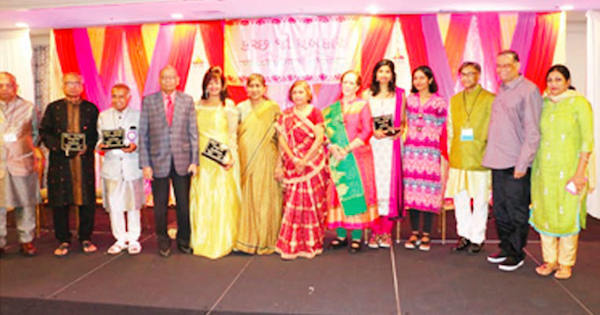
    NEW YORK (TIP): KOJAIN recognized the six individuals at the San Mateo Marriott San Francisco Airport Hotel in San Mateo, Calif, July 13 -15 during the 9thKOJAIN Sammelan 2018.

    Award Recipient receiving Award from Dr. Ela Dedhia

    During the Sammelan, KOJAIN honors persons of Kutchi Oswal heritage in North America who have achieved excellence and unique contributions in fields of 1) Art and Crafts, 2) Science, 3) Education, 4) Cultural Activities and 5) Community Services.  This year’s awardees included:

    (1)  Lifetime Achievement Award presented to Navin S. Dedhia, San Jose, California  “For
    Vision, Leadership, and Lifetime Commitment to Support and Promote KOJAIN”

    (2)  Leadership Award presented to Hemant M. Shah, Winnipeg, Manitoba, Canada, “For
    Acting as an Ambassador of Indian Culture and Trade in Canada”

    (3)  Special Recognition Award presented to Late Meenaben Shah, Hockession,
    Delaware,”For a Leader and Tireless Community  Service Worker and Generous
    Donor To KOJAIN and Other Jain Organizations”

    (4)  Service Award pesented To Nikita Dedhia Shah, St. Louis, Missouri, “For Promoting
    Education Opportunities in Germany for Indians”

    (5)  Recognition Award presented to Tanvi Chheda, Stanford, California, “For Excellence
    In Scholastic Achievement”

    (6)  Recognition Award presented To Jesika Haria, San Francisco, California, “For
    Excellence In  Scholastic Achievement”

    Mr. Peter Bheddah, Chair of the KOJAIN Recognition Committee invited Keynote Speaker, Mrs. Ela Dedhia and KOJAIN President, Geeta Gala for Awards distribution.

    Award acceptance speech by Navin S. Dedhia, San Jose, CA

    Awards Committee members were called upon to introduce the Award Recipient.
    Award Recipient was given two minutes time for the Awards Acceptance Speech. Each
    Awardee was given a beautiful plaque.


    KOJAIN is a Non-Profit 501 (c) (3) organization established in 1996 and incorporated in the State of Maryland. Its mission includes operating and promoting cultural, charitable, educational, and humanitarian activities in North America and elsewhere Its strength lies in serving 6000+ individuals residing in North America. One of the objectives of the organization is to maintain, educate, enhance, advance and preserve the heritage of Kachchh through art, language and culture.  Kachchh is a region located in the Northwestern part of Gujarat State in India. [Note: Kutch or Kachchh are synonymous words)

  • ‘India is at a crucial crossroads’; Sam Pitroda appeals NRIs for help

    ‘India is at a crucial crossroads’; Sam Pitroda appeals NRIs for help

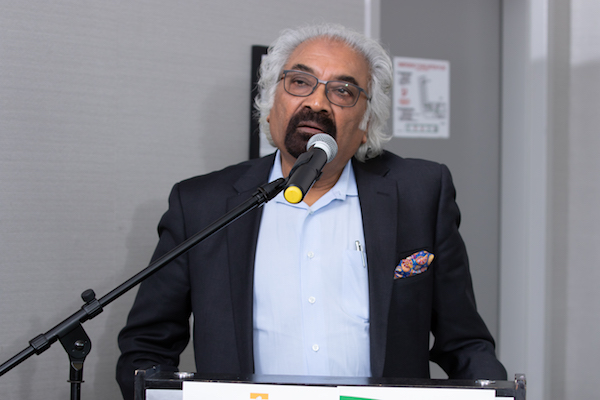
    NEW YORK (TIP): “India is at a crucial crossroads and unless NRIs come forward in preserving truth, trust, inclusion, and non-violence, India’s democracy could be in jeopardy,” Said Mr. Sam Pitroda, Chairman of the Overseas Congress Department of All India Congress Committee. Mr. Pitroda was inaugurating the National Conference of the Indian Overseas Congress that was held at the Crowne Plaza Hotel in New York. “A climate of fear is gripping the nation and lies are constantly propagated for political ends” Pitroda added citing the case against National Herald newspaper. “Congress believes in the bottom-up development, not top-down approach followed by the current government that benefits a few”.  Pointing to the upcoming parliamentary elections in 2019, he urged the delegates who have gathered there to collaborate and work together in unity so that Congress party can restore the democratic values that have been the hallmark of the nation for the last 7 decades.

    Audience

    Dr. Surinder Malhotra, who has served as the President of INOC, USA for a number of years and a member of the governing Board of IOC appealed to the gathering for an end to groupism and division and to move forward. Mr. George Abraham, the Vice-Chair of the IOC detailed various threats to democracy in India and asked the meeting to be pro-active in dealing with critical issues. “Constitution is out there to protect us; however, if we don’t protect the constitution, it will not protect us either” Abraham added.

    Mr. Mohinder Singh, Gilzian, President of the INOC, USA lauded the Congress party for its enormous contribution to India that made it a prosperous economy and detailed some of his plans to grow the Overseas Congress in the USA. He promised to increase the membership of the organization and bring in more young people to the fold primarily by reaching out to the large pool of Indian students at the Universities. He has also promised to conduct charitable programs on behalf of the organization and to send volunteers to the upcoming elections in India. In addition, he expressed optimism that a ‘Congress Bhavan’ can be built as headquarters for IOC in the not so distant future.

    Mr. Himanshu Vyas, newly appointed Secretary to the Overseas Congress Department of AICC spoke about building strong Overseas Congress Chapters around the globe and asked the participants to communicate with him for any extra help from his Delhi office.

    Mr. Madhu Yaskhi, former Member of Parliament and AICC Secretary Spoke about the challenges to Indian democracy and pointed out, in particular, the corruption at the highest levels citing the Rafael Jet purchasing case. He urged NRIs to get involved and bring about a change that is essential for the survival of India’s democracy.

    Mr. Shudh Prakash Singh, President of INOC (I) introduced several members of INOC (I) to the audience. Mr. Harbachan Singh, Secretary-General of the INOC, USA and Rajender Dichpally, General Secretary of INOC (I), Mr. Kamalpreet Singh Dhaliwal, President of IOC, United Kingdom and Dr. Dayan Naik also addressed the conference.

    Mr. Manoj Shinde presented an integrated IT plan for the organization and asked members to provide him with the content.

    Ms. Tavishi Alagh, the Media Coordinator for Overseas Congress Department of AICC, screened several videos at the conference showing the history the Congress Party and fortitude of the past leaders of the freedom struggle along with Mr. Rahul Gandhi’s vision for a more inclusive India.

    Madhu Yaskhi speaking, Sam Pitroda, Mohinder Singh Gilzian, Shudh Prakash Singh, Himanshu Vyas, George Abraham, Surinder Malhotra on the dias

    In the ensuing discussions, delegates from all Chapters spoke about the vision and missions of the organization and stressed the issue of unity as a pre-requisite to moving forward in achieving set goals. T. J. Gill, Malini Shah, John Joseph, Gurmit Singh Gill, Charan Singh, Phuman Singh, Ravi Chopra, Thomas T. Oommen, Satish Sharma, R. Jayachandran, Zinda Singh, Kulbir Singh Prempur Sarpanch, Sarvjit Singh, Prasad Kambapathy, Devendra Vora, Girish Vaidya, Ajay Singh Lakhan, Santok Singh, Paul Sihota, Rana Gill, Jaya Sundaram, Ram Gadula, Harkesh Thakur, Oommen Koshy, Chandu Patel, Santhosh Nair, Rajesh Allahdad, Thomas Mathew, Krishan Arora, Leela Maret, Sawaran Singh, Vishak Cherian, Paul Paramby, Ramesh Chandra, Nikhil G. Reddy, Saji Karimpannuur, Rajan Padavathil, Mr. Sravanth Poreddy, Krishna Chaithanya and Anil Patel, Dr. Mohammed Jameel, , Dr. Enu Karuvathu, Joy Thomas, Saji Abraham, Madhu Erugu, Raj Boda, Rajeev Mohanan also participated in the discussions. Delegates from various States including New York, New Jersey, Maryland, Virginia, Connecticut, Illinois, California, Indiana, Texas, Minnesota, Washington, Florida, Pennsylvania, Massachusetts, Michigan and Ontario (Canada) were present at the meeting.

    A copy of the constitution was presented to the meeting by Mr. Harbachan Singh who is the main architect behind that effort. The document was referred to Sanjay Dubey Esq to resolve various legal questions concerning that within the next two weeks.

    The meeting also appointed committee Chairpersons for Finance, Membership, Youth group, Women’s group, IT group, Social Media etc. and a detailed list will be published soon.

  • Missouri brewery apologizes & removes beer linked Lord Ganesha image after Hindu protest

    Missouri brewery apologizes & removes beer linked Lord Ganesha image after Hindu protest

    NEW YORK(TIP): Springfield (Missouri) based award-winning Springfield Brewing Company (SBC) has apologized and removed Hindu deity Lord Ganesha image portrayed on its Bombay Brown IPA beer label after upset Hindus protested, calling it “highly inappropriate”.

    “SBC sincerely apologizes to Rajan Zed and The Universal Society of Hinduism for the inappropriate usage of Lord Ganesha on our beer brand, Bombay Brown IPA. It was never our intention to offend any person with the artwork used for this brand”, an SBC release said. Lord Ganesha image associated with Bombay Brown does not show up anymore on the SBC website.

    Distinguished Hindu statesman Rajan Zed, who spearheaded this protest thanked SBC and its management for understanding the concerns of Hindu community, which thought image of Lord Ganesha on such a product was highly insensitive.

    Zed, who is President of Universal Society of Hinduism, suggested that companies should send their senior executives for training in religious and cultural sensitivity so that they had an understanding of the feelings of customers and communities when introducing new products or launching advertising campaigns.

    Rajan Zed had said that inappropriate usage of Hindu deities or concepts or symbols for commercial or other agenda was not okay as it hurt the devotees.

    Zed had indicated that Lord Ganesha was highly revered in Hinduism and he was meant to be worshipped in temples or home shrines and not to be used in selling beer for mercantile greed. Moreover, linking a deity with an alcoholic beverage was very disrespectful, Zed added.

    Hinduism was the oldest and third largest religion of the world with about 1.1 billion adherents and a rich philosophical thought and it should not be taken frivolously. Symbols of any faith, larger or smaller, should not be mishandled, Rajan Zed had noted.

    It was deeply trivializing of immensely venerated Hindu deity Lord Ganesha to be portrayed on a beer label sporting a wine/beer glass in one hand, Zed had stated.

    In Hinduism, Lord Ganesha is worshipped as god of wisdom and remover of obstacles and is invoked before the beginning of any major undertaking. There are about three million Hindus in USA.


  • KNOW YOUR RIGHTS WEEK: CLOSING CASES, OPENING DOORS-August 6-10, 2018

    KNOW YOUR RIGHTS WEEK: CLOSING CASES, OPENING DOORS-August 6-10, 2018

    QUEENS, NY (TIP): Borough President Melinda Katz and the Legal Aid Society announced details of their upcoming “Know Your Rights Week: Closing Cases, Opening Doors”, a week-long series of public legal workshops between August 6-10 in various neighborhoods throughout Queens. Participants can access free, confidential advice from lawyers on ways to alleviate unnecessary barriers to employment and economic opportunity, including applications to seal their non-violent criminal conviction records, cleaning up rap sheets, and obtaining Certificates of Relief and Good Conduct.

    “If you’ve proven that you’ve turned your life around and are making good, the burden of a past non-violent mistake should not ruin or impede your future opportunities for the rest of your life,” Borough President KATZ said. “Second chances and social justice reform are an integral part of New York values. This is about eliminating barriers to employment and economic opportunity, reducing recidivism rates and breaking the cycle. Our hope and aim with ‘Know Your Rights Weeks’ is to bolster public awareness and connect eligible New Yorkers with free legal assistance and, ultimately, relief. The tireless efforts on the part of our community partners – and especially the Legal Aid Society – to equip and empower New Yorkers of their rights have a direct impact on building a better future for the growing families of Queens.”

    “Everyone deserves a second chance, and that includes a genuine opportunity to seal dated convictions that jeopardize housing, employment and other livelihoods,” said TINA LUONGO, Attorney-In-Charge of the Criminal Defense Practice at The Legal Aid Society. “We’re proud to partner with Queens Borough President Melinda Katz and many community based partner organizations for ‘Know Your Rights Week’. Providing services and critical knowledge of the law to communities throughout this City is the key work of our Community Justice Unit and the core mission of everyone at The Legal Aid Society.

    Any criminal conviction can significantly hinder a person’s ability to secure employment, housing, financial aid, professional licenses and numerous other rights and benefits. New York’s conviction sealing law* is based on the belief that non-violent offenders who have turned their lives around for the better should no longer have to bear the stigma of a conviction or face unnecessary barriers to opportunity and employment.

    The new law went into effect on October 7, 2017 after Governor Andrew Cuomo signed legislation into law in April 2017. According to news reports, court officials believe that as many as 600,000 people in New York State could be eligible to seal their convictions, but as of May 2018, only 346 people statewide had their convictions sealed.

    The August 2018 “Know Your Rights Week: Closing Cases, Opening Doors” is in partnership with 696 Build Queensbridge, LIFE Camp, Inc., Sheltering Arms NY – Rock Safe Streets, Transitional Services for New York, Inc. and the Queens Library. The week is part of Borough President Katz’s slate of “Know Your Rights Weeks” and a continuation of her long-running partnership with the borough’s legal professionals to expand services across communities. All services and legal consultations provided during the week are free and confidential; RSVP is recommended but walk-ins are welcome.

    Borough President Katz has partnered with attorneys for several years to provide legal services at various Resource Fairs; as demands and needs increased, Borough President Katz launched her “Know Your Rights Week” initiative. The June 2018 series featured workshops and clinics focused on immigration; upcoming scheduled series include another week of “Closing Cases, Opening Doors” in September 2018, and on Domestic Violence and Sexual Assault in October 2018.

    “The 696 Build Queensbridge team whole heartedly supports having The Legal Aid Society’s ‘Case Closed’ Program coming into Queensbridge,” said K. BAIN, Founding Director 696 Build Queensbridge. “We believe that this program will open doors that were previously shut off to those who have fallen victim to the criminal justice system. In a society where mass incarceration and the privatization of prisons appear to be driving the economy one’s record being sealed for any person who has not committed a crime in 10 years and has no more than 2 convictions can make all the difference by bettering your chances at advancing your career, obtaining housing, and gaining access to resources. Additionally, this human justice approach to twos legal reform can be used to heal, low income communities of color, like ours, who have been targeted by biased policing and institutional discrimination and systemic oppression. We look forward to continuing our strong partnership with The Legal Aid Society that promotes the livelihood of all members in our communities, especially those who have been left behind for far too long.”

    “This program is giving people an opportunity to start over and get a second chance,” said ERICA FORD, LIFE Camp, Inc. “Investing into our communities is very important and I am glad to be a part of this process.”

    “Rock Safe Streets is excited to partner with the Queens Borough President to help the Far Rockaway community get their cases sealed,” said MOUSTAFA SHAKUR of Sheltering Arms NY – Rock Safe Streets.

    “We are proud to partner with the Borough President to present the opportunities that exist to free confidential resources to help get a second chance in their lives,” said LARRY S. GRUBLER, PSY.D., CEO of Transitional Services for New York, Inc. “Everyone needs an opportunity to transition from a point in their life where they need a lot of support to a point in their life where they need less support. Without this knowledge it is hard to move forward.”

    “We are grateful to Queens Borough President Katz for offering our patrons and the public access to legal assistance that may not be otherwise available to them to seal their convictions and help them be successful in their lives,” said DENNIS M. WALCOTT, Queens Library President and CEO. “The ‘Know Your Rights’ workshops have proven to be invaluable to individuals who have participated in them at our libraries to date and we look forward to working with Borough President Katz to bring more of them to our libraries.”

    *About New York’s Conviction Sealing Law

    The law applies only to specific – predominantly non-violent – crimes; convictions for sex offenses and class A and violent felonies cannot be sealed pursuant to this law. Ten years must pass after the person’s last conviction or release from prison (whichever is later) before a person may apply for this relief; the person must have no charges pending, and the person is unlikely eligible if they have been convicted of two or more felonies, or more than two crimes. If granted, the person’s conviction would be hidden from public records (a sealed record would still be available to law enforcement agencies, employers for jobs that require a firearm, and pursuant to a background check for a gun purchase).

  • IANT to host Independence Day Celebrations in Dallas

    IANT to host Independence Day Celebrations in Dallas

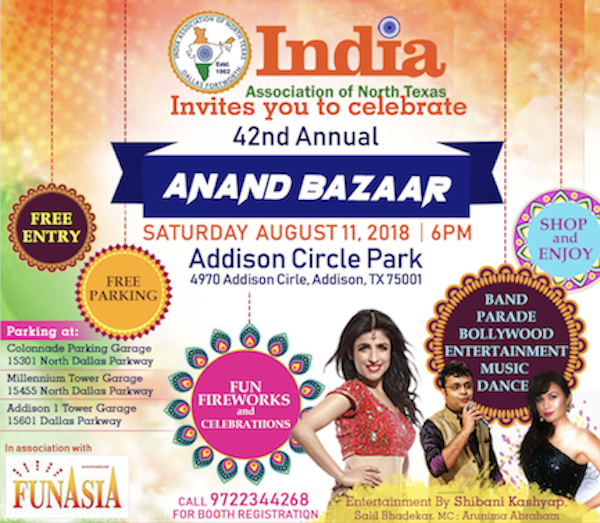
    DALLAS(TIP): The India Association of North Texas will host its Annual Anand Bazaar to celebrate India’s Independence Day. This will be the first time the event will be held in the heart of the DFW Metroplex, at Addison Circle Park in Addison.

    The program will showcase multiple food stalls featuring regional Indian and Non-Indian cuisine. The cultural program will include music and dances from all over India. Vendors from across the metroplex will have their wares displayed creating tempting shopping opportunities. The evening will also include parades and phenomenal fireworks!

    This year’s entertainment features renowned Shibani Kashyap accompanied by Salil Bhadekar. Arunima Abraham will MC the program.

    This is a FREE event, along with FREE parking! However, as proud supporters of North Texas Food Bank and the “Hunger Mitao!” campaign we request you to bring a jar of peanut butter as donation to feed the hungry in North Texas.

    For information on Sponsorship, Booth registration, Vendor Guidelines or to volunteer, visit www.iant.org

  • Detained immigrants in Texas on hunger strike -rights group

    Detained immigrants in Texas on hunger strike -rights group

    DALLAS (TIP): A group of immigrant fathers, recently reunified with their sons and detained in Texas, have gone on hunger strike to demand their release, an immigrant rights group representing them said on Thursday, August 2.

    The immigrants said they were being held at a detention center in Karnes, Texas, with no notification from U.S. authorities on their immigration status, the Refugee and Immigrant Center for Education and Legal Services (RAICES) said.

    It was not immediately clear how many fathers have joined the hunger strike, which began on Wednesday.

    U.S. Immigration and Customs Enforcement (ICE) agency denied there was a hunger strike by residents of the Karnes County Residential Center, about 51 miles southeast of San Antonio.

    “On Aug. 2, a small group of fathers and their children (fewer than 50 total) staged a brief sit-in and expressed their concerns about their immigration cases,” ICE said in a statement. The residents “appreciated the information and dispersed.”

    Fathers had staged sit-ins, children were refusing to take part in school activities, and some fathers had started a hunger strike, RAICES spokeswoman Jennifer Falcon said on a conference call with reporters on Thursday.

    “The dads are on a hunger strike and they are refusing to obey any directions from ICE and GEO guards,” she said, a reference to private contractor GEO Group Inc, which runs the center.

    GEO did not respond to a request for comment. Falcon could not immediately be reached later for comment on the ICE statement.

    U.S. President Donald Trump has made a hardline stance on immigration an integral part of his presidency and has promised to keep immigrants targeted for deportation locked up “pending the outcome of their removal proceedings.”

    Some 2,500 children were separated from their parents as part of a “zero tolerance” policy toward illegal immigration that began in early May. Many of them had crossed the U.S.-Mexican border illegally, while others had sought asylum. The U.S. government said last week it had reunited just over half of them.

    Fathers at the Karnes center said they were misled into agreeing to deportation as a condition of seeing their children again, RAICES said. Others said they had not been given the opportunity to apply for asylum.

    A federal judge in San Diego indefinitely suspended deportations.

  • Indian American Woman becomes the first ever CEO of Democratic National Committee

    Indian American Woman becomes the first ever CEO of Democratic National Committee

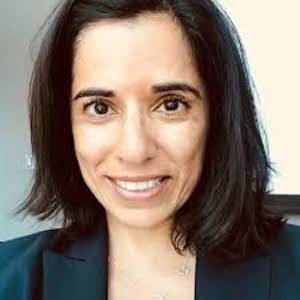
    WASHINGTON(TIP): Indian American Seema Nanda has been announced as the CEO of the opposition Democratic National Committee. She vows to fight for the “soul of the country” and ensure the victory of Democrats in every corner of the US in the crucial upcoming mid-term elections.

    “We are fighting now for the soul of our country, for our democracy and for opportunity,” Ms Nanda, the first Indian- American ever to be the Chief Executive Officer of either the Democratic National Committee or the Republican National Committee took over reigns of the main opposition party on July 23.

    In this capacity, she is responsible for the day-to-day operations of the powerful Democratic National Committee (DNC).

    She would play a key role in party’s winning strategy in the mid-term November elections, for which the DNC has set a target of winning back the House of Representatives from the Republicans.

    “Democrats are offering the positive solutions so desperately needed right now, solutions forged by the strength of our diversity, the rigor of our ideas, and the decency of our values,” she said.

    “Since (President Donald) Trump took office, it’s been clear that the number one best way for us to set our country back on track is to elect Democrats in every corner of our country. That’s why I took this job,” Ms Nanda said in her first message to Democratic supporters.

    Ms Nanda said supporting the Democratic party is synonymous with building a future for the children that they can be proud of.

    “My promise to my two teenage boys is to do all I can to create an America that is bright, fair, and that works for everyone, where opportunity for all means something,” she said.

    “Our party is strong because it’s built on forging positive solutions that include everyone. I’m proud to be the first Asian-American in recent memory to lead the DNC. Democrats are leading with our values and empowering people from diverse backgrounds to speak up and make our voices heard,” Nanda said.

    The fight to take back the country for working families is one that all must fight together, she said, adding “At the DNC, we have committed to helping Democrats win back seats at all levels of government, because we need Democrats from the school board to the Senate to take back our country”.

    Noting that everything is at stake with this year’s midterm elections in November, Nanda said Democrats are investing in state parties, putting organizers on the ground in all 50 states, and mobilizing 50 million voters by November through their nationwide ‘I Will Vote’ campaign.

    “We’re setting our sights and our goals higher than ever before in order to help Democratic leaders fight and win all across our country,” Nanda said.

    “As we head toward a crucial election, I’m one hundred percent certain that Seema’s leadership will help the DNC capitalize on the unprecedented grassroots energy and enthusiasm surging throughout the country,” DNC Chairman Tom Perez had said on her appointment last month.

    Ms Nanda’s appointment is seen as another sign of the political emergence of Indian-American in particular women in the country’s political arena.

    Nanda, whose parents are dentists, grew up in Connecticut. She went to the Brown University and Boston College Law School.

    She also has a background in labor and employment law and has worked in the Civil Rights Division of the Department of Justice.


  • Indian American Raj Shukla announces his candidacy for Madison, Wisconsin Mayor

    Indian American Raj Shukla announces his candidacy for Madison, Wisconsin Mayor

    MADISON, WI(TIP): Indian American Raj Shukla has announced that he will run for the Madison, Wisconsin, mayor. “I am running for mayor to lead Madison to become all we know it can be,” he said on his website announcing the candidacy. “I’ve helped businesses, nonprofits and governments move forward and live up to their ideals. I will do same for the people of Madison, WI.”

    The University of Wisconsin-Madison grad is currently the executive director of River Alliance of Wisconsin, a coalition of individuals, businesses and watershed groups that works toward protecting and restoring the state’s waters. Shukla also heads the Sustainable Madison Committee — an advisory panel appointed by the mayor that is tasked with ensuring that Madison is safe, clean and healthy. He once worked for former Vice President Al Gore’s Climate Reality Project.

    According to the Political Action Committee Indian American Impact Fund, if elected, Shukla would become the first Indian American mayor of one of the 100 largest cities in the United States.

    The primary will be held on February 19, 2019, and the general mayoral election is scheduled for April 2, 2019.

    Madison is an overwhelmingly progressive and Democratic city. The last time a Republican won a mayoral election in the city was in 1969.

    Shukla is the fourth Democrat to enter the race.

    The current Mayor Paul Soglin, who is running for Wisconsin governor, announced on July 17 that he will not seek re-election.

    Shukla and his wife, Tora Frank, have been residents of Madison since 2006. They have three daughters.

  • Indian American Senatorial candidate assaulted by a racist man

    Indian American Senatorial candidate assaulted by a racist man

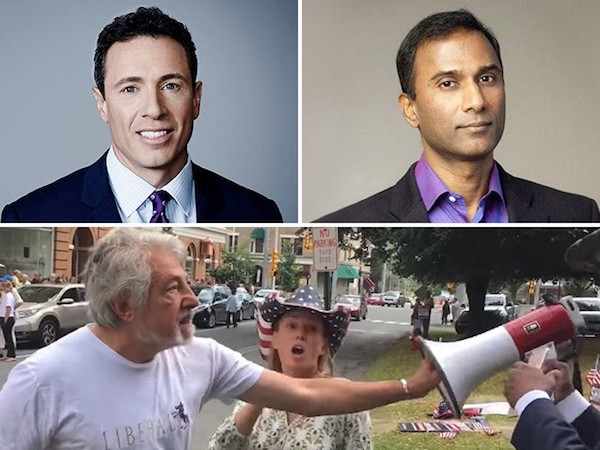
    NEW YORK(TIP): Indian American Shiva Ayyadurai, running for senate, has been

     assaulted allegedly by a racist man who punched him in the face leaving him severely bleeding at a town hall in Massachusetts.

    According to the media reports, Ayyadurai, 54, who is running Independent against powerful incumbent Elizabeth Warren from the Democratic party was attacked last week by her supporter.

    Mr Ayyadurai, an eminent scientist and an outspoken critic, was punched by a man, wearing a t-shirt which said “liberal” and a Warren for Senate sticker.

    He approached Mr Ayyadurai with an umbrella where he was scheduled to appear, the report said.

    “I was just punched in face by a racist @SenWarren supporter,” Mr Ayyadurai tweeted.

    “This is how these white privileged white supremacists react. What you just witnessed is how you white supremacists react when you don’t want to hear the truth from a dark-skinned Indian guy. The same guy you claim you want to help. You guys are racists,” Mr Ayyadurai said.

    He received a bloody lip, swelling, and abrasions, the report said.

    The encounter played out as a crowd of Warren supporters waited to enter a center, the Great Barrington police said in a statement. Paul Solovay left the line, crossed Castle Street, and approached Mr Ayyadurai.

    “Solovay allegedly engaged in a verbal confrontation that became physical when he pushed the bullhorn toward the speaker, striking his mouth,” police said. “Officers acted quickly to subdue Solovay and place him into custody.”

    “We don’t produce enough engineers. We don’t produce enough doctors. But we do produce a bunch of scumbag lawyer lobbyists like Elizabeth Warren,” Mr Ayyadurai says in the video before it cuts to Solovay shouting at him from across the street.

    When the two come face to face, Mr Ayyadurai repeatedly calls Solovay a racist through the megaphone before the 74-year-old pushes it into his face, the video shows.

    Solovay, who was charged with assault and battery and disorderly conduct, pleaded not guilty on Monday in Southern Berkshire District Court. He was released on personal recognizance.


  • Indian-Origin Scientist, one amongst developing drug to reverse hair loss

    Indian-Origin Scientist, one amongst developing drug to reverse hair loss

    NEW YORK(TIP): An Indian-origin scientist is one amongst others to develop an experimental drug that could successfully reverse hair loss, hair whitening and skin inflammation — all previously linked to diets heavy in fat and cholesterol (in mice).

    Treatment with D-threo-1-phenyl-2-decanoylamino-3-morpholino-1-propanol (D-PDMP) halts the production of certain fats called glycosphingolipids, or GSLs.

    GSLs are major components of skin and other cell membranes and could reverse hair discoloration, extensive hair loss and inflammation of skin exhibited by multiple wounds which result due to high fat diets, the researchers explained.

    “Our findings show promise for someday using the drug we developed for skin diseases such as psoriasis, and wounds resulting from diabetes or plastic surgery,” said Subroto Chatterjee from the Johns Hopkins University in Maryland, US.

    In the study, published in the journal Scientific Reports, the team fed Western diet high in fat and cholesterol, and standard chow to two groups of mice who had atherosclerosis — a disease in which arteries are clogged by fat deposits.

    The analysis said that mice who had Western diet had lost hair, formed skin lesions and suffered from hair whitening as compared to those who ate standard chow.

    These results became more severe when the mice continued eating a Western diet for 36 weeks, with 75 per cent of the mice having skin, hair loss and multiple skin lesions.

    But, mice who also received 1 mg and 10 mg of D-PDMP in a capsule per kilogram of body weight started regaining hair and hair color, and their skin inflammation reduced.

    The drug also significantly reduced the number of neutrophils, implying reduced skin inflammation and wounding.

    However, the researchers cautioned that the results in mice do not mean that the same effects would occur in people. But the findings do shed light on possible pathways for addressing hair loss and skin wounds in humans with oral or topical medications, they noted.

  • Indian American 15-year-old Graduated as a Biomedical Engineer

    Indian American 15-year-old Graduated as a Biomedical Engineer

    SACRAMENTO(TIP): Indian American Tanishq Abraham,15, reached a milestone in his academic journey and is all set to start his doctorate after completing his graduation in biomedical engineering, according to a media report.

    This child prodigy, graduated from the University of California, Davis with the highest honors of summa cum laude.

    “Of course, I feel very happy, very excited, and I’m very proud of my accomplishments,” Tanishq told the media.

    “He’s got a lot of passion and we have to keep up with him, pretty much,” said his parents, Taji and Bijou Abraham, hailing from Kerala.

    Tanishq has also designed a device that could measure the heart rate of burn patients without touching them.

    As for the future, it’s back into the lab at Davis for a Ph.D. and eventually medical school. Tanishq has big dreams of finding solutions to problems, the report said.

    “Yeah, of course, what everybody likes to say and what I am also interested in is, of course, cancer and developing new treatments for cancer, more effective treatments for cancer,” he said.

    Tanishq has already been accepted into the University of California, Davis graduate program where he plans to get his MD in the next four to five years.

  • Indian Australian Mathematician Wins Fields Medal, the “Nobel of Mathematics”

    Indian Australian Mathematician Wins Fields Medal, the “Nobel of Mathematics”

    NEW YORK(TIP): Indian-Australian mathematician, is one of four winners of mathematics’ prestigious Fields medal, known as the Nobel prize for math.

    The Fields medals are awarded every four years to the most promising mathematicians under the age of 40.

    Akshay Venkatesh, 36, who is currently teaching at Stanford University, has won the Fields Medal for his “profound contributions to an exceptionally broad range of subjects in mathematics.”

    The citation for his medal – awarded on August 1, at the International Congress of Mathematicians in Rio de Janeiro – highlights his “profound contributions to an exceptionally broad range of subjects in mathematics” and his “strikingly far-reaching conjectures.”

    Each winner received a 15,000 Canadian-dollar cash prize.

    At least two, and preferably four people, are always honored in the award ceremony.

    The prize was inaugurated in 1932 at the request of Canadian mathematician John Charles Fields, who ran the 1924 Mathematics Congress in Toronto.

    From being a child prodigy to becoming one of the most renowned researchers in the field of mathematics, Mr Venkatesh’s journey has been full of achievements and accolades.

    He moved to Perth, Australia, with his parents when he was 2 from New Delhi, India.

    He participated in physics and math Olympiads – the premier international competitions for high school students and won medals in the two subjects at ages 11 and 12, respectively.

    He finished high school when he was 13 and went to the University of Western Australia, graduating with first class honors in mathematics in 1997, at the age of 16.

    In 2002, he earned his PhD at the age of 20. Since then, he has gone from holding a post-doctoral position at MIT to becoming a Clay Research Fellow and, now a professor at Stanford University.

    Mr Venkatesh has worked at the highest level in number theory, arithmetic geometry, topology, automorphic forms and ergodic theory.NT

    His research has been recognized with many awards, including the Ostrowski Prize, the Infosys Prize, the Salem Prize and Sastra Ramanujan Prize.

  • Do sportspersons make good politicians?

    Do sportspersons make good politicians?

    Barring a few exceptions, they were all introduced on the political horizon as “bold and big game-changers”. Finding their wings clipped and sans all powers, they attempted to walk free, only to end up as “loners” and “failures”. What they did on playfields, they could not repeat even one per cent of that in politics. It is all the more intriguing that Indian sports is mired much deeper in politics than the politics of running the world’s biggest liberal democracy. But our sports personalities have failed on that front, too, says the author.

    Politics in sports and sportspersons in politics are two diverse, interesting and highly debatable issues. The emergence of former Test cricketer Imran Khan on the global political scenario has again activated an animated discussion on whether sportspersons make better politicians or not. Never before in the world has a Test cricketer been chosen to lead a country tormented by internal strife, economic turndown, corruption and armed conflict.

    For a sportsperson, building a career in politics on his athletic legacy may not be easy unless he has a high popularity profile, as the shift from the peak of being a sports celebrity to a political bigwig may not be possible without a deluge of publicity and unconditional support from the rank and file of the political outfit he intends to head or lead.

    There have been lots of Olympians and cricketing heroes who wandered into politics and made a name for themselves. Sportspersons-turned-politicians have held limelight all over, including the US, England, Australia, Canada, Japan, India.

    Sprinters Ralph Metcalfe and Jim Ryun, cagers Bill Bradley and Tom McMillen, decathlete Bob Mathias and judoka Nighthorse had successful innings in US politics after successful years in sports.

    Richard Charlesworth of Australia belongs to the rare category of people who excelled not only in more than one sport but also hogged limelight and honor as a trainer, a coach and politician. A Test cricketer, Olympic hockey gold medalist and MP, all made one Richard Charlesworth.

    Then there is Australian aboriginal Nova Perry, an Olympic gold medalist in hockey and Commonwealth Games gold medalist in athletics. She became the first indigenous woman to be elected to the Australian Parliament and later to the Senate.

    Ryoko Tami of Japan, a renowned judoka, who won silver in the Barcelona Olympic Games and gold medals in Sydney and Athens and a bronze in Beijing, turned to politics at the end of her career in sports. She won a seat in the House of Councilors of Japan.

    Before Imran Khan made it to the Pakistan National Assembly, his contemporaries in sports — Sarfraz Nawaz (cricket) and Akhtar Rasool (hockey) — also sat in the Punjab provincial Assembly and held ministerial posts.

    Sports stars-turned politicians: Kirti Azad, Navjot S Sidhu, Pargat Singh, Rajyavardhan S Rathore.

    India has a longer history of sportspersons in politics. There have been numerous instances of eminent sportspersons joining politics, both at the state and national levels. Olympian Jaipal Singh (hockey), Raja Karni Singh, Chetan Chauhan, Kirti Azad, Navjot Singh Sidhu, Sachin Tendulkar, Aslam Sher Khan, Mohammed Azharuddin, Pargat Singh, Dilp Tirkey and Rajyavardhan Singh Rathore are some of the stalwarts, who after or during their innings in sports, dabbled in politics. Their entry was either through established political parties or as independents.

    Kirti Azad (BJP) is a senior politician. His long innings in cricket and then in politics almost brought him to the brink for alleging wrongdoings in the DDCA.

    Why are sports stars damp squibs in politics? Or are they content with just a membership of Parliament or state assemblies?

    Athens Olympic medalist Rajyavardhan Singh Rathore and Test cricketer Navjot Singh Sidhu may be exceptions. Rathore is a part of the Modi ministry. His portfolio is sports. Sidhu is a minister in Punjab. But his portfolio does not include sports.

    It is more than a question of political rehabilitation for those leaving sports and opting for a new career. If politicians are not welcome to national sports federations, how can sports stars expect a warm welcome or assimilation in political administration, is a vexed question.

    The last election to the 15th Punjab Vidhan Sabha was, however, different as not only a large number of sportspersons, but also bureaucrats, technocrats, artistes, singers, academicians, journalists and realtors evinced a keen interest in politics.

    Besides Sidhu (cricket) and Olympian Pargat Singh (hockey), who were successful in the last Punjab Assembly elections, Asian Games gold medalist Kartar Singh (wrestling), Sajjan Singh Cheema (Olympian, basketball) and Gulzar Singh (kabaddi) were in the fray, while several others, including Olympians Surinder Singh Sodhi and Hardeep Singh Grewal and internationals Jagdeep Singh Gill and Asian Games gold medalist Rajbir Kaur Rai (all hockey), did not get a chance to enter electoral politics.

    In all previous instances, sportspersons may have stirred a hornet’s nest here and there, but in the long run, their actions have remained far too small to impact national or provincial politics.

    Barring a few exceptions, they were all introduced on the political horizon as “bold and big game-changers”. Finding their wings clipped and sans all powers, they attempted to walk free, only to end up as “loners” and “failures”. What they did on playfields, they could not repeat even one per cent of that in politics. It is all the more intriguing that Indian sports is mired much deeper in politics than the politics of running the world’s biggest liberal democracy. But our sports personalities have failed on that front, too.

    One may not be able to name a sport that is free from politics. Political affiliations apart, sports administrators defy rules, regulations and guidelines to monopolize state and national sports associations. Governments come and go, but our sports politicians, who have perfected the art of staying in office irrespective of the political party in power, remain indispensable.

    It is but natural to ponder that if our sports are so deep into politics, why sports personalities have been generally non-performers on the political scenario.

    (Source: Tribune)

    (The author is a Chandigarh based senior journalist. He can be reached at prabhjot416@gmail.com)