Year: 2018

  • Indian American Republican and Democrats attend Impact Summit 2018

    Indian American Republican and Democrats attend Impact Summit 2018

    WASHINGTON, DC (TIP)–  Indian Americans hosted an event “Impact” urging fellow politicians to expand the ranks of Indian Americans in government, politics, and public service.

    Puneet Ahluwalia, from President Trump’s Asian Pacific Advisory Committee praised and criticized in the same vein as Democrat Senators Kamala Harris from California and Cory Booker from New Jersey led the way for the speakers. There were over 200 Democrat Party leaning Indian American candidates, elected officials, philanthropists, leaders, and activists in attendance at the inaugural Impact Summit in Washington, DC.

    Senator Booker in his opening keynote remarks said, “We so urgently need Indian American leadership — not just because of the dynamism it has brought to other sectors of American society — but also because this is a time when the very idea of America is under assault.” With an indirect assault on Republican Party affiliated US President Donald Trump’s policies, Booker added, “We have a time now where Indian American pride, where Indian American strength, where Indian American ideas are critically needed.”

    First Indian-heritage US Senator Kamala Harris in her closing keynote remarks urged the Democrat Party leaning audience to “speak truth.” Harris also focused on the anti-immigrant policies of President Trump arguing, “This country was founded by immigrants. Unless you’re native American or your ancestors were kidnapped and brought over on a slave ship, you people are immigrants.”

    Welcoming the efforts, Ahluwalia said, “I applaud the effort of the Indian Americans and the organizers of Impact Project to propel the community in the mainstream politics. It is heartening to see the excitement and a sense of arrival on the political scene.” On the subject-line followed by the speakers to lambast Republican policies, especially ones of President Trump, Ahluwalia reminded his fellow citizens with the same heritage and background, “But it is President Trump who appointed the first Indian American, Ambassador Nikki Haley to a cabinet position along with many others. The Republican Party and its leadership has done far for more for the Indian Americans and India under their governance.”

    “The real truth is to talk about legal immigration and work with Republican president and its leadership in identifying solutions for those who are in our country illegally. But when offered opportunity, the democrats make it into a political theatre,” noted Ahluwalia. He lamented that “at every platform the Democrats and their leaders always blame President Trump and Republican leadership for their commonsense policies by giving lip service and empty words to make inroads into the community.”

    US lawmakers Ami Bera, Pramila Jayapal, Ro Khanna, and Raja Krishnamoorthi attended and also gave remarks. Also, in attendance were over 40 elected officials and candidates, including Hoboken Mayor Ravi Bhalla and eight candidates for the US House of Representatives.

    “This historic summit is proof that the Indian American community has truly arrived on the political scene,” said Raj Goyle, co-founder of Impact and a former member of the Kansas House of Representatives.

    “The energy, enthusiasm, and talent of our elected officials and candidates is truly inspiring,” added Deepak Raj, co-founder of Impact and chair of the Impact Fund. “Impact is proud to stand with them — and we look forward to expanding their ranks at every level of elected office.”

    Founded in 2016 by Raj Goyle and Deepak Raj, and formally launched earlier this year, the Indian American Impact Project is supposed to focus on encouraging Americans of Indian heritage to run for office and an affiliated organization, the Indian American Impact Fund, endorses and supports Indian American candidates running for office. But in reality, the organizational setup, speeches and other allied flavors are all Democrat in essence and nature.


  • Indian-Origin British Hotelier in Car Park Battle with Heathrow Airport

    Indian-Origin British Hotelier in Car Park Battle with Heathrow Airport

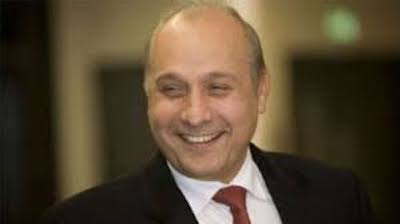
    LONDON(TIP): Leading Indian-origin British hotelier, Surinder Arora, is locked in a legal battle with Heathrow Airport for his right to build a multi-storey car park at one of the world’s biggest airport hubs.

    According to reports, Mr Arora has issued a UK High Court claim against the west London airport over his plans to build a 2,077-space nine-storey car park on a land he owns at Heathrow. While Heathrow Airport Limited claims it alone is entitled to build these spaces, Mr Arora has challenged that claim.

    Under local planning rules, a maximum of 42,000 car parking spaces are allowed at the airport. Mr Arora believes the 42,000 cap refers to the airport site as a whole, of which his land is a part and therefore should allow him the right to build car-park spaces too.

    A planning application has been pending with Hillingdon Council since 2015. Unable to secure approval for his multi-storey car park, Mr Arora was allowed to build a smaller version with 1,000 spaces and five storeys on the site, which opened last year.

    However, the Punjab-born entrepreneur behind a chain of hotels in the UK wants to add another four floors and undercut parking charges at Heathrow – which are among the most expensive in the world.

    But the Heathrow guards its car parking rights “jealously”. As well as earning money from drivers, they allow it to reap returns from airline passengers by adding the value of the car parks to its asset base, currently worth 15.8 billion pounds.

    The claims also state that the current row is about more than just car parking. It is a proxy for Mr Arora’s broader battle with the airport on whether competition should be allowed.

    The businessman wants the right to build a third runway at the airport and has backing from airlines including British Airways for his cut-price plan. Heathrow, however, claims the right to develop the runway is its own.

    Mr Arora, with an estimated fortune of 349 million pounds in the latest 2018 edition of ‘The Sunday Times Rich List’, is understood to have hired two top barristers to fight his parking case.

    Heathrow thinks Mr Arora should exhaust the planning process before going to court. “We believe this is entirely without merit and will respond accordingly,” the airport said in reference to the High Court claim filed by Arora.


  • Indian American Surgeon Atul Gawande Appointed CEO Of Amazon-JP Morgan Venture

    Indian American Surgeon Atul Gawande Appointed CEO Of Amazon-JP Morgan Venture

    NEW YORK(TIP): Indian American surgeon, writer and public health innovator Atul Gawande has been named as the CEO of a new US employee health care company, a joint venture between Amazon, Berkshire Hathaway and JPMorgan Chase, the three American majors announced on June 21.

    Mr Gawande, 52, will take over as the Chief Executive Officer of the company from July 9. The new company will be headquartered in Boston and will operate as an independent entity that is free from profit-making incentives and constraints.

    Mr Gawande said he was “thrilled” to be named the CEO of the health care initiative.

    “I have devoted my public health career to building scalable solutions for better health care delivery that are saving lives, reducing suffering and eliminating wasteful spending both in the US and across the world,” he said.

    “Now I have the backing of these remarkable organizations to pursue this mission with even greater impact for more than a million people, and in doing so incubate better models of care for all. This work will take time but must be done. The system is broken, and better is possible,” he said.

    Mr Gawande practices general and endocrine surgery at Brigham and Women’s Hospital and is Professor at the Harvard TH Chan School of Public Health and Harvard Medical School.

    He is founding executive director of the health systems innovation center, Ariadne Labs and is also is a staff writer for The New Yorker magazine.

    Mr Gawande has written four New York Times bestsellers: Complications, Better, The Checklist Manifesto, and Being Mortal and has received numerous awards for his contributions to science and health care.

    Berkshire Hathaway Chairman and CEO Warren Buffett said talent and dedication were manifest among many professionals the trio interviewed. “All felt that better care can be delivered and that rising costs can be checked. Jamie, Jeff and I are confident that we have found in Atul the leader who will get this important job done,” he said.

    Chairman and CEO of JPMorgan Chase Jamie Dimon said in a statement that as employers and as leaders, addressing health care was one of the most important things that can be done for employees and their families, as well as for the communities.

    “Together, we have the talent and resources to make things better, and it is our responsibility to do so. We’re so grateful for the countless statements of support and offers to help and participate, and we’re so fortunate to have attracted such an extraordinary leader and innovator as Atul,” he said.

    “We said at the outset that the degree of difficulty is high, and success is going to require an expert’s knowledge, a beginner’s mind, and a long-term orientation,” said Jeff Bezos, founder and CEO of Amazon.

    “Atul embodies all three, and we’re starting strong as we move forward in this challenging and worthwhile endeavor,” he said.

    Buffet, Dimon and Bezos had announced the partnership in January to tackle rising health-care costs.


  • The abrupt end of an unlikely alliance

    The abrupt end of an unlikely alliance

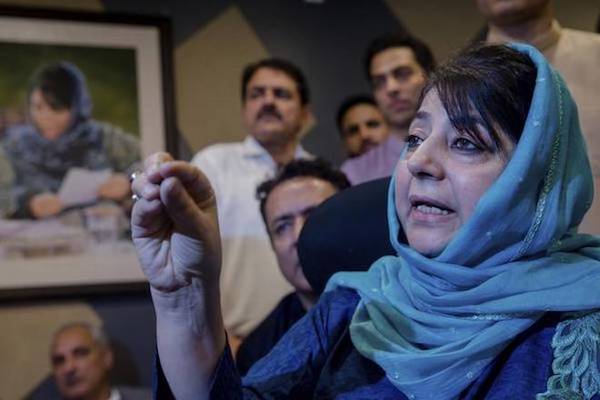
    The PDP and the BJP were always going to part ways. It’s clear Kashmir is headed for troubled times

    By Happymon Jacob
    “At a time when Opposition parties are uniting nationally to mount a challenge to the BJP in 2019, the latter’s act of dumping its ally in J&K is likely to strengthen the Opposition’s resolve to take the fight to the BJP”.

    “In the days ahead, the BJP is likely to justify its stated reason for withdrawing from the coalition by ratcheting up proactive military operations in Kashmir and putting further pressure on the separatist camp. An uncompromising militarist approach, which the BJP will perforce have to adopt, would inevitably mean more militant recruitments from within Kashmir and consequent civilian, military and militant casualties. What happens in Kashmir is directly linked to the higher infiltration on the Line of Control and International Border and more fire assaults between the Indian and Pakistani militaries. Furthermore, given the political humiliation it has suffered, the PDP will be left with two choices: extinction or a return to its soft-separatist stance. If the PDP adopts the latter, it would further vitiate the politico-security atmosphere in the State, at least in the short term. Howsoever one looks at it, Kashmir is headed for troubled times with potential implications for the rest of the country.

    The alliance between the People’s Democratic Party (PDP) and the Bharatiya Janata Party (BJP) in Jammu and Kashmir (J&K) began as an act of necessity, persisted due to sunk-costs and political expediency, and has finally ended as a result of political opportunism. With its sudden decision to withdraw from the coalition government in J&K, the BJP may have ended the political agony for both parties, but it has certainly left the PDP embarrassed and isolated. To be clear, the collapse of the coalition will not only have serious implications for the security situation in the sensitive border State; it also indicates how the BJP intends to use the Kashmir question in the 2019 elections.

    Politics of opportunism

    From the time the PDP and the BJP started negotiations to form a coalition government in January 2015, till June 19 this year when the BJP pulled the plug on the coalition, the alliance has reeked of political expediency and opportunism. The two bitterly opposed parties had come together to form a government primarily for instrumental reasons rather than for normative purposes. Such political expediency became clearer when they decided to keep aside the visionary agenda, negotiated over two months in early 2015, and started focusing on the mundane. As for the PDP, the Agenda of Alliance was its stated raison d’etre for staying in the coalition. But it decided to cling to power in the State even though its coalition partner summarily rejected most of the suggestions in the joint document. Almost no major item on the Agenda of Alliance has been taken up for implementation till date.

    For the BJP, this was the most opportune moment to dump the PDP, given that it not only does not need the PDP anymore, but it has indeed become a liability for its future political pursuits. Having formed the coalition, the BJP achieved what it had long wanted — to be part of the J&K government for the first time in the State’s history. Its leaders were accommodated in key positions in the State government with attendant benefits enjoyed by party functionaries. It might not have grown in Kashmir from an organizational point of view — which it always knew it would not be able to — but it certainly kept its local unit in Jammu content so far. More so, the BJP would now be better off without a ‘soft-separatist’ PDP in tow, especially given that the PDP’s prospects in the State in 2019 are hardly promising. The BJP, in that sense, has used and thrown the PDP. And by being the side that broke ties first, it has gained the first mover political mileage.

    Moreover, the BJP’s support base in Jammu was upset about the manner in which the State police went after the accused in the Kathua rape-murder case and how the two BJP Ministers in the J&K government had to resign due to the controversy arising from the incident.

    Having pulled out of the coalition government, the BJP now could potentially wean away PDP legislators (if the Assembly is not dissolved) and rule the State through the Governor. Individuals of its choice would be appointed as key advisers to the Governor who would act as de facto Ministers in the State.

    However, at a time when Opposition parties are uniting nationally to mount a challenge to the BJP in 2019, the latter’s act of dumping its ally in J&K is likely to strengthen the Opposition’s resolve to take the fight to the BJP.

    The BJP’s ‘stated reasons’ for pulling out of the coalition are perplexing at several levels. Its leadership argued that “there is grave concern over the deteriorating security situation in the State” and went on to say that the responsibility for the difficulty in the coalition lay with “the other side”. This is a problematic argument. While it is true that the security situation in Kashmir has deteriorated, the reality is that the armed forces operating in J&K go by the directives of New Delhi rather than of the State government even though the J&K Chief Minister is the chair of the Unified Command in the State. Second, the BJP was very much part of the government that has failed, and therefore pinning all the blame on the PDP is a cheap excuse.

    Having admitted that the security situation has deteriorated in the State, the BJP has also indirectly admitted that its Kashmir policy — the mainstay of which has been the use of crude force bereft of political strategy — has been flawed to begin with, and that it has not only failed to stabilize the State, but its policies have actually increased violence, terrorism and infiltration. More so, it has further alienated Kashmiris. This deterioration in the situation, let us be clear, is not the result of a soft approach but the direct result of a hardline approach: use of pellet guns against protesters, unwillingness to relent on the issue of AFSPA, or the Armed Forces (Special Powers) Act, and sending the Central agencies after the dissident leadership in Kashmir. The Mehbooba Mufti government could not have stopped any of these policy steps.

    Staring at extinction

    For the PDP, it’s a no-win situation. Having completely lost political legitimacy in Kashmir, the only support base it had, the party and its leadership are looking at a stark future and Ms. Mufti might not find it easy to revive the party any time soon. That is unfortunate given that the PDP had filled a significant political vacuum that existed between the mainstream parties and separatists in the State. Had the party ended the alliance with the BJP earlier, or at least before the BJP did, it would have retained some moral claim about taking normative positions. It was clear for at least two years now that the alliance was bleeding the party dry, but the party leadership lacked the wisdom and courage to say no to the attractions of power.

    In the days ahead, the PDP will struggle to maintain its relevance in the face of the anger of the local Kashmiris (who felt betrayed from day one of the alliance), mainstream parties such as the National Conference and the Congress looking to strengthen their position in J&K, and the BJP which will try to wean its legislators away. The PDP did not have Jammu — now it stands to lose Kashmir too.

    Security implications

    In the days ahead, the BJP is likely to justify its stated reason for withdrawing from the coalition by ratcheting up proactive military operations in Kashmir and putting further pressure on the separatist camp. An uncompromising militarist approach, which the BJP will perforce have to adopt, would inevitably mean more militant recruitments from within Kashmir and consequent civilian, military and militant casualties. What happens in Kashmir is directly linked to the higher infiltration on the Line of Control and International Border and more fire assaults between the Indian and Pakistani militaries. Furthermore, given the political humiliation it has suffered, the PDP will be left with two choices: extinction or a return to its soft-separatist stance. If the PDP adopts the latter, it would further vitiate the politico-security atmosphere in the State, at least in the short term. Howsoever one looks at it, Kashmir is headed for troubled times with potential implications for the rest of the country.

    (The author is Associate Professor of Disarmament Studies at Jawaharlal Nehru University, New Delhi)

  • Taking the UNHCR report in stride

    Taking the UNHCR report in stride

    The killings of Bukhari and Aurangzeb were meant to provoke New Delhi, which decided to be seen as tough

    By KC Singh
    If India and the US let domestic politics color their approach to the protection of human rights in the 70th year of the Universal Declaration of Human Rights, it would prove that terrorism and illegal immigration have succeeded in making the two major democracies less liberal, says the author.

    The 47-member Geneva-based UN Human Right Council and the UN High Commissioner for Refugees (UNHCR) have been in focus the past week. First came an unprecedented report by the UNHCR Zeid al-Hussein on Jammu and Kashmir (J&K), Pakistan Occupied Kashmir and Gilgit Baltistan. While Pakistani knuckles were rapped mildly, the report, as conceded in its executive summary, is really about “widespread and serious human rights violations’’ in J&K from the death of militant Burhan Wani in July 2016 to April 2018.

    Under separate headings it holds India guilty on account of lack of access to justice and impunity; military courts and tribunals blocking this access, excessive use of force and pellet-guns, arbitrary arrests, including of minors, torture and enforced disappearances, and sexual violence, etc. All through, even UN-listed terror outfits are referred to as “armed groups”. A former Indian diplomat writing elsewhere calls it more akin to a report by Organisation of Islamic Conference than a UN high official. India strongly rebutted it and could have probably ignored it, except that Zeid is on record saying he would recommend to the UN Human Rights Council (UNHRC), which convened on June 18 for one of its three annual sessions, an investigation.

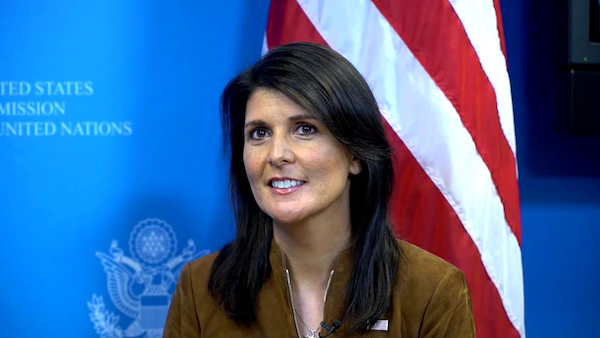
    Two events impinge on this development. One, Jammu and Kashmir has been placed under Governor’s rule with the BJP withdrawing from the coalition government. Two, US Ambassador to UN Nikki Haley announced, at the State Department, US withdrawal from the UNHRC, alleging lack of reform and it having become a “protector of human rights abusers and cesspool of political bias”. Both need closer examination.

    The Trump administration has been threatening to withdraw from the UNHRC for some time, but the decision came a day after Zeid slammed the US for separating children from parents on border with Mexico when apprehending illegal immigrants. The media is also reporting illegal immigrants from India, many from Punjab, held in detention centers under sub-human conditions.

    Republican Senator John McCain, terminally ill with brain cancer but combative as always, tweeted that the “administration’s current family separation policy is an affront to the decency of the American people, and contrary to the principles and values upon which our nation was founded’’. He later went on to oppose Trump’s nomination of Ronald Mortensen to lead the US refugee and migration policy, alleging he lacked empathy for people fleeing oppression. Thus, while the US is right that election to the UNHCR of nations like Venezuela and Congo (though the US omitted mentioning China) hardly makes it the custodian of global conscience on human rights, but neither does the US by its xenophobic immigration control creating gulags for apprehended illegal immigrants qualify it to lecture the council.

    The J&K imbroglio raises many similar questions about India’s trajectory in dealing with terrorism at home. The PDP-BJP alliance raised hope that their Agenda of Alliance would provide a template for resolution of the Kashmir issue. The death of Mufti Sayeed at the beginning of 2016 and a long hiatus before his daughter Mehbooba effectively took charge probably doomed the experiment, if at all had any chance to succeed.

    At the root of the problem was the Modi government’s Pakistan policy of “no dialogue” unless terror ends. On the contrary, the PDP had got elected promising dialogue with Pakistan, more political space even for separatists and improved trade and people-to-people links with Kashmiris across the Line of Control (LoC). The Pakistan army exacerbated these fault lines by keeping up support to militancy, provocatively killing Indian soldiers and turning the LoC into free-fire zone. The Governor’s rule now denies India the argument that J&K has a popularly elected government which is a guardian of people’s rights scrutinizing, if not overseeing, counter-terror operations of security forces. Pakistan, currently a member of the UNHRC, shall use the High Commissioner’s tendentious report and collapse of the alliance to pillory India in coming weeks.

    The Modi government must surely have assessed the profit-loss outcome of its decision. The domestic implications would dominate New Delhi’s thinking as the government heads into literally the last six months of effective rule before the Lok Sabha election process kicks-in. It needs to ensure that no major breakdown of security order in Kashmir occurs till election, particularly during the Amarnath pilgrimage.

    There may be information that leading to parliamentary election in Pakistan in July its army, having a freer hand than normal with a caretaker government in position, is planning to fling every last terror asset across the LoC in a make-or-break gambit. The targeted killing of moderate journalist Shujaat Bukhari and the taped torture and execution of soldier Aurangzeb were intended to provoke New Delhi. A big attack on pilgrims, as has happened in the past, could make the Union Government look extremely ineffective. Governor’s rule is the counter-move to ensure that despite the debate in Geneva on India’s human rights record the Modi government is seen as strong at home.

    If India and the US let domestic politics color their approach to the protection of human rights in the 70th year of the Universal Declaration of Human Rights, it would prove that terrorism and illegal immigration have succeeded in making the two major democracies less liberal. The latest survey by Freedom House, a US think-tank, is called “Democracy in Crisis”. Last year was the 12th consecutive year when nations suffering democratic setbacks outnumbered those gaining. According to Democracy Index of The Economist Intelligence Unit, 89 countries regressed in 2017 and only 27 improved. Globalization and technology in the West and Pakistan-sponsored terror in South Asia are derailing the quest for liberal, law-based democratic rule. If a four-year political alliance between the PDP and BJP, representing disparate views on Kashmir, cannot develop a consensus for bridging the divide, the future is indeed bleak. A fresh attempt at reconciliation seems unlikely until after parliamentary elections in Pakistan and India. Till then, geopolitical haze in South Asia will be thick as the dust that enveloped northern India a week ago.

    (The author is a former Secretary, Ministry of External Affairs, India)

  • First lady Melania Trump visits US-Mexico border amid crisis over separated migrant children

    First lady Melania Trump visits US-Mexico border amid crisis over separated migrant children

    DALLAS, TEXAS(TIP): Melania Trump is visiting two Texas facilities housing some of the more than 2,300 migrant children sent by the U.S. government after their families entered the country illegally, says an AP report.

    The first lady’s visit to Upbring New Hope Children’s Center on Thursday, June 21 comes after President Donald Trump signed an executive order halting the practice of separating families. However, his policy of criminally prosecuting illegal border-crossers remains.

    Mrs. Trump, whose focus is on children, may have helped encourage her husband to act.

    The first lady said earlier through her spokeswoman that she “hates” to see families separated at the border. A White House official followed up Wednesday, saying Mrs. Trump had been making her opinion known to the president that he needed to act to keep migrant families together.

  • Trauma at the border

    Trauma at the border

    As part of its “zero-tolerance” approach to dealing with undocumented migrants, the Donald Trump administration in the U.S. has been separating parents and children within migrating families, leading to outrage over the burgeoning number of minors lodged in foster care. Reports suggest that between October 2017 and May 2018 at least 1,995 children were separated from their parents, with a significant majority of the instances between April 18 and May 31. In recent weeks, disturbing images and videos have emerged of screaming toddlers in the custody of Customs and Border Protection personnel, or in what appear to be chain-link cages in facilities holding older children, as well as one disturbing audio allegedly of wailing children at one such unit. Democrats and Republicans alike have expressed deep concern about the ethics of using children, facing trauma from separation from their parents, to discourage further undocumented border crossings. Mr. Trump, however, has refused to accept sole responsibility for the family separations. Instead, he took to Twitter to blame his Democratic opponents for not working with Republicans to pass new immigration legislation to mitigate the border crisis.

    His response begs two questions. First, why, when both Houses of the U.S. Congress are under Republican control, is Mr. Trump unable to garner the numbers to pass legislation to end family separations? The answer is that poignantly tragic though the fate of these broken families may be, the issue as such has failed to garner even as much bipartisan momentum on Capitol Hill as Mr. Trump’s rescinding of the Obama-era immigration order on Deferred Actions for Childhood Arrivals. The second question is whether the policy of separating migrant families is new, or if there was indeed “bad legislation passed by the Democrats” that supports this action, as Mr. Trump claims. The answer is that both are true. Mr. Trump’s critics are correct in that there is no single U.S. law requiring families to be separated. Rather, what the White House referred to as “loopholes” in legislation are two legal provisions: a law against “improper entry by aliens” at the border, and a decree known as the Flores settlement. The first is a federal law that makes it impossible to summarily deport certain vulnerable categories of migrants, such as families, asylum-seekers and unaccompanied minors. To get around this the administrations of George W. Bush and Barack Obama adopted the policy of “catch and release” — whereby these migrants would be released from custody pending their deportation case adjudication. Family separation was unnecessary at that time, but under the Trump administration’s zero-tolerance approach, all undocumented migrants are charged in criminal courts. Here the Flores settlement applies, because it limits to 20 days the length of time migrant children may be held in immigration detention. While their parents face charges, the children are transferred to a different location, often with devastating consequences for their families. This is unspeakable cruelty.

    (The Hindu)

  • Israeli Prime Minister Netanyahu’s wife charged with fraud

    Israeli Prime Minister Netanyahu’s wife charged with fraud

    JERUSALEM(TIP): Israeli Prime Minister Benjamin Netanyahu’s wife Sara was charged, June 21, with fraud and breach of trust after a long police probe into allegations she falsified household expenses, the justice ministry said. “The Jerusalem district prosecutor a short time ago filed charges against the prime minister’s wife,” the ministry said.

    The allegations announced last year are that she and an aide falsely declared there were no cooks available at the prime minister’s official residence and ordered from outside caterers at public expense.

    The cost amounted to “over 350,000 shekels ($97,000))”, the justice ministry said. She has denied any wrongdoing. Her husband is himself under investigation on suspicion of corruption offences.

    In one case, he and family members are suspected of receiving one million shekels ($285,000) worth of luxury cigars, champagne and jewelry from wealthy personalities in exchange for financial or personal favors.

    In the other case, investigators suspect the premier of trying to reach an agreement with the owner of Yediot Aharonot, a top Israeli newspaper, for favorable coverage. Netanyahu has protested his innocence and vowed to remain in power.

    (Source: AFP)

  • Rajasthan sets Guinness record for world’s largest yoga gathering

    Rajasthan sets Guinness record for world’s largest yoga gathering

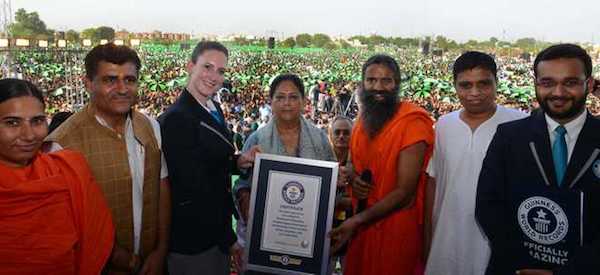
    JAIPUR(TIP): Rajasthan created, June 21, a world record bringing over a lakh of people together at a yoga session to mark the International Day of Yoga.

    Two representatives from Guinness World Records, watched as Yoga guru Ramdev put the gathering—which included Rajasthan Chief Minister Vasundhara Raje—through a series of asanas.

    The international private organization then handed over a certificate to Raje and Ramdev, saying it had been the largest gathering worldwide of people performing yoga.

    “The largest yoga lesson was achieved by Government of Rajasthan, Patanjali Yogpeeth and District Administration at Kota, Rajasthan, India on 21 June 2018,” it said.

    Nearly two lakh people were at the RAC grounds for the state-level function, also attended by ministers, MLAs and bureaucrats.

    Cameras set up at the site and on drones determined that 1.05 lakh people performed the asanas, beating the previous record of 55, 524 people in Mysore in 2017.

    The yoga camp started at 5 am.  Chief Minister Vasundhara Raje announced plans to set up a yoga center with an ‘acharya’ to coach people at each district headquarters.

    She also asked Ramdev to set up an Acharayakulam in Kota, on the lines of the Vedic school set up by him near Haridwar.

    Yoga roots out all bad habits and tendencies from the body and soul,” Ramdev said. State Health Minister Kalicharan Saraf, Agriculture Minister Phrabhulal Saini, legislators and top bureaucrats attended the event.

    The record-breaking crowd included a large number of students preparing for competitive exams in Kota, often described as a coaching hub. People were brought in buses from four districts of the Kota division.

    “I am proud to be the part of an event that has set a world record and highly elated to have performed yoga on International Yoga Day,” said Aakriti Shrivastav, an IIT-JEE aspirant from Uttar Pradesh.

    She said she has made up her mind to spare 10 to 20 minutes for yoga every day.

    Twinkle Rana, a NEET aspirant from Jharkhand, said she felt physically and mentally good after the session.

    Raje praised students being coached for exams in Kota for being a part of the yoga event.

    “It is the moment of pride that the world record in Yoga is being set at a place where the entire nation dwells, as large number of coaching students from across the country are present here,” she said.

    At Udaipur’s Narayan Seva Sansthan, over 500 differently-abled people performed yoga, Prashant Agrawal, president of the Sansthan, said.

    Soldiers at the Jaipur military station and their family members were also part of the countrywide celebrations to mark the fourth International Yoga Day.

    “A soldier has to be physically and mentally fit at all times and yoga fulfils the twin purposes,” said an officer involved in conducting a yoga event at the 61s Cavalry grounds in Jaipur.

    (With inputs from PTI)

  • We Wish Readers A Wonderful Summer

    We Wish Readers A Wonderful Summer

                 4th of July Special Edition

    Articles and advertisements are invited for the 4thof July special edition of The Indian Panorama.

    Please e-mail to editor@theindianpanorama.com  or salujaindra@gmail.com

    For any question, please call 646-247-9458

    Last date for submissions is July 2, 2018

  • House Rejects GOP Hardline Immigration Plan: Vote on Compromise Bill Delayed

    House Rejects GOP Hardline Immigration Plan: Vote on Compromise Bill Delayed

    WASHINGTON(TIP): House Republican leaders further delayed vote on GOP immigration bill until next week in the face of opposition. Earlier, the House of Representatives on June 21 voted down a conservative immigration bill introduced by Judiciary Chairman Bob Goodlatte (R-Va.).

    House Republican leaders abruptly postponed a high-stakes vote Thursday on GOP immigration legislation that appeared headed to defeat, despite President Trump’s last-minute lobbying.

    Several GOP hard-liners said Thursday, June 21, there was nothing leaders could do to convince them to vote for the bill. “I’m a big fat ‘no,’ capital letters,” said Rep. Lou Barletta (R-Pa.). “It’s amnesty, chain migration, and there’s no guarantee the wall will be built.”

    Republican leaders had set up two votes on their GOP bills — one on a hardline measure, the other on a compromise negotiated by conservatives and moderates.

    In the first vote, the House rejected the hardline measure that would have imposed limits on legal immigration and provided temporary relief to young undocumented immigrants. The vote was 231-193.

    As the vote occurred on a chaotic day on Capitol Hill, word circulated that the second vote would be postponed.

    The legislation would have provided a pathway to citizenship for young undocumented immigrants, imposed limits on legal immigration and provided $25 billion for Trump’s border wall. The bill also would have kept migrant families together at the border in detention centers.

    Neither bill was negotiated with Democrats or was expected to garner any Democratic votes. The separations crisis has prompted Democrats to dig in against the Republican immigration efforts barring a complete reversal of Trump’s “zero tolerance” policy.

    “Democrats are dedicated to securing our border, but we don’t think putting children in cages is the way to do it,” Minority Leader Nancy Pelosi (D-Calif.) said Thursday. “This is outside the circle of human behavior.”

    As prospects on Capitol Hill appeared to dim, Trump teed off on Democrats during the outset of a Cabinet meeting at the White House, suggesting that they were standing in the way of Republican success on immigration reform.

    “They say no to everything,” Trump said. “They’re obstructionists because they think that’s good politically. I think it’s bad politically — for them, I think it’s bad politically. We’ll see.”

    Trump attacked Pelosi and Senate Minority Leader Charles E. Schumer (D-N.Y.) as “extremist open-border Democrats” but also said he would welcome their presence at the negotiating table.

    “We should be able to do a bill,” Trump said. “I’d invite them to come over to the White House anytime they want.”

    The White House has made a last-minute push to pass legislation amid the brewing border crisis prompted by the family separations that resulted on the U.S.-Mexico border from Trump’s “zero tolerance” immigration policy.

    Trump, Attorney General Jeff Sessions and Homeland Security Secretary Kirstjen Nielsen have all appeared on Capitol Hill this week to urge Republican lawmakers to pass legislation. They have not specifically urged passage of one alternative, which stands to end with Republicans split on their preference and neither bill passing.

  • Yoga a powerful unifying force in strife-torn world: Modi

    Yoga a powerful unifying force in strife-torn world: Modi

    ‘From Dehradun to Dublin, Shanghai to Chicago, yoga’s everywhere’

    DEHRADUN(TIP): Prime Minister Narendra Modi on Thursday, June 21 performed yoga with over 50,000 enthusiasts at the Forest Research Institute campus here to mark the 4thInternational Day of Yoga,  saying the ancient Indian discipline had emerged as the most powerful unifying force in a strife-torn world.

    Addressing the large gathering in the backdrop of the iconic British-era building of FRI, Modi said yoga had shown the world the way from “illness to wellness” and enriching lives across the globe.

    He said in fact yoga had become the biggest mass movement across the globe in the quest for good health and well-being, which is crucial to the creation of a peaceful world.

    “Dehradun to Dublin, Shanghai to Chicago, Jakarta to Johannesburg, Himalayan highlands or sunburnt deserts, yoga is enriching millions of lives all over the world.

    “Yoga fosters amity in societies which can form the basis of national unity,” the Prime Minister said.

    He said the proposal for the Yoga Day at the UN was accepted in record time with a majority of nations supporting it.

    Today people all over the world had come to look upon yoga as something which belonged to them, Modi said.

    He also asked people to learn to honor their own legacy and heritage if they wanted the rest of the world to respect them.

    “If we don’t take pride in our own legacy and heritage no one else will. We should not hesitate in honoring the gems of our own heritage.”

    He said the way to lead a calm, creative and content life was yoga.

    “In yoga, we have the perfect solution to the problems we face, either as individuals or in our society,” the Prime Minister said.

    “Instead of dividing, yoga unites. Instead of further animosity, yoga assimilates. Instead of increasing suffering, yoga heals,” he said.

    Modi said yoga presented a ray of hope for future of the world. “Yoga is beautiful because it is ancient yet modern, it is constant yet evolving,” he said.

    “India’s legacy of which yoga is a significant part is unique and rich. We must take pride in it,” the Prime Minister said, adding that it had the power to promote universal brotherhood as it united and assimilated instead of dividing.

    “From Tokyo to Toronto, from Stockholm to Sao Paulo, yoga has become a positive influence in the lives of millions,” Modi said.

    He asked people to embrace yoga not just for a healthy but happy and peaceful life.

    The growing popularity of yoga across the globe had brought India closer to the world and this position is going to get strengthened in times to come, he said.

    The Prime Minister had arrived here on Wednesday night to participate in the main event on the International Yoga Day.

    Elaborate security arrangements were made and nearly 3,000 security personnel deployed in and around the venue.

    Modi arrived at the FRI at around 6.30 am and addressed the people before performing asanas with them.

    The Prime Minister had earlier participated in yoga celebrations at Rajpath in New Delhi in 2015, the Capitol Complex in Chandigarh in 2016, and the Ramabai Ambedkar Sabha Sthal in Lucknow in 2017.

    On Wednesday, while greeting yoga enthusiasts across the world, the Prime Minister had said that this exercise is one of the most precious gifts given by the ancient Indian sages to humankind.

    “Yoga is not just a set of exercises that keeps the body fit. It is a passport to health assurance, a key to fitness and wellness. Nor is yoga only what you practice in the morning. Doing your day-to-day activities with diligence and complete awareness is a form of yoga as well,” a statement quoting Modi had said.

    (With inputs from PTI)

  • June 22 New York & Dallas Print Editions

    June 22 New York & Dallas Print Editions

    [vc_row][vc_column][vc_column_text]

    Print Replica ~ Digitally

    E-Editions

    [/vc_column_text][/vc_column][/vc_row][vc_row][vc_column width=”1/3″][vc_custom_heading text=”New York Edition” font_container=”tag:h2|text_align:center” google_fonts=”font_family:Istok%20Web%3Aregular%2Citalic%2C700%2C700italic|font_style:700%20bold%20regular%3A700%3Anormal” link=”url:%20https%3A%2F%2Fwww.theindianpanorama.news%2Fwp-content%2Fuploads%2F2018%2F06%2FTIP-June-22-NYC.pdf|||”][vc_single_image image=”93326″ img_size=”full” add_caption=”yes” alignment=”center” onclick=”custom_link” link=” https://www.theindianpanorama.news/wp-content/uploads/2018/06/TIP-June-22-NYC.pdf”][/vc_column][vc_column width=”1/3″][vc_custom_heading text=”Dallas, Texas Edition” font_container=”tag:h2|text_align:center” google_fonts=”font_family:Istok%20Web%3Aregular%2Citalic%2C700%2C700italic|font_style:700%20bold%20regular%3A700%3Anormal” link=”url:%20https%3A%2F%2Fwww.theindianpanorama.news%2Fwp-content%2Fuploads%2F2018%2F06%2FTIP-June-22-Dallas-TX.pdf|||”][vc_single_image image=”93327″ img_size=”full” add_caption=”yes” alignment=”center” onclick=”custom_link” link=” https://www.theindianpanorama.news/wp-content/uploads/2018/06/TIP-June-22-Dallas-TX.pdf”][/vc_column][vc_column width=”1/3″][vc_single_image image=”82828″ img_size=”medium” alignment=”center” onclick=”custom_link” link=”https://www.theindianpanorama.news/advertising-media-kit-portal-indian-panorama/”][vc_single_image image=”82829″ img_size=”medium” alignment=”center” onclick=”custom_link” link=”https://www.theindianpanorama.news/advertising-media-kit-portal-indian-panorama/”][/vc_column][/vc_row][vc_row][vc_column][td_block_ad_box spot_id=”custom_ad_3″ tdc_css=””][/vc_column][/vc_row][vc_row][vc_column width=”2/3″][vc_custom_heading text=”Lead Stories This Week” font_container=”tag:h2|text_align:center” google_fonts=”font_family:Istok%20Web%3Aregular%2Citalic%2C700%2C700italic|font_style:700%20bold%20regular%3A700%3Anormal” link=”url:https%3A%2F%2Fwww.theindianpanorama.news%2F|||”][td_block_5 separator=”” limit=”8″ tdc_css=””][/vc_column][vc_column width=”1/3″][vc_widget_sidebar sidebar_id=”td-default”][/vc_column][/vc_row]

  • Interview : 4th International Day of Yoga

    Interview : 4th International Day of Yoga

    The Fourth International Day of Yoga is just a few days away. Since June 21, 2015, when International Day of Yoga was first celebrated, IDY celebrations have multiplied, spreading over a couple of days. This year, with quite a few celebrations already scheduled, we will be seeing the celebrations starting as early as June 15 and going up to the end of the month. However, among all other celebrations, there are two which are official and more noteworthy. The one is organized by Permanent Mission of India at the United Nations, and, the other, by the Indian Consulate.

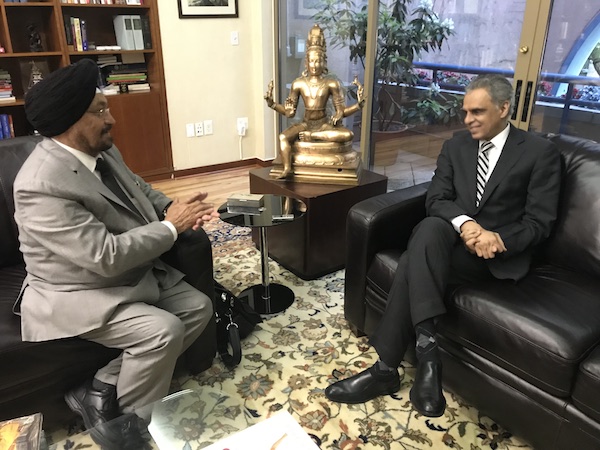
    The Indian Panorama Chief Editor Prof. Indrajit S Saluja spoke with Consul General of India in New York, Ambassador Sandeep Chakraborty, and Ambassador Syed Akbaruddin, Permanent representative of India to the United Nations to know from them how the historic event was planned this year.

    Here are excerpts from the interview with Ambassador Syed Akbaruddin.

     Prof: As I had requested, we want you to focus on the great event that is coming up. Congratulations to you, in the last 3 years it has become such a popular event having the whole world celebrate it at the UN. It does bring credit to you as India’s representative here and it does bring a lot of honor and respect for the country. This is the 4thone and every year the bar has been rising. So, this year the expectations are also very high. My readers would like to know what are the preparations for the event from 19 to 21stJune with regard to celebration of International Day of Yoga?

    Amb:Well the international day of Yoga as you know is perhaps the most significant effort that India has launched globally in promoting through soft power its culture and heritage. It’s an approach that started at the UN because we felt that the UN is the right platform to go global rather than do it in individual countries. We use the global platform to go global. As you said, every year the effort is to try and improve it and consolidate what we have done before. As in previous years we will have 2 events, one is the event of Yoga demonstration and another will be a conversation with the people who have benefitted from Yoga. So, there will be event on the 20thwhich will focus largely on the outside aspect of the UN where we expect more than a 1000 people to join us. They will be diplomats as well as some non- diplomats and we are working with various UN clubs as well as other organizations to get Yoga enthusiasts. And there are several Yoga masters who will also be participating in that with their supporters and those who are interested in joining in. In addition, the focus will be what we call Yoga for peace. Given today’s world where there is a lot of turbulence & violence in various parts of the world, the effort is that can Yoga contribute through its multifaceted approaches to a more peaceful world.  So, the outside event will be followed by an inside event on the 21stwhere we will have people who have benefitted from Yoga in various aspects for example, war veterans, disabled who have benefitted. Also, those who have served prison terms and how yoga has helped them reintegrate with world. So, we are trying to bring in different perspectives of people who have benefitted from yoga and how they have reintegrated with the society using Yoga as a pole along which they have constructed their lives.

    Prof: Well, very well said. But why are we so particular about spreading the message of Yoga?

    Amb: Well, Yoga is an ancient Indian heritage which has gone global because of its appeal in helping us tackle some of the most difficult issues that we have confronted. Because Yoga is not only an exercise; it is an approach to living in harmony with Nature. So, in today’s world where we have used and abused Nature in so many ways, living in harmony with Nature provides us a strong underpinning to reorient our lives. Look at the fear that we have in terms of a damage to the environment. Yoga is a philosophy of life which helps us in ensuring that man and environment are not in antagonism with each other. So, there are multifaceted benefits in terms of philosophical approach, in terms of controlling our emotions, in terms of living in harmony with Nature that Yoga helps us achieve and therefore the emphasis on promoting Yoga as a lifestyle approach in turbulent times.

    Prof: You mean that Yoga restores a balance in the health – Mental, Physical & Societal Health?

    Amb: It is one of the tools.

    Prof: And you want the world to know about this lifestyle?

    Amb:  It is a tool that helps human beings to confront the multifaceted issues that they face. .Like  various other tools are available. Meditation is a form; Anger management is one. So, there are multifaceted tools, and all must be used. In today’s world, every tool is useful in fostering harmony, fostering nonviolence, fostering peace, because we are in very turbulent times. We look around the world and we see around us a dissonance which many of us have not seen in our lifetimes. Change of such unprecedented nature is impacting on us and we need a pole that could help us stabilize in such turbulence.

    Prof:  Which means Yoga can be a very powerful business proposition also?

    Amb: Obviously, in today’s world anything to succeed, if it cannot manifest itself as a business proposition, it cannot succeed.

    Prof: Coming back to celebration of main event, is all set?

    Amb: Yes.

    Prof: Who all are coming this year?

    Amb: Dr. Nagendra from Bengaluru is coming. There will be an exhibition organized by Sehaj Yoga.

    Prof: What is your message to the readers of The Indian panorama?

    Amb: I want to invite readers of The Indian Panorama to come in large numbers to celebrate the historic day. I hope the message of Yoga is reflected from the global platform.

    Prof. How do participants get entry to the venue?

    Amb: They need to go to our website www.pminewyork.organd register.


  • Interview: 4th International Day of Yoga

    Interview: 4th International Day of Yoga

    The Fourth International Day of Yoga is just a few days away. Since June 21, 2015, when International Day of Yoga was first celebrated, IDY celebrations have multiplied, spreading over a couple of days. This year, with quite a few celebrations already scheduled, we will be seeing the celebrations starting as early as June 15 and going up to the end of the month. However, among all other celebrations, there are two which are official and more noteworthy. The one is organized by Permanent Mission of India at the United Nations, and, the other, by the Indian Consulate.

    The Indian Panorama Chief Editor Prof. Indrajit S Saluja spoke with Consul General of India in New York, Ambassador Sandeep Chakraborty, and Ambassador Syed Akbaruddin, Permanent representative of India to the United Nations to know from them how the historic event was planned this year.

    Here are excerpts from the interview with Ambassador Sandeep Chakraborty.

    TIP: Thank you so much and we are meeting for the 4th International Day of Yoga Celebrations this year and it was a wonderful, very successful day of Yoga last year; the first that probably was organized after you took over, and congratulations for that. And since you have already set the bar so high, people are expecting a lot better performance and celebration this year. So, without waiting, for my readers to know, I would request you first to highlight the program that you have devised for people to celebrate International Day of Yoga.

    Amb: Thank you Saluja Sahib. There are two aspects of this year’s celebration. One is that we are working with many organizations, particularly organizations which have and share this idea & vision of Yoga, associated to Yoga.  So, we are partnering with large number of organizations in many states and many counties. So, that part has already started. You know a few weeks back we had a big curtain raiser event at TV Asia, you must have seen it, many people came, I think it was covered in your Newspaper.

    TIP: Yeah, we even covered that right on the front page.

    Amb:  Yes. Yes…absolutely. So there if you saw, large number of organizations came. So, this year I think what we are trying to do is that we are partnering with many organizations in New York, New Jersey, Connecticut, Boston area and everybody has been joining hands under this one framework. So that celebrations have started and will continue. We have 2 weekends in frame of reference in the sense that starting from June 16 to June 24, we are celebrating Yoga Day, our main event. So, not only we did the TV Asia Program we also had a Yoga cruise partnering with Vegetarian Vision and Malcolm Foundation. So, around 400 people came for that Yoga cruise where there were a lot of discussions, asanans, a lot of yoga, and yoga related events took place on the cruise for 4 hours. So, that also is a part of our yoga day celebrations.

    Secondly, our main event is on June 16 at 11 o’clock. I invite everybody to Governor’s Island. We have chosen that to be a very iconic place in New York. And we though if we do Yoga there you know what the idea of Yoga Day is. The idea is to focus on the importance of Yoga and it’s like any anniversary that we celebrate so we thought that if we do it at an iconic place then the message will go loud and clear. So, on June 16, invite your readers to join us. It’s a beautiful place against the backdrop of the ocean, the Statue of Liberty and Manhattan Skyline. Carolyn Maloney who is our Congresswoman of Manhattan will be our chief guest. So that will be a 2-hour program with various aspects of Yoga and meditation, music and dance. So, it will be a fiesta of Yoga. Then various organizations like temples, cultural organizations, Indian community all over this region are doing and we are trying to support them and trying to attend their functions. So, that will be the Consulate’s footprint of Yoga Day. Then of course our permanent mission to the UN will be organizing I think 2 events, on 20th and 21st. Those are also important events. So, the Yoga calendar is rather packed, I must say.

    TIP: I understand you are having for the first time an International conference also.

    Amb: Yes, I was coming to that as well. Now as part of the Yoga day celebrations on June 20th and 21st, we are having an international conference on Yoga here in the Consulate. That is an event that is a specialized event, not an event for Yoga practitioners that way but much more about people who do research on Yoga, academicians, you know people who have been seriously working on Yoga, doctors, scientists, academicians so that will be technical seminar where people will read papers and you know trying to give more clinical and scientific basis to what we know is Yoga. So, that will be of 2 days on June 20th and 21st and President of ICCR Mr. Vinay Sahastrabuddhe, he will be coming as chief guest at this event.

    TIP:  And you have something on June 22, 23 and 24, 3rd International Conference on Integrative medicine?

    Amb: That is also there. We are joining hands with Center of Excellence of in Integrative Medicine in Boston. So that will be in Boston not here.  They are partnering with Harvard Medical School and some other prominent Institutions of the Boston area. So, those will take place from June 23 to June 25. So, it’s a very packed calendar, yes.

    TIP: Yes, I do see it’s a very packed calendar for community as well, as there are Yoga celebrations at various places starting from Hicksville, after that, Connecticut, Westchester, Hartsdale.  There are so many of them coming up.  These are all being supported by the Consulate?

    Amb:  These are all, yes in coordination, we are meeting, we are talking, and we are working together.

    TIP:  Now, having talked about this packed calendar, Congratulations! You know there is so much activity going on. It has now been 3 years you know. Now this is 4th year that we are into celebrating the International Day of Yoga, what has been the achievement because it means huge investment in terms of human energy, in terms of funds, finances; what has been the gain-the overall gain. How do you sum up this aspect?

    Amb: You see what we are trying to do, I think, the effort of Government of India and Consulate is that so far Yoga was seen as spherical, you know you do everything and then you do some Yoga. Yoga was more seen in the West at least as an exercise. You want to lose weight, you have back pain, you have a neck pain, you do Yoga. Our effort is now to mainstream Yoga. Yoga is a lifestyle. Yoga is not only doing asanas; yoga is meditation, yoga is keeping your mind and body under control. Yesterday I was addressing a seminar in Bhakti Center where eminent Professors from Yale and Indiana Universities had come. You know today some of the questions that are being raised, I think the only answer is in what we broadly term as Yoga. How do you treat depression? how do you treat addiction? how do you treat suicidal tendencies? how much of pills will you take?  The answer is Yoga…it teaches us to keep our mind and body and soul under control.

    TIP: Ultimately, all boils down to one thing “Health”

    Amb: Yeah, Mental & physical health.

    TIP: That is why the West is interested in it.

    Amb: I think all of us should be interested in it. Our effort is to mainstream Yoga and I think it is happening because the kind of interest that is being exhibited by Universities and Hospitals. A renowned Hospital in Manhattan now has a gallery on Ayurveda including Yoga. It was unthinkable a few years back that a mainstream hospital of New York will have a gallery on Yoga and which I went and inaugurated. Harvard Business School, Massachusetts Hospital, General Hospital, all these people have been doing work on Yoga because they realize you know that after some point this allopathy doesn’t give any answer. If a patient is dying how will you console him? What is that you have to do to control the pain? Here meditation and Yoga helps you. People are realizing it and that is the biggest gain of celebrating Yoga Day.

    TIP: You added to Yoga, Ayurveda which is altogether a different stream? This is now being combined and I have a question here for you. I understand the businesses in India, the business houses particularly the ones I can name like Baba Ramdev’s Patanjali. They are into manufacturing so may herbal medicines and all that and they claim to be curing so many maladies which even the higher end allopathic medicines cannot cure. Now you may look into this aspect also. Is there a thinking on the part of the government which is of course business friendly that one day Yoga would become a trillion-dollar business all over the world and with that Ayurveda would also become trillion or may be many more trillion, zillion dollar business?

    TIP: Is there a thinking of that kind?

    Amb: Yes, there are 2 aspects to it. One is I don’t see any problem in the sense that you know if our Indian medicines become popular in the world and generate revenue for the people, I see no harm in that but there is a slight difference in popularizing Yoga and popularizing Ayurveda. I am talking from experience. Yoga is very noninvasive; anybody can do Yoga and Yoga comes with caviars. If back pain, don’t do this exercise. If obese, don’t do this exercise, if spondylitis, don’t do this exercise, but there is no popping of pills, there is nothing that you consume but Ayurveda you have to consume you know herbs and other medicines. Now, when you consume there are regulatory issues like if you have to import a medicine into the US there is FDA regulation. So, then there is a barrier there and it is not so easy to overcome that barrier. So, I would say as and when companies will overcome that barrier they will register their products in foreign markets. Then what is the harm in popularizing Indian medicines in foreign markets?

    TIP: That’s why I say, like right now Yoga has been promoted over the years, So Ayurveda is now being promoted and we don’t do any of these kinds of things- promotions or something- unless and until we have something else on the back of our mind.

    Amb: I will not be able to focus on Ayurveda because there are issues in Ayurveda in terms of regulatory methods, but Yoga is noninvasive, Yoga is not subject to any regulatory control, Yoga is soft power. Yoga is a life style. I think it’s a very win-win kind of a formula that we have adopted, and it shows India in good light. It is an ancient Indian tradition, People are accepting it you know It’s not that Yoga has become popular only because Consulate or Government is promoting it.  Yoga has been popular in the US for many many years. In fact, although it originated in India it became very popular because of the work done in the US. So, I see a lot of synergy between what is happening in the US and our efforts in popularizing Yoga. Yoga is a way of thinking you know how you control your mind, how you become impulsive, how you become reflective, how you take care of the environment, how you build relationships. A lot of aspects are there, and I think it’s a very positive story which needs to be told and we feel very happy to be associated with the story.

    TIP: Let me phrase a question connected with entrepreneurship and Yoga removing Ayurveda, I understand Ayurveda products are being brought in as dietary supplements mostly, you cannot bring them in as medicines so there is that issue. Yoga as we know as of now connects with products like yoga mats , yoga pants , you have even shoes included etc. whereas in our original practice of yoga, we have bamboo mats or jute mats , so when we talk about entrepreneurship we are in the land of opportunities, America, promoting Indian products connected with Yoga only could be a focus point, removing everything when we see a lot of companies promoting all the above products,  even hot yoga studios, Is it possible that Govt. of India brings out one such business or branch for people who are connected with it may be we can have Kerala people making yoga mats with bamboo or Jute leading to a handicraft promotion?

    Amb: I think what you are saying is very relevant because yoga products, books are selling and becoming popular like hot cakes. Yoga professionals are getting jobs, yoga gurus have become more popular, Yoga sites and there is a yoga TV channel, popular, run by ZEE TV. So, these are spin offs of the concept

    TIP: That’s why I said Yoga could become a trillion-dollar business

    Amb: Yes, Why not? If Soccer and cricket are trillion dollar business then why not Yoga?

    TIP: Is there going to be a blueprint regarding the products.

    Amb: I think Govt, of India could be thinking about this but I am not really aware, but I know they were talking to Khadi Gram Udyog and they asked us for what products will do well. So, we told them to manufacture high quality Yoga mats in Khadi.

    TIP So there is a plan?

    Amb: Yes, there is. But I don’t think India is an open society. So most of the entrepreneurship will come from Private sector and I am sure it is there. I am sure, but we must not expect the govt to do so.

    TIP: The government is not into business. Govt. can make policies to promote.

    Amb: Yes, But I will be very happy if private sector does that and I am sure they are doing it. Like for example, Ghee. It is being rediscovered.  American Indians earlier referred to Ghee as a bad thing. Nowadays ghee is in demand, and popular. America companies are making it. In fact, some people came, and I gave them ghee as a return gift and told them to have it. It was a cardamom flavor made in the US. One Indian entrepreneur featured in a popular American TV show for manufacturing ghee. In fact, coconut oil is very popular and manufactured in the US. Then turmeric, of course, sweets and saffron. Turmeric is known to cure many diseases. So, we used to be carefree to consume all these things but in America people take these cautiously.

    TIP: Any message for readers of the Indian Panorama?

    Amb: Yes, please come to Governor’s Island on June 16 to celebrate International Day of Yoga. Hopefully, the weather will be fine, and we will have a great celebration.


  • Weekly Horoscope June 18 – June 24, 2018

    Weekly Horoscope June 18 – June 24, 2018

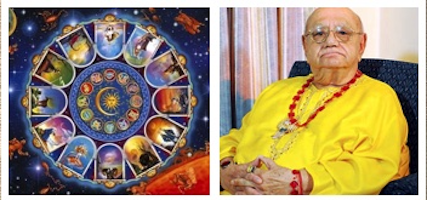
    By Astrologer Bejan Daruwalla
    www.bejandaruwalla.com

    Aries: Ganesha says you rope in your associates in your dealings and this proves to be a good move. The attention also shifts from the work front to home and family and there are many domestic responsibilities and joys to handle and enjoy. You also have to invest some time in your housing society or community and you can’t get away from all this. Nor do you want to. There are other responsibilities to attend to as well. Plus, there may be demands from siblings, co-workers, immediate and distant family and neighbors.

    Taurus:Love and money are the twin themes of the period. You also find time to relax, and there could perhaps be a home away from home as a kind of holiday retreat or weekend getaway. There will be loans, joint accounts, bonds, insurance and funds of all kinds to deal with on the money front, along with soaring expenses. You do a juggling act and manage it all well. You will also be spending a lot of time with loved ones and that will give you many happy moments.

    Gemini:Your people skills will be at their best and you will get the support of both colleagues and loved ones. Partnerships and collaborations are vital and most beneficial in this period. You surmount many obstacles and ride the wave to glorious times. You worry about your image and there may be legal issues that could tarnish it. You confide in family and form a strong team to battle these challenges. You find great support and strength in your associations and emerge victorious with ease.

    Cancer:Money and its jingle appeal to you more than ever before. You look at finances in a big way, as that is the main theme of this period. Personal and work-related finances hog the limelight. There are tax issues and all sorts of monetary developments that will take up your time. You have to solve it all and spend time behind closed doors getting to the nitty gritty of your finances and its implications. There are meetings galore in this period but they all work out happily in the end.

    Leo:Once the finances are worked out, you get to spending the money which you believe is hard earned. There are many expenses and for a change, your creative instincts blossom. You do well at work and there is recognition. You may even get an award for something you have done. You love the limelight and the appreciation that it all brings. You are the toast of the office, and may get a promotion, if not more. If you are on your own, you make tangible expansion of the business / enterprise. A tremendous sense of aestheticism, of beauty, new grips you. There have been good times and you have worked hard and earned well and now you want to get creative and bring some beauty into your surroundings.

    Virgo:You have achieved a lot, but you don’t want to stop here. You are prepared to stick your neck out like a platoon commander flushing out terrorists. This works as you break new ground and make many startling discoveries. Your new interests include religion and spirituality, travel and education. You have kept money aside for the family and for a nest egg, and so monetary issues are not the real focus this period. You look for harmony and try to smooth the feathers you have rustled in the past.

    Libra:Your conciliatory moves and work success are highly appreciated. There is enhanced income and prestige. You party a lot now and look at finances in the form of inheritance and legacies. You are a social butterfly and spend time at various gatherings enjoying yourself thoroughly. You are ebullient and enthusiastic, and your happy mood is contagious. All this is a welcome respite from the hard slog that you have put in over the last period.

    Scorpio:You are again on the work track. You are confident, pragmatic and determined and will forge ahead furiously. You earn plaudits for your achievements and decide to expand further and make more money, which is never out of your sights for long. You look at holistic progress and make the necessary adjustments to your personal and work life so that both show steady progress and harmony. You are also, once again, on a shopping spree with family and loved ones. Everyone has a ball!

    Sagittarius:You give your best to work and your relationships and there is great intensity in whatever you do. You extend your hand towards humanity, undertake social work and spend quality time with your children and / or parents. You are full of commitment and bond well with others. You are endowed now with a new vision and charisma and look at the future with immense possibilities in mind. You are riding the crest of a wave and feel that the world is yours to conquer.

    Capricorn:You see yourself in a new light and are empowered by your success. The early part of the period will be hectic and now you try to enjoy yourself and ride on the momentum generated in the previous period. There is a welcome change in your perspective and the way you are looking at the world. You are caring and considerate, alert and active. There is a new you eyeballing the world and whatever it has to offer. There is a chance that you are getting too big for your boots. You spend and entertain easily and have happy, boisterous times.

    Aquarius:You are busier than ever before and highly motivated in all that you undertake – and it shows in the results. You spend quality time with loved ones and there are possibilities of exciting travel. But there are pinpricks like unexpected expenses, ill-health in the family, and a frittering away of valuable resources on issues that are of no relevance to you; in other words, there is highly avoidable wastage of both time and money. There is envy and politics at the workplace and you have to tread with caution.

    Pisces:There are many distractions at play here. There are partnerships, religious ceremonies, meetings and interviews and several business / collaborations / connections, all of which lead you into a profitable, upward spiral. This is a good time to spread your wings and meet as many people as possible. There will be journeys and conferences and you will benefit greatly from them. There is romance in the air and, if married, there will be dealings with close family, your spouse, even your in-laws. If single, there is a chance that you may meet your life partner.

  • Indian American Neel Gonuguntla among The Dallas Business Journal 2018 Women in Business Awards honorees

    Indian American Neel Gonuguntla among The Dallas Business Journal 2018 Women in Business Awards honorees

    The 30 honorees, including US India Chamber of Commerce President, Neel Gonuguntla represent a variety of industries and roles

    DALLAS(TIP): The Dallas Business Journal has announced the honorees for its 11th annual Women in Business Awards program.

    These 30 individuals, including Indian American Neel Gonuguntla represent a variety of industries and roles that are crucial to the Dallas-Fort Worth ecosystem, including financial and legal services, commercial real estate and construction, and non-profit organizations.

    From leaders of global institutions, like Frito-Lay Chief Marketing Officer Jennifer Saenz and AT&T Business’ Anne Chow, to entrepreneurs behind innovative startups, like Elyse Dickerson of Eosera, the 2018 class of Women in Business touches on a concentration of transformative ingenuity and enterprising imagination that can only be found in North Texas.

    Four members of the Women in Business Awards class – Betty Garrett, Linda Kunz, Sandy Phillips, and Courtney Sinelli – have been selected to receive the distinction as a “Tourism, Travel and Hospitality” honoree. This category highlights the vital role that these verticals play in keeping North Texas a contender in national and international spheres.

    The 2018 honorees will be honored at a luncheon and trade show on Thursday, August 23, at the Omni Hotel Dallas.

  • Indian origin New Zealand based Radio Jockey dares Akal Takht Jathedar to open debate

    Indian origin New Zealand based Radio Jockey dares Akal Takht Jathedar to open debate

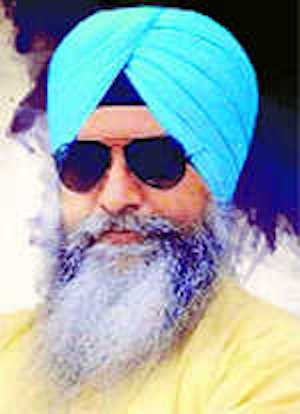
    CHANDIGARH (TIP): Akal Takht on Thursday, June 14, excommunicated New Zealand-based Harnek Singh Neki for “derogatory” remarks on Sikh Gurus and for distorting Gurbani while hosting a radio talk show.

    The “hukamnama (edict)” by the five Sikh high priests was pronounced by Giani Gurbachan Singh. The Jathedar directed the Sikhs to initiate legal proceedings to scrap Neki’s project — Radio Virsa — for running a relentless “propaganda” against the Gurus.

    Speaking to The Tribune on the phone 12,000 km away, an unruffled Neki invited the Akal Takht chief to his show for an open discussion on the origin of Sikhism and its principles. “I do not acknowledge the authority of the Akal Takht Jathedar or the SGPC. Both have lost their credibility. I never saw myself as part of the community governed by them. I challenge the Akal Takht Jathedar or any SGPC representative to a debate on my show on Sikh ethics and principles. Let the listeners decide for themselves.”

    Mocking the clergy, he said the ‘Taksali’ Sant Samaj and SGPC representatives had approached the New Zealand High Commissioner in New Delhi to demand that his radio ‘license’ be cancelled, “little knowing that in New Zealand, it is not required to run a small radio channel as Radio Virsa which I run in collaboration with a group of Sikhs settled there.”

    Jathedar Gurbachan Singh stressed that Neki was given three chances to appear before Akal Takht, but he did not respond. “He has been ‘distorting’ Gurbani and using objectionable language for the Sikh Gurus on his radio shows. The Sikh community must sever social, political and religious ties with him.”

    Neki was first summoned by the Akal Takht on May 16 and asked to respond to the allegations in writing within 10 days. Thereafter, he was called on June 1 and for the third time within the next one week.

    Parallel ‘Jathedar’ Dhyan Singh Mand too had excommunicated Neki on May 30 on the same charges.

  • Indian-American woman to become CFO of US carmaker General Motors

    Indian-American woman to become CFO of US carmaker General Motors

    NEW YORK(TIP): Dhivya Suryadevara, currently the vice president of corporate finance, will succeed Chuck Stevens, the GM’s present CFO, on September 1, the company said in a statement.

    Chennai-born Suryadevara, 39, has been GM’s vice president of corporate finance since July 2017. She will report to Chief Executive Officer (CEO) Mary Barra, 56, who has been head of the automaker since 2014.

    Barra and Suryadevara are the first women in their respective positions in the auto industry, as no other major global automaker has a female CEO, nor a CEO and CFO who are both female.

    Suryadevara earned her bachelor’s and master’s degrees in commerce from the University of Madras in Chennai, India She moved to the US at the age of 22 to pursue her MBA from Harvard University.

    She is a chartered financial analyst and accountant and worked at UBS and PricewaterhousCoopers before joining the Detroit-based GM in 2005 at the age of 25.

    “Dhivya’s experience and leadership in several key roles throughout our financial operations positions her well to build on the strong business results we’ve delivered over the last several years,” Barra said in a statement.

    Stevens, 58, has been CFO at the largest US automaker since January 2014 and will retire in March next year as a more than 40-year veteran of the company.

    He will remain with the company as an adviser until his retirement, the statement said.

    Stevens began at the Buick division in 1978 and, like Barra, was educated at General Motors Institute, which became Kettering University. He had a key role in GM establishing its joint venture in China with SAIC Motor Corp. and was a crucial player in GM selling its long-struggling Opel business to French automaker PSA Group.

  • Gujarat NRI shot dead near his store

    Gujarat NRI shot dead near his store

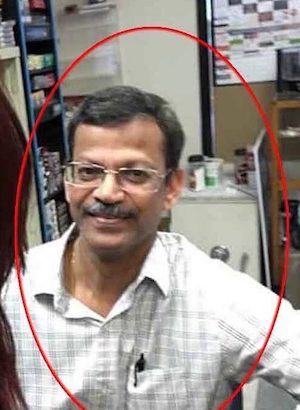
    ATLANTA(TIP): A man from Vadodara, Gujarat, settled in the US was shot dead in Atlanta on June 9 evening.

    Forty-eight-year-old Harikrishna alias Harish Mistry was shot thrice by an African-American man near his store at about 4pm.

    Police are yet to make an arrest in the case. Mistry moved to Atlanta with his family about 15 years ago and ran a gas-station-cum-store. “Our relatives in the US informed us about the killing on Sunday morning,” said Dilip Mistry, a cousin of the deceased.

    “We were told that Harikrishna was leaving his store when the attack occurred. Our relatives said the man who shot Harikrishna used to work at his store and was pulled up for misconduct a few days ago.”

    Harikrishna Mistry is survived by his wife Sheetal and two children — Nancy, 19, and Nayan, 4.

    Mistry’s two sisters are also settled in the US.

  • Indian American named finalist for Sammies People’s Choice Award

    Indian American named finalist for Sammies People’s Choice Award

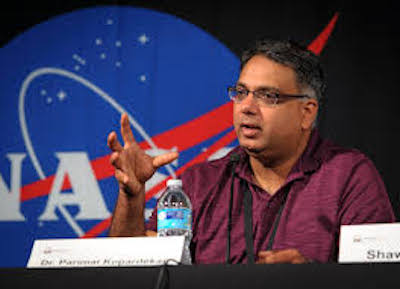
    NEW YORK(TIP): Parimal Kopardekar, a NASA senior technologist for Air Transportation System, has been selected as a finalist, among 12, for the 2018 Sammies People’s Choice Award by the Samuel J. Heyman Service to America Medals.

    Kopardekar, who is also a principal investigator of the Unmanned Aircraft System Traffic Management at the Moffett Field, Calif.-based NASA Ames Research Center, was named a finalist in the Promising Innovation category.

    According to a report put together by the Heyman Service to America Medals, the Federal Aviation Administration estimates that there could be more than 700,000 commercial drones flying at a low-altitude to deliver packages, monitor traffic, track storms, inspect power lines, aid search and rescue operations by 2022.

    However, it will require a sophisticated air traffic management system for unmanned aircraft that will prevent accidents and airborne congestion, working efficiently to serve public and commercial interests.

    Kopardekar and his team of engineers and scientists at NASA has designed a system that will safely manage multiple unmanned aerial vehicles flying in the same area at the same time and he has created a program with an $18 million annual budget, which has set the stage for an entire new era in unmanned aviation with the potential to unleash a multibillion dollar U.S. industry.

    “PK is the principal architect, researcher and engineer of the unmanned traffic management system. He has acted as a catalyst for government and industry, and has brought people together,” said Sean Cassidy, the director of safety and regulatory affairs at Amazon.

    Kopardekar became interested in aviation when he was a graduate student and it was then that he went to work for the FAA and then NASA.

    He then started developing a system for managing drones in 2012 and held a conference on drone traffic management issues in 2014.

    By 2015, a convention on the topic drew nearly 1,500 people.

    Kopardekar’s management system is an open-source system that uses software, the internet and cell service, instead of air traffic controllers, to keep the aircraft spaced apart, according to his bio report.

    It allows the drones with onboard sensors and connectivity to share information on where they are going, and it helps them optimize their trajectories based on what else is in the space.

    “The small drones are coming. If they are not supported and you send millions of drones into the sky, it will be unmanageable. This is a chance to study and put together an entirely new system that will have tremendous impact on society. The current way can’t accommodate large-scale operations. We have to change the paradigm,” Kopardekar said in a press release.

    Kopardekar was recently named a Fellow of the American Institute of Aeronautics and Astronautics.

    Voting on the people’s choice award is ongoing, the top four will be announced on June 21 and the winner will be declared on July 19.


  • Agents raid Texas ‘stash house’ and find 62 undocumented immigrants, says border patrol

    Agents raid Texas ‘stash house’ and find 62 undocumented immigrants, says border patrol

    DALLAS(TIP): Agents found and arrested 62 undocumented immigrants hidden inside a home in Laredo, Texas Tuesday, June 12, according to U.S. Customs and Border Protection.

    The immigrants were processed and found to be from Mexico, Guatemala, Honduras, and El Salvador.

    Laredo Sector Border Patrol found the “stash house” after receiving a tip that a large number of people were being held at a residence and awaiting transfer to the interior of the United States.

    This is one of several raids completed by border patrol in Texas this week. On Sunday, agents found 50 undocumented immigrants hiding inside a house in Mission, Texas. The following day three more houses were raided resulting in the discovery of 109 undocumented immigrants, according to a press release.

    Those men, women and unaccompanied children were from Honduras, Guatemala, Mexico, El Salvador, Nicaragua, Ecuador and Belize.

    The arrests come amid a national conversation about the Trump administration’s new “zero tolerance” policy towards undocumented immigrants which requires federal prosecutors to criminally charge anybody caught illegally crossing the border.

    The policy has resulted in the separation of families, drawing outcry from immigrant advocates.

  • A Tent City to house Migrant Kids

    A Tent City to house Migrant Kids

    It will have 450 beds; Kids will sleep in tents

    BROWNSVILLE, TEXAS(TIP): The Trump administration has selected Tornillo, Texas, for the construction of tents to house the overflow of immigrant children, many of whom have been separated from their parents under a new “zero tolerance” policy, according to three sources familiar with the decision.

    The Department of Health and Human Services will erect a “tent city,” full of large tents whose walls touch the ground, that is estimated to hold 450 beds for children, say the sources.

    It will not be the first time the U.S. government has erected tent cities to house immigrants. U.S. Customs and Border Protection used tents to house an influx of immigrants in 2014 and at the end of the Obama administration. But now the overflow of a particular immigrant population — in this case, children — is a government-created problem.

    The increase of children who are alone and in need of care at the border is the product of a new Trump administration policy that on May 7 began criminally prosecuting all adult migrants crossing the U.S.-Mexico border between ports of entry. As a result, the Department of Homeland Security separates any children traveling with those adults before prosecution.

    One shelter in Brownsville, holding nearly 1,500 boys aged 10 to 17, opened its doors to reporters on Wednesday. NBC News was among the first to tour the facility, which closely resembled a jail and allows children outside for only two hours per day.

    The overflow of children at HHS facilities has caused backup at border stations, the first stop for immigrants crossing into the United States. As of last week, over 570 unaccompanied children were in the custody of the U.S. Border Patrol, and nearly 300 of those had been held for more than 72 hours, the limit for holding an immigrant of any age at a border station.

    Ron Vitiello, acting deputy commissioner of Customs and Border Protection, told MSNBC on Thursday that about 1,500 immigrants are being arrested each day for crossing the border illegally. Vitiello said the policy is meant to deter families of immigrants from coming to the U.S.

    “If you apply consequence to illegal activity you get less of it,” he said in defense of the policy. “They are only in these shelters long enough to be reunited with their family members. That’s the purpose of them.”

    The facility in Brownsville is holding children for 52 days on average. They are sometimes sent to foster homes if relatives in the U.S. cannot be found.

    Just confirmed with @ckubeNBC: @HHSGov has selected Tornillo Land Port of Entry near El Paso as the first temporary shelter location.

    It will have 450 beds.Kids will sleep in tents.

    “HHS is legally required to provide care and shelter for all unaccompanied alien children referred by [the Department of Homeland Security] and works in close coordination with DHS on the security and safety of the children and community,” a spokesman for HHS said in a statement.

  • Dinesh D’Souza, Once Ousted from Job for Adultery, Now Pardoned by President Trump ​

    Dinesh D’Souza, Once Ousted from Job for Adultery, Now Pardoned by President Trump ​

    By M. P. Prabhakaran

    “Let me put in my two cents worth: Donald Trump issued the pardon because he wants Dinesh D’Souza out there, continuing his favorite job of spewing anti-Obama venom, says the author.

    First, a clarification: The pardon President Trump issued on May 31, 2018, has nothing to do with the adultery Dinesh D’Souza committed a few years ago. The adultery did cost this Indian-American his job as president of an evangelical college in New York. But for Donald Trump, himself an adulterer and philanderer, it’s no big deal. More about the adultery, in a little bit.

    Trump and D’Souza have one thing in common. They both hate former President Barack Obama. Each has been engaged in his own character assassination campaign against Obama for nearly a decade now. Since Obama left office and Trump entered it, the latter added one more goal to his campaign: to erase all traces of the achievements Obama had during his eight years in office. The pardon he issued last month, absolving D’Souza of the crime he committed during the 2012 election, is his way of rewarding him for the stupendous work he did in spreading anti-Obama venom. It is also aimed at enabling him to continue that work. More about the pardon, in a little bit.

    Trump’s destroy-Obama campaign started even before Obama became president, soon after he became the Democratic Party nominee for president. It started with a lie. The lie was that Obama was born in Kenya and hence ineligible even to enter the presidential race, let alone be president. The only basis for Trump’s claim was that Obama, though born to an American mother, had a Kenyan father. And since Trump became president, he has been making every effort to demolish the legacy the Obama presidency has left behind.

    D’Souza Questions Obama’s Patriotism

    Though the lie was exposed, with documents proving that Obama was a native-born American, the fact that Obama was born to a Kenyan father gave both Trump and D’Souza ample material to build a conspiracy theory questioning Obama’s patriotism. Building conspiracy theories based on figments of their imagination has been a favorite pastime of both Trump and D’Souza. To cite a few such theories D’Souza bandied about: Obama is against business because of the anti-colonialist trait in his character, which he inherited from his Kenyan father; the 9/11 terrorist attacks happened because of “America’s moral decadence” caused by liberals; the scandalous incident at the Abu Ghraib, Iraq, prison was the fault of liberals, because the soldiers who did those despicable things, Lynddie England and Charles Graner, were divorced, sex-crazed partiers, acting out “the fantasies of blue [Democratic] America”; the liberal billionaire-financier-philanthropist George Soros, who was a Jewish child in Nazi-occupied Hungary, was really a Nazi collaborator; etc., etc.

    When D’Souza, a native of India who became a naturalized citizen of America, questioned the patriotism of a native-born American, he may have evoked chuckles in many quarters. But he knew full well that playing the patriotism card is the surest way of getting accepted in the ultra-right wing of the Republican Party.

    According to D’Souza, all economic policies Obama adopted, and actions he took in pursuance thereof, could be traced to his anticolonialist mind-set. He dwelt at length on this theorizing in a cover story he wrote for Forbes magazine. The story, titled “Obama’s Problem with Business,” was published in the September 27, 2010, issue of the magazine. It portrays anticolonialism as evil and elaborates on his outlandish idea that President Obama was executing in this country the anticolonial agenda of his Kenyan father. A person born and brought up in a former colony portraying anticolonialism as evil did come as a shock to many. I was one of them. I wrote a response to D’Souza’s Forbes article and published it in this space, on September 21, 2010, under the title “An Indian of Quisling Ancestry Ridicules Obama’s Anticolonialist Ancestry.” The most important point I made in my response was:

    “If anticolonialism is evil, Mahatma Gandhi of India, Jomo Kenyatta of Kenya and even the founding fathers of America were guilty of having espoused an evil ideology.”

    D’Souza’s article in Forbes ended thus: “Incredibly, the U.S. is being ruled according to the dreams of a Luo tribesman of the 1950s. This philandering inebriated African socialist, who raged against the world for denying him the realization of his anticolonial ambitions, is now setting the nation’s agenda through the reincarnation of his dreams in his son. The son makes it happen, but he candidly admits he is only living out his father’s dream. The invisible father provides the inspiration, and the son dutifully gets the job done. America today is governed by a ghost.”

    D’Souza dwelt at length on the same idea in his book, The Roots of Obama’s Rage, published in 2010, and a documentary based on the book, released in 2012. Though many in the country found the idea stupid and sickening, the book sold very well. The documentary, titled 2016: Obama’s America and produced with financial help from another Obama-hating conservative, billionaire Joe Ricketts, “was one of the highest-grossing political documentaries of all time, behind only Michael Moore’s Fahrenheit 9/11,” according to The New York Times. D’Souza was happy to note that spreading hatred for Obama pays.

    The ideas he promoted through his numerous articles, nearly a dozen books, two documentaries (the second documentary, Hillary’s America: The Secret History of the Democratic Party, was released on July 22, 2016) and appearances on radio and television talk shows won him a large following among conservatives in the Republican Party. With the publication, in 2007, of the book What’s So Great About Christianity, he also became the darling of the evangelical wing of the party, making him a much-sought-after speaker at mega-churches in the country. His career also rose meteorically. His new-found status among evangelicals won him the top-most position at The King’s College, an evangelical institution in New York. The presidentship of the college came with a seven-figure salary.

    Extramarital Affair

    But the fame and prestige, which the presidentship of an evangelical college brought him, lasted only two years, from August 2010 to October 2012. On September 28, 2012, the man who masqueraded as a holier-than-thou-Christian was spotted in an un-Christian-like act. He was seen sharing a room with a woman at a hotel in South Carolina. His explanation that he had already been divorced from Dixie Brubaker, his wife since 1992, and that Denise Odie Joseph II, the woman he was with, was his fiancée turned out to be only half-true. Nobody believed, either, his plea that “nothing happened” in the hotel room between him and Denise.

    Reporter Warren Cole Smith from World Magazine broke the story on the illicit affair in the October 16, 2012, issue of the magazine. World is a biweekly Christian news magazine published by God’s World Publications. Smith later discovered that D’Souza filed for divorce from Dixie only on the day his story appeared in World. In the wake of the controversy the scandal stirred, The Smith’s College forced D’Souza to resign.

    I had written an article on the controversy and D’Souza’s fall from grace and published in this space, under the title “Obama-Baiting Indian-American Eased Out of His Job for Adultery.” The article, among other things, said:

    “A man losing his job for an extramarital affair may come as a surprise to many, especially in this day and age. But we are not talking about just any man and just any job. The adulterer we are talking about is one who steadily advanced his career by extolling Christian values and kissing up to the extreme right wing of the Republican Party. And the job he has been eased out of is the presidentship of an evangelical college whose mission statement emphasizes a “commitment to the truths of Christianity and a biblical worldview.”

    That the immoral act took place at the conclusion of an event at which 2,000-odd people had gathered “to hear high-profile Christians speak on defending the faith and applying a Christian worldview to their lives,” as the Smith story, puts it, made it all the more appalling. Dinesh D’Souza was the keynote speaker at the event and Smith’s report exposed his hypocrisy.

    Illegal Campaign Contribution

    It seems 2012 was the cruelest year thus far in D’Souza’s career. While the immoral act mentioned above cost him his job and the prestigious position he enjoyed among evangelicals, an illegal act he committed the same year made him a liability for the Republican Party. Until President Trump came to his rescue, that is. Let’s briefly go through what happened:

    In the 2012 mid-term election in the country, the Republican candidate for Senate from New York was Wendy Long, a friend of D’Souza’s since his Dartmouth College days. Ms. Long had requested him to help her raise campaign funds by appealing to wealthy Indian doctors in Westchester. D’Souza knew that he was the last person whom even Republicans among Indians would lift a finger to help. So, he found another way of helping his friend. He persuaded the woman he was having an affair with (the same Denise Odie Joseph II, married and 22 years his junior, who shared a hotel room with him in South Carolina) and her husband; and another couple (a young employee working under him and her husband) to contribute to Long’s campaign fund. The total contribution came to $20,000. Strictly speaking, there was nothing illegal about it, the legally permitted limit of individual contribution being $5,000. But the $20,000 which the four individuals contributed was reimbursed by D’Souza, as per his prior arrangement with them. In other words, he used the four people as straw donors, a practice prohibited under campaign finance laws.

    Sometime in 2013, when the F.B.I., while going through the campaign records of Wendy Long, spotted large sums appearing in the middle of small contributions. It raised a red flag. On further investigation, the Justice Department was able to trace the source of the $20,000 donation to D’Souza. He was charged with breaking campaign finance laws, “willfully and knowingly,” and causing a false statement to be made to the Federal Election Commission. The fact that his friend lost the election to her opponent, the incumbent Democratic Senator Kirsten Gillibrand, did not make his illegal contribution less of a crime.

    For four months D’Souza refused to plead guilty, arguing that he was a victim of “selective prosecution.” He was being targeted, he said, because he was a “sharp critic of the Obama presidency who has incurred the president’s wrath.”

    Richard M. Berman, the judge who presided over the case, dismissed D’Souza’s arguments as “all hat and no cattle.” On September 23, 2014, he issued his verdict. D’Souza was fined $30,000 and sentenced to five years’ probation, including eight months in a supervised “community confinement center.”

    He was languishing in infamy, at least in the eyes of many, when he received the heart-warming news about his being pardoned by the president. The first thing D’Souza did, after he heard of the pardon, was to send out tweets thanking Trump and railing at President Barack Obama. His tweet to Trump said: “Obama & his stooges tried to extinguish my American dream & destroy my faith in America. Thank you @realDonaldTrump for fully restoring both.”

    The next tweet, sent out on the same day, was directed at Preet Bharara, the Indian-American who prosecuted his case. It read: “KARMA IS A BITCH DEPT: @PreetBharara wanted to destroy a fellow Indian American to advance his career. Then he got fired & I got pardoned.”

    Preet Bharara was the U.S. attorney in New York and the investigation of D’Souza’s wrong-doing was undertaken by his office. Both D’Souza and Donald Trump treated him as their nemesis. As was expected, he became one of the early casualties of Trump’s erase-the-Obama-legacy campaign. No reason was given for his abrupt dismissal. Presidents don’t have to give any reason for dismissing anyone in the executive branch. It was rumored, though, that Bharara’s involvement in the investigation into the Trump campaign’s alleged collusion with the Russian meddling in the 2016 election and his being a protégé of Senator Chuck Schumer, the Democrat from New York who is also the minority leader in the U.S. Senate, had something to do with it. Since his dismissal, Bharara has been a vehement critic of Trump.

    Bharara defended his prosecution of D’Souza via a tweet of his own, which said: “The President has the right to pardon but the facts are these: D’Souza intentionally broke the law, voluntarily pled guilty, apologized for his conduct & the judge found no unfairness.”

    The Real Reason Behind the Pardon

    ​Yes, the president has the right to pardon anyone. But impartial observers can never stop wondering what made him pick D’Souza for this preferential treatment, ignoring all established procedures for granting pardons and disregarding more than 10,000 pending cases that are deserving of presidential pardon. The reason could be, many of them say, that the character assassination campaign against Barack Obama, which D’Souza has been conducting, resonates well with the one Trump has been engaged in. He doesn’t care that his action could be criticized as a clear abuse of president’s pardoning power.

    The New York Times has come up with another explanation: “Maybe the president is sending a signal of loyalty and reassurance to friends and family members who may soon find themselves facing similar criminal charges in connection with the special counsel’s Russia inquiry” (“Dinesh D’Souza? Really?” – editorial, nytimes.com, May 31, 2018). It is relevant to note here that one of the crimes that Trump’s lawyer Michael Cohen is now being investigated for is the same as the one D’Souza was convicted of.

    Let me put in my two cents worth: Donald Trump issued the pardon because he wants Dinesh D’Souza out there, continuing his favorite job of spewing anti-Obama venom.

    (The author is editor and publisher of The East -West Inquirer. He can be reached atmpprabha@juno.com)


    ​​


  • An improbable friendship

    An improbable friendship

    “Donald Trump and Kim Jong-un have stunned the world. They may yet surprise us by pulling off a détente.”

    “With Mr. Trump and Mr. Kim, it is difficult to predict how the process will unfold but it is a new opening. One can almost visualize Mr. Trump and Mr. Kim telling each other as they said their goodbyes in Singapore: “I think this is the beginning of a beautiful friendship.”

    By Rakesh Sood
    “Truth is stranger than fiction, but it is because Fiction is obliged to stick to possibilities; Truth isn’t,” wrote Mark Twain. Nothing proves it better than the summit between U.S. President Donald Trump and North Korean Supreme Leader Kim Jong-un in Singapore on Tuesday. No reality TV show could have scripted an episode with greater suspense and drama than what the two leaders successfully imparted to their meeting.

    Mr. Trump, the 72-year-old leader of one of the world’s oldest democracies, an $18 trillion economy with a 1.3 million strong military, of whom 28,500 troops are deployed in South Korea, and Chairman Kim, at 34 the third-generation leader of a totalitarian state with an impoverished economy estimated at less than $40 billion and a military force of 1.2 million with a newly acquired nuclear capability, make for an unusual couple. And yet, as Mr. Trump said, “From the beginning we got along.” Describing Mr. Kim as “very talented”, he recalled with a degree of empathy that the North Korean had faced a challenge when he took over his country at just 26 years.

    Art of making friends

    Less than a year ago, the heightened rhetoric on both sides had led to growing concerns about the possibility of a nuclear exchange as North Korea ramped up its nuclear and missile testing programs. In September 2017, it conducted its sixth nuclear test, declaring it a thermonuclear device, a claim that has been disputed. However, with a yield of 100-300 kt (kiloton), it marked a significant improvement from earlier tests. Four of the six tests have been undertaken by Mr. Kim with a view to miniaturizing the device to fit a missile warhead.

    Simultaneously, he accelerated the missile program conducting over 80 flight tests during the last seven years, compared to 16 undertaken by his father from 1994 to 2011. At least three new missiles have been successfully tested and inducted. These include the Musudan (around 3,500 km), Hwasong 12 (4,500 km) and Hwasong 14 (around 10,000 km). Last November, Hwasong 15 was tested with a range estimated at 13,000 km, making it clear that North Korea was close to developing the capability to target the U.S. mainland.

    Mr. Trump warned North Korea with “fire and fury like the world has never seen”. North Korea responded by threatening to hit Guam “enveloping it in fire”. Mr. Trump announced that “military solutions are now fully in place, locked and loaded”. The UN Security Council met repeatedly, tightening economic sanctions on North Korea. Mr. Trump described Mr. Kim as a “rocket man on a suicide mission for himself and his regime” while North Korea vowed to “tame the mentally deranged U.S. dotard with fire”. Russia and China appealed for restraint, proposing a “freeze for freeze”, calling on the U.S. to stop military exercises with South Korea in return for North Korea halting its nuclear and missile testing.

    Beginnings of a thaw

    The situation began to change with Mr. Kim’s New Year’s address indicating that North Korea had achieved its nuclear deterrent capability and offering a new opening in relations with South Korea as it prepared to host the Winter Olympics in February. Things moved rapidly thereafter. The two Korean teams marched together at the opening ceremony and the presence of Mr. Kim’s sister, Kim Yo-jong, added a dash of bonhomie to the soft diplomacy.

    Two senior South Korean officials visited Pyongyang in early March. Over a long dinner conversation, Mr. Kim indicated continued restraint on testing and willingness to discuss denuclearization of the Korean peninsula if military threats to North Korea decreased and regime safety was guaranteed. The testing restraint was formally declared on April 21, a week before the summit between the two Korean leaders on April 27 in Panmunjom, which was acclaimed a success.

    The U.S. was kept fully briefed by South Korean officials and in early March Mr. Trump indicated readiness to meet Mr. Kim, leading to heightened speculation about mismatched expectations all around. Even after two visits by Mike Pompeo (first as CIA chief and then as Secretary of State) and the release of three Americans sentenced for spying, there were hiccups when National Security Adviser John Bolton held up the “Libyan model” for North Korea’s disarmament and the U.S. launched air combat exercises together with South Korea. North Korea responded angrily. The summit was put off, followed by an exchange of conciliatory letters between the two leaders amid mounting suspense, and on June 1 the summit was reinstated.

    There have been previous attempts by the U.S. to address concerns regarding North Korea’s nuclear program. The first was the 1994 Agreed Framework after North Korea threatened to withdraw from the Nuclear Non-Proliferation Treaty (NPT). This was annulled by the Bush administration in 2002 with the ‘axis of evil’ speech. Consequently, North Korea withdrew from the NPT. The Six Party talks (second round) were initiated in 2004, resulting in a joint statement the following year reiterating commitment to denuclearization, with a peace treaty and security guarantees to be concluded. The process collapsed when the U.S. imposed new sanctions, and in 2006 North Korea conducted its first nuclear test.

    Changed situation

    Since then, the situation has changed. The old process is dead; North Korean capabilities have grown dramatically, increasing anxiety especially in South Korea and Japan and Chinese worries about U.S. deployment of missile defense in South Korea. There are challenges too. The U.S. would ideally like complete, verifiable and irreversible disarmament as would Japan. North Korea seeks regime legitimacy and regime security together with sanctions relief while reducing its dependency on China. China would like to prolong the process to ensure its centrality. And South Korea would like to lower tensions while retaining the American presence. Reconciling these needs time and sustained dialogue.

    The Joint Statement in Singapore is shy on detail but carries political promise. Instead of obsessing on the nuclear issue, it reflects clear recognition that a new beginning in U.S.-North Korea relations is possible only by replacing the 1953 Armistice Agreement with a permanent peace treaty and that regime security guarantee for North Korea is a prerequisite for denuclearization. Mr. Trump has accepted that the denuclearization process will take time, but he wants to take it to a point that makes it irreversible. The affirmation of the Panmunjom Declaration (signed between the two Korean leaders in April) means that bilateral normalization between the two Koreas will move apace and a meeting involving the U.S. and possibly China to conclude a peace treaty can happen by end-2018.

    Mr. Trump’s unilateral announcements at the press conference are equally promising. He announced suspension of joint military exercises with South Korea and indicated that North Korea would dismantle a major missile engine testing site. There is no sanctions relief yet but given the changing psychological backdrop, it is likely that there may be a loosening by China and Russia.

    Summit diplomacy has a mixed record. In 1972, U.S. President Richard Nixon travelled to China for the first summit with Chairman Mao Zedong leading to a realignment of political forces whose impact is still reverberating. In 1986, U.S. President Ronald Reagan and Soviet leader Mikhail Gorbachev met in Reykjavik, coming close to agreement on abolition of all nuclear weapons till realpolitik eventually prevailed.

    With Mr. Trump and Mr. Kim, it is difficult to predict how the process will unfold but it is a new opening. One can almost visualize Mr. Trump and Mr. Kim telling each other as they said their goodbyes in Singapore: “I think this is the beginning of a beautiful friendship.”

    (The author is a former diplomat and currently Distinguished Fellow at the Observer Research Foundation.  He can be reached at  rakeshsood2001@yahoo.com)