Colombo (TIP): Sri Lankan authorities on May 20 closed schools and asked public officials not to come to work in a desperate move to prepare for an acute fuel shortage that is expected to last days amid the nation’s worst economic crisis in decades. The Public Administration Ministry asked the public officials — except for those who maintain essential services – not to come to work on Friday “in a view of current fuel shortage and issues in transport facilities” across the country. State- and government-approved private schools also closed Friday amid the worsening fuel shortage, with thousands of people waiting in queues at fuel stations across the country for days at a time.
Sri Lanka is now almost without gasoline and faces an acute shortage of other fuels as well.
The government has been struggling to find money to pay for the importation of fuel, gas and other essentials in recent months as the Indian Ocean island nation is on the brink of bankruptcy.
Its economic woes have brought on a political crisis, with the government facing widespread protests and unrest. For months, Sri Lankans have endured long lines to buy those essentials, most of which come from abroad. Shortages of hard currency have also hindered imports of raw materials for manufacturing and worsened inflation.
Protesters blocked main roads to demand gas and fuel, and television stations showed people in some areas fighting over limited stocks. Authorities have announced countrywide power cuts of up to four hours a day because they can’t supply enough fuel to power generating stations.
Sri Lanka has suspended repayment of about $7 billion in foreign loans due this year out of $25 billion to be repaid by 2026. The country’s total foreign debt is $51 billion. The finance ministry says the country currently has only $25 million in usable foreign reserves. Protesters have occupied the entrance to the president’s office for more than a month, calling for President GotabayaRajapaksa to resign.
Months of anti-government rallies have led to the near-dismantling of the once-powerful ruling family, with one of the president’s brothers resigning as prime minister, and other siblings and a nephew leaving their Cabinet posts. Protesters accuse the Rajapaksas of triggering the crisis through corruption and misrule. Sri Lanka’s new Prime Minister RanilWickremesinghe said Monday that about $75 billion is needed urgently to help provide essential items, but the country’s treasury is struggling to find even $1 billion. (AP)
Istanbul (TIP): Turkey will oppose Sweden and Finland joining NATO, the country’s president flatly stated in a video released May 19. “We have told our relevant friends we would say ‘no’ to Finland and Sweden’s entry into NATO, and we will continue on our path like this,” President RecepTayyipErdogan told a group of Turkish youth in the video for Commemoration of Atatürk, Youth and Sports Day, a national holiday.
Turkey’s approval of Finland and Sweden’s application to join the Western military alliance is crucial because NATO makes decisions by consensus. Each of its 30 member countries has the power to veto a membership bid.
Erdogan has said Turkey’s objection stems from grievances with Sweden’s — and to a lesser degree with Finland’s — perceived support of the banned Kurdistan Workers’ Party, or PKK, and an armed group in Syria that Turkey sees as an extension of the PKK. The conflict with the PKK has killed tens of thousands of people since 1984. -AP
Geneva (TIP): The international Red Cross says it has been visiting prisoners of war on “all sides” since the start of the war between Russia and Ukraine almost three months ago. The International Committee of the Red Cross didn’t specify what “all sides” meant, but it is believed to mean Russian and Ukrainian government forces, as well as pro-Russian separatists who have been waging an armed struggle in eastern Ukraine against the Kyiv government since 2014. It could also include foreign fighters who might have been captured. A Red Cross statement Friday said the POW visits had enabled it to pass on information to hundreds of families about their loved ones.
The ICRC did not specify how many families had been informed about their relatives, or where the visits took place. It said only that the visits had taken place “in recent months.” The statement came a day after the humanitarian agency broke its silence about prisoners of war in the nearly three-month-long conflict, announcing it has registered “hundreds” of Ukrainian prisoners of war this week from the Azovstal steel plant in Mariupol who ended their defense against a weeks-long siege by Russian forces.
“Many more families need answers; the ICRC must have full access to POWs and civilian internees, wherever they are held, in order to provide those answers,” the Geneva-based organisation said. Some humanitarian law experts have questioned why the ICRC took so long to announce its POW visits, a key part of its mandate.
The ICRC often operates confidentially in its role to help protect civilians, prisoners of war and other noncombatants in conflicts, and ensure the respect of the rules of war. AP
Kyiv, Ukraine (TIP): Russian forces bombarded areas of Ukraine’s eastern Donbas region from land and air on May 20, destroying houses in residential districts and killing a number of civilians, Ukrainian officials said. President VolodymyrZelenskiy said the assaults had turned the Donbas into “hell”. As the war neared its three-month mark, the Ukrainian general staff said massive artillery barrages, including multiple rocket-launchers, had hit civilian infrastructure. Russian aircraft had also struck at targets, the general staff said in a statement. “The Russian army has started very intensive destruction of the town of Sievierodonetsk, the intensity of shelling doubled, they are shelling residential quarters, destroying house by house,” Luhansk governor SerhiyGaidai said via his Telegram channel. “We do not know how many people died, because it is simply impossible to go through and look at every apartment,” he said. Earlier reports had put the civilian death toll in the Luhansk area of the Donbas at 13 in the past day, with 12 of them in Sievierodonetsk, which lies on a river about 110 km (70 miles) northwest of the regional capital.
“The Donbas is completely destroyed,” President Zelenskiy said in an address on Thursday night. “It is hell there – and that is not an exaggeration.” Reuters could not independently verify the reports and Russia denies targeting civilians. In Moscow, Russian Defence Minister Sergei Shoigu said the “liberation of the Luhansk People’s Republic” would be completed soon. The industrial region compromises the Donetsk and Luhansk areas, parts of which are controlled by Moscow-backed separatists. “Groupings of the Russian Armed Forces, together with units of the people’s militia of the Lugansk (Luhansk) and Donetsk people’s republics, continue to expand control over the territories of the Donbas,” Shoigu said in a speech.
Russia’s focus on the Donbas follows its failure to capture the capital Kyiv in the early stages of the invasion launched by Russian President Vladimir Putin on Feb. 24.
In the weeks of warfare pitting Russia’s military might against dogged Ukrainian resistance, thousands of people have been killed and whole towns and cities shattered in the gravest crisis in Europe in decades.
Almost a third of Ukraine’s people have fled their homes, including more than 6 million who have left the country in a refugee exodus, while others remain trapped in cities pulverised by Russian bombardments.
British military intelligence said on Friday Russia is likely to further reinforce its operations in the Donbas once it finally secures the southern port city of Mariupol – scene of a weeks-long siege and Russia’s most significant success in a campaign of mixed fortunes for the Kremlin.
In a sign of Russia’s need to bolster its war effort, the parliament in Moscow said it would consider a bill to allow Russians over 40 and foreigners over 30 to sign up for the military. (Reuters)
HELSINKI (TIP): Russia’s Gazprom has informed Finland that it will halt flows of natural gas from Saturday morning, Finnish state-owned gas wholesaler Gasum said on May 20. Gasum has refused to pay Gazprom Export in roubles as Russia has requested European countries to do. “It is highly regrettable that natural gas supplies under our supply contract will now be halted,” Gasum CEO Mika Wiljanen said in a statement. “However, we have been carefully preparing for this situation and provided that there will be no disruptions in the gas transmission network, we will be able to supply all our customers with gas in the coming months,” he said. The cut-off is scheduled to take place at 0400 GMT on May 21.
Brussels (TIP): Police in four European countries have busted a crime gang accused of using young women to trick elderly Italian men out of their savings, the European Union’s law enforcement agency said on May 20.
Europol said the gang was mostly composed of members of one Romanian family and used young women hired as domestic workers to defraud men between the ages of 70 and 90. The agency said one of the victims lost almost 20,000 euros ($21,176). Another suffered two heart attacks after a young woman secretly slipped him Valium so accomplices could rob his house. The gang targeted elderly men who were isolated from their families, mostly in the southern Italian region of Calabria, Europol alleged.
The women usually began a physical relationship with the men, then asked for money, often on the pretext of needing it for health problems or to help a sick family member, the agency said. Some of the men were blackmailed if they refused. Europol said the gang managed to rake in more than 1 million euros ($1.1 million), and laundered the money through investments in real estate, cars and gold. (AP)
Nairobi (TIP): A 16-year-old British schoolboy who is on a quest to become the youngest person to fly around the world solo, landed his small plane in Kenya’s capital, Nairobi, on May 18. Mack Rutherford, who started his journey near the Bulgarian capital Sofia in March, is looking to clinch a Guinness World record currently held by compatriot Travis Ludlow, who was 18 when he completed a circumnavigation last year.
“I’m hoping, with this journey, to inspire young people to follow their dreams,” Rutherford said after clambering out of his two-seater single prop ultralight aircraft, at Wilson Airport. The plane’s manufacturer, Shark Aero, deemed the journey too risky and declined to partner with Rutherford’s project.
“Mack is no doubt a skilled pilot. However, we do not feel comfortable pushing the age limit to the lowest possible point for journeys where a certain level of risk cannot be avoided,” the company said on its website.
Rutherford’s journey will see him visit four more African and Indian Ocean countries, before heading to the Middle East, Asia and North America and finally returning to Europe.
Coming from a family of pilots, Rutherford first took the controls of an aircraft at the age of seven, sitting alongside his father. At 15 he became the youngest pilot in the world and is now following in the footsteps of his older sister Zara, the youngest woman to fly around the world at age 19.
Visibility was a challenge while flying across the Sahara desert, he said, but the scenery more than made up for it. “It hasn’t let me down, I’ve absolutely loved the views both around the Sahara desert and in Kenya,” he said. (Reuters)
London (TIP): A 13-year-old boy has been arrested in Britain for a terrorism offence as part of an ongoing investigation related to the alleged sharing of extreme Islamist material online, Scotland Yard said here on May 18. The Metropolitan Police said its Counter-Terrorism Command arrested the teenager at a west London address on Tuesday on suspicion of dissemination of terrorist material contrary to Section 2 of the UK’s Terrorism Act 2006. “The investigation relates to the alleged sharing of extreme Islamist material online,” the Met Police said. If he goes on to be charged and convicted, the teenager will become the youngest person in the UK to be found guilty of a terror offence. “While it is still very rare for such a young person to be arrested for a terrorism offence, in recent times we have seen a worrying increase in the number of teenagers being drawn into terrorism,” said Commander Richard Smith, head of the Met’s Counter Terrorism Command.
“This particular investigation remains ongoing, but more broadly, we work closely with a whole range of partners to try and protect and divert young, vulnerable people away from extremism and terrorism,” he said.
The boy was detained under the Police and Criminal Evidence Act (PACE) and taken into custody before being bailed to appear in court in mid-June. A PACE warrant to search the west London address was obtained by officers and has now been carried out. The Met Police said its officers will work closely with partners from child safeguarding agencies as the investigation continues. Commander Smith said the public have an important part to play, as he urged anyone who thinks a friend or relative is becoming “radicalised or drawn into a path towards terrorism” to contact the force as part of the ACT Early strategy – or Action Counters Terrorism Early. There is also an app called iREPORTit for people to report such terror related concerns. (PTI)
Kyiv (TIP): A 21-year-old Russian soldier asked a Ukrainian widow to forgive him for the murder of her husband, as a court in Kyiv met for a second hearing on May 19 in the first war crimes trial arising from Russia’s Feb. 24 invasion.
VadimShishimarin, a tank commander, pleaded guilty on Wednesday to killing an unarmed 62-year-old civilian in the northeast Ukrainian village of Chupakhivka on Feb. 28.
“I acknowledge my blame … I ask you to forgive me,” he told the widow, KaterynaShalipova, on Thursday.
Boyish, dressed in a tracksuit and with his shaven head lowered, Shishimarin cut a forlorn spectacle in a glass booth for defendants. He spoke calmly, but looked frightened.
The Kremlin has said it has no information about the trial and that the absence of a diplomatic mission in Ukraine limits its ability to provide legal assistance. The widow told the court she had heard distant shots fired from their yard and that she had called out to her husband the day he was killed.
“I ran over to my husband, he was already dead. Shot in the head. I screamed, I screamed so much,” she said.
Shalipova told the court she would not object if Shishimarin was released to Russia as part of a prisoner swap to get “our boys” out of the port city of Mariupol, a reference to hundreds of Ukrainian soldiers who have given themselves up to Russia. The trial takes place as much of Ukraine is gripped by the fate of its soldiers that it hopes Russia will hand over as part of an exchange. Some Russian voices are calling for them to be put on trial for crimes.
Shalipova said her husband had been unarmed and was dressed in civilian clothes. They had a 27-year-old son and two grandchildren together, she added.
Ukraine has accused Russia of atrocities and brutality against civilians during the invasion and said it has identified more than 10,000 possible war crimes. Russia has denied targeting civilians or involvement in war crimes. Shishimarin is accused of firing several shots with an assault rifle at a civilian’s head from a car after being ordered to do so.
Asked if he had been obliged to follow an order that amounted to a war crime, Shishimarin said “no”.
“I fired a short burst, three or four bullets,” he told the court.
“I am from Irkutsk Oblast (a region in Siberia), I have two brothers and two sisters … I am the eldest,” he said. Shishimarin could face up to life imprisonment if convicted. Reuters
LONDON (TIP): Indians are driving a rise in foreign nurses coming in to boost the workforce of the UK’s National Health Service, according to official figures released in London on Wednesday, May 18.
The Nursing and Midwifery Council (NMC) data for 2021-22 shows 37,815 Indian nurses on the council’s register of those qualified to work in the UK, up from 28,192 the previous year and a jump from 17,730 four years ago. The Philippines remains the top-most source country with 41,090 nurses and Nigeria is third with 7,256 nurses on the register. “Our register is at the highest level ever. This is good news considering all the pressures of the last two years. But a closer look at our data reveals some warning signs,” said Andrea Sutcliffe, Chief Executive and Registrar at the NMC. “The total number of people leaving the register has risen, after a steady and welcome fall over the previous four years. Those who left shared troubling stories about the pressure they’ve had to bear during the pandemic. A focus on retention as well as attracting new recruits needs to be part of a sustainable workforce plan to meet rising demands for health and care services,” she said. In total there were 48,436 joiners, up from 34,517 the previous year and 38,317 in 2019-2020, which was seen as a welcome sign for the health service coping with nursing staff shortages. The NMC found that of all the joiners almost half (48 per cent) had trained overseas and of those, 66 percent had trained in India or the Philippines. This means growth of the UK nursing and midwifery workforce has become more reliant than ever on internationally trained professionals joining the register, the NMC notes.
“Another note of caution is that growth of the workforce has become more reliant on internationally trained professionals joining our register. These professionals make a welcome and vital contribution to our nation’s health and wellbeing. But we can’t take them for granted,” warns Sutcliffe.
The UK’s Royal College of Nursing (RCN) also called for radical action to boost the nursing workforce in a sustainable way. “We again question how sustainable it is to recruit half of all new nurses from around the world. The UK’s health and care workforce is proudly diverse, but it must be done ethically and come at the same time as increased investment in education and domestic workers,” said Pat Cullen, RCN General Secretary and Chief Executive.
“When we have tens of thousands of vacant nurse jobs, a sharp rise in leavers should not be overlooked while we welcome new recruits. Nursing staff tell us these shortages are biting more than ever,” she said.
The UK government says the NHS follows ethical recruitment practices by not recruiting from a red list of countries, which have declared shortages of healthcare staff. All parts of the UK have set out plans to increase the number of nurses and midwives in the NHS, with a target to boost numbers domestically and be less reliant on foreign staff.
MUKTSAR (TIP): Five years after Manjit Kaur from Muktsar got selected in the Royal Australian Air Force (RAAF), her daughter Khushroop Kaur Sandhu has also made a mark by getting enlisted as an officer in the force. Gursahib Singh, Khushroop’s maternal uncle, said it was a double delight for the family. “Manjit and Khushroop are the first mother-daughter duo from Punjab who have got an opportunity to serve in the Air Force of any other country. They have set an example for others.” He said after completing Class XII, Khushroop cleared the RAAF test. She has chosen the cybercrime wing after finishing her training. “People should not consider girls any lesser than boys. We have never stopped the women of our family from doing anything,” said Paramjit Kaur, Khushroop’s grandmother.
Manjit is working as an aircraftwoman in the medical wing of the RAAF at the Darwin air base. Roop Singh Sandhu, her husband, is also an Australian Government employee. The couple had gone to Australia on the study visa in 2009. After getting the Australian PR in 2013, they took along their two daughters too.
DALLAS (TIP): An IndianAmerican boy was held in a chokehold and allegedly bullied by a white student in a school in the state of Texas, according to a media report. The incident happened during lunch at Coppell Middle School North in Texas on May 11, according to NBC 5. In a viral video, the Indian-American student sitting at a table is seen being put in a headlock by a white student, the report said.
In the video, a student can be seen asking the Indian-American boy to get up from his seat. When the Indian-American boy refused, he was choked and forcefully removed from the seat.
Meanwhile, other students could be heard reacting to the violence but not stopping it, according to the video.
“It was horrible. I couldn’t sleep for three nights straight. It felt like I was being choked. I cried many times watching it,” said Sonika Kukreja, mother of the student put in the headlock.
The authorities, however, chose to punish the Indian-American student harshly by suspending him for three days while the aggressor received a suspension of one day, parents Sonika and Kamlesh Pritmani said.
“I am deeply concerned about the safety of our children and the message our school board, our police department, is sending out by not acting on this,” said Kukreja.
“We need fair treatment for every kid and we need that bullying to be stopped,” said Pritmani.
In an email to parents, Coppell ISD’s Superintendent Dr Brad Hunt said in part, “Coppell ISD is aware of a video circulating on social media showing an incident at Coppell Middle School North involving a physical altercation between two students. Bullying, both verbal and physical, as well as physical acts of aggression are never acceptable and do not align with who we are at CISD and our core values.”
The email said the incident is being investigated and addressed by the school and the district according to the CISD Student Code of Conduct. Marwa Elbially, the attorney for the Pritmani family, denies the accusations and says the violence should never have happened.
“The school can preach all it wants that they’re antibullying and place it on their website, but they are sending a message to this kid and the rest of the student body that this behavior is acceptable,” said Elbially.
Mark Lassiter, the attorney for the family of the other student, told NBC 5 that the student was responding to vulgar and violent threats against his family.
The statement reads, in part, “We are confident that after all the facts are revealed, the case will be closed and no further action will be taken other than what the school has already decided was appropriate.”
The video, shot by fellow students and shared online, has sparked anger on social media. An online petition supporting the boy has received more than 150 thousand signatures.
SINGAPORE (TIP): An Indian-origin man was charged in a Singapore court on Thursday, May 19, for cheating two others of SGD 1.6 million (around USD 1.1 million) under a timeshare recovery scheme that was linked to a payout agency in Bangalore. Murlidharan Muhundan, 45, faces 21 charges of cheating, two charges of abetting cheating and another two charges of attempted cheating, according to a report by The Straits Times.
He is alleged to have cheated Chinese-origin Ooi Phaik Cheng and Indian-origin Marimuthu Therumalai in the timeshare recovery fraud. Murlidharan deceived Ooi on 13 occasions into believing that “Bhagyam Agencies Bangalore” would provide a payout for her timeshare agreement, the broadsheet reported, citing court documents.
She was duped into paying Murlidharan sums ranging from SGD 5,000 (USD 3,619) to SGD 100,000 (USD 72,391) between July 2020 and January last year.
Murlidharan also allegedly deceived Marimuthu on 12 occasions, including making him believe that he had to pay a fine of SGD 250,000 (USD 1,80,979) for taking photos at an office in Collyer Quay in November last year.
Marimuthu was also deceived into paying between SGD 20,000 (USD 14,478) and SGD 150,000 (USD 1,08,587) to Murlidharan between July and November last year to receive payouts from his timeshare agreement, according to the Singapore daily report. Those convicted of any of these offences face an imprisonment term of up to 10 years and a fine. On Thursday, the police urged members of the public to be vigilant when receiving unsolicited calls from companies or individuals purporting to help them recover monies from their timeshare memberships.
Individuals are advised to be wary when someone calls them regarding their timeshare membership. They should refrain from providing any personal information or details on their timeshare membership to the caller.
They are also urged to conduct background checks on the company’s track record before engaging its services and request a copy of the documentation on its proposals, representations, contracts and agreements.
The police also advised the public to be wary if the company is reluctant to provide documentation. They should check with the timeshare developer if the company had dealt with the former in the recovery of timeshare membership fees, and exercise extra caution if asked to make upfront payments.
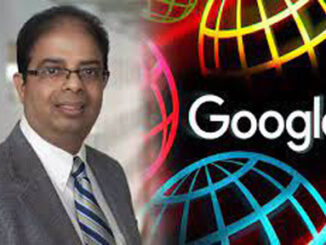
MOUNTAIN VIEW, CA (TIP): Tech giant Google has hired Bakul Patel, a former Indian American Food and Drug Administration (FDA) leader as its new senior director of global digital health strategy and regulatory.
Patel spent over a decade at the FDA and most recently was the chief digital health officer of global strategy and innovation. “I am excited to announce that I am joining Google Health to be part of an incredible mission – ‘To Help Billions of People Be Healthier,’” he wrote in a LinkedIn post Monday, May 16, announcing the move.
“I am looking forward to learning from the teams in health across Google and Alphabet and helping build a unified digital health and regulatory strategy,” Patel added.
Indian American CEO Sundar Pichai led Google has pushed further into health and healthcare over the past few years. Its ambitions range from mining big data for algorithms to developing disease-detecting tools to pumping wearables full of health features.
“As a ‘technology person’ first (before becoming a policy wonk @FDA) working on leading-edge solutions has been a key focus throughout my career,” Patel wrote.
“This technology-oriented mindset has continued to guide my efforts towards helping turn digital health from a hopeful concept to a reality,” he said. “Throughout my tenure at FDA, my biggest northstar has been to make digital healthcare accessible and equitable for all.”
Patel said he had talked often about the potential of digital health to be a gamechanger in heralding a new era for healthcare generally—one that is ubiquitous and poised to deliver care to all individuals, including preventing and predicting disease and keeping people healthy and out of the hospital.
“We are in the early stages of this journey, and there is a lot of work ahead,” he wrote. “But the potential of applying technology to improve health at scale can mean better health for everyone in our lifetime. The power of technology, when coupled with a unified digital health and regulatory approach, promises to transform people’s lives.”
Patel said he wanted to continue to build a world in which we use technology to engage individuals, caregivers and communities globally in care delivery, enabling us to reach populations that have long been overlooked, marginalized and underserved. “A world where we use digital information and technology to identify and predict the onset of disease before symptoms appear, literally changing, improving, and protecting people’s lives,” he wrote.
Patel said Google’s commitment to help billions of people be healthier aligns with his goal to move digital healthcare and technology forward together.
“This means building upon the work Google has already done in health—from providing authoritative Covid-19 information during the pandemic, to using AI and machine learning to build and provide solutions for caregivers and communities to tackle the world’s toughest health challenges.”
Patel said he was “thrilled and excited to continue furthering my mission to improve healthcare for all and be part of an organization that is committed to delivering products and services to help people along their health journey.”
Prior to joining FDA, Patel held key leadership positions in the telecommunications industry, semiconductor capital equipment industry, wireless industry and information technology industry.
His experience includes Lean Six Sigma, creating long and short-term strategy, influencing organizational change, modernizing government systems, and delivering high technology products and services in fast-paced, technology-intensive organizations. Patel earned an MS in Electronic Systems Engineering from the University of Regina, Canada, and an MBA in International Business from The Johns Hopkins University.
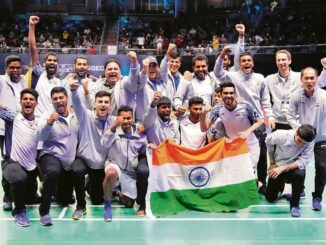
After hockey and cricket, badminton is the third game in which Indian men have been crowned World champions. The gold medal triumph at Bangkok on May 15 was the culmination of a long journey that started with a first round exit in 1949. In between India made the penultimate round in 1952, 1955 and again in 1979 in this elite inter-nation team event that has morphed into a World Championship.
In 1949, two years after freedom, India embarked upon its first Thomas Cup journey, its team had taken 24 hours to fly from Bombay to London from where it travelled by road to Southampton.
The next phase was a cruise that took the Indian team to Halifax in Nova Scotia enroute to Toronto where it was to make its debut in the inaugural edition of the elite tournament. In its first edition, it had eight European and two teams from North America besides India and Malaya (now known as Malaysia).
India lost its first round to the hosts Canada 2-7. Canada in turn lost to the USA 1-8. Ultimately, in the final Malaya beat Denmark to become the first champion of the Thomas Cup.
In 2022, when 16 qualifiers for the finals were clubbed, India and Canada got into the same pool. In the quarterfinals, India had the 1949 champions Malaysia as its opponent. Denmark, the losing finalist of the first edition, was India’s opponent in the semi-finals and Indonesia, winner of the Cup for 14 times – maximum by any nation – challenged the first time finalist India and lost.
I had my first exposure to this great badminton in 1975-76 when India played Malaysia at Ludhiana’s Lal Bahadur Shastri Indoor Hall. For me as a cub Reporter, it was a big event. I was not only assigned by The Tribune, the oldest and largest circulated English daily of north India at that time, but also Sportsweek, the then number one Indian sports weekly, besides a couple of other newspapers and magazines.
It was, needless to reiterate, a finest opportunity to see some of the top world badminton players in action at the only match played in Punjab in the history of the Thomas Cup. One of the architects to get this match to Ludhiana was the then Honorary Secretary of Punjab Badminton Association, Mr Naurattan Singh Bhalla.
Panch Gunalan, a great Malaysian badminton player, had come with his team as its manager. India had just beaten Pakistan 5-4 to earn the right to challenge the Malaysians.
The mainstay of the Indian team was young Prakash Padukone who not only masterminded India’s exciting win over Pakistan but was also instrumental in building 4-0 lead for the home team at Ludhiana by winning both his singles.
His efforts, however, fell short of getting India the much needed fifth win as he and his partner Asif Parpia lost a crucial doubles game. India lost 4-5.
Also in that Indian team was Dinesh Khanna, who had in 1965 become the only Indian to win the Asian Badminton championship. Now when India has won the Thomas Cup and two of its former stars – Prakash Padukone and Pulella Gopichand – had been winners of the All-England badminton championship, no other Indian has in the last 57 years could repeat Dinesh Khanna’s feat of winning the Asian title.
Born in Fatehgarh Churian, Dinesh Khanna studied at Punjab Engineering College, Chandigarh. He was also nick-named as “returning machine”. Dinesh Khanna also had the distinction of reaching semi-finals of the All-England championship. Other outstanding Punjabi players on national horizon at that time included Devinder Ahuja and Satish Bhatia. Satish Bhatia, a flyer in Indian Air Force, was known for his spin service and was perhaps the only player to have taken a game off great Rudy Hartono of Indonesia in all-England Badminton championship. Though not many players of Punjabi descent are on view at national or international level, badminton still remains a popular game in Punjab. Some promising youngsters, both boys and girls, are now training at various academies in Bangalore and elsewhere.
For India’s historic success at Bangkok, credit also goes to some promising and upcoming youngsters, including Lakshya Sen, who set the ball rolling with a win in the opening singles against Indonesia’s Anthony Ginting.
Lakshya, who had become the fourth Indian after Parkash Nath, Prakash Padukone and Pulella Gopichand to reach all-England final early this year, could not perform well in earlier games, including semi-finals against Denmark, as he was down with food poisoning. After losing the first set to his more experienced and higher ranked opponent, Lakshya came back strongly to win the next two sets to give India a great start with a 1-0 lead. Lakshya won 8-21, 21-17, 21-16. His success was followed by the Indian doubles pair of Satwiksairaj Rankireddy and Chirag Shetty as they overcame a stiff resistance from Mohammed Ahsan and Kevin Sanjaya Sukamuljo in a grueling three-setter at 18-21, 23-21 and 21-19. Finally, it was Kidambi Srikant, who clinched the issue for India by defeating Jonatan Christie at 21-15, 23-21.
India had created history. The journey started in 1949 was complete and India thus became the sixth nation after Indonesia, Malaysia, China, Japan and Denmark to inscribe its name on the Thomas Cup trophy.
The win, as Kidambi Srikanth, who won all his six matches in the finals, was a team effort. This was demonstrated at the award winning ceremony.
The young Priyanshu Rajawat, who played only in the 5-0 win over Canada, was sent to receive the Thomas Cup trophy by all the experienced stars, including Kidambi Srikanth and HS Prannoy.
Prannoy also played a stellar role. In the quarterfinals against Malaysia and semifinals against Denmark, he not only played the last crucial singles to take India from 2-2 to match winning 3-2 score, but also remained unbeaten. In the semis, after twisting an ankle, he continued heroically to see his team through. In fact, Prannoy had skipped the selections but was still included in the squad in spite of criticism in some quarters. But he performed to silence his critics. Selector and former India coach Vimal Kumar called it a momentous win, which was built on how the team fought as one. “This is an achievement of pure team spirit which was never seen in the past,” Kumar explained. “We always had talented and good players but would struggle. Now we also have a formidable doubles pair in Satwik and Chirag, who pulled it off in pressure matches. Similarly, both Srikanth and Prannoy delivered when it mattered,” Kumar was quoted as saying in the media.
(Prabhjot Singh is a veteran journalist with over three decades of experience covering a wide spectrum of subjects and stories. He has covered Punjab and Sikh affairs for more than three decades besides covering seven Olympics and several major sporting events and hosting TV shows. For more in-depth analysis please visit probingeye.com or follow him on Twitter.com/probingeye. He can be reached at prabhjot416@gmail.com)
In new India, can’t ask students to enquire, relate theory to socio-historical reality
By Avijit Pathak
“Recently, a private university in UP suspended a faculty of political science. In the first-year BA political science paper, he asked his students to share their observations on parallels between ‘Fascism/Nazism and Hindutva’. In new India, you cannot ask your students to enquire, relate theory to concrete socio-historical reality, and problematize the world they see and experience every day, as the non-reflexive bureaucrats who run the UGC think a question of this kind goes against ‘the spirit and ethos of our country which is known for its inclusivity and homogeneity’. And the university concerned did not hesitate to constitute a three-member committee to look into the ‘possibility of bias in the question’.” Bulldozer politics’ is a new idiom we are getting used to in the age of decadence that normalizes brute instincts, arrogance of power, insensitivity to the plight of the poor, and denial of democratic/humanistic sensibilities. This violence is infectious; and even the academic world — a realm that is supposed to celebrate the spirit of free enquiry — is finding it difficult to free itself from the logic of ‘bulldozer politics’, or its aggressive, non-dialogic and totalitarian practice. It would not be wrong to say that some of our Vice-Chancellors (VCs), Rectors and Registrars are always ready with their ‘bulldozers’ to annihilate the creative space that the learners endowed with the spirit of critical pedagogy seek to inhabit. Are we teachers convinced of the beauty of our calling? Or are we just paid employees without any voice and reflexivity?
Recently, a private university in UP suspended a faculty of political science. In the first-year BA political science paper, he asked his students to share their observations on parallels between ‘Fascism/Nazism and Hindutva’. In new India, you cannot ask your students to enquire, relate theory to concrete socio-historical reality, and problematize the world they see and experience every day, as the non-reflexive bureaucrats who run the UGC think a question of this kind goes against ‘the spirit and ethos of our country which is known for its inclusivity and homogeneity’. And the university concerned did not hesitate to constitute a three-member committee to look into the ‘possibility of bias in the question’. What sort of ‘inclusivity’ is the UGC talking about, and that too at a time when the might of majoritarianism, the aggression of the terribly demonstrative religious nationalism and the all-pervading toxic propaganda machinery are destroying the art of democratic living characterized by heightened sensitivity to heterogeneity, plurality, fusion of horizons and shared humanism? At a time when ‘apolitical’ and ‘fact-centric’ MCQs tend to kill the interpretative and hermeneutic art of understanding the complex social reality, any sensitive academic or pedagogue would appreciate the professor for raising this controversial or ‘out of the box’ question, and encouraging his students to think, interrogate and problematize what the UGC-dictated ‘official truth’ seeks to hide. It is quite possible for the UGC Chairperson, or the academic bureaucrats of the university to disagree with the professor’s worldview. However, they are not supposed to interfere in his pedagogic practice because it is not homogeneity, but the diversity of thoughts and worldviews that enhances the ethos of epistemological pluralism in a university. The harsh reality is that we have entered the age of bulldozer academics, and our academic bureaucrats have begun to suspect even the slightest trace of critical consciousness. Why is it so? First, as the neoliberal assault on education goes on, these academic bureaucrats behave like techno-managers with the mission to reduce education into a marketable skill, and transform students into consumers, or teachers into service providers. This instrumental and market-driven approach to education robs the culture of learning of what all great educators have always striven for — education as awakening and critical consciousness. Why should students and teachers bother to think about communalism, rising authoritarianism and everyday violence in the name of caste, gender and religion when there is nothing beyond the mythology of placement and salary package?
Second, with the steady rise of militant nationalism in the country, we see a visibly naked political appointment of many of our VCs in leading public universities. They are already compromised; it is almost impossible for them to approve of the culture of learning that encourages students and researchers to question the prevalent discourse of power, or see the violence implicit in militant nationalism. I wonder how these VCs would react if they find a professor of political sociology encouraging her students to study Wilhelm Reich’s The Mass Psychology of Fascism or Erich Fromm’s The Escape From Freedom, and enquire whether these classic texts have some relevance in contemporary India. When these academic bureaucrats demand absolute loyalty to the official discourse of nationalism, they kill the spirit of critical pedagogy and free enquiry. I would not be surprised if they issue a circular, and compel students and teachers to listen to the PM’s Mann Ki Baat!
Amid this despair, I would still plead for the pedagogy of hope. As a teacher, how can I forget the likes of Paulo Freire and bell hooks? They wanted us to realize the healing power of a dialogic classroom — a living/vibrant space that encourages the articulation of lived experiences, conversations, art of listening and imagination of a new world free from structural/psychic/cultural violence. However, even to imagine this possibility in this dystopian age, we as teachers have to unite, and realize that we are thinkers, communicators and healers; and we are not docile servants to be monitored through biometric devices and CCTV cameras, and bombardment of circulars that ask us to measure the utility of the courses, or the mathematics of publications for enhancing the ranking of the university.
However, the moot question is: Are we convinced of the beauty of our calling? Or, are we just paid employees without any voice and reflexivity? What has happened to the faculty of the private university, it should not be forgotten, can happen to anybody who has not yet lost his/her creatively nuanced critical thinking. Hence, it is important for all those who love the vocation of teaching to unite, raise their voice, stand with the victim, and resist the growing violence of ‘bulldozer academics’.
The Buffalo killings are part of a pattern: Most extremist violence in the U.S. comes from the political right.
By David Leonhardt
“It’s important to emphasize that not all extremist violence comes from the right — and that the precise explanation for any one attack can be murky, involving a mixture of ideology, mental illness, gun access and more. In the immediate aftermath of an attack, people are sometimes too quick to claim a direct cause and effect. But it is also incorrect to pretend that right-wing violence and left-wing violence are equivalent problems.”
“There is often overlap between these violent threats and white supremacist beliefs. White supremacy tends to treat people of color as un-American or even less than fully human, views that can make violence seem justifiable. The suspect in the Buffalo massacre evidently posted an online manifesto that discussed replacement theory, a racial conspiracy theory that Tucker Carlson promotes on his Fox News show.”
Over the past decade, the Anti-Defamation League has counted about 450 U.S. murders committed by political extremists. Of these 450 killings, right-wing extremists committed about 75 percent. Islamic extremists were responsible for about 20 percent, and left-wing extremists were responsible for 4 percent. Nearly half of the murders were specifically tied to white supremacists.
The data collected by the Anti-Defamation League shows that the American political right has a violence problem that has no equivalent on the left. And the 10 victims in Buffalo this past weekend are now part of this toll. “Right-wing extremist violence is our biggest threat,” Jonathan Greenblatt, the head of the ADL, has written. “The numbers don’t lie.” The pattern extends to violence less severe than murder, like the Jan. 6 attack on Congress. It also extends to the language from some Republican politicians — including Donald Trump — and conservative media figures that treats violence as a legitimate form of political expression. A much larger number of Republican officials do not use this language but also do not denounce it or punish politicians who do use it; Kevin McCarthy, the top House Republican, is a leading example.
It’s important to emphasize that not all extremist violence comes from the right — and that the precise explanation for any one attack can be murky, involving a mixture of ideology, mental illness, gun access and more. In the immediate aftermath of an attack, people are sometimes too quick to claim a direct cause and effect. But it is also incorrect to pretend that right-wing violence and left-wing violence are equivalent problems.
Fears in Washington
If you talk to members of Congress and their aides these days — especially off the record — you will often hear them mention their fears of violence being committed against them.
Some Republican members of Congress have said that they were reluctant to vote for Trump’s impeachment or conviction partly because of the threats against other members who had already denounced him. House Republicans who voted for President Biden’s infrastructure bill also received threats. Democrats say their offices receive a spike in phone calls and online messages threatening violence after they are criticized on conservative social media or cable television shows. People who oversee elections report similar problems. “One in six election officials have experienced threats because of their job,” the Brennan Center, a research group, reported this year. “Ranging from death threats that name officials’ young children to racist and gendered harassment, these attacks have forced election officials across the country to take steps like hiring personal security, fleeing their homes, and putting their children into counseling.” There is often overlap between these violent threats and white supremacist beliefs. White supremacy tends to treat people of color as un-American or even less than fully human, views that can make violence seem justifiable. The suspect in the Buffalo massacre evidently posted an online manifesto that discussed replacement theory, a racial conspiracy theory that Tucker Carlson promotes on his Fox News show.
“History has taught us that what begins with words ends in far worse,” Representative Liz Cheney, one of the few Republicans who have repeatedly and consistently denounced violence and talk of violence from the right, wrote on Twitter yesterday. “The House GOP leadership has enabled white nationalism, white supremacy, and antisemitism,” Cheney wrote, and called on Republican leaders to “renounce and reject these views and those who hold them.”
A few other Republicans, like Senator Mitt Romney, have taken a similar stance. But many other prominent Republicans have taken a more neutral stance or even embraced talk of violence.
Some have spoken openly about violence as a legitimate political tool — and not just Trump, who has done so frequently. At the rally that preceded the Jan. 6 attack, Representative Mo Brooks suggested the crowd should “start taking down names and kicking ass.” Before she was elected to Congress, Marjorie Taylor Greene supported the idea of executing Barack Obama, Nancy Pelosi and other top Democrats. Representative Paul Gosar once posted an animated video altered to depict himself killing Alexandria Ocasio-Cortez and swinging swords at Biden.
Rick Perry, a former Texas governor, once called the Federal Reserve “treasonous” and talked about treating its chairman “pretty ugly.” During Greg Gianforte’s campaign for Montana’s House seat, he went so far as to assault a reporter who asked him a question he didn’t like; Gianforte won and has since become Montana’s governor.
These Republicans have received no meaningful sanction from their party. McCarthy, the Republican leader in the House, has been especially solicitous of Brooks and other members who use violent imagery. This Republican comfort with violence is new. Republican leaders from past decades, like Ronald Reagan, Bob Dole, Howard Baker and the Bushes, did not evoke violence. “In a stable democracy,” Steven Levitsky, a Harvard political scientist, told me, “Politicians unambiguously reject violence and unambiguously expel from their ranks antidemocratic forces.”
Global attention to the slow ethnic cleansing missing
The recent brutal murder of two Sikh traders by Islamic State terrorists at Peshawar in the restive Khyber Pakhtunkhwa province marks another low in the unrelenting saga of ethnic cleansing of minorities in Pakistan. The joining of the locals in the protests by the enraged Sikhs demanding protection for the beleaguered non-Muslims is a heartwarming development. However, the sad truth is that be it in Pakistan or the adjoining Afghanistan, the oppressed Sikh community has had little support from the international community. Their slow decimation in their home countries over the past seven decades has not attracted enough deterring attention of the UN, Amnesty International or other human rights watchdogs which are quick to condemn communal strife elsewhere.
This apparent lack of global support has only emboldened successive regimes and the xenophobic majoritarian society to give their tacit approval to discriminatory tactics and misuse of the stringent blasphemy law. Many gurdwaras, churches and temples have been destroyed. Young Sikh girls are routinely abducted and forced to convert and marry Muslim boys. Sikh men are killed with impunity. Pakistan’s first Sikh policeman Gulab Singh Shaheen has been missing under mysterious circumstances for nearly a month now. A Sikh Member of the Provincial Assembly of Khyber Pakhtunkhwa, Soran Singh, was shot in 2016. Aasiya Bibi, a Christian in Pakistan who was on death row for blasphemy, could fly safely to Canada after her conviction by the apex court only because her case got global media limelight.
The targeted killings of Pakistan’s minority communities – Sikhs, Shias, Hindus, Ahmadiyyas, Christians and Parsis — have meant that either large sections of them have converted to Islam or sought asylum and left the country. Today, they have dwindled to just 3-4 per cent of the population, down from 23 per cent in 1947. The Sikhs’ rights must be protected in the two countries that have been a proud home to them since the time of Guru Nanak’s western sojourns, marked by His teachings of communal harmony.
Sanctions may not succeed because Europeans cannot afford to give up $104 billion exports to Russia. Europe will be pressuring USA to go for peace with Russia to lift sanctions. If sanctions are not lifted, oil and gas price will keep on going up adding up inflation. Russian economy and EU economy are integral parts. EU exports $105 billion whereas US exports only $10 billion to Russia. Ultimately, every country will be fighting for its national interests. It is not in the interest of world peace to exclude any large country. Even tiny North Korea has not been affected by sanction so far and daring to send missiles now and then. I think the US is making a big mistake by shoring up Ukraine to keep fighting.
NATO is a paper tiger. SEATO, CENTO were failures – paper tigers.
World economy is shrinking because of Ukraine war and sanctions. The stock markets have lost almost 10% from their highs in the world. Euro is now equal to the Dollar for the first time.
Inflation and Recession aggravated by Ukraine crisis and sanctions. Artificially arresting international trade will hurt not only Russia but the world economy.
How long can Americans afford to pay $4+ per gallon for gas?
IMF recommending govt should subsidize poor citizens – another handout!
(The author is a former diplomat with the United Nations)
The killing of 10 black people by a gun-toting white teenager in Buffalo, New York, indicates that not much has changed in the US even two years after a nationwide outrage over George Floyd’s murder had revitalized the Black Lives Matter movement. ‘Terrorism, terrorism, domestic terrorism,’ that’s how US President Joe Biden has described the Buffalo incident, while the authorities have termed it an act of ‘racially motivated violent extremism’. In a strongly worded statement, Biden has condemned white supremacists, the media, the Internet and politics for spreading racist conspiracy theories. The assailant was reportedly using social media to convince netizens about the ‘Great Replacement’ theory, which contends that white people are being deliberately replaced by minorities through immigration in the US and elsewhere.
Violence incited or perpetrated by white supremacists is regarded as one of the biggest terror threats the US is facing, but the country is not doing enough to stem the rot. Instead, the alarming trend of ‘copycat’ gunmen getting influenced by previous massacres and carrying out deadlier mass shootings appears to be on the rise. Online radicalization is fanning the flames of racial intolerance and injustice – two monstrous evils rooted in America’s troubled history. Even as various minorities in the US have been targeted after the 9/11 attacks, African-Americans continue to comprise the most vulnerable group.
The rate of gun deaths in America rose by 35 per cent in 2020 to the highest point since 1994. With the gun lobby holding sway, the US is way ahead of other countries in terms of the scale of firearm possession. Its ratio is at least 120 firearms per 100 residents, significantly higher than what it was a decade ago (88:100). Americans are using guns not only to kill others but also to end their own lives. A 2016 study published in the American Journal of Public Health found a strong link between gun ownership and firearm suicide rates. Gun laws, racism, mental health — these issues are inseparable and the US badly needs a multi-pronged strategy to ensure the safety of its citizens. The superpower should first set its own house in order.
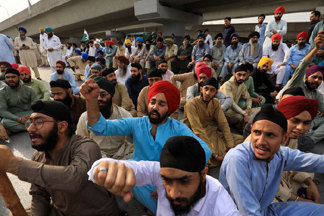
PESHAWAR (TIP): The brutal killing of two Sikh traders by the Islamic State terrorists has saddened the people of northwest Pakistan’s restive Khyber Pakhtunkhwa province and sparked protests by the community members as well as locals who demanded protection for minorities in the country.
Two Sikh businessmen, Kuljeet Singh, 42, and Ranjeet Singh, 38, were shot dead by the Islamic State terrorists in Peshawar on Sunday, the latest targeted attack against the minority community in Pakhtunkhwa province bordering Afghanistan. The victims were in the business of spices and had shops in Sarband, about 17 km from Peshawar. The Islamic State’s Khorasan unit (ISKP) claimed that it carried out the attack.
On Monday, Sikh community members were joined by local people who held a protest outside the Assembly building and blocked main GT Road in the city. Police have registered a case of target killings and terrorism. Peshawar police chief Ijaz Khan held a meeting with the representatives of the Sikh community and assured them full protection. The city police chief said the killers fled towards the Bara area where police operation is underway against the terrorists. The incident is also trending on social media in Peshawar. A local resident, Iqbal Khan, wrote on Twitter that “the killings of two Sikh traders have bowed our heads in shame”. Some people demanded immediate and quick justice for the affected families.
About 15,000 Sikhs live in Peshawar, mostly in the Jogan Shah neighborhood. Most are involved in business, while some also have pharmacies. This is the second big attack on Sikhs in the last eight months.
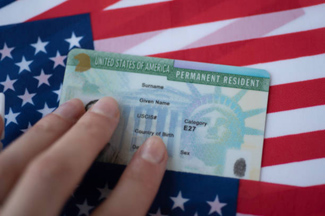
WASHINGTON, D.C. (TIP): A presidential advisory commission has unanimously voted to recommend President Joe Biden to process all applications for green cards or permanent residency within six months. To be sent to the White House now for approval, recommendations of the President’s Advisory Commission on Asian Americans, Native Hawaiians, and Pacific Islanders (PACAANHPI) if adopted is likely to bring cheers to the hundreds and thousands of Indian Americans and those waiting, some for even for decades, for a Green Card.
A proposal in this regard was moved by eminent Indian American community leader Ajay Jain Bhutoria during the meeting of the PACAANHPI, during which all its 25 commissioners unanimously approved it.
The proceedings of the meeting here in the national capital was webcast live last week.
To reduce, pending green card backlog, the advisory commission recommended US Citizenship and Immigration Services (USCIS) to review their processes, systems, policies and establish new internal cycle time goals by streamlining processes, removing redundant steps if any, automating any manual approvals, improving their internal dashboards and reporting system and enhancing policies.
The recommendations aim to reduce the cycle time for processing all forms related to family based green card application, DACA renewals, all other green card applications within six months and issue adjudicate decisions within six months of application received by it.
The commission recommended National Visa Center (NVC) State Department facility to hire additional officers to increase their capacity to process green card applications interviews by 100 per cent in three months from August 2022, and to increase Green card applications visa interviews and adjudicate decisions by 150 per cent – up from capacity of 32,439 in April 2022 — by April 2023.
“Thereafter Green Card visa interviews and visa processing timeline should be a maximum of six months,” it said.
Aimed at making it easier for the immigrants to stay and work in the country, the commission recommended that USCIS should review requests for work permits, travel documents and temporary status extensions or changes within three months and adjudicate decisions.
Only 65,452 family preference green cards were issued in fiscal 2021 out of the annual 226,000 green cards available, leaving hundreds of thousands of green cards unused (with many likely to be permanently wasted in the future), and keeping many more families needlessly separated.
There were 421,358 pending interviews in April compared to 436,700 in March, said the policy paper by Bhutoria.
Noting that while the US population has grown substantially in recent decades, the immigration system has not changed to keep pace, he said. The annual levels of immigration were established in the early 1990s and have remained largely unchanged since, he said.
To make matters worse, the method used to calculate the annual number of employment-and-family-based immigration is deeply flawed, and has led to family-based immigration levels being set at their absolute minimum every year for the past 20 years, while hundreds of thousands of green cards for family members go wasted, never used by any individuals, when they could be used to reunite families instead, Bhutoria said.
“The extraordinary wait time for a green card to be available causes significant hardship for American families forced to wait decades to reunite with their loved ones, even though those individuals are already qualified to immigrate right now. “Family separation takes a terrible emotional toll on families, and it imposes clear logistical, economic, and emotional hardships on families, and the growing nature of the backlogs makes the process uncertain and future planning impossible,” he said. Among other things, the commission also recommended USCIS to expand premium processing to additional employment-based green card applications, all work permit petitions, and temporary immigration status extension requests, allowing applicants to pay $2,500 to have their cases adjudicated within 45 days in a phased approach.
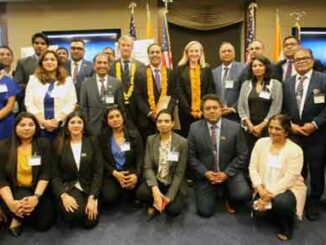
WASHINGTON, D.C. (TIP): Over a dozen influential Congressmen attended the formal launch of the nationwide “Azadi Ka Amrit Mahotsav” event by Indian Americans to celebrate the 75th anniversary of India’s independence, a remarkable achievement of the world’s largest democracy.
Coinciding with the Asian Heritage Month, the event attracted several hundred Indian Americans from various parts of the region, wherein they announced measures and festivities across the country to celebrate the momentous occasion of 75th anniversary of India’s independence.
Congressman Raja Krishnamoorthi called on the community leaders to help elect other Indian Americans to the US Congress and other elected bodies as well.
“If you do not have a seat at the table, you are on the menu,” he said.
Over a dozen and a half eminent lawmakers attended the event held at the US Capitol organized by the Federation of Indian Associations of New York, New Jersey and New England. Prominent among them included Congressman Frank Pallone and Congresswoman Sheila Jackson Lee.
FIA is planning a major festivity in New York around Independence Day, including flag hoisting at the Times Square, said Ankur Vaidya from the federation. “Today was a historical moment for Indian Americans to celebrate the 75th anniversary of India’s Independence Day at the US Capitol,” said Kenny Desai, FIA president. FIA is one of the oldest and largest non-profit grass-root umbrella organizations of Indian Americans.
“It was a great celebration of Azadi ka Amrit Mahotsav in the presence of US Congressmen. FIA’s community services have been recognized by Congressional Record,” said Srujal Parikh, FIA secretary.
Alok Kumar, former president of FIA and the chairman of Bihar Foundation USA, said the event was inspired by the call given by Prime Minister Narendra Modi to celebrate the momentous occasion across the world.
CHICAGO, IL (TIP): Chicago Premier League announced the Five Teams that will be participating in an IPL format Franchise Cricket Tournament. Guest of Honor, Toni Preckwinkle (President of the Cook County Board of Commissioners), and other Chicagoland Dignitaries, Jesal Patel (Mayor, Village of Lincolnwood), Mary Oshana (Commissioner, Skokie Park District) Pramod Shah (Clerk, Village of Skokie) was also present for the ceremony.
“Franchise Cricket will take cricket to the next level in Chicago,” said Adil Azeem Khan, President of Chicago Premier League. “I believe in team sports.,” Customer Name, President of Cook County Board of Commissioners said, during her brief reminisce of her athletic life in school. She also thanked Adil Azeem Khan who has championed the sport of cricket in Chicagoland. “You learn that when you contribute as a team you can together be successful,” continued Customer Name. “These are valuable life lessons that you learn.”
Chicago Premier League is committed at its core to cricket and will provide the best cricketing experience in Chicago, he added. Founded in 2022, Chicago Premier League is an extension of United Cricket League that Adil Azeem Khan has been using as a tool to bring communities together through cricket. CPL will provide and elite level of cricket for the talent and skill that is available in Chicagoland. Participating teams and owners for the first season of CPL Chicago Rowdies (Arif Patel), Chicago Hurricanes (Vishal Patel), Chicago Phantoms (Salman, Irfan, and Imran Khan), Chicago Destroyers (Sandip Mehta), Chicago Avalanche (Dr. Akbar Khan) were all present at the event. Each team had to fill a roster of Eighteen people, eight of which were selected ahead of the draft. The remaining ten players were selected today during the draft. Urvish Desai, Muhammad Daniyal Rashid, Randy Brown, Hassan Baqir, Liakatali Patel were first round picks for the night.
WASHINGTON, D.C. (TIP): Rudy Giuliani, former President Donald Trump’s onetime personal attorney and a lead architect of his attempt to overturn the 2020 election results, on Friday, May 20, met with the House select committee investigating the January 6, 2021, insurrection, CNN said quoting two sources.
Giuliani’s original deposition with the committee had been postponed after the former New York City mayor asked to record the interview, with both audio and video. At the time, Giuliani’s attorney Robert Costello said the committee rejected that request. Despite Giuliani backing out of the original deposition, the two sides continued to negotiate an appearance, which led to a virtual appearance Friday that lasted for more than nine hours, sources said.
Costello declined to comment Friday. A spokesperson for the select committee also declined to comment on Giuliani’s deposition. A central figure in Trump’s failed bid to overturn the 2020 election, Giuliani was subpoenaed by the committee in January and has been engaging with lawmakers, through his lawyer, about the scope of the subpoena and whether he may be able to comply with some requests.
In its subpoena, the committee alleges that Giuliani “actively promoted claims of election fraud on behalf of the former President and sought to convince state legislators to take steps to overturn the election results.” The subpoena also states that Giuliani was in contact with Trump and members of Congress “regarding strategies for delaying or overturning the results of the 2020 election.”
Several high-profile individuals from Trump’s inner orbit have voluntarily spoken with the committee in recent weeks and months. In early May, Donald Trump Jr. met with the committee. And Trump’s daughter and former senior White House adviser, Ivanka Trump, was interviewed for nearly eight hours last month; her husband and former White House senior adviser, Jared Kushner, has met with the panel as well.
(Source: CNN)
Signup to our Newsletter!
Don’t miss out on all the happenings around the world