Year: 2022

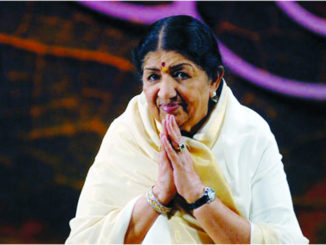
  • ‘End of an era’, ‘rest in melody’: Tributes for Lata Mangeshkar

    ‘End of an era’, ‘rest in melody’: Tributes for Lata Mangeshkar

    As the mellifluous voice of India’s nightingale Lata Mangeshkar fell silent on Sunday, tributes poured in for the legendary singer on social media as well, with many people also sharing her pictures or clips of her old songs, fittingly describing her death as an “end of an era”. From Twitter to Facebook, the news feed was flooded with images of the singer, whose divine voice has ruled the silver screen and hearts of millions of people, across generations, in India and around the world.

    No sooner had the news of her death come out, leaving legions of her admirers and fans grief-stricken, people also began to pay homage to her on social media.

    ‘End of an era’, ‘RIPLataji’ and ‘Lata Mangeshkar’ were trending on Twitter as thousands of social media users expressed their sentiments over the loss of a beloved icon of India, whose voice had the magical power to halt people in their tracks and melt anyone’s heart.

    On Facebook, the posts made by several users had a common refrain — “Meri Awaz Hin Pehchan Hai. Gar yaad rahe” (‘my voice is my identity, if your remember’). While some chose to post her image as an aged woman with a beaming smile she always wore, others used old, monochrome pictures of her in a young avatar.

    PM Modi leads tributes as country’s nightingale goes silent

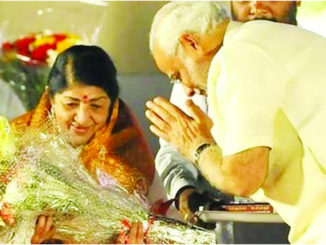
    Prime Minister Narendra Modi said the veteran singer left a void in our nation that can never be filled.  “I am anguished beyond words. The kind and caring Lata Didi has left us. She leaves a void in our nation that cannot be filled. The coming generations will remember her as a stalwart of Indian culture, whose melodious voice had an unparalleled ability to mesmerise people.”

    “Lata Didi’s songs brought out a variety of emotions. She closely witnessed the transitions of the Indian film world for decades. Beyond films, she was always passionate about India’s growth. She always wanted to see a strong and developed India.”

    The Prime Minister also said, “I consider it my honour that I have always received immense affection from Lata Didi. My interactions with her will remain unforgettable. I grieve with my fellow Indians on the passing away of Lata Didi. Spoke to her family and expressed condolences. Om Shanti.”

    Remembering the iconic singer, President Ram Nath Kovind said, “In her vast range of songs, rendering the essence and beauty of India, generations found expression of their inner-most emotions. A Bharat Ratna, Lata-ji’s accomplishments will remain incomparable.”

    Congress leader Rahul Gandhi said Mangeshkar remained the most beloved voice of India for many decades. “Her golden voice is immortal and will continue to echo in the hearts of her fans. My condolences to her family, friends and fans,” he added.

    Paying his “heartfelt tributes”, Union minister Nitin Gadkari said the singer’s passing away was “an irreparable loss to the country”.

    Ameen Sayani, veteran radio personality

    My heart is full of sorrow. India’s melody queen, Lata Mangeshkar, is no more. She was not only the queen of Indian melody but also my sister. She was three years older than me, but I never called her Lata didi like the rest of the world because she always looked about eight years younger than me. We had a lot of good times together. Of course, every time she sang, my heart used to be full of absolute happiness. When she fell ill this time, I sent her a letter telling her the same. My wife and I had lovely evenings together with Lata. We often went to her house on Pedder Road and had some great meals.

    I speak today with a hand on my grieving heart. What a lovely voice our Lataji had. It seemed as if god had poured some honey into her lovely renderings. Almost every song that she sang became a hit. My Radio Hit Parade Geetmala featured so many of her songs.

    Now that Lataji has passed away, the hearts of millions of music lovers all over the world must be singing for her that soulful film song, Tum kya jaano tumhari yaad mein hum kitna roye. With Lata’s passing, a lot of lovely feelings in my heart have passed away. I do hope she sings in heaven and keeps it full of melody.

    Anvita Dutt, lyricist and director

    Lata Mangeshkar is the sound of my childhood—of coming back home to lunch in Guwahati, of evenings in the verandah in Jodhpur, of the fiat in Sarsawa. In between the hiss of an LP and the crackle of the radio and the tangled-up cassettes of my teens, her voice was a synonym for songs. Today I write them, but she was singing them to me before I even knew how to spell lyrics.

    Shilpa Rao, singer

    I want to thank Lataji for showing us the path of learning and worshipping music. She was an institution of music and her connection with music was external. Our youth must learn from her how to uphold music in its true form. Her passing away is a huge loss for all of us. My favourite album of hers would be Pakeezah. We need to look at what Lataji has sung and for that, we need to learn and practice music; that’s when we can have a deeper connection.

    Balaji Vittal, author

    Lata Mangeshkar was born with a voice that only one in a billion can hope to be blessed with. That is her greatest strength. She could strike sustainable relationships with every production house and major directors. She was never seen as partisan. She had fallouts with SD Burman and Mohammed Rafi and never worked with OP Nayyar, but by and large, Lata Mangeshkar was a name acceptable to all. That is a tribute to the person that she is, not just the singer—humble, extremely hard working and with a sense of gratitude to everyone.

    Lata Mangeshkar, heroine off-screen

    Aakshi Magazine

    When playback singing was introduced in Indian cinema in 1935, it was not a given that the singer would become a star in their own right. After all, they had to be invisible on-screen. This was a change from the period of singer-actors like K L Saigal. But as this tradition came to be established, Lata Mangeshkar’s career trajectory would show that a “dual star text” — as film scholar Neepa Majumdar calls it — was possible. You could be a fan of Madhubala, as well as of Lata who was singing for her. You didn’t have to choose.

    While this stardom was enjoyed by other singers of that time like Mohammad Rafi, Mukesh, Talat Mahmood, Geeta Dutt, Hemant Kumar, Asha Bhosle and Kishore Kumar too, what is peculiar to Lata, is the enduring nature of her career — people have heard her voice age through seven decades and mostly been loyal listeners. Dual stardom ensured that even when her voice clearly did not fit a younger actor like Rani Mukherjee, fans let it go. Realism was not something Hindi cinema trained you in, its pleasures were different.

    This absence of realism created its own possibility, the song being the best example. This was the beauty of the Hindi film song sequence. Freed of demands of continuity or realistic characterisation, and yet taken seriously by filmmakers, musicians, lyricists, actors and singers, the song became a space of innovation. And freedom. It could celebrate love even if in real life caste-class barriers prevented it. Another world was possible.

    Even within the limited patriarchal imagination of most film narratives, the song could transcend barriers by becoming a space where inner lives were explored. The heroines did this through their expressiveness (often through dance), and Lata did this through her voice. Her star image may have been controlled and sanitised of possible gossip, but once she sang, nothing held her back. Not even her real life association with Hindu right-wing politics.

    To be sure it was sought to be tamed through the virgin-vamp binary, which placed the respectable Hindi film heroine in opposition to the bad girl — often the cabaret dancer who would transform into the vamp by the 1960s and 1970s. Lata herself said she didn’t sing “those” kinds of songs (they were reserved for the richly-textured voice of Geeta Dutt or her sister Asha Bhosle). This division was a reminder of the erasure of thumri singers and singer-courtesans that coincided with the rise of Lata. But has it really stood the test of time? In a lovely piece published in Agents of Ishq, Paromita Vohra lists what she calls Lata’s sexy songs and rethinks this binary, which is itself a patriarchal construct.

    Whether it is expressing longing in Lag Ja Gale, an erotic-romantic duet like Dum Bhar Jo Udhar Munh Phere or protest in Pyaar Kiya Toh Darna Kya and Jao Re Jogi, a female voice exploring desire was radical even when framed as “respectable” to soften its implication. Written by poet-lyricists and composed by talented composers, these songs do not conform to maintaining the status quo. The voice that brings these words to life, makes them real even as they are utopian.

    The film song is often a source of embarrassment today, or is enjoyed ironically. It is treated as something that has to be gotten over in order for Hindi cinema to evolve. In the songs of the 50s and 60s — the “golden era” — which Lata Mangeshkar perhaps best personified, we encounter feeling as feeling. It is not just about her perfect notes; perfection can often leave you cold. It is something else. This is a quality she carried with her to her later songs of the 2000s – like Luka Chuppi from Rang De Basanti or Pyaara Sa Gaon from Zubeidaa. All her best songs embody it. Much before we understand the words, we feel the truth in her voice.

    The writer, Aakshi Magazine, is a New Delhi-based writer and holds a PhD in film studies.

    Source: The Indian Express

  • Goodbye, nightingale

    Goodbye, nightingale

    Lata Mangeshkar, “the nightingale of Bollywood”, who has died aged 92 after contracting Covid-19, was a much-loved Indian national and international figure, whose songs provided the backdrop to the lives of millions for seven decades.

    Music sung by her was heard constantly across India, in shops, restaurants, taxis or on the radio, and she became known as “Didi”, or sister, because so many people identified with her often emotional songs. And yet she was best known as a playback singer, a vocalist who does not appear onscreen but provides the soundtrack for films in which actors lip sync to her singing.

    Her output was extraordinary – she is estimated to have recorded some 25,000 songs, which appeared in more than a 1,000 Hindi films, and she also sang in more than 20 different Indian languages. With an impressive vocal range, covering four octaves, she became massively popular with film directors for her ability to understand the context in which her songs would be used.

    Mangeshkar did not just sing, but made sure that her performance matched the storyline and the character, saying that she always read the lyrics and listened to the tune before agreeing to sing.

    She first came to national fame in India with the song Aayega Aanewala (meaning “the one who is destined to come will definitely come”), which she recorded in 1949 while still a teenager. A charming and dramatic song, which featured in the film Mahal that year, it was the start of a remarkable career in which she interpreted work by all the major Indian film composers.

    For more than three decades she recorded hundreds of songs by the composing duo of Laxmikant-Pyarelal (Laxmikant Shantaram Kudalkar and Pyarelal Ramprasad Sharma), including such hits as Sheesha Ho Ya Dil Ho (from the film Aasha, in 1980). She also worked with SD Burman, and later with his celebrated son the composer RD Burman (who would marry her sister Asha), recording RD Burman songs including Bahon Mein Chale Aao (from the film Anamica, 1973).

    Later she collaborated with the most internationally celebrated Bollywood composer, AR Rahman, and sang several of his best known songs including Jiya Jale (from the 1998 romantic thriller Dil Se) and Luka Chuppi (from the 2006 film Rang De Basanti), which she recorded when she was in her mid-70s. Rahman remembered how carefully she would rehearse: “She would sit with her assistant, and would start singing very slowly, with every lyric clear.” She was, he said, “part of a soul, part of a consciousness of India”.

    If she had any competition as India’s finest playback singer, it was from her younger sister Asha Bhosle. After all, it was Asha who had Cornershop’s 1997 hit Brimful of Asha written about her, and who had recorded the most number of songs (according to The Guinness Book of World Records Lata was ahead in 1974 but Asha overtook her), and it was Asha who recorded with the experimental Kronos Quartet. Lata insisted there was no sibling rivalry, saying; “we’re very close, we never competed with each other.”

    Mangeshkar was born in Indore, in what is now Madhya Pradesh state, the oldest child of Shevanti (later renamed Shuddhamati) and Pandit Deenanath Mangeshkar, a musician and teacher who ran a touring theatre company. Lata never went to school, as she quit on the first day when the teacher refused to allow her to bring her then 10-month-old sister Asha into the classroom.

    Much of her childhood was spent singing alongside her father at concerts. He died in 1942, when she was 13, and she then had to support her mother and four siblings. A close family friend, Vinayak Damodar Karnataki, offered her work with his film company Navyug Chitrapat, acting in minor roles. When the company moved to Bombay (now Mumbai) in 1945, she and her family moved with them.

    She said she disliked acting “because I was very small and hated putting on makeup and having to laugh and cry in front of the cameras”. But she loved playback singing, and was given her first break with a song in the film Majboor (1948). Then came the film Mahal, which included her hit song, and she rapidly became known as India’s Playback Queen.

    Though most celebrated for her film work, she also gave concerts in India and abroad. In 1963, shortly after the Sino-Indian war, she sang the patriotic Hindi song Aye Mere Watan Ke Logon (“Oh people of my country”) to an audience including Jawaharlal Nehru, the prime minister, who is said to have been moved to tears. In 1974 she performed many of her Bollywood hits at the Royal Albert Hall in London, backed by musicians including SD Burman, and was hailed as the first Indian artist to have performed there.

    Away from music, her passions included fast cars and cricket – she would insist on taking time off to watch matches. The former Indian captain Virat Kohli was among those who paid tribute to her, as did Imran Khan, another leading cricketer and now Pakistan’s prime minister. He wrote that “the subcontinent has lost one of the truly great voices the world has known” – a reminder that she had a vast following beyond India’s borders.

    Mangeshkar may have recorded thousands of emotional love songs, but she never married. Asked about her private life by the Hindustan Times, she said, “there are some things only for the heart to know. Let’s keep it that way.” In 2001 she received India’s highest honour for civilians, the Bharat Ratna. She is survived by her younger siblings Meena, Asha, Usha and Hridaynath, all of whom are singers or composers.                Source: The Guardian

  • Guru Ravidas: Mystic poet-saint of the bhakti movement

    Guru Ravidas: Mystic poet-saint of the bhakti movement

    Guru Ravidas was a poet-sant of the Bhakti movement and founder of the Ravidassia religion. He was a suave socio-religious reformer, a thinker, a theosophist, a humanist, a poet, a traveler, a pacifist, and above all a towering spiritual figure. He stressed equality where every citizen will enjoy human rights-social, political, cultural, spiritual.

    Guru Ravidass is by far the most revered among the scheduled castes, especially Dalits of Northwest and Central India. His devotional verses are included in the Sikh scriptures, Guru Granth Sahib. He was one of the leading saints of the Bhakti movement who was against the Hindu Caste-System. He propagated equality, human rights, and universal brotherhood, liberty, fraternity, and worship of one God.

    Early Life

    Guru Ravidas was born in Seer Gobardhangaon near Varanasi on Magh Purnima. His mother was Kalsa Devi and his father was Santokh Dass. Everyone has their own opinion on the birth of Ravidas, some people believe that he was born around 1376-77, some say 1399 CE. According to some documents, Ravidas lived between 1450 and 1520. His birthplace is now called ‘Shri Guru Ravidas Janam Asthan‘.

    Guru Ravidas was born in a lower caste family and his father was a sarpanch in the Raja Nagar state. He used to make and repair shoes. Ravidas Ji’s father used to make leather from the dead animal’s skin and then make sandals and shoes.

    Ravidas was very brave and adored God very much since childhood. Ravidas had to suffer from the inferiority complex of high clans since childhood, they used to always keep in mind that this child is not of a high clan. Ravidas used his pen to change society, he used to explain to people about life through his creations. Teaching people that a person should love his neighbor as himself without any discrimination.

    Ravidas education

    In childhood, Ravidas used to go to his Guru Pandit Sharda Nand’s school for education. After some time, the upper caste people stopped him from attending school. Pandit Sharda Nand knew the talent of Ravidas, he did not believe in the great things of society, he believed that Ravidas is a child sent by God. After which Pandit Sharda Nand started teaching Ravidas in his own Pathshala. He was a very talented and promising student, more than his mentor taught him; He used to do education with his understanding. Pandit Sharda Nand was very impressed with Ravidas, seeing his conduct and talent, he used to think that Ravidas would become a good spiritual teacher and great social reformer.

    Along with Ravidas, the son of Pandit Sharda Nand used to study in Pathshala, both of them were good friends. Once both of them were playing hide and seek, after playing 1-2 times it became night, due to which they asked to play the next day. On the second day, Ravidas comes to play in the morning, but that friend did not come. Then he went to his house, and find that his friend has died in the night. Hearing this, Ravidas becomes numb, then his guru Sharada Nand takes him to a dead friend. Ravidas had supernatural powers since childhood, he tells his friend that this is not the time to sleep, get up and play with me. His dead friend stands upon hearing this. Seeing this, everyone present there is amazed.

    Sant Ravidas life

    As Ravidas grows older, his devotion to Lord Rama increases. He always used the words Ram, Raghunath, Rajaram Chandra, Krishna, Hari, Govind, etc., which gave proof of his religiousness. Ravidas Ji used to be the religious guru of Meera Bai. Meera Bai was the daughter of the king of Rajasthan and the queen of Chittor.

    Guru Ravidas’s education very much influenced her and she became a great follower of guruji. Meera Bai also wrote a few words in honor of her mentor, such as ‘Guru Milaya Ravidas Ji…’ Meera Bai was the only child of her parents, after her mother’s death, her grandfather ‘Duda Ji’ raised her. Duda Ji was a great follower of Ravidas, Meera Bai along with her grandfather always used to meet Ravidas. Where she was very impressed by his education. After marriage, Meera Bai made Ravidas Ji her guru with the consent of her family. Meera Bai writes in her compositions that her Guru Ravidas Ji saved her several times from death.

    Babur was the first king of the Mughal Empire, who after winning the battle of Panipat in 1526, sat on the throne of Delhi where he sacrificed millions for the trust of God. He was already familiar with the divine powers of Sant Ravidas and decided that one day he would meet Guruji along with Humayun. He went there and touched his feet to honor Guru Ji however; Instead of blessing, he was punished by Guruji because he had killed millions of innocent people. Guruji explained to him deeply which influenced Babur very much and after that, he became a follower of Sant Ravidas and started doing social service by serving the poor of Delhi and Agra.

    Guru Ravidas teachings

    People say, God sent Ravidas Ji into the earth to protect religion because at this time sin had increased a lot, people used to do caste, apartheid in the name of religion. Ravidas Ji bravely faced all the discrimination and explained the true definition of faith and caste to the people. He used to explain to people that man is not known by faith in caste, religion, or God, but he is recognized by his actions. Ravidas Ji made a lot of efforts to end the prevalence of untouchability in society.

    At that time, those belonging to the lower caste were highly discouraged. They couldn’t worship in the temple, studied in school, moved out of the village during the day, and were even forced to live in a raw hut instead of a pucca house in the village. Seeing this plight of the society, Ravidas Ji decided to remove untouchability, discrimination from society and started giving the right message to the people.

    Ravidas Ji used to message people that ‘God has created man, not a man has created God‘. This means God creates every human being and everyone has equal rights on the earth. Saint Guru Ravidas Ji used to give various teachings to the people about universal brotherhood and tolerance. Guru Ravidas opposed all activities banned to the lower caste people like Shudras (untouchables) were not allowed to wear common clothes like Brahman such as Janev, tilak on forehead, and other religious practices.

    Various religious songs and other compositions written by Ravidas Ji have been included in the Sikh scripture Guru Granth Sahib‘. The fifth Sikh Guru ‘Arjan Dev‘ included them in the book. The followers of Guru Ravidas Ji’s teachings are called ‘Ravidassia’ and his collection of teachings is called ‘Ravidassia Panth‘.

    He was a true messenger of God, and he came on earth when it was necessary to save the real Dharma as at that time when social and religious patterns were distressing because of the lots of human-made discriminations over social beliefs, caste, color, and etc.

                    Source: Ritiriwaz.com

  • India in history this Week-February 11, 2022, to February 17, 2022

    11 FEBRUARY

    1901       Indian revolutionary Damodar Swaroop Seth was born.

    1856       The East India Company took over Awadh.

    1968       Jana Sangh founder, writer, journalist Pandit Deen Dayal Upadhyay was killed in Mughalsarai.

    1933       The publication of Mahatma Gandhi’s Harijan Weekly began in 1933.

    1966       Former Prime Minister Lal Bahadur Shastri died in Tashkent.

    1997       Indian Astrophysicist Jayant V Narlikar awarded the 1996 Kalinga Prize in 1996 by UNESCO.

    12 FEBRUARY

    1502       Vasco-de-Gama sailed from Lisbon for a second trip to India.

    1928       Gandhiji declared Satyagraha in Bardoli.

    1975       India declared itself as a smallpox-free nation on 12 February 1975.

    1999       President’s rule in Bihar.

    2009       In 2009, the University of Cambridge announced the conferment of a DeLitt degree to India’s renowned economist Amartya Sen.

    13 FEBRUARY

    1879       Birth of freedom fighter Sarojini Naidu.

    1984       Former Prime Minister Indira Gandhi inaugurates the Mazgaon Dock in Mumbai for the Navy.

    14 FEBRUARY

    1989       Union Carbide, responsible for Bhopal gas scandal, agreed to give compensation to the government.

    1881       In 1881, Rajendra Lal Dutt and Basu opened the country’s first homoeopathic college in Calcutta.

    1967       In 1967, the 74th Lok Sabha elections were held.

    1999       The fifth National Games were inaugurated in Imphal in 1999.

    1970       The ordinance was passed by the President in 1970 about nationality.

    15 FEBRUARY

    1869       Mirza Ghalib, the famous Urdu poet, died.

    2017       On this day ISRO launched 104 satellites simultaneously.

    1967       Elections to the fourth Lok Sabha were held in 1967 in India.

    1976       The Central Agricultural Research Institute was established in 1976 in Bhopal, the capital of Madhya Pradesh.

    16 FEBRUARY

    1944       Dada Saheb Phalke died.

    1982       The Jawaharlal Nehru International Gold Cup football tournament was held in Calcutta for the first time in 1982.

    1987       A missile with submarine capable of hitting the submarine was inducted into the Indian Navy in 1987.

    2008       Tata Motors launched a vehicle for the Army on February 16, 2008, called a Light Specialist Vehicle, to allow the Army to show its power through it.

    2009       On February 16, 2009, former President Pranab Mukherjee presented the Interim Budget for the year 2009-2010.

    17 FEBRUARY

    1915       Gandhiji visited Santiniketan for the first time.

    1931       Lord Irwin welcomed Gandhiji to the Viceroy’s residence.

    2007       Veteran Gandhian Smt. Arunaveen Desai passed away in Gujarat.

    2014       On 17 February 2014, the Election Commission banned the transmission of exit polls until the last phase of voting was over.

  • Why US inflation is so high, and when it may ease

    Why US inflation is so high, and when it may ease

    WASHINGTON (TIP)- Last year, it was a nasty surprise. And it wasn’t supposed to last. But now, inflation has become an ongoing financial strain for millions of Americans filling up at the gas station, lined up at a grocery checkout lane, shopping for clothes, bargaining for a car or paying monthly rent. For the 12 months ending in January, inflation amounted to 7.5% — the fastest year-over-year pace since 1982 — the Labor Department said Thursday. Even if you toss out volatile food and energy prices, so-called core inflation jumped 6% over the past year. That was also the sharpest such jump in four decades.

    Consumers felt the price squeeze in everyday routines. Over the past year, prices rose 41% for used cars and trucks, 40% for gasoline, 18% for bacon, 14% for bedroom furniture, 11% for women’s dresses.

    The Federal Reserve didn’t anticipate an inflation wave this severe or this persistent. In December 2020, the Fed’s policymakers had forecast that consumer inflation would stay below their 2% annual target and end 2021 at around 1.8%.

    But after having been an economic afterthought for decades, high inflation reasserted itself last year with brutal speed. In February 2021, the government’s consumer price index was running just 1.7% ahead of its level a year earlier. From there, the year-over-year price increases accelerated steadily — 2.7% in March, 4.2% in April, 4.9% in May, 5.3% in June.

    By October, the figure was 6.2%, by November 6.8%, by December 7.1%.

    For months, Fed Chair Jerome Powell and others characterized higher consumer prices as merely a “transitory” problem — the result, mainly, of shipping delays and temporary shortages of supplies and workers as the economy rebounded from the pandemic recession much faster than anyone had anticipated.

    Now, many economists expect consumer inflation to remain elevated well into this year, with demand outstripping supplies in numerous areas of the economy. “Inflation remains the single largest near-term challenge to the economy,? said Jim Baird, chief investment officer at Plante Moran Financial Advisors. “Although price pressures are expected to ease as the year progresses, inflation will remain above the Fed’s 2% target for some time to come.?

    So the Fed has radically changed course. Last month, the central bank signaled that it will begin a series of rate hikes in March. By doing so, the Fed is moving away from the super-low rates that helped revive the economy from 2020’s devastating pandemic recession but that also helped fuel surging consumer prices.

    Good news — mostly. When the pandemic paralyzed the economy in the spring of 2020 and lockdowns kicked in, businesses closed or cut hours and consumers stayed home as a health precaution, employers slashed a breathtaking 22 million jobs. Economic output plunged at a record-shattering 31% annual rate in last year’s April-June quarter.

    Everyone braced for more misery. Companies cut investment and postponed restocking. A brutal recession ensued.

    But instead of sinking into a prolonged downturn, the economy staged an unexpectedly rousing recovery, fueled by vast infusions of government aid and emergency intervention by the Fed, which slashed interest rates, among other things. By spring of last year, the rollout of vaccines had emboldened consumers to return to restaurants, bars, shops and airports.                 Source: AP

  • Invest in crypto at your own risk, cautions RBI Governor

    Invest in crypto at your own risk, cautions RBI Governor

    New Delhi (TIP)- Reserve Bank of India (RBI) Governor Shaktikanta Das has cautioned investors on cryptocurrencies stating that they should invest in the same at their own risk.

    Das said it is his “duty” to caution investors, and told them to keep in mind that they are investing at their own risk.

    He also added that cryptos are a threat to macroeconomic and financial stability while comparing it with the historical ‘tulip mania’ which was widely considered to be the first financial bubble. He said that the cryptocurrencies do not even possess the value of the exotic flower

    “Private cryptocurrencies or whatever name you call it are a threat to our macroeconomic stability and financial stability. They will undermine RBI’s ability to deal with issues of financial stability and macroeconomic stability,” Das added.

    The ‘tulip mania’ of the 17th century is often cited as a classic example of a financial bubble where the price of something goes up, not due to its intrinsic value but because of speculators wanting to make a profit by selling a bulb of the exotic flower.

    In the Union Budget for 2022-23 presented in Parliament on February 1, the government proposed levying a 30 per cent tax on gains made on cryptocurrency trades by investors and the announcement was welcomed by cryptocurrency industry players, saying it legitimises their trades.

  • RBI maintains status quo, keeps key rates unchanged

    RBI maintains status quo, keeps key rates unchanged

    New Delhi (TIP)- In its first monetary policy of the current calendar year, the RBI on Thursday, Feb 10,  held its key lending rates steady at record low levels for the tenth straight time. The move led to the rupee sliding by 10 paise against the US dollar as the market was expecting a hike in reverse repo rate to withdraw excess liquidity. The RBI has projected GDP growth of 7.8% in FY23 as against the Economic Survey’s 8-8.5% forecast and IMF’s projection of 9%. The conservative estimate is due to the uncertainties on account of pandemic and elevated global commodity prices, explained RBI Governor Shaktikanta Das. The RBI anticipated a lower inflation rate of 4.5% for FY23 as against 5.3% expected in the current year, assuming that the monsoon will be normal. The RBI’s Monetary Policy Committee also decided to keep the repo rate unchanged at 4% and the reverse repo rate at 3.35%.

  • India Weighing 5% Stake Sale In LIC’s Mega IPO: Report

    New Delhi (TIP)- India is considering selling about 5% of the shares it holds in a state insurer as it prepares to file documents for the country’s biggest initial public offering, according to people familiar with the matter. The government plans to offer 31.6 crore shares of the 632 crore shares it owns in Life Insurance Corp. of India, and no fresh stock will be issued, the people said, asking not to be identified discussing confidential information. The draft prospectus is expected to be filed this week, they said.

    The embedded value of the company is estimated to be about ? 5.4 lakh crore ($72 billion), though officials are still firming up the figures, the people said. The insurer’s board is likely to meet Friday to ratify the decision, one of the people said. Deliberations are still ongoing and details could change, the people said. Representatives for the company, known as LIC, didn’t immediately respond to requests for comment. A finance ministry spokesman in New Delhi was unavailable for comment. The first-time share sale by the insurer is part of Prime Minister Narendra Modi’s efforts to mop up cash and help rein in a budget deficit that’s widened in the midst of the pandemic.

  • $113 billion in 2021: India-US goods trade marks new record

    WASHINGTON/ NEW DELHI (TIP)-In yet another sign of the deepening economic relationship between India and the United States (US), bilateral trade in goods between the two countries crossed the $100 billion mark in 2021, making it the largest volume of goods trade in a calendar year in India-US economic history. This also represents an almost 45% jump from 2020, and while US trade with its top 15 partners increased over the past year, the single biggest jump was with India. India retains a trade surplus in the relationship.

    According to figures released by the US Census Bureau, India-US bilateral goods trade was worth $113.391 billion from January to December 2021. India exported goods worth over $73 billion, and imported goods worth a little over $40 billion dollars. In 2020 – an unusual year because of the pandemic and subsequent economic restrictions – trade fell to a little over $78.2 billion, from the high of $92.1 billion in 2019. India had then exported goods worth $57.8 billion and imported goods worth $34.2 billion.

    Placing the figures in perspective, Richard M Rossow, the Wadhwani chair in US-India Policy Studies at the Centre for Strategic and International Studies (CSIS) and the foremost expert of the bilateral economic relationship in Washington DC, said that bilateral trade has been on an upward trajectory for 20 years, and shrunk year-on-year only thrice since 2002. “While we should certainly pause to celebrate the milestone of crossing $100 billion in bilateral trade, it is not far off the overall trajectory of the trade relationship in this period.” The 45% jump, he said, was due to the “deep trough” in 2020, as both India and the US dealt with the initial onslaught of the coronavirus pandemic.

                    Source: HT

  • How to take Google’s security checkup

    How to take Google’s security checkup

    Step 1: Go to Google Security Checkup page

    You can find a quick shortcut to this page right below the Google homepage search bar. If you don’t see it, you can always navigate to the same options by clicking on your profile picture on the top-right, choosing ‘Manage your account’ and then navigating to the Security tab. Google will segregate your security checkup page under various sub-sections like ‘Your devices’, ‘Sign-in and recovery’ and ‘Third-party access’. Look for sections that are marked with the yellow alert icon. These are areas where Google suggests you take some security measures.

    Step 2: Remove access from older devices

    Remove access of your Google account from older devices that are no longer in use. These may be older smartphones and tablets.

    Step 3: Add updated alternative ways of signing in

    Google allows you to add alternative ways of signing in and recovering your Google account. This is important as adding an alternative email address (which doesn’t have to be a Gmail one) can help you recover your Google account if you ever forget your password.

    Step 4: Review recent activity

    If any settings with your Google account have been changed, update or if the account has been added to a new device recently, you will see it here. If you see any unfamiliar activity, Google will let you quickly take action like signing out from an unidentified device and/or changing your password.

    Step 5: Review third-party access

    If you have used your Google account to log in into games and services, this section is where you will find a log of all such data. Look for services you don’t use or games you don’t play anymore and sign out of them.

    Step 6: Have a look at saved passwords

    Check out the saved passwords to various websites if you have any. You may want to update or delete some of these listings if you don’t use them anymore. Source: The Indian Express

  • How China got blue skies in time for Olympics

    How China got blue skies in time for Olympics

    The blue skies greeting Olympic athletes here this month are a stark change from just a decade ago when the city’s choking air pollution was dubbed an “Airpocalypse” and blamed for scaring off tourists.

    Beijing’s air still has a long way to go, but is measurably better than past years when smog often made it difficult to see nearby buildings and people wore masks to protect themselves from pollution, not COVID-19. The city’s notorious pollution also made news in 2016, when Facebook CEO Mark Zuckerberg posted a photo of himself jogging in the haze through Tiananmen Square with a smile on his face. Some mused on social media that he was trying to ingratiate himself with Chinese authorities.

    Yet at this month’s Beijing Games, the air is clear enough for athletes to see the mountains surrounding the city.

    WHAT CHANGED?

    After pollution hit record levels in 2013 and became a source of international attention and widespread public discontent, China launched an ambitious plan to improve its air quality and said it would fight pollution “with an iron fist,” according to a recent report from the Energy Policy Institute at Chicago. That was also around the time the country bid on this month’s Winter Games.

    The ensuing efforts were similar to the measures China had previously taken to ensure clear skies for the 2008 Summer Games in Beijing, but on a larger scale, the report notes. Tougher emissions standards were imposed on coal-fired plants and the number of cars on the road was curbed to cut vehicle emissions. Local officials were given environmental targets, and coal-fired boilers in homes were replaced with gas or electric heaters.

    The government’s reporting of air quality data also improved.

    IS BEIJING’S AIR CLEAN NOW?

    Despite the progress, Beijing’s annual average air pollution last year was still more than six times the limit laid out by the World Health Organization’s guidelines. And the concentration of coal-burning industries that still surrounds the city means it remains susceptible to bad air days, said Lauri Myllyvirta at the Center for Research on Energy and Clean Air in Helsinki, Finland. When those happen can depend on factors like car traffic or how much wind there is to blow away smog. Still, Chinese officials hail the country’s achievements. Last year, they say there were 288 days of good air quality days in Beijing, compared to 176 days in 2013.   Source: AP

  • Twitter tests playback speed options for videos

    Twitter is testing a new feature that provides users with different playback speed options for videos. The test, being rolled out to users on Android and web will let them speed up or slow down a video while playing. “In 2x, 1x, 0.5x…now testing more options in playback speed for videos. Some of you on Android and web will have different sets of playback speeds to choose from so you can slow down or speed up videos and voice Tweets,” Twitter wrote from its official Support account. Users will have playback speed options ranging from 0.25x to 2x, as per the image shared by Twitter. Separately, the microblogging platform also started testing a new direct messages (DM) button on tweets to make it easier for users can reply directly to a tweet’s author. The feature is being tested on iOS. “As we test this with a small group, safety is always a priority. You can limit who can DM you. That setting, plus quality filters, applies to all DMs. More on these features,” it said.          Source: IANS

  • Google introduces smarter search history to Chrome browser

    Google has announced a couple of updates to Chrome that bring, among other things, a new way to resume your past searches in the browser. This new feature, dubbed “Journeys,” is now rolling out to Chrome on the desktop and will smartly group past searches by topic. The browser will automatically highlight this new experience when you start searching for a related term, or you can head diretly to the new Chrome History Journey page once it’s enabled on your browser. “Journeys will even take into account how much you’ve interacted with a site to put the most relevant information front and center, while also bringing you helpful suggestions on related searches you may want to try next,” Yana Yushkina, a product manager on the Chrome team, explains in today’s announcement.

    If you’ve ever started researching something and then had to abort that to work on another project, you know how hard it is to find your way back to the sites you previously visited. Any browser’s history list quickly becomes unwieldy after a while and until now, no browser vendor has really given it a lot of attention. In an increasingly competitive browser market, we’ll likely see vendors continue to innovate in exactly these kinds of areas that were long left untouched.

    Google stresses that users can turn this feature off completely if they are uncomfortable with the browser building these clusters for them. Google says Journeys will only group your history on your device and the clusters are generated on the device. Nothing is saved to your Google account.

    These topics, by the way, are completely unrelated to Topics, Google’s latest proposal to replace cookies for advertising purposes. Those Topics group the sites you visited into clusters around about 300 pre-set topics and there’s clearly some overlap in basic functionality here, but a Google spokesperson confirmed to me that they are not connected at all.

  • I have a special place in my heart for rom-coms: Jennifer Lopez

    I have a special place in my heart for rom-coms: Jennifer Lopez

    Hollywood star Jennifer Lopez says she has a soft spot for romantic comedies and that is why she has done several films in the genre, including her upcoming movie Marry Me. Between 2000 and 2010, the singer-actor has starred in popular rom-coms such as The Wedding Planner, Maid in Manhattan, Shall We Dance?, Monster-in-Law and The Back-up Plan. “Yes, I do have a special place in my heart for rom-coms. That’s why I’ve done so many of these throughout my career,” Lopez said in response to a question asked by PTI during the virtual press conference for Marry Me from Los Angeles. As a movie goer, the pop icon said she loves romantic comedies especially the ones starring Meg Ryan and Julia Roberts. “They are some of my favourite movies of all time whether it is ‘When Harry Met Sally’ or ‘Prelude to a Kiss’, any of these kinds of movies of Meg Ryan era, Julia Roberts, all of those movies are what I grew up on in a way. I love them so much,” she added. Jennifer Lopez’s last rom-com was 2018’s Second Act.

    Source: PTI

  • When Amrita Rao rejected the offer to be an in-house YRF actor

    When Amrita Rao rejected the offer to be an in-house YRF actor

    Bollywood actor Amrita Rao recently shared in a YouTube video that back in 2011, she rejected an offer to be an in-house YRF talent. Amrita, along with her husband RJ Anmol, shared this part of her life on their YouTube show Couple of Things. Amrita said that she really wanted to be in a YRF film and Aditya Chopra had previously offered her Neal ‘n’ Nikki and Bachna Ae Haseeno. She had to pass on both these offers as these films had kissing scenes and she was not comfortable performing them. In 2011, Aditya called Amrita to the YRF office and shared that he was creating a bank of actors who would be a part of YRF films and wanted Amrita to be a part of it. “He asked if I still had those reservations that I had before, about performing intimate scenes,” she recollected. After hearing Aditya’s pitch, Amrita was quite impressed but that’s when her dilemma started. Amrita recalled that she spoke to director Sooraj Barjatya, with whom she collaborated on Vivah, about the offer and he suggested that she should follow her heart.

  • Ranveer joins Machine Gun Kelly, Tiffany Haddish for NBA All-Star Game

    Bollywood actor Ranveer Singh is the official brand ambassador of NBA (National Basketball Association) for India. Taking his association forward with the NBA, the actor will now be flying to Cleveland to be a part of a star-studded NBA All-Star Celebrity Game that features basketball players and global musicians as well. For the unversed, Ranveer will be playing the game alongside Anuel, Machine Gun Kelly, Jack Harlow, Quavo and comedian Tiffany.

    The Gully Boy actor confirmed his participation in the game during a Q and A on social media. Ranveer informed his fans that he has started preparing for the big match, which is set to take place on February 18, in Cleveland. “I’m flying to Cleveland to play the NBA Celebrity All-Star Game later this month. Better get some practice, varna naak kat jayegi,” the actor said on social media. Last year, in September, when Ranveer was declared as the brand ambassador for the NBA in India, the actor had confessed his love for basketball.

    “I have loved basketball and the NBA since my childhood and have always been fascinated with its influence on popular culture, including music, fashion and entertainment. With the NBA tipping off its 75th season celebrations, there couldn’t have been a better time to join forces with the league and support their efforts to grow basketball in the country,” Ranveer said.

    Talking about the big game that is set to take place next week, it will also feature Cleveland Browns player Myles Garrett, Las Vegas Aces player Dearica Hamby and Cleveland Cavaliers legends, Booby Gibson and Anderson Varejao.

  • Akshay Kumar-Manushi Chhillar’s Prithviraj to release in theatres in June

    Prithviraj starring Akshay Kumar, Sonu Sood, Sanjay Dutt and Manushi Chhillar is all set to release in theatres. The YRF film, which was first scheduled to release in 2020, got postponed due to the pandemic. Directed by Chandraprakash Dwivedi, Prithviraj will now release in theatres on June 10. Akshay Kumar shared a few character posters with a caption that read, “The grand Samrat #Prithviraj Chauhan’s historic journey is coming to the big screen on 10th June in Hindi, Tamil & Telugu.” In November 2021, the film released the first teaser that gave a glimpse into the magnum opus. The film also stars Ashutosh Rana, Sakshi Tanwar, Manav Vij and Lalit Tiwari. The film marks Miss World 2017 Manushi’s debut in the movies. “It is truly an honour that I will be playing the role of one of the most fearless and courageous kings of India, Prithviraj Chauhan. As a nation, we should always celebrate our heroes and immortalize what they did to propagate the values that Indians lived by. Prithviraj is our attempt to bring to light his valour and daredevilry,” Akshay said.

                    Source: The Indian Express

  • Jimmy Kimmel slams Oscars for snubbing No Way Home in Best Picture category

    When the nominations for the 94th Academy Awards were announced on Tuesday, fans were disappointed to see that the Marvel-Sony blockbuster Spider-Man: No Way Home failed to win a nomination for Best Picture. The critically acclaimed and commercially successful film was tipped to be one of the rare superhero films to earn a Best Picture Oscar nod. But in the end, it failed to find a place among the ten nominees. Talk show host Jimmy Kimmel is among those who feel the film has been unjustly ‘snubbed’. The late-night chat show host used the February 8 episode of his show Jimmy Kimmel Live to attack the Academy Awards. During his monologue, he referred to No Way Home and said, “How did it not get one of the 10 nominations for best picture? Forget the fact that the movie made $750 million [in the US] and is still going. This was a great movie. It wasn’t in the top 10 best movies of the year?”

    Jimmy particularly took offence to satirical comedy Don’t Look Up pipping No Way Home in the nominees’ list. “There were three Spider-Men in it. You’re telling me Don’t Look Up was better than Spider-Man? It most certainly was not,” he said.

    The host argued that the voters of the Academy of Motion Pictures, Arts & Sciences, who determine the nominees, were swayed by Don’t Look Up’s heavyweight cast, including Leonardo DiCaprio and Meryl Streep.

  • Chris Pine all set to make his directorial debut with mystery-comedy film Poolman

    Chris Pine all set to make his directorial debut with mystery-comedy film Poolman

    Hollywood star Chris Pine is set to make his directorial debut with a mystery-comedy film, titled Poolman. According to Deadline, the 41-year-old actor will also star in the movie along with veteran actors Annette Bening and Danny DeVito.

    Poolman is being touted as a cross between Jeff Bridges-starrer The Big Lebowski and classic LA noir films, with a hint of Damian Chazelle’s La La Land. Pine will play Darren Barrenman, a hapless dreamer and would-be philosopher who spends his days looking after the pool of the Tahitian Tiki apartment block in sunny Los Angeles and crashing city council meetings with his neighbours Jack (DeVito) and Diane (Bening).“When Barrenman uncovers the greatest water heist in LA history since ‘Chinatown’, he makes uneasy alliances with a beautiful and connected femme fatale while following every lead he can with corrupt city officials, burned out Hollywood types, and mysterious benefactors, all in the name of protecting his precious Los Angeles,” reads the official plotline.

    Source: PTI

  • Farhan’s mom Honey Irani is ‘very excited’ for his wedding with Shibani

    Farhan Akhtar’s mother Honey Irani has said she finds his girlfriend Shibani Dandekar “gorgeous and madly in love” with her son. Farhan and Shibani are all set to tie the knot on February 21 after four years of relationship.

    Farhan is the son of lyricist and writer Javed Akhtar and his first wife, screenplay writer Honey Irani. The latter said Farhan and Shibani informed them about their plans to get married at a dinner outing some time back.

    Talking to ETimes about Shibani, Honey Irani said, “Shibani is lovely, pleasant and gorgeous; she is madly in love with Farhan. Farhan too is madly in love with her. I just hope they make and keep each other happy.” Javed Akhtar had earlier said that the wedding will be a simple affair due to the present situation of the coronavirus pandemic. Sharing her excitement for the same, Honey Irani added, “It’s a joyous occasion and I am looking forward to it. In fact, everyone in the family is looking forward to it. We are very excited.”

    She also said that they as parents are not the interfering types and would have approved of whatever they wanted. “The most important thing is that they are both very happy. I just hope they have a wonderful life; it’s really nice to see they are tying the knot now. They were very serious about each other.” she added.         Source: HT

  • ‘Mahabharat’s Bheem’ actor Praveen Kumar Sobti dies

    ‘Mahabharat’s Bheem’ actor Praveen Kumar Sobti dies

    New Delhi (TIP)- Actor-athlete Praveen Kumar Sobti, best known for playing Bheem in the TV series “Mahabharat” and for winning an Asian Games gold medal, died following a cardiac arrest late Monday, Feb 7,  evening.  The 74-year-old actor breathed his last at his Ashok Vihar residence here. “He had a chronic chest infection problem. At night, when he started feeling uneasy, we called the doctor at home. He passed away between 10-10.30 PM following a cardiac arrest,” a relative of Praveen told PTI.  Sobti, who hailed from a humble family in Sarhali Kalan village near Amritsar, was 20 when he joined the Border Security Force (BSF), where he was first noticed for his athletic skills. The athlete dominated the discus and hammer throw events for many years during the 1960s and 70s, winning medals in three Asian Games, one Commonwealth Games and taking part in two Olympics — the 1968 Mexico editions and the ill-fated 1972 Games in Munich — where Israeli athletes were massacred by a Palestinian terrorist group.

     He came up with his career-best efforts in the two Olympics — 60.84m in hammer throw (1968) and 53.12m in discus throw (1972).

     Sobti’s discus throw gold medals in the Asiad came in the 1966 and 1970 editions. He won a hammer throw bronze in the 1966 Asian Games and a silver in the same discipline in the Commonwealth Games that year. He also won a discus throw silver in the 1974 Asian Games. His hammer throw silver (in 1966) remains the only one that an Indian has won at the CWG. It was India’s maiden medal in a field event in the Commonwealth Games and only the second in athletics after Milkha Singh’s 440 yard gold in the 1958 edition. He gained further popularity after he began his acting career and featured as Bheem in BR Chopra’s classic “Mahabharat” in 1988.

    As an actor, Sobti featured in supporting parts in close to 50 movies like “Yudh”, “Adhikar”, “Hukumat”, “Shahenshah”, “Ghayal”, “Aaj Ka Arjun” and Tamil film “Michael Madana Kama Rajan”.

    He entered politics in 2013 when he joined the Aam Aadmi Party (AAP) to contest the Delhi assembly elections. However, Sobti lost to BJP’s Mahender Nagpal. After that, he joined the BJP in 2014.He is survived by wife, daughter, two younger brothers and a sister.

  • UP Assembly Elections 2022: 60.17% voting recorded in first phase of polls

    New Delhi (TIP)-Polling ended peacefully in 58 constituencies during the first phase of the Assembly elections in Uttar Pradesh on February 10. The Election Commission put the voting percentage at 60.17, which is about 1 per cent less than the figure for the 2017 Assembly elections. There were reports of technical snags in EVMs at some places, but voting was peaceful, sources said. Additional Chief Election Officer BD Ram Tiwari said, “There were reports of technical snags in EVMs at some places. Such EVMs were immediately replaced.” On the Samajwadi Party’s allegation that poor voters were not allowed to exercise their franchise at Dundukheda village in the Kairana Assembly constituency, Tiwari said the district magistrate concerned was asked to look into the matter.

    High voter turnout is crucial to the BJP achieving a comfortable majority in the state Assembly for the second successive time. In 2017, the BJP had won 53 of these 58 seats with an Opposition MLA joining it later.

    Of the 11 districts that went to the polls, the polling in Baghpat, Bulandshahr, Muzaffarnagar, Shamli and Hapur was well above the overall percentage, while it was tepid in urban-dominated Gautam Buddh Nagar and Ghaziabad. The polling percentage was around the overall average in Agra, Aligarh, Mathura and Meerut districts.

    The fate of six ministers in the Yogi Adityanath Cabinet has been sealed in the first phase. They are Shrikant Sharma, Suresh Rana, Sandeep Singh, Kapil Dev Aggarwal, Atul Garg and Chowdhury Laxmi Narayan Singh. A report from Ghaziabad said a minor skirmish took place between the supporters of BJP leader VK Singh and Congress leader Rajan Kant, allegedly when the former addressed mediapersons and talked about the work done by the BJP within the premises of a polling station.

    In all, 634 candidates, including 73 women, are in the fray for the first phase of elections. Leading the BJP’s campaign for the seven-phase Uttar Pradesh Assembly elections, Prime Minister Narendra Modi has been pitching for a double-engine government for fast-paced development, while attacking the Samajwadi Party-RLD combine. Union Home Minister Amit Shah and UP Chief Minister Yogi Adityanath have been trying to put the spotlight back on the alleged “exodus” of Hindus from Kairana before 2017, while SP president Akhilesh Yadav claimed the people have made up their mind to vote out the BJP.

                    Source: TNS

  • SC gives final opportunity to Vijay Mallya to appear before it in contempt case

    New Delhi (TIP)-The Supreme Court on Thursday, Feb 11,  gave a final opportunity to fugitive businessman Vijay Mallya, accused in bank loan default case of over Rs 9,000 crore involving his defunct Kingfisher Airlines, to appear before it personally or through his lawyer in a contempt case where he has been found guilty.

    The top court said it has given multiple opportunities to Mallya to appear either personally or through a lawyer and had even given specific directions in its last order dated November 30, 2021.

    A bench of justices U U Lalit, S Ravindra Bhat and P S Narasimha posted the contempt case for further hearing after two weeks, saying that respondent contemnor (Mallya) is at liberty to act as per direction given in order dated November 30 last year, failing which the matter shall be taken to its “logical conclusion”.

    At the outset, the bench told senior advocate Jaideep Gupta, who has been appointed amicus curiae in the matter, that it has found the contemnor guilty of contempt of court, and now, punishment has to be imposed.

  • India records 58,077 new Covid cases, 657 more deaths

    New Delhi (TIP)-India saw a single-day rise of 58,077 coronavirus infections, which took the tally of cases to 4,25,36,137, while the active cases have declined to 6,97,802, according to Union health ministry data updated on Friday, February 11.

    The daily Covid cases are being recorded at less than one lakh for the last five consecutive days.

    The death toll has climbed to 5,07,177 with 657 daily fatalities, the data updated at 8 am said.

    The active cases comprised 1.64 per cent of the total infections, while the national recovery rate had further improved to 97.17 per cent, the health ministry said.

    A reduction of 92,987 cases has been recorded in the active Covid caseload in a span of 24 hours.

    The daily positivity rate has been recorded at 3.89 per cent while the weekly positivity rate has been recorded at 5.76 per cent, according to the health ministry. The number of people who have recuperated from the disease has increased to 4,13,31,158, while the case fatality rate has been recorded at 1.19 per cent.

    The cumulative doses administered so far under the nationwide Covid vaccination drive has exceeded 171.79 crore.

  • Union minister’s son, accused of running over farmers in UP, gets bail

    Lucknow/Noida (TIP)-The Allahabad High Court on Thursday, February 10,  granted bail to Ashish Mishra, the son of Union minister Ajay Mishra, who was arrested in connection with the Lakhimpur Kheri violence that killed eight people including four farmers. The Bhartiya Kisan Union and the Rashtriya Lok Dal expressed displeasure over Mishra’s bail. Congress leader Priyanka Gandhi Vadra renewed her demand for the minister’s resignation.The Lucknow bench of the court had reserved its order on January 18 on Ashish Mishra’s plea after concluding the hearing through video-conferencing.

    Justice Rajeev Singh delivered the order, granting bail to Mishra who had spent four month in custody.

    The counsel appearing on behalf of the minister’s son had told the court that his client was innocent and there was no evidence against him that he incited the driver of a vehicle to crush the farmers.

    Opposing the plea, Additional Advocate General V K Shahi had said that at the time of the incident, Ashish Mishra was in the car that mowed down the farmers.

    On October 3, eight people were killed in Lakhimpur Kheri during violence that erupted when farmers were protesting against Uttar Pradesh Deputy Chief Minister Keshav Prasad Maurya’s visit to the area.

    Four farmers were moved down by an SUV. A driver and two BJP workers were then allegedly lynched by angry farmers.

    A journalist also died in the violence that triggered outrage among opposition parties and farmer groups agitating over the Centre’s now-repealed agri laws.

    RLD chief Jayant Chaudhary on Thursday hit out at the “system” that granted bail to Mishra.

    “What a system! Mowed down four farmers, got bail in four months,” Chaudhary tweeted in Hindi.

    BKU spokesperson Saurabh Upadhyay described the court order granting bail to the minister’s son as an “attack” on democracy.

    “Is it that easy for people charged with murder to get bail?” he asked, slamming the Modi government letting the minister continue on his post. “When will the farmers of the country get justice?” Upadhyay said, claiming that the government is yet to deliver on the promises made to the farmers who ended their year-long laws protest in December.

    Congress general secretary Priyanka Gandhi Vadra renewed the opposition demand that the accused’s father should resign. Source: PTI