Ingredients
Split Green Gram (GreenMoong Dal) – 1 cup, with skin, Turmeric Powder – 1/4 tsp
Chilli Powder – 1 tsp, Jeera Powder – 1/2 tsp, Coriander Powder – 1 1/2 tblsp, Salt as required, Bay Leaf – 1, Curry Leaves – few
Asafoetida Powder – little, Cumin Seeds – 1/2 tsp, Oil – 2 tblsp, Ghee – 2 tblsp Garam Masala Powder – 1/2 tsp, Wheat Flour – 1/2 cup, Turmeric Powder – 1/4 tsp, Jeera Powder – 1/2 tsp, Coriander Leaves – 1 tblsp, chopped, Oil – 1 tsp Powdered, Salt – 1 tsp
Method
– Mix turmeric, jeera powder, chopped coriander, salt and little oil with wheat flour.
– Add enough water and knead like a chappathi dough.
– Roll out like chapatis and cut into even sized square pieces (1 inch thickness)
– Heat plenty of water in a broad vessel. When it stars boiling add the dhokli pieces and cook till just soft.
– Strain excess water through a colander and keep dhokli pieces separately.
– Pressure cook the dal in enough water till just soft (one whistle).
– Heat oil and ghee in a kadai. When it becomes hot add bayleaf, curry leaves, cumin seeds, asafoetida powder.
– Stir for a minute and add coriander powder, red chilli powder, jeera powder, turmeric powder.
– Mix quickly and pour the cooked dal and salt.
– Cook for a few minutes, add dhokli pieces at the end and boil for 1-2 minutes.
Month: December 2023
-

Dal Dhokli
-

Gajar ka Halwa
INGREDIENTS
250 gm condensed milk
25 gm cashews
2 cup milk
5 strand saffron
1 kilograms grated carrot
20 gm Raisins
2 tablespoon ghee
How to make Gajar ka Halwa
– In a small bowl, add a tablespoon of milk and kesar strands and put aside.
– Now in a kadahi, mix the milk and carrots together and on a low flame slowly bring them to a boil.
– After a boil in the milk, add in the kesar flakes and boil it again till the milk dries up.
– Once the milk is dried up, add the condensed milk and stir occasionally till it also dries up.
– Then add the ghee and cook for another 10 minutes. Garnish with raisins and cashew nuts and serve hot. -
Skincare tips to look younger
While age sneaks up on you, it’s best to have a few tricks up your sleeve to keep looking younger. Here are some tips that will conceal and even undo many of the signs of ageing from your face and body, so that you continue to look your youthful best.
Skip heavy foundation
A thick layer of foundation will end up into the cracks, revealing the fine lines you are trying to cover. Begin with a moisturiser followed by a primer and then a light liquid foundation or BB cream. You can also use skin plumping serum after the moisturiser for a youthful glow.
Moisturise the eyelids
While doing your moisturising regimen, include the eyelids. Dry eyelids will show fine lines and will crease your eyeshadow, making the signs of ageing more prominent. Priming your eyelids before applying eye makeup is another way to conceal signs of ageing.
Groom the brows
A good set of eyebrows can make you look young in a jiffy, so take care of them. Find the right brow shape that suits your face. If the eyebrows have become thin or grey, groom them with an eyebrow pencil.
Exfoliate and moisturise the lips
Well moisturised and soft lips not only look youthful, but also make your lipstick perform better. Ensure to exfoliate your lips every two weeks to get rid of loose skin and keep your lipstick from bleeding. Keep your lips moisturised at all times to avoid cracks showing on the lips. -

Winter styling tips to ace your cold-weather look
Bomber Jackets
The versatile Bomber Jackets have been ruling the fashion industry for several seasons. Its casual and transeasonal appeal that has everyone wrapped has specially made a mind-blogging impact on the youth market by its recent iteration that has blurred the lines between outerwear and innerwear. The update on the classic utility bomber with the voluminous blouson top, starring shirt collars, deep rib hem and zipped closures grants the piece its flexibility, allowing it to be worn as a top or a jacket, delivering ephemeral value through multiple styling choices.
THE DTC (Denim Top Coat)- Beyond the Age of Long Black Coats (LBC)
There is no doubt that the LBC is a fashion statement and a wardrobe must-have, but in the age of experimentation and uniqueness it’s high time to invest in the Denim Topcoat, to look like a distinct fashion goddess in that minimalistic structured blue trench. As consumers seek multi-use items with longevity, the Denim Topcoat emerges as the perfect throw at transeasonal pieces. This refreshing take on box coat shapes in clean denim washes can work for a sartorial look but can also be fitted into elongated versions of trucker jackets for a more casual occasion.
Structured Barrel Leg Jeans
– Time for Blue Hues
A more relaxed style culture has been on the horizon, with Baggy Denims leading the race given the revival of 90’s style and noughties nostalgia. Denim has been one of the most popular and timeless materials used in the fashion realm, which is why it is only going to continue in the winter episodes as well. Blending comfort, style and newness the curved barrel leg silhouettes provide baggy-leg jeans more structure. Its polished capability capitalises on Business Casuals, adding instant bursts of confidence. With the right fit, it looks flattering on diverse body types boosting body positivity.
Plaid Suiting Blazer-
Go-To Quiet Luxury
One of the trends that everyone needs to onboard this winter is ‘Quiet Luxury’. Rapidly gaining pace on the sartorial scene, a perfect choice for all the Corporate Girlies is all about minimalism and eliminating the flamboyant display of luxury via logos. And what can be a better attire than a plaid-suiting blazer to paint the art of subtlety? Extremely simple to pair, from trousers to mini skirts the styling options are manifold. The Plaid design not only adds depth and tone to the blazer but integrates beautifully with luxuriance and serenity.
Shearling Shackets- Faux Alert
A classical style that will always be trending but even more so this winter is Shearling but in Shackets. While shearling jackets, coats and trenches have become commonplace, revamp your outfit by adding some magic to it with Shearling Shackets. Being extremely practical and chic, this season’s shearling shackets are packed with Faux Alert. Given the rising environmental damage, fashion mavens are shifting towards vegan fabric choices, which is why there is no need to look no further than Faux Shearling Shackets.
Source: HT -

Ranbir’s Animal character is toxic, admits on-screen sister Saloni Batra
Sandeep Reddy Vanga’s film Animal has been slammed by a section of people and termed ‘misogynistic’. Many are also criticising Ranbir Kapoor’s Animal character. Now, in an interview with DNA, actor Saloni Batra has opened up about how Ranbir’s character in Animal is problematic. Saloni essayed the role of Ranbir’s sister in the Sandeep Reddy Vanga film. The actor admitted the way Ranbir’s character Rannvijay Singh ‘talks and behaves is toxic’.
Saloni Batra said, “I am a facilitator. It’s my job as an actor to facilitate what an artiste wants to bring the table, who are the creators. Now, they have a vision about this character in this world. This character, the way he talks and behaves, is toxic. But the story is about him and Sandeep sir (Sandeep Reddy Vanga) has chosen to tell his story in his way. As an audience, it is our responsibility to watch and decide what is right and wrong. If that character is firing a gun in the college, it doesn’t mean it’s right.”
She added, “This is a vision of an artiste for entertainment. In this world, the character (Ranbir Kapoor’s Rannvijay Singh aka Vijay) stands true but like I said, it is your responsibility as an audience that you don’t take it home. You came to the theatre and were entertained. And that is the job of cinema. You don’t have to learn from it. You don’t have to take it back home and tell people that it’s ok to say such things to women… As a woman, I would be offended if someone in real life did that to me. But, such people exist. And this story is about one such story. The director is not being a teacher. He is being an entertainer.”
An excerpt from the Hindustan Times’ Animal movie review read, “If filmmaker Sandeep Reddy Vanga’s Arjun Reddy and Kabir Singh bothered you, wait till you watch Animal that presents Ranbir as an epitome of misogyny, and he has no qualms about it. Whether it’s telling his younger sister to drink wine and not whiskey, or taking a jibe at the elder one, a Harvard graduate, for just saying , ‘Chup raho, bas karo (Keep quiet)’ in her marriage; he’s loved, hated and misunderstood all at once. As the entitled, rich spoilt brat, Ranvijay considers himself the man in-charge after his father, so if the ladies of the houses (read sisters) are in any trouble, he would take law in his hand to serve people right.”
Source: HT -

Producer-director Ektaa Kapoor wants to be a creative ally in the coming times
From being called a wannabe producer to becoming the first Indian woman to receive the International Emmy Directorate Award, it’s been a whirlwind journey for producer-director Ektaa Kapoor, who considers megastar Amitabh Bachchan an inspiration when it comes to acing the ‘game of relevance’. It’s 30 years and counting for Kapoor in the showbiz across mediums of television, cinema and streaming. Going forward, her goal is clear — either create something she hasn’t before or become a ‘creative ally’ of newer voices.
“When I feel low, I channelise my inner Beyonce. When I feel even lower, I channelise my inner (Amitabh) Bachchan.’ I really think he is one person who has played the game of relevance so well. To be in an industry for 50 plus years and be relevant today means so much more today to me,” the producer said.
Last month, Kapoor was honoured with the International Emmy Directorate Award for significant contribution to the world of arts and entertainment at a ceremony in New York. “It has been quite a whirlwind journey. The Emmy was overwhelmingly a pleasant surprise. It’s great to bring home for India, especially the directorate award, which is really an honour that fills my heart with gratitude,” she added.
Kapoor is the co-founder of production house Balaji Telefilms. The banner, which later branched out to making movies (Balaji Motion Pictures) and streaming shows (ALT Balaji), will celebrate its three-decade anniversary in August 2024. Source: PTI -
Kriti Sanon wraps up Manali schedule of ‘Do Patti’
Actor Kriti Sanon has announced the schedule wrap of her upcoming thriller film ‘Do Patti’. Taking to Instagram, Kriti shared a string of pictures and videos which she captioned, “Manali.. You are beautiful! Its a Schedule wrap for #DoPatti !! Cold weather, Warm hearts!Passionate souls trying to create some magic while making memories! Such a fulfilling schedule, all thanks to a great team!@beatnikbob5 @martratassepp you guys killed it!”
She shared a video of the snowcapped mountains of Manali and wrote, “Manali!!! YOU ARE BEAUTIFUL #SCHEDULEWRAP #DOPATTI.”
In another story, she shared a picture of trees and wrote, “Manali Schedule Wrap #DoPatti.”
She also shared a picture of her director Shashanka Chaturvedi sitting on the ground and wrote, “Our director getting his coolness to every frame of the film! #DoPatti.”
In one of the pictures which she re-shared on her Instagram stories, the ‘Dilwale’ actor is seen posing with her co-actor Shaheer Sheikh.
Helmed by Shashanka Chaturvedi, ‘Do Patti’ is produced by Kathha Pictures and co-produced by Kriti Sanon, also written by Kanika Dhillon and will stream exclusively on the OTT platform Netflix.
The film is set to take viewers on a thrilling suspense-filled ride like never before and transport audiences to the mesmerizing hills of North India, which serve as a backdrop for the mystery and intrigue to unfold.
The film also stars Kajol in the lead role.
The official release date of ‘Do Patti’ is still awaited. ‘Do Patti’ marks Kriti’s second collaboration with Kajol after ‘Dilwale’.
Apart from this, Kriti will be seen sharing screen space with Shahid Kapoor in an untitled romantic film, which will be out in theatres on February 9, 2024. She also has ‘The Crew’ alongside Kareena Kapoor Khan, Tabu and Diljit Dosanjh.
Source: ANI -

Margot Robbie reveals she was asked to push ‘Barbie’ release by ‘Oppenheimer’ producer
In recent times, ‘Barbie’ actress Margot Robbie and ‘Oppenheimer’ actor Cillian Murphy got together to talk about their works in an episode of Variety’s ‘Actors on Actors.’ This is when the actress told Cillian that she was told to push the release date by one of three producers of ‘Oppenheimer.’
Margot told Murphy, “One of your producers, Chuck Roven, called me, because we worked together on some other projects. And he was like, ‘I think you guys should move your date.’ And I was like, ‘We’re not moving our date. If you’re scared to be up against us, then you move your date.’ And he’s like, ‘We’re not moving our date. I just think it’d be better for you to move.’ And I was like, ‘We’re not moving!’ I think this is a really great pairing, actually. It’s a perfect double billing, ‘Oppenheimer’ and ‘Barbie.’” Upon hearing this, the ‘Peaky Blinders’ star responded, “That was a good instinct.”
Continuing the conversation, Cillian went on to ask Margot if we should be expecting ‘Barbie 2.’ She revealed, “We put everything into that movie and it’s so good that I’m like ‘Oh no.’ I’m also so proud of the fact that it was an original and not a sequel or prequel, which is getting rare and rarer these days. Your movie too is original which is amazing that we both got theatrical opportunities for original ideas. The part of me would be like ‘Oh No’ if we do ‘Barbie 2’…I don’t know… But at the same time, I would do anything to be back on that set. I would do anything to be back on sets with Ryan (Gosling, co-actor) and Greta (Gerwig, director). Playing Barbie is the best. It’s so joyful. so, it’s not a no but also I would take a lot to live up to.”
‘Barbie’ is directed by Greta Gerwig while ‘Oppenheimer’ belongs to Christopher Nolan. Having the same release date worldwide, July 21, both movies clashed at the box office and were two of the massive releases of this year. -
Sofia Vergara gets temporary restraining order against alleged stalker
Actress Sofia Vergara has been granted a temporary restraining order against an alleged stalker. The 51-year-old ‘Modern Family’ actress went to court to gain an order of protection for herself and her 32-year-old son Manolo Gonzalez Vergara to keep Gregory Brown away from them both after the TV star accused him of “aggressive and harassing conduct”, reports Female First UK.
In legal documents obtained by TMZ.com, Sofia called Brown a “mentally unstable stalker” with “a delusional belief he personally knows her and has a relationship with her and her family.” She added that his “aggressive and harassing conduct” has caused her anxiety and emotional distress and made her fear for her safety.
In her filing, the actress claimed Brown made several attempts to contact her and her son including gaining unauthorised access to the gated community where she lives back in July. -

Halle Berry reveals Angelina Jolie and her bonded over ‘divorces and exes’
Halle Berry and Angelina Jolie are currently prepping for their joint production. Titled Maude v Maude, the film will be produced by the two actors and will have them sharing the screen space. Halle has now revealed in an interview to Variety that they had a rocky start as they began work on the project but they eventually bonded over their ‘divorces and exes’. “We had a rocky start and I think that is going to serve us well in our screen time together,” said Halle Berry. Calling Angelina “formidable”, Halle further said that she was “thrilled to work with another woman and craft a story with our sensibility and from our point of view”. She didn’t reveal what led the two of them to have a rocky start but added, ““We’ve been talking a lot about divorces and exes. We bonded, let’s say that.”
In the same interview, Halle revealed that their film Maude v Maude will somewhat be a mix of Mr and Mrs Smith and Mission: Impossible with a comedic twist. She hinted that she and Angelina Jolie will be battling “physically and intellectually” in the film.
Halle Berry’s divorce
Halle Berry and Olivier Martinez’ divorce was finalised this year. According to a report by Page Six, a Los Angeles court ordered Halle Berry to pay $8000 a month to Olivier in child support for their 9-year-old son, Maceo.
Angelina’s divorce
Angelina is currently in an ugly tussle with ex-husband Brad Pitt over custody battle, property and other issues. She and Brad have six kids together: Maddox, 17, Pax, 15, Zahara, 14, Shiloh, 13, and twins Vivienne and Knox, 10. On life after divorce with Brad, Angelina had told Vogue in an interview few months ago, “I think, recently, I would’ve gone under in a much darker way had I not wanted to live for them. They’re better than me, because you want your children to be.”
Source: HT -

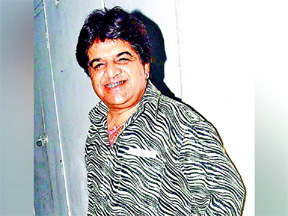
Actor Junior Mehmood dies of cancer at 68
Character actor Junior Mehmood, known for his roles in ‘Caravan’, ‘Haathi Mere Saathi’ and ‘Mera Naam Joker’, died on Friday, December 8, following a battle with cancer, his son Hasnain said. The actor was 68.
“My father passed away at 2 am following his battle with stomach cancer. He was in a critical condition for the past 17 days. He had lost 35-40 kg in a month,” Hasnain Sayyed, Junior Mehmood’s younger son, told PTI.
Junior Mehmood, whose real name was Naeem Sayyed, began as a child artiste with ‘Mohabbat Zindagi Hai’ (1966) and ‘Naunihal’ (1967). He was given the name Junior Mehmood by late comedy icon Mehmood after they starred together in 1968 film ‘Suhag Raat’.
According to the actor’s close friend Salaam Kazi, Junior Mehmood had pain in his stomach and was getting treated by a local doctor. But when he started losing weight, his family decided to take him to Tata Memorial hospital.
“They did a check-up and the doctors said he had cancer in his lung and liver, and a tumour in his stomach. He was also diagnosed with jaundice,” Kazi added.
Actors Jeetendra and Sachin visited the actor at his residence on Tuesday after he expressed a desire to meet them. Jeetendra had shared screen space with the actor in several movies, including ‘Suhaag Raat’ and ‘Caravan’.
In a career of over four decades, Junior Mehmood featured in over 260 films across seven languages. His other popular films include ‘Brahmachari’, ‘Kati Patang’, ‘Hare Raama Hare Krishna’, ‘Geet Gaata Chal’, ‘Imaandaar’, ‘Baap Numbri Beta Dus Numbri’, ‘Aaj Ka Arjun’, ‘Gurudev’, ‘Chhote Sarkar’ and ‘Judaai’. -

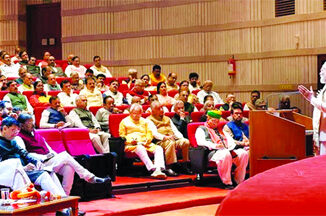
BJP appoints central observers as suspense over new CMs in 3 states continues
New Delhi (TIP) – Five days after the assembly election results for Madhya Pradesh, Chhattisgarh and Rajasthan were declared, the Bharatiya Janata Party (BJP) on Friday, December 8, named central observers for electing the leaders of its legislature parties in the state amid indications that new chief ministers may be named over the weekend, ANI reported. The party has named Union defence minister Rajnath Singh, Vinod Tawade and Saroj Pandey as observers of Rajasthan.
For Madhya Pradesh, the party has appointed Haryana Chief Minister Manohar Lal Khattar, K Laxman and Asha Lakra. In Chhattisgarh, Union Ministers Arjun Munda, Sarbananda Sonowal and Dushyant Gautam have been appointed as observers.
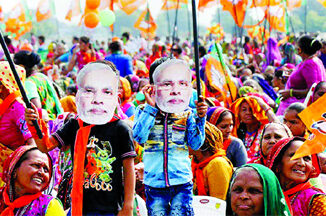
An unidentified BJP leader told PTI that the observers are likely to travel to the respective state to oversee the meetings of newly elected MLAs where the future chief ministers will be named. He added that no decision has been taken yet on the choices of the chief minister and the party will keep in mind social, regional, governance and organisational interests in picking the new chief ministers, according to PTI. The BJP ousted incumbent Congress from Rajasthan and Chhattisgarh and retained Madhya Pradesh with a landslide victory. This led to the saffron party tightening its hold in the Hindi heartland and gave a big boost to Prime Minister Narendra Modi for the 2024 Lok Sabha elections.
With an absolute majority in the 90-member Chhattisgarh assembly, the BJP won 54 seats while the Congress trailed at 35 seats. In Rajasthan, the saffron party won a total of 115 out of 199 seats. In Madhya Pradesh, BJP managed to stave off anti-incumbency after winning 163 seats in the 230-member assembly. However, the BJP bagged only eight seats in the 119-member Telangana assembly as Congress won the southern state by ousting K Chandrasekhar Rao-led Bharat Rashtra Samithi (BRS). Revanth Reddy of the Congress took oath as the new chief minister of Telangana on Thursday, December 7.
Since the poll results on Sunday, leaders from the three states have been meeting the top party brass, including Home Minister Amit Shah and party president J P Nadda. However, sources within the party have played down their significance, saying such meetings are routine, according to PTI.
On Thursday, December 7, morning, former Rajasthan chief minister and one of the frontrunners for the CM post Vasundhara Raje reached Delhi on Wednesday night but dodged any question on the meeting or the CM pick. “I have come to Delhi to see my daughter-in-law,” she told reporters outside the airport.
Narendra Singh Tomar, a seasoned BJP leader from Madhya Pradesh whose resignation as Union minister was accepted on Thursday, and Baba Balaknath, who is from Rajasthan, also met Shah on Thursday. Both quit Lok Sabha after becoming members of assemblies of their states. Tomar and Union minister Prahlad Singh Patel, who comes from politically significant Other Backward Classes, are seen as possible chief ministerial choices in Madhya Pradesh along with the incumbent Shivraj Singh Chouhan. In Chhattisgarh, BJP president Arun Sao, an OBC leader, Union minister Gomati Sai and Lata Usendi, both of whom come from Scheduled Tribes, are seen as serious contenders for the top seat. -

Cong calls meet to brainstorm over losses in three states
New Delhi (TIP) – The Congress brass will brainstorm over the party’s losses in Rajasthan, Madhya Pradesh and Chhattisgarh, in what is seen as the first structural review of its dismal performance in the recent round of assembly elections. The Congress won only one state – Telangana – of the five states that went to the polls. The grand old party lost its governments in Rajasthan and Chhattisgarh, and failed to dislodge the Bharatiya Janata Party (BJP) in Madhya Pradesh. It also failed to win the polls in Mizoram.
This round of assembly elections was seen as a virtual semi-final to the 2024 Lok Sabha polls, given that it was the last major electoral exercise before next year.
According to two Congress leaders aware of the details, the restructuring in the states where the party lost will be done after the review.
The Congress high command has summoned outgoing chief ministers Ashok Gehlot (Rajasthan) and Bhupesh Baghel (Chhattisgarh), former Madhya Pradesh chief minister Kamal Nath, state unit chiefs, in-charges and co-incharges of the three states for the meetings in Delhi.
While the defeat in Chhattisgarh and Madhya Pradesh will be analysed during a meeting on Friday, the poll loss in Rajasthan will be reviewed on Saturday, the leaders cited above said.
In Madhya Pradesh, state Congress chief Kamal Nath is likely to quit the post following the party’s worst performance in a decade. A senior Congress leader earlier said that during a meeting on Tuesday, party chief Mallikarjun Kharge conveyed to Nath that there is a growing consensus in the party that the 77-year-old should no longer helm the MP unit.
“Nath is willing to submit his resignation and will demand a new leader as state head and leader of opposition in the state assembly,” a senior party leader said, seeking anonymity.
Nath, who has sought a report from candidates on the poll loss by December 15, will attend the AICC meeting with leaders Govind Singh, Suresh Pachori and Rajya Sabha MP Digvijaya Singh on Friday, party functionaries said.
Baghel and Congress’s Chhattisgarh chief Deepak Baij left for Delhi on Thursday evening. “As I am informed, there will be a review meeting on the poll outcomes,” Sushil Anand Shukla, head of Chhattisgarh Congress communication wing.
A second senior Congress leader said the issue of the leader of opposition is likely to be discussed in the meeting. “Hopefully, the appointment of the leader of the opposition in the state assembly will also be discussed in this meeting,” the leader said.
Speaking to reporters, Baij said the elections were fought under collective leadership in Chhattisgarh. “The election was fought under a joint leadership, maintaining a balance among numerous senior leaders. As party chief for a brief period of four to five months, I tried my best to strike a balance. Despite the unexpected election results, we acknowledge the public’s mandate,” Baij said.
Source: HT -

RBI retains repo rate at 6.5% for 5th time
Mumbai (TIP) – The Reserve Bank of India (RBI) on Friday, December 8, maintained its benchmark repo rate at 6.5%, keeping its focus on anchoring inflation and boosting growth. The RBI also continued with its policy stance of “withdrawal of accommodation” to ensure inflation is in step with its target of 6%(+/-2), while supporting of economic expansion. In other words, the central bank will be focussed on curbing money supply in the economy to control inflationary pressure.
Monetary policy will remain actively “disinflationary”, RBI Governor Shaktikanta Das said after a two-day meeting of the bank’s six-member monetary policy committee. He said that the central bank’s successive policy rate hikes, a reference to increases in interest rates, “seems to be working”. The risks of high food prices continue to key be variables to watch that can alter the course of inflation. The global economy remains fragile due to elevated debt levels, lingering geopolitical tensions and extreme weather conditions, Das said, adding, “Long-awaited normality still eludes the global economy.”
Das has consistently warned of risks to food prices. India is vulnerable to food price shocks from extreme weather events and global factors despite a recent moderation in prices, he had said on November 22. This is the RBI governor’s second warning in a month about the risks from food inflation. In a speech delivered in Japan on November 8, Das had said the RBI saw risks from “recurring and overlapping” food price shocks.
The central bank had hiked the repo rate by 250 basis points to 6.5% between May 2022 and February 2023. It then hit a pause in the April review of the monetary policy. A basis point is one-hundredth of a percentage point. The repo rate refers to the rate at which commercial banks borrow money by selling their securities to the Reserve Bank, while the reverse repo rate is the rate at which the central bank borrows money.
These rates are key to boosting credit and investments by businesses to boost economy growth. A hike makes borrowing expensive for businesses, limiting money supply and cooling inflation – the key objective of why banks hike benchmark rates. -

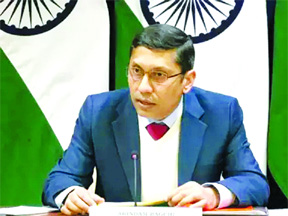
India has taken up threats on Indian Parliament made by Pannun with US, Canada: MEA
New Delhi (TIP) – India has raised the matter of threats issued by Khalistani terrorist Gurpatwant Singh Pannun on the Indian Parliament, with the United States and Canadian authorities, the Ministry of External Affairs said. Pannun, who is a designated terrorist by the National Investigation Agency (NIA), in a recent video, threatened to attack Parliament on or before December 13. Pannun holds the dual citizenship of both the US and Canada.
Notably, on December 13, 2001, a terrorist attack took place at the Indian Parliament and the main convict Mohammed Afzal Guru was hanged at the Tihar Jail in 2013. Addressing the weekly press briefing, Arindam Bagchi said, “We do take threats seriously. We are caught in a bind here. I don’t want to amplify too much credence to such extremists who make threats and get a lot of coverage. We have taken up this matter with the US and Canadian authorities. Extremists and terrorists have the tendency to want media coverage on an issue.
Regarding reports of threats on Air India flights by Khalistani extremists, the MEA said that the Indian security agencies will take appropriate action if any criminal activity takes place.
“Last month, they had threatened on a particular date…Of course, we would condemn any such threat and our security agencies will take appropriate actions…if there are incidents of criminal activity, or we feel there is a threat, we will take appropriate action,” Bagchi said.
On being asked if India has demanded the US to prosecute Pannun, the MEA spokesperson said that New Delhi seeks assistance through the proper procedure and has flagged its concerns to its partners multiple times.
“He (Pannun) is wanted by our agencies for violation of the law and there is a process under which we seek assistance and that they are prosecuted. It depends on whether the crime is committed. In our case, I think requests have gone through detailing the kind of crimes that he is responsible for, in India,” Bagchi said.
He added, “We have also flagged concerns to our partners regarding any threats made by extremists or terrorists against India or Indian diplomats…We do take it from time to time, there is ongoing conversation, security cooperation, it’s an ongoing process”.
MEA stated that Federal Bureau of Investigation (FBI) Director Christopher Wray’s upcoming visit to India is part of the bilateral cooperation between New Delhi and Washington.
However, Bagchi didn’t comment on what exact issues that will be discussed during his visit.
“We have robust security, cyber security, counter-terrorism and counter-narcotics terrorism with the US agencies. We also engage in capacity building programs…as part of this ongoing bilateral cooperation visit by the FBI director is in the works,” Bagchi said.
Regarding the reports of Lashkar-e-Taiba (LeT) terrorists being killed by unknown gunmen in Pakistan, the MEA said that India would like the terrorists to face the legal system in India.
“…Those who are wanted in India to face justice for criminal and terrorist activities, we would like them to come to India and face our legal system but I cannot comment on developments that are taking place in Pakistan,” Bagchi further said. Source: ANI -

Ethics Committee report on Mahua Moitra tabled in Lok Sabha
The Ethics Committee of Lok Sabha on Friday, December 8, tabled its report on the cash-for-query allegations against Trinamool Congress MP Mahua Moitra, in the lower house of the Parliament. The panel’s chief, BJP MP Vijay Sonkar, tabled the report. Soon after the tabling of the controversial report, the Lok Sabha was adjourned for two hours amid ruckus in the House.
The panel has reportedly recommended Moitra’s expulsion from the Lok Sabha over the charge that she asked businessman Darshan Hiranandani’s questions using her parliamentary portal in exchange for bribes.
Moitra has admitted that she shared her credentials with the businessman but the questions asked were hers. She has said she used the businessman’s staff to type out her questions on the portal. She has denied having accepted any bribes or violating any parliamentary rules.
The Opposition has been demanding a discussion on the report in the House. -

K Chandrasekhar Rao hospitalised after fall at his home
Former Telangana chief minister K Chandrasekhar Rao was admitted to a hospital around 2 am on Friday, December 8, after he reportedly fell in his house in Hyderabad.
The 69-year-old was rushed to Yashoda Hospital.
KCR’s daughter wrote on X that her father has been hospitalised.
Doctors suspect Rao may have suffered a hip fracture and may require a surgery.
The former chief minister’s party Bharat Rashtra Samithi (BRS) lost the state assembly polls to the Congress, the results of which were declared on Sunday, December 3.
KCR served as the chief minister of Telangana from 2014 to 2023. He fought from two seats in Telangana. He won from Gajwel, but lost from Kamareddy. -

All set for Ram Temple consecration ceremony on Jan 22
Sri Ram Janambhoomi Trust on December 7 said several tent cities have been erected in Ayodhya to accommodate around 10,000-15,000 devotees expected to arrive in the temple town for the Pran-Pratishtha (consecration) ceremony of Ram Lalla on January 22 next month, news agency ANI reported.
“…If 10,000-15,000 people want to stay the night, where will they find a shelter? Where will they get food and water? …For this purpose, the Trust is setting up a new tin-shed city which will be ready by at least February-end…,” the agency quoted Champat Rai, General Secretary of Sri Ram Janambhoomi Trust as saying.
“Experienced workers of the VHP and RSS from across the country are being called for this purpose…Everyone is carrying out their duties with full responsibility…” he added.
Prime Minister Narendra Modi will be chief guest at the ceremony on January 22, 2024. RSS chief Mohan Bhagwat will also be present at the event. Sri Ram Janmabhoomi Tirath Kshetra Trust has invited 4,000 saints of all sects for the ceremony.
The Trust has decided to enthrone Ram Lalla at the sanctum-sanctorum of the temple between 12 noon and 12:45 pm on that day.
The Vedic rituals for the Pran-Pratishtha ceremony of Ram Lalla (infant Lord Ram) will start on January 16,—a week before the main ceremony. Lakshmi Kant Dixit, a Vedic priest from Varanasi, will perform the main rituals of the Pran-Pratishtha ceremony on January 22.
Champat Rai said Ayodhya will mark a nine-day Amrit Mahautsav starting January 14. A 1008 Hundi Mahayagya will also be organised during the mahautsav, where thousands of people will be given food.
Prime Minister Narendra Modi on August 5, 2020, laid the foundation stone of Sri Ram Janambhoomi Temple in Ayodhya. It is important to note that the Supreme Court’s verdict in 2019 paved the way for constructing a grand Ram Temple in Ayodhya.
Adani, Bachchan, Kohli, Sachin among 8,000 invitees for ceremony
Invitations for the ceremony have been extended by the Shri Ram Janmbhoomi Teerth Kshetra to nearly 8,000 dignitaries including industrialists Gautam Adani, Mukesh Ambani and Ratan Tata. Actors Amitabh Bachchan and Akshay Kumar, besides cricketers Sachin Tendulkar and Virat Kohli are also among the invitees.
Sources in the Vishva Hindu Parishad (VHP) said invites have also been sent to journalists who supported them in making “the Ram temple a reality”. Among those likely to feature in the list of invitees are Sudhir Choudhary, Rajat Sharma, Arnab Goswami, Shweta Singh, Dainik Bhaskar MD Sudhir Agarwal, Jagran Prakashan CEO Sanjay Gupta and non-executive chairman Mahendra Mohan Gupta, besides India Today editor-in-chief Aroon Purie.
“We have invited journalists who have supported us through our journey. We have invited them formally to attend the event and take darshan as without them this struggle for Ram mandir was incomplete,” a VHP worker told ThePrint on condition of anonymity.
Invites have also been sent via post and WhatsApp to saints, priests, shankaracharyas, religious leaders and VVIPs including former civil servants, retired Army officers, lawyers, scientists, poets, musicians and Padma Shri and Padma Bhushan recipients.
Of the 8,000 invitees, nearly 6,000 will be religious leaders from from across the country, while the remaining 2,000 will be VVIPs from all walks of life, said a senior VHP functionary. The VHP worker added that a link will be shared with the invitees in the days leading up to the ceremony. Once they register using the link, a bar code will be generated that will then serve as their entry pass.
The Ram Lalla idol to be installed in the sanctum sanctorum of the grand temple in Ayodhya will be selected later this month from the three idols currently being chiseled by renowned sculptors in the temple town, HT reported.A five-member committee of prominent seers, constituted by the Shri Ram Janmabhoomi Teerth Kshetra — the trust overseeing the construction of the grand temple — will select the presiding idol depicting Lord Ram in the child form.
“It is most likely that the three idols will be ready between December 15 and December 20 to go through the selection process,” a member of the Trust said, requesting anonymity.
Two idols are being made from stones sourced from Karnataka and one from Rajasthan. Renowned sculptors Ganesh Bhatt and Arun Yogiraj from Karnataka and Satya Narayan Pandey from Rajasthan are chiseling the idols in Ayodhya at separate locations, which have been kept out of bounds of public.
All three idols of Ram Lalla are based on the sketch presented to the Trust by Mumbai-based renowned artist Vasudeo Kamath. “Ram Lalla’s 51-inch idol which is aesthetically closer to the deity will be selected,” Kameshwar Choupal, a member of the Trust, said. Mahant Kamal Nayan Das, who is part of the selection panel, said: “The idol must be a replica of five-year-old Ram Lalla. Selecting one idol out of the three will not be easy. The only criterion will be its resemblance to Ram Lalla.”’
The Trust will reveal the selected idol to the people in a Shobha Yatra in Ayodhya on January 17, days before it will be placed in the sanctum sanctorum of the Ram Temple on January 22. Starting January 18, five-day rituals of Pran Pratishtha (consecration) ceremony of Ram Lalla will start -
Assembly polls : BJP’s show in assembly polls a hard wake-up call for INDIA Bloc
A dominant and assertive victory has been claimed by the national ruling Bharatiya Janata Party across three crucial state assemblies: Rajasthan, Madhya Pradesh, and Chhattisgarh.
The Congress may have managed a comprehensive electoral win in Telangana to comfort themselves for now, consolidating their position in the south (a space where the BJP remains less visible) after winning Karnataka, but a lot of questions are going to be asked of the Grand Old Party. Its future role in the national opposition alliance, INDIA, six months before the 2024 Lok Sabha polls is key among them. Things cannot look darker for any opposition alliance hoping to stand against the BJP at this point. The state assembly poll results are a hard wake-up call for all the INDIA alliance members.
We do see how people across and within states vote differently for assembly elections versus national elections, but, if the current victories for the BJP say anything, it would be that an aggressive push for Hindutva politics, BJP’s own model of poor-centred welfarism, and a new aspirational idea for ‘developing India’ pitched under a hyper-nationalist wave, helps the national ruling party score over any other contesting party, especially in the northern Hindi-speaking states.
There are still some key lessons emerging from the polls that warrant a closer look.
Constituency-wise party-voter share
A closer look at party-wise vote shares (and breaking these down across communities), will help one understand what happened across constituencies for each party’s vote share base this time around.
The difference in percentage of vote share between the BJP and the Congress may not appear to be very high at this point, but, even a few points’ difference is enough for a party to have a considerable margin of victory or defeat in terms of seat-wise victory against the other.
Observing seat-wise vote share and relating it to each party’s previous strike rates there is a must before drawing any serious analysis for any given election result. This will help each party understand and comprehend where their ground efforts may have faltered.
For example, it is being increasingly observed now how the majority of the OBC vote bank, based on different caste-based electoral arithmetic, is pivoting in favour for the BJP, especially in the northern states, even if, the vote share of the Scheduled Castes and the Scheduled Tribe goes for the Congress or a regional opposition party.
This needs further scrutiny. Till the time any opposition party can get the Other Backward Classes, the SC and the ST voter bases together, they cannot win comprehensively. In the south too, the OBC vote, on the other hand, has closely pivoted in favour for the Congress. We saw this in Karnataka too.
Another point to observe is the preference amongst the electorate for a decisive mandate in the recent Indian elections. While political pundits and exit pollsters predicted a tough, close contest between the BJP and the Congress in electorally vital states of MP, Rajasthan, and Chhattisgarh, none of the close margin vote-base contesting seats turned away from the early leads established by either of the parties today. People on the ground seem quite clear about what or who they want – more than what those who are observing or interpreting the numbers and framing fictional narratives from newsrooms may think.
A divide
After the Karnataka victory for the Congress, it was apparent how that victory had a lot more to do with the way the grassroots-level leadership and cadre their had united (rather than stay divided) against the BJP under the local Congress leadership. The Telangana victory for the Congress under Reddy underscores a similar set of observatory points, keeping aside context-dependent factors that enabled it to counter the BRS and KCR’s incumbent leadership in this case.
Southern states have also been seen opting against the BJP-Hindutva model to prefer whatever that comes against that – whether in terms of the Congress or other regional party-based networks.
In creating an Access (In)Equality Index, measuring for state-wise access to pillars of basic amenities, healthcare, education, social security, finance, and legal recourse through 58 indicators, we saw how southern states like Telangana, Tamil Nadu, Kerala and Karnataka, have all performed remarkably better across all pillars of performative evaluation than the northern states, where the BJP electorally does well.
A socio-cultural history of localised economic and social movements safeguarding basic public goods, and capability-enhancing opportunities has made most southern states position themselves distinctly, and perform better in almost all key development indices.
This explains why BJP’s ‘poor-centreed welfarism’ in its own model of governance vision does not appear to work here, compared to some of the other, northern states (from UP to MP to Rajasthan) where the proportion of poor, low-income voting electorate is substantively higher.
A Mukhya Mantri Ladli-Behna Yojana in MP can help galvanise a lot more women votes in favour of the BJP as against a similar scheme-based electoral pivot happening in southern states where the electorate is more educated and has electoral preferences shaped a lot more around upward-mobility enhancing factors. Anyone studying the history of the two-party contests between DMK and AIDMK in Tamil Nadu will see how each of these competed strongly against each other for decades while almost never compromising on pursuing welfare models safeguarding upward mobility for the state-citizenry.
It’s not just about competing models of welfarism at stake in the south-north divide that separate a BJP’s northern stronghold compared to its electoral weakness in the south.
An aggressive, non-compromising push of Hindutva, while pursuing a hegemonic policy of ethno-linguistic cohesion around Hindi-speaking dominance does not work for the double engine Modi-anchored BJP in the south at all.
The BJP in this respect is both socio-linguistically limited or circumscribed in its local cadre and communication strategy across southern state assemblies, where sub-regional diasporas have remained dominant and embedded in a more complex ethno-linguistic fragmentation.
Even if national parties like the Congress come to power in some of these southern states (say, Congress emerging victorious in Telangana and Karnataka) it’s where there is a strong anti-incumbency factor developed against the regional or existing party in power (KCR’s BRS in Telangana and the BJP in Karnataka).
The Grand Old Party also has a relatively better organisational cohort on the ground in the southern states, due to the party’s older networks and historical links with solidarity networks and social movements, as compared to the BJP, but this gain may only remain temporal in nature.
The Gandhi
In a recent interview Prashant Kishor gave to Shoma Chaudhary, he spoke at length about how resilient Indian electoral democracy is at its roots, from a bottom up, village to city perspective, which the state assembly poll results reflect. He also spoke of how people from one village to another often evaluate a complex layer of social, economic, and political factors before voting for one party against another. It’s not as binarily linked as it may seem from outside.
Still, any major party, that aspires to bring real change, needs to do so from that level too, while providing not just a cohesive but a persistent vision to uproot any dominant party or narrative.
Leaving all the granulations of arithmetic aside, BJP got decisive mandates in three states.
What appears clear is that the Grand Old Party, whether at a national or state level, is failing to provide any coherent vision for the electorate against its counterpart. The Bharat Jodo Yatra, as argued earlier, may have helped the grassroots-level Congress party workers and the larger party cadre to find some solidarity and share a common sense of optimism, but to equate that ‘good feeling’ with the fact of becoming the ‘main reason’ for resounding state-level electoral victories is committing a huge disservice to both, the party’s own internal electoral machinery anchored by Siddaramaiah and D.K. Shivakumar, the role of other socio-economic factors such as price rise, unemployment, high corruption that mobilised a protest vote against the BJP.
Now, in much of the news room discussions around Congress’ Telangana victory, the same narrative – the Bharat Jodo Yatra working in favour of Congress due to Rahul Gandhi, is being echoed all over again, instead of credit to the local leadership and cadre for mobilising the protest vote against KCR’s BRS.
The Congress, particularly in context to the role of the Gandhi family, may very well continue to do what they have done so far, seen in the months ahead too and recognise what has worked for their party’s electoral appeal in Himachal Pradesh, Karnataka (and what worked for it in cases of Madhya Pradesh, Rajasthan, Chhattisgarh during their last assembly elections).
Unfortunately, the Gandhi-family has done little to ensure this in actual due process, which the current results show. The Party’s core decision making architecture remains deeply rooted within the family’s dynastical form of operational and functional politics which has only increased factionalism and disorganised the party’s core vision. The BJP is therefore happy to let the Gandhi-family silently anchor the party to ruin knowing very well on how well it does against the Congress in a one-on-one contest.
What to do? Well, Kishor made a revelation recently drawing upon the lessons offered by the applied and tested political practice of one of the oldest Congressmen, Mahatma Gandhi’s own ideals. He gave a template of what worked in mobilising the Indian nationalist protest vote against the British. There is value in envisioning an alternate course of political, socio-economic developmental vision.
In 2024, despite what electoral verdict India’s south might give for now, numbers from the Hindi heartland, which would also matter in deciding the 2024 polls, show how the BJP’s ruthlessly pragmatic vision is still accepted without contest because of a feeble opposition. Unfortunately, everyone, except the Congress, rusting under a confused leadership of the Gandhi family, have realised this.
(The writer, Deepanshu Mohan, is associate professor of economics and director, Centre for New Economics Studies, Jindal School of Liberal Arts and Humanities, O.P. Jindal Global University.)
Source: The Wire -

Four killed, several deaths feared as fire engulfs multi-storey mall in Pakistan’s Karachi city
KARACHI (TIP): Four people were killed and two others injured on December 6 evening when a fire broke out in a shopping and residential mall in Pakistan’s Karachi city.
TV footage showed billowing into the sky as flames engulfed parts of the building. The cause of the fire was not immediately clear and officers said they were still investigating.
Karachi Mayor Murtaza Wahab confirmed that three burnt bodies have been recovered so far from the building situated in the Ayesha Manzil area.
However, a senior police official said four bodies have been sent to civil hospital, while two persons who suffered burn wounds are undergoing treatment at the hospital.
Television channels showed black smoke and flames emanating from the building, located in a congested residential and commercial area of Karachi.
Fire brigade department official Humayun Khan said the fire apparently started on the ground floor and quickly spread to three other floors. “The Mezzanine and ground floor have around 200 shops while there are four more floors with residential apartments,” Khan said.
He said as soon as the fire engines and crew reached the spot they first evacuated all the residential apartments with the help of security personnel and took them to safety. “The fire is still being put out and we might recover more bodies and injured people,” he said.
Firefighters could also be seen attempting to douse the flames on television channels.
Pictures showed vehicles parked outside the building badly damaged as a traffic jam also took place in the heavily populated area. Senior police official Afzal Pechio said heavy casualties have been avoided because people helped one other to evacuate the building.
Almas Talha, a housewife who was in her apartment on the fourth floor said as soon there was a commotion, security guards and shopkeepers rushed to the residential floors and helped families evacuate quickly. Six fire tenders and a snorkel are being used to douse out the fire. Most structures in Karachi, and other parts of the country, lack fire prevention and firefighting systems, which often results in damages and casualties.
Karachi is the capital of southern Sindh province, where such incidents are common.
This is the second incident of a major fire in a mall in 12 days. A huge fire ripped through a six-storey commercial building in the city’s Gulistan-i-Jauhar area on Nov 25 in which 11 people were killed. After the fire in Gulistan-e-Jauhar, a preliminary report prepared by the Fire Brigade Department had stated that there was “no kind of public safety system” in many commercial and residential buildings in congested areas of Karachi.
(With inputs from PTI and AP) -
Four Rohingya killed in Bangladesh refugee camp shootout
COX’S BAZAR (TIP): Four Rohingya refugees were killed during a gunfight between two insurgent groups in Bangladesh, police said December 6, in the latest sign of deteriorating security in the country’s overcrowded relief camps. Bangladesh is home to around a million members of the stateless and mainly Muslim minority, most of whom fled a 2017 military crackdown in Myanmar that is now subject to a UN genocide probe. The dozens of squalid refugee camps housing the Rohingya have emerged as a battleground between rival armed groups who have used the settlements as staging posts for drug trafficking and human smuggling. Local police chief Shamim Hossain told AFP that an hourlong shootout took place between the Arakan Rohingya Salvation Army (ARSA) and Rohingya Solidarity Organisation (RSO) on Tuesday night.
“Four Rohingya refugees were killed and two Rohingya were seriously injured,” he added.
Neither group gave immediate comment on the clash. The RSO has been challenging the larger and more established ARSA for control of the camps since the start of the year, coinciding with a crackdown on ARSA by Bangladeshi security forces.
Violence has long been a fact of life for those living in the refugee settlements.
Police say more than 60 Rohingya refugees have been killed in Bangladeshi camp clashes this year, including women and children.
The United Nations Refugee Agency (UNHCR) said Sunday it was “alarmed by the continuing deterioration of security conditions in the camps”.
Malnutrition is also widespread, with the UN food agency saying a funding shortfall this year had forced it to cut rations by a third.
Those Rohingya remaining in Myanmar face severe persecution by authorities who deny them citizenship and access to healthcare.
The desperate situation both there and in the Bangladeshi camps has prompted thousands of Rohingya to embark upon dangerous and often deadly sea trips to Southeast Asian countries to escape. More than 1,000 landed in Indonesia’s westernmost province last month, the biggest wave of Rohingya since 2015.
Nearly 350 Rohingya died or went missing last year while attempting hazardous sea crossings, the UNHCR has estimated. (AFP) -

China formally accords diplomatic recognition to Taliban govt in Afghanistan
BEIJING (TIP): China has become the first country to confer diplomatic status to a Taliban-nominated official as Afghanistan’s Ambassador to Beijing, thereby formally recognising the Taliban-run administration as a legitimate government in Kabul.
“As a long-standing friendly neighbour of Afghanistan, China believes that Afghanistan should not be excluded from the international community,” Chinese Foreign Ministry spokesman Wang Wenbin told a media briefing on Tuesday when asked whether China recognised the Taliban as the legitimate government of Afghanistan.
Earlier reports from Kabul said China has given Bilal Karimi, a Taliban nominee the status of Ambassador and he has submitted his credentials to the foreign ministry here.
China along with Pakistan and Russia maintained its embassy in Kabul after the Taliban took control of Afghanistan in August 2021 following the withdrawal of American troops from the war-ravaged country.
While maintaining close contact with the Taliban interim administration, Beijing withheld recognition, especially over global criticism of the Taliban’s treatment of women and girls, excluding them from educational institutions.
No other country has formally recognised the Taliban government, which has been criticised over human rights violations and crushing women’s rights.
Defending China’s move, Wang said, “We hope Afghanistan will further respond to the expectations of the international community, build an open and inclusive political structure, adopt moderate and prudent domestic and foreign policies, firmly combat all forms of terrorist forces, develop friendly relations with other countries, especially with its neighbours, and integrate itself into the world community.”
“We believe that diplomatic recognition of the Afghan government will come naturally as the concerns of various parties are effectively addressed,” Wang said. China, which shares borders with Afghanistan, also has serious concerns over the regrouping of the East Turkistan Islamic Movement (ETIM), a banned outfit comprising Uighur militants from the volatile Xinjiang province, and pressing the Taliban administration to crack down on the outfit.
Significantly, China’s diplomatic recognition comes at a time when Pakistan, Beijing’s all-weather ally, is having serious problems with the Taliban which it once nurtured.
Pakistan is now blaming the Taliban government for recurring terrorist attacks in the country and criticised it for not cracking down hard on Pakistan Islamic militant groups, especially the Pakistani Taliban, operating from Afghanistan. In retaliation, Islamabad has ordered forceful evacuation of thousands of Afghan refugees living in the country for decades. (pti) -

Italy withdraws from China’s Belt and Road project
ROME (TIP): Italy has formally withdrawn from China’s vast Belt and Road infrastructure initiative, more than four years after becoming the only G7 nation to sign up, a government source said December 6.
The long-expected decision was communicated to Beijing three days ago, according to Italian newspaper Corriere della Sera, without any official statement from either side.
An Italian government source confirmed to AFP that Rome had pulled out, without giving details beyond saying it was done in such a way as to “keep channels of political dialogue open”.
Before coming to power last year, Prime Minister Giorgia Meloni said the decision by a previous government to join in 2019 was a “serious mistake”.
Critics have denounced the trillion-dollar investment scheme as a predatory “Trojan horse” aimed at buying political influence.
Italian Foreign Minister Antonio Tajani said in September that membership “has not produced the results we were hoping for”. The deal was due to automatically renew in March 2024 unless Italy opts out by the end of this year. But Rome has been wary of provoking Beijing and risking retaliation against Italian companies.
Meloni told reporters at the G20 summit in Delhi in September that month that should Rome leave the project, it “would not compromise relations with China”. (AFP) -

Israel battles Hamas in south Gaza City; armoured tanks bulldoze into Khan Yunis
JERUSALEM (TIP): Israeli troops battled Hamas militants December 7 in the heart of southern Gaza’s main city where a suspected mastermind of the October 7 attacks is believed to be hiding while pressing their offensive across the besieged territory.
Breaking through Hamas’s defences of Gaza’s second largest city, Israeli troops, tanks, armoured personnel carriers and bulldozers rolled into Khan Yunis, forcing already displaced civilians to flee again, witnesses said.
Hamas said late December 6 on Telegram its fighters were engaged in fierce battles against Israeli troops “on all axes of the incursion into the Gaza Strip”, as it claimed they destroyed two dozen military vehicles in Khan Yunis and Beit Lahia in the north of the territory.
Earlier, the Israeli army said it had pierced defensive lines and carried out “targeted raids in the heart of the city”, where they found and destroyed 30 tunnel shafts.
Prime Minister Benjamin Netanyahu said in a video statement that Israeli forces were closing in on the home of Hamas’s chief in the Gaza Strip Yahya Sinwar, with a spokesman saying it is “underground” in the Khan Yunis area.
Sinwar stands accused of being one of the masterminds of the October 7 attacks on Israel that killed 1,200 people, mostly civilians, according to Israeli authorities, and saw around 240 hostages taken.
Israel declared war on Hamas after the deadliest attack in its history, vowing to eradicate the group and bring home all the hostages.
Sinwar has not been seen in public during the war, and Israel has named him and the leader of Hamas’s armed wing, Mohammed Deif, as its top military targets.
But humanitarian organisations have warned the spread of the war into the south of the Gaza Strip will leave civilians who fled the north, much of which is now destroyed, with nowhere to go.
“We are devastated, mentally overwhelmed,” said Khan Yunis resident Amal Mahdi. “We need someone to find us a solution so we can get out of this situation.”
The latest toll from the Hamas government said the war has killed more than 16,000 people in Gaza, most of them women and children.
‘Where to go?’
Much of northern Gaza has already been reduced to rubble by fierce fighting and bombardment, displacing 1.9 million people according to UN figures.
Many civilians fled to Khan Yunis when Israel ordered them to evacuate the north of the territory earlier in the war.
They are now being pushed further south to Rafah on the border with Egypt.
“There was bombardment, destruction, leaflets dropping, threats, and phone calls to evacuate and leave Khan Yunis,” said Khamis Al-Dalu, who told AFP he was first displaced from Gaza City, and then from Khan Yunis to Rafah.
“Where to go? Where do you want us to go for God’s sake? We left Khan Yunis and now we are in tents in Rafah.”
And Israeli bombardments have followed them there.
A strike on a residential district in Rafah left 17 dead and dozens injured late Wednesday, the Hamas health ministry said, and an AFP journalist saw the wounded, including children, being taken to a local Kuwaiti hospital.
Meanwhile, Al Jazeera television network said one of its journalists had lost 22 members of his family in a strike in the northern refugee camp of Jabalia.
The Israeli army said Wednesday it had struck about 250 targets in Gaza over the past 24 hours and that troops had found a major arms depot “in the heart of a civilian population” near a clinic and school in the north of the territory.
“The depot contained hundreds of RPG missiles and launchers of various types, dozens of anti-tank missiles,” explosives and drones, it said in a statement.
AFP footage from Wednesday showed smoke trails after rocket fire from Rafah towards Israel.
According to the Israeli military, three Israeli soldiers were killed in fighting in Gaza on Wednesday.
‘Minimal’ fuel increase
Mass civilian casualties in the war have sparked global concern, heightened by dire shortages caused by an Israeli siege that has seen only limited supplies of food, water, fuel and medicines enter.
UN Secretary-General Antonio Guterres said he expects “public order to completely break down soon due to the desperate conditions” in Gaza, with “potentially irreversible implications for Palestinians as a whole.” (AFP)