Month: December 2023

  • Ambassador Jaiswal bids farewell, promising to meet again – ‘Phir Milenge’

    Ambassador Randhir Jaiswal said to the gathering that his wife Dr. Abha Jaiswal joined him in thanking them and that he looked forward to meeting them again.
    A view of the gathering. Seen, among others , from L to R: Deputy Consul General Dr. Varun Jeph, Dr. Abha Jaiswal (3rd from left), Vikas Khanna, Prof. Indrajit Saluja, Harry Panaser, Ranju Batra, Dr. Sudhir Parikh, Jagdish Sewhani.

    I.S. Saluja

    NEW YORK CITY (TIP): Consul General Randhir Jaiswal and Dr. Abha Jaiswal hosted a get together to bid farewell to friends and community at the Consulate on November 29. Ambassador Jaiswal heaped praises on the Indian American community for their contribution to strengthening India in a number of ways. Their contribution to the growth of India and strengthening of relations between India and the US received his adulation. “ As India grows by leaps and bounds we will count on your support to take us forward”, he said.

    He attributed his success in ensuring efficient services to the community to his colleagues at the Consulate who were committed to their work.

    Ambassador Jaiswal thanked the gathering for their presence and said they would meet again (Phir Milenge).

  • Sikh organizations  across the world condemn heckling of Indian envoy Taranjit Singh Sandhu at Gurdwara Nanak Darbar in Hicksville, New York

    Sikh organizations across the world condemn heckling of Indian envoy Taranjit Singh Sandhu at Gurdwara Nanak Darbar in Hicksville, New York

    • I.S. Saluja

    NEW YORK (TIP): Sikh organizations across the world have condemned the recent incident of heckling of Indian Ambassador to the USA Taranjit Singh Sandhu at a gurdwara in New York by a small group of Khalistan sympathizers. In a statement issued on Monday, November 27 from Washington, D.C., Sikhs of America said gurdwaras are places of worship and should be free from personal political views.
    “We urge the management of the gurdwara to take strict action against these miscreants so that peace-loving Sikh community in New York can come to gurdwaras freely without any fear or pressure,” Sikhs of America’s founder and chairman Jasdip Singh Jassee and its president Kanwaljit Singh Soni said in the joint statement.
    “Ambassador Sandhu went to the gurdwara to pray and the management honored him with a siropa. After that, a handful of miscreants tried to disrespect him and violated the peace and sanctity of the gurdwara. Gurdwaras are places of worship and should be free from personal political views,” the statement said.
    “Sikhs of America, the leading Sikh organization in the US, strongly condemns the disrespect of a Sikh devotee, Ambassador of India to US Taranjit Singh Sandhu in a gurdwara in Long Island, New York, yesterday,” it said.

    Delhi Sikh Gurdwara Management Committee (DSGMC) president Harmeet Singh Kalka said this instance had dented the image of the entire Sikh community and should be condemned.

    “Sandhu, besides being an envoy of the Indian Government, has also been the representative of the Sikh community on foreign soil. Only a handful of Sikh community members have been vitiating the atmosphere by indulging in such incidents without realizing its repercussions and problems for the common Indians living abroad,” he said.

    The SGPC general secretary, Rajinder Singh Mehta, said at least the gurdwaras should be free of such political views as they were the places of worship. “There could be differences of opinion among the Sikh community, yet a gurdwara was not an appropriate place to rake up such an issue and insult the Indian diplomat. The Indian government too should clarify its stance on the issue of killing of Hardeep Singh Nijjar,” he said.

    Delhi Akali chief Paramjit Singh Sarna too slammed the incident. “Some of these persons with vested interests intend to bring disrepute to the entire Sikh community. No Sikh who is aware of Sandhu’s legacy could do what they did,” he said. ‘

    Sarna underscored Ambassador Sandhu’s lineage as a grandson of none other than Sikh stalwart Teja Singh Samundri, who had played a vital role in the Gurdwara Reform Movement during the British era. The SGPC’s headquarters in fact is housed in a building named after Teja Singh Samundri.

    “For the Sikhs, Sandhu is and will always command high respect not only because of his legacy, but also because of his high geopolitical competence. We condemn the hecklers,” he said.
    (With inputs from TNS and PTI)

  • Indian student charged with family members’ triple murder

    Indian student charged with family members’ triple murder

    TRENTON, NJ (TIP): A 23-year-old Indian student has been arrested and charged for allegedly murdering his grandparents and uncle inside a New Jersey condominium, police and US media reports said.

    Om Brahmbhatt is accused of shooting Dilipkumar Brahmbhatt, 72; Bindu Brahmbhatt, 72; and Yashkumar Brahmbhatt, 38, the South Plainfield Police Department and the Middlesex County Prosecutor’s Office said in a statement. Officers responded to the home on Coppola Drive off New Durham Road in South Plainfield around 9 am on Monday, November 27, after a neighbor reported hearing shots fired at the Traditions condo complex, the Middlesex County Prosecutor’s Office said in a press release.

    After arriving, officers found three people — two men and a woman — had suffered gunshot wounds.

    Married couple Dilipkumar and Bindu Brahmbhatt were found shot to death in the second-floor apartment, police said. Their son, Yashkumar Brahmbhatt, was also found to have suffered multiple gunshot wounds. He was taken to the hospital, where he died. A suspect was taken into custody for questioning at the scene and later charged. Om was charged with three counts of first-degree murder and second-degree weapon possession. Om, hailing from Gujarat, resided with the victims and was found at the residence when authorities arrived at the scene. Om had just moved to New Jersey within the past couple of months, sources said, and had been living at the condo, NBC New York reported.

    He was taken to the Middlesex County Adult Correctional Centre pending a pre-trial detention hearing; it wasn’t immediately clear whether he had an attorney and a listed number for him couldn’t be found.

    According to the complaint, the crime was committed with a handgun Om says he purchased online. Om had a seemingly calm demeanor during Tuesday’s court appearance. Police say he was the one who called 911 that morning and when asked about who did it, officials say Om stated, “It might be me”. It was not clear what led up to the shooting. A neighbor told NBC New York that it wasn’t the first time police had been called to the condo.

    “I didn’t really know them, I just know one time the police were there for a domestic violence call,” said neighbor Jim Short, who lives upstairs from the unit where the three people were found dead. “Can happen anywhere but it is really creepy, it’s right downstairs.”

    The Traditions apartment complex, home to many young families who emigrated from India, is equipped with dozens of security cameras that neighbors hoped could help police.

    “There’s cameras all over and there are cameras coming in and out of the complex and every building has cameras outside and inside the breezeway. So hopefully that can help,” said another neighbor, Victor Orozco.

    An investigation led by the South Plainfield Police Department is ongoing. Anyone with information regarding the shooting is asked to call town police or the Middlesex County Prosecutor’s Office.

    An investigation by South Plainfield Detective Thomas Rutter and Middlesex County Prosecutor’s Office Detective Javier Morillo determined that there was no threat to the public and this was not a random act of violence, according to the prosecutor’s office.
    (Source: PTI)

  • 13-year-old Indian-origin yoga prodigy, Ishwar Sharma, wins gold in Europe

    13-year-old Indian-origin yoga prodigy, Ishwar Sharma, wins gold in Europe

    LONDON (TIP): A 13-year-old Indian-origin yoga prodigy from south-east England with several awards under his belt has added another gold medal to his tally at the European Yoga Sports Championship in Sweden.
    Ishwar Sharma, from Sevenoaks in Kent, started taking up yoga when he was three after seeing his father practice daily and went on to win several World Yoga Championships. Last weekend, he bagged the Europe Cup 2023 in the Boys 12-14 category when he competed in the European competition organized by the International Yoga Sports Federation in collaboration with Swedish Yoga Sports Federation in Malmo.
    “Ishwar is passionate about spreading the message of yoga, especially for special needs children,” his family said in a statement, with reference to his autism and Attention Deficit Hyperactivity Disorder (ADHD).
    Sharma, who led daily yoga classes for 40 children across 14 countries during the coronavirus lockdown, was honored by then British Prime Minister Boris Johnson with the Points of Light award.
    “You have brought the joy of yoga to hundreds of children globally during lockdown. I was particularly inspired to hear how you have helped children with special needs enjoy the activity you enjoy and excel at,” Johnson said in a personal letter to Sharma at the time in June 2021. He has won five world championships and British Citizen Youth Award at the House of Lords for his contribution to yoga. Along with his father, Vishwanath, Ishwar runs IYoga Solutions to spread the word about Yoga and its many benefits in the UK.

  • First Indian-origin lawmaker in Australia’s Parliament Dave Sharma wins Senate seat

    First Indian-origin lawmaker in Australia’s Parliament Dave Sharma wins Senate seat

    CANBERRA (TIP) : Dave Sharma, who became the first Indian-origin lawmaker in Australia’s Parliament in 2019, will return to politics after his victory in the New South Wales Liberal Senate race. Sharma, 47, will replace ex-foreign minister Marise Payne, who has retired from the Senate, the local media reported. Sharma, who represented the Sydney seat of Wentworth until his defeat at the 2022 election, beat former New South Wales (NSW) minister Andrew Constance, a frontrunner backed by Opposition leader Peter Dutton.
    In a vote by the New South Wales Liberal Party members, Sharma defeated Constance 251-206 in the final ballot on Sunday, November 26, the media reported.
    Sharma, who served as Australia’s ambassador to Israel from 2013 to 2017, was backed by the moderates within the party. Asserting that taking over from former Senator Payne was a privilege, Sharma said, “I would like to thank the party members for the opportunity to hold the Albanese government to account in the Senate over its many missteps and wrong decisions, and to fight for the many households across NSW struggling to deal with Labor’s cost-of-living crisis.”
    “The opportunity to serve in the Senate will allow me to fight for our nation’s national security interests in a time of greater global turmoil,” he was quoted as saying in the report. Congratulating him on securing the NSW Senate position, Opposition leader Dutton said Sharma’s entry to the Senate would come at a crucial time.

  • The Heckling of Indian Ambassador by Khalistani Protesters Deserves Condemnation

    The Sikh community witnessed a deplorable incident that struck a dissonant chord—heckling directed at Mr. Taranjit Singh Sandhu, the Indian Ambassador to the US, by some Khalistani individuals. Their accusations, tied to the assassination of Nijjar in Canada and alleged involvement in a conspiracy against Gurpatwant Pannu of Sikhs For Justice, unfolded in a religious shrine. Such actions, regardless of political motives, exhibit poor taste and fail to resonate within the Sikh community who have rightly condemned the hecklers.

    The act of heckling within a religious setting not only violates the sanctity of the shrine but also contradicts the principles of respect and harmony deeply ingrained in Sikh values. Instead of garnering support or sympathy for their cause, these Khalistani hecklers inadvertently caused harm. Their actions alienated potential supporters and detracted from the credibility of their aspirations for an independent Khalistan.

    It is crucial for any movement or cause to win hearts and minds within its community. However, the recent conduct of the Khalistani hecklers exemplifies a counterproductive approach. Rather than fostering solidarity and unity, their actions sowed seeds of discord and disapproval among the Sikh populace.

    Ambassador Taranjit Singh Sandhu’s family history bears testament to their invaluable contributions to the Sikh community. His father, Sardar Bishan Singh Samundri, remains revered as a distinguished educationist and the founding Vice Chancellor of Guru Nanak Dev University, a beacon of academic excellence in India. Additionally, his grandfather, Sardar Teja Singh Samundri, played a pivotal role in the Gurudwara Reform movement, earning recognition with the naming of Teja Singh Samundri Hall within the Golden Temple complex in Amritsar.

    The legacy of such remarkable individuals deserves utmost reverence and admiration. Criticism and dissent can be expressed in civil and respectful ways without resorting to demeaning or vilifying the heroes and their families who have significantly contributed to the Sikh community’s growth and stature.

    It’s paramount for those advocating the Khalistan cause to understand that their actions reflect upon the movement as a whole. By engaging in disrespectful behavior, they not only tarnish their image but also undermine the credibility and legitimacy of their objectives.

    Respect for differing opinions and adherence to ethical conduct form the bedrock of any movement’s success. Therefore, the recent incident serves as a cautionary tale, emphasizing the importance of upholding decorum, dignity, and respect in pursuing one’s beliefs and aspirations.

    The Sikh community, known for its rich history and strong values, should prioritize unity and inclusivity. While advocating for political demands, it’s imperative to avoid actions that divide or disparage the community’s esteemed figures.

    The actions of the Khalistani hecklers, while driven by political fervor, have detracted from their cause. Respect, decorum, and reverence for Sikh heroes and their families are essential tenets that must be upheld, fostering unity rather than division within the community. It’s time for introspection and a recalibration of strategies to garner genuine support and respect for the Khalistan cause.

  • A lot at stake: On India and the impact of the indictment by the U.S. Department of Justice

    • India’s reputation as a principled power is at stake after the indictment

    The impact of the 15-page indictment filed by the U.S. Department of Justice against an Indian national, believed to be directed by an Indian government official for attempting an assassination plot against U.S.-based Khalistani separatist Gurpatwant Singh Pannun, is likely to be felt in more than just the U.S. and India. The indictment is based on details of communications between the accused, an illicit drugs and arms dealer, Nikhil Gupta, with a serving senior Indian government intelligence officer, who is identified but unnamed, as well as with two men in the U.S., who were allegedly engaged to kill Mr. Pannun. The twist in the tale, unreported on so far in the U.S., or Canada, is that the two U.S.-based men were working for U.S. law enforcement, making it clear that American agents have been following the investigation since at least May. There have been meetings between the U.S. President Joseph Biden and Prime Minister Narendra Modi — other senior officials have met too — since then. The allegations raise troubling questions about how much was shared between the two countries, and whether the Modi government, which had been outraged by similar allegations made by Canadian Prime Minister Trudeau, has been less than honest about what it knows. If the government had knowingly authorized the targeting of Sikh separatists who are on India’s UAPA terrorist designation list, then that implies a dramatic change in Indian policy, which it should be more upfront about. If top officials had no inkling about the “plots”, and as the Ministry of External Affairs has stated this is not “government policy”, it is also a matter of grave incompetence and ‘rogue’ officers. If, however, the U.S.’s and Canada’s allegations are unfounded, and Indian officials are not linked to the plots, then the government needs to furnish evidence. In any case, the management of public messaging in the matter, especially India’s reaction to Canada versus the U.S., appears inconsistent.

    Whatever the factors behind the government’s responses thus far, it is significant that it has now instituted a high-level inquiry committee to look into the U.S.’s allegations. Much hinges on its outcome. To begin with, India’s U.S. ties could be impacted by what transpires, as White House expects India’s full cooperation. India too, must ask the U.S., which is rightly placing such emphasis on the plot, why it is not keen on extraditing to India a man facing terror charges. Second, the U.S. and Canadian allegations will directly impact India’s ties with all “Five Eyes” intelligence partner countries, which must not be overshadowed by this one case. Finally, it is India’s reputation as a consistent and credible power — one which has earned respect worldwide for its sagacity and principled approach on such issues in the past — that hangs in the balance, and New Delhi must judge its next steps in the case extremely wisely.
    (The Hindu)

  • The contentious legacy of Henry Kissinger

    The contentious legacy of Henry Kissinger

    On Kissinger’s death on November 29, the NSAGWU published a ‘declassified obituary’ that highlighted his achievements, including détente with the USSR, the breakthrough with China and the West Asia shuttle diplomacy. The assessment also exposed his ‘darker side’, including the overthrow of democracy in Chile, which paved the way for a brutal dictatorship, his ‘disdain for human rights and support for dirty and even genocidal wars abroad’, the secret bombing in Southeast Asia and, finally, his involvement in the Richard Nixon administration’s criminal abuses, including ‘the secret wiretaps of his own top aides’.

    By Vappala Balachandran

    Henry Alfred Kissinger, born on May 27, 1923, in Bavaria as Heinz Alfred Kissinger, was an intellectual giant. He was also a very controversial person. Seymour Hersh’s The Price of Power: Kissinger in the Nixon White House (1983) marked the beginning of the controversies surrounding him.

    Since 2001, the Washington DC-based National Security Archive of the George Washington University (NSAGWU) had been making legal efforts to bring Kissinger’s papers into the public domain. This was because Kissinger had removed the recorded telephone conversations and office files from the State Department when he left office in 1976. To obtain these, the NSAGWU had to file suits under the Freedom of Information Act against Kissinger, the US State Department and the US Government’s National Archives and Record Administration.

    On Kissinger’s death on November 29, the NSAGWU published a ‘declassified obituary’ that highlighted his achievements, including détente with the USSR, the breakthrough with China and the West Asia shuttle diplomacy. The assessment also exposed his ‘darker side’, including the overthrow of democracy in Chile, which paved the way for a brutal dictatorship, his ‘disdain for human rights and support for dirty and even genocidal wars abroad’, the secret bombing in Southeast Asia and, finally, his involvement in the Richard Nixon administration’s criminal abuses, including ‘the secret wiretaps of his own top aides’.

    The assessment was also based on the colossal number of papers that the NSAGWU managed to reveal, including 30,000 pages of daily transcripts of Kissinger’s phone conversations, which he had secretly recorded and had made his secretaries transcribe. Most of these conversations were recorded without the other persons’ permission since, as told to the NSAGWU by his aides, Kissinger wanted to remember “which lie he told to whom”.

    I feel that his China diplomacy stands out among his achievements. It took a lot of time for Nixon and Kissinger to realign a new policy towards Beijing after diplomatic reverses in that region consequent to the 1970 US invasion of Cambodia. Earlier efforts to open a dialogue had reached nowhere. In September 1970, Nixon asked Kissinger to make one more effort. The opportunity came in October when Pakistan President Yahya Khan visited the US. Kissinger had tried through two more channels: one through Romanian President Nicolae Ceausescu and the other via his old friend WR Smyser, a former diplomat, who contacted ‘J’ (Jean) in Paris, who was friendly with the Chinese ambassador, a ‘Long March’ veteran.

    Ultimately, only the Pakistan channel worked. That elevated its status among the most dependable US allies. On December 9, 1970, a message from Khan was received by Pakistan Ambassador Agha Hilaly in Washington DC. He read out this message to Kissinger, which also contained a message from Chinese premier Zhou Enlai, conveying their agreement to hold talks with US President Nixon.

    Kissinger made his preparatory visit from July 9 to 11, 1971, through an elaborate subterfuge. First, he visited New Delhi on July 9; it did not go off very well. Not that it mattered to him since his destination was elsewhere. The same day, he reached Islamabad and complained of ‘Delhi belly’. Yahya advised him to rest at the hill station of Nathia Gali near Abbottabad in Khyber Pakhtunkhwa. Instead, Kissinger secretly drove to Islamabad to board a PIA airplane for Beijing.

    That was how the path-breaking initiative from Nixon had fructified. Pakistan had a great role in this. It is not that indirect US-China talks were not going on in the interregnum. Zhou mentioned to Kissinger on July 9 that their delegations had met 136 times during the last 16 years. However, there was no ‘intention’ to solve problems.

    In Beijing, Kissinger spent 17 hours with Zhou in five meetings (July 9-11), not to mention another four hours in drafting minutes and communications. The transcripts of these meetings, running into 102 pages, indicate how forceful, blunt and deep the Chinese diplomatic bargaining was, even at that time when they were considered comparatively weak. In his report to Nixon, Kissinger said the meetings were “the most searching, sweeping and most significant discussions I have ever had in the government”.

    He wrote, according to declassified documents: “The Chinese treated the entire visit with elaborate correctness and courtesy. They were extremely tough on substance and ideological in their approach, but their dealings were meticulous; they concentrated on essentials; they eschewed invective and haggling over details.”

    The next day (July 10), Zhou bluntly suggested to Kissinger that the US should withdraw all armed forces from the Taiwan area and the Taiwan Strait, recognize China as the sole representative of the Chinese people, declare Taiwan as a part of China, affirm the ‘One China’ policy, and stop the State Department policy of saying that ‘Taiwan’s status is undetermined’.

    India came in for criticism from both sides for being aggressive to Pakistan. Sympathies were with Yahya Khan and Pakistan. After this meeting, a separate secret channel was established through Gen Vernon Walters, US Military Attaché in Paris. Zhou’s final words to Kissinger on July 11 were: “Please tell Yahya Khan that if India commits aggression, we will support Pakistan.”

    However, China did not help Pakistan in the 1971 war. The US subsequently put out an explanation that Kissinger had misinterpreted Zhou’s remarks. What he meant was that China would not be an ‘idle spectator’.

    Nixon’s visit to Beijing came during February 21-28, 1972. Again, we must depend upon the NSAGWU’s efforts, 27 years after this epoch-making visit, to know how it happened. When one compares these declassified documents, it could be seen that much more was revealed by the NSAGWU than the accounts provided by Nixon and Kissinger in their memoirs. It was during these talks that we came to know why the Chinese were so angry with Jawaharlal Nehru. On February 22, Zhou denounced Khrushchev for inciting Nehru to ‘attack’ China in 1962. He also blamed Khrushchev for allegedly misleading India that China would not hit back, thus emboldening Nehru to take on China.
    (The author is a Former Special Secretary, Cabinet Secretariat, Government of India)

  • Making this Israeli-Palestinian war the last

    Making this Israeli-Palestinian war the last

    • The only lasting solution is for Israel to vacate its occupation of the West Bank and let a viable Palestinian state emerge

    “To ensure Israel’s legitimate concern for the safety of its people, the new state should be demilitarized. Other measures can be thought of to assure the Israelis of their safety. Israel’s neighboring Arab states should all be engaged in this process. The Abraham Accords provide a foundation. If Israel has the vision of living in harmony in the region with its Arab neighbors, this is the only way. When that happens, Iran will lose its proclaimed reason for its anti-Israel tirades; Hezbollah will, likewise, lose its most important plank for threatening Israel. For decades, Israeli-Palestinian relations have been locked in a never-ending cycle of death, destruction and misery. The war in Gaza is the latest iteration. It should be the last. The Middle East could, finally, enjoy stable peace and security.”

    By Chinmaya R. Gharekhan & Karl F. Inderfurth

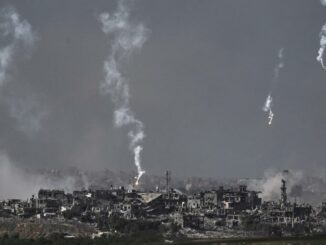
    All wars end. The Israeli-Hamas war will also end. When and how are still to be determined. But doing so is urgent. The United Nations says 1.3 million of the 2.3 million residents of the Hamas-controlled Gaza Strip have been displaced, and almost half of all homes in Gaza have been damaged or destroyed.

    One outcome of a war is when both sides gain something of value to them. The Israeli-Hamas war is likely to end in that kind of scenario.

    Israel will win in military terms, no doubt about that. But Hamas is likely to win in terms of a greatly increased following among Arab populations everywhere, including, especially, in the occupied West Bank.

    The Palestine Authority, which has been ruling there for the past 30 years, has become vastly unpopular and corrupt. Palestine Authority President Mahmoud Abbas, the most moderate Palestine leader Israel could have ever hoped for, has failed singularly in making any progress towards the objective of establishing a Palestinian state in the West Bank. He is perceived as collaborating with Israel in its hunt for ‘terrorists’. The peace process has long been dead.

    ‘Right of self-defense’ and the reality
    As United Nations Secretary-General António Guterres has reminded the international community, the Hamas attack on Israel on October 7, 2023, condemnable and despicable as it was, did not happen in a vacuum. Under Article 51 of the Charter of the United Nations, Israel has the inherent right of self-defense. The same article lays down that after acting in self-defense, the state concerned must report the action taken by it to the UN Security Council (UNSC). This does not seem to have been done. In any case, self-defense does not authorize the disproportionate or indiscriminate use of force against civilians. It has been reported that Gaza’s rate of death during Israel’s assault has few precedents in this century — almost 15,000, a majority of them women and children. This goes well beyond the prevailing customary law of self-defense.

    The most important and troubling issue is: what happens when Hamas has been subdued? What takes its place? Some, including the U.S. President Joe Biden, have suggested that the Ramallah-based Palestine Authority should take over administering the Gaza Strip, once the situation becomes ready for that. ‘The rich Arab states’, a phrase widely cited in the media, would be asked to finance the rebuilding of Gaza. The only problem is that the Palestinians, in Gaza as well as in West Bank, do not want the Palestine Authority led by Mr. Abbas to rule anywhere, let alone Gaza.

    The only available option is to hold fresh elections, in Gaza as well as in the West Bank, under international supervision as and when the situation allows. The UN should be asked to deploy a peace-keeping contingent on the border between Gaza and Israel to ensure security for both. The suffocating blockade of Gaza would be lifted. Israel does not like the UN, and likes the UN Secretary-General even less. It should be remembered that it was the UN that gave birth and legitimacy to the insipient state of Israel. The U.S. will need to take the lead on this in the UNSC.

    Feasibility of two-state solution
    Meanwhile, the proposal for a two-state solution, long pushed aside, has come alive. Everyone seems to be repeating the two-state mantra.

    But how feasible is the two-state concept today?

    The 1993 Oslo Accord envisaged Palestine to be based in the West Bank. Today, the West Bank is heavily populated by Israeli settlers, 4,50,000 at latest count. No Israeli government will succeed in persuading the settlers to return. Force would be required. The land is like Swiss cheese, having settler roads and innumerable settlements, with more planned. The current Israeli Prime Minister, Benjamin Netanyahu, will never agree to a Palestinian state, however truncated.

    What is needed, as soon as conditions permit, is to have a reality check of the two-state proposal — what is feasible and what is not. Painful concessions will be required, including land swaps, and a monitoring mechanism established to hold each side to the commitments they make. The only lasting solution is for Israel to vacate its occupation of the West Bank and let a viable Palestinian state emerge.

    Abraham Accords are a foundation
    To ensure Israel’s legitimate concern for the safety of its people, the new state should be demilitarized. Other measures can be thought of to assure the Israelis of their safety. Israel’s neighboring Arab states should all be engaged in this process. The Abraham Accords provide a foundation.

    If Israel has the vision of living in harmony in the region with its Arab neighbors, this is the only way. When that happens, Iran will lose its proclaimed reason for its anti-Israel tirades; Hezbollah will, likewise, lose its most important plank for threatening Israel.

    For decades, Israeli-Palestinian relations have been locked in a never-ending cycle of death, destruction and misery. The war in Gaza is the latest iteration. It should be the last. The Middle East could, finally, enjoy stable peace and security.

    (Chinmaya R. Gharekhan served as India’s Ambassador to the United Nations and as India’s Special Envoy to the Middle East, 2005-09. Karl F. Inderfurth served as the United States Deputy Ambassador to the United Nations Security Council and was Assistant Secretary of State for South Asia, 1997-2001)

  • Towards a Brighter Tomorrow: India’s G20 Presidency and the Dawn of a New Multilateralism

    Towards a Brighter Tomorrow: India’s G20 Presidency and the Dawn of a New Multilateralism

    “As India completes the G20 Presidency, penned a few thoughts on how the principles of Vasudhaiva Kutumbakam- OneEarth, One Family, One Future were reinforced in various ways through the year gone by. India focused on furthering sustainable development, empowering women, strengthening multilateralism and more”. Prime Minister Modi on X (formerly Twitter), November 30, 2023

    By Narendra Modi, Prime Minister of India

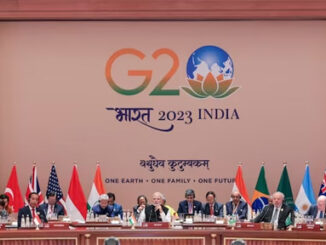
    Today marks 365 days since India assumed the G20 Presidency. It is a moment to reflect, recommit, and rejuvenate the spirit of ‘Vasudhaiva Kutumbakam, ‘One Earth, One Family, One Future.’

    As we undertook this responsibility last year, the global landscape grappled with multifaceted challenges: recovery from the Covid-19 pandemic, looming climate threats, financial instability, and debt distress in developing nations, all amid declining multilateralism. In the midst of conflicts and competition, development cooperation suffered, impeding progress.

    Assuming the G20 Chair, India sought to offer the world an alternative to status quo, a shift from a GDP-centric to human-centric progress. India aimed to remind the world of what unites us, rather than what divides us. Finally, the global conversation had to evolve – the interests of the few had to give way to the aspirations of the many. This required a fundamental reform of multilateralism as we knew it.
    Inclusive, ambitious, action-oriented, and decisive—these four words defined our approach as G20 president, and the New Delhi Leaders’ Declaration (NDLD), unanimously adopted by all G20 members, is testimony to our commitment to deliver on these principles.

    Inclusivity has been at the heart of our presidency. The inclusion of the African Union (AU) as a permanent member of the G20 integrated 55 African nations into the forum, expanding it to encompass 80% of the global population. This proactive stance has fostered a more comprehensive dialogue on global challenges and opportunities. The first-of-its-kind ‘Voice of the Global South Summit,’ convened by India in two editions, heralded a new dawn of multilateralism. India mainstreamed the Global South’s concerns in international discourse and has ushered in an era where developing countries take their rightful place in shaping the global narrative. Inclusivity also infused India’s domestic approach to G20, making it a People’s Presidency that befits that world’s largest democracy. Through “Jan Bhagidari” (people’s participation) events, G20 reached 1.4 billion citizens, involving all states and Union Territories (UTs) as partners. And on substantive elements, India ensured that international attention was directed to broader developmental aims, aligning with G20’s mandate.

    At the critical midpoint of the 2030 Agenda, India delivered the G20 2023 Action Plan to Accelerate Progress on the Sustainable Development Goals (SDGs), taking a crosscutting, action-oriented approach to interconnected issues, including health, education, gender equality and environmental sustainability.

    A key area driving this progress is robust Digital Public Infrastructure (DPI). Here, India was decisive in its recommendations, having witnessed the revolutionary impact of digital innovations like Aadhaar, UPI, and Digilocker first-hand. Through G20, we successfully completed the Digital Public Infrastructure Repository, a significant stride in global technological collaboration. This repository, featuring over 50 DPIs from 16 countries, will help the Global South build, adopt, and scale DPI to unlock the power of inclusive growth.

    For our One Earth, we introduced ambitious and inclusive aims to create urgent, lasting, and equitable change. The Declaration’s ‘Green Development Pact’ addresses the challenges of choosing between combating hunger and protecting the planet, by outlining a comprehensive roadmap where employment and ecosystems are complimentary, consumption is climate conscious, and production is planet-friendly.

    In tandem, the G20 Declaration calls for an ambitious tripling of global renewable energy capacity by 2030. Coupled with the establishment of the Global Biofuels Alliance and a concerted push for Green Hydrogen, the G20’s ambitions to build a cleaner, greener world is undeniable. This has always been India’s ethos, and through Lifestyles for Sustainable Development (LiFE), the world can benefit from our age-old sustainable traditions.

    Further, the Declaration underscores our commitment to climate justice and equity, urging substantial financial and technological support from the Global North.

    For the first time, there was a recognition of the quantum jump needed in the magnitude of development financing, moving from billions to trillions of dollars. G20 acknowledged that developing countries require $5.9 trillion to fulfil their Nationally Determined Contributions (NDCs) by 2030.

    Given the monumental resources required, G20 emphasised the importance of better, larger, and more effective Multilateral Development Banks. Concurrently, India is taking a leading role in UN reforms, especially in the restructuring of principal organs like the UN Security Council, that will ensure a more equitable global order.

    Gender equality took centre stage in the Declaration, culminating in the formation of a dedicated Working Group on the Empowerment of Women next year. India’s Women’s Reservation Bill 2023, reserving one-third of India’s Parliament and state legislative assembly seats for women epitomizes our commitment to women-led development.

    The New Delhi Declaration embodies a renewed spirit of collaboration across these key priorities, focusing on policy coherence, reliable trade, and ambitious climate action. It is a matter of pride that during our Presidency, G20 achieved 87 outcomes and 118 adopted documents, a marked rise from the past.

    During our G20 Presidency, India led deliberations on geopolitical issues and their impact on economic growth and development. Terrorism and the senseless killing of civilians is unacceptable, and we must address it with a policy of zero-tolerance. We must embody humanitarianism over hostility and reiterate that this is not an era of war. I am delighted that during our Presidency India achieved the extraordinary: it revitalised multilateralism, amplified the voice of the Global South, championed development, and fought for the empowerment of women, everywhere.

    As we hand over the G20 Presidency to Brazil, we do so with the conviction that our collective steps for people, planet, peace, and prosperity, will resonate for years to come.