Year: 2023

  • The Moscow declaration

    The Moscow declaration

    China and Russia agree to stand together on issues involving security interests

    “The declaration is a clear signal from Russia and China that they are prepared to stand together on issues involving each other’s security interests. While India finds mention on some issues of regional cooperation, there is nothing in the declaration to which it could take objection to. What now emerges is that Russia and China have much in common in dealing with the US and its allies. China prefers to keep out any mention of India. This should not surprise anyone with even a cursory understanding of China’s growing hubris, as it moves to attain global recognition of its economic clout and military potential. Moreover, there is considerable focus by China on Sino-Russian cooperation to build a security framework in the oil-rich Gulf region. China and Russia appear more than pleased that thanks to clumsy diplomacy by the Biden administration, they have been able to commence a rapprochement process between Iran and Saudi Arabia. Similar efforts are underway to forge normal ties between Syria and Saudi Arabia. These developments have resulted in a stronger Russian and Chinese presence in the region.”

    By G Parthasarathy

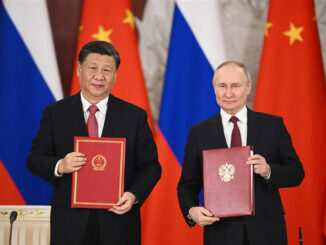
    The US and its Western allies were hoping that the Putin-Xi Jinping summit would turn out to be a damp squib. The recent Moscow summit has, however, produced a comprehensive plan by China and Russia to jointly meet the challenges they face from the US-led global order. The US and its allies have been repeatedly calling for sanctions against Russia, following its conflict with Ukraine. Some hope was also unrealistically expressed that China could follow through on its Ukraine plan by joining them in persuading Russia to pull out of Ukraine on Western terms. That hope now lies shattered. The joint declaration ends any illusion that Western powers may have had about China backing them on how the Ukraine conflict should be ended.

    The joint declaration states that the US and its allies would have to respect the legitimate security concerns of all countries, while adding that confrontation must be avoided. Russia and China have emphasized that ‘responsible dialogue’ is the best way to resolve problems and the international community should support constructive efforts. The declaration, in fact, calls on all parties to stop actions that promote tension to prevent the crisis from further aggravating, and even getting out of control. It concludes that China and Russia are opposed to unilateral sanctions not authorized by the UN Security Council.

    The US has, rather unconvincingly, been denying allegations made by one of its best-known investigative journalists, Seymour Hersh, that Washington had a hand in, and indeed organized, the bomb attack that destroyed the undersea Beixi gas pipeline (known also as Nordstream) carrying gas from Russia to Germany. Russia and China have bluntly noted, ‘The banner of extremism and the use of terrorist and extremist organizations to interfere in the internal affairs of other countries and achieve geopolitical goals.’ They have also demanded ‘an objective, impartial and professional investigation should be conducted on the Beixi pipeline explosion.’ It is going to be difficult for the US, and even Germany, which is reputed for observing high standards of respect for international law, to claim that they do not know who was responsible for blowing up the pipeline.

    Expectations in the international community that Russia may be persuaded by China to be more flexible on the withdrawal from Ukraine have been dashed. Russia and China announced that the ‘legitimate security concerns of all countries must be respected’, and that confrontation between camps, ‘adding fuel to the flames’, must be avoided. China firmly backs Russia’s position on the Ukraine crisis, averring that ‘responsible dialogue is the best way to solve problems steadily’. Most importantly, Russia has been assured of Chinese backing in the UN Security Council to ensure that ‘parties to the conflict stop all actions that promote tension and delay the end of war.’ Putin could not have asked for anything more from his Chinese guest. What remains to be seen is whether China will provide the military supplies that Moscow needs. The countries that would be most concerned by these developments are the US and its NATO allies. The declaration ends any illusion that Western powers, who speak for the so-called international community, have about China backing them on how the Ukraine conflict should be ended. China and Russia have also signaled that they have no regard for sanctions being imposed by Western powers. President Zelenskyy and the US would also have to think afresh on Russia’s concerns about the safety and security of Russians living in south-eastern Ukraine, while facing the reality that Russia intends to stay in Crimea, where it has exercised sovereignty for three centuries now.

    The declaration is a clear signal from Russia and China that they are prepared to stand together on issues involving each other’s security interests. While India finds mention on some issues of regional cooperation, there is nothing in the declaration to which it could take objection to. What now emerges is that Russia and China have much in common in dealing with the US and its allies. China prefers to keep out any mention of India. This should not surprise anyone with even a cursory understanding of China’s growing hubris, as it moves to attain global recognition of its economic clout and military potential. Moreover, there is considerable focus by China on Sino-Russian cooperation to build a security framework in the oil-rich Gulf region. China and Russia appear more than pleased that thanks to clumsy diplomacy by the Biden administration, they have been able to commence a rapprochement process between Iran and Saudi Arabia. Similar efforts are underway to forge normal ties between Syria and Saudi Arabia. These developments have resulted in a stronger Russian and Chinese presence in the region. There have sometimes been concerns about the impact of the growing Sino-Russia cooperation on Russia’s relations with India. Russia has for long been India’s largest supplier of modern weapons systems and has been helpful in India’s production of nuclear submarines. India is also manufacturing Russian-designed BrahMos missiles, which it has provided to friendly countries, with prospects of more buyers. Moreover, purchases of petroleum products at very reasonable prices from Russia have been helpful in managing India’s balance of payments. Russia, in turn, evidently understands that India’s defense cooperation with the US, together with its security links in groupings like Quad and I2U2 across the Indo-Pacific, are set to grow. While Russia is furious with Pakistan for supplying weapons to Ukraine, China would make every effort to get Moscow to assist Pakistan. Strategic autonomy, meanwhile, has been, and should remain, the hallmark of India’s defense and foreign policies.
    (The author is Chancellor, Jammu Central University & former High Commissioner to Pakistan)

  • EMMY-AWARD WINNING COMEDIAN INFUSES NJ WITH SATIRE

    EMMY-AWARD WINNING COMEDIAN INFUSES NJ WITH SATIRE

    By Mabel Pais

    Samantha Bee, Emmy Award-winner, returns to the stage, with her trademark satirical comedy, to the New Jersey Performing Arts Center (NJPAC) on Friday, April 7, at 8 PM.

    Samantha Bee has quickly established herself as having one of the most unique and sharp comedic voices on television. Born and raised in Toronto, Canada, Bee began her career performing as a member of the all-female sketch comedy troupe ‘The Atomic Fireballs.’

    In 2003, Bee joined Comedy Central’s ‘The Daily Show’s’ “Best F#@king News Team.” Bee departed ‘The Daily Show’ in 2015 and currently holds the title for being the longest-serving regular ‘Daily Show’ correspondent of all time (12 years).

    Bee received global recognition from the success of her very own weekly late-night comedy series, ‘Full Frontal with Samantha Bee,’ which premiered in 2016 and ran for seven seasons on the Turner Broadcasting System (TBS, a division of the Warner Brothers Network). ‘Full Frontal’ offered a unique satirical take on weekly news and explored other important stories in-depth that have been largely overlooked by more traditional media outlets. ‘Full Frontal’ received rave reviews, and the show was picked up by TBS for a full season within weeks of its premiere. In a landscape of male late-night talk show hosts, critics have appreciated Bee’s “fiery and fierce” delivery (The New York Times) and have embraced ‘Full Frontal’ as a “daring, innovative addition to the late-night slate” (Entertainment Weekly).

    Bee is the author of the essay collection ‘I Know I Am, But What Are You?’ and has been featured in ‘TIME 100: The Most Influential People.’ She is also the host of ‘Full Release,’ a podcast featuring in-depth conversations with the best and brightest of people about how to navigate the ever-changing world and what to laugh about along the way. Bee with her husband Jason Jones also co-created the half-hour comedy series, ‘The Detour,’ which ran for four seasons on TBS. ‘The Detour,’ which stars Jones, was inspired by their personal experiences on family getaways. The show follows Nate (Jones), Robin (Natalie Zea) and their two kids, Delilah and Jared, for what Nate believes will be the adventure of a lifetime on a road trip to Florida, which quickly turns into a disaster.

    In 2018, Bee announced her new production company, Swimsuit Competition, co-founded with ‘Full Frontal’ producer Kristen Everman. Swimsuit Competition aims to create inclusive, narrative and documentary television and will develop content for TBS.

    TICKETS

    For Tickets to see Samantha Bee, visit NJPAC.org or the Box Office or call 888. GO.NJPAC (888.466.5722).

    The New Jersey Performing Arts Center (NJPAC)
    Follow NJPAC Online:
    Website: njpac.org
    Twitter: @NJPAC
    Instagram: @NJPAC
    Hashtag: #NJPAC
    Facebook: facebook.com/NJPAC
    YouTube: NJPACtv

    Follow NJPAC’s Standing in Solidarity Series Online:
    Website: njpac.org/takeastand
    Hashtag: #NJPACTakeAStand
    Youtube: Standing in Solidarity playlist

    ————————————

    FEMALE VIDEO ARTISTS ADORN GALLERY VIA VENI, VIDI, VIDEO EXHIBIT

    Veni Vidi Video, Banner. (Photo Credit: mmjccm.org)

    By Mabel Pais

    A multimedia gallery exhibit highlights the role of Jewish female artists in shaping video art from the 1960s to today. The exhibit, curated by Sharon Balaban, features the work of 18 trailblazing American and Israeli artists and experimental filmmakers exploring themes of human rights, gender, and social dynamics. The exhibit ‘Veni, Vidi, Video’ opened during Women’s History Month and will be on display in The Laurie M. Tisch Gallery at the Marlene Meyerson Jcc Manhattan (MMJCCM) until May 18, 2023. The exhibit is free and open to the public.

    The artists on display in ‘Veni, Vidi, Video’ include Sharon Balaban, Hilla Ben Ari, Dara Birnbaum, Shirley Clarke, Keren Cytter, Maya Deren, Hadassa Goldvicht, Mierle Laderman Ukeles, Hila Lulu Lin Farah Kufer Birim, Vivian Ostrovsky, Alix Pearlstein, Nira Pereg, Martha Rosler, Mika Rottenberg, Shelly Silver, Anita Thacher, Rona Yefman, and Nevet Yitzhak.

    Taking its title from the declaration of masculine militancy and conquest attributed to Julius Caesar: Veni, vidi, vici — I came, I saw, I conquered, the exhibit highlights the role of Jewish female artists in shaping video art across many decades. It includes works from trailblazing American and Israeli artists and experimental filmmakers of the 1940s and 1950s and contemporary artists of the 1970s, through today’s works, which utilize new technologies and techniques.

    “It wasn’t until we started research for this exhibition that I realized how impactful these female Jewish artists have been in paving the way for video art as a central medium in contemporary art,” said Udi Urman, MMJCCM Director of the Lambert Center for Arts + Ideas. “This collective of artists broke the glass ceiling for so many to follow in their steps, and this journey is what we are exploring in Veni, Vidi, Video. It is fascinating to see that the themes of the works from 50 years ago are more relevant now than ever. Their artwork continues to push the right nerves and make you think. They inspire and ultimately impact the world for the better.”

    “This show is a great opportunity as a video artist and professor to share video works made by Jewish female artists who pushed the boundaries of contemporary art and whose works are a starting point for any conversation about video art and feminism,” shares Sharon Balaban, Exhibit Curator and Artist. “In our current ‘TikTok’ era, it is inspiring to look back and acknowledge these pioneer artists who recognized early on how technology can be used as a tool to deconstruct cultural norms, as a tool of defiance. It is a great honor to showcase their work alongside video artists from Israel who followed in their path. The multi-screen installation will celebrate the impact of these trailblazing artists.”

    Female artists have long used video technology to explore what it means to be female in a patriarchal society. The camera allows them to subvert social conventions and deconstruct cultural apparatuses and narratives, manipulating viewers’ expectations of what to expect from ‘moving images.’ Exploring work from a range of decades, ‘Veni, Vidi, Video’ showcases the development of technology and its infiltration into the art and the everyday fabric of our society. These timeless videos remain relevant and continue to make audiences think and feel. The ‘Veni, Vidi, Video’ exhibit which runs through Thursday, May 18, is free and open to the public during JCC building hours. For more details, please visit mmjccm.org/veni-vidi-video.

    THE MARLENE MEYERSON JCC MANHATTAN

    Learn more at mmjccm.org.

    (Mabel Pais writes on The Arts and Entertainment, Social Issues, Health & Wellness, Cuisine and Spirituality)

  • Indian-origin Inderdeep Gosal arrested for fatally stabbing a man in Canada’s Vancouver

    Indian-origin Inderdeep Gosal arrested for fatally stabbing a man in Canada’s Vancouver

    VANCOUVER (TIP): A 32-year-old Indian-origin man has been arrested and charged with second-degree murder of a Canadian in downtown Vancouver, police said. Inderdeep Singh Gosal fatally stabbed Paul Stanley Schmidt, 37, after a brief altercation between two men outside the Starbucks Cafe at West Pender and Granville Street on Sunday evening. The video of the incident has gone viral on social media.
    Footage of the videos shared by by-standers on social media show victim lying in a pool of blood outside the Starbucks Cafe, and Gosal being taken into custody by police.
    “We believe this homicide was witnessed by dozens of bystanders, and there may be people with information who have not yet come forward,” Sergeant Steve Addison of Vancouver Police Department said.
    “We particularly want to hear from anyone who was present in the moments before the stabbing, or anyone who has cell-phone video of the incident.”
    A constable patrolling in the area was flagged down moments after the stabbing, and arrested Gosal at the crime scene. Additional police officers attempted to save the victim’s life by performing first aid, however he succumbed to his injuries after being rushed to hospital. Investigators do not believe the victim and suspect knew each other, however the circumstances that led up to the fatal stabbing remain under investigation.
    Schmidt is Vancouver’s sixth homicide victim of 2023. According to some media reports, Gosal was last seen attending a pro-Khalistan rally outside the Indian High Commission in Canada.

  • Indian American Sacramento based Sikh community condemns shooting at gurdwara

    Indian American Sacramento based Sikh community condemns shooting at gurdwara

    Parminder Aujla

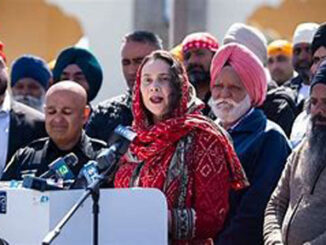
    SACRAMENTO (TIP): Sacramento area Sikh leaders have condemned the shooting that wounded two men at a Sikh gurdwara Sunday and marred what had been a weekend of joyous celebration.
    Two men were critically wounded in the afternoon shooting at the Gurdwara Sacramento Sikh Society on the 7600 block of Bradshaw Road, in Sacramento County’s Vineyard area where thousands had gathered Sunday for the temple’s first Nagar Kirtan, a traditional neighborhood celebration and parade.
    “There is no honor in causing harm to others including your own community,” Bobbie Singh-Allen, Elk Grove mayor and a parishioner of Gurdwara Sacramento Sikh Society told the local media.
    She was surrounded by parishioners and temple officials, at a Monday afternoon news conference on the gurdwara’s grounds. “We came to this country for a better life through the sacrifices of our parents and grandparents,” she was quoted as saying. “This is not the dream they imagined for their youth.”
    Two of the men were involved in a fistfight, the pair exchanging punches. A friend of one of the men shot a friend of the other combatant, Sacramento County Sheriff’s spokesman Sgt. Amar Gandhi said.
    The men, all in their 20s, were not part of the parade, but knew each other, Singh-Allen said Monday. “These displays of violence go against our Sikh faith. It is unfortunate that they brought their issues to a place of worship where everyone should feel safe.”
    The two men are expected to survive, Sacramento County Sheriff’s spokesman Amar Gandhi said. The suspected gunman, 21-year-old Karman Sandhu, was booked into Sacramento County Main Jail on suspicion of attempted murder charges and is being held without bail.
    One of the men who was shot will be booked into Sacramento County custody once he is released from the hospital, sheriff’s officials said. Gandhi said the men were of East Indian descent but did not know if they were of the Sikh faith.
    Gandhi said another firearm was found Monday on the temple grounds and that investigators were reviewing hundreds of interviews from witnesses who had crowded the festival.
    What brought them to the festival remained unclear Monday. “People don’t usually come to a place of worship to start trouble,” Gandhi said. Private security firm NorCal Security was hired to patrol the event but did not search or find weapons at the temple site.
    Organizers envisioned the Sikh Society’s first Sikh Parade as a replica of the traditional annual Sikh festival and parade in Yuba City, home to one the nation’s oldest Sikh communities. The festival draws tens of thousands of the faithful each year to agricultural Sutter County to celebrate faith and community. “It was just as beautiful as that,” Varinder Singh, a parishioner and one of the festival’s organizers said Monday.
    Sunday’s parade across nearly seven miles of south Sacramento County, was to be a capstone, according to the Bee. Then shots rang out. No one else among the thousands of revelers was hurt.
    The parade was halted briefly out of caution but soon resumed. Many of the revelers returned to the grounds for the evening’s services, a show, Singh-Allen said, of the community’s resilience.
    Singh-Allen and others singled out Gandhi, the sheriff’s sergeant, who ensured the Sikh holy scripture, carried at the parade, was returned to the gurdwara during an active crime scene.
    The Sacramento Sikh Society said it is unbowed. It plans for the weekend festival to be an annual event. March 31, 2024 is already marked for next year’s festival.
    “This is holy ground. This is a sanctuary. Everyone should feel safe and welcome here at the gurdwara, or any gurdwara,” Singh-Allen was quoted as saying.
    “This will not deter our community from coming together and openly celebrating our faith. We will work hard to make sure all future events will continue. We will not live in fear.”

  • Indian American Manmeet Colon becomes New Haven’s first Sikh assistant police chief

    Indian American Manmeet Colon becomes New Haven’s first Sikh assistant police chief

    NEW HAVEN, CT (TIP): Lt. Manmeet Colon, a Mumbai, India-born Sikh woman has become New Haven, Connecticut’s first ever assistant police chief of Indian descent and second ever female assistant chief of color.
    Surrounded by dozens of friends, family members, city workers, and police colleagues, Colon, 37, raised her right hand and took the oath of office as the city’s third assistant police chief in charge of patrol on Friday, local media reported.
    Colon’s older daughter Milan joined Colon’s brother Prabhjyot Singh in pinning Colon’s new assistant chief badge on her uniform, as Mayor Justin Elicker then administered the oath of office.
    “Your mom has done great things. She will do so many great things” to come, Elicker said through near-tears of his own as he looked over at Milan and her sister, Maya.
    Colon, who immigrated to the United States with her family when she was 11 years old hoped that she inspires others from similar backgrounds to pursue careers in law enforcement.
    “I come from a Sikh family. I speak Punjabi. I’m very proud of my heritage,” Colon was quoted as saying by the media.
    “More important is the mission and the values of the department. To me, it’s all about being fair and impartial. My background, my morals, my family values and traditions a I feel like I bring a lot to the table. I’m glad there’s a space for me at the table,” she added.
    Colon thanked her colleagues — and her family and friends — before closing out Friday’s ceremony. She urged her colleagues, especially on bad days, to “remind yourself of how privileged you are to be part of such a rewarding and strong profession.”
    “With great power comes great responsibility,” she said, “and ever greater accountability.”
    “A trailblazer, AC Colon is the 2nd woman of color & the 1st of Indian descent to serve in the position in the history of the NHPD – and I’m confident she will continue to serve our city w/honor & distinction in this new role,” Elicker tweeted.
    “This is a great day for the City of New Haven, and also for the Indian community and women of color in the city and state; another glass ceiling has been broken,” Police Commission Chair Evelise Ribeiro said.
    Colon, a 15-year NHPD veteran, has risen through the ranks and served in a wide variety of roles during her tenure with the NHPD, Ribeiro and Police Chief Karl Jacobson noted with praise.
    She has worked in patrol, as a detective in the special victim’s unit, as a sergeant supervising the robbery and burglary unit, as a lieutenant and district manager for Newhallville and Dixwell, and most recently as the head of the Internal Affairs division.
    “She was tough, but she was also very kind,” Jacobson said as he recalled working in patrol in the Hill at the same as when Colon joined the force a decade and a half ago. He said they both learned about what community policing truly looks like under the mentorship of Hill’s top cop at the time, now-retired Lt. Holly Wasilewski. Jacobson also noted how he brought his own daughter, who is studying criminal justice at University of New Haven, to Friday’s ceremony to be inspired by and take note of such an accomplished female police officer as Colon. “I brought her here because I want her to look up to you,” he said, pushing back tears as he looked over at Colon.

  • Indian American Congressman Ro Khanna bows out of Senate race

    Indian American Congressman Ro Khanna bows out of Senate race

    WASHINGTON, D.C. (TIP): Indian American House of Representative member Ro Khanna, who was considering a bid for the US Senate has announced he will not be running for the upper chamber next year.
    Khanna, who represents Silicon Valley in the Congress is instead endorsing fellow Democratic Rep. Barbara Lee and will co-chair her campaign in the competitive race to replace Sen. Dianne Feinstein.
    Khanna, who was considering his own bid for the US Senate seat that Feinstein will vacate at the end of her term, told media he decided the House was “the best place” for him at the moment.
    “I have concluded that despite a lot of enthusiasm from Bernie [Sanders] folks, the best place, the most exciting place, action place, fit place for me to serve as a progressive is in the House of Representatives, and I’m honored to be co-chairing Barbara Lee’s campaign for the Senate and endorsing her today,” he said to media.
    “We need a strong anti-war senator, and she will play that role,” he said. Lee is facing off against fellow Reps. Katie Porter and Adam Schiff, who have each already picked up key endorsements, from Sen. Elizabeth Warren and former House Speaker Nancy Pelosi, respectively.
    As a leader in the House Progressive Caucus, Khanna’s endorsement could help Lee shore up progressive support in what’s expected to be a competitive — and expensive — race, according to a report.
    “I have respect for them,” Khanna said of Porter and Schiff, “but Barbara Lee is a unique voice. She was the lone vote against the endless war in Afghanistan. She stood up so strongly against the war in Iraq. She worked with me and stopping — trying to stop the war in Yemen and the war powers resolution.”
    Khanna also noted that there are currently no African American women in the Senate, and Lee would fill that void. “Frankly, Jake, representation matters,” Khanna told the media. “The other two are formidable candidates, but I think Barbara Lee is going to be very, very strong.”
    Feinstein, 89, the longest-serving woman in Senate history, announced her plans to forgo a 2024 bid last month.
    California’s primary system allows the top two vote-getters to advance to the general election regardless of party, a system that’s likely to pit two Democrats against each other in November 2024 in a solidly blue state.

  • Indian-origin Sikh student assaulted in Canada, turban ripped off

    Indian-origin Sikh student assaulted in Canada, turban ripped off

    VANCOUVER (TIP): In an apparent hate crime, a 21-year-old Sikh student from India was attacked in Canada’s British Columbia province by a group of unidentified men who ripped off his turban and dragged him across the sidewalk by his hair, according to a media report.
    Gagandeep Singh was assaulted when he was heading home on Friday night, media reported. Councilor Mohini Singh said she heard of the attack shortly after it happened and went to visit Gagandeep.
    “I was horrified when I saw him. He could speak only in soft tones and couldn’t open his mouth,”‘ she told the media. She said the young man’s eyes were swollen shut and he was in significant pain.
    The councilor said she was told that Gagandeep was heading home around 10.30pm after grocery-shopping when he encountered a group of 12 to 15 young people on the bus. It was St Patrick’s Day and Mohini Singh said a rowdy group was on the bus, throwing a wig around.
    “They were harassing him and threw the wig at him. He told them not to bother him or he’d call the police, and they continued to harass him,” she said. Gagandeep got off the bus.
    “They got off after him, waited for the bus to leave and then they swarmed him, they beat him in his face, in his ribs, arms, and legs and then proceeded to grab his turban, pull his hair and drag him,” Mohini Singh said, adding that the group took the turban with them when they left Gagandeep in a pile of “dirty snow” on the roadside.
    “Taking his turban was the worst, it feels like they’ve taken it as a trophy.”
    After he regained consciousness, Gagandeep called a friend who came to the scene and called 911. Mohini Singh said Gagandeep’s friends and fellow international students had been left shaken and scared by the attack, prompting a gathering at the bus stop on Sunday where they spoke out about how they felt less safe in their community.
    The councilor said the fact that Gangandeep is Sikh and from India was “undoubtedly” a factor in the assault.
    “I entirely believe this is racism and it should be treated as that. It should be looked at through the lens of being a hate crime. This is so wrong on so many levels. This is not something that is acceptable anywhere — not in Kelowna, not anywhere,” she said.
    “This is intolerable, it’s absolutely disgusting.”
    The Kelowna Royal Canadian Mounted Police, in a statement, confirmed that they are investigating after someone was “hit from behind and assaulted” by a group of people at the bus stop on Friday evening and that responding officers found the victim “lying on the ground”. No details about injuries were provided but authorities said the victim was taken to hospital by paramedics. “The Kelowna RCMP take this very seriously and are concerned that this type of crime has happened in our city,” spokesperson Constable Mike Della-Paolera said. “This assault is the top priority for our investigators.”

  • Indian American 5-year old Mya Patel’s killer sentenced to 100 years in prison

    Indian American 5-year old Mya Patel’s killer sentenced to 100 years in prison

    LOUISIANA (TIP): A Louisiana man responsible for the shooting death of Mya Patel, a 5-year-old Indian American girl who was playing in a motel room with her family, will spend the rest of his life in jail.
    Joseph Lee Smith, 35, will spend the next 100 years in prison, Caddo Parish District Attorney’s Office announced on March 23, local media reported. Smith was found guilty in January 2023.
    District Judge John D. Mosely Jr. sentenced Smith to 60 years for the March 2021 death of Patel. Smith will also serve 20 years for obstruction of justice, and another 20 years for aggravated battery.
    His terms will be served without the benefit of probation, parole or reduction of sentence. And his sentences will be served consecutively, for a total of 100 years.
    The DA’s office said in a press release that “the terms were enhanced by Smith being a repeat felony offender and must be served consecutively, for the total of 100 years.”
    Back on March 20, 2021, Smith got into some sort of argument with another man in the parking lot of the Super 8 Motel in the 4900 block of Monkhouse Drive, Shreveport, Louisiana.
    At the time, the motel was owned and operated by Vimal and Snehal Patel, who were living in one of the units on the ground floor. The Patels were in their room with their daughter, Mya, and a younger sibling when the shooting happened. During the argument, Smith hit the other man with a 9 mm handgun, which went off. The bullet missed the other man but went into the room where the Patels were living and hit Mya in the head; the bullet also grazed Snehal. Patel was rushed to Ochsner LSU Health, where she battled for three days and was pronounced dead on March 23, 2021.

  • Four reasons the Sikhs are hurting. And it’s not about the K-word

    Four reasons the Sikhs are hurting. And it’s not about the K-word

    ‘Causes’ of anger are dera threat to Sikhism, incarceration of ‘Bandi Singhs’, inaction in sacrilege cases, & ‘if BJP-RSS want Hindu Rashtra, what’s wrong with Sikh Rashtra?’

    By Shekhar Gupta 

    There are two most important similarities between the mood in Punjab today and at the peak of the earlier crisis in the early 1980s. The first similarity is the good one. If you walk around Punjab and ask a random sample of Sikhs if they believe in creating a state separate from India — or what is loosely called Khalistan — the chances are that a very, very large majority will say no. It will be unanimous unless you run into an oddball.

    Many may even ask you to get your head examined. The fact is — although many in these new nationalist times elsewhere in the country might find it difficult to believe it — that’s how it was in the Bhindranwale era too.

    The second similarity is the tough one. You ask the very same people who laugh at the fantasy of a nation separate from India if they think Sikhs are victims of multiple, serious, and egregious injustices, and the answer — you’d be surprised from how many — will be yes. That’s precisely how it was in that past.

    The sense of injustice is, and was, righteous and deep. The line you heard then was the same as what you’d hear now: that the Sikhs are victims of dhakka or grave injustice.

    The ‘causes’ of the current anger and alienation are broadly four: sectarian deras (let’s say seminaries-cum-permanent congregations) as an existential threat to Sikhism, the continued incarceration of ‘Bandi Singhs’ (imprisoned Sikhs, as in the nine convicted on terror and assassination charges and held on long jail sentences). Third, that those guilty of sacrilege at Sikh shrines and for alleged desecration haven’t been caught or punished. And the fourth is a rhetorical one, that if the BJP and RSS say they’re building a Hindu Rashtra, what’s wrong with a Sikh Rashtra?

    Each one of these has nuances and arguments. And while I know it’s easy to respond to these with irritation and anger, it won’t serve any purpose. In fact, if we accept that there is a challenge in Punjab today, any realistic progress can only be made if the rest of the country, especially the government and the ruling party, engage with this sense of grievance. This is no call for appeasement. Just that debate and an open mind never hurt anybody.

    Two of these four, impunity for perpetrators of sacrilege, and deras, are to be read together. The larger fear, as in the 1980s, is that Sikhism is greatly threatened by ‘blasphemers’ pretending to be Sikh Gurus. In the past, the target was the Nirankari sect, now it is the heads of the deras. The first targeted attacks in the past were aimed at the leaders of the Nirankari sect, including its chief.

    Now the anger is with the various new babas who claim to be religious teachers but are seen by the devout Sikh as packaging themselves as modern-day Gurus. This is blasphemy in Sikhism. They are seen to dress and turn out like the Gurus and attract vast populations of Sikhs into their fold.

    The foremost of these is the rape/murder convict Gurmeet Ram Rahim Insan. The last three words of his name were added hurriedly as he faced heat from devout Sikhs for pretending to be a Guru. That’s why the suffixes of a Hindu and a Muslim name to assert a secular view, and Insan (human being) to deny any claim to divinity.

    On the ground, however, it makes no difference. His followers are increasing, his deras are being run as if he isn’t missing. And is he missing at all, in spite of his conviction and sentencing for rape and murder? These are the questions the Sikhs ask with a sense of hurt and anger.If he’s guilty of rape and murder, how does he seem to get more time out of jail on parole than inside? How does he get these long spells of parole as any election in the region, especially in Haryana, approaches? And so many political leaders, especially of the BJP, paying obeisance to him. The widespread belief among the Sikhs is that his followers were responsible for the incidents of ‘sacrilege’ and his political clout is the reason no government — Akalis, Congress, or AAP — has dared to catch and punish the guilty. He owns transferable vote banks.

    You want to know how strong this sentiment is, think about the recent lynchings — including one in the Golden Temple — of people caught by the devotees on mere suspicion of sacrilege. The once formidable Punjab Police have drawn as much of a blank in catching and punishing those guilty of these lynchings as in the earlier ‘sacrilege’ incidents. Of course, you haven’t seen any popular revulsion among devout Sikhs or the clergy at the lynchings.

    An added feature of the same insecurity that others are creeping in to convert Sikhs to other faiths and sects is the new wave of Christian evangelism. The most recent fight Amritpal Singh picked was with Christian pastors, who pushed back with protests. A lot of Sikhs, especially from the Scheduled Castes, patronize these new churches just like many more go to the deras. In each case, it is seen as a threat to traditional Sikhism. Just how popular these churches and pastors are becoming, you can read in this fine story by Chitleen Sethi. What triggers the Sikh conservatives even more is the fact that many of these pastors still dress in traditional Sikh attire.

    For any political party or coalition ruling Punjab, it would’ve been easier to handle these if the state, or more precisely its electorate, was as homogenous as many outsiders think it is. The state is a bit less than 60 per cent Sikh (2011 census). Among the Sikhs also, there are wide divisions. The most dominant and visible class and caste, Jatt Sikhs, make up barely 20 per cent of the total population. The state also, counterintuitively, has the largest percentage of Dalits of any state in the country, at almost 33 per cent. Or one in three. They are the ones among whom evangelists — whether of the deras or Christianity — find the most purchase. The third grievance, over what is called the ‘Bandi Singh’ issue, needs a close look. Again, we might all benefit from reading this story Chitleen had written explaining the problem.

    Briefly, however, this is about just nine prisoners, serving time for about 25-32 years after conviction on terror charges. Six of them were convicted for the assassination of then Punjab chief minister Beant Singh on 31 August, 1995. The remaining three were convicted for terror bombings.

    These include Beant Singh’s assassin Balwant Singh Rajoana, who told journalists outside a dental clinic where he had been taken for treatment that he doesn’t even want to be released. Among the bombers, the most prominent is Devinder Pal Singh Bhullar, convicted for the 11 September 1993 bombing in Delhi where the Congress’s Maninderjeet Singh Bitta survived, albeit with a battered body, and nine others died. His death sentence was commuted to life by the Supreme Court. A campaign has raged for more than a year now for their release.

    While it is true that even the Sikh clergy and the SGPC hailed Beant Singh’s assassins, and that the Akali Dal keeps fielding Rajoana’s sister as a candidate in elections, Sikhs you speak with won’t by and large go into whether what they did was right or wrong. They ask a more searching question.

    Rajiv Gandhi, they say, was assassinated at around the same time. His convicted assassins, serving life sentences, have been released on compassionate grounds. Why is this compassion reserved only for non-Sikhs? No political leader in Punjab has the intellect or spine to engage with the protesters on this. On the other hand, they’ve been trying to set the ‘Bandi Singh’ protesters against Amritpal Singh’s support base. That’s some political ‘genius’, isn’t it!

    The last point: If Modi, the BJP and the RSS can proudly say that India is a Hindu Rashtra, why can’t we have a Sikh nation? It will bring us back to the old point: the deep BJP/RSS belief that the Sikhs are Hindus who look different and follow one of the many ways of prayer and worship in Hinduism, so why should they complain. That’s a fundamental misreading, and serious errors of judgement flow from it. Muslims aren’t the only fellow Indians triggered by the talk of a Hindu Rashtra.
    (Republished from The Print, March 25, 2023 )
    (The author is Editor-in-Chief and Chairman, The Print)

  • Sikh History This Week- March 24, 2023, to March 30, 2023

    24th March
    1664 Guru Har Krishan Ji visited Aurangzeb’s court. This is the time Guru Sahib visited Aurangzeb’s court, when Ram Rai emphatically declared that the decision of his father in selecting his younger brother as his sucessor to the pontificate of Guru Nanak was based on cogent reasons, and that he was now under the command of the new Guru.
    1847 The British being aware of the Sikh’s emotional and sentimental attachment to Golden Temple and other shrines, issued special instructions to the British subjects to be careful in maintaining the sanctity of the shrines.
    1922 Meeting at Rajowal by Kishan Singh Gargaj group to devise ways and means of reforming the toadies
    1945 Master Tara Singh denounces the Acharyae Formula.
    25th March
    1830 Baba Ratta Ji Nirankari was born.
    1921 13th Sikh Education Confernce was held in Hoshiarpur that and lasted until Mar. 27. This conference saw the rise of miltant Akalis who advocated non-cooperation with the British government and were deeply inspired by Master Mota Singh. They met sperately and created disturbances in the conference as well as worked on a sperate program. They were equally patriotic believing in the militant traditions of the Nihangs.
    1921 The militant Akalis hatched a conspiracy to murder the officials respobsinle for the Nanakana carnage. 1972 Mohan Singh Tur became President of Akali Party. 1981 The SGPC unanimously passed the resolution “Sikhs are a Nation.” With the passing of such a resolution by the Sikh Parliament and with the ratification of this resolution by the Jathedar of the Akal Takht on April 21, 1981, the issue stood finally decided by the whole of the Sikh nation. On May 11, 1981, the Akali Party also passed a resolution to that effect.
    1986 Surjit S. Barnala himself ordered firing at the Sikhs who were observing holy festival at Anandpur Sahib, killing several Sikhs.

    26th March

    1644 Gur Gadhi Diwas, Guru Har Rai Sahib Ji (1644).
    1746 The forces of Yahiha Khan and Lakhapat Rai seized and set fire to the Kahnuwaan forest. 7,000 Singh were martyred here while another 3,000 were taken to Lahore and martyred there.
    1746 Matta Sunder kaur Ji sent a mace of Kalgidhar to honor Jassa Singh Ahluwalia.
    1748 Raja Amar Singh of Patiala was born. He was a thorough gentleman.
    1923 Amar Singh, granthi of Kot Fatuhi, is arrested

    27th March
    1843 Raja Suchet Singh murdered. Raja Suchet Singh was brother of Raja Dhiyan Singh Dogra and Gulab Singh Jammu. He was a popular propenent of Sikh Raj. Sher-e-Punjab, Maharaja Ranjit Singh, personally bestowed the honor Raja on Suchet Singh.
    1923 Hazara Singh Sirbrah of Behbalpur is murdered.
    1924 The 4th shahihi jatha of 500 valiant Akali satyagrahies, led by Sardar Puran Singh Bahowal, marched from Anandpur Sahib to Gangsar, Jaito.

    28th March


    1552 Gur Gadhi Diwas, Sri Guru Amar Das Sahib.
    1620 Guru Hargobind Ji had to marry Nanaki despite his refusal. This was an unfortunate upshot of the jubilation in Sikh community caused by Guru Sahib’s release from seven years of incarceration. Within a few months two brides were pledged to him by their parents. Under the customs prevalent at that time, on Guru Hargobind’s refusal, those girls would have remained unmarried throughout their life. So he had to marry Nanaki on March 28, 1620, and Mehrai also called Marwahi on July 10, 1620. The first incident occurred too close to his release. Taken aback at the second incident, he announced that no one should pledge his daughter to him in future.
    1965 SGPC resolves at its general meeting to establish Punjabi Suba.

    29th March

    1552 Second Patshahi, Guru Angad Dev Ji departed this planet from Khadur Sahib. He served as Guru for 12 years and none months. Today is the actual date of joti jot, though its is observed on a different date by Guru Khalsa Panth.
    1552 Third Patshahi, Guru Amar Das Ji ascended to Guruship of Sikhsism. Amardas was influenced to Sikhims by Bibi Amro, daughter of Guru Angad Dev Ji. She was married to Amardas’s nephew. Bibi Amro was a very pious woman. She would get up early in the morning, take a bath and start reciting the hymns of Guru Nanak. One day Amardasheard Bibi Amro sing Guru Nanak’s Jap Ji and pauris of Asa-di-var. He was touched by the divinity and peity of the hymns. He learnt those gymns from her and started reciting them every morning.
    1699 Baisakhi day, Guru Gobind created the Khalsa order at Anandpur Sahib. Earlier Hukamnamahs were sent to Sikhs all over Hindustan and beyond to vist Anandpur. The people were asked to visit with their hair unshorn. The hill chiefs, who, according to one account, were taken into confidence about Guru’s program, were present in strength. He Abolished the corrupt and debased institution of ‘masands’. Created a small regular army and fortified Anandpurs with a ring of smaller fortresses around it.
    1748 The Sikhs assembled at Amritsar on Baisakhi day and by a gurmatta, decided to form Dal Khalsa by reorganization of over 60 arms jathas, bands, into eleven associatios (misls) under the overall command of’ Jassa Singh Ahluwalia. Nawab Kapur Singh because of his age sought retirement from active overall leadership.
    1922 Akali Dal renamed as “Shiromani Akali Dal”.
    1940 The Khalsa National Party at its meeting in Lahore, under Sunder Singh Majithia, saw danger in the division of India into Hindu and Muslim independent states, and said that the Sikhs would not tolerate for a single day the unadultrated communal rule of any community. As a logical sequence, it asked for restoration of Sikh sovereignty of Punjab, which was held in trust by the British during the minority reign of Maharaja Dalip Singh.
    1981 SGPC adopted the motion “Sikhs are a Nation”. When the Presdient Gurcharan Singh Tohra, was asked the question that the SGPC was turning political, he answered “On October 10, 1946, Ishar Singh Mahjaiol, had moved in the house a resolution for the creation of a Sikh State. The resolution was seconded by Sardar Swaran Singh. The “Sikhs Are a Nation” proposal was part of S. Ganga Singh Dhillon’s speech at 54th All India Sikh Educational Conference that took place on March 13, 14, and 15, 1981. In his presidential address, S. Ganga Singh Dhillon wrote: “SIKHS ARE A NATION We all are born equal, with a human right to preserve our religious and cultural heritage, improve our economic inheritance and freedom to mould our destiny.

    30th March

    1664 Patshahi Eighth, Guru Harkrishan Ji, left this planet for heavenly abode from Delhi. He was eight years of age, when he took over on himself the sufferings and sins of the people of Delhi. As a result, he left for heavenly abode. Today is the actual date of joti joot, though it is observed differently by Guru Khalsa Panth.

  • Zampa, Agar have a ball as Oz win series

    Zampa, Agar have a ball as Oz win series

    Chennai (TIP)- Leg-spinner Adam Zampa took four wickets as Australia beat India by 21 runs to clinch the three-match ODI series 2-1 here on March 22. Electing to bat, Australia could not capitalise on a strong start and were bowled out for 269 in 49 overs on a slow track.
    Their bowlers, led by Zampa, did an excellent job defending the total and bowled out India for 248 in 49.1 overs as Australia exacted a modicum of revenge after losing the four-Test series 1-2. While Zampa was the pick of the Australia bowlers, left-arm spinner Ashton Agar turned the match on its head by removing Virat Kohli, whose 54 was the highest score by a batsman from either side, and Suryakumar Yadav in successive deliveries. It was a third straight golden duck for Suryakumar.
    For the hosts, Hardik Pandya claimed bowling figures of 3/44 and made a run-a-ball 40 but it was not enough to avoid India’s first series loss on home soil since Aaron Finch’s Australia beat them in 2019.
    India began briskly with Rohit Sharma (30) and Gill (37) playing a few attractive shots. Kohli tried to forge partnerships with KL Rahul (32) and with Pandya but he looked tired by the end. Zampa effectively decided the match by removing Pandya.
    Brief scores: Australia: 269 in 49 overs (Marsh 47, Carey 38; Pandya 3/44; Yadav 3/56); India: 248 in 49.1 overs (Kohli 54, Pandya 40; Zampa 4/45, Agar 2/41).

  • Ronaldo, Kane break records in wins for Portugal, England

    Ronaldo, Kane break records in wins for Portugal, England

    London (TIP)- It was a record-breaking night for Cristiano Ronaldo and Harry Kane as qualifying for the European Championship in 2024 got underway on Thursday, March 23.
    Already the leading scorer in men’s international soccer, the 38-year-old Ronaldo now has more international appearances than any other male player after racking up No. 197 in Portugal’s 4-0 win over Liechtenstein.
    The former Real Madrid and Manchester United striker marked the occasion by converting a penalty and adding another second-half goal — a powerful free kick from the edge of the area — to move onto 120 in international matches. Kane, meanwhile, became England’s outright leading scorer of all time by netting a first-half penalty in a 2-1 win at Italy. It lifted Kane to 54 goals for his country, one more than Wayne Rooney. Qualifying for Euro 2024, which will take place in Germany, started three months after the World Cup finished.
    BELATED REVENGE
    Call it belated revenge for England. The meeting with Italy in Naples was a repeat of the Euro 2020 final won by the Azzurri at Wembley Stadium. The teams have met since then — twice, in fact, with Italy gaining a win and a draw in Nations League qualifying last year.
    This time, England held on after first-half goals by Declan Rice and Kane, who tucked away a spot kick awarded following a VAR review after it was determined that Italy defender Giovanni Di Lorenzo touched the ball with his hand while attempting to prevent Kane from reaching a corner.
    Kane had missed his last penalty attempt for his country, late in the 2-1 loss to France in the World Cup quarterfinals last year.
    “It had to be a penalty, of course,” a smiling Kane said of his record goal. Argentina-born forward Mateo Retegui, who has Italian citizenship through his maternal grandmother, pulled a goal back on his debut and England played with 10 men from the 80th after left back Luke Shaw collected two yellow cards in the space of 54 seconds.
    Italy lost to England in a competitive match for the first time since a World Cup qualifier at Wembley back in 1977.
    It was a disappointing way for the Azzurri to start their latest qualifying campaign for a major tournament, having failed to get into the last two World Cups.
    “We might be starting with an uphill struggle this time,” Italy coach Roberto Mancini said, “but let’s hope we end it better.”
    North Macedonia beat Malta 2-1 in the other match in Group C, which also contains Ukraine.
    EASY FOR PORTUGAL
    Roberto Martinez enjoyed a comfortable start to his tenure as Portugal coach after handing Ronaldo a start against Liechtenstein.
    The striker was left out of Portugal’s knockout-stage matches at the World Cup but was selected up front alongside Joao Felix — and repaid the faith shown in him by Martinez, who left his role as Belgium after the tournament in Qatar. Source: AP

  • Lionel Messi reaches historic 800-goal mark with incredulous free-kick

    Lionel Messi reaches historic 800-goal mark with incredulous free-kick

    Lionel Messi’s Argentina made a return for the first time since lifting the World Cup last December, as they beat Pana 2-0 in an international friendly on Thursday, March 23. Thiago Almada and Messi were on target in a festive atmosphere at the Monumental Stadium in Buenos Aires, as manager Lionel Scaloni picked the same starting XI that also played in the World Cup final against France. Argentina couldn’t break through the Panama defence in the opening half of the match but Almada broke the deadlock with his first international goal, thanks to a rebound from a Messi free-kick.
    The Argentine captain, then, finally scored his 800th career goal with a free-kick that went into the top-right corner of the goal. His 89th minute goal doubled Argentina’s lead, ensuring a victory for the side in front of a 80,000-strong crowd at ‘El Monumental’. Messi became the second footballer to reach 800 goals after Cristiano Ronaldo of Portugal, who has 830 career goals to his name.
    A post-match ceremony was also organised by the Argentina Football Association to celebrate the country’s FIFA World Cup victory; it was the country’s third title and their first in 36 years.

  • Ram Navami: The birth of Lord Rama

    Ram Navami: The birth of Lord Rama

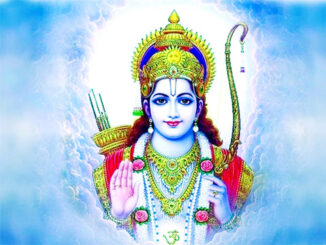
    Ram Navami, also marks as the birth of Lord Rama, the seventh incarnation of Lord Vishnu, is being observed on Thursday, March 30, this year. The auspicious festival of Ram Navami coincides with the last day of Chaitra Navratri. Chaitra Navratri is an auspicious nine-day festival starting next week. The word “Rama” literally means one who is divinely blissful and who gives joy to others, and one in whom the sages rejoice.
    According to Hindu mythology, Lord Rama was born on Navami Tithi during Shukla Paksha of Chaitra month. And hence, this day is celebrated as the birthday of Lord Rama each year.
    It is believed that Lord Rama was born during the Madhyahna period which is the middle of the Hindu day. Madhyahna which prevails for six Ghatis (about 2 hours and 24 minutes) is the most auspicious time to perform Ram Navami Puja rituals, according to Drik Panchang.
    Bhagwan Rama exemplified the perfect person (maryada purushottam). He was the embodiment of compassion, gentleness, kindness, righteousness and integrity. Although he had all the power in the world, he still was peaceful and gentle.
    His reign in Ayodha is referred to as Ramarajya, the epitome of perfect governance. Ayodhya was the capital founded by the king-rishi Manu. During the reign of King Dasharath, Ayodhya reached a period of great prosperity. But Dasharath had one problem–he had no children. Therefore he decided to perform the ashvamedh sacrifice. Elaborate and difficult rituals had to be observed. Rishi Rishyashring presided over the yagya. The performance of this sacrifice was a great event in Ayodhya. At the end, Rishyashring recited a Mantra and made an offering to the fire. Then the gods, gandharvas, siddhas, and rishis present around began to pray to Brahma. During that time Ravana, the king of Lanka, was terrorizing the people, and they were longing for liberation from his menace. Ravana had acquired great power because he had obtained from God Brahma the boon that he would never die at the hands of gods, or gandharvas, or yakshas (demigods) or demons. As he was not afraid of men, he did not care to include men in the list of his potential slayers. So Brahmadev declared that Ravana would die at the hands of a man. Then the gods went to Vishnu for help and requested him that since Dasharath was a glorious king, that He take birth in the wombs of his three queens in four different incarnations of His divinity. When Dasharath’s sacrifice came to an end, a shining figure appeared over the sacrificial kund, and offered the king a divine beverage called “payasam”, which was to be given to his queens Kausalya, Kaikayi, and Sumitra. In due time, Kausalya gave birth to Rama, Kaikayi to Bharat and Sumitra to Laxman and Shatrugna.
    The Sun is considered to be the progenitor of Rama’s dynasty, which is called the Solar Dynasty (Raghukula or Raghuvamsa – Raghu means Sun and Kula or Vamsa mean familial descendant). Rama is also known as Raghunatha, Raghupati, Raghavendra etc. That all these names begin with the prefix Raghu is also suggestive of some link with Sun-worship. The hour chosen for the observance of the Lord’s birth is that when the Sun is overhead and is at its maximum brilliance. In some Hindu sects, prayers on Ramnavami day start not with an invocation to Rama but to Surya (Sun). Again the syllable Ra is used in the word to describe the Sun and brilliance in many languages. In Sanskrit, Ravi and Ravindra both mean “Sun”.
    Significance
    The story of the Ramayan is a classic, eternal, universal message of Dharma versus adharma, of deva versus demon, of good versus evil, as represented in the battle between Rama and Ravana. Ravana was a brahmin; he was a great scholar who wrote numerous works on scriptural philosophy. He was powerful, dynamic, and beautiful in appearance. As the brilliant, handsome king of Lanka, he had everything one would need to be happy and peaceful. Yet, he was arrogant, egoistic, greedy and lustful. His insatiable desires led him to crave more and more power, more and more money, and more and more ladies to fulfill his every whim.
    There is one main difference: Bhagwan Rama’s heart overflowed with divinity, love, generosity, humility, and a sense of duty. Ravana’s heart, in contrast, was filled with avarice, hatred, and egoism. Under Bhagwan Rama’s divine touch, the animals became his devotees and his divine helpers. Under Ravana’s touch, even humans became animals.
    Through his noble and divine choices, he teaches the world to choose dharma over Artha (when he leaves for the forest rather than be coronated as King) and to choose Moksha over Kama (when he chooses his kingdom over his marriage).
    Bhagwan Rama teaches that :
    As a son
    Respectfully and lovingly obey your father’s orders. Sacrifice your own comfort for your father’s dignity.
    As a step-son
    Even when your step mother (or mother-in-law) is not kind to you, even when she clearly dis- criminates against you in favor of her own birth child, do not resent her, do not fight against her. Respect her and her wishes.
    As a brother
    Remain loyal to your brother. Care for him.
    As a husband
    Protect your wife. Fight for her protection and her purity. But there are times when one’s divine path must even take precedence over the path of householder. Do not keep the role of householder as the ultimate role.
    As a King
    Sacrifice everything for your people. Do not worry about your own comfort, your own convenience or your own pleasure. Be willing to put the kingdom ahead of your own needs.
    Pilgrimage
    People visit sacred places associated with Lord Ram during this holy time. Places like Ayodhya, Ujjain and Rameshwaram attracts thousands of devotees across the country. In Rameshwaram, thousands take a ritual bath in the sea before worshipping at the Ramanathaswamy temple. Many places in North India host fairs in connection with the festival, culminating in spectacular fireworks on Rama Navami.
    It is said that the repetition of his name (Rama Nama) is the surest, fastest and easiest way to attain purity, peace, wisdom, understanding, joy, prosperity and ultimately liberation. Bhagwan Rama Himself said, “Repetition of My name once is equal to the repetition of one thousand names of God or to the repetition of a Mantra one thousand times.”

  • New IPL Rule: Captains allowed to name playing XI after toss

    The captains of IPL teams can name their playing eleven after the toss instead of handing over team sheets before the spin of coin, stated the new playing conditions issued by the BCCI.
    According to playing conditions clause 1.2.1: “Each captain shall nominate 11 players plus a maximum of 5 substitute fielders in writing to the IPL Match Referee after the toss.”
    “Other than set out in Clause 1.2.9 no player (member of the playing eleven) may be changed after the nomination and prior to the start of play without the consent of the opposing captain.”
    This effectively means that after the toss, if a skipper feels that he needs to change his eleven as per demands of the situation, he is free to do that till the match starts.
    The other significant change in playing conditions is penalising unfair movement by the wicketkeeper in case there is shift in position before the batter meets the ball.
    In the event of unfair movement by the wicket-keeper, either umpire shall call and signal dead ball and inform the other umpire the reason for doing so. The bowler’s end umpire shall then: “award the one-run penalty for Wide or No ball, if applicable or award 5 Penalty runs to the batting side. Inform the captain of the fielding side of the reason for this action. Inform the batters and, as soon as practicable, the captain of the batting side of what has occurred.”
    The “Impact Substitution” where a new player can be introduced during the match from the five designated substitutions had already been announced by the tournament committee.

  • Jaisalmer: The Golden City

    Jaisalmer: The Golden City

    Jaisalmer is a prominent tourist spot located in the northwestern state of Rajasthan in India. It is known as the ‘golden city’ due to its golden dunes and castles clad in golden honey sandstone. Jaisalmer is adorned with lakes, ornate Jain temples and havelis. Climb onto the camel saddle and make your way through this desert to camp under the starry night sky for an unforgettable experience.
    The Jaisalmer Fort stands as a citadel with narrow alleys inhabited by people for generations and shops selling colourful handicrafts.
    Jaisalmer is a town, and to reach the Sand Dunes, travellers have to take a jeep safari followed by a camel ride. Thus, Jaisalmer is an amalgamation of exotic Indian desert culture, heritage and adventure.
    JAISALMER FORT
    Perched on top of a small hill, this large fort makes for a mesmerising sight. Also known as the Golden Fort, it is surrounded by a 30 foot high wall, and has over 99 bastions and some imposing gateways or pols. It has been inhabited for centuries, and encloses houses, handicraft shops, palaces, temples, hotels and restaurants, connected by cobble stone paths.
    The main square here is called the Dussehra Chowk, while the main palace is the Rajmahal. This seven-storey building was the residence of the former rulers. Its façade is embellished with stone carvings, while its interior houses the Jaisalmer Fort Palace Museum and Heritage Centre. The rooftop offers panoramic views of the city.
    JAIN TEMPLES
    This set of seven Jain temples lies inside the walls of the Jaisalmer Fort. They are connected to each other, and are all adorned with intricate carvings of mythological and dancing figures. These yellow sandstone temples were built between the 12th and the 16th centuries. They are dedicated to various tirthankaras. The largest of them, the Parsvanath Temple, is dedicated to the 22nd tirthankara.
    PATWON-KI-HAVELI
    This ornate haveli is among the most splendid in Jaisalmer. It consists of a set of five houses, which were built by five Jain merchant brothers in the 19th century. Their exterior is covered with intricate carvings. Inside, some of the walls are decorated with paintings and mirror work. The buildings comprise of a set of rooms, constructed around a central courtyard. There’s also a shop selling embroidered textiles and brocades.
    SAM SAND DUNES
    These shifting white sand dunes, located close to the village Sam, are a great way to explore the Thar desert. They are located 45 kilometres from Jaisalmer. The best way to explore the desert is through camel rides. The dunes look especially picturesque at sunset and sunrise.
    You can also stay here overnight to enjoy the campfires and folk music and dance performances held every evening. Rajasthan Tourism Development Corporation runs the Sam Dhani Resort on a hillock in front of the dunes. It has cottages and tents, which are perfect for a peaceful retreat.
    SALIM SINGH-KI-HAVELI
    This haveli was built by Salim Singh, the prime minister of Jaisalmer in the 19th century. Its most eye-catching feature is its beautiful arched roof with carved brackets shaped like peacocks, and pretty balconies below it. The haveli is also distinct because it’s been constructed entirely of stone, without the use of cement or mortar. A part of the haveli is still occupied, but it’s worth a visit primarily for its exquisitely designed exterior.
    BADA BAGH
    This garden, located on the outskirts of Jaisalmer, contains the cenotaphs of the Rajpur rulers. These are pyramidal and domed in shape, and have beautiful carved ceilings and equestrian statues of the rulers. Each chhatri also has inscribed tablets recording the death of the Maharawals. There’s also a set of windmills nearby, which make for a picturesque sight. There are several other attractions close to Bada Bagh. Amar Sagar consists of a beautifully-carved Jain temple located on the banks of a water reservoir. Lodhurva, the former capital of the Bhatti Rajputs, is now in ruins but it still has magnificent Jain temples with a gorgeous gateway. The main temple contains several beautiful sculptures and a silver image of Parsvanath, the 23rd tirthanakara.
    GADSISAR LAKE
    The beautiful rainwater lake is surrounded by numerous temples and pavillions, and offers magnificent views of Jaisalmer Fort. It was built by Maharawal Gadsi in the 14th century, and used to be the major source of drinking water for the city of Jaisalmer. It attracts water birds in winter and is a popular spot for bird watching, picnics and boating. There’s a lovely gateway called Tillon ki prol near the lake, built by a royal courtesan named Tillon.
    NATHMAL-JI-KI-HAVELI
    This 19th century haveli was built by two architect brothers, who designed their sections independently but with remarkable harmony. It has a beautifully carved exterior, while the interior is decorated with miniature paintings. Two yellow sandstone elephant figures guard the entrance to the haveli. There is no entry fee, but the family living here sells paintings and knick-knacks to tourists.

  • India’s Minister for Jal Shakti Gajendra Singh Shekhawat accorded a civic reception at the Indian Consulate

    India’s Minister for Jal Shakti Gajendra Singh Shekhawat accorded a civic reception at the Indian Consulate

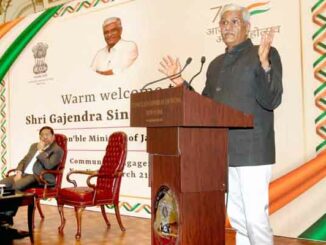
    Gajendra Singh Shekhawat, India’s Union Minister for Jal Shakti during a Q&A session after delivering a talk at the Indian Consulate on March 21, 2023. (Photo : Jay Mandal- On Assignment)
    Photo:-Jay Mandal/On Assignment

    NEW YORK (TIP): India’s Union Minister for Jal Shakti Gajendra Singh Shekhawat was accorded a civic reception at the Indian Consulate here on March 21, 2023. The visiting minister who spoke in Hindi dwelt on the phenomenal work India had done in the field of water management. He claimed that safe drinking water has been made available in the entire country. There were areas earlier where water was too scarce for human survival, and people had to travel miles to fetch drinking water. He said that the situation has changed. In the field of agriculture, too, the drought prone areas have been identified and plans drawn to reach water where required.

    To a question on connecting rivers of India, as suggested by the former President of India Dr. Abdul Kalam, the minister said that the former Prime Minister Atal Behari Vajpayee was enthusiastic about the proposal. The proposal which had gone into cold storage is now being reconsidered. Consul General of India Randhir Kumar Jaiswal moderated the question answer session. Deputy Consul General Dr. Varun Jeph thanked the visiting minister and the guests. Ms Shahana at the Community affairs section of the consulate emceed the program.

    A view of the audience. (Photo : Jay Mandal- On Assignment)
    Deputy Consul General Dr. Varun Jeph thanks the visiting minister and the guests (TIP Photo)
    The Master of Ceremonies, Ms. Shahana. (TIP Photo)
  • New York Telangana Telugu Association (NYTTA) Celebrated Maha Shivratri and Women’s Day with NYC Commissioner Dilip Chauhan

    New York Telangana Telugu Association (NYTTA) Celebrated Maha Shivratri and Women’s Day with NYC Commissioner Dilip Chauhan

    From left to right: Dr. Ramu Reddy-philanthropist, Mrs. Padma Taduri EC Member, Dr. Shilpa Reddy – philanthropist, Mrs. Sadhana Reddy Pailla-philanthropist, Mr. and Mrs. Sudhakar Vidiyala-Industrialist/philanthropists, Mr. Chauhan-Deputy Commissioner, Dr. Rajinder Jinna, Chairman NYTTA, Mr. Sunil Reddy Gaddam President NYTTA, Srinivas Guduru Founder NYTTA, Usha Teepireddy BOD, Dr Sheetal Desai South Asian Advisory member for New York State Assemblymember David Weprin, Mr. Vamshi Reddy President Telangana American Telugu Association
    Cultural Performance During the event.

    FLUSHING, NY (TIP): NYTTA, organized, NYTTA SAMBARALU, a grand celebration of Maha Shivaratri and Women’s Day on March 4, 2023, in Hindu Temple Auditorium, Flushing. (SAMBARALU, in Telugu, a South Indian Language means Celebrations). Maha Shivaratri is a Hindu Festival, celebrated in India, especially in the State of Telangana. Devotees fast during the day and offer all-night vigil called JAGARAN, singing bhajans in praise of the Lord Shiva. Incidentally, on this day Lord Shiva and Goddess Parvathi got married. Lord Parvathi is known as Jaganmatha, (mother of all mothers) is known to be a very powerful Shakti. Hence it was thought that it is apt to celebrate Women’s Day offering prayer to Goddess Parvathi, together with Maha Shivaratri.

    The event has been graced by more than 600 guests from all over New York City, Long Island and neighboring New Jersey and Connecticut states. Telanganites have a great presence not only in these states but also other states within the US. Children from the local community enthralled the audience with their gracious dances, devotional and folklore songs, composed by eminent Gurus. The festivities went on from 3 PM to midnight, with the audience pinned to their seats and watching the cultural programs. Artists from India have performed filmi and Telangana specific folklores. Sumptuous dinner with specials from the Telangana State have been served. Some of the authentic food items not available have been flown specially from India.

    It was a great honor that Mr. Dilip Chauhan, Deputy Commissioner for Trade, Investment and Innovation, the Mayor’s Office for International Affairs, Brooklyn President’s Office, graced the occasion. Mr. Dilip Chauhan has been a great friend of the Indian Community, especially Telugus in New York. He has attended several cultural, economic, and educational programs in New York, and has been a great inspiration for the community. As a Deputy Controller of the Minority Affairs office in Nassau Country he is a well-known motivating personality in Long Island as well. Thus, he has established a strong bond with the community spread across Long Island and New York City.

    In his speech to the audience, Mr. Chauhan congratulated the NYTTA Chairman, Dr. Rajender Jinna, and the President of NYTTA, Mr. Sunil Reddy Gaddam, on organizing such a massive gathering of Telangana Community. He congratulated the children and the parents on carrying the cultural values of their motherland forward and practicing them here as well. This brings diversity to the community which is the strong pillar of New York, which embraces communities from different countries and cultures. He said Telugus are one of the fastest growing communities, contributing to educational values and also as most of them are IT Professionals, Doctors, Engineers contributes significantly to the economy. He led the galaxy of leaders and philanthropists in releasing the first ever Souvenir commemorating the grand gala.

    NYTTA SAMBARALU commemorative souvenir being released by, Deputy Commissioner, in the presence of galaxy of leaders and philanthropists, Executive Committee and Board of Directors of New York Telangana Telugu Association.

    Chairman, Dr. Jinna thanked Mr. Chauhan for his valuable time and said the goal of the organization is to bring up the children to grow up as the responsible citizens. He said, the organization will make every effort in utilizing the encouragement provided by the Mayor’s office to the communities. President, Mr. Sunil Reddy Gaddam, explained him the upcoming activities of the organization and efforts of the organization in serving the community here in US and back home. Mr. Chauhan appreciated him for the innovative themes Mr. Sunil introduced this year. The founder of the organization, Mr. Srinivas Guduru, a long-time friend of Mr. Chauhan, gave his vision of establishing the organization in New York, and introduced him to the generous donors supporting the organization, and the esteemed local leadership from various organizations. He vehemently thanked Mr. Chauhan for his continuous support to the South Asians in general, and Telugus in particular, of this region.

    (Based on a Press Release)

    Usha Teepireddy BOD; Dr. Ramu Reddy-philanthropist and Committee members with Deputy Commissioner Dilip Chauhan.
    Chief Guest of the event, Mr. Dilip Chauhan, Deputy Commissioner, Deputy Commissioner for Trade, Investment and Innovation, delivering speech at the NYTTA SAMBARALU event, at Hindu Temple Auditorium, Flushing, March 4, 2023
  • Colon cancer ‘epidemic that has been underneath the surface for a long time’: Physicians at seminar in New York

    Colon cancer ‘epidemic that has been underneath the surface for a long time’: Physicians at seminar in New York

    Dr Arun Swaminath explained the various symptoms related to colorectal disease, including diarrhea and weight loss.

    NEW YORK (TIP):- Describing colon cancer as “an epidemic that has been underneath the surface” for a long time, leading physicians here have voiced concern over the low screening rates among the South Asian community and underscored the importance of spreading awareness about its early detection and treatments. Colorectal cancer is cancer that starts in the large intestine (colon) or the rectum (end of the colon). Other types of cancer affecting the colon include lymphoma, carcinoid tumors, melanoma, and sarcomas.

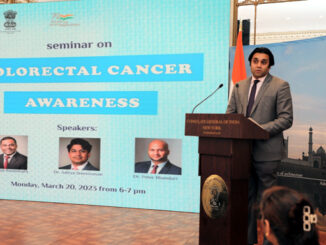
    New York City Health Commissioner Dr. Ashwin Vasan on Monday, March 20, said that as the world emerges from the COVID-19 pandemic, “we have a unique opportunity to turn the tide on these low rates of colorectal cancer screening, to reengage in our overall health and well-being, to focus… on prevention, moving upstream and focusing on the impact of diet and activity and exercise.” “This is an epidemic that’s been underneath the surface for a long time,” the Indian-origin physician and epidemiologist said at a seminar on Colorectal Cancer Awareness organized at the Consulate General of India here.

    Dr. Peter Bhandari spoke about colorectal cancer and its impact on the South Asian community.

    Citing data on low screening rates for colon cancer in certain communities, Vasan said, “the proof is in the epidemiological pudding,” adding that according to the city’s data, Asian and Pacific Islanders have the lowest rates of colorectal cancer screening (48.1 per cent) compared to the Blacks, Whites and Latino counterparts (70.8 per cent). At the seminar, Dr Arun Swaminath, who serves as the director of the Inflammatory Bowel Diseases Programme at Lenox Hill Hospital explained the various symptoms related to colorectal disease, including diarrhea and weight loss.

    Swaminath noted that five per cent of the US population will develop colon cancer in their lifetime and “most of them will have no symptoms,” stressing the importance of getting regular tests, and colonoscopy screenings to ensure early detection and treatment. The New York Chapter of the American College of Physicians (NYACP) Council Board Resident Representative for the Manhattan/Bronx Region Dr Peter Bhandari spoke about colorectal cancer and its impact on the South Asian community.

    Dr. Aditya Sreenivasan outlined colorectal risk factors as well as dietary and lifestyle habits, including regular exercises, that can help in the long term.Dr. Aditya Sreenivasan 

    He said colorectal cancer is the third most diagnosed cancer worldwide with approximately 1.9 million new cases in 2020. It is the second deadliest cancer with approximately 900,000 deaths and is also responsible for approximately 10 per cent of global deaths related to cancer, he said. “It is one of the most preventable cancers when identified early,” Bhandari said. He cited studies that have enabled physicians to identify potential barriers as to why the South Asian community has not been able to obtain colorectal screening at par with other ethnicities.

    He said these include a lack of awareness of colorectal cancer, geographic and economic accessibility, social and cultural beliefs, stigma in getting a colonoscopy and communication barriers. Associate Programme Director, Department of Gastroenterology, Lenox Hill Hospital, Northwell Health Dr Aditya Sreenivasan outlined colorectal risk factors as well as dietary and lifestyle habits, including regular exercises, that can help in the long term. “Many people understand the clear link between smoking and lung cancer, lung disease or heart disease, but it is clearly associated with the increased risk of colon cancer as well,” he said. He noted that being sedentary for more than 14 hours a day was associated with more than 2.5 times the risk of developing colon cancer. “So it’s more important than ever to get up, walk around and get some form of exercise every day,” he explained. The experts noted that colonoscopy is considered the “gold standard” for colon cancer screening. It is recommended that adults between the ages of 45 and 75 have a colonoscopy at least once every 5-10 years, depending on family medical history, digestive health issues and other gastrointestinal symptoms, according to Northwell Health.

    (With inputs from PTI)

    A view of the gathering.

  • NYC Train Daddy Returns: All Aboard for New Amtrak Job: Report

    NYC Train Daddy Returns: All Aboard for New Amtrak Job: Report

    • Andy Byford, once a top MTA boss until he clashed with former Gov. Andrew Cuomo, will join Amtrak next month, Streetsblog first reported

    NEW YORK CITY (TIP): New York City’s “Train Daddy” is back. Andy Byford is slated to become an executive vice president for Amtrak starting in April, according to an exclusive report by Streetsblog NYC. The reported new job will be a round trip of sorts for Byford, a Brit who came to New York City to run its subway and bus system. As MTA’s city transit president, Byford became popular for his moves to modernize the system and improve on-time performance. So popular, in fact, that stickers with his head appeared on subway trains. “Train Daddy loves you very much,” the stickers read. But that love apparently didn’t extend between Train Daddy and former Gov. Andrew Cuomo. Byford quit the MTA in 2020 amid repeated reported clashes with Cuomo and the governor’s micromanagement. It didn’t take long, however, for Byford to find a new job — he became London’s “Train Daddy.”

    After two years as London’s top transportation official, Byford returned to the U.S. to find another job in the transit industry, the New York Post reported in November. Now, it appears Amtrak has a Train Daddy.
    (Source: Patch)


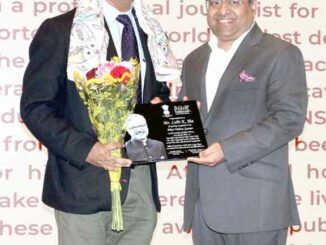
  • PTI White House Correspondent Lalit K. Jha honored at Bihar Divas Celebrations

    PTI White House Correspondent Lalit K. Jha honored at Bihar Divas Celebrations

    NEW YORK (TIP): Press Trust of India White House Correspondent Lalit K. Jha who comes from Bihar was honored for his work and contribution in the field of journalism and Maithili language , one of the Bihar languages, at a crowded Bihar Day celebration at the Indian Consulate here on March 21, 2023.
    Mr. Jha was presented a robe of honor by the Consul General of India at New York, Ambassador Randhir Kumar Jaiswal, himself a Bihari. Mr. Alok Kumar described Mr. Jha as a great son of Bihar and thanked him for the great work he has done in the field of promotion of Maithili language and in the field of journalism. He said Mr. Jha has done proud to Bihar and Biharis.
    In his acceptance speech, Mr. Jha said that Biharis have contributed greatly to the nation and the world. About his work, he said it was ongoing work and he hopes to continue to work for the promotion of Maithili.

  • Ambassador Harsh K. Bhasin dies at 79

    Ambassador Harsh K. Bhasin dies at 79

    • Visitation and prayers will be held from 11am-1pm on Tuesday March 28 at Moloney’s Lake Funeral Home (132 Ronkonkoma Ave., Lake Ronkonkoma, NY 11779)

    Harsh K. Bhasin, known variously to those who loved and admired him as Harshji, Mr. Ambassador, Professor, Nana, Dadaji, and Pa, died peacefully in New York City on March 24, 2023. Harsh dedicated his life to applying his knowledge, curiosity and pursuit of excellence to the service of others.
    Born on August 15th, 1944, his birth foretold a lifetime of service to his native India that would be independent 3 years later on that very day. In 1969, he began a 35-year career in the Indian Foreign Service in capitals around the world from Beijing and Hong Kong to Washington, Delhi and Pretoria.
    Always a bastion of honor, hard work and a kind word, he became Ambassador Bhasin to governments in Botswana, the United States, South Africa and Denmark. After his first “retirement”, eager to share his knowledge and love for diplomacy and international relations, he evolved into Professor Bhasin. In his almost 20 years at Stony Brook University, he exposed thousands of young people to the power of diplomacy over conflict, the wonders of South and East Asia, and the complexities of the geopolitics of India, China and the United States.
    Harshji was a devoted husband to his constant companion Kumkum for 52 years, as they moved almost 15 times across continents. Dadaji and Nana had boundless love for his grandchildren Shreyas, Shivanjali, Aashna and Jayna – with whom the next game of bluff, the next story-reading and the errant chocolate ice cream was never too much. And Pa was a father to Aditya (Kate) and Madhuri (Dan) who raised them through his example of pursuing excellence, of honesty and honor, and of course, a love of pizza, chocolate, and anything sweet. Our family, and the thousands of people he touched, will miss him dearly.
    Visitation and prayers will be held from 11am-1pm on Tuesday March 28 at Moloney’s Lake Funeral Home (132 Ronkonkoma Ave., Lake Ronkonkoma, NY 11779), followed by refreshments.
    In lieu of flowers, we request that you make a contribution to support an award in Ambassador Bhasin’s name for Stony Brook students interested in a career in the foreign service (details below).
    To make a contribution, please visit https://tinyurl.com/HarshBhasin .
    When making your contribution check the box on the second page under Tribute Information, select “in Memory of”, and insert Ambassador Bhasin’s name.
    If you would like to send a check, please make your check out to the Stony Brook Foundation (with Ambassador Bhasin’s name in the memo section) and mail it to:
    Attn: Chris Scarpati
    E3320 Frank Melville Jr. Library
    Stony Brook University
    Stony Brook, NY 11794-3391
    Ambassador Bhasin was a Visiting Professor of International Relations & Diplomacy at Stony Brook since 2001 and served as Chair of the Department of Asian & Asian-American Studies from 2008 to 2014 before rejoining the Department of Political Science in 2014. He holds an M.Sc degree from Banaras Hindu University.
    A career diplomat with four decades of professional experience in nine countries across the globe, his overseas assignments included China, Malaysia, the US, Hong Kong, Nepal, Botswana, South Africa and Denmark. He served as Ambassador in the last three countries.
    At the Headquarters of the Ministry of External Affairs in New Delhi, India, Ambassador Bhasin served at different times during his career in Personnel Administration, as the Deputy/Acting Director General of the Indian Council for Cultural Relations (ICCR), as Head of the Division handling matters pertaining to SAARC (South Asian Association for Regional Cooperation) and as Inspector of the Foreign Service.
    During his Foreign Service career, he served twice in the United States – in Washington DC in the late 70s and early 80s, and as Consul General of India in New York in the mid-90s . During the 1990-91 academic year he was a senior fellow at the Center for International Affairs at Harvard University. He is also a graduate of the National Defense College of India, New Delhi and holds an M.Phil Degree in Defense & Strategic Studies. Some notable highlights of his professional career in the foreign service include serving in the Peoples Republic of China during the Cultural Revolution and in South Africa during its transition from apartheid to a multiracial society. He was an Election Observer at South Africa’s first multiracial election (1993) that brought Nelson Mandela to power in that country.
    In the Department of Political Science at Stony Brook, Ambassador Bhasin taught courses on the Politics and Diplomacy of Contemporary China, Politics and Diplomacy of Contemporary India, Problems of International Affairs and other courses on Diplomacy and Foreign Policy.


  • March 24 New York & Dallas E – Edition

    [vc_row][vc_column][vc_custom_heading text=”E-Edition” font_container=”tag:h2|text_align:center” google_fonts=”font_family:Istok%20Web%3Aregular%2Citalic%2C700%2C700italic|font_style:700%20bold%20regular%3A700%3Anormal” link=”url:https%3A%2F%2Fwww.theindianpanorama.news%2Fwp-content%2Fuploads%2F2023%2F03%2FTIP-March-24-E-Edition.pdf”][vc_single_image image=”140648″ img_size=”full” alignment=”center” onclick=”custom_link” link=”https://www.theindianpanorama.news/wp-content/uploads/2023/03/TIP-March-24-E-Edition.pdf”][/vc_column][/vc_row][vc_row][vc_column width=”2/3″][vc_custom_heading text=”Lead Stories This Week” google_fonts=”font_family:Istok%20Web%3Aregular%2Citalic%2C700%2C700italic|font_style:700%20bold%20regular%3A700%3Anormal” link=”url:https%3A%2F%2Fwww.theindianpanorama.news%2F”][vc_wp_posts number=”5″ show_date=”1″][/vc_column][vc_column width=”1/3″][vc_single_image image=”82828″ img_size=”medium” alignment=”center” onclick=”custom_link” link=”https://www.theindianpanorama.news/advertising-media-kit-portal-indian-panorama/”][vc_single_image image=”82829″ img_size=”medium” alignment=”center” onclick=”custom_link” link=”https://www.theindianpanorama.news/advertising-media-kit-portal-indian-panorama/”][/vc_column][/vc_row]

  • Two Indian Americans among 3 indicted for buying, selling stolen beer

    Two Indian Americans among 3 indicted for buying, selling stolen beer

    OHIO (TIP): Three people, including two Indian Americans, are facing charges for allegedly buying and selling stolen beer worth approximately $20,000 at two local businesses in the US state of Ohio.
    Ketankumar and Piyushkumar Patel were arraigned this week in Mahoning County Common Pleas Court on charges of receiving stolen beer, media reported. The Patels operated the Schenley Carry Out and Lucky Food Drive Thru on Mahoning Avenue on Youngstown’s West Side, prosecutors told the court.
    They were accused of buying and selling beer, which was allegedly stolen by 37-year-old Ronald Pezzuolo of Youngstown from R L Lipton Distributors where Pezzuolo worked last year.
    According to the prosecutors, the operators of R L Lipton noticed the missing product and contacted police.
    Assistant Prosecutor Mike Yacovone said the value of the stolen beer to be approximately $20,000.
    While Pezzuolo faces a theft charge, the Patels face charges of receiving stolen property.
    All three will face preliminary court hearings next month.