Year: 2023

  • Nassau County Legislator Solages  pleads for Renewal of  Five Towns Community Center Lease

    Nassau County Legislator Solages pleads for Renewal of Five Towns Community Center Lease

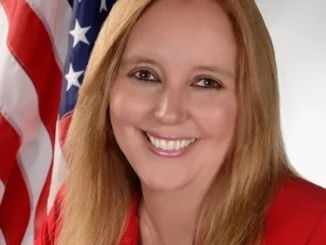
    LAWRENCE, NY (TIP): On Tuesday, March 7, Nassau County Executive Bruce Blakeman announced that the County would not renew the lease of the Five Towns Community Center. Following his announcement, Nassau County Legislator Carrié Solages (D – Lawrence) issued the following statement:

    “For months, the process of determining the future of the Five Towns Community Center has been marred by a lack of communication from the County Executive’s office and this has caused many residents to feel like their voices are not being heard. I am concerned that yesterday’s announcement by the administration that they will not renew the Five Towns Community Center’s lease will only further exacerbate their existing fears and frustration,” Nassau County Legislator Carrié Solages (D – Lawrence) said.“We must never lose sight of the fact that thousands of families depend upon the Five Towns Community Center for nutrition assistance, healthcare services, affordable childcare, afterschool programs, addiction treatment and recovery resources, and so much more. The County must guarantee these families that that they will continue to receive these crucial resources without interruption and at a center that is free and open to the public,” Legislator Solages said. “While I truly believe that we all want a community center that serves the needs of all our residents, that will not happen without collaboration. I urge the County Executive to immediately bring community stakeholders together and begin the process of developing a shared vision for the future of this vital community hub,” Legislator Solages concluded.

  • Biden appoints two Indian-Americans to Advisory Committee for Trade Policy and Negotiations

    Biden appoints two Indian-Americans to Advisory Committee for Trade Policy and Negotiations

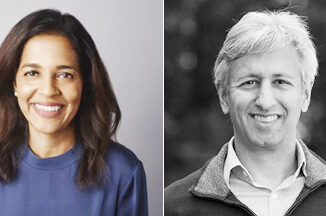
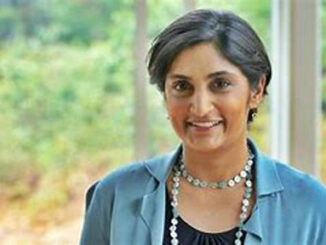
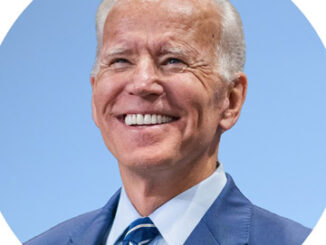
    WASHINGTON, D.C. (TIP): US President Joe Biden on Friday, March 11 named two Indian-Americans — Revathi Advaithi, CEO of Flex, and Manish Bapna, CEO of the Natural Resources Defense Council — to the Advisory Committee for Trade Policy and Negotiations.
    On Friday, Biden announced his intent to appoint 14 people to the Advisory Committee, which provides overall policy advice to the United States Trade Representative on matters of development, implementation, and administration of the US trade policy.
    Among these include negotiating objectives and bargaining positions before entering into trade agreements, the impact of the implementation of trade agreements, matters concerning the operation of any trade agreement once entered into, and other matters arising in connection with the development, implementation, and administration of the trade policy of the United States, the White House said. Revathi Advaithi is CEO of Flex, “the global manufacturing partner of choice that helps a diverse customer base design and build products to improve the world”. Since assuming the role in 2019, Advaithi has been responsible for architecting the company’s strategic direction and leading Flex through a transformation that is defining a new era in manufacturing, the White House said. Prior to Flex, Advaithi was president and Chief Operating Officer for the electrical sector business for Eaton, a company with more than USD20 billion in sales and 102,000 employees.
    She has also worked at Eaton’s electrical sector, Americas, and Honeywell, and serves on the Board of Directors of Uber and Catalyst.org.
    Advaithi is a Co-Chair of the World Economic Forum (WEF) Advanced Manufacturing CEO Community and joined the WEF Alliance of CEO Climate Leaders. She was recognized on Fortune’s Most Powerful Women in Business list for four consecutive years and named one of Business Today’s Most Powerful Women in India. She holds a bachelor’s degree in mechanical engineering from the Birla Institute of Technology and Science and an MBA from the Thunderbird School of Global Management.
    Manish Bapna is president and CEO of the Natural Resources Defense Council (NRDC), which has been behind many of the most significant environmental milestones of the last half century — from the creation of bedrock environmental laws, to landmark legal victories, and foundational research, the White House said.
    During his 25-year career, Bapna’s leadership roles have focused on tackling the root causes of poverty and climate change with strategies that are equitable, durable, and scalable. Most recently, he served as Executive Vice President and Managing Director of the World Resources Institute, a research organization focused on the intersection of the environment and human development, for more than 14 years.
    An economist by training, he got his start at McKinsey & Company and the World Bank before pursuing a career in advocacy at the Bank Information Centre. He has master’s degrees in Business and Political and Economic Development from Harvard University and a bachelor’s degree in Electrical Engineering from MIT, the White House said.
    (Source: PTI)

  • Two Indian American Democratic candidates to run for Virginia legislature

    Two Indian American Democratic candidates to run for Virginia legislature

    VIRGINIA (TIP): Two Indian American Democratic candidates have announced their bids for the Virginia Senate and the House of Delegates.
    Suhas Subramanyam, of Ashburn, a two-term delegate who currently represents the 87th House district, announced March 2 that he will run in the 32nd Senate District.
    Kannan Srinivasan, of Potomac Falls, announced Monday, March 6 that he will run for the open 26th House District, which includes the South Riding and Brambleton areas, instead of the 27th District, where he had previously filed to run, local Loudon Times reported.
    Subramanyam’s campaign, according to a press release would focus on “creating a robust economy that works for Loudoun families and businesses alike, protecting our freedoms like reproductive rights and voting rights from extremism, delivering a world-class education to our kids, and keeping our community safe and healthy.”
    The redrawn 32nd District is much more geographically compact than the former boundaries of the 13th District and includes all of eastern Loudoun south of Route 7 and east of Evergreen Mills Road and Lenah Road.
    Subramanyam, will face former Delegate Ibraheem Samirah, a Herndon Democrat who served one term representing the Sterling area and western Fairfax County before losing a primary in 2021, in a likely June primary for the Democratic nomination in a district where voters have favored Democratic candidates by more than 20-point margins in recent elections.
    Loudoun County Supervisor Sylvia Glass said March 3 that she is endorsing Subramanyam.
    Republican Greg Moulthrop, of Stone Ridge, previously announced that he is running in the 32nd Senate District. Moulthrop ran for the 87th House District seat in 2021, losing to Subramanyam by 17 percentage points.
    A resident of Loudoun County, Subramanyam became the first Indian-American and South Asian to ever be elected to the Virginia General Assembly in 2019.
    A technology and regulatory attorney, Subramanyam served as a White House advisor to President Barack Obama in 2015, where he led a task force on technology policy that addressed job creation, IT modernization, and regulating emerging technology.
    Prior to that, he earned his law degree with honors from Northwestern University School of Law, volunteering at the Center for Wrongful Convictions, where he was part of the legal team that freed a man who had spent 21 years in prison for a crime he didn’t commit. For his professional accomplishments and work in the community, he was named to the Loudoun Times-Mirror’s ’40 Under 40′.
    Meanwhile, Srinivasan announcing his House run Monday stated, “My experience in both the public and private sectors will serve the residents of Loudoun and Virginians across the Commonwealth well. I will fight for our public schools, stand up for gun safety, and protect abortion rights.” Srinivasan immigrated from India in 1993 and has been a Loudoun resident for almost 25 years, according to his campaign.
    He most recently has worked as a director of finance at device warranty and insurance company Asurion and vice president for finance at celebrity chef José Andrés’s restaurant business, the José Andrés Group. Loudoun Now reported.
    Srinivasan said his values come from experience, including being hit by a truck as a young man and being denied Medicaid assistance. He now serves as vice chair of the Virginia State Medicaid Board, and on the Loudoun Economic Development Advisory Commission.
    In 2019, Srinivasan ran unsuccessfully against Republican Loudoun County Treasurer Roger Zurn.
    He launched his House of Delegates campaign with 20 Democratic endorsements, including Loudoun elected officials US Rep. Jennifer Wexton, state senators Jennifer Boysko and Barbara Favola and state delegates David Reid and Irene Shin. Srinivasan is the only announced candidate in the newly configured district, which has no incumbent. The district lies west and south of Dulles Airport and stretches from the Dulles Greenway to the southeastern corner of Loudoun County.

  • Indian-origin professor Laxmi Balachandra files lawsuit against US college alleging racial discrimination

    Indian-origin professor Laxmi Balachandra files lawsuit against US college alleging racial discrimination

    BOSTON (TIP): An Indian-origin associate professor at the Wellesley Business School, Massachusetts has filed a lawsuit alleging that she was subjected to racial and gender discrimination, according to a media report.
    Lakshmi Balachandra, associate professor of entrepreneurship at Babson College alleged she lost career opportunities and faced economic losses, emotional distress, and harm to her reputation because of mistreatment and administrators’ failure to investigate her concerns, The Boston Globe newspaper reported on February 27.
    Balachandra joined Babson’s faculty in 2012 and earned tenure in 2019.
    In her lawsuit, she called out Andrew Corbett, a professor and former chair of the college’s entrepreneurship division, as the “primary direct perpetrators of the discriminatory work environment.” According to the complaint filed in US District Court in Boston dated February 27, Balachandra alleged that Corbett, who oversaw teaching assignments, class scheduling, and annual reviews, only allowed her to teach required courses in entrepreneurship despite her requests to teach electives – even though she had taught such classes previously at MIT Sloan School of Management and Harvard Business School. “Babson favors white and male faculty and predominantly reserves awards and privileges for them,” Balachandra’s complaint alleged.
    According to the complaint, despite her research record, expressed interest, and service to the college, she was denied numerous leadership positions and opportunities for more time to conduct research and write.
    “Such privileges are routinely given to white male faculty in the entrepreneurship division,” the complaint read.
    Balachandra’s attorney, Monica Shah, said that the professor has also filed a charge of discrimination with the Massachusetts Commission Against Discrimination.
    Meanwhile, Babson College has responded that it takes concerns or complaints seriously and has well-established protocols and resources in place to thoroughly investigate and address them.
    “The college is home to a diverse global community where equity and inclusion are valued and incorporated across every facet of campus, and where discrimination of any kind is not tolerated,” a spokesperson of Babson College was quoted as saying. Balachandra, who is currently on leave for a fellowship at the National Science Foundation, is seeking unspecified damages, the report added.

  • British Sikh MP Preet Kaur Gill gets threatening email

    British Sikh MP Preet Kaur Gill gets threatening email

    LONDON (TIP): Britain’s first female Sikh MP Preet Kaur Gill has said she was forced to contact police after receiving a threatening email message saying: “watch your back”. The senior Labor MP for Birmingham, Edgbaston said that following the email, she is forced to keep a bodyguard at her constituency surgery meetings.
    “It was very direct. It’s a worry because I’m with my daughters in the constituency all the time. My family lives there. It really puts into context the kind of job that you do. It’s tough enough as it is, but then when you’re faced with that, there’s very little support. This latest direct threat has really worried and concerned me,” Gill told the media on Saturday, March 4. “As a woman, when you put yourself forward and you want to address injustices and you care about issues that affect your constituents, you’re then faced with people that think it’s okay to say this sort of stuff to you.” Instead of using an alias, the threat was sent from a legitimate account with a genuine email address, which left Gill shocked. “I could not believe that this person used their place of work email to actually make that threat,” Gill, who had been a target of hate campaigns in the past, said.
    Gill has reported the incident to the West Midlands Police.
    “Once you’ve raised it with the police, they’ve got to go away and do an investigation, but there’s no real understanding of the impact it has on you, your everyday work, the psychological impact, the kind of always looking behind your shoulder,” she told media.
    Gill was recently accused of undermining victims of sexual abuse, according to a Guardian report.
    The Shadow Secretary of State for International Development had sent a series of WhatsApp messages to a group undermining allegations of sexual abuse within gurdwaras.

  • Biden unveils USD 6.9 trillion budget, raises taxes on rich, boosts spending on social programs, infrastructure

    Biden unveils USD 6.9 trillion budget, raises taxes on rich, boosts spending on social programs, infrastructure

    WASHINGTON, D.C. (TIP): President Joe Biden on Thursday, March 10 unveiled a USD 6.9 trillion annual budget for the year 2024, which proposes a hefty tax on the rich, massive spending on social measures and investment on building key infrastructure.
    The budget was termed a “non-starter” by the Republicans who have a majority in the House of Representatives.
    Biden at a rally in Philadelphia asserted that his budget reflects what “we can do to” lift the burden on hard working Americans and it would reduce the deficit this year by USD 160 billion.”To support working parents, my budget expands access to affordable childcare for millions of families. And it’s going to invest in paid family medical leave,” Biden said, adding that his budget also invests in elder care and home care and restores the child tax credit.
    Biden said the budget will deliver funding to help the US lead the world again. “My budget also invests in critical issues that matter to families, increasing the supply of affordable housing, lower rental costs, and make it easier to buy a home, all of which will generate economic growth and prosperity,” he said. Asserting that he brought down the deficit of USD 1.7 trillion more than any president in American history, Biden said his latest budget is going to reduce the deficit by nearly USD 3 trillion over 10 years.
    The budgetary proposals call for imposing a 25 per cent minimum tax on the wealthiest 0.01 per cent of households, quadrupling a one per cent surcharge on corporate stock buybacks, restoring the top marginal income tax rate to 39.6 per cent. It proposes to raise the corporate income tax rate from 21 per cent to 28 per cent. “No billionaire should be paying a lower tax than somebody working as a schoolteacher or a firefighter or any of you in this room. So, my plan is to make sure the corporations begin to pay their fair share. It used to be 35 per cent. We cut it down to 21 per cent. I think we should be paying 28 per cent,” he said.
    “There’s going to be a real fight in that but we should be paying more than 21 per cent. And I made clear under my plan, and I made this commitment when I ran and I haven’t broken it yet and I never will,” he said.
    Acknowledging that there are sharp differences with the Republicans, Biden said he is willing to sit down with them to talk and negotiate.
    “My budget is about investing in America and all of America, including places and people and folks who have been forgotten. Amid the economic upheaval of the past four decades, too many people have been left behind or treated like they’re invisible. Not anymore,” he said.
    The opposition Republican party was very critical of the budget. “President Joe Biden’s budget is a reckless proposal doubling down on the same Far Left spending policies that have led to record inflation and our current debt crisis, said Speaker Kevin McCarthy, Majority Leader Steve Scalise, Majority Whip Tom Emmer, and Republican Conference Chairwoman Elise Stefanik in a joint statement.
    “After passing trillions of dollars in new deficit spending that we cannot afford, over the next 30 years, the national debt will be nearly twice the size of the entire economy. In the next ten years, the federal government will spend over USD 10 trillion on interest alone,” they said. Vice President Kamala Harris said the administration is investing in the full potential of the American people. “Our budget will lower costs, invest in workers, and strengthen Medicare and Social Security. It does all of this while cutting the deficit and making sure billionaires pay their fair share,” she said.
    (Source: PTI)

  • Bipartisan bill introduced in US House to improve legal immigration

    Bipartisan bill introduced in US House to improve legal immigration

    WASHINGTON,D.C. (TIP): A bipartisan bill was introduced in the US House of Representatives on Friday to properly utilize the employment-based visas currently allocated each year under existing federal immigration law.
    Introduced by Congressman Raja Krishnamoorthi from the Democratic Party and Larry Bucshon from the GOP, the Eliminating Backlogs Act of 2023 would give greater flexibility to use existing allotted work visas that employers desperately need, its authors said.”Even as our country’s high-skilled immigration system helps us draw top talent from around the world, current law caps the number of employment-based visas available based on workers’ country of origin, leaving thousands of visas that would otherwise help our economy unused,” Krishnamoorthi said.
    The legislation is aimed at ending country-based discrimination in high-skilled immigration to ensure use of all allotted visa to draw skilled workers from across the globe to help strengthen the American economy and create jobs while they also continue to invest in the domestic workforce, he said.
    “Under current federal immigration law, there are a certain number of visas allocated annually for skilled workers, such as doctors and engineers, to ensure our workforce can meet the demands of our economy in Indiana and across the country,” Bucshon said.
    Unfortunately, bureaucratic policies and delays have prevented hundreds of thousands of these visas from being used, despite a serious need for more skilled workers across the country, he said.
    The bill helps eliminate this backlog and ensure that visas allocated under existing federal immigration law can be properly used. “This will help support an immigration system that incentivizes and rewards legal applicants and boosts our economy,” said Bucshon. Every year, the Congress allows for a set number of foreign nationals with specific skills and training to come to the US for work. This helps ensure that American businesses have access to the skilled labor force they need to succeed.
    Each nation is capped at receiving only seven per cent of the allotted employment-based slots in any year. Due to this per-country limitation and bureaucratic delays, US immigration officials failed to utilize approximately 9,100 employment-based visas in FY2020 and over 66,000 in FY2021, the media release said.

    (Source: PTI)

  • Cloture motion filed for Garcetti’s nomination; moves step closer to confirmation by US Senate

    Cloture motion filed for Garcetti’s nomination; moves step closer to confirmation by US Senate

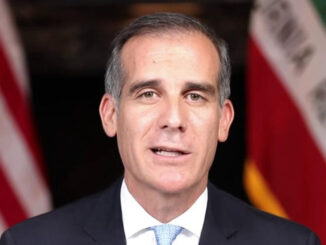
    WASHINGTON, D.C. (TIP): The nomination of Eric Garcetti for US Ambassador to India moved a step closer to being confirmed by the Senate as it adopted a cloture motion, indicating that the ruling Democrats have the support of a super-majority for his selection for the key position.
    Such a move by Senate Majority Leader Senator Chuck Schumer came a day after the Senate Foreign Relations Committee at its business meeting voted 13-8 in favor of his nomination.
    Garcetti’s nomination is pending before the US Congress since July 2021, when he was nominated for the prestigious diplomatic posting by President Joe Biden.
    His nomination was not brought to the Senate floor for a vote during the last Congress as the ruling Democratic Party did not have enough support to get the 52-year-old close aide of Biden through.
    On Thursday, March 9 afternoon, a Senate clerk read and brought the nomination of Garcetti to be Ambassador of the US to India on the Senate floor.
    “I send the cloture motion to the desk,” Schumer said on the floor which was adopted by a voice vote. A cloture motion is a procedural motion that, if adopted, limits further debate on the matter at hand. It allows the majority to defeat efforts by the minority to delay or obstruct proceedings on a matter by showing the matter has the support of a super-majority. After that, the clerk read a message from 16 senators.
    “We, the undersigned senators, in accordance with the provisions of rule 22 of the standing rules of the Senate do hereby move to bring to a close debate on the nomination of executive counter number 65, Eric Garcetti of California to be ambassador extraordinary and plenipotentiary of the United States of America to the Republic of India,” the clerk said.
    Schumer sought and received consent that the names of the 16 Senators are not read, following which the cloture motion was agreed to. Kenneth Juster, the last occupant of the ambassadorial residence of the US in New Delhi, stepped down in January 2021 after the change of government in America.
    During Thursday’s session, Schumer also got a similar cloture motion passed on the nomination of Indian-American Ravi Chaudhary to be an Assistant Secretary of the Air Force.

  • President  Biden, VP Harris and US lawmakers extend Holi greetings

    President Biden, VP Harris and US lawmakers extend Holi greetings

    WASHINGTON, D.C. (TIP): US President Joe Biden and Vice President Kamala Harris led the country in sending greetings to the Hindu community in the United States, in India and across the world on the occasion of Holi.

    While for several years now the festival of colors has been observed in various parts of the country, which many a times attracts thousands of participants like the one at Barsana Dham in Texas or in Atlanta and Florida, and lawmakers have been sending their greetings for quite some time now, this is for the first time probably the greetings of Holi has been broadcast from the White House.

    “I wish the happiest Holi to those celebrating love, laughter, goodness, and the arrival of spring during today’s Festival of Colors,” Biden said in a presidential tweet.

    “As we come together to mark the arrival of spring and celebrate the triumph of good over evil, may the vibrant colors of Holi brighten our world with joy, hope, and positivity. Happy Holi to all who celebrate,” tweeted Vice President Kamala Harris. Both of them had a colorful picture of Holi with the logo of the White House on it.

    Secretary of State Antony Blinken soon followed with his own tweet. “Wishing all celebrating a very happy Holi. May this festival of colors fill you with joy,” he said.

    As images of Commerce Secretary Gina Raimondo playing Holi at the residence of Defense Minister Rajnath Singh in New Delhi went viral, several lawmakers extended greetings on the festival. “Happy Holi to everyone celebrating across the world! Hoping you have a bright and peaceful Festival of Colors!” said Senator Mark Warner, co-Chair of the Senate India Caucus and Chairman of the Senate Intelligence Committee.

    Congressional Asian Pacific American Caucus Chair Congresswoman Judy Chu said “Happy Holi” to the millions that celebrate in the United States and around the world! “Let us commemorate this festival of colors by remembering to see the light even in the face of darkness and to celebrate our differences as strengths. May the arrival of spring bring new beginnings, hope, and happiness to all,” she said.

    Congresswoman Grace Meng said Holi is a joyous occasion to revel in the arrival of spring and to celebrate the victory of good over evil. “In the spirit of Holi, I hope we can all find optimism in the conviction that good will prevail when we stand by our beliefs and step forward in unity. I am grateful for all things that bring our communities joy, peace, and strength. Happy Holi!” she said.

    Holi is a joyous celebration that welcomes spring and reminds us that good will always triumph over evil, said Congressman Ted Lieu. “As we celebrate the renewal of life that spring brings, I am hopeful that 2023 will bring us more light, peace, and joy. Wishing a happy and prosperous Festival of Colors to all!” he said.

    Ami Bera, the longest serving Indian-American Member of Congress, said Holi is the celebration of light vanquishing darkness and the triumph of good over evil. “This new spring season, let us recommit to spreading love and tolerance within our communities and celebrate the ties that bind us closer together,” the Congressman said. Influential Indian-American Congresswoman Pramila Jayapal wished a happy Holi to all who celebrate in Seattle and around the world! “This is such a powerful time of year, as we come together to welcome in spring and new growth and celebrate the triumph of good over evil. I hope this holiday brings us all communion, love, and gratitude. Happy Holi!,” she said.

    “Happy Holi to everyone in CA-17 and around the world celebrating. Holi is a reminder of the triumph of good over evil and that there’s a bright future ahead for our country. I hope this year’s celebration brings you joy, renewal, and hope for the coming year,” said Congressman Ro Khanna.

    Congressman Andy Kim said even through the most challenging times, Holi signals a brighter future and reminds of the lasting triumph of good. “We hope this vibrant, spring celebration brings you and your loved ones together, to celebrate love and hope for a brighter future,” he said.

    Powerful Indian-American Congressman Raja Krishnamoorthi said during this festival of colors, “let us take a moment to celebrate the arrival of spring and renew our commitment” to bringing peace and prosperity to all.

    “Happy Holi to Hindu communities in the East Bay and across the globe! The Festival of Colors is a celebration of good over evil, of light over darkness. May this special time bring you and your loved ones peace and joy as we enter spring,” Congresswoman Barbara Lee said.

    “As we celebrate the start of Holi, let us boldly affirm our commitment to unity, diversity, and inclusivity. This festival of colors reminds us that our differences are a source of strength, and that by coming together with love and respect, we can overcome any obstacle. Let us pledge to continue spreading the vibrant hues of happiness and togetherness, and to stand up against hate and division in all its forms. Happy Holi to all in Michigan and around the world!” said Congressman Shri Thanedar.

    “Happy Holi to all those celebrating in Southern California and across the country! This colorful festival brings communities together to celebrate the new spring season and its fortunes. I join my CAPAC colleagues in sending joy, positivity, and good wishes to you and your family,” said Congresswoman Linda Sanchez.

    Republican National Committee (RNC) Chairwoman Ronna McDaniel also sent in her Holi message. “Happy Holi to all Hindu, Sikhs, and Jains who are celebrating today. May this festival of colors bring much joy as you mark the arrival of spring and celebrate the triumph of good over evil. Happy Holi!” she said.

  • Coalition of Nobel laureates, economists & academics endorse Ajay Banga for World Bank president

    Coalition of Nobel laureates, economists & academics endorse Ajay Banga for World Bank president

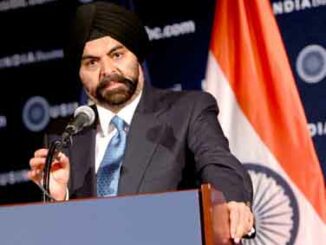
    WASHINGTON, D.C. (TIP): A coalition of 55 leading academics, economists, including three Nobel laureates, have endorsed the nomination of Indian-American Ajay Banga as the next President of the World Bank, describing him as the right person to lead the international financial institution as a “force multiplier” at a critical moment for the world economy.
    Banga, 63, was nominated by US President Joe Biden as the next President of the World Bank last month.
    In an open endorsement letter published on Thursday, 55 advocates, academics, executives, luminaries, and former government officials supported the business leader’s nomination to the post of President of the World Bank, indicating that the former MasterCard CEO’s candidacy is gaining ground.
    The four Nobel laureates to endorse Banga are Dr Joseph Stiglitz, recipient of the 2001 Nobel Prize in Economic Sciences; Dr Michael Spence, recipient of the 2001 Nobel Prize in Economic Sciences and Professor Muhammad Yunus, recipient of the 2006 Nobel Peace Prize.
    “A truly global citizen, Ajay has extensive experience living and working in developing economies. Importantly, as a leader with a deep appreciation for the global south, he intuitively understands that economic growth can only be sustained if people and nature thrive together, not apart,” the letter said.
    It added that Banga understands the World Bank must serve as a force multiplier by setting the correct agenda and then catalyzing action across governments, the private sector, multilateral development banks, civil society, and philanthropies. “Banga possesses a rare combination of leadership; track record of building successful alliances across the public, private, and social sectors; and experience working in developing countries for tackling some of the most critical challenges facing our world,” the endorsement letter added.
    “He is the right person to lead the World Bank at this critical moment,” the open letter from the world leaders of diverse backgrounds said.
    “Ajay built a regenerative agriculture partnership in Latin America to help farmers shift their practices toward long-term sustainability in a region at high-risk for climate disaster,” the letter said, adding that the business leader also shaped a crop insurance programme with the World Food Bank and a coalition of private and social sector partners, to insure two million farmers against the risks of climate disaster. As an advisor to General Atlantic’s climate-focused fund, BeyondNetZero, Banga played a key role in promoting investments in companies leading EV charging and solar power solutions for off-grid populations in Africa and India.
    “While at Mastercard, many of us saw first-hand how Ajay advanced financial inclusion and expanded access to the digital economy globally and especially in Africa.” the letter said, adding that by working with governments and civil society, Banga committed to bringing 500 million previously unbanked into the digital economy.
    “Included in this has been a commitment to bringing more women into the global economy-recognizing that women play an essential role in sustainable development solutions,” the letter of support said. Banga is currently on a global listening tour with visits to Cote d’Ivoire and Kenya. Both countries have endorsed his candidacy for World Bank President.
    He will head to Europe for meetings in London and Brussels, including a climate-focused roundtable.
    On a listening tour in London on March 9 and 10, Banga met senior government officials and civil society leaders in a meeting focused on development. He also convened leaders from the financial sector for a roundtable discussion focused on expanding climate finance.
    Banga will meet with senior government officials from a cross-section of European Union member states in Brussels, Belgium March 13 and 14. The conversations will focus on how the Bank can best meet its core development goals while addressing global challenges like climate change, pandemics, and fragility.
    “If elected to serve, Banga will draw from his experience living and working in emerging markets and his expertise in forging public-private partnerships to mobilize investments and action to confront longstanding challenges,” a statement by the Department of Treasury said.
    “That includes his efforts at Mastercard to successfully bring 500 million previously unbanked people into the digital economy, as well as its support for 50 million small businesses,” the statement said.
    Banga currently serves as Vice Chairman at General Atlantic. He was awarded the Padma Shri in 2016. If confirmed by the World Bank Board of Directors, Banga would be the first-ever Indian-American and Sikh-American to head either of the two top international financial institutions: the International Monetary Fund and the World Bank.

  • Xi tightens grip

    • India needs to be wary of Chinese President’s absolute power

    In an inevitable outcome, Xi Jinping has been ‘unanimously elected’ Chinese President for a historic third term. This makes him the country’s longest-serving leader since the Chinese republic’s founding father Mao Zedong and paves the way for his lifelong rule. Around 3,000 members of China’s parliament, the National People’s Congress, voted for him in an apology for an election that had no other candidate. Xi has also been re-elected Chairman of the Central Military Commission, thus ensuring his continuation as the head of the People’s Liberation Army, the largest military in the world.

    Xi has consolidated his hold on China amid increasingly strained relations with the US and the West over Taiwan and the Ukraine war and far-from-friendly ties with India in the backdrop of the lingering Ladakh standoff. The 7.2 per cent hike in the military budget makes it obvious that there will be no let-up in China’s muscle-flexing, even as the world’s second-largest economy faces the uphill task of making a robust recovery from the upheaval caused by the draconian zero-Covid policy in the past three years. Striking a balance between military augmentation and economic revival will be a major challenge for the Chinese President.

    India needs to be wary of Xi’s absolute power. The latest report by the US intelligence community states that China will continue its efforts to achieve his vision of making the country emerge as a ‘major power’ globally by undermining US influence. Xi is keen on ‘the great rejuvenation of the Chinese nation’ by 2049, the centenary year of the people’s republic. The two neighbors have held a series of talks in recent years in connection with the border stalemate, but China has not done enough to reduce the trust deficit as well as hostilities. With Xi more firmly in the saddle, China won’t hesitate from making provocative moves in retaliation for the growing closeness between India and the US. While keeping all communication channels open, New Delhi needs to be well prepared — militarily as well as diplomatically — for any eventuality.

    (Tribune, India)

  • State Must Revise Affordable Housing Proposal

    State Must Revise Affordable Housing Proposal

    As an elected official and a fellow Democrat, I urge New York State Governor Kathy Hochul and our state representatives not to adopt the housing proposal in its current form as part of the forthcoming state budget.

    One of the most amazing things about New York State is the diverse options of places to live, including rural towns, suburban bedroom communities, bustling metropolitan areas and everything in between. As a result of this diversity, communities across our state are presented with different and unique challenges.

    On Long Island, we face a unique issue of living on top of our drinking water, and the threat of saltwater intrusion caused by overdrawing from our single-source aquifer something we must always be vigilant about preventing. We must also be especially cognizant of traffic problems. Anyone traveling, especially at rush hour, knows how congested our roadways have become – and sometimes, it has taken me 40 minutes to travel from Mineola to Glen Cove. And last but certainly not least, many of our schools face budget concerns and overcrowding and would struggle to take on more students.

    Local governments are very well attuned to the specific needs and challenges facing the communities they serve. Unfortunately, the Governor’s current proposal would undermine local control by establishing minimum benchmarks for affordable housing growth – and creating a mechanism by which developers can do an end-run around local zoning if those benchmarks are not met. To have the state come in and impose a one-size-fits-all mandate is, in my opinion, truly irresponsible and counterproductive.

    Much like bail reform in previous years, the crucial issue of affordable housing is being linked to the Governor’s budget proposal, placing undue duress on state representatives to make an all-or-nothing vote for or against the entire budget. I once again implore our state officials to hear the voices of local community leaders, environmental experts, first responders and their partners in government to oppose the proposal in its current form.

    Let’s instead go back to the drawing board, take away the threats of state mandates, and work more closely with local towns, counties, villages, and cities to identify community-driven opportunities to incentivize revitalization, smart growth, and new transit-oriented development that will carry us all toward a more prosperous future.
    (Delia DeRiggi-Whitton, of Glen Cove, a Nassau County legislator representing the 11th District, is the ranking member of the Legislature’s Committee on Health & Social Services)

  • Media raids and breaking the silence on press freedom

    Media raids and breaking the silence on press freedom

    “The Supreme Court needs to revive and apply the doctrine of “effect and consequence” to consider a broader canvas of executive actions that will shape the practices of our criminal courts. For instance, in the BBC case, a relevant fact for a court to determine is not limited to allegations of tax evasion but whether the scrutiny is prompted by a documentary that is critical of the Prime Minister. Today, for a free and fair press, not only journalists but even our courts need to act without fear or favor.”

    By Apar Gupta

    On February 14, 2023, the Income Tax Department carried out a “survey action” on the offices of the British Broadcasting Corporation (BBC) in New Delhi and Mumbai. After continuing this survey for three days, a press release was issued by the Central Board of Direct Taxes (CBDT) citing an alleged evasion of taxes on remittances and discrepancies in BBC’s transfer pricing mechanism. Many media organizations such as the Press Club of India have described the raids as “deeply unfortunate”; the Editors Guild termed them as “intimidation”. Even those who may favor the tax survey will confess that the tax scrutiny is a natural outcome of the BBC’s two-part documentary series, “India: The Modi Question”, which the BBC released on January 17, 2023. In an emergency secret order issued by the Ministry of Electronics and Information Technology, the documentary’s web links were blocked on January 20, 2023. The timing and nature of the events points to something being rotten in the state of Denmark.

    Chilling message
    At the root of these “survey actions” is an attempt to instill fear and self-censorship that begins with knocking on the doors of the offices of journalists. Today, these actions have become sinister as they now involve the seizure of devices. Hence, an unpleasant surprise turns into severe shock when journalists, as in the case of the BBC, are treated as potential criminals.

    The CBDT press release gives us clues when it states that “crucial evidences by way of statement of employees, digital evidences and documents” were gathered. There are more pointers such as the one provided by the BBC which said that on February 19, 2023, “journalists’ computers were searched, their phones were intercepted and information was sought from them about their working methods”. Even if the case of the CBDT is perceived as legitimate, it would at its very best be limited to an accounting and financial investigation. Without any clear and compelling reasons to extend a digital dragnet on working journalists, this is what can be defined as a fishing expedition. It becomes important here to consider the wider trend of the extraction of sensitive data from journalists by using the tax and police departments across India.

    Since 2018, there have been at least 10 reported instances of device searches that impact press freedom. Beginning with the Quint, they have gone on to include the proprietors and senior editors of publications such as Alt News, Bharat Samachar, Dainik Bhaskar, NewsClick, The Wire, the Independent and Public-Spirited Media Foundation (IPMSF) and journalists such as Fahad Shah, Rupesh Kumar Singh and Siddique Kappan. This anecdotal list presents an incomplete data set as the Union government has stoutly defended its inability to keep count.

    Half truth in the executive response
    In a parliamentary response dated August 10, 2022, the Ministry of Home Affairs has stated that since “police” and, “law and order”, are topics within the competence of State governments, it cannot “centrally maintain” device seizures of journalists. This is a half truth for two reasons. The first is that the Crime in India report queries data from State governments and can easily be extended to include data on device seizures of journalists. Second, many of the searches and seizures have been performed by central agencies such as the Income-Tax Department and such a record can be maintained and published by the Ministry of Finance. Such institutional evasion only increases suspicion about the bona fides of prosecutions and also represents a lack of intent for any studied consideration by the executive, particularly the Union government. It also unearths a myopic, yet widely held, belief that protection of freedom of speech, especially its most critical voices, is a democratic duty limited to the courts. Here, the popular view of trial courts as a bulwark against threats to our constitutional rights is rhetorical to legal academics and trial court practitioners who honestly assess their role. Their underlying institutional cultures are what lawyer Abhinav Sekhri terms as “rooted in the avowed colonial mentality of maximizing state interests while depriving any semblance of protection to the accused persons”.

    This analysis has been dealt with in a paper that specifically looks at powers to unlock smartphones, drawing from the Code of Criminal Procedure, 1973 — the procedural law to govern criminal cases in India. It indicates that specific legal provisions provide for unfettered discretion to police officers apart from a carceral spirit that resides within our criminal justice system, deeply ingrained and practiced for decades. This results in outcomes where criminal courts rarely check the police for their investigatory practices and evidence collection.

    It is here that one may find an answer to the questionable legality of the CBDT’s “survey action”, as pointed out by tax experts such as Deepak Joshi. Without any fear of sanction, or checks on their powers, investigating officers in a “survey action” will freely conduct a more invasive, “search and seizure”. Oblivious to the limitations and spirit of the text in the Income Tax Act, 1961, abuses will only increase given the perceptible political interests and the impossibility for any real sanction.

    A way out
    In the absence of such checks and balances and also the unlikely event of systemic reforms, what is the role that constitutional courts play? Here, there is adequate room for the application and development of doctrines for press freedom. The first cluster requires the application of the fundamental right to privacy drawn from the Supreme Court’s judgment in K.S. Puttaswamy vs Union of India (2017). More than five years since the judgment was first pronounced, its application to the criminal justice system here is awaited in cases of electronic evidence. Resurrecting the D.K. Basu guidelines as relevant for a digital India may also be a way out. Stricter procedural safeguards are required today due to digitization, as the Supreme Court of the United States noted in Riley vs State of California. It said: “Cell phones differ in both a quantitative and a qualitative sense from other objects that might be kept on an arrestee’s person.”

    Such guidelines will only provide partial relief. It will require case specific and clear pronouncements on facts that consider how legal processes are abused in the device seizures of journalists. This recent trend is an adaptation of an old template where a muscular executive sidesteps a direct response to a critical article and in bad faith directs legal scrutiny on the publication itself. Such mischievous government actions have been considered by the Supreme Court in several press freedom cases, leading to the partial expansion of the “direct and inevitable” to the “effect and consequence” test. However, as jurist Rajeev Dhawan observed in 1986, “the partial attention paid to the operational and institutional needs of the press… seems to have died out”. There has indeed been a long and tragic silence on press freedom over decades.

    The Supreme Court needs to revive and apply the doctrine of “effect and consequence” to consider a broader canvas of executive actions that will shape the practices of our criminal courts. For instance, in the BBC case, a relevant fact for a court to determine is not limited to allegations of tax evasion but whether the scrutiny is prompted by a documentary that is critical of the Prime Minister. Today, for a free and fair press, not only journalists but even our courts need to act without fear or favor.

    (The author is the Co-founder and Executive Director of the Internet Freedom Foundation, India)

  • The unchallenged run of majoritarian encroachments

    The unchallenged run of majoritarian encroachments

    Indian civil society remains hierarchical and fragmented, desirous more of integrating itself into ruling power structures than challenging them. Therefore, any resistance to majoritarian encroachments on our constitutional order is not likely to come from civil society formations or the independent institutions that rely on their support.

    In a recent speech, senior advocate in the Supreme Court of India, Dushyant Dave, expressed his anguish at the seeming co-option of independent institutions to the will of a powerful executive. Mr. Dave contrasted the passivity of India’s civil society and public institutions with the protests that have paralysed Israel. These protests are the widespread demonstrations that have broken out against Israel’s right-wing government over its stated plans that are aimed at restricting the autonomy of the country’s Supreme Court.

    The parallel with Israel (made in the speech) does illuminate a necessary pre-condition for the healthy functioning of democratic institutions. This pre-condition is the existence of a civil society base which fortifies the political legitimacy of autonomous institutions in their confrontation with an overbearing executive. In Israel, the civil society base (which has made its presence felt on the streets), in support of the Supreme Court, is made up of the professionalised middle classes, who zealously guard their individual liberties. In the absence of a written Constitution, it is this social base which has kept mainland Israel (excluding the militarised zone of the occupied territories) a relatively free and democratic space. Meanwhile, right-wing parties such as Benjamin Netanyahu’s populist-nationalist Likud draw their support overwhelmingly from the economically marginalised and the less educated segments of Israeli society.

    The difference in India
    Unlike Israel, Hungary and Turkey, where resistance to the populist right wing has come from the educated middle classes, the Indian case is peculiar because the middle classes here have tended to be its most resolute ideological backers. As a Lokniti survey of 2017 noted, the educated classes displayed the greatest penchant for coercive violence on dissenting individuals (those who ate beef or refused to say ‘Bharat Ma ki Jai’, for instance), along with a higher level of empathy for dictatorship and suppression of speech than found among the cohort of illiterates.

    B.R. Ambedkar once explained the importance of a liberal-secular civil society to an American radio broadcaster this way: “The roots of democracy lie not in the form of Government, Parliamentary or otherwise… The roots of Democracy are to be searched [for] in the social relationship, in terms of associated life between the people who form a society.”

    Has such a civil society base evolved in Indian democracy over the last seven decades? In several States of northern India, the collective retribution of “bulldozer justice”, stringent laws over the conspiratorial fantasy of “love jihad”, and the unremitting stream of “police encounters” have certainly shown up the hollowness of the social and institutional support undergirding our constitutional order.

    In his work, The Social Origins of Dictatorship and Democracy (1966), political sociologist Barrington Moore identified the liberal bourgeoisie as the historical agents of democratisation. According to Moore, at least in the western democratic tradition, these industrial and professional middle classes played a crucial role in constraining state authority and ensuring democratic freedoms partly by pushing their interests through civil society institutions such as the press and trade associations. The Indian path towards modern democracy confounded Moore because, as he wrote in his book, the country “experienced neither a bourgeois revolution, nor a conservative revolution from above, nor so far a communist one”. Perhaps the case of Indian democracy was best captured by Sudipta Kaviraj’s memorable phrase of “passive revolution”, characterised by an absence of substantive democratic struggle and the entrenchment of ruling class dominance through modest reforms and co-option of the symbols of the opposition.

    The thesis of a passive revolution was particularly useful in understanding the Congress’s phase of dominance, where the middle classes and labor unions were firmly integrated into the statist model of nation-building.

    Democratisation, in U.P. and T.N.
    This lack of space afforded to an independent and oppositional civil society has plagued not just the Congress’s vision of democracy but also later models of democratization that came up to challenge its hegemonic rule. We can summarize here two such contrasting routes of democratization: the Mandal route in Uttar Pradesh and the Dravida Munnetra Kazhagam (DMK) route in Tamil Nadu.

    In Uttar Pradesh, the Samajwadi Party (SP) relied excessively on a top-down fabrication of electoral alliances between backward caste groups, while placing little emphasis on nurturing the political space for a democratic civil society. As political scientist Gilles Verniers argued in the paper, Conservative in Practice: The Transformation of the Samajwadi Party in Uttar Pradesh (2018), the SP turned increasingly socially conservative by the turn of the century, moving away from its socialist and progressive roots. The political capital made from the Mandal agitation was fed into the construction of a powerful electoral machine, which came to rely on locally dominant social groups for its electoral mobilization, rather than on a political programme for democratic emancipation. The paper, “Caste and the Power Elite in Allahabad” (2015), written by Jean Dreze et al. conclusively demonstrated how the commanding positions of civil society continued to be dominated by upper castes. In contrast, the DMK anchored its political mobilisation on a radical re-conceptualisation of the basis of politics, as the political scientists R. Sriramachandran et al. have illustrated in their recent book, Rule of the Commoner: DMK and Formations of the Political in Tamil Nadu, 1949–1967. The thesis of the book revolves around the concept of a counter-hegemonic struggle, theorised by the socialist political philosopher Ernesto Laclau.

    The DMK, in this formulation, spurned the path of liberal reforms to the political order and waged a struggle on behalf of the ‘people’ (the majority of the backward castes) against the political elite represented by the Congress. The Dravidian movement succeeded precisely because the conception of the ‘political’ was not confined to elections or democratic procedures but encompassed the transformation of the social and economic relations of power. However, the DMK, much like the Left in Bengal, also did not put too much store by an independent civil society as a guarantor of substantive democracy. Both parties sought to capture state power and then fashion their own civil society, embedded into various ruling party structures.

    Indian civil society remains hierarchical and fragmented, desirous more of integrating itself into ruling power structures than challenging them. Therefore, any resistance to majoritarian encroachments on our constitutional order is not likely to come from civil society formations or the independent institutions that rely on their support.

    (The author is a political researcher and columnist)


  • The CBI’s fishing expedition

    The CBI’s fishing expedition

    • It is not clear what offences punishable by law Sisodia is being charged with

    “Even if kickbacks are accepted and then credited to the party’s coffers, an offence would be made out under the Prevention of Corruption Act. It may not be easy to garner the evidence to prove the receipt of monies but adequate evidence to pin moral culpability must be disclosed to the public before tarring Sisodia with the accusing brush. People in our country forgive even those who have fattened themselves on corrupt practices. They will forgive Sisodia also even if the money has not gone to his personal account but to the party. His reputation, however, will then be tainted with a small stain on a white shirt.”

    By Julio Ribeiro

    Manish Sisodia, Delhi’s former Deputy CM, is presently in judicial custody after being arrested by the CBI. Narendra Modi and Amit Shah will breathe a little easy now! Sisodia’s popularity with the poorer population of Delhi surpassed Modi’s popularity with the affluent. With Sisodia out of commission, the AAP machine in Delhi will slow down or that, it appears, is the intent!

    To a neutral observer, it appears that the intent of the government is to rob the man and his party of any halo of respectability he or the party may be sporting.

    The Kejriwal government had concentrated on education and healthcare, the two subjects any government, either at the Centre or in the states, should pay particular heed to. It had done very well in both spheres, especially in education. That subject was handled by Sisodia. But the Rhodes scholar now in the AAP think tank, Atishi Marlena, will take care of that now.

    Instead of neutralizing those whose extraordinary talents and good work keep the AAP ahead of its political competitors, Modi and Shah should advise the double-engine governments in BJP-ruled states to emulate AAP’s achievements. Future generations of voters will surely discard such divisive politics. Revolutions in education and healthcare will appeal to all generations.

    I have always suspected that successive governments, starting with the Congress which was in power for decades after Independence, may not have wanted the masses to be fully literate. The uneducated blindly follow what is told to them by those with the ‘gift of the gab’. Literate individuals may not be really educated but they listen to news on the television and many of them decide to form her or his own opinion on important issues. Politicians cannot take their support for granted. Religion and caste will remain factors to contend with but votes cast without considering the pros and cons will reduce when people can read and write.

    It is not clear, to me at least, what offences punishable by law Sisodia is being charged with. An accused not cooperating with the police is certainly not an offence under any law. The police and the courts can draw an inference from the accused’s silence or refusal to answer questions but cannot force him to admit something that could later implicate him in an offence.

    Another complaint against Sisodia is that he was in the habit of using multiple phones at any one time and that he had obliterated call data. Again, inferences can be drawn from such practices but where is it laid down in law that one cannot use more than one phone at one time and that a record of calls needs to be kept?

    To a neutral observer, it appears that the sole intent of the government is to rob the man and his party of any halo of respectability he or the party may presently be sporting. To that end, the investigative agencies have been sent on a ‘fishing’ expedition that is not going to end till some fish, even a tiny one, is finally and firmly in the net.

    Investigative journalists are adept at ferreting out the truth. They manage to get hold of the remand applications that usually disclose the grounds for asking the court to give a few days of remand to force the truth out of the arrested individual. An insight into the remand application has not been established in Sisodia’s case. The public has not yet learnt of the grounds for his arrest!

    What the people have been told is that Sisodia, the man they admire and even love, is involved in a massive scam involving a hundred crores! As Excise Minister, he took decisions on his own without involving the Council of Ministers and the Lt Governor in the decision-making process. He allegedly tweaked the policy to benefit a group of licensees known to the investigators as the ‘South Group’ in which the daughter of Telangana CM K Chandrashekar Rao and an MP representing that state were members.

    The profit allowed to be earned by the group had been increased from 5% to 12%. This was sanctioned by Sisodia, who was asked to explain this decision but was unable to give a satisfactory explanation, according to the media.

    Lobbying for relaxations or workable policies is a common feature of working life in the Mantralayas, the seats of state governments. It was even more prevalent in the ministries of the Central government till the Modi administration discouraged the lobbyists. It is also true that a group like the Adanis could not have achieved success (now notoriety) without approaches to the ultimate power.

    Even if Sisodia had met someone from the South Group, that in itself would not inculpate him in a crime unless it is proved that he benefited personally from the interaction. The raids on his office, his home, his bank and the bank locker have drawn a blank.

    The party may have received kickbacks. It is a given that all political parties need money to run their business. The BJP at the Centre has electoral bonds, but in Karnataka, for instance, some ministers in the BJP government have been accused by contractors of demanding 40% cuts from contracts instead of the standard 15% (the figure quoted in the Mumbai MC is less, only 10%, and since the money is paid to the corporators, all parties benefit. Parties with a greater number of corporators benefit more!). The allegations by contractors against BJP leaders in Karnataka have been reinforced lately with the arrest of one of its prominent legislators and the recovery of crores of rupees from the home of his son.

    Even if kickbacks are accepted and then credited to the party’s coffers, an offence would be made out under the Prevention of Corruption Act. It may not be easy to garner the evidence to prove the receipt of monies but adequate evidence to pin moral culpability must be disclosed to the public before tarring Sisodia with the accusing brush. People in our country forgive even those who have fattened themselves on corrupt practices. They will forgive Sisodia also even if the money has not gone to his personal account but to the party. His reputation, however, will then be tainted with a small stain on a white shirt.

    (The author is a former governor and a highly decorated retired Indian Police officer)

  • Trump may be charged in connection with hush money paid to adult film star Stormy Daniels

    Trump may be charged in connection with hush money paid to adult film star Stormy Daniels

    NEW YORK (TIP): Throwing a huge question mark over the 2024 election, former President Donald Trump may be criminally charged in connection with hush money he allegedly paid to silence Stormy Daniels, an adult film star, who said she had an affair with him, according to news reports. A city prosecutor has “signaled” Trump’s lawyers that he could face criminal charges in the 2016 incident, The New York Times reported on Thursday evening citing unnamed sources.
    NBC news also reported quoting his lawyers that Trump had been asked to appear before a grand jury investigating the case, which is usually an indication that an indictment or framing of charges was likely.
    But he is not obligated to appear before the grand jury.

    Trump reacted with a post on his social media platform, Truth Social, calling it a witch hunt and denying the affair with the porn star. “I did absolutely nothing wrong, I never had an affair with Stormy Daniels, nor would I have wanted to have an affair with Stormy Daniels,” whom he described as “horse face”, he said.

    “This is a political Witch-Hunt, trying to take down the leading candidate, by far, in the Republican Party while at the same time also leading all Democrats in the polls, including Joe Biden and Kamala Harris,” he posted. Public prosecutors in New York are elected officials and Alvin Bragg won as a Democrat.

    It is now a race between Bragg and prosecutors in Georgia, where a grand jury has reportedly recommended filing charges against Trump for interfering with the 2020 elections by allegedly trying to pressure state officials to “find” more votes for him. Bragg had convened a grand jury — a citizens’ panel — to investigate the allegations against Trump and decide if charges should be filed. Under the legal system in the US, that is the first step in criminal cases and it is followed by the trial where a jury, also made up of citizens, hears the case under a judge and gives a verdict unless the accused asks to dispense with the jury and have the judge decide.

    Being charged, standing trial or even convicted would not disqualify Trump from running for President under the US Constitution. But the filing of charges and an eventual trial could come in the way of him getting the Republican Party’s nomination to run for president.He could, however, still run as a third-party candidate or an independent — which would mean a defeat for the Republican candidate. The charges he could face make a convoluted link to the payoff to Stormy Daniels, whose real name is Stephanie Clifford. The primary accusation against Trump is that he gave a former lawyer $130,000 in 2016 during the election campaign to pay off the porn star and showed it as a lawyer’s fee which would be a violation of the law regarding business records. Related to that is a possible violation of election laws if the payment is construed as an illegal election contribution, compounding the first accusation. The lawyer, Michael Cohen, was convicted in a federal trial in connection with the payoff and served prison time. If he were to be charged, it would be the ultimate test of Trump’s boast: “I could stand in the middle of Fifth Avenue and shoot somebody, and I wouldn’t lose any voters.: Already many Republicans are against Trump running in 2024.

    If in a travesty for the Republican Party, Trump runs for the nomination defying the indictments, he could cast himself as a martyr and count on his personal supporters.

    It is estimated from various polls that Trump has the hardcore personal support of about 30 per cent of the Republican Party — those standing by him despite the 2020 defeat and the 2022 reverses for his handpicked candidates, and who subscribe to his claims that he was the real winner in the election against President Joe Biden. The participants in the January 6, 2021, protests near the Capitol, which led to a riot with some breaking away and invading the building housing Congress, are from this group. Unless the rest of the party unifies behind a single candidate, Trump could still come ahead with the opposition votes split. In that scenario, he would have an even tougher uphill battle than in 2020 running against the Democratic Party candidate, who most likely would be Biden.

    But if he fails to get the Republican nomination, Trump could play the spoiler and bring down the party’s candidate with a third party run. In the 1992 election that brought Bill Clinton to power, the sitting Republican President, George H.W. Bush, lost because of Ross Perot, a conservative who ran as a candidate of the Reform Party that grew out of grassroots support for him. There is a precedent for a convict running for president from prison. Eugene Debs, a Socialist trade union leader, ran from prison in the 1920 presidential election after being convicted of sedition for opposing compulsory military service in case of war. He lost but polled nearly 1 million votes. There is, however, one constitutional bar to candidates running for office: participating in an insurrection or rebellion against the government. That would require Trump’s conviction in connection with the Capitol riots, which some Democrats want to see. But that is a very remote possibility.

    (Source: IANS)

  • Silicon Valley Bank collapse sends shockwaves across the banking industry

    Silicon Valley Bank collapse sends shockwaves across the banking industry

    • SVB is one of the largest lenders to fail since the 2008 Global Financial Crisis

    SANTA CLARA, CA (TIP): The collapse on Friday, March 10 of Silicon Valley Bank that catered to many of the world’s most powerful tech investors sent shockwaves across the banking industry, hammering shares of other smaller and regional lenders. SVB is one of the largest lenders to fail since the 2008 Global Financial Crisis.

    California’s banking regulators shut down Silicon Valley Bank and put it into receivership under the Federal Deposit Insurance Corp. (FDIC). That effectively gives control of the bank to the FDIC, which created a new entity to oversee it. Regulators announced the takeover after what was effectively a run on the bank. Depositors rushed to withdraw their money amid fears SVB wouldn’t be able to meet redemption requests.

    Although it was not in the same league as, say, Goldman Sachs or J.P. Morgan Chase, Silicon Valley Bank, or SVB, punched above its weight during its 40-year history.

    Based in Santa Clara, Calif., its clients included venture capital firms and startups, and it became a big player in the tech sector, successfully competing with bigger-name banks.

    “They really developed a niche that was the envy of the banking space,” says Jared Shaw, a senior analyst at Wells Fargo. “They are able to provide all the products and services any of these sophisticated technology companies, as well as these sophisticated venture capital and private equity funds, would need.”

    Silicon Valley’s business boomed as tech companies did well during the pandemic. That filled the lender’s coffers, and SVB had about $174 billion in deposits. But in recent months, many of Silicon Valley Bank’s clients had been withdrawing money at a time when the tech sector as a whole has been suffering.

    SVB said earlier this week, that in order to make good on those withdrawals, it had to sell part of its bond holdings at a steep loss of $1.8 billion. Bonds and stocks have been hammered since last year, as the Federal Reserve has raised interest rates aggressively, and SVB also noted it wanted to pare down its bond portfolio to avoid further losses. But that announcement spooked the bank’s clients, who got worried about SVB’s viability, and then proceeded to withdraw even more money from the bank — a textbook definition of a bank run.

    That led to a major slump in SVB’s shares. The bank’s stock price fell by 60% on Thursday, and as its share price continued to sink overnight.

    Trading was halted on Friday morning, and by midday, SVB had been taken over by the FDIC.

    Though the problems appear to be isolated at SVB, the run on the bank sparked concerns about the banking sector as a whole. On Thursday, shares of all kinds of lenders, including the big banks, sagged. J.P. Morgan, Wells Fargo, and Bank of America were all down about 5%.

    Investors feared that other lenders, especially smaller and regional ones, would suffer a similar surge in withdrawals and would struggle to meet the redemptions.

    The troubles at SVB come as Wall Street had already been on edge. Earlier this week, Silvergate, a California-based bank that caters to the cryptocurrency industry, announced plans to unwind its operations.

    Yet by Friday, fears about the health of the broader banking sector had eased, even before the FDIC took over SVB.

    Bank analysts at Morgan Stanley said in a note “the funding pressures facing” Silicon Valley Bank “are highly idiosyncratic and should not be viewed as a read-across to other regional banks.”

    “We want to be very clear here,” they wrote. “We do not believe there is a liquidity crunch facing the banking industry.” Wells Fargo analyst Shaw also said other banks were hit by panic selling.

    “It’s really just a fear that has gripped the market, and is sort of self-perpetuating at this point,” says Shaw.

    The entity created by federal regulators to oversee SVB, the Deposit Insurance National Bank of Santa Clara, has quite a few things to sort out. The FDIC said those with insured deposits with SVB, typically up to $250,000, would be able to access their money by no later than Monday.

    The fate of those with deposits at SVB that exceed insurance limits is less certain, however, with the FDIC saying they will receive an “advance dividend” for a portion of their funds along with “certificates” accounting for their uninsured funds. The regulator did not spell out what that would entail for these uninsured depositors.

    Investors will also continue to monitor for any further impact on other banks. The Treasury Department said Secretary Janet Yellen discussed the situation at a meeting she convened with financial regulators.

    “Secretary Yellen expressed full confidence in banking regulators to take appropriate actions in response and noted that the banking system remains resilient and regulators have effective tools to address this type of event,” the statement said.
    (With inputs from agencies)

  • India, US ink MoU on chip supply chain

    India, US ink MoU on chip supply chain

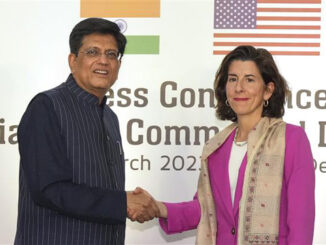
    NEW DELHI (TIP): India and the US on Friday, March 10, inked a memorandum of understanding (MoU) on establishing semiconductor supply chain and innovation partnership.

    US Commerce Secretary Gina Raimondo, who was present along with her counterpart Piyush Goyal, said the MoU was designed to help India achieve its aspirations to play a larger role in the electronic supply chain.

    The MoU was signed under the framework of India-US Commercial Dialogue which is being held for the first time since 2019. The US Commerce Secretary said the MoU had tasked semiconductor industries of both nations to prepare an assessment of gaps and the lack of resiliency in the supply chain.

    “We are absolutely thrilled to be working with India as part of the Indo-Pacific Economic Framework (IPEF). Through IPEF, the US, India and a dozen other partners are developing policies to create more resilient and secure supply chains, accelerate progress, green transitions and demonstrate our commitment to fostering a better business environment,” she said.

    “The MoU talks about how we will share information about the semiconductor commercial opportunities between our two countries, how we will have a continued dialogue around policies that would encourage private sector investment in the semiconductor ecosystem,” said Raimondo.

    However, she made no mention of labor standards and other markers that come along with the promise of more US investment and technology. Before her India visit, she had said in an interview, “I’m running the IPEF. And we’re saying sign up at the government-to-government level to labor standards, environmental standards, anti-corruption standards, rule of law standards. And in return, it’ll unlock US business, US capital jobs in India.”

    The Indian side also sought more clarity on the trade pillar of the IPEF from which it has disassociated while signing on to its other pillars.

    (Source: TNS)

  • British, French leaders seek migration deal; aim to beat Brexit tensions

    British, French leaders seek migration deal; aim to beat Brexit tensions

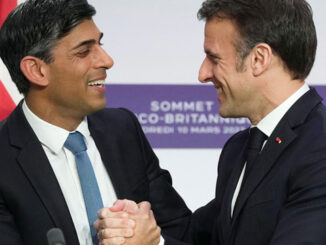
    PARIS (TIP): British Prime Minister Rishi Sunak and French President Emmanuel Macron agreed a new pact to stop illegal cross-Channel migration after a summit in Paris on March 10, 2023 aimed at overcoming years of Brexit tensions. Both leaders hailed a new start in relations between the two neighbors, after intense talks in Paris which were also marked by expressions of unity in their support for Ukraine in fighting the Russian invasion.
    British Prime Minister Rishi Sunak on Friday met French President Emmanuel Macron in Paris for a bridge-building summit, aimed at overcoming years of Brexit tensions and agreeing a new pact on cross-Channel migration.
    Mr. Sunak hailed as “essential” the relationship between the two neighbors ahead of talks, where the pair were also expected to vow more support for Ukraine and security in the Asia-Pacific region, Downing Street said.
    Mr. Macron welcomed Mr. Sunak at the Elysee Palace, after the premier travelled to Paris by train from London. A press conference was expected in the afternoon.
    It is the first U.K.-French summit in five years, after Mr. Sunak became prime minister in October, following the stormy tenures of Liz Truss and Boris Johnson.
    Mr. Macron’s distrust of Brexit figurehead Johnson was barely concealed, while Truss said she didn’t know whether the French leader was a “friend or foe” during her campaign to become prime minister.
    But both sides now see an opportunity to reset the “Entente Cordiale” between Western Europe’s two nuclear powers.
    “I hope it can be the start of a stronger relationship between us and it’s a privilege to be able to play a part in that,” Mr. Sunak told reporters as he travelled over.
    The new constructive mood is set to produce another deal to stem migration from France, with Mr. Sunak determined to thwart thousands of asylum seekers crossing the Channel and Mr. Macron pushing for extra resources to fund border controls.
    Britain has been paying France to help patrol the Channel, and a summit pact will focus on “increasing the resources deployed to manage this common border, with multi-year financing”, an aide to Mr. Macron said.
    The Times newspaper reported that the deal would be for around 200 million pounds (225 million euros, $240 million), spread out over three years.
    Mr. Sunak is under fierce pressure at home to reduce the number of asylum seekers arriving in Britain, and this week unveiled legislation that critics said would make Britain an international outlaw on refugee rights.
    “There is no one silver bullet to solve this problem. So the legislation we introduced this week is incredibly important, cooperation with the French is important, illegal migration enforcement at home is important,” Mr. Sunak explained.
    He also confirmed that the European Political Community — a Mr. Macron initiative formed after Russia invaded Ukraine a year ago — will be hosted by Britain following an October summit in Spain.
    Although Britain’s exit from the European Union still bedevils ties, recent developments, including an agreement to settle the EU trading status of Northern Ireland, have created goodwill.The two neighbors have also found common cause in supporting Ukraine against Russia.
    Mr. Sunak and Mr. Macron will agree to “further coordinate both the supply of weapons to Ukraine and the training of Ukrainian marines”, a Downing Street statement said.As well as Ukrainian soldiers and marines, Britain has undertaken to train Ukrainian pilots – although Western allies are wary of offering fighter jets to Kyiv.
    The leaders will further look at ensuring a “permanent presence of likeminded European partners” in the Asia-Pacific, where concerns about China’s growing assertiveness are shared in both capitals. Mr. Sunak and Mr. Macron were expected to agree on closer coordination of the deployment of France’s Charles de Gaulle aircraft carrier with the Royal Navy’s brand-new carriers — HMS Queen Elizabeth and HMS Prince of Wales.Both countries sent their carriers through the contested South China Sea in 2021.
    As part of the British government’s post-Brexit outreach, the summit paves the way for King Charles III to make France his first foreign destination when he heads there on a state visit at the end of March.
    While Johnson reveled in French-bashing, Mr. Sunak says he and Mr. Macron are “friends”, with their warm embrace during their first encounter in November sparking light-hearted speculation about a “bromance”.
    They are similar ages, 45 and 42, and are former investment bankers. Both were schooled privately, grew up in provincial towns and have fathers with medical backgrounds.
    “I would be careful to read too much into the ‘bromance’, but it’s true they come from a similar background and generation, which has an impact on how they see their countries’ roles in the world,” Alice Billon-Galland, a research fellow at the Chatham House think-tank in London, told AFP. “Both of them bring a new energy. Both sides really do want this (summit) to be a success.”

    (Agencies)

  • Sikh History This Week- March 3, 2023, to March 9, 2023

    3rd March

    1644       Sixth Patshah, Guru Hargobind Ji departed from this planet at Kirtapur. This is the actual date of Joti Jot, although it is observed on a different date by Guru Khalsa Panth.

    1762       Ahmad Shah Abdali, upon reaching Lahore, displays the heads of Sikhs by hanging them on doors and walls.

    1921       Speaking at Shaheedi Diwan, Gandhi sought to integrate the Gurudwara reform movement into the national movement against colonialism. He wanted them “to dedicate their martyrdom to Bharat mata and belive that the Khalsa can remain free only in a free India.” With this event Ghandhi, in his immitable style took politics into religion which the Central Sikh League, a political organisation, had carefully avoided by leaving the reform movement to the SGPC. Ghandhi was a “Hindu holy man with political cloak” in quest for power. Siks weren’t immediately taken in. However, the damage had been done. Gandhi had sown the seeds of division in the Tat Khalsa which sprouted only a few months later.

    1923       Dacoity at Jamser railway station ius committed by the Babbar Akalis.

    1924       3rd Shahidi Jatha of 500 valiant Akali Satyagrahies, led by Sardar Santa Singh of Chuck No. 133, Sargodha, courted arrest at Jaito.

    1947       Muslim League asked to form government in the Punjab. Sikh leaders met in the chamber of Assembly, Lahore. A mammoth crowd raised provocative slogans. At this point, Master Tara Singh came out, unleashed his sword and said “we shall lay down our lives but won’t concede Pakistan.” With this, it became famous that Master Tara Singh had cut off the Pakistan Flag. In actuality, Master Tara Singh did not tear any flag. However, being a fiery speaker, it was perceieved that he did.

    4th March

    1716 Marked the killing of Sikhs in Delhi, under the protection of Sarabrah Khan. 100 Sikhs were killed on the first day.

    1953 Akali led government of PEPSU province dismissed without any ground.

    1988 Jasbir SIngh Rode, a nephew of Jarnail Singh Bhindrawalae, who had been nominated as the Chief Granthi of Sri Akal Takhat, was won over by Rajiv Gandhi, while he was in jail. Under a secret agreement he was released on this day. He tried to confuse the Sikh masses as planned but the Sikh nation rejected him in the same manner as Ragi Darshan Singh. He called a meeting of Sarbat Khalsa at Talwandi Sabo on APril 13, 1988. Even this congregation declated that the Sikh nation would not compromise its freedom.

    5th March

    1716       Marks the begining of systematic execution of 740 Sikh soliders. After their surrender at the fort of Gurdas Nangal, Banda Singh Bahadhur, the valiant Sikh General and his 740 solidiers were taken to Delhi. From Mar. 5 through Mar. 11, these solidiers along with Banda Bahadhur were executed in groups of 100. They were given the option to adopt Islam and escape execution. However, each one of these solidiers refused the offer and instead willingly accepted shahadet with unflinching faith and fortitude.

    1748       Khalsa Panth gathered at Anandpur Sahib for Holla Mehla observations and resolved to gather in Amritsar for Vaisakhi celebrations.

    1892       The foundation stone for Khalsa College, a Shiromani education institution for Sikhs, was laid in Amritsar by J.B. Loyal. Prof. Gurmukh Singh was instrumental its establishment after more than a decade of tireless efforts. The College Council was controlled by its Vice-President Sit Attar Singh Bhadaur with Jawahar Singh serving as General Secretary.

    1921       Gurudwara Sach Khand (Chuharkana) Sahib was forcibly taken over and brought under the control of SGPC.

    1948       Khalsa Panth gathered at Anandpur Sahib for Holla Mehla observations and resolved to gather in Amritsar for Vaisakhi celebrations.

    1955       Punjabi Suba Conference was held at Patiala.

    1971       Elections to Indian Lower House were held. Akali Dal won 1 of the 13 Punjab seats.

    6th March

    1752       The cooperation between Sikhs and Mir Mannu snapped as a result of Kaura Mal’s death. This was evident from action during Abdali’s third invasion. The Sikhs under the patronage of Diwan Kaura Mal, a Khulasa Sikhs, had cooperated with Mir Mannu. henceforth, Mir Mannu as a nominee of Afghans pursued the policy of extirpating Sikhs. If nothing else, their women and children were taken to Nakhas, Lahore, in hundreds, and were subjected to gruesome torture and martyred. In 18 months, he killed about 30,000 Sikhs. The peasentry crushed, because of the Afghan depredations and roving provincial troops in search of the Sikh families, joined the Khalsa fold in large numbers who offered them protection.

    1752       Diwan Kodha Mal, also known as Mitha Mal, died while fighting in Lahore.

    1834       Peshawar occupied by Sikhs. Ranjit Singh sent a force under Hari Singh Nalwa, Ventura and Court under nominal command of Prince Nau Nihal Singh. Pathan chiefs sent their families away as they were aware of the duplicity Of Shah Shujah and Ranjit Singh’s intention to occupy Peshawar. They agreed to enhance the tribute but the Sikh army occupied Peshawar on the pretext that the Prince wanted to see the town and the Pathan chiefs left the city. Hari Singh Nalwa was appointed Governor of Peshawar along with the Governorship Of Hazara. British did not appreciate Sikh occupation of Peshawar. Sikh coins struck from Peshawar.

    1921       Gurudwara Manak Sahib was forcibly taken over and brought under the control of SGPC.

    7th March

    1921       Gurudwara Tham Sahib was forcibly taken over and brought under the control of SGPC.

    1959       SGPC at its general meeting accepted the announcement of Sri Damdama Sahib as Guru Khalsa Panth’s fifth Takhat.

    1966       The formation of Punjabi Suba was declared.

    1966       On the occasion of Hola Mohalla festival at Takhat Sri Kesgarh, Sri Anandpur Sahib, Khalsa Panth declared that all Hindi letters from the official boards, signs, and milestones be obliterated throughout the state and the Sikhs removed all those.

    8th March

    1644       Patshahi Seventh, Sri Guru Har Rai Sahib Ji, ascended to Guruship. Guru Hargobind had five sons, three of whom had died during his life time. Of the two who had survived him, SUraj Mal, born in 1617, was a worldly man, with only a moderate interest in religion, and Tegh Bahadhur, born in 1621, was a recluse. So by the command of Guru hargobind, the young Har Rai, grandson of the Guru, who was fourteen years old, was anointed as the seventh Guru of the Sikhs. The ceremony was performed by Baba Bhana, son of Baba Budha. Just before his death, Guru Hargobind put five paisas and a coconut before Har Rai, bowed to him and Baba Bhana put on his forehead the saffron mark and declared him to be the seventh Guru of the Sikhs.

    1758       Sikhs attacked Lahore. Taemur escaped to Kabul. Adina Begh became the new Governor and initiated atrocities against Sikhs.

    1853       Maharaja Dalip Singh coverted to Christianity. Christian missionaries had spread their network to Lahore, Amritsar and other parts of the Punjab after its annexation. They saw hopeful signs of conversion of the Sikhs and made them a special target.

    9th March

    1783 Sikh forces, under Jassa Singh Ahluwalia and Baghel Singh attacked Delhi and ransacked Houz Khaas after breaking the Mori Gate. Sabzi Mandi, Malkagunj and Pahari Dhiraj areas were plundered. Sikhs set up their headquarters at Majnu Tilla, out-skirts of Delhi. During this attack the Sikh forces captured Delhi. Sardar Baghel Singh returned to Punjab only after getting some major concessions for the Sikhs, raising Kesri Flag on Red Fort and constructing seven historical Gurudwaras connected with Sikh Gurus, including Sis Ganj and Rakab Ganj as memorials to the martydom of Sri Guru Tegh Bahadhur.

  • ‘GATHERING OF GIVERS’ MARKS WOMEN’S DAY

    By Mabel Pais

    Come get inspired at The International Day of Women celebration! Discover new connections!

    Gathering of participants on Women’s Day (Photo : Courtesy NJPAC)

    Women@NJPAC, for over 25 years, has enabled women to channel their time, talent and treasure in promoting the beneficial role of the arts in our everyday lives.

    Now, more than ever, we need the arts in all of its manifestations as we continue to fight injustice, reaffirm the autonomy and resilience of women and find sustenance for the journey toward equity and justice for all.

    The ‘Gathering of Givers’ event is a unique experience, offering women from across the state of New Jersey the chance to gather, connect, heal, motivate each other and recommit their energies to the collective fight ahead.

    Join the illustrious group of women on International Women’s Day for inspiration, healing and new connections as we work toward lasting change in our communities, our state and our world.

    PROGRAM

    What:  ‘Gathering of Givers: Embracing Resilience and Unleashing Hope’

    When:  Wednesday March 8, 2023, 8:30-11:30AM

    Where: NJPAC, 1 Center Street, Newark, NJ

    How:    Rsvp @ njpac.tfaforms.net/257 or call 973.353.7566

    Who:    Featuring 

    Aisha Glover, VP, Center for Urban Innovation, Audible

    Nina Cooke John, Principal, Studio Cooke John; Architect and Artist, ’Shadow of A Face’, The Harriet Tubman Monument, Newark, NJ

    Tamara Linde, Executive Vice President and General Counsel, PSEG; and Board Chair, Community Foundation of New Jersey

    Nelba Márquez-Greene, Founder, The Ana Grace Project

    LaMonica McIver, Council President, Newark Municipal Council

    Angelica M. Ogando, MBA, Co-Founder & COO of Yoshida Academy; Co-Founder & CEO of Warrior Queen Cosmetics

    fayemi shakur, Arts and Cultural Affairs Director, City of Newark

    Senator M. Theresa Ruiz, New Jersey Senate Majority Leader

    Lindsay Schambach, Executive Director, Imagine

    Scheherazade Tillet, Co-Founder, The Long Walk Home

    (Mabel Pais writes on Social Issues, The Arts and Entertainment, Health & Wellness, Cuisine and Spirituality)

    —————————————————

    TIK TOK COMEDIAN PINKY PATEL MAKES MILLIONS LAUGH

    By Mabel Pais

    “I want little Indian girls to watch their moms laugh because they have a phone in front of them and when they peek over their shoulders, it’s me, an Indian woman on their screen, making their mom laugh. To me, that is full circle.” – Pinky Patel

    Pinky Patel (facebook.com/PinkyPatelOfficial)

    The New Jersey Performing Arts Center (NJPAC) brings us PINKY PATEL and her ‘NEW CROWN WHO DHIS’ TOUR at the Victoria Theater, Newark on Saturday, March 11, at 8 PM.

    Pinky Patel, originally from Illinois, is a PTA mom turned creator, comedian, and social media personality with over 5 M Tik Tok followers. She is a fresh new comedian who got her start on TikTok, making millions of people laugh.

    When Pinky is not busy giving out free hits of serotonin, you can find her being an everyday PTA mom to her two young roommates and trying to find new and inventive ways to evict all of the extra eight-legged roommates she keeps acquiring in her glam cave. She is best known for her hilarious commentary and viral videos from her glam cave that has garnered millions of likes on social media. She has worked with brands such as Clorox, Pfizer, Pure Leaf Tea, and many more. You can catch Pinky in a city near you on her much-anticipated ‘New Crown Who Dhis Tour.’

    “You are more than a mom or a wife. You are more than the labels society places on you, you become whoever you want to be, whatever that looks like,” says Patel.

    “Pinky Patel is real, a comedian for every-woman. This new wave of comedy strays from the overdone approaches of forced shock and awe, unintelligible vulgarity and inflated egos,” says Bridge Magazine.

    TICKETS

    Tickets to see Pinky Patel can be purchased by visiting NJPAC.org or the NJPAC Box Office or calling 888. GO.NJPAC (888.466.5722).

    The New Jersey Performing Arts Center (NJPAC)

    Follow NJPAC Online:

    Website:     njpac.org

    Twitter:      @NJPAC

    Instagram:    @NJPAC

    Hashtag:     #NJPAC

    Facebook:    facebook.com/NJPAC

    YouTube:     NJPACtv

    Follow NJPAC’s Standing in Solidarity Series Online:

    Website:     njpac.org/takeastand

    Hashtag:       #NJPACTakeAStand

    Youtube:       Standing in Solidarity playlist 

    (Mabel Pais writes on Social Issues, The Arts and Entertainment, Health & Wellness, Cuisine and Spirituality)

    ———————————————–

    WOMEN IN POWER: CELEBRATING WOMEN’S HISTORY MONTH

    Girl Talk (scene) Photo : worldchannel.org.

    By Mabel Pais

    ‘WOMEN BE SEEN, BE HEARD, BE CELEBRATED’ is the theme of World Channel’s (worldchannel.org) presentation of films for Women’s History Month.

    Celebrate women – their history and present – appreciating the hard won battles for gender equality and recognizing how much more we all have to work toward.

     For too long, women in the United States, and around the globe, have been overlooked and oppressed, their intelligence, talents and opinions suppressed to maintain a patriarchal status quo. Today, through the achievement of trailblazers who fought against inequality, and the many waves of the feminist movement, women of all identities are able to demonstrate their leadership and power in science, politics, the arts and beyond.

    This Women’s History Month, watch films that showcase how women are working against deep-rooted gender discrimination and stereotypes while advocating for their stories to be told – from the groundbreakers of the suffrage movement to the high school students amplifying their voices to win championships and parity on a Massachusetts high school debate team in the new Local USA special ‘Girl Talk.’

    To access the month’s film schedule, visit worldchannel.org. The films are also available on other viewing platforms: pbs.org, youtube.com, Apple Podcasts (apple.com/apple-podcasts) and Spotify (spotify.com).

    (Mabel Pais writes on Social Issues, The Arts and Entertainment, Health & Wellness, Cuisine and Spirituality)

  • ONE EARTH FILM FEST “GETS LOUD”

    By Mabel Pais

    Featuring

    Rep. Alexandria Ocasio-Cortez, activist Varshini Prakash and others in ‘TO THE END’

    Vandana Shiva in ‘SEEDS OF VANDANA SHIVA’

    Children’s Films and many more

    One Earth Film Fest, poster

    The 12th Annual The ‘One Earth’ Film Festival of the greater Chicago area presents its 12th annual edition with the theme ‘Let’s Get Loud!’

    The Festival, on February 7, 2023, called on the audience to advocate the 2023 theme and programs which make a call to action to join the climate movement. The ‘One Earth’ Film Festival returns March 3-12, 2023, for its 12th festival season with its annual launch party and 10 thoughtfully curated film events that will be streamed online, with about a dozen in-person screenings, including ‘View & Brew’ events, in the greater Chicago area.

    The 2023 Festival launches with its annual opening night launch party at Park Tavern on March 3, offering both live and virtual participation. For this year’s theme, the Festival chose ‘Let’s Get Loud!’ to equip and empower individuals and communities far and wide to get loud in advocating for the planet. The films reveal what successful grassroots organizing looks like across different continents and cultures and the power of ordinary people getting loud, working together, and changing history.

    “Since its inception, One Earth has stressed the importance of taking collective action,” One Earth Collective Director Ana Garcia Doyle said. “Film is a powerful way to spur us toward social change and collective action. Much environmental communication heavily depends on data, but that’s not going to change hearts. The stories told through film invoke our empathy and spur our will to act. We must pull together – and be loud about it. The moment to make noise is now.”

    Films screened during the Festival encompass a range of environmental topics and themes that will take viewers around the planet. Through its streamed programs, One Earth now reaches audiences across the U.S., also attracting participant viewers in other countries. Its in-person programs reflect One Earth’s work with a slate of partners across the Chicago region to activate communities around solving the climate emergency. All One Earth presentations are designed to educate, inspire, and prompt action amid current environmental catastrophes. Screenings are accompanied by an expert panel discussion, offering ideas to equip audiences with ways to take action on the world’s most pressing environmental problems.

    Family & Youth Films, poster

    SCHEDULE OF FILMS

    In-person events are being added, so check oneearthfilmfest.org for the latest program details. All films have a virtual viewing option.

    2023 Opening Night Launch Party | March 3 | Park Tavern Chicago 6:30 p.m.

    Children’s (age 3-6+) Short Film Program | March 4 | 10 a.m. | Oak Park Public Library

    Children’s (age 7 to 12+) Short Film Program | March 4 | 10:30 a.m. | Oak Park Public Library

    Vandana Shiva. (Phots : One Earth Film Fest 2023)

    “The Seeds of Vandana Shiva” | March 4| 6:30 p.m. | First United Methodist at the Chicago Temple

    “Devil Put the Coal in the Ground” | March 5| 6:30 p.m.

    “Into the Ice” | March 6| 6:30 p.m.| Gorton Community Center, Lake Forest

    “Wasteland: Iowa” | March 7| 6:30 p.m.| Good Sheppard Lutheran, Oak Park

    “No Climate, No Equity, No Deal” | March 7 | 6:30 p.m. | Good Sheppard Lutheran, Oak Park

    International Women’s Day Selection

    Powerlands” | March 8 |6:30 p.m. | Oak Park Public Library | Pilot Project Brewing, Chicago

    “Going Circular” | March 9 | 6:30 p.m. | Waubonsee Community College, Aurora | Maine South High School, Park Ridge

    “The Falconer” | March 10| 6:30 p.m. | North Park Village Nature Center, Chicago | Euclid Ave. United Methodist Church, Oak Park | Four Rivers Environmental Education Ctr., Channahon

    “Mardi and The Whites” | March 10| 6:30 p.m. | North Park Village Nature Center, Chicago| Euclid Ave. United Methodist Church, Oak Park | Four Rivers Environmental Education Ctr., Channahon

    “Utama” | March 11| 6:30 p.m. “To The End” | March 12| 11:00 a.m. | Tavern at Haymarket Pub & Brewery, Chicago|The Well Spirituality Center, LaGrange Park

    TICKETS

    Tickets are available and mostly free, with a suggested donation. For Tickets, Film, and Program information, visit oneearthfilmfest.org.

    One Earth Film Festival

    One Earth Film Festival is the Midwest’s premier environmental film festival, creating opportunities for understanding climate change, sustainability and the power of people. It showcases top-issue, thought-provoking environmental films, leads audiences in interactive post-film discussions focused on solutions, and offers concrete actions people can take. One Earth Film Festival is a production of One Earth Collective. For more, visit oneearthfilmfest.org

    (Mabel Pais writes on Social Issues, The Arts and Entertainment, Health & Wellness, Cuisine and Spirituality)

  • Holi – The Festival of Colors

    Holi – The Festival of Colors

    Holi is the festival of colors. The festival signifies the arrival of spring and the end of winter. In India, this is the last full moon of the year and 15 days after this full moon is the New Year in India. So before that last full moon, the tradition is to just take all the old stuff and put it in the fire and play Holi with colors.

    There are many stories associated with Holi – of it being a beautiful full moon day, of welcoming spring , and of Krishna dancing with all the Gopis (devotees of Lord Krishna) while playing Holi.

    Holi is a festival when we break all the barriers and feel a sense of oneness with everyone. This is the message of this vibrant festival. As we apply colors on one another and wish each one the very best: “Let your life be colorful.”

    If you leave a group of kids in a room that come from many different backgrounds (rich, poor, intelligent, not-so-intelligent), do you know how they’ll play? They will play without finding any distinction between themselves. Similarly, Holi is one such festival that unites people of diverse backgrounds and professions.

    Society divides people – sometimes on the basis of profession, gender, age groups. Holi is the time when we break all these barriers of gender, nationality, race, and religion. From the elderly to the young! You hug everybody and put colors on them. It’s a unifying celebration.

    The essence of Holi

    There are different colors associated with our feelings and emotions. For instance:

    Red – anger

    Green – jealousy

    Yellow – vibrancy and happiness

    Pink – love

    Blue – vastness

    White – peace

    Saffron – sacrifice

    Violet – knowledge

    Each person is a fountain of colors that keeps changing its hues. If your life is like Holi, where each color is seen clearly, then that adds charm to your life. Harmony in diversity makes life vibrant, joyful, and more colorful.

    Like Holi, life should be colorful, not boring. When each color is seen clearly, it is vibrant. When all the colors get mixed, you end up with black.

    Similarly, in our day-to-day lives, we play different roles. Each role and emotion needs to be clearly defined. Emotional confusion creates problems. When you are a father, you have to play the part of a father. You can’t be a father at the workplace. When you mix roles in your life, you start making mistakes. Whatever role you play in life, give yourself fully to it.

    In ignorance, emotions are a bother; in knowledge, the same emotions add color. Tell yourself that you will do justice to all the roles you play. You can play all the roles: a good spouse, good child, good parent, and a good citizen. Assume that you have all these qualities in you. Just let them blossom

    History of Holi

    Holi is an ancient festival of India and was originally known as ‘Holika’. The festivals finds a detailed description in early religious works such as Jaimini’s Purvamimamsa-Sutras and Kathaka-Grhya-Sutras. Historians also believe that Holi was celebrated by all Aryans but more so in the Eastern part of India. It is said that Holi existed several centuries before Christ. However, the meaning of the festival is believed to have changed over the years. Earlier it was a special rite performed by married women for the happiness and well-being of their families and the full moon (Raka) was worshiped.

    Holika Dahan

    There are numerous mythological explanations that are described in the historical books regarding the death of Holika and its reference for the celebration of Holi. In accordance to those historical explanations Holika was booned by Brahma for not getting any harm from fire or never getting burnt in fire. Following the order of his Brother Hiranyakashyap (who was also the father of Prahlad) Holika sat on fire with Prahladf in order to burn him in fire and let to death. It was Prahlad’s prayers to Lord Vishnu that saved him from burning in fire. It was the protective shawl of Holika that flew to cover Prahlad’s body from Holika who was having it. This is the story behind the celebration of Holika Dahan that is still followed by the people of India.

    Legend of Holika and Prahlad

    There was once a demon king by the name of Hiranyakashyap who won over the kingdom of earth. He was so egoistic that he commanded everybody in his kingdom to worship only him. But to his great disappointment, his son, Prahlad became an ardent devotee of Lord Naarayana and refused to worship his father.

    Hiranyakashyap tried several ways to kill his son Prahlad but Lord Vishnu saved him every time. Finally, he asked his sister, Holika to enter a blazing fire with Prahlad in her lap. For, Hiranyakashyap knew that Holika had a boon, whereby, she could enter the fire unscathed.

    Treacherously, Holika coaxed young Prahlad to sit in her lap and she herself took her seat in a blazing fire. The legend has it that Holika had to pay the price of her sinister desire by her life. Holika was not aware that the boon worked only when she entered the fire alone.

    Prahlad, who kept chanting the name of Lord Naarayana all this while, came out unharmed, as the lord blessed him for his extreme devotion. Thus, Holi derives its name from Holika. And, is celebrated as a festival of victory of good over evil.

    Holi is also celebrated as the triumph of a devotee. As the legend depicts that anybody, howsoever strong, cannot harm a true devotee. And, those who dare torture a true devotee of god shall be reduced to ashes.

    The Legend of Radha-Krishna

    Young Krishna is known to be very playful and mischievous. The story goes that as a child, Krishna was extremely jealous of Radha’s fair complexion since he himself was very dark.

    One day, Krishna complained to his mother Yashoda about the injustice of nature which made Radha so fair and he so dark. To pacify the crying young Krishna, the doting mother asked him to go and colour Radha’s face in whichever colour he wanted.

    In a mischievous mood, naughty Krishna heeded the advice of mother Yashoda and applied colour on her beloved Radha’s face; Making her one like himself.

    Well, there is also a legend to explain Krishna’s dark complexion. It so happened that once a demon attempted to kill infant Krishna by giving him poisoned milk. Because of which Krishna turned blue. But Krishna did not die and the demon shriveled up into ashes.

    The Legend of Dhundhi

    It is believed that there was once an Ogress called Dhundhi in the kingdom of Prithu (or Raghu). The female monster used to specially trouble little children who became fed- up of her. Dhundhi, had a boon from Lord Shiva that she would not be killed by gods, men nor suffer from arms nor from heat, cold or rain. These boons which made her almost invincible but she also had a weak point. She was also cursed by Lord Shiva that she would be in danger from boys going about crazy.

    Deeply troubled by the Ogress, the King of Raghu consulted his priest. Giving the solution, the priest said that on Phalguna 15, the season of cold vanishes and summer starts. Boys with bits of wood in their hands may go out of their house, collect a heap of wood and grass, set it on fire with mantras, clap their hands, go around the fire thrice, laugh, sing and by their noise, laughter and homa, the ogress would die.

    The legend has it that on the day of Holi, village boys displayed their united might and chased Dhundhi away by a blitzkrieg of shouts, abuses and pranks. It is for this reason that young boys are allowed to use rude words on the day of Holi without anybody taking offence. Children also take great pleasure in burning Holika.

    Different Types Of Holi Celebrations In India

    Lathmaar Holi

    In what is known as the hub of holi in India – Barsana, Holi is known as Lathmaar Holi. Sounds violence?? There is more violece than the name signals off. The stick is in the hands of the women on this day and the men need to work a lot to save themselves from the immensely charged up womenfolk.

    The birth place of Lord Krishna’s beloved Radha, Barsana celebrates Holi with extreme enthusiasm as Krishna was famous for playing pranks on Radha and gopis. In fact, it was Krishna who started the tradition of colours by first applying colour on Radha’s face.

    Womenfolk, of Barsana it seems, after thousands of centuries want to take a sweet revenge of that prank of Krishna. Even men have not left their mischief and are still eager to apply colour on the women of Barsana.

    Following the tradition, men of Nandgaon, the birthplace of Krishna, come to play Holi with the girls of Barsana, but instead of colours they are greeted with sticks.

    Completely aware of what welcome awaits them in Barsana, men come fully padded and try their best to escape from the spirited women. Men are not supposed to retaliate on the day. The unlucky ones are forcefully led away and get a good thrashing from the women. Further, they are made to wear a female attire and dance in public. All in the spirit of Holi.

    The next day, it is the turn of men of Barsana. They reciprocate by invading Nandgaon and drench the womenfolk of Nandgaon in colours of kesudo, naturally occurring orange-red dye and palash. This day, women of Nadagow beat the invaders from Barsana. It is a colorful site.

    Dhulandi Holi in Haryana

    Celebrated magnanimously in the state of Haryana, Dhulandi is a celebration of the bond between Bhabhi (sister-in-law) and Devar (brother-in-law). This relationship of playing pranks and annoying each other is literally like the bond between partners in crime. On this special day, Bhabhis get an advantage to drag their Devars in mock rage. This is how they payback for the gags they play. Besides, smearing colors and splashing water is a ritual, the real essence of Holi lies in bringing colors and joy in otherwise mundane life.

    Phoolon Ki Holi in Vrindavan

    Celebrated on the Ekadashi in the Holi week, Phoolon ki Holi is played with petals of fresh flowers in Banke Bihari temple, Vrindavan with great fervor by the Krishna disciples. The exquisiteness lies in the ambiance that’s filled with fragrance and flowers, the scenic vista takes you to a different world. Unlike, usual Holi festival which is played with colors and water, Phoolon ki Holi is more about connecting with God of love and joy by showering him with flowers. Not too lengthy, a 15-minute affair is enough to take you in a trance.

    Rangpanchami in Maharashtra

    Out of the myriad ways of playing Holi, Rangpanchami celebrated in Maharashtra is yet another exquisite style. Celebrated on the 5th day preceding Phalgun Purnima, the fun seems ceaseless. Lord Krishna with his notorious comrades used to steal butter from the neighborhood and to keep the butter safe from these butter-thieves, women used to hide it in the highest chambers in the houses. Dated from that time, the tradition is followed in Mumbai and many cities of Maharashtra in the name of Krishna Leela. To relive the antics, every year pandals are set to break pots. The pots are hung on the great height and boys in huge numbers form pyramids. Trained boys climb up onto them while women deter them from reaching to the pot by splashing water and colors. The sight of this ceaseless battle brings verve and joy to the clocked-up life in big cities.

    Royal Holi in Jaipur

    The land that is already famous as Pink city is a delight to watch on the auspicious day of Holi as it is soaked in multiple hues, unrestricted to pink. The royals of the City Palace in Jaipur organize a grand ceremony in their condominium every year. This blazes up the excitement of Holi amongst the local folks and the foreign tourists. Every year, Jaipur is hoarded with huge footfall during this festival as it is the time when people get to smear the royal family with colors. The frolicsome grand celebration of the Holi Festival in Jaipur etches the indelible memories in the hearts of the visitors.

    Basant Utsav in West Bengal

    The day marked as the birth anniversary of Sri Chaitanya Mahaprabhu, Holi has this special significance in West Bengal. The land of writers and scholars celebrates the festival of colors with songs, dance, and chanting hymns in the University at Shantiniketan, Kolkata which was founded by the legend Rabindra Nath Tagore. Unlike the rambunctious Holi celebration all over India, here it is subdued and restrained but the essence of festivity is fine-tuned. No wonder if you dread the rowdiness, Holi in Bengal can be an option for a moderate and graceful way of celebrating Holi.

    Hola Mohalla in Anandpur, Punjab

    Lionized by Sikh Guru Gobind Singh, Hola Mohalla is a festival that is out of the ordinary and celebrated one day after Holi. Giving tribute to the mettle and valor of the Sikh men, it is celebrated as an event that exhibits martial arts, stunts, and mock fights followed by the usual tradition of playing with colors in the evening. There is a massive arrangement for langar (food) that is served in the Gurudwara all throughout the day. A one-day fun and frolic affair is held in open ground at a ford across the creek Charan Ganga, Hola Mohalla is the biggest festival of Anandpur Sahib, Punjab.

    Phalgun Purnima in Bihar

    The harbinger of the spring season, Holi in Bihar is celebrated to mark good harvests and fertility of the land besides the significance of the mythological tale of Prahlad winning over Holika. On the eve of Phalgun Purnima, bonfires are lit by putting cow dung cakes, grains from the fresh harvest, and wood of the Holika tree. Holi is marked as the beginning of the new year in Bihar therefore people clean their houses to bring positivity and prosperity to their life. Apart from smearing colors, folks in Bihar also use mud, the air fills with high pitch folk songs sung to the tune of the dholak. Folks indulge in consuming intoxicating bhang to brighten up the mood during this festival. They sing, dance, laugh, and enjoy the true spirit of the festival.

  • Hola Mohalla- the Sikh festival of display of martial  prowess

    Hola Mohalla- the Sikh festival of display of martial  prowess

    Falling on the second day of the month of Chet, which usually comes in March as per the Gregorian calendar, Hola Mohalla is all about exploring the essence of Punjabi culture.

    Organized at a grand scale in Anandpur Sahib in Punjab, this festival takes people on a fun-packed ride of heritage, glorifying the Sikh Culture.

    Mohala is a word that is usually used to describe a cheerful procession. And Hola Mohalla primarily implies to be a form of an army column that is accompanied by the war drums, standard-bearers, and much pomp and show.

    Hola Mohalla was first organized by the tenth guru of the Sikhs, Guru Gobind Singh Ji. It is believed that the main purpose of organizing this festival was to fundamentally strengthen the Sikh Community with fair use of military exercises and mock battles. Daredevil acts like bareback horse-riding by the warriors, standing upright simultaneously on two speeding horses to even tent pegging are a few common acts on display during this Indian festival.

    Hola Mohalla truly depicts the bravado of Sikh men through mock fighting of the Sikh warriors, which they have showcased in the battlefields over history.

    Meaning of “Hola Mohalla”

    The word “Hola” is a masculine form of feminine sounding “Holi” and is more likely to have evolved from word “halla” which implies a military charge. “Mohalla” is derived from an Arabic word mahalla, implying a colony, in this case an army procession. Thus, when combined together, the words “Hola Mohalla” mean “the charge of an army.”

    When is Hola Mohalla Celebrated?

    The dates of Hola Mohalla celebrations are based on the traditional lunar calendar of Sikhism, known as “Nanakshahi calendar”. The festival commences on the second day of Chett month, which is also the first month of Nanakshahi calendar.

    The festival of Hola Mohalla usually coincides or differs by a day with holi celebrations in the Gregorian calendar month of March. Holi is celebrated in the Phalgun month of Hindu calendar and the celebration falls on the first day of lunar month Chett.

    Hola Mohalla History

    The festival of Hola Mohalla was founded by the 10th Guru of Sikhism – Guru Gobind Singh. The history of Hola Mohalla dates back to 1699, when Guru Gobind Singh formed the Khalsa Panth, which is a warrior community of Sikhs. Khalsa was formed by the Guru to wage war against the atrocities and conversion philosophy of Mughal emperor Aurangzeb.

    The legend has it that in 1699 Guru Gobind Singh asked the sikhs to gather at Anandpur on the day of Vaisakhi, an annual spring harvest festival celebrated in Punjab. It was on this day that the Guru appointed “Panj Pyares” and called them as the first Khalsa in Sikh traditions.

    Subsequently, in the following year of 1701 on 7th March, Guru Gobind Singh initiated a new tradition of mock battles and poetry at the Lohgarh fort in Anandpur Sahib. Since then the festival of Hola Mohalla is being annually celebrated at Anandpur Sahib and has also spread to other Gurudwaras like Kirtarpur Sahib in Rupnagar district and is also replicated in the Gurudwaras around the world.

    Hola Mohalla at Anandpur Sahib

    Though the festivities of Hola Mohalla last for three days, people start gathering at Anandpur Sahib, a week before the main festival. The festival at Anandpur Sahib is specially celebrated as a display of war skills and velour of the Sikh community.

    Huge colorful procession is organized in which Sikh warriors display their skills of sword fighting, horse riding, martial arts, tent pegging and other daring activities like standing on two galloping horses, riding a bareback horse etc. The Akali warriors also known as Nihang and Khalsa warriors are main participants in mock battles.

    Apart from the mock battles, religious processions are also held, giving the people a deep insight into the Sikh religion. Sikhs as well as people of different faith from around the world gather at Ananadpur Sahib to witness the grand festival of Hola Mohalla. Nihangs riding on horseback, spray gulal at the audiences. Religious sermons are organized at various durbars in Anandpur Sahib.

    A huge fair is set up at Anandpur Sahib with various stalls for children and elderly. Stalls sell all type of weapons replica – swords, daggers, spear etc and also local delicacies. Another attraction of Hola Mohalla at Anandpur Sahib is the make shift tent houses for the performers and the people coming from far places.

    The festival concludes on the third day with a huge procession by Nihang warriors followed by hundred of Sikh pilgrims. The procession is headed by the Panj Pyare and originates from Takht Sri Keshgarh Sahib, one of the five panch takhts (religious thrones) of Sikhism.

    The procession then passes through other Gurudwaras – Quila Anandgarh, Mata Jitoji and Lohgarh Sahib, before terminating at Takht. Langars are organized at Gurudwaras as well as other locations for the visitors. Villagers too volunteer for organizing langar as community service.

    Hola Mohalla Celebration around the Globe

    The festival of Hola Mohalla is celebrated in other Gurudwaras of India and the Gurudwaras across the world as well. Religious sermons and poetry are recited. Stories of valor of Guru Gobind Singh and other religious Gurus are told to the devotees. The procession at Anandpur Sahib is also replicated at other places as well, with Sikh warriors displaying their battle skills.

    Hola Mohalla is also celebrated in the countries having good presence of Sikh Diaspora. The celebrations are usually marked by recitation of Guru Grant Sahib and story of Guru Gobind Singh and other religious gurus of Sikhs.

    Significance of Hola Mohalla

    Hola Mohalla gives a chance to the Sikh community to reaffirm their faith in religious customs and beliefs along with remembering their religious Gurus. The festival is a kind of tribute to Guru Gobind Singh who formed Khalsa warrior community to fight back invaders, and provide protection to the vulnerable, poor, oppressed and needy.

    People belonging to other religions and cultures get to know Sikh religion and admire their unity and war skills. The festival of Hola Mohalla also signifies unity in diversity as it is a huge congregation of not only Sikhs but also millions of various faiths and religions. People belonging to different religions and castes enjoy the festivities and dine at the langars (community feast) together.

  • International Women’s Day

    International Women’s Day

    International Women’s Day, also known as IWD for short, grew out of the labour movement to become a recognised annual event by the United Nations (UN). The seeds of it were planted in 1908, when 15,000 women marched through New York City demanding shorter working hours, better pay and the right to vote. A year later, the Socialist Party of America declared the first National Woman’s Day.

    The idea to make the day international came from a woman called Clara Zetkin, communist activist and advocate for women’s rights. She suggested the idea in 1910 at an International Conference of Working Women in Copenhagen. There were 100 women there, from 17 countries, and they agreed on her suggestion unanimously.

    It was first celebrated in 1911, in Austria, Denmark, Germany and Switzerland. The centenary was celebrated in 2011, so this year we’re technically celebrating the 111th International Women’s Day.

    Things were made official in 1975 when the United Nations started celebrating the day. The first theme adopted by the UN (in 1996) was “Celebrating the Past, Planning for the Future”.

    International Women’s Day has become a date to celebrate how far women have come in society, in politics and in economics, while the political roots of the day mean strikes and protests are organised to raise awareness of continued inequality.

    Why 8 March?

    Clara’s idea for an International Women’s Day had no fixed date.

    It wasn’t formalised until a war-time strike in 1917 when Russian women demanded “bread and peace” – and four days into the strike the Tsar was forced to abdicate and the provisional government granted women the right to vote.

    The date when the women’s strike commenced on the Julian calendar, which was then in use in Russia, was Sunday 23 February. This day in the Gregorian calendar was 8 March – and that’s when it’s celebrated today.

    Why do people wear the color purple?

    Purple, green and white are the colours of IWD, according to the International Women’s Day website.

    “Purple signifies justice and dignity. Green symbolizes hope. White represents purity, albeit a controversial concept. The colours originated from the Women’s Social and Political Union (WSPU) in the UK in 1908,” they say.

    How is Women’s Day celebrated?

    International Women’s Day is a national holiday in many countries, including Russia where flower sales double during the three or four days around 8 March.

    In China, many women are given a half-day off work on 8 March, as advised by the State Council.

    In Italy, International Women’s Day, or la Festa della Donna, is celebrated by the giving of mimosa blossoms. The origin of this tradition is unclear but it is believed to have started in Rome after World War Two.

    In the US, the month of March is Women’s History Month. A presidential proclamation issued every year honours the achievements of American women.

    What is the IWD 2023 theme?

    The UN’s theme for 2023 is “DigitALL: Innovation and technology for gender equality”. This theme aims to recognise and celebrate the contribution women and girls are making to technology and online education.

    This year, IWD will also explore the impact of the digital gender gap on inequality for women and girls, as the UN estimates that women’s lack of access to the online world will cause a $1.5 trillion loss to gross domestic product of low and middle-income countries by 2025 if action isn’t taken.

    But there are also other themes around. The International Women’s Day website – which says it’s designed to “provide a platform to help forge positive change for women” – has chosen the theme #EmbraceEquity with organisers and events seeking to “challenge gender stereotypes, call out discrimination, draw attention to bias, and seek out inclusion”.

    Why do we need it?

    In the past year, women in many countries such as Afghanistan, Iran, Ukraine and the US have been fighting for their rights amid war, violence and policy changes in their respective countries.

    In Afghanistan, the resurgence of the Taliban has hindered advancements in human rights with women and girls now banned from higher education, working most jobs outside of the home, travelling long distances without a male chaperone and they are instructed to cover their faces in public.

    In Iran, protests were sparked by the death of Mahsa Amini, a 22-year-old woman arrested by morality police in Tehran on 13 September 2022 for allegedly violating Iran’s strict rules requiring women to cover their hair with a scarf.

    Since then, demonstrations have continued across the country with many Iranians – both female and male – calling for better rights for women and a change from the current political leadership. “Woman, life, freedom” is the slogan of the protests. Authorities have portrayed them as “riots” and responded with force. More than 500 people have died.

    Following the invasion of Ukraine by Russian forces on 24 February 2022, the UN report that gender gaps in food insecurity, malnutrition, poverty, and increased gender-based violence have worsened inside Ukraine and around the world due to war-induced price hikes and shortages.

    On June 24 2022, the US Supreme Court overturned Roe v Wade, a historic piece of legislation which protected the right to abortion for American women, causing widespread outcry and demonstrations in the US. A number of US women have sought support to get a termination from people in Mexico, where a historic ruling in 2021 effectively decriminalised abortion.In the past few years though, there has been progress. In November 2022, the European Parliament passed a law after a 10-year battle to ensure more women are represented on publicly traded companies’ boards by July 2026. “There are plenty of women qualified for top jobs and with our new European law, we will, make sure that they have a real chance to get them,” the EU said.

    Meanwhile parental leave laws were updated in Armenia and Colombia, and Spain passed laws to support menstrual health leave and extended access to abortion.

    The International Olympic Committee reported the most gender-balanced Winter Games with women making up 45% of athletes at Beijing 2022. Though gender parity wasn’t achieved, new guidelines promoted more balanced coverage of women’s sport.

    The Fifa Women’s World Cup in 2023 is newly expanded, with 36 teams taking part. Ahead of the competition, the US Soccer Federation reached a historic agreement to pay its men’s and women’s teams equally, making it the first in the sport to promise both sexes matching money. Female players had filed a number of equal pay claims and lawsuits, arguing their case for more than five years.

    Source: BBC