Year: 2023

  • The South Asian Times celebrated felicitation of Anil Bansal as Person of the Year 2022 at the Indian Consulate

    The South Asian Times celebrated felicitation of Anil Bansal as Person of the Year 2022 at the Indian Consulate

    NEW YORK (TIP): Anil Bansal, Past President of FIA, a successful serial entrepreneur, ambassador and promoter of Indian arts and culture, and a great humanitarian, was felicitated as The South Asian Times Person of the Year (POY) 2022 at the Consulate of India here on January 21. The event was oversubscribed with the presence of who is who of the Indian diaspora of the New York metro area.

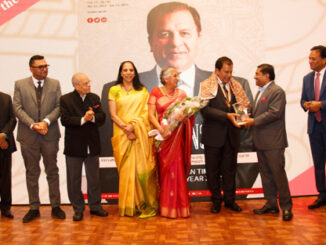
    At the graceful event, immediate past Person of the Year Mohan Wanchoo presented a shawl and Consul General Randhir Jaiswal presented the crystal plaque honoring Anil Bansal POY-2022 on behalf of  Forsythe Media Group. Joining in the presentation were Kamlesh C Mehta (Chairman, Forsythe Media), Ankur Vaidya (Chairman, FIA), Dr Nirmal Mattoo (Chairman, IAAC), Chintu Patel (CEO, Amneal Pharmaceuticals), and Haridas Kotahwala (Chairman, Navika group). Mrs. Nimmi Mehta presented a floral bouquet to Mrs. Kumud Bansal.

    As a surprise but memorable moment of the evening came when on request of FIA, Consul General Jaiswal presented to Bansal the Pravasi Bharatiya Medal conferred on FIA, which was honored by the Indian government for its commendable service in India and the US during Covid during Bansal’s presidency. Noticeably, Anil Bansal was president of FIA during the peak of COVID-19, and he was instrumental in sending over $50 Million worth of aid from FIA to India during the pandemic.

    Speaker after speaker praised the publication and Bansal’s accomplishments and services to the community and society. Kamlesh Mehta highlighted Bansal’s humility and selflessness, mentioning that it was hard to convince him to accept POY honor. Ankur Vaidya spoke on behalf of FIA (Federation of Indian Associations – NY-NY-CT-NE) and Rakesh Kaul and Dr Mattoo for IAAC (Indo-American Arts Council). POY Bansal  has supported both organizations for decades.

    Bansal’s extended family, friends and colleagues were present in full strength at the event. His son, Avin Bansal, CFO and investor, and daughter Neha Hannan, a lawyer, expressed their love and admiration for him. Nephew Dr Sharad Sahu, an internist, shared some family anecdotes involving Anil Bansal.

    Anil Bansal in his acceptance speech expressed gratitude for the honor and went on to share his life experiences. He concluded by sharing the life lesson of ‘giving back’: “I and Kumud felt that we have enough financial resources for the rest of our lives for what we want to do and how we want to live.”

    The newspaper featuring Anil Bansal as POY 2022 was also launched at the event by the Consul General. Copies of the issue were distributed to the attendees and coffee mugs gifted by alotusinthemug.com web magazine.

    Consul General Randhir Jaiswal presented PBD medal to Anil Bansal. The Indian government conferred PBD Samman award on FIA for 2020 when Bansal was its president.

    The South Asian Times could not formally felicitate Mohan Wanchoo, POY 2021 because of Covid, so he was honored with a shawl  by Kamlesh Mehta and crystal plaque by Haridas Kotahwala. Other past POYs who were honored and who spoke at the event included  Chintu Patel (2017), Haridas Kotahwala  (Navika – TSAT Organization of the Year 2018), and Ankur Vaidya (FIA was Organization of the Year 2015 during his presidency). Pam Kwatra, a renowned community leader, Shailesh ‘Sam’ Jain, Chairman of Cheapoair, and prominent community leaders Karamjit Singh Dhaliwal, Jasbir Jay Singh, Alok Kumar Dr. Avinash Gupta, Rajeev Kaul, Sunil Shah, Saurin Parikh, and Sujata Seth were among the attendees.

    The event was emceed by the famous Bollywood & Hollywood actor Prashantt Guptha.

    A sumptuous vegetarian dinner created by Michelin Star decorated chef Hemant Mathur was served.

    The proceedings of the event were supported by Eric Kumar, Totee Wadhwa, Nicky Jagda and Parveen Chopra. Chopra’s wellness and spirituality website, alotusinthemud.com was launched after the felicitation.

    Acknowledging felicitations from dignitaries, friends and family, Anil Bansal shared lessons from his own life with the audience.
    Kumud and Anil Bansal posing with son Avin and daughter Neha’s families.
  • Cargo ship sinks between South Korea and Japan; 2 dead, 8 missing

    Cargo ship sinks between South Korea and Japan; 2 dead, 8 missing

    Seoul (TIP): Ships searching in wind-whipped waters between South Korea and Japan have picked up at least 14 of the 22 crew members from a cargo vessel that sank early on January 24, killing at least two, officials said. South Korean officials said nine of those rescued remain unconscious, but they did not immediately confirm any deaths. Ten crew members were later airlifted to Nagasaki in southern Japan for treatment, but two of them were confirmed dead on arrival, Japanese officials said.

    South Korean and Japanese coast guard vessels and aircraft as well as two commercial cargo ships were continuing to search for the eight missing crew members but the efforts were being slowed by strong winds and waves, South Korean officials said.

    The Japanese coast guard confirmed the rescue of at least 13 crew members and said five of them – all Chinese nationals – were still alive. The 6,551-ton Jin Tian sank about 3 ½ hours after it sent a distress call around 11.15 pm on Tuesday in Japan’s exclusive economic zone, Japanese coast guard spokesperson Shinya Kitahara said.

    The vessel, which was Hong Kong registered and carrying lumber, sank about 160 kilometres (100 miles) southwest of Nagasaki, Japan, and about 150 kilometres (93 miles) south of South Korea’s Jeju island.

    The captain last communicated with the coast guard through a satellite phone around 2.41 am, saying the crew would abandon the ship, minutes before it sank, Jeju island coast guard officials said.

    Six crew members were picked up by South Korean coast guard vessels, while a cargo ship picked up five and Japanese aircraft picked up three, according to Jeju’s coast guard.

    Officials said 14 crew members are Chinese and eight are from Myanmar. According to maritime transport websites, the vessel left Malaysia’s Port Klang on December 3 and was headed for South Korea’s Incheon port.

    The ship is owned by Long Bright Shipping Limited, a Hong Kong-registered company that is a subsidiary of Shenzhen Shekou Shipping Transportation Co., Ltd., according to a July 2022 filing made by the parent company to China’s National Equities Exchange and Quotations.

    The filing says the Jin Tian was used as collateral for a loan that was later repaid.

    Calls to a number listed for Shenzhen Shekou Shipping Transportation in mainland China went unanswered on Wednesday during the weeklong Lunar New Year holiday.

    South Korean officials didn’t immediately say whether the nine who were unconscious were likely to survive. They said the five other crew members who were rescued were either conscious when found or regained consciousness.

    Kitahara said the cause of the ship’s sinking was not immediately known and there were no signs that it collided with another vessel. He said the arrivals of Japanese patrol boats and aircraft were delayed by difficult weather.

    Officials at Jeju’s coast guard said a strong wind warning was issued for the area earlier on Wednesday but was later lifted. Winds were blowing at around 56 kilometres (35 miles) per hour, creating waves 3-4 metres (9-13 feet) high.

    The Japanese coast guard said the water in the area remained rough with a temperature of 14 degrees Celsius (57 degrees Fahrenheit). (AP)

  • India Celebrates 74th Republic Day in Guatemala

    India Celebrates 74th Republic Day in Guatemala

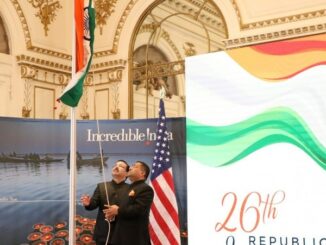
    GUATEMALA CITY (TIP): Embassy of India, Guatemala celebrated the  74th Republic Day with great fervor. Ambassador Manoj Kumar Mohapatra unfurled the tricolor on 26th January 2023.

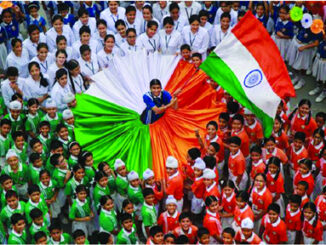
    As a part of AzadiKaAmritMahotsav celebrations, Ambassador Manoj Kumar Mohapatra unfurled the tricolor in Xela, the second-largest city in Guatemala in the presence of Mr. Juan Fernando López, Mayor of Xela on 24th January 2023. Ambassador Mohapatra unfurled the tricolor in the eastern Guatemalan city, Chiquimula in the presence of Hon’ble Governor, Mr. Ferlandy Caceres, Mayor, Mr. Rolando Guerra, & other regional mayors on 25th January 2023. Indian Embassy in Guatemala celebrated ‘India Day’ in Synergy International School in Guatemala City, with unfurling of the Indian flag, a lecture on Indian history and Yoga Session with more than 200 students on 25th January 2023.

  • Germany agrees to provide Ukraine with Leopard tanks

    Germany agrees to provide Ukraine with Leopard tanks

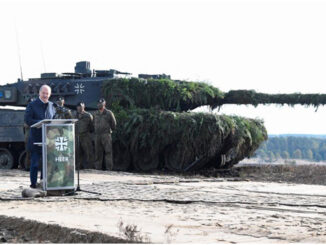
    Berlin (TIP): After weeks of hesitation that saw growing impatience among Germany’s allies, Chancellor Olaf Scholz announced on January 24 that his government would provide Ukraine with Leopard 2 battle tanks and approve requests by other nations to do the same. In a statement, the government said it would initially provide Ukraine with one company of Leopard 2 A6 tanks, which comprises 14 vehicles, from its own stocks. The goal is for Germany and its allies to provide Ukraine with a total of two battalions, or 88 tanks.

    Scholz said Germany was “acting in close coordination” with its allies.

    The long-awaited decision came after US officials said a preliminary agreement had been struck for the United States to send M1 Abrams tanks to help Kyiv push back Russian forces entrenched in the east almost a year since the start of the war.

    Scholz had insisted that any move to provide Ukraine with powerful Leopard 2 tanks would need to be closely coordinated with Germany’s allies, chiefly the United States.

    Ekkehard Brose, head of the German military’s Federal Academy for Security Policy, said tying the United States into the decision was crucial, to avoid Europe facing a nuclear-armed Russia alone.

    Kremlin spokesman Dmitry Peskov described German and US intentions with the tanks as a “a rather disastrous plan.” “I am convinced that many specialists understand the absurdity of this idea,” Peskov told reporters.

    The far-right Alternative for Germany called the decision “irresponsible and dangerous.” The Left party, which also has historic links to Moscow, warned of a possible escalations in the ongoing conflict. — AP

  • London Mayor issues high air pollution alert, calls to avoid car journeys

    London Mayor issues high air pollution alert, calls to avoid car journeys

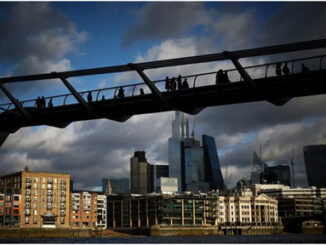
    London (TIP): Mayor of London Sadiq Khan issued a high air pollution alert for January 23 and called on Londoners “to be careful over the next few days” and avoid unnecessary car journeys.

    The UK capital has experienced moderate air pollution since the weekend as a result of continuing cold, still, and foggy conditions creating poor dispersion of vehicle emissions.

    Pollution alert messages will be displayed across the Transport for London (TfL) public transport network and schools in the city will also be notified as part of actions planned by the Mayor’s office. “On Tuesday, alongside the extreme cold temperatures we’ve been experiencing, we are also expecting high levels of air pollution,” said Khan.

    “We know how dangerous toxic air is for Londoners – that’s why I’m doing everything in my power to tackle it,” he said.

    “We all need to be careful over the next few days. I’m urging Londoners to look after each other by choosing to walk, cycle or take public transport where possible, avoiding unnecessary car journeys, stopping engine idling and not burning garden waste, all of which contributes to high levels of pollution. This is particularly important in order to protect those who are more vulnerable to high pollution,” he added. The London Mayor’s air pollution forecasts are issued by Imperial College London as combined forecasts based on a number of public forecasts, including the government’s Department for Environment, Food and Rural Affairs (Defra) and the Meteorological Office.

    The Mayor’s office said London has the “world’s largest air quality monitoring network”, which provides free live and archived air quality data to anyone who wants it as well as supporting pollution forecasting and London’s air quality alert service.

    The Mayor said the latest alert shows why it’s important to expand the capital’s Ultra Low Emission Zone (ULEZ) London-wide to reduce toxic air pollution in the city.

    The ULEZ, targeting the most polluting vehicles with a daily surcharge, is set to be expanded London-wide from August this year as part of measures to clamp down on the city’s air pollution.

    Under the ULEZ scheme, introduced in 2019, drivers are charged 12.50 pounds to enter the area within London’s north and south-circular orbital roads, to be applied to all London boroughs from later this year. (AP)

  • Russia launches wave of missile and self-exploding drone attacks on Ukraine

    Russia launches wave of missile and self-exploding drone attacks on Ukraine

    Kyiv (TIP): Ukrainian officials said on January 24 that Russia launched a wave of missile and self-exploding drone attacks on the country.

    Air raid sirens wailed nationwide. There were no immediate reports of the targets, but Kyiv’s mayor said a Russian missile strike killed one person, the first death from an attack in the capital since New Year’s Eve. Mayor Vitali Klitschko said two other people were injured in the strike. The head of the Kyiv city administration said 15 cruise missiles were shot down. Serhii Popko said the missiles were fired “in the direction of Kyiv” but did not clarify if the capital itself was a target.

    Odesa regional governor Maksym Marchenko reported that several facilities of energy infrastructure were damaged not just in the Odesa region, but other regions of Ukraine. That caused “significant problems with electricity supply.” The attacks came after Germany and the United States announced Wednesday that they will send advanced battle tanks to Ukraine, offering what one expert called an “armored punching force” to help Kyiv break combat stalemates as the Russian invasion enters its 12th month.

    Germany said it would supply Ukraine with dozens of Leopard 2 tanks from European countries, while the US said it share Abrams M1 tanks. Training for Ukrainian troops will begin in the coming days. Defense Minister Boris Pistorius said Ukrainian crews will start their training on German-made Marders, which are infantry fighting vehicles, and training on the heavier Leopard 2 tanks would start “a little later.” “In any case, the aim with the Leopards is to have the first company in Ukraine by the end of March, beginning of April,” Pistorius added. “I can’t say the precise day.” (AP)

  • Pakistani currency depreciates to record low

    Pakistani currency depreciates to record low

    Islamabad (TIP): The Pakistani rupee on January 27 fell to its lowest-ever level of Rs 262.6 against the US dollar ahead of an International Monetary Fund (IMF) delegation’s visit to Islamabad to discuss resuming disbursements from a bailout package.

    On January 26, the Pakistani rupee had suffered the largest single-day depreciation of Rs 24.54 and settled at Rs 255.43, adding to its woes of heightened violence in Khyber Pakhtunkhwa and Balochistan, high prices and even shortage of essentials and electricity blackouts. A devastating flood that affected large parts of the country preceded by the ravages of the Covid pandemic had already put pressure on the Pakistani economy, which was already affected by an unstable polity.

    As a result, foreign exchange reserves are at rock bottom with reports of 9,000 containers stuck at the Karachi port for want of payment. Some of the containers reportedly contain essential commodities, petroleum products, LNG and soybean.

    The steep devaluation that put pressure on essentials was itself an IMF formula which had asked for the removal of an unofficial cap on the dollar-Pakistani rupee rate to revive its loan programme.

    Pakistan is seeking a $1.1 billion IMF bailout after getting off the Financial Action Task Force’s grey list. It had negotiated a $7 billion package secured in 2019, but the IMF now wants Pakistan to take several tough and unpopular measures to get the next round of funding. These include an increase in electricity rates, widening the tax base and ending the artificial control on the exchange rate. The partial implementation of the last step has led to a plunge in the value of the Pakistani rupee.

    The IMF delegation is slated to visit Islamabad for 10 days from January 31 to discuss the ninth review of the $7 billion Extended Fund Facility. Then Imran Khan government had negotiated a loan of $6 billion loan in 2019, which was increased to $7 billion last year.

    Meanwhile, the foreign exchange reserves of the central bank continued to slide and hit a new nine-year low of USD 3.678 billion during the week ended on January 20. The State Bank of Pakistan on January 26 said that its forex holdings decreased by USD 923 million during the week due to external debt repayments. (TNS)

  • Need to fully implement law for Tamils’ political autonomy: Sri Lankan President

    Need to fully implement law for Tamils’ political autonomy: Sri Lankan President

    Colombo (TIP): Sri Lankan (SL) President Ranil Wickremesinghe has underlined the need to fully implement the India-backed 13th Amendment to the Constitution to grant political autonomy to the minority Tamils in the country.

    Addressing an all-party meeting, Wickremesinghe also said that if anyone opposed the full implementation of 13A, the Parliament must take steps to abolish the law. India has been pressing Sri Lanka to implement the 13th Amendment to the Constitution which was brought in after the Indo-Sri Lankan agreement of 1987.

    This law provides for the devolution of power to the Tamil community in Sri Lanka. Colombo has had a history of failed negotiations to end the Tamil claim of discrimination. The 13A provides for the devolution of power to the Tamil community in Sri Lanka. India has been pressing Sri Lanka to implement the 13A which was brought in after the Indo-Sri Lankan agreement of 1987.

    Wickremesinghe, who took over as the president last year amidst the unprecedented economic crisis and political turmoil, said that as the head of the nation, it was his duty to implement the prevailing laws. The all-party conference came closely on the heels of the visit by Indian External Affairs Minister S Jaishankar who had emphasised India’s wish to see the full implementation of 13A.

    The 13A became part of Sri Lanka’s Constitution due to direct intervention by India in Sri Lanka’s ethnic conflict way back in 1987. The provincial council system was part of the Indo-Lanka Accord signed by the then-Indian PM Rajiv Gandhi and Lankan President JR Jayewardene. Wickremesinghe in mid-December had initiated talks with the minority Tamil political groups in order to achieve reconciliation by February 4, the 75th anniversary of the independence of Sri Lanka from Britain.

    Sri Lanka has had a long history of failed negotiations to end the Tamil claim of discrimination by allowing some form of political autonomy. Over the years, the Sri Lankan government has been aggressive against Tamilian groups following its war with the Liberation Tigers of Tamil Eelam (LTTE). The LTTE ran a military campaign for a separate Tamil homeland in the northern and eastern provinces of the island nation for nearly 30 years before its collapse in 2009 after the Sri Lankan Army killed its supreme leader Velupillai Prabhakaran. According to Sri Lankan government figures, over 20,000 people are missing due to various conflicts including the three-decade brutal war with Lankan Tamils in the north and east which claimed at least 100,000 lives. (PTI)

  • Renowned Indian Physicist Prof. Hardev Singh Virk honoured with FRAY International Sustainability Award

    Renowned Indian Physicist Prof. Hardev Singh Virk honoured with FRAY International Sustainability Award

    By Dr. Devinder Pal Singh
    By Dr. Devinder Pal Singh

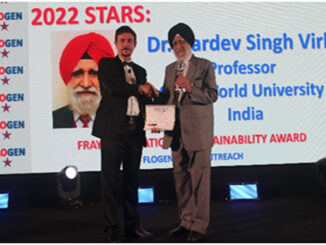
    Prof. Hardev Singh Virk, a pioneer in interdisciplinary research in India, has been honoured with FRAY International Sustainability Award for his ground-breaking research in irradiating minerals, glasses, polymers and other insulators using heavy ion beams. His outstanding contributions to understanding the health hazards by measuring Radon concentration in air, soil and groundwater and earthquake prediction in the Himalayas have led to the development of applications for sustainable development of the region. Fray International Sustainability Award,named after Prof. Derek Fray of Cambridge University, is conferred, since 2011, to prominent academics, CEOs, Politicians and Institutions globally.

    Fray International Sustainability Award was conferred to Prof. Virk by Dr. Florian Kongoli, the Chair of the symposium and President of SIPS 2022, The Sustainability Through Science and Technology/Sustainable Industrial Processing Summit, held in Phuket, Thailand, from 27 Nov. to 1 Dec. 2022. The award ceremony, held on 29 November 2022, was attended by many eminent international scientists, CEOs, and nine Nobel Laureates.

    Given Prof. Virk’s excellent contributions to science and technology, Virk International Symposium on Physics, Technology & Interdisciplinary Research for Sustainable Development was also organized as part of SIPS 2022, in which twenty eminent scientists presented their research findings.

    Prof. Hardev Singh Virk is the First Punjabi Sikh and First Indian (from India) to be conferred with this prestigious award for his scientific research in diverse areas of Radiation Physics, Earthquake and Radon Studies, Nanotechnology, Environmental Sustainability, and Heavy Metal contamination in Groundwater of Punjab. The Sustainability Through Science and Technology/Sustainable Industrial Processing Summit (SIPS), a multidimensional and multidisciplinary summit, is being organized by FLOGEN STARS OUTREACH, a not-for-profit international organization annually since 2003.

    References:

    (Dr. Devinder Pal Singh, M.Sc., Ph. D., is a Physicist by training, an academician by profession and an author by choice.

    Website: https://www.researchgate.net/profile/Devinder-Singh-4 )

  • India’s Minister Smt. Meenakashi Lekhi discusses with Guatemala and El Salvador leaders avenues for mutual cooperation

    India’s Minister Smt. Meenakashi Lekhi discusses with Guatemala and El Salvador leaders avenues for mutual cooperation

    GUATEMALA CITY (TIP) : India’s Minister of State for External Affairs and Culture, Smt. Meenakashi Lekhi visited Guatemala from 15-17 January and El Salvador from 17-19 January 2023.

    During her visit to Guatemala, MOS met with the Acting President of Guatemala, H.E. Mr Guillermo Castillo Reyes; Minister of Foreign Affairs of Guatemala, H.E. Mr. Mario Bucaro; Minister of Culture of Guatemala, H.E. Mr. Felipe Aguilar; Minister of Health, H.E Dr. Francisco José Coma Martín; and Minister of Energy and Mines, H.E. Mr. Alberto Pimentel Mata.

    Hon´ble Minister of State for External Affairs and Culture, Smt. Meenakashi Lekhi greeting Hon´ble President of El Salvador, H.E Mr. Nayib Bukele.

    During the meeting with the Acting President, MOS discussed cooperation in the fields of Science and Technology, Women Empowerment and Capacity Building in the interiors of Guatemala. In the meeting with Minister of Foreign Affairs, both sides reviewed the entire bilateral relations and decided to hold the next Foreign Office Consultations on a mutually convenient date in New Delhi. MOS handed over a symbolic key to the Foreign Minister for the donation of ten pickup trucks by the Government of India to the Government of Guatemala. To mark the 50th anniversary of establishment of diplomatic relationship, both Ministers inaugurated the bust of Mahatma Gandhi at the premises of the Foreign Ministry.

    Hon´ble Minister of State for External Affairs and Culture, Smt. Meenakashi Lekhi greeting Hon´ble Minister of Energy and Mines of Guatemala, Mr. Alberto Pimentel and Vice ministers of Foreign Affairs, Ms. Ava Atzúm Arévalo and Ms. Shirley Aguilar.

    MOS and Culture Minister Mr. Aguilar discussed growing cultural relations and the visit to India by a Guatemalan cultural troupe- Paabank. Culture Minister thanked the Government of India for the donation of the pick-up trucks to the Ministry of Culture. MOS and Energy and Mines Minister discussed possible areas of cooperation especially related to solar energy, International Solar Alliance and technical cooperation in the areas of mining. During the meeting with Minister of Health, both sides discussed growing bilateral cooperation in healthcare especially related to holistic healthcare and Ayurveda and donation of essential medicines by India.

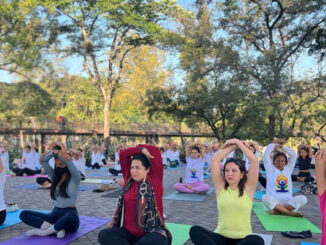
    On 15 January 2023, MOS inaugurated the warehouse of Indian companies in Technopark, Escuintla which will help in reducing the delivery times resulting in increase in Indian exports to Central America, in the presence of Vice Minister of Economy. MOS inaugurated the Indian Film Festival and participated in a Yoga Festival in Antigua. On 16 January, MOS participated in a Business dinner hosted by the Coordinating Committee of Agricultural, Commercial, Industrial and Financial Associations (CACIF) in the presence of top Guatemalan business leaders. MOS delivered talks on ‘50 Years of India-Guatemala Relations’ at the University del Valle (UVG) in Guatemala City, on 16 January. MOS virtually inaugurated the bust of Mahatma Gandhi in the eastern Guatemalan City of Livingstone where around 80 families of Indian origin people reside, who traveled to Guatemala from Belize in the middle of nineteenth century. On 17 January, MOS visited the world heritage site of Tikal, Peten at the invitation of the Government of Guatemala and participated in a tree plantation drive. MoS also interacted with the members of the Indian Community in Guatemala during her visit.

    Hon´ble Minister of State for External Affairs and Culture, Smt. Meenakashi Lekhi greeted by Hon´ble Foreign Minister of El Salvador, Ms. Alejandra Hill and Vice Foreign Minister, Ms. Adriana Mira.

    During the visit to El Salvador, MOS called on H.E. Dr. Nayib Bukele, President of El Salvador; and met with H.E. Ms. Alexandra Hill Tinoco, Minister of Foreign Affairs; H.E. Ms. Mariemm Pleitez, Minister for Culture; and H.E. Mr. J. Miguel Kattan, Secretary of Commerce and Investment.

    During the meeting with President, MOS discussed ways to further enhance bilateral relations especially India’s development cooperation with El Salvador, growing bilateral economic relations and cooperation at the multilateral level including at the UN. MOS also invited El Salvador to join the Coalition for Disaster Resilient Infrastructure (CDRI). During the meeting with Minister Hill, both the Ministers reviewed the entire bilateral relations and decided that the next Foreign Office Consultations would be held soon on a mutually convenient date in New Delhi. Minister Hill lauded India’s supply of COVID vaccine and essential medicines to the countries during the challenging times of the pandemic. Secretary Kattan and MOS discussed enhancing trade relations between two countries and opportunities for Indian companies for investment in El Salvador. In the meeting with Minister Pleitez, MOS discussed growing cultural relations. As India celebrates its 75 years of Independence, both the Ministers inaugurated Indian Film Festival in the University to mark Azadi Ka Amrit Mahotsav.

    Hon´ble Minister of State for External Affairs and Culture, Smt. Meenakashi Lekhi delivering a lecture on “75 Years of India´s Growth Story” at José Matías Delgado University in San Salvador.

    MOS delivered a talk on ‘75 years of India’s Growth Story’ at the Dr Jose Matias Delgado University in San Salvador. MOS participated in a Yoga Event and a tree plantation drive at the iconic Cuscatlán Park in the capital city. MOS also interacted with the members of the Indian Community and business leaders in El Salvador during her visit.

    The visit of the MOS to Guatemala and El Salvador shows the importance India attaches to the bilateral relations with both the countries. The visit is expected to provide further momentum to bilateral partnership and enhance mutual goodwill among the people.

  • Canada’s job vacancies declined in November 2022

    Ottawa (TIP): The number of job vacancies across all sectors in Canada decreased by 20,700 to 850,300 in November 2022, down from the peak of more than 1 million recorded in May 2022, the national statistical agency said, Statistics Canada said on January 26 that job vacancies decreased in the professional, scientific and technical services as well as the healthcare and social assistance sectors, reports Xinhua news agency.

    Job vacancies were up in construction, and little changed in accommodation and food services, retail trade and manufacturing, according to the agency.

    The job vacancy rate, which corresponds to the number of vacant positions as a proportion of total labour demand, was 4.8 per cent in November 2022, the lowest rate since June 2021, the agency said. There were 1.2 unemployed persons for every job vacancy in November 2022, virtually unchanged since August, but up slightly from the low of 1.0 in June. Before the Covid-19 pandemic, the unemployment-to-job vacancy ratio hovered around 2.2 from January 2019 to February 2020, Statistics Canada said. IANS

  • As fighting intensifies, Kyiv seeks more arms

    Kyiv (TIP): Ukraine on January 27 battled Russian troops trying to pierce its lines in the east and northeast before Kyiv takes delivery of tanks from its Western allies, saying the fighting showed it needed more weapons to repel the invaders. Kyiv said fierce battles were under way, a day after at least 11 people were killed in missile and drone strikes which were widely seen in Ukraine as a response to the promises by important allies to send it tanks. After weeks of wrangling, Germany and the US this week said they would send Ukraine dozens of modern tanks to help push back Russian forces, opening the way for others to follow suit.

    Poland gave Ukraine a further boost on Friday by promising an additional 60 tanks on top of 14 German-made Leopard 2 tanks it had already pledged. Both sides in the war are widely expected to launch spring offensives though Washington has advised Ukraine against doing so until the latest weapons are in place and training has been provided – a process expected to take several months. Russia said the US was “pumping weapons into Ukraine”, which Moscow says does Washington’s bidding, and chided President Joe Biden, saying he held the key to ending the conflict but had not used it. Ukrainian President Volodymyr Zelenskiy thanked allies for their support but renewed calls for tougher sanctions on Moscow and more weapons in the twelfth month of the war. Millions of Ukrainians faced electricity shortages after missile and drone strikes. Russia said the strikes focused on “facilities that operate Ukraine’s defence industrial complex and transport system,” and limited Ukraine’s ability to repair hardware and transport arms provided by its allies. — Reuters

  • 92% population in Beijing to get Covid by January end: Study

    Hong Kong (TIP): Around 92 per cent of the population in the Chinese capital of Beijing will have Covid by January 31, a new study published in peer-reviewed journal Nature Medicine has revealed.

    Nearly 76 per cent of people in Beijing had contracted Covid-19 as of December 22.

    It was expected to reach 92 per cent by January 31, according to researchers from the University of Hong Kong, reports South China Morning Post.

    For the study, the researchers tracked the reproduction rate of Omicron variant BF.7 in Beijing in November and December, after China eased its zero-Covid policy.

    There was a surge in cases across the country after the policy changes.

    The study estimated that the reproduction rate jumped from 1.04 on November 11 to 3.44 a week later – meaning that “one person with the virus could infect 3.44 others”.

    Their modelling had shown an estimated peak of 1.03 million daily cases on December 11.

    “Surveillance programmes should be rapidly set up to monitor the spread and evolution of Sars-CoV-2 infections, and further work should be done to track the transmissibility, incidence and infection rate of the epidemic,” the researchers wrote. (IANS)

  • Mysterious illness kills 18 in Pakistan

    Karachi (TIP): A mysterious illness has killed 18 people, mostly children, in Karachi’s Kemari area this month with health officials in this southern Pakistani port city still unable to find the cause of the deaths.

    Director Health Services Abdul Hameed Jumani said 14 kids were among the dead. “A health team is working to find the cause of the deaths but we suspect it may be related to the sea or water as the village is close to the coastal belt,” he said. (PTI)

  • Indian women’s rangoli enters Singapore Book of Records

    Singapore (TIP): An Indian mother and her daughter have made it to the Singapore Book of Records by creating a 6-by-6 metre rangoli artwork using 26,000 ice cream sticks which depicts notable Tamil scholar-poets. Sudha Ravi and her daughter Rakshita presented the rangoli during Pongal festivities last week. Sudha Ravi is already listed in the record book for creating a 3,200 sq ft rangoli in 2016. PTI

  • Earthquake jolts western Nepal, 1 dead

    Kathmandu (TIP): A 5.9-magnitude earthquake jolted western Nepal on January 24, killing one person and damaging a number of houses in the region, officials said.

    The earthquake, with epicentre in the Mela area of Bajura district in Sudurpaschim province, hit the region at 2.43 PM local time, said Lok Bijaya Adhikari, head of Earthquake Measurement and Research centre.

    A 35-year-old woman was killed in Gaumul Rural Municipality-2 when a falling rock hit her while she was cutting grass in the nearby forest, police said. According local police, the earthquake damaged a number of houses in Bajura and Bajhang districts. A landslide triggered by the earthquake resulted in the death of over 40 sheep, the police said, adding that one person was injured.

    Monika Dahal, who is head of the National Earthquake Monitoring and Research Centre, said the quake was felt in areas of Western Nepal. It was also felt in some parts of India. — PTI

  • 74th Republic Day of India celebrated at the Indian Consulate in New York

    74th Republic Day of India celebrated at the Indian Consulate in New York

    Ambassador Randhir Kumar Jaiswal welcomes the guests to the reception in celebration of the Republic Day of India.
    The distinguished gathering which included prominent members of the diaspora, elected officials, members of the diplomatic corps, friends from media and people from different walks of life.

    NEW YORK (TIP): The 74th Republic Day of India was celebrated at the  Consulate General of India, New York with a flag hoisting ceremony on Thursday, January 26th 2023.

    Consul General Randhir Jaiswal unfurled the national flag after which the national anthem was sung. Consul General then read out the address of the President of India. A short cultural program of patriotic songs was presented by Bharatiya Vidya Bhavan, USA. A large number of members of Indian diaspora and friends of India participated in the celebration. The event was webcast live through the Consulate’s social media platforms.

    The dignitaries who extended greetings on the occasion. Congresswoman Susan Wild, Congressman Brian Fitzpatrick , NY State Senator Kevin Thomas, and NY Assemblywoman Jenifer Rajkumar

    In the evening, the Consul General hosted a reception which was attended by prominent members of the diaspora, elected officials, members of the diplomatic corps, friends from the media and people from different walks of life. The leading lights of Indian diaspora graced the occasion, including Prof. S. R. Srinivasa Varadhan, the recipient of Padma Vibhushan this year – the second highest civilian award. State Senator Kevin Thomas, Assemblywoman Jenifer Rajkumar, Deputy Permanent Representative of India to the UN Ambassador R. Ravindra, Consuls General of Japan, Bangladesh, Mexico, Nepal, Singapore, Thailand, Peru, Malaysia and Germany, besides diplomats from several other Consulates participated in the reception. More than 150 guests graced the occasion.

    Speaking on the occasion, Ambassador Jaiswal said: “Speaking to the nation on the eve of Republic, the Honorable President of India said and I quote: “With hope and confidence, we began an experiment unique in the history of humankind. Such a vast and diverse multitude of people coming together as one nation remains unprecedented. We did so with the belief that we are after all, one, that we are all Indians. We have succeeded as a democratic republic, because so many creeds and so many languages have not divided us; they have united us, that is the essence of India.” The ambassador added: “Under the visionary leadership of Prime Minister Narendra Modi, India continues to march on with speed and scale and more importantly, with humility and confidence. Our story today is both inspiring and assuring provided by transformative reforms, next generation infrastructure and empowering digital public goods. We are the fastest growing major economy. We recently became the fifth largest economy in the world and remain on course  to achieve our  targeted spot in the not so distant a future.”

    Grammy Award winning singer Falguni Shah enthralled with patriotic songs.

    The evening function began with singing of Indian and US national anthem by Master Ishaan Tangirala, a young talented singer of Indian origin from New Jersey. Consul General welcomed the guests and thanked everyone for their participation. He underlined the growing partnership between India and the US, the oldest and the largest democracies in the world and the key role of diaspora in strengthening these ties. Congratulatory video messages from Congresswoman Susan Wild and Congressman Brian Fitzpatrick were played, followed by reading out of a citation from Congressman Michael Lawler. State Senator Kevin Thomas and Assemblywoman Jenifer Rajkumar delivered remarks conveying their greetings on the 74th Republic Day of India. This was followed by a video on the Consulate’s activities. Later, Grammy Award winning singer Falguni Shah gave  an enthralling performance of patriotic songs. Guests were then invited for an Indian dinner where they were treated to a wide variety of  regional cuisines. A special attraction on the menu was cuisines of millets from different parts of India, in celebration of International Year of Millets – 2023.

    The event had a distinct flavor of Azadi ka Amrit Mahotsav – the celebration of 75 years of India’s independence. Enthusiastic participation from the diaspora ensured Jan Bhagidari – or people’s participation in the celebration of 74th Republic Day.

    The welcoming trio. From L to R: Shahana Bagban, Aastha Srivastava, Sandhya Parajuli.
    Celebrating “The Year of the Millets” . The hosts had delicious millets dishes served.           
  • Short seller Hindenburg accuses billionaire Gautam Adani of ‘largest con in corporate history’

    Short seller Hindenburg accuses billionaire Gautam Adani of ‘largest con in corporate history’

    I.S. Saluja

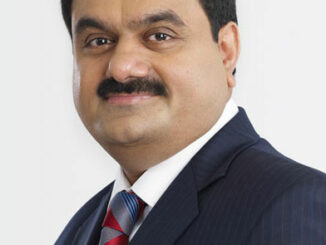
    NEW YORK (TIP): It may be the biggest scandal in corporate history in India in recent times. The Hindenburg report on Adani conglomerate has created shockwaves in the financial world. Nobody can wish away or wash away the findings of the Hindenburg investigation. It is not the first time that Hindenburg has investigated a corporate .

    Earlier, in 2020, Hindenburg published a report detailing malfeasance at the electric vehicle firm Nikola Corp.   Hindenburg said Nikola had engaged in an “intricate fraud,” including an instance in which the company faked a video that appeared to show one of its electric trucks driving down a highway. In actuality, the company “simply filmed it rolling down the hill.” Nikola founder Trevor Milton was later found guilty of securities fraud after Hindenburg’s allegations prompted an investigation

    A New York Post report of January 25 quoted  Hindenburg Research Group as alleging  that Gautam Adani, Asia’s richest man, is pulling “the largest con in corporate history” through his India-based conglomerate Adani Group”

    Hindenburg — whose previous targets have included electric truck makers Nikola and Lordstown Motors — revealed in a research note late Tuesday it had taken a short position in Adani Group and alleged that Adani’s rise in wealth was fueled by a variety of illegal misdeeds, The New York Post said.

    “We have uncovered evidence of brazen accounting fraud, stock manipulation and money laundering at Adani, taking place over the course of decades,” Hindenburg claimed in the note.

    Adani, 60, amassed a fortune estimated by Forbes at $125.5 billion before the Hindenburg report — overseeing a sprawling network of companies with holdings across several industries, including control of major ports and airports, energy, real estate and cement.

    “Adani has pulled off this gargantuan feat with the help of enablers in government and a cottage industry of international companies that facilitate these activities,” the firm added.

    He began Wednesday, January 25,  trailing only French luxury goods magnate Bernard Arnault and Tesla CEO Elon Musk in overall wealth, according to Forbes. But Adani lost an estimated $6.5 billion during the day after the Hindenburg report, dropping him to fourth behind Amazon founder Jeff Bezos.

    The firm noted that Adani Group has “previously been the focus of 4 major government fraud investigations” alleging money laundering, corruption and theft of taxpayer money.

    Hindenburg said it conducted a two-year investigation of the Adani business empire — with research that included dozens of interviews, including some with former company executives, as well as an analysis of internal documents and due diligence visits at company-controlled sites.

    The report alleged that Adani, several family members and other company executives oversee a network of offshore shell companies located in tax havens across Mauritius, the United Arab Emirates and the Caribbean.

    Hindenburg alleged that some of the shell companies appeared to be hastily cobbled together, with websites “featuring only stock photos, naming no actual employees and listing the same set of nonsensical services.”

    Hindenburg alleged that many of the shell companies are reportedly operated by Adani’s older brother, Vinod, or his “close associates.”

    “The Vinod-Adani shells seem to serve several functions, including (1) stock parking / stock manipulation (2) and laundering money through Adani’s private companies onto the listed companies’ balance sheets in order to maintain the appearance of financial health and solvency,” Hindenburg said.

    Hindenburg included a list of 88 questions about company operations that “we hope the Adani Group will be pleased to answer.” “Even if you ignore the findings of our investigation and take the financials of Adani Group at face value, its 7 key listed companies have 85% downside purely on a fundamental basis owing to sky-high valuations,” Hindenburg said.

    The short seller stressed that its report “represents our opinion and investigative commentary” and urged readers to draw their own conclusions about Adani Group.

    Adani Group has dismissed the report as baseless. Adani Group CFO Jugeshindar Singh said the company was “shocked” by Hindenburg’s allegations and issued a firm denial.

    “The report is a malicious combination of selective misinformation and stale, baseless and discredited allegations that have been tested and rejected by India’s highest courts,” Singh said.

    “The timing of the report’s publication clearly betrays a brazen, mala fide intention to undermine the Adani Group’s reputation,” Singh added.

    Billionaire investor Bill Ackman was all praise for U.S. short-seller Hindenburg Research’s report on Indian conglomerate Adani Group, calling it “highly credible” and “extremely well researched.”

    Billionaire investor Bill Ackman was all praise for U.S. short-seller Hindenburg Research’s report on Indian conglomerate Adani Group, calling it “highly credible” and “extremely well researched.”

    Hindenburg’s report on Wednesday accused the conglomerate of improper use of offshore tax havens and stated it held short positions in the company via its U.S.-traded bonds and non-Indian-traded derivative instruments.

    Adani group loses $48 billion since January 25; FPO takes a hit in light of Hindenburg report

    Adani Enterprises Ltd began a record $2.45 billion (₹20,000 crore) secondary share sale for retail investors on Friday, as a heavy selloff in Adani group companies intensified after an attack by a U.S.-based short seller.

    Seven listed companies of the Adani conglomerate — controlled by one of the world’s richest men Gautam Adani — have lost a combined $48 billion in market capitalization since Wednesday, January 25,  and saw falls in its U.S. bonds after Hindenburg Research flagged concerns in a report about debt levels and the use of tax havens.

    Adani Enterprises aims to use the share sale proceeds for capital expenditure and to pay debt. The anchor portion of the sale saw participation from investors including the Abu Dhabi Investment Authority on Wednesday.

    Bidding for the Adani Enterprises share sale for retail investors started on Friday and will close on January 31. The firm has set a floor price of ₹3,112 ($38.22) a share and a cap of ₹3,276. But on Friday the stock slumped to as low as ₹2,721.65, well below the lower end of the price offering.

    Adani group stocks took a beating, falling up to 20% after Hindenburg Research’s damaging allegations. The group’s flagship Adani Enterprises, which launched the ₹20,000 crore FPO on Friday, tanked 18.52%. Adani Ports plunged 16%, Adani Power by 5%, Adani Green Energy by 19.99%, and Adani Total Gas by 20%.

    In two days, the Adani group firms have lost a whopping ₹4,17,824.79 crore from their market valuation. The market valuation of Adani Total Gas plummeted ₹1,04,580.93 crore while that of Adani Transmission by ₹83,265.95 crore. Adani Enterprises market capitalization fell by ₹77,588.47 crore, Adani Green Energy lost ₹67,962.91 crore and Adani Ports by ₹35,048.25 crore.

    The market valuation of Ambuja Cements declined by ₹23,311.47 crore, Adani Power by ₹10,317.31 crore, ACC by ₹8,490.8 crore and Adani Wilmar by ₹7,258.7 crore. The rout took shares of Adani Enterprises, the group’s flagship company, well below the offer price of its secondary sale, which had initially been offered at a discount.

    In its report, Hindenburg said key listed Adani Group companies had “substantial debt”, putting the conglomerate on a “precarious financial footing”, and that “sky-high valuations” had pushed the share prices of seven listed Adani companies as much as 85% beyond actual value.

    Billionaire U.S. investor Bill Ackman said on Thursday, January 26,  that he found the Hindenburg report “highly credible and extremely well researched”.

    Hindenburg said it held short positions in Adani through its U.S.-traded bonds and non-Indian-traded derivative instruments, meaning it is betting that their price would fall.

    The Hindenburg report has encouraged political parties in India to demand a thorough investigation into the working  and practices of the Adani Group.

    Congress has demanded a  ‘serious investigation’ by RBI and SEBI into allegations levelled against the Adani Group. In a strongly worded statement, Congress general secretary in-charge of communication Jairam Ramesh asserted that exposure of financial institutions like the Life Insurance Company of India (LIC) and the State Bank of India (SBI) to the Adani Group would have implications for the country’s financial stability and crores of depositors “whose savings are stewarded by these pillars of the financial system”.

    “Normally a political party should not be reacting to a research report on an individual company or business group prepared by a hedge fund. But the forensic analysis by Hindenburg Research of the Adani Group demands a response from the Congress party,” Ramesh said, adding, ”This is because the Adani Group is no ordinary conglomerate: it is closely identified with Prime Minister Narendra Modi since the time he was Chief Minister”.

    The ports-to-power conglomerate, however, had said the charge against the Adani Group was “malicious, unsubstantiated, one-sided, and was timed to ruin the public listing of its shares”.

    “The allegations require serious investigation by those who are responsible for the stability and security of the Indian financial system, viz. the Reserve Bank of India (RBI) and the Securities and Exchange Board of India (SEBI),” Ramesh said.

    “The allegations of financial malfeasance would be bad enough, but what is worse is that the Modi government may have exposed India’s financial system to systemic risks through the liberal investments in the Adani Group made by strategic state entities like LIC, SBI and other public sector banks,” he added.

    The Congress leader said as much as 8% of LIC’s equity assets under management, amounting to a sum of ₹74,000 crore, are invested in the Adani Group of companies, while public sector banks have lent to the Adani Group twice as much as the private banks, with 40% lending being done by SBI. “Indians are increasingly aware of how the rise of Modi’s cronies has exacerbated the problem of inequality, but need to understand how this has been financed by their own hard-earned savings. Will the RBI ensure that risks to financial stability are investigated and contained? Are these not clear-cut cases of “phone banking”?” asked Ramesh.

    Asking if there is a quid pro quo between the Modi government and the Adani Group, the Congress leader alleged, “In perhaps, the most egregious case of crony capitalism, the previous operator of Mumbai’s Chhatrapati Shivaji Maharaj International Airport, India’s second busiest airport, was raided by the Enforcement Directorate (ED) and the Central Board of Investigation (CBI) after it rejected an offer by the Adani Group”.

    “The operator agreed to sell the airport to Adani a month later and it is a mystery what happened to the ED and CBI cases thereafter,” Ramesh added.

    Lok Sabha member Manish Tewari said on Twitter that if the Hindenburg report was even partially correct, “it merits both a Joint Parliamentary Committee-much like the 1992 JPC & a Supreme Court Monitored investigation to get to the bottom of the matter. The Budget Session of Parliament begins 31st Jan 2023”.

    Congress Rajya Sabha member Randeep Surjewala tweeted, ”Exposure of #LIC in Adani Group is ₹77,000 CR. LIC has today lost ₹23,500 CR in invest value in Adani Group i.e. at ₹53,000 CR against ₹77,000 CR. LIC is money of People of India. In any other country, heads would have rolled including that of FM# HindenburgReport.”

    (Source: New York Post, Agencies)

  • A vibrant parade marked Celebration of the 74th Republic Day of India

    A vibrant parade marked Celebration of the 74th Republic Day of India

    Nation’s  military prowess, cultural diversity, and other unique initiatives displayed

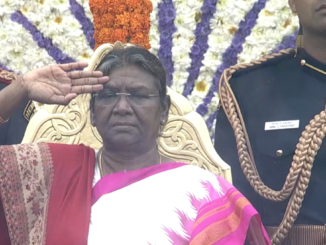
    NEW DELHI (TIP): The ceremonial boulevard of the national capital, the newly-christened Kartavya Path that has witnessed the country free itself from the clutches of colonial rule played host to the 74th Republic Day on January 26, 2023. President Droupadi Murmu led the nation in celebrating Republic Day, and Egypt’s President Abdel Fattah al-Sisi was the chief guest at the ceremonial event. This is the first time an Egyptian head of state has been invited to the ceremony. The invite also marks 75 years of diplomatic ties between Cairo and New Delhi.

    A total of 23 tableaux — 17 from States and Union Territories and six from various Ministries and departments depicting India’s vibrant cultural heritage, and economic and social progress were a part of the parade on the Kartavya Path.

    Indian Army, Indian Navy, and Indian Air Force along with other security forces presented a spectacular show in front of the nation as they marched past the dais where the President along with other dignitaries took the salute.

    World leaders conveyed Republic Day wishes to India on Thursday, January 26,  with Prime Minister Narendra Modi thanking them for their greetings and pledging to work together to further strengthen ties.

    Replying to the French president, PM Modi tweeted, “Grateful for your warm greetings my dear friend Emmanuel Macron on India’s Republic Day. I share your commitment to working together for the success of India’s G20 Presidency & 25th anniversary of the India-France Strategic Partnership. India and France together are a force for global good.” Macron said he looked forward to the two countries setting new ambitions together for the G20 and for the Indo-French strategic partnership as it turns 25 this year. Thanking his Israeli counterpart Benjamin Netanyahu, Modi said he looked forward to further strengthening the strategic partnership.

    He tweeted to Bhutan’s Prime Minister Lotay Tshering that India is committed to its unique partnership with his country for progress and prosperity of both the nations.

    PM Modi echoed similar sentiments in tweets to leaders of Nepal, Mauritius and Maldives among other countries.

    (With inputs from  PTI)

  • Mayor Adams Outlines “Working People’s Agenda” for NYC in Second State of the City Address

    Mayor Adams Outlines “Working People’s Agenda” for NYC in Second State of the City Address

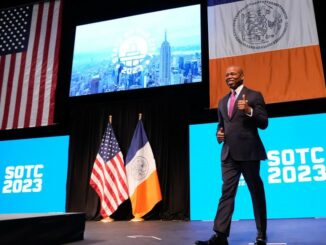
    NEW YORK (TIP): New York City Mayor Eric Adams, on January 26,  outlined a “Working People’s Agenda” in his second State of the City address, delivered at the Queens Theatre in Flushing Meadows-Corona Park.

    Mayor Adams’ agenda is built on four pillars that are essential to building a city that meets the needs of working New Yorkers and represent the focus of his administration’s work in 2023: jobs, safety, housing, and care.

    “Without a strong working class, this city cannot survive. That’s why, today, I’ve outlined how we plan to build a city for working people, one that is more affordable, safer, cleaner, and more livable,” said Mayor Adams. “You need good jobs and pathways to get those jobs, and those jobs need to be able to support a home for you and a family. You need to be safer, and you need care – not just in crisis but throughout your lives. These are the things that our administration is working for every day to sustain the workers who make this city possible and build a better city for all.”

    When he took office a year ago, Mayor Eric Adams vowed to make New York safe again. Gun violence is down, but other crimes are proving challenging.

    There are few things Adams is more passionate about than public safety, but public criticism of cops taking pictures of people for a social media post provoked an unscripted moment of passion.

    “Let’s stop starting off hating each other and start embracing each other. This is what we want to do,” Adams said.

    The mayor was defending cops against public criticism of their decision to take pictures of people leaving a Drake concert at the Apollo to post on social media, angry that an effort at community involvement was misconstrued.

    It was a moment of passion as he talked about new public safety initiatives for year two of his administration, including:

    • An expanded focus on preventing shoplifting,
    • More violence prevention programs,
    • A most wanted list of the 1,700 criminals responsible for a disproportionate amount of violent crime,
    • A push in Albany for criminal justice reforms,
    • And more neighborhood safety teams to get guns off the street.

    “We’re going to use proven methods and intensive community support to keep gun culture from taking root and taking over,” Adams said.

    The mayor also vowed to end traffic violence, saying, “2023 is the year we are going to tighten the screws on reckless drivers, holding them accountable for their actions before they harm others.”

    The mayor said he would go to Albany to seek a package of six bills called R.O.A.D.S.: Removing Offenders and Aggressive Drivers from our Streets.

    It would:

    • Increase penalties for serious crashes, running red lights and impaired driving;
    • Ensure swift penalties for those who drive with suspended or revoked licenses;
    • And revoking the privileges of driving on city streets and suspending the registration of cars that get five or more red light camera violations in a 12-month period.

    “We must treat traffic violence the same way we treat other dangerous crimes,” Adams said.

    There will also be more tow trucks to ticket and tow abandoned and illegal parked cars, and a new focus on Vision Zero.

    “New Yorkers should not have to fear for their lives every time they cross the street or bike to work,” Adams said.

    The mayor is also going to create a new city position called “Director of the Public Realm” to create more open spaces in the city. It’s unknown what the salary for that position is, but the new rat czar will get $170,000 a year.

  • Salient features of Constitution

    Salient features of Constitution

    Indian constitution, one of the utmost admired constitutions in the world was enacted after ‘ransacking’ all the known constitutions of the world at that time. This constitution that we have enacted has stood the test of times. Though provisions were borrowed from other constitutions, the constitution of India has several salient features that distinguish it from constitution of other countries

    Some of its salient features are discussed below:

    Lengthiest written constitution

    Constitution can be classified into written constitution such as that of America or unwritten constitution such as that UK.

    The constitution of India is a written constitution which happens to be the lengthiest written constitution in the world.

    It is comprehensive, elaborate and a detailed document

    The factors that have contributed to this phenomenon are: geographical factors (vastness of country and diversity), Historical factors (Influence of GoI, 1935), Single constitution for both centre and state and dominance of legal luminaries

    Drawn from various sources

    It has borrowed most of its provisions from the constitution of various other countries as well as from the Government of India act, 1935. Ex: structural part from GoI, 1935, independence of judiciary from USA, Fundamental Rights from USA etc

    Though it is borrowed, the Indian constitution-makers made sure the borrowed features were made suitable to Indian conditions. Ex: Though we borrowed cabinet form of governance from UK, the cabinet is not all-supreme as in the case of UK.

    Preamble of the constitution

    The Preamble consists of the ideals, objectives and basic principles of the Constitution.

    The salient features of the Constitution have developed directly and indirectly from these objectives which flow from the Preamble

    It asserts India to be a Sovereign Socialist Secular Democratic Republic and a welfare state committed to secure justice, liberty and equality for the people and for promoting fraternity, dignity the individual, and unity and integrity of the nation.

    The Preamble is the nature of Indian state and the objectives it is committed to secure for the people.

    Democratic system

    The authority of the government rests upon the sovereignty of the people. The people enjoy equal political rights.

    Free fair and regular elections are held for electing governments

    India is a republic

    The Preamble declares India to be a Republic.

    India is not ruled by a monarch or a nominated head of state. India has an elected head of state (President of India) who wields power for a fixed term of 5 years.

    After every 5 years, the people of India indirectly elect their President.

    Union of states

    Article I of the Constitution declares, that “India that is Bharat is a Union of States.”

    Fundamental Rights and duties

    The Constitution of India grants and guarantees Fundamental Rights to its citizens.

    The constitution of India confirms the basic principle that every individual is permitted to enjoy certain basic rights and part III of the Constitution deals with those rights which are known as fundamental right.

    The Six FR include- Right to Equality; Right to Freedom; Right Against Exploitation; Right to Freedom of Religion; Cultural and Educational Rights and Right to Constitutional Remedies (Art. 32).

    The fundamental rights are justiciable and are not absolute. Reasonable constraints can be imposed keeping in view the security-requirements of the state.

    A new part IV (A) after the Directive Principles of State Policy was combined in the constitution by the 42nd Amendment, 1976 for fundamental duties.

    Directive Principles of State Policy

    A unique aspect of the Constitution is that it comprises of a chapter in the Directive Principles of State Policy.

    These principles are in the nature of directives to the government to implement them to maintain social and economic democracy in the country.

    Parliamentary System:

    The Constituent Assembly decided to espouse Parliamentary form of government both for the Centre and the states.

    In Indian parliamentary system, distinction is made between nominal and real executive head.

    The Council of Ministers is responsible before the Lok Sabha, The lower house of union parliament. There are close relations between executive and legislature.

    Federal structure of government

    A federal state is a state where a country is divided into smaller regions and the government is functioning at two levels

    The Indian Constitution has envisaged a federal structure for India considering the geographical vastness and the diversity of languages, region, religions, castes, etc.

    Written Constitution, supremacy of the Constitution, division of powers between Union and States, bicameral Legislature, independent Judiciary, etc. are the features of Indian federation.

    Scholars describe India as a ‘Quasi-Federation’ (K.C. Wheare) or as ‘a federation with a unitary bias, or even as ‘a Unitarian federation.’

    Universal adult franchise

    All men and women enjoy an equal right to vote. Each adult man and woman above the age of 18 years has the right to vote.

    All registered voters get the opportunity to vote in elections.

    Single integrated State with Single Citizenship:

    India is the single Independent and Sovereign integrated state.

    All citizens enjoy a common uniform citizenship.

    They are entitled to equal rights and freedoms, and equal protection of the state.

    Integrated Judicial system

    The Constitution provides for a single integrated judicial system common for the Union and the states.

    The Supreme Court of India works at the apex level, High Courts at the state level and other courts work under the High Courts.

    Independent Judiciary

    It is necessary to secure the philosophical foundations of the rule of law and democracy

    Firstly, the Constitution makers created a separate Judiciary independent of Legislature and Executive.

    Secondly, the Constitution has ensured complete independence of Judiciary in the matters of administration and finances.

    Amending the Constitution of India

    Amending the Constitution of India is the procedure of making modifications to the nation’s fundamental law or supreme law.

    The procedure of amendment in the constitution is laid down in Part XX (Article 368) of the Constitution of India.

    This procedure guarantees the sanctity of the Constitution of India and keeps a check on uninformed power of the Parliament of India.

    Judicial Review

    The judiciary has significant position in Indian Constitution and it is also made independent of the legislature and the executive.

    The Supreme Court of India stands at the peak of single integrated judicial system

    It operates as defender of fundamental rights of Indian citizens and guardian of the Constitution.

    Basic Structure doctrine

    The basic structure doctrine is an Indian judicial norm that the Constitution of India has certain basic features that cannot be changed or destroyed through amendments by the parliament.

    The basic features of the Constitution have not been openly defined by the Judiciary. At least, 20 features have been described as “basic” or “essential” by the Courts in numerous cases, and have been incorporated in the basic structure.

    In Indira Gandhi v. Raj Narayan case and also in the Minerva Mills case, it was witnessed that the claim of any particular feature of the Constitution to be a “basic” feature would be determined by the Court in each case that comes before it.

    Secularism

    In no other country of the world so many religions co-exist as in India. In view of such diversity the Constitution guarantees complete freedom of religion to all. The citizens of our country are free to follow any religion and they enjoy equal rights without any distinction of caste, creed, religion or sex.

  • Framing of the Indian Constitution

    Framing of the Indian Constitution

    From 9th December 1946 to 26th November 1949, the constitution of India was framed which came into force after two months of completion, that is on 26th January 1950, celebrated as the republic day of India. The years spent in the making of the Indian Constitution were marked exceptionally tumultuous as:

    –              1942, Quit India struggle was just going through in our nation

    –              Subhas Chandra Bose bid to establish freedom through armed struggle

    –              August 1946, the Great Calcutta Killings

    –              Improvement in the ratings of the Indian Navy in different parts of the country including Bombay in 1946

    Timeline

    –              1945: The Labour Government came into power on July 26, 1945 in Britain

    –              1946: The Cabinet Mission announced the constitutional scheme on 16th May

    –              Cabinet Mission’s constitutional scheme was accepted by Muslim league on 16 June

    –              The schemes to form Interim Government at the Centre were presented on 6 June

    –              Direct Action Day was announced by the muslim league on 16 August 1946

    –              Interim Government was established and Nehru was designated as the Vice-President on 2 September

    –              The Interim Government was joined by the Muslim league on 13 October

    –              Attlee, the British Prime Minister met Indian leaders on 3-6 December

    –              Sessions were introduced in the constituent assembly on 9 December

    –              1947: Dissolution of constituent assembly demanded by the Muslim league on 29 January

    –              Interim government had its last meeting on 16 July

    –              The Constituent Assembly of Pakistan elected Jinnah as their first president on 11 August

    –              Pakistan celebrates its independence on 14 August

    –              India celebrates its independence on 15 August

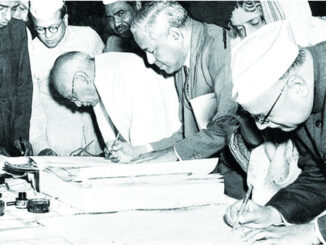
    –              1949: Constitution of India was signed in 1949

    The Making of the Constituent Assembly

    –              M.N Roy first proposed the idea of constituent assembly in 1934. Later, under the Cabinet Mission Plan of 1946, elections were held for the formation of a constituent assembly

    –              The Constituent Assembly was formed for the purpose of writing a constitution for independent India

    –              The constituent assembly members were not elected on the basis of the universal adult franchise, but chosen in 1945-46 from the provincial legislatures

    –              The Muslim League boycotted the Constituent Assembly as they wanted a separate constitution for Pakistan

    –              In order to create a sense of participation, the people in India were supposedly asked to analyse what needs to be amended for improvement and send their views to officials

    –              Many of the linguistic minorities were on their toes to protect their mother tongue., while dalits demanded an end to all seat reservations and caste oppression. Religious minorities wanted special safeguards

    –              Issues like social justice and  cultural rights were highlighted in these public discussions and were also debated on the floor of the Assembly

    The Dominant Voices in the Constituent Assembly

    –              The total members of the Constituent Assembly is 389. Of these, six members played particularly important roles

    –              Jawaharlal Nehru proposed the “Objective Resolution”. He also proposed that India’s National Flag should be of three colours saffron, green, and white in equal proportion with a dark blue coloured wheel at the centre

    –              Rajendra Prasad was President of the Assembly, where he had to steer the discussion along constructive lines while ensuring every member had equal chance to put across their views

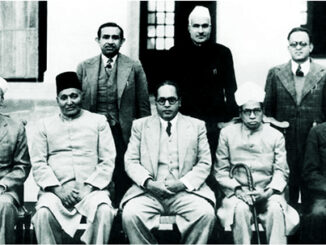
    –              Ambedkar served as Chairman of the Drafting Committee of the Constitution

    –              Other members of the drafting committee are Alladi Krishnaswamy Aiyar from Madras and K.M. Munshi from Gujarat, N. Gopalaswami, Mohammad Saadulla, B.L. Mitter, D.P. Khaitan

    –              The Constitutional Advisor was B.N Rau

  • Making of the Republic of India

    Making of the Republic of India

    R-day special

    India celebrates Republic Day annually on 26 January, and this year the country will celebrate its 74th Republic Day to mark the day India became a sovereign republic. While India gained independence from the British in 1947, but it wasn’t until 26 January 1950 that the Indian Constitution came into effect and India became a sovereign state, declaring it a republic. This day is celebrated with much pomp and fervour all over India, and in India’s capital Delhi, parades, tableaus and spectacular displays by the defense forces are showcased at Rajpath. The Indian flag is also hoisted all over the country.

    The Indian Constitution was drafted by Dr BR Ambedkar who is known as the Architect of the Indian Constitution. 26 January was chosen as the day to announce India becoming a republic as in 1929 on the same day the Indian National Congress denounced colonial rule and proclaimed Purna Swaraj, “complete freedom from the British”. And while the Constitution came into force in 1950 under a democratic government system, it was adopted by the Indian Constituent Assembly on 26 November 1949. This completed the country’s transition into becoming a sovereign republic.

    India celebrates Republic Day to commemorate the day the Government of India Act (1935) set by the British Raj was replaced by the Indian Constitution as the governing document of India. Other than flag hoisting, reciting the national anthem and organising shows and events on this day, the defense forces including the Indian Army, Navy, Air Force, police and paramilitary forces showcase their skills and display India’s defence prowess at the parade on Rajpath which is broadcast on television . Other than performing stunts, air shows, stunts on motorbikes, tanks and other weapons systems are also showcased. Alongside these are the beautifully decorated tableaus that reflect the uniqueness and beauty of the various states of India.

    India became independent from the British Rule on 15th August, 1947. However, the country did not have its own constitution and wholly depended on the modified colonial Government of India Act, 1935. Also, India was headed by King George VI, until the adoption of the Indian Constitution in 1950. Prior to this, the seeds of a republican nation were sowed by Pt. Jawaharlal Nehru in the Lahore session at the Indian National Congress at the midnight of 31st December, 1929 – 1st January, 1930.

    The tricolor flag was unfurled by the nationalists present who took a pledge to celebrate “Purna Swaraj” (complete Independence) Day every year on 26th January, while continuing to fight for the establishment of a Sovereign Democratic Republic of India. The independence was achieved in 1947 while the professed pledge was redeemed on 26th January, 1950.

    The Indian Constituent Assembly was called together on 9th December, 1946, where a committee was formed. Dr. B.R. Ambedkar became the chairman of the committee, who along with the other members drafted the Constitution. The Indian Constitution included 395 Articles and 8 Schedules. The Constitution was adopted by the Constituent Assembly on 26th November, 1949. In the following year on 26th January, 1950, the Constitution of India came into force and became a sovereign democratic republic of India, 894 days after the withdrawal of British Rule in 1947, which is why, it is said that India achieved its true independence on this day. Next, elections were held and Dr. Rajendra Prasad was elected as the first President of free India. He took the oath at the Durban Hall in the Government House, which was followed by the Presidential drive along the five-mile route to the Irwin Stadium. He unfurled the National Flag at the stadium. This transition of India into a sovereign democratic republic nation is indeed a historical event. The two-decade long journey, right from the conceptualization of the dream in 1930 to its actual realization in 1950, is certainly worth a grand celebration. Today, the Indian Constitution is the longest in the world, consisting of 397 articles and 12 schedules, providing a single citizenship for the whole nation. The national holiday is celebrated with festivities and patriotic fervor across the whole nation.

    Republic Day Parade

    The grandeur of the Republic Day of India is visible in the grand parade that is held along Rajpath, beginning from Raisina Hill near the Rashtrapati Bhavan (President’s Palace) and moving on to Rajpath past India Gate and proceeding to the Red Fort.

    The occasion witnesses the presence of the President, the Prime Minister and several other high-ranking officials of the country. The parade starts with the arrival of the President of India, who is escorted by a group of bodyguards on horses. Next, the Prime Minister of India offers wreaths at the Amar Jawan Jyoti at the India Gate in memory of the martyrs of the Indian army. The national flag is unfurled by the President of India, who is also the Commander-in-Chief of the Indian Armed Forces. This is succeeded by the cheerful tune of the National Anthem and a 21-gun salute. Led by three different divisions of the armed forces viz: Navy, Army and Air Force; the Republic Day Parade has all of them displaying their might along the Rajpath, saluting the President. The Armed Forces staff performs motorcycle rides whereas the staff of the Indian Air Force performs flying parade in fighter planes. The rich and colorful culture of India is showcased in the parade of the Republic Day. Traditional as well as cultural performances are given by professionals belonging to different regions. School children in picturesque costumes also participate in the display of different aspects of the glorious history of the country on this big day.

    The real heroes of the nation are honored with the bravery awards and medals. National Awards are given to children for selfless sacrifice and bravery.

    A row of IAF jets marks the end of the grand celebration, leaving behind a trail of colored smoke. It bids goodbye to the gathered audience by lavishing rose petals on them.

    Beating the Retreat Ceremony

    The Republic Day celebration ends officially with the Beating the Retreat ceremony, which is held on the 29 January every year. The event symbolizes retreat after a day on the battlefield and features remarkable performances by the Indian Air Force, the India Navy, and the Indian Army. Held at the Raisina Hill, New Delhi, Beating the Retreat Ceremony has its tickets available at the same outlets as the Republic Day Parade.

    Why is Republic Day of India

    celebrated on 26 January?

    The Constitution of India, which was adopted by the Constituent Assembly on November 26, 1949, came into effect on January 26, 1950. This completed India’s movement towards becoming an independent republic with a democratic government system. January 26 was also selected as the day to mark Republic Day because it had been on this day that the Indian National Congress (INC) proclaimed the Declaration of Indian Independence in 1929. This was opposite to the ‘dominion’ status offered by the British.

    The independence came through the Indian Independence Act 1947, an Act of the Parliament of the United Kingdom that partitioned British India into the two new independent Dominions of the British Commonwealth, India obtained its independence on 15 August 1947 as a constitutional monarchy as head of state and Earl Mountbatten as governor-general. The country, though, did not yet have a permanent constitution; instead, its laws were based on the modified colonial Government of India Act 1935.

    On 29 August 1947, a resolution was moved for the appointment of Drafting Committee, which was appointed to draft a permanent constitution, with Dr B R Ambedkar as chairman. While India’s Independence Day celebrates its freedom from British Rule, the Republic Day celebrates the coming into force of its constitution. A draft constitution was prepared by the committee and submitted to the Constituent Assembly on 4 November 1947. The Assembly met, in sessions open to the public, for 166 days, spread over a period of two years, 11 months and 18 days before adopting the Constitution. After many contemplations and some moderation, the 308 members of the Assembly signed two hand-written copies of the document (one each in Hindi and English) on 24 January 1950. Two days later which was on 26 January 1950, it came into effect throughout the whole nation. On that day, Dr Rajendra Prasad’s became the first president of India. The Constituent Assembly became the Parliament of India under the transitional provisions of the new law.

    Who will be the chief guest at the Republic Day 2023 event?

    This year, Egypt’s President Abdel Fattah al-Sisi will be the chief guest at the Republic Day celebrations in January.

    Flag hoisting time on Republic Day 2023

    The Republic Day Parade 2023 live telecast is scheduled to start from Kartavya Path (Rajpath) at 9:30 AM sharp, as usual with Prime Minister Narendra Modi visiting the Amar Jawan Jyoti. Later, President Droupadi Murmu will unfurl the national flag.

    At what time does the Republic Day parade start?

    The Republic Day parade will start at the scheduled time of 10 am.

    Republic Day Parade starts from which place?

    Republic Day celebrations in India are nearly synonymous with the grand parade that marches down New Delhi’s Rajpath on January 26. The parade marches from the Rashtrapati Bhawan along the Rajpath, to India Gate and from there to Red Fort. Its route is more than five kilometres long and opens with the unfurling of the national flag by the president of India.

    What is the theme of Republic Day 2023?

    According to official source, The government has proposed three specific themes for 2023 Republic Day Parade tableaux — India@75, International Year of Millets and Nari Shakti.

    Sources said that in a letter from the Ministry of Defence, various state governments, central ministries and departments have been invited to participate in the Republic Day Parade on January 26 by creating a tableaux choosing any of these three themes or a combination of the three.

    The government which is celebrating 75 years of India’s independence has proposed that India@75 tableaux include India’s freedom struggle, its achievements, actions and resolves over the past seven decades.

    The theme to mark a day of millets has its roots in 2021 when India had proposed to the United Nations to declare 2023 as the International Year of Millets (IYOM). The proposal of India received support from 72 countries and the United Nations General Assembly (UNGA) declared 2023 as International Year of Millets.

    Who hoisted the national flag on the first Republic Day?

    On January 26, 1950, India declared itself a Sovereign, Democratic and Republic state with the adoption of the Constitution. The 21 guns salute and unfurling of the Indian national flag by the first President of India Dr Rajendra Prasad saw the historic birth of the Indian Republic.

    Who takes the national salute on R-Day?

    The President of India who is the Commander-in-Chief of the Indian Armed Forces, takes the salute. Different contingents of various para-military forces of India and other civil forces take part on the Republic Day parade.

    When does the R-Day celebration end?

    The Beating Retreat ceremony is held after officially denoting the end of Republic Day festivities. It is conducted on the evening of 29 January, the third day after Republic Day. It is performed by the bands of the three wings of the military, the Indian Army, Indian Navy and Indian Air Force. The venue is Raisina Hill and an adjacent square, Vijay Chowk, flanked by the North and South block of the Rashtrapati Bhavan (President’s Palace) towards the end of Rajpath

    Who was the chief guest at the first Republic Day event?

    Indonesian President Sukarno was the first chief guest at the very first Republic Day parade of India.

    What is the difference between hoisting the flag on Independence Day and R-Day?

    Every year, on Independence Day and Republic Day people, people celebrate it with the spirit of patriotism by participating in the different event by decorating schools, offices and public places in tricolours.

    However, there is a huge difference between hoisting the flag on Independence day and unfurling it on Republic Day. On Independence Day, the national flag is tied at the bottom and then pulled up. The prime minister then hoists the tricolor. The day is to mark the historic event of the Independence of the country from British Rule. However, on Republic Day, the flag is tied up on the top and is unfurled without pulling it up. This depicts that the country is already independent.The Constitution was adopted by the Indian Constituent Assembly on November 26, 1949, and came into effect on 26 January 1950 with a democratic government system, completing the country’s transition towards becoming an independent republic.

    And one of the major differences is that the prime minister of India hoists the tricolour on Independence Day as the head of the Indian government because at the time of Independence, the Constitution of India did not come into force and the president who is the constitutional head did not take office. But on Republic Day, the president who is the first citizen of the country attends the event and unfurls the flag.

    When was the Indian national flag adopted?

    The design of the Indian national flag was adopted by the Constituent Assembly of India on July 22, 1947.

    Who designed the Indian national flag?

    Pingali Venkayya designed the flag of India and presented it to Mahatma Gandhi in 1921 during the session of the All India Congress Committee in Vijaywada. The flag, at that time, was made of green and saffron colours, representing the Muslim and Hindu communities of India.

  • People involved in drafting of the Constitution of India

    People involved in drafting of the Constitution of India

    R-day special

    The constitution of India is the supreme law of India. The document lays down the framework determining the fundamental political code, structure, procedure, powers and duties of the governments institutions. It also states the fundamental rights, principals and the duties of the citizens. In fact, it is the longest constitution in the world.

    Who all were involved in the drafting committee of the Constitution of India?

    It had seven main members:

    Alladi Krishnaswami Ayyar

    Dewan Bahadur Sir Alladi Krishnaswani Lyer was one of the main members of the drafting committee of the Constitution of India – an important member of the Constituent Assembly of India. Ayyar also served as an Advocate General of Madras State from 1929 to 1944.

    Alladi Krishnaswami lyer was born in 1883 in the small village of Pudur in Madras State (now the Nellore district of Andhra Pradesh). He was born to Ekamra Sastry, who was a priest. He passed his matriculation examination in 1899 and entered the Madras Christian College to study History. Ayyar used his spare time to attend classes in law and passed the B.L exam and become one of the leading members of the bar. He was renowned as Dewan Bahadur in 1930.

    He played a major role in drafting the Constitution of India. The main architect of Indian constitution Dr. B. R Ambedkar, who also chaired the constitution’s drafting committee said about Ayyar’s contribution,“There were in the drafting committee men bigger, better  and more competent as my friend Sir Alladi Krishnaswami Iyer.”

    N. Gopalaswami Ayyanger:

    Dewan Bahadur Sir Narasimba Ayyangar Gopalaswami Ayyangar, a proficient Member of the Drafting Committee of the Constitution. He was chosen to be the leader of the Rajya Sabha and a cabinet minister in the Government of India. He was selected as the first minister without a portfolio but he was intensely looking after Kashmir Affairs, and later was appointed the Railway Minister.

    In his Kashmir Affairs role, he represented India at the United Nation Security Council and later drafted Article 370 of the Indian constitution that granted autonomy to Jammu and Kashmir.

    Gopalaswami was born on March 31, 1882 in Tanjore District Madras. He studied at Wesley School, and then Presidency and Law College in Madras. He was also an Assistant Professor in Pachaiyappa’s college in 1904.

    Dr. B.R. Ambedkar

    Dr. Bhimrao Ramji Ambedkar also known as Babasaheb Ambedkar was a Indian jurist, economist, politician and social reformer who inspired the Dalit-Buddist movement. He also campaigned against social discrimination towards the untouchables. Babasaheb was Independent India’s first Law and Justice Minister. He was the major architect of the Constitution of India.

    Ambekar was a brilliant student – he had a doctorate in Economics from both Columbia University and the London School of Economics, and gained a reputation as a scholar for his research in Law, Economics and Political Science. Ambedkar was involved in a lot of campaigning and negotiations done for the Independence of the country, publishing journals and advocating political rights and social freedom for Dalits, and contributing significantly to the establishment of the state of India.

    In 1990, he received the Bharat Ratna – India’s highest civilian award.

    K. M Munshi

    Kanhaiyalal Maneklal Munshi also known as K.M Munshi, or by his pen name, Ghanshyam Vyas, was an brilliant Indian independence movement activist, politician, writer and educationist from Gujarat. He was a lawyer by profession, he later became an author and politician. He was a well-known name in Gujarati literature. He founded Bharatiya Vidya Bhavan an educational trust in 1938. Before the independence of India he was a part of Indian National Congress and after independence, he joined the Swatantra Party and Bharatiya Jana Sangh.

    Munshi held different posts – he was the member of Constituent Assembly of India, Minister of Agriculture and Food of India, and he was also the Governor of Uttar Pradesh.

    Mohammad Saadulla

    Sir Syed Muhammad Saadulla, was the Prime Minister of Assam (British India). He was also a Chairman of Gauhati Municipality in 1919 and minister in charge of education and agriculture for Assam from 1924 to 1934.

    He got his education from the Cotton College, Guwahati and Presidency College, Calcutta. He was born on 21 May 1885 in Gawahati to an orthodox Assamese Muslim family.

    The Assam Legislative Assembly elected Syed Muhammad Saadulla to the Constituent Assembly of India in 1947 and later he was elected in the drafting committee as well. He was also an integral part in preparing the Constitution of the Republic of India. Saadulla was the only member from the North East to be elected into the Drafting Committee.

    B. L. Mitter:

    B. L. Mitter worked with the Dewan of Baroda. Mitter is said to have made significant contributions to integration of the Princely States with India. He was later replaced by Madhav Rao on the drafting committee, who was the legal advisor to the Maharaja of Vadodara.

    D. P. Khaitan

    D. P, Khaitan, also known as Debi Prasad Khaitan, was the owner of Khaitan & co – one of the oldest working law firms in India. It had 530 fee earners and consultants including 115 partners and directors. Debi found this company in 1911 with the assistance of his brothers. He was a proficient member of the drafting committee including 6 others.

    Who wrote the Constitution of India?

    Prem Behari Narain Raizada was the calligrapher of the Indian Constitution. The original constitution was written by him in a flowing italic style. The Calligraphy of the Hindi version of the Original Constitution was done by Vasant Krishan Vaidya.

    Enactment and enforcement of the Constitution

    The Constitution was adopted on November 26, 1949, containing a Preamble, 395 Articles, and 8 Schedules after three sets of reading of the Draft that was prepared by the Drafting Committee, and published in October 1948. The motion on Draft Constitution was declared to be passed on November 26, 1949, thereby receiving the signatures of the members along with the President. It is to be noted that the Preamble succeeded the Constitution in enactment. Among the 395 Articles, some of the Articles like Articles 5 to 9, Articles 379, 380, 388, 392, 393 came into force on 26th November, 1949 itself. The rest of the Articles were enforced on Republic Day, that is 26th January, 1950. As the Constitution of India commenced, the Indian Independence Act, 1947, and the Government of India Act, 1935 ceased to exist. At present, our Constitution is decorated with 448 Articles, 25 Parts, and 12 Schedules.

  • Sikh History This Week- January 20, 2023, to January 26, 2023

    20th January

    1706       Guru Gobind Singh Sahib reached Talwandi, where he set camp, outside the village, is the location of Gurduara Damdamaa Sahib. Dam damaa means breathing place. That is take a breather after the many battles he had been through.

    1841       After Gulab Singh left Lahore, Sher Singh occupied the fort. Dhian Singh became the Wazir. The Sandalwalia Sardars, hostile to the ruling group, started entering into intrigues.

    1926       The British Government announced the judgement in Babbar Akali case. As a result, 5 Babbar Akalis were ordered to the hanged, 11 were sentenced to life imprisonment, and 38 were imprisoned four years. Approximately 90 religious, high spirited, daring fighters formed the Babbar Akali group. They had promised freedom to the masses and vigorously fought the British, especially in the Duaba and Malwa regions.

    1986       Sentences handed in the case of Indian Airline hijacking.

    21st January

    1831       The King of England sent valuable gifts to Maharaja Ranjit Singh as a gesture of friendship. The gifts were really meant to be a bate of friendship! The British had encroched into his territory and came all the way to the other side of river Satluj and finally attacked the Sikh kingdom as soon as he breatherd his last, after buying all the Dogras. What followed afterwards is a history!

    1846       Budhowal battle was fought and won by the Sikh troops against the East India Company. Sikhs defeated Harry Smith at Budhowal and captured his baggage. Sikhs also attacked and burned down large part of Ludhiana cantonement. HArry Smith fought a minor skirmish with Ranjodh Singh at Atwal.

    22nd January

    1848 Mool Raj, Governor of Multan, revolted against the British but was defeated.

    MOOL RAJ: During Maharaja Ranjit Singh’s reign, Mool Raj was an efficient and loyal Governor of Multan, He was the son of Diwan Sawanmal Chaupadhae and appointed Governor by the Lahore darbar. During his reign, two British officers were killed by the Lahore forces. As a result, the British Resident of Lahore, John Lawrence, wanted to dismiss Mool Raj. On account of his loyalty to the kingdom of Ranjit Singh, he revolted against the British East India Company who were forcibly annexing Ranjit Singh’s Punjab. He put up a brave defense of the fort of Multan but was defeated on this day. The British arrested and imprisoned him in Calcutta jail, where he died in 1850.

    1849 Multan fell to the British.

    1986 The additional session judge announced his judgement in the case of Indira Gandhi’s murder. Satwant Singh and Kehar Singh were to be hanged. The sentence was carried out on Jan. 6, 1989. Indira Gandhi was gunned down at her resident on Oct. 31, 1984.’ as a retribution for her role in operation Bluestar, during which the Indian Army attacked and desecrated Sri Harimandir Sahib, Amritsar.

    23rd January

    1923 Dhanna Singh Behbalpur joins the Babbar Akali Jatha.

    1923 Second attempt to kill Arjan Singh Patwari of Haripur also ends in a fiasco. He was alledged to be responsible for Master Mota Singh’s arrest.

    1948 Dr. B.R. Ambedkar suggested the Sikhs to struggle for a Punjabi speaking state.

    1960 Sirdar Tirath Singh accepted shahadat in Delhi, in connection with the Punjabi Subha morcha.

    24th January

    1849       Chatter Singh joined with Sher Singh against the British while the British forces spared from Multan battle joined their forces.

    1923       Pragpur is raided to arrest Kishan Singh Garhgaj.

    1928       Raghbir Singh RajaSasi formed the Central Sikh Association.

    1943       Maharaja Ripudaman Singh of Nabha passed away at Kadia-Kunal.

    Among the 12 Sikh misls, Nabha reign represented the major branch of Phullkiyan misl. The Nabha family began with Gurdit Singh, the eldest son of Chaudhary Tilok Singh, who in turn was the eldest son of Baba Phull. As a result, Nabha is also known as Chaudhary da Garh (house of Chaudhary).

    1960       129 members of the SGPC and over 100,000 GurSikhs took a vow to lay lives for Punjabi Suba.

    1993       Kesri Nishan hoisted at The Hague.

    25th January

    1921       Morcha of Taran Taran marked the beginning of Gurudwara Reform Movement. Hazara Singh became the first martyr of the movement.

    1922       Karam Singh of Daulatpur arranged diwan at Nawansehar.

    1936       The Nankana Sahib Committee established the Guru Nanak Prachar Trust.

    26th January

    1720       Nadir Shah attacked, ransacked, and looted Delhi.

    Pandits and Brahmins suffered extensively under Aurangzeb, Bahadhur Shah, Forkhshayer, Nadar Abdali, etc. and Guru’s Sikhs rescued their daughters, sacrificed their own lifes for saving their Dharam. Then these decepers used to honor the Sikhs as “saintly rulers.”

    1921       Sikhs assume control of Sri Darbar Sahib, Taran Taran.

    1950       Republic day of India. But the Sikh Nation’s aspirations remain unfulfilled.

    1986       The Sarbat Khalsa, gathered together at Akal Takht Sahib, Amritsar resolved to establish a sovereign State, Khalistan and elected a Panthic Committee to co-ordinate the movement for national independence.

    1986       Work was initiated to dismantle Akal Takht constructed under government’s forcible “Kar Sewa” after Bluestar Operation. This work was carried out by Baba Santa Singh, who was excummunicated from the Panth for his cooperation.