Year: 2023

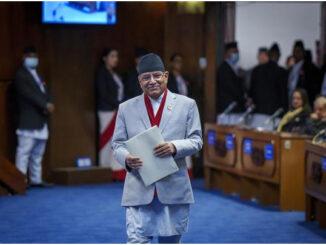
  • Nepal’s newly-appointed PM Prachanda wins vote of confidence in House of Representatives

    Nepal’s newly-appointed PM Prachanda wins vote of confidence in House of Representatives

    Kathmandu (TIP): Nepal’s newly-appointed Prime Minister Pushpa Kamal Dahal ‘Prachanda’ on January 10 won the vote of confidence in the House of Representatives. The 68-year-old CPN-Maoist Centre leader was sworn in as the Prime Minister for the third time on December 26 last year after he dramatically walked out of the pre-poll alliance led by the Nepali Congress and joined hands with opposition leader K P Sharma Oli. Out of the 270 members in the House of Representatives (HoR) present during the voting, 268 voted in favour of Prime Minister Prachanda, while 2 voted against him.

    Pashupati Shamsher JB Rana, the senior-most member of the House, who chaired the meeting, said that the HoR passed the vote of confidence proposal moved by Prachanda. Rana, who chaired the meeting did not vote, while four other lawmakers were absent.

    Prachanda needed only 138 votes in the 275-member parliament to continue his term as the prime minister. (PTI)

  • Clamour grows in Brazil over jail for rioters

    Rio De Janeiro (TIP): “No amnesty! No amnesty! No amnesty!” The chant reverberated off the walls of the jam-packed hall at the University of Sao Paulo’s law college on January 10 afternoon. Hours later, it was the rallying cry for thousands of Brazilians who streamed into the streets of Rio de Janeiro and Sao Paulo, penned on the protest posters and banners. The words were a demand for retribution against the supporters of former President Jair Bolsonaro who stormed Brazil’s capital on Sunday, and those who enabled the rampage. (AP)

  • UK, Japan sign defence deal amid China concern

    London (TIP) : The leaders of Britain and Japan are signing a defence agreement on January 11 that could see troops deployed to each others’ countries. The two countries are strengthening military ties amid growing concern about China’s increasing military assertiveness and designs toward Taiwan, which it considers a renegade province. The British government said the defence agreement “cements our commitment to the Indo-Pacific” region. It is due to be signed by Japanese Prime Minister Fumio Kishida and UK leader Rishi Sunak during a meeting in the symbolic setting of the Tower of London fortress.

    The deal has been in the works for years, and was discussed when Kishida visited Sunak’s predecessor, Boris Johnson, in London in May.

    The deal, Reciprocal Access Agreement — Japan’s first with any European nation — allows the two countries to hold joint military exercises. — AP

  • Suicide attack in Kabul leaves five dead, 40 injured

    Suicide attack in Kabul leaves five dead, 40 injured

    kabul (TIP): A suicide bomber killed at least five people outside the Afghan foreign ministry on January 11, police said, and a nearby hospital said over 40 people were wounded. Kabul police spokesperson Khalid Zadran said the official confirmed death toll was five. Ustad Fareedun, an official at the Taliban-run information ministry, said 20 people were killed. He said the bomber had planned to enter the foreign ministry but failed. Emergency Hospital, a surgical centre for those wounded by the war run by an Italian NGO, said it had received more than 40 patients following the explosion. The United Nations and several countries, including Pakistan and the United Kingdom, condemned the attack. “The UK rejects such senseless and indiscriminate acts of violence,” said Hugo Shorter, the charge d’affaires for the UK mission to Afghanistan. A photo of the area, confirmed by official sources, showed at least nine dead or wounded lying outside the ministry. The blast hit at about 4 pm (1130 GMT), Zadran said.

    No group immediately claimed responsibility. The Taliban-run administration has faced an insurgency by Islamic State militants who have targeted foreigners, including the Russian and Pakistani embassies and a hotel catering to Chinese businessmen.

    The blast took place during a busy time of day in a heavily fortified area surrounded by checkpoints on a street housing several ministries. Countries, including Turkey and China, have embassies in the area. — Reuters

  • Lankan ex-Prez told to pay Easter attack victims

    Colombo (TIP): Sri Lanka’s Supreme Court on January 12 ordered ex-President Maithripala Sirisena and four top former officials to pay 310 million in Sri Lankan Rupee (SLR) as compensation to the victims of the 2019 Easter attack for their negligence in preventing the country’s one of the worst terror strikes despite having credible intelligence from India of an imminent attack.

    In its verdict, a seven-member bench ruled that the respondents had violated the fundamental rights of the petitioners. The court ordered the then president Sirisena, who was also defence minister and commander-in-chief of the armed forces, to pay a compensation of Rs 100 million ($273,300) from his personal fund.

    It also ordered former police chief Pujith Jayasundara and former state intelligence services chief Nilantha Jayawardene to pay Rs 75 million rupees ($204,975) each, former defence secretary Hemasiri Fernando to pay a compensation of Rs 50 million ($136,650) and former national intelligence service chief Sisira Mendis Rs 10 million ($27,330).

    The court said top officials failed to act on the detailed intelligence information shared by India to avert the deadly suicide bombings. They have been ordered to pay from their personal funds to the victim fund maintained by the office of reparations. The court must be reported within six months on the payment of compensation. Nine bombers linked to ISIS attacked Catholic churches and hotels on April 21, 2019, killing nearly 270 people. (PTI)

  • British Prime Minister Rishi Sunak and 15 ministers at risk of losing seat in 2024

    London (TIP): British Prime Minister Rishi Sunak and 15 of his Cabinet ministers are at risk of losing their seats in a general election “wipeout” in 2024, according to a media report citing a new polling data.

    Senior Tory figures – including Prime Minister Sunak, Deputy prime minister Dominic Raab and health secretary Steve Barclay – are all at risk of defeat at the election expected in 2024, according to the polling data shared with The Independent newspapers. Foreign secretary James Cleverly, defence secretary Ben Wallace, business secretary Grant Shapps, Commons leader Penny Mordaunt and environment secretary Therese Coffey could also lose their seats, according to the Focaldata polling for Best for Britain. Only five Cabinet ministers – Jeremy Hunt, Indian-origin Suella Braverman, Michael Gove, Nadhim Zawawi and Kemi Badenoch – would cling on after the 2024 election, according to the poll. A new analysis shared with The Independent on 10 crucial “bellwether” seats – those who have voted consistently with the winning party in recent decades – shows that Labour is on course to take all 10. (PTI)

  • UAE to roll over $2 bn loan: Pak PM office

    Islamabad (TIP): The United Arab Emirates (UAE) on January 12 agreed to extend an existing loan of $2 billion and provide an additional loan of $1 billion to help cash-strapped Pakistan tackle its economic woes, including the fast-depleting foreign exchange reserves.

    Prime Minister Shehbaz Sharif’s Office made the announcement after his meeting with UAE President Sheikh Mohammed bin Zayed Al Nahyan in Abu Dhabi. The two leaders discussed bilateral relations and explored ways to further strengthen these ties, especially in the fields of trade, investment and energy. They also had an exchange of views on regional and international issues of mutual interest.

    While on one hand, the government supply of subsidised wheat has nearly stopped altogether, the prices of other essentials have skyrocketed on the other. Stores and grocery shops are running out of kitchen staples. The shortage of wheat flour has led to an increase in the prices of bread and bakery items too.

    The desperate situation has triggered chaos and some clashes among people were also seen in the region in the past few days. The locals blamed the government for the situation. “We will continue to protest till our demands are met. The scope of this protest can also increase, it can go from one district to another. We can protest in the entire PoK region. If the poor people yearn for bread, we are not responsible for it. It is the responsibility of the government,” said a protester in Muzaffarabad. /ANI

  • Multi-Billion-Dollar Casino Project Proposed for Nassau Hub Site

    Multi-Billion-Dollar Casino Project Proposed for Nassau Hub Site

    UNIONDALE, NY (TIP):  The Las Vegas Sands Corporation has entered into a deal to purchase the lease for the Nassau Coliseum and its surrounding property and, if approved by the state, build a casino on the site, says a Patch report. The company announced the multi-billion-dollar deal Thursday, January 12. It plans to build a large hospitality, entertainment and casino complex on the site.

    “Our company’s track record of driving significant economic benefits to the communities in which we operate and the meaningful relationships and partnerships we have created in each of those communities gives us a unique perspective on what it takes to develop transformative tourism destinations that positively impact the local community. Based on that experience, we strongly believe Long Island can be home to one of the region’s great entertainment and hospitality developments,” said Robert G. Goldstein, Sands chairman and CEO. “Our announcement today is only the first part of this journey. Our ability to put forward a compelling and competitive proposal will only succeed if we engage with the Long Island community and, in collaboration, develop a proposal that reflects the input of all those involved.”

    The drive for the casino comes from a decision by the state to add three casinos in the downstate area. A casino at the Hub area is still not a done deal. The state has said no determinations or licenses are expected until late 2023 at the earliest.

    However, Sands has big plans for the site, regardless of whether a casino is approved. The resort portions of the site would include outdoor community space, four- and five-star hotel rooms and a performance venue that “honors the legacy” of performances at Nassau Coliseum. Sands said the resort would also feature celebrity chef restaurants, experiential events and flexible meeting and convention spaces. The casino, if approved, would be less than a tenth of the project’s total square footage, Sands said.

    The Hub site in Uniondale was suggested to Sands by former Gov. David Paterson, who is a senior vice president with the Sands Corporation. “I will always consider Hempstead my home, so it is with great pride that I have a leadership role working with this great community on this transformational project,” he said. “We are committed to bringing opportunities for small businesses to thrive, career paths in multiple disciplines for our local residents, innovative approaches for minority and women-owned businesses, thousands of union jobs, and an understanding of our obligation to partner and communicate our vision for the future.” Sands said it will work with RXR Realty, which owns a large piece of property across the street from the Coliseum, to create a plan for the development that “maximizes economic opportunity, helps to build stronger communities, and protects the quality of life for all Long Islanders.”

    “After nearly two decades of working to transform the Nassau Coliseum site, including countless hours meeting with thousands of community members, the message has been overwhelmingly clear that Long Islanders want a global renowned entertainment destination that creates well-paying jobs and new opportunities at the Nassau Hub. But the challenge for turning this vision into reality has always been the commercial viability of a site encumbered by a nearly obsolete half-century-old arena,” said Scott Rechler, CEO and chairman of RXR. “The plan envisioned by Sands is a once-in-a-generation opportunity to create the kind of world-renowned entertainment and hospitality destination that has been sought after by Long Islanders.”

    In recent years, the Nassau Hub has been the source of much debate and many different proposals. More than a decade ago, Rechler and former Islanders owner Charles Wang tried to get The Lighthouse Project built at the site. It would have redeveloped the Hub with a new sporting/entertainment venue, as well as a hotel and other amenities and businesses. That plan, however, was squashed by the Town of Hempstead, which has control of zoning of the parcel.

    A few years later, Bruce Ratner took over the site and completely renovated the Coliseum, officially rebranding it NYCB Live, Home of the Nassau Veterans Memorial Coliseum. When the renovated Coliseum was revealed, Ratner said he hoped it would become “the Eiffel Tower of Long Island.” Under the Sands plan, it’s unclear what would happen to the Coliseum. In announcing the plan, Sands said it would honor the site’s legacy as a veteran’s memorial and pay tribute to Long Island service members, but did not say what would become of the Coliseum itself.

    “The entire Sands team is excited for the opportunity to help bring this vision to reality and we are ready to work in a serious and transparent manner with the local community in an effort to bring an exciting new industry to Long Island,” said Goldstein.

  • India’s Minister Piyush Goyal interacts with the Indian American community, details his government’s achievements

    India’s Minister Piyush Goyal interacts with the Indian American community, details his government’s achievements

    EDISON, NJ (TIP): India’s Minister of Commerce & Industry, Consumer Affairs, Food & Public Distribution, Textiles , and Leader of the Rajya Sabha, Piyush Goyal interacted  here with the Indian American community on January 8.

    The minister was gracious enough to apologize for arriving late. Referring to the cultural presentation by the young artists, he said : “It’s very heartening to see India’s culture  and our traditions being  kept alive by all of you and I’d like to thank you for, in some sense, instigating Indian value systems in the youth. The Indians who are born here,  who are living here, were largely exposed to the American way of life, American lifestyle. That little bit of Indian tradition, value systems, family culture, I think will hold them in good stead as they grew up to be good citizens of the United States of America.” Praising Indians in the United States of America, he said they had performed exceedingly well in both  the US and India Speaking of the strong linkages and bonds of friendship between India and the US, Mr. Goyal said,  “We have very strong geopolitical ties, huge interests in  business and trade, and  in economic wellbeing of both countries. In fact, India is happy that the United States of America is our largest trading partner.”

    “As we mark the contribution of all of the overseas Indians across the world, we feel proud that Indians have contributed to the rest of the world through our rich traditions and culture, and our acumen and managerial skills, our  talent which is today helping Indians lead large corporations, helping Indians contribute to the economic wellbeing of almost all parts of the world. Indians have been blessed with a huge amount of wealth of knowledge. And I believe the positive impact that all of you are making to America is well recognized in the reception that we get when we come to America or we go to any country. It’s truly because we represent a country of 1.4 billion Indians that we are recognized and respected.

    The minister made a long oration about the progress India had made under the prime ministership of Mr. Narendra Modi. One of the achievements among the many he proudly cited was that Mr. Modi ensured that not even a single person died of starvation during the Covid-19 period. His claim was met with a little disbelief by many in the gathering, as stories about starvation deaths during the Covid -19 period  were doing the rounds in the media, even as the government of India reported no starvation deaths in India since 2016.

    Earlier, in his welcome address, Consul General of India at New York, Randhir Kumar Jaiswal observed that “Indiais on a transformative path under  the visionary leadership of the  prime minister. There are three things that today happen to be part of global conversation. One, the Indian growth story. Two, the Indian startup ecosystem bursting and booming at its seams and three,  the socio-economic initiatives that are transforming India from food distribution to digital goods, and so on so forth. Let me tell you in all these three areas that form part of global conversation today, our honorable  Minister has a very critical role. He has played a very critical role in all these areas.” Mr. Vikas Nangia, well known TV Asia anchor excelled as the master  of ceremonies. The cultural content was extremely rich, with a song each being sung by a young man and a young lady, and a group dance which was presented by a troupe from Sneh Arts.

  • Governor Hochul Announces Climate Programs and Initiatives in State of the State Address

    Governor Hochul Announces Climate Programs and Initiatives in State of the State Address

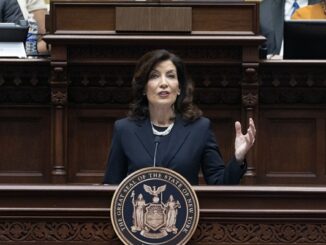
    ALBANY (TIP): Governor Hochul, on Tuesday, January 10th, announced in the 2023 State of the State address that New York will continue to undertake an ambitious and economywide effort to address the threat of climate change. It is truly encouraging to see New York’s climate and clean energy work represented in the Governor’s 2023 agenda, including important plans for a new Cap-and-Invest Program and significant investments in energy affordability, clean and efficient buildings, clean air, and clean water.

    New York is once again leading the way with the following climate and clean energy proposals.

    Cap-and-Invest Program: The Governor proposed advancing an ambitious Cap-and-Invest Program that will establish a declining cap on greenhouse gas emissions, invest proceeds in programs to reduce pollution, limit potential costs to New Yorkers, and maintain the competitiveness of New York industries. The Cap-and-Invest Program will be shaped by five core principles: affordability, climate leadership, creating jobs and preserving competitiveness, investing in Disadvantaged Communities, and funding a sustainable future. The Program will be developed in a public and transparent process to ensure stakeholders’ voices are heard and it will prioritize Disadvantaged Communities that have suffered from environmental injustice with at least 35%, and a goal of 40%, of investments directly benefitting these communities and ensuring pollution burdens are reduced in frontline communities. For more information on the Program, please read the press release and New York’s Climate Act website.

    Clean and Efficient Buildings: As part of the State’s comprehensive efforts to decarbonize its building stock, Governor Hochul announced a package of policy initiatives including zero-emission new construction (with no on-site fossil fuel combustion by 2025 for smaller buildings, and by 2028 for larger buildings) and to prohibit the sale of new fossil fuel heating equipment (by 2030 for smaller buildings and 2035 for larger buildings). These will be advanced alongside a grading system for larger buildings statewide based on their energy usage to help building managers make informed choices to cut electricity bills and emissions. These proposals are significant as New York’s building sector was responsible for 32% of emissions, the largest source of emissions in the state.

    Energy Affordability: To address high energy prices, Governor Hochul is proposing investments to insulate our most vulnerable households from rising energy prices while advancing the transition to lower emissions. These actions:

    Providing $200 million in relief for high electric bills. New York State will provide a credit to the more than 800,000 New York households that make under $75,000 annually to help pay burdensome electric bills.

    Pairing affordability support with modernizing low-income homes through EmPower Plus. The creation of the Energy Affordability Guarantee, the first-in-the nation pilot program will ensure low-income New Yorkers who participate in the EmPower Plus Program and fully electrify their homes will never pay more than six percent of their incomes on electricity.

  • New York nurses strike ends after tentative deal reached with hospitals

    New York nurses strike ends after tentative deal reached with hospitals

    NEW YORK (TIP): A nurses strike at two private New York City hospital systems has come to an end after 7,000 nurses spent three days on the picket line. CNN has reported that the New York State Nurses Association union reached tentative deals with Mount Sinai Health System and Montefiore Health System, which operates three hospitals in the Bronx that had been struck. The nurses had been arguing that immense staffing shortages have caused widespread burnout, hindering their ability to properly care for their patients.

    The union said the deal will provide enforceable “safe staffing ratios” for all inpatient units at Mount Sinai and Montefiore, “so that there will always be enough nurses at the bedside to provide safe patient care, not just on paper.” At Montefiore, the hospital agreed to financial penalties for failing to comply with agreed-upon staffing levels in all units.

    Montefiore said the agreement also includes 170 new nursing positions, a 19% increase in pay over the three year life of the contract, lifetime health coverage for eligible retirees and adding “significantly more nurses” in the ER.

    The deals were announced in the early hours Thursday morning, January 12 at 3 a.m. ET for Montefiore and about 30 minutes later at Mount Sinai. The nurses returned to the job for the 7 a.m. ET shift Thursday, and Montefiore Medical Center said all surgeries and procedures and outpatient appointments for Thursday and after will proceed as scheduled. Nurses will need to vote to approve the deal before it is finalized. But the union said the tentative deal will help put more nurses to work and allow patients to receive better care. “Through our unity and by putting it all on the line, we won enforceable safe staffing ratios at both Montefiore and Mount Sinai where nurses went on strike for patient care,” the nurses’ union said in a statement. “Today, we can return to work with our heads held high, knowing that our victory means safer care for our patients and more sustainable jobs for our profession.”

    Mount Sinai called the agreement “fair and responsible.”

    “Our proposed agreement is similar to those between NYSNA and eight other New York City hospitals,” Mount Sinai said in a statement. “It is fair and responsible, and it puts patients first.”

    “From the outset, we came to the table committed to bargaining in good faith and addressing the issues that were priorities for our nursing staff,” Montefiore said in a statement. “We know this strike impacted everyone — not just our nurses — and we were committed to coming to a resolution as soon as possible to minimize disruption to patient care.”

    The hospitals had stayed open during the three-day strike, using higher-cost temporary nursing services to provide care, and transferring other employees to take care of non-medical nursing duties. They had also diverted and transferred some patients to other hospitals and postponed some elective procedures.

    The striking nurses have said they are working long hours in unsafe conditions without enough pay — a refrain echoed by several other nurses strikes across the country over the past year. They said the hours and the stress of having too many patients to care for is driving away nurses and creating a worsening crisis in staffing and patient care.

    The union representing the nurses had reached tentative agreements offering the same 19% pay hikes at other New York hospitals, avoiding strikes by about 9,000 other nurses spread across seven hospitals in the city. But the nurses at the hospitals that went on strike said the pay raises weren’t the main problem, that the more severe staffing shortages at Mount Sinai and Montefiore needed to be addressed before a deal could be reached. Both hospitals had criticized the union for going on strike rather than accepting offers they described as similar to those the union accepted at other hospitals in the city.

  • January 13 New York & Dallas E – Edition

    [vc_row][vc_column][vc_custom_heading text=”E-Edition” font_container=”tag:h2|text_align:center” google_fonts=”font_family:Istok%20Web%3Aregular%2Citalic%2C700%2C700italic|font_style:700%20bold%20regular%3A700%3Anormal” link=”url:https%3A%2F%2Fwww.theindianpanorama.news%2Fwp-content%2Fuploads%2F2023%2F01%2FTIP-January-13-E-Edition.pdf”][vc_single_image image=”136458″ img_size=”full” alignment=”center” onclick=”custom_link” link=”https://www.theindianpanorama.news/wp-content/uploads/2023/01/TIP-January-13-E-Edition.pdf”][/vc_column][/vc_row][vc_row][vc_column width=”2/3″][vc_custom_heading text=”Lead Stories This Week” google_fonts=”font_family:Istok%20Web%3Aregular%2Citalic%2C700%2C700italic|font_style:700%20bold%20regular%3A700%3Anormal” link=”url:https%3A%2F%2Fwww.theindianpanorama.news%2F”][vc_wp_posts number=”5″ show_date=”1″][/vc_column][vc_column width=”1/3″][vc_single_image image=”82828″ img_size=”medium” alignment=”center” onclick=”custom_link” link=”https://www.theindianpanorama.news/advertising-media-kit-portal-indian-panorama/”][vc_single_image image=”82829″ img_size=”medium” alignment=”center” onclick=”custom_link” link=”https://www.theindianpanorama.news/advertising-media-kit-portal-indian-panorama/”][/vc_column][/vc_row]

  • Laid off Indian employees on H1B visa in the United States still struggling to find a job

    Laid off Indian employees on H1B visa in the United States still struggling to find a job

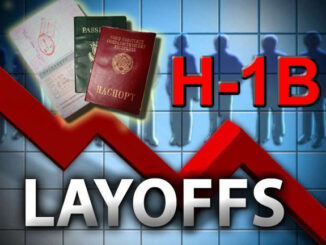
    WASHINGTON, D.C. (TIP): It has been a few months now and a new year but laid off Twitter and Meta employees are still struggling to find a new jobs given the macroeconomic conditions globally. Meta and Twitter laid off thousands globally. Many among them were Indians holding H1B visa. In 2022, employees working for tech companies were majorly impacted by layoffs. Some of the biggest layoffs that took place were at Twitter and Meta. Together, the two biggest tech companies laid off thousands of employees, many of which were Indians living in the United States with H1B visa. At the time of announcing layoffs, Meta head Mark Zuckerberg extended immigration support to foreign employees, but no such support was offered by Elon Musk-headed Twitter.

    (Source:  India Today Tech)

  • We count a lot on India’s G-20 leadership: IMF MD Kristalina Georgieva

    We count a lot on India’s G-20 leadership: IMF MD Kristalina Georgieva

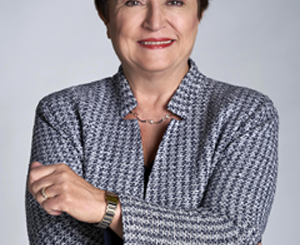
    WASHINGTON, D.C. (TIP): At a time when the world is faced with continued economic slowdown and social distress, the international community counts a lot on India’s leadership of G-20, the Managing Director of the International Monetary Fund Kristalina Georgieva said on Thursday, January 12.

    “India, which is the president of G-20 countries, remains among the countries that perform better than global average and by a good percentage,” IMF Managing Director told reporters during a media roundtable.

    India formally assumed the G20 (Group of 20) Presidency on December 1. The next G20 Leaders’ Summit at the level of Heads of State/Government is scheduled to be held on September 9 and 10 in New Delhi.

    “We count a lot on India’s leadership of the G-20. Because it is such a critical time for the world to protect its own wellbeing by protecting the integrated global economy. I hope that India will do that huge global service keeping us together,” she said.

    Georgieva lauded India for embracing digitization. “What we see as working extremely well for India is how the country has taken digitization that was accelerated by covid-19 to be a strong comparative advantage, both for public policy and for private sector growth,” the IMF Managing Director said in response to a question.

    (Source: PTI)

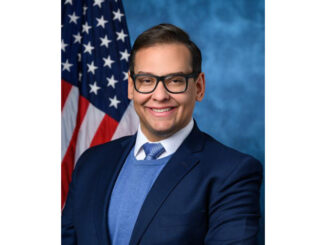
  • George Santos was paid for work at company accused of Ponzi scheme later than previously known

    George Santos was paid for work at company accused of Ponzi scheme later than previously known

    WASHINGTON, D.C. (TIP): Rep. George Santos (R-N.Y.), who has admitted to fabricating key details of his biography, received payments as recently as April 2021 from a financial services company accused by the Securities and Exchange Commission of a “classic Ponzi scheme,” according to a court-appointed lawyer reviewing the firm’s assets, a Washington Post report says.

    Santos did not divulge any income from the company, Florida-based Harbor City Capital, on a financial disclosure form required of all federal candidates. The payments the lawyer described to The Washington Post, which have not been previously reported, indicate that Santos received money at least a month after he has said he left the firm — and mere weeks before registering a business called the Devolder Organization that he has claimed as the basis for his wealth. The lawyer, Katherine C. Donlon, declined to tell The Post the amount Santos was paid.

    Santos, whose election to Congress from Long Island last year helped the GOP secure its narrow majority, has apologized for what he called “résumé embellishment,” but he has refused to step aside. On Wednesday, he rebuffed calls to resign from fellow New York Republicans, including leaders of the state GOP and the party in Nassau County, which had previously endorsed him. The congressman’s deceptions have already sparked an investigation by the district attorney’s office in Nassau County, as well as complaints before the Federal Election Commission. Authorities in Brazil are also seeking to revive a fraud case against Santos dating to 2008.

    During his first run for Congress in 2020, Santos reported earning a salary of $55,000 from a previous employer in the financial industry. His fortunes then improved dramatically, according to the financial disclosure he filed during his 2022 campaign: He earned an annual salary of $750,000 and received more than $1 million in dividends from the Devolder Organization. He also lent his campaign more than $700,000, according to campaign finance records. A key unanswered question is how Devolder made its money. The congressman has given various explanations about the firm — including saying it is an operation focused on “asset allocations” and an effort to help “all the people who were left adrift” at Harbor City.

    The financial disclosure form, filed in September of last year, covers earnings starting in January 2021 and anticipated through December 2022. It does not mention Harbor City.

  • AAPI’s 17thGlobal Healthcare Summit Announced During Curtain Raiser in Delhi

    AAPI’s 17thGlobal Healthcare Summit Announced During Curtain Raiser in Delhi

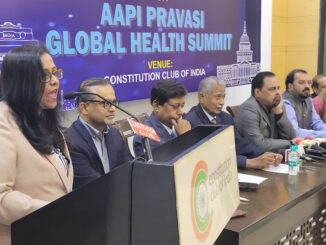
    NEW DELHI / NEW YORK (TIP): “After the highly successful Global Healthcare Summit in Visakhapatnam last weekend, I am happy to announce that the 17th annual Global Healthcare Summit will be held in New Delhi from January 2nd to 4th, 2024,” Dr. Anjana Samadder, President-Elect of the American Association of Physicians of Indian Origin (AAPI) announced here during a Curtain Raiser held at the prestigious Constitution Club in New Delhi on January 9th, 2023.

    Organized under the leadership of Dr. Udaya Shivangi, Women’s Forum Chair of AAPI, the kickoff event and press conference was attended by nearly 50 journalists from the nation’s capital and several leaders of APPI, who had come all the way from the United States to be part of this important ceremony. Prominent among those who attended the event included Dr. Seema Arora, past BOT Chair of AAPI, Dr. Raghu Lolabhattu, vice chair of AAPI BOT, Dr. Gautam Samadder, past president of AAPI, Dr. Sreeni Gangasani, Dr. Amit Chakrabarty, Dr. Raj Bhayani, and Dr. Joseph Chalil. Dr. Sampat Shivangi, Chair of AAPI’s Legislative Chair joined the meeting through a message of felicitation sent to the media and AAPI leadership.

    In her address, Dr. Anjana Samadder said, the theme for the next global healthcare summit will be “Maa Bachao,” meaning, protecting the mother, which will be a great way to strengthen families and humanity as a whole.

    Dr. Sushi Singh, chief guest at the event said, saving the mother and giving her due respect and honor is essential today more than ever. She pointed to the high infant mortality rate in India and urged all sections of society to work together to save girl children.

    Shri Karthikeyan, a decorated former IPS Officer, in his keynote address,  shared of the many sacrifices and contributions by the fraternity of doctors, and lauded them for their services to humanity, especially during the covid pandemic. He shared with the audience his personal experiences working with the most vulnerable people across society and urged everyone to work compassionately towards the poor and help uplift their lives.

    At the Delhi Press conference. From L to R: Dr. Anjana Samadder, Shri Karthikeyan, Dr. Sushi Singh , Dr. Udaya Shivangi

    In a message, Dr. Ravi Kolli, president of AAPI said, “The Global Healthcare Summit held annually in India across several states, has become a major contributing factor, where Indian American Doctors focus on various programs and policies in their efforts to make a huge difference in the delivery of healthcare in India.”
    “Coming from a nation that has given us so much, today Physicians of Indian origin have become a powerful influence in healthcare across the world,” said Dr. Shivangi.  “Nowhere in the world is their authority more keenly felt than in the United States. The overrepresentation of Indians in the field of medicine is striking – in practical terms, one out of seven doctors in the United States is of Indian Heritage. We provide medical care to over 40 million of the US population.”

    During an interactive session with the media persons who had filled the meeting venue, the leaders of AAPI shared with them of the numerous initiatives taken up by AAPI during the course of the past four decades in India as well as in the United States.

    “We the physicians of Indian origin are proud of our great achievements and contributions to our motherland, India, our adopted land, the US, and in a very significant way to the transformation of Indo-US relations and help India to have a cost-effective, efficient and advanced healthcare delivery benefitting India’s 1.4 billion people,” they pointed out.

    The Global Health Summit held annually in India has been a major contributing factor by Indian American Doctors, focusing on various programs and policies, and making a difference in the delivery of healthcare in India.

    In addition to educational seminars/workshops on current topics, the GHS includes a well-organized CEO forum with a panel of eminent healthcare leaders from the US and India, reinforcing the need for preventive care rather than disease management, to control the non-communicable diseases which are the biggest silent killers.

    Areas of ongoing skill training, investment in infrastructure, modernizing healthcare delivery, and private-public collaboration specific to each state in the healthcare sector are discussed and specific plans laid out, which are sent in a White Paper report for follow up in the coming months.

    Over the past 17 years and beyond, AAPI leadership has been able to establish Collaboration and multiple medical organizations – ACP – FSMB – ECFMG – NMC (India) – IMA (India)  GAPIO – UNICEF – Red Cross Society – CWC – Lifestyle Medicine – MDTok – Apollo Groups, only to name a few. These connections and collaborations are vital for us to stay connected and make a powerful impact on our communities.

    Through AAPI’s charitable activities with service to our motherland as the motto, AAPI has several programs in India and the United States.  Despite the Covid challenges of Delta and Omicron waves, in spite of limited resources, AAPI blood donation drives were done in several cities with several of them organizing multiple events.

    Journalists at the press conference

    Among several other initiatives, AAPI’s “Adopt a village” Rural Preventive Healthcare Screening Initiative in India, where free health screening camps with free physician consultations were done in several Indian rural villages in the middle of Covid pandemic.

    Continuing the efforts towards the Covid-19 Fund – Post-Covid Relief Activities, AAPI has raised over $5 million during the delta wave in India. The ongoing Covid-19 relief work in India is in progress, donating lifesaving equipment to support critically ill patients – Biochemical Analyzers, Ventilators, Oxygen Flow Meters, and Oxygen Plants. The funds will continue to support Covid patients in rural hospitals. Since its inception 40 years ago, AAPI has served as a link to foster stronger US-India relations and has been lauded by the governments of both nations for their great achievements and contributions.

    “We urge you to be part of this event in January 2024 and help create awareness and reach our services to the neediest in India and the United States,” said Dr. Anjana Samadder. For more details about AAPI and its many noble initiatives, please visit: www.aapiusa.org

  • The consulate also promotes economic relations between India and the US

    Consul General of India at New York Mr. Randhir Kumar Jaiswal, a few days after joining the present position on 19th July 2020  in an interview with The Indian Panorama, had spelt out  in brief  his  priorities which included nourishing and  strengthening the already strong bonds between India and the US, and exploring  new areas of cooperation and relationship in diverse fields of  economy, trade, technology, and   culture etc. Ambassador Jaiswal added  that serving the Indian Diaspora remained the primary focused concern of  the Consulate. The strengthening of multi-stake holders relationship will be another priority, he said. The Indian Panorama interviewed him a couple of times, and each time, Mr. Jaiswal was forthcoming on all issues raised ,and questions asked.

    Three days to the end of the year 2022, Mr. Jaiswal agreed to sit with the editor of The Indian Panorama to share for the readers of the publication his thoughts. It was a long interview in which Ambassador Jaiswal touched upon all the aforementioned areas.

    In the part 1 of the interview published two weeks ago, Ambassador Jaiswal focused on the vibrant Indian American community and its contribution.

    In part 2 of the interview, we brought  to readers Ambassador’s perspective on Indian students as a powerhouse of knowledge, catalysts of  national integration, and promoters  of Indian arts, culture and values.

    In this third part of the interview, Ambassador Jaiswal speaks about promoting economic relations between the two nations as one of the important functions of the Consulate, besides reiterating what he had said in the first part of the interview that the Consulate is “committed to public service”.

    Here are some excerpts from the interview.

    Consul General Randhir Kumar Jaiswal in interview with Prof. Indrajit S Saluja, chief editor of The Indian Panorama. (File photo)

     TIP:You spoke about the Consulate’s relationship with the Diaspora, and with the Indian students here.  What else do you think is the function of this Consulate?

    Ambassador:An important function of the consulate is to promote economic relations. So, we have product launches in the Consulate. Weare promoting “one district one product” scheme of government of India. When we had the parade this time, the consulate float  was based on one district one product. The idea is thatthere’s so much of capacity in India that we must realize that capacity,  produce goods and services for the Indian domestic market, and  also bring those goods and services  from India to the world outside. So,  on trade side with the US  we want to see how best we can leverage technology partnership with companies and link those companies with companies in India so that they can add value to a clean development or green growth or digital pathways or digital led development that we are committed to.

    Then, also on the investment side, trying to identify the right partners for investors here how they can invest in India;  how  they can be partnered in a good story; how they can be part of  the PM Shakti Infrastructure Program. Huge infrastructure projects are being undertaken in India- airports, expressways,  cities, new cities, Film City; all those things are being built. We have to see  how American companies can contribute to our growth and development. And then of course, you know, as part of our general overall friendship that we have to maintain, we are also in touch with US stakeholders, political stakeholders, so that we can inform them while that is happening in India on the economic side, on the reform side,  so that there is a better appreciation of our relationship,  and how India comes  up with the overall strategic partnership.

    TIP:Well, they say the number of complaints and grievances go to show the dissatisfaction of people with an organization. How  satisfied you are  after almost three years herewhen you find that the number of complaints and grievances has gone down considerably, almost non- existent?

    Ambassador:  The motto of the government of India is “people first”, and  that has been an approach with us at the Consulate. If a person is there, if he has a problem,  the problem needs to be solved. It  is in  line with  the mission – Karm Yogi . This is another reform that we have undertaken. Prime Minister Modi has  undertaken transformative reforms which have  changed bureaucracy and the way it is perceived,  the way it should be doing things for the society,  from rule  based to role based. That is the tagline- from rule  based to role based. We have to have a helping attitude; we have to have a positive attitude. We have  to have a problem-solving attitude.

    In the last year we introduced three features in our  consular services, bringing in more technology in a public service delivery. That is what is happening in India as well. We launched a mobile app of the consulate, so it becomes easy for people .If you go to a website and fill in a form, the form goes left, right, you don’t know where it goes. But on an app if you want to fill in a form it’s very easy. So that has made life easy for consular applicants. Most  of the queries that are generated on PRAMIT were about status check. What is the status of my passport? What is the status of my visa? Of course, I mean, status of visa is not there because you know we tender  it the same day or the following day. So,  we introduced an interface which  was somewhat difficult because we were dealing with two different technology platforms. We introduced  a status check in the form itself . So,  instead of asking us, they can themselves put their number and get the status check, and  that has been a major hit. We have at least 5000 to 6000 applicants using status check mechanism on PRAMIT on a  monthly basis, which means that the number of queries generated from a system has gone down substantially. And the third feature that we introduced  is  artificial intelligence based strong chatbot. If you have a query, you put your query, the chatbot will answer. Basically, chatbot is able to answer 99% of the questions. So, these three things have made life easy for everyone-people at the consulate and the public seeking consular services. They don’t have to run around. They don’t waste time and that savestheir  time, and  also their  energy.

    TIP: Well, you are making great use of the latest technology available to make things easier for both the consulate employees and the public, who until a few years ago, had to spend days together, running from pillar to post have a passport or visa issued, and of course, for other services.

    Ambassador:Also,  one more thing I would like to mention,  that we are committed to public service and for that reason, this consulate is open seven days a week. This Saturday also, we had to keep the consulate open as there was a case of emergency at the airport. One young student who was flying out lost his passport after he had checked in. It was a problem. We called him here. We got the passport issued, and then he was able to take another flight. So,  we are always there to attend to emergencies. I would encourage people to use the emergency helpline to request us even on a Saturday or a  Sunday; we’ll be more than happy to render all assistance. But also,  I would like to tell  your readers that they should  use the emergency helpline for emergency only, not for  random questions on India or things that may not be related to emergency.

    In the last several years, we have taken  a problem-solving approach. People who applied for asylum can ask for a passport, and  they will be given a passport.You ask for a visa; you will be given a visa. Similarly,   if you don’t have your passport details etc. and  you have  I797 we are giving people passport services as well. So, it has helped everybody.  This system has been helpful to people  and we have also reformed the way we work.

    TIP:And besides passport,  visa and  all other consular  services, how do you help the Indian origin people or the Indian community in your jurisdiction?

    Ambassador: There have been  many death cases. If a person here is alone and  there is no survivor, we take care of various needs, including cremation and sending the mortal remains to India. In fact, we do it almost on a weekly basis. For that sort of support,  we team with theTeammate, which  isan organization here and is very helpful. They deal with all sorts of trauma cases in the community, not just in the United States, but  also in Canada. They can reach out within hours in any corner of the nation because  they have their volunteers.  We have been able to provide a lot of help to the community with support from Teammate.

    Just a month back there was an accident in which  seven students were involved. Three or four of them  died. We immediately contacted the families and then we ensured that the mortal remains were sent back. These are critical situations, we understand. It’s very sensitive for the  family; we understand their emotion.

    We also render services in terms of reaching out to women folk who are disturbed here, for one reason or the other. We provide them. We connect them to NGOs. We provide legal services. We also provide some other assistance and required financial assistance at times. So, we have many people-to-people issues too to deal with,  and we are doing our best tohelp them resolve them.

                                                                                            (To be continued..)

  • George Santos Faces Calls to Resign

    George Santos Faces Calls to Resign

    WESTBURY, N.Y. (TIP): Dozens of Republican officials in New York State, including four recently elected congressmen, urged Representative George Santos, on Wednesday, January 11, to resign in a fracturing of local party support for Mr. Santos. Their call represented a sharp break from congressional Republican leaders, who insisted they would not push the embattled congressman to resign. Even as Mr. Santos’s former allies in New York insisted that his fabrications on the campaign trail had significantly violated the public trust, House Speaker Kevin McCarthy said that he not only would resist calls to push Mr. Santos out, but that he planned to seat him on a congressional committee.

    “The voters elected him to serve,” Mr. McCarthy told reporters in Washington, adding that Mr. Santos “has to answer to the voters and the voters can make another decision in two years.”

    Mr. Santos, who was elected to represent New York’s Third Congressional District, a consequential swing district in Queens and Long Island, emphatically resisted calls to leave office, saying on Twitter that he remained committed to serving the people of his district.

    The Nassau County party chairman, Joseph G. Cairo Jr., said that Mr. Santos, a first-term Republican, had lost the support of Republicans in his district, saying that Mr. Santos’s campaign was one of “deceit, lies, fabrication.”

    “He’s disgraced the House of Representatives, and we do not consider him one of our congresspeople,” Mr. Cairo said at the news conference. “Today, on behalf of the Nassau County Republican Committee, I am calling for his immediate resignation.”

    (Source: agencies)

  • IRS sets Jan. 23 as official start to 2023 tax filing season; more help available for taxpayers this year

    IRS sets Jan. 23 as official start to 2023 tax filing season; more help available for taxpayers this year

    WASHINGTON, D.C. (TIP):  The Internal Revenue Service, on January 12, announced Monday, Jan. 23, 2023, as the beginning of the nation’s 2023 tax season when the agency will begin accepting and processing 2022 tax year returns.

    More than 168 million individual tax returns are expected to be filed, with the vast majority of those coming before the April 18 tax deadline. People have three extra days to file this year due to the calendar.

    With the three previous tax seasons dramatically impacted by the pandemic, the IRS has taken additional steps for 2023 to improve service for taxpayers. As part of the August passage of the Inflation Reduction Act, the IRS has hired more than 5,000 new telephone assistors and added more in-person staff to help support taxpayers.

    “This filing season is the first to benefit the IRS and our nation’s tax system from multi-year funding in the Inflation Reduction Act,” said Acting IRS Commissioner Doug O’Donnell.  “With these new additional resources, taxpayers and tax professionals will see improvements in many areas of the agency this year. We’ve trained thousands of new employees to answer phones and help people. While much work remains after several difficult years, we expect people to experience improvements this tax season. That’s just the start as we work to add new long-term transformation efforts that will make things even smoother in future years. We are very excited to begin to deliver what taxpayers want and our employees know we could do with this funding.”

    These steps took place as the IRS worked for months to prepare for the 2023 tax season. The Jan. 23 start date for individual tax return filers allows the IRS time to perform annual updates and readiness work that are critical to ensuring IRS systems run smoothly. This is the date IRS systems officially begin accepting tax returns. Many software providers and tax professionals are already accepting tax returns; they will transmit those returns to the IRS when the agency begins accepting tax returns on Jan. 23.

    The IRS urges people to have all the information they need before they file a tax return. Filing a complete and accurate tax return can avoid extensive processing and refund delays as well as avoid the possibility of needing to file an amended tax return.

    In addition, the IRS encourages people to carefully review their tax situation to make sure they don’t overlook important tax credits they may be eligible for, like the Earned Income Tax Credit (EITC). The IRS has set a special day on Jan. 27 to encourage people to make sure they understand the important benefits of the EITC, a credit that can help low- and moderate-income workers and families.

    The IRS has a variety of free services available to help people. The IRS’s Volunteer Income Tax Assistance and Tax Counseling for the Elderly programs also offer free basic tax return preparation to qualified individuals. People can also get help from trusted tax professionals, commercially available tax software as well as IRS Free File, which provides free electronic filing of tax returns.

    April 18 tax filing deadline in 2023

    The filing deadline to submit 2022 tax returns or an extension to file and pay tax owed is Tuesday, April 18, 2023, for most taxpayers. By law, Washington, D.C., holidays impact tax deadlines for everyone in the same way as federal holidays. The due date is April 18, instead of April 15, because of the weekend and the District of Columbia’s Emancipation Day holiday, which falls on Monday, April 17.

    Taxpayers requesting an extension will have until Monday, Oct. 16, 2023, to file.

    Tips to help people with the 2023 tax season

    The IRS recommends several things for people to keep in mind for a smooth filing experience this year:

    Have the right information before filing. The IRS encourages individuals to have all the information they need before filing a complete and accurate return. Organize and gather 2022 tax records including Social Security numbers, Individual Taxpayer Identification Numbers, Adoption Taxpayer Identification Numbers and this year’s Identity Protection Personal Identification Numbers valid for calendar year 2023. Filing an accurate tax return can help taxpayers avoid delays or later IRS notices. Sometimes this means waiting to make sure individuals have accounted for all their income and the related documents. This is especially important for people who may receive one of the various Forms 1099 from banks or other payers reporting unemployment compensation, dividends, pension, annuity or retirement plan distributions.

    People should also remember that most income is taxable, including unemployment income, interest received or money earned from the gig economy or digital assets. Individuals should make sure they report the correct amount on their tax return to avoid processing delays. Visit IRS.gov first for questions. The IRS reminds people to visit IRS.gov first for common questions and also to check on the status of their refunds. IRS.gov has much of the same information that IRS phone assistors have.

    The IRS anticipates making significant improvements to phone service this year for taxpayers and tax professionals as more training for new phone assistors is completed in the weeks ahead. However, the IRS emphasizes it’s important to note that call volumes remain at historically high levels. The IRS urges people to visit IRS.gov for the information they need.

    “Our phone volumes remain at very high levels,” O’Donnell said. “For faster access to information, we urge people to start with IRS.gov. From there, taxpayers can quickly access the variety of free resources available to help taxpayers anytime, day or night.”

    Speed refunds by filing electronically and choosing direct deposit. There are important steps people can take to help ensure their tax return and refund are processed without delays. The most important is to file electronically with direct deposit. This is still the fastest and easiest way to file and receive a refund. To avoid delays in processing, people should avoid filing paper returns wherever possible.

    To speed refunds, the IRS urges people to file electronically with direct deposit information as soon as they have everything needed to file an accurate return. Individuals can use a bank account, prepaid debit card or mobile app to use direct deposit and will need to provide routing and account numbers with their return. Learn how to open an account at an FDIC-insured bank or through the National Credit Union Locator Tool.

    IRS Free File available Jan. 13

    IRS Free File will open Jan. 13 when participating providers will accept completed returns and hold them until they can be filed electronically with the IRS. Many commercial tax preparation software companies and tax professionals will also be accepting and preparing tax returns before Jan. 23 to submit the returns when the IRS systems open.

    The IRS’s Free File program, available only at IRS.gov, allows taxpayers who made $73,000 or less in 2022 to file their taxes electronically for free using brand-name software provided by commercial tax filing companies. Free File Fillable forms, a part of this effort, is available to any income level and provides free electronic forms that people fill out and file themselves also at no cost.

    Most refunds issued in less than 21 days; EITC refunds for many available starting Feb. 28

    The IRS anticipates most taxpayers will receive their refund within 21 days of when they file electronically, if they choose direct deposit and there are no issues with their tax return. Taxpayers should check Where’s My Refund? on IRS.gov for their personalized refund status.

    While the IRS will begin accepting returns Jan. 23, the IRS cannot issue a refund that includes the Earned Income Tax Credit or Additional Child Tax Credit (ACTC) before mid-February. This is due to the 2015 PATH Act law passed by Congress, which provides this additional time to help the IRS stop fraudulent refunds from being issued.

    Where’s My Refund? should show an updated status by Feb. 18 for most early EITC/ACTC filers. The IRS expects most EITC/ACTC related refunds to be available in taxpayer bank accounts or on debit cards by Feb. 28 if taxpayers chose direct deposit and there are no other issues with their tax return.

    Awaiting processing of previous tax returns? People can still file 2022 returns

    Currently, the IRS has processed all paper and electronic individual tax year 2021 returns received prior to November 2022 that didn’t require error-correction or further review. The IRS continues to work on remaining tax returns in these categories. This work will not impact tax refund timing for people filing in 2023, but the IRS continues to urge people to make sure they submit an error-free tax return this tax season to avoid delays. Check the IRS Operations page for the latest information about the status of tax returns received in 2022.

    IRS.gov, IRS Online Account provide free help

    Taxpayers can find online tools at IRS.gov that are easy-to-use and available anytime. Millions of people use them to help file and pay taxes, find information about their accounts, determine eligibility for tax credits and get answers to tax questions.

    An IRS Online Account allows individuals to log in securely to access personal tax account information including balance, payments and tax records including adjusted gross income.

    There are various types of tax return preparers, including enrolled agents, certified public accountants, attorneys and some who don’t have a professional credential. Choosing a Tax Professional offers information to help people select one. The Directory of Federal Tax Return Preparers with Credentials and Select Qualifications can help taxpayers find local preparers who currently hold professional credentials recognized by the IRS or who hold an Annual Filing Season Program Record of Completion.

    The Interactive Tax Assistant provides answers to many tax law questions. For example, it can help people determine if a type of income is taxable, or if they can deduct certain expenses. It also helps people find out if life event changes make them eligible for credits they didn’t qualify for in the past and provides answers for general questions, such as determining filing status, if someone can claim dependents or if they have to file a tax return.

    Where’s My Refund? offers taxpayers the ability to check the status of their refund within 24 hours after the IRS accepts their e-filed tax return. The Where’s My Refund? tool updates once every 24 hours, usually overnight.

    MilTax is a free tax resource available for the military community, offered through the Department of Defense. It includes tax preparation and electronic filing software, personalized support from tax consultants and current information about filing taxes. It’s designed to address the realities of military life – including deployments, combat and training pay, housing and rentals and multi-state filings. Eligible taxpayers can use MilTax to electronically file a federal tax return and up to three state returns for free.

    Key filing season dates

    There are several important dates taxpayers should keep in mind for this year’s filing season:

    Jan. 13: IRS Free File opens

    Jan. 17: Due date for tax year 2022 fourth quarter estimated tax payment.

    Jan. 23: IRS begins 2023 tax season and starts accepting and processing individual 2022 tax returns.

    Jan. 27: Earned Income Tax Credit Awareness Day to raise awareness of valuable tax credits available to many people – including the option to use prior-year income to qualify.

    April 18:  National due date to file a 2022 tax return or request an extension and pay tax owed due to the Emancipation Day holiday in Washington, D.C.

    Oct. 16: Due date to file for those requesting an extension on their 2022 tax returns.

    Before filing: Plan ahead

    It’s never too early to get ready for the tax-filing season. For more tips and resources, check out the Get Ready page on IRS.gov.

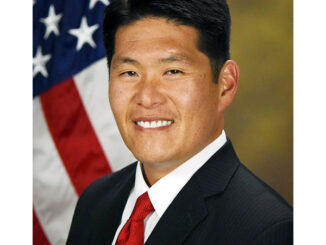
  • AG Garland Names Special Counsel in Biden Documents Case

    AG Garland Names Special Counsel in Biden Documents Case

    The announcement by the attorney general, Merrick Garland, came after the discovery of two batches of classified documents from Mr. Biden’s time as vice president

    WASHINGTON, D.C. (TIP): Attorney General Merrick B. Garland on Thursday. January 12,  appointed Robert K. Hur, a veteran prosecutor who worked in the Trump administration, to handle the investigation into how classified documents from President Biden’s time as vice president ended up at his private office and home.

    Mr. Hur, who previously served as the U.S. attorney for Maryland during the Trump administration, is responsible for investigating “the possible unauthorized removal and retention of classified documents or other records discovered” at the office of Mr. Biden’s think tank in Washington and his residence in Wilmington, Del., according to the order signed by Mr. Garland on Thursday.

    Mr. Hur, who also served as a top department official in the deputy attorney general’s office in 2017 and 2018, is authorized to prosecute any crimes arising from the inquiry or to refer matters for prosecution by federal attorneys in other jurisdictions, the order said. The decision to select a special counsel to look into the handling of the documents, which include briefing materials on foreign countries, comes at an extraordinary moment for Mr. Garland, who in November tapped Jack Smith, a former war crimes and public corruption, prosecutor, to lead the investigations into former President Donald J. Trump’s mishandling of government documents and his actions related to the Capitol attack on Jan. 6, 2021.

    A senior department official, speaking on the condition of anonymity, said the decision by Mr. Garland “was not taken lightly” but was required under department regulations as “a textbook example” of an investigation that necessitated appointment of a special counsel.

    The appointment is intended to insulate the Justice Department from accusations of partisanship at a time when the new Republican majority in the House has embarked on an aggressive and open-ended investigation into what they claim is the Biden administration’s bias against their party. Mr. Hur, who is a partner at the white-collar law firm Gibson, Dunn & Crutcher, had been appointed by Mr. Trump as the U.S. attorney for the District of Maryland in 2018, leaving that position when the Trump administration ended.

    The White House has acknowledged twice this week that Mr. Biden’s team had found batches of classified papers in two locations associated with him, in his former office at a think tank in Washington and in the garage of his home in Wilmington, Del.

    A batch of classified papers, which is said to have included briefing materials on foreign governments dating from Mr. Biden’s time as vice president, were found on Nov. 2, as lawyers were closing down his office at the Penn Biden Center for Diplomacy and Global Engagement in Washington.

    They alerted the National Archives, which retrieved them the next morning. Archives officials then informed the Justice Department; Mr. Garland assigned the preliminary phase of the inquiry to John R. Lausch Jr., the U.S. attorney in Chicago and a Trump appointee, to blunt criticism that he was seeking to protect the Democratic president who appointed him.

    Like Mr. Lausch, Mr. Hur was a political appointee of Mr. Trump. During the Trump administration, he was the top aide to the deputy attorney general, Rod Rosenstein, himself a former U.S. attorney in Maryland.

    But Mr. Hur had a significant career in an apolitical role as an assistant federal prosecutor in that office from 2007 to 2014, and then had worked as a trial lawyer in private practice before coming back to the Justice Department to assist Mr. Rosenstein.

    According to a biography, Mr. Hur’s prosecutorial career included cases involving gang violence, gun offenses and drug trafficking, as well as white-collar crimes like fraud, public corruption, tax offenses, hacking, and intellectual property theft.

    Mr. Hur also prosecuted high-profile domestic terrorism cases.

    Mr. Hur graduated from Harvard College and Stanford Law School and clerked for Chief Justice William H. Rehnquist, the biography said. He also worked as an aide to Christopher Wray, now the F.B.I. director, when Mr. Wray ran the Justice Department’s criminal division in the George W. Bush administration.

    Meanwhile, President Biden said he was ‘cooperating fully and completely’ with a Justice Department review. He  told reporters on Thursday, January 12,  that he was cooperating fully with the Justice Department in its investigation into classified documents found at his Delaware residence and promised a further explanation in the days ahead. Speaker Kevin McCarthy, a Republican, used his morning news conference to condemn Biden’s behavior. “This was discovered before the election,” McCarthy said, a reference to the Nov. 2 discovery of documents at a Washington think tank. He added: “Congress has to investigate this.”

    McCarthy also pointed out Biden’s criticism of former President Trump’s handling of documents, wondering if Biden had used the Justice Department to raid Mar-a-Lago. He added: “They knew this happened to President Biden before the election, but they kept it secret from the American public.”

    (Source: agencies)


  • 50 Indian American students  among America’s  top 300 for the Regeneron Science Talent Search 2023

    50 Indian American students among America’s top 300 for the Regeneron Science Talent Search 2023

    WASHINGTON, D.C. (TIP): About 50 Indian American students are among 300 semifinalists in the Regeneron Science Talent Search 2023, said to be the nation’s oldest and most prestigious science and math competition for high school seniors.

    The 300 scholars selected from 1,949 applications from 627 high schools across America and four other countries, will be awarded $2,000 each and their schools will be awarded $2,000 for each enrolled scholar, Society for Science announced Jan 10. Scholars were chosen based on their outstanding research, leadership skills, community involvement, commitment to academics, creativity in asking scientific questions and exceptional promise as STEM leaders demonstrated through the submission of their original, independent research projects, essays and recommendations, according to a society press release.

    The 300 scholars hail from 194 American and international high schools in 35 states and China.

    On Jan 24, 40 of the 300 scholars will be named Regeneron Science Talent Search finalists. The finalists will then compete for more than $1.8 million in awards during a week-long competition in Washington, DC, taking place March 9-15.

    “Congratulations to the top 300 scholars in this year’s Regeneron Science Talent Search,” said Maya Ajmera, President and CEO, Society for Science and Publisher, Science News.

    “The enthusiasm and quality of projects from this year’s participants were just outstanding. Each year, I am tremendously impressed by the ingenuity that the students bring to the competition. Their hard work, creativity and perseverance should be applauded.”

    Collectively, STS alumni over eight decades have received millions of dollars in scholarships and gone on to be awarded Nobel Prizes, Fields Medals, MacArthur Fellowships and numerous other accolades, the release said.

    Indian American semifinalists include:

    Ashwika Agrawal, 17 Cupertino High School, California.

    Project Title: Hanu: A Low-Cost Computer-Aided Lung Auscultation Apparatus with Automated Diagnosis of Respiratory Illnesses.

    Bhargav Raviseshachandra Annem, 17, Liberal Arts & Science Academy, Texas.

    Project Title: Impact of Orbiting Satellites on Star Formation Rate Evolution and Metallicity Variations in Milky Way-Like Discs

    Stavya Arora, 17, Maple Grove Senior High School, Minnesota.

    Project Title: Overcoming Opioids: Analyzing, Characterizing and Quantifying the Sentiment of Reddit Posts’ Tone and Language Prior to a Relapse To Allow for Early Intervention.

    Aaditya Krishna Arun, 18, Harmony School of Innovation, Sugar Land, Texas.

    Project Title: Determine the Deleterious Effect of Excess Fluoride on Reproductive Outcome and Development of Dip Bag-Based De-Fluoridation Solution.

    Shivani Babu, 17, Auburn High School, Alabama.

    Project Title: Attenuation of Adipocyte Hypertrophy in a Palmitic Acid-Induced 3T3 Cell Model Through Lupeol Treatment.

    Sruthi Balasubramanian, 17, American Heritage School Boca-Delray, Florida.

    Project Title: The Effect of Nicotinamide on the Il-6 Expression and Cell Count of Barrett’s Esophagus-Expressing Cells.

    Samir Batheja, 17, Half Hollow Hills High School, New York.

    Project Title: Association Between Sleep and Fatigue in Depression: Role of GABA and Glutamate.

    Shriya P Bhat, 17, Plano East Senior High School, Texas.

    Project Title: Cloning and Mutagenesis of the ampC Gene Encoding for β–lactamase in Pseudomonas aeruginosa To Identify Potential Allosteric Binding Sites.

    Rohan Tan Bhowmik, 17, The Harker School, California.

    Project Title: A Multi-Modal Wildfire Prediction and Early-Warning System Based on a Novel Machine Learning Framework.

    Kristi Biswas, 17, Paxon Senior High School, Florida.

    Project Title: Associations of Genetic SNPs with AD, Neuropathology and Gene Expression Offers Novel Insight Into AD

    Raka Bose, 17, Yorktown High School, New York.

    Project Title: Using Artificial Intelligence for ICU Patient Triage.

    Hiral Milind Chavre, 17, George W. Hewlett High School, New York.

    Project Title: NMDA Receptor Mutation and KCC2 Inhibition Induce Changes in Brain Development Associated with Neurodevelopmental Diseases.

    Rohini Elora Das, 17, Byram Hills High School, New York.

    Project Title: “Let’s Sleep on It”: Employing the Brain App to Measure the Impact of Sleep in Consolidating Prior Learning.

    Samara Davis, 17, Ossining High School, New York.

    Project Title: Developing Environmental DNA Metabarcoding for the Detection of Elusive Vernal Pool-Breeding Amphibians.

    Vihaan Dheer, 18, Hackley School, New York.

    Project Title: The Optimization of Flux Trajectories for the Adiabatic Controlled-Z Gate on Split-Tunable Transmons.

    Nadya Jasmine Dhillon, 17, Oak Park and River Forest High School, Illinois.

    Project Title: The Effect of a Novel Biomedical Technique on Reprocessing of Duodenoscopes Using Silver Nitrate and Methylene Blue Irradiated with Red Light.

    Advay Goel, 17, Acton-Boxborough Regional High School, Massachusetts.

    Project Title: The Geometry and Limits of Young Partition Flow Polytopes.

    Ambika Grover, 17, Greenwich High School, Connecticut.

    Project Title: Design of a Novel, Dual-Functioning, Tissue Plasminogen Activator and Factor XI-Inhibiting Anticoagulant Therapeutic for Rapid Ischemic Stroke Treatment.

    Arya Gupta, 17, Ardrey Kell High School, North Carolina.

    Project Title: Exploring the Relationship Between PolyCystic Ovary Syndrome and Its Five Related Conditions: Insulin Resistance, Menstrual Malfunction, Hyperandrogenemia, Obesity and Infertility.

    Ronit Gupta, 17, Greenwich High School, Connecticut.

    Project Title: Design of a Rapid, Lateral Flow COPD Diagnostic via Detection of Cyto-Keratin 19 Biomarkers.

    Varun Hariprasad, 17, Paul Laurence Dunbar High School, Kentucky,

    Project Title: Developing a Novel Autonomous Swarm-Based Beach Cleaning Robot.

    Anu Iyer, 17, Little Rock Central High School, Arkansas.

    Project Title: Systematic Parkinson Audio Recognition Construct SPARC: A Novel Machine Learning Method to Detect Parkinson’s Disease Using Voice in Three Seconds.

    Aashika Jagadeesh, 17, Fair Lawn High School, New Jersey.

    Project Title: FreeFeed: A Novel Deep Reinforcement Learning Approach for Achieving Multi-Sided Fairness in Recommendation Systems.

    Rishab Kumar Jain, 18, Westview High School, Oregon.

    Project Title: GlioMod: Spatiotemporal-Aware Glioblastoma Multiforme Tumor Growth Modeling with Deep Encoder-Decoder Networks.

    Tanish Jain, 17, Thomas Jefferson High School for Science and Technology, Virginia.

    Project Title: In silico Prediction of Drug Permeability Through an Inflamed Blood-Brain Barrier Using Molecular Feature Modeling.

    Aryan Thomas Kalluvila, 17, Hartford Union High School, Wisconsin.

    Project Title: An Accurate Super-Resolution Approach to 64 mT Low-Field MRI via Domain Adaptation and Nested U-Net Architecture.

    Archita Khaire, 17, North Carolina School of Science and Mathematics, North Carolina.

    Project Title: A Semi-Supervised Approach to Rank Potential Causal Variants and Their Target Genes in Microglia for Alzheimer’s Disease.

    Amav Khambete, 17, Coppell High School, Texas.

    Project Title: The Effects on Novel Drugs on EPH-EPHRIN Protein Interactions for the Inhibition of Chronic Pain.

    Sameer Ullal Kini, 17, Scarsdale High School, New York.

    Project Title: Associations Between Pathophysiological Traits and Symptom Development in V30M and V122I Transthyretin Amyloidosis.

    Sravan Kodali, 17, Christian Brothers Academy, New York.

    Project Title: Probing the Etiological Basis of Cancer and Neurological Disease: Epigenomic Signatures Associated with Spontaneous and Replication Stress-Induced Double Strand Breaks.

    Harish Krishnakumar, 17, Tesla STEM High School, Washington.

    Project Title: Analysis of Ring Galaxies Detected Using Deep Learning with Real and Simulated Data.

    Hari Hemanth Krishnamurthy, 17, Canyon Crest Academy, California.

    Project Title: Asylum Indicator: Predictive Modeling of Asylum Adjudications in the USA and in the EU To Help Refugees.

    Gouri Krishnan, 18, King School, Connecticut.

    Project Title: Energy Loss from Wasted Plastic and Lighting Inefficiency Can Be Reduced Through a Combination of Environmentally Friendly Polymers Created From Biomass and Energy-Saving Electrochromic Windows.

    Veda Kutagula, 17, Allen High School, Texas.

    Project Title: Predicting Binge Drinking Risk Among Teenagers as Part of an Overall Mental Health Predictive Model Using Machine Learning Techniques.

    Nishant Lahiri, 17, Corning-Painted Post High School, New York.

    Project Title: Polyethyleneimine-Impregnated Adsorbents for a Novel Community-Based Carbon Capture and Sequestration System.

    Darsh Sandip Mandera, 18, Jesuit High School, Oregon.

    Project Title: OncoPharML: A Machine-Learning Approach for Cancer Biomarkers Identification and Multi-Omics-Based Targeted Cancer-Drug Prediction.

    Krish Maniar, 17, The Harker School, California.

    Project Title: DANO Digital Phenotypic Assessment in Neuro-Oncology: Guiding Treatment Interventions and Forecasting Recurrence for Glioblastoma Patients Using Smartphone-Extracted Mobility Metrics.

    Arul Rhik Mazumder, 17, Massachusetts Academy of Math & Science, Massachusetts.

    Project Title: An Adaptive Hybrid Quantum Algorithm for the Metric Traveling Salesman Problem.

    Amishi Mittal, 17, Bergen County Academies, New Jersey.

    Project Title: Correlations Between Type 2 Diabetes and Alzheimer’s Disease and Increasing Aβ Degradation by Insulin-Degrading Enzyme via Zinc Chelation.

    Neel Moudgal, 16, Saline Area High School, Michigan.

    Project Title: Using Unassigned NMR Chemical Shifts to Model RNA Secondary Structure.

    Ishika Nag, 17, Oviedo High School, Florida.

    Project Title: Development of an Engineered Face Mask with Optimized Nanoparticle Layering for Filtration of Air Pollutants and Viral Pathogens.

    Lavanya Natarajan, 17, Viera High School, Florida.

    Project Title: A Prescriptive IoT Solution to Detect and Mitigate Fugitive Methane Gas in Landfills via a Supervisory Control and Data Acquisition System.

    Ayush Nayak, 18, Westview School, California.

    Project Title: Development of InSb/Si Quantum Dots for Next-Generation Multivalued High-Transport Transistor Technology.

    Siddhu Pachipala, 18, The Woodlands College Park High School, Texas.

    Project Title: SuiSensor: A Novel, Low-Cost Machine Learning System for Real-Time Suicide Risk Identification and Treatment Optimization via Computational Linguistics.

    Apoorva Panidapu, 17, Nautilus Academy Homeschool, California.

    Project Title: Short-Interval Sector Problems for CM Elliptic Curves.

    Jeeya Yogesh Patel, 17, George Washington High School, West Virginia.

    Project Title: Consequences of a Dot-1.1 Deletion on Germ Cell Components in Caenorhabditis elegans.

    Shloke Patel, 17, Hillsborough High School, Florida.

    Project Title: Developing Novel Biologicals with Multiple Modes of Action BM to Combat the Early Blight Disease in Tomato, Potato and Bell Pepper.

    Sohi Patel, 17, The Woodlands College Park High School, Texas.

    Project Title: Programmable Matter: A Microscale, Self-Reconfigurable, Swarm Robotic System.

    Ashwin Prabhakar, 17, Bob Jones High School, Alabama.

    Project Title: A Low-Cost Portable and Modular Single-Shot Hyperspectral Imaging System for Characterization of Materials.

    Ibrahim Qadri, 17, Valley Stream South High School, New York.

    Project Title: The Ability of Vitamin E To Improve the Reproduction and Metabolic Respiration of Nicotine-Induced D. Melanogaster.

    Akhila Ram, 18, Lexington High School, Massachusetts.

    Project Title: Unsupervised Representation Learning of GRACE Improves Groundwater Predictions.

    Tags: Indian Americans, Indians abroad, Indian-origin, USA, Science & Technology, Teens, Teenagers, Students, education, Regeneron Science Talent Search 2023


  • Being 1 per cent of US population, Indian-Americans pay 6 per cent of taxes: Congressman Rich McCormick

    Being 1 per cent of US population, Indian-Americans pay 6 per cent of taxes: Congressman Rich McCormick

    WASHINGTOON, D.C. (TIP): Indian-Americans who constitute about one per cent of the US population pay about six per cent of the taxes, a Congressman Rich McCormick told his Congressional colleagues on Thursday, January 12,  noting that this ethnic community does not cause problems and follows the laws.

    In his maiden speech on the House floor, Rich McCormick, 54, said that one of the five doctors in his community is from India and described Indian-Americans as great patriots, upstanding citizens and good friends.”Although they make up about one per cent of American society, they pay about six per cent of the taxes. They’re amongst the top producers, and they do not cause problems. They follow the laws,” McCormick said in a short speech on the floor of the US House of Representatives.

    A physician by profession, Republican McCormick represents the 6th Congressional District of Georgia, which mainly constitutes the northern suburbs of Atlanta. He defeated Bob Christian of the Democratic Party in the November 8, 2022 midterm elections.

    “They (Indian-Americans) don’t have the problems that we see other people have when they come to the emergency room for overdoses and depression anxiety because they’re the most productive or family-oriented and the best of what represents American citizens,” McCormick said. Georgia has a significant number of Indian-Americans. “I rise to this occasion to appreciate my constituents, especially those who have emigrated from India. We have a very large portion of my community that’s made up of almost 100,000 people who have emigrated directly from India,” he said. “One out of every five doctors in my community are from India. They represent some of the best citizens we have in America, we should make sure that we streamline the immigration process for those who come here to obey the law and pay their taxes and be the most creative and productive in society,” McCormick said.

    “God bless my Indian constituents and I look forward to meeting with the (Indian) Ambassador,” McCormick said in his brief remarks.

    (Source: PTI)

  • Yatra lends purpose to Rahul’s political journey

    Yatra lends purpose to Rahul’s political journey

     In Indian electoral politics, alliances are formed on the basis of strengths rather than weaknesses of the participants. The aura of success surrounding Rahul’s Bharat Jodo Yatra is set to provide him with moral authority to play a pivotal role. In addition, in Sonia Gandhi, Rahul has a reserve bench of sorts; the former party chief can act as a line of communication with many non-NDA allies, including the Left, to keep the mahagathbandhan going. 

    This year, the Congress faces a litmus test in Karnataka, Madhya Pradesh, Rajasthan and Chhattisgarh. If it can win these states, the grand old party would emerge as a serious challenger for the 2024 General Election.

    By Rashid Kidwai

    There are many quotes that have been attributed to Mahatma Gandhi. In the Congress party office at 24, Akbar Road, one of them reads, “Kabhi kabhi hum apne virodhiyon ke karan aage badhte hain.” (At times, we move ahead due to our opponents). Then there is another one saying, “Pehle woh aap par dhyan nahin denge, phir who aap par hasenge, phir aapse ladengen, aur tab aap jeet jayenge.”(First they would not pay any attention to you, then they would mock you and then they would fight with you. You would win once these stages are completed).

    In the context of Rahul Gandhi’s ongoing abstract, yet arduous, Bharat Jodo Yatra, these quotes ring a bell, bringing some relevance and hope for the Congress leader.

    There is a broader and growing consensus of sorts among Rahul’s detractors and well-wishers that finally, the Gandhi scion is showing signs of purpose, perseverance and hope in his political journey that began in 2004.

    Politically, the yatra may or may not be a game-changer, but it has succeeded in establishing Rahul as a credible politician who can walk the talk, intermingle with the masses and get support from a range of politicians and celebrities — from MK Stalin, Aaditya Thackeray, Supriya Sule and Farooq Abdullah to Raghuram Rajan, AS Dulat, Swara Bhaskar and Kamal Haasan.

    More importantly, the BJP’s stringent criticism, Union Health Minister Mansukh Mandaviya’s ‘appeal’ to suspend the yatra over Covid concerns, and the outrage over Rahul’s comments on China allegedly entering Indian territory have helped him become a singular dissenting voice.

    When the yatra began from Kanyakumari, Rahul’s popularity ratings were at an all-time low. The Congress organization was in a shambles and the leadership issue was far from settled. While the yatra was on the Kerala-Karnataka border, Rajasthan Chief Minister Ashok Gehlot, at that time tipped to be the next AICC president, stunned friends and foes alike by showing defiance, a throwback to the bygone era of Devaraj Urs, Arjun Singh and other party chief ministers.

    But throughout the Congress organizational election process, Rahul stayed away and focused on the yatra. The Assembly polls of Himachal Pradesh and Gujarat offered a mixed bag as the Congress went on to win HP. It was a surprise for those predicting the Congress’ death. The ‘corpse’ is, in fact, very much alive and kicking.

    This year, the Congress faces a litmus test in Karnataka, Madhya Pradesh, Rajasthan and Chhattisgarh. If it can win these states, the grand old party would emerge as a serious challenger for the 2024 General Election.

    We need to remember that the fortunes of the Congress and other non-BJP parties are closely linked to the 2024 Lok Sabha polls where the non-BJP, non-NDA Opposition and the Congress-UPA partners will have to target the ‘half of half’, i.e. half of the 272 Lok Sabha seats on their own — a challenging but not unmanageable number in the 2024 battle.

    There are four crucial states of West Bengal, Bihar, Maharashtra and Karnataka where the BJP-NDA had done exceedingly well in 2019 but the subsequent political developments have unfolded a new scenario. In West Bengal, for example, the BJP had won 18 Lok Sabha seats out of 42, while in Bihar, the alliance with the JD(U) had resulted in its netting 39 out of 40 parliamentary seats. In Karnataka, the BJP had won 25 out of 28 seats, while in Maharashtra, the alliance with the undivided Shiv Sena  had resulted in the NDA allies winning 42 out of 48 seats. Imagine a situation if the BJP’s strength from these four states gets reduced to half. A simple majority of 272 would become a distant dream and prospects of a khichdi government a reality.

    The Congress, in order to be a contender, has to win 100 or more Lok Sabha seats from states such as Kerala, Chhattisgarh, Maharashtra, Rajasthan, Madhya Pradesh, Assam, Karnataka, Uttarakhand, Himachal Pradesh and a few others where the grand old party has been in direct contest with the BJP or traditionally has a strong presence.

    Next year’s parliamentary polls are set to be contested in contrasting styles. If Team Modi is set to make full use of the Prime Minister’s personal ratings, big-ticket projects, Covid-19 handling in the context of the massive vaccination programme, achievements on the diplomatic front and reliance on emotive issues like the Ram Temple, the Congress and its potential allies are prepared to take the battle to the states where regional players are expected to hold sway.

    So, if the parties led by Mamata Banerjee, Nitish Kumar, Uddhav Thackeray, Sharad Pawar, MK Stalin, Naveen Patnaik, HD Kumaraswamy, Chandrababu Naidu and Akhilesh Yadav together manage to hold on to a chunk of the parliamentary seats, the Congress has the task of doing well in most of the Hindi-belt states and the Northeast.

    In Indian electoral politics, alliances are formed on the basis of strengths rather than weaknesses of the participants. The aura of success surrounding Rahul’s Bharat Jodo Yatra is set to provide him with moral authority to play a pivotal role. In addition, in Sonia Gandhi, Rahul has a reserve bench of sorts; the former party chief can act as a line of communication with many non-NDA allies, including the Left, to keep the mahagathbandhan going.

    (Rashid Kidwai is a Senior Journalist and Author)

  • Making diaspora invest in India a challenge

    Making diaspora invest in India a challenge

    “The unresolved issue with the NRIs is that the Indian government just does not know what it can do with them. The government wants their money, no doubt, and they are indeed sending money home, which accounts for 3 per cent of India’s GDP, according to the World Bank. The BJP’s foreign policy notion that the NRIs are its soldiers abroad to spread national glory is at best a delusion. And it could become a dangerous one if Indians abroad are seen as ‘fifth columnists’. Most NRIs have no interest in Indian politics nor are they motivated to push India’s case across the world. A time has to come when Indians need not migrate to other countries for better opportunities.”

    The NRIs remittances are higher than the foreign direct investment (FDI) that India is able to attract. The NRI remittances to India were $89.4 billion in 2021 and $100 billion in 2022.

    By Parsa Venkateshwar Rao Jr.

    The Bharatiya Janata Party (BJP), in its pursuit of overzealous nationalism, has looked upon the Indian diaspora across the world as an extension of India, politically as well as culturally. During the tenure of the then Prime Minister Atal Bihari Vajpayee, an attempt was made to woo overseas Indians, with the PM making it a point to interact with the Indians abroad rather than with other citizens of the host country. It was in 2002 that the first Pravasi Bharatiya Divas event was held in New Delhi.

    Prime Minister Narendra Modi intensified the outreach to the NRIs by addressing rallies in Madison Square Garden (New York) and then in Sydney after his party’s historic win in the 2014 Lok Sabha elections. But despite the enthusiasm to cultivate the NRI constituency in the past two decades, there is uncertainty and confusion over how to tap the potential of the NRIs to strengthen India at the global level or even at home.

    The 17th Pravasi Bharatiya Divas event, held in Indore from January 8 to 10, reflected the confusion. The Indian government does not seem to be keen that the Indians living abroad should come back and help in the development of the country with the knowledge and expertise they have acquired abroad. It only wants that the NRIs invest in India. But it is in many ways a non sequitur.

    Indians settled abroad, whether in the Gulf countries, the UK, the US, Canada, Australia or Singapore, have been sending money home to their families. But they have not thought that it is profitable to do business in India or invest in India. Even today, the NRIs remittances are higher than the foreign direct investment (FDI) that India is able to attract. The NRI remittances to India were $89.4 billion in 2021 and $100 billion in 2022, higher than what the Chinese and Filipino emigrants send to their home countries.

    So, at successive conventions of the Pravasi Bharatiya Divas, the country’s leaders of the day give rhetorical messages to the few thousand delegates who attend the event. And this year seems to have been no different. PM Modi, Finance Minister Nirmala Sitharaman and Education and Entrepreneurship Minister Dharmendra Pradhan delivered homilies and the unintended ironies were there for all to see. PM Modi, in his inaugural speech on January 8, said, “In Pravasi Bhartiyas, we see myriad images of Vasudhaiva Kutumbakam and Ek Bharat Shreshtha Bharat,” and “Pravasi Bhartiyas echo the voice of a powerful and capable India.”

    Pradhan said, “We all agree that once upon a time India was a ‘Vishwaguru’, not in terms of military power but in terms of intellect.” And then he turned to the government’s programme of creating a skilled network in the country. He told the NRIs that India has a skilled workforce of 500 million. Sitharaman, echoing PM Modi’s statement of how cheap India’s Mars mission was, said, “The cost of the Chandrayaan, which goes to the moon, is far less than that of a Hollywood film.” And citing a NASSCOM (National Association of Software and Service Companies) report, she said Indian IT companies hired 2 lakh Americans at an average salary of $1,06,360 in 2021.

    These statements can only confuse NRIs. The government wants to woo them by telling them how good India has become since they left the country and what an attractive investment destination it is now. Surely, the NRIs would want to test the government’s claims on the ground and it will be reflected in the investment decisions they will make in the future.

    But there is also the fact that though Indians in the US are sending home more money than those in the Gulf countries, as was the case earlier, the Indian-Americans are less likely to return home and even start businesses in India. The Indians in Gulf countries will come back at some point of time because as yet there is no possibility of becoming citizens in those countries. In contrast, more Indians are getting the coveted Green Card in the US and they are more likely to become citizens there. Secondly, there are more billionaires in India than among the NRIs. Steel magnate Laxmi Narayan Mittal and metal magnate Anil Agarwal are among the exceptions. The NRIs in the US are prosperous but they are not super-rich yet. They do not have surplus capital to pump into India like Meta’s Mark Zuckerberg or Amazon’s Jeff Bezos.

    It is, however, true that more and more Indians in western countries are becoming part of the political mainstream of their adopted countries, and they are reaching positions of influence and power. Whether it is Indian-origin leaders such as US Vice-President Kamala Harris, British Prime Minister Rishi Sunak, President of Guyana Mohamed Irfaan Ali or President of Suriname Chandrikapersad Santokhi (the last two were special guests at the Pravasi Bharatiya Divas event in Indore), they owe nothing to India, and there is nothing that India can do to support or strengthen them. India is not the imperial power that the Modi government would imagine itself to be.

    The unresolved issue with the NRIs is that the Indian government just does not know what it can do with them. The government wants their money, no doubt, and they are indeed sending money home, which accounts for 3 per cent of India’s GDP, according to the World Bank. The BJP’s foreign policy notion that the NRIs are its soldiers abroad to spread national glory is at best a delusion. And it could become a dangerous one if Indians abroad are seen as ‘fifth columnists’. Most NRIs have no interest in Indian politics nor are they motivated to push India’s case across the world. A time has to come when Indians need not migrate to other countries for better opportunities.

    (The author is a senior journalist)

  • The onus of furthering constitutional values is on the film fraternity and on other progressive forces

    The onus of furthering constitutional values is on the film fraternity and on other progressive forces

    An open letter to the Indian film industry

    “There has also been a concerted effort to suppress projects which do not fit the BJP’s vision of and for India. Consequently, barring some notable exceptions, India’s film fraternity consciously self-censors itself, hoping to ride out the storm. Faced with a dispensation that stops at nothing, this self-preservation imperative is understandable. After all, why should an actor or producer or director stand up for constitutional values when they face boycotts and threats, when investigative agencies are unleashed on them, and when no one publicly stands with them?”

    By Pushparaj Deshpande

    In 1938, Charlie Chaplin started work on The Great Dictator. Even though it critiqued the Nazis, Chaplin was forced to self-sponsor, direct and write the project himself because most mainstream Hollywood studios were hesitant to disrupt ties to German finance, or risk making an overtly political project. Additionally, many in the establishment felt appeasing Adolf Hitler could work, so official censorship was also a real threat. Yet, showing tremendous personal and ideological fortitude, Chaplin forged ahead. The film belied expectations and became Chaplin’s biggest commercial success. It was nominated for five Academy awards and became a cult classic.

    Contextualize the enormity of Chaplin’s achievement. Swimming against the tide, his film mocked Hitler’s fetish for photo-ops, self-aggrandizing schemes and critiqued the attacks against minorities to distract from economic failures. Most importantly, it exposed the futility of placating authoritarian figures. This was when Hollywood consciously eschewed taking an anti-Nazi stand on screen, even if it privately opposed Nazism.

    A site of contestation

    A similar situation has come to pass in India. India’s film industries are now a site of ideological and political contestation, as The Kashmir Files and Pathaan controversies highlight. The BJP is consistently leveraging films to sway mass audiences. Mixing religious imagery, patriotism and nationalistic ideals, these films methodically propagate key Sangh Parivar mythologies. The importance given to this endeavor is demonstrated by the fact that no less than the Prime Minister had multiple meetings with key film industry stakeholders, in an effort to prod them into producing “nation-building films”.

    There has also been a concerted effort to suppress projects which do not fit the BJP’s vision of and for India. Consequently, barring some notable exceptions, India’s film fraternity consciously self-censors itself, hoping to ride out the storm. Faced with a dispensation that stops at nothing, this self-preservation imperative is understandable. After all, why should an actor or producer or director stand up for constitutional values when they face boycotts and threats, when investigative agencies are unleashed on them, and when no one publicly stands with them?

    Coincidentally, this assault comes at a time when the nature of film consumption is undergoing a structural shift. As the DVD and retail business model has been rendered obsolete, filmmakers no longer get a second shot at turning a profit. This has been exacerbated by the unfortunate reality that confronting regressive values and uncomfortable truths is now a high-risk endeavor, for it could invite the wrath of regressive forces. Faced with these legitimate concerns, filmmakers are opting to churn out extravagant, high-budget films that are divorced from reality, or ‘safe’ films.

    But India’s film industries do not have the luxury of escaping socioeconomic and political realities. First, the BJP is creating a ‘committed film sector’ by attacking the structural integrity of the film and television sectors. By marshalling the full resources of the state (the merging of four film media units ignoring criticism from the industry, subsidizing projects of aligned filmmakers, the censor board withholding clearances, etc.) and coaxing its core vote bank to support films that pander to its political and ideological projects, the BJP is gerrymandering the market. That is partly why films like The Kashmir Files and Tanhaji did well commercially.

    Second, progressives are targeted not just for their project choices or because they dissent from the BJP, but for what they represent — an India where you could succeed no matter who you are or where you came from. Motivated by their ideological imperatives, these regressive forces need to constantly reinforce two things to their core vote bank, namely that broad-minded, outspoken and disruptive actors/filmmakers cannot shape India’s image of itself, nor do they have an equal space in films.

    Third, audiences do not seem to be watching films as an escape from reality. An ideologically captive audience is seemingly endorsing films that mirror what they are force-fed daily through the electronic and digital media. This is not just an act of solidarity with populist mythologies connected to national, religious and community pride; it also enables them to exert illusionary control over those they don’t agree with.

    However, following Newton’s third law, it follows that there is a liberal audience that spurns films with regressive values. That is why films like Samrat Prithviraj, Dhaakad, Manikarnika, etc. tanked at the box office, despite the initial leg-up they got from the BJP’s ecosystem. If viewership trends on OTT and digital platforms are anything to go by, a silent majority is desperate for films that do not propagate communal, casteist, xenophobic, racist and undemocratic values. In this reading, films that objectively and sensitively address socioeconomic and political realities can succeed commercially. These include Jai Bhim, Mandela, Article 15, Sardar Udham, Raazi, Mulk and Pink. Similarly, films on the farmers’/students’ movements; the lived realities of women, Sikhs, Muslims, Christians, Kashmiri Pandits, OBCs, Adivasis and Dalits; and India’s multiple successes since 1947 could resonate with, and bind Indians together positively.

    Admittedly, actualizing these requires courage. But the film fraternity needs to realize that it is an equal partner in fostering a national consciousness. While it does not need to wade into polarized political debates, it can (and must) use its craft in defense of our shared values. Unless it spearheads films and serials that remind us to preserve our humanity, that weave a symphony from the many voices of India and that envision a better tomorrow (while being truthful about today), this tsunami of hatred will not pass.

    The shared work of progressives

    Yet, the onus of furthering constitutional values is not on India’s film fraternity alone. It is also on other progressive forces (including political parties). Given how insidiously regressive forces are colonizing the minds of our fellow Indians, all progressives need to support each other in this normative battle for India’s soul. We need to propagate our shared values creatively because high-sounding appeals to protect secular, democratic and liberal values do not sway the silent majority. Furthermore, given the state of a section of India’s media, we need to open up new fronts. Unless we display politico-cultural dynamism, the BJP will keep changing its goalposts and unleashing new culture wars that liberals will struggle to catch up to. That is why progressives need to support the film and television industries. Civil society/political action against outfits attacking film sets, raising their issues in the legislature, the media and the judiciary, and establishing new platforms and means of support are just a few ways in which India’s film industries can be tangibly supported.

    B.R. Ambedkar had argued that “constitutional morality is not a natural sentiment. It has to be cultivated”. Seen in this light, it is incumbent on progressives to collaborate in the cultivation of mass emotions. Doing this would mean influencing social consciousness through soaring political rhetoric, disruptive movements like the Bharat Jodo Yatra, and the strategic use of popular culture. Notwithstanding the attack on India’s constitutional edifice, we must recognize that this is also a moment of possibilities — to redesign our operational methodologies, to shed ideological infirmities and to create a more liberal, just and compassionate India.

     (Pushparaj Deshpande is the Director of the Samruddha Bharat Foundation, a multi-party platform that furthers India’s constitutional promise & the series editor of the Rethinking India series [Penguin] )