Year: 2023

  • Europe’s wars inseparable from profiteering

    Europe’s wars inseparable from profiteering

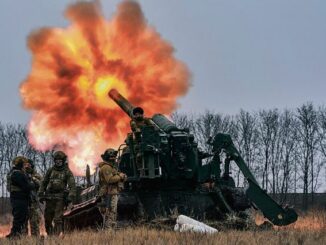
    As the demand for guns surges, profit too skyrockets with the sale of every weapon or machine. Thus, the enterprise of military hardware production and sale becomes too tempting and lucrative to be eschewed, as after a long gap a ‘real’ war has come to European soil, where big-buck investments and astronomical profits are being made. Shortage of food facilitates profiteering too.

    “The prolonged Russia-Ukraine war lays bare the stark reality that even an immoral war is good for the moral and ethical health of the West because through wreckage, blood, sweat and tears of widows, destitute and orphans emerge countless opportunities for wealth creation and open plunder by merchants and middlemen. Shortage of food facilitates profiteering too, the way it happened in the 1943 Great Bengal famine, killing 3 million people amid the World War II inflicted by Europe on the world.”

    By Abhijit Bhattacharyya

    On  the eve of the Russian invasion of Ukraine in February last year, UK Defense Secretary Ben Wallace had exclaimed, “The Scots Guards kicked the backside of Tsar Nicholas I in the 1853 Crimea War and we can always do it again,” comparing the 21st-century Russia-Ukraine conflict with the 19th-century war. The Tsar had been pitted against the combined might of England, France and the Ottoman Empire. The Russian defeat of yore and the lack of an international ally were sarcastically invoked to draw a parallel and warn Moscow to watch out for history repeating itself.

    What the British Defense Secretary said was neither unsurprising nor unique. War has always had a macabre fascination for Europe. The gory combats and their inglorious consequences have been used to portray the grandeur of the warring West. Most of Europe’s eminent and enlightened scholars, intellectuals and philosophers have been fascinated with, and have spoken eloquently on, the importance of power, war and violence.

    Machiavelli pointedly stated, “All armed prophets have conquered and unarmed ones failed.” To him, war, power and hypocrisy are connected. For Thomas Hobbes, conflict emerges from the impulse of self-preservation, thereby making life a “war of all against all” and resulting in it being “solitary, poor, nasty, brutish and short”. The views of Jean-Jacques Rousseau on the power of the state influenced global politics. His ‘Discourse on Inequality’, according to Voltaire, was “against the human race”. Georg Wilhelm Friedrich Hegel unabashedly admired Napoleonic wars and thought that it was a good thing to have wars from time to time. In all these expressions of the European mindset, one thing is clear. There is an element of axiomatic intellectual honesty about justifying, propounding or defending political dishonesty which appears preferable to the hypocrisy of depicting political polemics as an honest and noble enterprise. In this context, the prolonged Russia-Ukraine war lays bare the stark reality that even an immoral war is good for the moral and ethical health of the West because through wreckage, blood, sweat and tears of widows, destitute and orphans emerge countless opportunities for wealth creation and open plunder by merchants and middlemen. Shortage of food facilitates profiteering too, the way it happened in the 1943 Great Bengal famine, killing 3 million people amid the World War II inflicted by Europe on the world.

    As the demand for guns surges, profit too skyrockets with the sale of every weapon or machine. Thus, the enterprise of military hardware production and sale becomes too tempting and lucrative to be eschewed, as after a long gap a ‘real’ war has come to European soil, where big-buck investments and astronomical profits are being made.

    Further, if the war is between powerful belligerents, soaring profit is guaranteed because both possess the wherewithal to sustain a protracted conflict. In contrast, smaller wars in Third World countries reduce profitability as they are less destructive. Thus, the end of the 20-year-old Afghan war in August 2021 inflicted huge losses on arms and ammunition manufacturers. Undoubtedly, Russia is in the wrong. And the criticism thereof is justified. Nevertheless, Russian wrongs also raise a question. Why is Moscow pursuing this seemingly irreversible, hostile path? Although one-third of the answer was given by the British Defense Secretary with his comment on the 1853 Crimea War, it nevertheless leaves two-thirds unanswered, which lies in what happened in the 1810s and the 1940s.

    Russia saved the entire West from being annihilated by two European scourges of mankind (Napoleon and Hitler) in successive centuries. Indeed, it crushed the bloodthirsty Napoleon’s ‘Grand Armee’ in the battles of Borodino (September 1812) and Leipzig (October 1813) much before the Duke of Wellington’s victory over a weakened French army at Waterloo in June 1815. From the Napoleonic wars to the two World Wars and from the Balkanization of the 1990s to the present Ukraine war — all constitute intra-Europe conflicts, like ceaseless continental civil wars. And yet, the non-European world was inexorably dragged into these internecine disputes, thereby giving Europe pole position in world affairs.

    So, what’s next for the Russia-Ukraine war? Is a solution possible? Or will it again drag the entire Europe and the rest of the world into another Armageddon? Just hear the Europeans themselves on the “war within”, because “Europe is united” and yet “Europe is not united”. Europe is distressed because war fatigue and economic downturn have already gripped virtually every nook and corner of it. Hence, Deutsch Bank warns of the peril in borrowing from US banks and former German Chancellor Angela Merkel admits that the Cold War never ended. French President Emmanuel Macron is being berated for repeatedly calling for considering Russia’s legitimate security guarantee owing to NATO expansion in Russia’s neighborhood.


    The French certainly know best, owing to the post-World War I Versailles Treaty’s monumental folly of humiliating the defeated Germany, thereby sowing the seeds of World War II. Criticism of the US came from top EU diplomat Josep Borrell: “Americans, our friend, take decisions which have economic impact on us.” The EU has also accused Washington of profiting/profiteering from the Ukraine war. A more serious matter, however, is the growing intra-Europe conflict between Serbia and Kosovo. Serbia (former Yugoslavia) was attacked by the NATO and broken into seven pieces in the 1990s. Hence, Serbia, like Russia, is smarting and eyeing revenge.

    Indeed, there’s a real possibility of two simultaneous Balkan wars as the region is the ‘tinderbox’ of Europe where issues related to ethnic minorities have repeatedly triggered conflicts. Altogether, the possibility of the Russia-Ukraine conflict raising the stakes higher will only smoothen matters further for the profiteering brigade to make mega bucks from the sale of military merchandise.

    ( Abhijit Bhattacharya is an author and columnist)

  • Global intel collection seeing a sea change

    Global intel collection seeing a sea change

    In future, open-source information will have to be tackled by global security services. The explosion of social media contents as ‘Add-ons’ to strategic and tactical intelligence creates a serious challenge to the analytical capabilities as our agencies do not have time or capacity to monitor billions of terabytes of open information.

    “Significantly, Gen Jim Hockenhull, Commander of the British Strategic Command, had described the current battle as the ‘first digital war’ at a December 2022 Royal United Services Institute seminar. He said much of this digital capability was coming not from the traditional military sources but from “commercially available sources”. This creates “enormous opportunity, but also creates a real burden in terms of being able to deal with intelligence”. He said, “As many as 127 new devices are being connected to the Internet every second across the globe and there is a real challenge over the veracity of the available information.” He added a note of caution that this information was being used not just by sources inside the military but is being projected “for all to see and for all to interpret”.”

    By Vappala Balachandran

    A sea change is taking place in the intelligence collection and dissemination processes in western democracies. It has thrown the classical “intelligence cycle” to the wind. It is not clear whether this will augur well for the reliability of collected information. Although these changes were noticed earlier too, their constant use during Ukrainian resistance after the Russian invasion on February 24, 2022, has made them ‘trendy’.

    The traditional institutionalized collection of intelligence is being partly replaced by what is called ‘crowd-sourced open-source intelligence’ which had sprung up even before the Ukraine war started. Think tanks are acting as spokespersons instead of official channels. On February 25, 2022, the Royal United Services Institute (RUSI) released a paper, ‘Ukraine Through Russia’s Eyes’, based on documents accessed with the help of the Ukrainian intelligence. It said a February 2022 pre-invasion survey by the ninth Directorate of Russian intelligence Federal Security Service had found favorable conditions for a government change in Ukraine. Around 67 per cent of the Ukrainian public was ‘distrustful’ of President Volodymyr Zelenskyy.

    Although the majority trusted the army, that confidence did not extend to other institutions such as the police or even Parliament. In fact, 40 per cent of the respondents said they would not even join their army to defend Ukraine. Another point which swayed the decision towards invasion was a religious assessment that at least half of the Ukrainian population owing allegiance to the church would follow Moscow Patriarchy’s wishes.

    Simultaneously, not every component of the western intelligence alliance had shared the majority’s cautious optimism that Ukraine would be able to resist the massive Russian thrust. On June 4, 2022, the American Public Broadcast Service (PBS) said there was a feeling in the US Senate and House Intelligence Committee that the White House did not extend all-out support to Zelenskyy before the invasion began due to reticence by US intelligence services, perhaps based on their bad experience with the then Afghan President Ashraf Ghani, who fled in August 2021.

    The PBS quoted Lt Gen Scott D Berrier, Director of Defense Intelligence Agency, who admitted to having told a hearing in March 2022 that it “was a bad assessment” on his part to have earlier concluded that “Ukrainians were not ready as I thought they should be”. However, he admitted that this did not represent the entire intelligence community’s feelings. On the other hand, he said the Ukrainians had fought “bravely and honorably”.

    An assessment by a team of scholars at Brunel University, London, on May 19, 2022, had said a new model of cooperative government-public intelligence infrastructure was set up where the highlight was ‘crowd-sourced open-source intelligence’. Under this model, strategic intelligence collection has “transmuted into a distributed, globalized and even ‘democratized’ enterprise as open-source information has exploded in terms of scale and capabilities”.

    According to them, Russian reverses happened because they were unaware of the massive public-private capability of the NATO-backed coalition in intelligence, surveillance and reconnaissance, whereas Moscow, with a controlled media, was following the Cold War bureaucratic model of the intelligence process. In particular, they found that the Russian communication and intelligence infrastructure was failing. Consequently, they often used “in-field makeshift solutions such as mobile phones or unencrypted high-frequency radio which the Ukrainian military and even radio enthusiasts could have easily intercepted”.

    This assessment came true on January 1 when Ukraine conducted massive missile strikes on Makiivka in the Russian-occupied Donetsk region. This was described as one of the deadliest attacks on Russian forces, caused by careless use of mobile phones by Russian soldiers revealing their location, leading to a claim by Kyiv that 400 Russian soldiers had died and 300 injured. The Russian Defense Ministry has admitted to 63 deaths. A senior pro-Russian official of the region conveyed through ‘Telegram’ that a vocational school where the soldiers were housed was hit by the American high-mobility artillery rocket system (Himars).

    Significantly, Gen Jim Hockenhull, Commander of the British Strategic Command, had described the current battle as the ‘first digital war’ at a December 2022 Royal United Services Institute seminar. He said much of this digital capability was coming not from the traditional military sources but from “commercially available sources”. This creates “enormous opportunity, but also creates a real burden in terms of being able to deal with intelligence”. He said, “As many as 127 new devices are being connected to the Internet every second across the globe and there is a real challenge over the veracity of the available information.” He added a note of caution that this information was being used not just by sources inside the military but is being projected “for all to see and for all to interpret”.

    American academic Amy Zegart has said in Foreign Affairs that the Ukraine war has proved that “intelligence isn’t for government spy agencies anymore”. She said a volunteer group at Stanford University led by retired US Army veteran Allison Pusccioni, an open-source imagery analyst, has been providing evidence of Russian human rights violations to the United Nations. Zegart mentions that Bellingcat, an amateur investigators’ group, had identified the Russian hit team that tried to assassinate Sergei Skripal, a Russian renegade intelligence officer, in the UK. She recommends a permanent agency for the US to deal with only open-source information.

    In my opinion, this huge problem will have to be tackled in future by global security services. In my recent book on the history of intelligence, I had mentioned that even in 2007, all 16 US intelligence agencies were collecting one billion pieces of data everyday — much beyond their capacity to interpret. The explosion of social media contents as “Add-ons” to strategic and tactical intelligence creates a serious challenge to the analytical capabilities as our agencies do not have time or capacity to monitor billions of terabytes of open information which might have bearing on security. Such an agency could also openly liaise with media outlets and technology enterprises and also work as a technology innovator.

    (The author is Ex-Special Secretary, Cabinet Secretariat, Government of India)


  • Biden administration proposes massive hike in immigration fees, including H-1B visas, popular among Indians

    Biden administration proposes massive hike in immigration fees, including H-1B visas, popular among Indians

    WASHINGTON, D.C. (TIP): The Biden administration has proposed a massive hike in immigration fees, including the much sought-after H-1B visas for high-skilled foreign workers which is popular among Indian tech professionals.

    Under the proposed rule, published by the US Citizenship and Immigration Services (USCIS) on Wednesday, January 4,  the application for the H-1B visa increases from USD 460 to USD 780, and L-1 from USD 460 to USD 1,385. The application fee for O-1 visas has been proposed to increase from USD 460 to USD 1,055. The H-1B visa is a non-immigrant visa that allows US companies to employ foreign workers in specialty occupations that require theoretical or technical expertise.

    Technology companies depend on it to hire tens of thousands of employees each year from countries like India and China.

    In its federal notification, the Department of Homeland Security (DHS) said that USCIS is primarily funded by fees charged to applicants and petitioners for immigration and naturalization benefit requests. These fee collections fund the cost of fairly and efficiently adjudicating immigration benefit requests, including those provided without charge to refugees, asylum, and certain other applicants or petitioners, it argued.

    The proposed rule went on a 60-day public opposition period, following which it is expected to be enforced. Under the proposed rule, the fee for the H-2B petitions (for seasonal, non-agricultural workers) is proposed to increase from USD 460 to USD 1,080.

    “Economists would note that fee increase on these visa categories would work against the desire of US policymakers for more workers to enter the United States legally,” Forbes said in a news report.

    While there is no increase in the premium processing, the number of days is now 15 business days from the existing 15 days. However, in this proposal, DHS would eliminate the additional biometric services fee in most cases by including the costs in the underlying immigration benefit request fee.

    The USCIS said the new fees would allow the immigration agency to more fully recover its operating costs, re-establish and maintain timely case processing, and prevent the accumulation of future case backlogs. The agency receives approximately 96 per cent of its funding from filing fees, not from congressional appropriations, it said. The proposed fee rule is the result of a comprehensive fee review at the USCIS. That review determined that the agency’s current fees, which have remained unchanged since 2016, fall far short of recovering the full cost of agency operations. The USCIS generally publishes a fee rule biennially and proposes these changes to account for the expansion of humanitarian programs, federally mandated pay raises, additional staffing requirements, and other essential investments, a media statement said.

    (Source: PTI)

  • Eric Garcetti renominated US envoy to India

    Eric Garcetti renominated US envoy to India

    WASHINGTON, D.C. (TIP): US President Joe Biden has renominated Eric Garcetti as the Ambassador to India among a large number of recommendations for various posts, including several Indian-Americans such as Richard Verma to be Deputy Secretary of State for Management and Resources.

    The US had been without an envoy to India for over two years. Besides India, Biden has also approved nominations for Ambassadors to over 20 countries, including the UAE, Kuwait, Turkmenistan, Saudi Arabia, Nigeria, Ethiopia, Colombia, Azerbaijan and Cambodia.

    In July 2021, US President Biden nominated Los Angeles Mayor Garcetti as his Ambassador to India. But the Senate confirmation of Garcetti had been pending for more than a year. His nomination was initially blocked by Republican Senator Chuck Grassley because of allegations of inappropriate behavior by one of his senior staffers.

    Former US Surgeon General Vivek Murthy has been proposed as US representative on the Executive Board of the WHO, Kalpana Kotagal as Member of the Equal Employment Opportunity Commission, Geeta Rao Gupta as Ambassador at Large for Global Women’s Issues, Anjali Chaturvedi as General Counsel, Department of Veterans Affairs and Ravi Chaudhary as Assistant Secretary of the Air Force.

    Biden has also nominated the first Muslim-American woman to be a judge on a federal court as part of a list of diverse judicial nominees. If confirmed by the US Senate, Nusrat Jahan Choudhury of Bangladeshi descent would serve in a federal district court in New York state. Appointments were also announced for the chiefs of Commissioner of Internal Revenue, Federal Aviation Administration, Postal Regulatory Commission, Federal Communications Commission, Archivist of the US, Circuit and District Judges and Insurance Trust Funds.

    (Source: TNS)

  • New York judge declines to dismiss the state attorney general’s $250 million suit against Trump and family

    New York judge declines to dismiss the state attorney general’s $250 million suit against Trump and family

    NEW YORK (TIP): A New York judge declined on Friday, January 6,  to throw out the state attorney general’s civil fraud case against former President Donald J. Trump. There is now  the likelihood that he will face a trial this fall.

    In a sharply worded order, the judge, Justice Arthur F. Engoron of State Supreme Court in Manhattan, denied Mr. Trump’s motion to dismiss the case, granting the attorney general, Letitia James, another victory in the matter. In September, Ms. James filed a lawsuit accusing Mr. Trump, three of his adult children and their family business of overvaluing his assets by billions of dollars.

    In his written order, Justice Engoron said that some of the arguments repeatedly made by Mr. Trump’s lawyers were “frivolous,” and had been “borderline frivolous even the first time defendants made them.” The judge also rejected a separate attempt by Mr. Trump’s daughter Ivanka, who is named as a defendant in Ms. James’s lawsuit, to dismiss the accusations against her. “Once again,” Ms. James said in a statement, “Donald Trump’s attempts to evade the law have been rejected.” The decision, she added, “makes clear that Donald Trump is not above the law and must answer for his actions in court.”  Since leaving office, former President Donald J. Trump has been facing several investigations into his business dealings and political activities

  • Biden marks January  6 anniversary, cautioning ‘it could happen again’

    Biden marks January 6 anniversary, cautioning ‘it could happen again’

    Honors defenders of democracy

    WASHINGTON, D.C. (TIP): Marking the second anniversary of one of the nation’s darkest days, President Joe Biden paid tribute Friday, January 6,  to the heroism displayed on Jan. 6, 2021, while also warning that the forces that fueled the violence at the U.S. Capitol still lurk, a Politico report says. Biden touted the nation’s healing over the last two years but condemned the riot at the very citadel of the nation’s democracy. He derided the mob “as sick insurrectionists” who wreaked havoc and drew blood in the name of Donald Trump.

    “All of it was fueled by lies about the 2020 election,” Biden said. “But on this day two years ago, our democracy held. We the People, as our Constitution refers to us, ‘We the people’ did not flinch.”

    Biden also honored 14 Americans who stood up for democracy after the 2020 election, awarding medals to members of law enforcement, including Capitol Police officers who held off rioters, as well as election officials who stood their ground in the face of Trump’s onslaught of lies. Two years later, the images from that day remain horrifying. The scene that unfolded — mobs pushing through police barricades, breaking windows, then occupying seats of power — was one that Americans are accustomed to watching in distant lands with authoritarian regimes. But Biden made clear that the violence — which included gunshots fired in the Capitol, one death, and an armed occupation of the Senate floor — was born from the man who swore an oath to protect the very democratic traditions that rioters tried to undo in his name.

    “Our democracy was attacked. The U.S. Capitol was breached, which had never happened before in our nation’s history, even in the Civil War,” said Biden, who warned that the anti-democratic forces had not subsided.

    “We know it could happen again,” Biden said. “There’s no guarantee. Except for us. Except for all of you.”

    The event, emotional at times, largely focused on those who sacrificed so much that day. Biden described in vivid detail the assaults at the capital and awarded one of the nation’s highest civilian honors to several law enforcement officers, including Michael Fanone, Harry Dunn and Eugene Goodman.

    Others hailed were local officials such as Russell “Rusty” Bowers, the former speaker of the Arizona House of Representatives, as well Georgia poll workers Shaye Moss and Ruby Freeman, who both withstood threats on their lives from Trump supporters in the weeks after the 2020 election. Three of the medals given to law enforcement officers were done so posthumously: Brian Sicknick and Howard Liebengood of the U.S. Capitol Police and Jeffrey Smith of the District of Columbia Metropolitan Police. Sicknick suffered a stroke the day after the riot; both Smith and Liebengood died by suicide in the wake of the insurrection.

    “All of America watched it on television. America owes you,” the president said. “It owes you all a debt of gratitude, one we can never fully repay unless we live up to what you did.” Trump spent the end of 2020 declaring the election was “rigged” and making baseless accusations of widespread voter fraud that numerous federal courts and senior members of his administration said did not exist. Trump was enabled by dozens of fellow Republicans willing to object to the count, a maneuver they knew would delay but not change the outcome. This year, the Jan. 6 anniversary fell at a moment of political opportunity for Biden. He addressed the nation at the same time the Republican-led House of Representatives remained in chaos trying to choose its next speaker, and Trump, the GOP’s only declared presidential candidate to date, continued to espouse widely-rejected election denialism. Homegrown threats against the nation’s democracy have been a familiar theme for Biden, who launched his presidential campaign because he felt Trump was tearing at the nation’s fabric.

    As the general election campaign ramped up last fall, Biden delivered a pair of speeches urging vigilance against violent anti-democratic forces, one set against the backdrop of Independence Hall and the other, just days before the midterms, coming after the brutal assault of House Speaker Nancy Pelosi’s husband.

    Though the midterms have passed and the House Jan. 6 committee has all but finished its work, Biden will continue to sound the alarms in the months ahead, believing the threat has not dissipated. The president’s speech Friday came as House leadership remained in limbo, with a right-wing faction of the GOP paralyzing the process to select a speaker. Many of those same lawmakers — as well as others expected to play prominent roles in the new Congress — voted against Biden’s certification and have pushed false claims of election fraud.

    And while many of the most prominent election deniers lost in November, West Wing aides also point to Trump’s shadow looming over the political landscape. Though the former president has been politically weakened in recent months, many close to Biden believe Trump will still emerge as the GOP presidential nominee next year. As Biden takes steps to likely launch his own campaign in the coming months, some in his orbit are preparing to make Jan. 6 a central issue in the campaign.

    (Source: Politico)

  • Nobel Prizes 2022

    Every year in October, committees in Sweden and Norway award six Nobel Prizes, each recognizing a groundbreaking contribution by an individual or organization in a specific field. Prizes are given for physiology or medicine, physics, chemistry, economic science, literature and peace work. Winners receive a diploma and a medal, and each prize is also awarded 10 million Swedish krona, or about $900,000, which is divided if there are multiple winners.

    During the pandemic, the Nobels made adjustments. In 2020 and 2021, some events were canceled in favor of a digital ceremony for the winners, and the Oslo ceremony for the peace prize was smaller than in most years, with a limited audience.

    Fourteen laureates were awarded a Nobel Prize in 2022, for achievements that have conferred the greatest benefit to humankind.

    The Nobel Prize in Physics 2022

    Alain Aspect

    For experiments with entangled photons, establishing the violation of Bell inequalities and pioneering quantum information science.

    John F. Clauser

    For experiments with entangled photons, establishing the violation of Bell inequalities and pioneering quantum information science.

    Anton Zeilinger

    For experiments with entangled photons, establishing the violation of Bell inequalities and pioneering quantum information science.

    The Nobel Prize in Chemistry 2022

    Carolyn R. Bertozzi

    “for the development of click chemistry and bioorthogonal chemistry”

    Morten Meldal

    “for the development of click chemistry and bioorthogonal chemistry”


    1. Barry Sharpless

    “for the development of click chemistry and bioorthogonal chemistry”


    The Nobel Prize in Physiology or Medicine 2022

    Svante Pääbo


    “for his discoveries concerning the genomes of extinct hominins and human evolution”

    The Nobel Prize in Literature 2022

    Annie Ernaux


    “for the courage and clinical acuity with which she uncovers the roots.”

    Nobel Prize for Economics

    Ben S. Bernanke

    “for research on banks and financial crises”

    Douglas W. Diamond

    “for research on banks and financial crises”

    Philip H. Dybvig

    “for research on banks and financial crises”

  • From return of King Kohli to crowning of new king Surya Kumar Yadav

    From return of King Kohli to crowning of new king Surya Kumar Yadav

    The year 2022 gave Indian cricket fans exhilarating moments of joy, coupled with individual brilliances that will stay fresh in the fans memories for a very long time. From Virat Kohli, shedding off his poor run of form to get back amongst runs, to the crowning of the new King SuryaKumar Yadav; from Ishan Kishan’s ODI double ton in Chattogram to Jasprit Bumrah’s 6-fer against England at the Oval, Indian cricket witness some special performances from some high class performers.

    Ishan Kishan’s record breaking 210 vs Bangladesh

    With the series already lost to Bangladesh, India came into the dead rubber in Chattogram to salvage some pride. They did more than just save their honour as their replacement opener, Ishan Kishan, slammed his way into the record books. The diminutive opener slammed 210 runs in just 131 balls against a hapless Bangladeshi attack.

    On the way to his double ton, he broke several records, the most prominent of which was the fastest double hundred in ODI history in just 126 balls. He became also the youngest batsman to score a double hundred in ODIs at just 24 years and 145 days and only the fourth Indian after Sachin Tendulkar, Virender Sehwag and Rohit Sharma to enter the 200 club.

    Virat Kohli’s special drowns

    Pakistan at the MCG

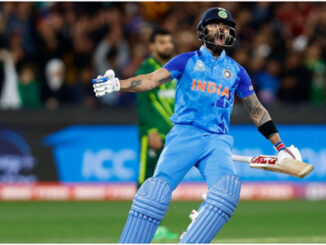
    The game was gone for all money when India was reduced to 31/4 in 6.1 overs chasing an improbable 160 runs to win against arch-rivals Pakistan. India’s superman Virat Kohli was their only hope, and he didn’t disappoint. Alongside Hardik Pandya, he took the game deep, and when 28 runs were required in the last eight balls, Kohli unleashed two outrageous sixes from nowhere off Pakistan pacer Haris Rauf to take the game into the last over.

    As and when Ravichandran Ashwin lofted the ball over mid-off for a single, the whole MCG erupted, as did over a billion fans back home and around the world. Kohli, looking from the outside, shed a tear or two, signaling what this knock meant to him and the whole of India.

    Suryakumar Yadav’s 360* show in 2022

    Indian batter SuryaKumar Yadav will not forget the year 2022 in a hurry. Right through the year, he played some breathtaking, jaw dropping, and scintillating knocks to keep the opposition and most of the times his teammates as well on the edge of their seats. In all, he scored 1164 runs from 31 innings, with the help of two tons and nine half-centuries to his name. His strike rate was in excess of 187, and most of his knocks produced victories for the Blues.

    In the middle of the year, he smashed 117 runs against England in Nottingham, and by the time the T20 World Cup arrived, he scored runs at will. His knocks against South Africa, Netherlands and Zimbabwe were pure masterclass in T20 format. He finished the year on a perfect note by smashing unbeaten 111 against the Kiwis in their backyard.

    Hardik Pandya sinks Pakistan in

    Dubai, 2022 Asia Cup

    First, he took three crucial wickets with the ball to restrict arch-rivals Pakistan to a respectable total of 147 in Team India’s opening encounter in the 2022 Asia Cup. Then with the bat, Hardik Pandya made his presence felt, as he scored an invaluable 33 runs off just 17 balls under immense pressure to take the Blues home. He kept his calm and fittingly smashed the winning six to take India past the winning line in the final over with just two balls to spare.

    Virat Kohli’s 72nd International Ton,  goes past Ricky Ponting

    Virat Kohli has scored so many hundreds that at times it is hard to keep a count of all of them. However, the one against Bangladesh in the 3rd ODI in Chattogram will be etched in the minds and hearts of Indian cricket fans forever. The match belonged to Ishan Kishan for his monumental double hundred, but Kohli made the occasion extra special by registering his 44th hundred in ODIs. This was his 72nd hundred in international cricket, and with it, he went past former Australian skipper Ricky Ponting’s record of 71 tons. The only man ahead of him is his idol, Sachin Tendulkar, the lone man with 100 international hundreds.

    Rishabh Pant’s heroics in Manchester, Test tons in Birmingham & Cape Town

    By the end of the year, Rishabh Pant struggled with form an injuries. However, at the start of 2022, his bat was scoring runs across formats, barring T20Is. Pant’s standout knock has to be the one against England in Manchester ODI. With the series on the line, Pant saved his best for the last and smashed unbeaten 125 to take India to a famous 2-1 series win over England in their backyard.

    As far as Test matches goes, Pant has had a fabulous year, averaging over 64 with the bat from 6 Tests. He scored two hundreds, both of which came in overseas conditions. The first of them against South Africa in Cape Town and that too in the 2nd innings. The next hundred came in the 5th rescheduled Test match against England in Birmingham. The southpaw smashed 146 runs in the 1st innings to go with 57 runs in the second innings. Unfortunately, India failed to register a win in both the Tests.

    Ravindra Jadeja’s 175 & 5-fer vs Sri Lanka, Mohali

    Like Rishabh Pant, all-rounder Ravindra Jadeja too had a fabulous run in Test cricket this year. His best performance in red ball cricket came against Sri Lanka in the 1st Test in Mohali in March this year. Jadeja, with the bat first scored a mammoth 175 runs batting at the number 7th position. Then with the ball, he bagged a 5-fer in Sri Lanka’s first innings to go with another four wickets in the second. He became only the fourth Indian cricketer to achieve the unique record of scoring a ton and then bag a five-fer in a Test match. India won the test match by an innings and 222 runs.

    Source: Insidesport

  • 2022: A year of many firsts for Indian sports

    2022: A year of many firsts for Indian sports

    Neeraj Chopra claimed a historic win at the Diamond League Finals in Zurich, while the men’s badminton team created India’s badminton history by winning the Thomas Cup and Nikhat Zareen sizzled in the ring as she became only the fifth Indian boxer to be crowned world champion.

    A look at the Indian athletes’ record-breaking achievements this year:

    Neeraj sparkles at Diamond League

    Olympic gold medallist Neeraj Chopra continued his magical run with the javelin in 2022.

    After a break, Neeraj roared back in the international circuit to win a silver medal and set a national record at the Paavo Nurmi Games. He had missed the first half of 2022 in order to restore his condition following a 10-month sabbatical after the Tokyo Olympics.

    Neeraj claimed a silver medal at the 2022 World Athletics Championships in Oregon, giving India its best performance at the event to date. This was only India’s second medal at the World Athletics since Anju Bobby George’s bronze medal in the long jump at the 2003 edition of the event in Paris.

    Neeraj achieved yet another historic feat in September, becoming the first Indian to win a prestigious Diamond League Finals title in Zurich.

    The 24-year-old Indian superstar now holds the titles of Olympic champion, World Championships silver medallist and Diamond League champion — all achieved in just 13 months.

    The Diamond League Finals is considered the most prestigious competition after the Olympics and World Championships.

    Neeraj had made a spectacular return from a one-month injury lay-off, winning the Lausanne-leg of the Diamond League series on August 26 and qualifying for the Finals.

    He became the first Indian to clinch a Diamond League meet title in Lausanne with his third career-best throw of 89.08m.

    He had missed the Birmingham Commonwealth Games (July 28 to August 8) due to a minor groin injury, suffered during his silver-winning performance in the World Championships in the United States in July.

    Nikhat crowned World champion

    Nikhat Zareen created history as she became only the fifth Indian boxer to be crowned world champion.

    She clinched the coveted gold in flyweight (52 kg) division with a facile 5-0 win over Thailand’s Jitpong Jutamas in the final of the Women’s World Championship in Istanbul in May.

    Six-time champion Mary Kom (2002, 2005, 2006, 2008, 2010 and 2018) Sarita Devi (2006), Jenny RL (2006) and Lekha KC (2006) are the other pugilists who have won the world title.

    Zareen had been in stellar form this year. She became the first Indian woman boxer to claim two gold medals at the prestigious Strandja Memorial in February.

    India’s athletes shine bright at Birmingham Games

    Despite shooting not being part of the 2022 Commonwealth Games, India’s athletes managed to claim 61 medals — including 22 golds, 16 silvers, and 23 bronze.

    While weightlifters, wrestlers, boxers, badminton and table tennis players lived up to expectations to finish with medals, there were also some surprise medallists.

    Lawn Bowls finally a household name in India with a superb performance at the Birmingham Games with the women’s team winning gold, while the men’s finished with a silver.

    The track and field athletes also shone bright. Eldhose Paul won India’s first triple jump gold after beating fellow countryman Abdulla Aboobacker to give the country its first-ever 1-2 finish at the Commonwealth Games. Murali Sreeshankar continued India’s good showing on the track as he bagged the silver medal in the men’s long jump.

    The Indian hockey teams and the women’s cricket teams also finished with medals in Birmingham.

    Race walkers Priyanka Goswami and Sandeep Kumar also earned a place on the podium, but the highlight was steeplechaser Avinash Sable, who kept pace with the Kenyans to claim a silver medal in the men’s 3000m steeplechase.

    India make badminton history at Thomas Cup

    India’s men created badminton history, shocking 14-time champions Indonesia 3-0 in the final to win the Thomas Cup for the first time, in Bangkok, in May.

    Lakshya Sen, Kidambi Srikanth and the doubles combination of Satwiksairaj Rankireddy and Chirag Shetty turned in superlative performances in their respective matches to earn the underdogs an unexpected, thumping victory.

    It was a memorable triumph for India, who had previously never reached the final of the Thomas and Uber Cup in its 73-year history.

    While Indonesia made the final with an unbeaten record, India lost just one match — to Chinese Taipei — in the group stage. If Indonesia disposed off mighty China and Japan in the knock-out stage, India went past five-time former champions Malaysia and 2016 winners Denmark.

    In 30 Thomas Cup tournaments since 1948–1949, only five countries have won it. Indonesia is the most successful team, having won 14 times.

    Indian men reached the Thomas Cup semi-finals in 1952, 1955 and 1979 while the women’s team made it to the Uber Cup top-four in 2014 and 2016.

    India women win inaugural

    FIH Nations Cu!

    India women ended the year in style as they clinched the inaugural FIH Women’s Nation’s Cup title with a 1-0 win over Spain in the final in Valencia earlier this month.

    Towards the end of the year, the women proved that the CWG bronze was not a fluke as they continued their upward graph under Dutch coach Janneke Schopman, defeating Spain 1-0 to win the inaugural FIH Nations Cup in Valencia and qualify for 2023-24 FIH Pro League.

    Hockey India announced Rs 2 lakh for each player and Rs 1 lakh for each support staff for winning the tournament.

    While the men’s team won silver, the women bagged a podium finish after 16 long years. The Indian women had won gold at the Manchester CWG in 2002 and silver at Melbourne four years later.

    But the Indian men had their share of success as well. They began the year with a third-place finish in the Asia Cup in Jakarta and followed it up by winning the inaugural FIH Hockey 5s tournament in Lausanne, where they beat Poland 6-4 in the final.

    In between, India also won the 10th Sultan of Johor Cup, an international men’s under–21 tournament, beating Australia 4-5 on penalties after both teams were locked 1-1 at the end of regulation time.

    sOURCE: rEDIFF.COM

  • BrahMos, Agni, Prithvi II: Lethal missiles India tested amid twin border threats

    BrahMos, Agni, Prithvi II: Lethal missiles India tested amid twin border threats

    With twin threats lurking at India’s northern and western borders from China and Pakistan, the country in 2022 made giant strides in successfully testing a host of lethal and advanced missiles, including the Agni V that can strike targets about 5,500 km away. In 2022, India tested a series of anti-ship, air-defence, ballistic, cruise, air-to-air, anti-missile systems and even the capability to hit targets in space. India also put its name in the global map, being among four nations owning an Anti-Ballistic Missile (ABM) system. India is also one of the seven countries possessing an Intercontinental Ballistic Missile (ICBM), Agni V, which can travel a minimum distance of 5,500 km. The year also saw the government pushing towards transforming India’s military into an ‘Aatmanirbhar’ force, equipping the armed forces with state-of-the-art weapons and technologies manufactured indigenously.

    The Ministry of Defence capped the year by approving the procurement of the indigenous short-range ballistic surface-to-surface (SRBM) missile Pralay, which would be deployed along the country’s borders with China and Pakistan.

    The development is a move towards creating India’s own Rocket Force — a concept that was envisaged by former Chief of Defence Staff (CDS) General Bipin Rawat.

    Here Are The Missiles Tested In 2022 By The Armed Forces:

    Agni Series

    The year saw India successfully testing several missiles under its Agni series.

    In December, India successfully test fired the long-range surface-to-surface nuclear capable ballistic missile, Agni 5, which has a range of over 5,000 km. This was the ninth test-firing of the Agni 5, which was first tested in 2012. The missile can reach most cities in mainland China, including Beijing.

    In November, a successful training launch of Intermediate Range Ballistic Missile, Agni 3, was carried out. Earlier, in June, Agni 4 was tested. The missile has a range of over 3,500 km

    BrahMos Extended Range Version Missile

    In May, India successfully fired the Extended Range Version of BrahMos missile from the Su-30 MKI fighter aircraft. The missile achieved a direct hit on the designated target in the Bay of Bengal region.

    Prithvi-II

    Short-Range Ballistic Missile Prithvi-II was tested in June from Chandipur, Odisha. The missile is capable of striking targets with a very high degree of precision.

    Submarine Launched Ballistic Missile

    INS Arihant carried out a successful launch of a Submarine-Launched Ballistic Missile (SLBM) in October. INS Arihant is presently armed with K-15 SLBM with a range of 750 km.

    Helina

    In April, Anti-Tank Guided Missile ‘HELINA’ was successfully flight tested twice at different high-altitude ranges from an indigenously-developed helicopter. The missile, which has been developed for integration with choppers, has a maximum range of 7 km. The missile system has all-weather, day, and night capability and can defeat battle tanks with conventional armour as well as explosive reactive armour.

    Laser-Guided Anti-Tank Guided Missile

    Indigenously-developed Laser-Guided Anti-Tank Guided Missile (ATGM) was successfully fired from battle tank Arjun in June. The ATGM comes with a High Explosive Anti-Tank (HEAT) warhead to defeat Explosive Reactive Armour (ERA) protected armoured vehicles.

    Naval Anti-Ship Missile

    In May, DRDO and Indian Navy successfully tested indigenously-developed Naval Anti-Ship Missile launched from a helicopter off Odisha coast. It was the first indigenous air launched anti-ship missile system for the Indian Navy.

    Quick Reaction Surface-to-Air Missile

    The Indian Army completed six flight-tests of the Quick Reaction Surface-to-Air Missile (QRSAM) system in 2022. The tests were conducted against high-speed aerial targets mimicking various types of threats to evaluate the capability of the weapon systems under different scenarios.

    Medium-Range Surface-to-Air Missile

    Two tests of the medium-range Surface-to-Air Missile were conducted in March. The weapon comprises a mobile launcher system and a multi-function radar.

    Vertical Launch Short-Range

    Surface-to-Air Missile

    Vertical Launch Short Range Surface to Air Missile (VL-SRSAM) was successfully flight-tested by DRDO and Indian Navy from a naval ship at Chandipur. The system will help the Navy neutralise various aerial threats at close ranges.

    Man Portable Anti-Tank Guided Missile

    In January, DRDO successfully flight tested the Man Portable Anti-Tank Guided Missile. The indigenously developed anti-tank missile is a low weight, fire and forget missile and can be launched from a portable launcher.

    Autonomous Flying Wing Technology Demonstrator

    In July, the maiden flight of Autonomous Flying Wing Technology Demonstrator was carried out successfully. Said to be the precursor to the future combat drones, such UAVs will be capable of launching missiles and precision-guided munitions.

    Source: ABPlive

  • From Djokovic deportation to Messi Magic: Top sports events of 2022

    From Djokovic deportation to Messi Magic: Top sports events of 2022

    It started with tennis superstar Novak Djokovic deported from Australia and ended with Lionel Messi lifting the World Cup in Qatar.

    A look back on 10 of the top sports stories of 2022

    Djokovic deported

    Novak Djokovic flew to Melbourne in January hoping to capture a 10th Australian Open. However, the famously unvaccinated Serbian had his visa cancelled and was held in a hotel housing refugees before being deported on “health and good order” grounds.

    Djokovic was also banned from travelling to the United States, ruling him out of the US Open but he managed to capture a seventh Wimbledon title in July.

    Djokovic has been cleared to play in the 2023 Australian Open where he will be chasing a 22nd Grand Slam.

    Valieva doping shame

    Kamila Valieva was at the centre of a doping scandal at the Beijing Winter Olympics. The Russian, who was 15 at the time, became the first woman to land a quadruple jump in Olympic competition, helping Russia secure gold in the team event. It then emerged she had tested positive before the Games for trimetazidine, a drug used to treat angina but which is banned for athletes because it can boost endurance.

    International sports court CAS allowed Valieva to continue competing at the Olympics, citing her young age, though without clearing her of doping. Valieva fell several times in the individual final and finished in fourth place.

    Russia outcasts

    Russia’s invasion of Ukraine in February saw them and allies Belarus become outcasts of world sport. Russia were kicked out of the football World Cup and world athletics championships while tennis players from both nations were banned from Wimbledon. However, Russian-born Elena Rybakina, representing Kazakhstan, won the women’s singles title at the All England Club. Tensions were also evident at the US Open where Ukraine’s Marta Kostyuk refused to shake hands with Victoria Azarenka of Belarus.

    Champions League final chaos

    The May 28 final at the Stade de France in Paris descended into chaos when thousands of Liverpool fans were unable to gain access to the ground for the match against Real Madrid. Ticket-holding fans, who were attacked with tear gas by police and fell victim to street crime, were initially accused of trying to enter the stadium illegally. These allegations were disproved and organisers and security chiefs damned for poor organisation.

    A French Senate inquiry contradicted assertions by UEFA and the French government that Liverpool fans without proper tickets were mainly responsible for the trouble. The inquiry instead cited a “string of dysfunctions” including a lack of preparation by authorities and UEFA, as well as poorly executed security arrangements.

    Swimming life-saver

    When  25-year-old American artistic swimmer Anita Alvarez passed out at the end of her solo routine at the World Championships in Budapest in June, her coach Andrea Fuentes plunged to the rescue. Dressed in shorts and a T-shirt, Fuentes dived to the bottom of the pool and dragged Alvarez to the surface. “I think she was at least two minutes without breathing because her lungs were full of water,” said Fuentes. Alvarez quickly recovered but was prevented from competing again at the championships.

    Golf split by LIV

    Backed by the deep pockets of the Saudis, LIV Golf got underway in July, splitting the sport as it attracted major winners such as Dustin Johnson, Phil Mickelson, Brooks Koepka and Bryson DeChambeau with pledges of multi-million dollar purses for 54-hole, no-cut tournaments. The new circuit has been accused of “sportswashing” Saudi Arabia’s human rights record, and the US tours responded by suspending any players who competed in LIV events.

    Farewell Federer and Serena

    Tennis said goodbye to two of its greatest stars. Roger Federer, unable to shake off a lingering knee injury, called it quits at the age of 41 in September after a career which yielded 20 Grand Slams – a figure now passed by Rafael Nadal and Novak Djokovic. Federer collected 103 titles and banked $130 million in prize money.

    Serena refused to use the word “retirement” when she played what was likely her final tournament at the US Open. Now 41, the American said she was “evolving” away from tennis. She won 23 Grand Slam singles titles, was number one for 319 weeks and, according to Forbes, was worth $260 million in 2022.

    Chess scandal

    American grandmaster Hans Niemann was accused by Norwegian world champion Magnus Carlsen of cheating.

    Niemann filed a law suit, seeking $100 million in damages from Carlsen, his company Play Magnus Group, Danny Rensch of Chess.com, the world’s leading online chess platform, and American grandmaster Hikaru Nakamura.

    Carlsen publicly accused Niemann of cheating, and chess.com alleged in a report that the 19-year-old American has “probably cheated more than 100 times” in online games.

    Messi’s final fantasy

    Lionel Messi led Argentina to World Cup glory with a penalty shootout triumph over France after an epic final in Doha finished 3-3 in extra-time. Messi’s virtuoso performance sealed his status as one of the greatest players of all time, joining fellow icons Pele and Diego Maradona in an elite group. The final has gone down as a modern classic, coming at the conclusion of one of the most controversial tournaments ever staged.  Source: News18

  • The 10 biggest movies of 2022 at the global box office

    The 10 biggest movies of 2022 at the global box office

    With 2022 about to take its final bow, film fans look to the global box office to find out which films have been the year’s biggest hitters. Unsurprisingly, the majority of the Top 10 is composed of sequels and big tentpole blockbusters, films which have become safe bets for studios and cinemas looking to get as many bums back in seats and to bounce back after the existential threat the Covid pandemic posed to the industry.

    1) Top Gun: Maverick ($1.489bn / approx. €1.4bn)

    The critically acclaimed legacy sequel to Tony Scott’s 1986 classic made the world re-enter the danger zone.

    Its success could be attributed to several factors: the fact that Tom Cruise is Hollywood’s last of the old-school A-listers and still box office Viagra; that the belated nature of the sequel rhymed with curious spectators hungry to see a beloved character on screen once more; or simply because audiences crave a good old-fashioned and exquisitely made action movie.

    Whatever you attribute the enormous box office success of Maverick to, the film seems to have resonated with audiences and critics alike. The film even surpassed Mission: Impossible – Fallout (2018) to become Tom Cruise’s highest-grossing film of all time at the worldwide box office.

    Director Joseph Kosinski, who had previously worked with Tom Cruise on 2013’s much-better-than-you-remember Oblivion, made Maverick a sincere drama and a thrilling ride that acknowledged that times had changed. It mercifully steered clear (for the most part) of the original’s brazen military recruitment vibe and replaced it with a certain mournful style that presents a world that could be on the verge of rendering pilots (in this case) irrelevant.

    2) Jurassic World: Dominion ($1.003bn / approx. €940m)

    Less praise for the final instalment of the Jurassic World saga, which did exceptionally well this year.

    The Jurassic Park franchise became the tenth film franchise to gross $6 billion with the release of Jurassic World Dominion. However, it remained a cynical, narratively barren cash grab with no soul and made you want to scream: “WHY DID YOU COME BACK, LAURA DERN? YOU DERSERVE SO MUCH BETTER!”

    It’s depressing seeing how well this embarrassment of a film did and considering Dominion became the 50th film to gross $1 billion worldwide, you can bet that the bean counters will ensure that we’re not done with the dinosaurs just yet.

    3) Doctor Strange in the Multiverse of Madness ($955.8m / approx. €896m)

    Marvel fans were disappointed – to say the least – with the MCU’s Phase 4 and its overdose of TV shows and middling releases, leading even the staunchest of fans to admit that superhero fatigue was seriously kicking in this year. And Doctor Strange in the Multiverse of Madness was partly responsible for this feeling; a trippy instalment from horror maestro Sam Raimi (the Evil Dead franchise, Drag Me To Hell) that wasn’t strange, mad or multiverse-y enough. Worse, it ruined what the series WandaVision had established with regards to the character of Wanda aka: The Scarlet Witch.

    4) Minions: The Rise of Gru ($939.4m / approx. €880.9m)

    Miniboss goes to San Papisco.

    Flawed and not as charming as previous instalments, this still yielded some decent laughs. The minions are just getting started.

    5) Avatar: The Way of Water ($889m / approx. €833m… and counting)

    As of writing, James Cameron’s costly Avatar sequel is in fifth place, with global ticket sales since its 16 December release tallying $889m. It had the 11th-biggest global opening of all time and the third-biggest global opening for a film in the pandemic era behind Spider-Man: No Way Home and the aforementioned Doctor Strange in the Multiverse of Madness, earning $441.7 million in its first week. Futhermore, with the release of The Way of Water, Disney led the studios in worldwide box office grosses and crossed the $4 billion mark for the eighth year. Estimates put it as being on course to make double this over the course of the next month, which would see the film soar to second place.

    6) Black Panther: Wakanda Forever ($790m / approx. €740.8m)

    If there was one redeeming film in this year’s MCU offering, it was Ryan Coogler unwieldy but powerful sequel to the cultural juggernaut that was Black Panther. It worked best when embracing its main thematic thrust about the agony of loss and reckoning with legacy, referencing the untimely death of its lead star, the much-missed Chadwick Boseman.

    7) The Batman ($770.8m / approx. €722m)

    Everyone went nuts for the inexplicably overrated Matt Reeves-Robert Pattinson iteration of the Dark Knight. However, look closely enough (which, granted, isn’t easy considering the tiresome stylistic trend that states that if things are serious, then the screen has to be as dark as possible) and it’s an overlong and narratively creaky Chinatown / David Fincher rip-off with little-to-no soul of its own. And while there’s nothing wrong about referencing past films, if you ape Fincher, you had better come correct.

    8) Thor: Love and Thunder ($761m / approx. €713.6m)

    This fourth solo MCU adventure for Thor was the worst offender this year for Marvel. And a surprising misfire, considering Taika Waititi was behind the camera once more after delivering what many felt was the perfect Thor film with 2017’s Thor: Ragnarok. The jokes were naff, the stakes were non-existent and the imagination and charm were nowhere to be found.

    9) Water Gate Bridge (also known as The Battle at Lake Changjin II) ($626.5m / approx. €587.5m)

    This Chinese war film and sequel to last year’s The Battle at Lake Changjin commemorates the 100th Anniversary of the Chinese Communist Party and is based on the historical fighting at Funchilin Pass during the Battle of Chosin Reservoir in the Korean War. It was released on the Chinese New Year and grossed $626.5 million in China, making it only with that domestic intake the ninth-highest-grossing film of 2022.

    10) Moon Man ($460.2m/approx. €431.5m)

    Another Chinese film rounds off the Top 10, this time a sci-fi comedy that tells the story of Duguyue, who, after being left unexpectedly on the moon, becomes the last person in existence when an asteroid destroys the earth.

                    Source: Euronews

  • The Kashmir Files to Brahmastra, highest-grossing Bollywood movies

    The Kashmir Files to Brahmastra, highest-grossing Bollywood movies

    Bollywood films suffered a huge blow at the box office in the past two-three years due to COVID. But after the situation returned to normalcy, cinephiles rushed to theatres to watch their favourite stars on the big screen again. Kartik Aaryan’s Bhool Bhulaiyaa 2 became the first Bollywood film of 2022 to emerge as a hit at the box office.

    It was followed by The Kashmir Files and Ranbir Kapoor-Alia Bhatt’s Brahmastra. Ajay Devgn and Tabu’s Drishyam 2, too, made it to the list of blockbuster films of the calendar year, as per a report by Box Office India. So, without further ado, let’s take a look at some highest-grossing Hindi films of 2022:

    The Kashmir Files

    The film directed by Vivek Agnihotri stars Mithun Chakraborty, Anupam Kher and Darshan Kumaar in the lead roles. It earned Rs 246.91 crores, making it the highest-grossing Bollywood film at the Indian box office. The film portrays the exodus of Kashmiri Pandits in 1990s.

    Brahmastra Part One – Shiva

    Ayan Mukerji’s magnum opus Brahmastra Part One: Shiva is the second top-grossing Hindi film that earned Rs 230.23 crores. The film starred Alia Bhatt, Ranbir Kapoor, Amitabh Bachchan, and Mouni Roy in pivotal roles. Shah Rukh Khan also made a cameo appearance in the film.

    Drishyam 2

    The film is a remake of a Malayalam hit of the same title. In it, Ajay Devgn, Shriya Saran, Ishita Dutta and Mrunal Jadhav have reprised their roles while Tabu and Akshaye Khanna have joined the star cast. Drishyam 2 turned out to be the third-highest grosser at the box office. The flick, directed by Abhishek Pathak, garnered Rs 209.86 crore in India.

    Bhool Bhulaiyaa 2

    Kartik Aaryan and Kiara Advani-starrer Bhool Bhulaiyaa 2 earned Rs 181.6 crore at the box office. The Bollywood film directed by Anees Bazmee is a horror-comedy that is a sequel to Akshay Kumar and Vidya Balan’s 2007 film of the same name.

    Gangubai Kathiawadi

    Gangubai Kathiawadi is a biographical film directed by Sanjay Leela Bhansali. The Alia Bhatt-starrer garnered Rs 126.32 crores at the Indian box office and emerged as the fifth Bollywood film to be in the list of mega box office hits. It is based on the life of Gangubai Kathiawadi, a sex worker in Mumbai’s Kamathipura who became a political leader of the area after overcoming a lot of struggles.

    Celebrities Who Opted For Low-Key Intimate Wedding In 2022

    2022 was filled with our favourite celebrities tying the knot, some anticipated while others surprising. However, not all of these celebrities wanted a grand traditional wedding – some went for intimate weddings with only friends and family.

    Farhan Akhtar and Shibani Dandekar

    While all the usual mehendi and sangeet ceremonies took place, the couple ditched a traditional Indian wedding with saat pheras and exchanged vows in a beautiful outdoor wedding. They got married in February, at Javed Akhtar and Shabana Azmi’s farmhouse in Khandala. The guest list was reserved for close friends and family, who the newlyweds celebrated with the entire evening.

    Ranbir Kapoor and Alia Bhatt

    Fans were awaiting and were delighted after finally receiving the news about one of the most loved B-town couples’ wedding. Ranbir and Alia tied the knot in April, carrying out a simple and intimate wedding on their balcony, in the presence of their closest friends and family. Alia shared photos of the wedding through her Instagram, which broke the Internet for sure!

    Vikrant Massey and Sheetal Thakur

    After dating for seven years, actor Vikrant Massey and Sheetal Thakur got married privately in Sheetal Shahtali’s ancestral home in Himachal Pradesh. What better day than Valentine’s to commit yourself to each other anyways, so the couple officially registered their marriage on 14th February and got hitched on the 18th.

    Mohit Raina and Aditi Sharma

    This new year certainly came bearing good news as actor Mohit Raina announced that he tied the knot with long-term girlfriend Aditi Sharma on January 1, in Rajasthan. Close friends and family of the couple attended the wedding.

    Sanah Kapur and Mayank Pahwa

    Shahid Kapur’s sister, Sanah Kapur and her beau Mayank Pahwa got hitched in March at Le Méridien, Mahabaleshwar in a close-knit simple wedding. The pre-wedding ceremonies were also quite intimate including mehendi, chooda ceremony and sangeet.

    Shama Sikander and James Milliron

    Popular TV and Bollywood actress Shama Sikander tied the knot with American beau and long-time boyfriend James Milliron in March this year. After getting engaged in 2015 and the pandemic delaying the wedding, the couple finally had a white destination close-knit ceremony in Goa.

    Cyrus Sahukar and Vaishali Malahara

    In April this year, well-known VJ and anchor Cyrus Sahukar married his long-time girlfriend Vaishali Malahara in Alibaug near Mumbai. The couple dated for over six years, before tying the knot.

  • Major natural disasters that struck India in 2022

    Major natural disasters that struck India in 2022

    India recorded an extreme weather event on almost 90 per cent of the days in the first nine months this year, according to a report of Centre for Science and Environment (CSE). This means that “India has seen close to a disaster every day in the nine months of this year – from heat and cold waves, cyclones and lightning to heavy rains, floods and landslides,” the report, `Extreme Weather Report 2022`, stated. These disasters have claimed 2,755 lives, affected 1.8 million hectare of crop area, destroyed over 416,667 houses and killed close to 70,000 livestock.

    With an event every second day, Madhya Pradesh saw the highest number of days with extreme weather events, but Himachal Pradesh saw the highest number of human fatalities — 359 deaths. Madhya Pradesh and Assam witnessed 301 human deaths each. Assam reported the highest number of damaged houses and animal deaths.

    Here`s a look at the natural disasters that took place this year in India.

    Amarnath floods

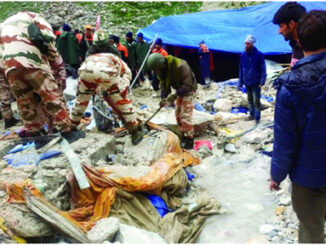
    In one of the deadliest monsoon-related incidents this year, at least 16 people lost their lives and several were injured in a cloudburst near the Amarnath cave in Jammu and Kashmir on July 8, 2022.

    Uttar Pradesh floods

    Six people died in rain-related incidents in Uttar Pradesh where over 1,300 villages in 18 districts were affected by floods. A total of 287 villages were affected by floods in Balrampur district, 129 villages in Siddharthnagar, 120 in Gorakhpur, 114 in Shravasti, 110 in Gonda, 102 in Bahraich, 86 in Lakhimpur Kheri and 82 in Barabanki district.

    Manipur landslide

    A landslide occurred in the Noney district of Manipur near the Tupul railway construction site on the night of June 30, 2022. At least 58 people were killed in the incident. Twenty-nine Indian Army personnel and 29 civilians were among the deceased.

    Cyclone Asani

    Severe Cyclonic Storm Asani was a strong tropical cyclone that made landfall in India in May 2022. Cyclone Asani originated from a depression that the Indian Meteorological Department first monitored on May 7. Conditions rapidly favored development as the system became a deep depression by that day before intensifying into a Cyclonic Storm. On the next day, it peaked and turned into a severe cyclonic storm, before making landfall as a deep depression system over Andhra Pradesh. It weakened into a well-marked low-pressure on May 12.

    Uttarakhand avalanche

    An avalanche hit the Draupadi Ka Danda peak in Uttarakhand on October 4.

    Twenty-seven mountaineers in the Advanced Mountaineering Course of the Nehru Institute of Mountaineering were killed due to the avalanche. The avalanche occurred at a height of 17,000 feet  when a team of the Nehru Institute of Mountaineering (NIM) was returning after summiting Draupadi Ka Danda II peak in Uttarakhand.

  • Deadliest natural disasters that took place around the world

    Deadliest natural disasters that took place around the world

    While the year 2022 is about to come to an end, it is indeed the right to recall some major happenings that took place in the past 12 months. From global events to the deaths of some notable personalities and the Russia-Ukraine war, 2022 has seen it all. Besides, the year has also witnessed some horrific natural disasters showing the turn of events concerning the environment and climate changes. With historic storms, heat waves, forest fires, to hurricanes among many others, the year definitely kept everyone at the edge of their seats with questions in their mind about what is to come next.

    Speaking of which, let’s take a look at some of the major natural disasters of 2022 and the environmental impact they left on the planet.

    Afghanistan earthquake and rainfall

    While already struggling under the Talibani rule, Afghanistan also became a host to massive rains and an earthquake that wreak havoc on the country. While it began with an earthquake of magnitude 5.9 that struck the eastern part of the country, the disaster led to the death of over 1,000 people. In less than two months after this, the country was again jolted by unseasonal rainfall for the entire month of August. As a result of this, around 182 Afghans lost their lives.

    Africa drought

    Another tragic event to strike a country this year was the drought situation in parts of East Africa. Following below-average rainfall for several seasons now, it left large swathes of East Africa in a dry state and thus faced the most prolonged drought in recent times. Surpassing the horrific drought of 2010-11 and 2016-17, the current situation has affected millions of people and is likely to deepen in the months ahead.

    Brazil floods

    With heavy rain across the country, floods and mudslides were reported in several parts of Brazil. The devastating flood resulting from incessant rains gripped several major cities and has now left people in a challenging situation.

    Indonesia earthquake

    After a magnitude-5.6 earthquake jolted the entire town of Cianjur in Indonesia in November, it caused massive devastation in the region. The tremors were felt across several areas and further led to the death of around 334 people.

    Heat waves across Europe

    The 2022 summer broke all the records for sending shocking heat waves across European countries. While the UK alone recorded its hottest-ever temperature in July, it also led to the death of thousands of people in mid-June and mid-July. Besides, the condition also led to huge damage to agriculture and the functioning of power plants and hydropower generators.

    Hurricane Ian in the United States

    Considered as the deadliest hurricane to ever hit Florida since 1935, Hurricane Ian caused massive devastation in the United States. It affected millions of people and further led to damages worth $67 billion.

    Floods in Pakistan

    After Pakistan faced record-breaking rainfall between June and October, it led to a disastrous flood that washed away homes and further claimed the lives of thousands. The floods were also said to be the country’s second-most expensive weather disaster on record.

    Bomb Cyclone

    US Bomb Cyclone in December: As of December 27, North America is in the grip of an intense snowstorm, also being called the ‘blizzard of the century’.

    Source: Firstpost

  • Tech lay offs – Major lay offs in corporate world

    The entire year passed with a grim reminder of imminent recession round the corner. The recovering economies around the globe faced multi-pronged challenges including Russia-Ukraine conflict, Supply-Chain constraint, more. Hence, many big tech companies laid off some portion of their workforce in order to cut cost and make themselves prepared for recession. Facebook, Meta, BYJU’s, Disney, and Salesforce were some of them which cut 1% to 13% of their staff this year.

    ChatGPT sensation on Internet

    Artifical Intelligence-based new prototype chatbot ‘ChatGPT’ made the sensation this year in the world for its advanced capability of understanding natural language and responding in a natural language. The prototype based chatbox was developed by Artificial research company OpenAI.

    FTX Fiasco

    Crypto exchange FTX filed for US bankruptcy proceedings on November 11 and Sam Bankman-Fried stepped down as CEO, after a rapid liquidity crisis at the cryptocurrency group that has prompted intervention from regulators around the world. FTX`s collapse also led to the spectacular fall in the fortune of its founder Bankman-Fried.

  • Guru Gobind Singh: A Saint warrior

    Guru Gobind Singh: A Saint warrior

    Guru Gobind Rai, who later became Guru Gobind Singh, is the tenth and last Sikh Guru, a spiritual leader, philosopher, poet and a great warrior. He emerged as tenth Sikh Guru at age nine after his father Guru Tegh Bahadur, the ninth Sikh Guru, was beheaded publicly by orders of Mughal emperor Aurangzeb as he refused to convert to Islam. Such atrocity led Guru Gobind Singh to found the Sikh warrior community called Khalsa that marked a significant event in the history of Sikhism. He also introduced the five articles famous as the Five Ks and commanded the Khalsa Sikhs to wear at all times. Other contributions of the Guru includes writing important texts on Sikhism and holding Guru Granth Sahib, the religious scripture of Sikhism, as the eternal living guru of the Sikhs.

    Childhood & Early Life

    He was born Gobind Rai on January 5, 1666 in Patna Sahib, Bihar, India in the Sodhi Khatri family of the ninth Sikh guru, Guru Tegh Bahadur and his wife Mata Gujri. The first Maharaja of Sikh Empire Ranjit Singh later built the Gurdwara Takht Sri Patna Sahib in the site of the house where Guru Gobind Singh was born and lived for the first four years of his life. The Guru returned to Punjab with his family in 1670 and later relocated with them to Chakk Nanaki on the edge of Shivalik Hills in March 1672 where he did his schooling. In 1675, the Kashmiri Pandits approached Guru Tegh Bahadur to protect them from oppression of the Islamic satrap of Mughal Emperor Aurangzeb called Iftikar Khan. According to the composition Bachittar Natak written by Guru Gobind Singh, his father promised to protect the Kashmiri Pandits and was summoned to Delhi on a pretext by Aurangzeb and on his arrival, Tegh Bahadur was asked to convert to Islam. Tegh Bahadur was arrested along with his associates after he refused and was beheaded in public on November 11, 1675, in Chandni Chowk, Delhi. Such execution only toughened determination of the Sikhs to fight against atrocities of the Muslims in safeguarding their human rights and identity as Sikhs.

    The martyrdom of his father led the Sikhs to formally install the nine year old Gobind Rai as the tenth Sikh Guru on March 29, 1676, on Vaisakhi. He continued with his education which apart from reading and writing also included archery, horse riding and other martial arts. Till 1685 he stayed in Paonta.

    Personal Life

    The Guru had three wives. On June 21, 1677, he married Mata Jito at Basantga?h. Together they had three sons Jujhar Singh born on 1691, Zorawar Singh born on 1696 and Fateh Singh born on 1699. He married his second wife Mata Sundari on April 4, 1684 at Anandpur with whom he had a son called Ajit Singh born on 1687. His third wife was Mata Sahib Devan whom he married at Anandpur on April 15, 1700. They had no children. Mata Sahib Devan played an instrumental role in Sikhism and was proclaimed as Mother of the Khalsa by the Guru.

    Introducing the Khalsa & the Five K’s Tradition

    In 1699, the Guru asked the Sikhs to assemble at Anandpur on Vaisakhi. The Guru with a sword in hand called for a volunteer from among the crowd who is ready to sacrifice his head. On his third call one Sikh named Daya Ram (later called Bhai Daya Singh) came forward. The Guru took him in a tent and returned alone to the crowd with blood dripping from his sword. Another volunteer was called by the Guru who was again taken inside the tent and after some time the Guru returned alone with the bloody sword. He continued the process with three more volunteers but after the fifth volunteer went inside the tent, the Guru came out with all the five volunteers unharmed. The Guru blessed the five volunteers namely Bhai Daya Singh, Bhai Dharam Singh, Bhai Sahib Singh, Bhai Mohkam Singh and Bhai Himmat Singh and called them the Panj Pyare (the five beloved ones) and the first Khalsa in the Sikh tradition. The Guru then took an iron bowl and prepared a solution of water and sugar stirring it with a double-edged sword calling it Amrit (nectar). The five volunteers then received the nectar from the Guru amidst recitations from the Adi Granth. With this the khande ka pahul (baptization ceremony) of the warrior community of Khalsa was initiated. A new surname of “Singh” meaning lion was given to them by the Guru. The Guru then asked the five baptized Sikhs to baptize him as a Khalsa and with this the Guru became the sixth Khalsa and from this time he came to be known as Guru Gobind Singh.

    The Guru commanded the Sikhs to wear five items all the time which included Kesh (uncut hair), Kangha (a comb made of wood), Kara (a bracelet made of iron), Kachera (a tieable undergarment made of 100% cotton) and Kirpan (a large iron dagger for self-defense). A code of discipline was introduced by him for the Khalsa warriors. These included prohibition of tobacco, eating ‘halal’ meat that is slaughtered as per Muslim ritual, fornication and adultery. The Khalsas consented never to communicate with followers of the rivals or their successors. The principle of equality was institutionalised in Sikhism with initiation of both men and women from different castes as Khalsas. The Guru played an instrumental role by institutionalising Khalsa in Sikhism thus strengthening the Sikhs in their resistance on the continuous persecution of the Mughal Empire under Aurangzeb. He came up with different concepts that posed indirect challenge to the biased tax system of the Islamic authorities.

    The Sikhs had a system of Masands before the Khalsa was initiated. In this system the Masands were the representatives and tithe collectors in Sikhism who led the local Sikh communities and temples, and accepted donations and wealth for the Sikh cause. The Guru concluded that the Masands system had corrupted with time and abolished it while initiating a centralised system which would be directly supervised by him. The new developments however gave rise to disagreements within the Sikh community during the 18th century, especially between the Nanakpanthis and the Khalsas.

    Guru Granth Sahib & other Sikh Scriptures

    Adi Granth, the first official edition of the Sikh scripture was compiled by the fifth Sikh Guru, Guru Arjan. It contained hymns of previous Gurus and of other saints. Adi Granth was eventually expanded into the Guru Granth Sahib. In 1706, Guru Gobind Singh released the second rendition of the religious scripture with addition of one salok, dohra mahala 9 ang, 1429 and all the 115 hymns of Guru Tegh Bahadur. The rendition came to be known as Sri Guru Granth Sahib. The Guru Granth Sahib composed by Guru Nanak Dev and other Sikh Gurus including Guru Arjan Dev, Guru Ram Das, Guru Angad Dev, Guru Amar Das, Guru Tegh Bahadur and Guru Gobind Singh and also containing traditions and teachings of Indian sants (saints), like Namdev and Kabir as also two Muslim Sufi saints Sheikh Farid and Bhagat Bhikan was declared as the eternal living guru for Sikhs by Guru Gobind Singh.

    Many of the texts of the religious text Dasam Granth are traditionally attributed to Guru Gobind Singh. Considered an important religious scripture of the Sikhs after the Guru Granth Sahib, it includes compositions like Benti Chaupai, Tav-Prasad Savaiye and Jaap Sahib that form part of daily prayers (Nitnem) as also part of the baptism ceremony (Khande di Pahul or Amrit Sanchar).

    The voluminous scripture Sarbloh Granth that encompass over 6,500 poetic stanzas also includes writings of the Guru.

    Sikh-Muslim Conflicts & the Zafarnama

    Hostility between the Sikhs and the Muslims increased following execution of Guru Tegh Bahadur. Guru Gobind Singh believed in a Dharam Yudh that is to fight to defend righteousness and fought thirteen wars against the Mughal Empire and the kings of Siwalik Hills but never held captive or destroyed place of worship of other religions. Among the conflicts, the Second Battle of Anandpur (1704) witnessed a fierce battle and towards its end Aurangzeb offered a safe passage out of Anandpur for the Guru, his family and followers which the Guru accepted. However the two batches of the Sikhs were attacked while they were leaving Anandpur and the one including the Guru’s mother Mata Gujari and his two sons Zorawar Singh aged 8 and Fateh Singh aged 5 was captured. The two sons died after they were buried live into a wall when they refused to convert to Islam while Mata Gujri died hearing her grandsons’ death. The Guru lost two of his other sons Ajit Singh and Jujhar Singh, along with other Sikh soldiers during the Battle of Chamkaur (1704).

    In 1705 following the Battle of Chamkaur where Aurangzeb and his army betrayed after making a promise the Guru wrote a defiant letter to Aurangzeb in Persian language titled Zafarnama (literally, “epistle of victory”). In the letter the Guru sternly censured and accused Aurangzeb and his commanders for being immoral, both in governing and in war conduct and predicted end of Mughal Empire in near future due to its immorality, persecution and untruthfulness.

  • Global economy faced steep challenges in 2022

    Global economy faced steep challenges in 2022

    For the global economy, 2022 brought forth several unforeseen challenges even as the world hoped to recover after two years of pandemic. Among the most powerful factors that hit the economy hard was the war in Ukraine. From triggering food and fuel shortage to creating an environment of uncertainty, the conflict – which even raised concerns of a nuclear threat – has kept the world on edge ever since it started on February 24. Amid the war, coupled with other factors, three largest economies – the United States, European Union and China – will continue to stall as we enter the next year, as per the IMF, as it warns that 2023 may feel like recession to many.

    The Ukraine war and its impact

    “Russia’s invasion of Europe continues to destabilise the global economy,” the International Monetary Fund (IMF) has warned in its Countering the Cost-Of-Living Crisis October 2022 report, adding that gas prices in Europe have surged four-fold since 2021 with Russia cutting the supply to 20 per cent as compared to 2021 levels. It also – as is widely known – pushed up the food prices in the global market, hitting low-income households and poorer nations hard.

    Inflation

    A cost-of-living crisis is said to have emerged following persistent and broadening inflation pressures, the UN agency further highlighted in its report, stressing that the inflation is expected to peak by the end of 2022. But it is likely to remain elevated for longer than expected period. “Global inflation is forecast to rise from 4.7 percent in 2021 to 8.8 percent in 2022 but to decline to 6.5 percent in 2023 and to 4.1 percent by 2024,” the IMF report underlines. “Monetary policy should stay the course to restore price stability, and fiscal policy should aim to alleviate the cost-of-living pressures while maintaining a sufficiently tight stance aligned with monetary policy,” it stresses. This year, many countries – including Japan, Australia among others – have registered record inflation. The central banks have been trying to strike a balance by hiking interest rates.

    China Covid curbs and supply chain issues

    2022 continued to see frequent lockdows in China – as part of the Covid Zero policy – that took a toll on the economy worldwide. The property sector – which represents about one-fifth of economic activity in China – is rapidly weakening, the international body has underlined. “ Given the size of China’s economy and its importance for global supply chains, this will weigh heavily on global trade and activity,” it stressed. At the time, the report was published the country had reported two new deaths, sparking new fears.

    The global growth is predicted to slow from 6.0 percent in 2021 to 3.2 percent in 2022 and 2.7 percent in

    1. “This is the weakest growth profile since 2001 except for the global financial crisis and the acute phase of the COVID-19 pandemic,” the IMF underlines in the latest report. “The global economy’s future health rests critically on the successful calibration of monetary policy, the course of the war in Ukraine, and the possibility of further pandemic-related supply-side disruptions, for example, in China,” it points out.

    Big news that dominated

    the Biz world

    Twitter Takeover Deal

    In a rollercoaster saga unfolded throughout the year 2022, tech billionaire finally bought microblogging platform Twitter at a whopping cost of $44 billion in October end. The deal remained clouded in uncertainty over Elon Musk’s whims on whether to buy it or not. However, after some coercion and legal battle, he had got ready to buy it.


  • Parameters that shaped the Indian Economy this year

    Parameters that shaped the Indian Economy this year

    The year 2022 has been challenging for India from various economic perspectives. While, on one hand the soaring inflation in India posed severe challenges to the masses, on the other hand, the Reserve Bank of India (RBI) left no stone unturned to address issues like falling foreign exchange (forex) reserves of the country and depreciating value of Rupee against US dollar.

    Here are the top eight parameters that defined and shaped the Indian economy this year.

    GDP growth rate

    The latest GDP growth numbers for the September quarter raised eyebrows again as growth for Q2 stood at 6.3 per cent. Although, the RBI in the latest monetary policy announcement predicted GDP growth to be 6.8 per cent, yet the concern over the GDP continued. Although the year started with low GDP growth (4.1 per cent) but the quarter ending in June brought some respite as it surged to more than 13 per cent.

    Forex Reserves

    The RBI took several measures to cope up with the sky rocketing value of US Dollar against the Indian Rupee. One of the major measures included selling dollars, which led to the fall in the forex reserves. Then, the RBI tried to maximize foreign inflows to augment the forex reserves. After witnessing a downtrend since August, the forex reserves have surged by $6.56 billion (for the week ending October 28) and recorded the highest jump in the past one year. India’s forex reserves hit several lows in the past few months, including dropping to their lowest levels since July 2020.

    Soaring Inflation

    Inflation was one of the major factors that affected the Indian economy this year. The country’s retail inflation measured by the Consumer Price Index (CPI), dropped to an 11-month low of 5.88% in November 2022 after RBI raised the repo rates several times since April.

    Concern grew as the RBI failed to bring down the inflation rate for a few months despite repeated rate hikes. The accepted rate of inflation is supposed to be at 6 per cent, but the limit was breached in January and spiked to 7.79 per cent in April.

    USD-INR exchange rate

    The rupee breached the 80 level versus the dollar for the first time on July 19, 2022, as crude oil prices rose in the international market on July 18. The average exchange value has mostly been around Rs 80.74 this year, although, it touched an all-time high of Rs 83.002 on October 22.

    Import-Export

    India’s exports witnessed a massive fall this year, and the total export fell by more than 25 per cent between June and October 2022. However, there was a slight rise in the numbers in November. Similarly, imports in India also faced a downtrend.

    Monetary Policy rate

    The central bank raised the repo rate by 225 basis points between April and December to cope up with the soaring inflation. While the repo rate hike brought some relief to those with investments in fixed deposits and other forms of deposits, it became a growing concern for loan borrowers.

    Per capita income

    This is one of the very few economic indicators that showed a positive trend this year. The per capita net national income, both in terms of constant price and current prices (calculated with the effect of price inflation), went up by more than 8 per cent and 16 per cent respectively. Although, it is yet to reach the pre-Covid level.

    Unemployment

    The unemployment rate rose by more than 1.4 per cent for India between January and November 2022. At nearly 10 per cent, the unemployment rate touched its highest in August this year.

    Indian Rises to Become 5th

    Largest Economy

    India became the fifth largest economy, leaving the UK behind in September this year. The size of the Indian economy with regards to ‘nominal’ cash was $854.7 billion compared to UK’s $814 billion, claimed a Bloomberg report. According to the National Statistical Office (NSO), during April-June 2022, India’s gross value added (GVA), which is GDP minus net product taxes and reflects growth in supply, climbed 12.7 per cent. While India saw stable growth, the UK has been battling its highest inflation rate in several decades. According to a Bank of England prediction, the UK is already in a recession period that may last up to 2024.

    Economic Growth

    At a time when many major economies around the globe struggled due to the aftereffects of the COVID-19 pandemic, India showed signs of stability. The country’s economy grew by an impressive 13.5 per cent in the June quarter of 2022 (Q4 of FY 22) even as the world’s major economies US and UK witnessed contractions. In the September quarter, the country’s economy registered a growth rate of 6.3 per cent.

    Increased Purchasing Power

    The impressive performance of the Indian economy was also indicated by a rising in purchasing power. As markets opened up and economic activities returned to full swing, the country saw a spike in the private consumption forecast by World Consumption. The country’s private consumption is expected to make up 9.4 per cent of the GDP compared to 7.9 per cent. The imports are also predicted to drop to 15.4 per cent from 35.5 in FY 2022

    The World Bank, in a report titled Navigating the Storm, appreciated the country’s policy measures and said that India was well positioned to weather global spillovers compared to most other emerging markets.

    Central bank digital currency launch

    The Reserve Bank of India on  December 1 launched the first pilot for retail digital Rupee (e-R). The pilot would cover select locations in closed user group (CUG) comprising participating customers and merchants. The e-R is a virtual token that can be used as a legal tender, according to the RBI.  It would be issued in the same denominations that paper currency and coins are currently issued. It would be distributed through intermediaries, i.e., banks.

    5G launch in India

    Prime Minister Narendra Modi on October 1, inaugurated the sixth edition of the India Mobile Congress (IMC). PM Modi also launched 5G services in India on that day. Soon many telecom companies including Airtel and JIO have brought their 5G plans. At the end of year, Airtel 5G service is available in over 50 cities across the country.

  • Shane Warne to Bill Russell — sportspersons who passed away in 2022

    Shane Warne to Bill Russell — sportspersons who passed away in 2022

    Sporting icons are considered immortals by their fans due to the indelible mark they make in their sporting careers. 2022 has been a year of several success stories, but this was also a year when several legendary sporting icons passed away. The sports world will always miss them.

    Shane Warne

    The Aussie leggie’s death on March 4 shocked the cricket fraternity and fans. The 52-year-old was found unconscious in his Thailand resort. An autopsy later declared that he died of natural causes.

    Andrew Symonds

    Over two months after Warnie’s death came the another shocker as another legendary cricketer from Down Under, Andrew Symonds, died on May 14. He was only 46. The former all-rounder was killed in a car crash.

    Bill Russell

    One of the greatest basketball players of all time played for Boston Celtics in the NBA during the civil unrest in the US. He won 11 championships in 13 seasons from 1957-69. He died on July 31, aged 88. As a civil rights activist, he had been a legend off the court also. Russell had marched with Martin Luther King jr, supported Muhammad Ali and had been awarded the Presidential Medal of Freedom.

    Asad Rauf

    The former ICC panel elite umpire from Pakistan died due to a cardiac arrest in Lahore on September 14. He had officiated 64 Tests, 139 one-dayers and 28 T20Is throughout his career, which met a controversial end after he was named in the IPL spot-fixing scandal in 2013. In 2016, BCCI banned Rauf for five years on misconduct and corruption charges. Before becoming an umpire, he also played 71 first-class matches as a middle-order batsman.

    Nick Bollettieri

    On December 4, Nick Bollettieri, one of the greatest tennis coaches passed away. He was 91. Bollettieri was considered the force behind players like Maria Sharapova, Andre Agassi and Monica Seles to become World No. 1. Also, according to the International Tennis Federation, six players whom Bollettieri coached have been inducted into the Hall of Fame.

    Rod Marsh

    The Australian cricket great was known as “Iron Gloves”, who started his career in 1970 has played 92 ODIs. The southpaw was the first Australian to score a Test century against Pakistan in 1982. A comatose Marsh passed away in an Adelaide hospital on March 4, at the age of 74.

    Rudi Koertzen

    The South African umpire died on August 9 in a car crash when he was returning home after playing golf. It was reported that Koertzen was travelling with three others when their car had a head-on collision near the town of Riverdale in Western Cape province. His style of declaring a batter out was popularly known as the “slow finger of death”, where he would slowly raise his left arm with pointing finger at the batter.

    Charanjit Singh

    The captain of the Tokyo Olympics gold medal-winning hockey team in 1964, Charanjit Singh, passed away at the age of 90 on January 27, after suffering a heart attack. He was one of the most celebrated Indian sportspersons of his generation. Singh was also part of the silver medal-winning team in the 1960 Olympics.          Source: ABPlive

  • From Queen Elizabeth II to Shinzo Abe, leaders who died in 2022

    This year, we have lost many renowned global personalities leaving millions of followers with a huge void in their hearts. From Queen Elizabeth II to the last Soviet leader Mikhail Gorbachev, the following are some of 2022’s most notable deaths:

    Queen Elizabeth II

    The longest-reigning queen of the United Kingdom, Queen Elizabeth the second passed away on September 07 at the age of 96, AFP reported

    The queen had reduced her public appearances due to her bad health. Her health issues left her unable to stand and walk freely.

    She was at her Balmoral Castle in Aberdeenshire, Scotland.

    It had been 70 years since the queen succeeded her father King George VI in 1952. She celebrated her Platinum Jubliee this year.

    Mikhail Gorbachev

    The former Soviet leader, Mikhail Gorbachev passed away at the age of 91 on August 30. The leader was known who brought the Cold War to a peaceful end.

    Gorbachev came to power in 1982 and introduced several reforms for the Soviet Union and the world as well.

    His health had been deteriorating recenlty. Medical experts said that he had been suffering from a long and serious illness.

    Shinzo Abe

    Japan’s former prime minister was shot dead on July 8 evening during election campaigns. The 67-year-old leader was one of the country’s longest-serving prime ministers. He resigned from the position in 2020.

    After being shot, he was flown to a hospital in a helicopter.

    From US President Joe Biden to India’s PM Narendra Modi, world leaders paid their tribute.

    Vladimir Zhirinovsky

    Russia’s ultranationalist political leader passed away at the age of 75 on April 06 after he contracted coronavirus and died weeks after in hospital with pneumonia.

    As per reports, the leader had eight COVID-19 vaccinations.

    His death was confirmed by the parliament speaker Vyacheslav Volodin.

    The leader in Dec 2021 predicted that Russia would invade Ukraine.

    Before entering politics, he ran a Soviet state-approved Jewish cultural organisation.

    Shireen Abu Akleh

    Shireen a Palestinian-American journalist who worked for Al-Jazeera was killed on 11 May 2022.

    As per reports, she was covering a raid by the Israel Defence Forces (IDF) in West Bank wearing a blue vest with “Press” written on it, and was shot and killed.

  • Political leaders who passed away this year

    The year 2022 has seen several ups and downs that be remembered for ages to come. Apart from the global pandemic and natural disasters, people mourned the demise of a number of revered political personalities. Indian politics suffered some serious setbacks as the following politicians breathed their last, leaving irreparable voids in the political landscape of India. Here is remembering them as the year comes to its end.

    Mulayam Singh Yadav

    Samajwadi Party (SP) founder Mulayam Singh Yadav died at Gurugram’s Medanta Hospital on October 10 due to multiple organ failure. He was 82. Yadav was hospitalised on August 22 and moved to the ICU on October 2 after his health condition deteriorated. Mulayam Singh Yadav, one of the most prominent leaders of Uttar Pradesh, served as the chief minister of the state thrice and also as India’s defence minister. He was elected 10 times as a member of the assembly and seven times as a Lok Sabha member.

    Tukaram Gangadhar Gadakh

    Tukaram Gangadhar Gadakh, veteran politician from Maharashtra, passed away on December 2. Gadakh was a member of the 14th Lok Sabha from 2004 to 2009. He represented the Ahmednagar constituency of Maharashtra.

    Samresh Singh

    Samresh Singh, veteran politician from Jharkhand, passed away on December 2. Singh, a five-time MLA from Bokaro, died at his home. He was 81 years old and was unwell for a while. He was the Vice President of Jharkhand Vikas Morcha (Prajatantrik). He was the first Science and Technology Minister of Jharkhand State Government.

    Mukta Tilak

    Bharatiya Janata Party (BJP) MLA from Pune, Mukta Tilak, passed away on December 22 at a private hospital in Pune after a five-year-battle with cancer. She was 57. Tilak, who was a first-time legislator, represented the Kasba Assembly segment in Pune city. Before becoming an MLA in 2019, Tilak was also the mayor of Pune. She was a great-granddaughter-in-law of freedom fighter Lokmanya Tilak.

    Karnendu Bhattacharjee

    Two-time Rajya Sabha MP from Assam and former Silchar MLA Karnendu Bhattacharjee passed away at a private hospital in Noida on December 23. He was 84. Bhattacharjee, who was regarded as one of the stalwarts of the Congress in the Barak Valley areas of Assam, served as the president of Silchar district Congress committee for almost 27 years.

  • Remembering the celebrities we lost in 2022

    Sidney Poitier, 94. He played roles of such dignity and intelligence that he transformed how Black people were portrayed on screen, becoming the first Black actor to win an Oscar for best lead performance and the first to be a top box-office draw. Jan. 6. Bob Saget, 65. The actor-comedian known for his role as beloved single dad Danny Tanner on the sitcom “Full House” and as the wisecracking host of “America’s Funniest Home Videos.” Jan. 9.

    Robert Durst, 78. The wealthy New York real estate heir and failed fugitive dogged for decades with suspicion in the disappearance and deaths of those around him before he was convicted last year of killing his best friend. Jan. 10.

    Ronnie Spector, 78. The cat-eyed, bee-hived rock ‘n’ roll siren who sang such 1960s hits as “Be My Baby,” “Baby I Love You” and “Walking in the Rain” as the leader of the girl group the Ronettes. Jan. 12.

    André Leon Talley, 73. A towering and highly visible figure of the fashion world who made history as a rare Black editor in an overwhelmingly white industry. Jan. 18.

    Meat Loaf, 74. The rock superstar loved by millions for his “Bat Out of Hell” album and for such theatrical, dark-hearted anthems as “Paradise By the Dashboard Light,” “Two Out of Three Ain’t Bad,” and “I’d Do Anything for Love (But I Won’t Do That).” Jan. 20. Louie Anderson, 68. His four-decade career as a comedian and actor included his unlikely, Emmy-winning performance as mom to twin adult sons in the TV series “Baskets.” Jan. 21.

    Ivan Reitman, 75. The influential filmmaker and producer behind many of the most beloved comedies of the late 20th century, from “Animal House” to “Ghostbusters.” Feb. 12.

    Sally Kellerman, 84. The Oscar and Emmy nominated actor who played Margaret “Hot Lips” Houlihan in director Robert Altman’s 1970 film “MASH.” Feb. 24.

    Emilio Delgado, 81. The actor and singer who for 45 years was a warm and familiar presence in children’s lives and a rare Latino face on American television as fix-it shop owner Luis on “Sesame Street.” March 10.

    Traci Braxton, 50. A singer who was featured with her family in the reality television series “Braxton Family Values.” March 12. William Hurt, 71. His laconic charisma and self-assured subtlety as an actor made him one of the 1980s foremost leading men in movies such as “Broadcast News,” “Body Heat” and “The Big Chill.” March 13.

    Madeleine Albright, 84. A child refugee from Nazi- and then Soviet-dominated Eastern Europe who rose to become the first female secretary of state and a mentor to many current and former American statesmen and women. March 23.

    Taylor Hawkins, 50. For 25 years, he was the drummer for Foo Fighters and best friend of frontman Dave Grohl. March 25.

    Estelle Harris, 93. She hollered her way into TV history as George Costanza’s short-fused mother on “Seinfeld” and voiced Mrs. Potato Head in the “Toy Story” franchise. April 2.

    Bobby Rydell, 79. A pompadoured heartthrob of early rock ’n roll who was a star of radio, television and the movie musical “Bye Bye Birdie.” April 5.

    Gilbert Gottfried, 67. The actor and legendary standup comic known for his raw, scorched voice and crude jokes. April 12.

    Liz Sheridan, 93. She played doting mom to Jerry Seinfeld on his hit sitcom. April 15.

    Orrin G. Hatch, 88. The longest-serving Republican senator in history who was a fixture in Utah politics for more than four decades. April 23.

    Naomi Judd, 76. Her family harmonies with daughter Wynonna turned them into the Grammy-winning country stars The Judds. April 30. Died by suicide.

    Mickey Gilley, 86. A country singer whose namesake Texas honky-tonk inspired the 1980 film “Urban Cowboy” and a nationwide wave of Western-themed nightspots. May 7.

    Fred Ward, 79. A veteran actor who brought a gruff tenderness to tough-guy roles in such films as “The Right Stuff,” “The Player” and “Tremors.” May 8.

    Bob Lanier, 73. The left-handed big man who muscled up beside the likes of Kareem Abdul-Jabbar as one of the NBA’s top players of the 1970s. May 10.

    Vangelis, 79. The Greek electronic composer who wrote the unforgettable Academy Award-winning score for the film “Chariots of Fire” and music for dozens of other movies, documentaries and TV series. May 17.

    Ray Liotta, 67. The actor best known for playing mobster Henry Hill in “Goodfellas” and baseball player Shoeless Joe Jackson in “Field of Dreams.” May 26.

    Andy “Fletch” Fletcher, 60. Keyboardist for British synth pop giants Depeche Mode for more than 40 years. May 26.

    Ann Turner Cook, 95. Her cherubic baby face was known the world over as the original Gerber baby. June 3.

    Tony Siragusa, 55. The charismatic defensive tackle who was part of one of the most celebrated defenses in NFL history with the Baltimore Ravens. June 22.

    James Caan, 82. The curly-haired tough guy known to movie fans as the hotheaded Sonny Corleone of “The Godfather” and to television audiences as both the dying football player in the classic weeper “Brian’s Song” and the casino boss in “Las Vegas.” July 6. Ivana Trump, 73. A skier-turned-businesswoman who formed half of a publicity power couple in the 1980s as the first wife of former President Donald Trump and mother of his oldest children. July 14. Injuries suffered in an accident.

    Anne Heche, 53. The Emmy-winning film and television actor whose dramatic Hollywood rise in the 1990s and accomplished career contrasted with personal chapters of turmoil. Aug. 14. Injuries suffered in a car crash.

    Len Dawson, 87. The Hall of Fame quarterback whose unmistakable swagger in helping the Kansas City Chiefs to their first Super Bowl title earned him the nickname “Lenny the Cool.” Aug. 24.

    Bernard Shaw, 82. CNN’s chief anchor for two decades and a pioneering Black broadcast journalist best remembered for calmly reporting the beginning of the Gulf War in 1991 as missiles flew around him in Baghdad. Sept. 7.

  • From Lata Mangeshkar to Bappi Lahiri, celebs who left us this year

    From Lata Mangeshkar to Bappi Lahiri, celebs who left us this year

    They say death is a bitter truth and sadly, the only certainty of life. And, people can’t help but agree with this. In the year 2022, we lost many famous Indian celebrities. From iconic actors to musical legends including Lata Mangeshkar, a lot of celebrities have said goodbye to us. Now, as we are inching closer to a new year, we have decided to do a quick recap.

    Lata Mangeshkar

    Legendary singer Lata Mangeshkar died from multiple organ dysfunction syndromes on February 6. She was 92. She tested positive for COVID-19 on January 8. People from all over the world paid tribute to the legendary singer. It is a void that the Indian Cinema will find hard to fill.

    Bappi Lahiri

    Singer and music composer Bappi Lahiri died of obstructive sleep apnea in Mumbai on February 15. Bappi Da was 69. Also known as the disco king, Bappi Lahiri had refined music for us. From Yaad Aa Raha Hai to Tune Maari Entry, Bappi Da has given us a lot to cheerish.

    KK

    Krishnakumar Kunnath, popularly known as KK, passed away on May 31. The 53-year-old died hours after his performance at Nazrul Mancha in Kolkata. He died of cardiac arrest. KK’s death grabbed a lot of attention and multiple PILs, in connection with his death, were filed in the Calcutta High Court.

    Pandit Birju Maharaj

    Legendary Kathak dancer, composer and singer, Pandit Birju Maharaj passed away on January 16 at his residence due to a heart attack. He breathed his last at the age of 83. He was conferred with the Padma Vibhushan, India’s second-highest civilian award, in 1986.

    Vikram Gokhale

    Vikram Gokhale was known for his magnificent theatrical skills. He retired from stage acting in February 2016 following a diagnosis of a throat ailment. He passed away aged 76 on November 26 due to multiple organ failure.

    Mithilesh Chaturvedi

    Mithilesh Chaturvedi, during his career, featured in several films such as Koi… Mil Gaya, Gadar: Ek Prem Katha, Satya, Asoka, Taal, Fiza, Krrish and many others. He had started his career with the film Bhai Bhai in 1997.

    Raju Srivastav

    Born Satya Prakash Srivastav, the famous Indian comedian Raju Srivastav passed away on September 21 at AIIMS, Delhi. He was 58. He was hospitalised for more than a month following a cardiac arrest on August 10 while running on the treadmill in a gym. He became a household name following his appearance in The Great Indian Laughter Challenge where he was the runner-up.

    Vaishali Takkar

    The 29-year-old actor, who rose to fame with her role in famous TV shows like Sasural Simar Ka and Yeh Rishta Kya Kehlata Hai, was found hanging at her apartment in Indore on October 15, 2022. A suicide note was also recovered from the spot. Following Vaishali’s death, her mother Anu Kaur Takkar claimed that her accused ex-boyfriend Rahul Navlani used to disturb her.

    Arun Bali

    Veteran Indian actor Arun Bali, died on October 7, 2022, due to a prolonged age-related illness. He was 79 years old. He appeared in several famous movies and TV shows such as 3 Idiots, PK, Kedarnath, Airlift and Panipat. He was last seen in Laal Singh Chaddha.

    Tabassum Govil

    Veteran Bollywood actress Tabassum Govil, passed away on November 18, 2022, due to a heart attack. The actress was 78. Notably, she was the sister-in-law of actor Arun Govil who is known for playing the role of Lord Ram in Ramanand Sagar’s Ramayan.

  • Global leaders who are this year’s biggest winners

    Global leaders who are this year’s biggest winners

    The year 2022 was a tumultuous one for global politics. The war in Ukraine upended the global economy – still facing the effects of Covid-19 – and threatened global peace and stability. Across the world, leaders had to adapt to the changing scenarios while resolving internal issues within their own countries.

    Europe was nervous that it may face a situation akin to World War II, the US was cautious not to begin a new Cold War with Russia and China, countries in West Asia witnessed unrest and the UK saw three prime ministers in a span of a couple of months.

    Some leaders managed to fight those adversities and lead their people, while others wilted in the face of challenges.

    Here are 2022’s top leaders whose actions gained global attention:

    PRIME MINISTER NARENDRA MODI

    Prime Minister Narendra Modi took a proactive approach to ensure cessation of hostilities in Ukraine.

    In the initial phases of the war, when European and American leaders sided with Ukraine, PM Modi made sure India sided with peace and called Russian President Vladimir Putin and Ukrainian President Volodymyr Zelensky and urged them to give diplomacy a chance – more than once.

    Today’s era is not an era of war, and I have spoken to you on the phone about this,” PM Modi told Vladimir Putin – a remark that drew praise and was even adopted by the G20 members in their draft communique.

    In 2023, the global focus on India as it hosts the G20 summit in New Delhi. PM Modi has promised the world that India will become a global factory and counter China’s dominance of global trade and supply chains.

    PM Modi said earlier in December that G20 offers the opportunity to India to showcase its capability to the world.

    “Today, the greatest challenges we face – climate change, terrorism, and pandemics – can be solved not by fighting each other, but only by acting together,” PM Modi said.

    Amid the chaos, PM Modi emerged as a global leader who united the world.

    UKRAINE PRESIDENT VOLODYMYR ZELENSKY

    When Zelensky ignored US’ intelligence reports that Russia would invade Ukraine, he took a gamble.

    He chose to trust his neighbour and Russian President Vladimir Putin, but on February 24, 2022, when Russia struck Kyiv with missiles he became a laughing stock for his detractors.

    The US was quick to offer him a safe route and become a leader-in-exile, like the Allies did with French wartime leader Charles de Gaulle when Hitler’s Nazi army invaded France and installed Vichy as the French president at the height of the second World War.

    “The fight is here; I need ammunition, not a ride,” Zelensky reportedly said. And 300 days later, he is still there, visiting frontlines, meeting old Ukrainian mothers whose sons and daughters are fighting a war, speaking to children and assuring them that he will be there, no matter what comes.

    And it has boosted morale of the Ukrainian soldiers fighting Russian troops.

    They know their leader was once an actor and a standup comedian and may know nothing about war but they know that their leader is doing what he does best – tell the world that Ukraine is under attack and get help.

    And he got the help he wanted. He received weapons from the US and other allies which thwarted Russia’s so-called ‘special military operation’ and Ukrainian forces are now planning to retake areas occupied by the Russian forces.

    His achievements were recognised by the Time Magazine, which named him as its person of the year.

    For the menacing tiger that is Vladimir Putin, Zelensky turned out to be a wily, guile porcupine.

    UK PRIME MINISTER RISHI SUNAK

    When Rishi Sunak lost the elections to Liz Truss early September, he may have felt it was over.

    But when the MP from Richmond (Yorks) became the prime minister seven weeks later – the first person of Indian descent to lead the country which colonised India for two centuries – he knew that he is the prime minister that the people of the UK needed and not the one that the Conservative Party of the UK wants.

    But why shall the UK not want Rishi Sunak to lead, despite him being the most eligible candidate for the top job?

    Take note – Rishi Sunak was not elected by the people of the UK but by his own party people.

    The same party people who preferred Liz Truss – simply because she was white, English and more palatable to the right-leaning faction of the Conservative Party.

    The Conservative Party felt that by electing Truss as Prime Minister they would have ticked the liberal checkbox by selecting the UK’s second female prime minister after Margaret Thatcher, ignoring the remarkable work Sunak did as UK finance minister at the height of the pandemic by saving jobs and extending furloughs.

    However, Truss ended up being the UK’s shortest-serving former prime minister, resigning after seven weeks.

    The same policies that Sunak warned against, Truss implemented, leading to her (and the UK economy’s) fall.

    Sunak stepped in and took over the reins of the country and is currently helping the UK wade through its cost-of-living crisis and rising inflation.

    He was also there in Ukraine, standing next to Zelensky and assuring him of UK’s support.

    Sunak is also not sparing China, calling it the single-largest threat to democracy.

    But closer home, unions and the NHS staff’s strikes are posing fresh challenges, but even his critics know that the shy, soft-spoken Sunak has a plan.

    FRENCH PRESIDENT EMMANUEL MACRON

    2022 was a record-setting year for Emmanuel Macron.

    He was the fourth French President to be reelected to office and while his critics were unsure of his survival in French politics, but he joined the ranks of Charles de Gaulle, François Mitterrand and Jacques Chirac.

    The liberals in Europe heaved a sigh of relief seeing far-right candidate Marine Le Pen defeated – for the moment, France is an emblem of democracy.

    Macron did not rest on his laurels.

    Macron understood that Europe should not just rely on the US for its own security, so he travelled to Kyiv and then to Moscow, to meet Putin and convince him to end his ‘military operation’.

    Macron in 2022 reminded people of former German chancellor Angela Merkel.

    He emerged as one of Europe’s tallest leaders, taking charge as neighbours grew wary of Putin and his ambitions.

    “The job of a diplomat is to talk to everybody and particularly to the people we disagree with,” Macron said, in response to criticism from his eastern European counterparts who were not happy when he said ‘Russia should not be humiliated’. “Independence doesn’t mean equal treatment. The US are our allies. But we don’t want to depend on them,” Macron said and he also kept his word.

    When he met US President Joe Biden, he ensured that his American counterpart knew that France was not happy with the AUKUS submarine deal.

    He did not take the humiliation lying down and forced his American counterpart to accept that the US was ‘clumsy’.

    As for the other two leaders who participated in his humiliation, UK’s Boris Johnson and Australia’s Scott Morrison, one was ousted by his own ministers and the other was voted out.

    TAIWAN PRESIDENT TSAI-ING WEN

    Tsai Ing-wen is readying herself for a possible Chinese invasion of Taiwan and she knows that the day will come.

    Chinese President Xi Jinping has been clear – reunify Taiwan with the motherland, if required, forcibly and Tsai Ing-Wen is paying attention.

    She has studied Volodymyr Zelensky closely and extended support to Ukraine because she knows that nothing angers autocrats more than flourishing democracies extending support to one another.

    She also weathered the storm quite remarkably when China carried out war drills around Taiwan in reaction to former US House Speaker and Democrat Nancy Pelosi’s visit.

    According to several experts, the war drills were nothing but a preparation for an invasion – that could come as soon as 2027.

    But Tsai is not scared. Speaking to the Atlantic, she said that Taiwan may be unfortunate to have a big neighbour but that makes Taiwan stronger.

    Tsai Ing-wen has been very clear regarding how the world should view Taiwan. Taiwanese sovereignty does not need validation from other countries but what Taiwan needs is moral support from other democracies and assurance that they will help Taiwan face Xi Jinping’s war machine from the very moment its engines start purring.

    “We are an independent country already and we call ourselves the Republic of China (Taiwan), and we have our own system of running the country, and we do have a government and we have a military, and we have elections,” Tsai told the BBC in a interview in 2020.

    As Xi struts about Beijing, happy with how he decimated the pro-democracy protests in Hong Kong, Tsai Ing-Wen is readying herself and the people of her country for an invasion and silently making Taiwan economically and militarily resilient.

    FLORIDA GOVERNOR RON DESANTIS

    If the so-called ‘woke mob’ is bothering you, help is not far away and help has come in the form of Florida’s Republican governor Ron DeSantis.

    After grabbing the headlines by implementing the ‘Don’t Say Gay’ Law which bars classroom instruction by school personnel or third parties on sexual orientation or gender identity may not occur in kindergarten through grade 3 or in a manner that is not age-appropriate or developmentally appropriate for students, DeSantis emerged like a messiah for those who were looking for a more palatable version of Donald Trump.

    His fans were overjoyed when he was reelected as Florida governor earlier as they chanted ‘two more years’.

    Yes, in two more years DeSantis could be the US President, defeating Joe Biden and the Democrats in the 2024 Presidential Elections.

    “We fight the woke in the legislature. We fight the woke in the schools. We fight the woke in the corporations. We will never, ever surrender to the woke mob. Florida is where woke goes to die,” DeSantis said in his speech, which was met with loud, raucous cheers.

    But it is not the just his anti-woke stance that has won him admirers, his model of governance during the pandemic where he allowed individuals to decide whether they want to take the risk of venturing out and also allowed businesses to remain open, showed the world and the rest of the US that there was indeed a way out other than lockdowns.Florida’s population grew, unemployment remained below national average and the education system improved.

    He also took steps to restore America’s Everglades, demonstrating his commitment towards saving the environment and fighting climate change. His anti-woke stance may fuel violence against the LGBTQIA+ communities, but Conservative America has found its new hero.

                    Source: News 18