Year: 2023

  • Navinder Oberoi

    The year 2022was the year of tiger according to Chinese calendar. Very sharp and aggressive with lots of ups and downs like roller coaster rides

    The circle of 365 (2022)days is just about to complete and very soon we will see the beginning of the first point of another cycle of the year 2023 with great hopes of prosperity and good health around the globe.

    How comfortable we all were in 2022 and where do we want to see ourselves in 2023 ?

    Expectations and disappointments are the most important characteristics of human nature but how we take this, that’s more important. The economy, stock market, jobs, real estate, banking industry , health sector, education etc.. Were the major issues we been fighting with throughout the year in 2022 because right after the pandemic  two year of suspension of our life, almost every public and private sector destroyed and many people lost their job but again life always rotates on our personal predictions and I am not a economist who can predict but based on my personal experience in my opinion I can’t see any major breakthrough in the year 2023 in any sector but like always real estate sector is the biggest shareholder because this sector alone provide jobs to many manufacturing sectors but the success of this sector is dependent upon banking interests rates if the mortgage rates remain same or going up and up in 2023 then I can’t see any difference in 2023.  I am not the one who decides the fate of billions of people it is the government who decides every moment of our life that how we are going to live in coming year

    We can learn so many lessons from past year failures but can also improve ourselves by not repeating those mistakes in the coming year and I wish all  readers a very Happy New Year 2023 .

    Navinder Oberoi

    (Navinder Oberoi is a businessman based in Abbotsford, Canada)

  • Mabel Pais

    MY THOUGHTS ON 2022 & HOPE FOR 2023

    2022 has been a year of consequential events: a year of Omicron variants paired with the emergence of Covid lifestyles, the “forever” war in Ukraine; the January 6 Committee gave us mountains of evidence; the Supreme Court overturned Roe v. Wade; the midterm elections; inflation hit a 40-year high; the inflation reduction act if not inflation reduction at least gave us the biggest climate action bill ever; Eric Adams became New York city’s mayor; Elon Musk bought Twitter; influx of asylum seekers; labor flexed its muscles in the private sector from Amazon to The New York Times; historic changes of government in Brazil to the left, in Israel further to the right; Rishi Sunak, the first Brit of Indian origin, became Prime Minister; Iran has begun executing women’s rights activists, Afghanistan has barred girls from higher education or women working in humanitarian relief organizations forcing ‘CARE’ & ‘Save The Children’ to pull out of the country; China eased its Zero Covid policy, the list goes on.

    My wish for all of us to stay healthy and focused in 2023 and live productive lives is to develop a healthy immune system that will NOT get impacted by any deadly virus. I think this can happen if we live as a co-existent, interdependent human society where we look out for one another. Nobel Prize laureate Archbishop Desmond Tutu, the South African Anglican bishop, theologian, and peace activist brings home the message: “I am, who I am….because…. we are, who we are.” “I am… because…. you are.” – Ubuntu thoughts. Our survival and our thriving are inextricably connected. Treading in the footsteps of another Nobel Prize laureate Nelson Mandela, Archbishop Desmond Tutu and other peace seekers, it is fitting to accept this co-existence and inter-dependence of us humans as absolutely vital to our survival and prosperity, if we wish to continue to thrive on Mother Earth. Mother Earth is our home. We cannot abuse our Mother who nurtures us and allows us to live and flourish day by day. Would we abuse our human mother? I doubt it. Let’s treat Mother Earth with the respect and caring she has bestowed on us for millennia. Let’s stop the abuse of nature: the flora and fauna with which we have been gifted from birth.

    (Mabel Pais writes on The Arts and Entertainment, Social Issues, Health & Wellness, Cuisine and Spirituality)

  • Kishor Satwick, FCA

    A look back at the amazing last few years of MODI Government

    It is really difficult to single out the achievements of 2022 without taking into consideration all the achievements of Modi government so far since the election of BJP government in 2014. Two of the most prominent domestic policy achievements so far are “Demonetization” and “Abrogation of Article 370”.

    Long plagued by scourge of black money and counterfeits, Modi government, by demonetizing Rs.500 and Rs.1,000 notes, has brought transparency to all the monetary transactions. This has allowed to India to create its own position in the international forum.

    The second achievement – a paramount achievement – was the abrogation of Article 370 and (35) A, which had granted a special status to union territory of Jammu and Kashmir, and Ladakh. By abrogating Article 370, Modi government has brought them in mainstream. The government also announced the split of the state into two Union Territories of Jammu and Kashmir and Ladakh.

    Not only the policy achievements, but the handling of crises that arose was also awe inspiring.

    Faced a Herculean task in combating COVID, Modi government not only managed the containment, but also developed two indigenous vaccines and vaccinated almost all of its population of 1.4 billion people. In the process, it also lent a helping hand to its neighbours.

    It also launched “Ayushman Bharat” – a scheme for low-income earners under which around 22 crore people have registered.

    On the international front, it really did shine through starting from Afghanistan, which saw India rescuing around 700 people when Taliban took power.

    In Ukraine, not only Modi government managed to rescue Indians but also rescued citizens of neighbouring countries.”

    The surgical strikes at Balakot, and clashes at Galwan and Tawang, have showed the enemy that it is resolute in the defence of India and is ready to inflict massive costs on the enemy.

    But there was also a notable policy setback regarding Farm Laws which was introduced for the betterment of the farmers but was later withdrawn in the interest of the nation due to ferocious pressure tactics of vested interests, foreign media and local leftist activists.

    Despite negative narratives being periodically built by the Western Media and their stooges in India, the future for India is bright. There are also the remaining tasks like CAA, NRC, Population Control Bill, Anti-Conversion Bill which need to be fulfilled. Just like Abrogation of Article 370, these tasks too would be fulfilled.

    Regarding economy, IMF and WB have already acknowledged that India would be the fastest growing economy from 2022 onwards despite recessionary trends experienced by the Western Nations.

    The Presidency and hosting of the G20 Summit in 2023 is a testament of the growing stature and power of India in the international arena.

    Kishor Satwick, FCA

    (The author is a practicing Chartered Accountant in Mumbai, India

  • Jay Mandal

    More worried today than in last 50 years

    (As told by Jay Mandal to Priyanka Khanna)

    Asked to put my thoughts together about India, my home country, and global affairs – I simply could not get myself to see the silver lining.

    Those who know me, know that I am rarely downcast. And when I managed to circumvent the world on a rickety bicycle, traversing the length and breadth of 154 countries back in 1970s  and 1980s, I developed a deep sense of hopefulness for the human race. So often I had no place to sleep in the 17 years that I rode my cycle solo but somehow, I always found food and water to sustain me even in God forsaken places.

    And I did grow more hopeful than most people when I was helped by perfect strangers on countless occasions, survived accidents, even facing wild elephants in southern Africa that few feel were survivable, besides facing the full fury of nature during my cycling days. So, when I ended my tour and began covering Indian and global affairs from my base in New York, I did so through my lenses and with the heart of a survivor.

    But after spending the year 2021 waiting for the promised recovery post the COVID-19 pandemic, the year 2022 made me truly sad. Starting from revelations of how deep corruption is steeped in the State where I come from – West Bengal – to Russia’s war on Ukraine, the state of women in Afghanistan, Iran and so many other places, to the lack of specific actions against Climate Change – which is already a reality and not a possibility – left me wondering if I have seen any similarly bad phase while chronologizing global and Indian affairs over the last five decades.

    I have covered the UN and the White House here in the US just as well as I have witnessed history in the making at 7 Racecourse in Lutyens’ Delhi for half-a-century, but I haven’t heard so much collective bad news from all corners of the world in such a short time.

    What bewilders me more is that the pandemic showed us the importance of working together swiftly to contain a contagious pathogen. Yet, the hope that coming out of 2020 we will learn lessons and work more closely together seems dashed. Yes, there is a lot of good that is happening as well but on the whole I feel this year we had more misses than hits.

    Beyond the more obvious attention-grabbing headlines, this year saw collapse of entire economies  right at India’s southern Island Nation of Sri Lanka as well as global tensions raising over Algeria, Belarus, Morocco, Turkey, Taiwan, South China Sea, Korean peninsula, Gaza, Iran’s nuclear programme, the opening up of Arctic routes, the escalation of tensions in India’s own backyard with Pakistan and China and of course the ongoing global trade wars.

    While India has actually done very well on many fronts in 2022, did well on Sri Lanka front, is now on at the helms of the influential G20 and is set to become the most populous country in the world in 2023, I am entering 2023 worrisome and apprehensive. My only hope really is that this too shall pass so I end by wishing for more consensuses in Indian and global affairs.

    (Jay Mandal is a Veteran photo-journalist and world Traveler)

  • Indu Jaiswal

    As we approach the end of 2022 and are looking forward to New Year 2023, we are still going to face tremendous challenges. We hope that the year 2023 will be better than 2022. We are still facing lots of challenges in our daily lives. COVID -19.Continues to be all over the world however Vaccine and Booster shots are providing better hope in times to come. Start of New Year is a chance for leaving the old year behind so one can look ahead to improve the overall Quality of Life. Another factor is to hope for better environment, address Global warming so we do not have to face extreme weather.  This is also a time to make New Year Resolutions. Let us draw everyone together and be inspired by the bonds of world brotherhood.The upcoming New Year 2023 symbolizes another opportunity for everyone once again to succeed instead of failing. We must respect everyone’s feeling and recognize the significance of your life We all must be positive in our thoughts,we should continue to protect environment and let 2023 be progressive and peaceful., and we continue to Salute out Frontline workers who continue to work tirelessly in providing us Quality health care and save our lives. We also want to Salute members of All armed forces and police officers for protecting oureveryday lives. We want to congratulate the team of Indian Panorama and Dr Indrajit Saluja and their staff  for excellence in journalism.. On behalf of TheIndian America Forum Members of Board of Trustees and Executive members we wish all of you Happy and Healthy New Year 2023. Let this new year be of brilliant brotherhood.

    Indu Jaiswal RDN CDN

    (Indu Jaiswal is Chair IAF)

  • George Abraham

    Looking for peace and tranquility

    I look forward to a New Year with the usual hopes and aspirations; however, the reality around us is inescapable. ! I hope we will have a new year when Russia and Ukraine sit around a table and resolve that conflict amicably. It may not be in the best interests of the deep state in Washington, who were having a field day waging a proxy war with the blood and sweat of Ukrainians and to the utter destruction of their homeland. The Washington Elites, who would never send their sons and daughters to war, have no qualms about Russians and Ukrainians fighting it out till the end, thereby achieving their so-called ‘strategic objective’.

    I also look forward to a New Year when some common sense prevails regarding this administration’s so-called energy policies. Fossil fuel deposits are wealth this country is blessed with. Renewable energy is always welcome, and nobody is against a cleaner environment. However, what is the point of a cleaner earth where people die of cold due to the unaffordability of heating oil or gas or are out of work due to nonsensical policies out of Washington where those in power are making deals with Beijing and ready to transfer more wealth to a totalitarian regime! The fanatical climate extremism of a minority is busy driving the American middle class into poverty.

    I am also looking forward to a New Year when our Children are no more confused about their gender and teachers are more focused on teaching kids reading and writing and  Math and Science instead of engaging in social engineering. The pandemic has set our children back years with  lost learning and let us promote more sensible policies in crises instead of allowing the politicians,bureaucrats,and teacher’s union to accumulate more power!

    Finally, I look forward to  more peaceful neighborhoods where the government will keep its obligation to provide safety and security to its law-abiding citizens and punish those who willfully violate them. A civilized society will not survive the onslaught of criminality that goes unchecked. I can’t wait to travel in subways without looking over my shoulder, shuddering in fear that I could be the next one tossed onto the track of an incoming train.

    Without peace and tranquility, no nation could progress, and those elements which are indulged in spreading hatred, bigotry, and religious nationalism to polarize the communities should be utterly rejected as we herald the New Year in the spirit of truth and harmony!

    George Abraham

    (George Abraham is a former Chief Technology Officer , United Nations)

  • Bina Sabapathy

    A Faith Renewed: A Reflection Upon 2022 and Hopes for 2023

    “Godsometimes takes us into troubled waters not to drown us, but to cleanse us.” This quote, told to me by a dear friend Ratna Bhalla, has been mymantra for this past year. Like many people, 2022 has beenfull of tribulations yet as the new year approaches, I would like to take a moment to reflect upon what this past year has taught me and what my hopes are for the next one.

    This past year had me questioning more than any year thus far. Shortly after the start of my second term as President of IALI, I found myself being challenged left and right. My excitement to faithfully serve my community for another term – a triumphant first in IALI history– was quickly tested and almost dissipated when every event, from my own induction ceremony to the most recent gala event, was threatened with boycotts. It was incredibly difficult to make it through. There was a time when truly thought I could not handle anymore and said,“God please give me the strength.” As I drew support from my mom and my religion, I trudged onward trying my best to execute the very best of events and not spare any amount of effort.

    It is easy to get stuck upon the unanticipated events of the past year, to the point that we may find our faith shaken and sense of self questioned. Even to the point that we may be frightened of the uncertainty that lies ahead. Yet, much like the dawning of the new year – it is all about perspective. Water has the power to drown us, just as much as it has the power to cleanse us. What can make us anxious in one moment, such as the passing of another year, can also shift intoa sense of possibility.The events of the past year, while difficult, have also solidified my commitment to IALI and served as a reminder ofmy capabilities. It is with this in mind that I hope to leave the troubles of 2022 in the past and embark upon 2023 with a renewed vigor and commitment to IALI.In 2023 I hope to have the honor of elevating IALI even further.
    Bina Sabapathy

    (Bina Sabapathy is currently serving her second term as President of India Association of Long Island. Bina was born and brought up in Udupi, a holy place in the southern part of India’s Karnataka State, before migrating to the United Sates in the 80s. Since moving 37 years ago she quickly began involving herself with a host of organizations that she still continues to be an active part of, alongside being a hobbyist gardener and singer. )

  • Ashook Ramsaran

    Impact of Year 2021 and Expectations in 2023– by Ashook Ramsaran

    Most impactful in 2022: The adverse global economic stress on costs, supplies, employment and affordability as countries emerged from 3 years of Covid-19; election of Indian origin prime minister Rishi Sunak in UK (among others: Ireland, Mauritius, Seychelles, Suriname and Guyana); continuing devastating effects of climate change globally while token steps internationally and by individual countries; gradual improvement in energy storage and use of non-fossil fuels; disastrous flood waters due to extra-ordinary rainfall and rising tides on coastal area; devastating continuation of the war in Ukraine; continuing global impact of political and cultural divisiveness with underlying misinformation; little improvement of effective and humanitarian care of seniors in convalescent facilities; shortages of skilled, unskilled, educators and medical workers worldwide; informed electorates opted for political stability over authoritarian regimes; a changing economy requiring variations of needed skills.

    Expectations in 2023: Alarming sharp rise in Covid-19 and variants resulting in reduced migration, travel, trade and economic growth; less than anticipated attendance at PBD2023 in India; political stability due to more informed and active electorates in USA, Europe, Europe and Pacific region, while potential for conflicts in the Middle East; potential for resolution of the war in Ukraine; conflicts between China and Taiwan, and others; continuing increase in military spending worldwide;Europe and US interest in tapping Africa’s natural and mineral resources; continuing devastating effects of climate change globally; world population growth a strain on food, medical, housing, energy supplies, increasing pollution and climate change; continuing rise in migrants at US southern border; rapid advances in robotics and artificial intelligence impacting everyday life; severe shortages of workers in developed nations impacting food and medical supplies, and services; continuing dominance of multi-national corporations and wealthy nations; struggles for health, wellbeing and improvement in the lives of poor and working people.; continued youthful optimism and enthusiasm.

    Ashook Ramsaran

    (President, Indian Diaspora Council International, New York, USA)

  • Scientific developments to watch out for

    Scientific developments to watch out for

    In India, the rollout of the nasal vaccine will be keenly observed. It has been given ‘emergency use’ approval and included as an additional option for a booster dose. The rollout is expected to generate the much-needed efficacy data of the new vaccine. Another Covid-19 vaccine to watch during 2023 will be the heat-tolerant candidate.

    “Among other science and technology developments that will be keenly watched during the next 12 months are the rollout of the ‘digital Rupee’ or the Central Bank Digital Currency, field trials of genetically modified mustard variety, science diplomacy initiative as part of India’s presidency of G20 and new applications of Artificial Intelligence technologies. The launch of the digital rupee by the Reserve Bank of India could be a watershed moment in the growing digital payment ecosystem. The central bank has assured that its digital currency will have all the features of the physical currency such as trust, universality and finality. The degree of anonymity, however, is an open question since the digital rupee will leave a trail like any other digital transaction.”

    By Dinesh C. Sharma

    We are about to enter a new year. The feeling is somewhat similar to that in January this year. It was the looming threat of a new wave due to the emergence of the Omicron variant of coronavirus then. This time, too, there is anxiety about the virus in its new avatar hitting us, though both our bodies as well as the health systems appear better prepared for any likely assault. The bigger question in 2023 is not about a new wave emerging but whether the Covid-19 pandemic is going to end or not. Dr Tedros Adhanom Ghebreyesus, Director-General of the World Health Organisation, is optimistic that the organisation might declare an end to the global health emergency caused by Covid sometime in 2023. The subject will be discussed during the WHO’s emergency committee meeting in January.

    Even if the world body decides to end the status of Covid-19 as a global emergency, it would not mean an end to the threat posed by the virus. It will continue to circulate and exist alongside other respiratory ailments such as flu and influenza. As far as national health systems are concerned, they will be on the alert and will have to deal with it, while scientists will continue to focus on new vaccines and therapeutic remedies for it. In India, the rollout of the nasal vaccine developed by Bharat Biotech will be keenly observed. It has been given ‘emergency use’ approval and included as an additional option for a booster dose. The rollout is expected to generate the much-needed efficacy data of the new vaccine.

    Another Covid-19 vaccine to watch during 2023 will be the heat-tolerant or warm vaccine candidate developed by scientists at the Indian Institute of Science and Mynvax, a startup incubated in the Bengaluru institute. In studies so far, the vaccine could trigger neutralizing antibodies against four current variants — Alpha, Beta, Gamma and Delta. It has been tested at CSIR-IMTech in Chandigarh as well as at the Australian Centre for Disease Preparedness. The human clinical trials for this new vaccine could begin in 2023. The vaccine has raised hopes because it is stable at high temperatures also, which means it will not need a cold chain for transportation and storage.

    A major scientific development slated for the year is the much-awaited launch of Aditya-L1, India’s first dedicated space mission to study the Sun. The 400-kg satellite carrying an indigenously developed Visible Emission Line Coronagraph is scheduled to be launched onboard Polar Satellite Launch Vehicle (PSLV-XL) in the first quarter of 2023 from Sriharikota. The mission has been in the making for over a decade and involves several scientific teams. The coronagraph, developed at the Bengaluru-based Indian Institute of Astrophysics, is expected to yield data critical for space weather studies. In addition, there will be six other payloads onboard Aditya L-1. It will be placed in the halo orbit around the first Lagrangian point (L1) of the Sun-Earth system, affording continuous viewing of the Sun without any occultation or eclipse. The second important mission of the Indian Space Research Organisation (ISRO) during 2023 will be Chandrayaan-3. It is a follow-on mission to Chandrayaan-2, aimed at demonstrating the capabilities for safe landing and roving on the lunar surface. It will consist of a lander and a rover configuration and will be launched by GSLV Mark 3 from Sriharikota.

    The space agency, however, will miss the deadline for its most ambitious mission — the manned human spaceflight called Gaganyaan. Prime Minister Narendra Modi had declared during his Independence Day address in 2018 that “a son or a daughter of India will go to space from Indian soil by an Indian vehicle by 2022 or sooner.” The Science and Technology Minister informed the Lok Sabha recently that human spaceflight is now targeted for the fourth quarter of 2024. One of the critical steps in the programme — a mission to demonstrate the performance of the crew escape system and parachute-based deceleration system for different flight conditions — might take place in the last quarter of 2023. There will be another uncrewed mission in the second quarter of 2024. Astronaut candidates are currently undergoing training in Bengaluru after undergoing initial training in Russia.

    In the field of atomic energy, some movement is likely in 2023 towards small modular reactors (SMRs) necessitated by clean energy imperatives and the changing energy dynamics globally due to the Ukraine war. Such reactors have a capacity of up to 300 megawatts and can be factory-built, unlike large conventional reactors which are built on-site and have a long gestation period. Along with this shift in technology, the government has also been mulling over private sector participation in nuclear energy production.

    Among other science and technology developments that will be keenly watched during the next 12 months are the rollout of the ‘digital Rupee’ or the Central Bank Digital Currency, field trials of genetically modified mustard variety, science diplomacy initiative as part of India’s presidency of G20 and new applications of Artificial Intelligence technologies. The launch of the digital rupee by the Reserve Bank of India could be a watershed moment in the growing digital payment ecosystem. The central bank has assured that its digital currency will have all the features of the physical currency such as trust, universality and finality. The degree of anonymity, however, is an open question since the digital rupee will leave a trail like any other digital transaction.

    The G20 summit and the events around it will provide an opportunity for India to showcase its science, technology and innovation (STI) prowess, and use science diplomacy to further ties with other members. A meeting of science ministers and a series of satellite events have been planned throughout the year in different places — Coimbatore, Lakshadweep, Agartala, Indore, Ranchi, Shimla, Diu, Itanagar and Dibrugarh. It is intriguing that none of the STI-related events will be held in Bengaluru, Hyderabad, Chennai or Ahmedabad, which are among the STI hubs of India.


  • Ashok Vyas

    Year to Year : Optimistic and Hopeful

    Impressions of any person, place or period are made of two parts. One relates to external circumstances, as we come to know of through media, another part is the internal response mechanism to any development or event.

    Looking at 2022, I would begin on an optimistic note, overall, we saw the world coming out of the clutches of the threat of Covid 19. We still have lingering effects of the epidemic and more apprehensions about its possible return with reports from China.

    This year also showed how quick our collective memories function in terms of forgetting the lessons of an unprecedented challenge faced by us as human race in recent times.

    The war between Russia and Ukraine captured our attention more intensely, gradually, less news but the challenge of war and destruction of a beautiful country as well as loss of innocent lives continues. The world order seems to be changing, the perception that USA’s support has helped Ukraine put on a brave fight against mighty Russia is gaining more ground with the recent visit of Ukraine president to the Whitehouse.

    India played a key role on the world scene in terms of successfully establishing its stand on several issues, including the stand adopted regarding its dealings with Russia. The Indian foreign minister showed on several forums that with calm mannerism and simple words, the strength of a nation can be expressed. Indian Prime Minister Narendra Modi continued to be the central figure in Indian politics as well as Global diplomacy. The only  leader, who openly and directly conveyed to Russian President Putin, that this is not the age of war. India didn’t stop buying Oil from Russia and while cornered, made it clear that Indian purchase is much less that the European nations. While the world economy has taken a hit after covid, the financial situation of the UK resulted in quick change of its prime minister. As we move towards 2023, Britisher with Indian roots Rishi Sunak, the first Hindu is leading the Great Britain.

    My expectations in 2023 are empowered by my hope and prayers. I believe we learn lessons but take time in implementing them, I look forward to the new year with greater awareness of taking care of the environment, leading a healthy life, building harmony and realizing the glory of being human. In addition to International day of Yoga, India gets the credit of drawing the attention of the world towards the significance of ‘Millet’ . Welcome to ‘The international year of Millet 2023 as declared by the United Nations in support of India’s initiative. We will have impactful impressions of India with creative and constructive insight under India leadsG20 as president. While saw massive layoffs, especially in the tech sector in the last few months of 2022 and the big news of twitter takeover by Elon Musk. I hope things would settle down and we will have a healthy, wealthy and growth oriented peaceful new year.

    Ashok Vyas


    (Poet, Hindu priest, author, program director with ITVGold for 25 years, founder of Heramba Art and Culture center with youtube channel ‘HerambaStudio’. President of Insight for Creativity LLC. Ashok has been working on three books for a few years, all are due to be published in 2023. (insightashok@Yahoo.com)

  • Ashok Ojha

    The unrealized dream of peace

    The year 2022 launched with many hopes, most of them are unrealized as it comes to an end. We hoped that the booster shots would kick out the pandemic. We hoped that the war between Russia and Ukraine will end quickly. We hoped that poverty, violence, and civil unrest wouldn’t drive people away from their homelands and will force them to be refugees in other countries. We hoped that the Southern border of USA will not be closed for migrants. We hoped there will be peace in the world.

    As the year comes to an end, none of the above happened. The world has become more brutal. Billions of dollars are being spent on the war machine. The USA is poised to open more fronts to fight beyond its border.  Russian fire power is mercilessly devastating people’s lives in Ukraine. More nations in the world are forced to bear the brunt of war, poverty and disease. And the pandemic caused by COVID-19 is back amidst us even after  a series of vaccine shots. It continues to kills people in the USA and beyond.

    The year 2022 is leaving behind a lot of unsolved puzzles. We continue to fight a never-ending war on poverty, disease and natural disasters. Tens of thousands of refugee seekers are waiting to enter the USA on its Southern border for a better living. The line of refugees at the Southern border of the USA is growing even larger.

    As a person of Indian origin, it is natural for me to look at my native where the politics seems is murkier than ever. The ruling party claims to have built modern resources while the opposition parties cry over the sufferings of the common man. War may erupt at India’s Northern border at any time to come,

    Welcome to 2023!

    A new year with more challenges than hopes.

    (Ashok Ojha, president, Yuva Hindi Sansthan and Hindi Sangam Foundation, is a New Jersey based language teacher and journalist. He is a recipient of the Fulbright-Hays Award 2022 by the US Department of Education. He may be reached by email: aojha2008@gmail.com)

  • Anil Bansal

    The world has changed, but then it is always changing

    In 2022, we continued with COVID-19, the war in Ukraine, and a call for freedom in Iran. The global pandemic has proven to be one of the most challenging events in our modern history. The pandemic which started in 2020 was supposed to be over.

    The sudden rise in inflation due to the energy cost and disruption of products around the world were unexpected additional challenges thrown at us. But then, the world has proven again to be resilient. Despite all the negatives, we have learned so much, changed our work habits, focused on family, and learned to work remotely, live with less, and be happy.

    2023, we really expect it to be rather difficult. Finally, with the Chinese being exposed to the virus, there will be a high loss of life but immunity will be built up all around the world. This will lead to the path of stability. We also expect more treaties and meaningful action on climate control. The ability to hire employees anywhere in the world will distribute more income to educated workers all over the world.

    The world has changed, but then it is always changing.

    Anil Bansal

    +1-201-401-5100

    bansalusa@yahoo.com

    (Anil Bansal is the President of First National Realty Management, which owns and manages commercial properties throughout the United States. He is very active in the community and serves on the boards of several corporations and charity organizations)


  • Arish Sahani

    Arish Sahani

    On New Year …

    On this  new year , promise yourself , I  will live like a  HUMAN.

    And promote  and follow “LIVE and let LIVE .”

    Ask yourself these questions and  find the answers.

    Am I a body or a soul ?

    Every life depends on the laws of karma.

    What about my rebirth ?

    Now start watching your life events.

    Why some time you win and some time you lose?

    Why in your own family some are successful  and others are not?

    Check how many years are left in your life now.

    Look back and watch how you spent your last  few years.

    Note , in your life you have only 15-20 yrs.  productive , 1/3 waisted in sleep . First 20-25 in education last 15-20 years as old age as retirement.

    Every new year brings new hope for many and for many new targets to achieve.

    We are all human but many do not know how to live like a human.

    Take time out to find how one should live and help others to change for good.

    Human life is  very precious but shame our world leaders , many are not caring for human the way it is required.

    You should feel lucky if you are living in a secular and free nations vs countries ruled based on religion or on communism.

    Every human has a right to live long  and healthy . Nature providesus with all we need but some greedy leaders with laws control  supplies and make many suffer.

    God has provided for all , only  if we have right kind of leaders to control.

    Living in free world,  if you are not using your vote power you are making mistake

    You have a responsibility to choose honest caring and nationalist leaders , if you are not part of choosing , you are putting your future generation in trouble and committing a bad act .

    It’s time to find your roots.

    You had no choice when born in a family but look for your roots and ancestors.

    You have right to  change yourself and change this world.

    We are all looking for wealth to make and accumulate but forget you came with nothing and take nothing when die.

    Consider using your wealth wisely before you die.

    Note , you will be remembered only if you did something for humanity.

    For family even animals do.

    This is the 21st century era of information.

    Mother earth is the only place where you can live and enjoy.

    There is no Heaven  and Hell outside the earth.

    If you are living a rotten life , poor , in fear you are in Hell now.

    If you are living a rich life and have freedom you are in Heaven.

    Arish k. Sahani

    A human for human.

    The world is one big family.

  • Melbourne Cricket Club expresses interest to host Indo-Pak Test

    Melbourne Cricket Club expresses interest to host Indo-Pak Test

    Melbourne (TIP)- The Melbourne Cricket Club (MCC) has expressed interest in hosting a Test match between arch-rivals India and Pakistan after successfully organising the marquee T20 World Cup clash between the two sides earlier this year. MCC, which manages the Melbourne Cricket Ground, and the Victoria government recently enquired with Cricket Australia (CA) about the possibility of hosting the high-profile Test. “Three (Tests) in a row would be lovely at the MCG. You’d fill it every time. We have asked,” MCC chief executive Stuart Fox said.

    “We’ve taken that up with Cricket Australia. I know the (Victoria) government has as well. Again, it’s enormously complicated from what I can understand, amongst a really busy schedule. So I think that’s probably the greater challenge. Wouldn’t it be great that it wasn’t just Australia-centric and Victoria-centric, that we’re catering for all the countries and filling the stadium all the time. So we have asked,” he added

    “Hopefully, CA keep taking it up with the ICC and keep pushing for it. When you do see some of the stadiums around the world unoccupied, I think it would be much better to have a full house,” he added.

    Source: PTI

  • Ronaldo will play for Saudi Arabian club Al Nassr until 2025

    Ronaldo will play for Saudi Arabian club Al Nassr until 2025

    Portugal captain Cristiano Ronaldo has joined Saudi Arabian club Al Nassr on a 2-1/2 year contract, the club announced on Friday, December 30, after leaving Manchester United to become a free agent.

    Ronaldo departed Old Trafford last month following an explosive television interview in which the 37-year-old forward said he felt betrayed by the club and did not respect their Dutch manager Erik ten Hag.

    Al Nassr issued a statement saying the five-time Ballon D’or winner will join on a deal until 2025 but did not disclose any financial details. Ronaldo’s contract has been estimated by media to be worth more than 200 million euros ($214.04 million). “I am fortunate that I have won everything I set out to win in European football and feel now that this is the right moment to share my experience in Asia,” Ronaldo said in the statement.

    “I am looking forward to joining my new team mates and together with them help the Club to achieve success.”

                    Source: Reuters

  • New Zealand vs Pakistan Test in Karachi ends in draw

    New Zealand vs Pakistan Test in Karachi ends in draw

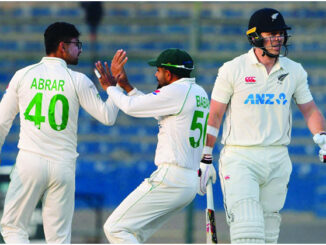
    Karachi (TIP)- The opening Test between Pakistan and New Zealand at the National Stadium in Karachi ended in a draw. It meant that Pakistan stayed winless in their last seven Test matches at home.

    At Stumps on Day 4, the match was poised for a stalemate. Imam-ul-Haq scored 96 as Pakistan declared their second innings at 311 for the loss of eight wickets. The left-hander failed to read a googly from Ish Sodhi, who got the batter out stumped after beating him all ends up. Saud Shakeel and Sarfaraz Ahmed were also impressive, having scored 55 and 53 respectively. Mohammad Wasim Jr added 43 runs and was also involved in a 71-run stand with Shakeel. Agha Salman, who scored a hundred in the first innings, fell cheaply.

    Sodhi was the pick of the bowlers for the Black Caps as he finished with stupendous figures of 37-11-86-6. Michael Bracewell picked up two wickets as well.

    Babar Azam took a brave call of declaring their second innings and setting New Zealand a target of 138 runs with 15 overs left. In their run-chase, the Kiwis came out all guns blazing and tried to give Pakistan a run for their money. The visiting team lost the early wicket of Bracewell as Abrar Ahmed rattled his woodwork.

    However, Devon Conway and Tom Latham threw their bats around to give New Zealand some hope. The duo put on an unbeaten partnership of 52 runs off 6.3 overs, but bad light stopped play once and for all.

    The Kiwis finished their innings at 61 for the loss of one wicket in 7.3 overs.

    The second Test is scheduled to get underway on Monday, January 2 at the National Stadium in Karachi.

  • BCCI to review T20 World Cup performance in new year

    BCCI to review T20 World Cup performance in new year

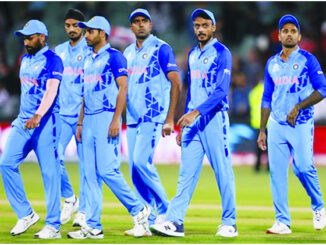
    The BCCI brass will review India’s underwhelming performance in the T20 World Cup with skipper Rohit Sharma and coach Rahul Dravid on January 1, according to BCCI sources.

    NCA chief VVS Laxman, who has been with the Indian team in Dravid’s absence, is also expected to be part of the meeting. The meeting in Mumbai is scheduled ahead of limited overs against Sri Lanka beginning on January 3.

    England had hammered India by 10 wickets in the World Cup semi-finals, extending their barren run in ICC events since 2013 when they won the Champions Trophy under M S Dhoni’s leadership. The last world title came at home in 2011. “Head coach Rahul Dravid and NCA head VVS Laxman are expected to analyse India’s performance with BCCI bosses. The roadmap going into 2023 World Cup is also expected to be discussed,” said the source. The selection panel led by Chetan Sharma were shown the door post the World Cup but a new panel is yet to be formed. The committee was sacked in November but it continues to track the ongoing Ranji Trophy and also picked the team for three T20s and ODIs against Sri Lanka.

    The Cricket Advisory Committee, which was formed earlier this month, met in Mumbai on Friday to shortlist the list of candidates for the selectors’ posts.         Source: PTI

  • Kolkata: The city of Joy

    Kolkata: The city of Joy

    Kolkata, India’s second biggest city, is a perpetually ongoing festival of human existence, concurrently luxurious and squalid, refined and frantic, pointedly futuristic, while beautifully in decay. A vibrant 350-year-old metropolis located on India’s Eastern Coast, the capital of West Bengal thrives on contradictions and imposing spectacles; nothing is commonplace in this city. Famously known as the City of Joy, Kolkata is, in every sense, the artistic, cultural and intellectual capital of the country. Kolkata’s streets are vivid, hectic, chaotic, and yet, brimming with life and creativity. Driven by the indomitable spirit of the self-made middle class, the city has created a beautiful juxtaposition of the old colonial-era charm with the nascent upcoming hipster culture that thrives amongst the city’s millennial residents.

    Starting from admiring the flourishing art scene in the city to going on rewarding gastronomical explorations to wandering amidst the countless bazaars to sitting by the banks of the Hooghly and enjoying a peaceful sunset, Kolkata is soaked in layers and layers of heritage and culture, and peeling off each layer to look beneath the hood is a very rewarding, once-in-a-lifetime experience. As the famous quote goes, “If you want a city with a soul, come to Calcutta”.

    Formerly the capital of the British empire before the government was shifted to Delhi, Kolkata has a distinct tinge of its royal past lingering in every nook and cranny of the city. If you want to soak in some of the city’s regal past, take a walk along the streets of North Kolkata, which houses some of the oldest mansions in the city, swathed with vines and a persistent sense of aristocratic pride. Kolkata is home to Rabindranath Tagore’s ancestral house, which has now been converted into a museum and houses a staggering collection of family portraits and paintings. There are plenty of ghats all over the city where you can sit and enjoy a sunset while sipping on tea, one of the most noted of these being the Prinsep Ghat, which offers stunning views of the Vidyasagar Setu in the backdrop. Close by is Millennium Park, which is a beautified waterfront park from where you can avail boat rides and cruises.

    Kolkata has a very lively nightlife, and the entire stretch along Park Street houses innumerable bars and pubs where you can party the night away. Kolkata’s street food is famous all across the country, and the city is lined with eateries and food stalls at every corner, where you can savour local Bengali food, or try out local snacks such as Jhalmuri, or Ghugni Chaat.

    Victoria Memorial

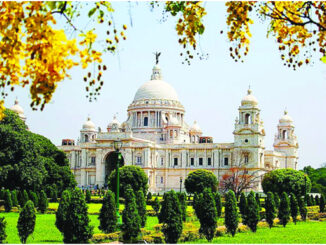
    Another relic of the British Raj in India, the Victoria Memorial is located in the heart of Kolkata, in West Bengal. This white marbled opulent structure was built in memory of Queen Victoria to celebrate her 25 years of rule over India and is almost a replica of the Victoria Memorial in London. Victoria Memorial is an iconic structure that is synonymous with the city of joy!

    The memorial is surrounded by a lush green and well-maintained garden, which spreads over 64 acres and has numerous statues and sculptures in it. A sixteen-foot tall bronze statue of victory, mounted on ball bearings at the top of the memorial, serves to heighten the overall appeal and grandeur of the entire complex. Victoria Memorial is breathtaking and marvellous, especially at night, when it is illuminated. The Sound and Light shows that take place in the evening are an added delight, and a must watch. All in all, the place is a must visit for people to wish to relive the essence of the Victorian era in the modern day world.

    Fort William

    The mighty edifice of Fort William is situated in the city of Kolkata, on the eastern bank of the  Hooghly River. Built in the year 1696, the fort is named after King William III and was the first stronghold of the British in the country. The magnificent structure is spread over 70.9 acres and is embellished with hundreds of arched windows that overlook lush green gardens. Meticulous stonework adorns the surface of the building and it took as long as took ten years to reach completion. However, it was soon realized that the building had a few loopholes, and a new octagonal building was constructed whose foundation was laid by Sir Robert Clive.

    Howrah Bridge

    An iconic landmark of Kolkata, Howrah Bridge is a massive steel bridge constructed over the Hooghly River. It is considered to be among the longest cantilever bridges in the world. Also known as Rabindra Setu, it connects Howrah and Kolkata. It carries daily traffic of over 100,000 vehicles and countless pedestrians and is as historic as it is grand. The opulence of the bridge, however, comes alive in the night time as it is all lit up. You can also take a ferry ride as it runs between Kolkata and Howrah, from the launch ghat. The view of the city from the ferry, especially in the night, is priceless, to say the least.

    Howrah Bridge was the third-longest cantilever bridge at the time of its construction, but now it is the sixth-longest one of its types. It was renamed as Rabindra Setu on June 14, 1965, after the name of Nobel Laureate Rabindranath Tagore. It spreads about 1500 ft over the Hooghly River and is 71 ft wide. There is a total of 8 lanes of strand road, bicycles, and pedestrians. What makes this bridge unique is the fact that it was built without a single nut or bolt and is held together by rivets.

    Birla Planetarium

    Situated at the famous Chowringhee Road right in the proximity of Victoria Memorial and St. Paul’s Cathedral Birla planetarium is the largest planetarium in Asia and the second largest in the world! Situated in the city of joy – Kolkata, Birla Planetarium is a magnificent edifice set up by Pandit Jawaharlal Nehru on 2nd July 1963. It is one of the three planetariums present in India. Also known as Taramandal, the Birla Planetarium regularly holds many shows and programs are in various languages including Hindi, English, Bengali, and other regional languages. In addition to being a planetarium, Birla Planetarium also has an electronics laboratory and an astronomy gallery that has a collection of paintings and astronomical models.

    Indian Museum

    The ninth oldest museum of the world and largest in India, the Indian Museum is located in the city of joy – Kolkata. The foundation stone of the Indian Museum was laid down in the year 1814 and has been a centre of multidisciplinary activities ever since. Popularly known as ‘Jadughar’, it has the finest collection of contemporary paintings, sacred relics of Buddha, Egyptian mummies and ancient sculptures. In addition to these, the Indian Museum boasts of some of the most exquisite collections of ornaments, fossils, skeletons, antiques, armours, and stunning Mughal paintings.

    Presently, the museum has 35 galleries which have been divided into six categories namely Art, Archaeology, Anthropology, Geology, Zoology and Economic Botany. For those inquisitive about history, there is also a library and bookshop present within the museum premises. Indian Museum recently celebrated its bicentennial anniversary with great fervour in February 2014. With its splendid collection, the museum takes you back in time to witness our fascinating past.

    Belur Math

    Belur Math in Kolkata is the headquarters of the Ramakrishna Math and Mission. Sprawling over forty acres of land on the west bank of the Hooghly River, it is visited by people from all over the world, irrespective of their religious beliefs. The temple is known for its distinctive architecture, which fuses Hindu, Christian and Islamic motifs as a symbol of unity of all religions. Founded by Swami Vivekananda, the chief disciple of Ramakrishna Paramahansa, the temple is at the heart of the Ramakrishna Movement. The temple complex also houses a museum and several other affiliated educational institutions.        Source: Holidify

  • The Wisdom of Isa Upanishad

    The Wisdom of Isa Upanishad

    The Isa Upanishad or Isavasya Upanishad is found in the 40th chapter of the Vajasaneya Samhita of the Yajurveda. Isa means the Lord of the Universe and vasya means enveloped or covered. The Upanishad is about God and our roles and responsibilities in ensuring order and regularity of the world and our own liberation in the end.

    The Upanishad explains very briefly, why human beings should live responsibly doing their duties, without pursuing wrong methods of knowledge and worship, so that they can attain liberation by going to the immortal world of Brahman. Good deeds are important. Truthfulness is important. One must perform all the ordained duties assigned by God to realize the four aims of human life and do justification for one’s birth and existence in the world owned by God. Although the Upanishad has only 18 verses, they sum up the essential beliefs and practices of Hinduism. In fact, spiritually and for the purpose of leading a divine centered life, the 18 verses are as important as the 18 chapters of the Bhagavadgita.

    The Upanishad contains some important concepts of Hinduism which are also found in the Bhagavadgita. They are explained below. The Bhagavadgita has eighteen chapters and the Isa Upanishad has 18 verses. In many ways, the eighteen verses are as significant as the 18 chapters. In eighteen verses, the Upanishad sums up the significance and purpose of human life and with what attitude one should live here upon earth and depart from their bodies.

    God is the true owner of and supporter of everything. The whole creation is inhabited and enveloped by God. He is also its supporter and sustainer. Creation is an extension or manifestation of Brahman. According to some it is a super imposition. Whatever may be the nature of creation, the Upanishad affirms that Brahman is the Supreme Lord of the universe and He is responsible for all movements and actions. He has apportioned duties and responsibilities for all beings in creation.

    The Upanishad also describes the nature of Self and the consequences of indulging in self-destructive actions. The Self is all pervading, faster than the senses and the mind. It is everywhere and present in everyone. Those who indulge in evil actions and harm their spiritual welfare go to the sunless worlds of utter darkness. However those who realize the Self feel no hatred or ill will.

    –              Duty must be performed with detachment, without claiming ownership and doership. Ownership and doership arise from attachment. The Isa Upanishad declares that since Brahman is the Lord of the universe, we should not covet the wealth that truly belongs to God and with this thought in our minds we should wish to live here performing actions with detachment. This is the only way to avoid karma and sin even when we perform actions. The third verse of the Upanishad is a direct reference to the yoga of action (karmayoga) and the justification for its practice.

    –              One must pursue both ritual knowledge and spiritual knowledge. The Upanishad deals with the yoga of knowledge in verses 9-11. True knowledge consists of both ritual knowledge (avidya) and spiritual knowledge. Both types of knowledge are essential for human beings to perform their obligatory duties. Those who take up householder’s life should ignore neither the sacrifices nor spiritual practices. Both are required to fulfill the four aims of human life, namely righteousness, wealth, pleasure and renunciation. Ritual knowledge and sacrifices should be pursued as a student and householder. In the later stages, during retirement and the life of renunciation, one should focus solely upon self-knowledge, abandoning all desires and attachments. Those who pursue either of the two types of knowledge, incur the sin of neglecting their obligatory duties. In the end, they enter the darkest hells.

    –              One must worship both manifested and unmanifested aspects of creation. The yoga of devotion is suggested in verses 12-14. Worldly people who take up householder’s duties should worship both the manifested and unmanifested aspects of Brahman. This is a continuation of the previous idea. The gods are the manifested aspects of Brahman. They should be worshipped through rituals and sacrifices as part of one’s obligation towards them and to maintain order and regularity of the worlds. The Supreme Self and the individual Self are the unmanifested aspects of Brahman because they are eternal and immutable. They should be worshipped internally through meditation, concentration and self-absorption. According to the Upanishad, the householders have an obligation to practice devotion by practicing both methods of worship. If they follow one or the other they will enter the darkest hells.

    –              One must lead a dutiful and truthful life to qualify for immortal heaven. The importance of truthfulness and dutifulness (satyadharma drista) are emphasized in verses 15, 17 and 18. These are similar to the divine qualities described in the Bhagavadgita. Only those who perform good deeds and practice their duties sincerely, abiding by truth, are qualified to reach the world of Brahman, travelling by the immortal path. Their journey is facilitated by Agni and made possible by Brahman, addressed in the Upanishad as Pusan, the deity hidden in the golden orb.

    –              One must pray to God at the time of death. The verses suggest that one’s thoughts must be focused upon Brahman and remain detached from the mind and body. This idea is also emphasized clearly in the Bhagavadgita. The last three verses in the Upanishad are chanted when someone is nearing death. They are meant to facilitate a soul’s journey to the world of Brahman through the last obligatory duty, which is sacrifice of the body as an offering to Agni. Detachment from the mind and body are suggested in the verse 17, where the departing soul makes an offering of the elemental body to fire, and requests the mind to remember the good deeds so that its journey to the immortal world is ensured.

    –              One must leave the body with good memories. The last three verses also signify the importance of keeping the mind in a positive state. One should remember Brahman constantly and remember all the good deeds performed. There must an aspiration to reach the highest heaven as the culmination of the good life one has led upon earth. The last three verses are in conformity with the declaration made in the Bhagavadgita that whatever a person remembers at the time of his death, that he attains. The three verses therefore urge us to remain positive and stay focused upon Brahman and His world while departing from here.

    Thus in a very brief and straightforward manner, the Isa Upanishad puts forth some of the most fundamental aspects of Hinduism and sums neatly the importance of acknowledging God as the Lord of the universe, doing our duties, pursuing knowledge, practicing devotion and keeping our minds focused upon God at the time of our departure from this world. The emphasis is upon leading a balanced life, in which we should ignore neither our worldly duties and obligations nor our spiritual welfare. We should make use of the human birth we have attained, which is a rare opportunity, to escape from the cycle of births and deaths. If the Bhagavadgita is the song of God, Isa Upanishad is the teaching of Isa, the Lord of the Universe.            Source: Hinduwebsite.com

  • Govt hikes interest rates on NSC, post office deposits; no change in PPF rate

    Govt hikes interest rates on NSC, post office deposits; no change in PPF rate

    Mumbai (TIP)- The government on Friday, December 30,  hiked the interest rates on small deposits — including post office term deposits, NSC and senior citizen savings scheme — by up to 1.1 percentage points from January 1, in line with firming interest rates in the economy. However, the interest rates on Public Provident Fund (PPF) and the girl child savings scheme Sukanya Samriddhi have not been changed.

    National Savings Certificate (NSC) will yield a 7 per cent interest rate from January 1, compared to 6.8 per cent at present. Similarly, the senior citizen savings scheme will give 8 per cent interest against 7.6 per cent currently.

    Interest rates on post office term deposit schemes of duration 1 to 5 years will rise by up to 1.1 percentage points.

    The monthly income scheme, too, will yield 7.1 per cent interest, up from 6.7 per cent.

    Revised Interest Rates On Small Savings Schemes For January-March 2023:

    –              1-Year Post Office Time Deposits: 6.5 per cent

    –              2-Year Post Office Time Deposits: 6.8 per cent

    –              3-Year Post Office Time Deposits: 6.9 per cent

    –              5-Year Post Office Time Deposits: 7.0 per cent

    –              National Saving Certificates (NSC): 7.0 per cent

    –              Kisan Vikas Patra: 7.2 per cent

    –              Public Provident Fund: 7.1 per cent

    –              Sukanya Samriddhi Account: 7.6 per cent

    –              Senior Citizens Savings Scheme: 8.0 per cent

    –              Monthly Income Account: 7.1 per cent.

    Since May this year, the Reserve Bank of India (RBI) has raised the key repo rate by 225 basis points, prompting banks to raise interest rates on deposits as well. On December 7, the RBI increased the repo rate by 35 basis points to 6.25 per cent, the fifth-time increase in a row. The repo rate is the interest rate at which the RBI lends to the commercial bank.

  • China economic activity worsens in December as Covid spreads

    China economic activity worsens in December as Covid spreads

    BEIJING (TIP)- China’s economic activity contracted at a steeper tempo in December as the nation all of the sudden reversed its Covid Zero coverage and the virus swept via main cities, inflicting folks to remain house and companies to close. The official manufacturing buying managers index fell to 47 this month from November’s 48, the National Bureau of Statistics stated Saturday. That was worse than an estimate of 47.8 in a Bloomberg survey of economists. The non-manufacturing index, which measures activity in the development and companies sectors, declined to 41.6 from 46.7 in November, decrease than the consensus estimate of 45. A studying beneath 50 signifies contraction, whereas something above suggests growth. Both readings have been the bottom degree since February 2020.

    The December information displays the month when the world’s second-largest financial system lastly ditched its lengthy-held Covid Zero coverage in an abrupt reversal.

    High-frequency information prompt that economic activity was pushed off a cliff as surging instances led folks to remain house and keep away from outlets, whereas manufacturing unit manufacturing was capped. There was even some disruption to authorities operations.

    “Manufacturing and consumption both declined as Covid situation brought relatively big impact to enterprises, personnel on duty and logistics,” the statistics bureau stated in a press release accompanying the information launch.

    Manufacturing PMI gauges measuring output, new orders and employment all contracted in December at a quicker tempo than the month earlier than. A sub-index measuring suppliers’ supply occasions additionally fell additional, an indication of provide disruptions.

    The coverage shift and the unfold of Covid might create extra snags for the financial system via the primary quarter of 2023, with a possible journey rush through the upcoming Lunar New Year vacation doubtlessly exacerbating the scenario.

    China’s financial system was faltering earlier than the pivot from Covid Zero as curbs to forestall the unfold of an infection depressed economic activity and stored the nation remoted from the remaining of the world. A persistent property market stoop, sluggish shopper demand and waning abroad urge for food for Chinese items contributed to the downturn, and gross home product is more likely to develop simply 3% in 2022.

    Economists see an rising risk for a quicker and stronger rebound later in 2023. After the doubtless gradual begin in the January-to-March interval, development is projected to choose as much as 4.8% for the yr, in keeping with the median estimate of economists surveyed by Bloomberg.

  • Adani buys Roys’ 27.26% stake in NDTV for Rs 602 cr

    Adani buys Roys’ 27.26% stake in NDTV for Rs 602 cr

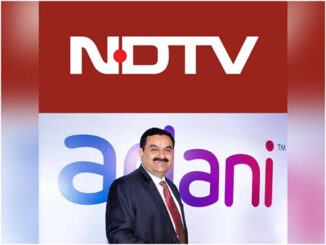
    New Delhi (TIP)- The Adani Group on Friday, December 30,  acquired 27.26% equity stake in NDTV from its founders Prannoy Roy and his wife Radhika Roy for Rs 602.3 crore.

    “RRPR, an indirect subsidiary of the company and member of the promoter/promoter group of NDTV, has acquired a 27.26% equity stake in NDTV from Prannoy Roy and Radhika Roy by way of inter-se transfer. The acquisition was completed on December 30, 2022 on the block,” said an Adani Enterprises’ regulatory filing to the bourses.

    “Vishvapradhan Commercial Private Limited (an indirect subsidiary of the company) holds 8.27% equity stake in NDTV and RRPR (prior to the present acquisition) held 29.18% equity stake in NDTV. Consequent to the present acquisition, RRPR will hold 56.45%,” it added.

    The Roys sold their equity at Rs 342.65 per share, which is 17% higher than what was offered to other shareholders in the open offer that closed on December 5. This premium may attract the attention of SEBI as such a difference in payouts is not allowed unless the selling company (RRPR) is part of the group offloading the shares. Roys had given up on December 23 when they announced their decision to sell off 27.26% of their holding while retaining 5% of the shares.

  • Core sector output rises 5.4% in Nov

    Production of eight infrastructure sectors increased by 5.4% in November against a 3.2% growth in the same month last year on a better show by coal, fertiliser, steel, cement and electricity segments, according to the official data released on Friday. Crude oil, natural gas and refinery products, however, recorded negative growth in November this year. The production growth of eight key sectors slowed down to 0.9% in October. The growth rate of eight infrastructure sectors — coal, crude oil, natural gas, refinery products, fertilisers, steel, cement and electricity — stood at 8% in April-November this fiscal as against 13.9% during the same period last fiscal.

    The production of coal rose by 12.3%, fertiliser by 6.4%, steel by 10.8%, cement by 28.6% and electricity by 12.1% in November 2022 compared to a year ago.

    Core sectors industries, which have 40.27% weight in the overall Index of Industrial Production (IIP), would also have a bearing on industrial production data. The IIP data for November is expected to be released by the government in the second week of January 2023.

    Source: PTI

  • Extend life of your old iPhone with these simple tricks

    Extend life of your old iPhone with these simple tricks

    While Apple releases a new iPhone every year, you can actually get the most out of your existing smartphone with a just software update. While some features could be limited to the latest models, regular users can continue to use an iPhone for at least three years without missing out on any major feature. If you have an older iPhone, here is how you can get the most out of it and make it work seamlessly with all the latest apps and services. Follow these simple little tricks to extend the lifespan of your iPhone and get the most out of your Apple device.

    Always install the latest software update: Apple is known for adding newer features with a software updates. An iPhone will receive at least four major iOS updates, which will keep the iPhone secure and up-to-date. With the latest iOS 16.2 update, Apple enabled 5G networking on iPhone 12 and the iPhone 13 series.

    Along with new features, the software also offers critical security fixes and fixes an existing software bug in the previous build. Hence, it is always recommended to install the latest software update on your iPhone to keep it up and running.

    Go to Settings > General > Software Update to install the latest available iOS version on your iPhone and make sure to have at least 60 per cent battery and a stable internet connection before attempting a software update.

    Replace the battery?

    Bought an iPhone a few years before, and it’s no longer lasting all day. While this could be one of the good reasons to get the latest iPhone, you can fix this issue by replacing the battery on your iPhone for a fraction of the cost.

    Again, get the battery replaced by an official service centre, ensuring a genuine component. Batteries tend to wear out over time, and it’s best to get a new battery rather than getting a brand-new iPhone.

    Go to Settings > Battery > Battery health and charging and check the maximum capacity. It is recommended to change the iPhone if the maximum capacity of the battery is less than 80 per cent. Apple charges $69 or Rs 5,699 for the battery replacement of iPhone 13 and older models. Similarly, the company charges $99 or Rs 8,177 for the battery replacement of iPhone 14 and the newer models.

    Reset the iPhone once a year: Running out of storage and the iPhone is feeling sluggish? You could solve these issues in some cases by just factory reset your iPhone. Factory resetting will remove all the cache and temp files from the device, freeing up the internal storage and the device resources, which will make the iPhone feel fast.

    Make sure to have at least a couple of GBs of free internal space, which will be essential for downloading and installing software updates on Apple iPhones. On top of that, you can also take a backup of your content on Apple iCloud to free up internal storage.

  • Not everything we call AI is actually ‘artificial intelligence’. Here’s what you need to know

    Not everything we call AI is actually ‘artificial intelligence’. Here’s what you need to know

    In August 1955, a group of scientists made a funding request for USD 13,500 to host a summer workshop at Dartmouth College, New Hampshire. The field they proposed to explore was artificial intelligence (AI). While the funding request was humble, the conjecture of the researchers was not: “every aspect of learning or any other feature of intelligence can in principle be so precisely described that a machine can be made to simulate it”.

    Since these humble beginnings, movies and media have romanticised AI or cast it as a villain. Yet for most people, AI has remained as a point of discussion and not part of a conscious lived experience.

    AI has arrived in our lives

    Late last month, AI, in the form of ChatGPT, broke free from the sci-fi speculations and research labs and onto the desktops and phones of the general public. It’s what’s known as a “generative AI” – suddenly, a cleverly worded prompt can produce an essay or put together a recipe and shopping list, or create a poem in the style of Elvis Presley.

    While ChatGPT has been the most dramatic entrant in a year of generative AI success, similar systems have shown even wider potential to create new content, with text-to-image prompts used to create vibrant images that have even won art competitions.

    AI may not yet have a living consciousness or a theory of mind popular in sci-fi movies and novels, but it is getting closer to at least disrupting what we think artificial intelligence systems can do. Researchers working closely with these systems have swooned under the prospect of sentience, as in the case with Google’s large language model (LLM) LaMDA. An LLM is a model that has been trained to process and generate natural language.

    Generative AI has also produced worries about plagiarism, exploitation of original content used to create models, ethics of information manipulation and abuse of trust, and even “the end of programming”.

    At the centre of all this is the question that has been growing in urgency since the Dartmouth summer workshop: does AI differ from human intelligence?

    What does ‘AI’ actually mean?

    To qualify as AI, a system must exhibit some level of learning and adapting. For this reason, decision-making systems, automation, and statistics are not AI.

    AI is broadly defined in two categories: Artificial Narrow Intelligence (ANI) and Artificial General Intelligence (AGI). To date, AGI does not exist.

    The key challenge for creating a general AI is to adequately model the world with all the entirety of knowledge, in a consistent and useful manner. That’s a massive undertaking, to say the least.

    Most of what we know as AI today has narrow intelligence – where a particular system addresses a particular problem. Unlike human intelligence, such narrow AI intelligence is effective only in the area in which it has been trained: fraud detection, facial recognition or social recommendations, for example. AGI, however, would function as humans do. For now, the most notable example of trying to achieve this is the use of neural networks and “deep learning” trained on vast amounts of data.

    Neural networks are inspired by the way human brains work. Unlike most machine learning models that run calculations on the training data, neural networks work by feeding each data point one by one through an interconnected network, each time adjusting the parameters.

    Source: PTI