Poor Communication
Open and honest communication is the cornerstone of any healthy relationship. When communication breaks down, partners may struggle to understand each other’s needs and feelings, leading to emotional distance and loneliness.
Emotional Neglect
When one or both partners fail to attend to each other’s emotional needs—such as showing affection, offering empathy, or providing support—it can result in emotional disconnection and feelings of being alone within the relationship.
Lack of Quality Time
Spending meaningful time together helps reinforce the emotional bond between partners. A lack of intentional, quality moments can make one or both feel isolated, even if they’re living under the same roof.
Divergent Interests
While it’s healthy to have individual hobbies, a complete lack of shared interests can lead to disconnection. Engaging in mutual activities helps strengthen the sense of partnership.
Unaligned Expectations
Differences in expectations—especially around emotional support or intimacy—can lead to misunderstandings and loneliness. Honest conversations about needs and desires are essential for mutual satisfaction.
Unmet Needs
When physical, emotional, or social needs go unfulfilled, loneliness can set in. For example, if one partner craves more physical affection or companionship and the other doesn’t respond, a disconnect can grow.
Conflicting Communication Styles
Partners may express themselves differently—through words, actions, or gestures—which can lead to misinterpretations and emotional gaps if those differences aren’t acknowledged and respected.
Month: May 2025
-

Causes of feeling lonely in a relationship
-

Remedies to lighten dark elbows and knees using DIY methods
Dark elbows and knees can make many people feel self-conscious, especially when wearing sleeveless tops or shorts. This skin discoloration usually occurs due to friction, lack of exfoliation, sun exposure, and neglect in moisturising. Fortunately, simple DIY remedies use natural ingredients that can help lighten and soften these areas over time.
WHY DO ELBOWS AND KNEES GET DARK?
Before jumping into the solutions, it’s important to understand the causes
Buildup of dead skin cells, Friction from clothing or cleaning, Lack of oil glands in these areas, Hyperpigmentation from sun exposure, Dryness and lack of moisture, Consistent care and patience are key. Let’s dive into some effective, natural remedies!
LEMON AND BAKING SODA SCRUB
– What you need: 1 lemon, 1 tablespoon baking soda
– How to use: Cut the lemon in half, sprinkle baking soda on it, and rub directly on dark areas for 2â??3 minutes.
– Let it sit for 10 minutes before washing off.
– Why it works: Lemon’s vitamin C bleaches and brightens skin; baking soda exfoliates.
ALOE VERA GEL AND TURMERIC
– What you need: Fresh aloe vera gel, a pinch of turmeric
– How to use: Mix and apply on elbows and knees. Leave for 15â??20 minutes before rinsing.
– Why it works: Aloe soothes and hydrates; turmeric reduces pigmentation.
SUGAR AND OLIVE OIL SCRUB
– What you need: 1 tablespoon sugar, 1 tablespoon olive oil
– How to use: Mix into a scrub and gently massage onto the area for 5 minutes. Wash with warm water.
– Why it works: Sugar removes dead cells; olive oil nourishes and softens skin.
POTATO JUICE
– What you need: 1 potato
– How to use: Grate or juice the potato and apply to dark areas daily. Leave for 15 minutes.
– Why it works: Potatoes contain enzymes and vitamin C that naturally bleach the skin.
COCONUT OIL MASSAGE
– What you need: Virgin coconut oil
– How to use: Massage daily after showering. For extra benefit, add a few drops of lemon juice.
– Why it works: Coconut oil moisturises deeply and contains vitamin E for skin repair.
CUCUMBER RUB
– What you need: Fresh cucumber slices
– How to use: Rub slices on elbows and knees for 5 to 10 minutes daily.
– Why it works: Cucumber cools, hydrates, and gradually reduces pigmentation. -
Sikh History This Week- 23rd May To 29th May
1606 Jahangir received false reports on Guru Arjan’s blessing Khusrau.
1848 Maharani Jind Kaur exiled and sent to Banaras prison.

1914 Guru Nanak Jahaz (Koma gata Maru) reached Vancouver port, Canada. However, it was forced to return to India. KOMA GATA MARU: Punjabis traveling to foreign land in search of better jobs were being discriminated against at the begining of 20th century. The Canadian government had issued prohibition against their entry and the British ships had refused to accept any Punjabi travelers. The Canadian law stated, for the purpose of preventing immigration from india and other countries, that only those passengers could land in Canada who travelled on a through ticket without any break in journey from their land of birth. However, no company provided such a service between the Indian and Canadian ports. As a result, many Punjabis were stranded for months in Hong Kong, unable to get tickets for their final destination, Canada.24th May

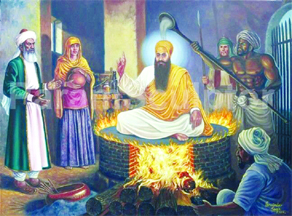
1606 Guru Arjan Dev reached Lahore for martyrdom in protection of the Dharam. For 6 days he suffrede emmense tortures. At the time of martyrdom, Sai Mia Meer and a priest from Puratgal, Saint Jaerom Jaevier witnessed the martyrdom.
1710 Baba Banda Singh Bahadur enters Sirhind city.
1960 Master Tara Singh and hundreds of Sikhs arrested.25th May

1606 GUR GADHI, Patshahi Sixth, Guru Har Gobind Ji. Pattshahi sixth, Guru Har Gobind Sahib Ji, ascended to Guruship of GurSikhism. Just after the martyrdom of Guru Arjan Dev, Baba Budha anointed Hargobind as the sixth Guru of the Sikhs. Guru Arjan had sent to Hargobind, five paisas and a coconut through a messenger. baba Budha put those in front of Hargobind and applied a ’tilak’ (saffron mark) on his forehead, bowed to him and declared him to be the next Guru of the Sikhs. The Guru then asked baba Budha to adorn him with a sword. Baba Budha who had not handled a sword before, tied it on the wrong side of the Guru. On realising his mistake he wanted to move it to the right side, but the Guru said not to remove that sword, but instead to put another one on the right side, which Baba Budha did. Thus the Guru wore two swords simultaneously. He declared that one sword represented ‘Piri’ (spirituality) or Bhakti) while the other represented ‘Miri’ (Temporality or Shakti). He told his followers that in the Guru’s house spiritual and temporal powers would be combined. He declared that his rosary would be the sword-belt and he would wear the emblem of royality on his turban. Further he instructed the Sikhs to keep a sword and a horse and always recite the name of God from their lips.
1675 Kashmiri Panditsi, led by Kirpa Ram, arrive in Anandpur Sahib to ask Guru Tegh Bahadhur for help in preserving Hindu dharam.26th May

1886 Maharaja Dalip Singh reentered Sikh faith. He received Khande Di Pahul (Amrit) on May 26, 1886 at Aden. Earlier, on On March 8, 1853, Maharaja Dalip Singh was formally admitted into the Christian Church with water brought from Ganges nearby at his own private dwelling house. The service was conducted by the Rev. M.W. Jay, with Dr. John S. Login, Mrs. Login, Colonel Alexander and Mr. Guise signing the Baptism register as witnesses.
1960 Morcha initiated for seeking Punjabi Subha.
1984 The last meeting was held between Akalis and Indira Gandhi.The last meeting was held between Akalis and Indira Gandhi regime. Several such meetings preceded this meeting. However, by now it became abundantly clear that this was in fact a drama. The government had planned an attack on Darbar Sahib for several months. Russian KGB and even British Intelligence was guiding the invasion of Darbar Sahib.
1988 The President of India issued an ordinance banning the Sikh fundamentals of Miri-Piri (Cohesive oneness of Religion and Politics). An integral part of the Sikh religion Miri-Piri is the most fundamental to Sikh religion. This ordinance (which later became law) meant that the Sikhs shall have to adopt only that part of their religion which the Hindu majority will allow. This was the final blow to the Sikh nation which made the professing of their religion under the subjugation of the Hindu regime.
1996 Atal Bihari Vajpayee, in his capacity as Prime Minister of India, visited Sri Harmandir Sahib, Amritsar and apologized to the Sikhs for the following two abominations committed by the Government of India.27th May
1710 Baba Banda Singh Bahadur announces the establishment of Sikh rule in a heavy Diwan organized in Sirhind city.
1921 The Governor of Punjab arrested Sardul Singh Caveesher for spearheading the non-cooperation resolution at SGPC meeting of May 11, 1921. This meeting was really a confrontation that once again demonstrated the majority of the radicals in the SGPC.28th May
1922 A meeting is called at Kaulgarh by Karam Singh Gargaj group to reform the Jholichuks.
1948 SGPC came under the control of Congress Sikhs.29th May
1606 Martyrdom, Fifth Patshah, Guru Arjan Dev Ji.
Guru Arjan Dev (1563-1606) Guru Arjan, the ‘Prince of Martyrs’ and the ‘Prophet of Peace’, proffered his precious life to nurture the glory that was to be the Sikh Panth. The Fifth Master’s life was marked by divine bliss and sublime sacrifices, born of a sweet acceptance of God’s Will. Gifted with a quintessential poetic afflatus, and immeasurable imaginative sympathies, the Guru gave the movement of Sikhism a definite direction, perspective and program. He made the new faith coeval or coextensive with the whole gamut of existence and raised its exquisite edifice on values for which there is neither death nor change.
Guru Arjan Dev adorned the sacred throne of Guru Nanak from Sept. 1, 1581 to May 30, 1606. Born at Goindwal on April 15, 1563, he was the youngest and noblest son of Guru Ram Das and Mata Bibi Bhani. On 23 Hadh sunmat 1636, he married Ganga Devi, daughter of Krishan Chand of Mau village. He had an innate poetic sensibility which was exquisitely displayed in the epistles that he sent to his father from Lahore. They are deeply expressive of the pangs of separation and the exuberance of Love. The Fourth Master’s decision to make Guru Arjan his spiritual heir was bitterly opposed by Prithvi Chand who contended that being the eldest son, he alone was entitled to the Guruship. Thus, he could never reconcile himself to his younger brother’s installation as Guru. Under Guru Arjan Dev the Sikh movement registered great progress. In sunmat 1645, he cemented the Santokhsar sarovar. Further, the Guru not only completed the construction of the Sarovars started at ‘Guru Ka Chak’ by his predecessor but also constructed two more Sarovars. He had the Harmandar built in the middle of Amritsar Sarovar and invited a celebrated Muslim divine, Mian Mir, to lay its foundation stone in sunmat 1645. Remarkable for its architectural and aesthetic beauty and unique in its conception, the temple with its four doors symbolizes the inborn equality of all mankind. -

Tom Cruise hints at end of Mission Impossible franchise
Tom Cruise’s ‘Mission: Impossible – The Final Reckoning’ is setting the cash registers ringing. At this time, the actor hinted at the film being the last one in the franchise. In an interview with The Hollywood Reporter, he responded to a question about the end of the film’s franchise, which fuelled speculation.
The change from its original name, ‘Dead Reckoning Part 2’, has already raised eyebrows amongst fans, hinting at a possible conclusion to Ethan Hunt’s high-stakes journey. With Cruise’s recent remarks fuelling the buzz, could this truly be the final mission for the iconic spy?
The premiere of ‘Mission Impossible 8’ took place last week at the Cannes Film Festival, followed by a limited release in select countries, including India, Japan, and Korea. On the Cannes red carpet, Tom Cruise spoke to The Hollywood Reporter. As the interview wrapped up, the host remarked, “I’d want everyone to see this movie. Maybe the final reckoning, maybe not, but what,” at which point Cruise jumped in, saying, “It’s the final,” and added, “It’s not called final for nothing.”
The possible confirmation has sparked mixed reactions amongst fans. Some praised Tom Cruise and director Christopher McQuarrie for giving the franchise a proper send-off, while others are saddened by the idea of bidding farewell to Ethan Hunt. “This is good. Tom can’t keep doing this in a wheelchair,” one fan joked, referencing Cruise’s age. Another said, “It’s better to end it before it goes downhill.” On the other hand, a hopeful fan shared, “I wish these films never end. They could bring in someone new, like they do with Bond.” During the same interview on the Cannes red carpet, Tom Cruise said, “I actually said I am going to make movies into my 80s; actually, I am going to make them into my 100s. I will never stop. I will never stop doing action, I will never stop doing drama, comedy films, I am excited.” However, he didn’t clarify whether this included more ‘Mission Impossible’ films. -

Jennifer Lopez sued for posting paparazzi pictures of herself
Singer-actor Jennifer Lopez is being sued for posting paparazzi pictures of herself at a Hollywood party on her X (formerly Twitter) and Instagram. A BBC report claims that damages worth $150K are being sought per photo by the photographer and his paparazzi agency.
Photographer Edwin Blanco and his agency, Backgrid, claim that Jennifer used the pictures without their permission. She posted pictures of herself arriving at the Amazon MGM Studios and Vanity Fair Party in Los Angeles the night before the Golden Globes in January. Both Edwin and Backgrid have filed lawsuits against her, claiming copyright for two photos she posted.
They argued that the pictures were used “to promote Ms Lopez’s public appearances, boost user engagement, increase shareability, and lend credibility to her branded content.” JLo posted the pictures on her social media with the caption “GG Weekend Glamour,” and they were re-shared by numerous fans and fashion pages, states the publication. She was dressed in a white dress and a matching faux fur coat outside of Chateau Marmont.
The lawsuits reportedly said, “Ms Lopez’s unauthorised use of the Images is commercial in nature, intended for the purpose of self-promotion. For example, Ms Lopez used the Images to spotlight the designer of her clothing and jewellery, leveraging the publicity from the event to promote her fashion affiliations and brand partnerships.”
This is not the first time JLo has faced legal action for sharing photos without permission. She was also sued in 2019 and 2020 for doing the same. Dua Lipa, Gigi Hadid and Khloe Kardashian have also faced similar legal complaints in the past. The legal documents also reportedly state that Backgrid and Edwin contacted the singer-actor’s representatives to agree on a deal and payment for the pictures, but she did not sign the agreement. -

Jessica Biel reveals what makes her marriage to Justin Timberlake strong
American actor-producer Jessica Biel opened up about the key to her strong marriage with singer-actor Justin Timberlake, highlighting how having a partner who understands the demands of their industries has been crucial. Speaking to InStyle, the 43-year-old reflected on what it’s like to balance family with two thriving careers.
“I think having a partner who understands this industry and adjacent industries like music industry has been really deeply important and profound for my life and for our partnership because he just understands when I’m working crazy long hours,” she shared.
On the flip side, Jessica explained that she returns the same level of understanding to Justin when his schedule gets hectic. “Works all night long,” she said of the singer’s late hours. “That’s kind of normal. So we are able to support each other throughout strange schedules and time apart because we know that’s just what it takes to make this kind of art,” she added.
Married since 2012, the couple are parents to two sons—Silas, 10, and Phineas, 4. -

Happy didn’t get typecast doing only special songs in films: Tamannaah
Actor Tamannah Bhatia says whether it is her special songs in movies, her performance in films or on OTT, as an entertainer, her aim is to reach out to her audience.
The actor, who has featured in special appearance in a song in some of the recent films like Kannada blockbuster “KGF: Chapter 1” starring Yash, Rajnikanth-led “Jailer”, “Stree 2”, John Abraham’s “Vedaa” and Ajay Devgn’s “Raid 2”, said song is “one of the many things” she does.
“It happens with a lot of people, they do get typecast. But it hasn’t happened with me because I do long format, features, and I work in different languages, and industries. I work on stage, I make reels. I’m an entertainer. I’m only interested in reaching people,” Bhatia told PTI in an interview.
“I don’t consider any platform small or big. My job is to entertain people in some way, and whenever I get that opportunity, I give it my all with respect and interest, I give it my all. I hope people like it.”
The actor said she has a slew of exciting films in the pipeline in Bollywood like “Ranger” with Ajay Devgn, Rakesh Maria biopic with John Abraham, “No Entry” sequel and folk thriller “Vvan” with Sidharth Malhotra. “Everything leads to something. It’s a misnomer that if you do something, you become typecast. I’ve done a lot of songs, if you count how many songs I’ve done, you will be stunned. But every song has either given me a connection with the people or taught me a little dance. -

Saiyami Kher recalls facing casting couch at 19: Was asked to make compromises
Actor Saiyami Kher, who made her Bollywood debut with Rakyesh Omprakash Mehra’s ‘Mirzya’, recently made a revelation about her struggling days. Saiyami said that she was asked to compromise for a role in a Telugu movie.
Saiyami in an interview with Bollywood Bubble, recalled the interaction with a female casting agent and said, “I have been very fortunate with regards to all the offers I have received. In the film industry, there was this one agent who called me for a Telugu film when I was 19 or 20 years old. She said, ‘You know, you will have to make compromises.’ I was trying to test her, because it was a woman saying it to another woman. I felt that deeply.”
She further added, “So I said, ‘Ma’am, I’m not understanding what you are saying.’ I kept repeating that. And then finally she said, ‘See, you have to understand.’ So I said, ‘I’m sorry that you feel I’m someone who needs to go down this route. There are certain limits I have never crossed in my life.’ So yes, I have experienced it once, but it was just that one time when a woman actually asked me this.”
Saiyami was paired opposite Anil Kapoor’s son, Harshvardhan Kapoor in ‘Mirzya.’ She later featured in movies such as ‘Choked,’ ‘Unpaused,’ and Telugu films like Nagarjuna’s ‘Wild Dog’ and ‘Highway.’ She was also praised for her roles in R Balki’s ‘Ghoomer,’ co-starring Abhishek Bachchan and Tahira Kashyap’s ‘Sharmajee Ki Beti.’
Saiyami was last seen in Sunny Deol-starrer action-drama ‘Jaat’ where she played Sub-Inspector Vijaya Lakshmi. The Gopichand Malineni directorial also featured Randeep Hooda, Regina Cassandra, Vineet Kumar Singh and others in crucial roles.
Saiyami is the granddaughter of late actor Usha Kiran and niece of actor Tanvi Azmi. -

Suniel Shetty says he, Akshay were clueless about Paresh Rawal quitting Hera Pheri 3
Paresh Rawal shocked everyone with his sudden decision to exit Priyadarshan’s Hera Pheri 3. Now, in an interview with India Today, Suniel Shetty also expressed shock at Paresh’s decision and revealed that even Akshay Kumar is clueless about it.
When asked about Paresh’s decision to quit Hera Pheri 3, Suniel said he was clueless about it and added, “This is absolutely shocking. I first thought about texting him, and then I thought I’d meet him and would discuss it. I have had no word about it with anybody. Even Akshay is clueless as to what happened.”
He further admitted, “This is a crisis. We are in the middle of this film, and this is the biggest shock. We were going to begin shooting next year. We had already started, in fact. We shot a promo. It’s a big thing. This is so shocking. I can’t make sense of this. And you know who sent it? Athiya and Ahaan – they both sent it to me within 15 minutes, asking ‘papa what is this?’. And I was here doing my interviews, and I felt like ‘holy s***’.”
After Paresh confirmed quitting Hera Pheri 3, there was speculation that he stepped away due to creative differences with the makers, and some even speculated that he left the film due to remuneration issues. However, in an interview with Mid-Day, the actor refuted any such rumours and revealed, “I know it came as a shock to many. We three make a great combination with Priyadarshanji directing us, but the fact is that I opted out because today I don’t feel like a part of it.”
The Hera Pheri franchise started with Priyadarshan’s Hera Pheri in 2000 and introduced the iconic trio of Akshay Kumar, Paresh Rawal and Suniel Shetty to Bollywood. The audience’s love for the slapstick comedy, one-liners and the characters of the film made it a cult classic. -

Indian-origin stabbed, killed by another Indian-origin man in public bus in Texas
AUSTIN, TX (TIP): In a tragic incident, a 30-year-old Indian was stabbed and killed by another Indian man in a public bus in Austin, Texas, police said. Akshay Gupta was travelling in a bus on the evening of May 14, the Austin Police Department (APD) said in a statement.
Police officers and emergency medical services responded to a “Shoot/Stab” call of someone being stabbed on a bus. When officers arrived on the scene, they located Gupta with trauma to his body.
Police said that life-saving measures were attempted, but unfortunately, Gupta was pronounced dead on the scene.
The suspect was identified as Deepak Kandel, 31. Investigation revealed that Kandel had been sitting next to Gupta on the bus when, without provocation, Kandel stabbed Gupta in the neck.
Once the bus stopped, Kandel calmly exited the vehicle with the other passengers.
APD patrol officers were able to locate and detain Kandel a short time later.
Kandel admitted to stabbing “Gupta due to him resembling his uncle”.
Kandel was booked into the Travis County Jail and has been charged with 1st Degree Murder. -

Indian-origin Singapore-based police officer charged for forging statements
SINGAPORE (TIP): An Indian-origin Singapore police officer was charged on Wednesday, May 21, with forging police statements and documents related to cases he had investigated between 2021 and 2023.
S Vikneshvaran Subramaniam, 35, was handed nine charges of forgery, according to local news channels.
The charges relate to five criminal cases which were ongoing and two concluded cases which did not result in prosecution, the Singapore Police Force (SPF) said in a media release.
“It was discovered that Vikneshvaran had allegedly forged nine documents comprising seven police statements and two acknowledgement slips across seven cases,” SPF said.
According to the charge sheets, in the five ongoing criminal cases at the time, Vikneshvaran allegedly forged the signatures of individuals he interviewed to give the impression that he recorded their statements in person and had them signed.
The police said the alleged forgery came to light after Vikneshvaran was placed on “enhanced supervision” in October 2022 due to his work performance.
A supervisory check of his work was conducted in January 2023, and irregularities relating to case exhibits and document management were detected. Other than the seven cases, no other wrongdoings were uncovered, said the police. Vikneshvaran has been suspended from duty.
He has indicated that he will plead guilty, and the case was adjourned for the parties to make representations. He will return to court on June 18, according to the Channel report. -

Indian-origin man arrested in US for plotting to kill his wife
Plan involved ‘poisoning his wife or staging a break-in at their home, during which the murder was to occur’
WASHINGTON, D.C. (TIP): An Indian-American, Darshan R Soni, has been arrested and charged with attempted murder and conspiracy to commit murder after allegedly plotting to kill his wife in a plan that spanned months and included a failed poisoning attempt, a murder-for-hire scheme, and efforts to cover his tracks.
According to a probable cause affidavit filed in Hamilton County in Indians, Soni, 44, asked one of his employees, Ken Cox, to help carry out the murder. The plan allegedly involved poisoning his wife and, when that failed, staging a break-in at their home on May 16, 2025, during which the murder was to occur.
The case unfolded after a tipster alerted authorities about Soni’s intentions. The tipster claimed Soni had previously asked them how to obtain a silencer and spoke about committing additional crimes. They also reported seeing Soni pick up a wig from Cox, presumably for use as a disguise.
Cox eventually cooperated with police after seeking legal counsel and admitted Soni had offered him money and a used car—a silver Ford Escape—to assist with the murder and help create an alibi by carrying Soni’s phone elsewhere.
Further investigation revealed disturbing details, as per court documents.
The victim reported odd-tasting smoothies and health issues in recent months. She recalled finding a white clumpy substance in her drink, which Soni dismissed as dish detergent. Cox later confirmed Soni claimed to have ordered poison, possibly Thallium or Valium, from India, though Soni said it was ineffective.
Under police surveillance, Cox wore a wire during a meeting with Soni on May 15.
During the recorded conversation, Soni appeared to walk back the plot, crediting Cox for talking him “off a ledge.” However, he also discussed philosophies around violence, detailed murder plots he had read about, and hinted that he still considered extreme actions before deciding on divorce.
Soni’s arrest follows a coordinated effort between Carmel police and the Marion County Prosecutor’s Office. He is charged with one count of attempted murder, a Level 1 felony, and one count of conspiracy to commit murder, a Level 2 felony. He is scheduled to make a court appearance on May 22.
The victim, who remains unnamed, has since been notified and provided support resources. Family members have expressed disbelief, with the victim reportedly describing Soni as innocent.
(Courtesy: www.5wh.com)
-

Indian-origin couple Amandeep & Neha Sharma defrauds New Zealand govt of over USD 2 million
CHRIST CHURCH, NEW ZEALAND (TIP): An Indian-origin couple has been found guilty of defrauding a government company for over USD 2 million in Christchurch in New Zealand.
On May 16, Amandeep Sharma pleaded guilty and will now be sentenced in June, the New Zealand Herald said.
Earlier in the month, his wife Neha Sharma was jailed for three years after pleading guilty to a series of charges including obtaining by deception, money laundering and using a forged document, the newspaper said
The government company Oranga Tamariki made 103 payments to Amandeep’s company, Divine Connection, between July 2021 and October 2022 against 326 invoices, newsportal thepress.co.nz said, adding, the total of these payments was just shy of USD 2.15 million. The New Zealand Herald described in detail how the couple carried out the fraud and quoted Oranga Tamariki chief executive Andrew Bridgman as saying that as soon as concerns were raised by his company in November 2022, an internal investigation was undertaken and then the case was referred to Serious Fraud Office (SFO) resulting in the prosecution
Neha started a job as property manager at Oranga Tamariki in 2021 after forging written references from her previous job at the Ministry of Education in New Zealand. As part of her agreement, she had signed a code of conduct that included clauses to avoid conflicts of interest.
Yet, in her official capacity, she enlisted her husband Amandeep’s construction company Divine Connection in the system to do jobs such as maintenance and upkeep of properties etc.
“Of the 203 jobs recorded as being assigned to Divine Connection in LogIT, 91 were created by Neha Sharma herself, 64 were created by the helpdesk and 20 were created by the friend. The remainder appeared to have been created by other Facilities Management Officer (FMO),” the New Zealand Herald said.
“No one knew about their marriage until after they’d conned the government agency out of more than USD 2 million,” the newspaper added.
Among the red flags were Amandeep’s company was registered in the same address as Neha’s residential address. When Oranga Tamariki started an internal investigation and confronted Neha, she quit her job. In no time, Amandeep’s name was removed as director of the company, its address changed. Neha even joined another company.
When the SFO came raiding, the couple owned three properties and three cars; they also had about USD 8,00,000 in cash in their joint bank accounts.
“Less than two weeks after the SFO knocked on their front door, the couple booked two one-way tickets flying business class on Singapore Airlines to Chennai, India. The trip seemed strange since the couple had a busy schedule ahead in Christchurch, including pregnancy,” the newspaper said.
“The couple boarded their flight on April 14, with 80 kg of luggage between them and before leaving, they attempted to liquidate their properties and cars and transferred just under USD 8,00,000 in cash from their bank accounts to accounts held in India,” the newspaper said, adding, the SFO investigation revealed that the concealed funds were transferred from Amandeep‘s Bank of India account to seven other bank accounts based in India.
The High Court in Christchurch also made restraining orders in relation to the properties and sale proceeds.
Quoting SFO director Karen Chang, thepress.co.nz said: “We would like to acknowledge the police and Indian authorities for their swift action and assistance in securing the defendant’s assets.”
On Friday, Neha’s lawyer said that she blamed the offending on baby brain, the Crown said, there was no evidence of remorse or offer of reparation.
She is now in prison with her baby while the couple’s older child is back in India with Amandeep’s sister. -

Indian American surgeon Dr. Inderbir Gill performs world’s first human bladder transplant
SACRAMENTO (TIP): A pair of surgeons at the University of California Health, including Indian American Dr. Inderbir Gill, have performed the first human bladder transplant, introducing a new, potentially life-changing procedure for people with debilitating bladder conditions.
Dr. Gill, the chairman of the urology department at UCLA, successfully completed the surgery with Dr. Nima Nassiri, a urologic transplant surgeon, at Ronald Reagan UCLA Medical Center on May 4, 2025.
Dr. Gill called the historic operation “the realization of a dream” for treating thousands of patients with crippling pelvic pain, inflammation and recurrent infections.
“There is no question: A potential door has been opened for these people that did not exist earlier,” he told the New York Times.
The operation was performed on a 41-year-old man who had lost much of his bladder capacity from treatments for a rare form of bladder cancer. “I was a ticking time bomb,” the patient, Oscar Larrainzar, said during a follow-up appointment with his doctors last week. “But now I have hope.”
“Despite the complexity of the case, everything went according to plan and the surgery was successful,” said Dr. Gill. The patient is doing well, and we are satisfied with his clinical progress to date.”
The doctors plan to perform bladder transplants in four more patients as part of a clinical trial to get a sense of outcomes like bladder capacity and graft complications before pursuing a larger trial to expand its use.
Until now, most patients who undergo a bladder removal have a portion of their intestine repurposed to help them pass urine. Some receive an ileal conduit, which empties urine into a bag outside the abdomen, while others are given a so-called neobladder, or a pouch tucked inside the body that attaches to the urethra and allows patients to urinate more traditionally.
But bowel tissue, riddled with bacteria, is “inherently contaminated,” Dr. Gill said, and introducing it to the “inherently sterile” urinary tract leads to complications in up to 8% of patients, ranging from electrolyte imbalances to a slow reduction in kidney function. The loss of the intestinal segment can also cause new digestive issues.
In late 2020, Dr. Nassiri was in his fourth year of residency at the University of Southern California when he and Dr. Gill sat down in the hospital cafeteria to begin brainstorming approaches, according to the Times.
After Dr. Nassiri began a fellowship on kidney transplantation at UCLA, the two surgeons continued working together across institutions to test both robotic and manual techniques, practicing first on pigs, then human cadavers, and finally, human research donors who no longer had brain activity but maintained a heartbeat.
One of the challenges of transplanting a bladder was the complex vascular infrastructure. The surgeons needed to operate deep inside the pelvis of the donor to capture and preserve a rich supply of blood vessels so the organ could thrive inside the recipient.
“When we’re removing a bladder because of cancer, we basically just cut them. We do it in less than an hour on a near-daily basis,” Dr. Gill said. “For a bladder donation, that is a significantly higher order of technical intensity.”
The surgeons also chose to conjoin the right and left arteries — as well as the right and left veins — while the organ was on ice, so that only two connections were needed in the recipient, rather than four.
When their strategy was perfected in 2023, the two drew up plans for a clinical trial, which eventually would bring the world’s first recipient: Oscar.
Dr. Gill previously served as chairman & professor, department of urology at the Cleveland Clinic, Cleveland, OH, where he was on faculty for 12 years (1997-2009).
His primary academic focus is advanced robotic urologic oncologic surgery for cancers of the kidney, bladder and prostate. More recently, his interest has expanded to focal targeted therapy for prostate cancer. He and his team are now exploring artificial intelligence (AI) applications in urology.
In 2021, under his leadership, USC Urology established the first, foundation-funded, dedicated Urology AI Center in a urology department in the U.S. -

British-Indian Professor Nitasha Kaul claims overseas citizenship cancelled over ‘anti-India activities’
LONDON (TIP): A British Indian Professor of Politics and International Relations at London’s University of Westminster has claimed her Overseas Citizenship of India (OCI) has been cancelled by the Indian authorities over alleged “anti-India activities”.
Nitasha Kaul took to social media on Sunday to post details of the communication received from the government of India, which accuses her of being motivated by “malice and complete disregard for facts or history”.
It follows her previous posts from February when the academic had hit back on being denied entry to India to reportedly attend a conference in Bengaluru.
“Know that arresting academics in India for speaking against hate is closely tied to removing access to country and family for academics outside India,” Kaul said in her post on X.
“Idea is to send a signal — don’t dare challenge us within and don’t dare analyze what’s going on to convey to audiences outside,” she said.
Under the OCI rules stipulated by the High Commission of India in London, the government of India can cancel an OCI registration of any individual on certain specific grounds including “if it is satisfied… the overseas citizen of India has shown disaffection towards the Constitution of India as established by law”.
An excerpt of the cancellation document purportedly received from the government of India, Kaul has been accused of “numerous inimical writings, speeches and journalistic activities at various international forums and on social media platforms” that target “India and its institutions on the matters of India’s sovereignty”.
Kaul, Director of the Centre for the Study of Democracy at the University of Westminster, has condemned the revocation of her OCI as a “bad faith, vindictive, cruel example of transnational repression” and claimed that she has been punished for “scholarly work on anti-minority and anti-democratic policies”. -

2 Indians staged ‘fake robberies’ that helped in obtaining US visas
BOSTON (TIP): An Indian national living in the United States has pleaded guilty to staging armed robberies at retail stores across several American states to help individuals fraudulently obtain US immigration benefits.
Rambhai Patel, 37, a resident of New York, entered a guilty plea on Tuesday, May 20, before U.S District Judge Myong J. Joun in Boston to one count of conspiracy to commit visa fraud. Sentencing has been scheduled for August 20. According to US federal prosecutors, Patel and a co-conspirator Balwinder Singh carried out at least nine staged robberies at convenience stores and restaurants—five of them in Massachusetts—beginning in March 2023. The purpose was to fabricate violent crime scenarios so that store clerks or owners could apply for U nonimmigrant status (U Visa), a special visa granted to victims of serious crimes who assist law enforcement.
Surveillance footage showed a fake robber brandishing a weapon, stealing cash, and fleeing the scene. The “victims,” who had paid Patel large sums—up to USD 20,000 in one case—would then wait before reporting the incident to police. Patel in turn paid store owners for access to the premises.
At least two individuals submitted U visa applications based on these staged incidents.
Patel was charged in December 2023. His co-conspirator, identified as Singh, is expected to plead guilty on May 22.
The charge carries a maximum sentence of five years in prison, three years of supervised release, and a fine of up to USD 250,000. Patel also faces deportation after completing his sentence.
The case was investigated by the FBI and U.S. immigration authorities with assistance from multiple law enforcement agencies in Massachusetts, Pennsylvania, Kentucky, and Tennessee.
(Source: PTI) -

NEW MICKALENE THOMAS INSTALLATION DEBUTS AT NYC HEALTH + HOSPITALS/SOUTH BROOKLYN HEALTH
BROOKLYN, NY (TIP): NYC Health + Hospitals and RxART, on May 22, debuted a new large-scale installation by Brooklyn-based artist Mickalene Thomas, Freesia on My Mind: The Beauty of Ruth Bader Ginsburg.
Located in the lobby of the Ruth Bader Ginsburg Hospital on the campus of NYC Health + Hospitals/South Brooklyn Health, the mosaic will welcome patients, visitors, and staff as they enter the hospital.
Justice Ginsburg worked tirelessly throughout her career to advance health equity, supporting fair and just opportunity for all people to achieve optimal health regardless of circumstance. In honor of the hospital’s namesake, the bold mosaic includes images of the late Supreme Court Justice’s favorite flowers: freesias and white hydrangeas. The mural showcases a meticulously arranged collage of paper cutouts, combining solid blocks of blues, yellows, and oranges to evoke a sky-like backdrop for a lush landscape of found floral imagery. At 76 feet by 8 feet, the mosaic covers an entire wall of the lobby mezzanine. The mosaic was supported by the Rallis Foundation and the Ruth Stanton Foundation and made possible by RxART in partnership with the Arts in Medicine department at NYC Health + Hospitals and the Laurie M. Tisch Illumination Fund.
This is the twelfth collaboration between RxArt and NYC Health + Hospitals. Previous collaborations include Fun #1 (2022) by Nina Chanel Abney at NYC Health + Hospitals/Elmhurst, Untitled (2020) by Derrick Adams at NYC Health + Hospitals/Harlem, Untitled (undated) by Keith Haring installed posthumously in 2018 at NYC Health + Hospitals/Harlem, and Untitled (2013) by Kenny Scharf at NYC Health + Hospitals/Kings County.

Freesia on My Mind: The Beauty of Ruth Bader Ginsburg (2025) by Mickalene Thomas welcomes patients, staff, and visitors as they enter the hospital.“The Arts in Medicine department is thrilled to bring this important work into the NYC Health + Hospitals system,” said NYC Health + Hospitals Assistant Vice President of Arts in Medicine Larissa Trinder. “Mickalene Thomas is a significant voice in the advancement of social and cultural dialogue that embraces representation, particularly for Black women. The late Ruth Bader Ginsburg, whom the mural is named after, defined an era supporting health equity, including gender equality and women’s rights. It is inspirational to have both women portrayed in the lobby of South Brooklyn Health. Mickalene joins other important artists in the collection including a significant mural by Romare Bearden, at NYC Health + Hospitals/Bellevue.”
“For almost 150 years, our hospital has been rooted in providing compassionate, patient-centered care to our diverse community. Mickalene Thomas’s mosaic, incorporating Justice Ruth Bader Ginsburg’s favorite freesias and white hydrangeas, powerfully reflects the dignity and respect that define our values,” said Svetlana Lipyanskaya, MPA, FACHE, Chief Executive Officer of NYC Health + Hospitals/South Brooklyn Health. “The flowers, chosen to honor her enduring legacy, symbolize the resilience and grace we witness daily in our patients and staff. It’s a fitting tribute as we continue to grow and adapt, ensuring we remain a leading provider of healthcare services for generations to come.”
“We are incredibly proud to have collaborated with Mickalene Thomas—one of the most important and visionary artists of our time—on this transformative project,” said Diane Brown, Founder and President of RxART. “Her mosaic is both a powerful tribute to Justice Ruth Bader Ginsburg and an uplifting work of art that brings beauty, dignity, and inspiration into the heart of South Brooklyn Health. At RxART, we are honored to work with great artists to help create spaces that support healing through art, and this installation exemplifies the meaningful impact that great art can have in a healthcare setting.”

At 76 feet by 8 feet, the mosaic covers an entire wall of the lobby mezzanine. “We’re proud to support the vital work of the Arts in Medicine department at NYC Health + Hospitals,” said Laurie Tisch, founder and president of the Laurie M. Tisch Illumination Fund. “Mickalene’s exquisite mural will bring beauty and joy to everyone entering the Ruth Bader Ginsberg pavilion and is a fitting tribute to her legacy and to the strength and resilience of the South Brooklyn Health community.”
“Public art has the power to transform our public spaces into places of connection, healing, and contemplation, and Mickalene Thomas’s powerful new mosaic at NYC Health + Hospitals’ Ruth Bader Ginsburg Hospital does exactly that,” said Cultural Affairs Commissioner Laurie Cumbo. “I applaud the Arts in Medicine department at NYC Health + Hospitals and RxART for their visionary embrace of the healing power of the arts, and for bringing yet another extraordinary artwork in the hospital system’s remarkable collection.”
“I’m honored to collaborate with RxArt – a visionary organization – and the larger NYC Health + Hospitals community to bring this mosaic to life for patients, staff, and visitors,” said Mickalene Thomas. “Justice Ruth Bader Ginsburg’s favorite flowers – freesias and hydrangeas – dance throughout the mural with an energy that emulates the joy, strength, and power that she embodied. My hope is that the mural offers an enduring sense of inspiration and resiliency to the community, just as the Justice uplifted and empowered us throughout her life and legacy.”
Mickalene Thomas is a renowned multidisciplinary artist known for her striking portraits of Black women, often embellished with rhinestones, acrylic, and enamel. Exploring themes of identity, race, and gender, her work explores themes of Black female identity and its complexities within Western culture. A Tony-nominated co-producer, curator, educator, and mentor, Thomas made history in 2023 as the first Black queer femme artist with a Yale University scholarship in her name. Her work is held in prominent collections, including the Museum of Modern Art New York, the Whitney Museum of American Art, and the Art Institute of Chicago.
The NYC Health + Hospitals art collection dates back to the 1930s, when the Works Progress Administration’s Federal Art Project hired artists to create works for government buildings. Its collection of more than 7,500 artworks includes paintings, mosaics, photographs, sculptures, installation art, and murals by both emerging and established professional artists. The collection includes works by some of America’s leading artists, such as Romare Bearden, Helen Frankenthaler, Philip Guston, James Van Der Zee, Mary Frank, Betty Blayton, Candida Alvarez, Andy Warhol, Alexander Calder, and Keith Haring. More than an art collection, these works contribute to healing environments, activate spaces, engage staff, promote visual acuity, and expand access to the arts for 43,000 employees and more than 1.2 million patients who receive care at NYC Health + Hospitals facilities. Nearly 850 works of art in NYC Health + Hospitals’ collection are available to view worldwide on the free Bloomberg Connects app, and these works have informational wall text and a QR code leading to additional material on the app.
The Ruth Bader Ginsburg Hospital on the campus of NYC Health + Hospitals/South Brooklyn Health opened in May 2023. The 11-story, 351-bed hospital includes a storm-resilient design, a flood-proof Emergency Department, private patient rooms and state-of-the-art equipment to serve South Brooklyn and its neighboring communities. Construction of the new hospital was funded by $923 million from the Federal Emergency Management Agency (FEMA) and includes upgrades to the rest of the health care campus, including a four-foot wall to withstand a 500-year storm and flood-resilient power, heating, cooling, and water systems. The new hospital is a major component of the extensive process to repair and protect the health care campus after sustaining significant damage from Hurricane Sandy in 2012.
About NYC Health + Hospitals’ Arts in Medicine Department
The Arts in Medicine department at NYC Health + Hospitals seeks to foster the emotional well-being and promote healing and wellness for all patients and their families, employees, and the greater community by utilizing the arts, including literary, visual, and performing arts throughout the health care system. In addition to managing the system’s significant visual arts collection, the Arts in Medicine department encourages evidenced based practices and provides technical assistance to all of the system’s health care facilities and clinics. This is accomplished by combining artistic innovation and education into a comprehensive health care continuum that supports the healing benefits of the arts. For more information, visit www.nychealthandhospitals.org/artsinmedicine/.
About NYC Health + Hospitals/South Brooklyn Health
NYC Health + Hospitals/South Brooklyn Health and its 351-bed Ruth Bader Ginsburg Hospital and Health & Wellness Institute is one of the public health system’s 10 acute care health care campuses that offers general and acute medical care to adults and children. The Ruth Bader Ginsburg Hospital offers modern trauma and emergency care, inpatient services for primary and acute care in general medicine, adult medicine, pediatrics, general surgery, medical and surgical sub-specialties, coronary care, intensive care, obstetrics and gynecology, midwifery, neonatology, critical care, rehabilitation medicine, psychiatry, and behavioral health. Its Health & Wellness Institute with over 40 ambulatory care practices provides patient and caregiver centered primary and specialty care to residents of South Brooklyn and the surrounding communities. The hospital has designations as a Certified Percutaneous Coronary Intervention (PCI) Center, an Advanced Primary Stroke Center, an accredited Baby-Friendly Hospital, a U.S. News & World Report high performing hospital, a SAFE Center of Excellence under the Sexual Assault Reform Act, Designated AIDS Center (DACs), and Level 2 Perinatal Center. For more information, visit www.nychealthandhospitals.org/southbrooklynhealth.
About NYC Health + Hospitals
NYC Health + Hospitals is the largest municipal health care system in the nation. We are a network of 11 hospitals, trauma centers, neighborhood health centers, nursing homes, and post-acute care centers. We are a home care agency and a health plan, MetroPlus. Our health system provides essential services to more than one million New Yorkers every year in more than 70 locations across the city’s five boroughs. Our diverse workforce of more than 43,000 employees is uniquely focused on empowering New Yorkers, without exception, to live the healthiest life possible. For more information, visit www.nychealthandhospitals.org and stay connected on Facebook, Twitter, Instagram and LinkedIn.
About RxART
RxART is a pioneering nonprofit organization that works at the intersection of visual art and healthcare. The organization’s mission is to pair leading contemporary artists with pediatric hospitals on projects designed to humanize healthcare environments and improve patient experience. Since its founding in 2000, RxART has championed the benefits of creative environments on patient outcomes and experience. RxART pursues this mission through collaborations with celebrated artists on site-specific, museum-quality art installations designed for children’s hospitals across the nation and fabricated in medically approved materials. These uplifting projects are at the forefront of an accelerating movement to better integrate art into wellness and improve healthcare settings for pediatric patients, families, and providers across the United States. Learn more at www.rxart.org.
-

US House passes Trump’s ‘big, beautiful’ tax and spending bill
WASHINGTON, D.C. (TIP): House Republicans have passed a sweeping multi-trillion dollar tax breaks package, a narrow victory for President Donald Trump and House Speaker Mike Johnson after weeks of negotiations with conservative hold-outs. Trump’s “big, beautiful bill” passed with a vote of 215 votes to 214, with two Republicans joining Democrats to oppose it and one voting present. It now heads to the Senate, which will have the chance to approve or change provisions of the bill. The US President’s allies on Capitol Hill have celebrated its passage as a victory, with Johnson saying it “gets Americans back to winning again”.
A look at the key items in House Republican’s ‘big, beautiful bill’
Long a policy priority of Trump’s, the legislation extends soon-to-expire tax cuts passed during his first administration in 2017, as well as provides an influx of money for defense spending and to fund the president’s mass deportations. It also temporarily eliminates taxes on overtime work and tips – both key promises Trump made during his successful 2024 presidential campaign.
“What we’re going to do here this morning is truly historic, and it will make all the difference in the daily lives of hard-working Americans,” Johnson said on the floor before the vote.
Additionally, the bill makes significant spending cuts, including to the Medicaid healthcare programme for lower-income Americans as well as Snap, a food assistance programme used by more than 42 million Americans.
These cuts were the subject of intense friction among Republicans, which was finally overcome after the President travelled to Capitol Hill on Tuesday. He privately told lawmakers to put aside their objections or face consequences.
Democrats also fiercely opposed the bill and warned that the cuts could have dire consequences for millions of lower-income Americans. “Children will get hurt. Women will get hurt. Older Americans who rely on Medicaid for nursing home care and for home care will get hurt,” Minority Leader Hakeem Jeffries, a New York Democrat, said on the House floor.
“People with disabilities who rely on Medicaid to survive will get hurt. Hospitals in your districts will close. Nursing homes will shut down,” he added. “And people will die.” The next day, a statement from the White House warned that the administration would see a failure to pass the bill as the “ultimate betrayal”.
The legislation, however, comes with a massive price tag. It is estimated to add $5.2tn (£3.9tn) to US debt and increase the budget deficit by about $600bn in the next fiscal year.
Those eye-popping figures – and the prospect of ballooning interest payments on the debt – were among the reasons that financial rating agency Moody’s downgraded the US credit rating last week.
The lengthy document of over 1,000-pages was released just hours before lawmakers were asked to vote on it, meaning there could be other provisions and line items yet to be discovered.
The Senate must also approve the bill and could make some changes in the process. If lawmakers there do, it will return to the House for another high-stakes vote with potential to go wrong.
On Truth Social, Trump urged the Senate to send the bill to his desk “as soon as possible”.
One of the first items senators will have to tackle is a report from the Congressional Budget Office that the debt increase in the House bill would trigger a provision of a 2011 law that mandates approximately $500bn in spending cuts to Medicare, the health insurance programme for the elderly.
Trump had pledged not to touch that popular government service – and Republicans would likely face a political price if they don’t tweak the rules to avoid the mandatory reductions.
Democrats are pledging to use today’s vote against Republicans in next year’s midterm congressional elections, highlighting other spending cuts – including to the low-income health insurance programme, government research and environmental spending – and tax reductions for the wealthy.
Even Congressional Republicans celebrate a win, the narrowness of the Republican House majority is vulnerable to even small shifts in public sentiment. The midterms could flip control of that chamber to the Democrats and grind Trump’s legislative agenda to a halt.
(Source: BBC) -

Nassau Democratic Legislators Push to Slash Nassau’s Outrageous Small Business Fees
New Legislation Would Deliver Relief to Over 30 Types of Small Businesses Burdened by Excessive County Licensing Costs
BELLMORE, NY (TIP): At a press conference held on May 22 at All American Cleaners, Nassau County Legislator Seth I. Koslow, joined by colleagues Delia DeRiggi-Whitton and Olena Nicks, unveiled legislation to permanently cut small business license fees across Nassau County — fees that currently run three to five times higher than in neighboring Suffolk County. “This isn’t about giving small businesses a handout. it’s about stopping a county government that keeps handing them the bill,” said Legislator Koslow. “Right now, we’re charging local entrepreneurs like they’re major corporations. These fees are outdated, unfair, and driving people out of Nassau.”
The proposed legislation targets more than 30 categories of business licenses, including dry cleaners, locksmiths, dog groomers, health clubs, home service providers, and more — slashing annual fees that currently reach up to $1,300 per business.
Mark, the owner of All American Dry Cleaners, pays $650 per year just for the license to operate, a figure nearly unheard of elsewhere.
“If you want to groom dogs, hang a sign, or fix locks in Nassau, you’re looking at hundreds of dollars in yearly fees. It reads less like a licensing schedule and more like a shakedown list,” Koslow added.
While these everyday business owners are struggling, the lawmakers criticized County Executive Bruce Blakeman for prioritizing “fireworks, photo ops, and political rallies” over real economic relief.
“Bruce Blakeman can find millions for celebrations,” Koslow said, “but nothing for the people who power our economy.”
Legislator Delia DeRiggi-Whitton said the fee structure exposes the hypocrisy of an administration that claims to support small business while leaning on them to pad the budget:
“Whether you’re in Glen Cove or Bellmore, small businesses are getting squeezed. We’ve seen what this administration values: vanity projects. But ask a pet groomer or gym owner how that helps pay their $650 licensing fee. This bill is what real relief looks like.”
Legislator Olena Nicks emphasized the equity and economic justice at the heart of the proposal:
“Why should a young entrepreneur in Nassau pay triple what someone pays across the county line? That’s not competition, that’s punishment. These fees hit hardest for women, minority, and veteran-owned startups. This bill is how we level the playing field.”
Legislator Debra Mulé echoed the urgency of reform.
“Nassau’s economy runs on small business, and those businesses are being choked by outdated fees. Cutting them is not just good policy, it’s the right thing to do. This legislation puts working people and local entrepreneurs first.”
The proposal comes at a time when Nassau’s small businesses need help the most. According to the U.S. Census Bureau, Nassau is home to over 200,000 small businesses. Small businesses make up over 99% of all businesses in the county and employ the majority of Nassau’s workforce.
Koslow will introduce the legislation at the next meeting of the Nassau County Legislature. The sponsors are urging bipartisan support to fast-track the measure before the summer session ends.
“At a time when families are feeling the squeeze, the least we can do is stop squeezing the businesses that keep our communities alive,” Koslow said. “If Bruce Blakeman won’t lead on that, we will.”
-

UN Women remarks at the Security Council: No Peace Without Protecting Women and Girls
UNITED NATIONS (TIP): “Today, I will focus on forms of gender-based violence that are too often overlooked: reproductive violence, explosive armed violence, mental trauma, and targeted attacks on women in public life—threats increasingly enabled by digital technologies”, UN Women Executive Director Sima Bahous remarked at the Security Council.
“61 per cent of all maternal deaths occur in just 35 conflict-affected countries. In the past year, we have seen bombed maternity wards, blockaded medical supplies, and massive funding cuts.
“In Afghanistan, where 90 per cent of women lack access to essential healthcare services, a woman dies from preventable pregnancy-related complications every two hours. One third already deliver without medical assistance. With bans on female workers and shrinking access to care, maternal deaths are projected to rise by 50 per cent by 2026. “In Gaza, over 28,000 women and girls have been killed since October 2023: an average of one woman and one girl killed every hour. Tens of thousands have given birth under bombardment and siege, without anesthetics, without postpartum care or clean water, and while being malnourished, displaced, and traumatized.
“These are not natural consequences of war. They constitute a pattern of reproductive violence. Today, I urge that we treat reproductive violence as a distinct category of harm and hold perpetrators accountable.”
“Violence leaves scars not only on the body, but on the mind. Trauma compounds over time, especially when layered with loss, with displacement, and with constant fear. Mental health is not a luxury—it is life-saving.
“In Gaza, 75 per cent of women suffer from depression. Girls say they wish they were dead.
“In Afghanistan, women speak of living in prisons.
“In Ukraine, domestic violence is rising, and more than half of displaced women report depression.”
“Women who speak out—journalists, activists, politicians—face bullets, bombs, threats, and smear campaigns.
“Even when not physically attacked, they are driven out by digital violence: deepfakes, harassment, and disinformation. “In Ukraine, 81 per cent of women journalists report facing online abuse.”
“I come to you with three asks:
“First, the Council must do more to support justice and accountability for women and girls. These atrocities continue in part because they are committed with impunity. “Second, support women’s organizations on the frontlines. Despite everything, women resist with courage, with leadership, and with care.
“Third, recognize women’s empowerment as a protection strategy. Protection and participation go hand in hand. The most effective shield we can offer women and girls is their own power, their own voice, and their own leadership.”
-

South Asian student group strongly condemns Trump administration’s decision to revoke Harvard’s eligibility to enroll foreign students
The Trump administration on Thursday, May 22, ordered Department of Homeland Security to terminate Harvard University’s Student and Exchange Visitor Programme (SEVP) certification
NEW YORK (TIP): A prominent South Asian student group at Harvard has “strongly condemned” the Trump administration’s decision to revoke the university’s eligibility to enroll foreign students, terming it an “unwarranted and flagrant attack” and calling on varsity’s administration to maintain steadfast support for its international student community.
In an unprecedented development, the Trump administration on Thursday ordered the Department of Homeland Security to terminate Harvard University’s Student and Exchange Visitor Programme (SEVP) certification.“This means Harvard can no longer enroll foreign students and existing foreign students must transfer or lose their legal status,” the federal agency said. The Harvard South Asian Association (SAA) said it “strongly condemns” the US Department of Homeland Security’s recent decision to revoke Harvard’s Student and Exchange Visitor Programme (SEVP) certification, barring future enrollment of international students and forcing current international students to transfer. “Amid this unwarranted and flagrant attack,” SAA expressed its “unwavering support for our international community.”
SAA called on Harvard’s administration, faculty and students to maintain “steadfast support for its international student body in these turbulent times. To all international students: you belong at Harvard and we will stand for you.” “We stand with our South Asian peers and community members who have been adversely impacted,” the organization said in a post on Instagram. It added that international students bring integral and immeasurable value to both SAA and the entire Harvard community.
Founded in 1986, SAA is one of the largest and most active student groups on campus with hundreds of members. It was built as a communal space for South Asians of all backgrounds, “most importantly, immigrants, international students and first-generation Americans. “Our members come from nations across the entire South Asian diaspora, and we strive to affirm their belonging and importance on campus,” it said.
“If this decision by the current federal administration is actualized, Harvard will lose some of its greatest minds and kindest souls, and SAA will irrevocably lose its community,” it added.
Currently, Harvard hosts a total of about 10,158 students and scholars from around the world across its schools.
According to statistics on the website of Harvard International Office, there are 788 students and scholars from India at all schools under Harvard University for the 2024-25 academic year.
(Source: Agencies) -

Oak Brook’s Swearing-In Ceremony Ignites Unity and Hope for a Thriving Future Oak
- Lighting the Path: Oak Brook’s Vibrant Ceremony for New Leadership
- Harmony in Oath: Oak Brook Welcomes Trustees with Heart and Heritage
CHICAGO, IL (TIP) : On May 13, 2025, the Samuel Dean Board Room at the Butler Government Centre in Oak Brook, IL, pulsed with civic pride as the village celebrated the re-election of Trustees Melissa Martin, Suresh Reddy, and James Nagle. This vibrant swearing-in ceremony, infused with spiritual depth, community engagement, and heartfelt pledges, marked a pivotal moment for Oak Brook. The Village Honor Guard’s solemn colors, Anu Malhotra’s transcendent invocation, and Judge Neal Cerne’s oath administration wove a tapestry of tradition and progress, setting an inspiring tone for the trustees’ new term.
The evening began with Village President Larry Herman’s warm welcome, framing the ceremony as a celebration of shared values. “This election was a testament to our residents’ resolve,” he said, urging unity in serving Oak Brook’s best interests. His call for integrity and collaboration set an optimistic tone, emphasizing a collective vision for peace and prosperity.

A. Suresh Reddy with the Consul General of India at Chicago, Mr. Somnath Ghosh and others. Anu Malhotra, a Hindu priestess and founder of Mindful Meditation Yoga, delivered a captivating invocation that elevated the event’s spiritual resonance. “Namaste,” she greeted, expressing gratitude for officiating. Leading the audience in chanting “Om” three times, she explained, “This primordial sound symbolizes unity and divine presence.” Her recitation of the Gayatri Mantra invoked wisdom, followed by a fire-lighting ritual with Trustees Reddy, Martin, and Nagle. “Fire embodies strength, aspiration, and light to dispel darkness,” she noted, as sandalwood’s fragrance filled the room. Malhotra’s blessing with flower petals—“May you be filled with joy, peace, and wisdom”—culminated in a prayer for global harmony: “Shanti, Shanti, Shanti.” Her words left a lasting impression, blending cultural richness with universal hope.
The oath administration by Judge Neal Cerne, a DuPage County associate judge and son of former Village President Glenn Cerny, was a solemn highlight. Cerne, who grew up with Herman, administered oaths to Martin, Nagle, and Reddy, who pledged to uphold the U.S. and Illinois constitutions. Reddy’s oath, sworn on the Gita, Bible, Quran, Buddhist Dharmapada and Adi Granth symbolized inclusivity, earning nods of approval from the audience.
The trustees’ acceptance speeches were deeply personal. Melissa Martin, with humor and emotion, shared her Texas roots, where a McDonald’s opening was monumental. “That I serve in McDonald’s headquarters village is weird karma,” she said, voice trembling. “I’m so grateful for this worldly community.” James Nagle, concise yet resolute, thanked voters and rallied, “We have a lot of work to do—let’s get started.” Suresh Reddy, beginning his second term, spoke passionately: “This victory belongs to every resident who believes in a united Oak Brook. Let us build bridges.” He thanked his wife, Leela, and son, Rohan, pledging “integrity, transparency, and purpose.”

The newly installed Village of Oak Brooks officials. Trustee Ef Tiesenga offered a philosophical reflection, citing Jacob Bronowski’s Western Intellectual Tradition. “The core value here is the right to make a case for change,” he said, praising the democratic process and Oak Brook’s unique guidance by founder Paul Butler’s vision. His remarks underscored the board’s strength and the trustees’ re-election as a mandate for progress.
Event Highlights and Minute Details The ceremony’s atmosphere buzzed with warmth, from the Honor Guard’s precise movements to the scent of sandalwood during Malhotra’s ritual. Attendees clapped enthusiastically as flower petals showered the trustees, a moment of shared blessing. Cerne’s light-hearted exchange with Nagle—“You picked the judge who beat me in the courtroom!”—drew chuckles, humanizing the formal proceedings. The audience’s attentive silence during the oaths contrasted with lively chatter at the West Queen Conference Room reception, where glasses clinked in toasts. Photographers captured the trustees’ smiles, with Reddy’s inclusive oath sparking whispers of admiration for Oak Brook’s diversity.

A. Suresh Reddy in his office The May 13 swearing-in ceremony was more than a formal induction; it was a celebration of Oak Brook’s unity, resilience, and forward-looking spirit. Malhotra’s invocation, the trustees’ heartfelt commitments, and the community’s engaged voices underscored a collective dedication to progress. As Oak Brook stands at a pivotal moment, this event reaffirmed its values of inclusivity and collaboration, setting the stage for a vibrant future. Asian Media USA proudly amplifies this milestone, honoring the leaders who will shape Oak Brook’s legacy.
“This ceremony exemplified Oak Brook’s inclusive spirit, with Anu Malhotra’s blessings and the trustees’ pledges inspiring hope. As a champion of unity through events like International Yoga Day, I applaud Oak Brook’s leadership for fostering a community that thrives on diversity and collaboration” Mr. Suresh Bodiwala, Chairman and Founder of Asian Media USA.
(Photographs and Press release by Asian Media USA)
-

“Evil of anti-Semitism must be eradicated from our society”, says White House on murder of Israeli diplomats
WASHINGTON, D.C. (TIP): The White House has expressed strongest condemnation on the killing of two Israeli diplomats in Washington DC. During a press briefing on Thursday, May 22, Press Secretary Karoline Leavitt said, “President Trump is saddened and outraged over the brutal murder of two Israeli embassy staff here in Washington, D.C. last night. Yaron Leshinsky and Sarah Milgram were a beautiful young couple. In fact, we learned that Yaron was planning to propose to Sarah next week in Jerusalem. ”
She added, “Yaron’s father, Daniel, spoke about the young couple’s devotion for one another this morning. He said, “they were in love, one for the other. The embassy told us they were like a star couple at the embassy. I never expected something like this. He had his whole life before him.”
Leavitt underscored, “These words, especially every parent knows, are heart wrenching. The evil of anti-Semitism must be eradicated from our society. I spoke to the attorney general this morning. The Department of Justice will be prosecuting the perpetrator responsible for this to the fullest extent of the law. Hatred has no place in the United States of America under President Donald Trump. Everyone here at the White House is praying for the victims’ friends and families during this unimaginable time.”
Earlier, Attorney General Pam Bondi announced on Thursday (US local time) that the threat level has been elevated nationwide for all Americans. Speaking to reporters at the Capital Jewish Museum where the shooting took place, she confirmed enhanced security measures implemented the previous evening. “US Marshals are coordinating closely to protect our embassy and ambassador while this investigation remains active,” she stated, urging all citizens to stay alert regardless of their background.
Separately, Karoline Leavitt detailed existing administration anti-antisemitism efforts during her briefing, highlighting the president’s executive order establishing the Joint Task Force to Combat Anti-Semitism and related student visa enforcement measures. This follows after two staff members from the Embassy of Israel were fatally shot outside the Capital Jewish Museum in Washington, DC.
The suspect, whom DC police identified as 30-year-old Chicago native Elias Rodriguez, pretended to be a bystander after the shooting, CNN reported, citing an eyewitness.
According to CNN, when police arrived, the man turned himself in and shouted “Free, Free Palestine” while being handcuffed. He is currently in custody, according to authorities. Metropolitan Police Department Chief Pamela Smith said the man “implied that he committed the offense.” Authorities are investigating possible motives, including terrorism and antisemitism, although the full context behind his actions remains under review.
(Source: ANI) -

US research institute at New York named after Indian educationist Dr Achyuta Samanta
Dr Samanta honored with Presidential Medal by the varsity
NEW YORK (TIP): The City University of New York (CUNY) has named a newly established research institute after well-known educationist Dr Achyuta Samanta. The institute, titled the “Achyuta Samanta India Initiative CUNY Crest Institute” (ASIICCI) was inaugurated in New York on Tuesday, May 20.
The inauguration took place in the presence of academicians and dignitaries from across the United States. This is the first time a research institute in the US has been named after an Indian. The institute will support research by American students on Odisha’s art and heritage. It will also focus on Dr Samanta’s work in education and tribal development.
The initiative was proposed by Dr Milton Santiago, President of Bronx Community College under CUNY, after his recent visit to KIIT and KISS in Bhubaneswar. Impressed by Dr Samanta’s work, Dr Santiago suggested naming the institute after him. The proposal was approved by the university board. Dr Samanta attended the inauguration on an invitation from Dr Santiago.
At the inauguration, Dr Santiago remarked, “The Achyuta Samanta India Initiative will help American students from diverse backgrounds understand and engage with India’s tribal communities, cultural roots and one of the world’s most impactful educational models.” At the event, Dr Samanta said it was an honor to have an institute in the US named after him. He said the recognition was a matter of pride for Odisha, KIIT and KISS. He dedicated the honor to the people of Odisha and the KIIT-KISS community.
CUNY, a 175-year-old public university in the US, has more than 3,00,000 students and includes 25 colleges. It has students from 122 countries. Dr Samanta was also awarded the university’s highest honor, the Presidential Medal, during the event.
(TNS) -

Martyrdom day of Guru Arjan Dev ji
Each year, millions of Sikhs around the world solemnly commemorate the Martyrdom Day of Guru Arjan Dev Ji, the fifth Guru of Sikhism and the first Sikh martyr, whose death in 1606 CE became a defining moment in the history of the Sikh faith. Observed during the summer month of Jeth (May–June), this day honors Guru Ji’s unwavering commitment to truth, religious freedom, and justice in the face of brutal persecution under the Mughal regime.
Guru Arjan (15 April 1563 – 30 May 1606) compiled the first official edition of the Sikh scripture called the Adi Granth, which later expanded into the Guru Granth Sahib.
Guru Arjan was born in Goindwal, in the Punjab, the youngest son of Bhai Jetha, who later became Guru Ram Das, and Mata Bhani, the daughter of Guru Amar Das. He completed the construction of the Darbar Sahib at Amritsar, after the fourth Sikh Guru founded the town and built a sarovar.Guru Arjan compiled the hymns of previous Gurus and of other saints into Adi Granth, the first edition of the Sikh scripture, and installed it in the Harimandir Sahib.
Guru Arjan reorganized the masand system initiated by Guru Ram Das, by suggesting that the Sikhs donate, if possible, one-tenth of their income, goods or service to the Sikh organization (dasvandh). The Masand not only collected these funds but also taught tenets of Sikhism and settled civil disputes in their region. The dasvand financed the building of gurdwaras and langars (shared communal kitchens).
Guru Arjan was arrested under the orders of the Mughal Emperor Jahangir accusing him of supporting a rebellion under Khusrau Mirza. He was asked to convert himself to Islam. He refused and, as a result, was tortured and executed in 1606 CE. Historical records and the Sikh tradition are unclear as to whether Arjan was executed by drowning or died during torture. The Sikh tradition states the Guru’s execution was a part of the ongoing persecution of the Sikhs under the Mughal Empire. His martyrdom is considered a watershed event in the history of Sikhism.
Early life
Guru Arjan was born in Goindwal to Bibi Bhani and Jetha Sodhi. Bibi Bhani was the daughter of Guru Amar Das, and her husband Jetha Sodhi later came to be known as Guru Ram Das. Arjan’s birthplace site is now memorialized as the Gurdwara Chaubara Sahib. He had two brothers: Prithi Chand and Mahadev. Various Sikh chroniclers give his birth year as 1553 or 1563, the latter is accepted by scholarly consensus as the actual year of birth with 15 April as the accepted birth date.
Guru Arjan spent the first 11 years of his life in Goindwal and the next seven years with his father in Ramdaspur. Per Sikh tradition, he had stayed for two years in Lahore during his youth after being sent by his father to attend the wedding of his first cousin Sahari Mal’s son as well as to establish a Sikh congregation. He was appointed as the Sikh Guru in 1581 after the death of his father. Guru Ram Das was a Khatri of the Sodhi sub-caste. With Arjan’s succession, the Guruship remained in the Sodhi family of Guru Ram Das.
Succession and time as Guru
Guru Ram Das chose Arjan, the youngest, to succeed him as the fifth Sikh Guru. Mahadev, the middle brother chose the life of an ascetic. His choice of Guru Arjan as successor, as throughout most of the history of Sikh Guru successions, led to disputes and internal divisions among the Sikhs.
The succession dispute regarding Guru Arjan created a schism that yielded different narratives for the two factions. In the orthodox Sikh tradition, Prithi Chand is remembered as vehemently opposing Guru Arjan, creating a factional sect of the Sikh community. The Sikhs following Arjan referred to the breakaway faction as Minas (literally, “scoundrels”). Prithi Chand and his followers attempted to assassinate the young Hargobind thrice. Prithi Chand also befriended Mughal agents. Subsequent written competing texts written by the Minas, on the other hand, offered a different explanation for the attempt on Hargobind’s life, and present him as devoted to his younger brother Arjan. The eldest son of Prithi Chand, Miharvan, is mentioned in both traditions as having received tutelage from both Prithi Chand and Arjan as a child.
The competing texts acknowledge the disagreements. They state Prithi Chand left Amritsar, became the Sahib Guru after the martyrdom of Guru Arjan and one who disputed the succession of Hargobind as the next Guru. The followers of Prithi Chand considered themselves the true followers of Guru Nanak as they rejected the increasing emphasis on militarization of the panth under Hargobind to resist Mughal persecution in the wake of Arjan’s martyrdom, in favor of non-violent interiorization. In addition to Prithi Chand, a son of Guru Amar Das named Baba Mohan had also challenged the authority of Arjan. These challenging claims were asserted by the early Sikh sects in part by their manuscripts of Sikh hymns. Baba Mohan possessed the Goindval pothi containing the hymns of Nanak and other early Gurus, while Prithi Chand possessed the Guru Harsahai pothi then believed to have been the oldest scripture from the time of Nanak. This, state scholars, may have triggered Guru Arjan to create a much enlarged, official version of the Adi Granth.
Upon the first parkash of the Adi Granth according to Gurbilas, Guru Arjan said, “Listen you all to my directive. And believe it as ever true. Accept the Granth as equal with the Guru. And think no distinctions between the two.”
The mainstream Sikh tradition recognized Guru Arjan as the fifth Guru, and Hargobind as the sixth Guru. Arjan, at age 18, became the fifth Guru in 1581 inheriting the title from his father. After his execution by the Muslim officials of the Mughal Empire, his son Hargobind became the sixth Guru in 1606 CE.
Execution
Guru Arjan died in Mughal custody; this has been one of the defining, though controversial, issues in Sikh history.
Most Mughal historians considered Guru Arjan’s execution as a political event, stating that the Sikhs had become formidable as a social group, and Sikh Gurus became actively involved in the Punjabi political conflicts. A similar theory floated in the early 20th-century, asserts that this was just a politically-motivated single execution. According to this theory, there was an ongoing Mughal dynasty dispute between Jahangir and his son Khusrau suspected of rebellion by Jahangir, wherein Arjan blessed Khusrau and thus the losing side. Jahangir was jealous and outraged, and therefore he ordered the Guru’s execution. But according to Jahangir’s own autobiography, most probably he didn’t understand the importance of Sikh gurus. He referred to Arjan as a Hindu, who had “captured many of the simple-hearted of the Hindus and even of the ignorant and foolish followers of Islam, by his ways and manners…for the three or four generations (of spiritual successors) they had kept this shop warm.” The execution of Arjan marks a sharp contrast to Jahangir’s tolerant attitude towards other religions such as Hinduism and Christianity.
The Sikh tradition has a competing view. It states that the Guru’s execution was a part of the ongoing persecution of the Sikhs by Islamic authorities in the Mughal Empire, and that the Mughal rulers of Punjab were alarmed at the growth of the Panth. According to Jahangir’s autobiography Tuzk-e-Jahangiri (Jahangirnama) which discussed Arjan’s support for his rebellious son Khusrau, too many people were becoming persuaded by Arjan’s teachings and if Arjan did not become a Muslim, the Sikh Panth had to be extinguished.
In 1606 CE, the Guru was imprisoned in Lahore Fort, where by some accounts he was tortured and executed, and by other accounts, the method of his death remains unresolved. The traditional Sikh account states that the Mughal emperor Jahangir demanded a fine of 200,000 rupees and demanded that Arjan erase some of the hymns in the text that he found offensive. The Guru refused to remove the lines and pay the fine which, the Sikh accounts state, led to his execution. Some Muslim traditional accounts such as of Latif in 19th-century states that Arjan was dictatorial, someone who lived in splendour with “costly attire”, who had left aside the rosary and the clothes of a saint (fakir). Shaikh Ahmad Sirhindi cheered the punishment and execution of Arjun, calling the Sikh Guru an infidel. In contrast, Mian Mir – the Sufi friend of Guru Arjan, lobbied when Jehangir ordered the execution and the confiscation of Arjan’s property, then got the confiscation order deferred, according to Rishi Singh.
Some scholars state that the evidence is unclear whether his death was due to execution, torture or forced drowning in the Ravi river. J.S. Grewal notes that Sikh sources from the seventeenth and eighteenth-century contain contradictory reports of Arjan’s death.J. F. Richard states that Jahangir was persistently hostile to popularly venerated saints, not just Sikhism. Bhai Gurdas was a contemporary of Arjan and is a noted 17th-century Sikh chronicler. His eyewitness account recorded Arjan’s life, and the order by Emperor Jahangir to torture the Guru to death.
A contemporary Jesuit account, written by Spanish Jesuit missionary Jerome Xavier (1549-1617), who was in Lahore at the time, records that the Sikhs tried to get Jahangir to commute the torture and death sentence to a heavy fine, but this attempt failed. Dabistan-i Mazahib Mobad states Jahangir tortured Arjan in the hopes of extracting the money and public repudiation of his spiritual convictions, but the Guru refused and was executed. Jerome Xavier, in appreciation of the courage of Guru Arjun, wrote back to Lisbon, that Arjan suffered and was tormented.
According to the Sikh tradition, before his execution, Arjan instructed his son and successor Hargobind to take up arms, and resist tyranny. His execution led the Sikh Panth to become armed and pursue resistance to persecution under the Mughal rule. Michael Barnes states that the resolve and death of Arjun strengthened the conviction among Sikhs that, “personal piety must have a core of moral strength. A virtuous soul must be a courageous soul. Willingness to suffer trial for one’s convictions was a religious imperative”.
There are several stories and versions about how, where and why Arjan died. Recent scholarship have offered alternative analyses, wary of “exaggerating fragmentary traces of documentary evidence in historical analysis”. The alternate versions include stories about the role of Arjan in a conflict between the Mughal Emperor Jahangir and his son who Jahangir suspected of trying to organize a patricidal coup. An alternate version highlights the role of a Hindu minister of Jahangir named Chandu Shah. He, in one version, takes revenge on Arjan for not marrying his son Hargobind to Chandu Shah’s daughter. In another Lahore version, Chandu Shah actually prevents Arjan from suffering torture and death by Muslims by paying 200,000 rupees (100,000 crusados) to Jahangir, but then keeps him and emotionally torments him to death in his house. Several alternative versions of the story try to absolve Jahangir and the Mughal empire of any responsibility, but have no trace or support in the documentary evidence from early 17th century, such as the records of Jesuit priest Jerome Xavier and the memoirs of Jahangir.
Guru Arjan’s father Guru Ram Das founded the town named after him “Ramdaspur”, around a large man-made water pool called “Ramdas Sarovar”. Guru Arjan continued the infrastructure-building effort of his father. The town expanded during the time of guru Arjan, financed by donations and constructed by voluntary work. The pool area grew into a temple complex with the Gurdwara Harmandir Sahib near the pool. Guru Arjan installed the scripture of Sikhism inside the new temple in 1604. The city that emerged is now known as Amritsar, and is the holiest pilgrimage site in Sikhism.
Continuing the efforts of Ram Das, Guru Arjan established Amritsar as a primary Sikh pilgrimage destination. He wrote a voluminous amount of Sikh scripture including the popular Sukhmani Sahib. Guru Arjan is credited with completing many other infrastructure projects, such as water reservoirs called Santokhsar (Pond of Contentment) and Gongsar (Pond of Bells), founding the towns of Tarn Taran, Kartarpur and Hargobindpur.
Community expansion
While having completing the Harmandir Sahib with dasvand donations during the first decade of his guruship between 1581 and 1589, creating a rallying point for the community and a center for Sikh activity, and a place for the instalment of the Adi Granth, guru Arjan had also gone on a tour of Majha and Doaba in Punjab, where he would found the towns. Due to their central location in the Punjab heartland, the ranks of Sikhs would swell, especially among the Jat peasantry, and create a level of prosperity for them; Arjan would serve not only as a spiritual mentor but as a true emperor (sacch? p?dsh?h) for his followers in his own right.
Adi Granth
According to the Sikh tradition, Guru Arjan compiled the Adi Granth by collecting hymns of past Gurus from many places, then rejecting those that he considered as fakes or to be diverging from the teachings of the Gurus. His approved collection included hymns from the first four Gurus of Sikhism, those he composed, as well as 17 Hindu bards and 2 Muslim bards (Bhagats). The compilation was completed on 30 August 1604, according to the Sikh tradition and installed in the Harmandir Sahib temple on 1 September 1604.
Guru Arjan was a prolific poet who composed 2,218 hymns. More than half of the volume of Guru Granth Sahib and the largest collection of hymns has been composed by Arjan. According to Christopher Shackle and Arvind-Pal Singh Mandair, Guru Arjan’s compositions combined spiritual message in an “encyclopedic linguistic sophistication” with “Braj Bhasha forms and learned Sanskrit vocabulary”.
After Guru Arjan completed and installed the Adi Granth in the Harimandir Sahib, Mughal emperor Akbar was informed of the development with the allegation that it contained teachings hostile to Islam. He ordered a copy be brought to him. Arjan sent him a copy on a thali (plate), with the following message that was later added to the expanded text:
In this thali (dish) you will find three things – truth, peace and contemplation:
in this too the nectar Name which is the support of all humanity.
AG 1429, Translated by William Owen Cole and Piara Singh Sambh
The Akbarnama by Abu’l-Fazl Allami mentions that Arjan met the Mughal emperor Akbar and his cortege in 1598. According to Louis Fenech, this meeting likely influenced the development of Sikh manuscriptology and the later martial tradition.
One of the Sikh community disputes following Guru Ram Das was the emergence of new hymns claiming to have been composed by Nanak. According to the faction led by Arjan, these hymns were distorted and fake, with some blaming Prithi Chand and his Sikh faction for having composed and circulated them. The concern and the possibility of wrong propaganda, immoral teachings and inauthentic Gurbani led Arjan to initiate a major effort to collect, study, approve and compile a written official scripture, and this he called Adi Granth, the first edition of the Sikh scripture by 1604.
The composition of both Prithi Chand and his followers have been preserved in the Mina texts of Sikhism, while the mainstream and larger Sikh tradition adopted the Guru Granth Sahib scripture that ultimately emerged from the initiative of Arjan.