New Delhi (TIP)- India’s relations and dealings with Pakistan will be “strictly bilateral”, which is a national consensus for many years and there is “absolutely no change” in that consensus, External Affairs Minister S Jaishankar said on Thursday, May 15. Interacting with reporters on the sidelines of an event here, he also said the UN Security Council had underlined the need to hold the perpetrators of the Pahalgam attack accountable, and on May 7 morning, “we held them accountable through the Operation Sindoor”.
India carried out precision strikes on terror infrastructure early on May 7 following which Pakistan attempted to attack Indian military bases on May 8, 9 and 10. The Pakistani actions were strongly responded to by the Indian side.
The hostilities ended with an understanding on stopping the military actions following talks between the Directors General of Military Operations of both sides on May 10.
“To me things are fairly clear. So, let me take this opportunity to spell out our position. One, where Pakistan is concerned, our relations, our dealings with them will be bilateral, and strictly bilateral.
“That is a national consensus for many years, and there is absolutely no change in that consensus that dealings with Pakistan will be bilateral,” Jaishankar said.
He said Prime Minister Narendra Modi has made it “very clear” that any talks with Pakistan will be only on terror.
“…Pakistan has a list of terrorists, who need to be handed over. They have to shut down terrorist infrastructure, they know what to do,” the external affairs minister said.
Jaishankar said New Delhi is “prepared to discuss” with Islamabad what is to be done on terrorism.
On the Kashmir issue, he said, “Only thing that remains to be discussed on Kashmir, is vacation of illegally occupied Indian territory in Pakistan-Occupied Kashmir, we are open to discuss it with Pakistan…the government position is very, very clear.”
Month: May 2025
-

Strictly bilateral exchange with Pak on terror, says EAM Jaishankar
-

Prez asks SC on assent to Bills: Can court impose timelines to decide?
New Delhi (TIP)- IN A reference to the Supreme Court, President Droupadi Murmu has posed 14 crucial questions over the top court’s April 8 verdict that fixed timelines for Governors and the President to act on Bills passed by state Assemblies. Seeking the Supreme Court’s opinion under Article 143(1), Murmu sought to know whether the actions of the Governors and President are justiciable and whether such timelines can be imposed on them in the absence of any such provision in the Constitution.
The reference pointed out that “there are conflicting judgments of the Supreme Court as to whether the assent of the President of India under Article 201 of the Constitution of India is justiciable or not”.
Under Article 145 (3), when the President makes a reference for the court’s opinion, it is placed before a five-judge bench. In the Ayodhya dispute, the apex court, citing pendency of the case, had declined to answer the question referred to it on whether a temple existed below the disputed structure.
Article 143 (1), which was invoked by the President to seek the court’s opinion, says that “if at any time it appears to the President that a question of law or fact has arisen, or is likely to arise, which is of such a nature and of such public importance that it is expedient to obtain the opinion of the Supreme Court upon it, he may refer the question to that Court for consideration and the Court may, after such hearing as it thinks fit, report to the President its opinion thereon”.
On April 8, the Supreme Court had set a timeline for Governors to act on pending Bills, and for the first time, prescribed that the President should take a decision on the Bills reserved for consideration by the Governor within three months from the date on which such reference is received. Under Article 201 of the Constitution, no timeframe has been set for a Presidential decision.
The top court had said that “in case of any delay beyond this period, appropriate reasons would have to be recorded and conveyed” to the state concerned.
The court, in its ruling, declared the action of Tamil Nadu Governor R N Ravi as illegal and erroneous in reserving 10 Bills for consideration of the President in November 2023 after they had already been reconsidered by the Assembly.
In her reference to the Supreme Court, President Murmu sought to know: “Is the exercise of constitutional discretion by the President under Article 201 of the Constitution of India justiciable? ?In the absence of a constitutionally prescribed timeline and the manner of exercise of powers by the President, can timelines be imposed and the manner of exercise be prescribed through judicial orders for the exercise of discretion by the President under Article 201 of the Constitution of India?” -

Turkiye firm loses permit to operate at Indian airports
New Delhi (TIP)- The Centre has revoked the security clearance of Turkish firm Celebi Airport Services, citing national security concerns. The development comes against the backdrop of Turkiye supporting Pakistan during the recent hostilities between the two countries.
“In the exercise of power conferred upon the Director General, Bureau of Civil Aviation Security (BCAS), the security clearance in respect of Celebi Airport Services India Pvt Ltd is hereby revoked with immediate effect in the interest of national security,” an official order by Joint Director, BCAS, Sunila Yadav, read.
The company had been operating in India for more than a decade at key gateway airports such as Mumbai, Delhi, Bengaluru, Hyderabad, Kochi, Kannur, Goa (GOX), Ahmedabad and Chennai where it provides a range of services, including ramp, passenger and cargo handling, bridge operations and lounge management.
As per the Turkish firm’s website, the company has around 7,800 employees in India.
Even though India and Pakistan, after engaging for four days, agreed to pause firing and shelling at the border on May 10, social media remained abuzz and enraged with Turkiye’s unconditional support for Pakistan.
During a media briefing, the Indian armed forces had said Pakistan used advanced weaponry, including drones and missiles, provided by Turkiye and China to attack India. The drones were of Turkish origin, while the missiles had been supplied by China.
Air Marshal AK Bharti had even shown the footage of the remains of a Chinese PL-15 missile launched by Pakistan but shot down by the Indian forces. Since then, calls for boycotting Turkish goods and tourism surfaced across the country, with online travel platforms such as EaseMyTrip, Cox & Kings and Ixigo issuing advisories against visiting these countries, while suspending all their travel packages to both nations.
Additionally, Indian travel brand — Go Homestays — has ended its partnership with Turkish Airlines, accusing the airline of supporting a nation unfriendly towards India. Source: TNS -
Three terrorists eliminated in security op at J&K’s Awantipora
Three terrorists were killed in an encounter with security forces in the Nader area of Jammu and Kashmir’s Awantipora, the Indian Army said on Thursday, May 15, adding that the identity of the terrorists is being ascertained. The Chinar Corps shared a post on their official ‘X’ handle stating, “Three hardcore terrorists have been eliminated in the ongoing Operation at Nader, Awantipora. Identity of terrorists is being ascertained”. On the basis of special intelligence input, a joint operation was launched by Indian Army, Jammu and Kashmir police and Central Reserve Police Force (CRPF) in the Nader area of J-K’s Tral in Awantipora in the morning hours of Thursday.
Suspicious activity was observed by the troops and on being challenged, the terrorists opened heavy fire on the forces and a fierce gunfight ensued. -

India calls for UN watch over Pak nuke arsenal
Srinagar (TIP)- Pakistan’s nuclear arsenal should be under the surveillance of the UN’s nuclear watchdog, Defence ninister Rajnath Singh said on Thursday May 15, , following a four-day conflict between Islamabad and New Delhi last week. Pakistan did not immediately respond to Singh’s comments, which came as the nuclear-armed rivals ended their worst military conflict in nearly three decades with a ceasefire announcement.
“I wanted to raise this question for the world: are nuclear weapons safe in the hands of a rogue and irresponsible nation?” Singh told troops at a base in Srinagar. “I believe that Pakistan’s atomic weapons should be brought under the surveillance of the IAEA (International Atomic Energy Agency),” Singh added.
The latest conflict between India and Pakistan had sparked global concerns that it could spiral into a full-blown war.
Fighting began when India launched strikes on May 7 against “terrorist camps” in Pakistan and Pakitan-occupied Kashmir following an April attack on tourists at Pahalgam in which 26 people were killed.
India has blamed Pakistan for backing the militants who were behind the attack — the deadliest on civilians in Kashmir in decades. Pakistan denies the charge.
Four days of intense tit-for-tat drone, missile and artillery exchanges ensued, leaving nearly 70 people, including dozens of civilians, dead on both sides.
Not on the table
Both India and Pakistan are nuclear powers and members of the IAEA, which regulates the use of nuclear weapons.
India has developed nuclear weapons since the 1990s in the form of intermediate-range ground-to-ground missiles. Long-range missiles are currently being tested, according to experts. Pakistan has developed short- and intermediate-range ground-to-ground and air-to-ground nuclear missiles that can carry warheads.
Pakistani ministers have repeatedly said the nuclear option was not on the table. They also stressed on Saturday that its nuclear governmental body was not summoned at any point in the recent conflict.
Pakistani military spokesman Ahmed Sharif Chaudhry told reporters on Sunday that escalating conflict between “rival nuclear powers” was “inconceivable and sheer stupidity”.
“That conflict can lead to the peril of 1.6 billion people, so in reality there is no space for war between India and Pakistan,” Chaudhry said.
In a speech this week, Prime Minister Narendra Modi said: “India will not tolerate any nuclear blackmail.”
India had earlier denied targeting Pakistan’s nuclear installations during the brief conflict.
“We have not hit Kirana Hills,” Indian Air Marshal AK Bharti told reporters on Sunday, referring to a vast rocky mountain range where, according to Indian media reports, Pakistan stores its nuclear arsenal.
Fearing further escalation, global leaders had urged restraint from the arch-enemies with US President Donald Trump announcing the surprise truce.
The ceasefire has held since the weekend, following initial claims of violations from both sides.
In a statement, Pakistan Foreign Office spokesperson Shafqat Ali Khan Thursday said these “irresponsible remarks reveal his profound insecurity and frustration” regarding Pakistan’s effective defence.
“Pakistan’s conventional capabilities are adequate to deter India, without the self-imposed ‘nuclear blackmail’ that New Delhi suffers,” Khan said.
“The comments of India’s Defence Minister also show his sheer ignorance of the mandate and responsibilities of a specialised agency of the United Nations like the IAEA,” the spokesperson said.
Earlier, speaking to the troops, Rajnath said Operation Sindoor showed India’s capability to take bold decisions.
“Operation Sindoor was a commitment demonstrated by India of not just carrying out defence, but taking bold decisions whenever needed. It was a dream of every soldier that we will reach every terrorist hideout and destroy them. Terrorists killed Indians based on their religion, we killed them for their deeds. It was our dharma to eliminate them. Our forces gave right direction to their anger and took revenge for Pahalgam with great courage & discretion,” he said. -

Tubi CEO Anjali Sud to be Honored by Pace University
NEW YORK CITY (TIP): Anjali Sud will receive a Doctor of Humane Letters, honoris causa, and will speak at the Seidenberg School of Computer Science and Information Systems Graduate Ceremony at 3:30 p.m. on Tuesday, May 20. Sud is CEO of Tubi, America’s most watched free TV and movie streaming service. Under Sud’s leadership the company has exhibited exciting growth and momentum, scaling to over 97 million monthly active viewers, expanding globally and solidifying its position as a major entertainment destination.
Prior to Tubi, Sud served as CEO of Vimeo, the global online video platform. During her six-year tenure, she took the company public and established Vimeo as the home for video creators and professionals worldwide, building a community of over 300 million users. Before that, she held various positions in e-commerce and media at Amazon and Time Warner.
Sud has been featured in Fortune’s 40 under 40, The Hollywood Reporter’s Most Powerful Women in Entertainment, Bloomberg’s Ones to Watch, and CNBC’s Changemakers. She is a designated Young Global Leader of the World Economic Forum and a Henry Crown Fellow at the Aspen Institute. She serves on the board of directors of Dolby Laboratories, SiriusXM, and as Chair of the board of Change.org. Anjali grew up in Flint, Michigan, and lives in New York City with her husband and two young sons.
-

GOPIO Plans to Launch GOPIO Chamber of Commerce Chapter in Connecticut
STAMFORD, CT (TIP): GOPIO International organized a Dinner/Meeting with GOPIO-CT officials and Indian Diaspora businesspeople to plan the launch of GOPIO Chamber of Commerce and Industry (GCCI) – Connecticut Chapter. It was attended by GOPIO Chairman Dr. Thomas Abraham, President Prakash Shah, General Secretary Siddharth Jain, Intl. Coordinator Raj Vangapaty, Associate Secretary Sunil Robert Vuppala and GOPIOI-CT President Mahesh Jhangiani and his team, the meeting started with a moment of silence for the victims of Pahalgam. Earlier GOPIO International had unequivocally condemned the terrorist action in Pahalgam. Attended by 25 participants, it was decided to officially launch chapter in the Summer. Hotelier and businessman Ravi Nichani of Stamford will lead this effort in Connecticut.
Currently, there are over 4 million small and medium businesses and professional practitioners among the Indian Diaspora. GCCI chapters would help to network them locally and globally, which will greatly benefit them. As a connected society, this will help the small and medium businesses among the Diaspora and their counterparts in India.
GOPIO requests businesses and/or professional practitioners to take the initiate to such launches in all major cities and towns with Diaspora population. If interested open GCCI Chapter in your city or town, please call at 203-561-6187 or send an email to gopio@optonline.net.

GOPIO-CT Group assembled to plant GOPIO Chamber of Commerce and Industry (GICC) – Connecticut Chapter -

AAPI Legislative Day Highlights Healthcare, Insurance, Immigration Issues on Capitol Hill
“Action Needed to Improve Patients Access and Outcomes”
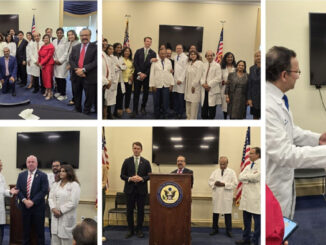
WASHINGTON, D.C. (TIP): The American Association of Physicians of Indian Origin (AAPI) presented to the United States lawmakers some of the major concerns of the Indian-American community, particularly those affecting the physicians fraternity during the annual Legislative Day on Capitol Hill, Washington, D.C., on May 7-8, 2025.
Dr. Satheesh Kathula, President of AAPI said, “Healthcare continues to be the center of the nation’s focus, especially with changes in policies on Immigration, Medicare/Medicaid, and Medical Education. AAPI’s annual Legislative Day has become a vital part of AAPI’s growing influence and has its united voice heard in the corridors of power.”
“AAPI has been seeking to collectively shape the best health care for the people of US, with the physician at the helm, caring for the medically underserved as we have done for several decades when physicians of Indian origin came to the US in larger numbers,” said Dr. Deepak Kumar, Chair of AAPI Legislative Affairs Committee.
Dr. Kathula along with other AAPI leaders presented before the lawmakers, key issues that affect the delivery of healthcare in the issues in the US. “Fixing Medicare reimbursement cuts, reforming prior authorization processes, addressing scope of practice concerns, fast-tracking green cards for H-1B visa holders, securing equitable Telemedicine payments, and proposing amendments to the Stark Law” were some of the issues AAPI highlighted in their meetings with the lawmakers.
Attended by several Congressmen and Senators from both the major political parties, the event held at the Rayburn House Office Building on Capitol Hill, Washington, DC had dozens of AAPI members from across the nation, who during the interactive sessions with the lawmakers shared their concerns with the current healthcare delivery system and for the need to bring about the much-needed changes.
In a show of support for AAPI, Indian American House members, Reps. Ami Bera, D-California, Raja Krishnamoorthi, D-Illinois, Rep. Suhas Subramanyam, D-Virginia, and Sri Thanedar, D-Michigan were among those who addressed the AAPI delegates and listened to their concerns and promised support.

Some of the other lawmakers who addressed Legislative Day included: Rep. Rich McCormick from GA; Rep. Frank Mrvan from Indiana, and Rep. Dave Taylor from OH. AAPI delegates met with Sen. John Boozman from AR, Sen. Bernie Moreno (OH), and Sen. Jon Ossoff from GA. All of them expressed their appreciation for AAPI for their advocacy and contributions to the US healthcare and promised to take on the issues affecting the healthcare system and work toward creating an efficient system that serves the needs of the patients and physicians.
AAPI addressed critical issues for physicians before lawmakers. The legislators responded positively, and we are encouraged by the momentum. AAPI’s advocacy on these critical topics will remain ongoing,” Dr. Vidya Kora, Co-Chair of AAPI Legislative Affairs Committee.
AAPI’s lobbying efforts on some of the issues affecting the broader Indian American community, particularly in the context of the Indo-Pak tensions, sought the support from the lawmakers to stand with India as it works with the larger world community to root out terrorism from the face of the earth.
“AAPI is once again in the forefront in bringing many burning health care issues facing the community at large and bringing this to the Capitol and to the US Congress,” said Dr. Sudhir Parikh, Co-Chair of AAPI Legislative Affairs Committee. Dr. Parikh expressed appreciation to all “AAPI colleagues who attended this event and ensured that our concerns and needs are heard by our lawmakers and ensure that they act on them.”
“AAPI Legislative Day has been a flagship annual event that rekindles and renews our energy in bringing up the issues that we need to bring to the attention of national policy makers and leaders of the US Congress on Capitol Hill,” said Dr. Amit Chakrabarty, president-elect of AAPI. “AAPI continues to discover her potential to be a player in shaping the healthcare of each patient with a focus on health maintenance rather than disease intervention.”
“It is a tradition for nearly four decades, which has brought many important transformations in National Healthcare policies that have helped Physicians of Indian Origin. Now, it is the need of the day to renew our friendship with new leadership and brief the Congressional leadership on issues that are important to us,” Dr. Hetal Gor, AAPI BOT Chair-Elect, said.
Dr. Meher Medavaram, Vice President of AAPI said pointed out: “The US is currently experiencing a physician shortage, which will be exacerbated by retiring baby boomers, affecting thousands of patients’ access to a physician, and ultimately the health care they need. In advocating for critical reforms in healthcare, AAPI’s role has come to be recognized as vital among members and among lawmakers. ”
AAPI members told the lawmakers how important it was to increase the number of residency positions to address the upcoming physician shortage. This includes providing opportunities for all qualified doctors of Indian origin to secure residency slots and the opportunity to become fully trained to practice medicine.
Dr. Soumya Neravetla, Treasurer-Elect of AAPI said, “Through Legislative Day, we are building a strong foundation for future advocacy and legislative successes at both the federal and state level. The presence of several lawmakers from both parties is a testament to the strength of AAPI’s reputation as strong leaders, with our physicians proudly serving as health care providers in all 50 states.”
The AAPI delegation also met with His Excellency Vinay Kwatra, the Indian Ambassador to the U.S., to brief him on AAPI’s initiatives in India and explore avenues for future collaboration with the Indian government. They took this opportunity to strongly condemn the recent terrorist attacks in Pahalgam, extending our deepest condolences to the families of the victims and reaffirming our full support to the Indian government in its efforts to bring the perpetrators to justice.
The growing influence of doctors of Indian heritage is evident, as increasingly physicians of Indian origin hold critical positions in healthcare, academic, research, and administrative positions across the nation. With their hard work, dedication, compassion, and skills, they have thus carved an enviable niche in the American medical community.
“To be a player in crafting the delivery of health care most efficiently and to strive for equality in health globally, the annual Legislative Day was a perfect way to impact Healthcare policy and programs most effectively. Come and join us on Capitol Hill,” Dr. Kathula said.

Dr. Klathula expressed his heartfelt thanks go to the Legislative Committee, Executive Committee, Board of Trustees, and all AAPI members and leaders who traveled from across the country to participate in and contribute to the success of this important event.“Your dedication and commitment continue to strengthen our voice on Capitol Hill,” Dr. Kathula said. “We had a very fruitful discussion, and we are very hopeful that Congress will act on the issues raised in our white paper,” Dr. Kathula, summarized the daylong event and the impact it has for the future of the growing Indian American community, healthcare providers and the healthcare delivery. For more information on AAPI and its programs and initiatives, please visit: www.aapiusa.org
(Based on a press release issued by Ajay Ghosh) -

Vidya Jyoti’s “Vibrant India” Cultural Festival Illuminates Chicago with Rich Traditions, Colorful Performances, and Community Spirit
CHICAGO, IL (TIP): There are some events that entertain, others that inspire and then there are those rare, radiant moments, where joy and purpose run together in harmony. April 27, 2025 on a Sunday afternoon, Vidya Jyoti Global Education Opportunity Foundation hosted the Vibrant India Cultural Festival at Ashton Place in Chicago, Illinois.
From the moment the guests stepped through the doors, they were swept into a celebration of Indian heritage, creativity, and most importantly: hope. The festival, free and open to the public, pulsed with color and life. It was hosted with charm and energy by two MC’s Neha Sobti and Priyanka Parekh, who guided the audience through an unforgettable journey. The show opened with an upbeat hip hop performance blending rhythm and youthfulness. As the day unfolded, the stage bloomed with a variety of dances: elegant ballet, vibrant Garba, classical Indian sequences, and children twirling in joyful abandon. Groups such as Suhani Dance Academy, Ghunguru School, and Four Stars Dance Group left audiences spellbound.
At the heart of it all was Vidya Jyoti’s powerful purpose: to educate underprivileged children across India, the U.S., and Haiti. The founder Pratibha Jairath spoke passionately, presenting stories of transformation. One such story was of Radhika, an orphaned child who, because of Vidya Jyoti’s support, is now scoring over 80% (A grade) in school. “We are not just giving money,” said Pratibha, her voice thick with emotion. “We are giving dignity. We are building futures.”Then came the two fashion walks, a moment where grace met pride. Dressed in stunning saris, lehengas, and Indo-western fusion wear, participants of all ages took to the runway in two dynamic segments. The fashionistas for the evening were: Swati Kukian, Suparna Dutta, Shree Guruswamy, Shraddha Marathe, Shalaka Sawant, Sara Bongale, Sakshi Sharma, Renuka, Pika Munshi, Nidhi Mishra, Neelam Aloor, Manisha Pandit, Kitkat shah, Falguni Sukhadia, Fal Rana, Deepti Gupta, Bharathi Devathi, Alli Dhanaraj.
In the Title Walk, finalists were judged not only on style, but voice and purpose. When Rihanna Tandon and Archana Pantraffan stepped forward as winners, their poise and eloquence gave everyone chills. The judges Sanskriti Sharma, Sushma Bhanot, and Archana Agarwal beamed with pride.
A moving highlight of the afternoon was the recognition of community champions by Pratibha Jairath and co-founder Madhu Uppal. With the support of Mayor John Leash of Aurora and Alderwoman Shweta Baid, Vidya Jyoti presented Plaques to Vidya Jyoti sponsors, Sunil Shah, Pinky Dinesh Thakkar, Sudhir Agarwal, Brij Sharma, Dr. Ashok Mehta, Bill Lyon, Ramesh Mehra, Dr. Bhupinder Beri. Plaques were also presented to Prem Sharma, Urmil Chawla for their vision and leadership, and to Anita Beri & Sarita Sood for their dedication to Vidya Jyoti.
Recognitions and tokens of appreciation were presented to community heroes; the people whose silent efforts light the path for others. The honorees included Ramesh Malhan, Vipin Wadhera, Balbeer Kaur, Pramila Malhotra, Anu Malhotra, Ram Saini, Anita Rawal Subhash Pandey, Anurag Misra, Jayanti Oza, Atul Wahi, Rosey Bhasin, Krishna Chitturi, Nikhil Shah and Uma Kartiki. Their highlights were also presented on a video screen as they were called, by Vidya Jyoti’s technical director Shivam Viswanathan.
Around the hall, food and shopping booths added flavor and flair to the event. Guests nibbled on savory chaats, sweets, and home-style meals. The effort of vendor booths was coordinated by a team led by Anita Beri, Sarita Sood, Shree Gurusamy, Alka Sood and Preeti Chawla. Colorful stalls offered handwoven jewelry, textiles, and gifts with their own story.
Advisory Board member Dr. Bhupinder Beri echoed the emotions in his powerful appeal, “We are fortunate because someone once invested in our education. For just $30 a month or a dollar a day, we can offer a child that same gift. Let’s make giving a habit, not a moment.” Ashok Potdar, a dedicated and passionate director of organization, reminded the audience that “Knowledge is the only wealth that cannot be stolen.” The room fell silent, then rose to applause. Another passionate advisory member, Ramesh Mehra had another powerful appeal to help folks understand the mission of Vidya Jyoti.
The two raffle draws, including a grand prize of $250, kept the energy high throughout. It was time for the final performance, a full-on Garba circle that united young and old, like the community had become one beating heart, dancing together.
As the event drew to a close, Pratibha took the mic one last time. Her words were soft but strong. “Vidya Jyoti started with a dream in India. Today, we are helping schools in the U.S., in Haiti, and beyond. Because when we educate a child, we educate generations.”
“This was more than a cultural event. It was a radiant expression of humanity’s best. Vidya Jyoti is not just teaching children they are awakening possibilities” said by Suresh Bodiwala, Chairman of Asian Media USA
Vidya Jyoti, through this colorful and impactful celebration, reaffirmed its mission: to educate, empower, and inspire through unity and cultural pride. For more information, sponsor a child or to get involved, visit www.vidya-jyoti.com.
(Photograph and Press release by Asian Media USA) -

Tanishq Opens Seventh U.S. Store in Santa Clara, Showcasing Indian Heritage in the Heart of Silicon Valley
SANTA CLARA, CA (TIP) : Tanishq, India’s most trusted fine jewelry brand, has expanded its U.S. presence with the opening of its flagship store in Santa Clara, California. Located at 3406 El Camino Real, the spacious 5,100 sq. ft. showroom, the brand’s largest in the country—opened its doors on March 18 and celebrated its Bay Area debut with a vibrant grand opening on May 8.
The celebration featured a traditional lamp-lighting ceremony, ribbon cutting, and a soulful musical performance, giving guests a glimpse into the rich cultural heritage and modern elegance that define the brand. Santa Clara Mayor Lisa M. Gillmor joined community leaders, families, and jewelry enthusiasts from across the region—underscoring Tanishq’s deepening connection with the South Asian diaspora and beyond.
Nestled in Silicon Valley’s thriving and diverse South Asian community, Santa Clara was a natural choice for Tanishq’s newest U.S. home. With growing demand for high-quality craftsmanship rooted in heritage, the Bay Area welcomed Tanishq’s signature blend of tradition and innovation. Inside the new showroom, guests can explore thousands of intricately crafted gold and diamond pieces—ideal for celebrating weddings, festivals, family milestones, and everyday elegance. Signature collections such as Rhythms of Rain, Tales of Mystique, and Enchanted Trails offer timeless designs that speak to both generational memories and modern sensibilities.

The inner view of the store “Opening our flagship store in Santa Clara marks an exciting chapter in our U.S. journey,” said Amrit Pal Singh, Business Head – North America, Titan Company Limited. “The Bay Area houses a dynamic South Asian community that values culture, innovation, and design—core to everything we do. We’re proud to bring our heritage of craftsmanship to California and look forward to becoming part of the local story—offering jewelry that bridges tradition with modern elegance.”
With its newest store, Tanishq reaffirms its commitment to serving the South Asian diaspora while welcoming all who appreciate the elegance of Indian fine jewelry. Each Tanishq store across the U.S. offers a luxurious, culturally immersive experience that honors the past, celebrates the present, and inspires future generations.
About Tanishq
Tanishq, India’s most beloved jewelry brand from the TATA Group, has been redefining luxury jewelry for over two decades by seamlessly blending tradition with contemporary style. With more than 400 retail stores across India, North America, the Middle East, and the Far East, Tanishq has become a global symbol of elegance and craftsmanship. In the U.S., Tanishq continues its rapid expansion, now with seven stores open in New Jersey, Houston, Dallas, Chicago, and more recently, Seattle, Atlanta & Santa Clara. For more information visit Tanishq.com. -

U.S. Supreme Court could block Trump’s birthright citizenship order but limit nationwide injunctions
The U.S. top court debates Trump’s birthright citizenship restrictions, nationwide injunctions, and potential impact on immigration laws
WASHINGTON, D.C. (TIP): The U.S. Supreme Court seemed intent on Thursday, May 15, 2025, on maintaining a block on President Donald Trump’s restrictions on birthright citizenship while looking for a way to scale back nationwide court orders.
It was unclear what such a decision might look like, but a majority of the court expressed concerns about would happen if the Trump administration were allowed, even temporarily, to deny citizenship to children born to people who are in the United States illegally.
The justices heard arguments in the Trump administration’s emergency appeals over lower court orders that have kept the citizenship restrictions on hold across the country.
Nationwide injunctions have emerged as an important check on Mr. Trump’s efforts to remake the government and a source of mounting frustration to the Republican president and his allies.
Judges have issued 40 nationwide injunctions since Mr. Trump began his second term in January, Solicitor General D. John Sauer told the court at the start of more than two hours of arguments.
Birthright citizenship is among several issues, many related to immigration, that the administration has asked the court to address on an emergency basis.
The justices also are considering the Trump administration’s pleas to end humanitarian parole for more than 500,000 people from Cuba, Haiti, Nicaragua and Venezuela and to strip other temporary legal protections from another 350,000 Venezuelans. The administration remains locked in legal battles over its efforts to swiftly deport people accused of being gang members to a prison in El Salvador under an 18th century wartime law called the Alien Enemies Act. Mr. Trump signed an executive order on the first day of his second term that would deny citizenship to children who are born to people who are in the country illegally or temporarily.
The order conflicts with a Supreme Court decision from 1898 that held that the Citizenship Clause of the 14th Amendment made citizens of all children born on U.S. soil, with narrow exceptions that are not at issue in this case.
States, immigrants and rights group sued almost immediately, and lower courts quickly barred enforcement of the order while the lawsuits proceed.The current fight is o ver the rules that apply while the lawsuits go forward.
The court’s liberal justices seemed firmly in support of the lower court rulings that found the changes to citizenship that Mr. Trump wants to make would upset the settled understanding of birthright citizenship that has existed for more than 125 years.
Birthright citizenship is an odd case to use to scale back nationwide injunctions, Justice Elena Kagan said. “Every court has ruled against you,” she told Sauer.
If the government wins on today’s arguments, it could still enforce the order against people who haven’t sued, Kagan said. “All of those individuals are going to win. And the ones who can’t afford to go to court, they’re the ones who are going to lose,” she said.
Justice Ketanji Brown Jackson described the administration’s approach as “catch me if you can,” forcing everyone to file suit to get “the government to stop violating people’s rights.”
Several conservative justices who might be open to limiting nationwide injunctions also wanted to know the practical effects of such a decision as well as how quickly the court could reach a final decision on the Trump executive order.
Is Trump’s order on birthright citizenship constitutional? | Explained
Justice Brett Kavanaugh pressed Sauer with a series of questions about how the federal government might enforce Mr. Trump’s order.
“What do hospitals do with a newborn? What do states do with a newborn?” he said.
Sauer said they wouldn’t necessarily do anything different, but the government might figure out ways to reject documentation with “the wrong designation of citizenship.”
Kavanaugh continued to push for clearer answers, pointing out that the executive order gave the government only about 30 days to develop a policy. “You think they can get it together in time?” he said.
The Trump administration, like the Biden administration before it, has complained that judges are overreaching by issuing orders that apply to everyone instead of just the parties before the court.
Picking up on that theme, Justice Samuel Alito said he meant no disrespect to the nation’s district judges when he opined that they sometimes suffer from an “occupational disease which is the disease of thinking that ‘I am right and I can do whatever I want’.” But Justice Sonia Sotomayor was among several justices who raised the confusing patchwork of rules that would result if the court orders were narrowed and new restrictions on citizenship could temporarily take effect in more than half the country.
Some children might be “stateless,” Sotomayor said, because they’d be denied citizenship in the U.S. as well as the countries their parents fled to avoid persecution.
22 States sue to stop Trump’s order blocking birthright citizenship
New Jersey Solicitor General Jeremy Feigenbaum, representing 22 states that sued, said citizenship could “turn on and off” for children crossing the Delaware River between Camden, New Jersey, where affected children would be citizens, and Philadelphia, where they wouldn’t be. Pennsylvania is not part of the lawsuit.
One possible solution for the court might be to find a way to replace nationwide injunctions with certification of a class action, a lawsuit in which individuals serve as representatives of a much larger group of similarly situated people. Such a case could be filed and acted upon quickly and might even apply nationwide.
But under questioning from Justice Amy Coney Barrett and others, Sauer said the Trump administration could well oppose such a lawsuit or potentially try to slow down class actions.
Supreme Court arguments over emergency appeals are rare. The justices almost always deal with the underlying substance of a dispute. But the administration didn’t ask the court to take on the larger issue now and, if the court sides with the administration over nationwide injunctions, it’s unclear how long inconsistent rules on citizenship would apply to children born in the United States.
A decision is expected by the end of June.
(Agencies) -

U.N. cuts India’s 2025 growth forecast to 6.3% from 6.6%, in line with slowing global growth
UNITED NATIONS (TIP): The United Nations has lowered its growth projections for India for this year and the next, to 6.3% and 6.4%, respectively. These are both 0.3 percentage points lower than its earlier projections. This is also in line with the slower growth projected for the global economy due to heightened trade tensions and with policy uncertainty. The U.N.’s mid-year update of its World Economic Situation and Prospects 2025 report released on Friday (May 16, 2025) has projected global growth to slow to 2.4% in calendar year 2025 and to 2.5% in 2026, both of which are lower by 0.4 percentage points than the projections made in January.
IMF’s April Outlook projects India to become fourth largest economy in 2025.
For India, as well, the data is based on calendar years rather than financial years, which is what India uses. The report also noted that, despite uncertainties on account of trade and tariff discussions, India can remain reasonably resilient.
“Despite a projected moderation, India remains one of the fastest-growing large economies, supported by resilient consumption and government spending,” the report noted.
The report also noted that “robust services exports” will also support economic growth. This is in line with the latest government data as well. According to data released by the Ministry of Commerce and Industry on Thursday, while India’s merchandise trade deficit widened in April, so did its services trade surplus — basically meaning that services exports were extending their lead over services imports.
“While looming United States tariffs weigh on merchandise exports, currently exempt sectors—such as pharmaceuticals, electronics, semiconductors, energy, and copper—could limit the economic impact, though these exemptions may not be permanent,” it added.
World Bank lowers India’s FY26 growth forecast to 6.3%. The report further said that unemployment in India “remains largely stable amid steady economic conditions” but highlighted persistent gender disparities in employment and the need for greater inclusivity in workforce participation.
“In India, inflation is projected to slow from 4.9% in 2024 to 4.3% in 2025, staying within the central bank’s target range,” the report added.
On global growth, the United Nations portrayed a dismal picture, saying that the global growth outlook “has deteriorated significantly” since the January 2025 forecast.
“Sweeping United States tariff announcements and counter-announcements, along with heightened policy uncertainty have eroded global growth prospects, already weaker than the pre-pandemic trend due to high debt levels, sluggish productivity growth and geopolitical tensions,” it said.
Fitch cuts India growth estimates by 10 bps to 6.4% amid escalations in global trade war
It further said that declining consumer and business confidence, increased financial market volatility, and potential disruptions in manufacturing and supply chains are weighing on economies worldwide.
-

Trump wraps up Mideast tour with a visit to interfaith place of worship
President Donald Trump arrived in the United Arab Emirates Thursday, May 15, for the last leg of his first major foreign trip.
ABU DHABI (TIP): U.S. President Donald Trump wrapped up a Mideast tour in the United Arab Emirates with a breakfast for business leaders and a visit to an interfaith place of worship named for the Abraham Accords he negotiated. As part of the accords, the UAE and some other countries in the Middle East recognized Israel. Mr. Trump then left Abu Dhabi after his visit to the Abrahamic Family House .
During his visit to the region, violence flared in the West Bank, with more than 120 people being killed in Gaza.
Trump says the U.S. and Iran have ‘sort of’ agreed on the terms for a nuclear deal
President Donald Trump arrived in the United Arab Emirates Thursday , May 15, for the last leg of his first major foreign trip. Air Force One was given a fighter jet escort into the country’s airspace, just as Saudi Arabia and Qatar offered on the first stops of his Mideast trip.
Mr. Trump was greeted by UAE President Sheikh Mohammed bin Zayed Al Nahyan and later headed to the Sheikh Zayed Grand Mosque — among the largest mosques in the world. He also attended a state dinner at the presidential palace in Abu Dhabi. The U.S. President walked out of the palace with Sheik Mohammed after dinner. They shook hands, and then Mr. Trump stepped into his limousine.
(Source: AP) -

NJ Transit strike begins, halting all trains across N.J.
NEWARK, NJ (TIP): NJ Transit engineers announced late Thursday, May 15 evening, that contract negotiations between the union and the transit agency failed to reach an agreement and that the union was going on strike. NJ Transit and the Brotherhood of Locomotive Engineers and Trainmen had been negotiating up until the deadline.
The Brotherhood of Locomotive Engineers and Trainmen announced the move shortly after 11 p.m. Thursday.
The primary demand of NJ Transit train engineers is fair compensation, including a wage increase that would bring their salaries on par with those of engineers at other major railroads. Specifically, the Brotherhood of Locomotive Engineers and Trainmen (BLET) is seeking a contract that would raise the average annual salary of a train engineer from $135,000 to at least $190,000, while NJ Transit has offered a raise that would bring the average to $172,000. The union also wants the agreement to include fair working conditions and pay.
The transit agency’s chief executive, Kris Kolluri, has repeatedly said that it cannot afford the pay increases the union is demanding.The union said they would get back to the negotiating table on Sunday morning and pick up where they left off.
-

Dr. Manoj Kumar Mohapatra designated India’s Ambassador to Romania
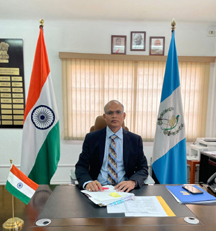
NEW YORK (TIP): Ambassador Dr. Manoj Kumar Mohapatra, currently India’s Ambassador to Guatemala, El Salvador and Honduras, has been designated Ambassador to Romania. He is expected to take charge in mid-July.
Dr. Mohapatra is a 2000 batch Indian Foreign Service (IFS) officer. He was posted as the Ambassador of India to Guatemala in December 2021. His earlier postings have been Minister (Commerce), Embassy of India, Washington, July 2019-2021; Joint Secretary, Ministry of External Affairs, New Delhi, 2017-2019; Deputy Consul General, Consulate General of India, New York, 2014-2017; Counsellor, Embassy of India, Dhaka, 2013-2014; First Secretary, Embassy of India, Dhaka, 2011-2013; First Secretary, Embassy of India, Budapest, 2007-2011; Under Secretary handling relations with Bangladesh in Ministry of External Affairs, 2006- 2007; Third Secretary / Second Secretary, Embassy of India, Berlin, 2002-2006. Dr. Mohapatra holds a master’s in veterinary science (M.V.Sc.) and a Post Graduate Diploma in Business Management (PGDIBM).
He is married to Mrs. Jyotirmayee Mohapatra, and they have two Children, Ms. Suhani Mohapatra and Rohan Mohapatra. Ambassador Mohapatra likes reading and travelling.
-
Sri Lanka to monitor bus drivers with AI after worst crash in decades
COLOMBO (TIP): Sri Lanka will use artificial intelligence to monitor bus drivers and make seat belts mandatory on public transport, a government minister said on Wednesday, after the country’s worst bus crash in two decades killed 23 people. The South Asian nation, which records an average of 3,000 road fatalities annually, has some of the most dangerous roads in the world.
Buses are to be equipped with driver monitoring systems from next year, while seat belts will become compulsory on public transport from June, Transport Minister Bimal Rathnayake told reporters in Colombo.
It came after an overcrowded bus carrying dozens of Buddhist pilgrims plummeted into a precipice on Sunday.
The changes are aimed at “educating motorists to develop a better driving culture and improving safety standards”, Rathnayake said.
“We are going to make AI-backed driver observation systems mandatory on all buses from next year, and we will expand them to all long-distance trucks as well.”
The minister said the cause of Sunday’s crash in the tea-growing mountainous region of Kotmale was still being investigated, but that two more passengers had died, raising the toll to 23.
Fifty-four passengers were admitted to hospital, Rathnayake said, adding that preliminary inquiries had found no immediate indication of driver error.
Another driver had reported a problem with the bus’s steering wheel the day before, but managers said it was attended to.
Sunday’s crash off a cliffside road was the deadliest recorded in Sri Lanka since April 2005.
The state-owned bus was carrying around 77 passengers — about 20 more than its capacity.
In March 2021, 13 passengers and the driver of a privately owned bus died when the vehicle crashed into a precipice in Passara, about 100 kilometres (62 miles) east of the site of Sunday’s crash. (AFP) -
Military ops against India was designed under supervision of Nawaz Sharif, claims Pak minister
LAHORE (TIP): A senior leader of the ruling Pakistan Muslim League-Nawaz (PML-N) on Wednesday claimed that the military operation against India was designed under the supervision of the party president Nawaz Sharif.
Nawaz, the former three-time premier and elder brother of Prime Minister Shehbaz Sharif, had congratulated Pakistan’s civil and military leadership soon after the two countries reached an understanding on Saturday to end the conflict after four days of intense cross-border drone and missile strikes.
“The whole operation against India was designed under the supervision of former prime minister and PML-N chief Nawaz Sharif,” Pakistan’s Punjab province Information Minister Azma Bukhari claimed.
She said Nawaz is not a leader of “a, b, c, d type”, rather his work speaks for himself.
“It was Nawaz Sharif who made Pakistan a nuclear power and now designed the whole operation against India,” the minister claimed.
India carried out precision strikes under ‘Operation Sindoor’ on terror infrastructure in Pakistan and Pakistan-occupied Kashmir early on May 7 in response to the April 22 Pahalgam terror attack.
Following the Indian action, Pakistan attempted to attack Indian military bases on May 8, 9 and 10.
Nawaz had been advocating for a diplomatic solution to the rising tensions with India.
“Pakistan is a peace-loving country and prefers peace, but also knows how to defend itself,” Nawaz said in a post on X on Saturday.
“Thanks be to Allah Almighty for making Pakistan proud. I congratulate the Prime Minister of Pakistan, Shahbaz Sharif, the Chief of Army Staff, General Syed Asim Munir, the Chief of Air Staff, Air Chief Marshal Zaheer Sindhu, and the armed forces of Pakistan,” he said.
Nawaz was the prime minister of Pakistan during the Kargil war of 1999. (PTI) -
Bangladesh’s interim government strips former ruling party of registration, barring it from polls
DHAKA (TIP): Bangladesh’s Election Commission has cancelled the registration of the former ruling party of ousted Prime Minister Sheikh Hasina, preventing it from participating in the next national election, which is expected to be held by June next year. The decision on Monday came hours after the country’s interim government headed by Nobel Peace Prize laureate Muhammad Yunus issued an official notification banning the Awami League party and its affiliated bodies from conducting activities online and elsewhere.
Monday’s formal notification from the Ministry of Home Affairs was issued two days after the interim Cabinet decided to ban all activities of the party under the country’s Anti-Terrorism Act until a special tribunal concludes a trial for the party and its leaders.
In the notification, the government said it outlawed all activities “including any kind of publication, media, online and social media” as well as “any kind of campaign, procession, meeting, gathering (or) conference until the trial of the leaders and activists … is completed.”
It said the decision was effective immediately.
Separately, the Election Commission said Monday it would not allow the Hasina-led party to contest the next election. Political parties must be registered with the Election Commission to take part in elections.
A government adviser said Monday that anyone who posts comments online in support of the Awami League party would face arrest.
On Sunday, the Awami League accused the interim government of “stoking division” and trampling on “democratic norms” by banning its activities. It said in a statement that the ban “stoked division within society, strangled democratic norms, fueled ongoing pogrom against dissenters and strangled inclusivity, all undemocratic steps.”
The Awami League is one of two major parties in Bangladesh, which has a fractious parliamentary democracy with a violent history of coups and political assassination.
Hasina, the daughter of Bangladesh’s independence leader Sheikh Mujibur Rahman, fled the country on Aug. 5 last year and has been in exile in India since then along with many senior party colleagues and former Cabinet minsters and lawmakers. They have been accused of killing protesters during an uprising against Hasina’s 15-year rule in July-August last year.
The United Nations human rights office said in a report in February that up to 1,400 people may have been killed during three weeks of anti-Hasina protests. The Awami League, which led a nine-month war against Pakistan for independence in 1971, has been under severe pressure since Hasina’s ouster. (AP) -

IAEA rejects ‘radiation leak’ rumours at Pakistan nuclear sites after clash with India
Vienna / Islamabad (TIP): The International Atomic Energy Agency (IAEA) on Thursday confirmed that no radiation leak or release has occurred from any nuclear facility in Pakistan, following speculation that Indian airstrikes under ‘Operation Sindoor’ may have targeted sensitive installations.
“Based on information available to the IAEA, there has been no radiation leak or release from any nuclear facility in Pakistan,” a spokesperson for the agency said in a statement issued in response to queries.
The IAEA’s clarification comes days after unverified claims circulated on social media suggesting that India’s armed forces had struck Kirana Hills, an area in Pakistan reported to house nuclear infrastructure.
These allegations emerged after India launched coordinated military strikes on May 7 in response to the April terror attack in J&K’s Pahalgam, that killed 26 civilians, including a Nepali national.
Notably, India has rejected claims that it targeted nuclear sites.
Air Marshal AK Bharti, Director General of Air Operations, told reporters on May 12, “We have not hit Kirana Hills, whatever is there.”
When asked about the location, he added, “Thank you for telling us that Kirana Hills houses some nuclear installation, we did not know about it.”
India’s strikes targeted airbases in Sargodha and Nur Khan, as well as other military sites across Pakistan and Pakistan-occupied Kashmir, damaging radar systems, communication facilities, and airfields, according to Indian officials.
Meanwhile, Union Defence Minister Rajnath Singh on Thursday said that Pakistan’s nuclear weapons should be brought under the supervision of the IAEA as they are not safe in such a rogue nation.
The defence minister’s comments came days after Prime Minister Narendra Modi said India would not tolerate “nuclear blackmail” by Pakistan and would punish cross-border terrorism strongly.
Similarly, External Affairs Ministry Spokesperson Randhir Jaiswal dismissed US President Donald Trump’s comments suggesting that Washington had helped avert a nuclear confrontation between India and Pakistan.
He said India’s military operations were “in the conventional domain” and rejected suggestions of a nuclear escalation.
Trump had earlier claimed, “We stopped a nuclear conflict. I think it could have been a bad nuclear war. Millions of people could have been killed.”
Tensions between India and Pakistan began to de-escalate following an understanding on the cessation of hostilities reached on May 10. (AFP) -

China says ready to ‘expand practical cooperation’ with Russian army
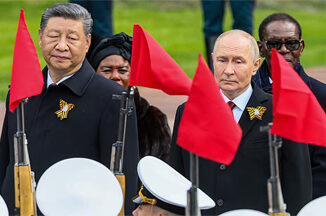
BEIJING (TIP): China said Thursday it was ready to “expand practical cooperation” with the Russian army, after President Xi Jinping’s recent visit to Moscow for a lavish World War II Victory Day parade.
The two countries have drawn closer in recent years, including since Moscow launched a full-scale invasion of Ukraine in 2022.Xi’s trip to Russia last week drew ire from Kyiv’s allies, who have accused Beijing of giving Moscow economic and political cover to wage a war of aggression. Beijing says it is a neutral party to the conflict and has made indefatigable efforts for peace.On Thursday, in response to a question linked to Xi’s visit asking how China would promote military-to-military ties with Russia, the defence ministry said the relationship was “operating at a high level.”
“The Chinese military stands ready to work with the Russian side to further deepen strategic mutual trust, step up strategic communication, and expand practical cooperation,” defence ministry spokesman Jiang Bin said in a response posted to social media platform WeChat.
The moves would “enrich the content of China-Russia comprehensive strategic partnership of coordination for a new era”, Jiang said.
He added that they would also “contribute to maintaining and strengthening global strategic stability.”
After a lengthy meeting with President Vladimir Putin on his trip, Xi said China’s ties with Russia brought “positive energy” to a turbulent world. He added that both nations stood firm against “hegemonic bullying” — an apparent swipe at the United States.
Putin, for his part, told reporters he and Xi had held “traditionally warm, friendly” talks and addressed the Chinese leader as his “dear friend.” (AFP) -

Poland votes for new president on May 18 as worries grow about its future
WARSAW (TIP): A war next door in Ukraine.Migration pressure at borders. Russian sabotage across the region. Doubts about the US commitment to Europe’s security. In Poland’s presidential election Sunday, security looms large. So do questions about the country’s strength as a democracy and its place in the European Union. One of the new president’s most important tasks will be maintaining strong ties with the United States, widely seen as essential to the survival of a country in an increasingly volatile neighborhood.
A crowded field, a likely runoff
Voters in this Central European nation of 38 million people will cast ballots to replace conservative incumbent Andrzej Duda, whose second and final five-year term ends in August.
With 13 candidates, a decisive first-round victory is unlikely. Some have appeared unserious or extreme, expressing openly pro-Putin or antisemitic views. A televised debate this week dragged on for nearly four hours. There are calls to raise the threshold to qualify for the race.
A runoff on June 1 is widely expected, with polls pointing to a likely showdown between Rafal Trzaskowski, the liberal mayor of Warsaw, and Karol Nawrocki, a conservative historian backed by the Law and Justice party, which governed Poland from 2015 to 2023.
Poland’s geography gives the election added importance. Bordering Russia’s Kaliningrad exclave, Belarus and war-torn Ukraine — as well as several Western allies — Poland occupies a critical position along NATO’s eastern flank and serves as a key logistics hub for military aid to Ukraine.
Fears are rising that if Russia prevails in its full-scale invasion of Ukraine, it could target other countries that freed themselves from Moscow’s control some 35 years ago. Against that backdrop, the election will shape Warsaw’s foreign policy at a moment of mounting strain on trans-Atlantic unity and European defense.
Both leading candidates support continued US military engagement in Europe. Trzaskowski puts greater emphasis on deepening ties with the European Union, while Nawrocki is more skeptical of Brussels and promotes a nationalist agenda.
When Law and Justice held power, it repeatedly clashed with EU institutions over judicial independence, media freedom and migration.
Why the presidency matters
While Poland is a parliamentary democracy, the presidency wields significant influence. The president serves as commander-in-chief, holds veto power, shapes foreign policy and plays a symbolic role in national discourse.
Under Duda, the office largely advanced the conservative agenda of Law and Justice. Since Prime Minister Donald Tusk’s centrist coalition came to power in late 2023, Duda has blocked key reforms aimed at restoring judicial independence and repairing relations with the EU. (AP) -
Thailand cops arrest man for smuggling ‘critically endangered’ baby orangutans
BANGKOK (TIP): Thai police have arrested a man suspected of smuggling two baby orangutans into the kingdom, they said Thursday, in a case linked to an international wildlife trafficking network.
The 47-year-old suspect was detained on Wednesday evening at a petrol station in a residential district of Bangkok while preparing to hand over the animals to a customer, police said in a statement.
Two infant orangutans — one about a year old, the other just one month — were found in a plastic basket wearing diapers, with a feeding bottle beside them, according to photos released by police.
The arrest followed a joint investigation with the US Fish and Wildlife Service and United Nations Office on Drugs and Crime (UNODC).
Orangutans, native to Borneo and Sumatra, are classified as Critically Endangered on the IUCN Red List and protected under the CITES treaty, and are among the most trafficked primates in the world.
Thai police said the apes were believed to have been sold for around 300,000 baht each ($8,900).
The man was charged with “illegal possession of protected wildlife” under Thai law and faces up to four years in prison.
The orangutans, named Christopher and Stefan, were handed over to the Department of National Parks, Wildlife and Plant Conservation for health checks and care to help “rehabilitate their condition.”
Police said the suspect admitted he was hired to deliver the animals, but did not disclose the payment amount.
“We are investigating the larger network,” Kasidach Charoenlap, a police officer with the Central Investigation Bureau, who was part of the investigation told AFP.
Thailand is a major transit hub for wildlife smugglers, who often sell highly prized endangered creatures on the lucrative black market in China, Vietnam and Taiwan. (AFP) -

Ukraine’s Zelenskyy arrives in Turkey for peace talks with Russia, Putin skips meeting
ISTANBUL (TIP): A low-ranking Russian delegation arrived in Istanbul for peace talks with Ukraine, Russian Foreign Ministry spokeswoman Maria Zakharova said Thursday, while a Ukrainian delegation led by President Volodymyr Zelenskyy and including other senior government figures landed in the Turkish capital Ankara.
Russian President Vladimir Putin was not part of the Moscow delegation, according to a list released by the Kremlin Wednesday night, prompting criticism from Western officials that the Kremlin isn’t serious about the peace effort.
Vladimir Medinsky, an aide to Putin, will lead the Russian team that will also include three other senior officials, the Kremlin said. Putin also appointed four lower-level officials as “experts” for the talks.
Earlier this week, Zelenskyy challenged the Russian leader to meet in person in Turkey to talk about ending the more than three-year war. Zelenskyy said he would travel to Ankara to meet with Turkish President Recep Tayyip Erdogan and wait for Putin.
Also in the Ukrainian delegation are Defense Minister Rustem Umerov, Foreign Minister Andrii Sybiha, and the head of the Ukrainian presidential office Andriy Yermak, the official said.
He spoke on condition of anonymity for security reasons as the team had not yet arrived in Ankara.
“Now, after three years of immense suffering, there is finally a window of opportunity,” Turkish Foreign Minister Hakan Fidan said at a NATO meeting taking place separately in Turkey. “The talks in Istanbul hopefully may open a new chapter.”
But Zelenskyy will sit at the table only with Putin, Ukraine’s presidential adviser, Mykhailo Podolyak, said.
Details about whether, when and where the Ukrainian delegation might meet their Russian counterparts are still unclear but is expected to be clarified after Zelenskyy and Erdogan meet, according to a Ukrainian official who requested anonymity to speak openly about the day’s plan.
Tass said that the talks were to take place in a presidential office on the Bosporus. (AFP) -
An Israeli woman on her way to give birth was killed in a West Bank attack
TEL AVIV, Israel (TIP): Tzeela Gez was on her way to the hospital to bring new life into this world when hers was suddenly cut short. As her husband drove their car through the winding roads of the occupied West Bank late Wednesday, a Palestinian attacker shot at them. Within hours, Gez, nine months pregnant, was dead. Doctors barely saved the life of the baby, who is in serious but stable condition.
Israel says it is trying to prevent such attacks by waging a monthslong crackdown on West Bank militants that intensified earlier this year. But the escalating offensive, which has killed hundreds of Palestinians over 19 months, displaced tens of thousands and caused widespread destruction, has ultimately not snuffed out attacks.
And the latest bloodshed is only likely to fuel a cycle of violence that has persisted for decades between Israelis and Palestinians. Israel has pledged to find the attacker, who fled the scene, and the military chief of staff, who visited the area Thursday, told troops that the broader operation would continue alongside the manhunt.
“We will use all the tools at our disposal and reach the murderers in order to hold them accountable,” Lt. Gen. Eyal Zamir said, according to a statement from the military, which said it had sealed Palestinian villages in the area of the attack and set up checkpoints.
The shooting, especially because the victim was a pregnant mother with three other children, has the potential to ignite vigilante violence against Palestinians by radical Jewish settlers. They regularly storm Palestinian towns and villages, burning and damaging property, in response to such attacks. Marauding settlers are rarely held to account for their actions and Palestinians are left to pick up the pieces of the destruction with little recourse to compensation or assistance from Israeli authorities.
Gez, 37, and her husband Hananel, were residents of Bruchin, a settlement of some 2,900 in the northern West Bank. She worked as a therapist and on her Facebook page, shared developments in her professional life as well as her thoughts on the war in Gaza, the fallen Israeli soldiers and the hostages still held by Hamas. Meital Ben Yosef, head of the settlement’s local council, told Israeli Army radio that Gez was “all mother. A mother in her essence.”
“A couple of parents were driving to the happiest moment that a parent can experience and the wife is killed on the way. It’s a horrific incident,” she said. Abu Obeida, spokesman for Hamas’ armed wing, praised the attack as “heroic” in a video statement Wednesday but stopped short of saying the militant group was behind it. (AP)