Month: June 2025

  • TLCA Inaugurates Telugu Bhavanam-A Landmark Cultural Center and a First of Its Kind in the U.S.

    LEVITTOWN, NY(TIP): In a momentous celebration of culture, community, and legacy, the Telugu Literary and Cultural Association (TLCA) proudly inaugurated Telugu Bhavanam, the first-ever Telugu community-owned cultural center in the United States, on May 4th, 2025, at 1 North Village Green, Levittown, NY. This historic milestone marks a new era for the 54-year-old nonprofit, which has served as a steadfast guardian of Telugu heritage for over five decades.
    The inaugural event was a grand affair, attended by a diverse gathering of community members, dignitaries, and elected officials who came together to honor this long-awaited dream come true.
    Chairwoman of the TLCA Board of Trustees, Raji Kuncham, opened the ceremony with heartfelt remarks, warmly welcoming attendees and reflecting on the journey that led to this historic day. “Telugu Bhavanam is more than a building—it’s a symbol of our unity, our perseverance, and our deep commitment to passing on our rich cultural legacy to future generations,” she said. She paid tribute to past Chairmen and Presidents for their foundational leadership and vision, and expressed deep gratitude to all donors and supporters who helped make the dream a reality.
    A highlight of the event was the special recognition of Dr. Mohan Badhey, Senior Life Trustee and visionary philanthropist, whose extraordinary donation of over $500,000 was instrumental in the creation of Telugu Bhavanam. In a deeply meaningful gesture, the new center will bear the name “Narayanswamy and Kamalamma Badhey TLCA Telugu Bhavanam,” honoring Dr. Badhey’s beloved parents and their enduring legacy.
    Congressman Tom Suozzi and Chairwoman Raji Kuncham came together to formally honor Dr. Badhey for his unparalleled contributions to the Telugu community. In a moving tribute, they presented him with a commemorative plaque and acknowledged his decades of service, leadership, and generosity. Congressman Suozzi praised Dr. Badhey as “a shining example of community spirit and cultural stewardship,” and lauded the TLCA for “preserving and promoting Telugu culture with unwavering passion, ensuring that this vibrant tradition continues to flourish for generations to come.”
    Dr. Badhey expressed his joy and pride, stating, “This is a dream come true. I’m incredibly proud that our community now has a permanent home—a place where our culture can thrive, and our future generations can stay connected to their roots.”
    The impressive 12,000-square-foot facility spans two stories and includes ample parking. TLCA has ambitious plans for future development, including a mini auditorium, a library, children’s and youth activity areas, women’s and senior centers, and a full kitchen and dining hall. Chairwoman Kuncham called on the community and public officials for continued support to help realize these exciting next steps.
    The event was further elevated by the presence of esteemed elected officials, including State Senator Steve Rhoads, Assemblyman John Mikulin, Nassau County Legislators Debra Mulé and Seth Koslow, North Hempstead Town Clerk Ragini Srivastava, and representatives from County Executive Bruce Blakeman’s office and the Consul General of India. They echoed the significance of this achievement and commended TLCA for its unwavering commitment to cultural preservation.
    Sumanth Ramsetti, TLCA’s current Executive Committee President, shared his excitement, noting that his team will be the first to utilize Telugu Bhavanam as a dynamic hub for community programs, cultural celebrations, and educational events.
    Also in attendance were leaders from prominent Indian American organizations including IALI, AIA, IAF, Kannada Koota, Tamil Sangam and BAPS underscoring the spirit of unity and shared celebration among South Asian communities.
    TLCA Chairwoman Raji Kuncham reiterated that the Telugu Bhavanam is not just a building—it is a beacon of identity, culture, and collective achievement for the Telugu diaspora in America. TLCA invites all community members to join in shaping the future of this cultural cornerstone.

    Grand donors Dr. and Mrs. Badhey, TLCA Chairwoman Raji Kuncham cutting the ribbon at the ceremony.
    Chairwoman Raji Kuncham, making welcoming and inaugural remarks, along with the Board of Trustees and Executive Committee members.
    Congressman Souzzi, Chairwoman Raji Kuncham along with Board of Trustees and dignitaries honor Dr. Badhey and Mrs. Ratnamala Badhey and family.
    Gracing the inaugural ocassion – Congressman Souzzi, Senator Rhoads, Assemblyman John Mikulin, Legislator Debra Mulé, Legislator Koslow, North Hempstead Town Clerk Ragini Srivastava, and representatives from County Executive Bruce Blakeman’s office and the Consul General of India.
    Community leaders gather getting ready for the inaugural of the TLCA Bhavanam.
    Grand donor Dr. Mohan Badhey expressing joy as the TLCA Bhavanam becomes a reality.
  • TLCA Inaugurates Telugu Bhavanam-A Landmark Cultural Center and a First of Its Kind in the U.S.

    TLCA Inaugurates Telugu Bhavanam-A Landmark Cultural Center and a First of Its Kind in the U.S.

    LEVITTOWN, NY(TIP): In a momentous celebration of culture, community, and legacy, the Telugu Literary and Cultural Association (TLCA) proudly inaugurated Telugu Bhavanam, the first-ever Telugu community-owned cultural center in the United States, on May 4th, 2025, at 1 North Village Green, Levittown, NY. This historic milestone marks a new era for the 54-year-old nonprofit, which has served as a steadfast guardian of Telugu heritage for over five decades.
    The inaugural event was a grand affair, attended by a diverse gathering of community members, dignitaries, and elected officials who came together to honor this long-awaited dream come true.
    Chairwoman of the TLCA Board of Trustees, Raji Kuncham, opened the ceremony with heartfelt remarks, warmly welcoming attendees and reflecting on the journey that led to this historic day. “Telugu Bhavanam is more than a building—it’s a symbol of our unity, our perseverance, and our deep commitment to passing on our rich cultural legacy to future generations,” she said. She paid tribute to past Chairmen and Presidents for their foundational leadership and vision, and expressed deep gratitude to all donors and supporters who helped make the dream a reality.
    A highlight of the event was the special recognition of Dr. Mohan Badhey, Senior Life Trustee and visionary philanthropist, whose extraordinary donation of over $500,000 was instrumental in the creation of Telugu Bhavanam. In a deeply meaningful gesture, the new center will bear the name “Narayanswamy and Kamalamma Badhey TLCA Telugu Bhavanam,” honoring Dr. Badhey’s beloved parents and their enduring legacy.
    Congressman Tom Suozzi and Chairwoman Raji Kuncham came together to formally honor Dr. Badhey for his unparalleled contributions to the Telugu community. In a moving tribute, they presented him with a commemorative plaque and acknowledged his decades of service, leadership, and generosity. Congressman Suozzi praised Dr. Badhey as “a shining example of community spirit and cultural stewardship,” and lauded the TLCA for “preserving and promoting Telugu culture with unwavering passion, ensuring that this vibrant tradition continues to flourish for generations to come.”
    Dr. Badhey expressed his joy and pride, stating, “This is a dream come true. I’m incredibly proud that our community now has a permanent home—a place where our culture can thrive, and our future generations can stay connected to their roots.”
    The impressive 12,000-square-foot facility spans two stories and includes ample parking. TLCA has ambitious plans for future development, including a mini auditorium, a library, children’s and youth activity areas, women’s and senior centers, and a full kitchen and dining hall. Chairwoman Kuncham called on the community and public officials for continued support to help realize these exciting next steps.
    The event was further elevated by the presence of esteemed elected officials, including State Senator Steve Rhoads, Assemblyman John Mikulin, Nassau County Legislators Debra Mulé and Seth Koslow, North Hempstead Town Clerk Ragini Srivastava, and representatives from County Executive Bruce Blakeman’s office and the Consul General of India. They echoed the significance of this achievement and commended TLCA for its unwavering commitment to cultural preservation.
    Sumanth Ramsetti, TLCA’s current Executive Committee President, shared his excitement, noting that his team will be the first to utilize Telugu Bhavanam as a dynamic hub for community programs, cultural celebrations, and educational events.
    Also in attendance were leaders from prominent Indian American organizations including IALI, AIA, IAF, Kannada Koota, Tamil Sangam and BAPS underscoring the spirit of unity and shared celebration among South Asian communities.
    TLCA Chairwoman Raji Kuncham reiterated that the Telugu Bhavanam is not just a building—it is a beacon of identity, culture, and collective achievement for the Telugu diaspora in America. TLCA invites all community members to join in shaping the future of this cultural cornerstone.

    Grand donors Dr. and Mrs. Badhey, TLCA Chairwoman Raji Kuncham cutting the ribbon at the ceremony.
    Chairwoman Raji Kuncham, making welcoming and inaugural remarks, along with the Board of Trustees and Executive Committee members.
    Congressman Souzzi, Chairwoman Raji Kuncham along with Board of Trustees and dignitaries honor Dr. Badhey and Mrs. Ratnamala Badhey and family.
    Gracing the inaugural ocassion – Congressman Souzzi, Senator Rhoads, Assemblyman John Mikulin, Legislator Debra Mulé, Legislator Koslow, North Hempstead Town Clerk Ragini Srivastava, and representatives from County Executive Bruce Blakeman’s office and the Consul General of India.
    Community leaders gather getting ready for the inaugural of the TLCA Bhavanam.
    Grand donor Dr. Mohan Badhey expressing joy as the TLCA Bhavanam becomes a reality.
  • Nirjala Ekadashi: The austerity of devotion, the gateway to liberation

    Nirjala Ekadashi: The austerity of devotion, the gateway to liberation

    In the vast ocean of Sanatana Dharma, Ekadashi stands as an island of purification and spiritual elevation. Each month, on the 11th lunar day, the devotee is offered a divine opportunity to transcend the pull of the material world through fasting, prayer, and surrender to Lord Vishnu.Yet among these luminous days, there is one that blazes with unmatched brilliance—Nirjala Ekadashi, the most austere, the most powerful, and the most sanctifying of them all.Observed during the Shukla Paksha of Jyeshtha month (May–June), when the sun blazes overhead and thirst scorches the throat, Nirjala Ekadashi calls the devotee to sacrifice even water, the very essence of life, in pursuit of a higher truth.This Ekadashi is more than a fast—it is a pilgrimage of the soul, an offering of the self at the lotus feet of Lord Vishnu. It is the day when the body is silenced, and the spirit speaks.
    The Legend of Bhima and the
    Divine Grace of Vyasa Muni
    The story of Nirjala Ekadashi is rooted in the Mahabharata tradition, and preserved in the Padma Purana.
    Bhima, the mighty son of Vayu and one of the Pandava brothers, was renowned for his enormous appetite and strength. His devotion to dharma and loyalty to Krishna were unwavering, yet he struggled with one command of spiritual discipline-fasting on Ekadashi.
    Despite the encouragement of his noble mother Kunti and his devout brothers-Yudhishthira, Arjuna, Nakula, and Sahadeva-Bhima admitted to his grandfather Sage Vyasa that he could not bear hunger and especially not thirst. He feared that he would fail in observing Ekadashi and thus lose the spiritual merit.
    Vyasa, filled with compassion, told him:
    “O Bhimasena! If you cannot observe all the Ekadashis, then observe one-Nirjala Ekadashi-with complete faith, without food or water, from sunrise to sunrise. This will bestow upon you the merit of all 24 Ekadashis and cleanse you of all sins.”
    Bhima agreed. He undertook the Nirjala fast with great difficulty, yet he endured it with the fire of bhakti (devotion) and emerged spiritually awakened. Since then, Nirjala Ekadashi has also been called Bhimaseni Ekadashi, and its observance is praised as the essence of all Ekadashis combined.
    The Spiritual Meaning of
    Fasting Without Water
    The word “Nirjala” means “without water.” To abstain from food is difficult, but to abstain from water, especially in the heat of Jyeshtha, is a supreme form of tapasya (austerity). It is a symbolic gesture of:
    – Self-surrender: Placing one’s entire bodily needs at the feet of God.
    – Renunciation of ego: “I do not rely even on water, Lord, but only on Your grace.”
    – Concentration on the soul: Turning away from the body’s call and toward the eternal Self (Atman).
    In the Bhagavad Gita, Lord Krishna declares:
    “Whoever offers Me with love and devotion a leaf, a flower, a fruit, or water, I accept that offering of devotion.” (Gita 9.26)
    But on this day, the devotee offers even water itself as a sacrifice.
    How Nirjala Ekadashi Leads
    the Soul to Liberation
    According to the Skanda Purana, those who observe Nirjala Ekadashi with faith and devotion:
    – Are forgiven for all sins, even the most grievous.
    – Do not meet the messengers of Yama, the god of death.
    – Are escorted to Vaikuntha, the eternal abode of Lord Vishnu, by divine beings.
    – Achieve freedom from the cycle of birth and death (moksha).
    The fast is not meant to be mere physical deprivation. It is a sacrifice born of devotion (bhakti-yajna). The body may thirst, but the heart must sing with the name of the Lord. That is the true essence of Nirjala.
    The Path of Devotion on Nirjala Ekadashi
    Even those unable to fast fully due to health or age can observe this sacred day with devotion, purity, and spiritual intent. What matters most is bhava-the inner feeling of surrender.
    Spiritual Practices on Nirjala Ekadashi
    – Waking early before sunrise and taking a sacred bath.
    – Offering prayers to Lord Vishnu, especially as Madhusudana or Narayana.
    – Chanting the Vishnu Sahasranama, reading the Bhagavad Gita or Srimad Bhagavatam.
    – Meditating and singing bhajans in praise of the Lord.
    – Performing charity-especially giving water, fans, clothing, or food to the poor.
    – Feeding cows, Brahmanas, or saints, a deeply purifying act.
    – Even a glass of cool water offered to a thirsty soul in the name of the Lord on this day brings great merit.
    Method of observing the fast
    Before observing the Nirjala fast, pray to God, “O Lord! Today I observe a Nirjala fast, and tomorrow I will eat food. I will observe this fast with devotion. May all my sins be destroyed by your grace.” On this day, one who remains without water himself and donates a pitcher full of pure water to a Brahmin or a needy person with this mantra, attains special virtue.
    Rules and importance of the fast
    This fast should be observed by both men and women. On this day, keeping a waterless fast and worshipping Lord Vishnu in the form of Sheshashayi has special importance. On this day, one should chant the mantra “Om Namo Bhagwate Vasudevay” and donate cows, clothes, umbrellas, fruits etc.
    In the Ekadashi fast, consumption of water is prohibited except for bathing and achamana. There should not be more than six mase of water in achamana, otherwise it becomes similar to drinking alcohol. Food should not be eaten on this day, because eating food breaks the fast.

  • India calls for WTO action on non-tariff barriers, improved conflict resolution

    India calls for WTO action on non-tariff barriers, improved conflict resolution

    Paris (TIP)- India has called for sweeping reforms to the World Trade Organization (WTO) during a high-level mini-ministerial meeting of 25 member countries in Paris, pressing for action against non-tariff barriers and the restoration of the WTO’s stalled dispute settlement mechanism. Commerce and Industry Minister Piyush Goyal outlined India’s vision for a modernized WTO, emphasizing the need to address trade distortions and bolster multilateral governance ahead of the organization’s crucial ministerial conference next year.
    Speaking to reporters after the Australia-convened meeting, Goyal detailed India’s three-pronged reform agenda: tackling non-tariff barriers that restrict market access, addressing distortions caused by non-market economies, and reviving the WTO’s dispute settlement system, which has been paralyzed since 2009 due to U.S. opposition to appellate body appointments. The minister stressed the importance of preserving the WTO’s consensus-based decision-making and special treatment for developing nations, which India views as cornerstones of the organization’s legitimacy.
    The dysfunctional dispute settlement system has left countries without a mechanism to resolve trade disputes, undermining the WTO’s enforcement capabilities. While some members have proposed the Multi-Party Interim Appeal Arbitration Arrangement (MPIA) as a temporary solution, Goyal expressed doubts about its effectiveness. “Only one or two members spoke about it, but there doesn’t seem to be much consensus or traction. I haven’t heard of any cases resolved through MPIA,” he remarked.
    India also firmly opposed efforts to expand the WTO’s mandate beyond traditional trade issues, particularly rejecting a China-led Investment Facilitation for Development proposal supported by 128 countries. Goyal argued that such initiatives risk fragmenting the multilateral system and creating divisions among members. “Issues mandated at the WTO should take priority and be resolved first. Non-trade issues should not be introduced, as they would deepen differences,” he said.
    The Paris discussions also tackled longstanding challenges, including agricultural trade reforms and environmental concerns. Key priorities included finding permanent solutions for public food grain stockholding programs and addressing overfishing practices that threaten marine ecosystems. Goyal emphasized resolving existing mandated issues before introducing new frameworks, reflecting India’s focus on completing unfinished business.
    Despite growing tensions within the 166-member organization, Goyal dismissed claims of an existential crisis for the WTO. “One should not jump to conclusions about a crisis,” he said, advocating for pragmatic solutions within existing frameworks. He highlighted a collective resolve among participating countries to strengthen the WTO, respect its core principles, and promote global trade growth.

  • Most Asian markets rise as US data feeds rate-cut hopes

    Most Asian markets rise as US data feeds rate-cut hopes

    Asian shares mostly rose on Thursday, June 5, after soft US economic data boosted expectations the Federal Reserve will soon cut interest rates and put the focus on key jobs figures coming at the end of the week. Investors were also keeping track of developments in Donald Trump’s trade war and signs of movement on possible talks between the US president and his Chinese counterpart Xi Jinping.
    Wall Street provided an uninspiring lead as a report by payroll firm ADP showed private-sector jobs rose by 37,000 last month, a sharp slowdown from April’s 60,000 and less than a third of what was forecast in a Bloomberg survey. Another survey showed activity in the services sector contracted in May for the first time since June last year.
    The readings stoked concerns that the world’s number one economy was stuttering, with the Fed’s closely watched “Beige Book” study noting that “economic activity has declined slightly”.
    It flagged household and business caution caused by slower hiring and heightened uncertainty surrounding Trump’s policies. However, the readings ramped up bets on a Fed cut, with markets pricing in two by the end of the year, with the first in September.
    Still, there is some concern that the US president’s tariff blitz will ramp up inflation, which could put pressure on the Fed to keep borrowing costs elevated. Most of Asia rose in early trade, with Hong Kong, Sydney, Singapore, Taipei and Wellington up. Shanghai was flat and Tokyo fell ahead of a closely watched Japanese government bond auction. Seoul rallied more than two percent on continued excitement after the election of a new president ended a six-month power vacuum. The won rose around 0.4 percent, building on a recent run-up. Jakarta edged higher as Indonesia’s government began rolling out a $1.5 billion stimulus package after Southeast Asia’s biggest economy saw its slowest growth in more than three years in the first quarter.

  • YouTube app will stop working on these iPhone and iPad models

    YouTube app will stop working on these iPhone and iPad models

    YouTube has quietly rolled out a new app update that ends support for a number of older iPhones and iPads. With the latest 20.22.1 version, the YouTube app now requires iOS 16 or later to function, cutting off access for Apple devices that can’t go beyond iOS 15. This means users still using the iPhone 6s, iPhone 6s Plus, iPhone 7, iPhone 7 Plus, or the first-generation iPhone SE won’t be able to install or update the YouTube app anymore. Support has also ended for the iPod touch 7th generation, which is also stuck on iOS 15.
    On the iPad side, YouTube now demands iPadOS 16 or later, which leaves behind models like the iPad Air 2 and iPad mini 4. These devices, despite being reliable for basic use, are no longer compatible with the latest version of the app.
    While the YouTube app won’t run on these devices, users still have the option to access the platform via the mobile browser by visiting m.youtube.com. However, that experience lacks many features found in the app, such as smooth navigation, offline support, and better video streaming tools.
    The shift reflects an ongoing trend where developers are increasingly focusing on newer devices with more advanced software. YouTube’s decision to drop support for older iPhones comes around the same time as Apple officially labelled the iPhone 6 as “obsolete”, meaning it no longer qualifies for repairs or service through official channels.
    Interestingly, WhatsApp also implemented a similar move a few days back. The Meta-owned messaging platform has now restricted its service to iPhones running iOS 15.1 or higher, and Android phones running Android 5.0 or above. This ends WhatsApp support for a range of smartphones launched before 2014, including models like the iPhone 5s, iPhone 6, Samsung Galaxy S3, HTC One X, and Sony Xperia Z.
    According to Meta, older devices lack the security standards and system capabilities required to support modern versions of WhatsApp. The company said it routinely assesses which devices still make sense to support, and gradually phases out ones with minimal user share and outdated hardware.
    For users still relying on these legacy devices, these changes signal that it may finally be time to consider an upgrade, especially if daily-use apps like YouTube and WhatsApp are beginning to leave them behind.

  • Google working on AI tool to answer emails in your style

    Google working on AI tool to answer emails in your style

    Artificial intelligence may one day cure diseases and resolve the climate crisis, but for now, the Google DeepMind CEO has his sights set on a more relatable goal: conquering the modern email inbox. Demis Hassabis revealed during his keynote at the SXSW festival in London that his team is developing an advanced AI-driven email system aimed at lifting the burden of routine digital correspondence. “The thing I really want, and we’re working on, is can we have a next-generation email,” he said. He added, “I would love to get rid of my email. I would pay thousands of dollars per month to get rid of that.”
    The system would automatically manage everyday messages, respond in the user’s tone, and help prioritise what needs urgent attention, essentially functioning as a digital personal assistant. “Something that would just understand what are the bread-and-butter emails, and answer in your style – and maybe make some of the easier decisions,” Hassabis explained.
    While AI is often touted as a solution to humanity’s grandest problems, Hassabis cautioned against inflated short-term expectations. “Its impact is overhyped in the short term,” he noted, but added that AI will bring “profound longer-term changes to society.”
    In addition to streamlining communication, Hassabis envisages AI as a counterforce to the very systems built by tech companies to capture attention. “I’m very excited about the idea of a universal AI assistant that knows you really well, enriches your life by maybe giving you amazing recommendations, and helps to take care of mundane chores for you,” he said. “[It] basically gives you more time and maybe protects your attention from other algorithms trying to gain your attention. I think we can actually use AI in service of the individual.”
    Hassabis also touched on the race to develop artificial general intelligence (AGI) — systems capable of human-level reasoning across diverse tasks. He had initially assumed this effort would be spearheaded by academia, but the speed of AI’s commercial uptake has drawn major corporations into the fray far earlier than expected.
    With the stakes rising, he urged the United States and China to collaborate on safety protocols and global standards. “I hope at least on the scientific level and a safety level we can find some common ground, because in the end it’s for the good of all of humanity,” he said. “It’s going to affect the whole of humanity.”

  • Qualcomm fixes multiple zero-day chip flaws after Google warns of active exploits by hackers

    Qualcomm fixes multiple zero-day chip flaws after Google warns of active exploits by hackers

    Chipmaker Qualcomm has rolled out security patches to fix three serious zero-day vulnerabilities affecting its Adreno GPU (graphics processing unit) driver, after Google warned that hackers were actively exploiting these flaws in targeted attacks. The issues came to light after Google’s Threat Analysis Group (TAG) shared evidence that the vulnerabilities — tracked as CVE-2025-21479, CVE-2025-21480, and CVE-2025-27038 — were being used in the wild. These flaws affect dozens of chipsets and could allow attackers to gain control of a device or install spyware.
    “There are indications from Google Threat Analysis Group that CVE-2025-21479, CVE-2025-21480, CVE-2025-27038 may be under limited, targeted exploitation,” Qualcomm said in a security advisory on Monday.
    The first two vulnerabilities, CVE-2025-21479 and CVE-2025-21480, were reported to Qualcomm in January by Google’s Android Security team. These issues are related to incorrect authorisation in the GPU’s graphics framework, which can lead to memory corruption. The third flaw, CVE-2025-27038, was reported in March and is described as a use-after-free bug – a type of memory corruption that happens when a program continues to use memory after it has been freed.
    The third vulnerability is believed to be connected to the rendering process in Chrome when using Adreno GPU drivers. Qualcomm said it provided patches for all three vulnerabilities to original equipment manufacturers (OEMs) in May. The company says that the patches for the issues affecting the Adreno Graphics Processing Unit (GPU) driver have been made available to OEMs in May together with a strong recommendation to deploy the update on affected devices as soon as possible.
    While the specific devices affected were not listed, Qualcomm advised users to contact their device makers for patch information. “We encourage end users to apply security updates as they become available from device makers,” Qualcomm spokesperson Dave Schefcik said in a statement.
    Google also confirmed that its Pixel line of smartphones were not affected by these vulnerabilities, a Google spokesperson told TechCrunch.

  • Hydrate, exfoliate, moisturize to avoid dry skin

    Hydrate, exfoliate, moisturize to avoid dry skin

    Save your skin from dryness and dehydration. Increase water intake and exfoliate the dead skin cells to achieve smooth skin, says an expert. An expert from Advanced Beauty and Cosmetic Clinic has shared a few tips to get spotless skin:
    – Hydrate: Hydrating yourself is absolutely essential to keep your skin healthy. A lot of water content from the body is lost while you sweat during summer season. Therefore, it is essential to increase water intake by a couple of glasses every day.
    – Avoid caffeinated drinks and keep away from aerated drinks too as they further dehydrate the skin. Instead, opt for freshly squeezed lime juice or go for coconut water and other fresh juices.
    – Exfoliate: Exfoliation helps in the removal of dead skin cells and in achieving smooth skin. You can do it yourself at home with the right mix.
    – Oatmeal, honey, lemon, curd, cucumber are some of the ingredients that can work wonders on your skin. In summer season, exfoliate at least thrice a week to remove dead skin and improve blood circulation.
    – Moisturize: It is necessary to moisturise your skin before you step out in the searing sun. This will keep your skin hydrated and prevent it from becoming dry and scaly.
    Apply a light and non-greasy moisturiser after you step out from a shower and before applying sunscreen. Follow this procedure in the night.
    – Balanced diet: It is not just water that helps you to stay hydrated; indulging in fresh fruits, leafy vegetables and salads help as well. Eat the right food to nourish your skin and stay fit during summer. Avoid boiling or steaming vegetables for too long, as this will reduce their water content. Junk food, beverages, non-vegetarian and spicy preparations are a strict no-no as well during summer.

  • Walnuts may help fight ageing

    Walnuts may help fight ageing

    Eating an overall healthy diet, including certain foods such as walnuts and other whole foods, may reduce the risk of physical function impairments throughout the ageing process in women, a new study has found. Women who consumed 1-2 servings of walnuts per week (1/4 cup per serving) showed reduced risk of developing impairments in physical functions, the study said. Walnuts are unique among nuts in that they are primarily composed of polyunsaturated fat (13 grams per ounce), which includes alpha-linolenic acid (ALA), the plant-based omega-3 fatty acid. They are the only nut to contain a significant amount of ALA with 2.5 grams per one ounce serving, the study noted.
    “There is a lot of research that looks at specific health conditions in ageing, such as diabetes and heart disease, but less attention to research on quality of life and ability to maintain independence with ageing,” said Francine Grodstein, Professor at Brigham and Women’s Hospital and Harvard Medical School in the US.
    Further, a higher intake of fruits and vegetables, lower intake of sugar-sweetened beverages, trans fat and sodium and moderate alcohol intake were diets most associated with reduced rates of incident physical impairment.
    Among food components, the strongest relations were found for increased intakes of oranges, orange juice, apples, pears, romaine or leaf lettuce and walnuts.
    Overall diet quality, rather than individual foods, may have a greater impact on reducing risk of physical function impairments, emphasised the paper published in the Journal of Nutrition.
    For the study, the team looked at data from 54,762 women in the Nurses’ Health Study, which tracked women for over 30 years.
    Between 1992 and 2008, the team examined these participants’ association between the dietary habits of the participants and subsequent impairment in physical function.
    Helps weight loss
    Contrary to what people believe, walnuts can form a part of weight management diet. Several studies have suggested that regular consumption of walnuts is unlikely to cause weight gain or obesity. In fact, an ounce of walnuts contains 2.5g of omega 3 fats, 4g of protein and 2g of fibre that help provide satiety. Any successful weight management plan must include satiety factor; so walnut is undoubtedly the right food to consider if you are into a weight management programme. Despite being ‘dense in calories, walnuts can be an important tool in helping you lose weight.
    Induces sleep
    Walnuts contain a compound called melatonin, responsible for conveying messages regarding the cycle of light and dark to the body. Since melatonin is already synthesised by the body, consumption of walnuts increases the blood levels of melatonin, thereby inducing sleep. That’s why eating walnuts can be a great way to improve sleep.
    Great for your hair
    Walnut is a good ‘hair food’ too. This is because walnuts contain biotin (vitamin B7) that helps strengthen hair, reduce hair fall and improve hair growth to certain extent. In addition to walnuts, you can try these foods to prevent hair loss.
    Prevents heart disease
    Among all the dietary plants and nuts, walnuts contain the highest amount of antioxidants. Around 100 g of walnuts will give more than 20 mmol antioxidants, which makes them extremely effective in combating heart disease by their ability to destroy free radicals. They are also loaded with omega-3 fatty acids that lowers bad cholesterol and increases the production of good cholesterol making it a great snack to keep your heart in great health.
    Prevents diabetes
    All types of nuts are associated with a lowered risk of diabetes and walnuts are no exception. According to a study, women who consumed 28 grams of walnuts twice a week were 24% less likely to develop type 2 diabetes.

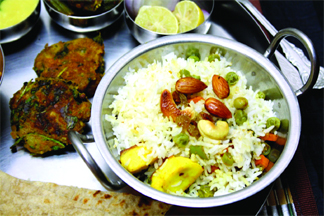
  • Nawabi Pulao

    Nawabi Pulao

    Ingredients
    1/2 kg chicken
    1/4 kg mutton
    1/2 kg rice
    1 cup curd, well beaten
    1 cup milk
    3 onions
    2 eggs
    1/2 cup green peas, shelled
    1 pod arlic
    1 big piece of ginger
    1 tsp rose water
    Ghee or oil for frying
    Salt to taste
    Method
    n Clean and wash rice and soak it in water for 15 minutes.
    n Cook the rice till half done. Keep aside. 3. Clean and cut the mutton into cubes. Joint the chicken. Boil the eggs and keep aside.
    – Slice the onions. Grind ginger and garlic to a paste.
    – Heat ghee in a frying pan, add onions, ginger-garlic paste and fry well.
    – Add the jointed chicken and fry. Add 3 cups of water and salt to taste and cook on slow fire till the meat is tender and only 1/3 of the gravy is left.
    – Add some more ghee and the well beaten curd. Cook on a slow fire until the curd gets absorbed.
    – Add 1 tsp of rose water after the meat has cooled.
    – Take a heavy bottomed pan and arrange alternate layers of rice and cooked meat taking care that the first and last layers are that of rice.
    – Place in an oven and cook for about 15-20 minutes on low heat.
    – Garnish with fried onions, quartered boiled eggs and boiled green peas.

  • Daniel Craig returns as Detective Benoit Blanc in the newest Knives Out mystery trailer

    Daniel Craig returns as Detective Benoit Blanc in the newest Knives Out mystery trailer

    If there’s one thing OTT has mastered, it’s turning murder mysteries into comfort food. Knives Out — the now-iconic whodunnit series crafted by Rian Johnson — has managed to stay razor-sharp through its clever storytelling, absurdly rich characters, and the ever-charismatic presence of Daniel Craig as detective Benoit Blanc. Now, the long-awaited trailer for the third film, Wake Up Dead Man: A Knives Out Mystery, has finally dropped, and it’s everything fans had hoped for, and then some. This time, Benoit Blanc isn’t just solving another murder — he’s entering a whole new tone. With a slightly rugged new look and that unmistakable Southern drawl, Craig returns to anchor what appears to be a darker, more gothic entry in the franchise. As always, he’s backed by an all-star cast: Josh O’Connor, Glenn Close, Josh Brolin, Mila Kunis, Jeremy Renner, Kerry Washington, Andrew Scott, Cailee Spaeny, Daryl McCormack, and Thomas Haden Church are all set to appear, adding major star power to this next mystery.
    The internet, as expected, had a lot to say. Reddit lit up the moment the trailer hit screens, with reactions ranging from hyped to emotional. “Southern Gothic Knives Out? Fuck yeah I’m in,” declared one user, perfectly summing up the collective mood. Another said, “I’m happy to see the tonal shift from movie to movie. I wasn’t a fan of Glass Onion. It was a little too on the nose for me, but I recognise a lot of people enjoyed it. Hoping to enjoy the third one as much as I did the first — this trailer certainly does much more to appeal to my tastes.” One comment read, “Love all the previous movies in this franchise; can’t wait to see what they do with this one.”
    Another fan added, “I’m digging the murder mystery genre lately. Between this and the Brannagh Poirot movies, I have been spoiled.” Still, perhaps the highest praise came from a fan reflecting on Daniel Craig’s post-Bond career: “Daniel Craig could do this series for the rest of his life and I wouldn’t complain… love that he’s found his niche so quickly after his long stint as 007. I don’t think any other James Bond actor has ever found such a compelling franchise after 007 like Craig has, very impressive ??.”
    Knives Out began with a simple but delightfully twisted premise: a wealthy crime novelist dies on his 85th birthday, and everyone in the family is a suspect. The 2019 original was both a tribute to Agatha Christie-style mysteries and a clever social satire, earning critical acclaim and box office success.
    Its sequel, Glass Onion, took Benoit Blanc to a Greek island for a tech billionaire’s murder-mystery party that turns fatally real. While some fans found it too on-the-nose, others praised its playful critique of the ultra-rich and clueless.
    Now, with Wake Up Dead Man, it seems Johnson is once again shifting gears — taking us deeper into darker territory while maintaining the franchise’s ridiculously enjoyable plotting. And thank goodness, because murder has never looked so good!

  • Metro…In Dino trailer: Anurag Basu film explores love, life, longing in busy city

    Metro…In Dino trailer: Anurag Basu film explores love, life, longing in busy city

    The trailer for ‘Metro In Dino’ is out now. This marks the return of director Anurag Basu with the final chapter of his much-loved hyperlinked storytelling trilogy. After ‘Life in a Metro’ and ‘Ludo’, Basu brings the film showcasing contemporary bittersweet relationships, highlighting different shades and emotions of love.
    Set in the heart of a bustling city, the trailer shows four different couples across different age groups. It highlights how love finds its way even in the middle of the hustle and chaos of city life, facing its own challenges, and painting an everlasting ‘everything comes together at the end’ picture.
    The trailer begins with Aditya Roy Kapur and Sara Ali Khan sharing a cab ride. Though they start as just friends, their bond slowly turns into love. Other couples are also shown, revealing their past and present struggles. All of them are going through difficult phases in their relationships. Meanwhile, the film’s song, by Pritam, has already caught the audience’s attention and is getting great love from fans.
    According to the filmmakers, ‘Metro In Dino’ isn’t just a film, it’s an emotional tribute to the people and feelings that often get left behind in the fast life of the city. Whether it’s about love or discovering yourself, the trailer shows relatable stories.
    Backed by Bhushan Kumar’s T-Series and Anurag Basu Productions, the film features a stellar ensemble cast including Anupam Kher, Neena Gupta, Pankaj Tripathi, Konkona Sen Sharma, Aditya Roy Kapur, Sara Ali Khan, Fatima Sana Shaikh, and Ali Fazal. The film is all set to release in theatres on July 4, 2025.

  • ‘Hope I die with my shoes on’: Aamir Khan says Mahabharat could be his last spectacle

    ‘Hope I die with my shoes on’: Aamir Khan says Mahabharat could be his last spectacle

    Actor Aamir Khan has hinted at his final film project, which could be a grand cinematic spectacle. The 60-year-old, who has spoken about his desire to make ‘Mahabharat’ for long, stated that the epic-drama might be his last movie. “I hope I die with my shoes on…” he said while talking about the film. The ‘Sitaare Zameen Par’ actor feels that the grandeur of this project is going to be such that after making the film based on India’s ancient text by sage Ved Vyas, he will have nothing else left to do.
    The superstar raved about the sheer grandeur and emotional resonance of ‘Mahabharat’ in a podcast with Raj Shamani. While speaking about the scale of creating the epic on-screen, he said, “It’s layered, it has emotion, it has scale, everything you find in the world, you will find in ‘Mahabharat’.”
    He further said, “Maybe after doing this, I will feel that I have nothing left to do. I cannot do anything after this, as the material of this film is going to be like that.”
    The actor concluded, “I hope that I die with my shoes on, but since you are asking, this is the one thing I can think of. Perhaps after this, I will feel that I don’t need to do anything else.”
    In a previous interview with The Hollywood Reporter, Aamir spoke about his vision for ‘Mahabharat’ and said, “That’s one of my biggest ambitions. We’ll see who we should cast based on who’s appropriate for which part.”
    The actor further said, “I don’t think you can tell the ‘Mahabharat’ in one film, so it will be multiple films. I am looking at the large scale.” While pointing out that the film might need multiple directors, he concluded, “To complete it within a set time, we will need more than one director.”

  • Rekha’s cult classic Umrao Jaan set to return to theatres

    Rekha’s cult classic Umrao Jaan set to return to theatres

    One of Indian cinema’s most iconic films, ‘Umrao Jaan’, starring the legendary actor Rekha, is set to return to the big screen. It is returning to theatres on June 27, restored in 4K resolution.
    The 1981 classic has undergone restoration led by the National Film Archive of India (NFAI) and the National Film Development Corporation (NFDC), bringing the 19th-century poetic epic to life for a new generation of cinephiles.
    Directed by Muzaffar Ali, ‘Umrao Jaan’ is a cinematic gem celebrated for its soulful storytelling, music, and rich portrayal of Awadhi culture. The film was originally produced by SK Jain & Sons and Integrated Films, and has long been revered for Rekha’s unforgettable portrayal of the courtesan-poet, a performance that earned her the National Film Award for Best Actress.
    PVR Inox announced the re-release on Instagram. “A story of elegance, love, and timeless music! Revisit Umrao Jaan in stunning 4K – a cinematic jewel restored, reimagined, and reborn with our Curated Shows. #UmraoJaan re-releasing at PVR INOX on June 27!,” read the caption.
    To mark the occasion, filmmaker Muzaffar Ali will also launch a limited-edition coffee table book, offering a rare glimpse behind the scenes of the film’s making. The book features never-before-seen photographs, original costume sketches, calligraphy, poetry, and personal anecdotes from the set. It will be released in tandem with the film’s theatrical re-release.
    Speaking about the film’s revival, Ali said in a statement, “Umrao Jaan was not just a film – it was a journey into the soul of a lost culture, a forgotten tehzeeb. Through her pain, poetry, and grace, we tried to resurrect the elegance of an era where love and longing spoke in verse. I had actors who brought a lot of heft to their characters, and then there was Rekha, who lived Umrao Jaan and truly immortalised it. I am thrilled that the film is back on the big screen for a whole new generation to discover a time and culture that’s very much a part of our being.”
    The film’s illustrious cast also includes Farooq Shaikh as Nawab Sultan, Naseeruddin Shah, Raj Babbar, Shaukat Kaifi, Dina Pathak, and Gajanan Jagirdar, among others. It also marked the debut of the late Farrukh Jaffar, who portrayed Umrao’s mother in the film.

  • Shashi Tharoor’s son grills him on Pak role in Pahalgam terror attack

    New Delhi (TIP)- Congress MP Shashi Tharoor, who is in the United States leading an all-party delegation, was asked a question by his son, Ishan, on Thursday, June 5, about Pakistan’s involvement in the Pahalgam terror attack.
    Ishan Tharoor asked whether any country had asked the delegation led by his father for evidence of Pakistan’s involvement in the deadly Pahalgam terrorist attack on April 22 that killed 26 people, mostly tourists. He also asked about Pakistan’s consistent denial of its involvement in the attack. To this, Tharoor said India would not have retaliated in the way it did if there was not convincing evidence against Pakistan.
    Responding to his son’s question, Tharoor said, “I’m very glad you raised this. I didn’t plant it, I promise you,” before adding that no country had asked for any such evidence.
    “Very simply, no one had any doubt, and we were not asked for evidence. But the media have asked in two or three places. Let me say very clearly that India would not have done this without convincing evidence,” Tharoor said.
    Further elaborating on Pakistan’s involvement in terrorism, Tharoor highlighted the country’s 37-year pattern of terror attacks accompanied by repeated denials. He brought up the Mumbai attacks in 2008 and Osama Bin Laden’s location near an army base in Pakistan.
    “But there were three particular reasons I want to draw your attention to all of you. The first is that we’ve had a 37-year pattern of repeated terror attacks from Pakistan, accompanied by repeated denials. I mean, Americans haven’t forgotten that Pakistan didn’t know, allegedly, where Osama bin Laden was until he was found in a Pakistani safe house right next to an army camp in a cantonment city. That’s Pakistan,” Tharoor said.
    “Mumbai attacks- They denied having anything to do with it. One of the terrorists was captured alive. His name, his identity, and his address are in Pakistan. Everything was revealed under interrogation. He told us where he was trained and what was done,” he added.
    Tharoor also talked about the recording of the Pakistani handler giving minute-by-minute instructions to the killers in Mumbai, which he said was recorded by both Indian and US intelligence.
    “We know what Pakistan’s all about. They will dispatch terrorists. They will deny they did so until they’re actually caught with red hands. That’s the first,” he added.
    Shashi Tharoor highlighted that the Resistance Front (TRF), which he called a “well-known proxy front of the Lashkar-e-Taiba”, claimed responsibility for the April 22 Pahalgam terror attack “within 45 minutes or so” of the tragedy.

  • Centre announces Census in 2027; caste to be counted

    New Delhi (TIP)- India will count its population by March 1, 2027, in a census to be held after an unprecedented 16-year gap, the Union Ministry of Home Affairs announced on Wednesday (June 4, 2025). This will be the country’s first digital census, and the first in independent India to include an enumeration of castes as well.
    The census will be conducted in two phases by February 28, 2027 and the data will have a reference date of 12 a.m. on March 1, 2027. However, the government has not yet notified the date of commencement of the exercise. The notification of the Centre’s intention to conduct the census, and the dates of the two phases will be “published in the official gazette tentatively on June 16 as per provision of section 3 of the Census Act 1948.”
    As per the constitutional mandate, the first census after 2026 can be used as the basis to redraw Lok Sabha constituencies. The next general election is expected to be held in 2029.
    The last census was held in 2011 and the subsequent exercise scheduled to take place in 2021 was delayed indefinitely, initially due to the COVID-19 pandemic. On April 30, the Union Cabinet had decided to include caste enumeration as part of the next census exercise.
    For the Union Territory of Ladakh and the non-synchronous snow-bound areas of the UT of Jammu and Kashmir and the States of Himachal Pradesh and Uttarakhand, the reference date for the population count will be 12 a.m. on October 1, 2026.
    India’s census is conducted under the provisions of the Census Act, 1948 and the Census Rules, 1990, and will be completed in two phases: first, the house listing and housing schedule; and then, the population enumeration. Both phases usually span a period of 11 months from April 1 to February 28 the following year. This time around, caste will be enumerated in the second phase.
    The last census was conducted in 2010 and 2011, with the first phase completed between April 1 and September 30, 2010, and the second phase from February 9 to February 28, 2011.
    A senior official said that the process of the census begins with the issuance of the notification in the gazette of India. “The second and final phase will begin on February 27 and conclude on March 1, the same year,” the official added. The 24 lakh enumeration blocks that were finalised for the planned 2021 census are likely to be used for the 2027 exercise. Around 30 lakh enumerators, including a sizeable number of government school teachers, will be trained afresh on the mobile application that has been readied for the exercise.
    Source: The Hindu

  • PM inaugurates world’s highest railway bridge over Chenab in J&K

    PM inaugurates world’s highest railway bridge over Chenab in J&K

    Jammu (TIP)- Prime Minister Narendra Modi on Friday inaugurated the Chenab railway bridge, the world’s highest rail bridge, marking a historic milestone in India’s infrastructure journey. After landing at the Air Force station in Udhampur, PM Modi flew to the Chenab bridge site to formally inaugurate the marvel. This visit marks his first trip to Jammu and Kashmir following Operation Sindoor, a military strike across the border in retaliation to the Pahalgam terror attack in April that claimed 26 lives. Modi also spoke with chief minister Omar Abdullah, railway minister Ashwini Vaishnaw, and union minister Jitendra Singh while viewing an exhibition on the USBRL project.
    During the visit, PM Modi also interacted with engineers, workers, and officials who were involved in the execution of the ambitious project that connects Kashmir to the rest of India by rail. The iconic structure, built across the Chenab river, is part of USBRL project that now connects Kashmir with the rest of the country through rail.
    Following the Chenab railway bridge inauguration, Modi is also set to inaugurate India’s first cable-stayed Anji bridge, further enhancing connectivity in the region.
    He will also flag off two Vande Bharat Express trains between Shri Mata Vaishno Devi Katra and Srinagar, completing the full 272-km USBRL stretch.
    The world’s highest railway arch bridge is standing at 359 metres above the riverbed—35 metres taller than the Eiffel Tower. The USBRL project, built at an estimated cost of Rs 43,780 crore, features 36 tunnels stretching 119 km and 943 bridges, offering all-weather rail connectivity between Kashmir and the rest of India. The completion of this mega project is seen as a turning point for regional development and national integration.
    The prime minister said the link would “transform mobility, bring prosperity and improve the quality of life for the people of Kashmir.”
    To ease movement in border regions, Modi will also inaugurate multiple road and flyover projects. These include the Rafiabad-Kupwara road widening on NH-701, the Shopian bypass on NH-444, and flyovers at Sangrama and Bemina junctions in Srinagar.

  • British Sikh MPs call for independent probe into UK role in Operation Bluestar

    British Sikh MPs call for independent probe into UK role in Operation Bluestar

    British Sikh Members of Parliament Warinder Juss and Jas Athwal on Thursday reiterated their demand in the UK Parliament for an independent investigation into the involvement of the then Margaret Thatcher-led Conservative government in India’s Operation Blue Star in June 1984.
    Juss, who represents the governing Labour Party in Wolverhampton West in northern England, and Athwal, who is the Labour MP for Ilford South in the east of the country, raised the matter during the “Business of the House” session with the Leader of the House of Commons, Lucy Powell.
    They highlighted the 41st anniversary of the anti-militant Indian military operation at Golden Temple and pointed to Powell’s assurance to their fellow Sikh Labour MP, Tan Dhesi, earlier this year of the “need to get to the bottom of what happened”.
    “Documents revealed in 2014 showed that the Thatcher government had helped their Indian counterpart by providing advice for Operation Blue Star,” said Juss.
    “Since 2014 there have been many calls to establish the extent of the British government’s involvement, and many assurances have been given. Will the Leader of the House give a statement to the House announcing an independent, judge-led public inquiry to, in her own words, get to the bottom of what happened,” he asked.
    Powell responded by acknowledging the concerns of members of the country’s Sikh community but said she did not have an update since the last time the matter was raised in Parliament in early January.
    “When I was asked about this issue previously, I did follow up, and I am sorry to say that I am still waiting,” she said.
    Athwal intervened later during the session to highlight that this week coincides with the anniversary of Operation Blue Star.
    He said: “Some 41 years later, questions about British involvement in the desecration of the holiest Sikh site in Amritsar remain unanswered. Labour promised in its 2017 and 2019 manifestos to hold an inquiry, and the Prime Minister [Keir Starmer] and the Deputy Prime Minister [Angela Rayner] pledged to do so before the last election.
    “Will the Leader of the House allow time for an update from the Foreign Secretary on the progress of implementing that inquiry and ensure that promises made in opposition are fulfilled in government?” Powell reiterated that she understood how important it was for the British Sikh community to see “progress on this issue”.
    “That is the second time that it has been raised with me this morning. I will ensure that the Foreign Secretary [David Lammy] is aware of the concerns being raised again on the Floor of the House and that the update I previously asked for is made available to Members and this House,” she said.
    The first demand for an independent inquiry arose a few years ago when it emerged that British military advice was given to Indian forces prior to Operation Blue Star.
    The then British Prime Minister, David Cameron, had ordered an internal review into this discovery, which led to a statement in Parliament declaring that Britain’s role had been purely “advisory” and the Special Air Service (SAS) advice had “limited impact” on Operation Blue Star in June 1984.
    Source: PTI

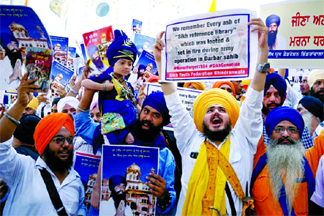
  • Operation Bluestar and its deep impact on the Sikh psyche: The third ghallughara

    Operation Bluestar and its deep impact on the Sikh psyche: The third ghallughara

    Operation Bluestar, executed by the Indian Army in June 1984 at the Golden Temple in Amritsar, was not merely a military offensive—it became a watershed moment in the history of Sikhism. For the Sikh community, it was not a battle against terrorism but an unforgivable desecration of their holiest shrine, an assault on their collective identity, and the beginning of a long era of emotional, political, and spiritual rupture.In Sikh history, the term Ghallughara, meaning “holocaust” or “massacre,” has been used to describe periods of mass violence inflicted upon the Sikh people. Operation Bluestar is remembered as the Teeja Ghallughara (Third Holocaust)—a modern-day catastrophe that left a deep scar on the Sikh psyche.
    Historical Context: Sikh Ghallugharas
    The Sikh community has endured repeated episodes of persecution and massacres known as Ghallugharas:
    – Chhota Ghallughara (1746): A brutal massacre by Mughal forces in which thousands of Sikhs were killed.
    – Wadda Ghallughara (1762): The Great Massacre where Afghan invader Ahmad Shah Abdali killed tens of thousands of Sikhs in one day.
    – Teeja Ghallughara (1984): The storming of the Golden Temple by the Indian Army, followed by the anti-Sikh riots post-Indira Gandhi’s assassination.
    These historical traumas are etched deeply into the Sikh collective consciousness as moments of suffering and sacrifice, but also resilience.
    Devastation of the Golden Temple Complex
    The Indian Army’s use of tanks, heavy artillery, and infantry inside the sacred Golden Temple complex caused massive physical destruction:
    – Damage to the Akal Takht: The Akal Takht, the supreme temporal authority of Sikhism, was heavily damaged. It was reduced to rubble, which was an unimaginable blow to Sikh spiritual sovereignty.
    – Destruction of the Sikh Reference Library: The library housed centuries-old scriptures, historical documents, handwritten manuscripts, and relics of the Gurus. Its burning was perceived as a deliberate attempt to erase Sikh history.
    – Widespread Casualties: Estimates of deaths vary, but it is widely accepted that hundreds, possibly thousands, of militants, civilians, and pilgrims died during the assault. The presence of unarmed pilgrims and non-combatants inside the complex intensified the trauma.
    Desecration and Violation
    The Golden Temple is not only a place of worship but a sanctuary, a symbol of Sikh identity and spiritual refuge. The operation violated this sanctity, leaving many Sikhs feeling profoundly betrayed and humiliated. The act of soldiers entering the shrine with weapons and destroying sacred sites was seen as sacrilege.
    Impact on the Sikh Psyche
    Collective Trauma and Spiritual Wound: Operation Bluestar was not experienced as a simple military action but as an assault on Sikh identity and spirituality.
    – The sense of violation was akin to a profound spiritual wound. The Guru Granth Sahib, the eternal Sikh scripture, and the sanctity of the Harmandir Sahib were perceived to be attacked.
    – Many Sikhs described feelings of shock, disbelief, and grief, similar to collective mourning for a devastating loss.
    – This trauma entered the cultural memory as a form of existential crisis, shaking the foundations of Sikh confidence in the Indian nation-state.
    A Crisis of Faith and Identity
    For many, Bluestar triggered a deep crisis of faith – not in Sikhism itself, but in the protection that the Indian state was supposed to offer its minorities. The event forced Sikhs to re-examine their place in India.
    – Feelings of alienation and vulnerability intensified.
    – The Sikh community felt targeted, marginalized, and feared further erosion of their political and cultural rights.
    – Many Sikh youth turned towards assertive identities, including militancy, as a way of reclaiming dignity and protecting their heritage.
    The Aftermath
    The trauma of Bluestar was compounded by the horrific anti-Sikh riots that erupted in November 1984, after the assassination of Prime Minister Indira Gandhi by her Sikh bodyguards.
    – Over 3,000 Sikhs were massacred in Delhi alone, with thousands more killed in other parts of India.
    – The widespread nature of the violence, often with alleged complicity or passive support of political actors, deepened feelings of betrayal.
    – This event reinforced the perception of systemic persecution, making the Sikh community feel under siege.
    The combined effect of Operation Bluestar and the 1984 pogroms is often described as a modern Ghallughara, reshaping Sikh political and social consciousness.
    Sociopolitical and Cultural Ramifications
    Rise in Sikh Militancy and Calls for Khalistan
    – Operation Bluestar galvanized militant groups advocating for a separate Sikh homeland, Khalistan.
    – The event became a rallying cry for those who saw armed struggle as the only means to protect Sikh interests.
    – While the majority of Sikhs did not support violence, the trauma legitimized radical political voices in many communities.
    Diaspora Mobilization
    – Sikh diaspora communities in Canada, the UK, and the US responded with protests, fundraisers, and political lobbying.
    – Bluestar strengthened Sikh identity abroad and heightened advocacy for human rights and justice.
    – The diaspora became crucial in keeping the memory alive and pushing for international awareness.
    Memory, Mourning, and
    Identity Preservation
    Commemoration as a Collective Process
    – Every year, Sikhs commemorate the anniversary of Operation Bluestar with memorial prayers (Ardas), candlelight vigils, and seminars.
    – The event is remembered in literature, music, and art, serving both as a mourning and a form of resistance.
    Passing Trauma Across Generations
    – The trauma has been passed down through oral histories, storytelling, and family narratives.
    – New generations understand Bluestar as part of their identity, often with strong feelings of justice, remembrance, and resilience.
    Psychological Effects: Trauma and Healing
    – Many Sikhs suffered from post-traumatic stress, depression, and a sense of helplessness.
    – Counseling and support structures were limited, especially in the 1980s and 1990s.
    – Over time, Sikh organizations and mental health professionals have worked to address this trauma through community healing initiatives.
    An Unhealed Wound
    Operation Bluestar was more than a military event-it was a collective trauma that profoundly altered Sikh consciousness. It was a moment when the sanctity of faith, the integrity of identity, and the sense of security for millions of Sikhs were violently shattered.The memory of the Teeja Ghallughara continues to influence Sikh politics, culture, and spiritual life. Until the wounds of 1984 are acknowledged and healed with justice and reconciliation, the pain and mistrust remain a defining feature of Sikh relations with the Indian state.

  • Operation Bluestar: The siege of Golden Temple and the tragedy that followed

    Operation Bluestar: The siege of Golden Temple and the tragedy that followed

    Operation Bluestar, executed in June 1984, was one of the most traumatic episodes in independent India’s history. Conceived by the Indian government to flush out Sikh militants from the Golden Temple complex in Amritsar, Punjab, it became a military operation of immense scale — unprecedented in its political, religious, and human costs. It left a deep scar on the Sikh psyche, led to significant loss of life and heritage, and forever altered the course of Indian politics and Sikh-Centre relations.
    Operation Bluestar, conducted between June 1 and June 10, 1984, was a military operation ordered by then-Prime Minister Indira Gandhi to remove Sikh militants, including the heavily armed followers of Jarnail Singh Bhindranwale, from the Harmandir Sahib (Golden Temple) complex in Amritsar, Punjab. The assault, carried out by the Indian Army, not only resulted in significant casualties and damage but also triggered a tragic chain of events including the assassination of Indira Gandhi and the genocidal violence against Sikhs in November 1984.
    The Build-Up to the Operation
    By the early 1980s, Punjab was in the grip of rising militancy, with radical Sikh groups demanding Khalistan-a separate Sikh homeland. The central figure of this movement was Sant Jarnail Singh Bhindranwale, a fiery preacher who positioned himself as a defender of Sikh rights and identity. He had taken up residence in the Akal Takht, one of the holiest Sikh sites within the Golden Temple complex, along with hundreds of armed followers.
    Tensions escalated as violence spread across Punjab. Political deadlock between the Indian government and the Akali Dal deepened, and bombings, assassinations, and communal killings increased. By early 1984, the Golden Temple complex had become a fortress, and the government considered the situation untenable.
    Operation Bluestar Begins
    On June 1, 1984, the Indian Army began preliminary operations by surrounding the temple complex. Officially, the army claimed it was responding to provocation from inside the temple. On June 3, a full curfew was imposed in Punjab, communication lines were cut, and news media was barred-effectively sealing the region.
    The main assault began on the night of June 5 and continued until June 6, involving elite army units including the Para Commandos and Sikh Regiment soldiers. Tanks and artillery were brought into the sacred complex, and the Akal Takht was fired upon with heavy ordnance.
    Destruction of the Akal Takht
    One of the most painful outcomes for the Sikh community was the near-total destruction of the Akal Takht, the highest seat of earthly authority for Sikhs, which had been converted by militants into a fortified bunker. The Indian Army used tank fire and shelling to neutralize resistance, reducing the historic building to rubble. Ancient manuscripts, relics, and scriptures were lost or destroyed.
    Damage to the Golden Temple Complex
    – Bullet marks pockmarked the marble walls of the Harmandir Sahib.
    – Sacred pools turned red with blood.
    – Libraries and the Sikh Reference Library were set ablaze; priceless historical texts were lost forever.
    – More than 100 gurdwaras across Punjab were raided as part of related operations (Operations Woodrose and Trident).
    Death Toll and Casualties
    There is no consensus on the number of people killed during Operation Bluestar.
    – Official government figures put the number of deaths at about 492 militants and civilians and 83 soldiers, with 249 injured.
    – Independent sources and Sikh groups estimate 3,000-7,000 deaths, many of them civilians and innocent pilgrims caught in the crossfire during a sacred time (Guru Arjan Dev’s martyrdom anniversary), when the complex was crowded.
    – Women, children, and elderly pilgrims were among those killed.
    – Eyewitnesses and survivors spoke of wounded being denied medical help, and unarmed men being shot or dragged away.
    The operation caused deep psychological trauma to survivors and thousands of families, many of whom never recovered the remains of their loved ones.
    Aftermath & Wider Repercussions
    Assassination of Indira Gandhi
    On October 31, 1984, Indira Gandhi was assassinated by her two Sikh bodyguards in retaliation for Operation Bluestar. This led to anti-Sikh pogroms, especially in Delhi, where over 3,000 Sikhs were killed, women were raped, properties were destroyed, and entire neighborhoods burned down with police and political complicity.
    Rise in Militancy
    Operation Bluestar radicalized many Sikh youth. The sense of betrayal and desecration pushed many into the armed separatist movement. From 1984 to the early 1990s, Punjab saw intense insurgency, enforced disappearances, extrajudicial killings, and heavy militarization.
    Army Mutinies
    Several Sikh soldiers across regiments mutinied in response to the assault on the Golden Temple. Around 5,000 were arrested or dismissed. The army, one of the most respected institutions, faced internal rupture along communal lines.
    4. Social and Political Fallout
    The trust between the Indian state and the Sikh community was shattered. Many Sikhs felt alienated, fearful, and unsafe. Even moderate voices in the Sikh community were pushed to the margins, as polarizing forces gained ground. Politically, it laid the groundwork for the rise of Hindu nationalism in the 1990s and deepened communal cleavages.
    Cultural and Religious Trauma
    For Sikhs, Operation Bluestar was not just a political or military event-it was a spiritual wound. The Golden Temple is not merely a place of worship; it is the soul of the Sikh faith. To see tanks roll in, the Akal Takht bombed, pilgrims gunned down, and sacred texts destroyed was a trauma akin to sacrilege.
    The operation is now remembered by Sikhs as the Teeja Ghallughara (Third Holocaust), following:
    – The Chhota Ghallughara of 1746 (approx. 10,000 Sikhs killed),
    – The Wadda Ghallughara of 1762 (approx. 30,000 Sikhs massacred).
    Ardaas (Sikh prayers) in many gurdwaras now incorporate remembrance of this event, embedding it into Sikh collective memory.
    Operation Bluestar left behind more than just rubble and blood-it tore through the fabric of India’s secular promise, fractured national unity, and deeply wounded the Sikh community’s psyche. The scars of June 1984 continue to shape Sikh identity, Indian politics, and public memory.
    No official apology has ever been issued. No full reckoning of the deaths, disappearances, and destruction has occurred. And until the state addresses its moral responsibility-through truth, justice, and reconciliation-the ghosts of Operation Bluestar will not be laid to rest.

  • The road to Operation Bluestar: The tumultuous prelude in Punjab

    The road to Operation Bluestar: The tumultuous prelude in Punjab

    “History does not occur in a vacuum- it accumulates, builds, and sometimes explodes.” Such was the case with Operation Bluestar, the Indian Army’s June 1984 military action inside the Golden Temple complex in Amritsar. The event shocked the nation, wounded the Sikh psyche, and catalyzed a decade of turmoil. But to truly understand why such an extreme step was taken, one must explore the complex mosaic of Punjab’s political, social, and religious landscape in the decades leading up to it.

    Operation Bluestar did not emerge in isolation. It was the result of a turbulent and complex socio-political environment in Punjab in the late 20th century, marked by rising communal tensions, political miscalculations, and the growing assertiveness of Sikh identity politics. The operation, conducted by the Indian Army in June 1984 to remove Sikh militants from the Golden Temple in Amritsar, was the culmination of years of festering conflict, deep mistrust, and institutional failures. This article outlines the critical developments that led to this watershed moment in Indian history.
    Historical and Political Background
    Post-Independence Sikh Aspirations: After independence in 1947, the Sikhs, a prominent and influential community in Punjab, felt marginalized in the new Indian nation-state. Despite their significant contribution to the freedom struggle and sacrifices during the Partition, many Sikh leaders believed that their religious and cultural identity was not adequately recognized.
    The Punjabi Suba movement (1955-1966), led by the Shiromani Akali Dal, aimed to create a separate Punjabi-speaking state. Though the movement was partially successful with the reorganization of Punjab in 1966, many Sikhs still felt that the political structure did not fully accommodate their aspirations.
    The Anandpur Sahib Resolution (1973)
    A major turning point was the adoption of the Anandpur Sahib Resolution by the Akali Dal in 1973. While its primary focus was to demand greater federal autonomy and assert Sikh identity, it was often misinterpreted by opponents as a secessionist document. Key demands included:
    – Devolution of power to states (especially Punjab)
    – Control over river waters
    – Recognition of Sikhism as a distinct religion
    – Protection of Sikh institutions and culture
    The central government, under Indira Gandhi, viewed these demands with suspicion, fearing they might encourage separatist sentiments.
    The Rise of Jarnail Singh Bhindranwale
    Emergence as a Religious Leader: Jarnail Singh Bhindranwale, the head of the Damdami Taksal (a Sikh seminary), initially gained prominence as a preacher aiming to revive orthodox Sikh practices. His popularity surged among rural Sikhs due to his austere lifestyle and sharp critique of moral decline and drug abuse in Punjabi society.
    Politicization of Bhindranwale
    In the late 1970s, the Congress party under Indira Gandhi allegedly promoted Bhindranwale to weaken the Akali Dal and fragment Sikh politics. However, this move backfired as Bhindranwale grew increasingly independent and militant in his approach.
    By the early 1980s, he was being seen as a spokesperson for Sikh grievances. His fiery speeches, demand for justice in cases of discrimination against Sikhs, and opposition to the central government attracted large followings-especially among the rural youth.
    Rise of Militancy in Punjab
    From 1978 onward, Punjab witnessed a series of violent events:
    – 1978 Amritsar clash: Bhindranwale supporters clashed with the Nirankaris, a heterodox sect, leading to 13 Sikh deaths. This incident catalyzed a sense of injustice among Sikhs.
    – 1981-1983: A wave of assassinations, including the killing of Lala Jagat Narain (editor of a prominent anti-Bhindranwale newspaper), and numerous targeted killings followed. Though Bhindranwale denied direct involvement, he was widely blamed.
    – Law and order deteriorated rapidly. Civilians, police officers, and public officials were attacked, contributing to a climate of fear and chaos.
    Occupation of the Golden Temple Complex
    By late 1983, Bhindranwale and his armed followers took up residence inside the Akal Takht within the Golden Temple complex, turning it into a fortified base. This action was both symbolic and strategic-it reinforced his religious authority and gave him protection from police action.
    The Role of the Central and
    State Governments
    Governor’s Rule in Punjab: In 1983, after the assassination of DIG A.S. Atwal (right at the Golden Temple’s steps), the Punjab government was dismissed, and President’s Rule was imposed. However, the breakdown of democratic processes further alienated the Sikh population.
    Failure of Dialogue
    Multiple attempts to open dialogue between the Akalis and the central government failed due to mutual distrust. Akali leaders feared backlash from radicals, while the central government remained convinced that strong-arm tactics were needed.
    Indira Gandhi’s government oscillated between conciliatory gestures and coercive policies, failing to take decisive action in either direction.
    Escalation and Final Crisis
    Militarization of the Temple: Throughout early 1984, the Golden Temple complex became heavily militarized. Trenches were dug, weapons smuggled in, and defensive positions set up. Intelligence agencies noted a growing cache of arms and the presence of trained militants under Bhindranwale and retired army officer General Shabeg Singh, who organized the defense.
    Nationwide Impact
    The growing unrest in Punjab had national implications:
    – The rail and road transport system was frequently disrupted.
    – Hindu-Sikh communal relations deteriorated, especially with inflammatory media coverage.
    – Rumors of foreign (particularly Pakistani) involvement in fomenting separatism spread.
    – The demand for Khalistan, a separate Sikh homeland, though not universally supported by Sikhs, became a rallying cry for extremist elements.
    Government’s Dilemma
    Indira Gandhi faced a political and strategic crisis:
    – Delay in action could lead to further strengthening of militants.
    – Forceful action inside the Golden Temple-Sikhism’s holiest shrine-could provoke mass outrage.
    Ultimately, after secret deliberations, the decision was made to launch Operation Bluestar in early June 1984, targeting Bhindranwale and his followers entrenched in the temple complex.
    A Crisis of Governance and Identity
    The situation in Punjab leading up to Operation Bluestar was the result of layered crises-historical grievances, political manipulation, religious assertion, and administrative paralysis. What began as a struggle for identity and federal rights became militarized under state negligence and communal polarization. The tragic events of June 1984 were not inevitable, but the product of a series of missteps, miscommunications, and a lack of visionary leadership on all sides.
    Even today, the scars of this period remain fresh in the Sikh psyche, with the events of 1984 serving as a powerful reminder of how identity, politics, and religion can converge to cause national trauma.

  • Ram Temple moves towards completion, idol of ‘Raja Ram’ consecrated

    The idol of Raja Ram was consecrated and the Ram Darbar inaugurated at the Ram Jamnabhoomi complex on Thursday, June 5, a major step towards completion of a grand temple that has been at the intersection of political and religious discourse for three decades.
    The city was festooned and lit up as priests gathered at the first floor of the Ram temple to install the almost five-feet white marbled statue of Raja Ram, the god in his royal form, amid the chanting of hymns and elaborate rituals.
    The Ram Darbar also features the idols of Sita, Lakshman, Bharat, Shatrughn and Hanuman. The day, chosen to coincide with the occasion of Ganga Dussehra, comes 16 months after the consecration of Ram Lalla, the child god, on January 22, 2024.
    While Prime Minister Narendra Modi, the top government brass and a host of celebrities were present at the high octane occasion then, the event this time was quieter.

  • Rafale fuselage to be made in Hyd as Tata inks deal with Dassault

    New Delhi (TIP)- The main body of future Rafale fighter jets will be produced in India, outside France for the first time, with French aircraft maker Dassault Aviation and Tata Advanced Systems Limited (TASL) on Thursday, June 5, announcing their partnership to build Rafale fuselage at a facility being set up in Hyderabad, in a move that is seen as a big leap for the government’s wide-ranging Make-in-India initiative.
    India has signed a Rs 63K-cr deal with France to buy 26 Rafale M aircraft for the deal.
    The Hyderabad facility will supply the fuselages for India and other international markets 2028 onwards, the two firms said. Some of the 26 Rafale Marine fighters ordered by India for its navy will come with locally produced fuselages, people aware of the matter said.
    Dassault Aviation and TASL have signed four production transfer agreements to manufacture the Rafale fuselage in India and called it a significant step forward in strengthening the country’s aerospace manufacturing capabilities and supporting global supply chains.
    “Under the scope of the partnership, TASL will set up a cutting-edge production facility in Hyderabad for the manufacture of key structural sections of the Rafale, including the lateral shells of the rear fuselage, the complete rear section, the central fuselage, and the front section,” the two firms said in a joint statement issued in Saint-Cloud and Mumbai.

  • Home, vehicle loans to become cheaper as RBI cuts repo rate by 50 basis points

    Home, vehicle loans to become cheaper as RBI cuts repo rate by 50 basis points

    Mumbai (TIP)- The RBI on Friday, June cut, repo rate by a higher-than-expected 50 basis points to prop up growth, which has slowed to a four-year low of 6.5 per cent in FY25. Following the rate cut, the key policy rate eased to a three-year low of 5.5 per cent, providing relief to home, auto and corporate loans borrowers.
    This is the lowest repo rate in three years. The repo rate—the rate at which banks borrow funds from the RBI—had last stood at 5.40 per cent on August 5, 2022. After a detailed assessment of the evolving macroeconomic and financial development, as well as the economic outlook, the Monetary Policy Committee (MPC) decided to reduce the repo rate by 50 basis points, RBI Governor Sanjay Malhotra said.
    Since February 2025, the RBI has reduced the policy rate by 100 basis points. In its previous policy review in April, it had also trimmed the repo rate by 25 basis points to 6 per cent.
    After reducing repo by 100 bps in quick succession, monetary policy is left with limited space to support growth, he added.
    This is the first time since Covid-19 that the RBI has passed on three consecutive rate cuts, beginning February 2020.
    Malhotra, however, retained the GDP forecast for the current fiscal at 6.5 per cent. The inflation projection was lowered to 3.7 per cent from the earlier estimate of 4 per cent, supported by expectations of a good monsoon.
    The MPC felt that the front-loading of the rate cuts would help growth, he added.
    The Rate-setting panel changed the stance to neutral from ‘accommodative’.