Month: June 2025

  • Sen. Jon Husted (R-Ohio) Praises ITServe’s Support for STEM Education and Professional Development Programs at Columbus Chapter Meeting

    Sen. Jon Husted (R-Ohio) Praises ITServe’s Support for STEM Education and Professional Development Programs at Columbus Chapter Meeting

    COLUMBUS, OH (TIP): “Information technology is essential to the modern workforce,” said Sen. Jon Husted (R-Ohio), during his keynote adders at ITServe Alliance Columbus Chapter’s Monthly meeting at Sonesta Columbus Downtown, Columbus, OH on May 28, 2025.

    Sen. Husted, who was the chief guest at the event, while lauding the many initiatives and the mission of ITServe Alliance, said, “ITServe’s support for STEM education and professional development programs enhances companies’ abilities to succeed.”  On his official website, it is posted that Sen. Jon Husted “met with ITServe’s Columbus chapter. ITServe is the largest association of IT services in the nation.”

    Anju Vallabhaneni, President of ITServe Alliance said, “It is encouraging to see that the dedicated efforts of our ITServe PAC and CPAC teams over the past few years—along with the support of Monte—are now yielding visible results. We were honored to host Senator Jon Husted, the influential Republican leader filling the Senate seat vacated by Vice President JD Vance.”

    Sen. Jon Husted (R-Ohio) is escorted by the organizers to the venue.

    Vallabhaneni, while expressing his appreciation and gratitude to the Sen. Husted, who serves on the Committee on Health, Education, Labor, and Pensions, the Committee on Small Business and Entrepreneurship, the Committee on Environment and Public Works, and the Special Committee on Aging, said, “We truly appreciate the time he spent with us and the valuable insights he shared. His perspectives on current affairs and the evolving role of IT and AI in the industry were both timely and thought-provoking.”

    “ITServe Alliance, the largest association of IT companies with nearly 2,500 member companies from across the nation has been consistently working to protect the needs of its members,” said Siva Moopanar, President-Elect of ITServe. “To that end, ITServe Alliance has been consistently working with the Lawmakers on behalf of its members on Capitol Hill and with the US Administration.”

    While urging the ITServe members to come and actively participate at the upcoming Capitol Hill Day, Sateesh Nagilla, Director of ITServe Alliance Policy Advocacy Committee (PAC) & Immigration said, “The Capitol Hill Day planned to be organized by ITServe Alliance in Washington, DC on June 11, 2025 offers us a unique and powerful way to advocate for policies and legislation that impact the small and medium size IT industries in the United States. We are encouraged by the overwhelming support from our members, who have expressed keen interest in being part of this critical event, where we have the opportunity to meet in person with US Representatives and Senators, including influential committee chairs and members, whose decisions impact our businesses.”

    The gathering 

    Capitol Hill Day is a vital part of ITServe Alliance, which was born out of the necessity to be the voice of IT companies in the United States, advocating for our rights, with the objective of educating lawmakers working toward meaningful changes that will benefit the IT industry and the larger society across the nation.

    The fundamental pillars of ITServe PAC are: Education, Advocacy, and, Strategic Legal Initiatives. The Capitol Hill Day is part of the overall mission of ITServe Alliance in making the  lawmakers and the larger American community aware about the need for favorable immigration programs to businesses by meeting, collaborating, and advocating with Congressmen and Senators to work together and help write and amend laws that are helpful to ITServe community.

    Dr. Anil Makhuja, Dean’s Distinguished Professor of Finance until 2024, having served for ten years as Dean and John W. Berry, Sr. Chair in Business of the Max M. Fisher College of Business. Dr. Makhija shared his thoughts on Business Education for Tomorrow, an insightful session that the members can adapt to their businesses.

    Phani Yenugu, Columbus Chapter President, thanked the guests, ITServe national leaders, Sponsors, and Chapter members, who were at the Monthly Meeting that was attended by dozens of ITServe members from the region. “Columbus monthly meeting was a grand success with great turnout,” Yenugu said. “Many thanks to the core team for their unwavering efforts. Special thanks to Anju Vallabhaneni, National President for the guidance and efforts to pull local businesses to the meeting.”

    The organizers and guests with Sen. Jon Husted

    About ITServe Alliance:

    Founded in 2010, ITServe’s vision has been to empower local communities by creating, retaining, and fostering employment opportunities within the United States. ITServe has an active membership of 2,500 + members, and 24 Chapters established across the United States, who are small & medium-sized companies that create local employment and fulfill the growing demand for highly skilled professionals in America.

    Together, the ITServe members have 175,000+ IT professionals employed throughout the U.S. and generate over $12 billion in revenue annually. ITServe and its member community are committed to corporate social responsibility (CSR) and actively contributing to local communities nationwide, particularly in the realm of STEM (Science, Technology, Engineering, and Math) education.

    For information on ITServe and its many noble initiatives, please visit: www.itserve.org

  • A Soulful Odyssey: Ustad Ghulam Abbas Khan Mesmerizes Chicago at Al Larson Prairie Center

    A Soulful Odyssey: Ustad Ghulam Abbas Khan Mesmerizes Chicago at Al Larson Prairie Center

    Raga & Resonance: A Night of Classical Magic with Ustad Ghulam Abbas Khan

    CHICAGO, IL (TIP): On the enchanting evening of May 31, 2025, the Al Larson Prairie Center for the Arts in Schaumburg, Illinois, transformed into a sanctuary of soul-stirring melodies, as the legendary Ustad Ghulam Abbas Khan took center stage for an unforgettable night of Hindustani classical music, Sufi, and ghazals. Organized by Khurram Syed under the esteemed banner of DK Omsheel Production and with the gracious support of Chicago community leader Mr. Iftekhar Sharif, the first overseas citizen of India, this cultural extravaganza, titled Soulful Classical, Sufi & Ghazals, brought together connoisseurs of music for a four-hour journey from 8:00 PM to midnight. The event was a testament to the timeless allure of Indian classical music, weaving together tradition, artistry, and emotional depth.

    The evening was masterfully hosted by Amin Haider, whose eloquent commentary and storytelling added a profound layer to the experience. Haider’s insightful introductions, peppered with anecdotes from Ustad Ghulam Abbas Khan’s illustrious career, illuminated the maestro’s journey from a musically inclined youth to a globally revered artist. One such story captivated the audience: a young Ustad, at just 16, faced the daunting challenge of performing classical music a genre unfamiliar to him at Delhi’s Daulat Ram College. Despite his inexperience, his innate talent shone through, earning praise from none other than Pandit Debu Chaudhary, who paused the performance to personally tune the tanpura, ensuring the young artist’s brilliance was perfectly showcased. This anecdote set the tone for an evening that celebrated not just music, but the resilience and passion of a maestro whose name is synonymous with excellence.

    Ustad Ghulam Abbas Khan is welcomed with a bouquet

    Ustad Ghulam Abbas Khan, a scion of the Rampur-Sahaswan Gharana, delivered a performance that was nothing short of transcendent. His mastery over khayal, thumri, dadra, Sufi kalams, bhajans, and ghazals left the audience spellbound. From the intricate taans of Raga Puriya Kalyan to the emotive renditions of traditional and original bandishes, such as “More Ghar Aaja” and “Ab To Tumhi Sang Lagan Lagai,” his voice carried the weight of centuries-old traditions while infusing them with contemporary resonance. His performance was a seamless blend of technical precision and emotional depth, reflecting the legacy of his mentors. His father Padma Shri Ustad Ghulam Sadiq Khan is a renowned Hindustani Classical Vocalist and his maternal grandfather Padma Bhushan Ustad Mushtaq Husain Khan.

    The evening was further enriched by the soulful performance of Chicago’s own Payel Ganguly, whose brief yet powerful presentation paid homage to the traditions that continue to inspire artists across generations. Her authentic and heartfelt rendition added a local flavor to the night, earning her resounding applause and cementing her place as a rising star in the classical music scene.

    The musical ensemble was elevated by the exceptional accompaniment of Shehzad Marcus on keyboard, whose melodic flourishes provided a rich backdrop to the vocal performances. Young tabla prodigy Abhijeet Kastha demonstrated a masterful command of rhythm, weaving intricate patterns that complemented the maestro’s vocals with precision and flair. The seamless coordination between the artists created an immersive experience, transporting the audience to the heart of India’s musical heritage.

    A view of the audience

    The event was graced by distinguished guests, including Nayab Hamid Ali Khan, son of the legendary Ustad Hamid Ali Khan, and community leaders such as Paul Chopra, Ramesh Punatar, Chris Veteran, and Syed Razi, alongside US and Indian Army veterans. Their presence underscored the event’s significance as a cultural milestone for Chicago’s South Asian community. Although Mr. Iftekhar Sharif, the chief guest, was unable to attend due to an unforeseen schedule change, the evening was honored by the presence of Amir Mohammed Khan, a renowned ghazal singer, as the Guest of Honor.

    Ustad Ghulam Abbas Khan’s performance was not just a concert but a celebration of a legacy that spans continents. With over 15 albums to his name and performances across prestigious stages in the UK, Australia, Japan, Singapore, Hong Kong, China, Indonesia, Malaysia, Mauritius, Thailand, Pakistan, Afghanistan, Saudi Arabia, UAE, and Oman, the Ustad has carried the torch of Hindustani classical music to global audiences. His contributions have earned him accolades such as the Central Fellowship Award from the Ministry of Culture, the Global Achievement Award in 2017, and the Dr. Radhakrishnan Award in 2018. Notably, his performance at the President’s House during Dr. APJ Abdul Kalam’s tenure remains a highlight of his illustrious career.

    The event’s success was bolstered by the generous support of sponsors, including Masood Ali of Ali’s Catering, Ena Agnihotri of Radisson Hotel in Schaumburg, Urdu Institute, Aftab Baig of Monty’s Banquet, Windy City Pharmacies, South Asian Seniors, United States Disability Cricket, and Universal Seniors Association. Their contributions ensured a flawless execution, making the evening a cherished memory for all attendees.

    The event poster

    Special thanks to Mahesh Kumar of Melody and Soul of Playback USA, whose expert sound engineering delivered pristine acoustics, amplifying every note’s brilliance.

    This evening was a radiant celebration of India’s musical heritage, brought to life by the unparalleled artistry of Ustad Ghulam Abbas Khan and the vibrant contributions of Chicago’s own Payel Ganguly. Payel Ganguly’s authentic rendition in Chicago earned warm applause, complemented by Shehzad Marcus on keyboard and tabla prodigy Abhijeet Kastha. Notable guests, including Nayab Hamid Ali Khan, and Guest of Honor Amir Mohammed Khan, attended.

    “Event was not only showcased the depth of Hindustani classical music but also highlighted the cultural unity and passion of Chicago’s South Asian community. Events like these remind us of the power of music to transcend borders and connect hearts, and we look forward to supporting more such cultural milestones in the future” Editor’s Note by Suresh Bodiwala, Chairman and Founder of Asian Media USA

    (Photographs and Press release by Asian Media USA)

  • Indian American civil rights lawyer Anuj Dixit running for Congress from California

    Indian American civil rights lawyer Anuj Dixit running for Congress from California

    • Parminder Aujla

    SACRAMENTO (TIP): Indian American civil rights lawyer Anuj Dixit, a son of immigrants from India, is running for Congress in California’s 41st congressional district, to challenge Republican hardliner Ken Calvert.
    Dixit, with a six-year veteran of the U.S. Air Force father, says he is running for Congress to shake up a system that’s been rigged for decades by insiders like Calvert with fresh energy and bold ideas to make Washington work for the middle class
    A resident of the Inland Empire, a metropolitan area centering around the cities of San Bernardino and Riverside, he’ll make it easier to open a business, find a good-paying job, and help more Americans get ahead in life, according to his website. Dixit will lead the charge on going after big businesses that buy elections and dodge taxes and fight to cut middle-class taxes and make California more affordable, it says.

    This race is one of the top red-to-blue priority contests in the country and will be critical to Democrats’ efforts to flip the U.S. House in 2026, according to Indian American Impact Fund which has endorsed Dixit.
    A bold new voice for the Inland Empire, Dixit represents the next generation of leadership, focused on delivering real results for working and middle-class families, the political advocacy group stated in a press release.
    “After coming of age in the post-9/11 era, Dixit dedicated his life to fighting for justice—defending voting rights, advocating for fair elections, and standing up for our democratic values,” it says. “Now, he’s running for Congress to bring that same commitment to Washington.”
    “We’re thrilled to endorse Anuj Dixit, a fierce advocate for democracy and opportunity. Anuj understands the challenges facing working and middle-class families because he’s lived them—and he’s spent his career fighting for the rights and dignity of others,” Chintan Patel, Executive Director of Indian American Impact Fund, stated.
    “He’s ready to make it easier for people to start small businesses, find good-paying jobs, and afford the basics—like buying a car, owning a home, and building financial security. At a time when trust in government is low and the cost of living is high, Anuj is offering a clear and hopeful vision rooted in accountability, transparency, and results. He’s exactly the kind of leader we need in Congress—and we’re proud to stand with him.”
    “I’m honored to have the support of the Indian American Impact Fund,” stated Dixit. “This organization has led the way in making sure that communities like mine—often overlooked and underestimated—finally have a seat at the table.
    “As the son of immigrants, a civil rights lawyer, and someone who’s spent his life fighting for fairness, I share that mission deeply. In Congress, I’ll continue that work—standing up for the Inland Empire and building a government that listens to and delivers for the people it serves.”
    Dixit, according to his website, grew up on March Air Force Base in Riverside County, grounded in the values of service, hard work, and community. He grew up believing in the American Dream: if you work hard and treat people the right way, you can build a better life. But for too many working and middle-class families here in the Inland Empire, that dream has slipped further and further out of reach.
    “Dixit’s commitment to justice was forged in tragedy. He lost his grandparents, aunt, and cousins in the Pan Am 103 (Lockerbie) bombing, and came of age in the shadow of 9/11,” it says. “Those moments cemented his determination to fight for what’s right and defend the values that bind us together as Americans.”
    Off the campaign trail, Dixit helps run his family’s health clinic, which provides essential care to patients in the community. He is a graduate of UCLA and Columbia Law School.

  • Judge puts temporary hold on Trump’s latest ban on Harvard’s foreign students

    Judge puts temporary hold on Trump’s latest ban on Harvard’s foreign students

    WASHINGTON, D.C. (TIP): A federal judge has temporarily blocked a proclamation by President Donald Trump that banned foreign students from entering the U.S. to attend Harvard University.

    Trump’s proclamation was the latest attempt by his Republican administration to prevent the nation’s oldest and wealthiest college from enrolling a quarter of its students, who account for much of its research and scholarship.

    It’s the second time in a month Harvard’s incoming foreign students have had their plans thrown into jeopardy, only to see a court intervene. Alan Wang, a 22-year-old from China who is planning to start a Harvard graduate program in August, said it has been an emotional roller coaster. “I cannot plan my life when everything keeps going back and forth. Give me some certainty: Can I go or not?” Wang said.

    Wang was born and raised in China but attended high school and college in the U.S. He’s now in China for summer vacation. Recently he has been exploring options in countries with more appealing immigration policies, including Canada, Australia and New Zealand. Harvard filed a legal challenge on Thursday, asking for a judge to block Trump’s order and calling it illegal retaliation for Harvard’s rejection of White House demands. Harvard said the president was attempting an end-run around a previous court order.

    A few hours later, U.S. District Judge Allison Burroughs in Boston issued a temporary restraining order against Trump’s proclamation. Harvard, she said, had demonstrated it would sustain “immediate and irreparable injury” before she would have an opportunity to hear from the parties in the lawsuit.

    Collin Binkley has covered Harvard for nearly a decade – most of the time living half a mile from campus.

    Burroughs also extended the temporary hold she placed on the administration’s previous attempt to end Harvard’s enrollment of international students. Last month, the Department of Homeland Security revoked Harvard’s certification to host foreign students and issue paperwork to them for their visas, only to have Burroughs block the action. Trump’s order this week invoked a different legal authority.

    A court hearing is scheduled for June 16 to decide if the judge will extend the block on Trump’s proclamation.

    If Trump’s measure were to survive the court challenge, it would block thousands of students who are scheduled to go to Harvard’s campus in Cambridge, Massachusetts, for the summer and fall terms. It would also direct the State Department to consider revoking visas for Harvard students already in the U.S.

    “Harvard’s more than 7,000 F-1 and J-1 visa holders — and their dependents — have become pawns in the government’s escalating campaign of retaliation,” Harvard wrote Thursday in a court filing.

    While the court case proceeds, Harvard is making contingency plans so students and visiting scholars can continue their work at the university, President Alan Garber said in a message to the campus and alumni.

    “Each of us is part of a truly global university community,” Garber said Thursday. “We know that the benefits of bringing talented people together from around the world are unique and irreplaceable.”

    Trump’s proclamation invoked a broad law allowing the president to block “any class of aliens” whose entry would be detrimental to U.S. interests. It’s the same basis for a new travel ban blocking citizens of 12 countries and restricting access for those from seven others.

    In its challenge, Harvard said Trump contradicted himself by raising security concerns about incoming Harvard students while also saying they would be welcome if they attend other U.S. universities.

    “Not only does this undermine any national security claim related to the entry of these individuals, it lays bare the Proclamation’s true purpose: to punish Harvard as a disfavored institution,” the school wrote.

    Harvard has attracted a growing number of the brightest minds from around the world, with international enrollment growing from 11% of the student body three decades ago to 26% today.

    Rising international enrollment has made Harvard and other elite colleges uniquely vulnerable to Trump’s crackdown on foreign students. Republicans have been seeking to force overhauls of the nation’s top colleges, which they see as hotbeds of “woke” and antisemitic viewpoints.

    Garber says the university has made changes to combat antisemitism. But Harvard, he said, will not stray from its “core, legally-protected principles,” even after receiving federal ultimatums.

    Trump’s administration also has taken steps to withhold federal funding from Harvard since it rejected White House demands related to campus protests, admissions, hiring and more. Harvard’s $53 billion endowment allows it to weather the loss of funding for a time, although Garber has warned of “difficult decisions and sacrifices” to come.
    (Source: AP)

  • PM Modi invited to attend G7 Summit in Canada, says ‘looking forward to meeting Mark Carney’

    PM Modi invited to attend G7 Summit in Canada, says ‘looking forward to meeting Mark Carney’

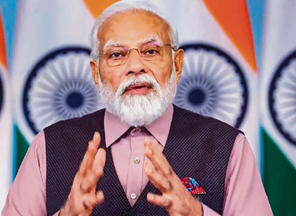
    NEW DELHI (TIP): Signaling a revival of the India-Canada ties, India’s Prime Minister Narendra Modi will travel to Canada at the invitation of his counterpart Mark Carney. Modi will be a part of the G7 summit being hosted by Canada from June 15 to 17. Modi posted on X about the visit, ending days of speculation that the PM may miss the G7 summit, a first since 2019. India is not a member of the G7 but is invited as one of the larger economies.

    Modi mentioned about the phone call with Carney saying, “Congratulated him on his recent election victory and thanked him for the invitation to the G7 Summit in Kananaskis later this month.”

    Making a shift from the era of Justin Trudeau when India and Canada levelled serious allegations against each other, Modi said in his post, “As vibrant democracies bound by deep people-to-people ties, India and Canada will work together with renewed vigor, guided by mutual respect and shared interests. Look forward to our meeting at the Summit (G7).” In international summits, the host country has the discretion, particularly regarding guest invitations, agenda setting, and the overall tone of the summit. The discretion allows the host to tailor the event to its priorities and to promote its own foreign policy objectives.

    The G7 is a grouping of the most industrialized economies in the world—the US, the UK, France, Germany, Italy, Japan, and Canada. Summits are also attended by the European Union (EU), the IMF, the World Bank and the UN.

    India-Canada relations nosedived following the killing of Khalistani separatist leader Hardeep Singh Nijjar in Canada in June 2023. Trudeau accused India of being involved in the assassination. India called Trudeau’s charges baseless.
    (TNS)

  • “China absolutely impossible factor to ignore in India’s confrontation with Pakistan”: Tharoor

    “China absolutely impossible factor to ignore in India’s confrontation with Pakistan”: Tharoor

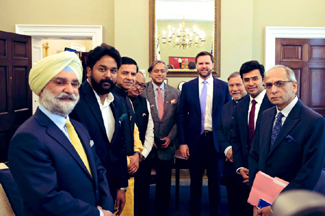
    WASHINGTON, D.C. (TIP): China is an “absolutely impossible factor to ignore” in India’s latest confrontation with Pakistan, Congress leader Shashi Tharoor has said, emphasizing that a thaw in relations between Delhi and Beijing over the past few months was “seemingly making good progress” before the conflict.

    Tharoor, who is leading a multi-party parliamentary delegation to the US, said, “I’m not going to mince my words, but we are aware that China has immense stakes in Pakistan.” His remarks came during an interaction with representatives of think tanks organized at the Indian Embassy here on Thursday, June 5.

    The largest single project under the Belt and Road Initiative is the China-Pakistan Economic Corridor, Tharoor said, adding that 81 per cent of Pakistani defense equipment is from China.

    “Defense may be the wrong word here. Offense in many ways,” he said. “China is an absolutely impossible factor to ignore in what has been our confrontation with Pakistan,” Tharoor said.

    He noted that despite the tensions between China and India since the Galwan Valley clashes in June 2020, “we had actually begun a thaw with China in September of last year, which was seemingly making good progress before this tragedy occurred.” Tharoor added that “then we saw a very different China” in terms of its practical support for Pakistan, even on the Security Council.

    “We have no illusions about what the challenges are in our neighborhood, but I want to remind you all that India has consistently chosen a path of keeping open channels of communication, even with our adversaries,” he said.

    “We have tried as much as possible to focus on development, on growth, on trade. Our trade with China is still at record levels. It’s not that we are adopting a posture of hostility, but we would be naive” not to be aware of these other currents around, he said. Pakistan is currently a non-permanent member of the UN Security Council.

    Following the April 22 Pahalgam attack, the UN Security Council had on April 25 issued a press statement on the ‘terrorist attack in Jammu and Kashmir’ in which the members had condemned it in “the strongest terms”.

    “The members of the Security Council underlined the need to hold perpetrators, organizers, financiers and sponsors of this reprehensible act of terrorism accountable and bring them to justice,” the press statement had said.

    However, the press statement did not mention The Resistance Front as the group responsible for the attack after Pakistan managed to get the name removed with the support of China.

    In October last year, India and China firmed up a disengagement pact for Depsang and Demchok, the last two friction points in eastern Ladakh.

    Days after the agreement was finalized, Prime Minister Narendra Modi and Chinese President Xi Jinping held talks in Kazan, Russia, and took a number of decisions to improve ties.

    External Affairs Minister S. Jaishankar met Chinese Foreign Minister Wang Yi in November last year in Rio de Janeiro on the sidelines of the G20 Summit and the two met again in February this year in Johannesburg.

    During a conversation at the Council on Foreign Relations earlier in the day, Tharoor was asked about the Chinese military equipment that Pakistan used in the conflict against India and if there is a reassessment over this.

    “Frankly, the reassessment took place while the fighting was going on,” Tharoor said.
    He added that when India saw what the Pakistanis were attempting to do using Chinese technology, for instance, the ‘kill chain’ that the Chinese specialize in, where the radar, GPS, planes and missiles are all linked together and they react instantly, “we simply did things in a different way. Otherwise, we wouldn’t have been able to hit” 11 Pakistani airfields and “we wouldn’t have been able to breach the Chinese-supplied air defenses.

    “So it’s clear that assessments were taking place while the fighting was happening, and we were recalibrating our strategies in order to end as effectively as we were able to end,” Tharoor said.

    “The fact is China has immense stakes in Pakistan, the largest single project on the Belt and Road Initiative is the one in Pakistan – the China- Pakistan Economic Corridor. So we have no illusions about the degree of commitment that China may well be feeling towards Pakistan.”
    (Source: PTI)

  • Trump issues travel ban for 12 countries

    Trump issues travel ban for 12 countries

    WASHINGTON, D.C. (TIP): President Trump issued a proclamation Wednesday, June 3, restricting the entry of people from a dozen countries into the U.S., citing national security concerns.

    Trump’s order states that he has decided to “fully restrict and limit” entry from Afghanistan, Myanmar, Chad, Republic of the Congo, Equatorial Guinea, Eritrea, Haiti, Iran, Libya, Somalia, Sudan and Yemen.

    He is also partially restricted and limited entry of nationals from seven countries: Burundi, Cuba, Laos, Sierra Leone, Togo, Turkmenistan, and Venezuela. “These restrictions distinguish between, but apply to both, the entry of immigrants and nonimmigrants,” the order states. Driving the news: The order that was made moments before he directed an investigation into President Biden, goes into effect Monday, per the proclamation.

    It includes exceptions for lawful permanent U.S. residents, existing visa holders, other special visas, adoptions, and for athletes traveling for the World Cup, Olympics or other major sporting events.
    Exceptions will be made “case-by-case for individuals for whom the Secretary of State finds, in his discretion, that the travel by the individual would serve a United States national interest,” the order states.
    What he’s saying: “The recent terror attack in Boulder, Colorado, has underscored the extreme dangers posed to our country by the entry of foreign nationals who are not properly vetted,” Trump said in a video posted on Truth Social Wednesday evening.

    “We don’t want ’em,” the president said, blaming his predecessor, Biden, for “his open door policies.”
    Trump added, “We cannot have open migration from any country where we cannot safely and reliably vet and screen those who seek to enter the United States.”
    Context: The proclamation comes after Trump issued an executive order on Jan. 20 directing the State Department, Homeland Security and the Director of National Intelligence to draft a report on whether there’s a national security risk posed by entry to the U.S. from certain countries.

    Flashback: Trump issued a similar executive order during his first term, banning travel to the U.S. by citizens of predominantly Muslim countries, including Iraq, Iran, Libya, Somalia, Sudan, Syria and Yemen.

    The order, often referred to as a “Muslim ban,” was highly controversial and was met with legal challenges. The administration was forced to revise the order and the Supreme Court ultimately upheld a version of it.

    Biden rescinded the ban on his first day in office.

    President Trump is again prioritizing travel bans, furthering his administration’s crackdown on unauthorized immigration.

    Trump’s first term travel bans caused immediate confusion, humanitarian concern and were slammed as discriminatory.

  • June 6 New York & Dallas E – Edition

    [vc_row][vc_column][vc_custom_heading text=”E-Edition” font_container=”tag:h2|text_align:center” google_fonts=”font_family:Istok%20Web%3Aregular%2Citalic%2C700%2C700italic|font_style:700%20bold%20regular%3A700%3Anormal” css=”” link=”url:https%3A%2F%2Fwww.theindianpanorama.news%2Fwp-content%2Fuploads%2F2025%2F06%2FTIP-June-6-E-Edition.pdf”][vc_single_image image=”184755″ img_size=”full” alignment=”center” onclick=”custom_link” css=”” link=”https://www.theindianpanorama.news/wp-content/uploads/2025/06/TIP-June-6-E-Edition.pdf”][/vc_column][/vc_row][vc_row][vc_column width=”2/3″][vc_custom_heading text=”Lead Stories This Week” google_fonts=”font_family:Istok%20Web%3Aregular%2Citalic%2C700%2C700italic|font_style:700%20bold%20regular%3A700%3Anormal” css=”” link=”url:%20https%3A%2F%2Fwww.theindianpanorama.news%2F”][vc_wp_posts number=”5″ show_date=”1″][/vc_column][vc_column width=”1/3″][vc_single_image image=”82828″ img_size=”medium” alignment=”center” onclick=”custom_link” css=”” link=”https://www.theindianpanorama.news/advertising-media-kit-portal-indian-panorama/ “][vc_single_image image=”82829″ img_size=”medium” alignment=”center” onclick=”custom_link” css=”” link=”https://www.theindianpanorama.news/advertising-media-kit-portal-indian-panorama/ “][/vc_column][/vc_row]

  • India’s $4-trillion economy masks inequity and jobless growth

    India’s $4-trillion economy masks inequity and jobless growth

    Consider this: India’s per capita GDP still hovers around $2,480, compared to Japan’s $33K or Germany’s $54K

    “A forward-looking economic agenda would include a progressive wealth tax, higher marginal rates on capital gains and closing of corporate loopholes that erode the tax base. Expanding public investment in child and elder care infrastructure could unlock female labor force participation while generating millions of dignified jobs. Moreover, formalizing informal employment through universal social protection floors, streamlined labor codes and digital inclusion can offer security without sacrificing flexibility. Fiscal policy must evolve beyond scarcity-thinking and towards rights-based provisioning, treating education, health and employment not as charity but as citizenship guarantees.”

    Also Read: https://www.theindianpanorama.news/opinion/modi-selling-rising-gdp-as-a-sign-of-prosperity-to-the-deprived-masses-of-india/

    By Deepanshu Mohan

    India has taken an economic leap, overtaking Japan to become the fourth largest economy in nominal GDP. At $4 trillion, the Indian economic landscape sits just behind the US, China and Germany. But size-driven growth alone does not confer greatness. Nor does scale guarantee substance. In the Indian context, economic size also has very little to offer on distributive equity. Beneath the din lies a quieter, sobering narrative, one of persistent inequality, vast informal labor, low human development and frayed social safety nets. India’s economic expansion remains acutely uneven in distribution and experience. It has produced islands of affluence in a sea of precarity.

    This is not to deny the real progress India has made. But we must ask: aspiration fulfilled for whom? Because when growth is judged by volume rather than value and size by nominal metrics rather than lived outcomes, it risks becoming a mirage, a spectacle of progress untethered from social reality.

    Consider this: India’s per capita GDP still hovers around $2,480, compared to Japan’s $33K or Germany’s $54K, and lagging behind even Vietnam and the Philippines. India’s $4-trillion GDP, when divided among its 1.4 billion citizens, shows cracks. Thus, India’s average citizen earns approximately 1/22nd of a German and slightly less than 1/14th of a Japanese. The symbolism is striking: two nations once seen as economic underdogs now offer a higher average standard of living than the world’s fourth largest economy.

    This is a call to distinguish economic size from developmental depth. This problem is conceptual. Aggregate GDP is a blunt instrument, better suited to measuring production than prosperity. It counts luxury condominiums and slums at the same time, billionaires and daily wagers alike and tells us who owns assets, who can access formal credit, who inherits safety nets and who remains locked out.

    In India, economic mobility is still tethered to geography, caste, gender and inheritance. Without meaningful redistribution, through progressive taxation, asset reform or targeted social investment, the system will remain one of exclusion rather than inclusion.

    According to the World Inequality Report, the top 1 per cent of Indians command 22.6 per cent of the national income and a staggering 40.1 per cent of the wealth. The bottom 50 per cent earn just 15 per cent of the income and hold a mere 6.4 per cent of wealth. In Germany and Japan, the bottom 50 per cent hold nearly 20 per cent of national income.

    The imbalance in India’s rise is most visible in its labor market. This is a paradox where growth coexists with joblessness and expansion leaves the majority of workers behind. Despite over three decades of liberalization, India’s growth model remains stubbornly capital-intensive, privileging high-margin sectors such as finance, IT and real estate while neglecting the labor-absorbing capacity of manufacturing, agriculture and small-scale enterprises. The result? A “jobless growth” trajectory that fuels GDP numbers but fails to create meaningful employment for millions.

    Over 90 per cent of the workforce is employed informally, without social security, pensions or formal contracts. This becomes a structural fault line. It depresses labor productivity, narrows the tax base and exacerbates inequality by excluding the majority from rights-based protections.

    According to the India Employment Report 2024, youth unemployment has risen from 5.7 per cent in 2000 to 17.5 per cent in 2019. The quality of jobs remains poor, often informal, low-wage and devoid of upward mobility. More alarming is the female labor force participation, which languishes below 25 per cent. Cultural constraints, safety concerns, poor transport and a lack of childcare facilities play a role, but so does an architecture that favors capital subsidies over investments in public infrastructure and services. Japan and Germany, despite ageing populations, have increased women’s workforce engagement through robust maternity benefits, subsidized childcare and flexible work arrangements.

    Meanwhile, India’s middle class is under increasing strain. Household debt surged to 42.9 per cent of GDP by mid-2024 from 36.6 per cent in June 2021, while household savings fell from 84 per cent of total savings in 2000 to 61 per cent in 2023.

    The disconnect between India’s capital-rich growth and labor-poor reality underscores the need for a rethink.

    With a tax-to-GDP ratio of just 6.8 per cent as of December 2024 (it was 9.1 per cent in September), India finds itself with too little fiscal muscle to fund ambitious public goods or progressive welfare. Germany’s tax-to-GDP ratio is 38 per cent and Japan’s 34.1 per cent. This reflects not only the tax capacity of the state but also the tax intention.

    This constraint is compounded by the narrow base of direct taxation. India has hesitated to meaningfully tax wealth, inheritances or large capital gains, mechanisms used widely in OECD economies to fund equitable growth. Welfare schemes provide only subsistence and not any structural uplift. The absence of fiscal federalism also hobbles inclusive development. State governments, responsible for health, education and infrastructure, remain financially starved and dependent on the Centre’s transfers. This limits the potential for targeted interventions that account for regional disparities in poverty, caste exclusion and gender gaps.

    A forward-looking economic agenda would include a progressive wealth tax, higher marginal rates on capital gains and closing of corporate loopholes that erode the tax base. Expanding public investment in child and elder care infrastructure could unlock female labor force participation while generating millions of dignified jobs. Moreover, formalizing informal employment through universal social protection floors, streamlined labor codes and digital inclusion can offer security without sacrificing flexibility. Fiscal policy must evolve beyond scarcity-thinking and towards rights-based provisioning, treating education, health and employment not as charity but as citizenship guarantees.

    If India is to truly ascend not just in rankings but also in the lived reality of its people, it needs a structural course-correction. It must resolve to building an economy not just of the few, but for the many.

    (Deepanshu Mohan is a Professor of Economics and Dean, IDEAS, Office of Interdisciplinary Studies, and Director, Centre for New Economics Studies, O.P. Jindal Global University.)

  • Elon Musk Goes Nuclear

    Elon Musk Goes Nuclear

    The world’s richest man and the president of the United States are now openly fighting

    By David A. Graham

    From the moment Elon Musk bounded onstage, midriff bared, to campaign for Donald Trump, cynics predicted that the two men’s egos were too large to allow for a lasting alliance. Improbably, however, the bond persisted, despite the rocky rollout of the U.S. DOGE Service, disagreements over legislation, and even covers of The New Yorker and Time that seemed designed to troll Trump and drive a wedge between the men.

    Now it seems the cynics weren’t wrong—just premature in their predictions. A feud that simmered all week broke into outright hostility this afternoon, with Trump appearing to threaten to cancel all of the contracts and tax subsidies Musk’s companies have with the government, and Musk alleging that Trump hasn’t released files related to Jeffrey Epstein because he’s implicated in them. The falling-out feels both inevitable and still shocking. (The Germans must have a word for this situation; perhaps Trump could ask Chancellor Friedrich Merz, who visited the White House today.)

    It was only Friday that Trump and Musk held an amiable press conference in the Oval Office to mark the end of Musk’s time as a “special government employee,” as he returns to his somewhat battered companies. Trump presented Musk with a key to the White House—gilded, but you knew that—and Musk promised to continue to offer Trump advice as much as desired. “I hope so,” the president replied. He’s apparently having second thoughts now. “I’m very disappointed in Elon,” Trump said in an appearance alongside Merz.

    The rift opened over the past few days, as Musk began campaigning against the One Big Beautiful Bill Act, the sprawling legislation that Republicans are trying to move through both houses of Congress to extend Trump’s first-term tax cuts, slash entitlements, and achieve whatever else of the president’s agenda they can cram in or sneak past members and the Senate parliamentarian.

    “This massive, outrageous, pork-filled Congressional spending bill is a disgusting abomination,” Musk posted on X on Tuesday. “Shame on those who voted for it: you know you did wrong. You know it.” In another post, he wrote, “Bankrupting America is NOT ok! KILL the BILL.” In yet another: “The Big Ugly Bill will INCREASE the deficit to $2.5 trillion!” And a fourth: “This bill was never shown to me even once and was passed in the dead of night so fast that almost no one in Congress could even read it!”

    What Musk wants is not entirely clear. His understanding of government spending has always been muddled, which is one reason DOGE was doomed to miss its cost-cutting targets. His sudden emergence as a strict deficit hawk is difficult to believe, though if he’s really concerned, he could call for higher taxes. (Somehow it’s not surprising that a multibillionaire would prefer to cut social services for average citizens.) One hint about the true source of his fury is that he keeps bringing up reductions in subsidies for electric vehicles, something that could directly affect his bottom line.

    At first, in an unusual display of circumspection and restraint, the White House tried to avoid directly responding to Musk. Then officials began pushing back, mostly in policy terms. Trump unleashed a flurry of announcements last night that seemed intended to distract from Musk. But then Trump’s patience ran out, producing today’s sound bite. The president also said he’d rather Musk criticize him personally than the bill, which sounds false.

    The situation puts Trump in an ironic position: He likes to be the guy on the outside, attacking government officials for failing to accomplish some impossible task. Now Musk is doing that to him, while Trump has to defend the imperfect process of legislation. As of this writing, Musk had pinned to the top of his X profile a repost of many screenshots of Trump arguing for fiscal discipline before having won his first term. “Where is this guy today??” Musk sniped.

    A clash between Musk and Trump will be a test of what happens when two of the greatest promoters in mass-media history square off. Both are adept at driving a news cycle; both are the owners of social-media platforms; and although X is much larger than Truth Social, Trump also has the advantage of being, you know, the president of the United States. Which of them can control the news more?

    But the most interesting clash is the one between two guys who thought they had bought each other off. For a time, they both must have thought they had a great deal. Trump got at least a quarter of a billion dollars in campaign support from Musk, and he got the joy of having the world’s richest man as his sidekick. Maybe Trump even believed that DOGE would be able to make huge budget cuts via improvements in efficiency.

    Musk, meanwhile, was able to wield unprecedented power as an unelected, unconfirmed bureaucrat. In 2023, during an onstage discussion, Israeli Prime Minister Benjamin Netanyahu asked the South African–born Musk, “You can’t be president of the U.S. last time I checked, right?” Musk replied with a smirk, “Not officially.” For a moment, he seemed to achieve that unofficial reign. DOGE was given wide latitude. Musk skulked around the Oval Office with his young son and mugged in interviews with the president. He could also help direct contracts to his companies, hurt competitors, and install allies in key posts. At the peak of their bond, and a nadir of propriety, the president arranged an infomercial for Tesla on the White House lawn.

    Now, as they drift apart, both men are feeling burned. “I’ve helped Elon a lot,” Trump groused today. Later, he unloaded on Musk on Truth Social. “Elon was ‘wearing thin,’ I asked him to leave, I took away his EV Mandate that forced everyone to buy Electric Cars that nobody else wanted (that he knew for months I was going to do!), and he just went CRAZY!,” Trump wrote, adding in a threat: “The easiest way to save money in our Budget, Billions and Billions of Dollars, is to terminate Elon’s Governmental Subsidies and Contracts. I was always surprised that Biden didn’t do it!”

    Musk’s anger, though just as hot, was tinged with imperious presumption. “Without me, Trump would have lost the election, Dems would control the House and the Republicans would be 51-49 in the Senate,” Musk wrote on X this afternoon. “Such ingratitude,” he added. You can kind of see his point: He thought that investing massive amounts of money into Trump would allow him to get whatever he wanted from Trump, and Trump did little to dispel that impression. Musk’s transparency about DOGE’s actions was wanting, but he’s making it crystal clear what he thought he bought. Trump and Musk are both learning the limitations on their purchases—and the public is getting an illustration of the danger of someone like Musk having so much personal influence on the government.
    (David A. Graham is a journalist based in Durham, North Carolina. He is a staff writer at The Atlantic, where he covers politics, criminal justice, music, and other topics. His coverage of the 2020 presidential election won the 2021 Toner Prize for Excellence in National Political Reporting.)

  • End of Pax Americana: An International Perspective

    End of Pax Americana: An International Perspective

    The decline of Pax Americana might just be the invitation the world needed to imagine and create something better, based indeed on a genuinely rules-based order and not exceptionalism.

    • By Khushi Mishra & Dr. A. Adityanjee
    Dr. A. Adityanjee

    For much of the 20th and early 21st centuries, the international order operated under the broad shadow of Pax Americana—a term that implied not just military supremacy, but the cultural, economic and institutional dominance of the United States. From shaping the post-WWII Bretton Woods institutions to setting the terms of global diplomacy, America attempted to fashion a world order in its image with some success. However, today, that benign shadow of all-pervasive Uncle Sam is receding. Not with a dramatic collapse but through slow erosion—an unravelling marked by shifting power centers, declining institutional legitimacy, and ideological fragmentation. The end of Pax Americana is not a future possibility but a present condition, albeit starting with a slow decline. And its consequences stretch far beyond the U.S., rippling across continents, alliances, and geopolitical imaginations.

    Cracks in the Foundation

    The U.S. was not just a superpower but the architect of a system that promised liberal democracy, free markets and so-called rules-based multilateralism. After the break-up of the former Soviet Union, it became the sole hyperpower in the nineties. However, cracks began to show long before the term “American decline” entered the mainstream. The unnecessary war in Iraq and the prolonged occupation and nation-building in Afghanistan revealed the limits of hard power.  The 2008 financial and banking crisis exposed vulnerabilities in the very model America exported.

    Domestically, political dysfunction and extreme political polarization and racial strife eroded the internal coherence necessary to sustain global leadership.

    The Trump administration 1.0 did not invent this decline—it merely amplified it. Unilateral withdrawals, erratic diplomacy, and an “America First” posture ruptured long-standing alliances and triggered a recalibration among both adversaries and allies. Trust, once the bedrock of American hegemony, began to fade.

    Doubts about the cognitive competence of a series of US presidents have contributed to the lack of confidence in the US decision-making at the highest level.  Trump 2.0 administration’s MAGA (Make America Great Again) policies are contributing to the pervasive lack of faith in US decision-making process by the international community and the comity of civilized nations.

    Multipolar Drift and the Return of Strategic Autonomy

    As the U.S. retreats from the center, other players have moved in—not to replicate American leadership but to reconfigure the playing field altogether. China’s rise is not simply about GDP or military capacity but about narrative control.

    Beijing offers an alternative to Western liberalism—development without democracy and influence without direct intervention. However, China’s debt trap BRI scheme and wolf warrior diplomacy have not gained it any new friends.

    The US has tried to face the economic challenge from rising China by de-risking and decoupling its economy and has instituted near-shoring, friendshoring and onshoring. Despite economic constraints, Russia has strategically asserted itself through information warfare, military entrenchments and diplomatic offensives.

    Meanwhile, middle powers and regional powers like India, Brazil, Türkiye, European Union, Saudi Arabia, Iran and South Africa are asserting strategic autonomy. No longer content with junior-partner status, they are reshaping regional alliances, experimenting with new institutional arrangements, and occasionally resisting U.S. pressure outright.

    In this emerging order, power is no longer unipolar or bipolar or even cleanly multipolar—it is diffused, competitive and unpredictable.  We are heading towards an era of nascent oligo-polarity.

    Europe and the Limits of Transatlantic Dependence

    In Europe, the end of Pax Americana feels less like liberation and more like abandonment. The postwar European project was built on the twin foundations of American security and economic partnership. As U.S. foreign policy became more transactional, Europe began grappling with an uncomfortable reality: the transatlantic safety net may no longer hold.

    Calls for “strategic autonomy” are gaining momentum, particularly in France and Germany. From digital sovereignty to independent defense capabilities, the EU is slowly inching towards a more self-reliant posture. However, internal divisions and bureaucratic inertia make this transformation uneven and uncertain.

    Europe, once a pillar of Pax Americana, is now navigating its future in a more volatile world.

    Voices from the Global South

    In the Global South, reactions to the unravelling of American primacy are more complex. For many, the liberal international order was less about freedom and more about hierarchy. Structural adjustment programs, conditional aid, and numerous but selective military interventions without UN Security Council approval left deep scars.

    Yet, the same U.S.-led rules-based order also enabled global development financing, diplomatic recognition and conflict resolution mechanisms.

    As U.S. influence wanes, new opportunities and new risks emerge. China’s infrastructure-first developmental model through the Belt and Road Initiative offers an alternative, but it comes with its own dependencies and debt trap schemes.

    A previous version of the BRI project was named One Belt, One Road (OBOR), an acronym that was lampooned as ODOR (One Debt, One Road). China’s maritime claims against the exclusive economic zones of several ASEAN countries and its refusal to comply with the international tribunal verdict of 2016 does not inspire any confidence about its benign intentions as a rising superpower.

    Russia’s engagement, often transactional, fills security vacuums but seldom addresses long-term governance needs. The Global South is not passively watching this transition—it is actively negotiating, leveraging and resisting in ways that challenge old hierarchies.

    What Happens When the Centre No Longer Holds?

    The end of Pax Americana does not signal a complete collapse of the global order. There is an ongoing Cold War 2.0 between the reigning hegemon and the rising hegemon without a complete binary division of the comity of nations.

    Global South is hedging and not willing to take sides in this new Cold War 2.0. Whether these two competing nations will fall into Thucydides’ trap is yet to be seen. We are witnessing the slow emergence of a multiplex world—a complex, culturally diverse, and normatively contested international system. In such a world, no single actor sets the rules. Power is negotiated, legitimacy is localized, and the global order is constantly in flux.

    Burgeoning US debt to the tune of $38 trillion also questions the stability of the post-World War II financial system. Several countries are selling the US Government treasury bonds and buying gold for fiscal stability. Financial transactions are no longer based on the supremacy and hegemony of the US dollars.

    Many countries are doing bilateral trade using regional and local currencies, bypassing the dollar. China has encouraged the use of the Yuan or Renminbi for international trade since the 2008 banking crisis in the US. China’s own economy is facing headwinds, with the housing sector insolvent and high unemployment among college graduates. The debt-to-GDP ratio for China is currently 300%.

    China’s attempts to browbeat Japan and other countries by leveraging its monopoly of rare earth and mineral supply chains have not endeared it to the rest of the world. De-dollarization is not imminent. It is a slow and steady process, but it will not be replaced by Humanization. Despite talks of a future BRICS currency, there aren’t many takers for it in the BRICS-plus grouping, barring China.

    This transition is not without danger. Without a stable hegemon, flashpoints can become firestorms. Institutions built for a different era may prove inadequate in managing 21st-century crises—from pandemics and cyber wars to climate change and artificial intelligence. At the same time, this flux creates possibilities for reimagining global governance beyond Western templates. It invites pluralism, regionalism and new solidarities.

    Conclusion

    Pax Americana was always as much a myth as it was a reality—one held together by narratives of exceptionalism and promises of liberal peace. That myth is now unravelling, not because America has disappeared, but because the world has changed irreversibly.

    The erosion of U.S. primacy is not merely a geopolitical event; it is a civilizational moment. It challenges us to rethink power without hegemony, order without uniformity, and progress without domination. No country in the world, however, wants the replacement of Pax Americana with Pax Sinica. China’s lack of transparency and failure to acknowledge its role in the lab-created Wuhan virus pandemic have made the world suspicious of China’s intentions.

    This is not the end of international cooperation, but it may be the end of a very aggressive and one-size-fits-all globalization. As the world turns into a multipolar mosaic, the future lies not in nostalgia for the lost primacy of an American melting pot, but in constructing new frameworks—messy, plural, negotiated, and perhaps more just.

    The decline of Pax Americana might just be the invitation the world needed to imagine and create something better, based indeed on a genuinely rules-based order and not exceptionalism.

    (Dr. A.  Adityanjee is President of the Council of Strategic Affairs and Chairperson, Board of Directors)

  • A Wound That Refuses to Heal: On the 41st Anniversary of Operation Blue Star

    A Wound That Refuses to Heal: On the 41st Anniversary of Operation Blue Star

    By Prof. Indrajit S Saluja
    By Prof. Indrajit S Saluja

    In the summer of 1984, a tragic and defining chapter unfolded in Indian history—Operation Blue Star, a military action ordered by the Indian government under Prime Minister Indira Gandhi, to flush out Sikh militants, including the leader Jarnail Singh Bhindranwale, who had taken refuge in the Golden Temple complex in Amritsar. What was executed as a counterinsurgency operation turned into a national trauma, especially for the Sikh community. Four decades on, its memory remains raw, its pain festering like an open wound.

    The operation was launched on June 1, 1984, and reached its devastating peak between June 5 and 8, with the Indian Army storming the holiest shrine of the Sikhs—the Harmandir Sahib, popularly known as the Golden Temple. The timing of the operation—coinciding with the martyrdom anniversary of Guru Arjan Dev, when the temple was thronged with pilgrims—added to the grief and shock experienced by the community.

    The Toll: Lives Lost and Sanctity Violated

    Official figures of casualties remain controversial. The Indian government at the time claimed around 492 civilian deaths, including militants and pilgrims. However, independent estimates and Sikh organizations argue the number was significantly higher, with figures ranging from 3,000 to 5,000 civilians, many of whom were unarmed worshippers trapped inside the complex. 83 Indian Army personnel also lost their lives, and over 200 were injured.

    The damage to the Akal Takht, the highest seat of temporal authority for the  Sikhs, was particularly heart-wrenching. The historic structure was reduced to rubble, its walls perforated by bullets, its sanctity desecrated by tanks and artillery fire. Rare manuscripts, scriptures, and artworks were destroyed, a loss that can never be compensated.

    The Psychological and Civil Fallout

    The immediate aftermath of Operation Blue Star saw Punjab placed under virtual martial law, with strict curfews, mass arrests, and widespread surveillance. Thousands of Sikh youths were detained without charge or trial under preventive detention laws such as the National Security Act and the Armed Forces (Special Powers) Act. Families were broken, civil liberties suspended, and a climate of fear hung over the state for years.

    The Sikh community across India and abroad was devastated. The wounds deepened with Operation Woodrose, a lesser-known but equally brutal military campaign in rural Punjab that followed Blue Star, aimed at rooting out “suspected militants.” Thousands of young Sikh men “disappeared” or were extrajudicially killed, their bodies never returned to their families.

    Betrayal of a Community

    The Sikhs, who make up just about 2% of India’s population, have contributed far beyond their numbers to the defense and development of the nation. They fought valiantly for India’s freedom, and after independence, they stood at the nation’s borders, defending it in every war. Yet in 1984, they were made to feel like outsiders in their own land.

    The very sanctum sanctorum of Sikhism was turned into a battlefield by those entrusted with safeguarding the country’s unity and diversity. The barbarity of storming a sacred shrine, especially when peaceful alternatives had not been fully exhausted, felt to many Sikhs like a deliberate provocation, a message that their faith and heritage were dispensable in the pursuit of state power.

    Many Sikhs ask, rightly: Would such an operation have been carried out in any other place of worship with similar force and timing? The sense of betrayal remains intense. What compounded the trauma was the lack of accountability, no official apology, and the subsequent anti-Sikh pogroms in November 1984 after Indira Gandhi’s assassination, where thousands more were murdered in cold blood—with state complicity and impunity.

    A Memory that Refuses to Fade

    For Sikhs around the world, Operation Blue Star is not just history—it is lived memory. It is their Holocaust moment, a violent rupture that has shaped the community’s relationship with the Indian state ever since. Just as the Jewish people have not forgotten the Holocaust, the Sikhs have not forgotten Blue Star. It is their green wound, unhealed and perhaps unhealable.

    Memorials in gurdwaras, stories passed from generation to generation, and annual commemorations serve not only as acts of remembrance but as assertions of identity and resistance against forgetting. While governments have changed and political narratives evolved, no amount of time has dulled the pain of watching tanks roll into the most sacred site of Sikhism.

    A Call for Justice and Healing

    Even today, many Sikhs feel that the state has not adequately acknowledged the enormity of what was done. Truth-telling, accountability, and real justice have been scarce. There is an urgent need for the Indian state to engage in genuine reconciliation, not through token gestures, but through institutional reform, historical honesty, and an apology that truly acknowledges the depth of hurt inflicted.

    Operation Blue Star was more than a military operation—it was a violation of trust, a rupture in the secular promise of India. Whether the movement led by Bhindranwale was right or wrong is a debate for historians and political scientists. What is beyond debate is that the handling of the situation was catastrophic, and the brutality inflicted on an entire community has left scars that remain visible even today.

    As India celebrates its democratic credentials, it must also confront the ghosts of its past. For the Sikhs, 1984 is not over. It is a continuous echo, a festering sore that demands to be seen, acknowledged, and remembered.

  • Prem Bhandari, Chairman of Jaipur Foot USA and President of RANA, Hosts Dinner Reception for visiting Union  Minister  Ramdas Athawale

    Prem Bhandari, Chairman of Jaipur Foot USA and President of RANA, Hosts Dinner Reception for visiting Union  Minister  Ramdas Athawale

    Athawale commits full support for the upcoming camps being organized in memory of Dr. Ambedkar in Delhi and Mumbai

    NEW YORK (TIP): Shri Ramdas Athawale, Minister of State for Social Justice and Empowerment, who is on a visit to New York, was honored at a special dinner reception hosted in Long Island by Prem Bhandari, Chairman of Jaipur Foot USA and President of the Rajasthan Association of North America (RANA).

    The Minister shares a longstanding association with Jaipur Foot USA. In 2023, he inaugurated two major camps for the differently-abled (Divyangjan) in Hyderabad and Tirupati. These camps were organized in collaboration with the Federation of Indian Associations (FIA) of NY, NJ, CT & NE — an organization known for hosting the world’s largest India Day Parade outside India — and Jaipur Foot USA’s parent body, Bhagwan Mahaveer Viklang Sahayata Samiti (BMVSS).

    Speaking at the event, Mr. Bhandari highlighted Prime Minister Narendra Modi’s declaration of the “Panch Teerth” — five sacred sites associated with Dr. B.R. Ambedkar’s life:

    1. Mhow – his birthplace,
    2. Nagpur – Deeksha Bhoomi,
    3. London – where he pursued higher education,
    4. Delhi – where he passed away,
    5. Mumbai – where he was cremated.

    To commemorate Dr. Ambedkar’s 125th birth anniversary in 2016, BMVSS organized two Jaipur Foot camps — one in Mhow and the other at Deeksha Bhoomi in Nagpur. Mr. Bhandari announced that, under the guidance of BMVSS Founder and Chief Patron Padma Bhushan Shri D.R. Mehta, preparations are underway for upcoming camps in Delhi and Mumbai.

    He expressed gratitude for the continued support that BMVSS and Jaipur Foot USA have received from the Ministry of Social Justice and Empowerment and the Ministry of External Affairs, under the leadership of  Prime Minister Shri Narendra Modi.

    Mr. Bhandari also commended India’s Permanent Representative to the United Nations, Ambassador P. Harish, for organizing a special event at the UN on June 10 on Jaipur Foot and BMVSS to showcase India’s pioneering work in lower limb disability empowerment. The event will feature the impactful contributions of BMVSS in India and globally. BMVSS Founder and Chief Patron Mr D.R. Mehta and BMVSS President Ambassador Satish Mehta will arrive in New York on June 9 to participate in the event.

    Jaipur Foot USA Chairman Prem Bhandari spoke at length about the enormous work being done by Jaipur Foot under the leadership of Mr. D. R. Mehta, Founder and Chief Patron of Bhagwan Mahaveer Viklang Sahayata Samiti (BMVSS), parent body of Jaipur Foot.
    Seen in the picture, from L to R: Rajeev Bhambri, Ajay Patel, K.K. Mehta, Prem Bhandari, Ramdas Athawale, Harish Thakkar, Dilip Chauhan, Ravi Jargarh

    Since its inception in 1975, BMVSS has benefited over 2.4 million differently-abled individuals by providing them with Jaipur Foot and other assistive devices. The organization has conducted 114 international camps in 44 countries, including 32 camps under the ‘India for Humanity’ initiative — fully sponsored by the Ministry of External Affairs, Government of India, to commemorate the 150th birth anniversary of Mahatma Gandhi.

    Mr. Bhandari, who recently visited Guatemala and Trinidad & Tobago, said that Jaipur Foot camps have been approved by the Ministry of External Affairs in :

    • Guatemala – 600 limbs
    • Sudan – 600 limbs
    • Trinidad & Tobago – 800 limbs

    All three camps will be conducted later this year.

    He further shared that an artificial limb fitment center will soon be opened in Malawi with MEA support, following the announcement made by President Droupadi Murmu last year.

    Minister Athawale assured Mr. Bhandari of his full support for the upcoming camps in Delhi and Mumbai, being organized in memory of Dr. Ambedkar. He also praised the transformative work carried out by Jaipur Foot USA’s parent organization BMVSS in India and around the world.

    Minister Atawale further said he would request Prime Minister Narendra Modi to consider establishing a memorial for Dr. Ambedkar in New York. In response, Mr. Bhandari stated that his family would be the first to contribute toward this noble cause.

    Prem Bhandari presented to the Union Minister a brochure of Jaipur Foot.

    Union Minister Athawale (right) and Prem Bhandari hold the Jaipur Foot Brochure.


    The dinner was attended by prominent community leaders and members from RANA, Jaipur Foot USA, BRUHUD Seniors New York, AIA, AAPI, RAJMAI, REDIO, and other Indian-American organization.

    Dignitaries and Attendees

    • K.K. Mehta – President, Rajasthan Foundation
    • Arvind Bhandari- One of the Founders of RANA
    • Dasrath Dugar, Former President, RANA
    • Dilip Chauhan – Deputy Commissioner, Mayor’s Office, New York City
    • Ajay Patel – President, BRUHUD Seniors New York
    • Dr. Shashi Saha – Trustee, AAPI (American Association of Physicians of Indian Origin)
    • Harish Thakkar – Representative, AIA (Association of Indians in America)
    • Haridas Kotawala – Former President, Indian Diamond and Color Association
    • Neelam Modi – Treasurer, RANA (Rajasthan Association of North America)
    • Dr. Raj Modi – Member, RANA
    • Dr. Raj Bhayani – Community leaders
    • Rajeev Bhambri – Secretary, Jaipur Foot USA
    • Ravi Jargarh – Secretary, RANA
    • Vilas Savargaonkar, Member, Jaipur Foot
    • Atul Kothari-Board Member, RANA
    • Dulichand Baid, Board Member, RANA
    • Navneet Goyal, Board Member, RANA
    • Amit Saraf, Board Member, RANA
    • Amit Shorewala, Board Member, RANA
    • Prominent leaders from the Indian-American community across New York and New Jersey
    • Representatives from RAJMAI, REDIO, AAPI, AIA, and BRUHUD Seniors NY

    (Based on a press release)

  • D.R. Mehta: A Revolutionary Force of Compassion, Innovation, and Social Justice

    D.R. Mehta: A Revolutionary Force of Compassion, Innovation, and Social Justice

    By Prem Bhandari

    In a world often dominated by personal ambition and fleeting recognition, few individuals leave behind a legacy that truly transforms millions of lives. One such revolutionary figure is Mr. D.R. Mehta – the visionary founder and Chief Patron of Bhagwan Mahaveer Viklang Sahayata Samiti (BMVSS), the parent body of the world-renowned Jaipur Foot.

    A Jaipur Foot camp was organized at Mhow, Madhya Pradesh, on April 14, 2016, to commemorate the 125th birth anniversary of Bharat Ratna Dr. Bhimrao Ambedkar. Prime Minister Modi inaugurated.
    In the picture, among others, from L to R: Prem Bhandari, D.R. Mehta, differently-abled Kamala- recipient of an artificial limb, Union Minister Shivraj Singh Chauhan, Narendra Modi.

    Founded in 1975, BMVSS under Mr. Mehta’s leadership has become the world’s largest organization for the rehabilitation of the physically challenged. It has provided dignity and mobility to more than 2.4 million beneficiaries, offering artificial limbs, calipers, and other aids – all completely free of cost to those in need, 95% of whom live below the poverty line.

    What sets Mr. Mehta apart is his patient-first, humane approach. With an open-door policy and same-day prosthetic fittings, BMVSS operates around the clock to ensure that patients don’t just get help – they get it with dignity, speed, and compassion. His model has not only inspired millions but has also caught the attention of prestigious institutions. Both Harvard Business School and IIM Bangalore have written case studies on BMVSS and Jaipur Foot. Renowned management guru Prof. C.K. Prahalad even featured BMVSS in his iconic book The Fortune at the Bottom of the Pyramid.

    A Jaipur Foot camp was organized at Nagpur-Diksha Bhoomi- on October 14, 2016.
    Seen in the picture, among others, from L to R: D.R. Mehta, Prem Bhandari, Maharashtra Chief Minister Devendra Phadnavis. Seated is a differently-abled boy who received an artificial limb.

    Mr. Mehta’s impact is international. He has spearheaded 114 limb-fitment camps across 44 countries, including conflict-ridden areas like Afghanistan, Iraq, Syria, and Palestine. His model blends technology with empathy, partnering with institutions such as Stanford University, MIT, and IITs to continuously upgrade BMVSS’s innovation. TIME Magazine recognized the Jaipur Knee, developed with Stanford, as one of the 50 Best Inventions of the World in 2009.

    A staunch Gandhian, Mr. Mehta practices what he preaches. Through initiatives in remote, violence-hit areas like Sukma and Dantewada, he has brought hope where it was long lost. His literary work includes over 70 books on Gandhism and peace, and he holds key positions in Gandhian institutions.

    A Jaipur Foot camp was organized at Mahudi, Ahmedabad. It was hosted by Ajay Patel, President, BRUHUD Seniors, in memory of his late father Shashikant Bhai Patel. D.R. Mehta addressed the gathering. Seen in the picture, among others, from L to R: Ajay Patel, Prem Bhandari, Harsh Vardhan Shringla, former Foreign Secretary of India, S.J. Haider, Chief Secretary, Gujarat

    In recognition of his unparalleled service, Mr. Mehta has received numerous awards, including the Padma Bhushan (2008), Rajiv Gandhi Sadbhavna Award (2012), and international honors such as the TECH Museum Innovation Award (USA).

    Before his social work journey, Mr. Mehta was a distinguished IAS officer (1961 batch), holding critical positions in both state and central governments. He served as Deputy Governor of the Reserve Bank of India, and later as Chairman of SEBI, where he oversaw landmark reforms in India’s capital market from 1995 to 2002.

    Born in 1937, Mr. Mehta is an alumnus of Rajasthan University, Royal Institute of Public Administration (London), and the Alfred Sloan School of Management, MIT. He has also served on MIT’s board for Asia, Europe, and Africa.

    Jaipur Foot and its Founder& Chairman, D.R. Mehta stand tall at Times Square, New York

    In a time when the world searches for authentic leadership, Mr. D.R. Mehta stands tall as a true hero- a revolutionary who turned empathy into action, and vision into global impact.

    (Prem Bhandari is the Founding Chairman,  Jaipur Foot USA (subsidiary of BMVSS); President of Rajasthan Association of North America (RANA); Co-founder & Chairman, Rescuing Every Distressed Indian Overseas (REDIO); Chief Advisor, BRUHUD NY Seniors & Team Aid)

  • Birthday Predictions- June 2 to June 8

    Birthday Predictions- June 2 to June 8

    • By Astrologer Chirag Daruwalla  

    June 2

    Ganesha says you can see that you are very excited today. Your sociable behavior and jovial nature are highly appreciated in the social circle. The power of your leadership ability can fill you with so much confidence that you will be able to do everything very well. If you work hard, success may kiss your feet. Today may bring some good luck as the planets are in your favor.

    June 3 

    Ganesha says may your day be very kind today. Today you may be able to complete the remaining tasks in the projects. You can complete your work faster so that you will be able to enjoy your time with your family. You can plan to go somewhere with your partner. Your business can do very well today. Today, things can happen as per your wish, as you are getting the full support of luck. A new opportunity may come your way, which can come immediately today itself and can give you good profits. The stars are in your favor, which can help you to easily solve any problem regarding this new opportunity.

    June 4 

    Ganesha says you will see that things are working in your favour without any special effort. Small, auspicious tasks can be performed throughout the day. It is a great thing that everything will be fine for you today, but do not be lazy and focus on the tasks you have to do today. You are very lucky today because you can get what you want. Make sure that you use today’s luck for your benefit and not for others, because only then can it be a positive thing for you.

    June 5

    Ganesha says meditate first thing in the morning; This can be beneficial for your personal and professional life. You can make a good profit in your business, so today can be a good day for you. Given the spiritual awakening in your zodiac sign, today you may be more inclined towards philanthropy. Make sure that you do not stray away from your dreams and ambitions, as you may face some distractions today. Make sure that you are ethical in both your personal and professional life.

    June 6

    Ganesha says you may feel that you are getting a lot of love and care from family, friends, as well as from your partner. You may have a difficult day today but may you feel supported and cared for in every way. At the end of the day, you may feel very satisfied at this time in your life. Your partner’s loving and caring nature can make you fall in love with your partner immensely today. You can experience for yourself how beautiful it is to be loved and cared for by someone you trust and love with all your heart.

    June 7

    Ganesha says your love life has been full of ups and downs, but today you can experience stability. Try saying what you’re thinking. Expressing your feelings can help you improve your love life. Venus may bring love, and the Moon may bring luck to your face today. You are entering a new phase that marks the beginning of a lane called success. Along with your old commitments, you may also handle additional responsibilities today, but it may not seem like a difficult or difficult task, as you may enjoy doing it.

    June 8

    Ganesha says you are very lucky today because you can get what you want. Make sure you use today’s luck for your benefit and not for others, because only then can it be a positive thing for you. You may focus more on your financial issues so that your love life may take a back seat. Your life partner’s full cooperation may surprise you a bit. Try to be patient and understanding. You are so close to finding that one person who can support you through everything, don’t make that person angry.

  • Weekly Horoscope- June 2, 2025 to June 8, 2025

    Weekly Horoscope- June 2, 2025 to June 8, 2025

    • By Astrologer Chirag Daruwalla

    Aries 

    Ganesha says this week will give you new energy and inspiration. This week, there may be changes in your social life, which will enhance your personality even more. At work, try to establish better coordination with colleagues. Teamwork will prove beneficial for you. Your financial condition will improve if you manage your expenses in a planned manner. This is a good time for those who are thinking of investing. In personal relationships, try to spend time with your loved ones. Misunderstandings are likely to be cleared by mutual communication. This week is the time to focus on yourself and set new goals. In terms of health, try to stay active and exercise regularly. Overall, this week will bring new possibilities and opportunities for growth for you. Maintain your positivity and face challenges with confidence. 

    Taurus 

    Ganesha says this week will be a positive time for Taurus natives. Your focus will mostly be on personal development and financial matters. This week, you will find the right time to implement your plans. Your hard work will pay off this time, and you will feel moving to your goals. Communicating with colleagues at the workplace is a must; with their help, you will be able to complete some important projects. Spending time with family will give you mental peace. Communicate with your loved ones and try to understand their feelings. This is a good time to strengthen relationships. Health-wise, take some rest this week and balance your routine. Yoga and meditation will help improve your mental health. You may also feel inclined towards spirituality, so try some sadhana or meditation. Remember, the key to happiness lies in your thoughts. Keep your positive attitude this week, and success will kiss your feet. 

    Gemini 

    Ganesha says this week will be full of opportunities for Gemini natives. You may have many important conversations due to your communication abilities. New possibilities and friendships are likely to develop in social life. Your creativity will be at its peak this week, which will inspire you to work on new projects. To achieve success at work, working together with team members will be beneficial. In personal life, spending time with family members will strengthen your relationships. There is a possibility of an old problem getting resolved, which will give you mental peace. In terms of health, pay attention to your routine. A little exercise and a balanced diet will help increase your energy levels. There will also be an opportunity to learn new things and expand your perspective this week. Overall, this week will be full of progress, connections, and new beginnings for you. 

    Cancer 

    Ganesha says this week will be an important time for you from an emotional and spiritual point of view. Staying in touch with family and close friends will give you happiness and satisfaction. Your sensitivity will play a very important role in your existence this week. In work life, some new opportunities will come your way. They will need to be looked at carefully. Your ideas and suggestions can prove to be inspiring for others, so share your thoughts without hesitation. In terms of health, early awakening and meditation can prove beneficial for you to stay stress-free. This is also a good time to adopt a new exercise system. Mutual understanding and cooperation in relationships will increase this week. Spending time with your loved ones will strengthen your relationships. Overall, this week is favorable for introspection and personal growth. Listen to your intuition and move forward. 

    Leo 

    Ganesha says many exciting opportunities may come your way this week. Your confidence and plans will be renewed, which will help you move faster towards your goals. In professional life, it is time to establish better coordination with colleagues. If you are working on a new project, your ideas will be appreciated. In personal life, time spent with family will give you satisfaction. Try to increase communication with your partner, this will strengthen the relationship. In terms of health, a little hygiene and exercise will fill you with energy. This week is a great time to make new social contacts. By sharing your ideas, you will not only expand your thinking but will also make new friends. Keep in mind that it is important to have confidence in yourself and maintain positivity. Every moment of this week can teach you something new. 

    Virgo 

    Ganesha says this week, your hard work and dedication will be appreciated, and there is a strong possibility of achieving success in the tasks you are doing. Your organizational skills will prove to be very important for you this week. In personal life, a new warmth will be seen in relationships. Spending time with family and increasing mutual communication will be beneficial for you. Thoughtful conversations will increase mutual dedication. In terms of health, you need to be a little careful. Emphasis on regular exercise and meditation to avoid stress and fatigue. Your mental state will be better, which will also help you in other tasks. In financial matters, be cautious and avoid spending without thinking. Consider all aspects before making any new investment. This week will bring challenges as well as opportunities for you, so face every situation with patience and understanding. This is the time to focus on yourself, so that you can achieve your goals. 

    Libra 

    Ganesha says this week, you will experience a new sense of harmony and connection. Your relationships will be strengthened in both personal and professional spheres. Meeting an old friend or connecting with a new colleague can give you new possibilities. In terms of health, this is the right time to focus on self-care. Spending some time in yoga or meditation will make you mentally calm and energized. Pay attention to your feelings this week and do not hesitate to share your thoughts to reduce stress. Be cautious in financial matters. Try to control expenses and avoid unnecessary expenses. This week is not favorable for investments; therefore, think well before making important decisions. During this time, you may focus on your personal goals. Making new plans will be beneficial, and you will feel inspired. Spending time with loved ones will boost morale, and sweetness will also remain in relationships. Try to maintain positivity and balance this week. Take advantage of opportunities to embrace your creativity and make your surroundings happy. 

    Scorpio 

    Ganesha says this week, many new possibilities are being presented to you. You will be able to express your thoughts with clarity, so that people around you will understand your thinking better. You may see positive changes in your professional life, especially if you are working on a new project. Your creativity will be at its peak at this time, so this is the right time to start art or a new project. Be honest with yourself this week and express your feelings openly. This will also strengthen your relationships. In terms of health, you must maintain some balance in your routine. Along with work, rest is also important. Take the help of meditation or yoga to take care of your mental health. Finally, the most important thing for you this week will be to go deep within yourself and know and understand yourself. Your energy and stability in this phase of life will help you move forward. 

    Sagittarius 

    Ganesha says this week is a time of enthusiasm and new challenges. Your confidence will lead you to new opportunities, which you should take seriously. Your efforts will be appreciated in the work sphere, and establishing good relations with colleagues will help in achieving your goals. In personal life, a golden opportunity to spend time with family will come your way. Interact with people close to you, and share your feelings. This will strengthen the relationship. From a health point of view, focus on exercise and healthy eating this week. Take time to meditate and do yoga to relieve mental stress. This will give you energy and freshness. This week, try to embrace new experiences and engage in a new activity. Your preparation and positive attitude will bring success to you. Remember, every challenge can be overcome with positive thinking. 

    Capricorn 

    Ganesha says this week is going to be a shower of opportunities for Capricorn. Your hard work and determination can get you better results during this time. At the workplace, your commitment and discharge of responsibilities will impress everyone, which can make your seniors respond positively to you. This is the time to test your abilities. Personal relationships will also improve. Spending time with family members will be beneficial for your mental health. Some old differences may also get resolved, which will make the home environment even more pleasant. It is important to be health-conscious. This week will give you a good opportunity to achieve mental peace through yoga and meditation. Follow a proper diet and keep yourself away from too much stress. You will also be active in social relationships. Meeting new people and spending time with old friends will be enjoyable for you. Do not hesitate to share your ideas this week. Positivity will surround you this week, and you will start getting the fruits of your hard work. Keep moving towards your goals and remain confident. 

    Aquarius 

    Ganesha says the prediction for this week is very encouraging. You will feel an increase in your creativity and thoughtfulness, which will help you face new opportunities. New friendships and opportunities for collaboration will come in social life. Your professional success will require hard work and patience, but you will see some significant progress this week. Your health condition will be better, but do not forget to take care of your mental health. You can maintain your inner peace with yoga and meditation. This week, you will also get a chance to spend time with family, which will strengthen your relationships. Financially, you are advised to spend wisely. Avoid making any big purchases this week, and focus on your financial goals. Overall, this week is a chance for you to bring balance not only in your professional life but also in your personal life. Keep a positive attitude and keep moving towards your goals. 

    Pisces 

    Ganesha says this week has signs of change, especially for you. It is time to believe in yourself, recognize your inner desires. You will understand your emotional side even better, which will help you make better decisions. You may face challenging situations in the field of work, but your spontaneity and creativity will help you find solutions to problems. Try to keep better coordination with the team. You also need attention in personal relationships. Hidden emotional issues may come to the fore, so communicate and talk honestly with your loved ones. Be a little more careful about your health this week. You may feel mentally exhausted, so try to relax and take some time for yourself. Measures like meditation and yoga will help improve your mental health. Maintain a positive attitude, and face whatever situations come with some patience and understanding. The purpose of this week is to recognize and unleash your inner strength.