Month: December 2025

  • Habits that build stronger bonds in a relationship, as per psychology

    Habits that build stronger bonds in a relationship, as per psychology

    These days, with busy work schedules and constant distractions, relationships often don’t get the attention they deserve. It’s not always the grand gestures that keep love strong, but the small, everyday habits that partners build together.
    These simple actions create comfort, trust, and a sense of stability– making the bond feel safe and lasting over time.
    Tell your partner why they matter
    Everyone wants to feel appreciated. Taking time to tell your partner why you value them– for their care, patience, or just being there– makes a big difference.
    It shows that you choose them every day, not just sometimes. Saying this often gives your partner confidence and makes them feel loved. Over time, it helps build trust and closeness.
    Stay calm in arguments
    Fights happen in every relationship, but how you handle them matters most. Staying calm, avoiding harsh words, and listening carefully can stop small problems from getting worse. Handling emotions well helps both partners feel understood. It also makes it easier to solve problems together without hurting each other.
    Notice the good things
    It’s easy to notice mistakes, but looking for the good keeps a relationship positive. Saying thank you, giving a compliment, or noticing small efforts shows respect and care. This encourages partners to continue supporting each other. Over time, it makes the relationship more hopeful and happy.
    Talk about boundaries
    Boundaries are about respect, not distance. Talking openly about personal space, comfort, and limits prevents misunderstandings. Knowing each other’s boundaries makes living together easier. It also helps both partners feel respected while keeping their independence.

  • Nawabi Kesar Koftas

    Nawabi Kesar Koftas

    Ingredients
    1 tbsp milk, 1/4 cup grated low fat mawa (khoya), 1/2 cup grated paneer (cottage cheese), 1/2 cup boiled , peeled and grated potatoes, 1 tbsp roughly chopped raisins (kismis), 1 tbsp cornflour, 1 tbsp plain flour (maida), 1 tsp finely chopped green chillies, salt to taste, 3/4 cup sliced onions, 1 tbsp broken cashewnuts (kaju), 1 tbsp chopped almonds (badam), 2 tsp coriander (dhania) seeds, 2 tsp cumin seeds (jeera), 1 tbsp poppy seeds (khus-khus), 2 tsp aniseeds (vilayati saunf), 2 tbsp freshly grated coconut, 2 tsp chopped ginger (adrak), 1 tsp chopped green chillies, 4 whole dry kashmiri red chillies , broken into pieces, 2 cardamoms, 2 cloves (laung / lavang), a small stick of cinnamon (dalchini), 6 curry leaves (kadi patta), salt to taste, 1 tbsp oil, 4 tbsp tomato puree, 1/2 tsp dried fenugreek leaves (kasuri methi) salt to taste, 1/4 cup fresh cream,
    Method
    – Combine the saffron and milk in a small bowl and mix well. Combine all the ingredients along with the saffron-milk mixture in a deep bowl and mix well. Divide the mixture into 8 equal portions and shape each portion into a ball.
    – Heat the oil in a deep non-stick kadhai and deep-fry, a few koftas at a time, on a medium flame till they turn golden brown in colour from all sides.
    – Drain on an absorbent paper and keep aside.
    – Heat the oil in a deep non-stick pan, add the prepared paste and sauté on a medium flame for 5 minutes.
    Add the tomato purée, mix well and cook on a medium flame for 2 to 3 minutes, while stirring continuously. Add ½ cup of water, dried fenugreek leaves and salt, mix well and cook on a medium flame for 3 minutes, while stirring occasionally. Lower the flame, add the fresh cream, mix well and cook on a medium flame for 1 minute, while stirring occasionally.

  • FILMS OF NOTE

    FILMS OF NOTE

    • By Mabel Pais

    COVER UP

    “Brilliant and damning… In refracting more than 50 years of crime and conspiracy through the prism of Hersh’s career as an investigative reporter, COVER-UP is also the deepest and most damning film that Poitras has ever made about truth in America — and the power to control it… A rare and unmistakably urgent documentary.” – David Ehrlich, IndieWire

    “Riveting… Grips the attention from the opening frames… Explores the extraordinary career of Hersh, who is widely acknowledged as one of the greatest investigative journalists in American history (except perhaps by those whose misdeeds he has exposed)…. The film includes audio of President Nixon snarling about Hersh in conversation with his national security advisor, Henry Kissinger. In one of the White House tapes, Nixon grouses, ‘The son of a bitch is a son of a bitch. But he’s usually right, isn’t he?’”

    – Matthew Carey, Deadline

    “Enthralling… Captures how uncovering corruption is always a mountain to climb.” – Owen Gleiberman, Variety

    DIRS: Laura Poitras & Mark Obenhaus; Prod: Yoni Golijov, Olivia Streisand, Laura Poitras & Mark Obenhaus; 2025; USA; Doc Feature; Rated: R; 1h 57m;

    Russian school teacher. (Credit: docnyc.net)

    Pulitzer-winning investigative reporter Seymour M. Hersh was first to uncover the My Lai massacre during the Vietnam War, multiple illegal CIA covert operations

    (including domestic spying and conducting experiments on Americans), and the U.S. Army torturing prisoners at Abu Ghraib in Iraq.

    Oscar®-winning filmmaker Poitras (CITIZEN FOUR) and Emmy®-winning filmmaker Obenhaus trace the history of Hersh’s courageous, iconoclastic reporting (much of which was initially met with skepticism by mainstream outlets), his deep reservoir of sources inside government agencies, and his run-ins with politicians and editors.

    At a time when freedom of the press is increasingly in jeopardy and self-censorship by major media is prevalent, COVER-UP is a reminder of the critical role hard-hitting investigative reporting plays in a democracy.

    COVER-UP premiered at the 2025 Venice International Film Festival, and was also screened at Telluride, Toronto, New York and London Film Festivals.

    Screening Platform: A Netflix release.

    +++++++++++++++++++++++++++++++++++++

    ON HEALING LAND, BIRDS PERCH

    DIR; Naja Pham Lockwood; 44m

    Director Naja Pham Lockwood, who escaped from Vietnam in 1975 at the end of the Vietnam War and now makes Utah her home, has directed a short documentary.

    ’On Healing Land, Birds Perch’ looks at the traumas of the Vietnam War through the lens of one of the most iconic Pulitzer Prize winning photographs which defined the Vietnam War called Saigon Execution. The film searches out the children of those involved in the photo and through a Vietnamese and Vietnamese American perspective takes us on a journey where healing is possible.

    ++++++++++++++++++++++++++++++++

    SEEDS

    Shortlisted for the 2026 Academy Award® for Documentary Feature Film

    WINNER – U.S. Documentary Grand Jury Prize, 2025 Sundance Film Festival
    NOMINEE – Truer Than Fiction Award, 2026 Film Independent Spirit Awards

    “Nine years in the making, [SEEDS is] as patient and persevering as the Black farmers it documents. A languid, loving portrait of Black farmers in the South, SEEDS is a mixture of celebration and lament. Family farming has been endangered, but for African American farmers, the land—holding onto it, cultivating it—is even more precarious and precious.” – Lisa Kennedy, Variety 

    “Quietly stunning… Brittany Shyne constructs an empathetic portrait of Black agrarian life while also revealing threats to its survival. Not a journalistic investigation but a poetic contemplation that recalls Garrett Bradley’s TIME and RaMell Ross’ HALE COUNTY THIS MORNING, THIS EVENING. In the early 20th century, Black farmers owned 16 millions acres of land; today that number has shrunk to roughly a million. With SEEDS, Shyne helps spotlights the farmer, the mature and the budding, fighting to protect what remains.” – Lovia Gyarkye, The Hollywood Reporter 

    DIR: Brittany Shyne; Exec Prod: Maida Lynn, Tessa Thompson; Prod: Danielle Varga, Sabrina Schmidt Gordon, Brittany Shyne; USA; 2025; 2h 5m;

    Interweaving the stories of three Black generational farmers to create a collective and intimate portrait of farming today, SEEDS is a moving and powerful exploration of their lives, joys and struggles as well as the fragility of legacy and owning land. With remarkable intimacy,the film documents their everyday lives – cotton harvesting, chasing cows, dealing with broken machinery and financial precarities. The camera relishes simple moments – conversations through car windows, candy from grandma’s purse as it captures moments of warmth, joy and fulfillment – turning them into striking vignettes that honor the families’ connection to the land and each other.

    But the sobering reality underscores the urgency of their story. Black farmers owned 16 million acres of land in 1910 but today, that number has dwindled to a fraction. The farmers in the community struggle to access funding that white farmers nearby seem to secure with ease. Through these inter-generational stories, we see the cycles of inequity and embedded racism that persist to this present day, and the signs of hope and renewal with younger generations of farmers. SEEDS emphasizes how human beings are innately tied to our foundational roots, roots which carry our ancestral memories – somber, bitter, and sweet.

    RELEASE: U.S. Theatrical Premiere at Film Forum Friday, January 16

    +++++++++++++++++++++++++++++++++++

    MR. NOBODY AGAINST PUTIN

    “An unseen human angle on an ongoing conflict.” – Variety

    “A horrifying blueprint for authoritarianism.” – Reel News Daily

    “This is one of the few documentaries that genuinely deserves adjectives like ‘brave’ and ‘daring’ – Cinema Daily US

    DIR: David Borenstein and Pavel (Pasha) Talankin; Prod: Helle Faber; Exec Prods: Radovan Sibrt & Alzbeta Karaskova; Russian; 1h 30m

    In a remote Russian mining town, a primary school teacher covertly documents the state’s transformation of classrooms into recruitment grounds for war. Tasked with filming “patriotic education” sessions, he turns the lens on the indoctrination of youth, capturing moments of coerced loyalty and silent dissent. This intimate documentary offers a rare, unfiltered glimpse into the erosion of truth and the resilience of those who dare to resist, even at great personal cost.

    ++++++++++++++++++++++++++++++++++

    HOOPS, HOPES AND DREAMS

    DIR: Glenn Kaino; Rating: PG; 20m

    ‘Hoops, Hopes & Dreams’ is a short documentary that explores how basketball has been a tool for connection, organizing, and community participation.

    Directed by artist and filmmaker Glenn Kaino, the documentary reveals a lesser-known aspect of the Civil Rights Movement, showing how Reverend Dr. Martin Luther King Jr. and other activists used basketball to reach young people, build trust, and bring communities together. This influence was seen in President Barack Obama’s campaign, where basketball once again became a bridge linking generations, cultures, and coalitions through shared experience.

    Blending archival footage, animation, and interviews, the film invites viewers to reflect on the importance of sports as a space for leadership, conversation, and civic engagement. Featured in the film are Ambassador Andrew Young, NBA legend Jerry West, journalist Jemele Hill, Michael Strautmanis from The Obama Foundation, and Reginald L. Love, a former Duke basketball player and aide to President Obama.

    Mabel Pais writes on The Arts and Entertainment, Spirituality, Social Issues, Education, Business, Health and Wellness, and Cuisine.

  • 2026 SUNDANCE FILM FESTIVAL PAYS TRIBUTE TO FOUNDER ROBERT REDFORD AND HONORS THREE; AMONG THEM: GEETA GANDBHIR

    2026 SUNDANCE FILM FESTIVAL PAYS TRIBUTE TO FOUNDER ROBERT REDFORD AND HONORS THREE; AMONG THEM: GEETA GANDBHIR

    • By Mabel Pais

    Sundance Film Festival (festival.sundance.org) at its 2026 annual fundraiser –  CELEBRATING SUNDANCE INSTITUTE: A TRIBUTE TO FOUNDER ROBERT REDFORD will also honor three individuals for their work. This will take place on Friday, January 23, 2026, at the Grand Hyatt Deer Valley in Utah.

    During the evening, CHLOE ZHAO will receive the annual Trailblazer Award, NIA DACOSTA will be presented with the annual Vanguard Award for Fiction, and GEETA GANDBHIR will receive the annual Vanguard Award Presented for Nonfiction. Additional special guest participants include Amy Redford, Ava DuVernay, Ethan Hawke, David Lowery, Tessa Thompson, and more. The Film Festival (sundance.org) will be held from January 22–February 1, 2026, in person in Park City and Salt Lake City, Utah, with the at-home program available online from January 29–February 1, 2026, for audiences across the country.

    The evening will be a meaningful tribute to Sundance Institute’s Founder,  Robert Redford — his legacy, vision, and enduring mission to support independent storytellers, and the inaugural Robert Redford Luminary Award will be presented to GYULA GAZDAG and ED HARRIS. The annual event enables the nonprofit to raise funds to support artists year-round through labs, intensives, grants, fellowships, a continuum of support, and public programming.

    Recognizing an artist’s unwavering dedication and notable contributions to the field of independent film, the Sundance Institute Trailblazer Award will be presented to Academy Award–winning filmmaker Chloé Zhao. Previous honorees include Christopher Nolan and James Mangold.

    Chloé Zhao is a Beijing-born writer, director, editor, and producer. Her debut feature, ‘Songs My Brothers Taught Me’ (2015), was supported by the 2012 Sundance Institute Directors and Screenwriters Labs and later premiered at the 2015 Sundance Film Festival. Zhao’s other films include ‘The Rider’ (2017), ‘Eternals’ (2021), and ‘Nomadland’ (2020), which won three Oscars. Most recently, she directed, co-wrote, and co-edited Focus Features’ ‘Hamnet’ (2025), from the bestselling novel of the same name. Led by her masterful creative vision and collaborative storytelling, the film has earned nine audience awards, as well as Golden Globe and Critics Choice Association nominations for Best Picture, Best Director, and Best Screenplay. She launched the production company ‘Book of Shadows’ in 2023 and ‘Kodansha Studios’ in 2025.

    “Sundance Institute was where my journey as a filmmaker truly began, so to be honored with the Trailblazer Award by this community feels like coming home,” said Chloé Zhao. “I’m deeply grateful for the support, friendship, and inspiration I’ve found here over the years, and I feel incredibly lucky to be a part of this empathetic and fearless community of storytellers.”

    The annual Vanguard Awards honor emerging artists whose work highlights the art of storytelling and creative independence in both fiction and nonfiction. The Vanguard Award for Fiction will be presented to Nia DaCosta, director of ‘Hedda’ (2025), and the Vanguard Award for Nonfiction will go to ‘Geeta Gandbhir,’ director of ‘The Perfect Neighbor’ (2025). Previous honorees include Sean Wang, Julian Brave NoiseCat, Emily Kassie, Celine Song, Maite Alberdi, Ryan Coogler, W. Kamau Bell, Nikyatu Jusu, Siân Heder, Ahmir “Questlove” Thompson, Radha Blank, Lulu Wang, Boots Riley, Dee Rees, Marielle Heller, Damien Chazelle, Benh Zeitlin, and many more.

    Nia DaCosta wrote, directed, and produced Hedda, which was released this fall. Previously, DaCosta directed and co-wrote ‘The Marvels’ (2023), ‘Candyman’ (2021), and ‘Little Woods’ (2018), her debut feature supported by the 2015 Sundance Institute Directors and Screenwriters Labs. Her next film, ’28 Years Later: The Bone Temple,’ will be released in theaters on January 16, 2026.

    “It is such an honor to be receiving the Vanguard Award from the Sundance Film Festival,” said Nia DaCosta. “It’s also incredibly fitting because all of the qualities of creative independence and intentional storytelling I am being recognized for are things I learned there, on the mountain during the Sundance Institute labs with Bob Redford, Michelle Satter, and their wonderful team. I can’t wait to accept this award, but most importantly I cannot wait to celebrate Bob, the Festival, and all of the amazing filmmakers in Park City next year.”

    Director Geeta Gandbhir is an Emmy, Independent Spirit, and Peabody Award–winning filmmaker. Her documentary ‘The Perfect Neighbor’ (Netflix) premiered in the U.S. Documentary Competition category at the 2025 Sundance Film Festival and won the juried Directing Award: U.S. Documentary. As a director,

    her other recent credits include ‘Katrina: Come Hell and High Water’ (2025), ‘Eyes on the Prize’ (2025), ‘The Devil Is Busy’ (2024), ‘How We Get Free’ (2023), ‘Born in Synanon’ (2023), and ‘Lowndes County and the Road to Black Power’ (2022).

    “For many years, the Sundance Film Festival has been a guiding light for me — a place where bold, uncompromising stories find their home,” said  Geeta Gandbhir. “The Festival has always embodied the kind of filmmaking I strive for: courageous, deeply human, and unafraid to confront difficult truths. What has meant the most to me is how the Festival continues to build community — one that not only celebrates artistic excellence but actively uplifts underrepresented voices and filmmakers who challenge the status quo. As someone whose work is rooted in justice, empathy, and the power of storytelling to spark change, being recognized with the Vanguard Award is profoundly meaningful. I’m deeply honored to be part of this community and this legacy of truth-telling and transformation.”

    TICKETS

    2026 Sundance Film Festival Single Film Tickets for in-person screenings are available @ (festival.sundance.org/tickets/in-person) and online screenings go on sale January 14 at 10 a.m. MT. Visit the Sundance Film Festival website for more information @ festival.sundance.org.

    Sundance Institute (sundance.org)

    As a champion and curator of independent stories, the nonprofit Sundance Institute provides and preserves the space for artists across storytelling media to create and thrive. Founded in 1981 by Robert Redford, the Institute’s signature labs, granting, and mentorship programs, dedicated to developing new work, take place throughout the year in the U.S. and internationally. 

    Sundance Collab (collab.sundance.org), a digital community platform, brings a global cohort of working artists together to learn from Sundance Institute advisors and connect with each other in a creative space, developing and sharing works in progress. The Sundance Film Festival and other public programs connect audiences and artists to ignite new ideas, discover original voices, and build a community dedicated to independent storytelling. Through the Sundance Institute artist programs, Sundance Collab has supported such projects as ‘Beasts of the Southern Wild,’ ‘The Big Sick,’ ‘Bottle Rocket,’ ‘Boys Don’t Cry,’ ‘Boys State,’ ‘Call Me by Your Name,’ ‘Clemency,’ ‘CODA,’ ‘Dìdi (弟弟),’ and many more.

    Through year-round artist programs, the Institute also nurtured the early careers of such artists as Paul Thomas Anderson, Gregg Araki, Darren Aronofsky, Lisa Cholodenko, Nia DaCosta, Ryan Coogler, The Daniels, Robert Eggers, Rick Famuyiwa, David Gordon Green, Sterlin Harjo, Marielle Heller, Miranda July, Nikyatu Jusu, James Mangold, Lulu Wang, and Chloé Zhao and more.

    Join Sundance Institute on Facebook, Instagram, TikTok, YouTube, X, and Bluesky.

    Sundance Film Festival®

    The Sundance Film Festival, a program of the nonprofit Sundance Institute, is the preeminent gathering of original storytellers and audiences seeking new voices and fresh perspectives. Since 1985, hundreds of films launched at the Festival have gone on to gain critical acclaim and reach new audiences worldwide.

    The Festival has introduced some of the most groundbreaking films and episodic works of the past three decades, including ‘Kiss of the Spider Woman,’ ‘Prime Minister,’ ‘Pee-wee as Himself,’ ‘Dìdi (弟弟),’ ‘A Real Pain,’ ‘Daughters,’ ‘Thelma,’ ‘Will & Harper,’ ‘Past Lives,’ ‘20 Days in Mariupol,’ ‘The Eternal Memory,’ ‘Still: A Michael J. Fox Movie,’ ‘A Thousand and One,’ ‘Pretty Baby: Brooke Shields,’ ‘Rye Lane,’ ‘Navalny,’ ‘Fire of Love,’ ‘Flee,’ ‘CODA,’ ‘Passing,’ ‘Summer of Soul’ (…Or, ‘When the Revolution Could Not Be Televised’), ‘Minari,’ ‘Clemency,’ ‘Never Rarely Sometimes Always,’ ‘Zola,’ ‘O.J.: Made in America,’ ‘The Big Sick,’ ‘Little Miss Sunshine,’ ‘An Inconvenient Truth,’ ‘Napoleon Dynamite,’ ‘Hedwig and the Angry Inch,’ ‘Reservoir Dogs,’ ‘sex, lies, and videotape’ and many more.

    The program consists of fiction and nonfiction features and short films, series and episodic content, innovative storytelling, and performances, as well as conversations and other events. The 2026 Festival will be held January 22–February 1, 2026, in Park City and Salt Lake City, Utah, and online January 29–February 1, 2026, across the country.

    Be a part of the Festival at festival.sundance.org and follow the Festival on Facebook, Instagram, TikTok, YouTube, X, and Bluesky.

    For more information, visit festival.sundance.org.

    Mabel Pais writes on The Arts and Entertainment, Spirituality, Social Issues, Education, Business, Health and Wellness, and Cuisine.

  • Bangladesh ramps up rhetoric, Indian agencies push back

    Bangladesh on Dec 28 sharpened its rhetoric against India, with Dhaka accusing New Delhi of spreading a “misleading narrative” on the condition of minorities in the country and the Bangladeshi police claiming that suspects in the murder of radical student leader Sharif Osman Hadi had fled to Meghalaya, an allegation rejected by security agencies in the northeastern state.
    The neighbouring country’s foreign ministry, in a statement, contended there was a “selective and unfair bias” in certain quarters in India whereby “isolated incidents are amplified, misrepresented and propagated to incite common Indians against Bangladesh, its diplomatic missions and other establishments in India”. The spreading of “misleading narratives” has the potential to undermine “good neighbourly relations and mutual trust”, it said.
    The statement came days after ministry of external affairs (MEA) spokesperson Randhir Jaiswal flagged “unremitting hostility against minorities in Bangladesh” in the wake of the December 18 lynching of Dipu Chandra Das, who was beaten to death by a mob after being accused of blasphemy. Bangladesh’s foreign ministry said Jaiswal’s comments “do not reflect the facts” and rejected “inaccurate, exaggerated, or motivated narratives that misrepresent Bangladesh’s longstanding tradition of communal harmony”.

  • Was advised to hide in bunker during Op Sindoor: Pak Prez Zardari

    Was advised to hide in bunker during Op Sindoor: Pak Prez Zardari

    Islamabad (TIP)- Pakistan President Asif Ali Zardari has revealed that he was advised to “hide in a bunker” when India launched Operation Sindoor in May.
    Zardari made the revelation while speaking at an event in Larkana, Sindh province, to mark the 18th death anniversary of his wife and former Prime Minister Benazir Bhutto, who was assassinated in a gun and bomb attack in Rawalpindi on December 27, 2007.
    “My military secretary came to me and said, ‘Sir, the war has started. Let’s go to a bunker.’ I had actually told him four days earlier that a war was going to happen… I said, ‘If martyrdom is to come, it will come here. Leaders don’t die in bunkers. They die on the battlefield. They don’t die sitting in bunkers’,” he said on Saturday.
    India launched Operation Sindoor on May 7, targeting terror infrastructure in Pakistan and Pakistan-occupied Kashmir in retaliation for the Pahalgam attack that killed 26 civilians. The strikes triggered four days of intense clashes between the two countries and ended with an understanding to stop the military actions on May 10.
    “Pakistan desires peace but remains fully prepared to defend itself,” Zardari said, while making claims about what he called Pakistan’s “decisive stance” during the four-day conflict.
    President Zardari also praised army chief Asim Munir for what he called a “befitting reply to India” in the armed conflict in May.
    Meanwhile, Pakistan’s Deputy Prime Minister Ishaq Dar has admitted that India attacked its Nur Khan airbase in the early hours of May 10, in possibly a first-time admission eight months after the conflict.
    Dar also said Islamabad did not request mediation between Pakistan and India during the May conflict but claimed that US Secretary of State Marco Rubio and Saudi Foreign Minister Prince Faisal bin Farhan expressed a desire to speak with New Delhi.
    “As many as 79 of 80 drones sent by India were intercepted within 36 hours. India then made the mistake of attacking the Nur Khan airbase in the early hours of May 10, prompting Pakistan’s retaliatory operation,” Dar, who is also the foreign minister, said while outlining Pakistan’s diplomatic engagements in 2025.
    Dar said that on May 10, US Secretary of State Rubio called him at around 8.17 am, in which he conveyed that India was ready for a ceasefire and asked whether Pakistan would agree. “I said we never wanted to go to war,” Dar added.
    He further said Saudi Foreign Minister Prince Faisal later contacted him seeking permission to speak with India and “subsequently confirmed that a ceasefire had been agreed.”

  • Khaleda Zia dies at 80: Widowed by a coup, she went on to rule Bangladesh twice

    Khaleda Zia dies at 80: Widowed by a coup, she went on to rule Bangladesh twice

    Khaleda Zia, Bangladesh’s first female prime minister and one of its most formidable political figures, died on Tuesday, December 30, 2025, after days of battling an illness. She was 80. Her party announced the tragic news of demise on its social media page, saying she passed away at around 6 am this morning, right after the Fajr prayers.
    “We pray for the forgiveness of her soul and request everyone to offer prayers for her departed soul,” the BNP said in a post on its Facebook page.
    Khaleda Zia, born in Jalpaiguri, then part of the undivided Dinajpur district of British India, went on to make history in 1991 when she became Bangladesh’s first woman prime minister. The daughter of Iskandar and Taiyaba Majumder, she led the country after the restoration of parliamentary democracy and served a second term from 2001 to 2006.
    She is survived by her elder son, Tarique Rahman, along with his wife Zubaida Rahman and their daughter Zaima Rahman. Tarique returned to Bangladesh on December 25 after spending 17 years in exile and is currently the BNP’s acting chairman. He is also a frontrunner in upcoming Bangladesh elections. Her younger son, Arafat Rahman Koko, passed away several years ago in Malaysia.
    However, her political journey began not by choice but by tragedy. She entered public life after the assassination of her husband, Ziaur Rahman, who served as Bangladesh’s president from 1977 to 1981 and founded the BNP in 1978. Rahman was killed in a military coup in 1981.
    In the years that followed, Zia emerged as a key figure in the movement against military rule. She played a central role in mobilising opposition to the regime of military dictator Hussain Muhammad Ershad, who was finally ousted in 1990.
    Her principal political rival through much of her career was Sheikh Hasina, leader of the Awami League. The two women dominated Bangladesh’s politics for decades, with their rivalry shaping elections, governments, and street politics alike.
    Zia had been unwell for years, with her health steadily deteriorating. She frequently travelled abroad for medical treatment and, most recently, had returned to Dhaka in May this year after undergoing care in the United Kingdom.
    According to her doctors cited by Reuters news agency, Zia had been battling multiple health issues, including advanced cirrhosis of the liver, arthritis, diabetes, and chest and heart-related problems.
    Her failing health had also shaped the final phase of her political life. In 2018, she was jailed following a corruption conviction, a case she said was politically motivated. Two years later, in 2020, the Awami League government led by her long-time rival Sheikh Hasina suspended her prison sentence on medical grounds, placing her under house arrest and barring her from travelling abroad or taking part in politics.
    It was only after Hasina’s ouster from power that those restrictions eased. In early January this year, Bangladesh’s interim government allowed Zia to travel overseas for treatment, after her earlier requests had reportedly been rejected at least 18 times by the Awami league.
    Even after stepping back from active politics due to illness, Zia remained entangled in legal battles. She consistently described the corruption cases against her as politically driven.
    In January 2025, the Supreme Court acquitted her in the last remaining corruption case. The verdict would have cleared the way for her to contest the general election scheduled for February.

  • Thai army accuses Cambodia of violating truce with over 250 drones

    Thai army accuses Cambodia of violating truce with over 250 drones

    Bangkok (TIP)- Thailand’s army accused Cambodia on Monday of violating a newly signed ceasefire agreement, reached after weeks of deadly border clashes, by flying more than 250 drones over its territory.
    The Southeast Asian neighbours agreed to the “immediate” ceasefire on Saturday, pledging to end renewed border clashes that killed dozens of people and displaced more than a million this month.
    But the fresh allegation from Bangkok and its threat to reconsider releasing Cambodian soldiers held by Thailand left a sustained truce in doubt, even as their foreign ministers wrapped up two days of talks hosted by China.
    The Thai army said on Monday, Dec 29, “more than 250 unmanned aerial vehicles (UAVs) were detected flying from the Cambodian side, intruding into Thailand’s sovereign territory” on Sunday night, according to a statement.
    “Such actions constitute provocation and a violation of measures aimed at reducing tensions, which are inconsistent with the Joint Statement agreed” during a bilateral border committee meeting on Saturday, it said.
    The reignited fighting this month spread to nearly every border province on both sides, shattering an earlier truce for which US President Donald Trump took credit.
    Under the truce pact signed on Saturday, Cambodia and Thailand agreed to cease fire, freeze troop movements and cooperate on demining efforts and combatting cybercrime.
    They also agreed to allow civilians living in border areas to return home as soon as possible, while Thailand was to return 18 Cambodian soldiers captured in July within 72 hours, if the ceasefire held.
    – ‘Small issue’ –
    Cambodian Foreign Minister Prak Sokhonn described the drone incident as “a small issue related to flying drones seen by both sides along the border line”.
    He said on Cambodian state television on Monday that the two sides had discussed the issue and agreed to investigate and “resolve it immediately”.
    Thai army spokesman Winthai Suvaree said in a statement the drone activity reflected “provocative actions” and a “hostile stance toward Thailand”, which could affect the security of military personnel and civilians in border areas.
    Thailand’s army “may need to reconsider its decision regarding the release of 18 Cambodian soldiers, depending on the situation and the behaviour observed”, it said.
    Several family members of soldiers held by Thailand for six months had little faith they would be released, even before Bangkok raised fresh doubts.
    Heng Socheat, the wife of a soldier, told AFP on Monday she worried the Thai military might renege on its pledge.
    “Until my husband arrives home, then I will believe them,” she said.

  • North Korea says it tested long-range cruise missiles

    North Korea says it tested long-range cruise missiles

    Seoul (TIP)- North Korea said on Monday, Dec 29, it fired long-range strategic cruise missiles into the sea to test the country’s nuclear deterrence, days after it showed apparent progress in the construction of its first nuclear-powered submarine. Sunday’s launches were the latest weapons display by North Korea ahead of its planned ruling Workers’ Party congress early next year. Keen outside attention on the congress, the first of its kind in five years, will be on whether North Korean leader Kim Jong Un will establish new priorities in relations with the US and respond to Washington’s calls to resume long-dormant talks.
    The official Korean Central News Agency reported that Kim expressed “great satisfaction” over Sunday’s launches, which occurred off the country’s west coast. It said Kim noted that testing the reliability of North Korea’s nuclear deterrence and demonstrating its might are “just a responsible exercise of the right to self-defence and war deterrence” in the face of external security threats. South Korea’s Joint Chiefs of Staff said it was aware of several cruise missile launches made from North Korea’s capital region on Sunday morning. It said South Korea maintains a readiness to repel any potential North Korean provocations through its alliance with the United States.
    UN Security Council resolutions prohibit North Korea from launches involving its huge stockpile of ballistic missiles. Its cruise missile tests are not banned, but they still pose a threat to the US and South Korea because they are highly manoeuvrable and fly at low altitudes to avoid radar detection. Analysts say North Korea would aim to use cruise missiles to strike US warships and aircraft carriers in the event of conflict.
    Last week, North Korea test-launched new anti-air missiles off its east coast and displayed photos showing a largely-completed hull of a developmental nuclear-powered submarine. North Korea implied it would arm the submarine with nuclear missiles.
    A nuclear-powered submarine is among a slew of sophisticated weapons systems that Kim has vowed to introduce to cope with what he describes as US-led security threats. Some experts say North Korea’s recent alignment with Russia — including sending thousands of troops and military equipment to support President Vladimir Putin’s war in Ukraine — may have helped it to receive crucial technologies in return.
    North Korea has focussed on weapons-testing activities to expand its nuclear arsenal since Kim’s high-stakes nuclear diplomacy with US President Donald Trump collapsed in 2019.
    But in an apparent response to Trump’s repeated outreach, Kim suggested in September that he could return to talks if the US drops “its delusional obsession with denuclearisation” of North Korea. Experts say Kim might think his enlarged nuclear arsenal would give him greater leverage to wrest concessions in potential talks with Trump.

  • Netanyahu meets Trump as Gaza ceasefire approaches crossroad

    Netanyahu meets Trump as Gaza ceasefire approaches crossroad

    Jerusalem (TIP)- Prime Minister Benjamin Netanyahu and US President Donald Trump will meet Monday to discuss the ceasefire in Gaza, whose troubled opening months are stoking concern that regional fighting could resume in the new year.
    Trump is to host Netanyahu, his most frequent foreign guest, at his Mar-a-Lago estate in Florida after hearing complaints from Arab and Muslim partners about continuing Israeli military strikes in the war-shattered and now-divided Palestinian enclave, as well as in Lebanon and Syria.
    Israel says it’s fending off fresh threats by armed Islamist groups. Chief among these is Hamas, which triggered the two-year conflict in the Gaza Strip and agreed to the truce and a full hostage release — but not to surrender weapons as demanded by Trump’s internationally endorsed 20-point peace plan. The group has said it might be willing to integrate into the military of a future Palestinian state.
    In Lebanon, Israel has been hitting Hezbollah and accusing the Beirut government of lagging in its promise to prevent the militia from rearming and regrouping at the border.
    Netanyahu’s goal in the Trump talks will be to “strengthen, preserve and safeguard the achievements of the war and thus ensure that the offensive capabilities that we denied our enemies won’t be restored,” said Guy Levy, a Netanyahu spokesman.
    Trump has been highly supportive of Israel even as it faced censure elsewhere over the Gazan carnage. When Netanyahu took the war to Iran — the sponsor of Hamas and Hezbollah — in June, US strategic bombers joined Israel’s air force in the assault on its nuclear facilities.
    But the president has shown impatience with questions of when and how his Gaza plan can move to the reconstruction and reconciliation stages, known as Phase 2.
    Israelis, meanwhile, are bracing for more war. A poll by the Israel Democracy Institute think-tank found that 71% of the public believe there will be a flare-up with Hezbollah in the coming year. Sixty-nine percent see it happening with Iran, and 53% with Hamas.
    “No one is arguing that the status quo is sustainable in the long term, nor desirable,” US Secretary of State Marco Rubio, said.
    Trump is expected soon to name fellow global leaders to a “Board of Peace” to oversee the interim administration of post-war Gaza. Formation of an International Stabilization Force, also known as ISF, consisting of troops from other countries, should soon follow.
    Yet Israeli and US officials privately acknowledge arguing over whether Israel should withdraw troops and tanks from parts of the 53% of the territory it still holds, and hand them over to the ISF, even as Hamas remains armed and defiant in the rest. It’s also unclear whether the ISF would be willing and able to confront Hamas, which is branded a terrorist group in the West.
    Another sticking point has been over Hamas’ failure to return the body of the last of the some 250 people it seized during the Oct. 7, 2023 shock invasion of southern Israel.

  • Six Islamic State militants and 3 police officers killed in clash in northwest Turkey

    Islamic State militants clashed with police in northwest Turkey on Monday, Dec 29, leaving three police officers and six militants dead, Turkey’s interior minister said. At least eight other police officers and a night guard were wounded.
    The shooting occurred in Elmali district in Yalova province, south of Istanbul, as police stormed a house where the militants were hiding. Special forces from neighboring Bursa province were dispatched to reinforce the operation. Interior Minister Ali Yerlikaya said the operation in Yalova was one out of more than 100 simultaneous raids carried out against IS suspects in 15 provinces across the country.
    The operation in Yalova was carried out with “great care” because women and children were inside the house where the militants were located, Yerlikaya said. All five women and six children were safely evacuated from the house, he said. All of the militants were Turkish nationals, the minister told reporters.
    The operation began at around 2 a.m. local time and was officially completed at 9:40 a.m, he added.
    Meanwhile, the Yalova Chief Public Prosecutor’s Office launched an investigation, assigning five prosecutors to lead the probe, Justice Minister Yilmaz Tunc said on the X social media platform.
    He said five people have been taken into custody as part of the investigation, without providing further information on the suspects.

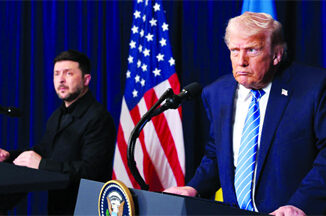
  • TRUMP AND PUTIN SPEAK BEFORE ZELENSKIY MEETING

    Shortly before Zelenskiy and his delegation arrived at Trump’s Florida residence, Trump and Russian President Vladimir Putin spoke in a call described as “productive” by the U.S. president and “friendly” by Kremlin foreign policy aide Yuri Ushakov.
    Ushakov, in Moscow, said Putin told Trump a 60-day ceasefire proposed by the European Union and Ukraine would prolong the war. The Kremlin aide also said Ukraine needs to make a decision regarding the Donbas “without further delay.”
    Trump said he and Putin spoke for more than two hours. He said the Russian president pledged to help rebuild Ukraine, including by supplying cheap energy. “Russia wants to see Ukraine succeed,” Trump said. “It sounds a little strange.”
    As Trump praised Putin, Zelenskiy tilted his head and smiled. Trump said he would call Putin again following the meeting with Zelenskiy.
    The Kremlin expressed support for Trump’s negotiations. “The whole world appreciates President Trump and his team’s peace efforts,” Kirill Dmitriev, Putin’s special envoy, posted on X on Dec 29 after Trump’s talks with Zelenskiy.
    U.S. negotiators have also proposed shared control over the Zaporizhzhia nuclear plant. Power line repairs have begun there after another local ceasefire brokered by the International Atomic Energy Agency, the agency said. Negotiators, Trump said, have made progress on deciding the fate of the plant, which can “start up almost immediately.”

  • Trump says US and Ukraine ‘a lot closer’ on peace deal but ‘thorny issues’ remain

    Trump says US and Ukraine ‘a lot closer’ on peace deal but ‘thorny issues’ remain

    PALM BEACH (TIP)- U.S. President Donald Trump said on Sunday that he and Ukrainian President Volodymyr Zelenskiy were “getting a lot closer, maybe very close” to an agreement to end the war in Ukraine, while acknowledging that the fate of the Donbas region remains a key unresolved issue.
    The two leaders spoke at a joint news conference after meeting at Trump’s Mar-a-Lago resort in Florida on Sunday afternoon. Both leaders reported progress on two of the most contentious issues in peace talks – security guarantees for Ukraine and the division of eastern Ukraine’s Donbas region that Russia has sought to capture.
    Both Trump and Zelenskiy offered few details and did not provide a deadline for completing a peace deal, although Trump said it will be clear “in a few weeks” whether negotiations to end the war will succeed. He said a few “thorny issues” around territory must be resolved.
    Zelenskiy said an agreement on security guarantees for Ukraine has been reached. Trump was slightly more cautious, saying that they were 95% of the way to such an agreement, and that he expected European countries to “take over a big part” of that effort with U.S. backing.
    French President Emmanuel Macron, in an X post published after Trump met with Zelenskiy, said progress was made on security guarantees. Macron said countries in the so-called “Coalition of the Willing” would meet in Paris in early January to finalise their “concrete contributions.”
    Zelenskiy has said previously that he hopes to soften a U.S. proposal for Ukrainian forces to withdraw completely from Donbas, a Russian demand that would mean ceding some territory held by Ukrainian forces. While Moscow insists on getting all of Donbas, Kyiv wants the map frozen at current battle lines.
    Both Trump and Zelenskiy said on Sunday the future of the Donbas had not been settled, though the U.S. president said discussions are “moving in the right direction.” The United States, seeking a compromise, has proposed a free economic zone if Ukraine leaves the area, although it remains unclear how that zone would function in practical terms.
    “It’s unresolved, but it’s getting a lot closer. That’s a very tough issue,” Trump said.
    Nor did the leaders offer much insight into what agreements they had reached on providing security for Ukraine after the war ends, something Zelenskiy described Sunday as “the key milestone in achieving a lasting peace.”
    Russia has said any foreign troop deployment in Ukraine is unacceptable.
    Zelenskiy said any peace agreement would have to be approved by Ukraine’s parliament, or by a referendum. Trump said he would be willing to speak to parliament if that would secure the deal.

  • A year of dissipating promises for Indian foreign policy

    A year of dissipating promises for Indian foreign policy

    New Delhi confronts challenges that concern economic and energy security, global strategic stability, and regional security

    By Suhasini Haidar

    The year 2025 began as one of considerable promise for Indian foreign policy. After 2024, a year that was dominated by national elections and political recalibration, Prime Minister Narendra Modi was expected to resume active diplomacy, with a full calendar of bilateral visits and multilateral engagements. Relations with the United States were expected to be reset under the second term of the Trump administration, continuing from Donald Trump’s first term. Long-running Bilateral Trade Agreement (BTA) negotiations with partners such as the United States, the United Kingdom, Australia, New Zealand and the European Union (EU) seemed imminent, with commitments to complete them by the end of the year.

    Across the geopolitical divide, a new engagement appeared to be taking shape with China after years of a stand-off along the Line of Actual Control (LAC), especially after Mr. Modi’s visit to China. Economic ties with Russia were also at a high point: India’s oil imports from Russia had surged to $52 billion, with U.S. and EU sanctions pressure having eased. Regionally, the government attempted to repair frayed relationships by reaching out to the Yunus administration in Bangladesh with a visit, in December 2024, by the Foreign Secretary, Vikram Misri, sending External Affairs Minister S. Jaishankar to Pakistan (October 2024), engaging the Taliban leadership in Dubai (January 2025), and preparing for regional visits from Nepal, Sri Lanka, and others. Five years after the Balakot strikes and the reorganization of Jammu and Kashmir, New Delhi was also projecting confidence in its security posture and its deterrent capacity for terrorism from Pakistan.

    However, many of those expectations for 2025 dissipated by the end of the year. India’s foreign policy planners found themselves wrestling with profound challenges across four interconnected domains: economic security, energy security, global strategic stability and regional security.

    Economic and energy security
    Instead of resetting India-U.S. ties, 2025 proved to be the most difficult year of this century. Actions by the Trump administration on tariffs, immigration and sanctions pushed trust levels back by decades. Washington’s decision to levy a steep 25% reciprocal tariff on Indian goods hit key labor-intensive sectors such as apparel, gems and jewelry, and seafood. This followed from the Trump first term, where India’s Generalized System of Preferences (GSP) trade privileges were withdrawn.

    To compound matters, the U.S. introduced a 25% surcharge on Indian imports of Russian oil, effectively making India the most heavily tariffed trading partner. Even if a forthcoming BTA softens the blow, the losses in contracts mean that factory-line closures and the retrenchment of workers remain. Immigration restrictions, particularly on H-1B visas, further undermined remittances, a key pillar of India’s foreign exchange inflows. Of all the trade deals on the anvil, India signed FTAs with the U.K., Oman and New Zealand. But the big prizes that leaders had committed to signing in 2025, with the U.S. and the EU, are still pending.

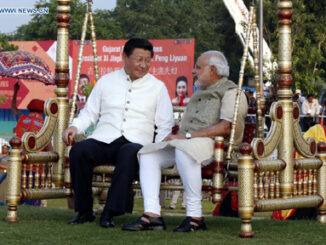
    Ties with China and Russia remained tenuous despite the iconic photo-moment of Mr. Modi-President Xi-President Putin holding hands at the Shanghai Cooperation Organization Summit (September 2025) and the Modi-Putin bear hug on the tarmac of New Delhi airport earlier this month. While India-China flight-visa-pilgrimage links were restored, more fundamental security guarantees for the LAC were not. Neither have economic investment regulations been removed. The hours-long detention of an Indian air passenger from Arunachal Pradesh at Shanghai (November 2025) has raised new concerns.

    After three years of resisting western pressure over Russian Ural energy imports, New Delhi appeared to bend, after a new wave of U.S. sanctions. Whether India will be compelled to zero out its Ural imports — similar to how it halted Iranian and Venezuelan oil imports under U.S. pressure in the past — remains uncertain, but the choice carries economic and reputational costs. The India-Russia summit, that ended without any major agreements in strategic spheres such as defense, energy, nuclear and space cooperation, disappointed all the hype preceding it.

    Global and regional security
    A central challenge for Indian strategists in 2025 has been the rise in global unpredictability. In its 2017 National Security Strategy (NSS), Washington identified China and Russia as “revisionist powers” seeking to undermine U.S. influence and global stability. In contrast, the 2025 NSS presents a softened, more ambiguous stance — avoiding direct mentions of China’s aggression in the South China Sea and toward Taiwan, and treating Russia with more caution than criticism. The 2017 NSS hailed India’s rise as a “leading global power” and “major defense partner”, but the 2025 version offers only a limited articulation of India’s role, primarily in the context of Indo-Pacific security and critical minerals. Given the short shrift to traditional U.S. allies in Europe and Asia, any deeper alignment with Washington, as had earlier been envisaged, seems risky now. Mr. Trump’s references to his meeting with Xi Jinping as a potential “G-2” only intensify concerns about India’s position in the Asian power balance.

    At the same time, global acceptance of the Gaza and Ukraine peace proposals — both of which critics argue favor the aggressors — signals a weakening of the international rules-based order. China’s rollout of a framework for “Global Governance” reflects its ambition to shape an alternative international architecture. For India, this requires serious thought about its own vision for a future global order, especially as the UN’s failures at controlling conflict grow.

    India’s immediate neighborhood, which initially appeared stable in early 2025, became more volatile as the year progressed. The terror attack in Pahalgam (April) was a grim reminder that even with the security crackdown in Jammu and Kashmir and past cross-border operations in 2016 and 2019, threats remain embedded. That terrorists came hundreds of kilometers inside the Valley to carry out the killings and escaped should merit serious introspection. India’s retaliatory Operation Sindoor was militarily effective, but New Delhi’s diplomatic campaign following the strike encountered setbacks. While countries condemned the terror attack, few openly supported India’s cross-border response. Persistent questions — particularly regarding speculation about the loss of Indian jets — damaged India’s credibility, as the government neither confirmed nor denied the reports.

    Complicating matters were claims that other countries supported Pakistan’s military actions. While India set aside concerns over China’s role in Pakistan Air Force strikes, ties with Türkiye and Azerbaijan have nose-dived. The announcement of a Saudi-Pakistan mutual defense pact was an additional blow to India’s regional calculus.

    Mr. Modi’s declaration of a “new normal” after the Pahalgam attack led to international worries over rapid escalation of the next conflict in South Asia. India’s restrained handling of the Delhi blasts conspiracy (November 2025) eased some of those worries, but the broader issue remains: how will New Delhi respond to the next major attack, especially with Pakistan’s political landscape increasingly shaped by the ultra-hawkish Field Marshal Asim Munir?

    The 2024 regime-change protests in Bangladesh and the 2025 Gen-Z demonstrations in Nepal have created fragile transitional governments, reducing predictability in India’s periphery. With elections in both countries scheduled for early 2026, New Delhi must prepare to engage with new leadership that is not necessarily positively disposed to it. With Bangladesh in particular, the end of the year has seen relations at their lowest ebb yet. The elections in Myanmar, on December 28, will be held on the Junta’s terms, despite New Delhi’s best attempts at fostering talks with the deposed NUG members and to ask for the more humane treatment of Aung San Suu Kyi.

    Lessons for 2026
    Several lessons from 2025 stand out clearly. India must recognize the limits of performative diplomacy — warm embraces, highly publicized summits and symbolic gestures such as awards and leaders driving together in the same car do not necessarily translate into tangible gains. Performative aggression — threats to isolate or boycott countries only mean something if other countries join in. The government was sensible in shifting its projection of India as “Vishwaguru” (global teacher) during the G-20 year in 2023 to “Vishwamitra” (global friend). But it must now avoid slipping into the narrative of a “Vishwa-victim”, blaming all others — American sanctions, Chinese maneuvering, Pakistan’s machinations, or the “ingratitude” of neighboring states — for its disappointments.

    New Delhi must stop being blind to its own double standards too — concerns over the lynching of a minority member in Bangladesh can only ring true only if the Modi government is prepared to condemn and stop similar attacks on minorities in India. The same is true for concerns about democracy and inclusive elections in the neighborhood. If rising Islamism in the region is an issue, then how does the government sanguinely sup with the Taliban? In 2026, with a world turning increasingly transactional, India can only bring up principles if it follows them consistently, regardless of whether they pertain to ties with geopolitical powers, or its own neighbors.
    (The author is an editor with The Hindu. They can be reached at
    suhasini.h@thehindu.co.in)

  • 2025 : The year of Trumpism

    2025 : The year of Trumpism

    US-India relations have sunk to a new low, with the Cold War era distrust returning

    “As for the NSS, three things have so far been clarified. First, that Trump would like to, as it were, ‘circle the wagons’ and secure control over the western hemisphere, declaring North and South America as “out of bounds” for “outside” powers. In some ways, this mirrors views in Asia that believe the US is an “outside” power in this part of the world. There is, however, no evidence to suggest that Trump would have US forces retreat from Asia and hand over the security of the region to regional powers.”

    By Sanjay Baru

    There is little doubt that US President Donald Trump dominated world headlines in 2025. He did so on five different fronts: first, with his ‘America First’ and ‘Make America Great Again’ policy that has not only had an impact on US domestic politics and economics but also on global trade, migration and investment flows; second, with his tariff war and the use of tariffs as a geo-economic weapon; third, by seeking to inject himself into various bilateral conflicts around the world, from South, West and South-east Asia to Europe; fourth, by altering the equation between the US, China and Russia, seeking a G-2 with the former and a détente with the latter; and, finally, by becoming the subject of investigations and news headlines about his sex life.

    Most recently, the focus has been on the Trump administration’s National Security Strategy (NSS). Scores of papers and articles have been written worldwide commenting on this document. It has been described as a new Monroe Doctrine, not only asserting the primacy of the Western Hemisphere in American security strategy but also proposing military action in the region to defend those interests.

    How important this stated strategy would be in influencing the actual behaviour of the US on the diplomatic and military fronts remains to be seen. In India, much of the commentary has been on the NSS view of US-India relations and India’s place in Trump’s worldview and ‘grand strategy’. It has been noted widely that US-India relations have sunk to a new low, with the distrust of the Cold War era returning, especially in the nature of the relationship at the leadership level.

    In Prime Minister Indira Gandhi’s time, the unprintable language in which President Richard Nixon spoke about her and India remained within closed doors and sealed papers till the confidentiality was broken and various memoirs recorded the low level of discourse in Washington, DC, about India and its leadership. Today, most of what is said is on television and social media. This has cast a long shadow on the relationship.

    As for the NSS, three things have so far been clarified. First, that Trump would like to, as it were, ‘circle the wagons’ and secure control over the western hemisphere, declaring North and South America as “out of bounds” for “outside” powers. In some ways, this mirrors views in Asia that believe the US is an “outside” power in this part of the world. There is, however, no evidence to suggest that Trump would have US forces retreat from Asia and hand over the security of the region to regional powers.

    Second, Trump has prioritised US relations with China above all else. China is both a challenge and a power to deal with. His tweet about the idea of a G2 — Group of Two — set the cat among Asian pigeons. He would like the war in Europe to end more or less on Russia’s terms, thereby further promoting the implicit view that the three Big Powers are entitled to their spheres of influence and security. These approaches have implications for India.

    Finally, many in India and overseas, especially in Europe, have interpreted the NSS as a statement of American retrenchment. This particular conclusion is a misinterpretation of Trump’s worldview and exaggerates the possibility of American retrenchment.

    Consider the fact that nowhere in the NSS is there any statement proposing retrenchment as far as the real projection of American power worldwide is concerned, namely, the US military bases overseas. There is no suggestion in the NSS that these would be shut down or that there would be any significant draw-down in the number of US troops stationed abroad.

    There are, as of now, over 1,60,000 US troops stationed in over 100 countries worldwide at 750 military sites. The most important overseas stations of US armed forces are in the ‘occupied’ countries of Germany, Japan, Italy and Korea (countries occupied by the US in the Second World War), member nations of the North Atlantic Treaty Organisation and in the ‘client’ states of West Asia, especially Bahrain and Kuwait.

    The annual cost of maintaining these bases has been estimated variously as being between $50 billion and $60 billion. The NSS says nothing about reducing the number of troops or bases but is emphatic that there has to be a greater “burden-sharing”. The US wants NATO members, Japan, Korea and Gulf states to increase their defence spending by partly financing the presence of US armed forces on their territories.

    Neither President Trump nor any other American President since the Second World War has ever said that there is any longer any reason for the US forces to be stationed in other countries.

    While these forces are present in limited numbers in many countries, including in India, thanks to bilateral agreements, the fact is that the larger presence in some countries is linked to the outcome of the Second World War. US troops remain stationed in all the countries the US ‘liberated’ and ‘occupied’ at the end of the war.

    Trump’s NSS has not called for a retreat or a retrenchment from these territories. It merely asks these countries to pay up for the maintenance of the US forces they host. It is the classic mafia-style act of demanding ‘protection money’ for the ‘security’ offered against potential threats from other Big Powers.

    So, think about this — the US is willing to allow China and Russia to be powerful military machines in Europe and Asia so that the European and Asian neighbours of Russia and China would seek protection from these regional hegemons from the global hegemon, the United States. In what way is this US retrenchment?

    This will be Trump’s legacy and going forward, the 2020s will be defined by how the world and the US respond to what can best be described as Trumpism.
    (Sanjay Baru is a senior journalist)

  • National Alliance of Indian Organizations is recognized at Grand BAPS Celebration in Jodhpur, India

    National Alliance of Indian Organizations is recognized at Grand BAPS Celebration in Jodhpur, India

    JODHPUR (TIP): The National Alliance of Indian Organizations (NAIO) — a national umbrella organization dedicated to bringing together Americans of Indian origin across the United States — and its Founder Trustee , Mr. Naveen Shah, were honored during a grand community celebration hosted by BAPS Swaminarayan Sanstha in Jodhpur, India.

    The prestigious recognition took place on December 25, 2025, during a special celebration marking Christmas Day, symbolizing unity, peace, and global harmony. The event witnessed an extraordinary gathering of over 15,000 attendees, including community leaders, dignitaries, devotees, and members of the Indian diaspora.

    During the ceremony, a senior BAPS priest praised the vision and mission of NAIO, stating:

    “This endeavor is the beginning of uniting the entire Indian diaspora all over the world, and it gives a strong message of One Voice, One India.”

    Mr. Shah was honored for his visionary leadership, lifelong commitment to community service, and his instrumental role in establishing NAIO as a unifying platform for Indian American organizations nationwide. Under his leadership, NAIO has emerged as a strong voice promoting collaboration, cultural unity, civic engagement, and empowerment of Americans of Indian origin in the United States.

    Naveen Shah receives the blessings from a BAPS priest

    Expressing his gratitude, Mr. Naveen Shah said he was deeply humbled to receive the honor and emphasized the importance of collective leadership:

    “This effort to unite Americans of Indian origin is very much needed at this time. I am truly grateful to my team members Girish Patel, Dr Raj Bhayani, Chintu Patel, Harry Singh Bolla and other members who have joined hands with me to build NAIO into a strong organization dedicated to unity and shared purpose.”

    Community leaders at the event highlighted that this recognition reflects the growing global impact of Indian American leadership and the strengthening ties between India and the Indian diaspora worldwide.

    The National Alliance of Indian Organizations (NAIO) continues to advance its mission of connecting diverse Indian American organizations under one platform, fostering shared values, leadership development, cultural pride, and community advancement across the United States.

    About NAIO

    The National Alliance of Indian Organizations (NAIO) is a national umbrella organization committed to uniting Americans of Indian origin by fostering collaboration among cultural, professional, business, religious, and community-based organizations. Guided by the vision “Stronger Together,” NAIO works to amplify collective impact and strengthen the Indian American voice nationwide.


  • Sant Rajinder Singh Ji Maharaj- Ambassador of Peace

    Transforming Lives through Meditation, Ethical Living & Selfless Service

    Sant Rajinder Singh ji Maharaj
    Sant Rajinder Singh ji Maharaj
    By Dr. Renee Mehrra

    Sant Rajinder Singh Ji Maharaj is an internationally renowned  spiritual teacher, an ambassador of peace, scientist, and an acclaimed author, offering a compelling vision for global harmony and oneness. He is the head of Science of Spirituality (www.sos.org), a nonprofit, non-denominational organization that focuses on personal transformation through meditation, ethical living and selfless service under his spiritual guidance. Science of Spirituality has a special consultative status with the Economic and Social Council of the United Nations since 2013, and also maintains a presence as a club with the United Nations Staff Recreational Council. The organization’s global outreach is extensive with over 3400 centers worldwide. It regularly responds to natural disasters with financial assistance, food, clothing, and volunteer relief workers. In addition, it sponsors blood drives, annual free eye clinics, and provides medical resources to needy communities.

    Born in India and educated as a scientist in the United States, Sant Rajinder Singh Ji  has a keen understanding of both mysticism and science. He  embodies a lifelong commitment to inner and outer peace, bridging science and spirituality, and sharing to a global audience the timeless spiritual wisdom in a clear, logical, and accessible manner.

    Those who have had the privilege of attending his inspirational talks experience a profound sense of calm, joy, and quietude that lingers long after his programs have concluded. In today’s world of strife and stress, the powerful impact of his teachings helps cultivate a more positive and compassionate outlook on life, making individuals understand that challenges can be turned into opportunities for their spiritual growth. His simple, non-denominational meditation technique empowers people to find their center and cultivate inner resilience for a more harmonious and meaningful existence.

    A prolific author, Sant Rajinder Singh Ji’s publications include books in fifty languages, among them are; Inner and Outer Peace through Meditation, Meditation as Medication for the Soul, Spark of the Divine, and Building Bridges through Meditation. Since 2020, Global Meditation in Place has been streamed every Sunday at 10 am EST featuring his weekly talks and meditation sessions that help to nurture one’s spirit, and foster spiritual growth. His unwavering dedication to the human unity movement has led to his global efforts to help humanity transcend racial, cultural, religious and economic differences. He  regularly convenes International Human Unity Conferences in India to bring civic, social, religious, and spiritual leaders together to share their views on integrating human unity into their communities.

    In his various keynote addresses around the world, including at academic and medical institutions, United Nations, US Coast Guard Academy, and the National Institute of Health, Sant Rajinder Singh Ji outlines a sustainable blueprint for world peace, successful leadership and social transformation through meditation that leads to inner peace paving the way to building bridges of outer peace and unity in the world, A strong advocate for conscious living, and eco-friendly lifestyle, he has promoted Veggie Fest, one of North America’s largest vegetarian and vegan lifestyle festivals in Chicagoland. Take the Vegetarian Challenge,” and Take the Meditation Challenge initiatives underscore the importance of responsible consumption and production, and address environmental and health concerns. These represent a significant contribution to the Sustainable Developmental Goals of the United Nations particularly those related to Good Health and Well Being (SDG 3) and Responsible Consumption and Production (SDG 12).

    As founder of 24 Darshan Academy K-12 schools across India and South America  Sant Rajinder Singh Ji has been tirelessly cultivating a generation of peacemakers for tomorrow, enhancing their spiritual quotient and making them embrace universal values of truthfulness, non-violence, interconnectedness, and respect for all.

    Sant Rajinder Singh Ji is being felicitated by former President of India Shri Pranab Mukherjee, 2016

    Sant Rajinder Singh Ji  has been felicitated and honored for his global efforts toward unity and peace from international and national leaders. These accolades include recognition by the former President of India, Shri Pranab Mukherjee,  Award from the President of the State of Mexico, Extraordinary Grand Cross Award by the Governor of Quindío, Colombia, US Congressional Citations, Exemplary Service to Humanity from New York State and New Jersey, Peace Award  by the UN-NGO community & Interfaith Center of New York, Distinguished Leadership Award  for Peace and Spirituality, Illinois Institute of  Technology Chicago, and many more…

    Sant Rajinder Singh Ji’s message of inclusion, and personal transformation through spirituality and meditation  has profoundly impacted global efforts to promote human unity, dismantle the walls of racial prejudice, bias and intolerance, and foster an environment that contributes to a better and more peaceful world. In his words: “True happiness comes when we connect with the source of joy within us: our soul and God.” 

    This holiday season, let us all embark on an introspective journey of self-discovery and unwrap the priceless gifts of joy and inner bliss that await us, and embody the change we want to see on earth.

    (Dr. Renee Mehrra is an Award-winning Broadcaster and Civic Leader)

  • ‘I don’t appease’: Mamata Banerjee’s pre-poll temple push, BJP bristles

    Kolkata (TIP)-West Bengal Chief Minister Mamata Banerjee laid the foundation stone for ‘Durga Angan’, a cultural complex dedicated to Goddess Durga. At the event, she insisted that she was a “true secularist,” and dismissed accusations of “appeasement politics.”
    The BJP, however, hit back sharply and accused Banerjee of misusing land intended for industrial development, calling her “fake” and questioning the lack of tenders and work orders for the project.
    Durga Angan is a Rs 261.99 crore project that will come up near Eco Park in Kolkata’s New Town area on a 17.28-acre plot. As per the Chief Minister, the complex is a tribute to Unesco’s recognition of Durga Puja as a cultural heritage.
    “I respect all religions and participate in their festivals because I believe faith belongs to individuals, but festivals belong to everyone,” Banerjee said on the occasion. The Chief Minister’s statement came in response to repeated allegations from opponents accusing her of engaging in appeasement politics.
    Banerjee described herself as a secular leader dedicated to equal respect for all faiths. She told the gathering, “Many people blame me for appeasement politics. I am a true secularist. I believe in the peaceful coexistence of all religions. You can’t show me a religion whose celebrations I don’t attend.”
    “Every religion has its cultural practices. How can I disregard any of them? Some people are looting and vandalising. Decisions are being made about who will stay and who will have to leave. I will pray to Goddess Durga to destroy evil,” she said.
    In her address, the Chief Minister also took a dig at the Special Intensive Revision of electoral rolls in West Bengal, which the ruling Trinamool Congress has vehemently opposed. “What is the link between nationality and voting rights? When someone speaks Bengali, they are denied rooms in hotels. When a person speaks Bengali, they are labelled as Bangladeshi. You are ready to call those who arrived in 2024 citizens, but not those who have lived and died here. We are being patient. But there is a limit. The land of Bangla doesn’t bow down. Everyone’s voting rights must be preserved,” she added.
    BJP leaders, however, sharply criticised the timing and process behind the Durga Angan project, which comes just months ahead of the Assembly polls in the state.
    Senior party leader Suvendu Adhikari questioned the use of the land and the transparency of the initiative.
    “She is doing it on a plot that was meant for industry. She drove away industry and is now doing all this. There was no tender sought. There is no work order. This is all fake. Everyone calls Mamata Banerjee a thief. From today, her new name is fake Chief Minister,” he said.

  • Missiles, kamikaze drones part of India’s Rs 79k-cr defence push

    Missiles, kamikaze drones part of India’s Rs 79k-cr defence push

    New Delhi (TIP)- The defence acquisition council (DAC) on Monday gave its initial approval to the purchase of military hardware worth Rs 79,000 crore, including beyond-visual-range missiles, loitering munitions (kamikaze drones), long-range rockets, radars, and drone detection and interception systems, to boost the military’s combat readiness, the defence ministry said.

    The DAC, headed by defence minister Rajnath Singh, also accorded its acceptance of necessity (AoN) for leasing high-altitude long range remotely piloted aircraft systems to boost the navy’s capabilities in the vast Indian Ocean region, it added. Under India’s defence procurement rules, AoN by the council is the first step towards buying military equipment.

    The key proposals cleared by the council — India’s apex military procurement body — include the acquisition of indigenous Astra Mk-II beyond-visual-range air-to-air missiles to sharpen the precision strike capability of the Indian Air Force, and long-range guided rocket ammunition for the army’s Pinaka multiple launch rocket system (MLRS).

    “The MoD under the leadership of PM Narendra Modi is working tirelessly to strengthen India’s defence preparedness. The decisions taken today will help in enhancing operational capabilities of the armed forces,” Singh said on X.

    Long-range precision weapons proved effective during Operation Sindoor in May when the Indian military struck terror and military installations in Pakistan and Pakistan-occupied Kashmir (PoK). Between the launch of the operation in the early hours of May 7 and the ceasefire on May 10 evening, Indian forces bombed nine terror camps in Pakistan and PoK, killing at least 100 terrorists, and IAF struck targets at 13 Pakistani airbases and military installations. Pakistan lost as many as 12 to 13 aircraft, including fighter jets such as US-made F-16s and Chinese-origin JF-17s, to IAF’s precision strikes on ground and in the air during Operation Sindoor, launched in response to the April 22 Pahalgam terror attack in which 26 people were killed.

    “Astra Mk-II missiles with enhanced range will increase the capability of the IAF’s fighter aircraft to neutralise adversary aircraft from long standoff range,” the ministry said in a statement. The long-range guided rockets, it added, will enhance the range and accuracy of Pinaka MRLS for effective engagement of high value targets.

    The purchase of loitering munitions, or kamikaze drones, also used during Operation Sindoor, low-level light-weight radars and integrated drone detection and interdiction systems for the army was cleared by DAC.

    “Loitering munitions will be used for precision strike of tactical targets, whereas low-level light weight radars will detect and track small size, low flying unmanned aerial systems. The integrated drone detection and interdiction system Mk-II with enhanced range will protect the vital assets of the Indian Army in tactical battle area and hinterland, the defence ministry said.

    The hardware cleared for the IAF includes automatic take-off landing recording system, full mission simulator for the light combat aircraft (LCA Mk-1A) and SPICE-1000 long-range guidance kits. “Induction of the automatic take-off landing recording system will fill the gaps in the aerospace safety environment by providing high definition all-weather automatic recording of landing and take-off. The full mission simulator will augment pilot training in a cost effective and safe manner, while SPICE-1000 will enhance long range precision strike capability of the IAF,” the ministry said.

    The hardware cleared for the navy includes bollard pull tugs to assist warships and submarines in berthing, unberthing, and manoeuvring in confined waters/harbour; and high-frequency software defined radios to boost long-range secured communication.

  • Brigitte Bardot dies at 91: What is the French cinema icon’s net worth?

    Brigitte Bardot, the screen siren whose portrayals of free-spirited ingenues made her the pride of France before she turned her back on movie sardom in 1973 to become an animal rights activist, has died at 91, according to French media and The Associated Press.
    She died at her residence in Saint Tropez, her foundation said in a statement. “The Brigitte Bardot Foundation announces with immense sadness the death of its founder and president, Madame Brigitte Bardot, a world-renowned actress and singer, who chose to abandon her prestigious career to dedicate her life and energy to animal welfare and her foundation,” read the statement, as reported by NBC News.
    Bardot rose to international fame with performances in And God Created Woman, The Truth, and Viva Maria!, the latter earning her a BAFTA nomination. She later stepped away from acting to become a leading animal rights advocate, declaring in 1973, “I gave my youth and beauty to men; I give my wisdom and experience to animals,” as reported by The Mirror US.
    Throughout her lifetime, Bardot amassed a substantial fortune, estimated between $65 million and $100 million, through her celebrated film roles, modeling contracts, and valuable property investments, according to Express US. During the 1960s, Bardot ranked among the world’s highest-paid actresses, earning $350,000 for Viva Maria!, about $3.66 million in today’s dollars. Her 1966 memoir, Initiales B.B., reportedly generated an additional $4 million.
    Her primary residence, La Madrague, in Saint Tropez, purchased in 1958, has been valued at no less than $23 million. She also owned Le Castelet, a medieval hillside property near Cannes that was listed for sale in 2020 at around $6.5 million, as per The Mirror US.

  • Sydney Sweeney says she wants to do films that ‘save people’s lives’, calls The Housemaid ‘dream project’

    Sydney Sweeney says she wants to do films that ‘save people’s lives’, calls The Housemaid ‘dream project’

    Sydney Sweeney wants to make films that “save people’s lives.” In a recent interview with the BBC, the 28-year-old said she wants her movies to have an “impact.” This year, she starred in The Housemaid and the biopic Christy. Both films address domestic violence, which she thinks is a “prevalent” topic.
    The Euphoria star takes a “lot of care” when playing such roles. “Being able to have a film that’s on a more commercial level talk about a very difficult topic is important,” she told the outlet. Addressing her latest thriller, based on Freida McFadden’s best-selling novel of the same name, Sweeney said she is a “huge fan of the book” and loves “all the characters” in it. Calling the film a “dream project,” Sweeney admitted that she loves “complex, juicy, crazy, twisted stories.” In The Housemaid, she stars opposite Amanda Seyfried and Brandon Sklenar. Their characters, Nina and Andrew Winchester, hire the Echo Valley star’s character, Millie Calloway, as a live-in house help.
    Seyfried likened herself to Sweeney, saying, “There’s a similarity between us that is uncanny, and it’s really fun to work with people [who] are doing life in a similar way, have similar ideals about the job and life.”

  • Tribunal orders removal of BrahMos CEO over lapses after top scientist complains

    The Central Administrative Tribunal (CAT) has ordered the removal of Jaiteerth R Joshi as Director General and Chief Executive Officer (CEO) of BrahMos Aerospace and directed the Defence Ministry to reconsider the claim of senior scientist Sivasubramaniam Nambi Naidu for the top post. Naidu had challenged Joshi’s appointment, alleging procedural lapses. In its order passed on Monday, the Hyderabad bench of the tribunal asked the Ministry of Defence and the Defence Research and Development Organisation (DRDO) to revisit Naidu’s claim within four weeks. Until a final decision is taken, the CAT directed that an in-charge arrangement be put in place, explicitly barring the current Director General from holding the charge. The tribunal examined the powers of the Secretary, Defence Research and Development and Chairman, DRDO, observing that while the authority is empowered to approve one of the names recommended by the Selection Committee for the Director General’s post, it cannot disregard the complete service records of other scientists empanelled for the position.

    Joshi’s appointment as DG and CEO of BrahMos Aerospace was challenged by Naidu, a senior DRDO scientist, who alleged unjust supersession and procedural irregularities. Naidu contended that he was seven years senior to Joshi and held the higher rank of Distinguished Scientist, while Joshi was a Scientist ‘H’ at the time of his appointment. In its verdict, the CAT directed the Defence Ministry and DRDO to remove Joshi from the post, restart the selection process, reconsider the claims of Naidu and other senior scientists, and appoint an interim in-charge for BrahMos Aerospace within four weeks, barring Joshi from holding that role.

  • Anaconda: This Jack Black–Paul Rudd film isn’t good, but it’s making people laugh until they snort

    Anaconda: This Jack Black–Paul Rudd film isn’t good, but it’s making people laugh until they snort

    If there’s one actor who can commit to absolute chaos and still make it work, it’s Jack Black. And in case you somehow missed it, yes — he’s starring in the latest Anaconda movie. Paired with Paul Rudd, the casting alone feels like a joke. Set up as a survival thriller with a comedic edge, Anaconda unfolds in the depths of the Amazon rainforest. The film follows four friends — Doug McCallister (Jack Black), Griff (Paul Rudd), Kenny (Steve Zahn), and Claire (Thandiwe Newton) — who venture into the wilderness hoping to rediscover their love for filmmaking. What begins as a creative escape quickly turns into a fight for survival when a deadly anaconda begins stalking them through the jungle.
    While the premise sounds intense, audience reactions suggest the film leans far more into absurdity than suspense, and viewers seem to be very aware of that.
    Early reviews paint Anaconda as a film that doesn’t pretend to be prestige cinema. One viewer summed it up bluntly: “If you only see one movie in which a man sits on another man’s back in order to pee on a third man, make it this one.”
    Others admit the film doesn’t always work, but still manages to land unexpected laughs. “This movie was generally not good, but I’d be lying if I said I didn’t cackle laughing when it turned out the pig strapped to Jack Black’s back was also still alive.” There’s also a recurring theme in reactions: nostalgia. “It gives early 2000s comedy vibes which is fine. Critics will hate it but I bet it finds a following.”
    Some viewers felt the film’s chaotic energy works best with a crowd. “Way better movie to see in theatres, this would be awful on a plane/at home/etc.” Others appreciated the movie’s honesty about what it is—and what it isn’t. “Oh, it’s really not a good movie at all BUT it knows what it is and is very honest about what it is sooooo….it’s fine?”

  • SC puts its own ruling on Aravalli redefining in abeyance

    SC puts its own ruling on Aravalli redefining in abeyance

    New Delhi (TIP)- Noting that certain clarifications were needed regarding the definition of Aravalli Hills it recently approved, the Supreme Court on Monday, Dec 29,  ordered to keep in abeyance its November 20 ruling that was based on a committee’s recommendations.

    A three-judge special vacation Bench led by CJI Surya Kant decided to set up a new high-powered committee of domain experts to examine the environmental impact of the recommendations made by the earlier committee. The composition of the new panel has not been announced.

    The Bench noted that there had been a significant outcry among environmentalists, who had expressed profound concern about the potential for misinterpretation and improper implementation of the newly adopted definition and this court’s directions. It said, “This public dissent and criticism appear to stem from the perceived ambiguity and lack of clarity in certain terms and directives issued by this court. Consequently, there is a dire need to further probe and clarify to prevent any regulatory gaps that might undermine the ecological integrity of the Aravalli region.”

    “While we have no scientific reasons justifying any ex-facie acceptance of the same, it seems prima facie that both the committee’s report and the judgment of this court have omitted to expressly clarify certain critical issues,” said the Bench, which also included Justice JK Maheshwari and Justice AG Masih.

    It said, “In the interim, to subserve the ends of complete justice and in the broader public interest, we deem it necessary to direct that the recommendations submitted by the committee, together with the findings and directions stipulated by this court in its judgment dated November 20, 2025, be kept in abeyance.

    “This stay shall remain in effect until the present proceedings reach a state of logical finality, ensuring that no irreversible administrative or ecological actions are taken based on the current framework.

    “We therefore deem it appropriate that prior to the implementation of the committee’s report, or the execution of the directions contained in paragraph 50 of this court’s judgment, a fair, impartial and independent expert opinion must be obtained and considered, after associating all requisite stakeholders. Such a step is essential to resolve critical ambiguities and to provide definitive guidance on issues (relating to the definition of the ‘Aravalli Hills and Ranges’).”

    As a matter of abundant caution, the Bench directed that “until further orders, no permission shall be granted for mining, whether it is for new mining leases or renewal of old mining leases, in the Aravalli Hills and Ranges as defined in the FSI (Forest Survey of India) report dated August 25, 2010, without prior permission from this court.”

    Issuing a notice to the Centre and governments of Haryana, Rajasthan, Gujarat and Delhi, the top court posted the matter for further hearing on January 21, 2026. It urged Attorney General R Venkataramani, Solicitor General Tushar Mehta, senior advocate and amicus curiae K Parmeswar and the Central Empowered Committee (CEC) to assist it on various issues concerning the hills

  • Alia Bhatt’s Alpha postponed to avoid clash with Salman’s Battle of Galwan

    Alia Bhatt’s Alpha postponed to avoid clash with Salman’s Battle of Galwan

    Yash Raj Films has decided to delay the release of its upcoming spy thriller Alpha, which was previously scheduled for April 17, 2026. The decision was made to prevent a direct clash with Battle of Galwan, an anticipated war drama starring Salman Khan that is slated for release around the same time. The postponement was confirmed on Saturday morning by trade analyst Taran Adarsh on the social media platform X (formerly Twitter).
    The announcement marks the second time that Alpha has been postponed. The film was initially intended for a Christmas 2025 release but was delayed due to the need for additional time in post-production. Extensive visual effects work reportedly required more time, prompting the first schedule change. Trade analyst Taran Adarsh said, ‘The industry insider has claimed that Alpha, starring Alia Bhatt and Sharvari, will not be released in April 2026 to avoid clashing with Salman Khan’s war drama, Battle of Galwan.’
    Confirming the latest development, Taran Adarsh wrote, ‘”#BreakingNews… ALPHA AVOIDS CLASH WITH BATTLE OF GALWAN – YRF TO DECIDE ON A NEW DATE… #AdityaChopra steps aside for #SalmanKhan, moving Alpha from its previously announced release date of April 17, 2026, to avoid a direct clash with BattleOfGalwan. #YRF had locked April 17, 2026, for Alpha, but the makers will now announce a new release date after assessing the theatrical release calendar over the next couple of months,” Taran Adarsh wrote on X (formerly Twitter) on Saturday morning.’