Month: December 2025

  • Border 2 teaser review: Sunny Deol war drama banks on nostalgia and patriotism

    Border 2 teaser review: Sunny Deol war drama banks on nostalgia and patriotism

    War dramas are supposed to bank on emotion. They need to be hair-raising, tear-jerking, and most of all, engaging. Think of the best war films India has made – from Haqeeqat to Shershaah, and they all tick all these boxes. Border, perhaps, is at the top of that list. 28 years ago, the JP Dutta film used all these tools in its arsenal to sell emotion as no war film has done before. As the teaser for Border 2 unrolled yesterday (December 16), a similar picture played out – a focus on emotions like nostalgia, pride, and patriotism, rather than technical finesse.
    But it worked. Border 2 teaser, particularly when Hindustan Meri Jaan begins to play, hit all the right notes. From Sunny Deol’s monologue to the heroes’ introductions, the film attempted to be larger-than-life while grounding itself with real stories. Is it perfect? By no means. However, the Border 2 teaser reveals that the Anurag Singh film isn’t aiming for perfection, but rather engagement and entertainment. And in that regard, it has made a good start.
    Sunny Deol is the biggest USP of Border 2, apart from the title itself. With Gadar 2, the veteran actor showed that he still has it in him to deliver a blockbuster in his 60s, aided by just solid packaging, and the nostalgia of a successful IP. Border 2 has both of those things. The three young heroes all get a chance to shine. The diversity Varun Dhawan, Diljit Dosanjh, and Ahan Shetty provide is a treat for those marketing this film, as most audience sub-sections have a ‘favourite’. And the visuals of naval warfare – a novelty in Indian films – are a cherry on top.
    But mostly what Border 2 gets right is how it uses nostalgia. If the original announcement video perfectly used Sandese Aate Hain, the teaser utilised Hindustan Meri Jaan in an even better fashion. It is a very clear and smart use of relatable content to reel in the loyal fanbase.

  • Tisca Chopra reveals she ‘almost got divorced’ while writing ‘Saali Mohabbat’

    Tisca Chopra reveals she ‘almost got divorced’ while writing ‘Saali Mohabbat’

    Tisca Chopra recently made her directorial debut with Saali Mohabbat, which she co-wrote with her husband, Sanjay Chopra. Speaking about her experience, Tisca revealed how they almost ended up divorced due to their creative differences.
    In a conversation with Mid-Day, Tisca explained how her writing style is more subtle, while husband Sanjay’s is more robust.
    She said: “We almost got divorced writing it. So the yin and yang came together nicely in the script. We were told in the beginning [to drop it], but we still went ahead and recorded it. Then we had to dub it to something else. I’m not a big fan of censorship. If at 18 years you can choose a government, why can’t you choose what you want to watch?”
    She added: “Directing is a mother-of-god hard job. It just never ends. You start your day with a volley of questions. What should be the size of the car’s number plate? Should the actor shave his chest or not? If you don’t answer, they’ll think you don’t know your mind. So you just have to make a decision, even if it’s wrong. And then you make the right decision.”
    About Saali Mohabbat
    Saali Mohabbat is a drama-thriller set against the backdrop of a quaint small town. The story unravels when an ordinary housewife finds her monotonous life uprooted as betrayal, lies, and hidden tensions surface after two disturbing deaths disrupt the delicate balance around her.
    Alongside Radhika Apte, Sauraseni Maitra, Divyendu Sharma, Anshumaan Pushkar, and Anurag Kashyap, also play key roles in the film, it is produced by Jyoti Deshpande, Dinesh Malhotra, Vipin Agnihotri, and Manish Malhotra.

  • The eternal flame of courage: From Chamkaur to Sirhind, the martyrdom of Sahibzadas

    The eternal flame of courage: From Chamkaur to Sirhind, the martyrdom of Sahibzadas

    In the Sikh tradition, Shaheedi Pakhwara—literally meaning the fortnight of martyrdom—is not merely a span of dates on the calendar. It is a deeply contemplative and spiritually charged period during which the Sikh community collectively remembers some of the most defining sacrifices in its history. Observed primarily in the latter half of December, this pakhwara commemorates the martyrdoms of Guru Gobind Singh’s family members and the extraordinary sacrifices that shaped Sikh identity forever.Unlike festivals marked by celebration, Shaheedi Pakhwara is observed with solemnity, reflection, and inner resolve. It calls upon Sikhs to revisit the values for which their Gurus and Sahibzadas laid down their lives—faith, courage, righteousness, and resistance to tyranny.

    The month of December occupies a unique and painful place in Sikh history. It was during this period in 1704-1705 that the Sikh Panth witnessed an unbroken chain of martyrdoms that tested the very soul of the community.

    Within a span of just a few weeks: The elder Sahibzadas, Baba Ajit Singh and Baba Jujhar Singh, attained martyrdom fighting valiantly at Chamkaur Sahib.

    The younger Sahibzadas, Baba Zorawar Singh (9) and Baba Fateh Singh (6), were martyred at Sirhind.

    Mata Gujri, mother of Guru Gobind Singh, passed away in captivity after learning of her grandsons’ execution.

    Guru Gobind Singh himself endured unimaginable personal loss while continuing to lead the Khalsa with unbroken spirit.

    ‘Shaheedi Pakhwara’ emerged organically in Sikh memory as a period to collectively remember this unparalleled sacrifice. Unlike festivals marked by celebration, Shaheedi Pakhwara is observed with solemnity, reflection, and inner resolve. It calls upon Sikhs to revisit the values for which their Gurus and Sahibzadas laid down their lives-faith, courage, righteousness, and resistance to tyranny.

    Martyrdom of younger Sahibzadas

    Few episodes in the long sweep of Indian history possess the emotional gravity, moral clarity, and civilizational significance of the martyrdom of Sahibzada Zorawar Singh and Sahibzada Fateh Singh, the younger sons of Guru Gobind Singh, the Tenth Guru of the Sikhs. Their sacrifice, sealed on December 26, 1705, was not merely an act of cruelty by a tyrannical regime; it was a defining moment when innocence confronted power, when conscience stood against coercion, and when faith revealed its highest form-fearlessness in the face of death.

    The story of the Sahibzadas does not belong to one community alone. It belongs to the ethical memory of humanity. Across centuries, their martyrdom has endured as a testament to the truth that moral courage is not measured by age, and that even the smallest voices can thunder through history.

    India under Aurangzeb: A climate of fear and orthodoxy

    The late seventeenth century was a period of profound transformation and turbulence in the Indian subcontinent. The Mughal Empire, once known for its relative religious accommodation under rulers like Akbar, had entered an era of rigid orthodoxy under Emperor Aurangzeb. His reign was marked by the reimposition of the jizya tax, systematic destruction of temples, curtailment of non-Islamic practices, and a policy of forced conformity that deeply fractured India’s pluralistic ethos. Religious freedom, which had long been woven into India’s civilizational fabric, was under direct assault. Communities that resisted faced persecution, exile, or death. It was in this climate that the Sikh Gurus emerged as the strongest moral counterforce to imperial tyranny-not as rebels seeking political power, but as defenders of human dignity and freedom of belief.

    Martyrdom of Guru Tegh Bahadur: The Moral Foundation

    The roots of the Sahibzadas’ sacrifice lie in the martyrdom of their grandfather, Guru Tegh Bahadur, who was executed in 1675 for refusing to convert to Islam and for defending the religious rights of Kashmiri Pandits. His execution in Delhi marked a turning point in Indian history-it was perhaps the first recorded instance where a religious leader sacrificed his life explicitly for the freedom of another faith.

    This act redefined Sikh identity. From that moment onward, resistance to injustice became inseparable from Sikh spirituality. Guru Tegh Bahadur’s martyrdom planted the seed that would later bloom into the Khalsa and ultimately into the supreme sacrifice of his grandsons.

    Guru Gobind Singh: The Making of a Saint-Soldier Civilization

    Ascending the Guruship at a young age, Guru Gobind Singh inherited not only spiritual leadership but an embattled legacy. He understood that piety alone could not survive unchecked tyranny. In 1699, through the historic creation of the Khalsa Panth, he reshaped Sikh society into a disciplined, fearless collective committed to justice, equality, and sacrifice.

    The Khalsa was revolutionary. It erased caste distinctions, demanded moral integrity, and required absolute commitment to righteousness-even unto death. This transformation deeply unsettled the Mughal authorities and their allied hill rajas, who saw in the Khalsa a force they could neither control nor intimidate.

    The Siege of Anandpur and the betrayal of sacred oaths

    Repeated military campaigns were launched against Guru Gobind Singh. The prolonged siege of Anandpur Sahib subjected Sikhs to hunger, deprivation, and constant assault. Eventually, the Mughal authorities and hill chiefs swore solemn oaths-on the Quran and the cow-guaranteeing safe passage if the Guru vacated Anandpur.

    Trusting the sanctity of these oaths, the Guru agreed. The assurances were broken almost immediately. Sikh caravans were attacked, families scattered, and chaos reigned. During this tragic exodus, Guru Gobind Singh’s family was separated-an event that would lead directly to one of the darkest crimes in Indian history.

    Separation, refuge and betrayal

    Amid the flooded currents of the Sirsa river, Mata Gujri, along with her two grandsons-Zorawar Singh (9) and Fateh Singh (6)-became separated from the Guru. Cold, exhausted, and vulnerable, they sought refuge in the home of Gangu, a former servant of the Guru’s household.

    What should have been a moment of compassion became an act of treachery. Tempted by greed and fear, Gangu betrayed them to Mughal officials. The elderly grandmother and the two children were arrested and marched to Sirhind, the seat of Mughal authority in the region.

    The Thanda Burj: Suffering in silence

    At Sirhind, Mata Gujri and the Sahibzadas were confined in the Thanda Burj, a tower designed to provide relief during summer heat but utterly exposed during winter. December winds pierced through its open structure. Food was scarce. Warm clothing was denied.

    Yet, within those cold walls, something extraordinary unfolded. Mata Gujri did not allow despair to consume her grandchildren. Instead, she narrated stories of the Gurus’ sacrifices, reminding them of who they were and what they stood for. These were not tales meant to frighten children-but lessons meant to prepare souls. The Sahibzadas listened with clarity beyond their years.

    The court of Wazir Khan: Innocence versus authority

    When the children were produced before Wazir Khan, the Mughal governor of Sirhind, the court expected tears, fear, and submission. What it encountered instead was composure and conviction.

    They were promised riches, royal status, and protection-on the sole condition that they convert to Islam. The offer was repeated. Religious scholars attempted persuasion. Threats followed. The children refused.

    Their refusal was calm, articulate, and unwavering. They chose faith over life-not out of stubbornness, but out of understanding. In that moment, the court of Sirhind witnessed something it could not comprehend: spiritual sovereignty.

    Bricked Alive: The ultimate act of tyranny

    Enraged by their defiance, Wazir Khan ordered the unthinkable. The Sahibzadas were to be bricked alive within a wall, a punishment intended to terrorize and humiliate the Sikh community into submission.

    As bricks were laid around their small bodies, Sikh tradition recounts that the wall collapsed repeatedly, as though refusing to stand upon injustice. Ultimately, when the wall could not be completed, the executioners beheaded the children.

    On December 26, 1705, two young lives were extinguished-but a moral victory was sealed forever.

    Mata Gujri’s final breath

    When news of the execution reached Mata Gujri, the shock proved unbearable. Having endured cold, hunger, imprisonment, and the loss of her grandsons, she breathed her last soon after. Her passing is remembered not as a natural death, but as a martyrdom born of unbearable grief and spiritual surrender.

    The martyrdom of the younger Sahibzadas is unparalleled in world history. It symbolizes:

    –           Courage beyond age

    –           Faith beyond fear

    –           Resistance without violence

    –           Victory without survival

    They did not wield weapons, yet they defeated an empire morally. Their sacrifice exposed the emptiness of power when stripped of ethics.

    Far from weakening the Sikhs, this atrocity ignited greater resolve. Within years, Banda Singh Bahadur would dismantle Mughal authority in the region, and Sirhind itself would face historical reckoning.

    The Sahibzadas became the moral heartbeat of Sikh resistance-a reminder that tyranny must never go unanswered.

    Shaheedi Jor Mela: Living Memory

    Every year, lakhs gather at Fatehgarh Sahib for Shaheedi Jor Mela, where the martyrdom of the Sahibzadas is remembered not with despair, but with reverence and resolve. Their story is retold so it may never fade into silence.

    Veer Bal Diwas: A Nation Acknowledges Its Children

    In 2021, the Government of India declared December 26 as Veer Bal Diwas, marking a watershed moment in national remembrance.

    Veer Bal Diwas (Day of Brave Children) is observed annually in India on December 26th to honor the supreme sacrifice of Sahibzada Zorawar Singh and Sahibzada Fateh Singh, the younger sons of Guru Gobind Singh Ji, for refusing to convert to Islam and choosing martyrdom over renouncing their faith. Declared a national observance by the Government of India in 2022, it’s a solemn day to remember their incredible bravery, commitment, and courage against tyranny, inspiring generations to uphold truth and justice.

    The Elder Sahibzadas at Chamkaur: Valor Forged in Faith

    At Chamkaur Sahib, history witnessed an act of courage so profound that it redefined the meaning of sacrifice in Sikh tradition.

    Baba Ajit Singh, barely eighteen, and Baba Jujhar Singh, only fourteen, stood beside their father, Guru Gobind Singh, as a small band of Sikhs faced an overwhelming Mughal force numbering in the thousands. Surrounded, outnumbered, and fully aware that survival was impossible, the elder Sahibzadas did not seek escape. Instead, they sought honour in righteousness.

    When the Guru asked for volunteers to step out of the besieged fortress and confront the enemy, Baba Ajit Singh was the first to rise. His decision was not impulsive bravado, but the natural expression of Khalsa training-where fearlessness is born of faith and life itself is secondary to truth. Armed with resolve and guided by the Guru’s blessing, he rode into battle and attained martyrdom after fighting with extraordinary valor.

    Soon after, the fourteen-year-old Baba Jujhar Singh followed his elder brother’s path. Despite his tender age, his spirit was unyielding.

    He engaged the enemy with remarkable courage, embodying the Sikh ideal that age is irrelevant when dharma calls. His martyrdom affirmed that the Khalsa is defined not by years lived, but by the strength of conviction.

    The sacrifice of the elder Sahibzadas at Chamkaur symbolises the warrior ethos of Sikhism-a tradition where the sword is raised not for conquest, revenge, or hatred, but solely in defence of righteousness and justice.

    Their martyrdom stands as a powerful reminder that Sikh warfare is not aggression, but resistance rooted in moral responsibility.

    Together, Baba Ajit Singh and Baba Jujhar Singh demonstrated that true bravery lies not in survival at any cost, but in standing firm when truth is threatened, even if it demands the ultimate sacrifice. Their legacy continues to inspire generations, affirming that the Khalsa warrior fights not to dominate, but to protect dignity, faith, and freedom.

    Sahibzada Ajit Singh Ji

    Sahibzada Ajit Singh (1687-1705) was born to Mata Sunder Kaur and Guru Gobind Singh at Paonta Sahib. Sahibzada Ajit Singh and Sahibzada Jujhar Singh are remembered as ‘Vade Sahibzada’ in Sikh history. Sahibzada Ajit Singh was very intelligent, gifted with Gurbani, and agile from his childhood. At an early age, he mastered horseback riding and gun shooting. On May 23, 1699, while commanding a group of one hundred Singhs, he successfully raided the nearby village of Ranghars, who had once plundered the company of Pothohar Sikhs coming towards  Anandpur Sahib. On March 15, 1700, he attacked the Gujars of Bajrur village, who once robbed the caravan of Singhs. On August 29, 1700, when the hill kings attacked the Taragarh fort, Sahibzada Ajit Singh bravely fought along with the Singhs. Similarly, in October 1700, again, the mountain forces attacked Nirmohgarh. Sahibzada took the lead, fought vigorously, and killed many hilly soldiers. Once, Dwarka Das Brahmin’s wife was taken away by the ruler of Bassi Kalan. On March 7, 1703, along with Bhai Uday Singh, Sahibzada and a group of one hundred (100) Singhs rescued the wife of the Brahmin from Basi Kalan and handed her over to the Brahmin. Sahibzada Ajit Singh spent most of his life on the land of Anandpur Sahib. In May 1705, when Anandpur Sahib was besieged by a coalition force of Hill Cheiftians and Mughal forces, he was also there. Both the elder Sahibzadas were with their father while leaving Anandpur Sahib. When forty Singhs fought a fierce battle in the fort of Chamkaur, Sahibzada Ajit Singh went to the battlefield with Singh spirit, showed his bravery, and killed many enemies. “Gur Sobha” testifies to this. Sahibzada Ajit Singh’s total age at the time of martyrdom was 18 years, 11 months, and 19 days.

    Sahibzada Jujhar Singh Ji

    Sahibzada Jujhar Singh (1691-1705) was born to Guru Gobind Singh and Mata Jit Kaur at Anandpur Sahib. Like his elder brother, he too was very intelligent, Gurbani-oriented, and skilled in horseback riding and archery. When Guru Sahib left Anandpur Sahib, he was also a companion. During the war of Chamkaur, he demonstrated his unwavering bravery and skill in a face-to-face fight with enemy forces. Before achieving martyrdom, he fought fiercely and killed many soldiers of the Mughal forces. Such a great personality was Guru Gobind Singh ji that before the start of the battle, he himself introduced both the Sahibzadas to the tradition of martyrdom. The Battle of Chamkaur was fought between the Khalsas and the joint forces of Mughals and hill chieftains of Shivalik Hills. It started at noon and continued until sunset. Guru Sahib has also mentioned this battle in his historical letter in Farsi, ‘Zafarnama’ or “Epistle of Victory,” addressed to Aurangzeb. The details of this battle are also found in ‘Bhattvahi Multani Sindhi”. By evening, only five Singhs were left in this battle. A council of Punj Pyares was convened and appealed Gurmata to order the Guru Sahib to leave the fort (kachi garhi) with three Singhs. The next morning, December 8, 1705, the remaining two Singhs, Bhai Sant Singh and Bhai Sangat Singh achieved martyrdom fighting the Mughal forces. Thus, the Battle of Chamkaur, fought between 40 odd Singhs and ten lacs of coalition forces led by the Mughals, remained the most unparalleled battle ever fought.

  • IndiGo disruptions: CCI to review mass flight cancellations

    IndiGo disruptions: CCI to review mass flight cancellations

    New Delhi (TIP)- The Competition Commission of India (CCI) announced on Thursday that it will investigate complaints received regarding IndiGo’s flight disruptions. The antitrust watchdog did not specify the nature of the competition law violation, but complaints were about an alleged violation of Section 4 of the Competition Act, which deals with abuse of dominance.

    “CCI has taken cognizance of information filed against IndiGo in the context of the recent flight disruptions witnessed in the aviation sector, across various routes. Based on the initial assessment, the Commission has decided to proceed further in the matter in accordance with the provisions of the Competition Act, 2002,” the regulator said in a statement.

    InterGlobe Aviation Ltd, the company operating IndiGo, informed stock exchanges on Thursday that its operations have fully normalized.

    “Having completely stabilized operations across the network starting 9 December 2025 with 1,800 plus flights, IndiGo has been gradually and carefully adding capacity and will be operating over 2,200 flights today, in line with the revised schedule,” the company said.

    “We have been flying to all our 138 operational destinations and maintaining normal on-time performance, as per IndiGo standards. We continue to maintain full integrity of the revised schedule and remain committed to delivering consistently reliable service to over 3.5 lakh customers daily,” the IndiGo spokesperson stated.

    Queries emailed to InterGlobe Aviation on Thursday seeking comments remained unanswered.

    The disruptions in IndiGo’s operations began due to a shortage of eligible crew for flight operations following the government’s introduction of new norms aimed at providing pilots with more rest and reducing fatigue. Many flights faced delays or cancellations as the company struggled to find enough personnel to operate the flights.

    The flight cancellations led to widespread criticism of the company on social media, as well as in Parliament, prompting CCI’s decision to investigate the matter. Experts cautioned against using the antitrust statute to investigate the operational disruption of a company.

  • VB-G RAM G Bill passed in Parl amid Oppn walkout, to replace MGNREGA

    VB-G RAM G Bill passed in Parl amid Oppn walkout, to replace MGNREGA

    New Delhi (TIP)- Parliament on late Thursday, Dec 18,  night passed the Viksit Bharat-G RAM G Bill amid opposition’s protest. The new legislation named – Viksit Bharat Guarantee for Rozgar and Ajeevika Mission (Gramin) Bill – will replace the MGNREGA Act, to ensure guaranteed employment days for rural workers in the country. VB-G Ram G has been cleared by the Parliament after it was passed by the Rajya Sabha with a voice vote, hours after the Lok Sabha cleared it, amid strong protests by the opposition over the removal of Mahatma Gandhi’s name from the existing rural employment guarantee scheme MGNREGA and financial burden being put on states.

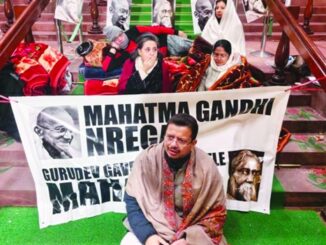
    As the discussion was underway on G Ram G, some opposition members protested in Well of Rajya Sabha when the Chairman warned them not to go towards treasury benches. Several members of the opposition staged a walkout in the Rajya Sabha during the passage of the Bill after demanding its withdrawal and raising slogans against the government. The opposition parties later sat on a dharna outside the Samvidhan Sadan in the Parliament complex against the Bill.

    The opposition has also demanded that the Bill be sent to a parliamentary panel for further scrutiny.

    Responding to the five-hour discussion on the Bill in the Rajya Sabha, Rural Development Minister Shivraj Chouhan accused the Congress of “killing” the ideals of Mahatma Gandhi several times and using his name to further political gains.

    Chouhan said that during the UPA’s rule, MGNREGA was riddled with corruption and the expected amount of funds was not spent on procurement of material for designated jobs.

    Opposing the Bill, Congress announced a series of nationwide protests on December 17, accusing the BJP and RSS of attempting to “dismantle rights-based welfare”. Lok Sabha had passed the bill on Thursday amid protest and sloganeering by opposition members. During the debate on the bill, Union Agriculture Minister Shivraj Singh Chouhan asserted that it was needed to fix shortcomings in the old scheme.

    What is MGNREGA?

    The Mahatma Gandhi National Rural Employment Guarantee Scheme, better known as MGNREGA, aims at enhancing the livelihood security of households in rural areas by providing at least 100 days of guaranteed wage employment in a financial year to every household whose adult members volunteer to do unskilled manual work.

  • Delhi pollution discussion goes for a toss as Parliament adjourned indefinitely

    An expected discussion among lawmakers on Delhi’s worsening air pollution did not end up taking place as Parliament’s Winter Session ended on Friday, Dec 19, morning. The Session began on December 1 and was marked by the passing of important bills on nuclear energy and rural employment. The latter – the G RAM G Bill that seeks to replace the UPA-era MGNERGA rural employment scheme – was particularly contentious with the Opposition opposing it tooth and nail.

    As the Winter Session headed towards its end, it was expected that there would be a discussion on the issue of air pollution in North India. Last week, in a rare show of unity, Rahul Gandhi’s passionate pitch for a discussion on the inherent Delhi pollution swiftly received the Centre’s acceptance. But, even as the residents of the capital and its adjoining regions continue to choke on severe air quality, the discussion on the same has clearly gone for a toss.

    Union Environment Minister Bhupendra Yadav was supposed to reply on the pollution matter in Lok Sabha on Thursday at around 6 pm. However, the House was adjourned merely an hour after resumption amid fierce sloganeering by Opposition MPs as Union Agriculture Minister Shivraj Singh Chouhan spoke about the G RAM G Bill. It was passed, stirring sharp Opposition remarks, then cleared in Rajya Sabha as well in a midnight drama. Meanwhile, the impending pollution discussion – a vital issue haunting the capital for years – was cancelled. Leading up to the initial expected date of discussion, several Congress leaders had submitted an adjournment notice in Parliament, seeking an immediate discussion on the Delhi pollution.

  • People don’t even have drinking water: SC junks plea on standards

    People don’t even have drinking water: SC junks plea on standards

    New Delhi (TIP)- The Supreme Court on Thursday, Dec 18,  disapproved of what it termed an “urban-centric approach” to public interest litigation, refusing to entertain a plea seeking fresh and stricter standards for polyethylene terephthalate (PET) bottles used for bottled water and other food items, remarking that such causes overlook the far more basic problems faced by large sections of the population.

    A bench, comprising Chief Justice of India Surya Kant and Justice Joymalya Bagchi, lamented that while “luxury” petitions frequently reach the apex court, the concerns of the poor and marginalised often remain unaddressed. Pointing to the stark reality that many parts of the country may still not have access to safe and potable drinking water, the bench questioned the propriety of invoking the court’s jurisdiction to seek judicial intervention on standards governing bottled water, which is largely consumed by the urban population.

    The court was hearing a public interest litigation filed by architect and environmentalist Sarang Yadwadkar, represented by senior advocate Anitha Shenoy, which raised concerns about antimony and synthetic chemical DEHP leaching into water and food from PET plastic packaging. Antimony, a metalloid used as a catalyst in the manufacture of PET plastic, and DEHP, a phthalate, can migrate into water or food, especially when plastic bottles are stored at higher temperatures, potentially posing health risks.

    Shenoy argued that there were inadequate standards governing bottled water and plastic food packaging in India, and that this posed serious public health concerns. She relied on Section 18 of the Food Safety and Standards Act, 2006, which lays down guiding principles for food safety, and contended that international standards and scientific evidence had not been adequately factored in by Indian regulators such as the Food Safety and Standards Authority of India (FSSAI) and the Bureau of Indian Standards (BIS).

    The bench, however, was unconvinced. “There is no potable water in many areas and here you have filed a petition for standards of bottled mineral water,” remarked the court, observing that bottled water is accessed primarily by urban consumers, while people in rural and remote areas continue to depend on groundwater, wells and other sources.

    Describing the plea as reflective of an urban and metropolitan mindset, the bench said it would have been more appropriate had the petitioner approached the court with data on regions still deprived of basic drinking water facilities.

    “These are all luxury litigations,” said the bench, taking exception to the petitioner’s reliance on Canadian, Australian and other foreign guidelines. With India’s population size and developmental challenges, the court said, it was not appropriate to press for standards drawn from developed countries without considering local realities.

    “Let this country grow at its own pace. Wait for some more years,” observed the bench, adding that hardly anyone took up the cause of poor people before the court.

  • India, Oman seal free trade pact as PM Modi holds talks with Sultan Haitham

    India, Oman seal free trade pact as PM Modi holds talks with Sultan Haitham

    New Delhi/Muscat (TIP)- India and Oman on Thursday, Dec 18,  signed a free trade agreement as Prime Minister Narendra Modi held wide-ranging talks with Sultan Haitham bin Tarik, seeking to add greater depth and momentum to the bilateral Strategic Partnership.

    The Comprehensive Economic Partnership Agreement (CEPA) was signed following the talks at Al Baraka Palace, where Sultan Haitham formally welcomed Modi, who arrived in Muscat on Wednesday on the final leg of his three-nation tour.

    The agreement was inked by Union Commerce and Industry Minister Piyush Goyal and Oman’s Minister of Commerce, Industry and Investment Promotion Qais bin Mohammed Al Yousef.

    The two leaders noted that the conclusion of the CEPA coincides with the 70th anniversary of the establishment of diplomatic relations between India and Oman, describing it as a milestone in the evolving partnership. Ministry of External Affairs spokesperson Randhir Jaiswal said the leaders explored ways to further strengthen cooperation across multiple sectors and deepen strategic ties.

    According to Jaiswal, the discussions covered a broad spectrum of areas, including defence and security, trade and investment, energy, agriculture, technology, culture and people-to-people exchanges, besides issues of regional and global importance.

    Both sides welcomed the CEPA as a key step that would significantly strengthen economic engagement and reinforce the strategic partnership.

    The agreement is expected to improve market access, boost investments and enhance cooperation across critical sectors.

    It is also aimed at supporting trade diversification and strengthening supply chain resilience at a time of global economic realignment.

    Prime Minister Modi said the CEPA would infuse new confidence and energy into India–Oman relations.

    His visit, undertaken at the invitation of Sultan Haitham, is his second to the Gulf nation and holds special significance as it marks seven decades of diplomatic ties. Modi earlier visited Ethiopia and Jordan as part of the same tour.

    Oman is India’s third-largest export destination among Gulf Cooperation Council countries. India already has a similar trade pact with another GCC member, the United Arab Emirates, which came into force in May 2022. Bilateral trade between India and Oman stood at about USD 10.5 billion in 2024–25, with India’s exports valued at USD 4 billion and imports at USD 6.54 billion.

    India’s major imports from Oman include petroleum products and urea, which together account for over 70 per cent of inbound shipments, along with polymers, pet coke, gypsum, chemicals, iron and steel, and unwrought aluminium.

    India’s exports to Oman include mineral fuels, chemicals, precious metals, iron and steel, cereals, ships and floating structures, electrical machinery, boilers, tea, coffee, spices, apparel and a range of food items.

  • 7-yr jail, Rs 1L fine for hate speech: Karnataka House passes Bill

    The Karnataka Assembly on Thursday, Dec 18,  passed the country’s maiden anti-hate speech legislation, which the BJP termed as a ‘Brahmastra’ against the opposition and the media with an eye on ‘vote bank politics’.

    The Hate Speech and Hate Crimes (Prevention) Bill, which has a provision for a fine up to Rs 1 lakh and a jail term of up to seven years, was passed in the House amid din by the BJP MLAs, with the government referring to the Supreme Court observations against hateful remarks.

    The Bill was cleared by the Cabinet on December 4, and presented in the House by Home Minister G Parameshwara on December 10.

    According to the bill, any expression, which is made, published or circulated in words either spoken or written or by signs or by visible representations or through electronic communication or otherwise, in public view, with an intention to cause injury, disharmony or feelings of enmity or hatred or ill-will against person alive or dead, class or group of persons or community, to meet any prejudicial interest, is hate speech. While discussing the Bill, Parameshwara said the Supreme Court had come down strongly against hate speech, saying that it could not be tolerated. He said hate speech and hate crimes lead to murders, create social unrest and vitiate the society.

  • What’s going on with Donald Trump’s health?

    What’s going on with Donald Trump’s health?

    The president’s appearance and schedule have sparked speculation – perhaps fueled in part by his political fortunes

    “Now, questions about Trump’s own health and fitness for office are beginning to simmer. Trump revealed that he received an MRI in October, though he declined to elaborate on what his physicians were looking for, or what they found. “I have no idea what they analyzed,” he asserted to reporters on Air Force One. “But whatever they analyzed, they analyzed it well, and they said that I had as good a result as they’ve ever seen.” The president’s physician said in a letter that the scan was used to image Trump’s heart and abdomen, and that it was “preventative”. But experts countered that an MRI would not typically be used as preventative care, saying that the kind of scan that Trump received would usually be requested to monitor existing heart conditions or another underlying disease.”

    By Moira Donegan

    Recently, he’s looked tired. His famous fake tan is a bit more sallow than usual and seems painted on more thickly and clumsily than it was before. He appears to nod off in front of cameras more and more often, including in cabinet meetings and press events in the Oval Office. His public schedule is light: he is often at his golf clubs, has traveled around the country less frequently than at this point in his first term, and now only rarely holds the stadium rallies that once defined his preferred style of politics. He tends to sit, even when others are standing, and has shortened his daily schedule, often not conducting official duties before noon. A New York Times report found that his public appearances have declined by nearly 40% compared to his first year in office. He sometimes disappears from public view for days as he did in the late summer, and he and his administration have released unclear and conflicting information about his health. His right hand seems to be experiencing frequent injury or discoloration – it will often be covered with a band-aid or smeared with makeup; the White House has claimed, implausibly, that he is bruised from shaking too many hands. In some images, his ankles are visibly swollen.

    Trump, at 79, is the oldest man to ever be elected to the presidency. And he ascended to the office after making his own harsh criticisms of Joe Biden, whose age became the subject of scandal after stiff, stumbling, and incoherent public appearances provoked speculation that his staff were concealing the extent of his decline. In 2024, Trump made Biden’s age and infirmity into a symbol of the inadequacy of the Democratic party, and the Washington elites’ unwillingness to combat America’s backward slide. When he took office early in 2025, he placed a picture of an autopen – the device that became a stand-in for Biden’s incapacity in the rightwing imagination – in the place where Biden’s official portrait would have been on the “presidential walk of fame” that Trump installed. The notion was that Biden, too old to hold the office, was out to lunch, running the administration on autopilot – a kind of virtual stand-in rather than a responsible wielder of power.

    Now, questions about Trump’s own health and fitness for office are beginning to simmer. Trump revealed that he received an MRI in October, though he declined to elaborate on what his physicians were looking for, or what they found. “I have no idea what they analyzed,” he asserted to reporters on Air Force One. “But whatever they analyzed, they analyzed it well, and they said that I had as good a result as they’ve ever seen.” The president’s physician said in a letter that the scan was used to image Trump’s heart and abdomen, and that it was “preventative”. But experts countered that an MRI would not typically be used as preventative care, saying that the kind of scan that Trump received would usually be requested to monitor existing heart conditions or another underlying disease.

    Trump also offered that “I took a cognitive test and I aced it.”

    It’s not clear that anything is specifically wrong with Trump’s health, and it would be irresponsible to attempt to diagnose him here. But the speculation about his age and physical decline reflect a reality of his regime: that Trump is mortal, and that he is old. His reign—as the president, as the head of the Republican party, and as the gravitational center of American politics—is going to end.

    It is possible that Trump’s health would not have become the subject of so much speculation if his polling was better. The president has experienced a dramatic cratering in the public’s esteem; recent polls show him underwater in a majority of states and with almost every demographic. The shock-and-awe first months of his second term, in which he made sweeping changes to the federal bureaucracy and attempted to use the force of the executive branch to impose huge cultural changes at universities, corporations and other institutions reliant on government funding, has given way to a more tepid era, in which Trump’s power has diminished as it becomes clear how shallow much of his support really is. People are more willing to push back on him when his approval rating is in the toilet, and this pushback in turn makes him seem less mighty, less effective.

    If Trump seems weak physically, then, it might in part be because he is at his weakest politically. The changing winds of public opinion have now seemed to quiet Trump’s ambitions to seek an unconstitutional third term, at least for the time being: Republicans are less willing to stick their necks out to help Trump attempt something so obviously illegal when his own ability to pull it off seems so slim. And with that change has come a broad recognition that Trump is a lame duck.

    US democracy – or what remains of it – is not safe. It would not be safe if Trump was still at his most formidable, and it would not be safe if he vacated his office tomorrow. But his increasingly obvious mortality is beginning to change everyone’s calculations. Even, it seems, his own. Trump seems increasingly ponderous and reflective in his old age, and lately, he’s been talking about death more often. “I think I’m not maybe heaven-bound,” he said in October. “I’m not sure if I’m going to be able to make heaven.”

    (Moira Donegan is writer in residence for the Clayman Institute, Stanford University)

  • The changing patterns of India’s student migration

    The changing patterns of India’s student migration

    The rapid expansion of Indian student migration points to contradictions between aspiration and outcome, and opportunity and exploitation

    “India is one of the top senders of international students, with the United States and Canada as the top destinations (40%), followed by the United Kingdom, Australia and Germany. This significant development is reflected in the report of the Parliamentary Committee on the Welfare of Indian Diaspora (2022) which engages with students as one of India’s major diaspora categories.

    Most students migrate through self-financing or education loans, often mortgaging family property, with the hope of better employment and higher wages that would repay debts and enable higher living standards. However, for many, this journey ends in debt, underemployment or forced return, a phenomenon that economists describe as reverse remittances, where Indian households subsidize foreign economies.”

    By Ginu Zacharia Oommen, Anu Abraham
    By Ginu Zacharia Oommen, Anu Abraham

    India’s latest wave of student migration marks a decisive shift that is no longer confined to elite universities or programs that are fully funded. Today’s migration is characterized by self-financed education where middle-class households invest heavily in the promise of a global degree and upward social mobility. In Ministry of External Affairs data, more than 13.2 lakh Indian students were enrolled in over 70 countries by 2023, which rose to 13.35 lakh in 2024, and projected to reach 13.8 lakh in 2025.

    India is one of the top senders of international students, with the United States and Canada as the top destinations (40%), followed by the United Kingdom, Australia and Germany. This significant development is reflected in the report of the Parliamentary Committee on the Welfare of Indian Diaspora (2022) which engages with students as one of India’s major diaspora categories.

    The true picture

    While all this is seen by some as a democratization of foreign education, with doors opening to students from different socio-economic classes, the reality is more complex. Many of these students are channeled into lower-tier institutions and vocational colleges, into courses often unrelated to their expertise and without much job prospects, due to recruitment agencies that operate in a grey legal zone. The partnership between recruitment networks and less credible private colleges abroad is driven primarily by commissions and profit, reflecting the largely unregulated expansion of the foreign education industry.

    The outcome is widespread deskilling and underemployment, with many graduates unable to transition into skilled work. In the U.K., what were once polytechnics have become universities post 1992 that cater primarily to international students, sometimes waiving entry requirements and triggering controversy due to declining academic standards. Reports suggest that approximately only one in four Indian postgraduates in the U.K. secures a sponsored skilled visa.

    Student migration from India represents a middle-class aspiration with significant risks. Kerala, historically defined by Gulf labor migration, illustrates this transformation as the Kerala Migration Survey (KMS) 2023 reports that student migration doubled in five years, from 1.29 lakh in 2018 to 2.5 lakh in 2023, which is 11.3% of total emigrants. Outward student remittances from Kerala are estimated at ₹43,378 crore, equivalent to about 20% of total inward remittances from labor migrants.

    Reverse remittance

    Most students migrate through self-financing or education loans, often mortgaging family property, with the hope of better employment and higher wages that would repay debts and enable higher living standards. However, for many, this journey ends in debt, underemployment or forced return, a phenomenon that economists describe as reverse remittances, where Indian households subsidize foreign economies.

    Foreign students contribute significantly to host economies. In Canada, international students contributed about $30.9 billion to GDP in 2022, supporting over 3,61,000 jobs. In 2023, Canada hosted over 4,27,000 Indian students, which is roughly 45% of international enrolments. In the U.S., roughly 4,00,000 Indian students, in 2024, spent an estimated $7 billion-$8 billion annually on tuition, housing and living costs, sustaining universities and local economies.

    Across destinations, students shoulder substantial financial burdens, sometimes to the tune of ₹40 lakh-₹50 lakh, to finance studies abroad. Rising rents, restricted working hours, and visa caps exacerbate financial and mental strains. Unable to find skilled work, many take up low-wage unskilled jobs, often juggling multiple part-time jobs, sometimes undocumented, to work longer hours, and facing exploitation. Restrictive visa rules, limited post-study employment options and a lack of placement support from low-ranked colleges exacerbate this downward mobility. For instance, until 2024, the U.K. allowed students to convert student visas into care visas, offering a survival route in a tight job market, but this pathway has since become impossible due to new restrictions.

    The local context

    This outflow of students needs to be understood within the domestic context that is driving it. Is it the perceived lack of quality in domestic institutions or an inability to find well-paid domestic employment? With foreign universities establishing offshore campuses in Dubai, Singapore, and other destinations offering western degrees at lower costs, it is telling that Indian students rarely choose them. The reason is more structural. For many, studying in OECD countries is not only about education but about permanent residency, social mobility and an escape from a third world identity.

    Ironically, this wave of student migration has also created a new form of cheap labor for OECD countries, akin to Gulf labor migration except that it is now accompanied by reverse remittances often financed through savings and debt.

    This rapid expansion of Indian student migration exposes deep systemic contradictions between aspiration and outcome, and between opportunity and exploitation, resulting in a phenomenon that can be described as brain waste. It calls for stronger regulation of education agents, pre-departure counselling, and bilateral frameworks to ensure institutional accountability abroad.

    (Ginu Zacharia Oommen is Chairperson , Kerala State Food Commission. Anu Abraham is Senior Researcher, Peace Research Institute Oslo (PRIO)

  • The Trump NSS, Europe’s existential crisis

    The Trump NSS, Europe’s existential crisis

    With the Trump Administration’s National Security Strategy making it clear that American support to Europe is now faint, it remains to be seen how Europe responds

    By Priyanjali Malik

    Hope is not a strategy. For most of this year, European leaders have hoped that the Trump Administration has not actually meant its President’s oscillating support for the North Atlantic Treaty Organization (NATO), its Vice-President’s berating his European hosts in Munich over their liberal values and immigration policies, President Donald Trump’s tirade against migration at the United Nations, and of course his mercurial support for Ukraine. The hope was that, all things considered, America would ultimately stand with Europe.

    The Trump Administration’s National Security Strategy — a 33 page document that spends much time congratulating the President for saving America from apparently terminal decline as it charts an unapologetically MAGA-esque America-first mercantilist position — appears not to notice Africa, Australia and New Zealand. It sweeps by Asia as it focuses strongly on perceived trade imbalances with China and lands squarely on a defense of the ‘Western Hemisphere’ according to American interests while lamenting the decline of Europe. Europe is a problem, not an ally.

    The stand on Europe

    In ‘Promoting European Greatness’, the NSS warns of Europe’s ‘civilizational erasure’, precipitated by the European Union (EU)’s policies on migration and freedom of speech, ‘the suppression of political opposition’, and the ‘loss of national identities and self-confidence’. In case there was any doubt about which migrants were unwelcome, the NSS declares that if Europe continues on its present trajectory, ‘within a few decades … certain NATO members will become majority non-European.’ The U.S. will help Europe regain its ‘former greatness’ by choosing ‘patriotic European parties’ to promote what this administration views as ‘genuine democracy’ and ‘unapologetic celebrations of European nations’ individual character and history’. To most Europeans, at best this reads as a meddling in the internal politics of sovereign nations, and at worst as regime change.

    Europe, the NSS states, needs to stand on its own feet, assume ‘primary responsibility for its own defense’ and re-establish ‘strategic stability with Russia’. NATO ‘cannot be a perpetually expanding alliance’, a warning of course to Ukraine, but also an interesting glossing over of Sweden and Finland’s accession to the alliance after Russia invaded Ukraine in 2022. In this document, the threat is not Russia and its invasion of a sovereign nation, but Europe’s cultural decay. The tramp of the jackboots of 1930s Europe echoes with every mention of civilizational decline.

    Of course, an administration’s national security strategy is not policy, but a guide to its thinking. They can and have been over-ridden by events, most notably George H.W. Bush’s 1990 NSS, which was overtaken by the fall of the Berlin Wall, German reunification and the first Gulf War. Observers could chart the evolution of the administration’s thinking in the two subsequent iterations of 1991 and 1993.

    As a high-level document, the NSS often provides the lens through which to interpret an administration’s foreign policy goals and is assumed to set the tone for the administration’s national defense strategy, its Quadrennial Defense Review and national military strategy. Mr. Trump’s famously mercurial nature might caution against viewing it as declared policy. However, given that this is a Congress-mandated document, it is more than just a rhetorical exercise: while it should not be taken literally, it should be taken seriously.

    What Europe’s response could be

    As the dust settles, Europe now faces three options in responding: it can ignore the NSS and hope that it will go away; its leaders can dial up their flattery of Mr. Trump in the hope that he will change his mind on Europe; or Europe can face up to the prospect that Mr. Trump’s America is not a reliable ally and that they will need to fend for themselves.

    Europe tried a mixture of the first two strategies after J.D. Vance’s outburst at the Munich Security Conference. After some tepid talk of needing to pull together to see off Russian President Vladimir Putin’s ‘imperialist’ ambitions in trying to ‘rewrite history’ or the need for Europe to wean itself off U.S. dependence, Europe doubled down on doing whatever it would take to keep America in NATO and Europe. Britain flattered Mr. Trump with an invitation for an unprecedented second state visit. Germany’s Friedrich Merz forgot about his observations of February this year as Chancellor-in-waiting that his ‘absolute priority will be to strengthen Europe … so that … we can really achieve independence from the USA’.

    Germany has since abandoned half-explored plans of developing European capabilities and ordered more American military kit, which is dependent on American intelligence to work. NATO’s Hague Summit of June this year will be remembered as much for European states agreeing to raise their military spending to 5% of GDP as for Secretary-General Mark Rutte’s calling Mr. Trump ‘Daddy.’

    The third option will not be easy. Europe has never defended itself as an entity and there is no concept of integrated European defense. Even limited projects of joint development of military kit tend not to get very far, as the stalled Franco-German project on sixth generation fighter jets demonstrates. If the U.S. pulls American troops out of Europe — as this administration has periodically hinted it might do — then Europe will have a serious manpower problem that experiments in ‘voluntary’ conscription will not even begin to address. Then there is the question of nuclear deterrence and Britain’s uneasy post-Brexit relationship with the EU and Europe. 

    The state of the world order

    How Europe responds will have implications beyond the continent. Mr. Trump’s NSS, with its attack on transnational institutions (that he insists ‘undermine political liberty and sovereignty’), its dismantling of the post-war trading order in favor of a mercantilist America-first policy; and the signaling of a U.S. retreat into its own ‘Hemisphere’ (however that might be defined, and with the implication that China and Russia are free to carve up the rest of the world as long as they do not impinge on America’s trading footprint) have profound implications for the rest of the world. The post-war world order that America helped shape and uphold is imperfect and crumbling. The power imbalances at the United Nations and the Bretton Woods Institutions that help anchor expectations of peace, security, development and trade reflect an outdated world order. But, however imperfect this rules-based system might be, it is still a bulwark against a descent into a Hobbesian free-for-all, where might makes right.

    The debate about this National Security Strategy is, therefore, not about a document that might shed light on an administration’s thinking. It is about whether Europe chooses to defend a rules-based liberal order or defers to a President whose transactional and racist view of the world will have consequences that stretch far beyond his borders.

    (Priyanjali Malik writes on nuclear politics and security)

  • SETON HALL UNIVERSITY’S STILLMAN SCHOOL OF BUSINESS EXPANDS UNDERGRADUATE OFFERINGS

    SETON HALL UNIVERSITY’S STILLMAN SCHOOL OF BUSINESS EXPANDS UNDERGRADUATE OFFERINGS

    • By Mabel Pais

    Seton Hall University’s (shu.edu) Stillman School of Business (shu.edu/business) is expanding its undergraduate offerings with the addition of two new undergraduate majors: Forensic Accounting and Wealth Management. Both programs were created in response to industry demand for graduates who are prepared to step into fast-growing, specialized roles in the financial sector.

    “These new programs reflect Seton Hall’s focus on innovation and preparing students for meaningful careers,” said  Joyce Strawser, Ph.D. (shu.edu/profiles/joycestrawser), Stillman School dean and associate professor of accounting and taxation. “Forensic accounting and wealth management are fields where the need for ethical leaders is especially critical, and our students will be ready to make a difference.”

    The new Bachelor of Science in Business Administration (B.S.B.A.) in Forensic Accounting (shu.edu/academics/bsba-forensic-accounting) blends coursework in accounting, business analytics and criminal justice. Students learn how to investigate financial fraud, analyze records and support legal proceedings.

    Courses cover topics such as forensic accounting, criminal procedure and evidence, business intelligence and federal taxation. Graduates will be positioned for careers in public accounting firms, corporations, government agencies and law enforcement.

    The program also prepares students to pursue the Certified Fraud Examiner (CFE) credential, which can lead to increased career opportunities and higher earning potential.

    “With fraud and financial crime becoming more complex, organizations are seeking professionals who can uncover irregularities and help safeguard assets,” said  Mark Holtzman, C.P.A., Ph.D. (shu.edu/profiles/markholtzman), chair and associate professor, department of accounting and taxation. “Our graduates will be uniquely prepared to serve both the business community and the public interest.”

    The Stillman School is **AACSB (Association to Advance Collegiate Schools of Business) accredited in both business and accounting — an achievement earned by less than one percent of business schools worldwide.

    Assistant Dean and Instructor of Finance Mark Schild works with students in the Trading Room, a hands-on learning environment for business students. (Credit for both: shu.edu)

    The Bachelor of Science in Business Administration (B.S.B.A.) in Wealth Management (events.shu.edu/event/44385-division-of-finance-open-forum) takes a comprehensive approach to preparing students for careers in personal financial advising, investment planning, and financial consulting. A hallmark of the program is its focus on behavioral finance, teaching students to understand client decision-making and build trust-based relationships.

    Students in the program will gain practical experience through internships, financial labs, and volunteer opportunities, including the IRS-sponsored Volunteer Income Tax Assistance program. They will also earn industry credentials such as the Securities Industry Essentials (SIE) and Bloomberg Market Concepts (BMC) certifications. Graduates will be eligible to sit for the Certified Financial Planner® (CFP®) exam.

    “Our wealth management program is designed to go beyond technical knowledge,” said Stillman’s Associate Dean for Student Success and Instructor of Finance Mark Schild, M.B.A. (shu.edu/profiles/MarkSchild), “We want students to be able to provide trusted guidance to clients, addressing not only investments but the broader financial challenges people face throughout their lives.”

    According to the U.S. Bureau of Labor Statistics, jobs for financial advisors are projected to grow 17 percent by 2033. Forensic accounting also continues to be one of the most in-demand specialties in the profession.

    “These majors are the latest examples of how Seton Hall prepares students for success,” Strawser said. “Through the benefit of rigorous academics, hands-on  learning and strong industry connections, our graduates are ready to lead and thrive in some of the most important and fastest-growing areas of business.”

    Stillman School of Business – Tradition of Excellence

    The Stillman School of Business at Seton Hall University was established in 1950 to provide education geared toward the complex, practical needs of business leaders. The School was the first private business school in New Jersey to earn accreditation from the Association to Advance Collegiate Schools of Business (AACSB International). Decades later, the School continues to maintain professional accreditation from AACSB and is the only school in northern New Jersey with both business and accounting accreditation.

    Nationally Recognized Educational Experience

    The Stillman School is recognized by Poets & Quants among the top 50 in the nation for best undergraduate business schools. In addition, the Gerald P. Buccino ’63 Center for Leadership Development earned, for the fifth year in a row, a No. 1  ranking in the LEAD Awards sponsored by HR.com.

    It’s M.B.A. program is included in The Princeton Review’s “Best Business Schools” and has been a US News & World Report “top business school for part-time MBAs.”

    Seton Hall University

    One of the country’s leading Catholic universities, Seton Hall University has been developing students in mind, heart and spirit since 1856. Home to over 10,000 undergraduate and graduate students and offering more than 90 rigorous majors, Seton Hall’s academic excellence has been singled out for distinction by ‘The Princeton Review,’ ‘U.S. News & World Report’ and ‘Bloomberg Businessweek.’

    Seton Hall’s 58-acre main campus (shu.edu) is located in the quaint town of South Orange, New Jersey, only 14 miles from Manhattan. The University’s nationally ranked School of Law (shu.edu) is located in nearby Newark, N.J. The new Interprofessional Health Sciences (IHS) campus (shu.edu/interprofessional), situated in the towns of Clifton and Nutley, N.J., opened in July 2018. The IHS campus houses Seton Hall’s College of Nursing (shu.edu/nursing) and School of Health and Medical Sciences (shu.edu/health), as well as the Hackensack Meridian School of Medicine (hmsom.edu).

    Mabel Pais writes on Education, Business, Spirituality, Social Issues, Health and Wellness, Cuisine and The Arts and Entertainment.

    ~Sidebar~

    **AACSB Accreditation: What does this mean?

    The Hallmark of Excellence in Business Education
    The Stillman School was the first private business school in New Jersey to earn accreditation from the Association to Advance Collegiate Schools of Business (AACSB International).  Decades later, the School continues to maintain professional accreditation from AACSB. Stillman is also the only school in northern New Jersey with both business and accounting accreditation – making it one of only 188 institutions worldwide to hold an additional, specialized AACSB Accreditation.

    Why Does AACSB Accreditation Matter?
    Recognition by AACSB International means that an institution commits to fulfill its mission, and continues to sustain and improve educational quality of its undergraduate, master’s and doctoral degree programs according to the business or accounting standards of AACSB International as interpreted by its peer review team(s), accreditation committees and the Board of Directors. AACSB-accredited schools have the highest-caliber instructors, and offer the leading-edge courses and programs that businesses look for when hiring the leaders they need today — and tomorrow.

    • AACSB-accredited schools provide high-quality education to their students
    • Many top companies worldwide will only recruit from AACSB-accredited schools
    • Business degrees from AACSB-accredited schools are recognized by universities all over the world
  • India’s Ambassador to Romania Dr. Manoj Kumar Mohapatra visits Suceava to Promote Regional Level Cooperation

    India’s Ambassador to Romania Dr. Manoj Kumar Mohapatra visits Suceava to Promote Regional Level Cooperation

    BUCHAREST (TIP): Ambassador Dr. Manoj Kumar Mohapatra undertook an extensive visit to Suceava County from 10 to 12 December 2025, aimed at deepening India-Romania cooperation at the regional level across political, economic, academic, and people-to-people domains. The visit underscored India’s strong commitment to strengthening partnerships beyond capital cities and engaging meaningfully with Romanian regions of strategic importance.

    Engagement with Regional Authorities

    Ambassador Mohapatra met Mr. Gheorghe Șoldan, President of the County Council, and Mr. Traian Andronachi, Prefect of Suceava County, for constructive discussions on enhancing bilateral cooperation, with particular emphasis on regional engagement. The talks focused on expanding institutional linkages and economic collaboration. The Ambassador extended an invitation to the Council President to lead a delegation to India to explore concrete partnership opportunities.

    Ambassador Dr .Manoj Kumar Mohapatra meeting with Prof. Mihai Dimian, Rector of “Ștefan cel Mare” University of Suceava.

    In a separate meeting, Ambassador Mohapatra met Mr. Vasile Cărăre, Mayor of Milișăuți, and expressed India’s deep appreciation for the town’s exemplary humanitarian support during the early days of the Russia-Ukraine conflict. Milișăuți had provided shelter and assistance to thousands of Indian nationals, including students. This gesture of solidarity was warmly acknowledged as a lasting symbol of friendship between the peoples of India and Romania. The Ambassador extended an invitation to the Mayor to visit India. Ambassador also met Mr. Vasile Rîmbu, Mayor of Suceava, and Mr. Dan Ioan Cusnir, Deputy Mayor, to discuss avenues for strengthening ties between India and the Suceava region. The discussions highlighted opportunities in trade, investment, education, and cultural exchanges. 

    Academic and Educational Cooperation

    A key highlight was the Ambassador’s engagement with “Ștefan cel Mare” University of Suceava. He met Prof. Mihai Dimian, Rector of the University, for productive discussions on expanding academic cooperation, institutional partnerships, and student exchanges between Indian and Romanian universities. Both sides reaffirmed their shared commitment to strengthening educational ties as a cornerstone of long-term bilateral relations. Ambassador Mohapatra also visited the university campus and addressed students and faculty alongside Rector Prof. Mihai Dimian and Prefect Traian Andronachi. In his address, he spoke about India’s global outlook, rapid economic growth, innovation ecosystem, emerging opportunities for Romanian partners, and India’s leadership in new and emerging technologies, including the forthcoming AI Summit. The interaction generated keen interest among students in India’s education, technology, and research landscape.

    Ambassador Dr. Manoj Kumar Mohapatra visited Ștefan cel Mare University of Suceava and addressed students alongside Rector Prof. Mihai Dimian and Prefect Traian Andronachi.

    Economic and Business Outreach 

    As part of India’s economic diplomacy, Ambassador Mohapatra addressed members of the In-Business Club Suceava. He highlighted India’s robust economic performance, with projected GDP growth of over 7% in FY 2025–26, and outlined opportunities for Romanian companies to invest in, source from, and partner with India. He elaborated on priority sectors such as digital transformation, renewable energy, pharmaceuticals, infrastructure, electronics, and advanced manufacturing, while spotlighting flagship initiatives like Make in India, PLI schemes, and the India–EU Trade and Technology Council.

    Ambassador Dr. Manoj Kumar Mohapatra meeting with Mr. Vasile Rîmbu, Mayor of Suceava, and Mr. Dan Ioan Cusnir Deputy Mayor of Suceava.

    The meeting drew active participation from leading Romanian companies, including Carpatis & Fabrica Veche, Ecooptic, Avastar România, Spălătoria din Cartier, Fiziomed, Amis, Denis, Office Consulting, AGN, and Fusion, among others. These firms expressed strong interest in organizing business visits to India to scout investment prospects, participate in trade fairs, and engage with Indian counterparts. The event aligns with the upward trajectory of India-Romania relations, where bilateral trade has surged by over 20% in recent years, reaching new milestones. The Ambassador encouraged Romanian businesses to explore India’s dynamic, innovation-driven market and build long-term partnerships.

    Ambassador Dr. Manoj Kumar Mohapatra participating in an event held by In Business Club Suceava.

    In a separate engagement, Ambassador Mohapatra met Mr. Dumitru Mihalescu, Founder of Marelvi, Romania’s largest electronics distributor. The discussions focused on strengthening commercial ties and exploring new opportunities in electronics and technology sectors. The Ambassador also met Mr. Nicolae Troase, President, and Mr. Lucian Gheorghiu, Executive President, of the Chamber of Commerce and Industry of Suceava. He invited them to lead a business delegation to India and emphasized Suceava’s strategic location and its potential role in Ukraine’s future reconstruction, an area where Indian companies have expressed growing interest.

    Ambassador Dr. Manoj Kumar Mohapatra meeting with Mr. Dumitru Mihalescu, founder of Marelvi.
    Ambassador Dr. Manoj Kumar Mohapatra meeting with Mr. Vasile Cărăre, Mayor of Milișăuți.

    Ambassador’s visit to Suceava featured high-level political engagement, strong academic outreach, and focused economic diplomacy. It significantly reinforced India–Romania relations at the regional level and laid the groundwork for concrete follow-up in trade, education, technology, and humanitarian cooperation. Suceava’s strategic relevance and positive disposition toward India position it as an important partner in advancing bilateral and trilateral ties in the years ahead.

    (Based on a Press Release issued by the Indian Embassy in Bucharest)

    Ambassador Dr. Manoj Kumar Mohapatra meeting with Mr. Nicolae Troase, President, and Mr. Lucian Gheorghiu, Executive President of the Suceava Chamber of Commerce.
  • Embassy of India in Bucharest Hosts Cultural and Diaspora Engagement Events

    Embassy of India in Bucharest Hosts Cultural and Diaspora Engagement Events

    BUCHAREST (TIP): Embassy of India hosted a series of engaging events on 13th December, celebrating India’s rich cultural heritage, fostering community engagement, and promoting awareness of India’s contemporary initiatives. These events reflected the Embassy’s continued commitment to connecting with the Indian diaspora and friends of India while showcasing India’s diversity, creativity, and modern achievements in a holistic and interactive manner.

    Commemoration of 150 years of Vande Mataram

    The Embassy organized a special movie night, screening Kantara: A Legend – Chapter 1, providing an immersive experience into India’s cinematic excellence. The screening offered the audience a glimpse into India’s vibrant storytelling traditions, regional folklore, and artistic creativity. Beyond entertainment, the movie night sparked lively discussions on India’s cultural narratives, folklore-inspired cinema, and the country’s evolving film industry, fostering cross-cultural understanding and strengthening ties between the Indian community and local audiences in Romania.

    An interactive quiz on Atmanirbhar Bharat, held at the Embassy.

    In addition, the Embassy conducted an Open House for members of the Indian diaspora, where Ambassador Dr. Manoj Kumar Mohapatra personally listened to their concerns and grievances. The session emphasized the Embassy’s commitment to responsive, inclusive, and people-centric engagement, ensuring that the voices of the diaspora are heard and valued. This initiative provided an important platform for dialogue on issues ranging from consular services to cultural initiatives, reinforcing the Embassy’s role as a bridge between India and its global community.

    The Embassy also commemorated 150 years of Vande Mataram with a mass singing by members of the Indian community. This deeply symbolic event served as a moment of unity, reflection, and national pride, honoring one of India’s most enduring expressions of patriotism and cultural identity. The performance highlighted the importance of preserving traditions while inspiring younger generations to connect with India’s historical and artistic legacy, reinforcing a shared sense of heritage and belonging.

    Ambassador highlighted the importance of International Day of Meditation.

    Highlighting the International Day of Meditation, Ambassador Mohapatra emphasized the significance of mindfulness, wellness, and self-awareness for the Indian diaspora. The session encouraged participants to cultivate inner balance, mental well-being, and harmony in today’s fast-paced and often stressful environment. This initiative reflected India’s global contribution to mental health and spiritual practices while promoting a holistic lifestyle that blends traditional wisdom with contemporary relevance.

    Screening of Kantara: A Legend – Chapter 1 at the Embassy.

    Further promoting awareness of India’s contemporary vision, the Embassy hosted an interactive quiz on Atmanirbhar Bharat (Self-Reliant India). Through an engaging and informative format, participants explored India’s journey towards innovation, resilience, and sustainable development. The quiz highlighted the country’s strides in entrepreneurship, technology, and economic self-sufficiency, sparking curiosity and discussion about India’s strategic initiatives and its growing global influence.

    Through these initiatives, the Embassy of India in Romania continues to strengthen cultural ties, celebrate India’s heritage, and engage meaningfully with the Indian community and friends of India in Romania.

    (Based on a Press Release issued by the Indian Embassy in Bucharest)

  • Guru Gobind Singh: The Conscience of India and the Price of Human Dignity

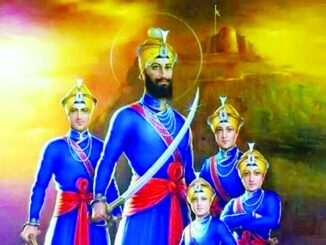
    Shri Guru Gobind Singh Ji, the Tenth Master of the Sikhs and the Founder of the Khalsa. His Prakash Divas (Birth anniversary) falls on December 27, 2025 (AI image/ ChatGPT)
    Prof. Indrajit S. Saluja
    By Prof. Indrajit S. Saluja

    History records many warriors, reformers, and martyrs. Yet there is no parallel in world history to the scale and depth of sacrifice made by Guru Gobind Singh Ji, the tenth Sikh Guru, in defense of human dignity, freedom of faith, and basic human rights. In a life cut short at 48, Guru Gobind Singh did not merely resist tyranny—he redefined the moral duty of resistance itself.

    Seventeenth-century India was a land under strain. The Mughal Empire, particularly during the reign of Aurangzeb, had increasingly embraced religious orthodoxy enforced by state power. Forced conversions, destruction of temples, discriminatory taxation, and brutal suppression of dissent had become instruments of governance. It was against this backdrop that Guru Gobind Singh emerged—not as a rebel seeking power, but as a moral leader challenging injustice at its very roots.

    The foundations of this struggle were laid when Guru Gobind Singh was still a child. At the age of eight or nine, he witnessed one of the most defining moments in Indian history. Kashmiri Pandits, facing forcible conversion, sought protection from his father, Guru Tegh Bahadur Ji. It was the young Gobind Rai who urged his father to stand firm, even at the cost of his life. Guru Tegh Bahadur’s martyrdom in 1675 was an unprecedented act, a  spiritual leader laying down his life not for his own faith, but for the right of another community to practice theirs. It marked a watershed moment in the evolution of religious freedom in India.

    The martyrdom day of older Sahibzadas (sons) of Guru Gobind Singh- Baba Ajit Singh and Baba Jujhar Singh , falls on December 22, 2025 (AI image/ ChatGPT)

    This early exposure to supreme sacrifice shaped Guru Gobind Singh’s philosophy. For him, spirituality was inseparable from social responsibility. Faith that did not defend the oppressed was hollow; devotion that ignored injustice was incomplete. These beliefs would later find their most powerful expression in the creation of the Khalsa in 1699.

    The establishment of the Khalsa at Anandpur Sahib was not merely a religious event; it was a social revolution. By initiating ordinary men into a disciplined brotherhood of saint-soldiers, Guru Gobind Singh dismantled centuries of caste hierarchy, fear, and submission. The Khalsa was founded to ensure that no individual would remain defenseless in the face of tyranny. It fused moral purity with martial courage, creating a model of resistance grounded in ethics rather than vengeance.

    Predictably, such an egalitarian force alarmed both the Mughal authorities and local hill rulers. Guru Gobind Singh spent much of his life in a state of siege—physically, politically, and spiritually. Battles were frequent, resources limited, and betrayals painful. Yet he never deviated from his core principles. His struggle was not against any religion, but against oppression and injustice, regardless of their source.

    The most tragic and defining chapter of his life unfolded in December 1704, during the battle of Chamkaur Sahib. Vastly outnumbered by Mughal forces, Guru Gobind Singh took a decision that continues to challenge human comprehension. He sent his two elder sons—Sahibzada Ajit Singh and Sahibzada Jujhar Singh, both in their teens—into battle. They fought with extraordinary bravery and fell as martyrs. Their deaths were not acts of youthful recklessness, but conscious offerings to the cause of freedom and dignity.

    The martyrdom day of younger Sahibzadas (sons) of Guru Gobind Singh- Baba Zorawar Singh and Baba Fateh Singh – falls on December 27, 2025 (AI image/ ChatGPT)

    Even this was not the end of his suffering. Shortly thereafter, his younger sons—nine-year-old Sahibzada Zorawar Singh and seven-year-old Sahibzada Fateh Singh—were captured at Sirhind. Offered life in exchange for conversion to Islam, the children refused. They were bricked alive for their faith. Few episodes in history expose the cruelty of religious coercion as starkly as this. Fewer still reveal the power of moral upbringing so vividly—children choosing death over the surrender of conscience.

    What distinguishes Guru Gobind Singh from many historical figures is not merely the magnitude of his loss, but his response to it. Despite losing all four sons, he neither retreated into despair nor sought revenge. Instead, he reaffirmed his faith in divine justice and continued to inspire resistance rooted in righteousness. His writings reflect resilience, courage, and an unshakeable belief that tyranny, however powerful, is ultimately transient.

    Guru Gobind Singh’s philosophy was strikingly modern. Long before the language of “human rights” entered political discourse, he articulated and defended its core principles: equality of all human beings, freedom of belief, resistance to injustice, and the dignity of the individual. His life demonstrated that rights are not granted by rulers; they are claimed and defended by people of conscience.

    There is a poignant symbolism in the calendar itself. In 2025, the martyrdom of the four Sahibzadas  is commemorated from December 22 when the older Sahibzadas- Baba Ajit Singh and Baba Jujhar Singh were martyred in the Battle of Chamkaur Sahib,  on to December 27, when the younger Sahibzadas- Baba Zorawar Singh and Baba Fateh Singh-were bricked alive, while Guru Gobind Singh’s birth anniversary falls on December 27. This period, often described as a martyrdom week, encapsulates the essence of his life—where birth and sacrifice, celebration and sorrow, are inseparably intertwined. It is a reminder that the freedoms enjoyed today are rooted in endured yesterday.

    In an era when authoritarianism, religious intolerance, and erosion of civil liberties continue to challenge societies worldwide, Guru Gobind Singh’s life carries urgent relevance. He teaches that neutrality in the face of injustice is moral failure, that faith must empower ethical action, and that true leadership demands personal sacrifice.

    As we observe the Martyrdom Week, commemorating the extraordinary bravery, courage, and steadfastness of the Sahibzadas, and celebrate the Prakash Divas (birth anniversary) of Guru Gobind Singh Ji, let this sacred period be more than remembrance. Let it be a renewed pledge. A pledge to walk in their footsteps, to resist injustice in all its forms, and to protect the fundamental human rights to freedom and dignity of every individual—regardless of race, color, creed, or belief. In honoring Guru Gobind Singh and his sons, we reaffirm not only a chapter of history, but a timeless moral responsibility that remains as urgent today as it was more than three centuries ago.

  • A Christmas Wish for a World at Peace

    A Christmas Wish for a World at Peace

    By Prof. Indrajit S. Saluja

    As the world prepares to merrily celebrate Christmas on December 25, with carols, candles, gifts and gatherings my kids have been so enthusiastic about, my thoughts drift, inevitably and uneasily, to people across continents who will mark this season not with joy, but with fear, deprivation and grief. When one surveys the globe today, a grim common thread binds distant lands and diverse societies: conflict. It manifests in many forms—economic, political, ethnic, ideological and military—but its consequences are uniformly cruel. Peace, despite humanity’s bitter experiences, continues to elude us.

    History offers no shortage of warnings. The twentieth century alone witnessed two World Wars whose scale and savagery reshaped the world. World War I, sparked by nationalism, imperial rivalries and diplomatic failure, left nearly 20 million dead and shattered empires. Instead of ushering in lasting peace, it sowed the seeds of resentment and economic despair that gave rise to fascism and World War II. That second conflagration, the most destructive in human history, claimed over 60 million lives, devastated Europe and Asia, and culminated in the nuclear annihilation of Hiroshima and Nagasaki, grim reminders of humanity’s capacity for self-destruction.

    In the aftermath of World War II, leaders vowed “never again.” Institutions such as the United Nations were created to resolve disputes through dialogue, not arms. Yet the decades that followed tell a sobering story. The Cold War divided the world into hostile blocs, bringing proxy wars in Korea, Vietnam, Afghanistan, Africa and Latin America. While nuclear deterrence prevented direct confrontation between superpowers, millions perished in regional conflicts fueled by ideological rivalry.

    The end of the Cold War briefly raised hopes for a “peace dividend.” Instead, the world entered a new phase of instability. Ethnic conflicts tore apart Yugoslavia. Genocide scarred Rwanda. The Middle East remained trapped in cycles of war and retaliation. The US-led interventions in Iraq and Afghanistan, launched in the name of security and democracy, produced long wars whose human and economic costs far outweighed their gains. Terrorism emerged as a global threat, feeding on unresolved grievances and failed states.

    Today, conflict has returned with alarming intensity to Europe itself, a continent that once prided itself on having learned the lessons of history. The war between Russia and Ukraine has inflicted immense suffering on ordinary people: cities reduced to rubble, millions displaced, families torn apart, and an entire generation growing up amid sirens and uncertainty. Whatever the geopolitical arguments advanced by either side, the human cost is undeniable and indefensible.

    This is not an isolated tragedy. From Gaza to Sudan, from the Sahel to Myanmar, violence continues to uproot lives. Economic conflict, too, is pervasive: trade wars, sanctions, debt crises and widening inequality pit nations and classes against one another. Even societies not directly at war feel the consequences through inflation, refugee flows, energy shortages and a growing sense of global insecurity.

    One might ask: how, after centuries of bloodshed, does humanity still fail to learn? Part of the answer lies in the persistence of ego, power politics and short-term thinking among leaders. War is often justified in the language of national interest, honor or security, yet it is invariably paid for by civilians. Children lose schools, the sick lose hospitals, and the poor lose whatever fragile stability they possess. Reconstruction takes decades; trauma lasts generations.

    Christmas, at its core, is a celebration of peace, compassion and goodwill. The image of a child born in a manger has endured precisely because it speaks to humility and humanity, not conquest. At this moment, therefore, it is worth articulating a simple, perhaps unfashionable wish: that this Christmas brings wisdom to leaders who command armies and shape destinies.

    In particular, one hopes that Russia’s President Vladimir Putin and Ukraine’s President Volodymyr Zelensky pause, even briefly, to reflect not on strategy or prestige, but on their people, the soldiers in trenches, the civilians in bomb shelters, the parents who bury their children. History will not judge them by how long they fought, but by whether they found the courage to stop.

    Peace, contrary to popular belief, is not weakness. It requires moral strength to shed ego, to compromise, and to accept that no victory built on ruins can truly be called a triumph. Europe learned this lesson after 1945; it must not be forgotten now.

    In this context, any genuine effort toward peace deserves encouragement, regardless of who undertakes it. If President Donald Trump seeks to play a role in ending the conflict, one can only wish him success. The world has seen enough failed wars and broken promises. A negotiated settlement, however imperfect, is infinitely preferable to endless bloodshed. If peace were to come to a ravaged region through such efforts, it would indeed be a gift worthy of global recognition.

    One might even indulge in a Christmas metaphor: Santa Claus, bearer of goodwill, presenting the Nobel Peace Prize not as a personal accolade, but as a symbol of what humanity values most, the saving of lives. Such symbolism matters, because it reminds leaders that history honors peacemakers long after warriors are forgotten.

    Ultimately, however, responsibility does not rest with leaders alone. Citizens, media and institutions must resist the idea that war is something normal. We must question narratives that glorify violence and demand accountability for decisions that destroy futures. Future generations will inherit the world we leave behind. They should not look back on us as idiotic warmongers who knew the costs of conflict yet chose it anyway.

    As candles are lit this Christmas, let them illuminate not just homes, but consciences. Let the season renew our collective commitment to dialogue over destruction, empathy over enmity, and peace over pride. For without peace, no celebration—Christmas or otherwise—can ever be complete.

    Merry Christmas, and may it bring the world closer to the peace it so desperately deserves!

  • AMAS THEATRE PRESENTS MUSICAL ICON BACHARACH’S SONGS

    AMAS THEATRE PRESENTS MUSICAL ICON BACHARACH’S SONGS

    • By Mabel Pais

    Who in this world doesn’t have a favorite Burt Bacharach song?

    Amas Musical Theatre (Donna Trinkoff, Artistic Producer) and Jack Lewin will present the World Premiere of ‘Going Bacharach: The Songs Of An Icon,’ a musical revue featuring the many songs of Burt Bacharach, including such recognizable titles as “Do You Know the Way to San Jose?,’ “What’s New Pussycat?,” and “That’s What Friends Are For”, and many more.

    LOCATION & SCHEDULE

    Performances will begin on Thursday, January 8, 2026 at 7:30pm at The Marjorie S. Deane Little Theater (10 West 64th Street – between Broadway & Central Park West).

    Opening Night is scheduled for Monday, January 12 at 7:30pm.The production will play through Sunday, February 15, 2026.

    The regular performance schedule is

    Monday at 7:30pm; Wednesday at 2:30pm; Thursday at 7:30pm; Friday at 7:30pm; Saturday at 2:30pm and 7:30pm; and Sunday at 2:30pm. There is an additional 7:30pm performance on Sunday, January 11, 2026.

    KEY CREDITS

    The show was co-created by Will Friedwald, Adrian Galante, Tedd Firth & Jack Lewin, and conceived by Mr. Lewin.The arrangements and orchestrations are by Adrian Galante, who also serves as the production’s Music Director. Musical supervision is by Tedd Firth, and the show is directed by Tony and Olivier Award winner David Zippel.

    Rediscover the soundtrack of a lifetime with ‘Going Bacharach,’ a vibrant new revue celebrating the legacy of one of America’s most iconic composers. Three powerhouse vocalists backed by a five-piece band take audiences on a melodic journey through the timeless songs spanning Bacharach’s extraordinary career. Joyful and illuminating, ‘Going Bacharach’ offers fresh, sophisticated, and original interpretations.

    The cast of ‘Going Bacharach: The Songs of an Icon’ includes vocalists Hilary Kole, John Pagano, Ta-Tynisa Wilson, and Adrian Galante at the Piano & Clarinet leading a 5 piece band. ‘Going Bacharach: The Songs of an Icon’ is produced by Amas Musical Theatre by special arrangement with Jack Lewin. General Management Consultation is by Visceral Entertainment. Marketing & Advertising is by Schanzer Marketing.

    BURT BACHARACH

    For nearly 70 years, Burt Bacharach supplied the soundtrack of  the American experience. His is one of the most stylistically diverse and individualistic catalogues in popular music.Through his early classical training undercomposer Darius Milhaud and his exposure to the vibrant New York City Jazz scene as a teenager in the early 1940s, Bacharach was able to seamlessly amalgamate a wide range of stylistic influences to create his own brand of popular song.

    His catalogue of hits served as a bridge from the classic Great American Songbook standards of the early 20th century to the post Rock n’ Roll era of popular music, creating a library of songs that became the soundtrack to the lives of multiple generations… recorded by everyone from Dionne Warwick and Aretha Franklin to Adele, from Frank Sinatra to Elvis Presley to Elvis Costello.

    TICKETS

    Tickets can be purchased at goingbacharach.com.

    VIP Package Upgrades are available.

    Mabel Pais writes on The Arts and Entertainment, Spirituality, Social Issues, Education, Business, Health and Wellness, and Cuisine.

  • BLIND BOYS OF ALABAMA DELIVER THE GIFT OF JOY

    BLIND BOYS OF ALABAMA DELIVER THE GIFT OF JOY

    • By Mabel Pais

    The BLIND BOYS OF ALABAMA deliver the gift of joy at the New Jersey Performing Arts Center (NJPAC) on Sunday, December 21 at 3PM.

    In this uplifting holiday show, the GRAMMY®-winning gospel legends perform Christmas classics and songs from their albums ‘Go Tell It on the Mountain’ and ‘Talkin’ Christmas.’ You’ll be singing and clapping along with the spirit of the season.

    Hailed as “gospel titans” by Rolling Stone, the Blind Boys of Alabama defied the considerable odds stacked against them in the segregated south, working their way up from singing for pocket change to performing for three different American presidents. Inducted into the Gospel Music Hall of Fame in 2003, the group has won five Grammy Awards for their albums (plus a Grammy Lifetime Achievement Award), received a National Heritage Fellowship from the National Endowment for the Arts, and collaborated with artists as diverse as Mavis Staples, Stevie Wonder, Chrissie Hynde, Lou Reed, Tom Waits, Peter Gabriel, Bonnie Raitt, and Bon Iver. Beyond the group’s considerable commercial success, the artistic influence the Blind Boys imparted onto their contemporaries and the generations of gospel, rock, and soul singers who followed is immeasurable.

    The New York Times explained that in their earlier years, the band “came to epitomize what is known as jubilee singing, a livelier breed of gospel music,” adding that “they made it zestier still by adding jazz and blues idioms and turning up the volume, creating a sound…like the rock ‘n’ roll that grew out of it.” TIME raved that the group has always been “hunting for—and finding—the perfect note or harmony that lifts an old tune into the sublime,” while The Washington Post praised their “soul-stirring harmonies” and “cross-genre collaborations,” and The New Yorker simply dubbed them “legendary.”

    “One of the greatest and most venerated gospel groups the world has ever known … an impeccable mix of polished blues, swinging soul and from-the-gut gospel.”

    TICKETS

    Tickets for the ‘Blind Boys of Alabama’ can be purchased by visiting NJPAC.org or  the NJPAC Box Office or by calling 888.GO.NJPAC (888.466.5722).

    New Jersey Performing Arts Center (NJPAC)

    Learn more at njpac.org.


  • WITH CHRISTMAS AROUND THE CORNER CECE WINANS AND COMPANY LIGHT UP THE HOLIDAY

    WITH CHRISTMAS AROUND THE CORNER CECE WINANS AND COMPANY LIGHT UP THE HOLIDAY

    • By Mabel Pais

    NJPAC makes the holiday season come alive … before the curtain even rises!

    With only a few days before Christmas, CeCe Winans lights up your holiday with joyful music. The 12-time GRAMMY® winner is the shining star atop the glittering tree of gospel. It’s impossible to count all the songs she’s gifted to us over the years: “Count on Me” from “Waiting to Exhale,” “Alabaster Box” and “Goodness of God” are just a few. And there’s nothing like her renditions of your favorite Christmas songs. Rejoice and feel the glory of this special time of year. Roman Collins will open the show.

    PROGRAM

    CHRISTMAS WITH CECE WINANS LIVE IN CONCERT 

    Friday, December 20th at 8:00 p.m.

    Saturday, December 21st at 8:00 p.m.

    Performance Prelude

    On Friday, Dec 19 @ 6 – 7:30PM, enjoy the performance prelude.

    Arrive at 6PM for pre-show drumming, dance and poetry experiences, exclusively for CeCe Winans ticket holders. Join professional artists for a drumming workshop and learn two joyous dance styles: West African and pageantry.

    Then starting at 7PM be moved by captivating spoken word performances to witness a free liturgical dance prelude by DEW Ministries on Friday. Special thank you to Trinity & St. Philip’s Cathedral of Newark for providing a practice space for the prelude performer.

    TICKETS

    To purchase tickets to Cece Winans, visit njpac.org/event/cece-winans.

  • NEW JERSEY SYMPHONY RETURNS WITH ITS HOLIDAY TRADITION: HANDEL’S MESSIAH

    NEW JERSEY SYMPHONY RETURNS WITH ITS HOLIDAY TRADITION: HANDEL’S MESSIAH

    • By Mabel Pais

    “What the New Jersey Symphony has established, bringing music to the Garden State in schools and in six different cities, is a sincere accomplishment. And it’s never been better.” – nj.com

    The New Jersey Symphony will present three performances of George Frideric Handel’s Messiah. The Symphony will perform all three parts of the oratorio (see program below).

    Handel composed the famous oratorio in just 24 days. Messiah was premiered in Dublin, Ireland, in April of 1742. The performance of this masterpiece became an annual tradition in London after 1750 and has been performed countless times by orchestras and choruses around the world since.

    PROGRAM

    Princeton – Friday, December 19, 2025, 7:30 pm, Richardson Auditorium

    61 Nassau Street , Princeton, New Jersey 08542

    Princeton – Saturday, December 20, 2025, 7:30 pm, Richardson Auditorium

    61 Nassau Street , Princeton, New Jersey 08542

    Newark – Sunday, December 21, 2025, 7 pm, Cathedral Basilica of the Sacred Heart

    89 Ridge Street , Newark, New Jersey 07104

    HANDEL’S MESSIAH

    New Jersey Symphony Holiday Tradition

    Anthony Parnther conductor

    Caitlin Gotimer soprano

    Maria Dominique Lopez mezzo-soprano

    Orson Van Gay II tenor

    Shyheim Selvan Hinnant bass-baritone

    Montclair State University Singers | Heather J. Buchanan, director

    New Jersey Symphony

    Pre-Concert performance

    Preceding the performance on Friday, December 19, at 6:30 pm, the audience is invited to enjoy a festive array of holiday songs and carols from the Montclair State University Singers and Heather J. Buchanan.

    TICKETS

    For tickets to Handel’s ‘Messiah’ at Princeton on December 19, visit https://my.njsymphony.org/22667/22880

    For tickets to ‘Messiah’ at Princeton on December 20, visit

    https://my.njsymphony.org/22667/22881

    For tickets to Handel’s ‘Messiah’ at the Newark Cathedral Basilica on December 21, visit https://my.njsymphony.org/22667/22882

    Anthony Parnther

    American conductor Anthony Parnther is in his sixth season as music director of California’s San Bernardino Symphony Orchestra and was recently praised as the “quintessential L.A. musician of our day” by the L.A. Times. As conductor of the Gateways Music Festival Orchestra, whose members hail from leading orchestras nationwide, Parnther led its sold-out Carnegie Hall debut, showcasing the world premiere of ‘I Can’ by five-time GRAMMY Award-winner Jon Batiste.

    A master of multiple genres, Parnther has conducted many of the world’s preeminent artists, from Joshua Bell, Lynn Harrell, Jessye Norman, and Frederica von Stade to Imagine Dragons, John Legend, Avenged Sevenfold, Wu-Tang Clan, Metro Boomin, Rihanna, and more. Parnther’s recent conducting engagements include the New York Philharmonic, Los Angeles Philharmonic, Chicago Symphony, Royal Scottish National Orchestra, Vancouver Symphony, Sydney Symphony, and the Chineke! Orchestra (UK), with whom he debuted at the BBC Proms, and more.

    Dedicated to amplifying traditionally underrepresented voices, Parnther has reconstructed and performed orchestral works by Margaret Bonds, Duke Ellington, Zenobia Powell Perry, Florence Price, William Grant Still, and Samuel Coleridge-Taylor. He also led LA Opera’s world premiere of Tamar-kali Brown’s oratorio ‘We Hold These Truths’ and Long Beach Opera’s revival of Anthony Davis’ Pulitzer Prize-winning ‘The Central Park Five.’ For his extensive championing of works by Black, Latino, and women composers, Parnther was profiled in 2015 as a “Local Hero” by Los Angeles’ PBS SoCal/KCET. He was also featured in a New York Times profile for his New York Philharmonic debut.

    One of today’s top film conductors, Parnther helms recording sessions for multiple international feature films and television series. Recent projects include ‘Avatar: The Way of Water,’ ‘Black Panther: Wakanda Forever,’ ‘Encanto,’ ‘Transformers: Rise of the Beasts,’ and more. Learn more at anthonyparnther.com.

    Caitlin Gotimer

    “Caitlin Gotimer, in the title role, delivered an object lesson on the art of classical singing … negotiating the most intricate ornamentations and sustained, high-flung passages with equal agility … this soprano has yet to disappoint … displaying a voice of truly heroic proportions—seemingly with the greatest of ease, but the amount of talent and study involved in creating such an impression boggles the mind”

    – OnStage Pittsburgh.

    In the 2025-26 season, Ms. Gotimer reprises the title role in Tosca at the renowned Glyndebourne Festival under Robin Ticciati; she makes a thrilling debut at the Royal Danish Opera, singing Nedda in ‘Pagliacci’ under the baton of Giulio Cilona; makes her role debut as Cio-Cio-San in ‘Madama Butterfly’ with North Carolina Opera; and joins the roster at The Metropolitan Opera to cover Mimì in ‘La bohème.’ In addition to her concerts with the New Jersey Symphony, she also appears at the Megaron Mousikis in Athens for a special performance of Rufus Wainwright’s ‘Dream Requiem.’

    Recent operatic credits include La Madre (‘La Fiamma’), Donna Anna (‘Don Giovanni’), and the title role in Silvana for Deutsche Oper Berlin; Nedda (‘Pagliacci’) for Pittsburgh Opera; Countess (‘Le nozze di Figaro’) at the Aspen Music Festival as a Renée Fleming Artist; She has also covered Musetta (‘La bohème’) at the Bravo! Vail Music Festival, the title role in ‘Suor Angelica,’ and Giorgetta in ‘Il tabarro’ in a high-profile production led by Carlo Rizzi for Opéra national de Paris.

    Equally at home on the concert stage, Ms. Gotimer has performed Handel’s ‘Messiah’ with the Santa Fe and Idaho Falls Symphonies, Mozart’s ‘Requiem’ at Québec’s Festival Songe d’été en musique, and Bach’s ‘Missa Brevis’ with Binghamton University. Learn more at caitlingotimersoprano.com.

    Maria Dominique Lopez

    Praised as “a rich-voiced mezzo” (‘Operawire’) and “a real tour-de-force” (‘Splash Magazines Worldwide’), Mexican-American mezzo-soprano Maria Dominique Lopez has sung operatic roles and symphonic works throughout the US and Europe, in addition to recording vocals for independent films and major motion pictures (including the Golden Globe and Academy Award®-winning DisneyPixar film, ‘Coco.’

    She has had recent stage appearances in various locations including Houston Grand Opera’s ‘Opera to Go!,’ Arizona Opera (Third Lady, ‘The Magic Flute’; Bonita, ‘Arizona Lady’), The Phoenix Symphony (Vaughan Williams’ ‘Magnificat’), Pacific Opera Project (Madam Flora, ‘The Medium’; Mercédès, ‘Carmen’; Musetta, ‘La bohème’), the world premiere at The John F. Kennedy Center for the Performing Arts of Jenni Brandon’s ‘3 Paderewskis,’ the premiere of Mark Weiser’s ‘The Place Where You Started,’ and many more.

    Ms. Lopez lives in the Los Angeles area and owns her own reiki healing practice, ‘Ascending Arts.’ She is a Senior Fellow in the Eric Fütterer Vocal Studio of Academy of Advanced Vocal Technique, and studies shamanic and energy practices with Shaman and Reiki Master, Jamie Jones. Follow her at tiktok.com/@ascendingarts.

    Orson Van Gay II

    Orson Van Gay II has captivated audiences in classical and contemporary opera and concert hall performances with his charisma and “fine heroic tenor” (San Francisco Classical Voice). He has garnered acclaim for roles in his home of Southern California and across the US, with Broadway World declaring, “his sound was fluent and his high notes golden.” 

    Recent opera appearances include the role of Raymond Santana in the world premiere of Anthony Davis’ ‘The Central Park Five’ (winner of a 2021 Pulitzer Prize) with Long Beach Opera. He made his debut in two roles with Pacific Opera Project as ‘The Athlete’ in the West Coast premiere of I Can’t Breathe and as Rodolfo in La bohème and more.

    Mr. Van Gay has sung extensively with the LA Opera’s “Connects” series which explores the connections between music, wellness, and recovery.

    Equally at home in the concert hall, he joined the California Philharmonic Orchestra in celebration of Leonard Bernstein’s 100th anniversary, performing in Beethoven’s Symphony No. 9, “Chorale,” at Walt Disney Concert Hall. Mr. Van Gay has also appeared at Carnegie Hall in a recital with Wang Wei.

    In December 2023, he released his debut classical album, ‘Colors of a Lyric,’ a curation of arias that capture the warmth and stratosphere of this rising star’s vocal spectrum.

    Shyheim Selvan Hinnant

    Hailing from Woodbridge, Virginia, Shyheim Selvan Hinnant is a multi-disciplinary artist who puts the “tone” in bass-baritone. As a singer, songwriter, actor, and electric bass player, he has dedicated his life to creating art and inspiring others.

    Currently, he is pursuing a Master of Musical Arts degree from Yale University under the tutelage of mezzo-soprano Adriana Zabala. His favorite roles include Simone (‘Gianni Schicchi’), Figaro (‘Le nozze di Figaro’), and Colline (‘La bohème’). He recently completed a residency with Des Moines Metro Opera as an apprentice artist, where he premiered the role of Clarence in Damien Geter’s ‘American Apollo’ and covered the role of First Nazarene in Richard Strauss’ ‘Salome.’

    Cathedral Basilica of the Sacred Heart (interior), Newark. (Credit: njsymphony.org)

    As a commercial model and actor, Shyheim has worked for various clients including UNO!™, Facebook (Meta), Away Travel, AllBirds, and Intel. In 2022, Shyheim starred in Christian Osagiede’s short film ‘Hunted,’ which was a finalist in Dolby’s Finish the Script filmmaker competition.

    In his free time, he writes alternative R&B music under the alias of Shy Lennox. His smooth sound and creative work have been increasingly recognized and featured in ‘AfroPunk,’ ‘Lyrical Lemonade,’ ‘The Commonwealth Times,’ ‘Ink Magazine,’ ‘RVA Magazine,’ and in various online publications. Shyheim’s debut single “afterblunts,” has gained over five million streams and over 50,000 monthly listeners.

    Shyheim currently resides in New Haven, Connecticut where he sings as the bass-baritone section leader and soloist for The Congregational Church of New Canaan. He also teaches both virtual and in-person voice lessons and tutors music theory and mathematics. Learn more at orsonvangay.com.

    Montclair State University Singers | Heather J. Buchanan

    Under the direction of Australian-born conductor Heather J. Buchanan since September 2003, the Montclair State University choral program has been recognized for successful collaborations with world-renowned artists and celebrated professional musicians in national and international venues, including Meredith Monk, Richard Alston Dance Company (UK), VOCES8 (UK), and Eric Whitacre. Montclair choirs appear regularly with the New Jersey Symphony and have won critical acclaim for their “heartfelt conviction,” “and vibrant sound,” being a “marvel of diction, tuning, and rhythm,” “eloquence” and for singing with the “crispness and dexterity of a professional choir.” Pianist Gregory Stout is the Montclair choral accompanist.

    University Singers, Montclair’s flagship choir, is an elective mixed-voice ensemble comprising undergraduate and graduate students with a passion for choral singing. Previous New Jersey Symphony performances include Felix Mendelssohn’s ‘A Midsummer Night’s Dream’ and Gustav Mahler’s Symphony No. 3, Wolfgang Amadeus Mozart’s ‘Requiem,’ the US premiere of Kate Whitley’s ‘Speak Out,’ and George Frideric Handel’s ‘Messiah’ annually since 2014. They recorded ‘Songs of Ascension’ with Meredith Monk & Vocal Ensemble on the prestigious European label ECM Records under legendary producer Manfred Eicher, which received a GRAMMY Award nomination in the Producer of the Year Category. Their solo recording ‘I Sing Because’ is available on Spotify and iTunes.

    Established in 1908, Montclair State is a Research Doctoral Institution ranked in the top tier of national universities, with 13 degree-granting colleges/schools serving more than 24,000 undergraduate and graduate students. At Montclair’s John J. Cali School of Music, students study with a world-class faculty drawn from the finest musicians and scholars in the New York metropolitan area and beyond. Professor of Music and Director of Choral Activities Dr. Heather J. Buchanan, a vibrant teacher, dynamic performer, and passionate health advocate for musicians, she is in demand as a guest conductor, somatic educator, and choral clinician in the US and abroad. Learn more at montclair.edu & facebook.com/heather.j.buchanan.7

    New Jersey Symphony

    New Jersey Symphony is a GRAMMY and Emmy Award-winning orchestra. Under the direction of Music Director Xian Zhang, the Symphony performs more than 55 mainstage concerts across the state at venues in Newark, Princeton, New Brunswick, Red Bank, and Morristown, as well as at schools and public spaces statewide.

    Programming at the Symphony reflects an unwavering commitment to diverse communities throughout the state, while providing students unparalleled opportunities to achieve musical excellence through its Youth Orchestra and other education programs.

    In 2024, the Symphony announced it would continue to deliver its statewide activities from a new, permanent office, rehearsal, and concert space in Jersey City, set to open in 2026. For more information about the New Jersey Symphony, visit the website at njsymphony.org.

    Connect with NJ Symphony

    Follow NJ Symphony on Facebook, Instagram, TikTok, X, and YouTube

    Mabel Pais writes on The Arts and Entertainment, Spirituality, Social Issues, Education, Business, Health and Wellness, and Cuisine.

  • 2 Indian-origin players named in Australia U19 World Cup squad

    2 Indian-origin players named in Australia U19 World Cup squad

    Aryan, a handy batter and slow left-arm spinner, and James, a right-arm medium pace all-rounder, were both part of the squad that played against India in the youth Tests and one-dayers in September

    MELBOURNE (TIP): Two Indian-origin players-Aryan Sharma and John James have been named in Australia’s 15-member squad for the men’s U-19 World Cup scheduled to be held in Namibia and Zimbabwe from January 15 to February 6.

    Aryan, a handy batter and slow left-arm spinner, and James, a right-arm medium pace all-rounder, were both part of the squad that played against India in the youth Tests and one-dayers in September. Besides cricketers of Indian heritage, the squad features two players of Sri Lankan (Naden Cooray and Nitesh Samuel) and one of Chinese Origin (Alex Lee Young).

    Australia enters the tournament as defending champions, with Oliver Peake as captain.

    “We’re delighted to announce a strong and well-balanced squad for the ICC Under-19 World Cup. Our focus has been on selecting a group with complementary skill sets that provide the best chance of success in tournament,” head coach Tim Nielsen said in a release.

    “The players named have impressed with their performances during the U19 series against India in September and at the recent National U19 Championship in Perth. “It’s an exciting group, some have already experienced senior training environments, while others are progressing rapidly through our pathway.” Australia is placed in Group A alongside Ireland, Japan, and Sri Lanka. The team will reach Namibia in early January and play warm-up matches from January 9–14. “The World Cup is a fantastic opportunity for these young cricketers to showcase their talent and test themselves against the best in the world,” Nielsen said.

    Australia Men’s U19 Squad: Oliver Peake, Kasey Barton, Naden Cooray, Jayden Draper, Ben Gordon, Steven Hogan, Thomas Hogan, John James, Charles Lachmund, Will Malajczuk, Nitesh Samuel, Hayden Schiller, Aryan Sharma, William Taylor, Alex Lee Young.

  • Indian American Neal Mohan Named TIME’s 2025 CEO of the Year for Transforming YouTube’s Global Reach

    Indian American Neal Mohan Named TIME’s 2025 CEO of the Year for Transforming YouTube’s Global Reach

    WASHINGTON, D.C. (TIP): YouTube chief executive Neal Mohan has been named TIME Magazine’s CEO of the Year for 2025, an honor recognizing his leadership of the world’s largest video platform during a period of rapid change in the global media landscape.

    Mohan, who took over as CEO in 2023, was cited by TIME for steering YouTube’s evolution from a primarily mobile-video destination to a dominant presence in household living rooms, with major gains in TV-screen viewership through YouTube TV and smart-TV integrations. The magazine described him as a “cultural architect,” noting that decisions taken under his leadership shape what billions of people around the world watch, learn, and share.

    The recognition also highlights YouTube’s expanding role in the creator economy. Under Mohan, the company has rolled out new tools and investments for creators, pushed for broader monetization opportunities, and strengthened the platform’s position amid tightening competition and regulatory pressures. According to TIME, Mohan has managed this growth while navigating complex challenges in content moderation, misinformation, and digital policy.

    Mohan, 52, was born in Indiana and spent part of his childhood in Lucknow, India, before returning to the United States for higher education. A graduate of Stanford University, he joined Google after a digital advertising startup he worked for was acquired. He later became YouTube’s Chief Product Officer and succeeded Susan Wojcicki as CEO.
    Media outlets in India and the United States noted the significance of the honor for the global Indian diaspora, pointing to Mohan’s rise as part of a broader trend of Indian-origin executives leading major American technology companies.
    In profiling him, TIME wrote: “Mohan is the farmer; what he cultivates will be what we eat,” underscoring the scale of YouTube’s influence under his stewardship.
    The CEO of the Year distinction is part of TIME’s annual recognition of leaders shaping business, culture, and technology.

  • Indian American professor Murali Haran named editor-in-chief of international statistics journal

    Indian American professor Murali Haran named editor-in-chief of international statistics journal

    PENNSYLVANIA (TIP) : Murali Haran, an Indian American professor at Penn State University, has been named editor-in-chief of the Journal of Agricultural, Biological and Environmental Statistics (JABES) for a three-year term starting in 2026.
    A professor of statistics in Eberly College of Science, much of Haran’s research is motivated by problems in environmental science and disease modeling, according to a university release. Haran joined the faculty at Penn State in 2004 and served as the head of the Department of Statistics between 2018 and 2024.
    “I am honored to take on this role,” Haran said. “This is a time when biology, agriculture, and the environmental sciences are being transformed by powerful statistical, machine learning and AI methods, as well as interesting new kinds of data that are available to scientists. It will be exciting to learn about the new questions and statistical ideas emerging in these fields over the next three years.”
    JABES is published jointly by the American Statistical Association, the world’s largest professional organization for statisticians, and the International Biometric Society, a professional and academic society promoting statistical and mathematical theory and methods in the biosciences.
    JABES is dedicated to introducing new statistical methods to solve challenging problems in the agricultural, biological, and environmental sciences. The journal is international in both its authors and readership, with previous editors-in-chief representing five different continents.
    With collaborators in the Department of Geosciences and the Center for Infectious Disease Dynamics at Penn State, Haran has also studied the Antarctic Ice Sheet and the transmission of infectious diseases, respectively.
    In addition to interdisciplinary research, he has worked extensively on fast computer algorithms for solving statistical problems and on methods for analyzing” spatial data” — observations that have locations associated with them.
    He has published in both scientific journals and statistical methodology journals, with his research recognized with the 2015 El-Shaarawi Young Researchers Award from the International Environmetrics Society.
    His research interests are in Monte Carlo algorithms, statistical analysis of complex computer models, models for spatial data, and interdisciplinary research in climate science and infectious disease modeling.
    His methodological contributions include developing Markov chain Monte Carlo algorithms for spatial models and intractable normalizing function problems, methods for the analysis of high-dimensional non-Gaussian spatial data, and uncertainty quantification for simulation models with high-dimensional outputs.
    His scientific contributions include studying the future of the Antarctic ice sheet, the use of hydrology models for studying flood hazards, understanding the impact of vaccinations and the environment on the spread of infectious diseases, and estimating infectious disease burden (cases) based on multiple imperfect data sources.
    Haran has a PhD in Statistics from the University of Minnesota, and a B.S. in Computer Science (with minors in Statistics, Mathematics and Film Studies) from Carnegie Mellon University.

  • Indian American Management Professor Dr. Poonam Arora named Dean of Babson business school

    Indian American Management Professor Dr. Poonam Arora named Dean of Babson business school

    WELLESLEY, MA (TIP) : Indian American management professor Dr. Poonam Arora has been named the new dean of the Undergraduate School at Babson College, a private business school in Wellesley, Massachusetts, focusing on practical skills, global mindset, and innovation.
    “Dr. Arora brings a wealth of thought leadership and experience across academia and the corporate world to this new role,” Provost and Executive Vice President Ariel Armony said.
    “Her student-first approach to academic leadership will ensure that Babson remains the top destination for learners seeking to make the world a better place for generations to come.”
    Arora currently is the associate dean of faculty affairs and strategic initiatives and professor of management at Quinnipiac University, where she has led strategic planning efforts within the School of Business aimed at promoting sustainable growth amid a shifting higher education landscape, according to a media release.
    She first joined Quinnipiac as the associate dean of faculty affairs in 2022. In her time at the university, Arora supported reaccreditation efforts, undertook the restructuring of the School of Business’s assurance of learning processes and standards, curriculum innovation and mapping, and updated scholarly contribution standards and support.
    “Dr. Arora has proven to be a passionate supporter of faculty excellence and interdisciplinary approaches to the integration of liberal arts and business education,” Armony said. “That support and philosophy will pair well with proven Babson’s Entrepreneurial Thought & Action framework.” Prior to joining Quinnipiac, Arora served as the Capalbo Professor of Business Administration and department chair of management and marketing at Manhattan College.
    Her experience at Manhattan spans scholarship and academic leadership, including roles as co-director of the Center for Ethics, chair of the O’Malley School of Business Strategic Priorities Committee, and faculty representative for the Shared Governance Working Group.
    Arora brings extensive experience beyond academia to Babson’s Undergraduate School. She held corporate and nonprofit leadership roles that span industries, including as acting executive director and CFO of Working Today Inc., vice president of U.S. securitization at Citicorp Securities, senior associate at McKinsey & Company, and junior economist at the United Nations International Fund for Agricultural Development.
    Arora earned her Bachelor of Business Administration (BBA) degree, summa cum laude, in business economics from John Cabot University in Rome, Italy, her MBA from the Kellogg School of Management at Northwestern University, and a PhD in psychology from Columbia University.