


- By George Abraham
As the Diaspora celebrates the 79th Independence Day of India, a pressing question looms in the minds of people across the globe: Is today’s India truly a liberal democracy? This week, we may witness widespread celebrations of India’s independence that will be held in many cities across the U.S. However, one may hear very little regarding whether the hard-fought freedom by the founders of modern India is in danger of being extinguished, a concern that should be at the forefront of our discussions.
Many cultural and religious organizations that host such events seem indifferent to the steadily eroding freedoms of India’s citizens and the weakening of its democratic institutions. It is essential that the Indian diaspora, with its unique vantage point and influence, take a principled stand and speak out on these issues. Yet, far too often, these forums choose instead to recycle the same celebratory narratives of India’s history and heritage, continually invoking our noble ancestry and cultural traditions. Adding to this irony, many of the same leaders neglect to acknowledge the freedoms and opportunities they themselves have enjoyed in their adopted countries—and, in some cases, go so far as to deride the so-called “decadent culture” of the West, as though migration to this part of the world were something imposed upon them.
A noticeable trend in recent years has been the decline of India’s rankings on several global indices, especially dealing with subjective issues such as democracy and freedom. According to Varieties of Democracy (V-Dem), which produces the most extensive global dataset on democracy, India remains an “Electoral Autocracy”. Freedom House downgraded India from “Free to” Partly Free” and maintained that classification since 2024. The Economic Intelligence Unit (EIU) ranks India as a “Flawed Democracy”.
Under Modi’s rule, the suppression of journalists has intensified. Tactics such as raiding news organizations like the BBC and bringing up sham charges against investigative journalists have become regular tools of intimidation. The Unlawful Activities Prevention Act, counter-terrorism laws, and a new censorship bill have been used to silence any criticism. India, like any other authoritarian country, has harassed and denied foreign funding to civil society organizations and religious ones. Academic freedom has also been a casualty, leading to the dismissal of professors critical of the Government.
The democratic Institutions that were built and maintained under the Congress rule over the years are under deep duress. There has been a growing pressure on the judiciary by the Executive, resulting in inconsistent rulings in politically sensitive areas. There is also a steep decline in debates in parliaments over critical issues, while the governing party relies more and more on the use of ordinances, marginalizing the opposition. India’s election commission appears to have compromised its impartiality while becoming a vassal for the BJP political machine.
India leads the world in Internet shutdowns, and platforms like Twitter and YouTube have been pressured to remove content critical of the Government. There are allegations of Pegasus spyware’s use against journalists, activists, and opposition politicians, painting a picture of a surveillance state that is said to be in operation, violating fundamental civil liberties. Since the Narendra Modi government came to power, access to information through the Right to Information (RTI) Act has diminished dramatically, according to the annual report of the Central Information Commission (CIC) for 2014-15. “Every Indian deserves to know the truth,” and the BJP wants to hide the truth. The BJP believes the truth must be hidden from the people, and they must not question people in power. The changes proposed to the RTI (Right to the Information Act) would make it a useless Act,” Rahul Gandhi, the opposition leader, once said on the X platform.
Agencies such as India’s Central Bureau of Investigation (CBI), the Enforcement Directorate of the Finance Ministry, the Tax authorities, and even local police forces are often accused of doing the Government’s bidding. The opposition has charged that their leaders have frequently been targeted for harassment, which they consider a political vendetta for expressing their opinions critical of the Government.
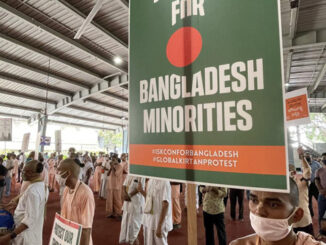
Religious freedom in India continued on a downward trend, said the United States Commission on International Religious Freedom’s annual report released recently. It noted that although government statistics have indicated that communal violence has decreased over the past two years, under the BJP rule, Hindu-nationalist groups have sought to “saffronize” India through violence, intimidation, and harassment against non-Hindus and Hindu Dalits. However, the Indian Constitution guarantees freedom of religion through articles 25 and 26. Since the ascendance of Modi as the Prime Minister, tensions between minorities and the majority community have increased in many parts of the country, further pushing minorities towards marginalization.
These days, the Embassies and Consulates of India have been utilized as propaganda machinery for the ruling party in India. In the name of promoting soft power, they have been forced to underwrite programs with intrinsic religious themes or ones that would fit their nationalist agenda. Even English is often being banished at official functions to the dismay of the attendee population, which always includes non-Hindi speaking people from the south or people who are born and brought up abroad.
India’s electoral integrity has been a focus of critics and a growing concern in recent years. Rahul Gandhi, the opposition leader, has recently exposed wholesale fraud in the voter rolls in the Mahadevapura constituency in Bangalore in the last parliamentary election. He had earlier alleged bogus turnout in the recently concluded Maharashtra elections. His concern reflects more profound structural anxieties about the whole electoral systems where disparate voices are calling for a shift to paper ballots away from Electronic Voting Machines (EVMs), The changing of the composition of the Election Commission to majority appointees by the ruling disposition cast a serious cloud on that body for its independence and integrity to dealing with chorus of protests and complaints arising from the opposition ranks.
The basis for democracy is Liberty,’ said Aristotle. However, today, the Institutions that were built to safeguard that principle are under duress. India is one of the most diverse nations in the world. The country has a population of 80% Hindu, 14% Muslim, Sikhs, and Christians, about 2% each. It has Castes and sub-castes, many languages and dialects, and varying customs and traditions, including different dress codes and dietary habits. That is the crossroad where India is today, with Narendra Modi in power, disregarding the aspirations of the minorities and diminishing the power structures that provided political and social equilibrium in the last six decades or more.
Many liberal critics of the Modi regime sincerely believe that his administration is run by a political dogma inspired by the RSS ideology. That ideology is based on a common thread promoted by the Sangh Parivar organizations and is called the ‘Hindu Nationalist agenda of the BJP.’ The ultimate goal of the agenda is to transform the pluralistic and democratic India into a Hindu nation where the majority religion will have the pre-eminence and minorities are relegated to a subservient role, probably being denied equal protection or opportunities, that too, to a substantial segment of the population.
The constitution’s framers created a democratic system wherein the legislature would make laws, the Executive would implement laws and be accountable to parliament, and an independent judiciary would interpret them. They also put in a system of checks and balances among these three organs of the state. However, over the years, these three organs of the state have pushed the boundaries of their relationship with one another. NDA has the majority in the Lok Sabha, where they pass ordinary bills and then pass them on to the Rajya Sabha as Money bills to circumvent their numerical impairment in that body. They have also shown utter disregard for deliberating on essential bills, bypassing various parliamentary committees.
The Bhartiya Janata Party’s victory in the Lok Sabha elections of 2014 has ushered in an unprecedented attack on India’s democracy and injected new elements of intolerance and authoritarianism into the lives of people living in the country. Most political scientists agree that a liberal democracy rests on the pillars of free and fair elections, the rule of law, civil liberties, minority rights protection, pluralism, political competition, and institutional autonomy. The Modi government has utterly failed on those scores, earning India the inglorious title of a ‘flawed democracy’.
Martin Luther King Jr. once said: Our lives begin to end the day we become silent about things that matter. The question is: will the Diaspora continue its long-held silence on the state of India’s democracy?
(The author is a former United Nations Chief Technology Officer. He is Vice Chair of IOC USA. He can be reached at gta777@gmail.com)

Be the first to comment