
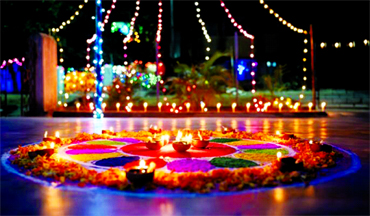

As twilight descends and the first lamps of Diwali flicker to life, India transforms into a glowing mosaic of radiance. Yet, if one looks closely, the light that fills today’s homes and streets carries a new hue. Once, Diwali’s charm was rooted in the soft, trembling glow of clay diyas filled with mustard oil, their flicker a prayer whispered to the heavens. Today, it dances in the steady, electric pulse of LED strips, fairy lights, and digital fireworks. The festival of lights has evolved-from sacred simplicity to modern spectacle-reflecting the changing face of India itself.
From Earth and Oil: The timeless Glow of the Diya
For centuries, the humble earthen diya has been the heart of Diwali. Made by village potters, dried in the sun, and filled with oil and cotton wicks, it symbolized purity, devotion, and connection to the earth. Lighting a diya was an act of faith-a ritual of awakening the soul, dispelling darkness within, and invoking prosperity.
Every flicker of that handmade lamp carried meaning. It embodied the five elements-earth (clay), water (used to mold it), fire (the flame), air (that sustains the flame), and ether (the space in which light spreads). When families lit hundreds of such diyas, their homes glowed with a golden warmth, the same light said to have welcomed Lord Rama to Ayodhya, heralding the triumph of dharma over evil.
The diya was not merely an object; it was a living symbol of India’s agrarian roots, of handmade artistry, and of spirituality grounded in simplicity.
The Arrival of Modern Light
The 20th century brought electricity into Indian homes-and with it, a new era of Diwali celebration. The first recorded use of electric illumination for Diwali dates back to early 1900s Bombay, when wealthy traders began stringing incandescent bulbs along their balconies. What began as novelty soon became aspiration.
By the 1970s and 80s, electric bulbs had become a common sight-multicolored garlands decorating markets, temples, and public buildings. Cities gleamed with neon signs proclaiming “Shubh Deepavali,” and electricity replaced oil as the dominant source of festival light.
The symbolism shifted subtly but significantly. The electric bulb, steady and powerful, contrasted with the organic fragility of the diya. The festival’s aesthetic grew brighter, grander, and more urban.
LEDs, Lasers, and the Era of Glitz
The 21st century has taken Diwali into a new visual age. With the LED revolution, energy-efficient lighting has made it possible to illuminate entire cities with minimal cost. Streets, malls, and temples now blaze in synchronized color displays, often choreographed to music or animations.
Homes no longer rely solely on traditional lamps. Instead, LED curtains cascade from balconies, sensor-lit diyas glow automatically at dusk, and programmable lights mimic the dancing of flames. Urban skylines twinkle not just with fireworks, but with digital light shows and drone spectacles.
In metropolitan India, the festival has merged with technology-driven aesthetics: eco-friendly laser shows replacing noisy crackers, 3D projection mapping on heritage buildings, and “smart diyas” powered by solar cells. The modern Diwali is as much about design and innovation as devotion.
A Shift in Mood and Meaning
With these transformations, Diwali’s sensory palette has changed. The rustic fragrance of clay lamps mingled with mustard oil has given way to the faint hum of circuitry and the sterile glow of LEDs. The festival, once deeply rooted in ritual and simplicity, now often mirrors urban consumerism-defined by shopping festivals, gadget launches, and social media sparkle.
Yet, this change is not merely about aesthetics-it also reflects a larger shift in India’s rhythm. The traditional Diwali was intimate, family-centered, and inward-looking. Today’s Diwali, while still joyous, is expansive, outward, and performative. Neighborhood competitions for the brightest house, Instagram-perfect rangolis, and influencer-led Diwali décor trends speak of a celebration that has adapted to a hyperconnected world.
Still, amid the glitter and technology, the essence remains-every lamp, whether clay or LED, still symbolizes hope. The medium has changed; the message endures.
The Environmental Awakening
One positive outcome of modernization has been an awakening toward sustainability. As awareness grows about pollution and waste, many urban households have begun to embrace eco-friendly celebrations. LEDs, despite their commercial glitz, are more energy-efficient and safer than traditional bulbs. Similarly, clay diyas have made a comeback in green-conscious homes that seek to support local artisans and reduce plastic waste.
The modern Diwali is thus evolving into a fusion-where tradition and technology coexist. Solar-powered diyas and biodegradable decorations embody this new balance, proving that innovation need not erase heritage, only illuminate it differently.
Artisans in Transition: The Potters’ Plight
However, the changing face of Diwali has not been without consequence. For generations, potters (kumhars) across India earned their living by crafting earthen diyas. But with the rise of mass-produced plastic and electric lamps, their livelihoods have been threatened.
In towns like Khurja (Uttar Pradesh) and Molela (Rajasthan), artisans now struggle to sell their handcrafted wares against the flood of imported LED decorations. Some have adapted, creating designer diyas, painted lamps, and eco-friendly terracotta products for urban markets. Others, sadly, have faded into economic obscurity.
The diya’s decline, therefore, is not just about changing aesthetics-it’s about the silent dimming of traditional craftsmanship.
Balancing Tradition and Modernity
India’s Diwali today straddles two worlds-the ancient and the futuristic. In many homes, grandmothers still insist on lighting the first oil diya before switching on the fairy lights. The old and the new coexist, often on the same threshold: clay lamps glowing softly beneath LED garlands, firecrackers replaced by laser shows, paper lanterns alongside digital décor.
This hybrid Diwali is perhaps India’s truest reflection-a civilization constantly reinventing itself without losing its soul. The festival’s transformation mirrors the nation’s journey from rural simplicity to technological sophistication, from handmade to high-tech.
The Light That Endures
Whether cast by an earthen diya or an LED bulb, Diwali’s light continues to embody humanity’s eternal yearning-to overcome darkness, to celebrate life, and to renew faith. The mediums may change, but the meaning endures.
In the end, the most radiant Diwali is not the one that dazzles with brightness, but the one that kindles warmth-the glow of togetherness, compassion, and hope.
So, as India lights up once again-some with clay lamps, others with neon brilliance-what truly matters is not how we illuminate our homes, but how we illuminate our hearts.
1 Trackback / Pingback