
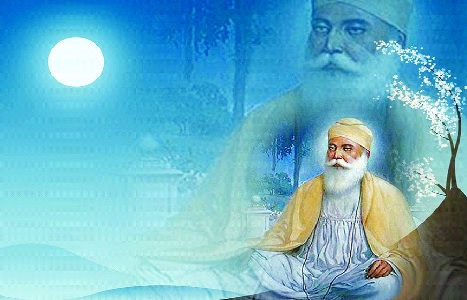

In the vast spiritual landscape of India, few figures command as much reverence, intellectual curiosity, and universal admiration as Guru Nanak Dev Ji-the 15th-century seer whose words became the foundation of Sikhism. More than five centuries later, Nanak’s luminous teachings continue to stir minds and hearts across traditions, drawing reflections not only from his followers but also from spiritual masters, philosophers, and historians across the world. From Osho Rajneesh and the Dalai Lama to modern historians like W.H. McLeod, each has seen in Nanak a mirror reflecting their own quest for truth, harmony, and social transformation.
Among modern spiritual teachers, Osho Rajneesh spoke of Guru Nanak with deep affection and awe. To Osho, Nanak was not merely a preacher but a poet of the divine, a singer who expressed cosmic truths through rhythm and melody.
“Nanak’s path to realization,” Osho once said, “is not dry philosophy but a song filled with fragrance and joy. His way is music, not asceticism.”
In his discourses on the Japji Sahib, Osho interpreted Nanak’s words as the first outpouring of divine union-the spontaneous poetry of enlightenment. He described Nanak as a mystic who bridged earth and sky through his hymns, whose “Naam” (the divine Name) was both the path and the destination.
“When the ego disappears,” Osho wrote, “whatever stands before your eyes is God Himself. Nanak saw this and sang it.”
For Osho, Nanak symbolized the freedom of the spirit-a soul that transcended dogma, uniting Hindu and Muslim, philosophy and devotion, silence and song.
The 14th Dalai Lama, the global voice of Buddhist compassion, has often spoken of his admiration for Guru Nanak Dev Ji. On the 550th birth anniversary celebrations of the Guru, His Holiness said:
“I admire Guru Nanak, who came from a Hindu background, for making a pilgrimage to Mecca as an expression of respect. His life is a message of harmony among all faiths.”
The Dalai Lama finds in Nanak’s life an embodiment of karuna-compassion that transcends boundaries. He has called the Sikh community “an example for the modern world,” praising their work ethic and generosity:
“Among the Sikhs,” he noted, “there are hardly any beggars. You are not only hard-working but also generous in helping one another. Guru Nanak’s teachings of equality and selfless service are what the world needs today.”
To the Dalai Lama, Nanak stands as a spiritual bridge-builder, a saint who lived the essence of interfaith respect long before such terms existed. His message of compassion and selfless action aligns seamlessly with Buddhist principles of loving-kindness and mindfulness.
According to Swami Vivekananda: “There was a great prophet in India, Guru Nanak … He conferred with Hindus and Mohammedans, and tried to bring about a new state of things.”
Rabindranath Tagore said: “The freedom that Baba Nanak had felt was not political freedom; his sense of dharma was not constricted by the worship of deities that was limited to a certain country’s or people’s imagination and habit, and did not accommodate the universal human heart… he dedicated his life to preaching that freedom to all.” Tagore recalled his childhood visit to the Harmandir Sahib (Golden Temple) in Amritsar and wrote: “I remember the Gurudarbar at Amritsar like a dream. … My father would sit among those Sikh worshippers …”
On Nanak’s hymn-“aarti” (Gagan Mai Thaal) Tagore said: “Asked to compose an anthem for the entire world, that had already been done long ago by Guru Nanak.”
In a prayer meeting speech (New Delhi, 26 Sept 1947) Mahatma Gandhi said: “Sikhism started with Guru Nanak. What did Guru Nanak teach? He said that God is known by several names including Allah, Rahim, Khuda. … Nanak Sahib tried to bring together all religions.”
While spiritual masters view Guru Nanak through the eyes of love and devotion, historians and scholars approach him with a different kind of reverence-through research, analysis, and interpretation.
Swami Sivananda of the Divine Life Society, said: “Guru Nanak is a great prophet of Peace. Guru Nanak’s teaching breathes the purest spirit of devotion… He takes the view of the Upanishads that there is one Brahman.”
Several of Paramahansa Yogananda’s self-realization hymn collections reference Guru Nanak’s devotional lines (e.g., translations/adaptations of Nanak’s chants such as “He Hari Sundara / O God Beautiful” appearing in collections attributed to Yogananda followers).
Contemporary Aurobindo Society posts and tributes commemorate Guru Nanak’s call to unity and humanity:
Sant-poets such as Kabir and Ravidas are often invoked together with Nanak in devotional/poetic dialogues. Traditional janamsakhi-style stories present mutual respect among these sants; modern retellings present Nanak praising Kabir’s “nij baani” and vice versa.
The pioneering New Zealand historian W.H. McLeod, in his landmark study Guru Nanak and the Sikh Religion, examined Nanak as a historical and religious innovator. McLeod applied critical methods to the traditional Janamsakhis (biographical legends) and argued that Nanak’s message belonged to the Sant tradition of northern India, emphasizing inner devotion over ritual. Though McLeod’s approach was groundbreaking, it also sparked debates within Sikh circles for what some saw as an over-secular reading of Nanak’s spirituality.
Sadhguru speaks of Guru Nanak as a spiritual master who lived from an “inner experience of life” rather than through scriptures. He emphasizes Guru Nanak’s compassionate and courageous nature, noting that he was not always gentle but knew when to be hard and when to be soft. Sadhguru highlights the story of the “heavenly needle” to illustrate that Guru Nanak’s life was not about amassing possessions, but about living from a place of inner spaciousness and realizing life itself.
A Pioneer of Universal Humanism: Scholars view Guru Nanak’s philosophy as a “liberating philosophy of universal humanism,” advocating liberty, love, respect, justice, and equality for all. He is recognized for questioning and condemning social customs and religious practices that discriminated against people based on caste, creed, or gender.
Original Metaphysical Thought: While his ideas derived in part from the Sant and Bhakti traditions, scholars argue that the fundamental issues of Sikhism are “fundamentally different in substance and direction,” and his metaphysical aspects are considered original, not merely syncretic.
Rejection of Ritualism and Asceticism: Academic experts highlight his pragmatic approach to spirituality. He rejected idol worship, the caste system, and the idea of asceticism or renouncing the world, advocating instead for a “householder’s life” combined with spiritual practice and honest labor (Kirat Karni).
Emphasis on Truthful Living: Scholars emphasize that for Guru Nanak, “truth is a high ideal, higher still is truthful living”. His teachings are seen as a call to action for creating a just society, not just a guide for personal salvation in the afterlife.
A Poet and Mystic: Guru Nanak is also recognized as a poet of “uncommon sensitivity” and a “wonderful mystic” whose verses, compiled in the Guru Granth Sahib, communicate complex spiritual ideas in simple language accessible to the common person.
“Hindu ka Guru, Musalman ka Pir”: This popular saying reflects how he was, and still is, revered by both Hindus and Muslims, who saw him as their own teacher and spiritual guide.
Baha’i Faith: The Universal House of Justice of the Baha’i Faith considers Guru Nanak to have been endowed with a “saintly character” and views him as a “saint of the highest order” who was divinely inspired to reconcile the conflicts between Hinduism and Islam.
Ahmadiyya Muslim Community: This community considers Guru Nanak to have been a Muslim saint who sought to educate people about the real teachings of Islam.
A Light for All Ages
Five hundred years after his birth, Guru Nanak continues to illuminate the human quest for truth and peace. His hymns still resound in gurdwaras and homes across the world, his ethics still shape communities, and his message still speaks to the global heart weary of division


Be the first to comment