


Every year, as the waning moon of the Hindu month of Margashirsha (November-December) casts its dark shadow across the sky, devotees of Lord Shiva observe a powerful and mysterious night – Kaal Bhairav Jayanti, the divine appearance day of Lord Kaal Bhairav, the ferocious manifestation of Mahadev himself.
It is believed that on this night, the cosmic energies vibrate with heightened intensity, and Shiva, in his most awe-inspiring form as the Lord of Time and Death, emerges to remind creation that even time has its master.
The Legend: When Shiva Became Bhairav
According to the Shiva Purana, the story of Kaal Bhairav’s birth begins in the heavenly city of Kashi, when the Trimurti – Brahma, Vishnu, and Shiva – were engaged in a cosmic discussion about supremacy. In a moment of arrogance, Lord Brahma proclaimed himself the supreme creator, claiming that all beings and even time itself flowed from him.
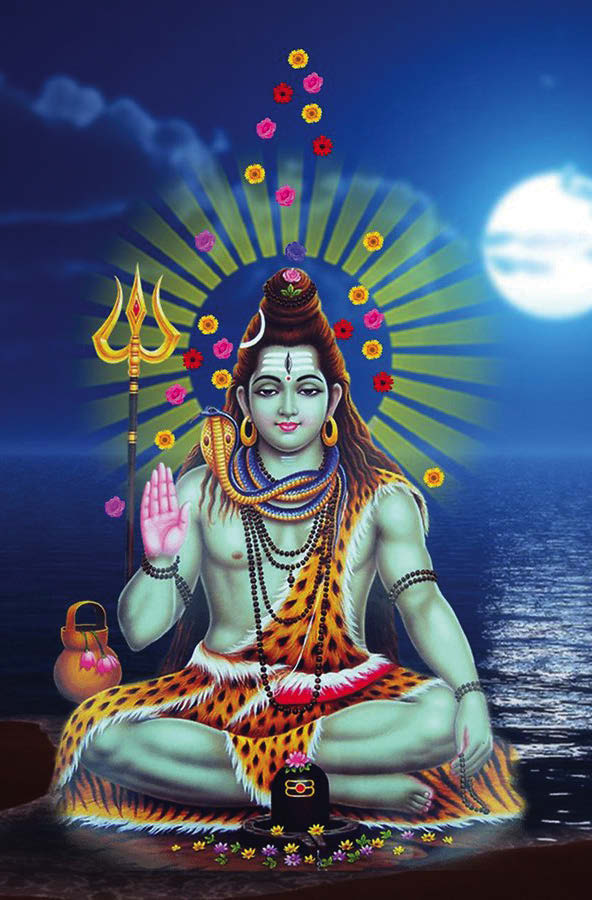
Displeased by Brahma’s pride, Shiva manifested a fierce energy from his own being – a blinding flame that took the form of Kaal Bhairav, dark as a storm cloud, adorned with serpents, and carrying a trident, drum, and skull-bowl.
When Brahma continued to ignore Shiva’s warnings, Kaal Bhairav swiftly severed one of Brahma’s five heads – the symbol of ego and false knowledge. But for the act of taking a divine life, even Bhairav had to bear the burden of sin. With the skull of Brahma stuck to his hand, he roamed the three worlds as a penitent, until he reached Kashi, where the skull fell off – freeing him of the curse.
From that moment, Kashi (Varanasi) became known as the city of liberation, and Kaal Bhairav its eternal Kotwal (guardian or protector). Even today, devotees believe that one cannot reside in Kashi or achieve moksha there without the permission of Kaal Bhairav.
The Philosophy of Kaal Bhairav
The name Bhairav comes from the Sanskrit roots bh? (fear) and rava (sound) – yet, paradoxically, Kaal Bhairav is not to be feared, but to be revered. He represents the destruction of fear itself – the courage to face mortality, time, and illusion.
Kaal means “Time,” and Bhairav is “the transcendental energy beyond it.” Together, they symbolize the understanding that time devours all, and only awareness (Shiva) remains eternal.
In Shaiva philosophy, Kaal Bhairav is the force that cuts through ignorance and ego, awakening the seeker to the impermanence of worldly existence. His ferocity is not malice – it is the cosmic compassion that destroys falsehood, illusion, and arrogance, leaving only truth behind.
Worshipping Kaal Bhairav, therefore, is not an act of appeasement but of self-confrontation – the acceptance that birth and death are illusions in the cycle of time, and that the spirit remains untouched by both.
The Festival of the Fearless
Kaal Bhairav Jayanti, also known as Kalashtami, falls on the Krishna Paksha Ashtami (the eighth day of the waning moon) in the month of Margashirsha. On this sacred night, devotees observe fasts, night-long vigils, and rituals dedicated to Lord Bhairav.
Rituals and Observances
Fasting and purification: Devotees wake before sunrise, take a holy bath, and observe a strict fast throughout the day. The fast is believed to purify the body and mind, preparing one to receive Bhairav’s blessings.
Worship of Bhairav idols: At dusk, elaborate pujas are performed with offerings of mustard oil, black sesame, flowers, and black cloth – all symbolic of his dark and protective energy.
Offering of alcohol to the deity: In certain Shaiva traditions, a few drops of liquor (particularly country-made or desi) are ritually offered to Bhairav, signifying the offering of one’s delusion and attachment rather than indulgence.
Recitation of Bhairav Chalisa and Stotra: Devotees chant the Kaal Bhairav Ashtakam composed by Adi Shankaracharya, an eight-verse hymn extolling the deity as the supreme destroyer of fear and ignorance.
Night vigil (jagran): Throughout the night, temples resound with chants of “Jai Kaal Bhairav!” as devotees meditate, light lamps, and reflect upon the transient nature of existence.
Sacred Abodes
Among all his shrines, Kaal Bhairav Temple in Varanasi holds the highest reverence. Built in the ancient city that Bhairav guards, the temple remains open late into the night on Jayanti, drawing thousands of devotees. The deity here is depicted holding a trident and a severed head – a stark reminder of his cosmic role as the remover of ego.
Other important shrines include:
– Annapoorneshwari Temple Complex, Kashi: Where Kaal Bhairav stands as the guardian of the city’s spiritual energy.
– Kala Bhairava Temple, Ujjain (Madhya Pradesh): One of the eight Bhairavas of the Ashta Bhairava tradition, worshipped with offerings of alcohol and red flowers.
– Kashi Vishwanath Corridor: Where Bhairav is venerated as a protector deity of Shiva’s Jyotirlinga.
In many Himalayan and South Indian temples, Bhairav is also regarded as the protector of tantric knowledge, and his Jayanti becomes a night of deep meditation, mantra sadhana, and introspection.
Symbolism: The Eternal Dance of Time
Every symbol associated with Kaal Bhairav is profoundly spiritual:
– The dog (Shvan) that accompanies him represents loyalty, humility, and the control of instincts.
– The trident (Trishul) symbolizes mastery over the three aspects of existence – creation, preservation, and destruction.
– The skull bowl (Kapala) signifies detachment from ego and the acceptance of life’s impermanence.
– His necklace of skulls represents the cycle of time – where every birth is followed by death, and every end leads to a new beginning.
In a deeper philosophical sense, Bhairav’s terrifying form reflects the inner energy of Kundalini Shakti, which when awakened, annihilates the ignorance that binds the soul to illusion.

Be the first to comment