
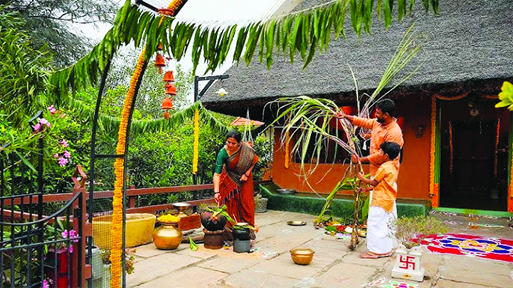

As the winter Sun climbs higher in the southern sky and the land turns generous after months of cultivation, South India, particularly Tamil Nadu awakens to one of its most cherished festivals-Pongal. Celebrated over four days in mid-January, Pongal is not merely a harvest festival; it is a profound expression of thanksgiving-to the Sun (Surya), the earth, the farmer, and the cattle that sustain agrarian life.
Rooted in ancient Tamil civilization and aligned with the solar transition of Uttarayan and Makar Sankranti, Pongal embodies a timeless philosophy: that human prosperity is inseparable from harmony with nature.
The Origin of Pongal: An Ancient Tamil Thanksgiving
The word Pongal comes from the Tamil verb “ponga”, meaning to boil over-a symbolic gesture of abundance, prosperity and overflowing joy. The festival’s origins can be traced back more than two millennia, referenced in classical Tamil literature, including Sangam texts, which celebrate agriculture, seasonal rhythms and Sun worship.
Pongal is believed to have emerged as a Dravidian harvest observance, long before its later assimilation into broader pan-Indian solar festivals. Over time, it became closely associated with Makar Sankranti, marking the Sun’s northward journey and the end of the winter solstice.
In ancient Tamil society, where agriculture was central to survival and culture, Pongal served as a communal pause-an opportunity to acknowledge nature’s benevolence and reaffirm collective responsibility toward land and livestock.
Significance of Pongal: Gratitude as a Way of Life
At its heart, Pongal is a festival of gratitude. It celebrates not conquest or mythic triumph, but the quiet miracle of sustenance-the grain that ripens, the cattle that plough, the Sun that nourishes.
Spiritually, Pongal honors:
– Surya, the life-giving Sun
– Bhumi Devi, the fertile Earth
– Mattu (cattle), partners in agriculture
– Farmers, custodians of food security
The festival reinforces the Tamil worldview that prosperity must be acknowledged, shared and respected-not exploited.
The boiling of Pongal rice until it spills over the pot is accompanied by joyful cries of “Pongalo Pongal!”, invoking abundance in homes, fields and hearts.
The Four Days of Pongal: Rituals and Observances
Bhogi Pongal: Renewal and Release
The festival begins with Bhogi Pongal, dedicated to renewal. Old possessions, broken tools and discarded items are ceremonially burnt, symbolising the shedding of negativity and stagnation.
Homes are cleaned, walls freshly decorated, and intricate kolams (rangoli) drawn at entrances using rice flour-both an aesthetic and ecological act, as they feed birds and insects.
Bhogi honors Indra, the deity of rain, acknowledging the water that sustains crops.
Thai Pongal: The Festival of the Sun
The second and most important day, Thai Pongal, is dedicated to Surya. Families prepare the sacred dish-Pongal-using newly harvested rice, milk and jaggery, often outdoors under the open sky.
As the pot boils over, prayers are offered to the Sun, thanking him for warmth, light and life. The dish is first offered to the deity before being shared among family and neighbours, reinforcing the spirit of community.
Mattu Pongal: Honoring the Silent Workers
Mattu Pongal is a moving tribute to cattle-bulls, cows and buffaloes-acknowledging their indispensable role in agriculture. Animals are bathed, decorated with garlands, bells and painted horns, and fed special meals.
In villages, this day reflects a deep ethical tradition-recognizing labor beyond the human. It also coincides with traditional events such as Jallikattu, a centuries-old sport celebrating valor and cattle rearing, now regulated and symbolic of cultural identity.
Kaanum Pongal: Community and Kinship
The final day, Kaanum Pongal, is devoted to social bonding. Families visit relatives, exchange gifts and enjoy picnics near rivers or fields.
Women offer prayers for the prosperity of their brothers, echoing themes of protection and familial harmony. The day emphasises that harvest celebrations are incomplete without human connection.
Food, Kolams and Cultural Expression
Food lies at the heart of Pongal, not as indulgence but as ritual. Variants such as Sakkarai Pongal, Ven Pongal and sugarcane delicacies dominate festive tables.
Kolams drawn with mathematical precision reflect Tamil Nadu’s unique fusion of art, science and spirituality. Folk songs, rural games and temple festivities add vibrancy, ensuring that Pongal is celebrated as much in the streets as in the home.
Pongal in Contemporary Times
While urbanisation has transformed lifestyles, Pongal remains deeply relevant. Cities celebrate with community feasts, cultural performances and eco-conscious practices. Schools and institutions use the festival to reconnect younger generations with agrarian values.
Importantly, Pongal has evolved into a symbol of Tamil identity and pride, transcending religious boundaries and uniting people across communities.
A Festival Rooted in Humility and Harmony
Pongal endures because it celebrates the fundamentals of life-food, family and gratitude. In a world increasingly disconnected from nature, the festival serves as a gentle reminder that prosperity is not self-created, but co-produced by sun, soil, rain and labour.
As pots boil over and kolams bloom at dawn, Pongal quietly teaches an enduring lesson: to receive with humility, to share with joy, and to live in harmony with the earth that sustains us.



Be the first to comment