Tag: Aam Aadmi Party – AAP @AamAadmiParty

  • AAP falls from shining hill – Kejriwal’s immense loss of credibility

    AAP falls from shining hill – Kejriwal’s immense loss of credibility

    In the Aam Aadmi Party, morality collided with realpolitik. Unsurprisingly, the latter won. Many supporters of the party, who gave it such a stunning victory in the Delhi assembly elections, are nursing their hurt and are reconciling themselves to the end of another illusion.

    The AAP leader and now Delhi’s Chief Minister, Mr. Arvind Kejriwal, was never in doubt on two points. One, he had to stamp his authority on the baby party. Second, while the morality stick was good to wave, the hard reality of playing politics had to take the first place.

    Mr. Yogendra Yadav and Mr. Prashant Bhushan, with their persistent admonitions and waving the flag of morality, had simply become too distracting and inconvenient for Mr. Kejriwal’s plan to rule his fledgling party with an iron hand. He had had a taste of their mettle by their objecting to some of the tainted candidates fielded by the party and they had raised questions about large dubious donations.

    Mr. Kejriwal thus came to the conclusion that nothing short of a purge of the two from the Political Affairs Committee will do. And he set about it in the hoary tradition of Indian political culture pioneered by the Congress party and followed by all others. First, seek their resignation while airing Mr. Yadav’s clandestinely taped conversation with a journalist to embarrass him. Then offer inconsequential posts to sideline them.

    When every trick failed, they were voted out in the executive by a surprisingly narrow 11 to 8 margin. True to the accepted political tradition, Mr. Kejriwal absented himself with the plausible excuse of undergoing treatment while sending in his own resignation as party convener, predictably rejected.

    Mr. Kejriwal has won a victory at great cost. Its quantum remains to be determined. The plan did not run to script because neither of the gadflies had an ulterior motive in raising the questions they did. They sought to keep AAP on the straight and narrow: moral imperatives that had persuaded them and so many others to support a party seeking a higher moral ground. The immense response it got in Delhi was due to the electors’ conviction that here was a new party of leaders with conviction who wanted to change the way politics functioned.

    As far as the bulk of supporters are concerned, the let-down has been tremendous. While some compromises are necessary in politics as in life, the duplication of the traditional deviousness practiced by Mr. Kejriwal’s henchmen was breathtaking. One can expect the Delhi Chief Minister to undertake an act of showmanship to try to surmount his huge embarrassment, but he will find it difficult to regain trust.

    Perhaps the questioning duo was being unrealistic in trying to keep AAP to a high moral benchmark. Perhaps it also became a question of Mr. Kejriwal’s “amour proper”, of men of an intellectual standing challenging his actions in the party. Perhaps the leader who abandoned Anna Hazare’s movement to start a political party felt that only as an unchallenged leader could he deliver on his promises.

    By their very nature, these are assumptions, but the crisis in AAP poses larger questions. Can a party that sought to give a new direction to Indian political culture survive the body blow that has been dealt it? How will Mr. Kejriwal convince his bewildered supporters that he is sincere in fulfilling his promises?Has he indeed misjudged his two critics in believing that they can be tackled through traditional methods of placating or expelling them?

    These are portentous questions that go to the heart of the rationale for a new party. Judging by the number of defections to the Bharatiya Janata Party after its impressive victory in the Lok Sabha elections last year, politicians gravitate towards power, especially when the future of the losing party seems bleak. To give one example of horse-trading, we all know how Mr. P.V. Narasimha Rao converted his minority government at the Centre into a majority dispensation.

    The shock over how the AAP crisis was managed was in the tawdry nature of the tricks that were played upon the dissenting duo by Kejriwal loyalists. They hopelessly misread the dissenters who were not raising objections for their own aggrandizement, but were highlighting the nature of the compromises made in winning the Delhi elections.

    Mr. Kejriwal’s stance of being above the conflict by absenting himself from the executive meeting and sending in his own resignation are old tricks in the political game. It is worth noting, however, that in a vainglorious move, he has divested himself of all portfolios in the newly-formed Delhi ministry so that he remains the monarch of all he surveys.

    The tragedy for those who voted for AAP in Delhi – and millions more across the country cheering the new kid on the block — is that the melodrama played out in the executive committee came so soon after its unprecedented triumph. It represents a let-down of immense proportions.

    Mr. Yadav and Mr. Bhushan, who were sought to be banished from AAP, have not taken the bait. Mr. Yadav has said he would abide by the party’s decisions and help the party go forward because it had been founded on so many hopes and aspirations. Obviously, he will raise questions troubling him at the party’s larger forums.

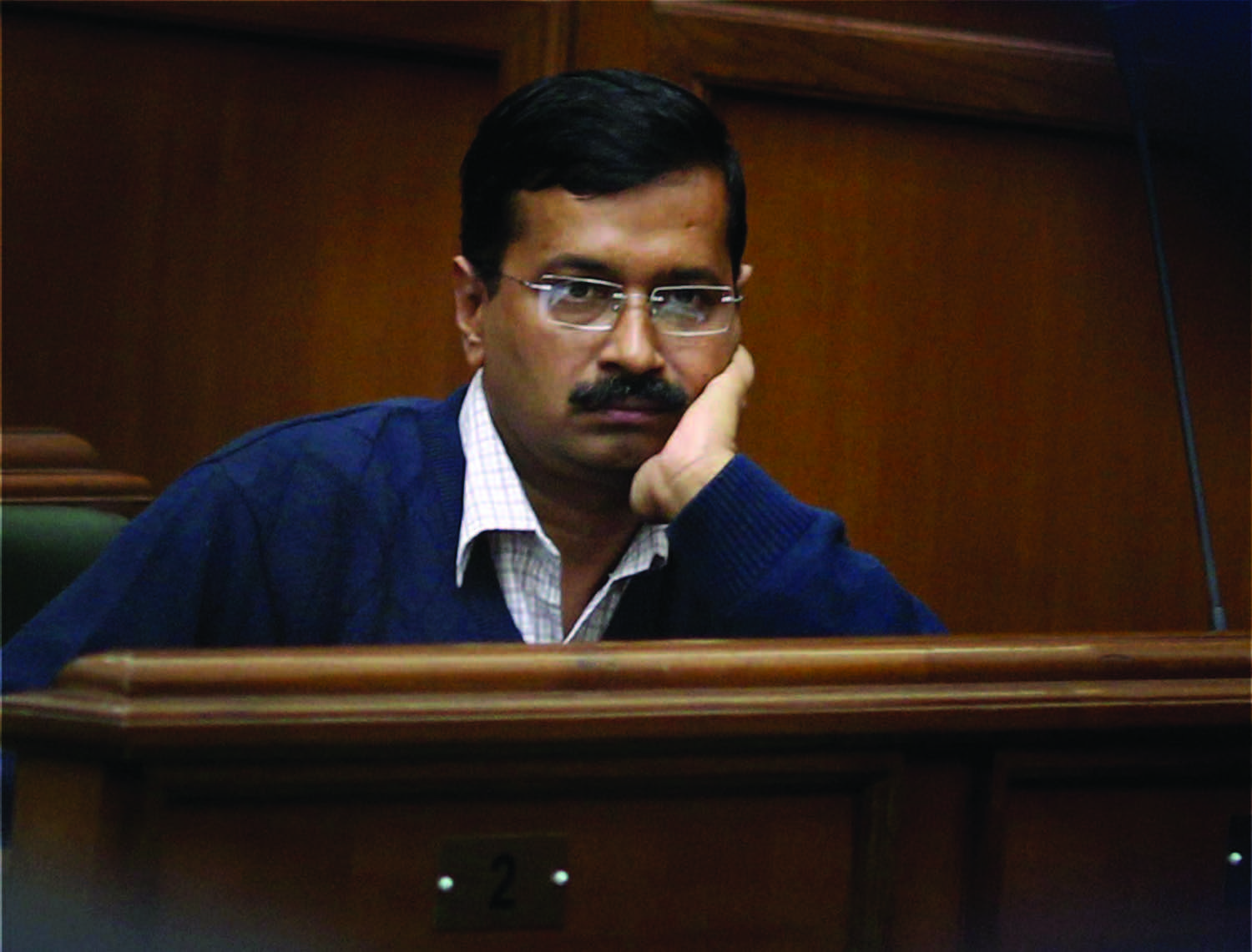
    Whatever the future holds for AAP, the party has witnessed its watershed moment. The party on the hill has tottered and Mr. Kejriwal’s task now is how to rescue it from the dirty politics played in his name and presumably under his direction. He has time to think through his tactics while undergoing treatment. There would be little profit in dissembling to suggest that he was unaware of what was being enacted.

    Many AAP supporters and the wider public will wonder whether they had again backed the wrong horse. By turning the party’s back on two of its most illustrious founder members, it has betrayed the trust of many. It remains to be seen whether the duo will be allowed to play any role in the party’s larger forums, given the level of animosity Kejriwal loyalists have displayed.

  • Bhushan, Yadav removed from PAC – AAP in Crisis – Kejriwal offers to resign as national convenor

    Bhushan, Yadav removed from PAC – AAP in Crisis – Kejriwal offers to resign as national convenor

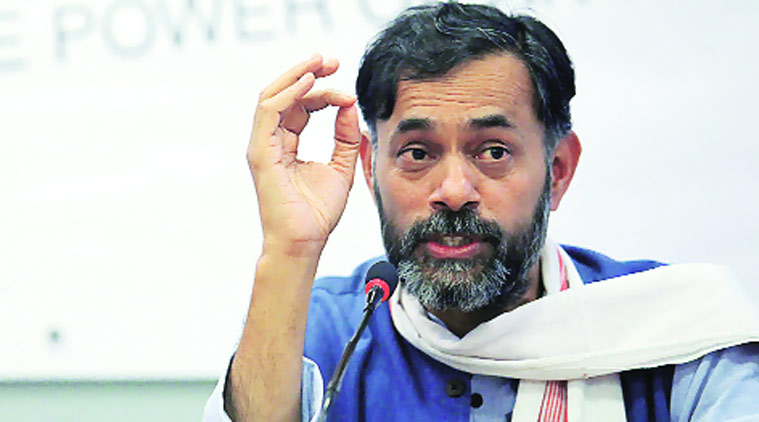
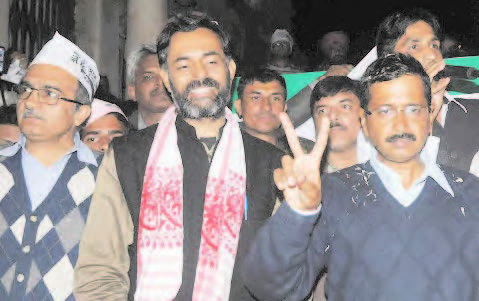
    In a dramatic vote within the Aam Aadmi Party’s political affairs committee Senior AAP leaders Yogendra Yadav (party’s official spokesperson) and Prashant Bhushan have been voted out of the party’s political affairs committee and Yadav has also been asked to step down as the party’s official spokesperson, news channels reported late this evening.

    Considered to be the pillars of the party’s organisation structure, Bhushan and Yadav refused to comment on the developments that took place during the meeting and said they were volunteers of the party and would take up whatever role the party offered.

    Eleven members voted against Prashant and Yogendra being a part of the PAC, while eight voted in favour of them, CNN-IBN reported.

    Speaking to reporters post the meeting, party spokesperson Kumar Vishwas said, “the national executive has decided to relieve Yogendra Yadav and Prashant Bhushan from the PAC… they will be given new responsibilities. The party has reiterated that everyone stands united.”

    On Kejriwal’s resignation as national convener, Vishwas said: “the party has rejected Kejriwal’s resignation.” 

    Speaking with AAP supporter Jas told The Indian Panorama that Kejriwal should not have offered to resign and should have taken the internal rift lightly and handled it in an open debate. 

    After the Delhi polls it is very likely that if Kejriwal’s resignation was accepted; he would have apologized for the step taken and would again contested the internal elections (if any) for the Aam Aadmi Party’s national convenor post.

    “We wish the AAP does not make the same mistakes again that they made last year; To be honest within 30 days the rift being sparked does point out the anarchist nature of Arvind Kejriwal” said Umapathi (one of the loyalist of the AAP) from Bengaluru.

  • Kejriwal starts to fulfil promises – Halves power tariff & gives 20K litres free water

    Kejriwal starts to fulfil promises – Halves power tariff & gives 20K litres free water

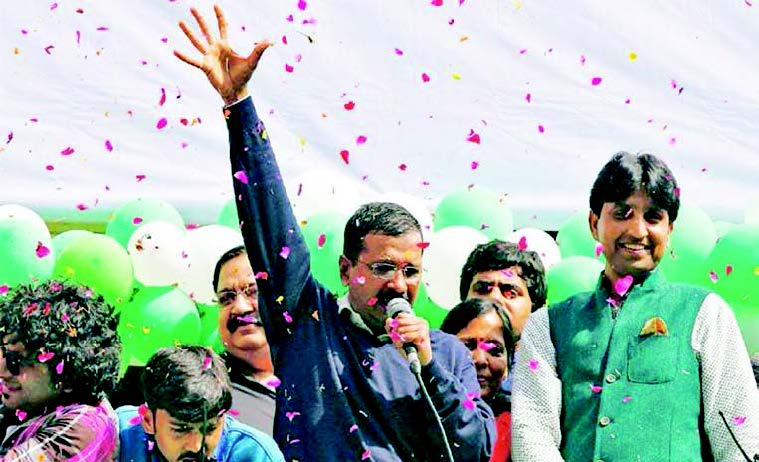
    Within twelve days of coming back to power in Delhi, AAP government earlier today slashed power tariff by 50 percent for consumption up to 400 units per month and 20,000 litres of free water per household every month.

    “The reduction in power tariff will benefit 36,06,428 families, which is around 90 percent of the city’s population,” Sisodia said, adding that those consuming over 400 units would have to pay the full bill. Water tariff will also be charged if the consumption limit exceeds 20,000 litres. The rates will come into effect from March 1, announced Deputy Chief Minister Manish Sisodia here after a Cabinet meeting.

    On free power scheme, Sisodia said the government will review power rates after Comptroller and Auditor General of India​ completes audit of the accounts of the power discoms. The announcements came on the heels of Kejriwal’s meeting with Comptroller and Auditor General Shashi Kant Sharma to assess the status of the audit of power companies ordered by the first AAP government more than a year ago. In January last year, Kejriwal had ordered a CAG audit of the finances of the three power companies – BSES Yamuna Power Ltd, BSES Rajdhani Power Ltd and Tata Power Delhi Distribution Ltd. It had even warned the discoms that their licenses may be cancelled if they do not cooperate with the audit. Delhi discoms are a 51:49 per cent joint venture between the private companies and the Delhi government.
     

    Slashing power tariff and giving free water were two of the key electoral promises made by the AAP ahead of the Delhi Assembly polls, which the party won with a landslide majority.


  • KEJRIWAL TAKES OATH AS EIGHTH CM OF DELHI

    KEJRIWAL TAKES OATH AS EIGHTH CM OF DELHI

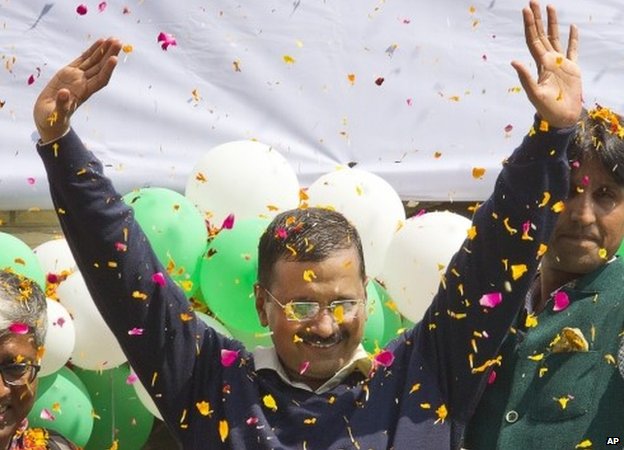
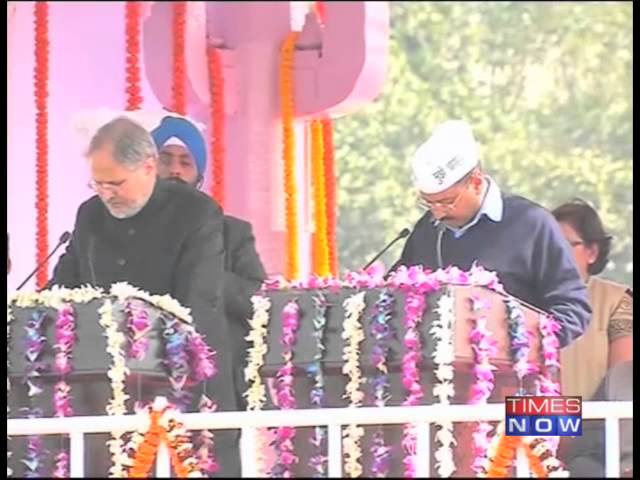
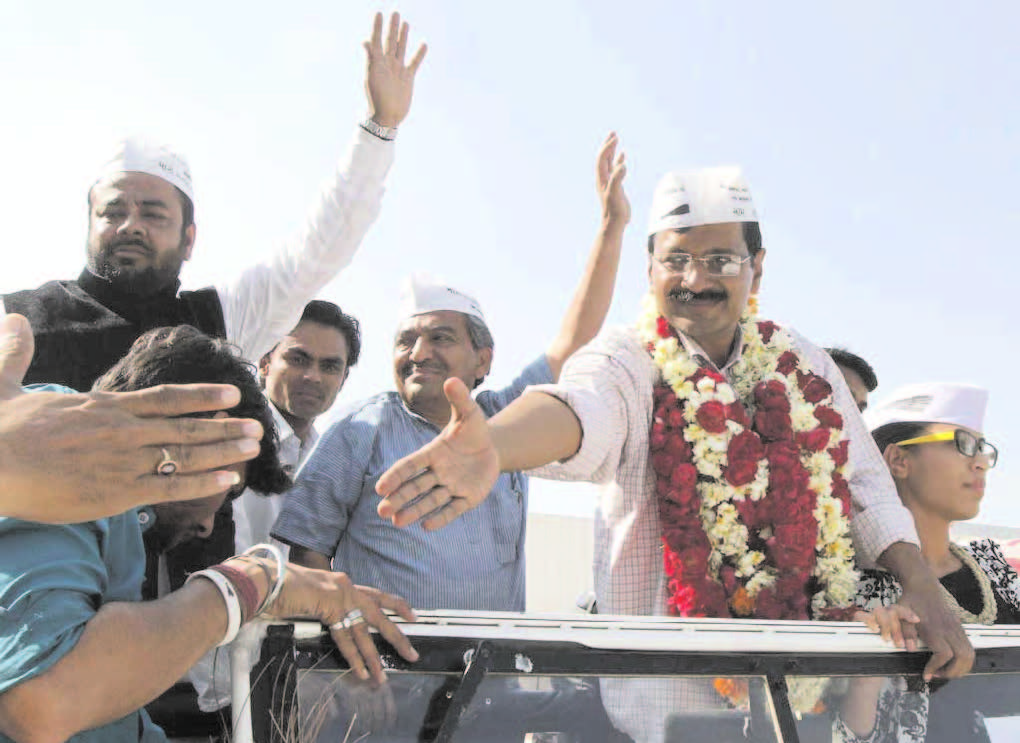
    NEW DELHI (TIP): Arvind Kejriwal took oath as Delhi’s youngest chief minister on February 14 with a speech that thanked the aam aadmi, reassured the minorities, reached out to the opposition and promised an end to corruption and VIP culture in five years.

    KEJRIWAL TAKES OATHAddressing a crowd of about 50,000 people at the Ramlila Maidan – a city landmark where the anti-corruption movement spearheaded by Anna Hazare first started – Kejriwal laid all speculations about his party’s national ambition to rest saying that AAP’s massive mandate was a “miracle” and also a “directive” for him to focus only on Delhi for the next five years.


    KEJRIWAL TAKES OATH 1 “Over the last few days I have heard some of our volunteers talk about fighting more state elections. This is wrong. We paid for our arrogance in the 2014 Lok Sabha polls. God punished us for it. I will stay here for the next five years and work for Delhi with full dedication,” he said. AAP, particularly Kejriwal, had received a lot of flak from the capital’s electorate for the impulsive exit from power and also the decision to contest on 440 Lok Sabha seats barely six months after its impressive debut in the capital in 2013.


    Kejriwal reaches outListing out his priorities for the next five years, the new CM assured that his government will pass the Janlokpal Bill and also revive the anti-corruption helpline that was started during his 49-day stint in power. “I’ll try to make Delhi the first corruption-free state of the country. I will repeat what I said on December 28 – if someone asks you for a bribe, don’t refuse. Pick up your mobile phones and record it. We will act upon it,” he said.

    At a time when the central government has been criticised for remaining mum on communal violence, Kejriwal, interestingly, spoke out on this issue. Referring to the recent incidents in the capital, he said he will work with the police to ensure people of all religious communities feel safe. He also hinted at the involvement of “political forces” in such unrest. “I would also appeal all those forces [indulging in communal violence] to stop resorting to such kind of politics,” he said.

    Often described as a “man in a hurry”, the AAP leader this time was careful in setting deadlines for himself and the government. He appealed to the media to not judge his work in a few hours as he has five years to prove himself. He also dropped enough hints that he had made peace with the legitimate perks of being in power.

    He then reached out to the opposition starting from prime minister Narendra Modi to Kiran Bedi and the voters who polled in favour of the BJP during the state elections. While he sought Modi’s “constructive cooperation” for implementing AAP’s promise of full statehood for Delhi, Kejriwal said that he would welcome Kiran Bedi’s and Ajay Maken’s guidance on governance.

    As for the people who did not vote for him, Kejriwal said, “The aam aadmi’s sarkar is everyone’s government whether you voted for us or not. I am everyone’s chief minister – even the three constituencies which voted for the BJP.”

  • Kejriwal reaches out to the aam aadmi, begins ‘Janta Darbar’

    Kejriwal reaches out to the aam aadmi, begins ‘Janta Darbar’

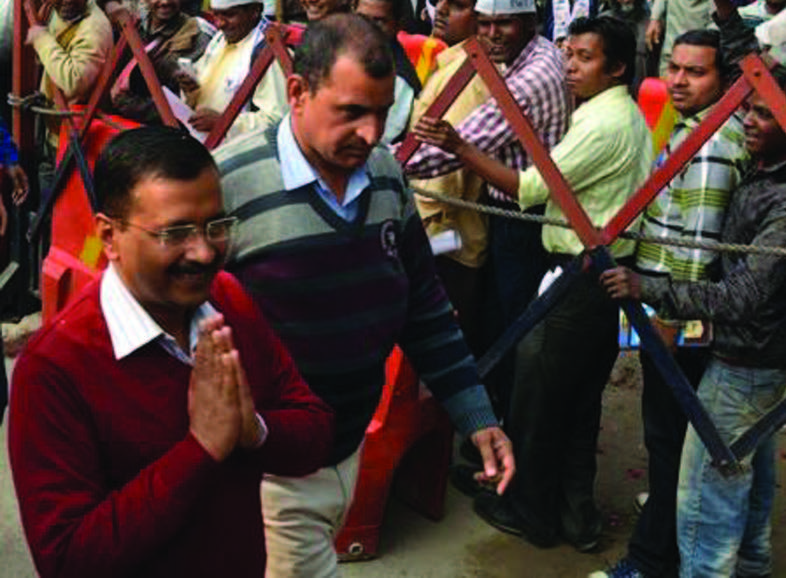
    NEW DELHI (TIP): In a first after becoming Delhi Chief Minister for the second time, Arvind Kejriwal on Feb 18 morning held a “Janta Darbar” at the Aam Aadmi Party office in Kaushambi, Ghaziabad.

    Kejriwal met visitors for around three hours and took note of their problems. Most of the people who came to meet the CM were contractual employees who wanted to be made permanent and others who had lost their jobs. Giving permanent status to contractual employees was one of the biggest poll promises that the AAP government had made in their poll manifesto.

    A contractual employee with the New Delhi Municipal Corporation, Lala Ram said: “I have been a contractual employee for a very long time now. The department does not give me and many others like me, a permanent job. I want to request  Kejriwal to make all the contractual employees in NDMC permanent.”

    A group of women from Home Guard who had lost their job in 2013, also came to meet the Chief Minister. “All of us lost our job in the year 2013. The department hired people from a batch junior to us after sacking us. They assured us that they would give our jobs back but nothing happened. We had come to meet the CM about this issue during his last Janta Darbar also but we could not meet him. This time, we hope to meet him and hope that something will happen.”

    Differently-abled Nahid from Shastri Park reached “Janta Darbar” complaining about his lost job. “I was working as a contract employee with Jag Pravesh Chand Hospital but three months ago, I was removed and now I do not have any job. I have come here hoping that Kejriwal listens to my problem and I get my job back,” Nahid said.

    Some people came with nursery admission problems, others came with some civic issues. While many others came just to wish good luck to the CM and share their ideas with him.

    The first “Janta Darbar”, however, was held minus the fan fare witnessed during the event held outside Delhi Secretariat that ended up in chaos during his previous stint as Delhi CM.

    The district administration of Ghaziabad has granted permission to AAP to hold public meetings thrice a week for an hour at Mr. Kejriwal’s residence. To handle crowd and provide security during the meeting, a team of police personnel under the supervision of a police inspector were present.

  • Arvind Kejriwal takes oath as the eighth Chief Minister of Delhi

    Arvind Kejriwal takes oath as the eighth Chief Minister of Delhi

    NEW DELHI: Arvind Kejriwal took oath as Delhi’s youngest chief minister on Saturday with a speech that thanked the aam aadmi, reassured the minorities, reached out to the opposition and promised an end to corruption and VIP culture in five years.

    Addressing a crowd of about 50,000 people at the Ramlila Maidan — a city landmark where the anti-corruption movement spearheaded by Anna Hazare first started — Kejriwal laid all speculations about his party’s national ambition to rest saying that AAP’s massive mandate was a “miracle” and also a “directive” for him to focus only on Delhi for the next five years.

    “Over the last few days I have heard some of our volunteers talk about fighting more state elections. This is wrong. We paid for our arrogance in the 2014 Lok Sabha polls. God punished us for it. I will stay here for the next five years and work for Delhi with full dedication,” he said. AAP, particularly Kejriwal, had received a lot of flak from the capital’s electorate for the impulsive exit from power and also the decision to contest on 440 Lok Sabha seats barely six after its impressive debut in the capital in 2013

    Listing out his priorities for the next five years, the new CM assured that his government will pass the Janlokpal Bill and also revive the anti-corruption helpline that was started during his 49-day stint in power. “I’ll try to make Delhi the first corruption-free state of the country. I will repeat what I said on December 28 — if someone asks you for a bribe, don’t refuse. Pick up your mobile phones and record it. We will act upon it,” he said.

     
  • ARVIND KEJRIWAL: MAN OF DESTINY

    ARVIND KEJRIWAL: MAN OF DESTINY

    NEW DELHI (TIP): Arvind Kejriwal is a social activist and politician. He is the CM designate of Delhi as his party AAP won 67 of the 70 assembly seats of Delhi. He launched the Aam Aadmi Party (AAP) in 2012. A former Indian Revenue Service officer, he is better known for his key role in drafting the Jan Lokpal Bill.

    In 1999, Kejriwal founded Parivartan, an NGO aiming to assist the citizens in electricity, income tax and food ration-related matters. He won the 2006 Ramson Magsaysay Award for Emergent Leadership for his contribution to empower the poorest at the grassroots level and implement the Right to Information Act (RTI). He created a corpus fund with the award money and founded the NGO ‘Public Cause Research Foundation’ in 2006.

    Kejriwal also published a book called Swaraj in 2012. Arvind Kejriwal was sworn in as Delhi Chief Minister for the first time on 28 December 2013 at the Ramlila Maidan and formed the government with Congress’s support. However, his tenure lasted for only 49 days as he decided to resign from his post after both BJP and Congress turned adamant and put their foot down against giving clearance to Aam Aadmi Party’s Jan Lokpal Bill.

    Personal background

    Arvind Kejriwal was born on 16 August 1968 in Bhiwani, Haryana, to a well-educated couple, Gobind Ram Kejriwal and Gita Devi. Arvind Kejriwal has a younger brother and a younger sister. His father, Gobind Ran Kejriwal, was an electrical engineer from the Birla Institute of Technology, Mesra. His father’s work related transfers led him to several different places. Consequently, Arvind Kejriwal had to spend his childhood mostly in towns like Ghaziabad, Hisar and Sonepat. He studied at the Campus School in Hisar. Arvind Kejriwal graduated in mechanical engineering from the Indian Institute of Technology, Kharagpur, in 1989. He also spent some time at the Ramkrishna Mission and Nehru Yuva Kendra in Kolkata.

    Kejriwal is married to Sunita, his batch mate from the National Academy of Administration, Mussoorie. She is an IRS officer. They have two children – a daughter, Harshita, and a son, Pulkit. Arvind Kejriwal is a pure vegetarian and has been a regular practitioner of Vipassana.

    Professional background 

    After completing his studies in mechanical engineering from the Indian Institute of Technology, Kharagpur, he joined Tata Steel. He took leave of absence from the company so that he could concentrate on the Civil Services examination. In 1992 he quit his job. In the same year he cleared the Civil Services examination and joined the Indian Revenue Service. In February 2006, he resigned from the post of Joint Commissioner in the Income Tax Department. While working with the Income Tax department, he assisted in forming the NGO Parivartan in December 1999.

    How did Arvind Kejriwal joined politics?

    During the nation-wide protests against corruption, Arvind Kejriwal had a difference of opinion with social activist Anna Hazare. Hazare wanted the Jan Lokpal movement to be politically neutral. On the other hand, Kejriwal’s opinion was that as no progress had been attained through talks with different political parties, it was necessary to get directly involved in politics. An organisation named India Against Corruption conducted a survey in this regard. The result indicated support for politicisation. Others involved in the anti-corruption movement too had split opinions. While Kejriwal’s move was supported by Shanti Bhushan and Prashant Bhushan, others like Santosh Hegde and Kiran Bedi opposed it.

    On 19 September 2012, Anna Hazare and Arvind Kejriwal found that their differences over formation of a political party to replace India against Corruption movement were irreconcilable. On 2 October 2012, the birth anniversary of Mahatma Gandhi, Kejriwal announced the formation of a political party. He mentioned that the party would be formally launched on 26 November 2012. The Constitution of India was adopted on this day in 1949.

    The party was launched in Delhi on the scheduled date and was called the Aam Aadmi Party (AAP) or the Common Man’s Party. The party contested elections for the first time on 4 December 2013 for the Delhi legislative assembly. Arvind Kejriwal defeated Sheila Dikshit in the New Delhi assembly constituency, who had been the chief minister of Delhi for three successive terms. He was first sworn in as the Chief Minister on 28 Dec 2013. He governed Delhi for only 49 days as he resigned from the post in Feb 2014.

    Strategy for 2014 General Elections

    After Arvind Kejriwal’s resignation from the CM’s post in February, the AAP set its sights on the Lok Sabha polls. A month earlier than stepping down, Kejriwal had said that he would not contest the Parliamentary Elections. He later contested from the Varanasi parliamentary constituency in Uttar Pradesh against BJP’s Prime Ministerial candidate Narendra Modi, alleging that the party members insisted him to do so. Kejriwal lost the elections with a margin of around four lakh votes.

    Arvind Kejriwal led AAP’s run up to the 2015 Delhi Assembly Elections After 9 months of Governor’s Rule in Delhi, the Elections Commission of India dissolved the Delhi Legislative Assembly. This meant that Delhi had a date with fresh elections. Arvind Kejriwal led Aam Aadmi Party (AAP) started making a strategy for the elections. Initially, the party released a list of 62 candidates for the elections. It later added eight other names. Thus the party fielded its candidates in all 70 constituencies of Delhi as compared to 69 in the 2013 elections. AAP has resorted to innovative ways of raising funds for campaigning such as offering lunch and dinner with Kejriwal via subscriptions. The party also received funds online from the public. Social media sites too helped Kejriwal gain popularity among the masses.

    Historic Win in Delhi for AAP and Arvind Kejriwal’s Re-election as the Chief Minister

    The National Capital Territory of Delhi went to polls on 7 February 2015 and saw a record electorate turnout of 67.14 percent. But the history was still to be made. Three days later, on 10 February 2015, the “Broom” of AAP swept the Delhi polls. The AAP registered a slam-bang victory by grabbing 67 seats of the available 70. The favourite BJP was compressed to be restricted to as minimal as three seats, while Congress and the rest were crushed to ashes, accounting for none. The chief and the CM candidate of AAP, Arvind Kejriwal himself won from the New Delhi assembly constituency with a margin of more than twenty six thousand votes. He defeated the debutant Nupur Sharma of BJP and veteran Congress leader Kiran Walia. Kejriwal decided to take oath as the Chief Minister of Delhi on 14 February 2015 (a year after he had resigned from the same post), at the famous Ramlila Ground in Delhi.

    Achievements

    • In 1999 Kejriwal helped in the foundation of Parivartan, an NGO aiming to assist the citizens in electricity, income tax and food ration-related matters.
    • Played a key role to empower the poorest at the grass-root level and implement the Right of Information Act (RTI).
    • Created a corpus fund with the award money he received from the Magsaysay Award, and with that founded the NGO called Public Cause Research Foundation in 2012.
    • A committee constituted by the Government of India inducted Arvind Kejriwal as a representative member of the civil society to draft the Lokpal Bill.
    • Participated in drafting the Jan Lokpal bill.
    • Arvind Kejriwal became the architect of the movement that was started by Anna Hazare — the Jan Lokpal that demanded Citizen’s Ombudsman Bill.
    • To fight corruption cases in government departments like Delhi Electricity Board, Income Tax Department, Municipal Corporation of Delhi and the likes, Kejriwal uses the Right To Information Act.
    • Exposed alleged corruption and irregularities of political parties and government agencies through press conferences.
  • IIT alumnus Kejriwal inspires poll campaign on Powai campus

    IIT alumnus Kejriwal inspires poll campaign on Powai campus

    MUMBAI (TIP): After the landmark New Delhi assembly polls, it is the turn of young ‘netas’ at IIT-Bombay to do an Arvind Kejriwal in terms of promises.

    A team of students from the institute had helped AAP understand trends on social media so that the party could finalize its manifesto for the national capital. Now, students contesting for elections to 10 posts at IIT-Powai seem inspired by the manifesto that worked wonders in the national capital.

    So, much in the style of AAP and its leader who is himself an IIT alumnus, they have made a range of promises, from the directly borrowed one of Wi-Fi connectivity to the trivial (a pizza outlet on campus), the necessary (a 24-eatery on campus) and the more serious promises of reducing students’ academic load for the first year and an increase in health insurance cover.

    None of the candidates is part of the team that recently assisted AAP, but the Kejriwal effect is evident.

    There are 18 candidates in all fighting the polls which are held annually. Five of the 10 posts on offer are for general secretaries — hostel affairs, academic affairs, sports and cultural affairs etc -and among the remaining five are those for the Mood Indigo and Techfest coordinators.Sarthak Agrawal, contesting for the post of general secretary, hostel affairs, has promised a dabba service from the mess to academic area at nominal charges during lunch and dinner hours. He and his opponent, Srikant Bukya, have both promised Wi-Fi connectivity across the campus, though they have worded their promises differently.

    Some candidates have promised counselling and stress relief workshops, others have said they will set up CCTV cameras in public areas, and still others have vowed to arrange for a/c study rooms, fire mock drills and hotline numbers to report emergencies during IIT festivals. To ease academic strain, a few candidates have promised a week-long Diwali break, and those appealing to students’ well-being have spoken of the digitisation of student records in the hospital on campus.

    Some incumbents hoping to retain their posts have assured their fellow students of follow-up action on setting up washrooms for the opposite sex in the hostels (a women’s washroom in the men’s hostel and vice versa). One candidate has even promised a system where cashless surgical and medical treatments will be possible for students across India.A student said none of the candidates has ever managed to fulfill 100% of his/her promises. ‘On an average, a good candidate fulfils around 50-60% of promises made during his/her tenure,” the student said. “The students media body acts as a watchdog and conducts debates before the elections where candidates are grilled over their ‘over-ambitious’ projects. Some fail to convince the students during these debates. After candidates are elected, every term-end their progress is reviewed comparing their performance with what they had promised in their manifestos,” the student added.Each of the candidates has prepared around two pages of manifestos. The candidates also get 10 days to go door-to-door campaigning across the 16 hostels, so that they can explain and convince the voters about their vision. Over 3,000 of the 3,600 undergraduate students are expected to vote on Monday. “The turnout is lower among post-graduate candidates with around 50% of the total 4,000 participating in the institute’s polls,” said a student.

  • MANISH SISODIA TO BE DELHI DEPUTY CM

    MANISH SISODIA TO BE DELHI DEPUTY CM

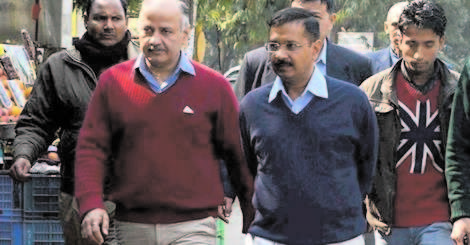
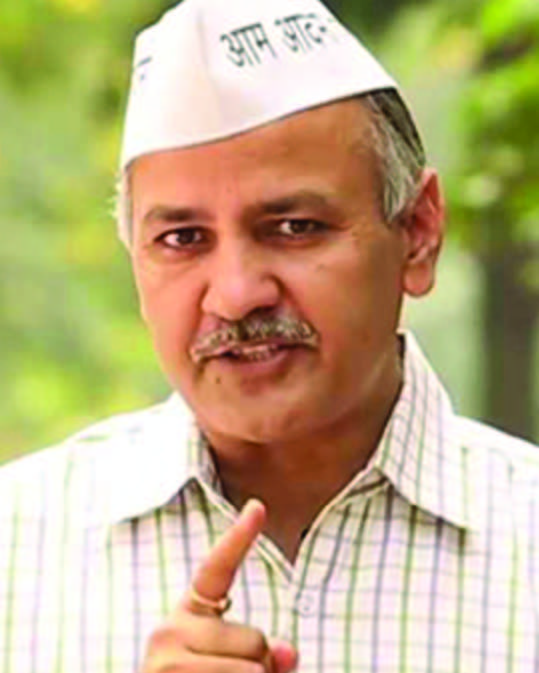
    NEW DELHI (TIP): Manish Sisodia is all set to be the deputy chief minister in Arvind Kejriwal government which is likely to have four new faces this time, Aam Aadmi Party sources said.

    Barring Sisodia, who is a close confidant of Kejriwal, and Satyendra Jain, the rest four- Rakhi Birla, Saurabh Bharadwaj, Somnath Bharti, Girish Soni— who were in AAP’s earlier cabinet —are unlikely to make it this time.

    The sources said the party has decided to induct Jitendra Tomar (Tri Nagar), Kapil Mishra (Karawal Nagar), Sandeep Kumar (Sultanpuri Majra) and Asim Ahmed Khan (Matia Mahal)- the only minority face- in the ministry. The four are also first time legislators. The new government may not have a woman member.

    The list will be sent to Lt Governor Najeeb Jung today, they added. The new Cabinet will be sworn in on Saturday.

    Sisodia was de facto number two in the previous AAP government and had handled important portfolios like education, urban development, PWD, land and buildings.

    Jain, a two-time MLA from Shakur Basti who handled the health portfolio in the previous AAP government, is another minister who is likely to be retained.

    “There is a lot of brain storming going on in the party. But it would not be right to talk about it until it is formally announced,” Sisodia told reporters, when asked about his appointment as the Deputy CM. According to sources, the decision to make Sisodia the Deputy CM was taken at a meeting of AAP’s Political Affairs Committee (PAC) last night at Kejriwal’s residence in Kaushambhi.

    Sisodia is being given the responsibility so that Chief Minister-designate Kejriwal can focus on building the party at the national level, they said.

    It was also decided that Shahdra MLA Ramniwas Goel will be the Speaker while Bandana Kumari, from Shalimar Bag constituency, will be Deputy Speaker in the Delhi Legislative Assembly. The latter is also heading AAP’s women wing.

  • ARVIND KEJRIWAL to take oath as Delhi CM on Feb 14

    ARVIND KEJRIWAL to take oath as Delhi CM on Feb 14

    Sisodia likely to be Dy CM,  Four new faces expected in AAP Cabinet

    NEW DELHI (TIP): Exactly one year after he had resigned as Delhi Chief Minister, AAP convener Arvind Kejriwal will be taking oath as the CM again on February 14 at Ramlila Maidan.

    “Arvind Kejriwal will take oath as the Delhi Chief Minister on February 14 at Ramlila Maidan,” AAP leader Ashutosh said after the party’s landslide victory in the Delhi Assembly polls.

    Kejriwal emerged victorious in the high-profile New Delhi constituency by handing over a crushing defeat to BJP’s Nupur Sharma by a huge margin of 31,583 votes.

    After AAP had thrown a surprise by uprooting Congress out of power in 2013 Assembly elections as a debutant party, Kejriwal had taken oath as Delhi’s seventh Chief Minister on December 28 at a public ceremony in the historic Ramlila Maidan, the venue of the Lokpal movement.

    He had defeated the three-time Delhi Chief Minister Shiela Dixit on her home-turf by a margin of 25,864 votes.

    However, after serving the government for 49 days, he had resigned on February 14 last year after his push for the anti-corruption Jan Lokpal Bill was blocked in the state Assembly by BJP and Congress.

  • Ex-Aam Aadmi Party Leader Shazia Ilmi Turns Up at BJP Event

    Ex-Aam Aadmi Party Leader Shazia Ilmi Turns Up at BJP Event

    New Delhi (TIP): Shazia Ilmi, who five months ago quit the Aam Aadmi Party (AAP), onb October 10 made a surprise appearance at an event organised by Delhi BJP to launch Prime Minister Narendra Modi’s ‘Clean India’ campaign.
    “As a common citizen, I have come here to participate in BJP’s Swachh Bharat Abhiyan. If a party, with which you have a problem in the past, is doing good work then we should appreciate it. People should also support it. This campaign is a great mission and I am happy to be part of it” Ms Illmi said.
    Ilmi, who is among nine personalities roped in by Delhi BJP for the campaign, praised the Modi government for the initiative calling it a “great mission” and said she was happy to be part of it.
    Asked whether she was considering joining BJP, she said she has not decided about it.
    Ilmi had unsuccessfully contested the Lok Sabha election from Ghaziabad on an AAP ticket and quit the party in May citing lack of internal democracy.
    Union Urban Development Minister M Venkaiah Naidu and Delhi BJP Chief Satish Upadhyay were among the leaders present on the occasion.
    “Cleaning is not just the duty of sanitation workers. It is also our responsibility to clean our country, states and streets. The time has come to create people’s movement in this regard,” Ms Illmi said.
    She said her participation in the event should not be seen as her inclination to BJP.
    “The Delhi University Vice Chancellor has also come. He doesn’t belong to any political party. My visit should not be connected to any political angle. Cleaning our areas is our responsibility and when I was asked for this, I agreed to become part of BJP’s campaign,” she added.
    Asked if she would also join AAP chief Arvind Kejriwal if he invites her for her participation in “his campaign”, she said, “If he really invites me, I will definitely join him.”

  • Kejriwal submits ‘sting’ CD to President, police

    Kejriwal submits ‘sting’ CD to President, police

    NEW DELHI (TIP): Aam Aadmi Party (AAP) leader Arvind Kejriwal on September 11 approached President Pranab Mukherjee and Delhi police commissioner BS Bassi and submitted a CD of the recorded footage which purportedly shows BJP leader Sher Singh Dagar trying to bribe an AAP MLA. “AAP submitted to the President a copy of the video CD and the transcript of the sting operation, which caught the Delhi BJP vice-president offering Rs. 4 crore bribe to AAP MLA Dinesh Mohania,” said an AAP press release.

    The CD and transcript was delivered at Rashtrapati Bhawan along with party convenor Arvind Kejriwal’s letter, in which the President has been apprised of the alleged attempts going on to form a government in Delhi through all possible and “illegal” means. “Kejriwal has appealed to the President to order immediate dissolution of the Delhi assembly to prevent subversion of the Constitution by the BJP,” the release says. Kejriwal also met Bassi with his party colleague Manish Sisodia, and requested the police to act against Dagar. “We have submitted the copy of the CD of the sting operation along with a formal complaint and have handed it over to the police commissioner. We have requested him to lodge an FIR and arrest Dagar and question him,” Kejriwal told reporters. BJP’s Dagar has been vehemently denying the allegations made by AAP.

  • MANISH SISODIA ‘LETTER’ ACCUSES YOGENDRA YADAV OF GUNNING FOR KEJRIWAL

    MANISH SISODIA ‘LETTER’ ACCUSES YOGENDRA YADAV OF GUNNING FOR KEJRIWAL

    NEW DELHI: An ugly fight within the top leadership of the Aam Aadmi Party surfaced on June 5 with the emergence of a letter, purportedly from founder member Manish Sisodia, to senior leader Yogendra Yadav, accusing the latter of fomenting factional fights within the party and gunning for AAP chief Arvind Kejriwal. When contacted, Yadav did not deny the existence of the letter. He merely said he would not comment on it.

    Sisodia could not be contacted despite repeated attempts. The letter seems to make plain the growing bad blood in the top AAP leadership. Sisodia has not only accused Yadav of fueling factionalism and targeting Kejriwal, he has charged him with misleading the leadership on AAP’s prospects in Haryana and goading it into a disastrous Lok Sabha contest. Sisodia refers to an ongoing spat between Yadav and Navin Jaihind, another senior party member who has been working with the former in Haryana, as the main reason for writing the letter.

    “You have made the fight public and because it is not being handled in the way you would like, you are trying to draw Kejriwal into it. In fact, you have accused Kejriwal of not listening to the parliamentary affairs committee and acting like a party supremo. Your issues with Jaihind need to be sorted out but instead, you have made this fight public and tried to draw Kejriwal into it,” he says. The letter also reveals that Yadav ignored majority opinion in the PAC and insisted on contesting the Lok Sabha elections from Gurgaon. Sisodia has also said Kejriwal was firmly against contesting from so many seats in the LS elections but went ahead on Yadav’s persuasion.


    25
    Yogendra Yadav

    “Kejriwal wanted to focus on Delhi politics for some years. However, you and some other members were in favour of contesting from across India. The result is in front of us,” says the letter. Sisodia has also challenged Yadav on his accusations against Kejriwal. “After our resignation from Delhi government, you got a survey carried out in Haryana in which AAP was getting 23% votes.

    But when under your leadership we managed to get only 3% votes a month and a half later, the party wants to know what happened. Instead of answering questions, you are trying to deflect attention to Kejriwal by accusing him of acting like a supremo,” Sisodia said. The letter ends with Sisodia accusing Yadav of not attending party meetings but sending emails instead. “What are you trying to achieve through these emails,” he has asked. “Are you trying to finish the party? Are you trying to win this fight against Jaihind or are you trying to finish Kejriwal?

  • Arvind Kejriwal in custody: Protest off but AAP will target Nitin Gadkari

    Arvind Kejriwal in custody: Protest off but AAP will target Nitin Gadkari

    NEW DELHI (TIP): The Aam Aadmi Party suspended all forms of protest against the judicial custody of Arvind Kejriwal and said that it would instead start a door-to-door campaign against BJP leader Nitin Gadkari. Kejriwal on May 21 refused to furnish a bail bond of Rs 10,000 in a defamation case filed by Gadkari and chose to go to jail instead. The decision was taken after senior AAP members Sanjay Singh and Ashutosh met Kejriwal in Tihar on Thursday morning. By evening, to counter charges that it made the allegations without proof, the party put out documents and the video of Kejriwal’s press conference in 2012 where he made revelations about the irrigation scam in Maharashtra, linking Gadkari with it.

    A meeting of Delhi volunteers has been organized on May 23 evening where the party will decide on its next course of action, including a protest against the section of law under which Kejriwal has been imprisoned. AAP has also opposed the lower court ruling, claiming that asking for a bond or sending to prison were not the only options available to the magistrate.

    “Section 88 of the CrPC, under which the magistrate gave Kejriwal the two options, states that ‘when any person for whose appearance or arrest the officer presiding in any court is empowered to issue a summons or warrant, is present in such court, such officer may require such person to execute a bond, with or without sureties, for his appearance in such court, or any other court to which the case may be transferred for trial’.

    The operative word is ‘may’. Even the Supreme Court has said that there is no need for such bonds because of which thousands of people are languishing in jails unnecessarily,” said senior AAP leader and lawyer Prashant Bhushan.

  • KEJRIWAL, HIS PARENTS FORCED TO LEAVE TEMPLE COMPLEX

    KEJRIWAL, HIS PARENTS FORCED TO LEAVE TEMPLE COMPLEX

    VARANASI (TIP): Aam Aadmi Party (AAP) chief Arvind Kejriwal and his parents moved out from the Sankat Mochan temple complex, where they had been staying since April 15, on Friday morning. Sources said that there were objections from the devout coming to the temple about the spurt of “political activity” there.

    Kejriwal and his parents, Gita Devi and Gobind Kejriwal, were guests of the head priest of the renowned Sankat Mochan temple in Varanasi, Bishambhar Mishra. This is only one in a series of hostile moves the party is facing here after Kejriwal took on Narendra Modi in an electoral contest. The AAP leader’s meetings have been disrupted twice in the past 12 hours. The move to shift out could prove symbolically damaging since it displays the lukewarm support in the city.

    AAP sources said that Kejriwal and his parents had moved to the Durga Kund area near BHU. Mishra is the head priest of the temple but, more significantly, his father, the late Veer Bhadra Mishra, was acclaimed not only as the head priest but also as a hydraulics engineer who was categorized by Time magazine as one of the “Heroes of the Planet” in 1999 for his campaign to clean the Ganga. The party, however, chose to see the hostility as a reflection of “frustration” in the Modi camp.

    “The party which was claiming a wave is now resorting to muscle power to browbeat its rivals, but BJP has forgotten that AAP cannot be cowed down by its strongarm tactics,” the party said in a statement. In less than 12 hours, BJP workers have twice attempted to disrupt Kejriwal’s campaign in Varanasi. AAP said its leaders have been pushed and abused by BJP workers. Modi touches Joshi’s

  • Khichdi for Modi, Rahul chomps chocolates, Kejriwal munches chana

    Khichdi for Modi, Rahul chomps chocolates, Kejriwal munches chana

    AHMEDABAD/NEW DELHI (TIP): Narendra Modi prefers a light Gujarati meal in the evening, Rahul Gandhi gorges on chocolates and diabetic Arvind Kejriwal opts for digestive biscuits — amid a gruelling election campaign, politicians cope with hunger pangs in their own ways. Modi is a frugal eater and avoids meals at unknown places, an aide reveals.

    “He favours light Gujarati food prepared by his cook. Usually he opts for a simple khichdi diet in the evening. And he prefers lemonade when travelling. These days he is on a nine-day fast for Chaitri Navratri and drinks only warm water with lime,” he says. On the other hand, Rahul doesn’t mind skipping breakfast and on occasion has been happy to make do with readyto-eat noodles, according to an article in the daily Mint.

    “To stay hydrated during his hectic travel, he sips on diet colas or lemon juice. But it is chocolates he’s really fond of and that keeps his energy levels up,” the article says. That aside, “he loves coastal Indian dishes, vegetarian and non-vegetarian ,” says the article. Whenever Kejriwal is in Delhi, his wife packs him a lunch box. The menu varies but the AAP leader’s food is non-spicy as he cannot handle chillies.


    28

    “During the day, his team tries to ensure he has juice and fruits but there is no fixed routine. Often, he has to stop by at homes of volunteers to have lunch but it has to be simple food,” a source close to Kejriwal said. Kejriwal, 43, is fond of moong dal and munches on roasted chana and digestive biscuits due to his sugar problem. “He has been avoiding cold drinks but if he has to drink something cold, he prefers a diet cola,” he said. The three leaders have varying health regimes. The 63-year-old PM candidate for BJP is considered overweight (around 90 kilos).

    But Modi is particular about fitness. His day begins between 4.30am and 5am. He enjoys a session of yoga, pranayam and morning walk in the garden of his Gandhinagar residence. “By 7.30am, he’s ready,” says an aide. These days, his schedule is tied to the campaign. With at least four rallies every day, he often leaves home by 7.30am and reads media reports and important files on his way. He usually works till 1am. Despite a hectic schedule, Modi prefers to return to his residence at the end of the day.


    29

    “He likes to be home every night,” says the aide. The much-younger Rahul enjoys an evening run. “He runs on pre-planned routes wherever he stays while campaigning, even if he’s halted at a village. In Delhi, he takes lessons in aikido and goes swimming or cycling,” says the Mint report. Aikido is a form of Japanese martial arts. Kejriwal enjoys yoga and does vipasana whenever he gets time. “These days he wakes up around 6-7 am and goes to bed between midnight and 1am,” a source said.

  • Arvind Kejriwal punched in Delhi, attacker beaten by AAP men

    Arvind Kejriwal punched in Delhi, attacker beaten by AAP men

    NEW DELHI (TIP): Arvind Kejriwal, the top man of the Aam Aadmi Party or AAP, has been hit in Delhi while campaigning. Kejriwal was punched in the back in the Dakshinpuri area of South Delhi while he was shaking hands with supporters.

    Later the man was thrashed by AAP workers and handed over to the police. “Our religion teaches us non-violence. If we raise our hands, this movement will come to an end,” Kejriwal said. Appealing for calm, the AAP leader asked his supporters not to indulge in any violence. Some days ago, Kejriwal was in Haryana when a man climbed onto his jeep and hit him in the neck.

    AAP supporters then assaulted the man before handing him over to the police. On Twitter, Kejriwal reprimanded those involved, urging, “If we ever become violent, the movement wud be finished. So, pl pl pl, in future, if anyone hits us including me, we shud be nice to him, (sic).” Last month, the 45-year-old was sprayed with ink and Mobil oil while campaigning in Varanasi, where he is running for Parliament against the BJP’s prime ministerial candidate, Narendra Modi.

  • Kejriwal attacks media, says will ‘send all to jail’

    Kejriwal attacks media, says will ‘send all to jail’

    NEW DELHI/NAGPUR (TIP): Arvind Kejriwal found himself embroiled in a raging controversy after a surprising comment by him threatening to send mediapersons to jail for allegedly promoting BJP leader Narendra Modi for monetary considerations went viral. The controversy could well signal the end of the Aam Admi Party’s already fraying honeymoon with the media.

    A video of Kejriwal’s diatribe against the media at a fund raising dinner in Nagpur on Thursday saw him promise an inquiry against mediapersons if AAP came to power. “If our government comes to power then we will set an inquiry into this. And along with media people, all will be sent to jail,” he said.

    The video marked a shocking and sweeping attack on the media for allegedly hyping up Modi while airing negative or critical news about AAP and immediately sparked off a furious spat between the party and its political opponents with BJP and Congress leaders condemning Kejriwal’s comments as reflecting a dictatorial and vengeful mindset.

    Though Kejriwal denied the remarks saying, “I didn’t say that. I didn’t say anything. How can I be upset with you (media),” his senior party colleagues Dilip Pande, Ashutosh, Sanjay Singh and Ashish Khetan stuck to charging TV and print media with targeting AAP and promoting BJP. Kejriwal’s comments and their justification by senior AAP leaders marks a new low in the rapidly deteriorating relationship between the party and the media after an initial phase last year when the new outfit received rave reviews.

    In UP, NaMo gujia takes on RaGa namkeen
    ALLAHABAD (TIP): The political climate has influenced Holi celebrations in Allahabad this year with ‘NaMo’ Gujias taking on ‘RaGa’ namkeen in two different shops of the Old City area. The Gujias named Narendra Modi are a hit. The unique Gujia priced at Rs 80 per piece weighs around 250 grams as a normal one. “The NaMo design is carefully applied on one side of the gujia. It is written by Kesar (saffron) and as the gujia is fried, saffron coloured word starts reflecting on one side of the sweet,” said Subodh, the shop owner. The sweet has been an instant hit as the trial stock of around 75 pieces was sold off within a couple of hours after being put on display, he said.

    Court imposes Rs 2,500 fine each on Kejriwal, Sisodia
    NEW DELHI (TIP): A trial court on March 15 imposed a fine of Rs 2,500 each on Aam Aadmi Party leaders Arvind Kejriwal and Manish Sisodia after they failed to appear before it in connection with a criminal defamation complaint filed against them by Union telecom minister Kapil Sibal’s lawyer son Amit Sibal. Metropolitan magistrate Sunil Kumar Sharma, however, accepted their pleas seeking exemption from personal appearance for the day only. The court also released AAP leaders Prashant Bhushan and Shazia Ilmi, who had appeared before it, on an undertaking that they would appear before the court on each and every date of hearing.

    Trinamool Congress rules out post-poll tie-up with BJP
    Kolkata (TIP): Trinamool Congress on March 15 ruled out any post-poll alliance with BJP in the upcoming Lok Sabha elections. “There is no question of any tie-up with BJP before or after the Lok Sabha poll,” Trinamool Congress general secretary Mukul Roy said. Earlier, to a question at a media briefing during the day, he said that there was no question of Trinamool Congress going soft on BJP PM nominee Narendra Modi. “Our fight is against corruption of the UPA government and communalism of BJP. We have consistent stance against communalism. Our leader Mamata Banerjee has repeatedly said including at the Brigade Parade Ground rally on January 30 that we do not want the face of riots,” he said.

  • Kejriwal ready to fight Modi, Varanasi decision on March 23

    Kejriwal ready to fight Modi, Varanasi decision on March 23

    NEW DELHI/BANGALORE (TIP): Aam Aadmi Party leader Arvind Kejriwal on Sunday, March 16, said he was ready to contest the Lok Sabha polls against BJP prime ministerial candidate Narendra Modi, but would take a decision at his party’s rally in Varanasi, Uttar Pradesh, on March 23.

    “The party wants me to contest against Modi, but the people of Varanasi will tell me on March 23,” Kejriwal said in Bangalore, sending the political mercury soaring. Underlining that it was “important to defeat Modi”, the former Delhi chief minister said: “It is a very big challenge. It is not a small challenge… I am ready to accept this challenge.”

    But Kejriwal quickly added he will take a decision after judging the response of the people in Varanasi Kejriwal had set the tone for the tantalising contest through a tweet at 12.15pm, saying: “Many people asking me – “will I contest against Modi ji?” I will talk on this issue in today’s rally at Bangalore (sic).”

    Kejriwal’s decision comes a day after the Bharatiya Janata Party (BJP) declared Modi as the candidate from Varanasi, whose sitting parliamentarian Murli Manohar Joshi has been given the BJP ticket from Kanpur. The AAP leader’s move confirmed the buzz that had been going around for some time now and the AAP too had lined up its trump card accordingly. On March 2, the AAP had smartly let it be known that Kejriwal would take on Modi from Varanasi.

    The Kejriwal versus Modi contest will invariably become a big story till the Lok Sabha polls end. Win or lose, this plays out perfectly for the AAP, which is making its national debut after a stunning performance in the Delhi assembly polls. Kejriwal had defeated three-time Delhi chief minister Sheila Dikshit in the assembly polls. Kejriwal’s big announcement came following his Saturday fund-raising dinner in the city that brought the AAP Rs. 50 lakh. Varanasi goes to polls on May 12, four days before votes are counted and India gets to know if there is a clear verdict in favour of a party to form the next government, or a hung one.

  • Despite Kejriwal’s “illegal” tactics, Media refuses to discuss corporate corruption

    Despite Kejriwal’s “illegal” tactics, Media refuses to discuss corporate corruption

    “Having said that, what has amazed me most in recent days is the blanket refusal of the media to discuss the main agenda of Kejriwal’s latest outbursts: the Corporate Corruption”, says the author.

    The media says that Kejriwal is using “illegal” methods to attract attention. I have also been looking with some disbelief at some of his methods that appear to be illegal. But even if they are illegal, like many other methods of protest traditionally adopted in this country and elsewhere in the world, they remain legitimate methods in democracy.

    Seen from purely the legal point of view, almost all methods of “democratic” protests are illegal. These include fasting unto death (attempt to suicide), rail roko, raasta jaam, dharna disturbance of public order) and jail bharo, which again is achieved through defying the public order. All these protests are organized to attract attention. Those who organize them claim that they are aimed at attracting the attention towards their genuine demands.

    The opponents allege that the organizers are interested in their own publicity. If this is a common practice, then why so much hullabaloo on Kejriwal’s defying the “Model Code of Conduct” and an attempt to justify it and the protest at Delhi BJP office “without permission”? These should also be accepted as “legitimate” “democratic” “methods of protest”. Of course, violence cannot be condoned, and all those involved in violence should be adequately punished. But again the violence has unfortunately been an integral part of protests with buses, cars, and other objects often burnt, people beaten and lathi-charged and sometimes shot at.

    Unfortunately, all these acts of violence are justified for one reason or the other by the side that indulges in them, and more often than not, the culprits got Scot free. Having said that, what has amazed me most in recent days is the blanket refusal of the media to discuss the main agenda of Kejriwal’s latest outbursts: the Corporate Corruption. Till when he was labeling charges against the “corrupt” politicians, he was being hailed as a hero by the media. The Anna Movement in fact appeared to be a corporate driven movement. As soon as he shifted his attention to corruption in corporate world, he has rapidly been transformed into a villain. Not a single debate on TV channels has focused on the charges against Mukesh Ambani. No one is interested in debating the truth behind the charges against the richest man of the country.

    There is total boycott of the issue in the media except reporting what Kejriwal has uttered. And of course, there is absolutely no debate on the larger role of the forces of economics in influencing the political and socioeconomic scenario. I have been campaigning for more than 15 years against what I call “economic fundamentalism”, particularly the role of corporates in monopolizing the wealth, accentuation of economic disparity, influencing the governmental policies (corporatocracy), commercialization of human weaknesses and hijacking of all social institutions. Despite all attempts, I have failed to highlight the issues in the mainstream media. When my book “The Killer Sex” was released – Kuldeep Nayar did the honors – some of my friends in the media tried to get it reviewed in Times of India and Hindustan Times.

    I was later told that some very critical reviews were written but even those were not allowed to be published because even criticism could have given publicity to the book. I sent a copy of the book to Khushwant Singh. Interestingly, I got an instant reply saying “I am looking forward to reading the book. Hopefully it will make an exciting reading.” He was perhaps stimulated by the title and hoped that it would help the cause of his hormones. He did not write again to me because he might have found the book exactly opposite to what he had anticipated. Irrespective of his political fortunes and the impact on the future composition of Parliament, if Kejriwal can sustain pressure on the role of corporates and uses his strategies to that effect, he will have done a great service to the country.

    My only fear is that the more he hounds Ambanis, the more he will be hounded by their minions in politics and media. My advice to him would be that while targeting individual corporates may not be an unwelcome exercise in order to attract attention towards the issues, what he needs more is to understand the philosophy behind the dominance of the corporate lobbies in all the affairs of the country and their hugely destructive effects on the people. He has to understand that it is this philosophy which is largely if not wholly responsible for all the evils: Poverty, Crimes including crimes against women, corruption, social vices of all kinds and the fast degeneration of moral and family values.

  • Prima facie Arvind Kejriwal violated Model Code: Election Commissioner

    Prima facie Arvind Kejriwal violated Model Code: Election Commissioner

    NEW DELHI (TIP):
    Arvind Kejriwal, who is in Gujarat, has violated the election code of conduct by not getting prior police permission for his road-show, the Election Commission said, adding a new installment to the drama that has surrounded his tour. Kejriwal says he is in Gujarat to check on the claims of uber-development brandished by Narendra Modi, the BJP”s candidate for prime minister, who has governed the state since 2001. So far, Kejriwal says, he has seen no evidence of the clean and effective governance that Modi offers as his main qualification for running the country. Kejriwal, the 45-year-old leader of the Aam Aadmi Party or AAP, was detained briefly at a police station in the western town of Radhanpur yesterday where he was asked to explain why he had not got clearances for his large convoy.

    Once elections are called, the code of conduct applies and any political procession requires police sanction. “If you go strictly by law, Kejriwal violated the model code of conduct. The whole world knew that the code was in place after the announcement of the national election dates in the morning,” Election Commissioner HS aid. Kejriwal’s detention triggered egregious street battles in Delhi and Lucknow where his party workers gathered at BJP offices to protest against what they described as their leader’s harassment in Gujarat.

    Nearly 30 people were injured in clashes between the rival parties in Delhi; the police has blamed AAP for instigating the violence, an accusation Mr Kejriwal’s colleagues firmly reject. (Day 1 of Gujarat road-show bumpy for Arvind Kejriwal) As Kejriwal drove through the region of Bhuj, he was escorted by 10 police cars, a consequence of an attack last night on his convoy which left the windshield of his car shattered. Though Mr Kejriwal refused to press charges, the Gujarat police says it has filed a case and formed two teams to identify and locate the vandals. So far, nobody has been arrested.

  • Kejriwal summoned as accused in criminal defamation case

    Kejriwal summoned as accused in criminal defamation case

    NEW DELHI (TIP): Former Delhi chief minister Arvind Kejriwal was on Friday summoned as an accused in a criminal defamation complaint filed against him by BJP leader Nitin Gadkari.

    Metropolitan Magistrate Gomati Manocha issued summon for April 7 against Kejriwal on the complaint in which Gadkari had alleged that he was defamed by the Aam Aadmi Party (AAP) leader, who had included his name in the party’s list of ” India’s most corrupt”. Senior advocate Pinki Anand and advocate Ajay Digpaul, who had appeared for Gadkari, had argued that Kejriwal had made the statement against the BJP leader with a “malafide intention” to tarnish the image and lower the dignity of their client.

    The counsel had contended that Kejriwal had made “baseless and false allegation” against 57-year-old Gadkari. The court had on February 18 recorded statements of Gadkari and advocate Neeraj as complainant witnesses in the complaint. Gadkari in his statement had claimed the former Delhi chief minister had included his name in the list of alleged corrupt politician to tarnish his public image.

    “The accused (Kejriwal) is in the habit of making false and defamatory statements without any basis. The statements made by the accused and his party members have damaged and tarnished my image in the eyes of the people. “The said statements have been made maliciously by the accused person and his party people with the knowledge that the same are false, without any basis and with the malafide intention to defame and tarnish my reputation,” he had said.

  • Kejriwal Back to the Streets

    Kejriwal Back to the Streets

    Back to the streets. Aam Aadmi Party made cool calculations and decided that it was time to quit the government and get back to the streets. It is the familiar and favorite playground of Arvind Kejriwal. Immediately after submitting the resignation of his government, Kejriwal addressed his supporters at the party headquarters at Hanuman Road.

    The speech he made is quite revealing. He projected both the BJP and the Congress party as enemies of aam aadmi. He accused them of dancing to the tune of Mukesh Ambani, Chairman of Reliance Industries. He accused Modi indirectly of getting funds from Ambani. In short, he stamped them all as corrupt and as enemies of aam aadmi.

    What does he do now? He made it clear that a countrywide agitation for rooting out corruption and for the Jan Lokpal Bill will be launched. The mood and expectations of Aam Aadmi Party workers can be gauged from the comment of a volunteer who said, “Kejriwal can now go to people playing victim and also realize his – and the party’s — national ambitions.”

    Interestingly, supporters outside party headquarters at Hanuman Road in central Delhi were shouting: “Abhi toh Sheila haari hai, ab Modi ki baari hai (We have defeated Sheila, now its Modi’s turn).” By now Kejriwal and his advisers have understood well the politics of pressure. And they know pressure comes from people’s movement.

    They have known it because there is a history of JP movement before them. They have the most recent Anna Hazare movement of which Kejriwal himself was one of the key players, before them. They must certainly be encouraged to come out in the streets. My fear is the movement is not going to remain non violent.

    In fact, I am inclined to believe that given the utterances of many in AAP, it is more likely that the agitation will turn violent, compelling the law enforcement authorities to resort to harsher ways to quell the agitators and prevent loss of property. It is what AAP wants. Provoke authorities to take to harsher ways and blame the government for being harsh on innocent aam aadmi; project the government as enemy of am aadmi and get their support and vote for themselves. It is on the basis of such a calculation that Kejriwal has said AAP will come back to Delhi Assembly with absolute majority, bagging more than fifty seats. The coming weeks will be difficult for the people of Delhi and for the central government.

  • A Report Card of 49 day Kejriwal government

    A Report Card of 49 day Kejriwal government

    In the seven weeks since its stunning victory in the assembly polls, the Kejriwal government has come in for heavy criticism over a series of stand-offs with the authorities — including its law minister’s ‘vigilante’ action against Africans and the CM’s own dharna demanding greater control over the police. Here is a detailed report card of the AAP government in Delhi — their actions and controversies.

    GOVERNMENT
    Dec 28: Arvind Kejriwal takes oath as chief minister with six ministers at Ramlila Maidan.
    Jan 2: AAP government wins trust vote.
    Jan 3: AAP MLA MS Dhir elected Assembly Speaker.
    Jan 5: Shoaib Iqbal threatens to withdraw support over Kumar Vishwas’ remarks against minority community.
    Jan 17: AAP puts rebel MLA Vinod Kumar Binny on notice.
    Jan 24: Cong to carry out referendum on pulling plug on AAP govt after LS polls.
    Jan 26: Binny expelled from AAP for anti-party activities.
    Jan 27: Binny wraps up dharna against AAP within four hours.
    Feb 2: Binny threatens to withdraw support.
    Feb 10: Independent MLA Rambir Shokeen withdraws support.


    11

    Kejriwal sleeping out in the street to demand action against police officials

    POWER AND WATER
    Dec 29: Delhi Jal Board chief transferred.
    Dec 30: 700 litres of free water announced for households with regular water connection.
    Dec 31: 50% power subsidy for those consuming up to 400 units.
    Jan 1: CAG audit of power discoms ordered.
    Jan 6: L-G backs CAG audit.
    Jan 10: Helpline to report power cuts.
    Jan 31: Govt threatens to cancel discom licences over outages.
    Feb 3: DERC asked to cancel licences of discoms.

    ANTI-CORRUPTION
    Jan 6: 800 DJB employees transferred.
    Jan 8: Anti-corruption help line announced, launched on Jan 13.
    Feb 6: Fresh probe in Commomwealth Games’ street light project.
    Feb 7: Probe into fi nancial irregularities in construction of Salimgarh Bypass.
    Feb 10: Probe in three DJB ‘scams’.


    12
    Kejriwal addressing his supporters after resigning.

    EDUCATION
    Jan 4: Quota for Delhi students in DU colleges promised.
    Jan 5: AAP volunteers take rounds of government hospitals to take stock of facilities.
    Jan 7: Nursery admission helpline announced.
    Jan 8: Infrastructure audit of government schools started.

    AUSTERITY DRIVE
    Jan 4: Kejriwal refuses to take Duplex house, refuses security.

    GOVERNANCE
    Dec 28: Nine officials transferred, red beacons banned.
    Jan 15: Govt says will remove Millennium Depot from Yamuna riverbed.
    Jan 18: CM requests L-G to replace fi ve senior ACB officials.
    Jan 23: Eight senior Delhi government officials transferred.
    Jan 28: CAG audit of DIMTS (it operates the BRT in Delhi) ordered.
    Jan 29: Govt seeks SIT probe into 1984 anti-Sikh riots.
    Feb 2: Govt plans to do away with MLA fund.
    Feb 3: Cabinet clears Delhi Lokpal Bill.
    Feb 4: Kejriwal promises to include Northeast history in school texts.
    Feb 9: Govt plans to scrap the Bhagidari scheme.
    Feb 12: Cabinet approves decision to hold special assembly session in a stadium.
    Feb 13: Govt fails to table Jan Lokpal Bill in assembly, blames BJP and Cong for disruption.

    CONTROVERSIES
    Jan 7: Law minister Somnath Bharti’s bid to summon HC judges sparks row.
    Jan 10: Bill waiver announced for those who took part in power tariff protest.
    Jan 11: Chaos at Kejriwal’s janata darbar; scrapped two days later.
    Jan 16: Somnath Bharti/ Rakhi Birla late night raids row surfaces.
    Jan 18: Kejriwal defends night vigils by ministers.
    Jan 19: Delhi police registers criminal case against Bharti and supporters for allegedly misbehaving with African women in Khirki.
    Jan 20: Kejriwal sits on a dharna at Rail Bhawan against the Centre, Delhi Police.
    Jan 24: Somnath Bharti skips DCW hearing, goes kite flying.
    Feb 8: Kejriwal reiterates that the Jan Lokpal Bill will not be sent to the Centre for its nod.
    Feb 11: Kejriwal orders FIRs against Mukesh Ambani, Veerappa Moily and Milind Deora for increasing the price of natural gas produced in India.

  • KEJRIWAL RESIGNS AS CM OF DELHI

    KEJRIWAL RESIGNS AS CM OF DELHI

    Union Cabinet recommends President’s Rule: Assembly to remain in suspended animation

    New Delhi (TIP): Forty-nine days after he took charge of the Delhi government, Chief Minister Arvind Kejriwal on February 14 resigned following a tumultuous day in the state assembly where combined Congress and BJP legislators “defeated” his party’s attempts to introduce its signal Jan Lokpal bill, which the Aam Admi Pary (AAP) says was meant to curb corruption in high places.

    In political embarrassment for the Aam Aadmi Party (AAP) government, Kejriwal introduced the bill amid din in the assembly, but an aggressive Congress and the Bharatiya Janata Party (BJP) leaders became strange bedfellows to force Speaker M.S. Dhir to go for voting. In the voting, 42 members voted against the introduction of the bill, while only 27 MLAs – all AAP leaders – voted for it. Delhi assembly has a total strength of 70.

    As it became apparent that the Congress, BJP and Janata Dal-United legislator Shoiab Iqbal and lone independent Rambeer Shokeen will not allow the AAP government to introduce the bill, Kejriwal and his senior cabinet colleague Manish Sisodia presented two appropriation bills that would empower the government to access funds for expenditure. Kejriwal then stood up to speak, giving enough indication he was going to resign when he said that this “seems like our last (assembly) session”. He said it was more important to “fight corruption than to run a government”.

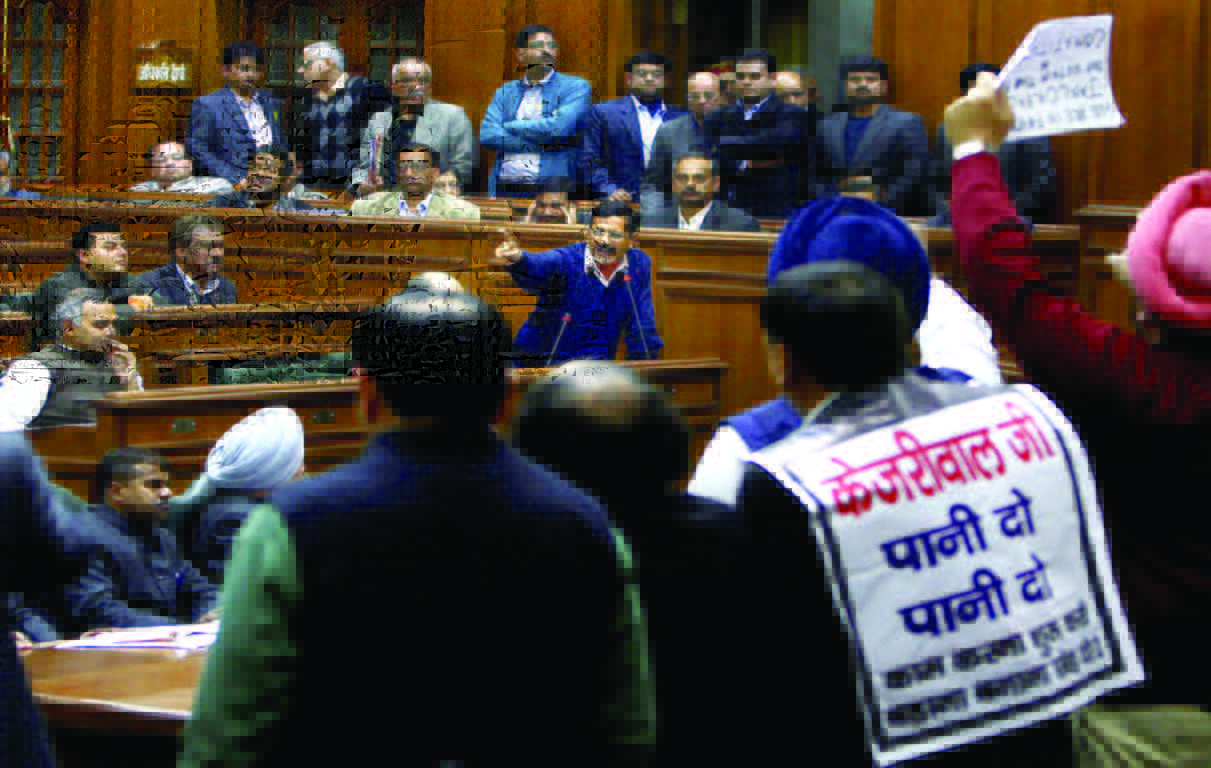
    “Today, they did not let the Jan Lokpal bill to be introduced. It has been defeated,” declared a defiant and gesticulating Kejriwal. “Whether our government remains in power or not is not important,” he said, trying to make himself heard above the din caused by sloganeering and heckling by Congress and BJP legislators. “We have come here to save the country. If we have to give up the chief minister’s post for the sake of the country, we will do it not a hundred times but a thousand times,” he said. Kejriwal took charge Dec 28 at the head of a minority government propped up by the Congress after an astonishing election victory. Both the BJP, Congress, Shokeen and Iqbal were demanding a discussion on Lt.

    Governor Najeeb Jung’s appeal to the government not to table the bill in the house without his approval. Jung had earlier in the day written to the speaker on the matter, which had become contentious over the past week with the lieutenant-governor saying that the union government’s nod is needed for introducing the bill – an issue on which opinion is divided among legal and constitutional experts. But the AAP government was firm and had decided to push for the bill, which was its poll promise. But much before the house could be adjourned, messages went out to AAP members to meet at its party headquarters at Hanuman Road.

    When the three-day session ended in just two days, Kejriwal, without interacting with media, left for the party office. It was here that he announced his resignation. The final decision was taken by the party’s Political Affairs Committee. On Feb 9, Kejriwal had threatened to resign if the bill was not allowed to be passed. It was an action-packed 49-day stint for the AAP government, which received both bouquets and brickbats for its actions and utterances in its brief and maiden stint in power in a politically-charged journey that began with the party’s formation on November 2012.

    The party was able to deliver some of its biggest poll promises, including cheap water, power, anti-corruption helpline, audit of power companies and acting on suspected corruption in the organisation of Commonwealth Games and in gas pricing in which he took on from former Delhi chief minister Sheila Dikshit to industrial Mukesh Ambani, chairman of Reliance Industries and India’s richest man. But the indiscretions of one of his ministers, especially Law Minister Somnath Bharti who went after African residents on suspicion of them being part of a drug-and-sex racket, and his nightlong blockade of the centre of the capital, days before the Republic Day Parade, got the party a lot of flak and adverse media attention.

    His resignation now sets him free to get back to the streets and do what he knows best – to emote with the problems of the aad admi, the common man, whose ranks have swelled in support for his party and on whom he is counting to translate his national ambitions. Political analysts expect Kejriwal and his AAP to make a strong bid for a substantial parliamentary presence in order to be player in the post-election scenario in three months’ time.